Mahatma Gandhi & The South African March
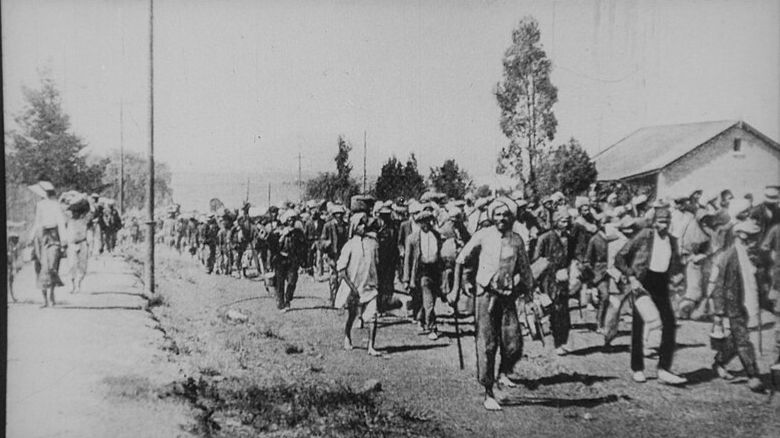
In 1913, Mohandas Gandhi was arrested for leading a march of Indian coal mine and railway workers. It was a non-violent march where the workers who were known as "satyagrahis" marched 36 miles from Newcastle to Charlestown. Satyagraha was a term created by Gandhi to describe non-violent protestors and meant "truth-force." The protest was in response to a three pound annual tax for immigrant workers among other injustices waged against Indian immigrant workers.[1]
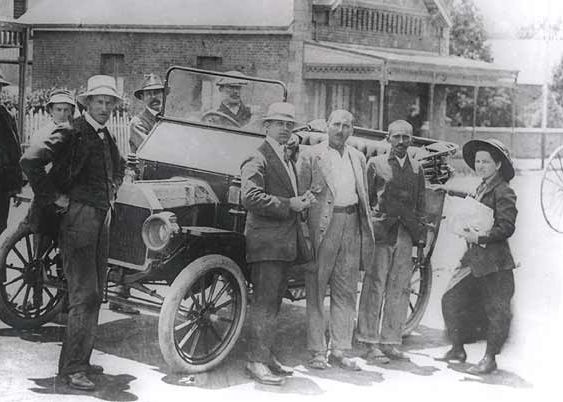
This was not the first time that Gandhi had been arrested in South Africa. Mohandas Gandhi had come to South Africa in 1893 after becoming a lawyer in London. He arrived in South Africa for the purpose of working on a legal dispute between two Indian businessmen. Rather than just solving the legal dispute and then leaving, he ended up staying in South Africa for 21 years and becoming involved in the advancement of civil rights for Indians in South Africa.
How Mahatma Gandhi's Political Career Accelerated - YouTube Short
In those days, conditions for Indian workers in South Africa were made to be very difficult. The Asiatic Law Amendment Ordinance of 1906 was passed in the South African province of Transvaal and heavily discriminated against the Indian workers.
Systematically they undertook to make life in South Africa as miserable an affair for all Indians, especially those above the labor class, as malice and cruelty could provide. Thus, these Indians were burdened with special taxes; they were forced to register in degrading ways; their thumb-prints were taken as though they were criminals; they were publicly insulted and discriminated against.[2]
This particular march happened on November 6, 1913 and Gandhi was arrested three times in four days eventually resulting in a prison sentence of nine months with hard labor. In addition, around 2,500 Indian workers were put in jail. On November 10, the marchers were arrested and transported back to the mines where they were placed under strict supervision.[3]
Despite a nine month prison sentence, Gandhi only remained in jail for six weeks before being released. He was released because word had traveled to India and uprisings began to form there, forcing Lord Hardinge in India to denounce the treatment of Indians in South Africa. After being released early from prison, Gandhi met with one of the leading South African generals Jan Smuts and made a set of demands on behalf of his fellow Indians. Sometime in early 1914, the Gandhi's and his fellow Indian's demands were granted, including repealing the 3 pound annual tax. Thanks to this success, Gandhi receive high praise from his peers and received the honorific title of "Mahatma" which means "great-souled."[4] The case of Gandhi in South Africa was a "battle of the unaided human soul against overwhelming material force."[5]
Returning Home To India - January 1915
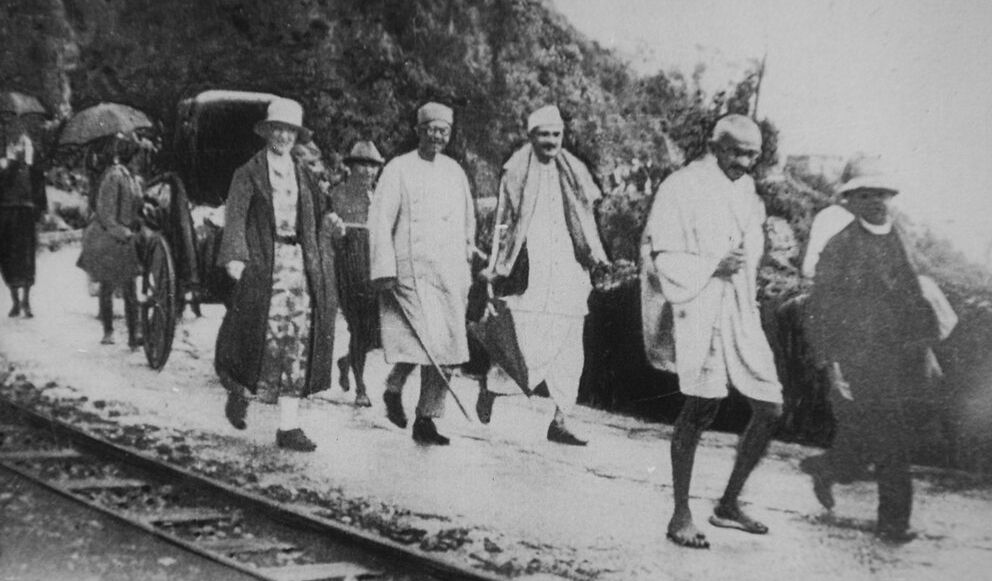
In January 1915, Gandhi arrived back in India after 21 years in South Africa and when he arrived, he continued in the work of advancing Indian civil rights under the rule of the British government. During his first year back in India, Gandhi remained politically inactive during the year as he patiently observed Indian society. In 1916, he gave a commencement speech at a college and also met Jawaharlal Nehru, who was a political leader and eventually became the nation's first prime minister after India gained its independence in 1947.
In 1917, the Champaran Satyagraha became Gandhi's first satyagraha since returning to India where Indigo farmers protested low pay while being forced to grow Indigo. Then in 1918, Gandhi asked 5,000 peasants collectively to not pay their land taxes . And in February 1919 the Rowlatt Act was passed and Gandhi and his followers protested the act, which gave police the power to arrest anyone without cause. Effectively, anyone suspected of "terrorism" by the British government could be arrested. The act clearly hoped to slow down the nationalist movements occurring in India, but they backfired. The protests of the Rowlatt Act led to the Jallianwala Bagh massacre in April 1919 when British Indian troops opened fire on a crowd of peaceful protestors killing hundreds, maybe even thousands. After the massacre, Gandhi was quoted as saying, "this Satanic government cannot be mended. It must be ended."[6]
In addition to Satyagrahis, Gandhi continually encouraged other peaceful acts of protest such as removing children from British schools and to quit your job if you were employed in a British colonial government job. Despite desiring freedom from the British government, Gandhi did not dislike the British peoples. Here he is quoted as saying, "I tell the British peoples that I love them and I want their association," however Gandhi was in pursuit of "self-respect and...absolute equality."[7]
By 1920, Mahatma Gandhi was the central political figure in India and in September 1920, he launched a large-scale protest that became known as the non-cooperation movement. His 1920 non-cooperation protest was unsuccessful in gaining self-government for India, but it started a long-term movement which eventually brought independence to India in 1947.
Important Dates
Gandhi led a non-violent march of Indian workers from Newcastle to Charlestown to protest unjust laws.
Gandhi and many marchers were arrested and transported back to the mines under strict supervision.
South African authorities accepted Gandhi's demands, including the repeal of the three-pound annual tax on Indian workers.
Gandhi returned to India after spending 21 years in South Africa advocating for Indian civil rights.
Gandhi met Jawaharlal Nehru and delivered a commencement speech while observing India's political conditions.
Gandhi led the Champaran Satyagraha, supporting indigo farmers protesting unfair treatment and low wages.
The British government passed the Rowlatt Act, allowing arrests without trial and sparking widespread protests.
Gandhi launched the Non-Cooperation Movement, a nationwide campaign of peaceful resistance against British rule.
Frequently Asked Questions
Why was Mahatma Gandhi arrested in South Africa in 1913?
Gandhi was arrested for leading a non-violent march of Indian coal mine and railway workers from Newcastle to Charlestown. The march protested unfair laws, including a three-pound annual tax imposed on Indian immigrant workers.
What does the term "satyagraha" mean?
Satyagraha was a term created by Gandhi to describe non-violent resistance and peaceful protest. It means "truth-force" and emphasized the power of truth and moral courage over violence.
Why did Gandhi remain in South Africa for 21 years?
Gandhi originally traveled to South Africa in 1893 to help resolve a legal dispute between two Indian businessmen. After witnessing discrimination against Indians, he stayed to fight for their civil rights and equality.
What was the outcome of the 1913 South African protest?
The protest drew international attention and led to widespread criticism of South Africa's treatment of Indians. Gandhi's demands were eventually accepted, including the repeal of the three-pound annual tax.
Why was Gandhi given the title "Mahatma"?
Gandhi received the honorific title "Mahatma," meaning "great-souled," after his successful leadership in South Africa. The title recognized his commitment to justice, non-violence, and civil rights.
What did Gandhi do after returning to India in 1915?
After returning to India, Gandhi spent his first year observing Indian society and political conditions. He then began leading satyagraha campaigns to support farmers, peasants, and others facing injustice under British rule.
What was the Non-Cooperation Movement of 1920?
The Non-Cooperation Movement was a nationwide protest led by Gandhi against British rule in India. Although it did not immediately achieve self-government, it inspired a long-term struggle that helped India gain independence in 1947.
Citations
- Nakhoda , Zein. “Indians in South Africa Wage Satyagraha for Their Rights, 1906-1914.” Indians in South Africa wage Satyagraha for their rights, 1906-1914 | Global Nonviolent Action Database, May 14, 2011. https://nvdatabase.swarthmore.edu/content/indians-south-africa-wage-satyagraha-their-rights-1906-1914 ↑
- M. K. Gandhi: (The Man of the Moment.). India: Gupta, 1921. 65. ↑
- The Indian Review. India: G.A. Natesan & Company, 1918. 236. ↑
- “Mahatma Gandhi Bio.” The Global Indian, July 25, 2023. https://www.globalindian.com/profiles/mahatma-gandhi/ ↑
- The Indian Review. India: G.A. Natesan & Company, 1918. 237. ↑
- The Legacy of Mahatma Gandhi. N.p.: PS Opus Publications, 2021. 49. ↑
- M. K. Gandhi: (The Man of the Moment.). India: Gupta, 1921. 70. ↑