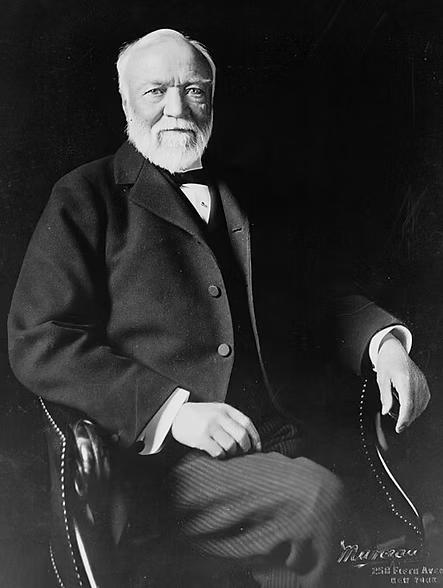
By 1913, Andrew Carnegie had transformed himself from one of the world's most successful industrialists and one of its most prominent advocates for international peace. Convinced that war was humanity's greatest crime, Carnegie devoted his wealth and influence to promoting arbitration, international cooperation, and institutions designed to prevent conflict between nations. His efforts reached a high point that year as he addressed the American Peace Congress, met with Kaiser Wilhelm II during the German emperor's Silver Jubilee, and celebrated the dedication of the Peace Palace at The Hague—just one year before Europe descended into the First World War.
Andrew Carnegie's Peace Activism
As Andrew Carnegie grew older, he became more focused on philanthropy and becoming an activist for peace among the nations. In 1913, Andrew Carnegie was age 76 and had been retired from business since 1901 when he sold his steel business to JP Morgan for $480 million.
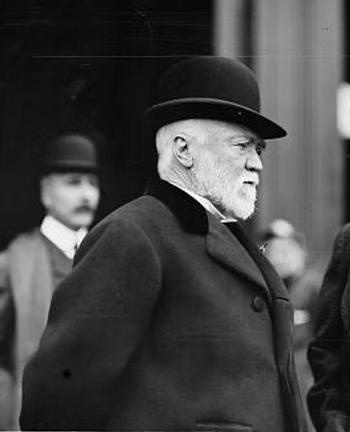
In early May 1913, before traveling to Europe for Wilhelm Kaiser's Silver Jubilee and Dedication of the Peace Palace, he gave a speech at the Fourth American Peace Congress held in St. Louis that year. In his speech he stated,
Let us recognize the truth that man killing man as a means of settling disputes is the crying sin, curse and disgrace of our time...this diabolical practice of man killing man is truly, as has been said, "the foulest fiend ever vomited from the mouth of hell."[1]
In this same speech, he also stated, "I believe in the League of Peace idea, the formation of an International Police, never for aggression, always for protection..."[2]
Wilhelm Kaiser II's Silver Jubilee
In June 1913, Andrew Carnegie traveled to Europe for the German Monarch’s silver jubilee, the celebration of Kaiser Wilhelm II's 25th year as monarch. Wilhelm's celebration was one month after another important occasion, Princess Victoria Louise's wedding. Andrew Carnegie hoped to encourage the monarch towards continued peace. It is said that Kaiser Wilhelm II made the statement to Carnegie, “Twenty-five years of peace, Mr. Carnegie, and I hope there will be twenty-five more!” Wilhelm had stated many times that it was a major goal throughout his life to keep peace in Europe.[3] However, at the time, there was an arms race among European countries as well as Russia. With the Agadir incident in 1911 visible in the rearview mirror, there were also still tensions between France and Germany. Wilhelm also had more hawkish advisors, such as his Chief of Staff, Conrad von Hotzendorf.[4] Nonetheless, Carnegie urged Kaiser Wilhelm II to choose peace and Carnegie received all indications that that was his plan.
Andrew Carnegie and the Peace Palace - YouTube Short
Dedication of the Peace Palace
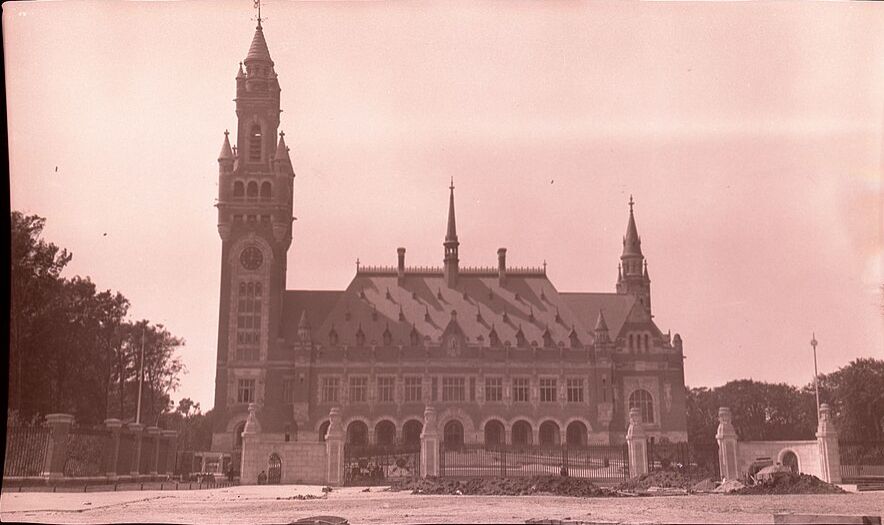
When Carnegie was finished visiting the monarch in June, the Peace Palace was set to have its inauguration ceremony that August. Carnegie had donated $1.5 million to the project which equates to roughly $50 million today.[5] Carnegie's speech at the dedication was accompanied by the unveiling of a bust of Sir Randal Cremer who passed away in 1908. Cremer was a pacifist who led the "international arbitration movement" and received the Nobel Peace Prize in 1903. He was also the original founder of the International Arbitration League.
Mr. Carnegie opened his speech by saying,
My Chairman, my Lords, Ladies, and Gentlemen, My first duty today is to unveil the bust of one of the pioneers of the greatest of all causes--the abolition of war, the killing of man by man, the greatest of all crimes.[6]
Carnegie went on to refer to Kaiser Wilhelm II's impressive record of peace several times in his speech. Here is one such instance where, despite Germany entering WWI a year later, Mr. Carnegie recognized that Germany's newfound prosperity was a product of its current era of peace.
Surveying the world today, the most striking figure seen is another emperor, the German Emperor, who has recently celebrated his 25th year of peaceful reign, his hands unstained with human blood--a unique record--hence Germany's astounding progress educationally, industrially, and commercially, proving that the greatest of all national blessings is peace.[7]
After its inauguration, The Peace Palace immediately became the home for the Permanent Court of Arbitration, an intergovernmental organization that resolves disputes among its member nations, which is still there to this day.
The Hague Academy of International Law was started in 1914, but moved into the Peace Palace in 1923 and is still there today. It is a place where higher education is provided to select individuals teaching subjects related to international law.
And finally, since 1913, the Carnegie "Stichting" which is the Dutch word for foundation, has been located in the Peace Palace. The same year that the Rockefeller Foundation began, the Carnegie Foundation moved into its new home in the Peace Palace.
Peace Palace and the League of Nations
The League of Nations formally began in January 1920, and a couple years later, the Peace Palace began housing the International Court of Justice in 1922, which today, and since 1946 has been the judicial body for the United Nations.
The industrialist turned peace advocate and philanthropist, Andrew Carnegie passed away in August 1919 at the age 83.
Important Dates
Andrew Carnegie retired from business after selling Carnegie Steel to J.P. Morgan for approximately $480 million, allowing him to focus on philanthropy and international peace efforts.
Sir Randal Cremer, founder of the International Arbitration League, received the Nobel Peace Prize for his work promoting international arbitration.
Sir Randal Cremer died, five years before a bust honoring him was unveiled at the Peace Palace dedication ceremony.
The Agadir Crisis heightened tensions between Germany and France, contributing to concerns about peace in Europe despite ongoing diplomatic efforts.
Andrew Carnegie addressed the Fourth American Peace Congress in St. Louis, where he strongly condemned war and advocated for a League of Peace.
Carnegie traveled to Germany to attend Kaiser Wilhelm II's Silver Jubilee celebration marking the emperor's 25th year on the throne.
The Peace Palace in The Hague was formally dedicated, with Carnegie delivering a speech celebrating international arbitration and the pursuit of world peace.
The Carnegie Foundation (Carnegie Stichting) established its headquarters in the newly opened Peace Palace.
The Rockefeller Foundation was founded in the same year that the Peace Palace was inaugurated.
The Hague Academy of International Law was established, although it would not move into the Peace Palace until several years later.
World War I began less than one year after the dedication of the Peace Palace, undermining many hopes for lasting peace in Europe.
Andrew Carnegie died at age 83, shortly before the creation of the League of Nations.
The League of Nations officially came into existence, advancing many of the international cooperation principles Carnegie had championed.
The Permanent Court of International Justice, a predecessor to today's International Court of Justice, began operating from the Peace Palace.
The Hague Academy of International Law moved into the Peace Palace, where it continues to educate scholars and practitioners of international law.
The International Court of Justice became the principal judicial organ of the United Nations and continued its work from the Peace Palace.
Frequently Asked Questions
Why was Andrew Carnegie involved in the peace movement?
Andrew Carnegie believed that war was humanity's greatest crime and dedicated much of his fortune to promoting international peace. After retiring from the steel industry, he focused on arbitration, diplomacy, and institutions designed to prevent armed conflict.
What did Andrew Carnegie say at the American Peace Congress in 1913?
At the Fourth American Peace Congress in St. Louis, Carnegie condemned war as "the crying sin, curse and disgrace of our time." He also advocated for a League of Peace supported by an international police force dedicated to protecting nations rather than waging aggression.
Why did Andrew Carnegie meet Kaiser Wilhelm II in 1913?
Carnegie traveled to Germany during Kaiser Wilhelm II's Silver Jubilee celebration to encourage the German emperor's commitment to maintaining peace in Europe. The meeting reflected Carnegie's belief that influential world leaders could help prevent future wars through diplomacy.
What was the Peace Palace and how was Andrew Carnegie involved?
The Peace Palace in The Hague was built with a $1.5 million donation from Andrew Carnegie to support international arbitration and peaceful dispute resolution. It officially opened in 1913 and became a symbol of the global peace movement.
What did Andrew Carnegie say at the dedication of the Peace Palace?
During the dedication ceremony, Carnegie described the abolition of war as "the greatest of all causes" and called war the greatest of all crimes. He praised leaders who maintained peace and emphasized the economic and social benefits that peace brings to nations.
What organizations have been housed in the Peace Palace?
The Peace Palace became the home of the Permanent Court of Arbitration and later housed the Hague Academy of International Law. It also became the seat of the International Court of Justice, which serves as the principal judicial organ of the United Nations.
Did Andrew Carnegie live to see the League of Nations established?
Andrew Carnegie died in August 1919, a few months before the League of Nations officially began operations in January 1920. Although he did not live to see it, his advocacy for international cooperation and peaceful dispute resolution helped advance ideas that influenced the League's creation.
Citations
- Carnegie, Andrew. Address by Andrew Carnegie. United States: Redfield bros., 1913. 15. ↑
- Carnegie, Andrew. Address by Andrew Carnegie. United States: Redfield bros., 1913. 12. ↑
- https://www.mentalfloss.com/article/51198/world-war-i-centennial-kaiser-hopes-25-more-years-peace# ↑
- Clark, Christopher. The Sleepwalkers: How Europe Went to War in 1914. United States: HarperCollins, 2013. 101 ↑
- Encyclopedia of Violence, Peace, and Conflict. United States: Elsevier Science, 1999. 697. ↑
- The Arbitrator. United Kingdom: International Arbitration League., 1913. 111. ↑
- The Arbitrator. 112. ↑