Canberra: Between Sydney and Melbourne
Canberra was chosen as the Australian capital in 1906 as a compromise between the already existing cities of Melbourne and Sydney. For reference, the Canberra region is landlocked inside the territory of New South Wales with the city having coordinates of 35.2802° S, 149.1310° E. Throughout the 19th century and continuing to today, Melbourne and Sydney were the largest cities in Australia and have had very comparable populations during that time. In 1914, Melbourne had a population of 670,000 and Sydney had a population of 720,000.[1] [2] These two cities presently remain the largest Australian cities and have grown in lockstep as they still maintain similar populations today.
Australia Before 1913
Australia before 1913 was a group of geographically associated British colonies. Since 1850,
New South Wales(where Sydney and Melbourne are located) was then and still is today the most prominent of all the Australian regions and did not see a strong benefit to forsaking its independence as a colony to become tied to the other colonies. Nonetheless, eventually in1885 the Federal Council of Australasia was formed and thus created a governing structure that loosely united the colonies.[3]
The Federal Council of Australasia met from 1886 until 1899, despite having no official executive powers. New South Wales only participated on a limited basis and so the council was mostly ineffective in providing any sort of government for Australia at large. Around 1891-92, an Australian Constitution began to be drafted and proponents of a stronger centralized government began to gain momentum. By 1899, the Australian Constitution had been proposed and passed by the colonies via referenda. The colonies approved the referenda with New South Wales affirming it by a slight majority. Following the referenda, Queen Victoria gave her assent to the Australian Constitution on July 9, 1900 by passing the Commonwealth of Australia Constitution Act. In the following year the first Parliament of the Commonwealth of Australia was convened on May 9, 1901 in Melbourne, Australia by the Duke of York.[4]
The Story Behind Canberra
King O'Malley
King O'Malley was one of the instrumental figures in the development of Canberra as Australia's capital city. Interestingly, it is believed that he was born in or near Valley Falls, Kansas in 1858 but historians are unsure of his exact birthplace in Kansas. Following his father's death in the Civil War, he moved to New York City to live with his aunt and uncle. Eventually O'Malley made the trek out to Oregon and Washington State before moving to Australia in 1888 after his wife died in 1886 from tuberculosis while pregnant with their first child. When asked why he moved to Australia, O'Malley fabricated a story in which he told people that he left America due to health reasons but the true reason was that he was fleeing accusations of embezzlement while working as an insurance salesman for Northwestern Mutual in Oregon and Washington.[5]
Upon arriving in Australia, King O'Malley traveled by foot hundreds of miles from Port Alma to Sydney and then Melbourne and eventually to Adelaide where he settled. In his early years in Adelaide, he accumulated wealth via the gold fields of West Australia. Eventually he entered politics and served in various capacities from 1896 until 1917. His longest tenure was as a member of Australian Parliament from 1903 until 1917. His importance to Canberra lies with the fact that he was the Australian Minister of Home Affairs in 1913 when Canberra's construction began. The final vote which chose the Yass-Canberra region as the capital occurred in 1906. When the final votes for determining the location of the capital city were cast, O'Malley and many others voted for Dalgety, a small city 170 km south of Canberra. However, Canberra eventually won and despite O'Malley not voting for Canberra, he was granted the honor of driving the first survey peg in the Canberra area on February 20, 1913.[6]
In those days, it would have been illegal for anyone born in America to serve in Australian politics. This is one reason why it is uncertain where King O'Malley was exactly born. In order to serve in parliament, O'Malley claimed that he was born in one of the eastern townships of Quebec, Canada which also sat under the British throne at the time.[7]
Following O'Malley's survey peg, the Australian governor's wife, Lady Denman laid the first foundation stone for the city on March 12, 1913. At this ceremony, it was announced that the new city would be named Canberra and construction began shortly thereafter. Canberra is a name that means "meeting place" in the language of the native aboriginals. She is quoted as saying, ‘I name the capital of Australia, Canberra – the accent is on the Can’.[8]
As this section describing King O'Malley closes, here is an account of O'Malley's charismatic personality.
King O'Malley is best remembered as a colourful and at times controversial politician in the period following Australia's federation. He was a significant figure in the initiative to create a national bank with central banking responsibilities. . . O'Malley was a charismatic, gregarious and colourful figure. His considerable intellect and his flair as a salesman contributed to his success both in business and in politics. His mischievous sense of humour charmed many.9
Choosing Canberra
How was Canberra chosen? In January 1899, a meeting was held by governing officials for determining the capital of Australia and it was agreed that the new capital should be located in New South Wales and not more than 100 miles from Sydney. That same year in November, New South Wales issued a Royal Commission to Alexander Oliver, the president of the Land Appeal Court, to report on potential sites throughout New South Wales. Alexander Oliver passed away in 1904 but before passing he had nominated Dalgety as the most favorable location. Interestingly, one of the determining factors was its colder climate which some believed was beneficial for health reasons as well as the fact that its climate would be less attractive to non-British.[9]
Those who have been commissioned to find [an ideal federal capital city site] have not been sent out to discover a climate for a Black republic, but one to which not only will the constitutions of Australians of British descent readily accommodate themselves but by which their physique will be improved, their faculties and energies raised to a higher pitch of usefulness.[10]
In similar fashion King O'Malley is recorded as saying, “cold climates have produced the greatest geniuses.”[11]
However, in 1906, the Yass-Canberra region was examined by a group of parliamentarians as a potential site. From the vote in1906 forward, the campaign for Canberra continued by several prominent parliamentarians such as former Australian Prime Minister George Reid. In 1910, New South Wales ceded the necessary land to the Australian Commonwealth for the capital city.
Effectively, Canberra beat out the other sites due to it being a compromise among officials who were looking for a site that was the right distance between Melbourne and Sydney. The previously mentioned town of Dalgety was a viable option but some believed that it was not close enough to Sydney. In 1913 Canberra was a blank slate containing only raw land. "The Canberra area was no more than an outback sheep station divided by the Molonglo River."[12] Therefore, it would become a city completely planned and built from the ground up. In order to begin the work, Australia submitted a request for proposal for city plans from various reputable architecture firms and 137 architectural proposals were submitted. King O'Malley's committee was responsible for choosing the winning proposal.
The Griffin Architecture Firm
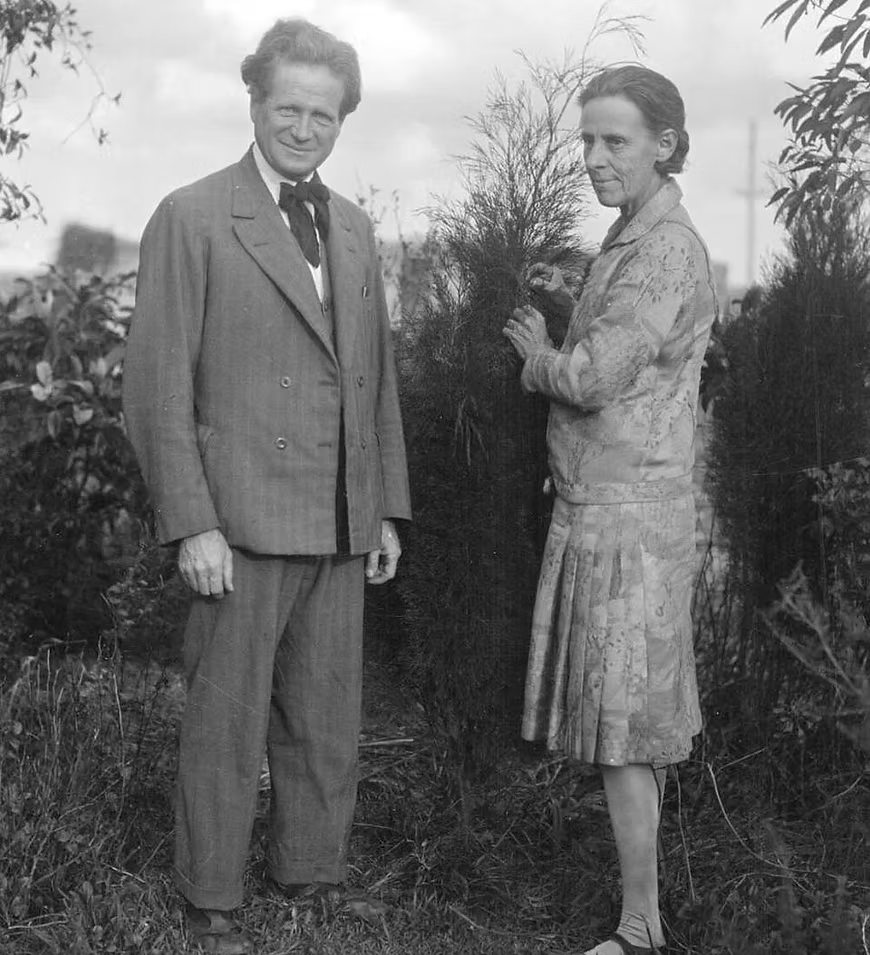
The architecture firm from Chicago of the married couple Walter Burley Griffin and Marion Mahony Griffin submitted the winning plans for the city. The couple married in 1911 around the same time that Mr. Griffin began working on the plans for Canberra. Walter Burley Griffin was an up and coming architect who previously held employment under the famous architect Frank Lloyd Wright and at one point even tried to marry Wright's sister but was turned down. Based on its purpose, the city was nicknamed "a city made for bureaucrats." And although the city accepted Griffin's proposal, the Griffin plans were not followed very closely. The original plans for the city were made to hold 25,000 people.[13]
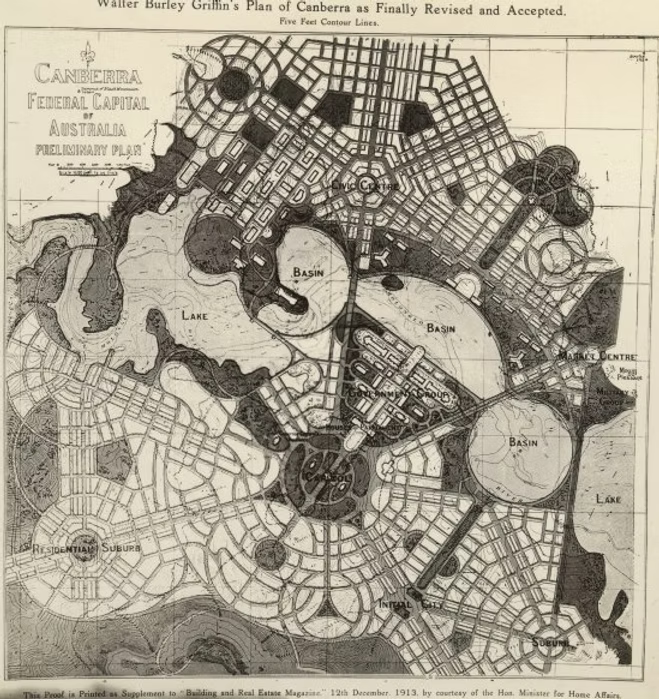
Griffin's winning design showed a chain of lakes along the Molonglo Valley and a triangular framework for a central national area laid out along major vistas from Mount Ainslie and Black Mountain. . . .It has been said that, of all the designs submitted in the competition, only Griffin's plan showed an artistic grasp of town planning. It was a simple but splendid concept, laid out in an attractive geometric pattern intricately developed from the topography of the valley, with long tree-lined avenues and boulevards integrated into the Canberra Valley.[14]
After winning the project, the Griffins arrived in Australia in 1913. Among bureaucratic challenges and World War I diverting attention and capital, Griffins plans for the city did not come to fruition and Griffin left the project in 1920. Today, only some of the streets adhere to Griffin's original design and the zero buildings were built according to Griffin's plan. Despite leaving the Canberra project, the Griffins remained in Australia and a number of buildings in Sydney and Melbourne as well as designs for other towns are credited to Griffin.[15]
Here's an image Griffin's original plans for Canberra.
Canberra's Reputation Today
Today, Canberra has a mixed reputation. In recent years it has been gaining momentum as a more popular city with a vibrant culture. However, for the past century, some have said it has a reputation for being "boring and soulless."[16] Despite being the Australian capital, the city is home to only roughly 500,000 people as of 2024.[17] Ironically, when otherwise knowledgeable people are asked to name the Australian capital, they almost instinctively say Melbourne or Sydney with few having ever heard of an Australian city called Canberra.
Important Dates
The Federal Council of Australasia was established as the first formal body to coordinate affairs among several Australian colonies.
Australian colonies voted in referenda on a proposed constitution that would create the Commonwealth of Australia.
Queen Victoria approved the Commonwealth of Australia Constitution Act, formally authorizing Australian federation.
The first Parliament of the Commonwealth of Australia convened in Melbourne following federation.
The Yass-Canberra region was selected as the site for Australia's future capital city.
New South Wales ceded the land that would become the Australian Capital Territory to the Commonwealth government.
Walter Burley Griffin and Marion Mahony Griffin won the international competition to design Canberra.
King O'Malley drove the first survey peg into the Canberra site, symbolically beginning construction of Australia's future capital.
Lady Denman officially named the new capital city "Canberra" during the city's foundation ceremony.
Walter Burley Griffin and Marion Mahony Griffin arrived in Australia to begin work on implementing their winning Canberra design.
Growing disputes between Walter Burley Griffin and government officials began slowing progress on the capital city's construction.
Administrative changes and wartime pressures further reduced the pace of work on Griffin's Canberra plans.
The federal government increasingly modified Griffin's original vision, leading to ongoing conflicts over the city's design.
Construction efforts remained limited as World War I and its aftermath continued to constrain resources for Canberra.
Frustrated by bureaucratic obstacles and repeated alterations to his plans, Walter Burley Griffin left the Canberra project.
Frequently Asked Questions
Why was Canberra chosen as the capital of Australia?
Canberra was selected as Australia's capital city in 1906 as a compromise between Sydney and Melbourne, the nation's two largest cities. The Australian Constitution required that the capital be located in New South Wales but at a sufficient distance from Sydney to maintain political neutrality.
What does the name Canberra mean?
The name Canberra is generally believed to derive from an Aboriginal word meaning "meeting place." The city was officially named Canberra by Lady Denman during a foundation ceremony on March 12, 1913.
Who designed the city of Canberra?
Canberra was designed by American architects Walter Burley Griffin and Marion Mahony Griffin after they won an international design competition in 1912. Their vision featured geometric layouts, grand boulevards, and integration with the natural landscape surrounding the city.
Was Canberra built according to Walter Burley Griffin's original plan?
Only parts of Griffin's original city layout were ultimately implemented. Political disputes, bureaucratic delays, and the impact of World War I resulted in many of his architectural and planning ideas being modified or abandoned.
Why isn't Sydney the capital of Australia?
Although Sydney was Australia's largest city, many political leaders wanted to avoid giving either Sydney or Melbourne an advantage. Canberra was created as a purpose-built capital city located between the two major population centers.
What is Canberra known for today?
Canberra is best known as the seat of Australia's federal government and home to Parliament House, national museums, and important cultural institutions. The city is also recognized for its planned design, green spaces, and high quality of life.
How many people live in Canberra?
Canberra's metropolitan population is approximately 500,000 people, making it much smaller than Sydney and Melbourne. Despite its relatively modest size, it serves as the political and administrative center of Australia.
Citations
- “Sydney in 1914 | New South Wales Anzac Centenary - State Archives and Records NSW,” Accessed January 7, 2024. https://nswanzaccentenary.records.nsw.gov.au/on-the-homefront/sydney-1914/# ↑
- Faculty of Engineering and Information Technology. “1910s.” Accessed January 7, 2024. https://eng.unimelb.edu.au/about/history/1910s ↑
- National Library of Australia. “Federation of Australia,” January 7, 2024. https://www.nla.gov.au/collections/guide-selected-collections/federation-australia ↑
- National Library of Australia. “Federation of Australia." ↑
- Daily Telegraph. “Capital Overseer Full of Tall Tales and Mystery,” June 29, 2018. Accessed January 8, 2024. https://www.dailytelegraph.com.au/news/capital-overseer-king-omalley-was-a-master-of-political-evasion/news-story/74b1ceedee6442a44c9a458c3eaa476a ↑
- Daily Telegraph. “Capital Overseer." ↑
- Daily Telegraph. “Capital Overseer." ↑
- Australian Government National Capital Authority. “The Siting and Naming of Canberra.” Accessed January 8, 2024. https://www.nca.gov.au/education/canberras-history/siting-and-naming-canberra# ↑
- Warden, Ian. “Canberra Was Chosen as Australia's Capital City Precisely Because It Was Cold.” The Canberra Times, July 6, 2019. https://www.canberratimes.com.au/story/6249766/canberras-shivering-origins/ ↑
- Warden. "Canberra Was Chosen." ↑
- Daily Telegraph. “Capital Overseer." ↑
- Australian Government. "The Siting and Naming of Canberra." ↑
- Australian Government National Capital Authority. “Walter Burley Griffin.” Accessed January 8, 2024. https://www.nca.gov.au/education/canberras-history/walter-burley-griffin# ↑
- Australian Government. "Walter Burley Griffin." ↑
- Australian Government. "Walter Burley Griffin." ↑
- Brown, Andrew. “Why Does Canberra Bashing Exist? New Research Is Trying to Find out Why.” The Canberra Times, July 7, 2019. Accessed January 8, 2024. https://www.canberratimes.com.au/story/6252125/how-come-so-many-people-bash-canberra-new-research-is-trying-to-find-out-why/ ↑
- MacroTrends. “Canberra, Australia Metro Area Population 1950-2024.” Accessed January 8, 2024. https://www.macrotrends.net/cities/206175/canberra/population ↑