Winston Churchill's Rise to Fame in the Boer War
In 1913, Winston Churchill was the First Lord of the Admiralty, a post he held since his appointment on October 25, 1911. Previously he held the position as the president of Britain's Board of Trade. Churchill was born on November 30, 1874 and came from a prominent, aristocratic British political family. In 1886, his father had become the youngest Chancellor of the Exchequer in British history at the age of thirty-seven.
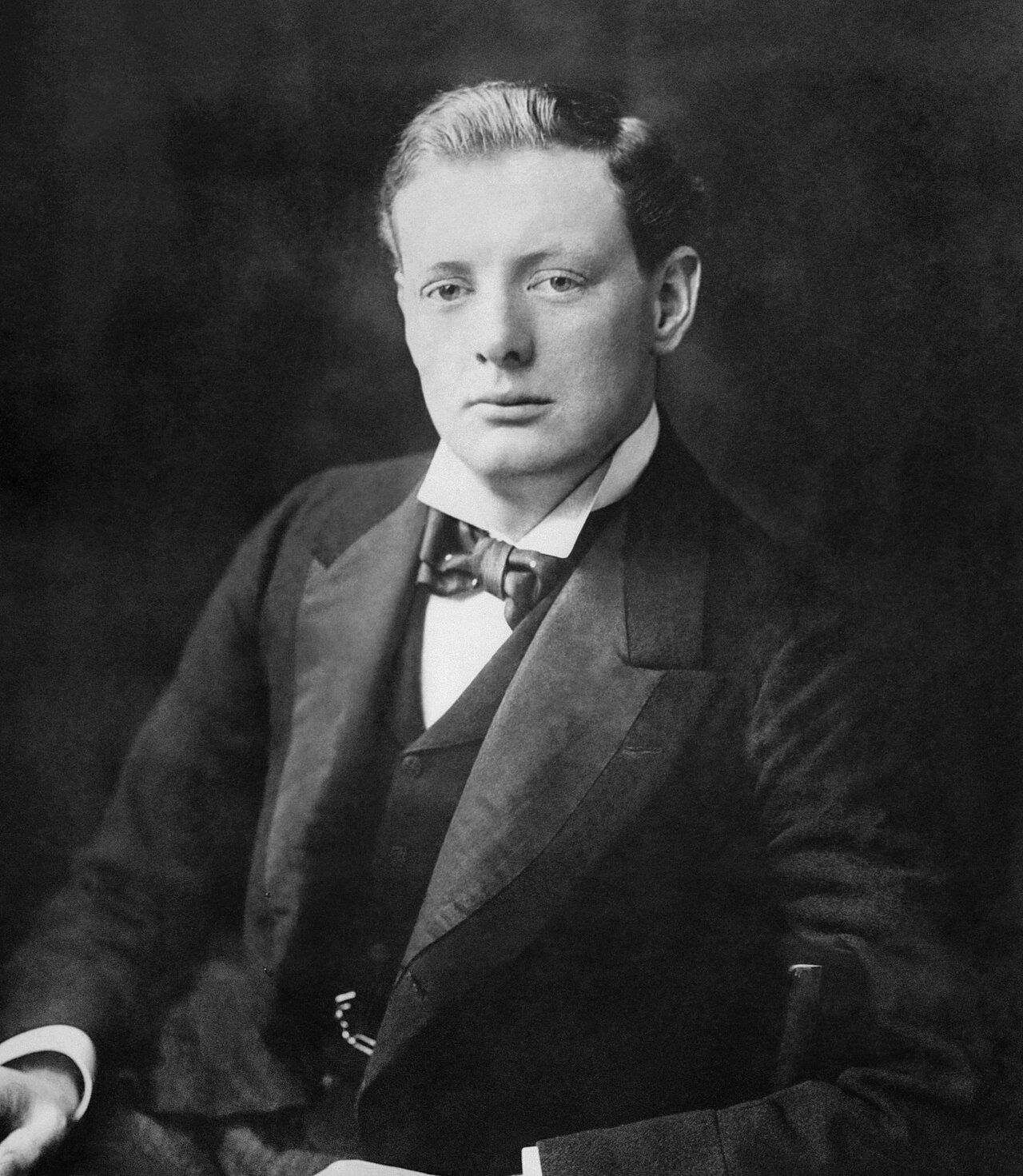
Churchill became famous during the Boer War in South Africa when in 1899, he escaped from a prisoner of war camp. He had traveled to Cape Town South Africa on October 30, 1899 to work as a journalist documenting the war. Churchill was hired by the London Morning Post for the modern-day equivalent of $150,000 for four months of work.[1] He joined the likes of other famous writers documenting the Boer War such as Rudyard Kipling and Sir Arthur Conan Doyle. Several publications competed for Churchill's services as he was known for his writing skills. He is known to have stated, "my literary talents do not exist in my imagination alone."[2] Less than one month into his job, on November 15, 1899, the train he was a passenger on was ambushed and he was captured and became a political prisoner held in a POW camp.
Only about a month later, Churchill escaped the POW camp on December 12th with nothing but a few bars of chocolate. A reward of 25 pounds was offered by the Boers for Churchill's capture as the 24-year old Churchill embarked on a 300 mile journey to reach safety.[3] Through trial and some fortuitous circumstances, Churchill made his way to East Africa. Although Churchill was young, he had already been through other character-refining experiences and after enduring these trials, it further confirmed to Churchill in his mind that he was destined for greatness. As Churchill recalled his life in the light of the events of World War II, he stated "I felt as if I were walking with destiny, and that all my past life had been but a preparation for this hour and this trial."[4]
Churchill in 1913 Before the War
In the May of 1913, as the First Lord of the Admiralty, Churchill embarked on a cruise through the Mediterranean joined by his mother, and Prime Minister Asquith's family. At the moment, Jennie, Churchill's mother, was divorcing her second husband, George Cornwallis-West. Jennie's first husband and Churchill's father had passed away in 1895. As the cruise continued, they made stops in Malta, Greece, and Italy. The cruise was a leisurely experience but little did Churchill know that the continent would be embroiled in war and the naval campaign which would earn him his demotion would take place not far from this trip's path.[5]
The Marconi Scandal
While Churchill was on his Mediterranean cruise, several prominent members of the British government were embroiled in a scandal. It began in 1912 when the Chancellor of the Exchequer David Lloyd George as well as others were accused of insider trading in shares of the Marconi Wireless Company. At the time, the Marconi Wireless Company was the largest radio company in the world, and the British parent company known as British Marconi was founded by the Italian inventor of the radio, Guglielmo Marconi in 1897. Churchill was also implicated in the scandal but aggressively defended himself as innocent calling the accusations slanderous.
The scandal began when the British Post Office accepted a proposal from the British Marconi to construct and maintain a national radio system made up of regional radio transmitters throughout the British Empire. Given that the British Empire was at its height and encompassed 25 percent of the world, this was a massive contract for whoever would win it.
As government officials were determining who they would award the contract to, it was leaked to certain government officials that the government had submitted the request for proposal and that British Marconi would win the contract. The officials involved included the aforementioned Chancellor of the Exchequer David Lloyd George, the Attorney General Sir Rufus Isaacs, the Postmaster General Herbert Samuel, and the Parliamentary Secretary to the Treasury Alexander Murray.[6]
Despite accusations of insider trading from multiple publications, no legal action was brought against any of the government officials. Several of the accusing publications were either charged or threatened with libel lawsuits, including the French publication Le Matin and Cecil Chesterton, brother of the more famous, G.K. Chesterton, who wrote for a British publication called New Witness.[7]
In 1913, H.H. Asquith set up an investigative committee to help resolve the issue. Both Isaacs and Murray confessed to purchasing shares in the American subsidiary of British Marconi known as American Marconi. Nonetheless, the investigative committee concluded that the government officials did nothing wrong by using their inside information to profit on American Marconi shares.
An Oil-Powered Navy
Since taking the position as First Lord of the Admiralty in 1911, Churchill had been focused on transitioning the British Admiralty from being powered by steam produced from coal to being powered by oil. Oil-powered ships contained several strategic advantages that if they were gained by some other navy, Britain's navy would lose its position atop the best in the world. In July 1913, Churchill petitioned the House of Commons to purchase a stake in the Abadan Oil Refinery by purchasing a 51 percent stake in the Anglo-Persian Oil Company. In July 1914, the British government arrived at an agreement to purchase a 51 percent stake in the Anglo-Persian Oil Company which eventually became known as British Petroleum. In exchange, the Anglo-Persian Oil Company was obligated to provide oil to the British Navy at a certain price. It proved to be a valuable decision just as the world was on the doorstep of war.
World War I and Winston Churchill
World War I started in the middle of 1914. Soon after the war began, the two sides reached a stalemate on the western front which extended across France's eastern border. This led to both sides trying to determine their next move. This led British leadership to engage the Gallipoli Campaign in 1915.
The Gallipoli Campaign
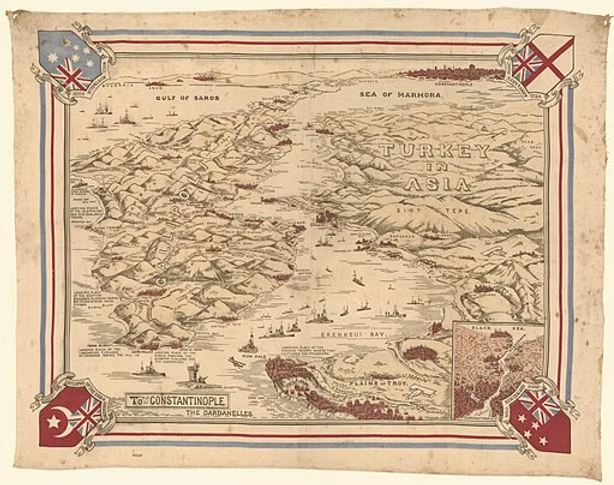
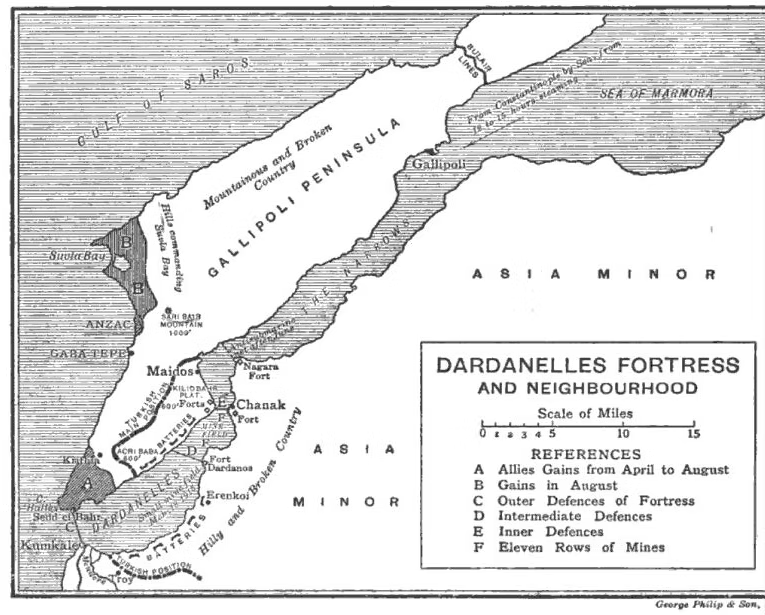
In February 1915, the infamous Gallipoli campaign began. Although many people were responsible for planning and signing off on the campaign, Churchill became the primary individual that was held responsible. The Gallipoli Campaign is also known as The Dardanelles Decision named after the Dardanelles Strait which is a narrow strip of water that connects the Aegean Sea to the Sea of Marmora. This was strategic for the Allies because this ultimately then leads into the Black Sea through a narrow isthmus where Istanbul, Turkey sits. In 1915, Istanbul was known as Constantinople, and was the capital of the Ottoman Empire. France and Britain together planned to force its way through the Dardanelles Strait to attack Constantinople but after a long campaign lasting most of the year, it was determined a failure. Initially, the shelling of the forts from sea failed followed by attempts of amphibious landings which for survivors of the landing, quickly led to trench warfare.[8] The campaign lasted from February 19, 1915 to January 9, 1916.
When the war began, leaders had originally expected and hoped that the war would be brief. And British leadership hoped that the Gallipoli Campaign would potentially achieve these ends. Here, Churchill broadly documents the events of 1915 in this short post-mortem.
The year 1915 was disastrous to the cause of the Allies and to the whole world. By the mistakes of this year the opportunity was lost of confining the conflagration within limits which though enormous were not uncontrolled. Thereafter, the fire roared on. . . Thereafter events passed very largely outside the scope of conscious choice. Governments and individuals. . . swayed and staggered forward in helpless violence. . . In January 1915 the terrific affair was still not unmanageable. . . It could have been grasped, before the world was exhausted, before the nations were broken, before the empires were shattered to pieces, before Europe was ruined.[9]
One of the challenges of the Gallipoli campaign were Britain's old ships. Britain had a fleet of new ships arriving in 1915 and many of the crews on current ships would become employed on the new ships. The new ships were Dreadnoughts which were an altogether new type of ship which rendered the old ships obsolete. Dreadnoughts were larger, they were faster, and they were equipped with large-caliber guns. These older ships, although obsolete versus the modern German battleship, were expected to be able to hold their own against the Ottoman's forts in the Straight of Dardanelles. Furthermore, the Ottoman's didn't have a navy worth mentioning. However, several miscalculations led to the failed attempt to force their way through the Dardanelles. Here, Churchill describes the state of the British ships in the attack.
All the Majestics, all the Canopuses, all the Formidables, all the Duncans, were inexorably marked for final extinction within the next year to fifteen months. . .In 1905, no one would have risked them in trying to force the Dardanelles. They were our latest vessels and all we had. In 1915, they were surplus and moribund. Yet related to the forts their strength was unimpaired.[10]
Winston Churchill On The Front Lines
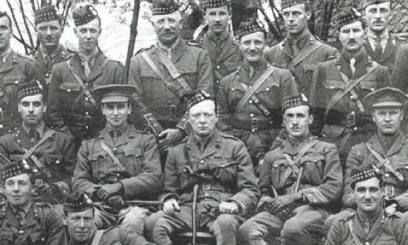
In November 1915, Churchill resigned from First Lord of the Admiralty and entered a new position as Chancellor of the Duchy of Lancaster. In the same month, and for the next six months he joined the Royal Scots Fusiliers as an infantry officer on the Western Front. He wrote this letter on January 12, 1916 to the Duke of Marlborough describing his circumstances as potentially Fiel pero desdichado, meaning "Faithful but unfortunate", were he to parish on the front lines.
I have meditated a great deal on the g[rea]t situation & have fairly clear views about it. Perhaps later in the year I shall come back to the House: but for the moment this is the course marked out for me. I see no reason to expect a Brigade for a long time & of course there can be no question of any military career. On the other hand, I like soldiering for its own sake; & if I am killed at the head of my battalion, it will be an honourable & dignified finale. Do you think I sh[oul]d deserve the family motto "Fiel pero desdichado"? I am now passing through a stage in my journey quite beyond any that my father had to traverse. Your letters & affection are a g[rea]t pleasure to me. We must always try to keep together as the world grows grey.[11]
In another excerpt, Churchill described the miserable circumstances of the front lines within the trenches.
. . .[f]ilth and rubbish everywhere, graves built into the defences & scattered about promiscuously, feet & clothing breaking through the soil, water and muck on all sides; & about this scene in the dazzling moonlight troops of enormous rats creep & glide, to the unceasing accompaniment of rifle & machine guns & the venomous whining & whirring of the bullets which pass overhead.[12]
Churchill's playful attitude in the midst of chaos shows up in this excerpt from a letter written to his mother the month he arrived at the front lines.
I am happy here … I always get on with soldiers. I do not certainly regret the step I took … I know that I am doing the right thing out here … Do you know I am quite young again?[13]
On May 3, Churchill was recalled back to Britain to once again take a position inside the government. His battalion was combined with another and his position became redundant. In a letter written in 1915 by Hankey, the Secretary of the War Cabinet, he recognized there was a lack of courage in the cabinet.
Since Churchill left the Cabinet and War Council we have lacked courage more than ever.[14]
The Minister of Munitions
On July 18, 1917, he was appointed as the Minister of Munitions by the now Prime Minister David Lloyd George and remained in that position until January 1919. Churchill was offered his choice between Ministry of Munitions or the Air Ministry, which was just created. This appointment by Lloyd George was controversial from both sides of the aisle, however Lloyd George moved ahead and eventually people accepted the decision.
The Minister of Munitions was a new position that was created in July 1915 with the Munitions War Act, in the midst of the Gallipoli Campaign. The department was created to oversee the production of munitions to ensure demand for the war was met. As the war continued, and especially in the midst of the Gallipoli Campaign, it began to require more munitions than was previously expected.
By 1917, when Churchill took the position, he described Britain as entirely focused on winning the war and production for the war had become a part of everyone's lifestyle in some way.
Three years of the struggle had engaged very nearly the whole might of the nation. Munition production of every kind was already upon a giant scale. The whole island was an arsenal.[15]
One of the most dramatic events that happened on the western front during his duty as Minister of Munitions was the German Spring Offensive of March 21, 1918. On that day, beginning at 4:30 AM, the British Armies were barraged by over 6,000 German artillery guns and 3,500 heavy mortars.[16] As Churchill sat 8,000 yards away from the front lines, writing in 1927, he said it "was the most tremendous cannonade I shall ever hear."[17] It was an offensive that the Germans had been planning since November 1917 and the first surge lasted until the evening of March 27th. The second surge continued on the 28th and the result was failure for the Germans. "The Germans, who advanced with the utmost bravery, were mowed down in heaps."[18] The German Spring Offensive hoped to break through the western front before more Americans arrived and viewed this as one of their last chances to do so. Although America entered the war in 1917, they didn't begin offensive action until May 1918.
World War I ended shortly thereafter in November of 1918.
The Secretary of State for Air and War
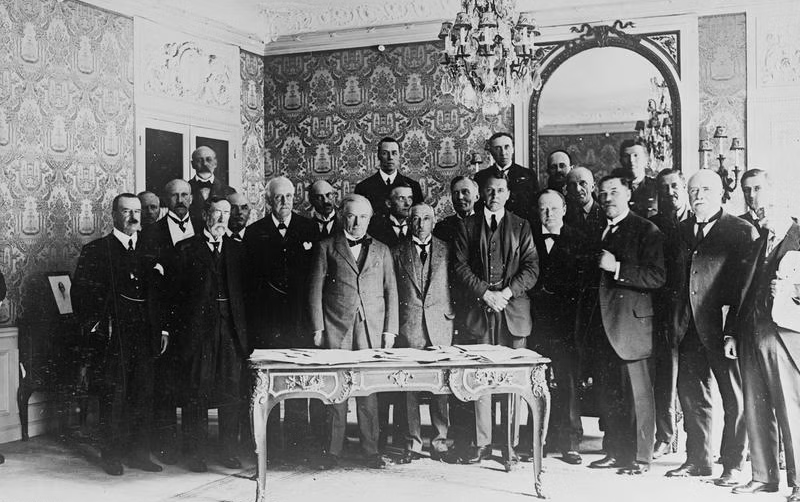
On January 10, 1919, he stepped down from Ministry of Munitions and was appointed simultaneously as the Secretary of State for both Air and War. He was part of the British delegation at the Paris Peace Conference in June 1919 although he did not play an active role in the conference.
Despite the war being over, the British Empire was in a state of uncertainty after the war. Although the British were on the winning side, the British Empire was never as large as it was prior to the war. Ireland's fight for independence was gaining ground. Arabs in the region of modern-day Iraq were revolting and assassinating British officials.
Anti-Semitism was also becoming more common. And in 1917, the Balfour agreement created British backing for a Jewish state in the region where Palestine existed. In 1920, Churchill was what is known as a Zionist and felt compelled to write:
If as may well happen, there should be created in our own lifetime by the banks of the Jordan a Jewish State under the protection of the British Crown, which might comprise three or four millions of Jews, an event would have occurred in the history of the world which would, from every point of view, be beneficial.[19]
Churchill held the positions of Secretary of State for Air and War until February 13, 1921.
Churchill's Growing Legacy
Following World War I, Churchill's experiences and legacy were large enough for one man's life time. And yet, more challenges lay ahead for Churchill.
Churchill's story from 1913 to 1920 was one which showcased Churchill's willingness to lead coupled with humility. There are few men living in any time period who would be just as happy serving on the front lines as they would be in the safety of an office, delivering orders. And while Churchill was fighting on the frontlines, it left a noticeable lack of courage in the War Department according to Mr. Hackney. Churchill was a great man because he was not only ready to serve Britain in the capacity of First Lord of the Admiralty, but after he became responsible for Gallipoli, he was equally willing to join the front lines of the war. Churchill's tremendous personality became a recurring theme during his life, from the Boer War and all the way through World War II.
Important Dates
Winston Churchill arrived in Cape Town as a high-profile war correspondent for the London Morning Post to document the brewing Boer War.
Less than a month into his new journalism role, the armored train Churchill was traveling on was ambushed, resulting in his capture as a prisoner of war.
The 24-year-old Churchill escaped from his POW camp with nothing but chocolate, embarking on a grueling 300-mile escape journey that made him a household name.
As First Lord of the Admiralty, Churchill took a leisurely cruise through the Mediterranean with his family, sailing the very waters where his future naval campaign would soon collapse.
Churchill petitioned the House of Commons to buy a controlling 51 percent stake in the Anglo-Persian Oil Company, successfully transitioning the British fleet from coal to oil power.
The infamous Gallipoli Campaign officially launched with a naval bombardment of Ottoman forts along the strategic Dardanelles Strait.
While serving on the dangerous front lines of the Western Front, Churchill wrote a reflective letter to the Duke of Marlborough pondering his family's motto and his potential demise.
Prime Minister David Lloyd George brought Churchill back into political leadership by appointing him to oversee Britain's massive war production.
Churchill personally witnessed what he described as the most tremendous artillery cannonade he would ever hear when German forces launched a massive final surge on the Western Front.
Shortly after World War I concluded, Churchill stepped down from munitions to simultaneously run the British Empire's War and Air ministries during a time of immense global instability.
Frequently Asked Questions
How did Winston Churchill first achieve widespread fame?
Churchill became famous in 1899 during the Boer War when he made a daring escape from a prisoner of war camp in South Africa. After escaping with only a few bars of chocolate, the 24-year-old journalist successfully completed a 300-mile journey to safety.
What was the Marconi Scandal of 1912?
The Marconi Scandal involved allegations of insider trading against several high-ranking British government officials regarding shares of the Marconi Wireless Company. While the government was preparing to award a massive Imperial radio contract to the company, these officials allegedly used insider information to profit from its American subsidiary.
Why did Churchill push to transition the British Navy from coal to oil power
Churchill recognized that oil-powered ships offered immense strategic and performance advantages over traditional coal-powered steam vessels. To secure this advantage, he orchestrated the British government's purchase of a 51 percent stake in the Anglo-Persian Oil Company to guarantee a steady, priced supply of fuel.
Why did Churchill serve on the front lines of World War I in late 1915?
Following the catastrophic failure of the Gallipoli Campaign, Churchill resigned from his post as First Lord of the Admiralty. He subsequently joined the Royal Scots Fusiliers as an infantry officer, spending six months leading a battalion in the miserable trenches of the Western Front.
What role did Churchill play as the Minister of Munitions?
Appointed by Prime Minister David Lloyd George in 1917, Churchill oversaw the massive industrial scale-up of arms and ammunition production across Britain. During his tenure, he witnessed the dramatic German Spring Offensive of 1918, which he later described as the most tremendous cannonade he would ever hear.
What positions did Churchill hold immediately following the end of World War I?
In January 1919, Churchill stepped down from the Ministry of Munitions to simultaneously serve as the Secretary of State for both Air and War. In these roles, he navigated a volatile post-war climate marked by Irish independence movements, uprisings in modern-day Iraq, and emerging geopolitical shifts in the Middle East.
Citations
- Klein, Christopher. “The Daring Escape That Forged Winston Churchill.” HISTORY, March 28, 2023. Accessed November 9, 2023. https://www.history.com/news/the-daring-escape-that-forged-winston-churchill ↑
- Churchill, Randolph Spencer., Gilbert, Martin. Winston S. Churchill. United States: Houghton Mifflin, 1967. 922. ↑
- Albjerg, Victor Lincoln. Winston Churchill. United States: Twayne Publishers, 1973. 32. ↑
- “Summer 1940.” International Churchill Society, May 11, 2021. Accessed November 9, 2023. https://winstonchurchill.org/the-life-of-churchill/war-leader/summer-1940/ ↑
- “Spring 1913 (Age 38).” International Churchill Society, May 11, 2021. Accessed November 9, 2023. https://winstonchurchill.org/the-life-of-churchill/rising-politician/1910-1919/spring-1913-age-38/ ↑
- “The Marconi Scandal - National Library of Wales.” Accessed November 9, 2023. https://www.library.wales/discover-learn/digital-exhibitions/david-lloyd-george/the-life-and-work-of-david-lloyd-george/the-marconi-scandal ↑
- Core. “The Marconi Scandal and Related Aspects,” April 1978. Accessed November 9, 2023. https://core.ac.uk/download/pdf/77023447.pdf ↑
- Imperial War Museums. “What You Need To Know About The Gallipoli Campaign.” Accessed November 9, 2023. https://www.iwm.org.uk/history/what-you-need-to-know-about-the-gallipoli-campaign ↑
- Churchill, Winston. The World Crisis. United States: C. Scribner's sons, 1923. 1. ↑
- Churchill, Winston. The World Crisis. 98. ↑
- “Winston Churchill to the Duke of Marlborough, January 12, 1916, Churchill and the Great Republic (A Library of Congress Interactive Exhibition, Text Version).” Accessed November 9, 2023. https://www.loc.gov/exhibits/churchill/interactive/_html/wc0069.html ↑
- “On the Western Front.” International Churchill Society, September 10, 2021. Accessed November 9, 2023. https://winstonchurchill.org/the-life-of-churchill/life/man-of-action/on-the-western-front/ ↑
- "On the Western Front." International Churchill Society. ↑
- “Action This Day – Spring 1890, 1915, 1940.” International Churchill Society, May 11, 2021. Accessed November 9, 2021. https://winstonchurchill.org/publications/finest-hour/finest-hour-170/action-this-day-spring-1890-1915-1940-2/ ↑
- Churchill, Winston. The World Crisis, 1916-1918. United Kingdom: Scribner's, 1927. 2. ↑
- Churchill, Winston. The World Crisis. 130. ↑
- Churchill, Winston. The World Crisis. 130. ↑
- Churchill, Winston. The World Crisis. 139. ↑
- “Myth and Reality – What Did Churchill Really Think about the Jews?” International Churchill Society, May 11, 2021. Accessed November 10, 2023. https://winstonchurchill.org/publications/finest-hour/finest-hour-135/myth-and-reality-what-did-churchill-really-think-about-the-jews/ ↑