The Abadan Oil Refinery's Beginnings
The Abadan Oil Refinery was the first refinery in the Middle East to refine oil in significant volumes. Construction began in 1910 and when it first began refining oil in 1912, it started with a refining capacity of 2,500 barrels per day.[1]
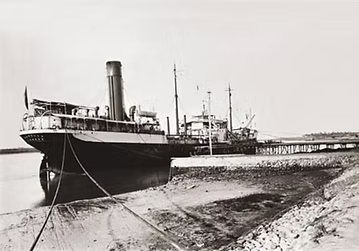
Oil was first discovered in the Middle East when George Bernard Reynolds made a significant discovery in 1908. This first large oil discovery was made near the city of Masjed Soleiman in today's Khuzestan province. They had been searching for oil in the region since 1902 but had only found minimal amounts. Reynolds was hired by the British millionaire William Knox D'Arcy to prospect for oil. D'Arcy had signed an exclusive deal with the Persian Shah, Din Shah Qajar in 1901 to prospect for oil in Persia. This became known as the D'Arcy Concession.
How the Abadan Oil Refinery began - YouTube Short
After discovering oil in 1908, the Anglo-Persian Oil Company was started in 1909. The company was started as a subsidiary of the Burmah Oil Company and shares in the company were also sold to the general public. The Burmah Oil Company was founded in 1886 and was headquartered in Glasgow, Scotland. Unfortunately for Mr. D'Arcy, prospecting for oil in the region had used a substantial portion of his resources and by 1909 the Burmah Oil Company had purchased most of the exploration rights from the D'Arcy Concession. However, D'Arcy still owned a portion and this discovery made him a very wealthy man.[2]
Abadan Oil Refinery Is Completed
After construction was completed in 1912, the refinery began ramping up and became fully operational in 1913.[3] The refinery got off to a difficult start and was nearly bankrupt by 1914.[4] But in June 1913, Winston Churchill, the First Lord of the Admiralty, sent a memo to the King's cabinet and recommended that Britain acquire dependable supplies of oil. In June 1914, the cabinet agreed and parliament passed a bill where Britain would acquire a 51 percent stake in the Anglo-Persian Oil Company, thus controlling the Abadan Oil Refinery. The agreement was mutually beneficial as it provided the Abadan Refinery with a consistent demand for its product and provided Britain with a trustworthy source of oil for its navy. For some additional context, the first British navy ship to be converted to oil was the HMS Spiteful which was built in 1899 and became fully oil-powered in 1904.
As World War I began, the Anglo-Persian Oil Company began to expand capacity at the refinery to meet the increased demand from the war. During World War I, the German struck a pipeline in the region and the British deployed military forces known as the South Persia Rifles to secure its oil supplies.
When World War I concluded, the relationship between Britain and Persia became complicated. In 1919, Britain attempted to convert Persia into a British Protectorate with the Anglo-Persian Agreement. This agreement didn't come to fruition but Britain behaved forcefully as if it had and in 1920, the Anglo-Persian Oil Company formed a new subsidiary called the North Persia Oil Company which was not a region of Persia that was included in the D'Arcy Concession. Rather than confront the British in Northern Persia, Persia courted American companies such as Standard Oil to come and explore the region, eventually granting them a concession rather than the British.[5]
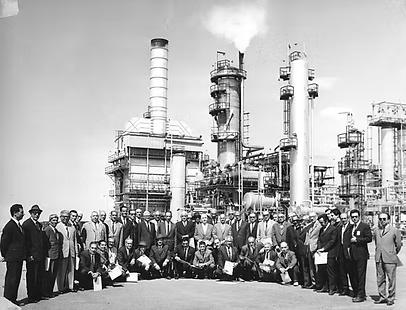
In 1951, the Abadan Oil Refinery was nationalized and today it is operated by the National Iranian Oil Refining and Distribution Company(NIORDC). Today, the Abadan Oil Refinery produces over 400,000 barrels of refined products per day.[6]
Important Dates
William Knox D'Arcy signed the D'Arcy Concession, granting him exclusive rights to explore for oil in Persia.
George Bernard Reynolds began searching for oil in Persia under D'Arcy's concession.
Reynolds discovered the first major oil field in the Middle East near Masjed Soleiman.
The Anglo-Persian Oil Company was established following the oil discovery.
Construction of the Abadan Oil Refinery began on Abadan.
The refinery commenced operations and began refining oil at a capacity of 2,500 barrels per day.
The Abadan Oil Refinery became fully operational and expanded production capabilities.
The British Cabinet approved the acquisition of a controlling 51 percent stake in the Anglo-Persian Oil Company to secure naval oil supplies.
Britain entered World War I, increasing demand for oil from the Abadan refinery.
The Anglo-Persian Oil Company created the North Persia Oil Company, expanding its interests beyond the original D'Arcy Concession area.
Frequently Asked Questions
When was the Abadan Oil Refinery built?
Construction of the Abadan Oil Refinery began in 1910 and refining operations started in 1912. The refinery became fully operational in 1913 with an initial capacity of 2,500 barrels per day.
Why is the Abadan Oil Refinery historically significant?
The Abadan Oil Refinery was the first refinery in the Middle East to process oil in significant commercial volumes. It played a major role in the development of the region's oil industry.
Who discovered the oil that led to the refinery's creation?
British geologist George Bernard Reynolds discovered oil near Masjed Soleiman in 1908 after years of unsuccessful exploration. His discovery became the first major oil find in the Middle East.
What was the D'Arcy Concession?
The D'Arcy Concession was an agreement signed in 1901 that gave William Knox D'Arcy exclusive rights to explore for oil in Persia. This concession ultimately led to the discovery of oil and the creation of the Anglo-Persian Oil Company.
Why did the British government invest in the Anglo-Persian Oil Company?
Britain wanted a reliable supply of oil to fuel its growing naval fleet. In 1914, the government acquired a 51 percent stake in the company to secure long-term access to oil.
How did World War I affect the Abadan Oil Refinery?
The refinery expanded production during World War I to meet increased military demand. Britain also deployed forces to protect oil infrastructure after German attacks targeted pipelines in the region.
Who operates the Abadan Oil Refinery today?
The refinery was nationalized by Iran in 1951 and is now operated by the National Iranian Oil Refining and Distribution Company. Today, it produces more than 400,000 barrels of refined petroleum products per day.
Citations
- “About Us.” Abadan Oil Refining Company. Accessed September 11, 2023. https://abadan-ref.ir/en/about-us ↑
- “First Oil – 1901-1908.” BP Global. Accessed September 11, 2023. https://www.bp.com/en/global/corporate/who-we-are/our-history/first-oil.html ↑
- “Early History” BP Global. Accessed September 11, 2023. https://www.bp.com/en/global/corporate/who-we-are/our-history/early-history.html ↑
- “Ābādān.” Encyclopædia Britannica. Accessed September 11, 2023. https://www.britannica.com/place/Abadan. ↑
- F. Kazemi, “ANGLO-PERSIAN OIL COMPANY,” Encyclopaedia Iranica, II/1, pp. 61-65, available online at http://www.iranicaonline.org/articles/anglo-persian-oil-company (accessed on 11 September 2023) ↑
- “About Us.” Abadan Oil Refining ompany. Accessed September 11, 2023. https://abadan-ref.ir/en/about-us. ↑