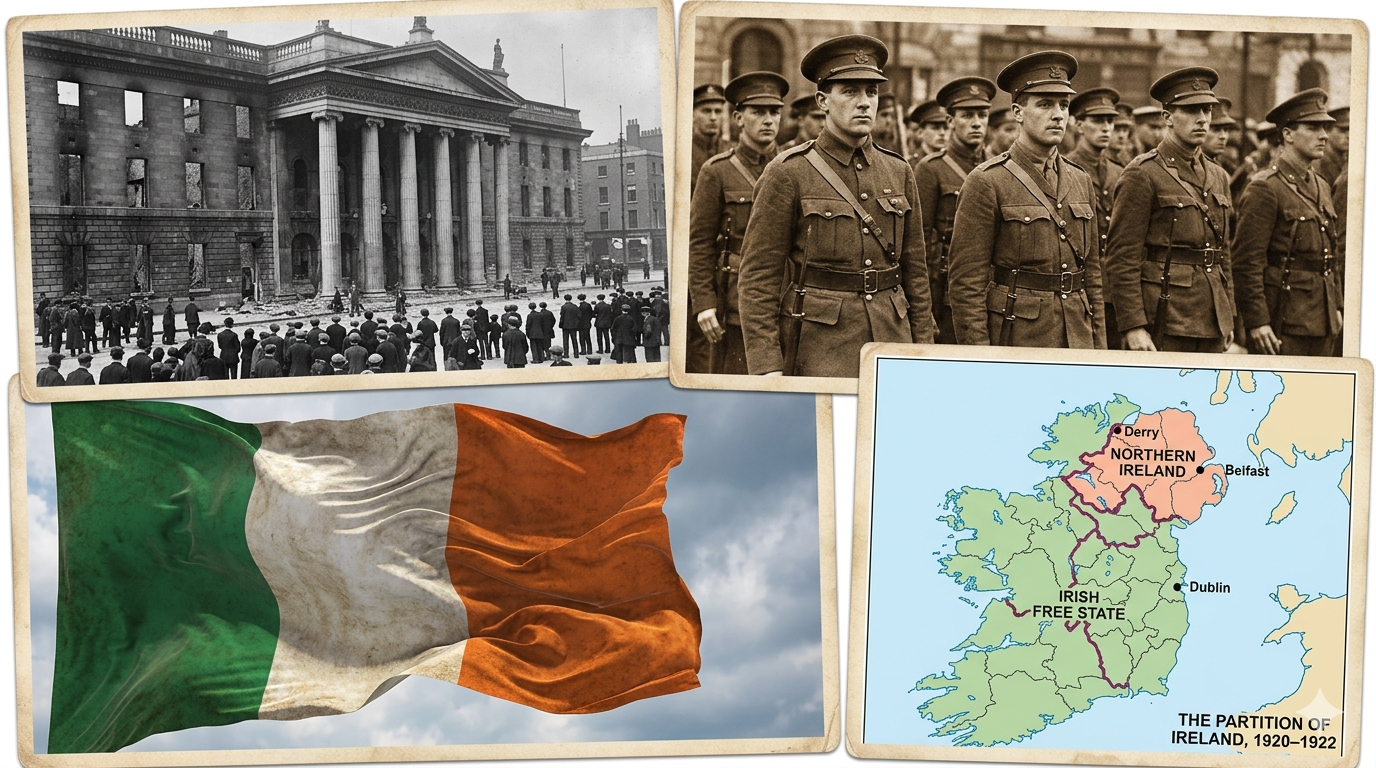
Ireland's path to independence was shaped by decades of political struggle, economic grievances, and growing resistance to British rule. Although the Home Rule movement appeared to achieve a major victory with royal assent for self-government in 1914, the outbreak of World War I delayed its implementation and set the stage for a more radical push for independence. From the Easter Rising of 1916 to the Irish War of Independence, a combination of political events and economic pressures ultimately transformed Ireland's relationship with Great Britain and led to the creation of the Irish Free State in 1922.
The Home Rule Act For Irish Independence
In 1913, Ireland was campaigning for its independence and the Home Rule Act was proposed in the House of Commons which was a law that would grant Ireland self-rule. The law had been proposed before, once as the Irish Government Bill of 1886 but it was defeated in the House of Commons. The bill was resurrected a few years later as the Irish Government Bill of 1893. This time it was passed in the House of Commons but voted down in the House of Lords. For historical context, the Irish "Home Rule Movement" was a movement that began in the 1870s and continued through to post-WWI, when independence was achieved.
When the Home Rule Act was proposed in 1913, the law was once again rejected in the House of Lords, however, in September 1914, the bill was given royal assent. With World War I just getting underway, the bill never actually took effect. Although the Irish had just received royal assent for "Home Rule," it is estimated that 140,000 Irishmen volunteered to fight for the United Kingdom during WWI.
On April 24, 1916, the event known as the Easter Rising occurred where Irishmen revolted against the British in Dublin. The revolt was short-lived as it was poorly executed and found out by the British ahead of time.[1]
Then in 1918, the British tried to draft Irishmen to fight in the war but they defiantly refused.[2] This only furthered Irish tensions and led to the Irish War for Independence immediately following World War I that officially ended in 1921. However, by the middle of 1920, Irish republicans had gained control of the government and the British government in Ireland collapsed. Violent uprisings continued through 1921, however, in December 1920, the royal assent was once again given with the signing of the 1920 Government of Ireland Act.
The 1920 Government of Ireland Act outlined the process for the split of Ireland into Northern Ireland, which remained part of the United Kingdom, and the independent southern portion known as the Irish Free State. Lord Lexden of the House of Lords stated that the 1920 Government of Ireland Act was a “vital staging post on the road” to the Irish Free State just a couple years later in 1922.[3]
How Ireland Became Independent from Great Britain: YouTube Short
The Economic Case For Ireland's Independence
Out of all the cases that could be made that Ireland should vie for its independence, the economic case is one of the strongest. At the time, Britain was exacting a high tax bill from Ireland. Here is an excerpt from the 1920 book The Economic Case For Irish Independence by Darrell Figgis.
. . .she[Ireland] is weighted under an unendurable taxation to the sole and individual advantage of England.[4]
Taxation By Nation Relative to Population in 1919
This table shows that Ireland was being taxed in far greater amounts than other respective nations relative to their population. The tax burden being placed upon Ireland was substantial.
| Nation | Population | Revenue From Taxation (pounds) | Ratio (Lower = Better) |
|---|---|---|---|
| Norway | 2,632,000 | 7,790,000 | 2.95 |
| Denmark | 2,940,000 | 9,559,000 | 3.25 |
| Switzerland | 3,937,000 | 9,112,000 | 2.31 |
| Sweden | 5,800,000 | 20,350,000 | 3.51 |
| Portugal | 5,957,000 | 8,655,000 | 1.45 |
| Holland | 6,724,000 | 18,243,000 | 2.71 |
| Belgium | 7,571,000 | 32,029,000 | 4.23 |
| Spain | 19,950,000 | 43,244,000 | 2.16 |
| Ireland | 4,390,000 | 38,000,000 | 8.65 |
Source: Figgis. The Economic Case for Irish Independence. 1920. 16.
Last Year of Trade Before World War I Started in July 1914
Next, when one considers the amount of trade that Ireland conducted with England relative to its population, it provides an indicator that Ireland was indeed being oppressed by England/Britain. It seems that England neglected one of their most important trade partners within their own empire and America's trade with England had only surpassed Ireland's a few years prior to 1914.[5]
| Nation | Population | Trade (pounds) |
|---|---|---|
| Portugal | 5,957,000 | 6,000,000 |
| Austro-Hungary | 49,607,000 | 7,000,000 |
| Japan | 55,965,000 | 12,500,000 |
| Spain | 19,994,000 | 21,000,000 |
| Italy | 34,671,000 | 21,000,000 |
| Belgium | 7,490,000 | 24,000,000 |
| Russia | 120,588,000 | 32,000,000 |
| Holland | 5,984,000 | 38,000,000 |
| France | 39,610,000 | 63,000,000 |
| Germany | 65,359,000 | 70,000,000 |
| Ireland | 4,390,000 | 135,000,000 |
| United States | 91,972,000 | 173,000,000 |
Source: Figgis. The Economic Case for Irish Independence. 1920. 12.
Ireland's (lack of) Population Growth
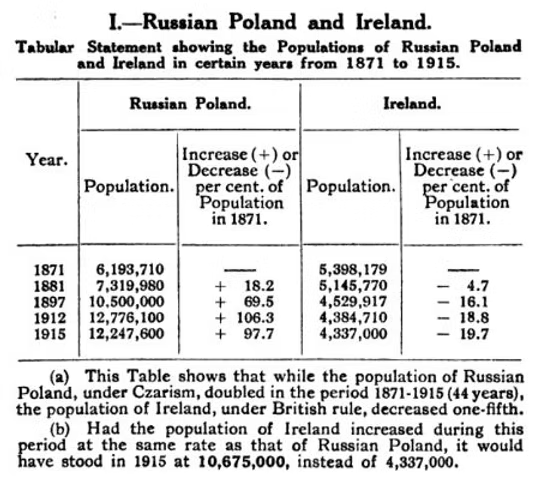
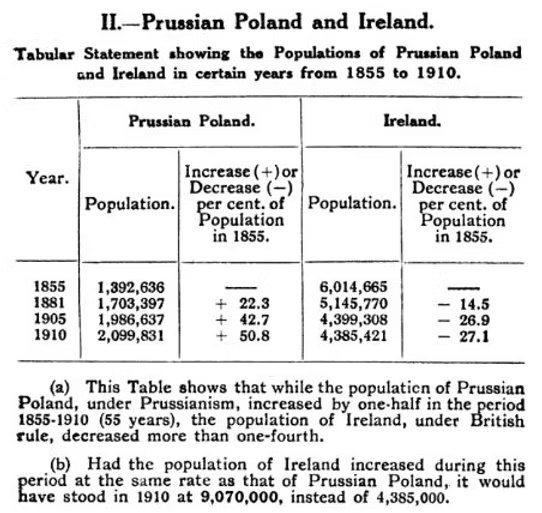
Next to the economic case, when Ireland's population growth is compared to other regions of the world from the mid-1800s up until the early 1900s, population growth was strangely declining in Ireland. While many other regions of the world were experiencing strong population growth, Ireland's population was decreasing. Simply by observing the economic difficulties imposed on Ireland under the rule of Great Britain, one might conclude that this also had an impact on that nation's prosperity measured by its population. Ireland's population decline during the 19th century demonstrated in the tables below was not something common to Ireland during the 18th century, as Ireland's population quadrupled during that time.[6]
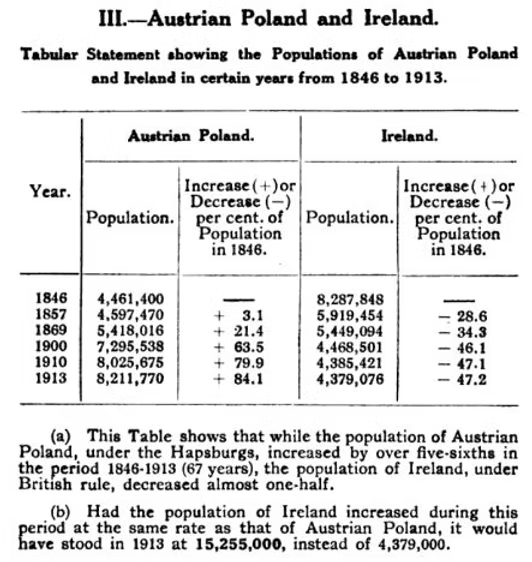
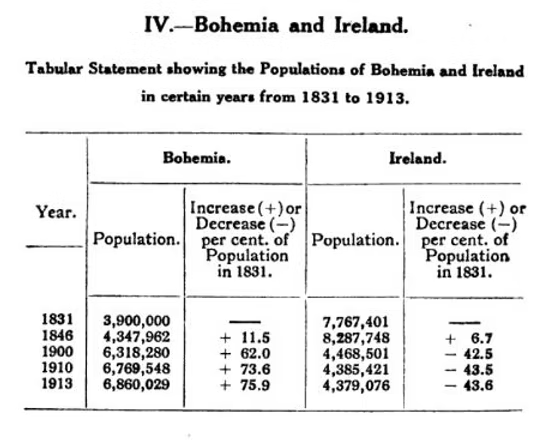
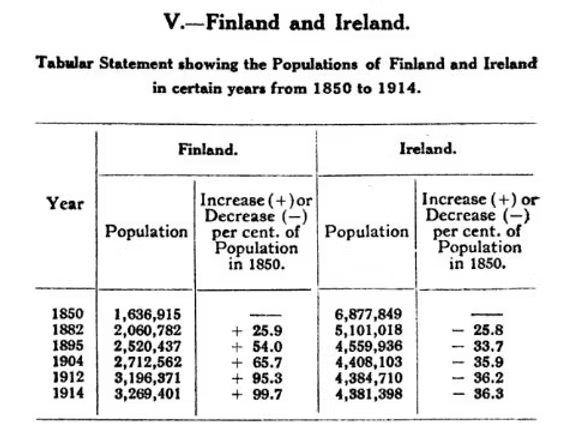
This period from 1913 to 1920 was a period of upheaval for the British Empire and it started with Ireland. Evidence suggests that this period from 1913 to 1920 marked the height of the British Empire. It is interesting that as Britain's Empire grew smaller during the 20th century that is started with its neighboring state, Ireland.
Places in this Story
The places this story moves through, in order — follow them on the interactive map →
- London, England 1913
The Home Rule Act was proposed in the House of Commons, representing a major political campaign for Irish self-government and independence.
- Dublin, Ireland April 24, 1916
The Easter Rising occurred as Irishmen revolted against British rule, though the uprising was short-lived and poorly executed.
- London, England December 1920
The 1920 Government of Ireland Act received royal assent, establishing the framework for partitioning Ireland into Northern Ireland and the Irish Free State.
Important Dates
The First Irish Government Bill (First Home Rule Bill) was introduced in the British Parliament but was defeated in the House of Commons.
The Second Irish Government Bill (Second Home Rule Bill) was introduced and passed the House of Commons before being rejected by the House of Lords.
The Third Home Rule Bill was proposed again, renewing efforts to grant Ireland self-government within the United Kingdom.
The Home Rule Act received royal assent, officially becoming law. However, the outbreak of World War I delayed its implementation indefinitely.
World War I began, preventing the Home Rule Act from taking effect and changing the course of Irish politics.
The Easter Rising began in Dublin as Irish republicans launched an armed rebellion against British rule.
The British government attempted to extend military conscription to Ireland, triggering widespread opposition and strengthening the independence movement.
The Irish War of Independence officially began with the Soloheadbeg Ambush and the establishment of Dáil Éireann.
Irish republicans gained effective control over much of the local government in Ireland as British authority weakened.
The Government of Ireland Act of 1920 received royal assent, creating the framework for partition and separate governments in Northern and Southern Ireland.
A truce came into effect between British forces and Irish republicans, effectively ending major fighting in the Irish War of Independence.
The Anglo-Irish Treaty was signed, establishing terms for Irish self-government and the creation of the Irish Free State.
The Irish Free State was officially established as a self-governing dominion, marking Ireland's formal independence from Great Britain while Northern Ireland remained part of the United Kingdom.
Frequently Asked Questions
When did Ireland gain independence from Great Britain?
Ireland's path to independence from Great Britain culminated in the creation of the Irish Free State in 1922. This followed decades of political activism, the Easter Rising, and the Irish War of Independence.
What was the Home Rule Act and how did it affect Irish independence?
The Home Rule Act was legislation intended to grant Ireland self-government while remaining within the United Kingdom. Although it received royal assent in 1914, World War I delayed its implementation and increased support for full Irish independence.
What was the Easter Rising and why was it important to Ireland's independence?
The Easter Rising of 1916 was a rebellion by Irish nationalists seeking independence from British rule. Although the uprising was suppressed, it helped build public support for the Irish independence movement.
What caused the Irish War of Independence?
The Irish War of Independence was fueled by growing nationalist sentiment and opposition to British rule after World War I. Resistance to British conscription efforts in Ireland also contributed to rising tensions and conflict.
What was the Government of Ireland Act 1920?
The Government of Ireland Act 1920 divided Ireland into Northern Ireland and Southern Ireland. The legislation became an important step toward the establishment of the Irish Free State in 1922.
What were the economic arguments for Irish independence?
Supporters of Irish independence argued that Ireland faced excessive taxation and economic policies that disproportionately benefited Britain. These economic grievances became a major part of the case for ending British rule in Ireland.
Why did Ireland's population decline before independence?
Ireland's population declined significantly during the 19th and early 20th centuries, unlike many other European regions that experienced growth. Advocates of Irish independence cited this trend as evidence of economic difficulties and limited opportunities under British governance.
Citations
- The Editors of Encyclopaedia Britannica, “Easter Rising | Events, Leaders, Executions, & Facts,” Encyclopedia Britannica, July 7, 2023, https://www.britannica.com/event/Easter-Rising ↑
- John_Dorney, “‘A Declaration of War on the Irish People’ The Conscription Crisis of 1918 – The Irish Story,” April 24, 2018, https://www.theirishstory.com/2018/04/24/a-declaration-of-war-on-the-irish-people-the-conscription-crisis-of-1918/ ↑
- Tudor, Sarah. “Government of Ireland Act 1920: What System Did It Create?” Lordslibrary.parliament.uk, 9 Dec. 2020, lordslibrary.parliament.uk/government-of-ireland-act-1920-what-system-did-it-create/ ↑
- Figgis, Darrell. The Economic Case for Irish Independence. Ireland: Maunsel, Limited, 1920. 15. ↑
- Figgis. The Economic Case. 20. ↑
- Figgis. The Economic Case. 12. ↑