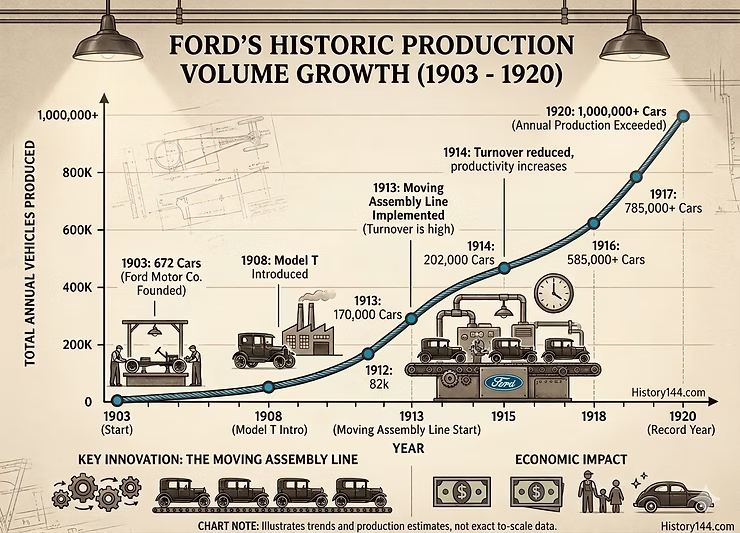
In 1913, Henry Ford introduced the moving assembly line at the Highland Park factory, revolutionizing industrial manufacturing. By dramatically reducing production time for the Model T, Ford lowered automobile prices, increased worker wages, and helped usher in the age of mass production.
Henry Ford and the Moving Assembly Line
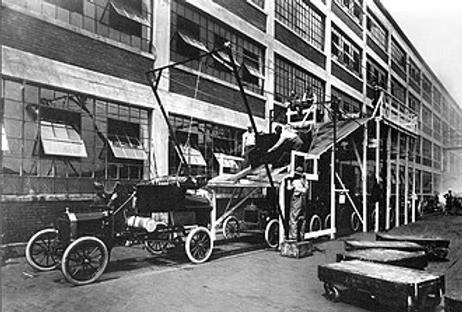
In 1913, Henry Ford had produced just over 170,000 Model T automobiles.[1] Then, on December 1, 1913, Henry Ford's moving assembly line began operations with the goal of increased efficiency and productivity at Ford's Highland Park plant. The idea of the moving assembly line for manufacturing was unique, however, Ford borrowed the idea from the Chicago meat packing industry. Some point out the irony that Ford derived his idea for the assembly line from an industry that disassembles. When the assembly line began, it was organized into 84 stations with a worker at each station.[2] Ford had been experimenting and preparing for the assembly line upgrade since April 1913.
Ford Struggles to Keep Workers
In January 1914, just a month after the assembly line began, Henry Ford more than doubled the wage he was paying his workers to $5 per day for a 5-day work week. Henry Ford's pay raise came in the form of what he called "profit-sharing."[3] Ford hoped that this would reduce worker turnover. Adjusted for inflation, this was a manageable living wage. For context, $5 then was worth $150 to $160 today.
When the moving assembly line was created it reduced the time it took to assemble a Model T chassis from 12 hours to 1.5 hours.[4] But it created new challenges in the work environment, primarily causing work to be very repetitive and taxing. When workers were only making $2.34 cents and working on the assembly line, worker turnover was high. The annual worker turnover rate was 380 percent. That means Ford had to hire 52,000 people per year just to maintain a workforce of 14,000 people.[5] When Ford asked his managers to increase the workers pay, they agreed to increase pay by 25 cents per hour. Ford told his managers that was not enough and he demanded his managers agree to $5/day and 8-hour work days rather than 9-hour work days. This is a great example of what can happen when workers become more productive thanks to technology and businesses are willing to share the profits with their workers. More on this in the concluding section of the article.
The Ford Sociological Department
Following the success of the 1913 assembly line, to locate and ensure Ford had the best workforce, he created the Ford Sociological Department in 1914. This was a radical experiment on one hand but a common sense practice on the other. Worker's personal conduct outside of work became linked to their paycheck. To qualify for the famous $5-a-day profit-sharing—which was nearly double the industry average wage—employees had to meet strict moral and behavioral standards set by Henry Ford. A team of investigators would visit workers' homes to ensure they kept a clean house, avoided alcohol and gambling, contributed to savings accounts. For immigrants, they needed to be actively learning English and "Americanizing" their lifestyle. This practice significantly improved the living standards and health of many Ford employees. However, one can understand how this practice received scrutiny as well.[6] Today, we call this the "Human Resource Department."
The Ford-Dodge Drama
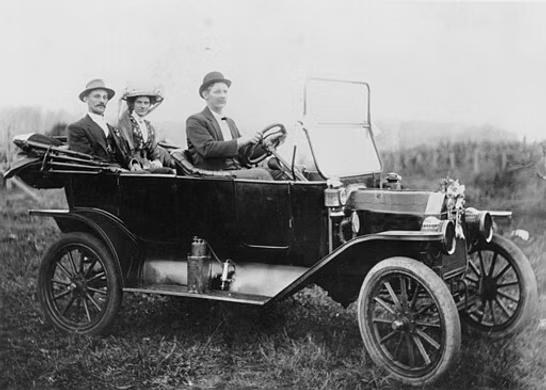
On December 30, 1918, Henry Ford stepped down as the president of Ford Motor Company and his son, Edsel Ford stepped into the role. The Dodge Brothers had sued Ford for withholding dividends as they held significant shares in the company. The Dodge brothers had acquired shares of the company when Ford had them contract manufacture parts beginning in 1903. At the time, Ford couldn't pay them their full wages and so he agreed to pay them in part with shares in the company.
Henry Ford Resigns
After resigning as president in 1918, Henry went on to threaten to sell all his shares in the company and start a new company. In response, the Dodge Brothers sold all their shares to Ford as they didn't want to face Henry Ford as a competitor and they were busy managing their own car company since 1913. By July 1919, only Henry Ford and his family members owned shares in the company.
In 1920, Ford reorganized the company as a Delaware chartered company and had a record-breaking year, producing over 900,000 vehicles.[7] This was a dramatic increase from 1913 production, when the assembly line began.
Tragically, the Dodge brothers both passed away in 1920 when they contracted the flu and pneumonia while attending an auto expo in New York City. John Dodge died in January 1920 and Horace Dodge died months later in December 1920.
YouTube Short: Henry Ford Moving Assembly Line
The Danger of the "Division of Labor" and Adam Smith
Since industrialization began, workers have been forced to specialize more and more to the point of hyper-specialization we experience today. In the past, of course there was always a degree to which work was specialized but today, it is not unusual for someone to sit in front of a computer, performing the same task, the entire work-day...or any number of other very repetitive tasks. And its not just office workers. Generally speaking, if you want to make it in the world today, you will be required to hyper-specialize.
The famous author, Adam Smith who wrote, The Wealth of Nations, stated in Volume 5 of his work, that:
The man whose whole life is spent in performing a few simple operations... generally becomes as stupid and ignorant as it is possible for a human creature to become.[8]
On the other hand, Smith recognized in Volume 1, that the key to increased productivity was, in fact, specialization. He used a pin factory as an example.
One man draws out the wire, another straight[en]s it, a third cuts it, a fourth points it, a fifth grinds it at the top for receiving the head; to make the head requires two or three distinct operations; to put it on, is a peculiar business, to whiten the pins is another; it is even a trade by itself to put them into the paper; and the important business of making a pin is, in this manner, divided into about eighteen distinct operations...[9]
Smith went on to argue that the division of labor, aka specialization, would only make sense in urban areas. He argued that there must be enough people to absorb or otherwise demand the increased labor output. In rural areas, and without advanced supply chains, there is not enough demand to absorb the increased productivity resulting from specialization.
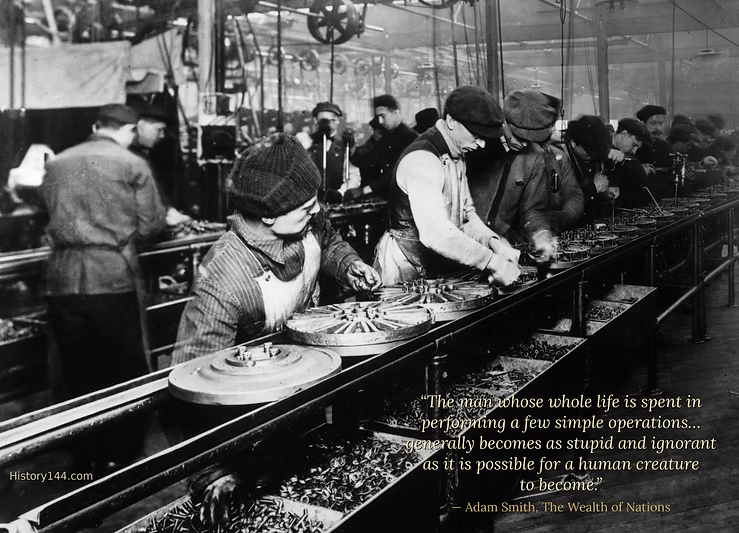
Smith's division of labor would result in greater efficiencies from three things: dexterity, time-saving, and machinery. Author Douglas Irwin in his book Against the Tide: An Intellectual History of Free Trade, argued that Ford's genius was realizing that division of labor was a scalable law of nature. Ford engineers were able to break down the car manufacturing process into such minute tasks that it effectively "de-skilled" the labor, which Adam Smith warned about. We went from a workforce who knew the entire automobile to one that only knew their part. On the other hand, this positively made the automobile a mass-market commodity instead of a luxury. Adam Smith's pin factory example had 18 distinct tasks to create a pin, while Ford divided their processes into over 8,000 specialized tasks.[10]
As disappointing as it is, Smith's solution to the dumbing down of society's workforce, was a publicly funded education system. Smith was right that repetitive tasks make people stupid, but he did not live to see the detrimental results of government funded education that we are living through today.
Are Workers Receiving the Fruit of their Labor (Productivity Gains) Today?
Can you imagine, getting a 100 percent raise overnight from your employer? Or an employer implementing a profit-sharing program that shares a substantial portion of the profitability of the company? Ask anyone working today and they are happy to squeak out a 2 percent raise. Anything above that is considered extraordinary. And in a world that is rightly ordered, a 2 percent raise in a world with five to eight percent annual inflation, would be laughed at. Rather, raises would reward workers for the productivity gains they create while at the same time, increasing their employer's profitability. However, since 1913, there has been a dual system that steals any productivity gains from the workers who create them. Those two things are the US Federal Reserve Bank and the 16th Amendment that legalized the income tax. Today, workers are not rewarded for becoming more productive...rather, they are continually stressed to find new ways to do greater and greater amounts of work without being proportionately rewarded. Why is it happening this way? One reason it is happening this way thanks to the U.S. Federal Reserve central bank doubling the money supply in 2009 and again in 2020-21. The Federal Reserve, thanks to its money printing, causes inflation to rise, and as a result, any productivity gains that workers create, mostly go to the state in the form of a hidden inflation tax. I realize it may be difficult for some to conceptualize this and connect these two concepts: increasing productivity vs increasing wages. That's why there is a beautiful chart, just below, that provides a visual, yet factual, understanding for us.
In this chart, one line represents worker productivity and the other represents hourly wages. Historically, these two lines remained in lockstep, however notice the date that the two lines began to diverge. The divergence between worker's productivity and their wages began to happen immediately after 1971. Ask yourself, "What happened in 1971?" Most already know, but this was the year that fiat(paper) money became unpegged from gold. Today, governments can print as much money as they want with nothing backing it. This causes inflation which will eat up any productivity gains you create in your work...leaving the workers to work harder while earning less when adjusted for inflation.
Although the dollar didn't become unpegged from gold until 1971, the institution that made this possible, the Federal Reserve, was created in the same year as Henry Ford's moving assembly line: 1913.
Source: FRED St. Louis Federal Reserve
Important Dates
The Dodge brothers begin manufacturing parts for Ford and receive company shares as part of their compensation.
Ford begins experimenting with and preparing for the moving assembly line.
Ford produces just over 170,000 Model T automobiles.
Henry Ford introduces the moving assembly line at the Highland Park Ford Plant.
Ford raises worker pay to $5 per day and reduces the workday from 9 to 8 hours.
Ford creates the Ford Sociological Department to oversee worker welfare and eligibility for profit-sharing.
Henry Ford resigns as president of Ford Motor Company; his son Edsel Ford becomes president.
Ford and his family become the sole owners of Ford Motor Company after buying out other shareholders.
John Dodge dies from complications of flu and pneumonia.
Ford reorganizes the company as a Delaware-chartered corporation and produces over 900,000 vehicles.
Horace Dodge dies from complications of flu and pneumonia.
Frequently Asked Questions
What Was Henry Ford’s Moving Assembly Line?
Henry Ford introduced the moving assembly line at Ford’s Highland Park factory in 1913 to increase manufacturing efficiency and lower automobile production costs. The innovation revolutionized industrial manufacturing by dramatically speeding up production of the Ford Model T and helping make cars affordable for average Americans.
Why Was the 1913 Ford Assembly Line Important?
The 1913 moving assembly line is considered one of the most important industrial innovations in modern history because it transformed mass production. By reducing assembly time from over 12 hours to about 90 minutes, Ford changed how factories around the world manufactured goods.
Why Did Henry Ford Pay Workers $5 Per Day?
In January 1914, Henry Ford introduced the famous $5-per-day wage to reduce worker turnover and improve factory productivity. The higher pay also helped workers afford the products they manufactured, strengthening the growing consumer economy.
What Was the Ford Sociological Department?
The Ford Sociological Department was created in 1914 to investigate the personal lives and living conditions of Ford employees. Workers seeking access to Ford’s profit-sharing program had to meet strict behavioral standards involving hygiene, finances, alcohol use, and family life.
Did Henry Ford Invent the Assembly Line?
Henry Ford did not completely invent the assembly line, as earlier versions existed in industries like meatpacking. However, Ford perfected and scaled the moving assembly line for automobile manufacturing, permanently changing global industry.
What Was the Dodge Brothers Lawsuit Against Ford About?
The Dodge brothers sued Ford Motor Company because they believed Henry Ford was withholding shareholder dividends to reinvest profits into company expansion. The lawsuit became one of the most important early corporate law cases involving shareholder rights and business control.
How Did Henry Ford Use Adam Smith’s Ideas About Division of Labor?
Adam Smith argued in The Wealth of Nations that specialization increased productivity and efficiency. Ford applied these ideas on a massive scale by dividing automobile manufacturing into thousands of highly specialized tasks on the assembly line.
Citations
- “Henry Ford and Edsel Ford with Ford Motor Company Executives, Henry Ford’s Office at the Highland Park Plant, circa 1913 - The Henry Ford,” 8/25/2023. https://www.thehenryford.org/collections-and-research/digital-collections/artifact/114263 ↑
- “A Science Odyssey: People and Discoveries: Ford Installs First Moving Assembly Line,” 8/25/2023. https://www.pbs.org/wgbh/aso/databank/entries/dt13as.html# ↑
- Gilchrist, Robert Niven. The Payment of Wages and Profit-sharing: With a Chapter on Indian Conditions. India: University of Calcutta, 1924. 200. ↑
- Ford Website. “Company Timeline,” 8/25/2023. https://corporate.ford.com/about/history/company-timeline.html# ↑
- Watts, Steven. The People's Tycoon: Henry Ford and the American Century. New York: Alfred A. Knopf, 2005. 190-194. ↑
- Meyer, Stephen, III. The Five Dollar Day: Labor Management and Social Control in the Ford Motor Company, 1908–1921. Albany: State University of New York Press, 1981. ↑
- “Ford Production,” 8/25/2023. https://www.mtfca.com/encyclo/fdprod.htm ↑
- Smith, Wealth of Nations, 5.1.178. ↑
- Smith, Adam. An Inquiry into the Nature and Causes of the Wealth of Nations. Edited by R. H. Campbell and A. S. Skinner. Vol. 1 of the Glasgow Edition of the Works and Correspondence of Adam Smith. Oxford: Oxford University Press, 1976. Original edition, London: Strahan and Cadell, 1776. 1.1.3. ↑
- Irwin, Douglas A. Against the Tide: An Intellectual History of Free Trade. Princeton, NJ: Princeton University Press, 1996. 75–78. ↑