At noon on Wednesday, May 10, 1643, the common hangman burned a book in Cheapside. The sheriffs of London and Middlesex had fixed the hour, and anyone who held a copy had been ordered to surrender it to them. Burning by the hangman was the usual end of a seditious or blasphemous libel, and this book was neither. It was a royal declaration, first issued by James I and reissued by his son Charles ten years before, which ministers had been made to read aloud from their pulpits at the king’s command. What it told English parishioners was that after divine service on a Sunday they might lawfully dance, shoot with the bow, and set up a maypole.[1]
The fire was the end of a quarrel that had started eleven years earlier in a county courtroom. In Lent of 1632, the assize judges of England's Western Circuit, sitting in Somerset, ordered an end to the county's church ales and wakes, the parish feasts at which villagers ate, drank, danced, and raised money for their churches. A copy was to be put into the hands of every parish minister, and each minister was to read it aloud to his congregation, so that the ban would be heard from the pulpit as well as entered in the court's books.[2] Nothing in the ban itself was new. Somerset justices had issued similar prohibitions in 1594, 1596, 1608, 1624, and 1628, and justices in neighboring Devon had done the same at least four times.[3] What was new was the pulpit. That one clause would set the Lord Chief Justice of England, Sir Thomas Richardson, against William Laud, then Bishop of London, and it would end with Richardson rebuked before the Privy Council and taken off the circuit.
It is easy to assume that a quarrel over village feasts would stay in the village. This one reached the king. Within two years, Charles I had reissued his father's Declaration of Sports, the royal statement permitting dancing, archery, maypoles, and village feasts on Sunday afternoons, and had ordered that it be published in every parish church in England. Over the following decade the declaration, known popularly as the Book of Sports, became a test of obedience for the clergy, a grievance in parliamentary petitions, and finally, after Parliament and king went to war, an object to be burned in the street. By April 1644 Parliament had outlawed the very Sunday recreations that Charles had commanded his subjects to enjoy, and the archbishop most closely associated with the declaration was on trial for his life. The historian Thomas Barnes, writing about the Somerset quarrel, argued that the religious divisions which had preoccupied members of Parliament in the 1620s became a matter of everyday concern in the countryside only during Charles's years of rule without Parliament in the 1630s.[4] The Book of Sports was one of the clearest routes by which that happened. It carried a quarrel over royal and church authority into the parish church on Sunday morning and put it in the minister's mouth, where every villager could hear it. This is the story of those twelve years.
The Ale in the Churchyard
The church ale was an old institution in the West Country. The term covered a family of celebrations held in or near the churchyard. A wake was the revel held on the anniversary of a church's dedication, a "bidale" was organized for the relief of a villager or household in need, and a "clerkale" helped pay the parish clerk.[5] Ale was brewed and sold, food was served, and there was music and dancing. The profits went to the parish, and they could be significant. One Somerset church, East Coker, had been repaired with the proceeds of a church ale in the late 1620s. The typical return from such a feast, however, had fallen considerably over the previous century, from somewhere between ten and twenty pounds to perhaps four or five.[6] The ales also supported a modest trade in entertainment. In the summer of 1607, a professional bull-baiter took more than three and a half pounds from five church ales in Somerset, Dorset, and Wiltshire.[7]
To the godly members of the county's gentry and magistracy, these gatherings were occasions for drunkenness, disorder, and sin, and above all a profanation of the Sabbath. Petitions against church ales routinely spoke of riots, disorders, and even murders. Barnes, who read every criminal examination sent to the Somerset quarter sessions between 1625 and 1640, found that such language was largely a formula. He identified only one serious disturbance at a church ale in those fifteen years, a riot at Coleford in the Mendip hills on Holy Thursday, May 30, 1633, in which eighteen men from neighboring villages were arrested.[8] The campaign against the ales therefore rested less on any wave of crime than on a conviction, strongest among the Puritan-minded, that Sunday belonged wholly to God.
That conviction, usually called Sabbatarianism, had been growing in England since the late sixteenth century. It held that the fourth commandment, to keep the Sabbath day holy, bound Christians as fully as the commandments against murder or theft, and that Sunday was to be spent in worship, sermons, prayer, and rest, not in games. Many English Protestants who would not have called themselves Puritans shared some version of this view. To others, including the king, it was a meddlesome strictness that set ministers and magistrates against ordinary pleasures. In 1632 the Somerset judges carried that quarrel into every parish pulpit in the county.
To Strike Equally on Both Hands
The Book of Sports itself was not Charles's invention. In the summer of 1617, James I passed through Lancashire on his way south from Scotland. According to the account he later published, he heard with his own ears the complaints of his subjects that they were barred from all lawful recreation on Sunday afternoons after divine service had ended.[9] Lancashire was a county with an unusually large Catholic population, and local Puritan magistrates and ministers had been suppressing Sunday games. James issued a declaration for the county, and in 1618 he extended it to the whole kingdom.[10]
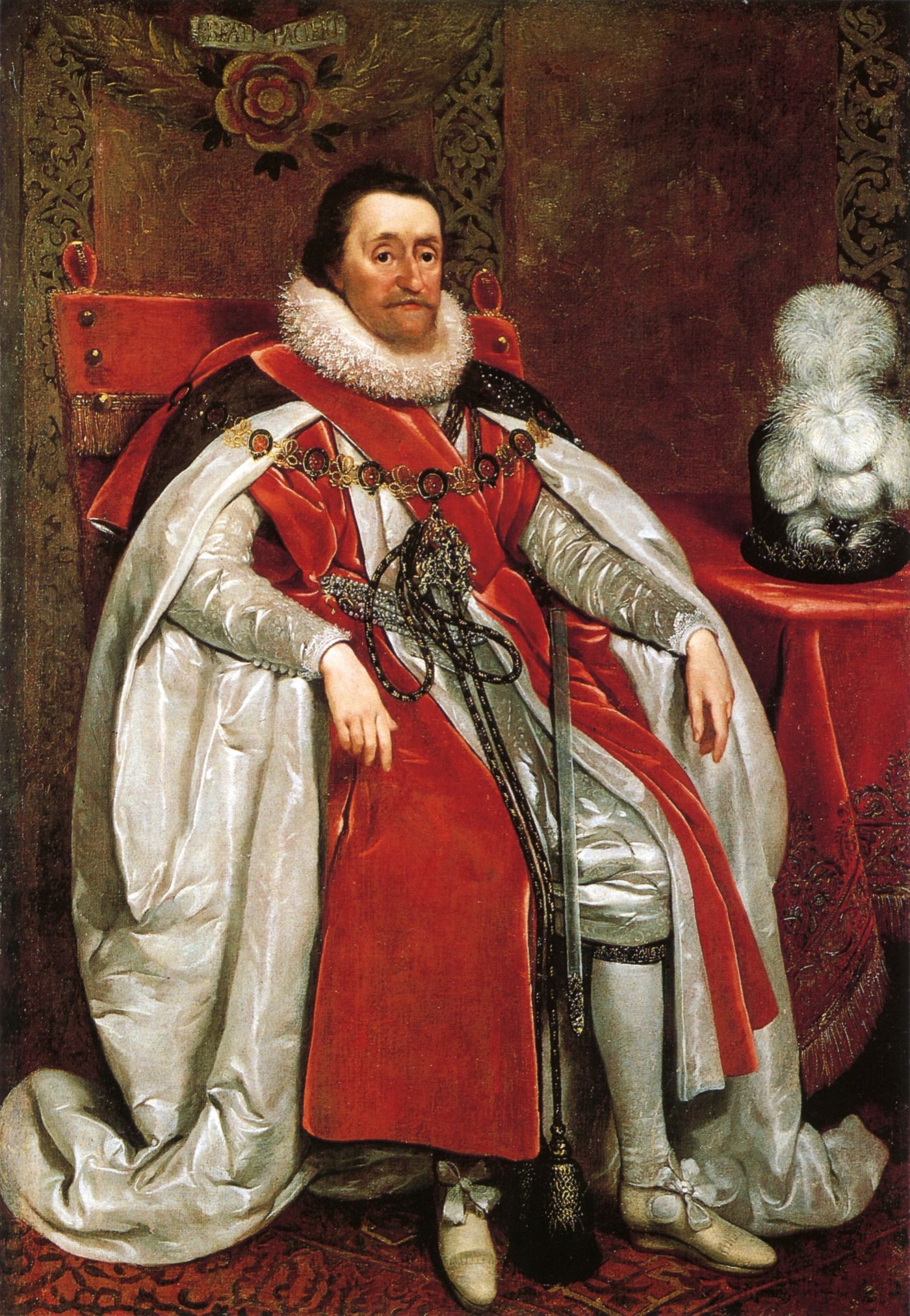
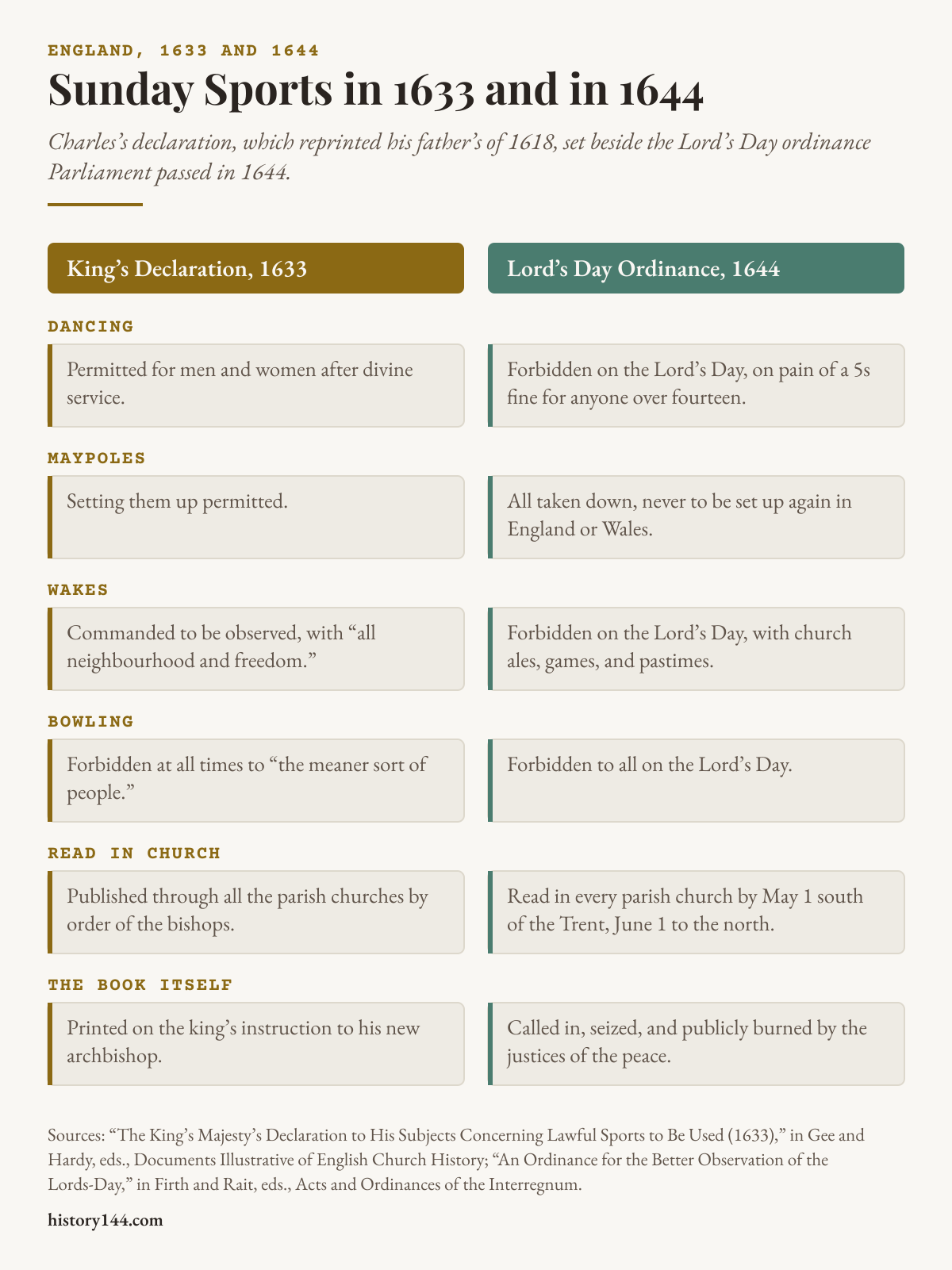
The declaration explained the king's reasons with some care. A ban on Sunday recreation, James wrote, would hinder the conversion of Catholics, whose priests would persuade them that the Protestant religion allowed no honest mirth. It would also deprive working people, who labored all week, of the only time they had to exercise, and it would weaken the bodies the realm might need for war. In place of healthy exercise, he warned, it would drive people into the alehouse.[11] The king therefore declared that after divine service his people should not be disturbed or discouraged from lawful recreation, on holy days as well as Sundays. The recreations he listed were dancing for men and women; archery, leaping, and vaulting for men; May games, Whitsun ales, and morris dances; and the setting up of maypoles. Women might carry rushes to the church to decorate it, according to old custom. Bear-baiting, bull-baiting, and interludes remained forbidden on Sundays, and bowling stayed forbidden at all times to "the meaner sort of people."[12]
The declaration's liberty came with conditions. It applied only to those who had first attended church. Known recusants, the Catholics who refused to attend Anglican services, were barred from the benefit, as was anyone, however conformable, who had not been present at the service that day. Each parish was to hold its own recreations, and no offensive weapons were to be carried.[13] It was meant to cut both ways. It rebuked "Puritans and precise people" for unlawfully punishing harmless recreation, and it ordered the bishop to deal firmly both with Catholics who would not conform and with Puritans, so as "to strike equally on both hands."[14] To strict Sabbatarians, the conditions hardly mattered. A king had published a list of pleasures approved for the Lord's Day.
Lawn Sleeves
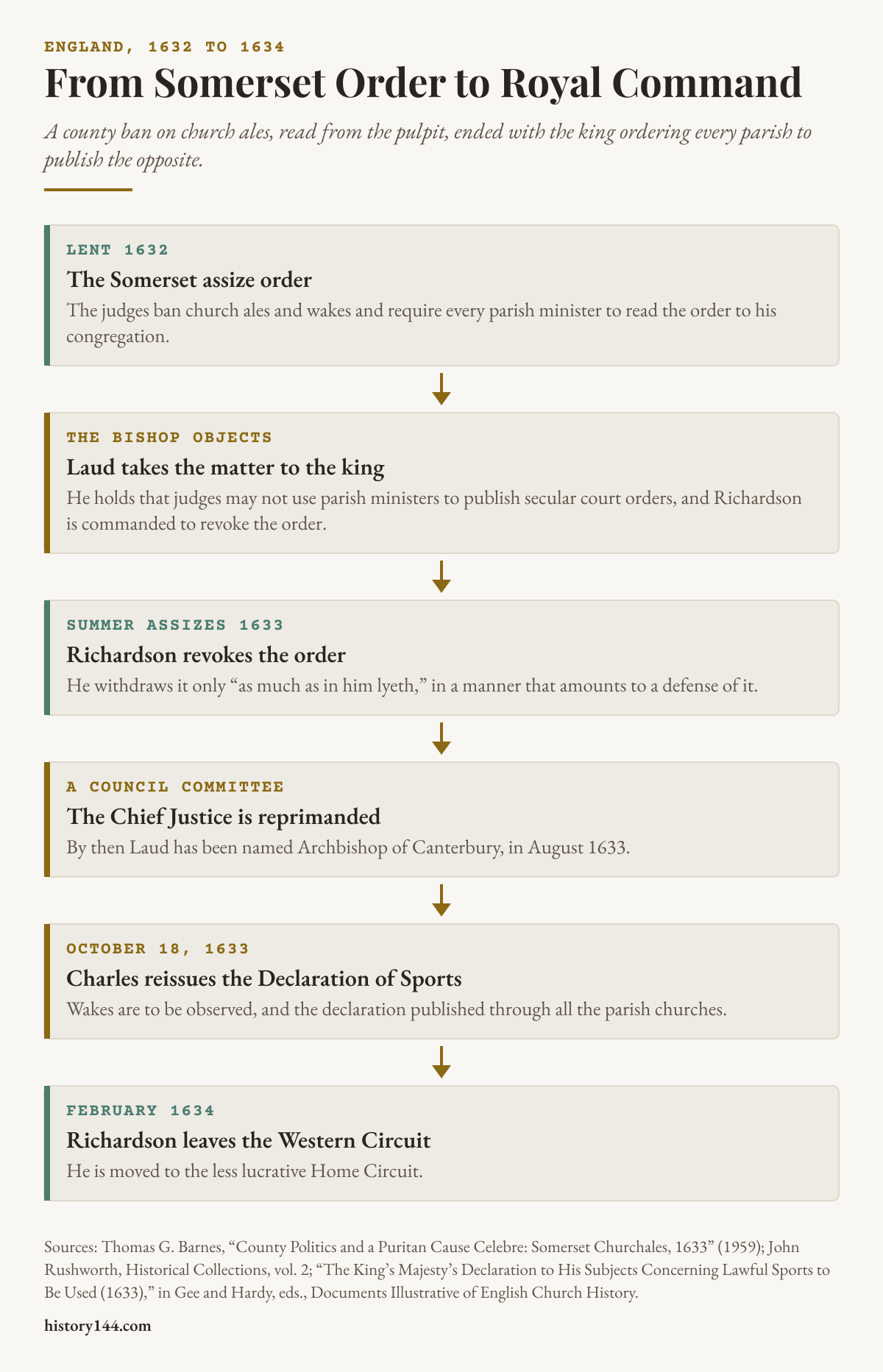
In 1632 the Somerset order brought the old dispute back to life, though at first the fight was over who could use the pulpit. Laud's main objection, as both his critics and his defenders later agreed, was that judges of assize were using parish ministers to publish secular court orders, which he regarded as an encroachment on the authority of the church. As bishop of London he had already stopped the lord mayor from making a similar use of the city's clergy.[15]
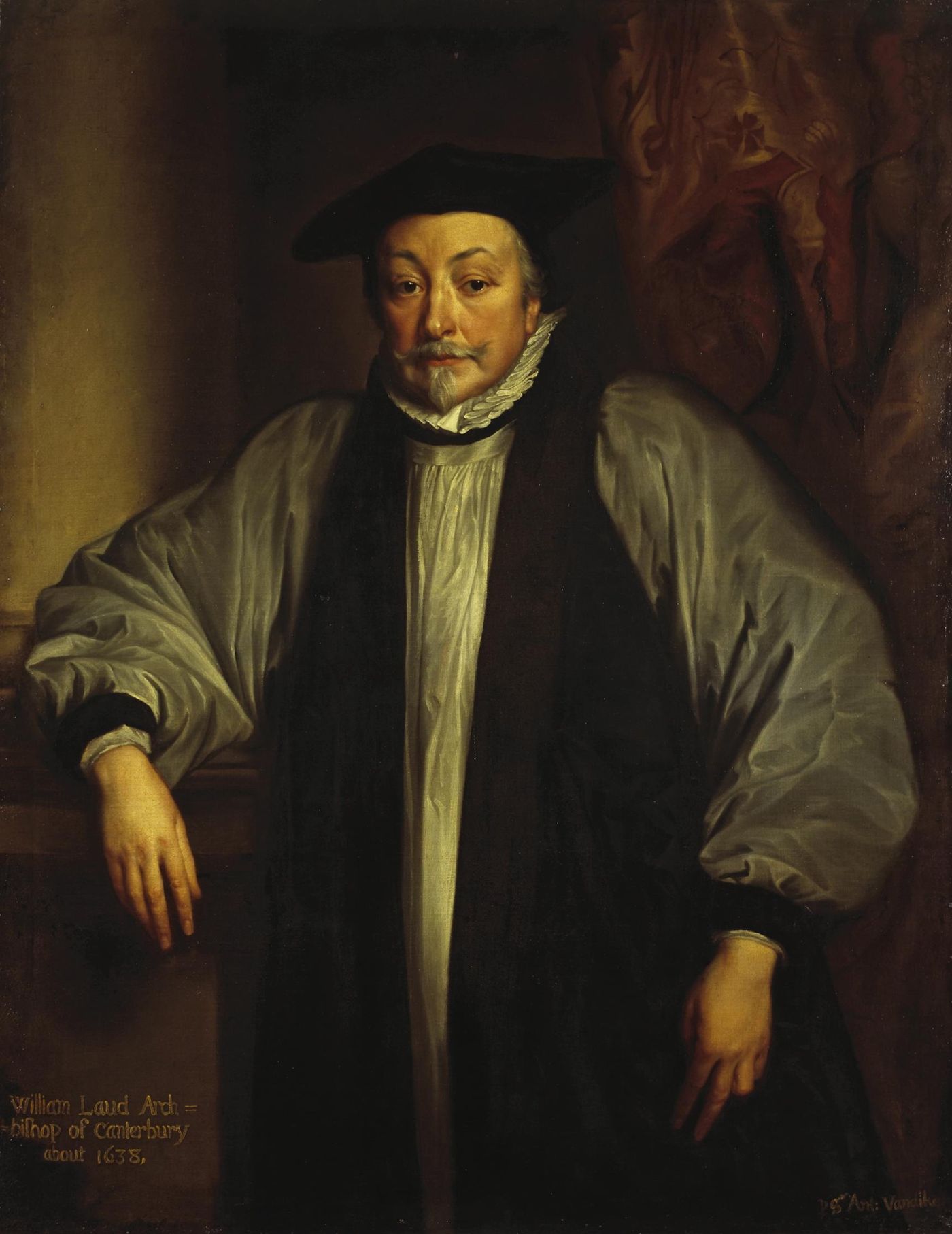
Accounts of who drafted the 1632 order differ. Seventeenth-century writers, including the Puritan lawyer William Prynne and Laud's own biographer Peter Heylyn, attributed it to Richardson. Barnes, who located the order in the assize records, concluded that this attribution was mistaken. He also noted that Richardson's colleague on the circuit, Baron John Denham, had made a similar order at the Dorset assizes the previous autumn, though without requiring the clergy to read it.[16] Whoever wrote it, Richardson became its public face and its defender.
Richardson was not a natural champion of Puritan causes. He was a Norfolk-born lawyer who had served as Speaker of the House of Commons in 1621, had become Chief Justice of the Common Pleas in 1626, and in October 1631 had been made Chief Justice of the King's Bench, assigned to the Western Circuit. Rushworth, who printed the documents of the affair, records that Laud took the matter to the king and that Richardson was required to revoke the order.[17]
Somerset's politics complicated the matter. Sir Robert Phelips, one of the county's leading gentlemen and a long-standing figure in Parliament, was a rival of Richardson's and a defender of the traditional revels. The historian Samuel Rawson Gardiner believed that Phelips had alerted Laud to the order in the first place. Barnes found no proof of this, although Richardson himself suspected Phelips of stirring up opposition.[18] In August 1633 Phelips wrote directly to the king about the affair.[19] Richardson, for his part, resented the interference. According to Phelips, the judge remarked that Phelips might make "very fyne speeches in the Parliament house," but Richardson would still be Lord Chief Justice.[20]
Richardson first withdrew the prohibitions at the Dorset assizes in the spring of 1633. The Coleford riot followed about two months later, and Barnes suggested that the revelers of the Mendips had been emboldened by the news.[21] When Richardson came to revoke the Somerset order at the summer assizes, he did so in a manner that amounted to a defense of it. He laid the matter before the justices and the grand jury, explained that the order had been made with the consent of the whole bench, and showed from the county records that it merely confirmed orders going back to Elizabeth's reign.[22] The written revocation itself carried a small reservation, withdrawing the order only "as much as in him lyeth."[23]
This performance cost Richardson dearly. He had already been called before the council once and commanded to revoke the order, and Rushworth says he revoked it "after his Reproof at the Council Table." After the summer assizes he was summoned again, this time before a committee of the Privy Council, where Laud rebuked him for the grudging manner of his obedience. Seventeenth-century writers liked to tell how he left the council table muttering that he was likely to be choked with the archbishop's lawn sleeves, the white linen sleeves of a bishop's vestments. No record of the council contains the remark, and it reads like the kind of story that attaches itself to a famous quarrel.[24] By then Laud had been named Archbishop of Canterbury, in August 1633. Richardson was transferred from the Western Circuit to the less lucrative Home Circuit, which included Essex, by a patent dated February 1634.[25] He died in his house in Chancery Lane on February 4, 1635.
Laud also wanted evidence from the clergy of Somerset. He wrote to William Piers, bishop of Bath and Wells, asking how the wakes were conducted. Piers replied on November 5, 1633, with the opinions of seventy-two parish incumbents who spoke warmly in favor of the revels. Barnes described them as hand-picked.[26]
All Neighbourhood and Freedom
By the time Piers's answer reached London, the king had already acted. On October 18, 1633, Charles issued The King's Majesty's Declaration to His Subjects Concerning Lawful Sports to Be Used. The document reprinted James's declaration of 1618 in full and added a new paragraph at the end. Charles explained that he was ratifying his father's declaration because in some counties, "under pretence of taking away abuses," there had been a general prohibition not only of ordinary gatherings but of the feasts of the dedication of the churches, "commonly called wakes."[27] The connection to Somerset could hardly have been clearer. The king now commanded that these feasts be observed, that justices of the peace prevent disorder at them while allowing "all neighbourhood and freedom," and that the judges of assize ensure that no one troubled his loyal subjects in their lawful recreations. He also ordered that the declaration be published through all the parish churches by order of the bishops.[28]
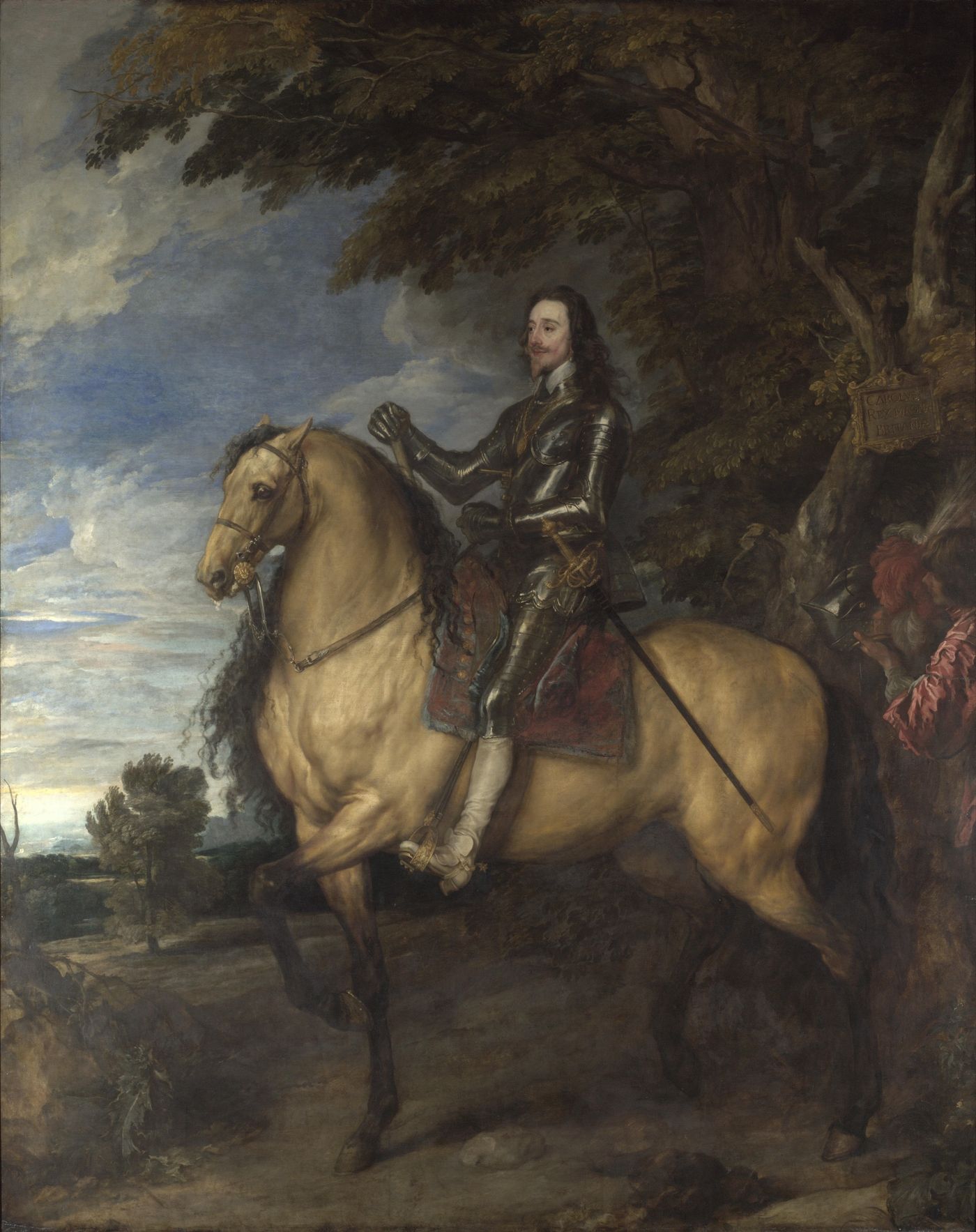
Attached to the proclamation was a brief instruction from the king to his new archbishop, telling him to see that the declaration was printed.[29] Puritan critics would later accuse the bishops of procuring the reissue, though even the Root and Branch Petition of 1640 made the charge only "as it is thought."[30] Who had asked for the reissue would matter a great deal in the 1640s, when Laud's enemies were assembling the case against him. In 1633 the pressing question was what would happen in the parishes when ministers were told to read the king's declaration to their congregations.
Blow Ye the Trumpet in Zion
The 1633 reissue differed from the 1618 original chiefly in its enforcement. Clergy throughout the country were required to read the declaration from their pulpits or face disciplinary action. For a minister with Sabbatarian convictions, this created a direct conflict of conscience. He was being ordered, by the head of his church, to announce to his flock that the Sabbath could be spent dancing around a maypole. Those who refused faced the bishops' courts.
The records of individual refusals are scattered, but enough survive to show the pattern. In Somerset, where the dispute had begun, the incumbents of Claverton, Ubley, and Beer Crocombe were punished for refusing to comply. The vicar of Montacute was censured for preaching on a revel day from the second chapter of Joel: "Blow ye the trumpet in Zion... for the day of the Lord cometh, for it is nigh at hand."[31] In Kent, five ministers were suspended for refusing to read the declaration in the mid-1630s: Thomas Wilson of Otham, near Maidstone, Richard Culmer of Minster in Thanet, John Player of Kennington, Thomas Hierom of Herne Hill, and Lawrence Snelling of Paul's Cray.[32]
The diocese of Norwich provides the clearest figures. Its bishop, Matthew Wren, was among the most energetic of Laud's allies, and in a certificate on the state of his diocese he described the situation he found at his visitation. The declaration, Wren reported, had not been published in a great many places in the diocese. He had about sixty copies on hand and caused them to be put to the ministers he most suspected. Many refused and were suspended, though several soon promised to conform and were absolved. In a diocese of roughly fifteen hundred clergy, Wren concluded, no more than about thirty now stood excommunicated or suspended, some for failing to appear at his visitation and others for obstinately refusing to publish the king's declaration.[33]
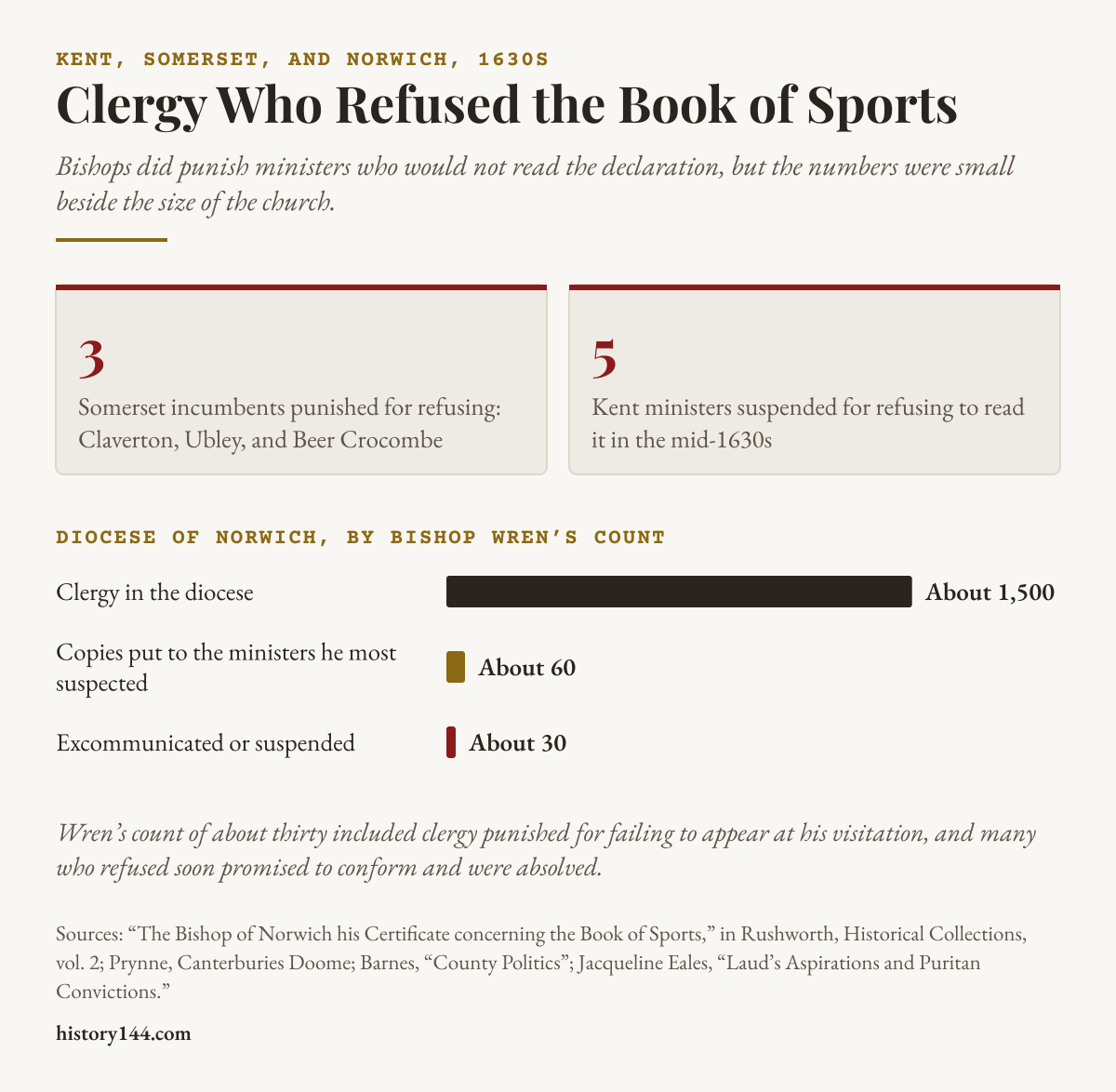
Wren's figures cut in two directions. They show that a determined bishop could and did suspend ministers for refusing to read the book. They also show that the number of clergy punished was small compared with the size of the church, and that many refusers found ways to submit. The historian Julian Davies has argued that the bishops applied the policy unevenly, that censures often turned on other offenses as much as on the declaration itself, and that various loopholes allowed many refusers to escape punishment. What none of them escaped, in his view, was the strain on their consciences.[34] The Book of Sports did not purge the Puritan clergy. It did make them choose, publicly and on a particular Sunday, between their bishop and their understanding of God's law. It also created a group of men with personal grievances that they would remember when the political situation changed.
Roots and Branches
The situation changed in 1640. The Scottish rebellion against Charles's religious policies forced him to summon Parliament, and the Long Parliament met in November of that year. The Book of Sports was quickly drawn into its program of grievances. On the motion of Sir Benjamin Rudyerd, the House of Commons included the declaration among the matters it wanted redressed. Members began raising the cases of ministers who had been suspended for refusing to read it. In early 1641 the Commons' committee for religion recommended that several of them be restored, while questioning some clergy who had promoted the book with special zeal. Any attempt to enforce the declaration ended with the meeting of Parliament, although Charles never formally withdrew it.[35]
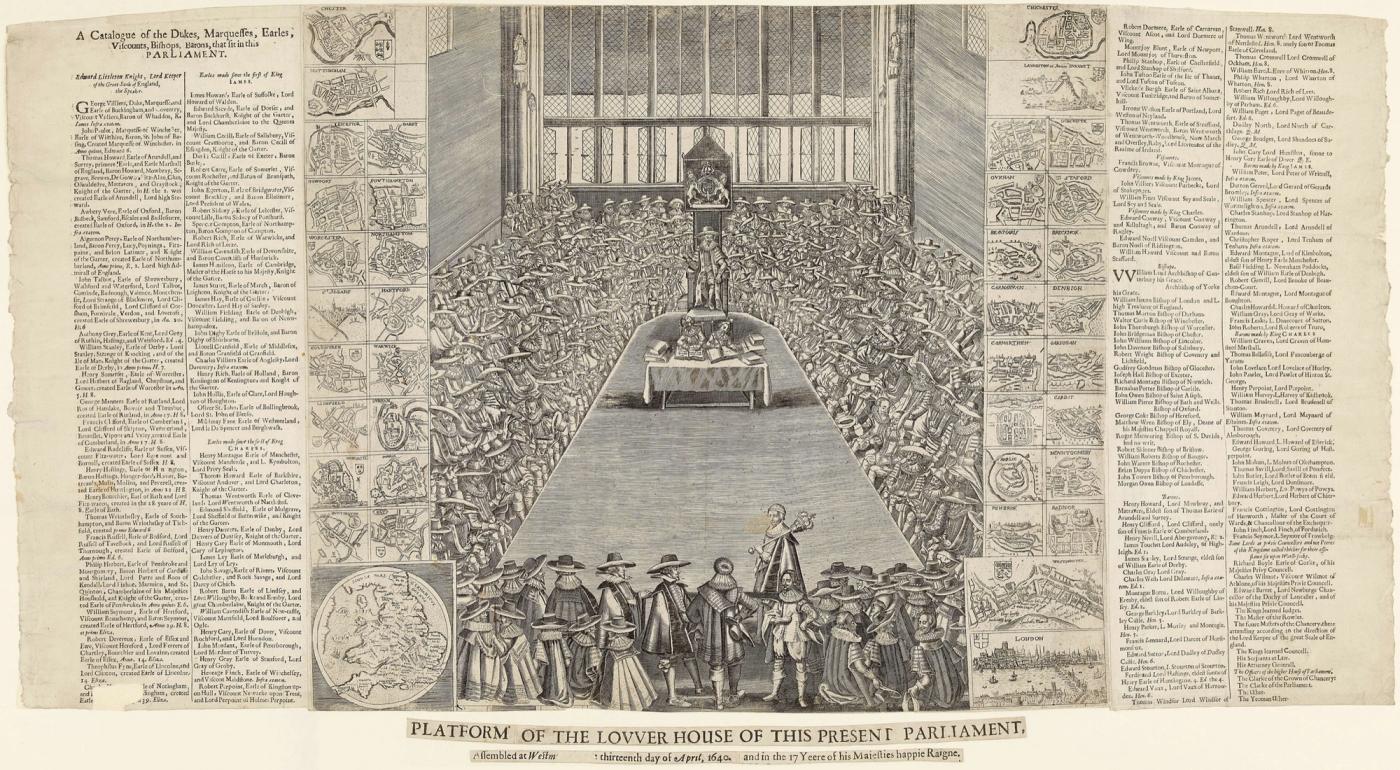
The Book of Sports also appeared in the most radical petition of the period. On December 11, 1640, the Root and Branch Petition was presented to the Commons in the name of many subjects in and about London and several counties. It called for the government of the church by bishops to be abolished "with all its dependencies, roots and branches." Among the many grievances it listed was the profanation of the Lord's Day. The petitioners complained that the bishops had enjoined ministers to read a declaration tolerating sports on that day, which they believed the bishops had procured, and had suspended and deprived "many godly ministers" for refusing to read it.[36] The petition presented the matter as the petitioners saw it: a question of conscience on the ministers' side, and of arbitrary power on the bishops'.
A week later, on December 18, 1640, Laud was impeached in the House of Lords and placed in the custody of Black Rod. He was moved to the Tower of London in early 1641. His case then stalled for more than two years while Parliament turned to other matters.
By the Hand of the Common Hangman
By the spring of 1643, England was at war. The king had raised his standard at Nottingham the previous August, and Parliament now governed London and much of the south and east without royal assent. It was in this setting that the Book of Sports met its end as a public document. The Commons had resolved as early as Sunday, November 13, 1642, that the book be "forthwith burnt by the Hands of the common Hangman, in the usual Places," but an order of the Commons alone did not carry. On Friday, May 5, 1643, the Lords and Commons ordered that the book "concerning the enjoyning and tollerating of Sports upon the Lord's Day" be burned by the hand of the common hangman in Cheapside and other usual places. The sheriffs of London and Middlesex were to assist, and anyone who held a copy was required to surrender it to them. The sheriffs fixed the burning for the following Wednesday, May 10, at noon.[37]
Public burning by the hangman was a punishment usually reserved for seditious or blasphemous books. This time the hangman was burning a royal declaration, republished by the reigning king. The fire announced that Parliament regarded the declaration as an instrument of the bishops' misrule rather than a legitimate expression of royal authority. The recreations the book permitted were still lawful. That would change a year later.
A Heathenish Vanity
The final stage of the story unfolded in 1644 on two fronts at once. The first was the prosecution of Laud. The Commons voted a fresh set of articles against him in the autumn of 1643, and his trial before the House of Lords began on March 12, 1644 and continued into the summer. The Book of Sports was not in itself a charge of treason, but it served as evidence of the wider accusation that Laud had persecuted godly ministers and favored popery. Two of the suspended Kent clergy, Thomas Wilson and Richard Culmer, testified at the trial that Laud had suspended them in the mid-1630s for refusing to read the declaration.[38] William Prynne, who acted as solicitor for the prosecution, later published his own account of the trial, Canterburies Doome (1646). It contains the Commons' case against Laud on the question of church ales. Barnes found Prynne's transcriptions of documents accurate when he checked them against the manuscripts, but judged his chronology badly confused and his account overcolored.[39]
The second front was legislation. On April 6, 1644, the Lords and Commons passed an ordinance "for the better observation of the Lords-Day."[40] Its preamble complained that the Lord's Day had been greatly profaned and that "the Prelatical Faction" had published ungodly books against the morality of the day. The ordinance then turned the Sabbatarian position into law. All existing statutes on Sunday observance were to be enforced. No one was to sell goods, travel without reasonable cause, or do worldly work on Sunday, on pain of fines. No one was to take part in or attend any wrestling, shooting, bowling, ringing of bells for pleasure, masque, wake, church ale, dancing, game, sport, or pastime on the Lord's Day, on pain of a fine of five shillings for anyone over fourteen. Parents and guardians would pay twelve pence for each offense committed by children in their care.[41]
The ordinance dealt with maypoles in a clause of their own. Because the profanation of the Lord's Day had been "greatly occasioned by May-Poles," which the ordinance called "a Heathenish vanity, generally abused to superstition and wickedness," all maypoles were to be taken down by the constables and churchwardens of each parish. None was ever to be set up again in England or Wales. Officers who failed to remove them within a week of notice would forfeit five shillings, and a further five shillings every week until the pole came down. Offenders unable to pay their fines were to sit in the stocks for three hours.[42]
Finally, the ordinance ordered that the king's declaration concerning wakes and Sunday recreation, the book entitled The Kings Majesties Declaration to his Subjects, concerning lawfull Sports to be used, and every other book written against the morality of the fourth commandment be called in, seized, and publicly burned by the justices of the peace. The ordinance itself was to be read in every parish church before the first of May south of the River Trent, and before the first of June to the north.[43] The pulpit was turned around. Ministers who had been made to read the Book of Sports to their congregations were now required to read the ordinance that ordered it burned.
The impeachment of Laud did not produce a verdict. In the autumn of 1644 Parliament abandoned it in favor of an ordinance of attainder, which declared him attainted of high treason without a judgment of the Lords on the impeachment. The Lords agreed to the ordinance on January 4, 1645[44], and Laud was beheaded on Tower Hill six days later. His death falls just beyond the twelve years of this story.
The Minister's Voice
The Book of Sports did not cause the English Civil War. Its importance is that it shows how quickly a local administrative question could become a national test of authority, and how the methods of the Personal Rule turned ordinary disagreements into personal grievances. In 1632, the question in Somerset was whether a parish should hold its annual revel. Within two years, through the decisions of a judge, a bishop, and a king, that question had become a matter of royal command, enforced through the church courts, with consequences for the careers of parish ministers in Kent, Norfolk, and Somerset. Each step made sense to those who took it. Laud was defending the jurisdiction of the church; Charles was defending his father's policy and the customs of his people; the refusing ministers were obeying what they believed to be God's law. Taken together, these steps produced a body of clergy with specific and remembered injuries, and a Parliament ready to treat those injuries as evidence of a design against true religion.
The declaration also shows how the parish church served as the main channel between the government and the governed. The Somerset order of 1632 became controversial because it was to be read from the pulpit, and the same was true of Charles's reissue in 1633 and of Parliament's ordinance in 1644. Each side in turn used the minister's voice on Sunday morning to tell villagers how to spend Sunday afternoon. The struggle over the Book of Sports was therefore also a struggle over who could speak to the nation through its churches, and on whose authority.
Barnes argued that it was in the 1630s that the religious divisions of the age reached ordinary people in the countryside, forcing them to take sides.[45] The judges who tried to suppress the wakes in 1632 believed they were maintaining order. The king who protected it in 1633 believed he was preserving harmless recreation and the loyalty of his people. The Parliament that abolished it in 1644 believed it was restoring the Sabbath to God. In 1632 Somerset's ministers had been handed a judge's order to read against the wakes. By 1644 they had been told to read the king's command to keep them, and had seen Parliament order that command burned by the hangman. The common ground that had once allowed justices, bishops, and villagers to compromise over a churchyard feast had largely disappeared in those twelve years.
Places in this Story
The places this story moves through, in order — follow them on the interactive map →
- Somerset, England Lent 1632
The assize judges ordered every parish minister to read their ban on church ales from the pulpit.
- Lancashire, England 1617
James I heard his subjects complain that they were barred from all lawful recreation on Sundays.
- Coleford, England May 30, 1633
Eighteen men from neighboring villages were arrested after a riot at a church ale in the Mendips.
- Dorset, England Spring 1633
Richardson withdrew the prohibitions here first, before facing the Somerset bench in the summer.
- Wells, England November 5, 1633
Bishop Piers sent Laud the opinions of seventy two incumbents who spoke warmly for the revels.
- Whitehall, London October 18, 1633
Charles reissued his father's declaration and ordered the bishops to publish it in every parish.
- Maidstone, England 1630s
Thomas Wilson of nearby Otham, suspended for refusing to read the king's declaration, moved here while under suspension.
- Norwich, England 1630s
Bishop Wren put the book to the ministers he most suspected and suspended many who would not read it.
- Cheapside, London May 10, 1643
The sheriffs set noon this day for the common hangman to burn the Book of Sports, by order of the Lords and Commons.
Frequently Asked Questions
What was the Book of Sports?
It was the royal declaration, first issued by James I for Lancashire in 1617 and for the kingdom in 1618, permitting dancing, archery, May games, morris dances and maypoles on Sunday afternoons after divine service. Charles I reissued it on October 18, 1633 and ordered it read in every parish church.
What was a church ale?
It was a parish feast held in or near the churchyard, with ale brewed and sold, food, music and dancing, and the profits going to the parish. One Somerset church was repaired out of the proceeds of a church ale in the late 1620s.
Why did Laud object to the Somerset assize order of 1632?
His objection was about jurisdiction rather than recreation. The judges had required parish ministers to read a secular court order from the pulpit, which Laud regarded as an encroachment on the authority of the church.
What happened to Chief Justice Thomas Richardson?
He was made to revoke the Somerset order, did so in a manner that amounted to a defense of it, and was then reprimanded before the Privy Council. In February 1634 he was moved from the lucrative Western Circuit to the Home Circuit, and he died the following year.
Were ministers punished for refusing to read the declaration?
Yes, Bishop Wren of Norwich put the book to the ministers he most suspected and suspended many who refused, reporting about thirty still under censure in a diocese of some fifteen hundred clergy. Five Kent ministers were suspended in the same years.
When was the Book of Sports burned?
The Lords and Commons ordered it burned by the common hangman on May 5, 1643, and the sheriffs fixed the burning for noon on May 10 in Cheapside and other usual places. Anyone holding a copy was required to surrender it.
What did Parliament's ordinance of April 1644 forbid?
It barred wrestling, bowling, dancing, wakes, church ales and any other game or pastime on the Lord's Day, on pain of a five shilling fine. It also ordered every maypole in England and Wales taken down as a heathenish vanity and never set up again.
Bibliography
Barnes, Thomas G. "County Politics and a Puritan Cause Celebre: Somerset Churchales, 1633." Transactions of the Royal Historical Society, 5th ser., 9 (1959): 103-22.
Barnes, Thomas G., ed. Somerset Assize Orders, 1629-1640. Somerset Record Society 65. 1959. Google Books. https://books.google.com/books?id=rmQN0gEACAAJ. Accessed November 9, 2026.
Davies, Julian. The Caroline Captivity of the Church: Charles I and the Remoulding of Anglicanism, 1625-1641. Oxford: Clarendon Press, 1992. Google Books. https://books.google.com/books?id=UIfZAAAAMAAJ. Accessed November 9, 2026.
Eales, Jacqueline. "Laud's Aspirations and Puritan Convictions." KAS Newsletter 56 (Spring 2003). Kent Archaeological Society. https://www.kentarchaeology.org.uk/magazine/56/18-lauds-aspirations-and-puritan-convictions. Accessed October 25, 2026.
England and Wales. Parliament. Die Veneris 5 Maij. 1643. It Is This Day Ordered by the Lords and Commons in Parliament, That the Booke Concerning the Enjoyning and Tollerating of Sports upon the Lords Day, Be Forthwith Burned. London: Thomas Underhill, 1643. Broadside. Wing E1611. EEBO-TCP. https://llds.ling-phil.ox.ac.uk/llds/xmlui/handle/20.500.14106/A82856. Accessed October 25, 2026.
Firth, C. H., and R. S. Rait, eds. Acts and Ordinances of the Interregnum, 1642-1660. London: His Majesty's Stationery Office, 1911. British History Online. https://prod.british-history.ac.uk/no-series/acts-ordinances-interregnum/pp420-422. Accessed October 25, 2026.
Gardiner, Samuel Rawson, ed. The Constitutional Documents of the Puritan Revolution, 1625-1660. 3rd ed. Oxford: Clarendon Press, 1906. https://constitution.org/1-History/eng/conpur026.htm. Accessed October 25, 2026.
Gardiner, Samuel Rawson. History of England from the Accession of James I to the Outbreak of the Civil War, 1603-1642. 10 vols. London: Longmans, Green, 1883-84.
Gee, Henry, and William John Hardy, eds. "The King's Majesty's Declaration to His Subjects Concerning Lawful Sports to Be Used (1633)." In Documents Illustrative of English Church History, 528-32. New York: Macmillan, 1896. Hanover Historical Texts Project. https://history.hanover.edu/texts/ENGref/er93.html. Accessed October 25, 2026.
Heylyn, Peter. Cyprianus Anglicus. London, 1668. Google Books. https://books.google.com/books?id=p8JQAAAAcAAJ. Accessed November 9, 2026.
Hutton, Ronald. The Rise and Fall of Merry England: The Ritual Year, 1400-1700. Oxford: Oxford University Press, 1994. Google Books. https://books.google.com/books?id=IVZbE_QwXGMC. Accessed November 9, 2026.
Journal of the House of Lords. Vol. 6, 1643. London, 1767-1830. British History Online. https://www.british-history.ac.uk/lords-jrnl/vol6/p32. Accessed October 25, 2026.
Kennett, White. Parochial Antiquities. Oxford, 1695. Google Books. https://books.google.com/books?id=M8560AEACAAJ. Accessed November 9, 2026.
Laud, William. The Works of William Laud. Vol. 4, The History of the Troubles and Tryal. Oxford: John Henry Parker, 1854. Internet Archive. https://archive.org/details/theworksofthemos04lauduoft. Accessed November 9, 2026.
The Life and Death of Mr. Tho. Wilson, Minister of Maidstone, in the County of Kent. London, 1672. EarlyPrint transcription. https://distantreader.org/stacks/earlyprint/txt/A62048.txt. Accessed November 9, 2026.
Prynne, William. Canterburies Doome. London, 1646. Google Books. https://books.google.com/books?id=TqF0QwAACAAJ. Accessed November 9, 2026.
Rushworth, John. Historical Collections of Private Passages of State. Vol. 2, 1629-38. London: D. Browne, 1721. British History Online. https://prod.british-history.ac.uk/rushworth-papers/vol2/pp461-481. Accessed October 25, 2026.
Rushworth, John. Historical Collections of Private Passages of State. Vol. 5, 1642-45. London: D. Browne, 1721. British History Online. https://prod.british-history.ac.uk/rushworth-papers/vol5/pp748-787. Accessed October 25, 2026.
Victoria County History of Somerset. Vol. 2. 1911. Google Books. https://books.google.com/books?id=XJs4AQAAMAAJ. Accessed November 9, 2026.
Citations
- Journal of the House of Lords, vol. 6, 1643 (London, 1767-1830), 32 (May 5, 1643), for the order; England and Wales, Parliament, Die Veneris 5 Maij. 1643. It Is This Day Ordered by the Lords and Commons in Parliament, That the Booke Concerning the Enjoyning and Tollerating of Sports upon the Lords Day, Be Forthwith Burned (London: Thomas Underhill, 1643), broadside, Wing E1611, for the sheriffs’ notice fixing Wednesday, May 10, at noon. ↑
- Order of the assize judges, Western Circuit, Lent 1632, The National Archives (TNA), ASSI 24/20, fol. 49v, printed in Thomas G. Barnes, ed., Somerset Assize Orders, 1629-1640, Somerset Record Society 65 (1959), no. 42; cited in Thomas G. Barnes, "County Politics and a Puritan Cause Celebre: Somerset Churchales, 1633," Transactions of the Royal Historical Society, 5th ser., 9 (1959): 110n3. ↑
- The orders survive in TNA, SP 16/96/7 (1594); Somerset Record Office, sessions rolls 2, no. 77 (1608); quarter sessions order book 1620/1-1627, Easter 1624, order no. 4 (1624); and sessions rolls 61, pt. 1, no. 74 (1628). The 1596 order is printed in William Prynne, Canterburies Doome (London, 1646), 152. All are listed in Barnes, "County Politics," 109n1. ↑
- Barnes, "County Politics," 103. ↑
- Barnes, "County Politics," 106n4, drawing on White Kennett, Parochial Antiquities (Oxford, 1695). ↑
- For East Coker, see Bishop Piers's note of 1634, TNA, SP 16/353/13, cited in Barnes, "County Politics," 108n1. For the decline in profits, see Barnes, "County Politics," 107n3. ↑
- Somerset Record Office, sessions rolls 2, no. 64, cited in Barnes, "County Politics," 107n1. ↑
- Informations and examinations taken before Sir Ralph Hopton, JP, July 20, 1633, Somerset Record Office, sessions rolls 70, no. 121, cited in Barnes, "County Politics," 116n1. For Barnes's survey of the sessions records, 1625-40, see ibid., 107n2. ↑
- "The King's Majesty's Declaration to His Subjects Concerning Lawful Sports to Be Used (1633)," in Documents Illustrative of English Church History, ed. Henry Gee and William John Hardy (New York: Macmillan, 1896), 528-29. Charles's 1633 declaration reprints James's 1618 text in full. ↑
- "King's Majesty's Declaration," 528-29. ↑
- "King's Majesty's Declaration," 529-30. ↑
- "King's Majesty's Declaration," 530-31. ↑
- "King's Majesty's Declaration," 531. ↑
- "King's Majesty's Declaration," 529-30. ↑
- Peter Heylyn, Cyprianus Anglicus (London, 1668), 256-57, and Prynne, Canterburies Doome, 128-49; both cited in Barnes, "County Politics," 111n1. ↑
- Barnes, "County Politics," 110n3. Denham's Dorset order is TNA, ASSI 24/20, fol. 35v. ↑
- John Rushworth, Historical Collections of Private Passages of State, vol. 2, 1629-38 (London: D. Browne, 1721), 191-96, which prints the documents of the quarrel and the revocation. ↑
- Barnes, "County Politics," 111n3, 113n1, citing S. R. Gardiner, History of England, 1603-1642, vol. 7 (London, 1899 printing), 319. ↑
- Sir Robert Phelips to the king, August 18, 1633, Somerset Record Office, Phelips Papers, DD/PH, fol. 131, cited in Barnes, "County Politics," 115n1. ↑
- Phelips Papers, DD/PH, fols. 137ff., quoted in Barnes, "County Politics," 116n2. ↑
- Barnes, "County Politics," 116n1. ↑
- Barnes, "County Politics," 115n3, and Rushworth, Historical Collections, 2:191-96. ↑
- Revocation order, summer assizes 1633, TNA, SP 16/255/39(iv) (copy), printed in Barnes, Somerset Assize Orders, no. 78; quoted in Barnes, "County Politics," 115n3. ↑
- Rushworth, Historical Collections, 2:191-92, for the command to revoke given at the council board and the revocation made "after his Reproof at the Council Table"; S. R. Gardiner, History of England, 1603-1642, vol. 7 (London, 1899 printing), 320, for the second summons before a committee of the council after the summer assizes. The remark is reported by seventeenth-century writers rather than by any record of the council, and should be read as the kind of story that attached itself to a famous quarrel. ↑
- Crown Office docket book, February 23, 1634, TNA, Index 4212, cited in Barnes, "County Politics," 118n2. ↑
- Laud to Piers, October 4, 1633, printed in Rushworth, Historical Collections, 2:192 (manuscript cited by Barnes as TNA, SP 16/247/24), and Piers to Laud, November 5, 1633, TNA, SP 16/250/20, both cited in Barnes, "County Politics," 119n1. ↑
- "King's Majesty's Declaration," 532. ↑
- "King's Majesty's Declaration," 532. ↑
- Charles I to Archbishop Laud, warrant, in John Rushworth, Historical Collections of Private Passages of State, vol. 2, 1629-38 (London: D. Browne, 1721), 193; see also "King's Majesty's Declaration," 532 (editors' note following the text). ↑
- "The Root and Branch Petition," December 11, 1640, clause 21, in The Constitutional Documents of the Puritan Revolution, 1625-1660, ed. Samuel Rawson Gardiner, 3rd ed. (Oxford: Clarendon Press, 1906), 137-44. ↑
- Prynne, Canterburies Doome, 149, and Victoria County History of Somerset, vol. 2 (1911), 44; both cited in Barnes, "County Politics," 120n2. The scriptural text is Joel 2:1. ↑
- The Life and Death of Mr. Tho. Wilson, Minister of Maidstone (London, 1672), chap. 8, for Wilson's suspension at Otham in 1635; William Laud, The History of the Troubles and Tryal, in The Works of William Laud, vol. 4 (Oxford: John Henry Parker, 1854), 253-55, for Culmer, Wilson, and Snelling; Jacqueline Eales, "Laud's Aspirations and Puritan Convictions," KAS Newsletter 56 (Spring 2003), Kent Archaeological Society, for the five names. ↑
- "The Bishop of Norwich his Certificate concerning the Book of Sports," in John Rushworth, Historical Collections of Private Passages of State, vol. 2, 1629-38 (London, 1721), 461-62. ↑
- Julian Davies, The Caroline Captivity of the Church: Charles I and the Remoulding of Anglicanism, 1625-1641 (Oxford: Clarendon Press, 1992), chapter on the Book of Sports. ↑
- Ronald Hutton, The Rise and Fall of Merry England: The Ritual Year, 1400-1700 (Oxford: Oxford University Press, 1994), chapter on the 1640s. ↑
- "Root and Branch Petition," in Gardiner, Constitutional Documents, 137-44. ↑
- Journal of the House of Commons, vol. 2, 1640-1643 (London, 1802), 847-48, under Sunday, November 13, 1642, for the Commons resolution; Journal of the House of Lords, vol. 6, 1643 (London, 1767-1830), 32 (May 5, 1643), for the joint order. For the sheriffs' notice fixing the date and hour, see England and Wales, Parliament, Die Veneris 5 Maij. 1643. It Is This Day Ordered by the Lords and Commons in Parliament, That the Booke Concerning the Enjoyning and Tollerating of Sports upon the Lords Day, Be Forthwith Burned (London: Thomas Underhill, 1643), broadside, Wing E1611. ↑
- William Laud, The History of the Troubles and Tryal, in The Works of William Laud, vol. 4 (Oxford: John Henry Parker, 1854), 253-55, where Laud answers the testimony of Culmer and Wilson; see also Eales, "Laud's Aspirations." ↑
- Barnes, "County Politics," 104n2. ↑
- John Rushworth, Historical Collections of Private Passages of State, vol. 5, 1642-45 (London, 1721), 749. Rushworth dates the ordinance April 6; the edition by Firth and Rait dates it April 8. ↑
- "April 1644: An Ordinance for the Better Observation of the Lords-Day," in Acts and Ordinances of the Interregnum, 1642-1660, ed. C. H. Firth and R. S. Rait (London: His Majesty's Stationery Office, 1911), 420-22. ↑
- "Ordinance for the Better Observation of the Lords-Day," 420-22. ↑
- "Ordinance for the Better Observation of the Lords-Day," 420-22. ↑
- Journal of the House of Lords, vol. 7, 1644 (London, 1767-1830), 124-27, for the Lords’ agreement to the ordinance of attainder on January 4, 1645. On the same day the Lords passed the ordinance setting aside the Book of Common Prayer. ↑
- Barnes, "County Politics," 103. ↑