A Proclamation in October
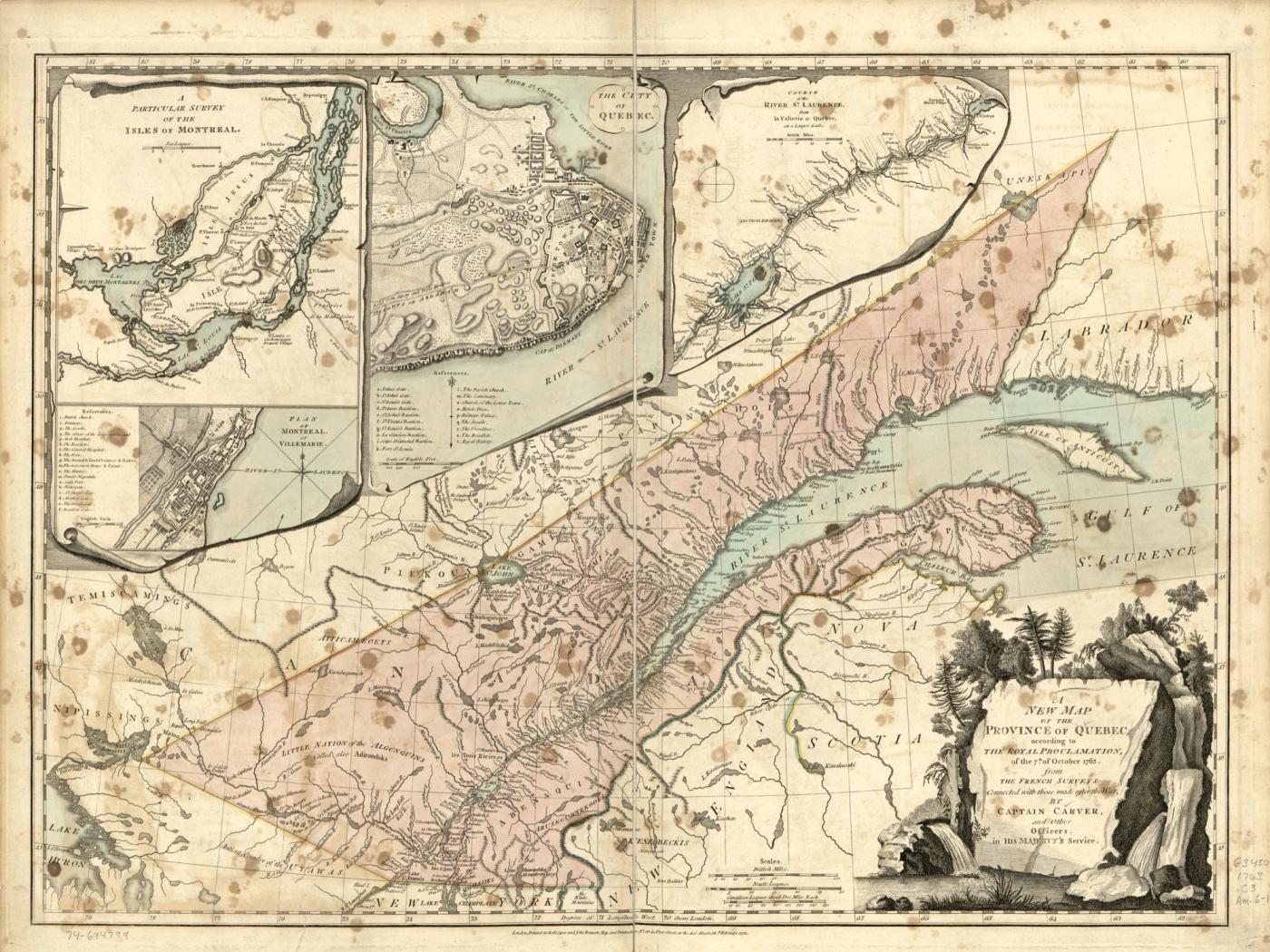
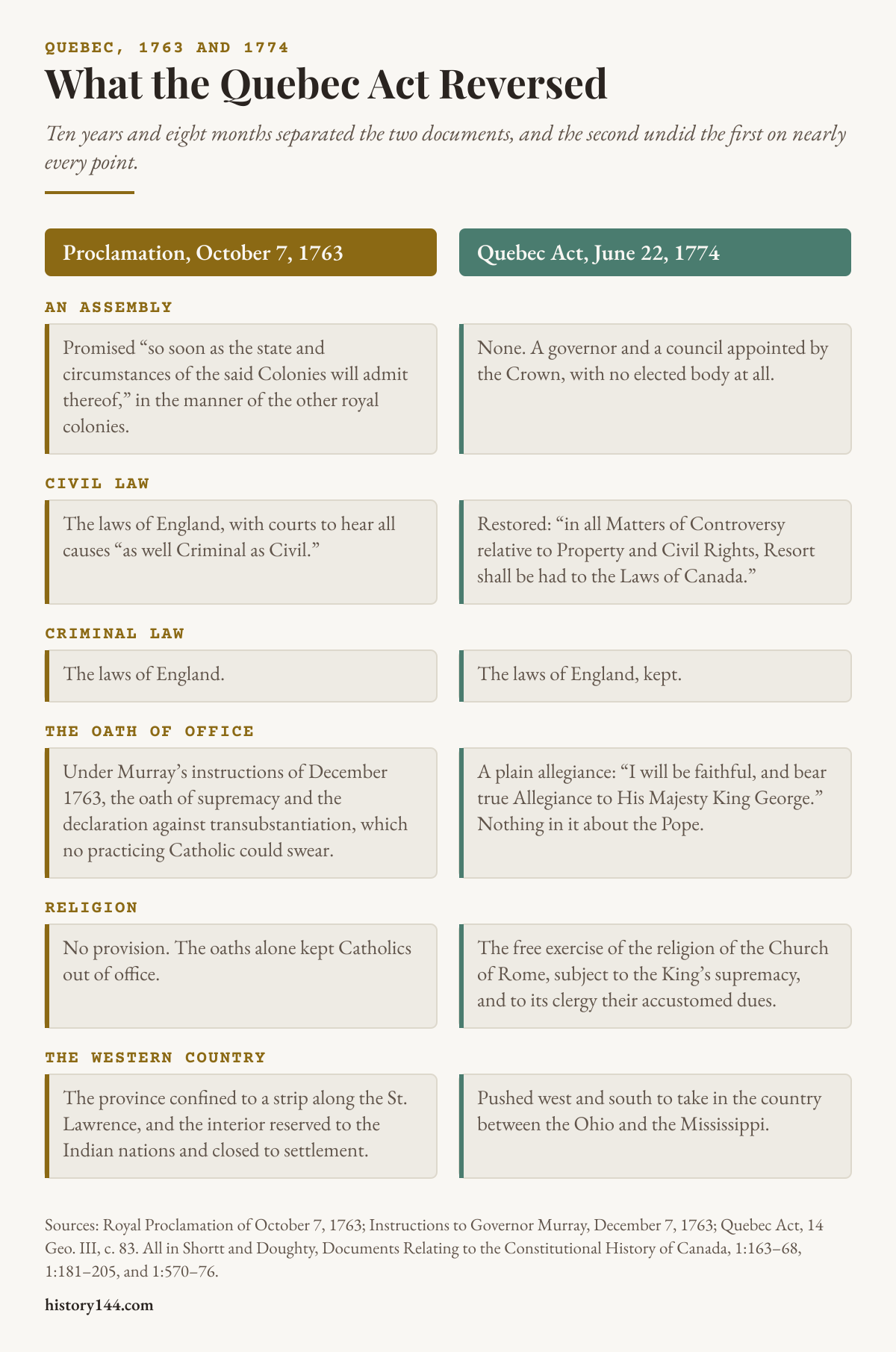
On October 7, 1763, eight months after the Treaty of Paris transferred Canada to the British Crown, George III issued a proclamation organizing what had been won. It erected four distinct and separate governments within the countries and islands ceded by the treaty, and the first of them was Quebec.[1]It promised that the governors would, "so soon as the state and circumstances of the said Colonies will admit thereof," summon "General Assemblies" in the manner used in the other colonies under the King's immediate government. Those assemblies would make laws "as near as may be agreeable to the Laws of England." Courts would be erected to hear all causes "as well Criminal as Civil," also according to the laws of England. Until the assemblies could meet, everyone in the new colonies could "confide in our Royal Protection for the Enjoyment of the Benefit of the Laws of our Realm of England."[2]
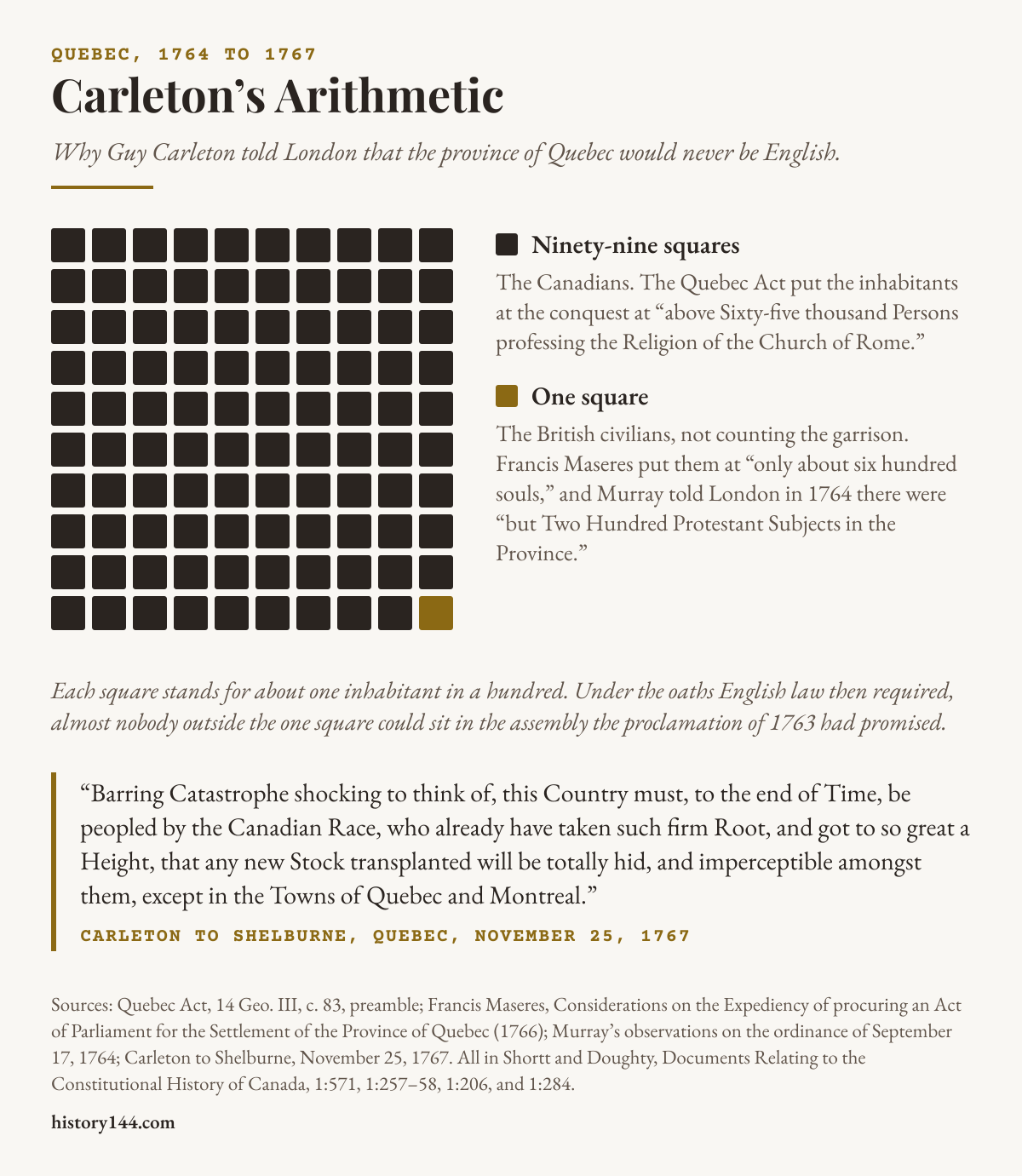
The plan assumed a colony of English settlers, and Quebec had very few. The preamble of the Quebec Act would later state that the inhabitants of the province at the conquest amounted to "above Sixty-five thousand Persons professing the Religion of the Church of Rome," holding "an established Form of Constitution and System of Laws" of their own. They lived under the Custom of Paris and a parish structure answering to a bishop. Besides the garrison, the British in Quebec were a small civilian community from Britain, Ireland, and the older colonies, which Francis Maseres, soon to be the province's attorney general, put at "only about six hundred souls." The proclamation offered an English assembly to a province where, under English law as it then stood, almost nobody was eligible to sit in one.[3]
The proclamation also kept the province small. It was confined to a strip along the St. Lawrence, and the interior west of the Appalachians was reserved to the Indian nations and closed to settlement. Trade with those nations stayed "free and open to all our Subjects whatever" on a license from a governor, but the country that supplied it was put outside the province. The fur trade out of Montreal, which had been the mainstay of Canada's economy, now depended on country that lay outside the province.[4]
This is the story of the twelve years that followed. It runs from the proclamation of October 1763 to an October day in 1775 when an American detachment took a fort on the Richelieu River and, with it, the gunpowder that made the invasion of Canada possible.
The Governor's Commission
James Murray, who had commanded at Quebec since the conquest, was commissioned captain general and governor in chief of the province on November 21, 1763, and received his instructions on December 7.[5] Civil government began on August 10, 1764, when the military regime formally ended.
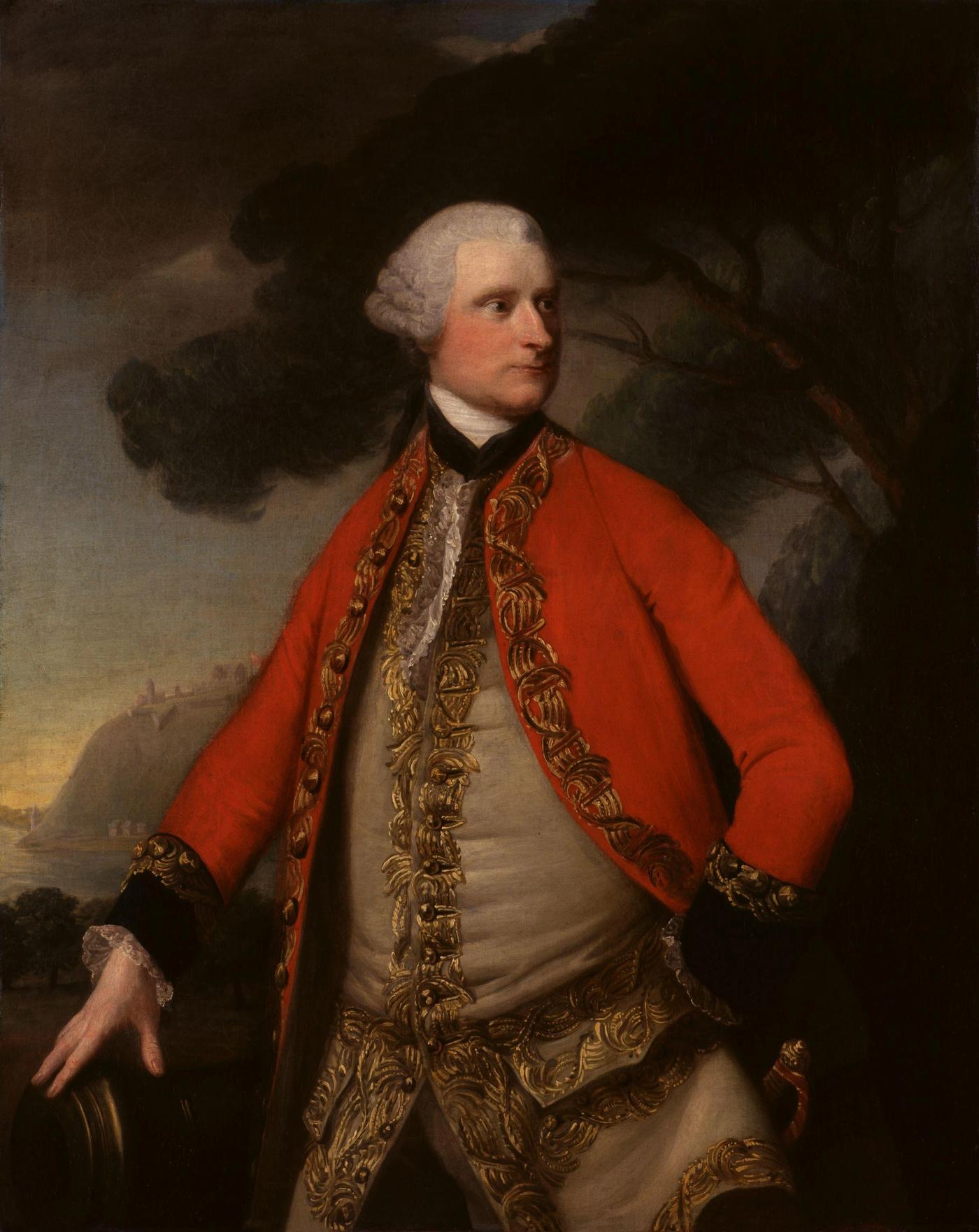
The instructions repeated the promise of an assembly and added a condition that ruled it out. Officeholders were to take the oaths required by English law, including the oath of supremacy and the declaration against transubstantiation, which no practicing Catholic could swear. In England those tests shut out a small minority; in Quebec they shut out nearly the whole population.[6]Murray saw the difficulty quickly. He had a council of a dozen men, a handful of Protestant merchants demanding the assembly they had been promised, and a population of Canadian subjects who had been assured at the capitulation and in the treaty that they might practice their religion. The laws he was told to apply had been written for a country where Catholics were the exception.
The Ordinance and the Jury
On September 17, 1764, Murray issued the ordinance establishing the province's civil courts.[7] It set up a Court of King's Bench applying the laws of England, below it a Court of Common Pleas for property above ten pounds, and justices of the peace for smaller sums. In the Common Pleas, French laws and customs were "to be allowed and admitted in all Causes in this Court, between the Natives of this Province, where the Cause of Action arose before the first Day of October, One Thousand Seven Hundred and Sixty-four." Canadian advocates could practice in the Common Pleas, and there only, because, as Murray explained, no English barrister in the province understood French. Juries in the King's Bench were to be drawn from "all His Majesty's Subjects in this Colony" without distinction, which put Catholics on them. French law kept only this narrow foothold, and the whole arrangement was meant to be provisional. Murray described the jury clause to London as "no more than a temporary Expedient to keep Things as they are until His Majesty's Pleasure is known."
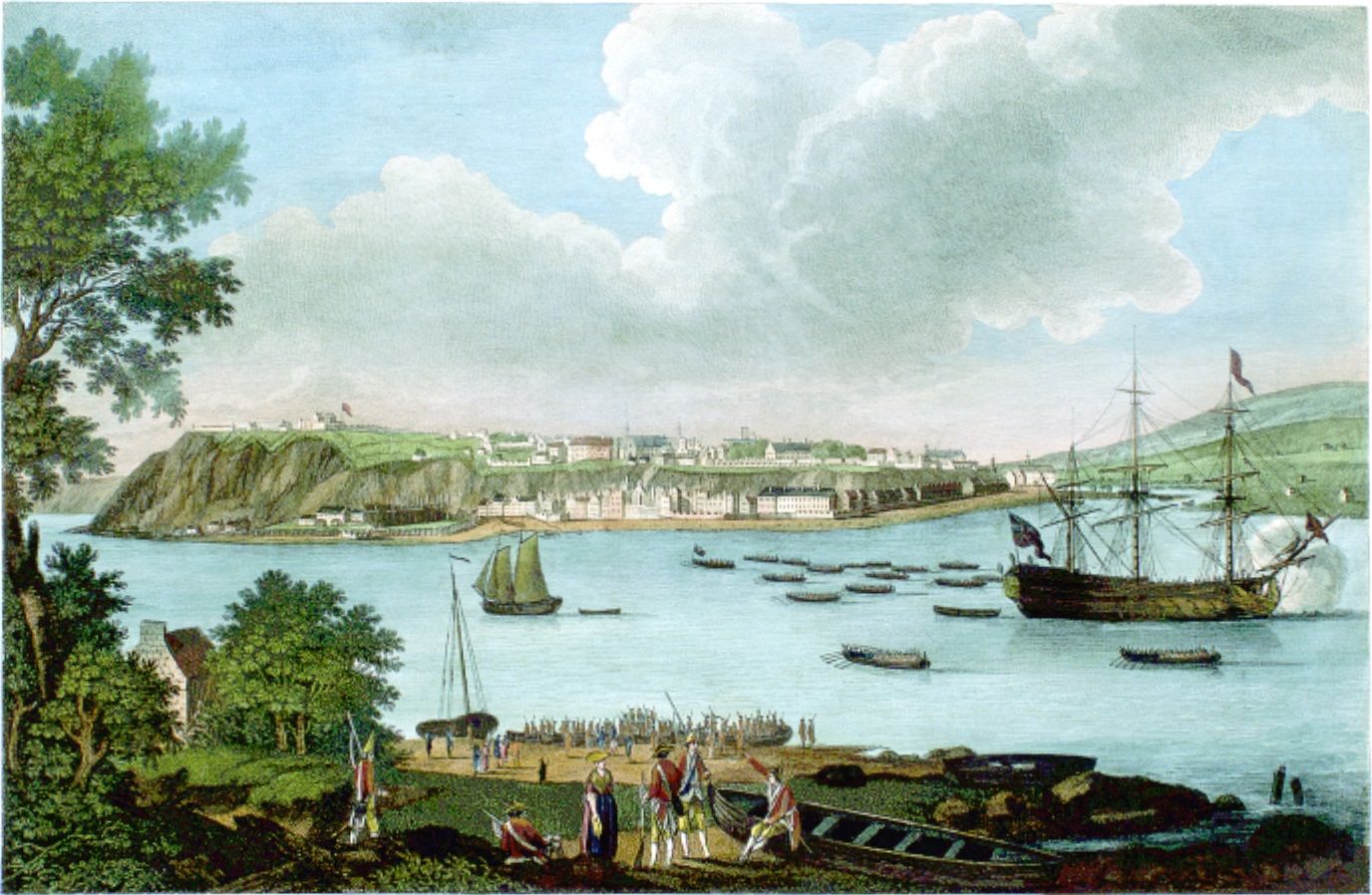
The first protest came within a month. On October 16, 1764, the grand jury of Quebec, seven of whose members were Canadian Catholics, presented a list of grievances. Its English-speaking members then signed a second presentment on their own. It carried the complaint that persons professing the religion of the Church of Rome, who acknowledged "the supremacy and jurisdiction of the Pope," had "been unpannelld, en Grand and petty Jurys even where Two protestants were partys."[8] The grand jurors also claimed, as "the only Body representative of the Colony," a right to be consulted on ordinances and to examine the public accounts.
The French jurors who had served alongside them replied on October 26. They had signed the general presentment, they said, after it was read to them only in English and never interpreted, and several of its articles had never been explained to them. The attack on their religion was in the second paper, which only the English-speaking jurors had signed and which the Canadians had since read in French.[9] In January 1765 the French citizens of Quebec addressed the King directly about the legal system.[10]The same division ran through the next ten years. The small British minority wanted the English constitution in full, including an assembly that only Protestants could sit in. The French majority wanted its own law and its church, and the governor was left to square both with a promise made in London.
The Bravest and the Best Race
Murray's own view of the two communities is preserved in a letter he wrote to the Lords of Trade from Quebec on October 29, 1764, three days after the French jurors filed their statement. He was sending his secretary, Hector Theophilus Cramahé, to London to explain the situation in person, because he no longer trusted letters to do it. "Little, very little, will content the New Subjects," Murray wrote, "but nothing will satisfy the Licentious Fanaticks Trading here, but the expulsion of the Canadians who are perhaps the bravest and the best race upon the Globe." If the Canadians could "be indulged with a few priveledges which the Laws of England deny to Roman Catholicks at home," he thought, they "wou'd soon get the better of every National Antipathy to their Conquerors and become the most faithful and most useful set of Men in this American Empire."[11]
Murray saw the problem plainly. English law denied Catholics in Quebec what it denied Catholics in England, and in Quebec that meant nearly everyone. His remedy was to stop applying it, but he could not carry it through. The merchants petitioned against him, he was recalled to answer their charges, and he left the province in June 1766. He was never formally condemned, and he never returned.[12]
Carleton's Arithmetic
Guy Carleton arrived in September 1766 as lieutenant governor and became governor in 1768. He had been in the province a few months when he wrote to General Gage about the state of the forts on the Lake Champlain corridor. Crown Point, Ticonderoga and Fort George were, he reported, "in a very declining Condition."[13] He urged that they be repaired and a proper place of arms built, since the most to be hoped from the Canadian gentry was "a passive Neutrality." Eight years later an American army came up that same corridor.
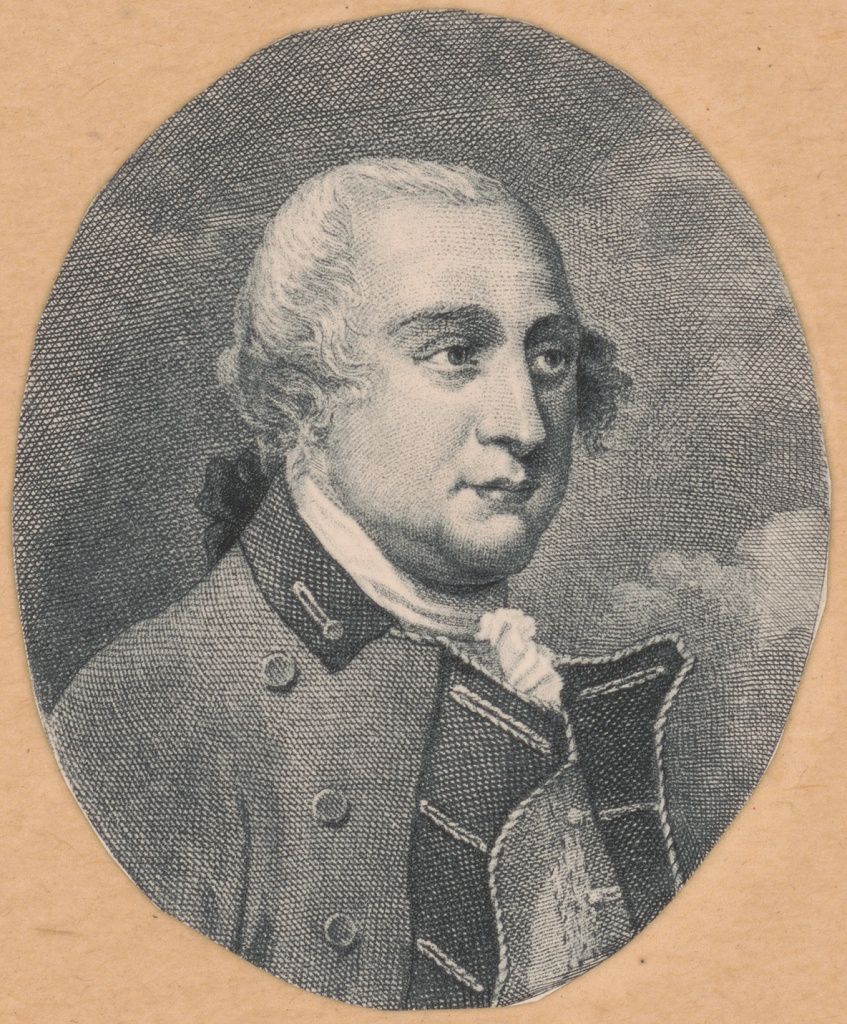
Carleton's central document is the long report he sent to Lord Shelburne on November 25, 1767, written because London had told him that the civil constitution of Quebec was under serious consideration and that any light on the subject would be material. He surveyed the strength of the old and new subjects, by which he meant the British and the Canadians, and recorded "the great Superiority of the Latter."
He went on to explain why it would last. Europeans who emigrated would not choose "the long unhospitable Winters of Canada" over the southern provinces. The few British already there were mostly disbanded soldiers and traders who had found the trade harder than expected, and many had left or would leave. The Canadians, by contrast, multiplied. "Barring Catastrophe shocking to think of," Carleton wrote, "this Country must, to the end of Time, be peopled by the Canadian Race, who already have taken such firm Root, and got to so great a Height, that any new Stock transplanted will be totally hid, and imperceptible amongst them, except in the Towns of Quebec and Montreal."[14]
Carleton's conclusion was practical. If the province would always be French and Catholic, the Crown should govern through the men the Canadians already followed, the seigneurs and the clergy, and give them reason to be loyal. An assembly chosen by a few hundred Protestant merchants would answer to those merchants. Carleton wanted government by the governor and an appointed council, with the seigneurs and the church behind it.
The Years of Drafts
Between 1766 and 1773 the question of Quebec's constitution passed through the law officers of the Crown, the Board of Trade, and a succession of drafts. Francis Maseres wrote a paper before sailing to take up the attorney generalship. In it he pointed out that the English statute of supremacy, applied to Quebec, would require the Canadian clergy and much of the laity to take the oath of supremacy, "which it is well known the most moderate Catholics cannot take."[15] The Board of Trade produced a long report on ecclesiastical affairs, proposing to reform the religious communities in ways compatible with "that free exercise of the Religion of the Church of Rome, Stipulated by the Treaty of Paris."[16]
Both communities petitioned London. The British merchants asked for a general assembly, and the Canadians asked for the restoration of their law and custom and sent a memorial in support.[17] Ministers prepared, circulated, and argued over several drafts of a Quebec bill. Lord Hillsborough recorded his objections to the third draft, and Lord Dartmouth answered them. Separate papers dealt with the clause on religion and with extending the province's boundaries.[18]By the time a bill reached Parliament, the government had been deliberating on the constitution of Quebec for more than ten years.
The Quebec Act
The Quebec Act received the royal assent on June 22, 1774, and came into force on May 1, 1775.[19] It reversed the proclamation on nearly every point. It guaranteed the free exercise of the religion of the Church of Rome, subject to the King's supremacy, and secured to the Catholic clergy their accustomed dues from those of their own faith. It restored French civil law: "in all Matters of Controversy relative to Property and Civil Rights, Resort shall be had to the Laws of Canada," and causes concerning property and rights were to be determined according to the laws and customs of Canada. English criminal law was kept. The province was to be governed by a governor and an appointed council, with no assembly. The boundaries were extended west and south to take in the country between the Ohio and the Mississippi.[20]
The provision that mattered most to the men who had to live under it was the oath. In place of the oaths that no Catholic could swear, the act substituted a plain promise of allegiance: "I A. B. do sincerely promise and swear, That I will be faithful, and bear true Allegiance to His Majesty King George, and him will defend to the utmost of my Power, against all traiterous Conspiracies, and Attempts whatsoever."[21] It said nothing about the Pope, so a Catholic could take it, and the Elizabethan oath that had barred Catholics from office no longer applied to them. Ten years after Murray had asked for "a few priveledges which the Laws of England deny to Roman Catholicks at home," Parliament granted them, though only in Quebec and in the same statute that denied the province an elected assembly.
An Intolerable Act
In the Thirteen Colonies the act arrived in the same season as the measures punishing Massachusetts for the destruction of the tea, and Americans read it as one of them. They objected to the boundary, which put the western country under a government with no assembly, and to the protection it gave the Catholic Church.
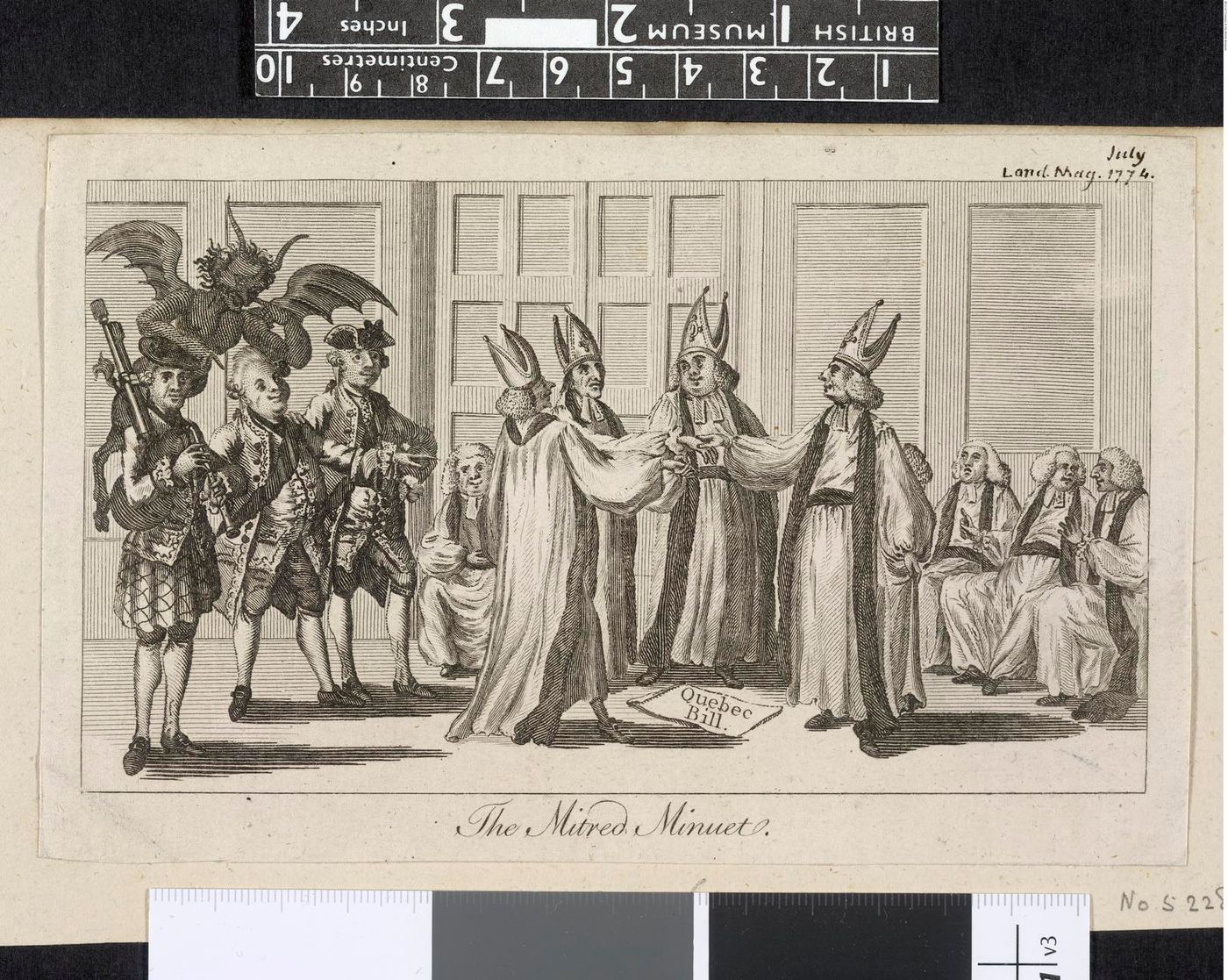
On October 21, 1774, the First Continental Congress approved an address to the people of Great Britain that denounced the establishment in Quebec of a religion that had "deluged your island in blood, and dispersed impiety, bigotry, persecution, murder and rebellion through every part of the world."[22] Five days later, on October 26, the same Congress approved a letter to the inhabitants of the province of Quebec. A committee of Thomas Cushing, Richard Henry Lee and John Dickinson had prepared it, and it was translated into French and printed for distribution. It invited the Canadians to choose delegates and join the next Congress. It assured them that the difference of religion was no obstacle, and cited the Swiss cantons as proof that Catholics and Protestants could make common cause.[23]Congress sent a second letter in May 1775. Quebec sent no delegates to either Congress.[24]
The Invasion
Carleton had two understrength regiments to hold the St. Lawrence and the Richelieu when the war began, the 7th and the 26th, spread between Quebec, Montreal and the forts on the river. On the evening of May 19, 1775, a letter from Gage reached him with news that fighting had begun in Massachusetts. The next morning an express brought word that Benedict Arnold had landed at St. John's early on the 18th, taken the sergeant and ten men of the 26th posted there, and carried off the King's sloop. Ticonderoga and Crown Point had fallen earlier in the month. The express credited all of it to "one Benedict Arnold said to be a native of Connecticut, and a Horse Jockey," which overstated Arnold's part. He set down what he had to meet it with in a despatch to Lord Dartmouth of June 7: "Not six hundred Rank & File fit for Duty upon the whole Extent of this great River, not an armed Vessel, no Place of Strength; the ancient Provincial Force enervated and broke to Pieces." Two days later, before leaving Montreal, he proclaimed martial law and ordered the militia within the province "to be forthwith raised."[25]
The militia did not come. The seigneurs of the neighborhood were called on to collect their inhabitants, Carleton told Dartmouth in the same despatch, "but tho' the Gentlemen testified great Zeal, neither their Entreaties or their Example could prevail upon the People." A few of the gentry, mostly young men, formed a small corps of volunteers and took post at St. Jean. "The Indians shewed as much Backwardness as the Canadian Peasantry." Carleton saw in this the failure of the authority he had built the government around: "all Subordination overset, and the Minds of the People poisoned by the same Hypocrisy and Lies practised with so much Success in the other Provinces." The gentry and the clergy had shown fidelity, he wrote, and "both have lost much of their Influence over the People." Three months later Hector Cramahé, administering the government at Quebec, reported the same result in plainer words: no means had been left untried to bring the Canadian peasantry to take up arms in defense of the province, "but all to no Purpose."[26]
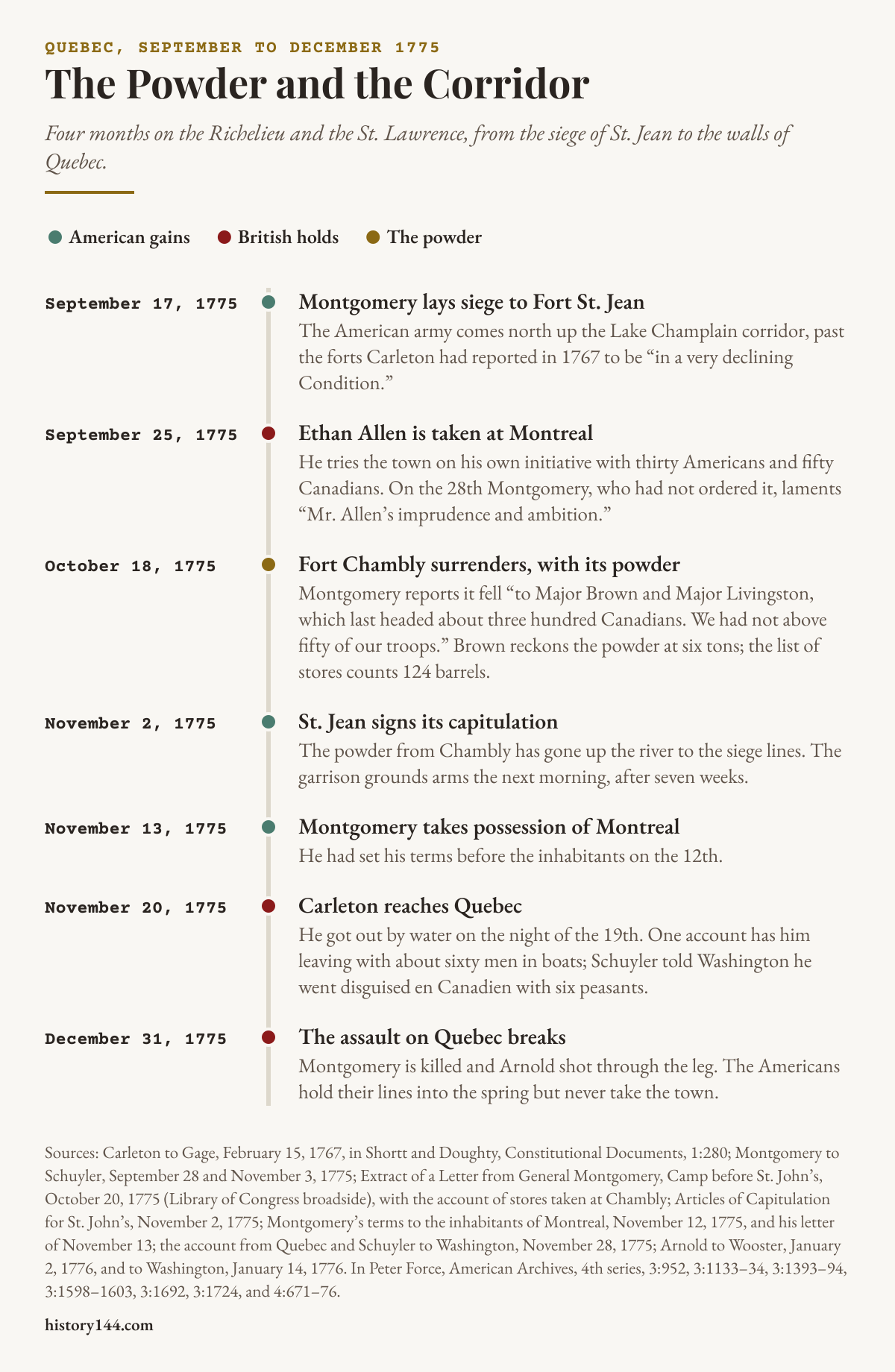
The invasion came up the corridor Carleton had described in 1767. Richard Montgomery moved north from Ticonderoga and laid siege to Fort St. Jean on the Richelieu from September 17. Ethan Allen, attempting Montreal on his own initiative with thirty Americans and fifty Canadians, was taken prisoner on the 25th. Montgomery, who had not ordered it, wrote three days later that he had "to lament Mr. Allen's imprudence and ambition, which urged him to this affair single handed, when he might have had a considerable re-enforcement."[27] The siege of St. Jean dragged on, and the American army was running short of powder.
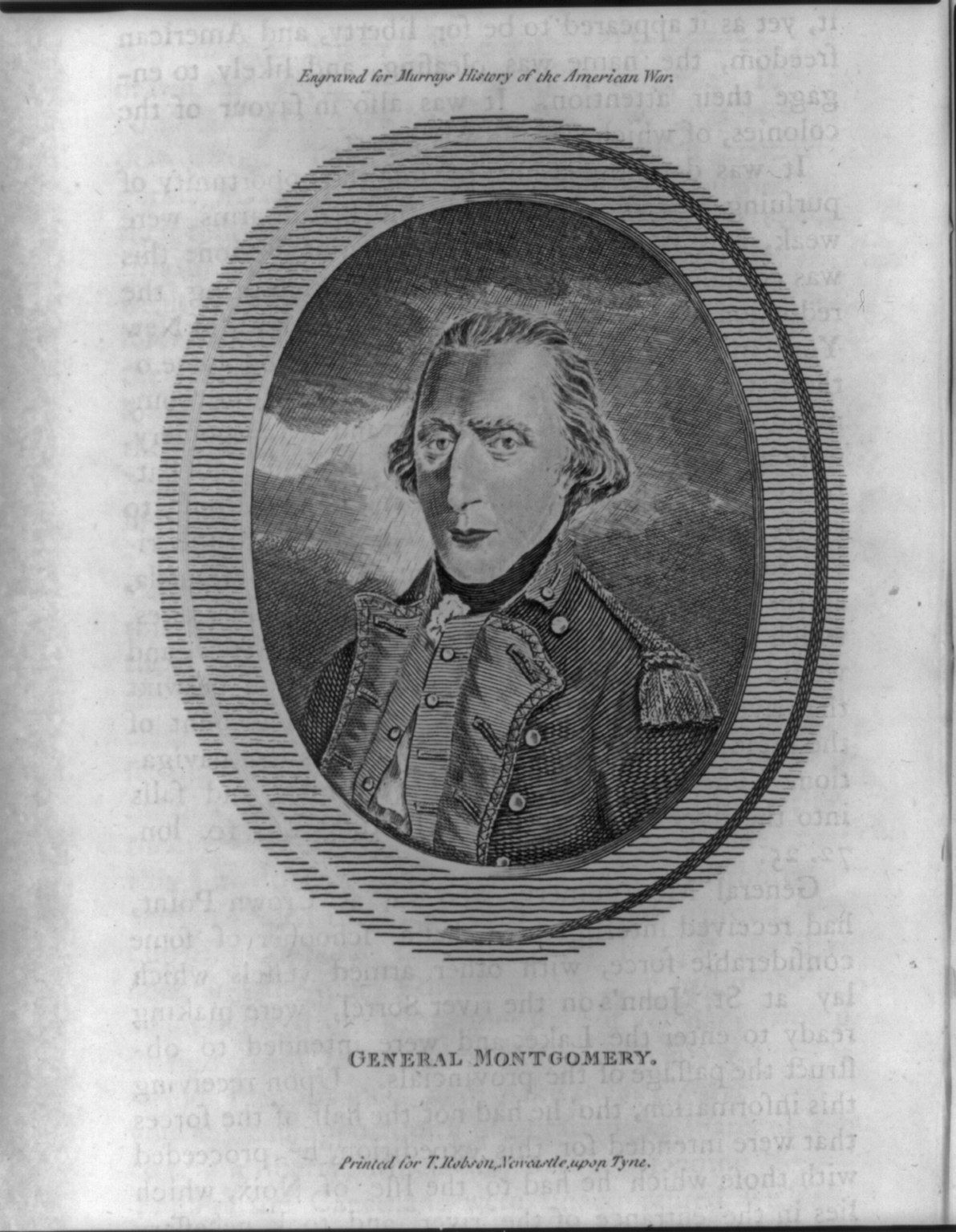
On October 18, 1775, Fort Chambly, a few miles down the river from St. Jean, surrendered to a force made up mostly of Canadians. Montgomery reported the capture two days later in a letter from the camp before St. John's: the fort had fallen "to Major Brown and Major Livingston, which last headed about three hundred Canadians. We had not above fifty of our troops." The plan, he added, had been the Canadians' own, and it was they who had carried the artillery down past St. Jean in bateaux. He enclosed the colors of the 7th Regiment.[28]
The fort's real value was its gunpowder. "Major Brown assures me we have gotten six tons of powder," Montgomery wrote, "which with the blessing of God will finish our business here."[29] The powder went up the river to the siege lines. St. Jean, which had held for seven weeks, signed its capitulation on November 2, and its garrison grounded arms the next morning. Montgomery set his terms before the inhabitants of Montreal on the 12th and took possession of the town on the 13th. Carleton got out by water on the night of the 19th and reached Quebec on the 20th. How he did it was reported two ways. An account written at Quebec has him leaving Montreal in a dark night with about sixty men, who escaped in boats and went aboard a brigantine that carried them down. Schuyler told Washington that he slipped away disguised en Canadien with six peasants, after his vessels had twice tried and failed to pass the American batteries near the mouth of the Sorel.[30]
Some habitants had taken the American side. About three hundred had helped take Chambly, and James Livingston was in the field with a body of Canadians that Montgomery put at a thousand. An account written at Quebec reported that the Canadians had been of great use to Montgomery at St. Jean and Chambly by supplying him. They received the Americans into their houses and brought them provisions, and the writer put it down to the dislike they had taken to the Quebec Act.[31] A smaller number served with the British, and many more kept out of the fighting altogether, whatever they thought of either side.
The assault came at the walls of Quebec on the last night of December and broke, with Montgomery dead and Benedict Arnold shot through the leg. The Americans held their lines outside the town into the spring, but they never took it, and the province stayed British.[32]
Why the Twelve Years Mattered
The proclamation of 1763 was written for a province that did not exist. It promised an assembly that the population could not sit in and English law to a society that lived by another. For ten years the governors of Quebec reported that the plan did not fit, and the government in London drafted, objected, and redrafted. The Quebec Act of 1774 accepted what they had been saying. It dropped the assembly, restored the civil law, and gave Catholics an oath they could take. Carleton's case for it rested on numbers rather than principle: the province would be French to the end of time, so the Crown should govern it that way and win over the men who led it.
The policy was tested within eighteen months, and the result was mixed. The seigneurs and the clergy stood by the government but could not bring the people with them, and Carleton's plan had depended on their doing so. The habitants divided. About three hundred helped take Chambly, a few hundred served in American units, others fed and housed the invading army without joining it, and many stayed home. Carleton did not get the loyal militia he had counted on, but Congress did not get the general rising it had invited either, and no Canadian delegates went to Philadelphia.
In the Thirteen Colonies the same act had the opposite effect. In Boston and Philadelphia it was read as proof that London would establish a church, abolish an assembly, and hand the west to an appointed governor whenever it chose, and it was counted among the Intolerable Acts. Britain kept Canada partly because it had stopped trying to make Canada English, and lost the Thirteen Colonies partly because the same concessions alarmed them.
Places in this Story
The places this story moves through, in order — follow them on the interactive map →
- London, England October 7, 1763
George III organized the conquest into four new governments and promised each an elected assembly.
- Westminster, London November 21, 1763
James Murray was commissioned captain general and governor in chief of the Province of Quebec.
- Quebec City, Canada October 16, 1764
The grand jury's English-speaking members complained that Catholics had been seated on grand and petty juries.
- Chateau Saint-Louis, Quebec October 29, 1764
Murray called the Canadians the bravest and best race on the globe and asked London for relief.
- Crown Point, New York February 15, 1767
Carleton reported the forts on the Champlain corridor were in a very declining condition.
- Whitehall, London 1773
Draft after draft of a Quebec bill passed between the Board of Trade and the secretaries of state.
- Palace of Westminster, London June 22, 1774
The Quebec Act received the royal assent, restoring French civil law and withholding an assembly.
- Philadelphia, Pennsylvania October 26, 1774
Congress invited the Canadians to send delegates, five days after denouncing their religion.
- Fort Chambly, Quebec October 18, 1775
About three hundred Canadians helped take the fort and its six tons of gunpowder.
Frequently Asked Questions
What did the Royal Proclamation of 1763 do to Quebec?
It made Quebec one of four new governments and promised an elected assembly and the laws of England. Both promises assumed a Protestant population that the province did not have.
Why could Catholics not hold office in Quebec after 1763?
English law required officeholders to swear the oath of supremacy and to deny transubstantiation, which no practicing Catholic could do. The promised assembly would therefore have excluded almost the whole province.
What did the Quebec Act of 1774 change?
It restored French civil law, guaranteed the free exercise of the Catholic religion, and replaced the old oaths with a plain oath of allegiance a Catholic could take. It also settled that Quebec would be governed without an elected assembly.
Why did the Thirteen Colonies call the Quebec Act intolerable?
Congress objected both to a province governed without an assembly and to the official toleration of Catholicism. On October 21, 1774 it told the British public that the act established a religion that had deluged their island in blood.
Did the Canadians join the American invasion of 1775?
Some did, and about three hundred of them helped capture Fort Chambly in October 1775. Most habitants stayed out of the war, and the province sent no delegates to the Continental Congress.
What did the Americans capture at Fort Chambly in 1775?
General Montgomery reported six tons of gunpowder on Major Brown's estimate, and the list of stores taken counted 124 barrels of it. That powder supplied the siege of Fort St. Jean, which surrendered two weeks later.
Who was Guy Carleton and why did he matter to Quebec?
He governed Quebec from 1766 and argued that the province would be French and Catholic to the end of time. His reports shaped the Quebec Act, and he commanded the defense against the American invasion.
Bibliography
Extract of a Letter from General Montgomery, dated Camp before St. John's, October 20, 1775. Broadside. Library of Congress, rbc/bdsdcc.00601. https://tile.loc.gov/storage-services/service/rbc/bdsdcc/00601/00601.pdf. Accessed November 8, 2026.
Force, Peter, ed. American Archives: Consisting of a Collection of Authentick Records, State Papers, Debates, and Letters and Other Notices of Publick Affairs. 4th series, vols. 3 and 4. Washington, 1840-1843. Internet Archive. https://archive.org/details/americanarchive043forc. Accessed November 8, 2026.
Ford, Worthington Chauncey, ed. Journals of the Continental Congress, 1774-1789. Vols. 1 and 2. Washington: Government Printing Office, 1904-1905.
Maseres, Francis. Considerations on the Expediency of procuring an Act of Parliament for the Settlement of the Province of Quebec. 1766. Printed in Shortt and Doughty, Documents Relating to the Constitutional History of Canada, 1:257-72. Google Books. https://books.google.com/books?id=NbYunQEACAAJ. Accessed November 9, 2026.
Shortt, Adam, and Arthur G. Doughty, eds. Documents Relating to the Constitutional History of Canada, 1759-1791. 2nd and rev. ed. 2 vols. Ottawa: King's Printer, 1918. Internet Archive. https://archive.org/details/documentsrelatin01publuoft and https://archive.org/details/documentsrelatin02publuoft. Accessed November 8, 2026.
Citations
- By the King. A Proclamation, October 7, 1763, in Adam Shortt and Arthur G. Doughty, eds., Documents Relating to the Constitutional History of Canada, 1759–1791, 2nd ed., 2 vols. (Ottawa: King's Printer, 1918), 1:163. ↑
- Proclamation of 1763, in Shortt and Doughty, Constitutional Documents, 1:163–65. ↑
- The Quebec Act, 14 Geo. III, c. 83, preamble, in Shortt and Doughty, Constitutional Documents, 1:571; Francis Maseres, Considerations on the Expediency of procuring an Act of Parliament for the Settlement of the Province of Quebec (1766), ibid., 1:257-58, for the British population and the French at "about ninety thousand souls" as it was then reckoned. ↑
- Proclamation of 1763, in Shortt and Doughty, Constitutional Documents, 1:166–68. ↑
- Commission appointing James Murray captain general and governor in chief of the Province of Quebec, November 21, 1763, in Shortt and Doughty, Constitutional Documents, 1:173; Instructions to Governor Murray, December 7, 1763, ibid., 1:181. ↑
- Instructions to Governor Murray, December 7, 1763, in Shortt and Doughty, Constitutional Documents, 1:181–205. ↑
- Ordinance of September 17, 1764, Establishing Civil Courts, in Shortt and Doughty, Constitutional Documents, 1:205–10; Murray's explanatory observations on the ordinance, sent home with it, are printed by the editors in the notes at 1:206–07 (Canadian Archives, Q 62 A, pt. 2, pp. 500–504). ↑
- Presentments of the Grand Jury of Quebec, October 16, 1764, in Shortt and Doughty, Constitutional Documents, 1:212–16. ↑
- Statement by the French Jurors in reference to the foregoing Presentments, October 26, 1764, in Shortt and Doughty, Constitutional Documents, 1:216–22 (French text and English translation). ↑
- Address of French Citizens to the King regarding the Legal System, January 7, 1765, in Shortt and Doughty, Constitutional Documents, 1:223–27. ↑
- Governor Murray to the Lords of Trade, Quebec, October 29, 1764, in Shortt and Doughty, Constitutional Documents, 1:231. ↑
- Murray to the Lords of Trade, October 29, 1764, and the merchants' petitions, in Shortt and Doughty, Constitutional Documents, 1:231–35; for his recall on April 1, 1766 and his departure from Canada on June 28, 1766, the editors' note at 1:248n. ↑
- Carleton to Gage, Quebec, February 15, 1767, in Shortt and Doughty, Constitutional Documents, 1:280. ↑
- Carleton to Shelburne, Quebec, November 25, 1767, in Shortt and Doughty, Constitutional Documents, 1:284; the original is Canadian Archives, Q 5-1, p. 269. ↑
- Francis Maseres, Considerations on the Expediency of procuring an Act of Parliament for the Settlement of the Province of Quebec (1766), in Shortt and Doughty, Constitutional Documents, 1:260. ↑
- Report of the Lords Commissioners for Trade and Plantations on ecclesiastical affairs in Quebec, in Shortt and Doughty, Constitutional Documents, 1:390. ↑
- Petition for a General Assembly, in Shortt and Doughty, Constitutional Documents, 1:417; Petition for the Restoration of French Law and Custom, ibid., 1:419–25; Memorial of French Subjects in Support of their Petition, ibid., 1:508–12. ↑
- Third Draught of the Quebec Bill, in Shortt and Doughty, Constitutional Documents, 1:543; The Clause Concerning Religion in the Third Draught, ibid., 1:549; Lord Hillsborough's Objections to the Third Draught, ibid., 1:551; Earl of Dartmouth's Reply to Lord Hillsborough, ibid., 1:554; Proposed Extension of Provincial Limits, ibid., 1:541. ↑
- The Quebec Act, 14 Geo. III, c. 83 (1774), in Shortt and Doughty, Constitutional Documents, 1:570-76. The act received the royal assent on June 22, 1774 and took effect on May 1, 1775. ↑
- The Quebec Act, 14 Geo. III, c. 83, printed in Shortt and Doughty, Constitutional Documents, 1:570–76. ↑
- The Quebec Act, 14 Geo. III, c. 83, printed in Shortt and Doughty, Constitutional Documents, 1:573. ↑
- Address to the People of Great Britain, October 21, 1774, in Journals of the Continental Congress, 1774–1789, ed. Worthington Chauncey Ford, vol. 1 (Washington: Government Printing Office, 1904), 82–90. ↑
- Letter to the Inhabitants of the Province of Quebec, October 26, 1774, in Journals of the Continental Congress, 1:105–13; the committee of Cushing, Lee and Dickinson was ordered to prepare it, ibid., 1:101. ↑
- Journals of the Continental Congress, 1:105–13. The second address, drafted by John Jay, is in ibid., 2:68–70. ↑
- Carleton to Dartmouth, Montreal, June 7, 1775, in Shortt and Doughty, Constitutional Documents, 2:663-66; the quotation is at 2:665. Carleton's proclamation of martial law was issued at Montreal two days later, on June 9, 1775, and published in the Quebec Gazette of June 15, 1775; the editors print its operative words at 2:666n. Carleton's express credited Arnold with Ticonderoga and Crown Point as well as St. John's; Arnold's own report of May 11, 1775 says he found about a hundred and fifty men already collected under Ethan Allen and joined them, and that a party of fifty sent on to Crown Point was driven back by head winds, Peter Force, ed., American Archives, 4th ser. (Washington, 1837-1853), 2:557-58, with Allen's letter of the same date, ibid., 2:556. ↑
- Carleton to Dartmouth, June 7, 1775, in Shortt and Doughty, Constitutional Documents, 2:664-65; Cramahé to Dartmouth, Quebec, September 21, 1775, ibid., 2:667-68. ↑
- Montgomery to Schuyler, Camp near St. John's, September 28, 1775, in Peter Force, ed., American Archives, 4th ser. (Washington, 1837-1853), 3:952, reporting on the letters he had just had from Livingston and Warner that Allen "has passed the river to Montreal, or below it, rather, with thirty of our men and fifty Canadians." Allen's own later narrative of his captivity puts the Canadians higher, at about eighty; the figures here follow Montgomery's contemporaneous report. ↑
- Extract of a Letter from General Montgomery, dated Camp before St. John's, October 20, 1775, broadside, Library of Congress, rbc/bdsdcc.00601. Sources differ on the day of the surrender, some giving October 20; Montgomery's letter of the 20th reports it as already accomplished, which favors the 18th. ↑
- Montgomery, Extract of a Letter, October 20, 1775. The six tons is Major Brown's estimate as Montgomery reports it; the account of stores taken at Chambly, which Montgomery enclosed, lists one hundred and twenty-four barrels of gunpowder, Peter Force, ed., American Archives, 4th ser., 3:1134. ↑
- Articles of Capitulation proposed by Major Charles Preston for His Majesty's forts at St. John's, November 2, 1775, with Montgomery's answers, in Peter Force, ed., American Archives, 4th ser. (Washington, 1837-1853), 3:1394, and Montgomery to Schuyler, Camp near St. John's, November 3, 1775, ibid., 3:1393; Montgomery's terms to the inhabitants of Montreal, November 12, 1775, ibid., 3:1598, and his letter reporting that "this morning we have taken possession of the Town," ibid., 3:1603; for Carleton's escape and his arrival at Quebec on November 20, an account from Quebec printed ibid., 3:1724 ("having left Montreal in a dark night, with about sixty men"), and, for the other version, Schuyler to Washington, Ticonderoga, November 28, 1775, ibid., 3:1692, reporting that Carleton's vessels "made two attempts to pass our batteries, near the mouth of Sorel, but was drove back" and that on the 19th he escaped "disguised en Canadien, and accompanied by six peasants." ↑
- Montgomery to Schuyler, November 3, 1775, in Peter Force, ed., American Archives, 4th ser. (Washington, 1837-1853), 3:1393, reporting Livingston "with, I believe, one thousand Canadians"; by January, Arnold counted "Colonel Livingston's Regiment of two hundred Canadians, and some scattered Canadian forces, amounting to two hundred more" before Quebec, Arnold to Wooster, January 2, 1776, ibid., 4:671. For the Canadians supplying the army, the Quebec account at ibid., 3:1724: they "were of great use to General Montgomery in the taking St. John's and Chambly, by supplying them with necessaries. They receive them into their houses, bring them provisions," which the writer ascribed to "the great dislike they have to the Quebeck Act." ↑
- Arnold to Washington, Camp before Quebec, January 14, 1776, in Peter Force, ed., American Archives, 4th ser. (Washington, 1837-1853), 4:674-75; "List of Killed, Wounded, and Prisoners, in the attack on Quebeck, December 31, 1775," ibid., 4:676; Arnold to Wooster, January 2, 1776, ibid., 4:671-72, written "in such excessive pain from my wound, (as the bones of my leg are affected)." ↑