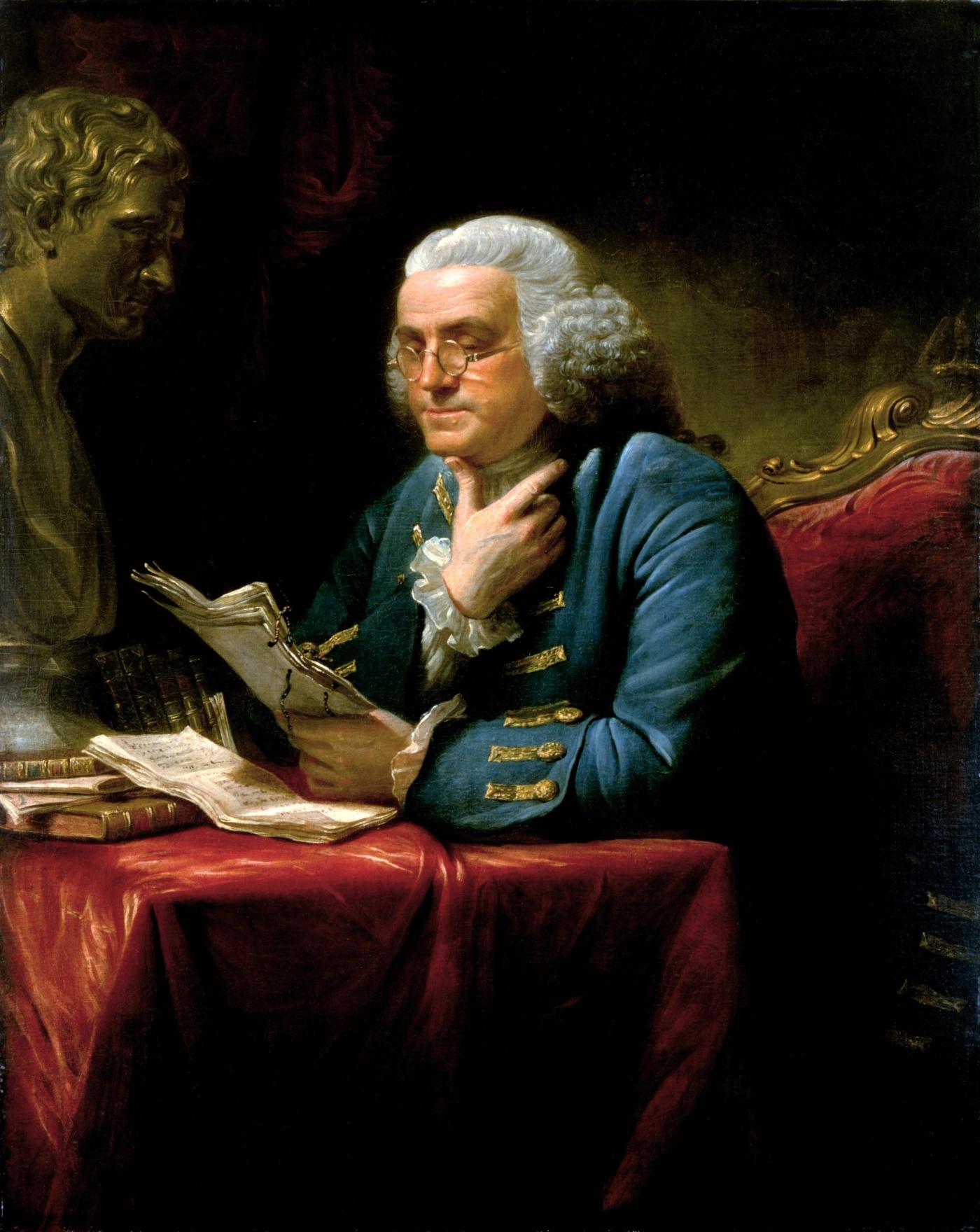
On Thursday, February 13, 1766, Benjamin Franklin stood at the bar of the British House of Commons to be questioned by members sitting as a Committee of the Whole. He was then the agent of the Pennsylvania Assembly in London. Of the 174 questions recorded, one went to the heart of the matter: what had been the temper of America toward Great Britain before the year 1763? Franklin's answer was that it had been "the best in the world." The colonists had submitted willingly to the Crown and to acts of Parliament, and they had cost Britain nothing in forts or garrisons to keep them obedient. "They were governed by this country at the expence only of a little pen, ink and paper," he said. "They were led by a thread." Asked what their temper was now, he answered: "O, very much altered."[1]
Franklin chose 1763 because that was the year the Peace of Paris ended the Seven Years' War, known in the colonies as the French and Indian War, and left Great Britain in possession of Canada and dominant among the European powers in eastern North America. It was also the year the British government began searching in earnest for a way to make the American colonies help pay for the empire they now shared. The revenues Parliament hoped to collect over the next twelve years were modest beside Britain's national debt. What turned a quarrel over revenue into a revolution was that Britain's need for money forced a long-unspoken constitutional question into the open, and once it was asked, neither side could find an answer the other would accept. This is the story of those twelve years.
The Price of Victory
The war that ended in 1763 had been the most expensive Britain had ever fought. It had been paid for largely with borrowed money. Adam Smith, writing in The Wealth of Nations in 1776, set out the figures. In 1755, before the war broke out, the funded debt of Great Britain stood at £72,289,673. By 1764, counting both funded and unfunded debt, the total had risen to £139,516,807, a figure Smith took from a contemporary writer on public finance.[2] In less than a decade the nation's obligations had nearly doubled.
Peace did not bring relief from expense. The new territories had to be garrisoned, and the frontier had to be held against the Native nations of the Ohio country and the Great Lakes, who rose against British posts in 1763 in Pontiac's War. The ministry decided to keep a standing army of regulars in North America after the peace. To George Grenville, who became First Lord of the Treasury in April 1763, and to many members of Parliament the reasoning seemed simple. The war had been fought largely to protect the colonies, the colonists were lightly taxed, and they should help pay for their own defense.
Franklin laid out the colonial side of the account in 1766. The colonies, he told the House, had raised, clothed, and paid nearly 25,000 men during the war and had spent many millions. Pennsylvania alone had disbursed about £500,000, and the reimbursements Parliament granted it had not exceeded £60,000. Pennsylvania was still taxing itself heavily to discharge its war debt, with levies scheduled to run until at least 1772.[3] From the American point of view the colonies had already made substantial contributions and were still paying the debts they had incurred. From the British point of view they had paid only what their assemblies chose to grant. That difference, between contributions freely granted and taxes imposed, would become the central issue of the next twelve years.
Molasses and the Sugar Act
Grenville began by revising an old tax. Since 1733 Parliament had imposed a duty of sixpence a gallon on molasses imported into the mainland colonies from the French and Spanish West Indies. The duty had been meant to protect British sugar planters, and it had been so widely evaded through smuggling that it raised almost nothing.
The American Revenue Act of 1764, soon called the Sugar Act, cut the duty on foreign molasses in half, to threepence a gallon. Grenville meant this duty to be collected, and the preamble of the act announced a purpose that no earlier trade law had stated so plainly. It declared it "just and necessary, that a revenue be raised, in your Majestys said dominions in America, for defraying the expences of defending, protecting, and securing the same."[4] The duty was now openly a source of income for the Crown.
The enforcement provisions mattered as much as the rate. Under the act, forfeitures in the colonies could be prosecuted in a court of vice-admiralty, which sat without a jury, at the choice of the informer who brought the case. In disputes over seized goods the burden of proof lay on the owner, and an officer whose seizure had "probable cause" was shielded from suit even if the owner won.[5] To colonial merchants these clauses looked like an attack on trial by jury. Years later, Edmund Burke described Grenville as a statesman of real ability whose training led him to take "regulation to be commerce, and taxes to be revenue."[6] The Sugar Act drew petitions from several colonies, but protest was confined largely to merchants and lawmakers. The next measure would reach nearly everyone.
The Stamp Act
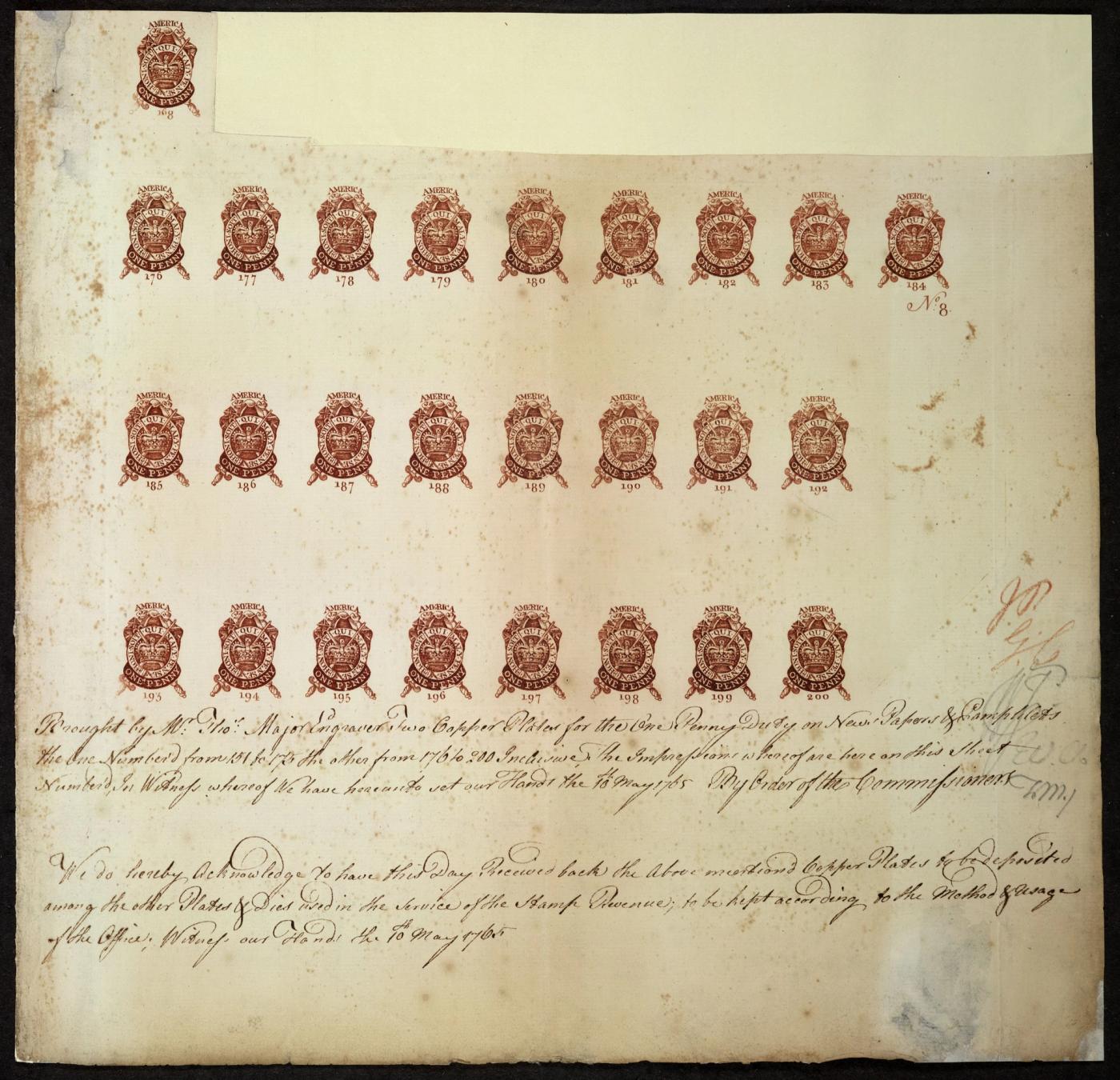
The Stamp Act, which received the royal assent in March 1765, was meant to raise what its preamble called "a further revenue" within the American dominions, again toward "defraying the said expences" of defense. It was to take effect on November 1, 1765.[7] Legal documents, licenses, and printed matter had to be written or printed on paper bearing an embossed stamp, which could be bought only from official distributors. A document on unstamped paper had no standing in court.
The schedule ran to dozens of items. A pleading in a court of law required a stamp of threepence. Admission to practice as an attorney cost ten pounds, a college degree two pounds, and a pack of playing cards one shilling. Newspapers were to pay a halfpenny or a penny on each copy, depending on the size of the sheet, and every advertisement printed in a newspaper was charged two shillings. Deeds, mortgages, bills of lading, liquor licenses, and apprentices' indentures were all taxed. The duties were to be paid in sterling, which was chronically scarce in the colonies, and violations could again be prosecuted in courts of admiralty.[8]
The tax fell hardest on the most articulate people in colonial society. Lawyers, merchants, and printers could hardly work without stamps. Franklin would later tell the Commons that much of the revenue would come from lawsuits over debts and so would be paid by the poorest colonists, making it "a heavy tax on the poor, and a tax upon them for being poor."[9]
A Summer of Fury
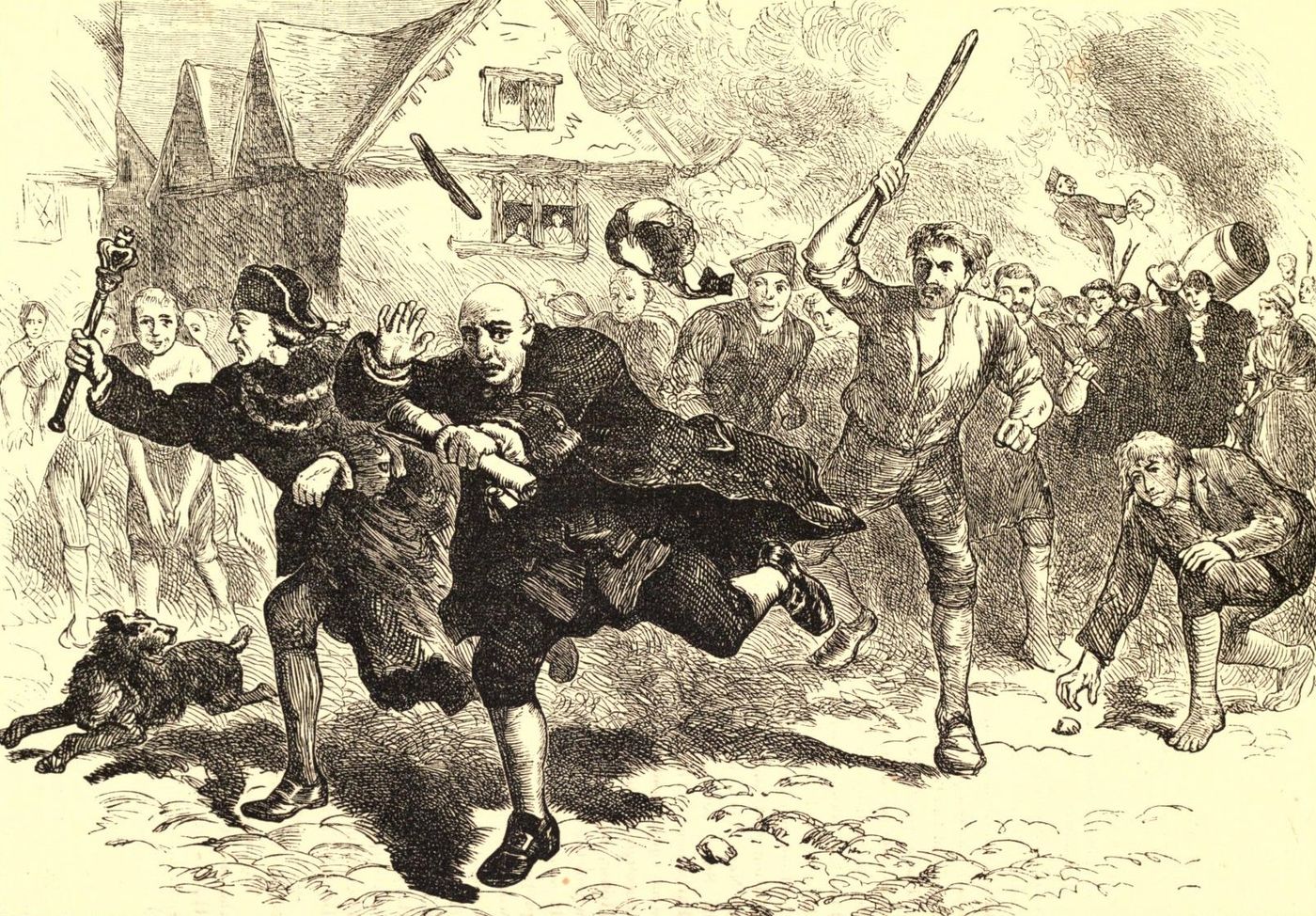
Boston moved first. On August 14, 1765, an effigy of Andrew Oliver, the man appointed to distribute the stamps in Massachusetts, was hung from a tree in the South End that Bostonians would soon call the Liberty Tree. That evening a crowd paraded the effigy through the town, pulled down a small building Oliver had put up near his wharf and was presumed to intend as the stamp office, burned the effigy on Fort Hill, and attacked Oliver's house. The next day Oliver announced that he would resign his commission.[10]
The violence did not end there. Oliver's brother-in-law, Thomas Hutchinson, was lieutenant governor and chief justice of the province, and rumors spread that he had privately encouraged the Stamp Act in letters to England. By his own account Hutchinson had argued against the act before it passed, but once it became law he told grand juries that resistance to an act of Parliament was a serious offense, and that was enough to make him a target. On the evening of August 26, as he wrote four days later to Richard Jackson, the province's agent in London, he was at supper with his children when word came that the mob was coming. His eldest daughter refused to leave without him, so he withdrew with her to a neighbor's house. Within minutes, he wrote, "the hellish crew fell upon my house with the Rage of devils & in a moment with axes split down the door & entred."[11]
The crowd worked through the night. They tore off the wainscoting and wall hangings, beat down the partition walls, cut away the cupola, and had begun stripping slate and boards from the roof when daylight stopped them. By his reckoning they carried off about £900 sterling in cash, along with silver, portraits, and clothing, and scattered or destroyed the manuscripts and public papers Hutchinson had been collecting for thirty years. "Such ruins were never seen in America," he wrote.[12] The next morning, because the Superior Court could not sit without him, the chief justice appeared on the bench in the only clothes he had left. According to a report by the young lawyer Josiah Quincy, he apologized for his dress and swore before God that he had never promoted the Stamp Act in any way.[13]
Many Bostonians who opposed the act were appalled. The Reverend Jonathan Mayhew, whose sermon on liberty the day before had been blamed for inflaming the crowd, wrote to Hutchinson that he would "rather lose my hand, than be an encourager of such outrages."[14] Hutchinson himself believed that the men who had organized the first protest "never intended matters should go this length."[15] Whatever its organizers intended, the violence worked. Across the colonies, stamp distributors resigned under pressure, and by November 1 there was almost no one left in America willing to sell the stamps.
In October 1765 delegates from nine colonies met in New York in what became known as the Stamp Act Congress. Their resolutions, adopted on October 19, professed loyalty to the king and "all due subordination" to Parliament, but they drew a firm line on taxation. It was "the undoubted right of Englishmen, that no taxes be imposed on them, but with their own consent, given personally, or by their representatives," the delegates declared. The colonists were not represented in the House of Commons and "from their local circumstances cannot be," and so no taxes could be constitutionally imposed on them except by their own legislatures.[16] The act's defenders had a ready answer. Thomas Whately, a secretary to the Treasury under Grenville, argued in a pamphlet of 1765 that the colonists stood in the same position as the many Englishmen without a vote: "none are actually, all are virtually represented in Parliament."[17] To the delegates in New York, a body the colonists had not chosen could not give their consent. Merchants agreed to stop importing British goods, and Franklin reported that colonists had agreed to eat no lamb so that more wool could be spun at home.[18]
Repeal and Declaration
By the winter of 1765–66, Grenville had fallen from office, and the new ministry under the Marquess of Rockingham faced an unenforceable law and a boycott that was hurting British merchants. Pressed by the Commons on why the colonists accepted old trade duties but refused the stamps, Franklin drew a distinction that would not last. An external tax, he explained, was a duty on imported goods, which was added to the price, and "if the people do not like it at that price, they refuse it; they are not obliged to pay it." An internal tax, by contrast, "is forced from the people without their consent, if not laid by their own representatives." Asked whether soldiers could enforce the act, he warned: "They will not find a rebellion; they may indeed make one."[19]
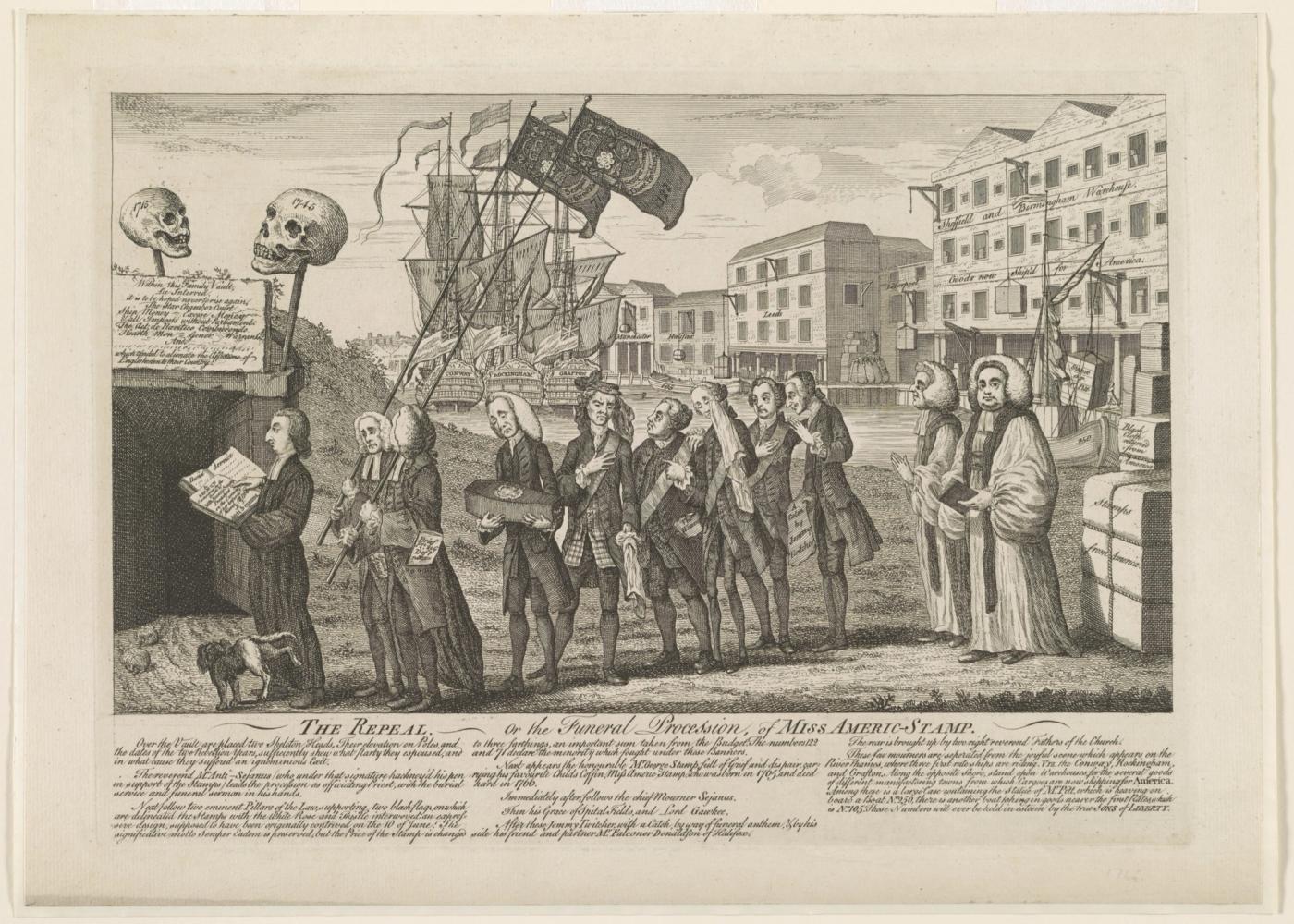
Parliament repealed the Stamp Act in March 1766. On the same day it passed the Declaratory Act, which asserted that the colonies were subordinate to the Crown and Parliament of Great Britain, and that Parliament "had, hath, and of right ought to have, full power and authority to make laws and statutes of sufficient force and validity to bind the colonies and people of America . . . in all cases whatsoever."[20] Americans celebrated the repeal and paid the declaration little attention, as Franklin had predicted. The colonists, he had told the House, would regard such declarations much as they regarded Parliament's claimed right to tax Ireland, which Parliament asserted but never exercised. He also offered a warning. Some in England had been arguing that if Parliament had no right to impose internal taxes, it had none to impose external ones either. "At present they do not reason so," Franklin said of the colonists, "but in time they may possibly be convinced by these arguments."[21]
Townshend's Duties and the Pennsylvania Farmer
The test came within a year. Charles Townshend, Chancellor of the Exchequer in the ministry of William Pitt, now Earl of Chatham, proposed in 1767 to raise an American revenue through duties of exactly the kind Franklin had described as acceptable. The Revenue Act of 1767 placed import duties on glass, red and white lead, painters' colors, many grades of paper, and tea, which was charged at threepence a pound. These were external taxes, collected at the ports, but the purpose of the revenue alarmed many colonists more than the tax itself. The preamble stated that the money was to make "a more certain and adequate provision for defraying the charge of the administration of justice, and the support of civil government" in the colonies. Royal governors and judges whose salaries had depended on the annual votes of colonial assemblies would now be paid by the Crown out of American customs revenue, freeing them from the assemblies' control. The act also confirmed the power of colonial superior courts to grant writs of assistance, general warrants letting customs officers search houses and warehouses for smuggled goods, and so revived a controversy over such writs that had already erupted in Massachusetts in 1761.[22]
The most influential answer came from John Dickinson, a wealthy Philadelphia lawyer who had helped draft the Stamp Act Congress's declaration of rights and grievances. In twelve essays that began appearing in Pennsylvania newspapers in the winter of 1767–68 and were reprinted throughout the colonies, he wrote in the character of a modest farmer. The second letter went directly to Franklin's distinction and discarded it. Parliament, Dickinson granted, had an unquestioned authority to regulate the trade of the empire. But the new duties were imposed "not for the regulation of trade" but "for the single purpose of levying money upon us." The question was therefore simply "whether the parliament can legally take money out of our pockets, without our consent." If the colonists once admitted that Britain could tax its exports to America for revenue, he warned, she would need only to lay those duties on goods the colonists were forbidden to manufacture for themselves, "and the tragedy of American liberty is finished."[23]
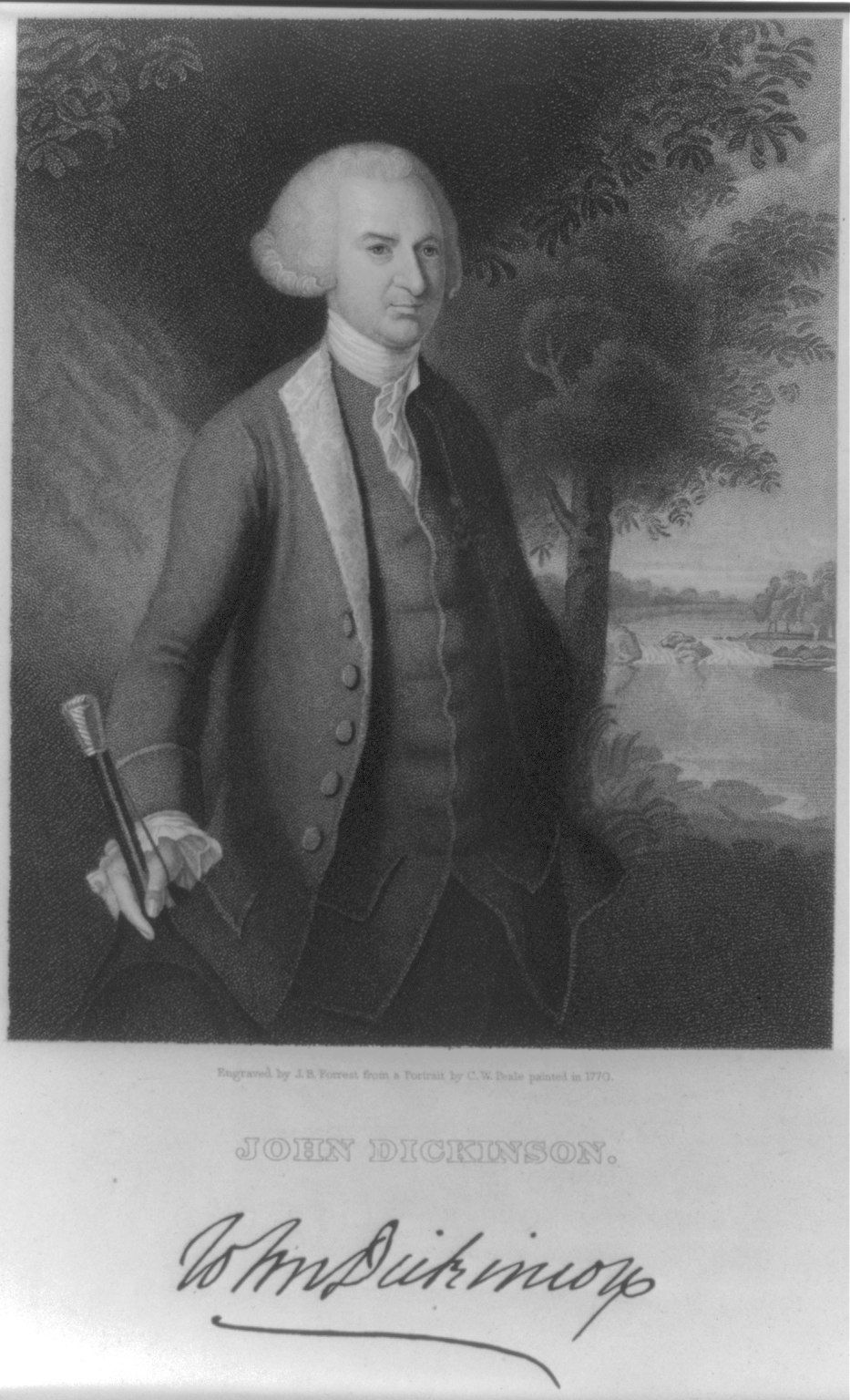
After Dickinson the issue was no longer whether a tax was collected inside the colonies or at their ports, but whether its object was to regulate commerce or to raise money. By that test the Townshend duties were as unconstitutional as the stamps. Merchants again stopped importing British goods, and in 1768 Massachusetts urged the other assemblies to joint opposition and refused an order from the colonial secretary, Lord Hillsborough, to retract its appeal. That autumn regiments of regulars arrived in Boston, and the friction between soldiers and townspeople culminated on the night of March 5, 1770, when troops fired into a crowd on King Street and killed five people.
Threepence on Tea
The Townshend duties failed as revenue too. On May 13, 1769, Lord Hillsborough sent a circular letter to the colonial governors assuring them that the ministry had "at no time entertained a design to propose to Parliament to lay any further taxes upon America for the purpose of raising a revenue," and promising that the duties on glass, paper, and colors would be taken off because they had been "laid contrary to the true principles of Commerce."[24] Under the new First Lord of the Treasury, Lord North, Parliament repealed the Townshend duties on glass, lead, painters' colors, and paper in 1770. The duty on tea remained, chiefly so that the principle of parliamentary taxation would not be surrendered.
Burke later mocked the arrangement as "a preamble without an act." The problem, he argued, had never been the size of the tax. "No man ever doubted that the commodity of Tea could bear an imposition of three-pence," he told the House. "It is the weight of that preamble, of which you are so fond, and not the weight of the duty, that the Americans are unable and unwilling to bear."[25]
For three years the tea duty remained in force while much of the tea Americans drank came from Dutch smugglers. In 1773 the East India Company was close to ruin, and Burke later spoke of some ten million pounds of tea lying unsold in its warehouses. To rescue it, Parliament passed the Tea Act in May 1773, which licensed the company to export tea directly to its own agents in America and relieved that tea of the duties paid on it in England. The threepenny American duty remained. Burke argued that America, where tea had become "next to a necessary of life," could have absorbed that surplus had the duty not stood in the way.[26] Now the company's tea would be cheap enough to undersell the smugglers, but every chest sold would still carry the tax.
The colonists saw the bargain as a test of principle, and in most ports the consignees were pressured into resigning. In Boston, where the governor's own sons were among the consignees,[27] Hutchinson refused to grant the tea ships a pass to leave the harbor without unloading. Under the customs laws the duty had to be paid within twenty days of arrival or the cargo could be seized, and the deadline for the first ship, the Dartmouth, was about to expire.[28] On the afternoon of December 16 a great meeting at the Old South Meeting House learned that the governor would not relent. That evening a body of men, some disguised as Indians, went aboard the three ships at Griffin's Wharf. According to the Massachusetts Gazette and Boston Weekly News-Letter, they broke open 342 chests of tea in about three hours and emptied them into the harbor. Hutchinson, writing his history later in exile, gave the same number and defended his refusal of the pass.[29] Contemporary counts differ slightly: the Boston minister Samuel Cooper, writing to Franklin the next day, put the figure at about 340, and the East India Company's claim for compensation listed 340 chests.[30]
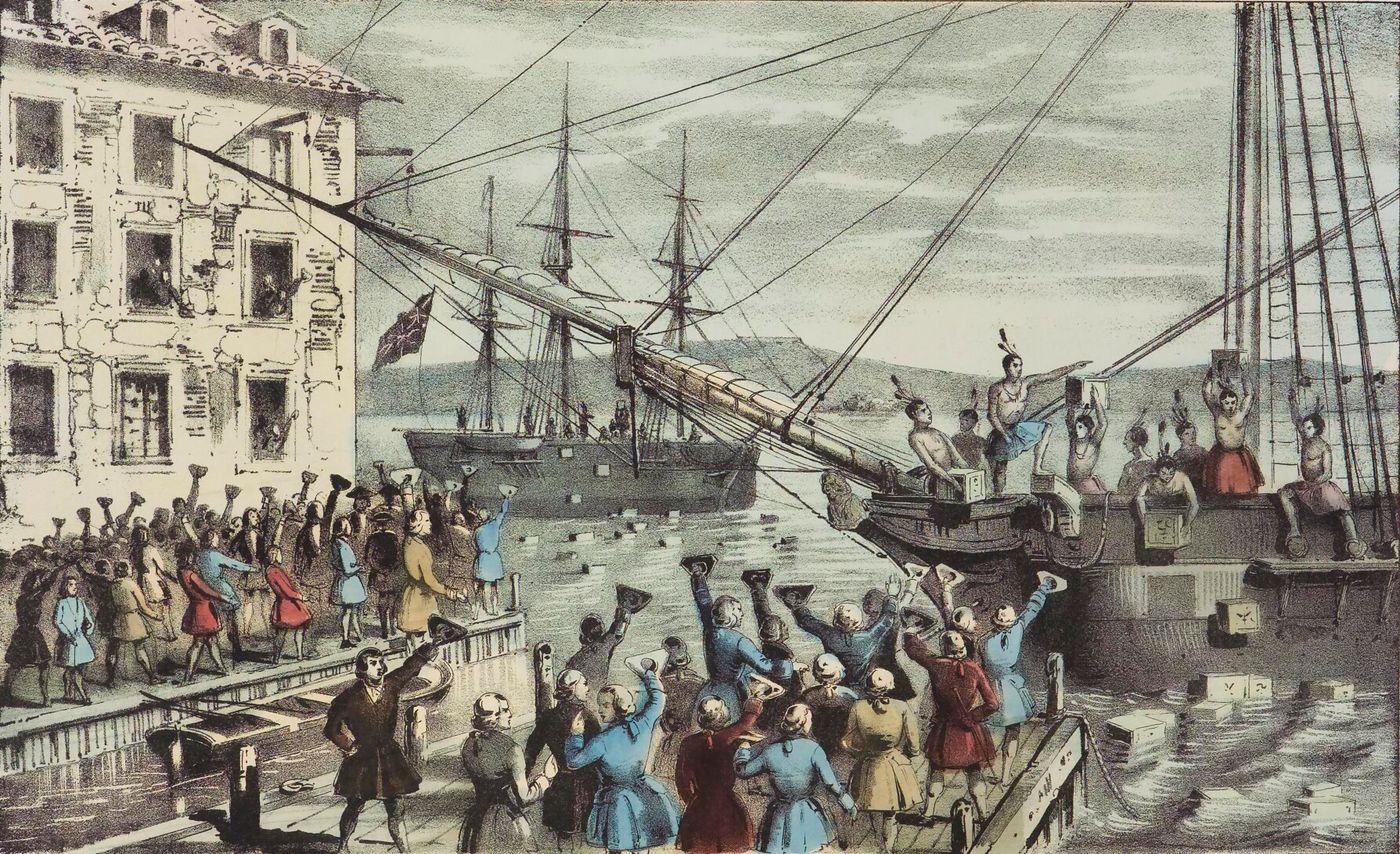
John Adams, then a Boston lawyer, wrote in his diary the next day that the destruction of the tea was "the most magnificent Movement of all." To let the tea be landed, he reasoned, "would be giving up the Principle of Taxation by Parliamentary Authority, against which the Continent have struggled for 10 years."[31]
Coercion and Congress
London's response was swift. In 1774 Parliament passed a series of measures that the colonists soon called the Intolerable Acts. One closed the port of Boston to commerce until the tea was paid for. Another remade the charter government of Massachusetts, a third allowed officials accused of crimes while suppressing riots to be tried outside the province, and a fourth revised the rules for quartering troops. Congress would also condemn the Quebec Act, passed in the same session, although that act was not itself a punishment for the destruction of the tea.[32] General Thomas Gage, commander of British forces in America, arrived in Boston as governor in May, and Hutchinson sailed for England on June 1, never to return.[33]
On April 19, 1774, as the punitive bills were moving forward, a motion was made in the Commons to consider repealing the tea duty, and Burke rose to support it. "For nine long years, session after session," he began, "we have been lashed round and round this miserable circle of occasional arguments and temporary expedients." He urged the House to return to the policy that had governed the empire before Grenville. "Leave America," he said, "if she has taxable matter in her, to tax herself."[34] The House did not listen.
In September 1774 delegates from twelve colonies gathered in Philadelphia as the First Continental Congress. On October 14 they adopted a declaration condemning the revenue acts since 1764 and the punitive acts of 1774. The fourth resolution showed how far the argument had traveled since Franklin's testimony. The colonists, Congress declared, could not be represented in the British Parliament and were therefore entitled to "a free and exclusive power of legislation" in their own assemblies "in all cases of taxation and internal polity." They would accept acts truly restricted to regulating external commerce, but only on terms "excluding every idea of taxation internal or external, for raising a revenue on the subjects, in America, without their consent." The distinction Franklin had offered the Commons in 1766 was gone, as he had warned it might be. The declaration announced that Congress would enter into an agreement to cut off trade with Britain.[35] On October 20, Congress adopted the Continental Association, which committed the colonies to stop importing British goods from December 1, 1774, and pledged to halt exports to Britain, Ireland, and the British West Indies from September 10, 1775, if the grievances remained unredressed.[36]
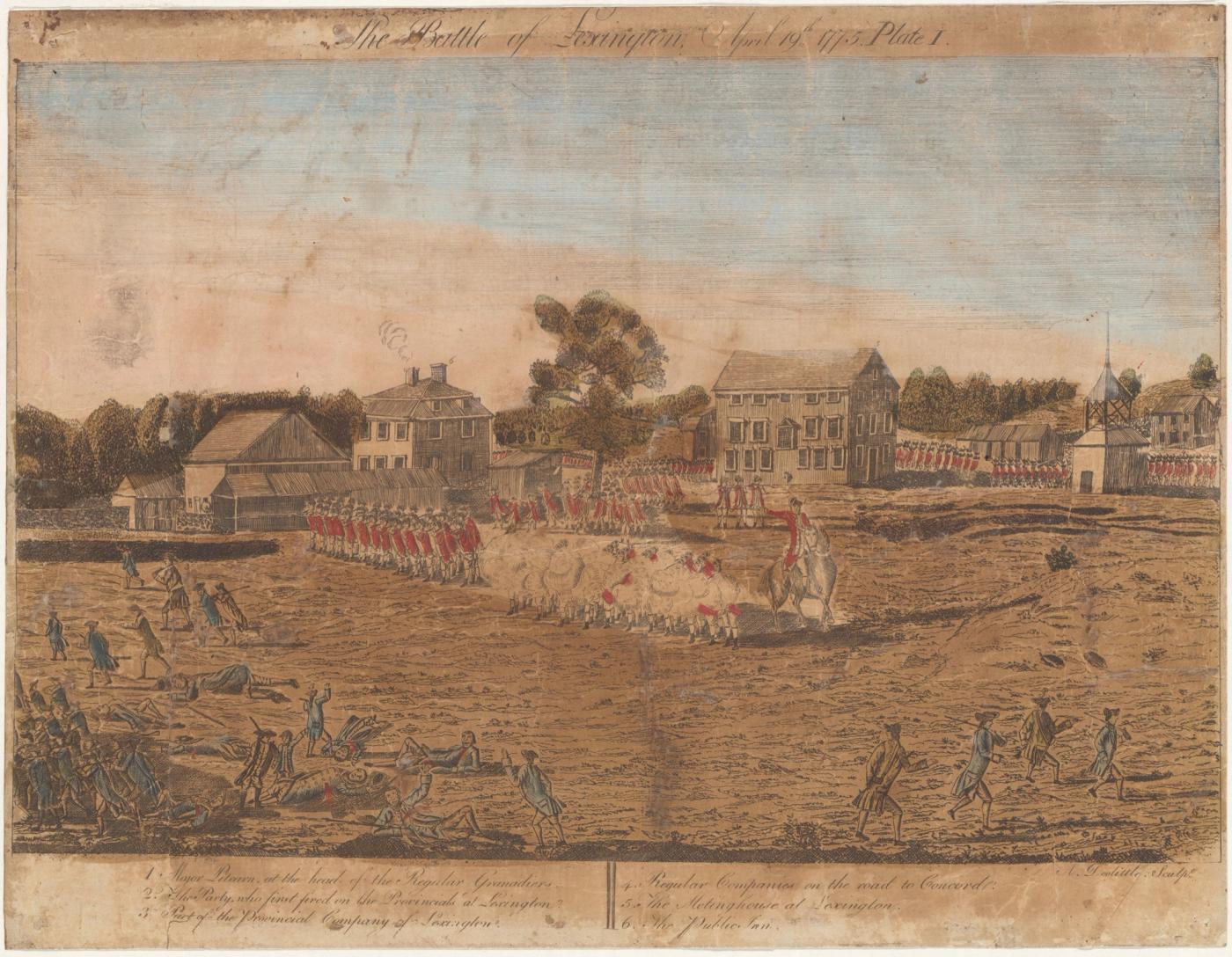
Gage, meanwhile, tried to govern Massachusetts with an army. In the early hours of April 19, 1775, he sent a column of regulars out of Boston to seize military stores at Concord. On the green at Lexington, and later at Concord's North Bridge, they met armed militiamen, and the war began. It came one year to the day after Burke had begged the House of Commons to let America tax herself.
Why It Mattered
The twelve years from 1763 to 1775 began with a problem of public finance and ended with a war. The British debt was real, and the argument that the colonists ought to contribute was not unreasonable on its face. What made it so hard to resolve was the principle on which Parliament insisted and the colonists' growing determination to defend the authority of their own assemblies. Every attempt to raise money by act of Parliament forced the colonists to state more precisely why Parliament could not do so. As the dispute widened to questions of courts, executive power, and military authority, each new statement of colonial rights went further than the last. The objection grew from admiralty courts in 1764 to internal taxes in 1765, to any duty laid for revenue in 1768, and in 1774 to a claim of exclusive colonial power over taxation and internal government. Parliament, for its part, moved from asserting a right to declaring it "in all cases whatsoever," and then to enforcing it with soldiers. Neither side could retreat without conceding the principle the other had made the center of the dispute.
The amounts at stake were modest. The Sugar Act lowered a duty rather than raising one. The Townshend duties were modest, and the tax that finally provoked the destruction of the tea was threepence a pound on a commodity whose price was falling. Burke saw the paradox clearly when he said that it was the preamble and not the duty that Americans would not bear. Adams, Dickinson, and the delegates in Philadelphia believed that consenting to a small tax for revenue meant consenting to the power to impose any tax, and that a people taxed without their consent were no longer free.
When Franklin told the House of Commons in 1766 that the colonies had once been led by a thread, he was describing a relationship held together by habit, affection, and an unspoken agreement not to press questions of ultimate authority. The search for revenue after 1763 pulled at that thread until it broke. In the same examination Franklin had warned that soldiers sent to America would find no rebellion there but might well make one. Nine years later, on a village green in Massachusetts, his prediction came true.
Places in this Story
The places this story moves through, in order — follow them on the interactive map →
- Palace of Westminster, London 1763–1766
Where the whole quarrel was argued. Grenville took the Treasury in April 1763 facing a war debt that had nearly doubled; three years later Franklin stood at the bar of the Commons and told the House the colonies had once been “led by a thread.”
- Fort Detroit, Great Lakes country 1763
Pontiac’s War struck British posts across the Great Lakes and the Ohio country in 1763, confirming the ministry’s decision to keep a standing army of regulars in North America — the expense that made American revenue seem necessary.
- Newport, Rhode Island 1764
New England’s distillers ran on French and Spanish West Indian molasses, and on the smuggling that evaded the 1733 duty. The Sugar Act halved the rate to threepence a gallon precisely so it could be collected.
- Vice-Admiralty Court, Halifax, Nova Scotia 1764
The Sugar Act let an informer prosecute forfeitures in a vice-admiralty court, which sat without a jury and put the burden of proof on the owner. To colonial merchants the enforcement clauses mattered more than the rate.
- Liberty Tree, Boston August 14, 1765
An effigy of stamp distributor Andrew Oliver hung from an elm in the South End. The crowd paraded it through town, pulled down the building near Oliver’s wharf, and burned the effigy on Fort Hill. Oliver resigned the next day.
- Thomas Hutchinson’s house, North End, Boston August 26, 1765
A mob split the door with axes and worked through the night, taking some £900 sterling and destroying thirty years of manuscripts. “Such ruins were never seen in America,” the lieutenant governor wrote. He sat on the bench next morning in his only remaining clothes.
- City Hall, Wall Street, New York October 19, 1765
Delegates from nine colonies met as the Stamp Act Congress and resolved that no taxes could be imposed on Englishmen but by their own consent — and that the colonists, unrepresented in the Commons and “from their local circumstances cannot be,” could be taxed only by their own legislatures.
- Philadelphia 1767–1768
John Dickinson’s twelve Letters from a Farmer in Pennsylvania began appearing in the city’s newspapers and were reprinted across the colonies. They shifted the test from where a tax was collected to why — regulation of trade, or revenue.
- King Street, Boston March 5, 1770
Regiments sent to Boston in 1768 to protect the customs service ended up quartered among a hostile town. On the night of March 5, 1770, troops fired into a crowd on King Street and killed five people.
- Griffin’s Wharf, Boston December 16, 1773
Hutchinson refused the tea ships a pass to leave the harbor, and the twenty-day deadline on the Dartmouth was about to expire. That evening men boarded three ships and broke open the chests — 342 by the Boston News-Letter’s count, about 340 by others.
- Carpenters’ Hall, Philadelphia September–October 1774
Delegates from twelve colonies met as the First Continental Congress, claimed “a free and exclusive power of legislation” in their own assemblies, and on October 20 adopted the Continental Association to cut off trade with Britain.
- Lexington Green, Massachusetts April 19, 1775
Gage’s regulars, marching to seize military stores at Concord, met militiamen on the green. The war began one year to the day after Burke had asked the Commons to leave America to tax herself.
Frequently Asked Questions
Why did Britain start taxing the American colonies in 1763?
The Seven Years’ War had nearly doubled the national debt, from £72.3 million funded in 1755 to roughly £139.5 million funded and unfunded by 1764, and Britain had decided to keep a standing army in North America after the peace. George Grenville, who took over the Treasury in April 1763, concluded that colonists who were lightly taxed should help pay for their own defense.
What did the Stamp Act of 1765 actually tax?
It required an embossed stamp on legal documents, licenses, and printed matter — court pleadings at threepence, admission as an attorney at ten pounds, a college degree at two pounds, a pack of playing cards at a shilling, a halfpenny or penny on each newspaper, and two shillings on every newspaper advertisement. Deeds, mortgages, bills of lading, liquor licenses, and apprentices’ indentures were all covered, and the duties had to be paid in scarce sterling.
What is “virtual representation”?
It was the ministry’s answer to the charge that colonists were taxed without consent. Thomas Whately, a Treasury secretary under Grenville, argued in 1765 that the colonists were in the same position as the many Englishmen who had no vote: “none are actually, all are virtually represented in Parliament.” The Stamp Act Congress rejected it, holding that a body the colonists had not chosen could not consent on their behalf.
Why was the Stamp Act repealed, and what replaced it?
By early 1766 the act was unenforceable — nearly every stamp distributor in America had resigned — and a colonial boycott was hurting British merchants. Parliament repealed it in March 1766 but passed the Declaratory Act the same day, asserting authority to bind the colonies “in all cases whatsoever.” Americans celebrated the repeal and largely ignored the declaration.
What was the difference between internal and external taxes?
Franklin told the Commons in 1766 that an external tax was a port duty folded into a price a buyer could refuse, while an internal tax was taken directly without consent. Charles Townshend built the 1767 duties on exactly that distinction. John Dickinson then dissolved it in his Letters from a Farmer in Pennsylvania, arguing the real test was purpose: a duty levied to raise revenue rather than regulate trade was a tax wherever it was collected.
Why did colonists destroy the tea when the Tea Act made tea cheaper?
The 1773 act let the East India Company ship directly to its own agents and dropped the English duties, but the threepenny American duty stayed in place — so cheap tea would have meant paying the tax. John Adams wrote that landing it “would be giving up the Principle of Taxation by Parliamentary Authority.” On December 16, 1773, men boarded three ships at Griffin’s Wharf and emptied the chests into the harbor.
What were the Intolerable Acts?
Four punitive measures Parliament passed in 1774: the Boston Port Act closed the harbor until the tea was paid for, the Massachusetts Government Act remade the province’s charter government, the Administration of Justice Act allowed officials accused of crimes in suppressing riots to be tried outside the province, and a new Quartering Act revised the rules for housing troops. The First Continental Congress also condemned the Quebec Act, passed the same session, though it was not a punishment for the tea.
Bibliography
Adams, John. Diary and Autobiography of John Adams. Edited by L. H. Butterfield. 4 vols. Cambridge, MA: Belknap Press of Harvard University Press, 1961. Founders Online, National Archives. https://founders.archives.gov/documents/Adams/01-02-02-0003-0008. Accessed October 14, 2026.
Adams, John. Marginalia in Letters to the Right Honorable the Earl of Hillsborough, from Governor Bernard, General Gage, and the Honorable His Majesty's Council. Boston, 1769. [June 1774?]. In Papers of John Adams, vol. 2, edited by Robert J. Taylor. Cambridge, MA: Belknap Press of Harvard University Press, 1977. Founders Online, National Archives. https://founders.archives.gov/documents/Adams/06-02-02-0021. Accessed October 14, 2026.
Burke, Edmund. Speech of Edmund Burke, Esq. on American Taxation, April 19, 1774. London: J. Dodsley, 1775. Reprinted in Select Works of Edmund Burke, edited by E. J. Payne, vol. 1. Oxford: Clarendon Press, 1874–78. Reprint, Indianapolis: Liberty Fund, 1990. Econlib. https://www.econlib.org/book-chapters/chapter-vol-1-speech-of-edmund-burke-esq-on-american-taxation/. 1775 Dodsley printing at Internet Archive, https://archive.org/details/bim_eighteenth-century_speech-of-edmund-burke-_burke-edmund_1775_0. Accessed October 14, 2026.
Continental Congress. "Declaration and Resolves of the First Continental Congress." October 14, 1774. Avalon Project, Lillian Goldman Law Library, Yale Law School. https://avalon.law.yale.edu/18th_century/resolves.asp. Accessed October 14, 2026.
Continental Congress. "The Articles of Association." October 20, 1774. In Journals of the Continental Congress. Avalon Project, Lillian Goldman Law Library, Yale Law School. https://avalon.law.yale.edu/18th_century/contcong_10-20-74.asp. Accessed October 14, 2026.
Cooper, Samuel. Samuel Cooper to Benjamin Franklin, December 17, 1773. In The Papers of Benjamin Franklin, vol. 20, edited by William B. Willcox. New Haven: Yale University Press, 1976. Founders Online, National Archives. https://founders.archives.gov/documents/Franklin/01-20-02-0266. Accessed October 14, 2026.
Dickinson, John. Letters from a Farmer in Pennsylvania, to the Inhabitants of the British Colonies. Philadelphia: David Hall and William Sellers, 1768. Excerpts of Letter II at Hanover College History Department, https://history.hanover.edu/courses/excerpts/334dickinson.html. Complete text, in a 1903 facsimile edition, at Internet Archive, https://archive.org/details/lettersfromfarme00dick. Accessed October 15, 2026.
East India Company, Court of Directors. Memorial to the Earl of Dartmouth requesting compensation for the tea destroyed at Boston. February 16, 1774. CO 5/247. The National Archives, Kew. Described in "Request for Compensation for the Boston Tea Party," The National Archives. https://www.nationalarchives.gov.uk/explore-the-collection/stories/request-for-compensation-for-the-boston-tea-party/. Accessed October 14, 2026.
Franklin, Benjamin. The Examination of Doctor Benjamin Franklin, before an August Assembly, relating to the Repeal of the Stamp-Act, &c. Philadelphia: Hall and Sellers, 1766. In The Papers of Benjamin Franklin, vol. 13, edited by Leonard W. Labaree. New Haven: Yale University Press, 1969. Founders Online, National Archives. https://founders.archives.gov/documents/Franklin/01-13-02-0035. Accessed October 14, 2026.
Great Britain. Parliament. "An Act for Granting and Applying Certain Stamp Duties, and Other Duties, in the British Colonies and Plantations in America" (Stamp Act). 5 Geo. III, c. 12. 1765. In The Statutes at Large, edited by Danby Pickering. Cambridge: Bentham, 1762–1869. Avalon Project. https://avalon.law.yale.edu/18th_century/stamp_act_1765.asp. Accessed October 14, 2026.
Great Britain. Parliament. "An Act for Granting Certain Duties in the British Colonies and Plantations in America" (Sugar Act). 4 Geo. III, c. 15. 1764. In The Statutes at Large, edited by Danby Pickering. Cambridge: Bentham, 1762–1869. Avalon Project. https://avalon.law.yale.edu/18th_century/sugar_act_1764.asp. Accessed October 14, 2026.
Great Britain. Parliament. "An Act for Granting Certain Duties in the British Colonies and Plantations in America" (Townshend Revenue Act). 7 Geo. III, c. 46. 1767. In The Statutes at Large, edited by Danby Pickering. Cambridge: Bentham, 1762–1869. Avalon Project. https://avalon.law.yale.edu/18th_century/townsend_act_1767.asp. Accessed October 14, 2026.
Great Britain. Parliament. "An Act for the Better Providing Suitable Quarters for Officers and Soldiers in His Majesty's Service in North America" (Quartering Act). 14 Geo. III, c. 54. 1774. Avalon Project. https://avalon.law.yale.edu/18th_century/quartering_act_1774.asp. Accessed October 14, 2026.
Great Britain. Parliament. "An Act for the Better Regulating the Government of the Province of the Massachusets Bay, in New England" (Massachusetts Government Act). 14 Geo. III, c. 45. 1774. Avalon Project. https://avalon.law.yale.edu/18th_century/mass_gov_act.asp. Accessed October 14, 2026.
Great Britain. Parliament. "An Act for the Better Securing the Dependency of His Majesty's Dominions in America upon the Crown and Parliament of Great Britain" (Declaratory Act). 6 Geo. III, c. 12. 1766. In The Statutes at Large, edited by Danby Pickering. Cambridge: Bentham, 1762–1869. Avalon Project. https://avalon.law.yale.edu/18th_century/declaratory_act_1766.asp. Accessed October 14, 2026.
Great Britain. Parliament. "An Act for the Impartial Administration of Justice in the Cases of Persons Questioned for Any Acts Done by Them in the Execution of the Law, or for the Suppression of Riots and Tumults, in the Province of the Massachusetts Bay" (Administration of Justice Act). 14 Geo. III, c. 39. 1774. Avalon Project. https://avalon.law.yale.edu/18th_century/admin_of_justice_act.asp. Accessed October 14, 2026.
Great Britain. Parliament. "An Act to Discontinue . . . the Landing and Discharging, Lading or Shipping, of Goods, Wares, and Merchandise, at the Town, and within the Harbour, of Boston" (Boston Port Act). 14 Geo. III, c. 19. 1774. Avalon Project. https://avalon.law.yale.edu/18th_century/boston_port_act.asp. Accessed October 14, 2026.
Hutchinson, Thomas. The Correspondence of Thomas Hutchinson. Vol. 1, 1740–1766. Edited by John W. Tyler and Elizabeth Dubrulle. Boston: Colonial Society of Massachusetts, 2014. Online edition, https://www.colonialsociety.org/node/2507. Accessed October 14, 2026.
Hutchinson, Thomas. The History of the Province of Massachusetts Bay, from 1749 to 1774. Edited by John Hutchinson. London: John Murray, 1828. Google Books. https://books.google.com/books/about/The_History_of_the_Province_of_Massachus.html?id=dHoFAAAAQAAJ. Accessed October 14, 2026.
Massachusetts Gazette and Boston Weekly News-Letter. December 23, 1773. Excerpted in "Boston Tea Party," Declaring Independence, Colonial Williamsburg Foundation. https://research.colonialwilliamsburg.org/pf/declaring/bostonTeaParty.cfm. Accessed October 14, 2026.
Smith, Adam. An Inquiry into the Nature and Causes of the Wealth of Nations. 2 vols. London: W. Strahan and T. Cadell, 1776. Book V, chapter 3, Marxists Internet Archive. https://www.marxists.org/reference/archive/smith-adam/works/wealth-of-nations/book05/ch03-2.htm. Accessed October 14, 2026.
Stamp Act Congress. "Resolutions of the Stamp Act Congress." October 19, 1765. Avalon Project, Lillian Goldman Law Library, Yale Law School. https://avalon.law.yale.edu/18th_century/resolu65.asp. Accessed October 14, 2026.
Whately, Thomas. The Regulations Lately Made concerning the Colonies, and the Taxes Imposed upon Them, Considered. London: J. Wilkie, 1765. Published anonymously. Internet Archive. https://archive.org/details/regulationslatel00what. Accessed October 15, 2026.
Citations
- Benjamin Franklin, The Examination of Doctor Benjamin Franklin, before an August Assembly, relating to the Repeal of the Stamp-Act, &c. (Philadelphia: Hall and Sellers, 1766), questions 36–37, in The Papers of Benjamin Franklin, vol. 13, ed. Leonard W. Labaree (New Haven: Yale University Press, 1969). The figure of 174 recorded questions is from the editors' headnote to the same document. ↑
- Adam Smith, An Inquiry into the Nature and Causes of the Wealth of Nations (London: W. Strahan and T. Cadell, 1776), bk. 5, ch. 3. ↑
- Franklin, Examination, questions 4–6 and 27–28. ↑
- "An Act for Granting Certain Duties in the British Colonies and Plantations in America" (Sugar Act), 4 Geo. III, c. 15 (1764), preamble and sec. 6. ↑
- Sugar Act, secs. 41, 45, 46. ↑
- Edmund Burke, Speech of Edmund Burke, Esq. on American Taxation, April 19, 1774 (London: J. Dodsley, 1775), in Select Works of Edmund Burke, ed. E. J. Payne, vol. 1 (Oxford: Clarendon Press, 1874–78), 186. ↑
- "An Act for Granting and Applying Certain Stamp Duties, and Other Duties, in the British Colonies and Plantations in America" (Stamp Act), 5 Geo. III, c. 12 (1765), preamble. ↑
- Stamp Act, schedule of duties and sec. 58. ↑
- Franklin, Examination, question 110. ↑
- Thomas Hutchinson to William Bollan, September 1, 1765, in The Correspondence of Thomas Hutchinson, vol. 1, 1740–1766, ed. John W. Tyler and Elizabeth Dubrulle (Boston: Colonial Society of Massachusetts, 2014), 296–97; Thomas Hutchinson to Unknown, October 26, 1765, in the same volume. The account of the effigy's route, the destruction of Oliver's building, and the bonfire on Fort Hill also appears in the editorial note to John Adams's diary entry of August 15, 1765, in Diary and Autobiography of John Adams, ed. L. H. Butterfield, vol. 1 (Cambridge, MA: Belknap Press of Harvard University Press, 1961). ↑
- Thomas Hutchinson to Richard Jackson, August 30, 1765, in Correspondence of Thomas Hutchinson, 1:291. Hutchinson's opposition to the act before its passage and his charges to grand juries afterward are described in Thomas Hutchinson to Henry Seymour Conway, October 1, 1765, in the same volume. ↑
- Hutchinson to Jackson, August 30, 1765. ↑
- Thomas Hutchinson, Speech to the Superior Court, [August 27, 1765], as reported by Josiah Quincy Jr., in Correspondence of Thomas Hutchinson, 1:287–88. ↑
- Jonathan Mayhew to Thomas Hutchinson, August 27, 1765, in Correspondence of Thomas Hutchinson, vol. 1. ↑
- Hutchinson to Jackson, August 30, 1765. ↑
- "Resolutions of the Stamp Act Congress," October 19, 1765. ↑
- [Thomas Whately], The Regulations Lately Made concerning the Colonies, and the Taxes Imposed upon Them, Considered (London: J. Wilkie, 1765), 109. ↑
- Franklin, Examination, questions 63 and 87. ↑
- Franklin, Examination, questions 59 and 83. ↑
- "An Act for the Better Securing the Dependency of His Majesty's Dominions in America upon the Crown and Parliament of Great Britain" (Declaratory Act), 6 Geo. III, c. 12 (1766). ↑
- Franklin, Examination, questions 69 and 156. ↑
- "An Act for Granting Certain Duties in the British Colonies and Plantations in America" (Townshend Revenue Act), 7 Geo. III, c. 46 (1767), preamble and secs. 1, 4, and 10. On the 1761 application for writs of assistance before the Massachusetts Superior Court and the opposition it met, see Hutchinson to Conway, October 1, 1765, in Correspondence of Thomas Hutchinson, vol. 1. ↑
- John Dickinson, Letters from a Farmer in Pennsylvania, to the Inhabitants of the British Colonies (Philadelphia: David Hall and William Sellers, 1768), letter 2. ↑
- Lord Hillsborough, circular letter to the colonial governors, May 13, 1769, as read into the record by Burke in Speech on American Taxation, in Select Works, ed. Payne, 1:172. ↑
- Burke, Speech on American Taxation, in Select Works, ed. Payne, 1:164–69. ↑
- Burke, Speech on American Taxation, in Select Works, ed. Payne, 1:167. ↑
- Thomas Hutchinson, The History of the Province of Massachusetts Bay, from 1749 to 1774, ed. John Hutchinson (London: John Murray, 1828), 438, which describes the governor visiting "his sons, who were confined there with the other consignees of the tea" at Castle William. ↑
- Editors' note to Samuel Cooper to Benjamin Franklin, December 17, 1773, in The Papers of Benjamin Franklin, vol. 20, ed. William B. Willcox (New Haven: Yale University Press, 1976). ↑
- Massachusetts Gazette and Boston Weekly News-Letter, December 23, 1773; Hutchinson, History of the Province of Massachusetts Bay, 436. ↑
- Samuel Cooper to Benjamin Franklin, December 17, 1773, in Papers of Benjamin Franklin, vol. 20, giving the figure as "about three hundred and fourty"; East India Company, Court of Directors, memorial to the Earl of Dartmouth, February 16, 1774, The National Archives (UK), CO 5/247, which refers to "three hundred & forty chests of tea." ↑
- John Adams, diary entry, December 17, 1773, in Diary and Autobiography of John Adams, ed. L. H. Butterfield, vol. 2 (Cambridge, MA: Belknap Press of Harvard University Press, 1961), 86. ↑
- Boston Port Act, 14 Geo. III, c. 19 (1774), sec. 10; Massachusetts Government Act, 14 Geo. III, c. 45 (1774); Administration of Justice Act, 14 Geo. III, c. 39 (1774); Quartering Act, 14 Geo. III, c. 54 (1774). For the Quebec Act among the grievances Congress condemned, see "Declaration and Resolves of the First Continental Congress," October 14, 1774. ↑
- John Adams, marginalia in Letters to the Right Honorable the Earl of Hillsborough, from Governor Bernard, General Gage, and the Honorable His Majesty's Council (Boston, 1769), [June 1774?], in Papers of John Adams, vol. 2, ed. Robert J. Taylor (Cambridge, MA: Belknap Press of Harvard University Press, 1977), with editors' note; on Hutchinson's departure on June 1, 1774, see the editors' notes in Correspondence of Thomas Hutchinson, vol. 1. ↑
- Burke, Speech on American Taxation, in Select Works, ed. Payne, 1:159; for "Leave America . . . to tax herself," Burke, Speech of Edmund Burke, Esq. on American Taxation (London: J. Dodsley, 1775), 89. ↑
- "Declaration and Resolves of the First Continental Congress," including resolution 4. ↑
- Continental Congress, "The Articles of Association," October 20, 1774, arts. 1 and 4. ↑