On July 3, 1776, John Adams sat down in Philadelphia to write to his wife, Abigail, about what the Continental Congress had done the day before. On July 2, meeting in the Pennsylvania State House, the delegates had adopted Richard Henry Lee's resolution that the colonies were, and of right ought to be, free and independent states. Twelve colonies voted in favor, and New York's delegation did not vote. Adams was sure the date would be remembered. "The Second Day of July 1776, will be the most memorable Epocha, in the History of America," he wrote, and he predicted that later generations would mark it "with Pomp and Parade," with shows, games, guns, bells, bonfires, and illuminations from one end of the continent to the other. He also knew what the vote would cost. He was well aware, he told Abigail, of the "Toil and Blood and Treasure" it would take to maintain the declaration and to support and defend "these States."[1]
Adams was wrong about the day, since Americans came to celebrate the Fourth, when Congress approved the text of the Declaration, and he was right about the festival. His plural “these States” was the more revealing word. The Declaration announced thirteen free and independent states, and for most of the next twelve years it remained an open question whether they amounted to a nation at all. Winning the war proved easier than governing the peace. The first frame of government the states agreed on, the Articles of Confederation, was designed to guard against a distant and overbearing central power, and it succeeded so well that the Union it created could not pay its soldiers, enforce its treaties, or regulate its trade. What finally carried the states to a stronger union was less the triumph of a single idea than an accumulation of failures, frights, and bargains. This included a near-mutiny among the army's officers, an uprising of indebted farmers in Massachusetts, a summer of secret debate in Philadelphia, and a ratification contest so close that a few dozen votes in three or four states could have undone it. By July 4, 1788, Adams's pomp and parade had arrived in Philadelphia, but the occasion being celebrated was a new constitution. This is the story of those twelve years.
Independence Declared
Since it first met in May 1775, the Second Continental Congress had gradually taken on the work of a national government, establishing a Continental Army and a continental currency and, by the end of July 1775, a post office for the "United Colonies." King George III replied with a proclamation that his American subjects were in open rebellion, and Parliament with a law making American ships and cargoes forfeit to the Crown. In the spring of 1776 Congress authorized privateers, opened American ports to the trade of other nations, and urged the colonies to form governments of their own. By the middle of May eight colonies had decided to support independence, and Virginia's convention instructed its delegates to propose it.[2]
Lee did so on June 7. Some delegates, bound by older instructions, still hoped for reconciliation, and on June 11 Congress postponed the question for three weeks by a vote of seven colonies to five. In the meantime it appointed a committee of five, John Adams, Benjamin Franklin, Thomas Jefferson, Robert R. Livingston, and Roger Sherman, to prepare a statement of the colonies' case. Jefferson drafted it, and Adams and Franklin made a few changes before the committee reported it. Once Lee's resolution passed on July 2, Congress spent the rest of that day, all of July 3, and the morning of July 4 revising the text, cutting and altering passages while leaving the document substantially Jefferson's.
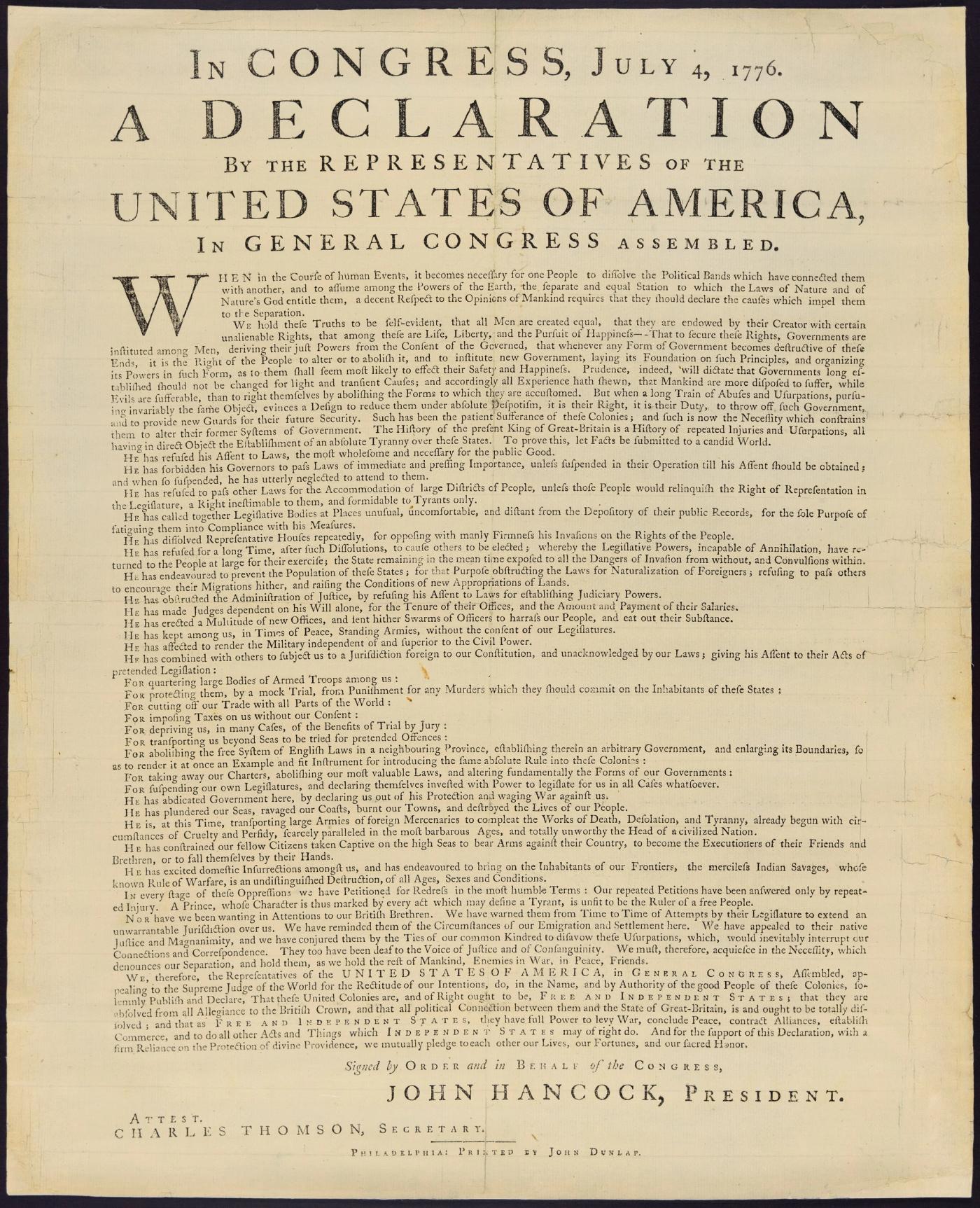
The copies John Dunlap printed that night, which members of Congress sent out the next morning to assemblies, committees, and army commanders, carried only two names, those of John Hancock, the president of Congress, and Charles Thomson, its secretary. New York's convention gave its approval on July 9, and only then could Congress order the text engrossed on parchment under the title "The unanimous declaration of the thirteen United States of America." The engrossed copy was signed on August 2, several delegates added their names later, and a few who had voted for independence never signed at all. Among them was John Dickinson of Pennsylvania, who still clung to the hope of reconciliation.
The Declaration did not say how the states would act together. Congress began debating a plan of confederation on July 22, and the delegates quickly divided over whether each state should cast one vote or votes in proportion to its size, and over the vast western lands that several states claimed under their colonial charters. Those arguments would take five years to settle.
A League of Friendship
The committee that drafted the plan had one member from each colony, and its principal writer was Dickinson, the same delegate who had declined to sign the Declaration. His draft gave the new confederation its name, "the United States of America." The arguments over representation and land kept it in committee and on the floor for more than a year. By the time Congress returned to the plan in October 1777, the British had captured Philadelphia, the delegates had fled to York, Pennsylvania, and some form of national government had begun to seem urgent. Congress adopted the Articles of Confederation on November 15, 1777, and sent them to the states.[3]
Under the Articles, each state retained "its sovereignty, freedom and independence," along with every power not "expressly delegated" to Congress, and the states entered into what the third article called "a firm league of friendship with each other." Each state had one vote, and the most important decisions, including making war, coining or borrowing money, and setting the size of the army and navy, required the assent of nine states. Congress could ask for money, but the taxes to raise it were to be "laid and levied" by the state legislatures, in proportions based on the value of each state's land. There was no separate executive and no general system of national courts, and no amendment could take effect unless it was confirmed by the legislature of every state. Most delegates knew the plan was a flawed compromise, and they accepted it as better than no formal government at all.[4]
Ratification exposed the same rivalries that had slowed the drafting. Virginia ratified first, on December 16, 1777, and most other states followed in the early months of 1778. Maryland, which had no western claims, refused to join until the states that did surrendered theirs to the Union. Its holdout lasted more than three years, until British raids in the Chesapeake, prodding from the French minister, and Virginia's agreement to cede its western lands finally brought the Maryland legislature around. The Articles became effective on March 1, 1781, more than four and a half years after the Declaration.
The Army and the Purse
The war meanwhile had turned in the Americans' favor. The surrender of a British army at Saratoga in October 1777 helped bring about an alliance with France the following February, and in October 1781 a combined American and French force compelled Lord Cornwallis to surrender at Yorktown. Yet the government that had won the war could barely pay for it. Without the power to tax, Congress depended on requisitions, requests for money that the states met irregularly and often not at all. Soldiers and officers went unpaid for long stretches, and the army frequently had to requisition supplies from civilians. In 1780 Congress promised officers half-pay for life after the war, but as of early 1783 the states had not provided the money to fund it. A group of nationalists, led by the superintendent of finance, Robert Morris, his assistant Gouverneur Morris, and Washington's former aide Alexander Hamilton, backed an amendment to let Congress levy its own taxes, and the states rejected it. Once the fighting wound down, the states grew still less willing to pay.[5]
By the winter of 1782–83, many officers of the army encamped at Newburgh, New York, had concluded that Congress would never keep its promises. On March 10, 1783, an anonymous notice called a meeting of officers for the following day, and with it circulated an inflammatory address, written by Major John Armstrong Jr., an aide to General Horatio Gates. It urged the officers to drop the moderate tone of Washington's appeals and present Congress with an ultimatum. If the war went on, the army could disband and leave the country undefended. If peace came, it could refuse to disband, a thinly veiled threat to use force against the civil government. Historians still disagree about how the crisis began, whether nationalists in Philadelphia stirred up the army to frighten the states into granting Congress revenue, or whether a few officers around Gates were contemplating something closer to a coup.[6]
Washington forbade the meeting and called another for March 15, implying that he would not attend. When the officers gathered that day in the large hall at the New Windsor cantonment known as the Temple of Virtue, he entered by a side door and stood before them to read a long address. He agreed that they had suffered much, reminded them that he had shared their hardships, and asked whether they would really "sully the glory" they had won by turning on the government they had fought to establish. He then tried to read them a letter from Joseph Jones, a Virginia congressman, and faltered over the opening lines. According to a frequently repeated account, he drew out a pair of spectacles and apologized, saying that he had grown gray in their service and now found himself growing blind. The exact words vary from one telling to another, but the effect is not in doubt. Many officers were reportedly moved to tears, and the next day they adopted resolutions affirming their loyalty to Congress. Washington went on pressing their claims, and Congress eventually granted the officers five years of full pay in place of the pensions.[7]
Peace Without Power
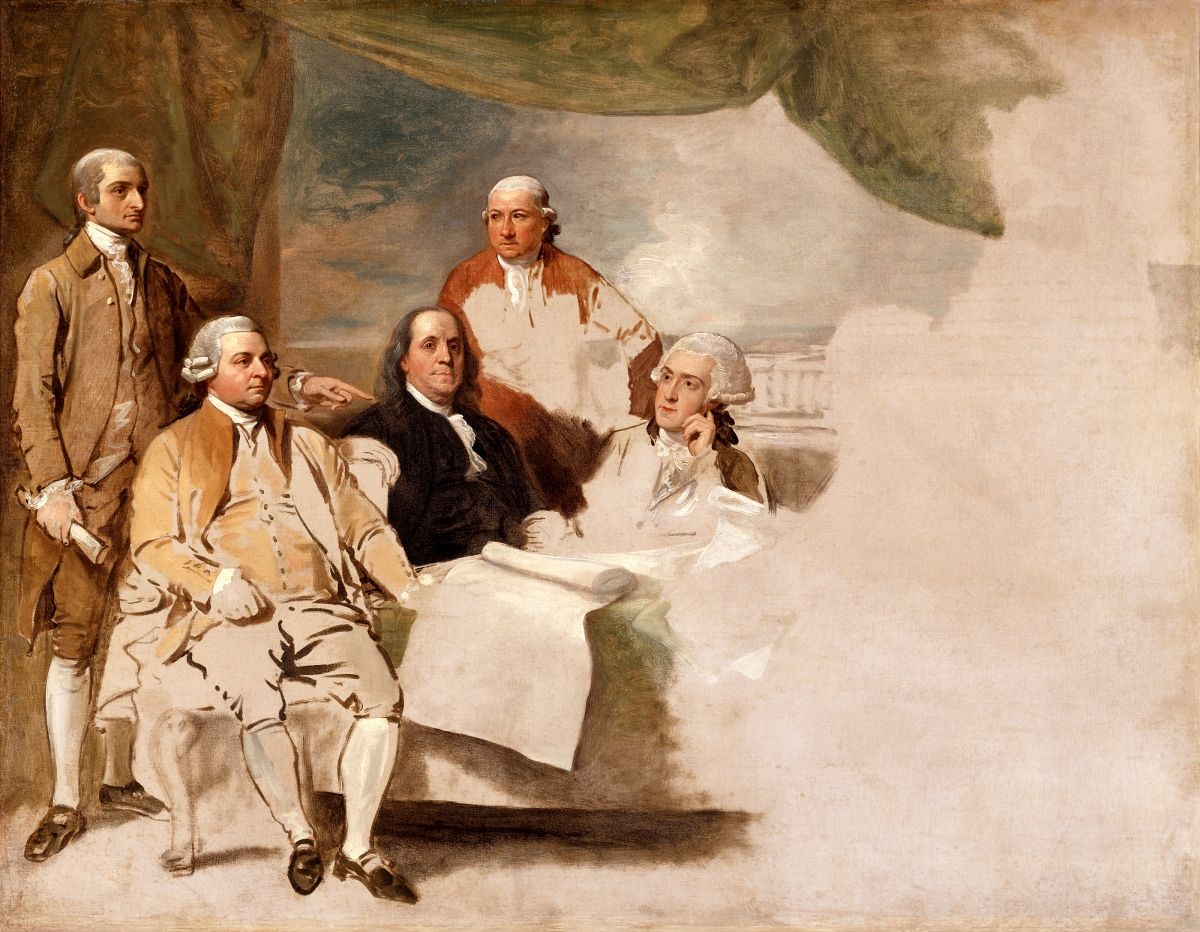
The war formally ended with the Treaty of Paris, signed on September 3, 1783, by David Hartley for Great Britain and by John Adams, Benjamin Franklin, and John Jay for the United States, on the basis of provisional articles agreed the previous November. Britain acknowledged the thirteen states, each named in the first article, as "free sovereign and Independent States," and drew their boundaries generously, west to the Mississippi River and north to the Great Lakes. Americans kept the right to fish on the Grand Banks of Newfoundland. In return, British creditors were to meet "no lawful Impediment" in recovering prewar debts, and Congress agreed to "earnestly recommend" that the states restore property confiscated from loyalists. Congress, in other words, could recommend but not command.
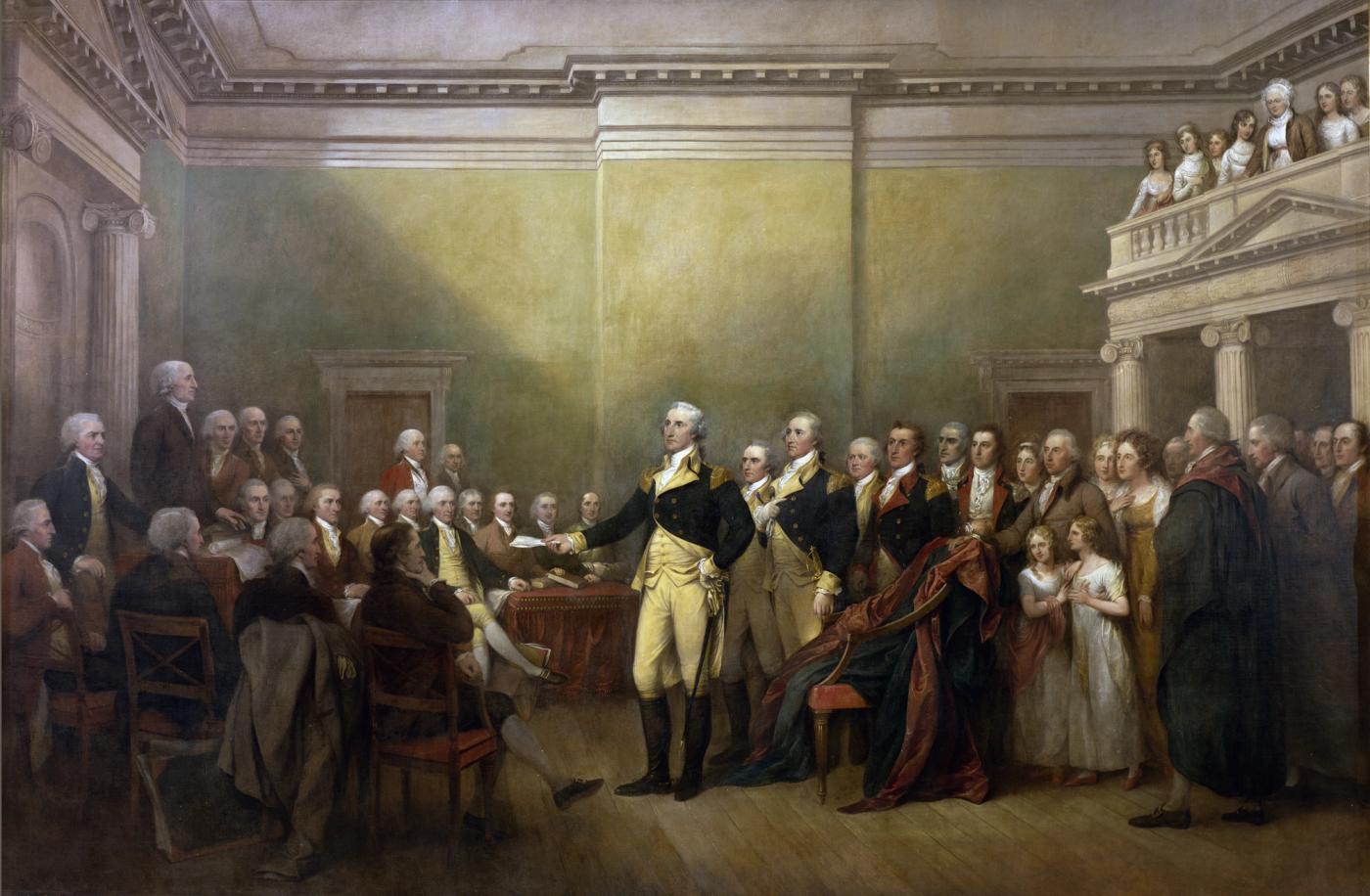
The commander who had kept the army loyal to that weak government then gave up his own power. On December 23, 1783, Washington appeared before Congress, then meeting in the Senate chamber of the Maryland State House in Annapolis, and resigned his commission as commander in chief. He left for Mount Vernon at dawn the next day. On January 14, 1784, in the same building, Congress ratified the treaty of peace. Congress itself had no settled home. Having left Philadelphia in June 1783, it met at Princeton, then Annapolis, then Trenton, before settling in New York in 1785.[8]
Peace exposed the Confederation's weaknesses more plainly than war had. Several states refused to honor the treaty's provisions on British debts and loyalist property, and Britain answered by keeping its garrisons in forts on American soil around the Great Lakes. British merchants flooded American markets with goods, and Congress had no power to regulate trade in response, while the states began laying duties on one another's commerce. Spain, which held New Orleans, closed the lower Mississippi to American shipping. Southern delegates wanted the river reopened, while many northeastern merchants were willing to give up that claim for a favorable commercial treaty, and because important measures required the votes of nine states, the dispute ended in sectional deadlock. Individual states pursued their own foreign policies as well. Georgia conducted its own dealings with Spanish Florida, at times threatening war, and Congress could do nothing to stop it.[9]
"Fast Verging to Anarchy"
The crisis that frightened the country's leaders most came from within. After the war, merchants in Europe and America called in debts and demanded payment in hard currency, which was scarce, and the pressure passed down the chain of credit to ordinary borrowers. Farmers in the western counties, many of them veterans who had never been fully paid for their service, began losing land and livestock to debt suits. When the legislature adjourned in the summer of 1786 without acting on their petitions for relief, armed crowds began closing the county courts, beginning at Northampton in late August, to stop foreclosures. They called themselves Regulators, and one of their leaders, Daniel Shays, a former captain in the Continental Army, gave the uprising its name.
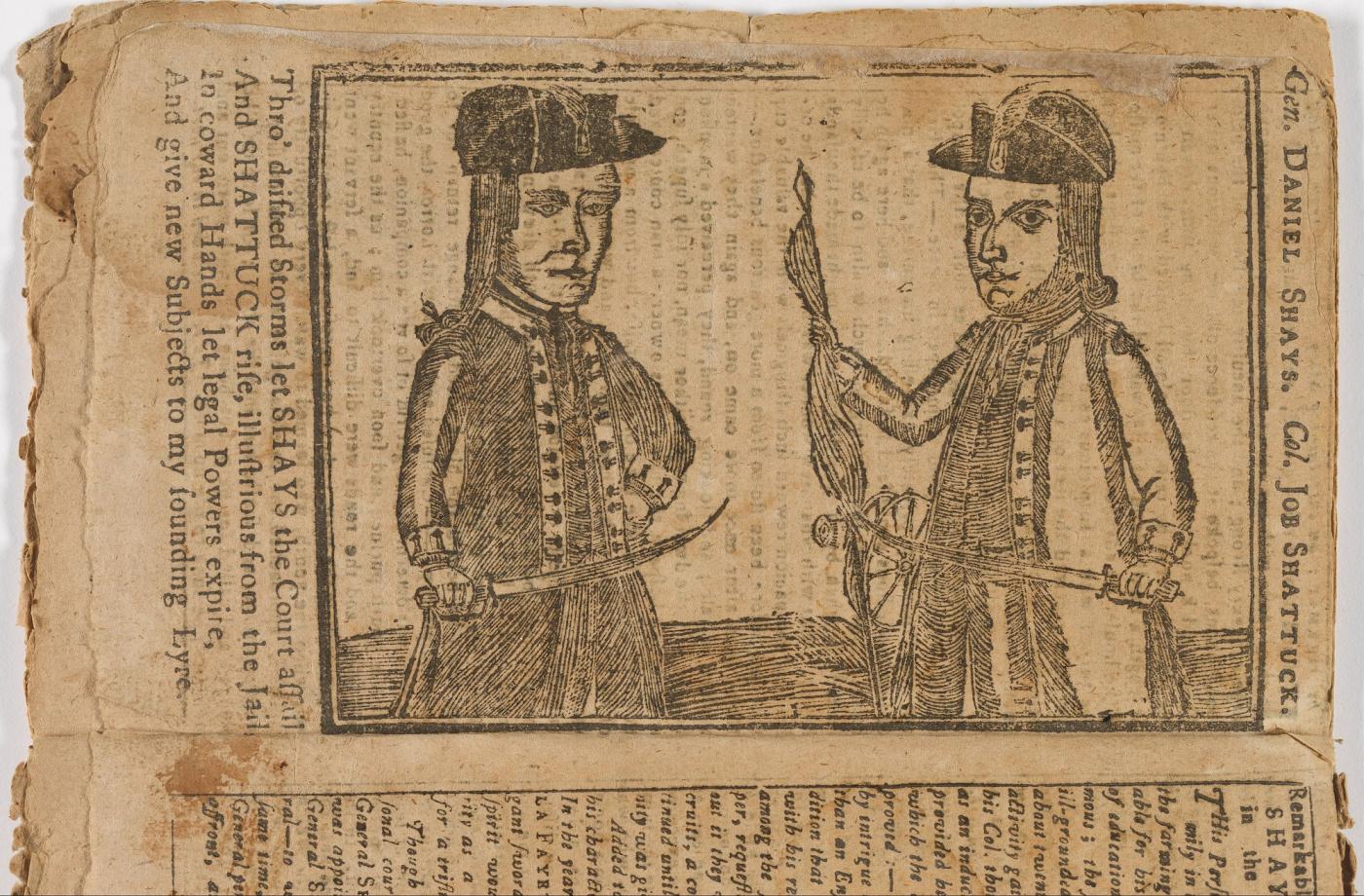
Governor James Bowdoin raised a militia army under the former Continental general Benjamin Lincoln, paid for by private merchants. On January 25, 1787, when Shays approached the federal arsenal at Springfield with roughly 1,500 men, the militia guarding it fired warning shots and then artillery. Four insurgents were killed and about twenty wounded, and the rest scattered into the countryside. Most participants, including Shays, were later pardoned. The Confederation government did little to meet the crisis, and its ineffectual response became one more argument for a stronger union.[10]
The rebellion alarmed men who had little else in common. Washington, watching from Mount Vernon, feared that such disturbances, like snowballs, would gather strength as they rolled. On November 5, 1786, he poured out his anxiety to James Madison. "We are fast verging to anarchy & confusion!" he wrote, and he warned that "Thirteen Sovereignties pulling against each other, and all tugging at the fœderal head, will soon bring ruin on the whole."[11]
A path toward reform had already opened, though from an unexpected direction. In September 1786, commissioners met at Annapolis to discuss the regulation of trade. Only five states, New York, New Jersey, Pennsylvania, Delaware, and Virginia, sent delegates, and the twelve men who gathered, among them Hamilton, Madison, and Dickinson, judged it unwise to proceed with so partial a representation. Instead, in a report that Madison later said Hamilton had drafted, they proposed that the states send commissioners to Philadelphia on the second Monday of the following May to devise whatever provisions were needed "to render the constitution of the Fœderal Government adequate to the exigencies of the Union."[12] Shays's Rebellion accelerated the movement for change, and every state except Rhode Island eventually chose delegates.
The Summer in Philadelphia
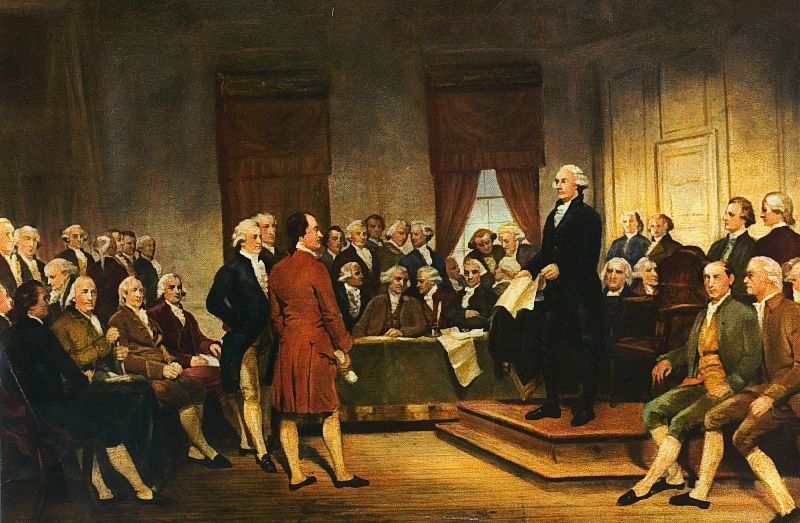
The convention was called for May 14, 1787, in the same State House where independence had been declared, but so few delegates had arrived that it adjourned from day to day until seven states were present on May 25. The delegates chose Washington to preside, adopted a rule of secrecy, and shuttered the windows so they could speak freely through a hot summer.[13]
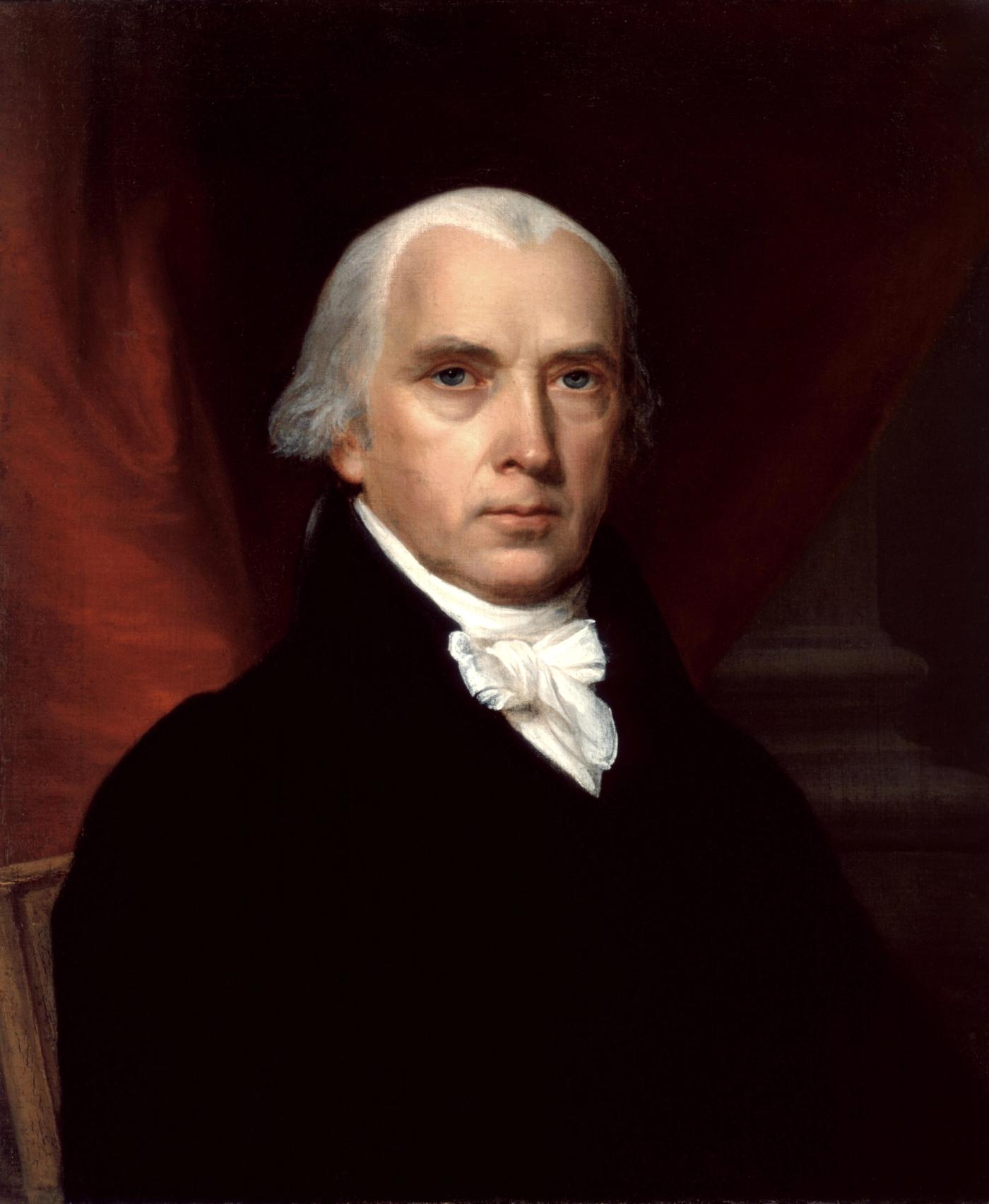
No one came better prepared than Madison. In the spring of 1787 he had written a memorandum titled "Vices of the Political System of the United States," which listed the failure of the states to meet requisitions, their encroachments on federal authority, their violations of treaties, and their trespasses on one another's rights. The Confederation, he wrote, lacked the essential elements of a government: "A sanction is essential to the idea of law, as coercion is to that of Government." He also turned a critical eye on the states themselves, arguing that unjust laws passed by local majorities, such as paper money and laws delaying the payment of debts, threatened private rights. A larger republic, he believed, would contain so many interests that no single faction could easily dominate it. His letters setting out these ideas became the basis of the resolutions that Edmund Randolph, Virginia's governor, presented to the convention on May 29, known as the Virginia Plan. It proposed a national legislature with representation based on population, and by mid-June the delegates had decided to draft an entirely new frame of government rather than amend the Articles.[14]
That decision brought the oldest quarrel of the Confederation back to the center. Delegates from the small states would not accept a legislature in which their votes counted for little, and those from the large states would not accept equal votes for unequal populations. On July 16, the convention finally adopted a compromise that gave the states equal votes in the second branch, the future Senate, while apportioning the first branch by population, with seats adjusted by a regular census. The vote was five states in favor, four opposed, and Massachusetts divided, with New York's delegation absent. Randolph, dismayed, said the vote had embarrassed the business extremely. The next morning a number of large-state delegates met to consider their response, but by Madison's account they wasted the time in vague conversation and reached no agreement, and the small states concluded they had nothing more to fear.[15] The convention also bargained over slavery, agreeing to count three-fifths of the enslaved population in apportioning representation and direct taxes, a compromise that gave slaveholding states more seats, and so more political power, than they would have had if only free inhabitants had been counted.
Through the rest of the summer, the delegates gave the new government the power to tax and to regulate commerce, and the presidency gained authority as the debates went on, including the conduct of foreign relations, while the requirement that two-thirds of the Senate approve treaties eased southern fears that the Mississippi might be bargained away.[16]
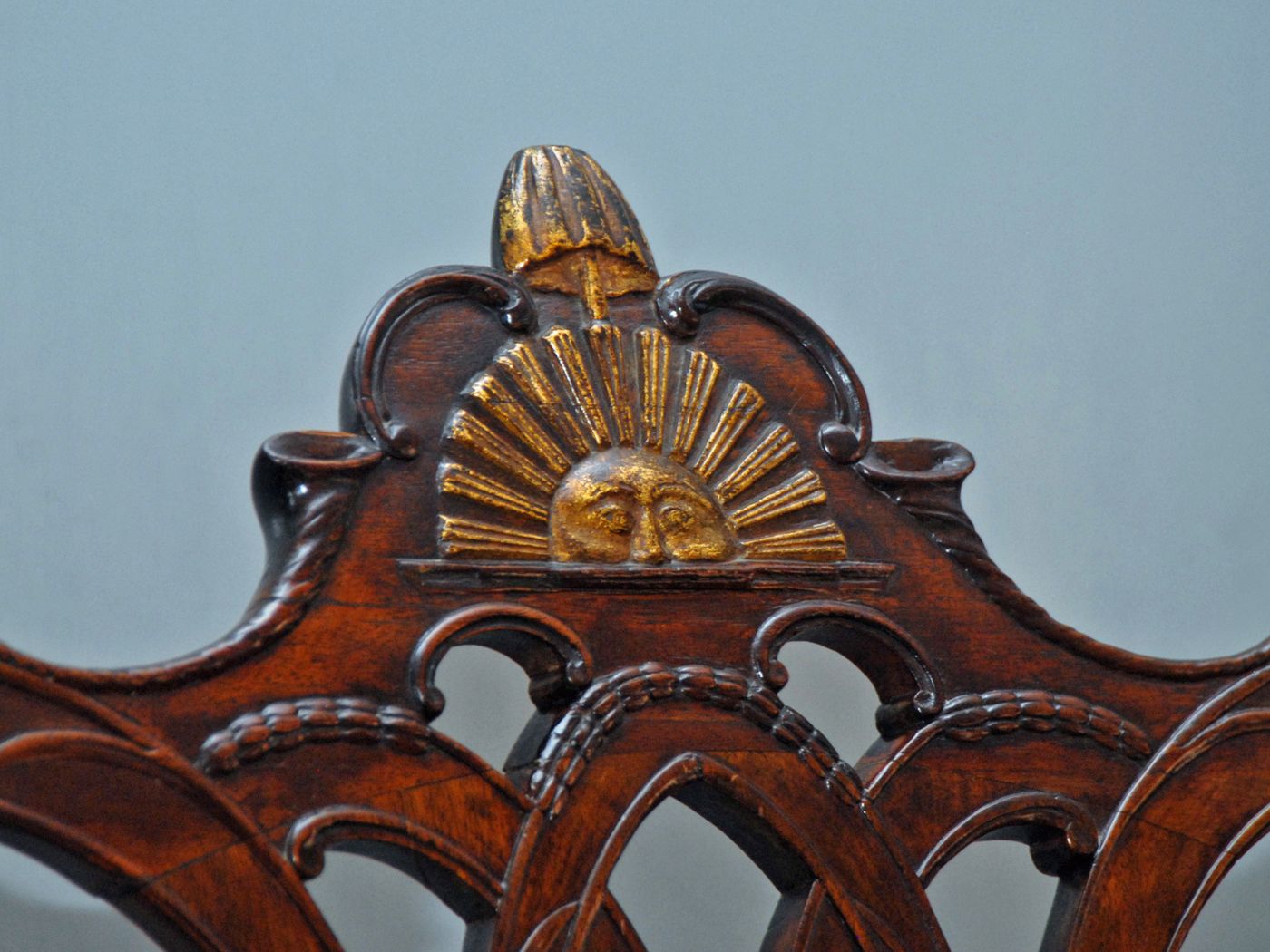
On September 17, 1787, with the engrossed Constitution before them, the delegates heard a speech by Franklin, now eighty-one, which James Wilson read aloud. Franklin admitted there were parts of the plan he did not approve, but said he agreed to it "with all its faults, if they are such," because he doubted that any other convention could do better. That day Nathaniel Gorham of Massachusetts proposed a last-minute change allowing one representative for every thirty thousand people instead of forty thousand. Washington, rising to put the question, expressed his wish that the change be adopted, which Madison noted was the only occasion on which the convention's president entered the discussions at all, and the convention agreed to it unanimously. Three delegates still present, Randolph, George Mason, and Elbridge Gerry, refused to sign. While the last members were signing, Franklin looked toward the president's chair, on which a sun had been painted. Painters, he remarked to those near him, found it hard to distinguish a rising sun from a setting one, and through the session he had often looked at that chair without being able to tell which it was. "But now at length," Madison recorded him saying, "I have the happiness to know that it is a rising and not a setting Sun."[17]
The People Debate
The convention provided that the Constitution would take effect once conventions in nine states had ratified it, a deliberate departure from the unanimity the Articles required. The small states moved first. Delaware ratified on December 7, 1787, followed by Pennsylvania, New Jersey, Georgia, and Connecticut by early January. In New York, where opposition was strong, Hamilton, Madison, and Jay published a series of essays under the shared pen name "Publius," explaining and defending the plan provision by provision. The first seventy-seven appeared in New York newspapers beginning in October 1787 and were reprinted elsewhere, while Nos. 78 through 85 first appeared in the bound edition of 1788, which gathered all eighty-five as The Federalist.[18]
The first serious test came in Massachusetts, the state that had just suppressed Shays's Rebellion. Its convention was closely divided, and two of its best-known patriots, Samuel Adams and John Hancock, were critics of the plan. Many opponents, known as Anti-Federalists, called for amendments to the plan. Federalists broke the impasse with a compromise under which the convention would ratify the Constitution while recommending amendments for the new Congress to consider. On February 6, 1788, Massachusetts ratified by 187 votes to 168. The Massachusetts compromise became a model for the states that followed. Maryland ratified in April by 63 to 11, and South Carolina in May by 149 to 73.[19]
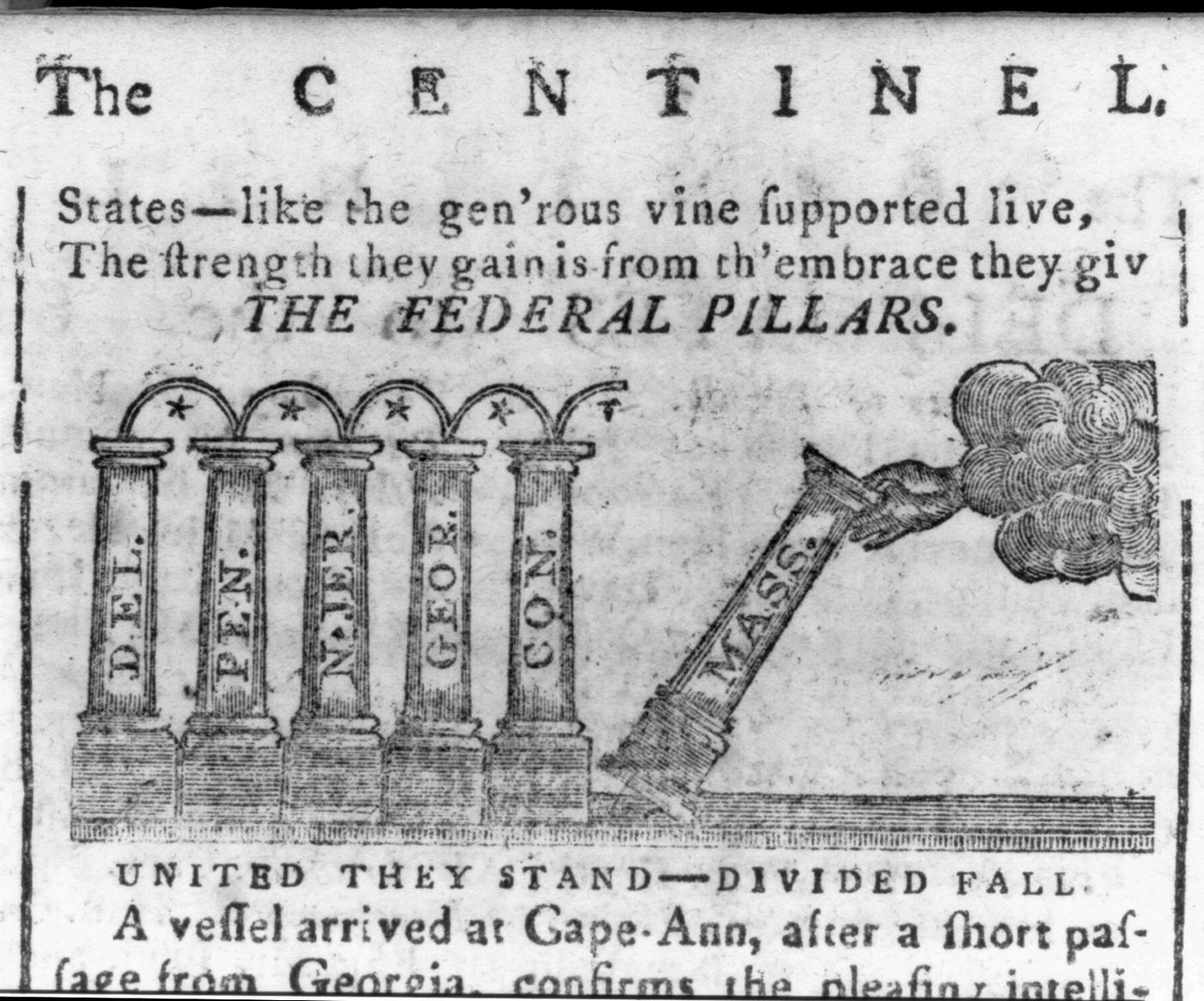
That made eight. Three state conventions were scheduled for June, and none was safe. By the best available estimates, delegates entering the New Hampshire convention were split evenly at 52 to 52, Virginia's at 84 to 84, and New York's opponents outnumbered supporters by 46 to 19.[20] New Hampshire ratified first, on June 21, 1788, by 57 votes to 47, becoming the ninth state and putting the new constitutional system into effect among the states that had ratified it. Virginia ratified on June 25 by 89 to 79, recommending amendments of its own. News of both decisions reached New York while its convention was still in session, and on July 26 it ratified by 30 to 27.[21] North Carolina and Rhode Island stayed outside the new Union until after the federal government had begun to operate.
A Rising Sun
On the Fourth of July 1788, between New Hampshire's vote and New York's, Philadelphia gave Adams the festival he had predicted, though not on the day he had expected. At sunrise a bell rang from Christ Church and the ship Rising Sun, anchored off Market Street, fired its cannon. Along the Delaware, ten ships flew white flags bearing the names of the ten states that had ratified. Some five thousand people, organized largely by trade, formed a procession about a mile and a half long that wound over a three-mile course.[22] Francis Hopkinson, a signer of the Declaration who helped plan the day and wrote its official account, described the "Federal Ship Union," a vessel thirty-three feet long with rigging in proportion. A Federal Edifice, a dome on thirteen Corinthian columns, rode on a carriage drawn by ten white horses, and on the printers' float a working press turned out copies of an ode Hopkinson had written for the occasion. Seventeen ministers and rabbis marched together, five of them arm in arm. The procession ended on the grounds of Bush Hill, where James Wilson, who had read Franklin's speech to the convention, addressed the crowd from the Federal Edifice, where about seventeen thousand people had gathered on Union Green. A large collation had been prepared, and the drink was beer and cider. "Rank for a while forgot all its claims," Benjamin Rush wrote afterward.[23]
The celebration was also an argument. New York had not yet ratified, and Hopkinson, sending Jefferson his account a few weeks later, admitted it was "very doubtful" whether it would.[24] The procession displayed the Union as its supporters wished it to be, complete, harmonious, and prosperous, at a moment when it was still none of those things. The promised amendments had yet to be written. Two states remained outside. The compromises over slavery had been made to hold the Union together, and they would test it for generations.
Even so, the distance traveled since Adams wrote to Abigail was very great. In 1776 Congress had spoken for thirteen states that had each declared their independence from Britain, and in 1781 those states had bound themselves in a league that left each of them sovereign. The Constitution opened instead with "We the People," and it created a government that could tax, regulate commerce, raise an army, and act directly on individual citizens. Its makers had learned, through unpaid soldiers, ignored treaties, and closed courthouses, that independence alone could not secure the liberty it was meant to protect. Franklin had spent the summer of 1787 unsure whether the sun painted on Washington's chair was rising or setting. A year later, when the Rising Sun fired its guns over the Delaware, enough of his countrymen's chosen representatives had decided, by the narrowest of margins, to bet that it was rising.
Places in this Story
The places this story moves through, in order — follow them on the interactive map →
- Philadelphia, PA July 4, 1776
Congress approves the final text of the Declaration of Independence.
- York, PA November 15, 1777
Congress, fled from British-occupied Philadelphia, adopts the Articles of Confederation.
- New Windsor Cantonment, near Newburgh, NY March 15, 1783
Washington quells the Newburgh conspiracy among unpaid officers with his spectacles speech.
- Paris, France September 3, 1783
The Treaty of Paris formally ends the Revolutionary War.
- Annapolis, MD December 23, 1783
Washington resigns his commission as commander in chief before Congress.
- Annapolis, MD September 14, 1786
Commissioners meet and call for a convention to strengthen the federal government.
- Springfield, MA January 25, 1787
Militia repel Daniel Shays's armed farmers at the federal arsenal.
- Philadelphia, PA September 17, 1787
Delegates sign the completed Constitution.
- New York City, NY October 1787
Hamilton, Madison, and Jay begin publishing The Federalist to win over New York.
- Philadelphia, PA July 4, 1788
Philadelphia's Grand Federal Procession celebrates ratification by ten states.
Frequently Asked Questions
What were the Articles of Confederation?
The Articles of Confederation were the first constitution of the United States, adopted by Congress on November 15, 1777, and in force from March 1, 1781. They created a "firm league of friendship" in which each state kept its sovereignty and one vote, and Congress could neither levy taxes nor regulate trade.
Was the Declaration of Independence signed on July 4, 1776?
No. Congress voted for independence on July 2 and approved the Declaration's text on July 4, but the engrossed parchment copy was signed on August 2, 1776, and several delegates added their names later. The first printed copies carried only the names of John Hancock and Charles Thomson.
Why did the Articles of Confederation fail?
The Articles gave Congress no power to tax or regulate commerce, and any amendment required every state's consent. Congress could not pay its soldiers, enforce the Treaty of Paris, or stop the states' trade wars, and Shays's Rebellion in 1786 and 1787 convinced many leaders that a stronger national government was needed.
What was the Newburgh Conspiracy?
The Newburgh Conspiracy was a crisis in March 1783, when unpaid Continental Army officers camped near Newburgh, New York, were urged to threaten Congress. On March 15, George Washington addressed the officers at the New Windsor cantonment, asking them not to "sully the glory" they had won, and they reaffirmed their loyalty to Congress.
What was Shays's Rebellion?
Shays's Rebellion was an uprising of indebted farmers in western Massachusetts in 1786 and 1787, named for Daniel Shays, a former Continental Army captain. Armed crowds closed county courts to stop foreclosures, and on January 25, 1787, militia fired on the rebels at the federal arsenal in Springfield, killing four.
What was the Great Compromise?
The Great Compromise, adopted by the Constitutional Convention on July 16, 1787, gave every state an equal vote in the Senate and apportioned the House of Representatives by population. It passed by five states to four, with Massachusetts divided, and settled the convention's fiercest quarrel between the large and small states.
How close was the vote to ratify the Constitution?
Several key states ratified by narrow margins. Massachusetts approved the Constitution 187 to 168, New Hampshire 57 to 47, Virginia 89 to 79, and New York only 30 to 27. New Hampshire became the ninth state on June 21, 1788, putting the Constitution into effect.
Bibliography
"Account of the Federal Procession in Philadelphia, July 4, 1788." American Museum 4, no. 1 (July 1788): 57-75. As cited in "The Federal Procession of 1788," Mathew Carey. Google Books. Accessed October 7, 2026. https://books.google.com/books?id=NNlCAQAAMAAJ.
Adams, John. John Adams to Abigail Adams, July 3, 1776. Founders Online, National Archives. Accessed October 4, 2026. https://founders.archives.gov/documents/Adams/04-02-02-0016.
"Address of the Annapolis Convention, [14 September 1786]." In The Papers of Alexander Hamilton, vol. 3. Founders Online, National Archives. Accessed October 4, 2026. https://founders.archives.gov/documents/Hamilton/01-03-02-0556.
"The Federal Procession of 1788." Mathew Carey (website). Accessed October 4, 2026. https://www.mathewcarey.info/life-legacy/becoming-american-1784-1789/the-federal-procession-of-1788/.
Hattem, Michael, and Zoie Horecny. "Newburgh Conspiracy." Digital Encyclopedia, George Washington's Mount Vernon. Updated March 26, 2025. Accessed October 4, 2026. https://www.mountvernon.org/library/digitalhistory/digital-encyclopedia/article/newburgh-conspiracy.
Hopkinson, Francis. Francis Hopkinson to Thomas Jefferson, July 17, 1788, with editorial note. Founders Online, National Archives. Accessed October 4, 2026. https://founders.archives.gov/documents/Jefferson/01-13-02-0273.
Hopkinson, Francis. "An Account of the Grand Federal Procession, Performed at Philadelphia on Friday the 4th of July 1788." In The Miscellaneous Essays and Occasional Writings of Francis Hopkinson, Esq., vol. 2. Philadelphia: T. Dobson, 1792. Evans Early American Imprint Collection, University of Michigan. Accessed October 6, 2026. https://quod.lib.umich.edu/e/evans/N18777.0001.001/1:64?rgn=div1&view=fulltext.
Library of Congress. "Full Text of The Federalist Papers." Federalist Papers: Primary Documents in American History, research guide. Accessed October 4, 2026. https://guides.loc.gov/federalist-papers/full-text.
Library of Congress. "Today in History – December 23." Accessed October 4, 2026. https://www.loc.gov/item/today-in-history/december-23/.
Madison, James. Notes of Debates in the Federal Convention, July 16, 1787. Avalon Project, Lillian Goldman Law Library, Yale Law School. Accessed October 4, 2026. https://avalon.law.yale.edu/18th_century/debates_716.asp.
Madison, James. Notes of Debates in the Federal Convention, September 17, 1787. Avalon Project, Lillian Goldman Law Library, Yale Law School. Accessed October 4, 2026. https://avalon.law.yale.edu/18th_century/debates_917.asp.
Madison, James. "Vices of the Political System of the United States, April 1787," with editorial note. In The Papers of James Madison, vol. 9. Founders Online, National Archives. Accessed October 4, 2026. https://founders.archives.gov/documents/Madison/01-09-02-0187.
Maryland Manual, 1963–64. Archives of Maryland, vol. 171. Maryland State Archives. Accessed October 4, 2026. https://msa.maryland.gov/megafile/msa/speccol/sc2900/sc2908/000001/000171/html/am171--29.html.
Maryland State Archives. "The Old Senate Chamber." The Maryland State House. Accessed October 4, 2026. https://www.msa.maryland.gov/msa/mdstatehouse/html/old_chamber.html.
National Archives and Records Administration. "Articles of Confederation (1777)." Milestone Documents. Accessed October 4, 2026. https://www.archives.gov/milestone-documents/articles-of-confederation.
National Archives and Records Administration. "Constitution of the United States (1787)." Milestone Documents. Accessed October 4, 2026. https://www.archives.gov/milestone-documents/constitution.
National Archives and Records Administration. "The Declaration of Independence: A History." America's Founding Documents. Accessed October 4, 2026. https://www.archives.gov/founding-docs/declaration-history.
National Archives and Records Administration. "Treaty of Paris (1783)." Milestone Documents. Accessed October 4, 2026. https://www.archives.gov/milestone-documents/treaty-of-paris.
National Constitution Center. "4.5 Info Brief: Ratification Timeline." Constitution 101 Resources. Accessed October 4, 2026. https://constitutioncenter.org/education/classroom-resource-library/classroom/4.5-info-brief-ratification-timeline.
Office of the Historian, U.S. Department of State. "Articles of Confederation, 1777–1781." Milestones in the History of U.S. Foreign Relations. Accessed October 4, 2026. https://history.state.gov/milestones/1776-1783/articles.
Office of the Historian, U.S. Department of State. "Constitutional Convention and Ratification, 1787–1789." Milestones in the History of U.S. Foreign Relations. Accessed October 4, 2026. https://history.state.gov/milestones/1784-1800/convention-and-ratification.
Rush, Benjamin. "Observations on the Philadelphia Procession." American Museum 4, no. 1 (July 1788): 76-80. As cited in "The Federal Procession of 1788," Mathew Carey. Google Books. Accessed October 7, 2026. https://books.google.com/books?id=NNlCAQAAMAAJ.
Stockwell, Mary, and Zoie Horecny. "Newburgh Address." Digital Encyclopedia, George Washington's Mount Vernon. Updated March 26, 2025. Accessed October 4, 2026. https://www.mountvernon.org/library/digitalhistory/digital-encyclopedia/article/newburgh-address.
Teaching American History. "The Six Stages of Ratification." Accessed October 4, 2026. https://teachingamericanhistory.org/resource/fafd-stagefive/.
Tilva, Rahul. "Shays' Rebellion." Digital Encyclopedia, George Washington's Mount Vernon. Accessed October 4, 2026. https://www.mountvernon.org/library/digitalhistory/digital-encyclopedia/article/shays-rebellion.
U.S. Government Publishing Office. "States and Dates of Ratification." Ben's Guide to the U.S. Government. Accessed October 4, 2026. https://bensguide.gpo.gov/j-states-ratification.
Washington, George. George Washington to James Madison, November 5, 1786. Founders Online, National Archives. Accessed October 4, 2026. https://founders.archives.gov/documents/Washington/04-04-02-0299.
Citations
- John Adams to Abigail Adams, July 3, 1776. ↑
- National Archives and Records Administration, "The Declaration of Independence: A History." ↑
- Office of the Historian, "Articles of Confederation, 1777–1781"; National Archives and Records Administration, "Articles of Confederation (1777)"; National Archives and Records Administration, "The Declaration of Independence: A History," appendix B (location of Congress, September 1777–June 1778). ↑
- Articles of Confederation, arts. II, III, V, VIII, IX, XIII, transcribed in National Archives and Records Administration, "Articles of Confederation (1777)"; Office of the Historian, "Articles of Confederation, 1777–1781." ↑
- Hattem and Horecny, "Newburgh Conspiracy." ↑
- Hattem and Horecny, "Newburgh Conspiracy." ↑
- Stockwell and Horecny, "Newburgh Address"; Hattem and Horecny, "Newburgh Conspiracy." The quotation "sully the glory" comes from Washington's address as quoted by Stockwell and Horecny. The words attributed to Washington when he put on his spectacles are given by Stockwell and Horecny on the authority of Douglas Southall Freeman's biography, and are paraphrased here because the wording differs among accounts. ↑
- Library of Congress, "Today in History – December 23"; Maryland State Archives, "The Old Senate Chamber"; Maryland Manual, 1963-64, 29; National Archives and Records Administration, "The Declaration of Independence: A History," appendix B. ↑
- Office of the Historian, "Constitutional Convention and Ratification, 1787–1789"; Office of the Historian, "Articles of Confederation, 1777–1781." ↑
- Tilva, "Shays' Rebellion"; Office of the Historian, "Articles of Confederation, 1777–1781" (the Confederation's ineffectual response). ↑
- Tilva, "Shays' Rebellion," citing George Washington to David Humphreys, October 22, 1786; George Washington to James Madison, November 5, 1786. ↑
- "Address of the Annapolis Convention," September 14, 1786, with editorial notes. ↑
- National Archives and Records Administration, "Constitution of the United States (1787)"; Tilva, "Shays' Rebellion" (Washington's election as president of the convention); National Archives and Records Administration, "Articles of Confederation (1777)" (secrecy and shuttered windows). ↑
- James Madison, "Vices of the Political System of the United States," April 1787, with editorial note; National Archives and Records Administration, "Constitution of the United States (1787)." ↑
- Madison, Notes of Debates, July 16, 1787. ↑
- Office of the Historian, "Constitutional Convention and Ratification, 1787–1789." ↑
- Madison, Notes of Debates, September 17, 1787. Madison's bracketed remark that this "was the only occasion on which the President entered at all into the discussions of the Convention" appears in his own footnote to the day's proceedings. ↑
- U.S. Government Publishing Office, "States and Dates of Ratification"; Library of Congress, "Full Text of The Federalist Papers." The guide's table of contents shows Nos. 78-85 taken from McLean's 1788 edition rather than from a newspaper. ↑
- National Constitution Center, "4.5 Info Brief: Ratification Timeline." ↑
- Teaching American History, "The Six Stages of Ratification." ↑
- National Constitution Center, "4.5 Info Brief: Ratification Timeline"; Teaching American History, "The Six Stages of Ratification." Sources differ on Virginia's date; most give June 25, 1788, which is used here. ↑
- Hopkinson, "Account of the Grand Federal Procession"; "The Federal Procession of 1788," Mathew Carey, citing the "Account of the Federal Procession in Philadelphia, July 4, 1788," American Museum 4, no. 1 (July 1788): 57. Page numbers for Hopkinson's 1792 reprint could not be confirmed. ↑
- Hopkinson, "Account of the Grand Federal Procession" (page number not confirmed); "Account of the Federal Procession in Philadelphia," American Museum 4, no. 1 (July 1788): 59, 66-67, 70-71, and Benjamin Rush, "Observations on the Philadelphia Procession," American Museum 4, no. 1 (July 1788): 76, 79-80, both as cited in "The Federal Procession of 1788," Mathew Carey. The American Museum pages were not consulted directly. ↑
- Francis Hopkinson to Thomas Jefferson, July 17, 1788, with editorial note. ↑