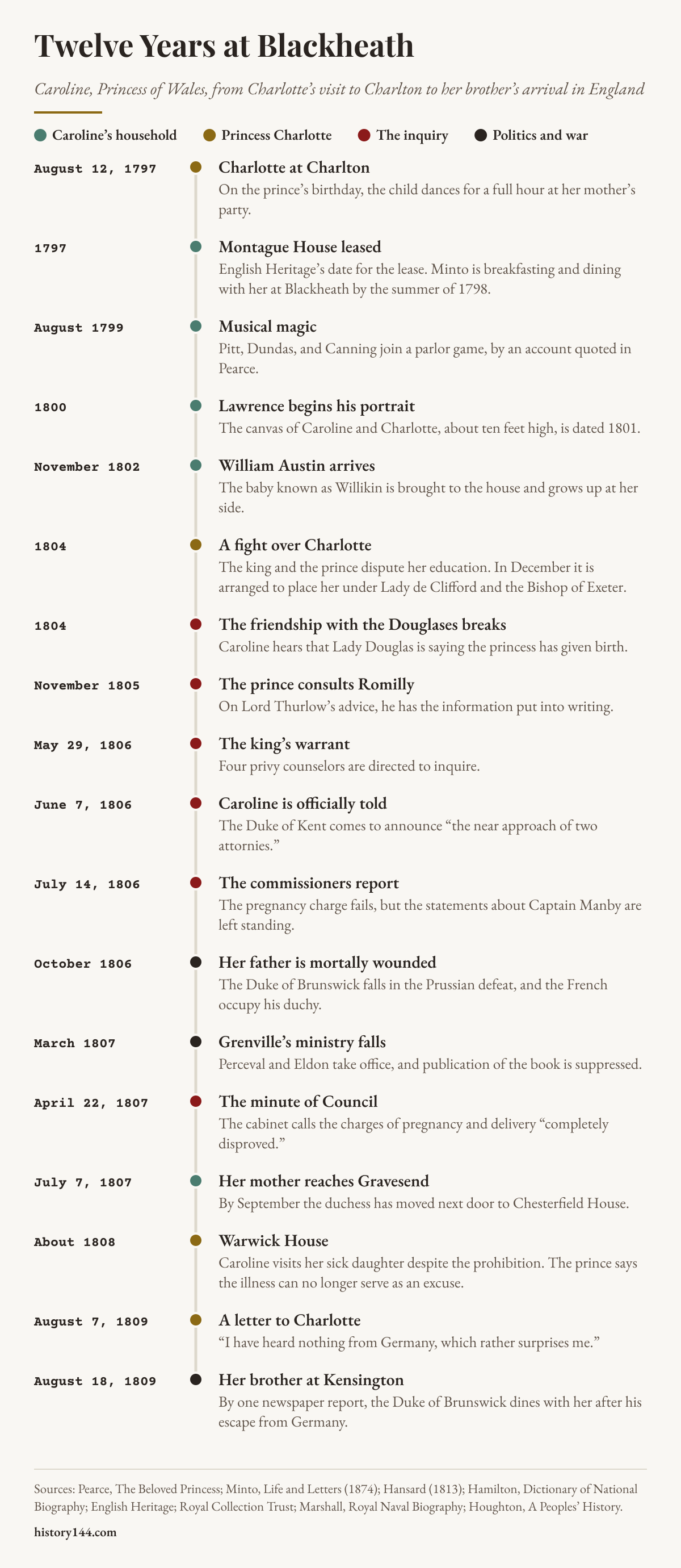
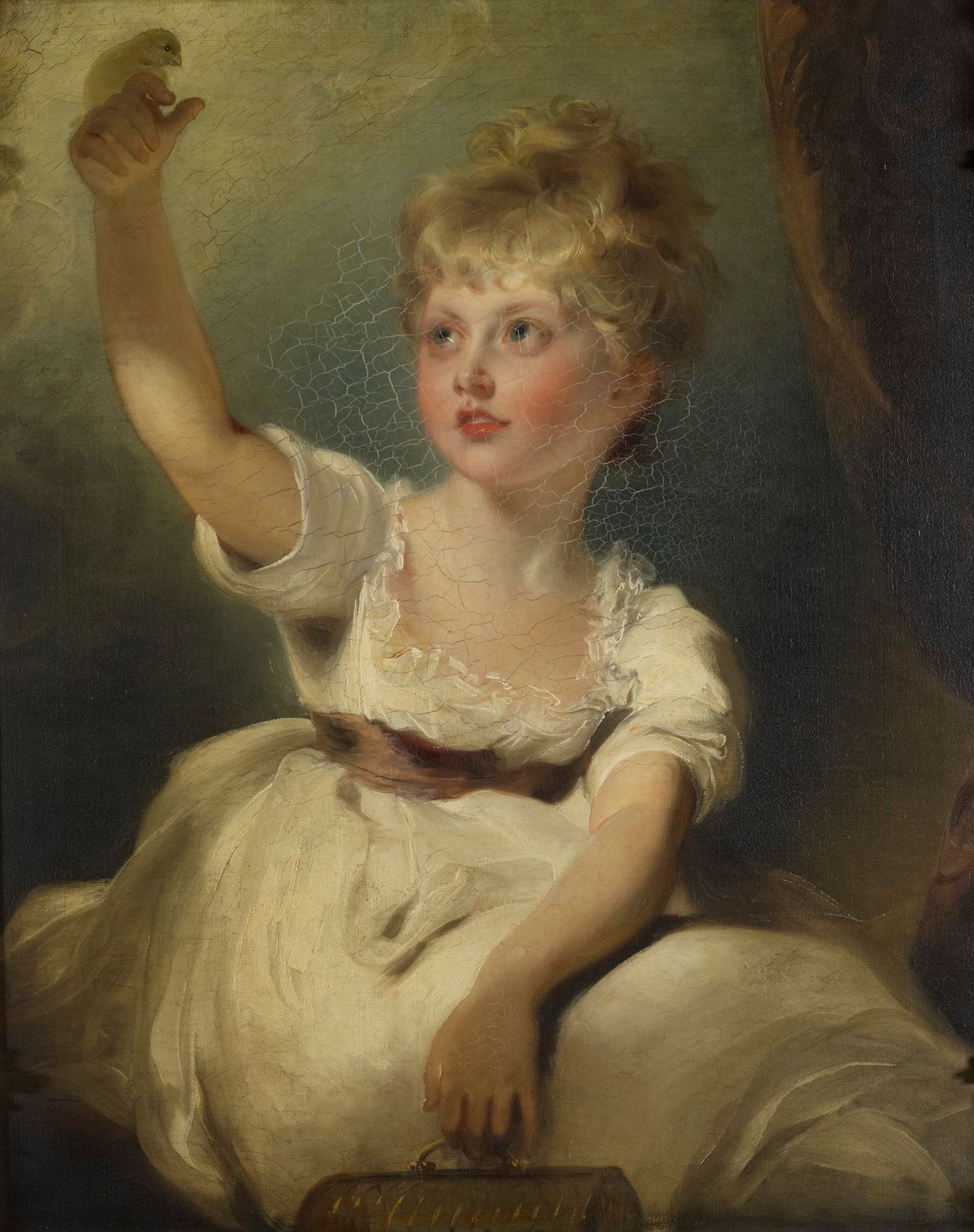
On August 12, 1797, the Prince of Wales turned thirty-five, and his daughter spent the day with the wife he refused to see. Princess Charlotte, nineteen months old and "in her new rig," reached her mother's house at Charlton soon after two o'clock with her two governesses. The Duke and Duchess of Dorset were already there with Lord and Lady Auckland, and the exiled Stadtholder of the Netherlands and his wife arrived soon afterward. The sub-governess, Miss Hayman, described a concert and recalled the child dancing by herself for a full hour in the middle of the company.[1] The historian Charles Pearce thought the date so pointed that he inferred the visit was paid by "express command," which would mean that the prince, not the princess, chose it.[2]
The party came near the start of twelve years in which Caroline, Princess of Wales, tried to make a life beyond a failed royal marriage. She had no husband in any useful sense and only limited access to her child. She did keep her title, her income, and the favor of the old king. On the heath southeast of London she built something between a household and a court, and her freedom there delighted her friends and armed her enemies. In 1806 that freedom nearly destroyed her, when a discarded companion swore that she had secretly borne a son. The charge failed, but the inquiry showed how quickly her private life could become a matter of state. By August 1809 she had outlasted the accusation, yet clearing her name had won her little of what she wanted. This is the story of those twelve years.
A Change of Air
The formal separation came in the spring of 1796, within a year of the wedding, and Caroline at first stayed on at Carlton House. Accounts of her departure disagree sharply. Lady Charlotte Bury, who joined her household years later, repeated a story that her rooms had been stripped to "two shabby chairs." According to the same story, the pearl bracelets the prince had given her were taken to decorate the arms of his mistress, Lady Jersey. Miss Hayman, named as the source of this tale, denied it: "I remember no such thing." She recalled instead that Caroline had obtained the prince's permission to move to Charlton "for change of air."[3] Hayman owed her later post as keeper of the privy purse to the prince, so she was not an impartial witness. Bury, however, was repeating events she had not seen, and neither version can be accepted whole.
The sources also differ on the house. John Ashton's entry in the Victorian Dictionary of National Biography places her at Shrewsbury House, near Shooter's Hill. Pearce says that she took a house at Charlton, near the same hill.[4] In the summer of 1797 she visited her daughter in the Carlton House nursery on most days. The prince avoided the nursery in order to escape meeting her.[5]
At the end of June she reminded him of a promise and asked that Charlotte be sent to her at Charlton. No answer came.[6] Her hopes and her habits did not always match. Hayman claimed that "a month has elapsed without her going to see her child," and she wrote of a daughter "for whom she never showed a fondness."[7] Lord Minto, the former Sir Gilbert Elliot, was a friendlier observer. At a Blackheath dinner in December 1798, he watched Caroline romp with the child "about the carpet on her knees."[8] Both accounts may be accurate. Caroline's affection seems to have come in bursts, and those who supervised the nursery were well placed to notice the gaps.
Montague House
Caroline soon moved a short distance to Montague House, at the edge of Greenwich Park and overlooking the common at Blackheath. English Heritage dates her lease to 1797, and the house became her main home. That date fits Minto's letters, which have him breakfasting and dining with her at Blackheath by the summer of 1798, though they do not name the house. Ashton's date of 1801 appears too late, since the Royal Collection places her "alternative court" at Montague House by 1800.[9]
The early gatherings were respectable. In June 1798 Minto sat at tables laid "in a little strip of garden under a row of trees," and he stayed for music in the house afterward. He found her "very undeserving of such strange neglect and repudiation" and judged her "positively a handsome woman." In July he dined there with Lord Thurlow, the former lord chancellor, whom he called "her principal champion and adviser." Over two games of chess, Minto reported, "she saw I did not play like a courtier."[10] That December she told him something stranger. The prince, she said, had written to invite her to settle at Carlton House for the winter, and she had declined. Minto resolved to press her not to refuse offers of reconciliation. Pearce found no confirmation of the overture and wondered whether she had invented it.[11]
The tone loosened in 1799. Dinners ran into suppers, suppers ran into the small hours, and her closest friends began to worry. One account of a Sunday dinner in August 1799, whose writer has not been confirmed, shows how far matters could go even in distinguished company. The guests included the lord chancellor, William Pitt, Henry Dundas, and George Canning, and they played a parlor game called musical magic. Dundas went down on his knees to kiss a young woman's hand. Pitt was made to kiss a bust of the Queen of Prussia. Two other guests were tied together and told to nurse bolsters as babies. When someone proposed blindman's buff, the prime minister replied, "I will endeavour to shut my eyes" as far as he could, though he could not answer for the rest of the world.[12]
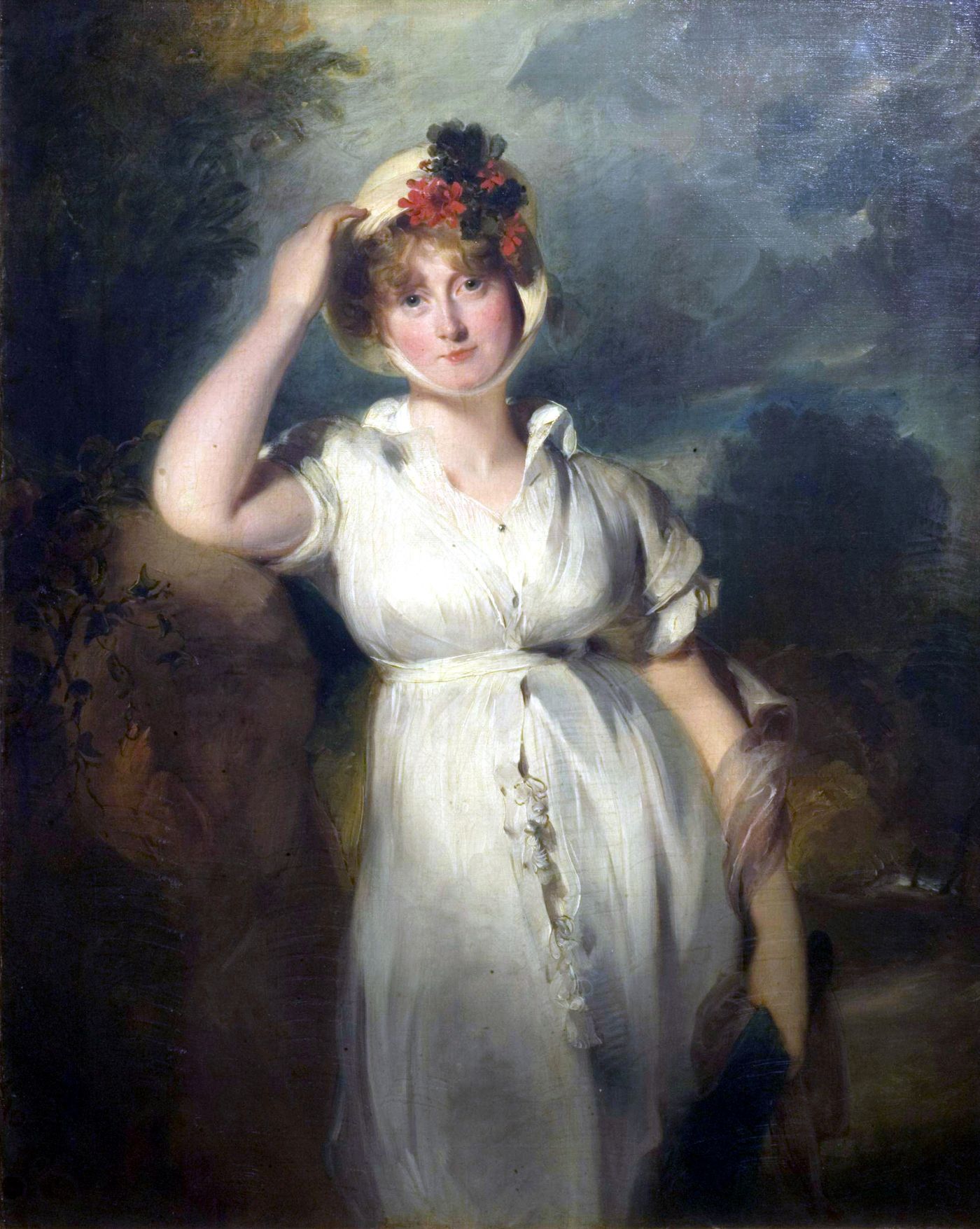
Such evenings would have meant little in a private house, but Caroline was not a private person. In 1800 Thomas Lawrence began a portrait of her with Charlotte, dated 1801, that stands about ten feet high. The commission came from the Marchioness Townshend, her mistress of the robes, and was introduced by Lawrence's friend John Julius Angerstein, her neighbor at Blackheath.[13] Lawrence's name later appeared among the men in the accusations against her.[14] George III, meanwhile, remained fond of her. By September 1805 he had made her ranger of Greenwich Park, an honorary position that put the park beneath her windows at her disposal.[15]
A Daughter by Appointment
The king's kindness sharpened the prince's hostility. Charlotte stood next in line after her father, and from 1804 the question of who should raise her became an open conflict between the two men. The prince offered the girl to the king's care and then drew back, implying that his father's mental illness made him unfit for the charge. The prince denied having consented to a plan for her education at Windsor, and the dispute ran into 1805, when the king insisted that he must have the whole superintendence of her education or none at all.[16] Negotiations had resumed in December 1804 through the lord chancellor, and it was arranged to place her under the care of Lady de Clifford and the Bishop of Exeter. She moved to Lower Lodge at Windsor in 1805 and also spent time at Warwick House. The prince treated that residence as part of Carlton House and barred his wife from visiting there.[17]
The king made his own view clear. In a letter to Lord Eldon that he knew the prince would see, he described the sight of mother and daughter together as charming.[18] He also went to Blackheath in person. Ashton, who places these visits after the inquiry, wrote that he "often passed a whole day" there with Caroline and his granddaughter, which widened the breach with his son.[19]
Denied steady company from her own child, Caroline collected other people's. She took in several children of the poor at Blackheath and paid for their upkeep, and she told her ladies, to their amusement, that she had nine children.[20] One of them stayed with her. William Austin, known in the household as Willikin, was brought to the house as a baby in November 1802, the son of a Deptford dockyard worker who had lost his job during the peace of 1802. He grew up at her side.[21] Her affection for him was open, and it proved dangerous.
The Lady in the Lilac Pelisse
The danger came from the neighborhood. Sir John Douglas, a marine officer who had served with Sir Sidney Smith at Acre, lived at Blackheath with his wife, Charlotte. Lady Douglas later described how the acquaintance began. Sitting by her window on a snowy day, she saw the Princess of Wales pacing outside the railings in a lilac satin pelisse and primrose half boots. Caroline nodded to her, walked in, asked to see her child, and stayed an hour.[22] The story comes from a hostile pen and may have been shaped to show a princess forcing herself on a reluctant neighbor. Ashton names the Douglases, Smith, and Captain Thomas Manby, a naval officer, among the friends she entertained at Montague House.[23]
The friendship with the Douglases broke in 1804. According to a later newspaper summary, Caroline ended it over a drawing that suggested an improper relationship between Lady Douglas and Smith.[24] By Pearce's account, rumors had also reached the princess that Lady Douglas was saying she had given birth. A formal note asked Lady Douglas to stop calling, and her letter of denial came back unopened. Caroline had handed her the material. By Ashton's account, she had "foolishly talked some nonsense" about expecting a child that she would explain away as adopted.[25]
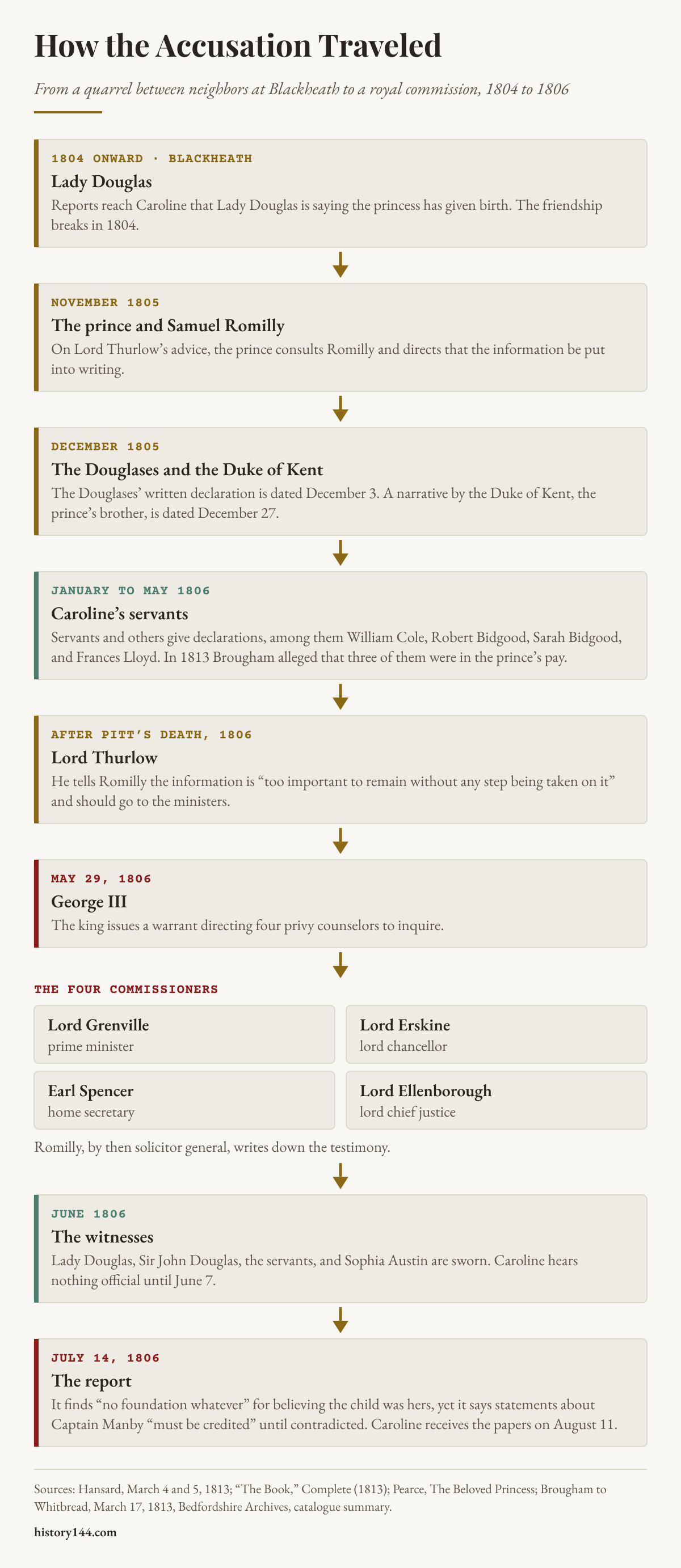
The accusation traveled upward through the royal family. In November 1805 the prince, on Lord Thurlow's advice, consulted the lawyer Samuel Romilly and directed that the information be put into writing. The Douglases' written declaration is dated December 3, and a narrative by the Duke of Kent is dated December 27.[26] Inquiries among Caroline's present and former servants followed. Declarations from William Cole, Robert Bidgood, Sarah Bidgood, and Frances Lloyd were gathered between January and May 1806.[27] In 1813 Henry Brougham, then advising Caroline, told Samuel Whitbread that Bidgood, Lloyd, and Cole had been in the prince's pay.[28]
Four Lords
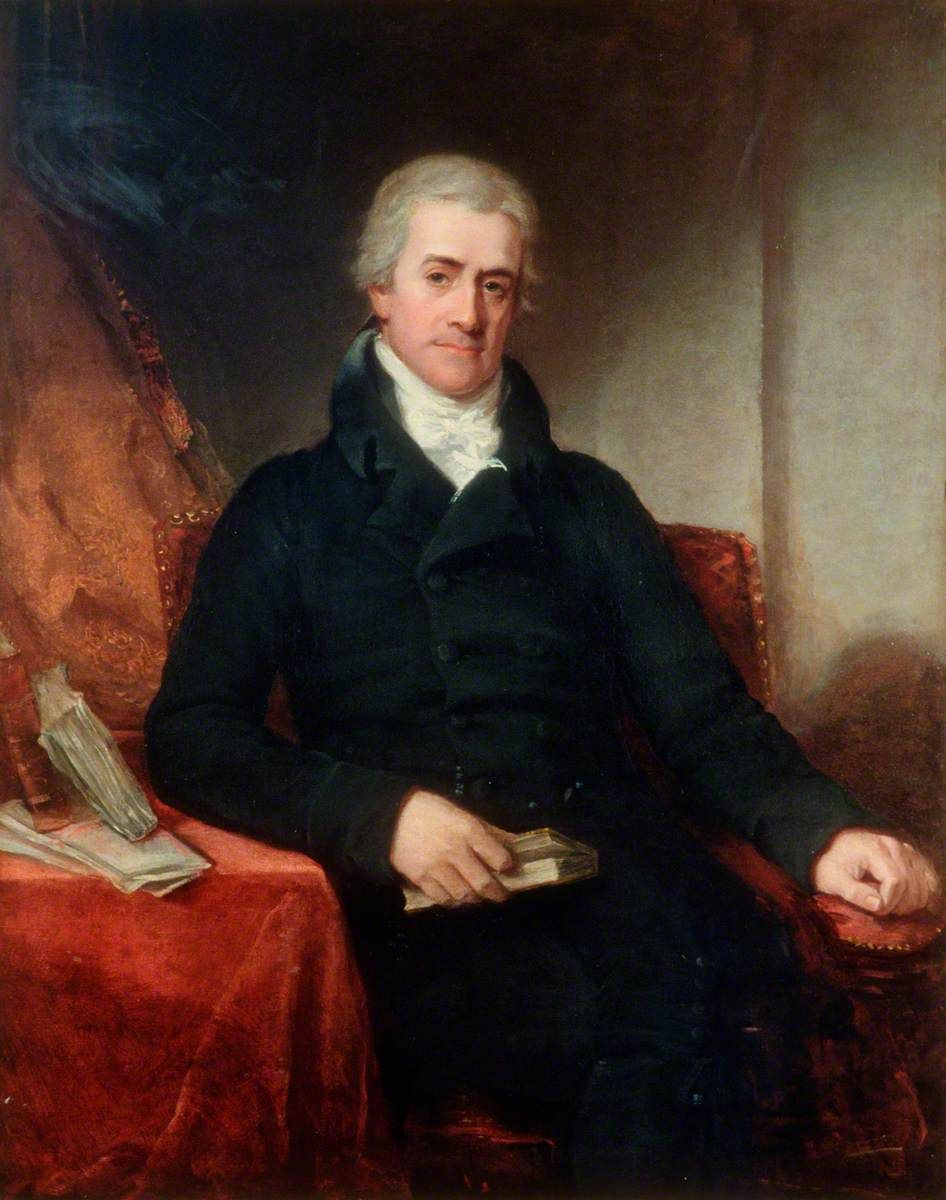
The accusation went far beyond embarrassment. It said that the princess had become pregnant in 1802, had secretly given birth to a boy, and was raising him in her own house. Speaking in the Commons in 1813, her defender Andrew Cochrane Johnstone called this a charge of high treason and said it endangered the succession. Lord Castlereagh denied that the succession had ever been in real doubt.[29] Thurlow told Romilly that the information was "too important to remain without any step being taken on it."[30] On May 29, 1806, the king issued a warrant directing four privy counselors to inquire: Lord Grenville, the prime minister; Lord Erskine, the lord chancellor; Earl Spencer, the home secretary; and Lord Ellenborough, the lord chief justice. Romilly, by then solicitor general, wrote down the testimony.
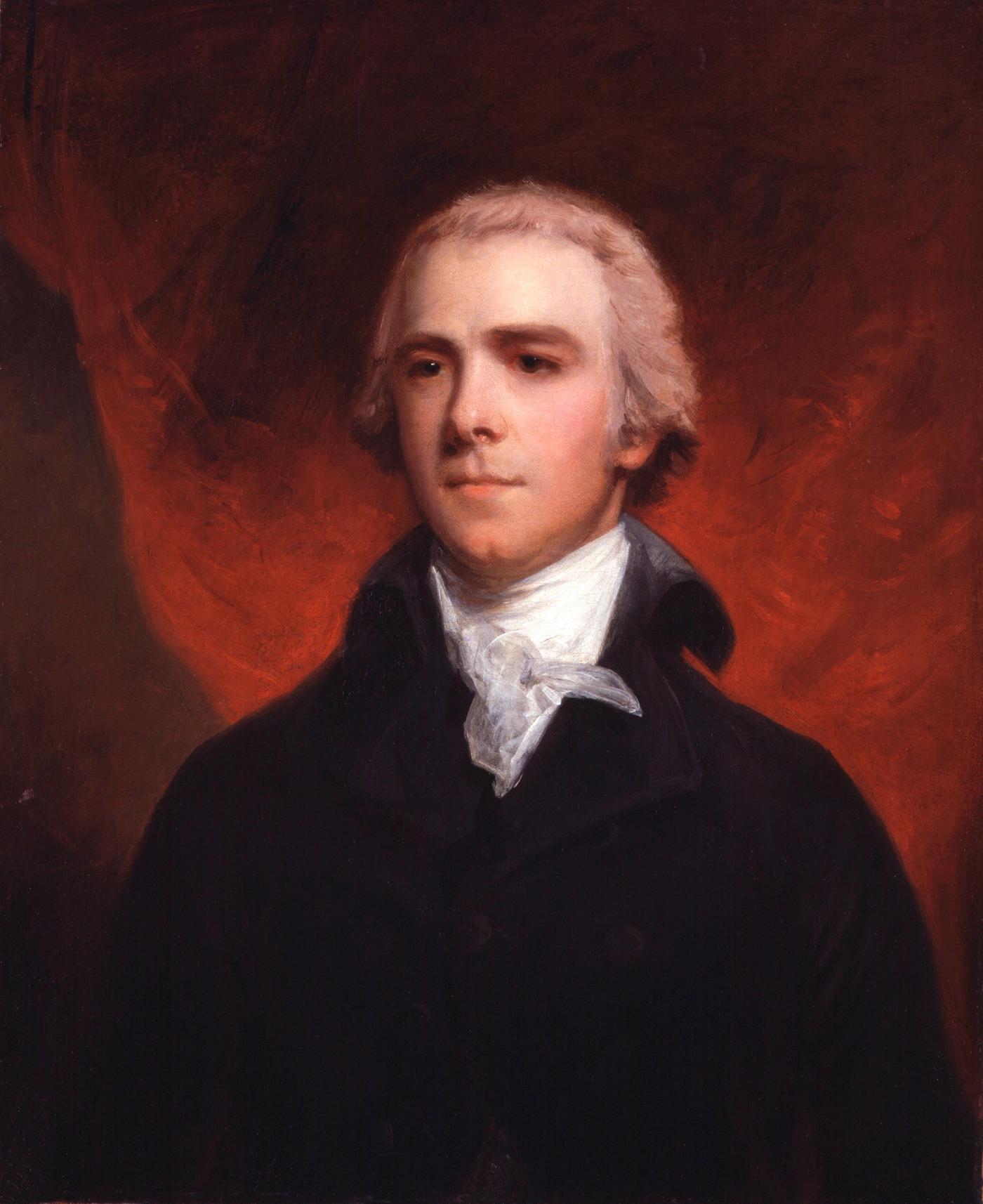
Lady Douglas and Sir John swore their depositions on June 1. Caroline heard nothing official until Saturday, June 7, when the Duke of Kent came to announce "the near approach of two attornies," who were to take away half her household for examination. She asked only that he remain with her until her servants had gone, so that no one could say she had spoken to them.[31] That evening she kept a dinner engagement at Lady Carnarvon's, and in the middle of the circle she quietly told Minto what had happened. The next day, Sunday, she entertained the French princes at Blackheath as though nothing were amiss. Minto was astonished by her composure.[32]
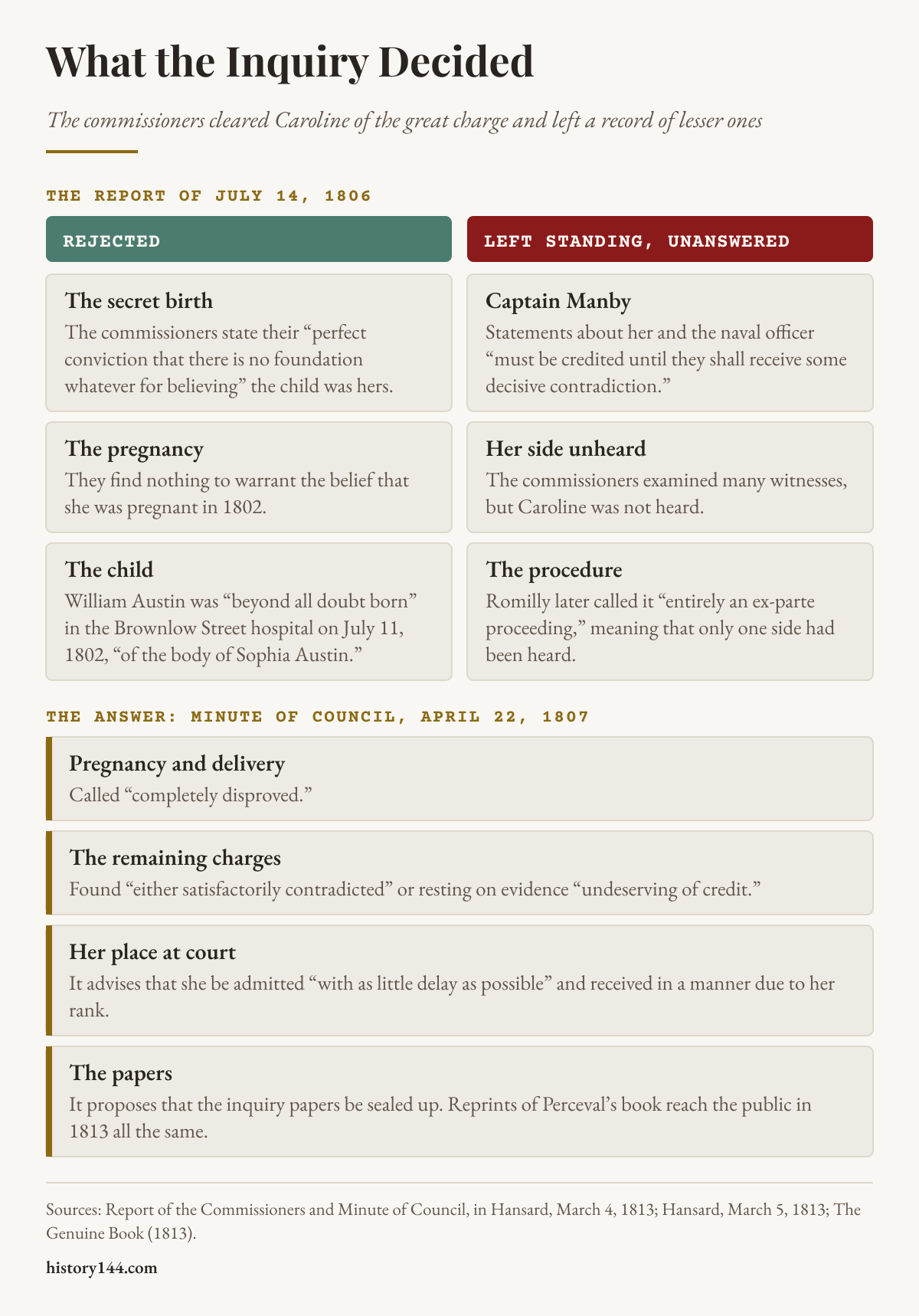
The boy's history settled the central charge. Sophia Austin deposed on June 7, and the commissioners' papers came to include extracts from the register of the Brownlow Street hospital. Their report of July 14 stated their "perfect conviction that there is no foundation whatever for believing" that the child was Caroline's. They also found nothing to warrant the belief that she had been pregnant in 1802. He had been "beyond all doubt born" in that hospital on July 11, 1802, "of the body of Sophia Austin," and had first come to the princess's house that November.[33]
The commissioners did not stop there. They wrote that other statements, "particularly those stated to have passed between her Royal Highness and Captain Manby, must be credited until they shall receive some decisive contradiction."[34] The commissioners had examined many witnesses, but Caroline had not been heard. By one later newspaper account, neither had the men named. Romilly later called the proceeding "entirely an ex-parte proceeding," meaning that only one side had been heard, and said that no one could be convicted on it alone. He defended it as the kind of inquiry the privy council had always made before any judicial step. The damage to her reputation remained.[35]
She received the papers on August 11 and turned to lawyers then in opposition. Spencer Perceval, Lord Eldon, and Sir Thomas Plumer advised her, and a long protest went to the king under her name that October. It objected that the warrant was "not countersigned, nor under Seal," and it called the witnesses "confederates in foul conspiracy with my false accusers."[36] The king's reply disappointed her. He was glad that the chief charge had failed, but he noted "circumstances of conduct" that he could view only with serious concern. She asked to see him, and he seemed ready to agree. The prince then announced that he had placed the documents with his own lawyers and asked his father to wait, and the king did so.[37]
The Book
Perceval answered by preparing the strongest weapon available to her. He assembled the report, depositions, and correspondence into a book, and the threat of publication alarmed the government and the royal family alike. Lady Malmesbury, driving back to town with him from Blackheath, joked that they might be sent to the Tower. Perceval replied, according to Minto's editor, that he would go to the Tower or the scaffold in such a cause.[38]
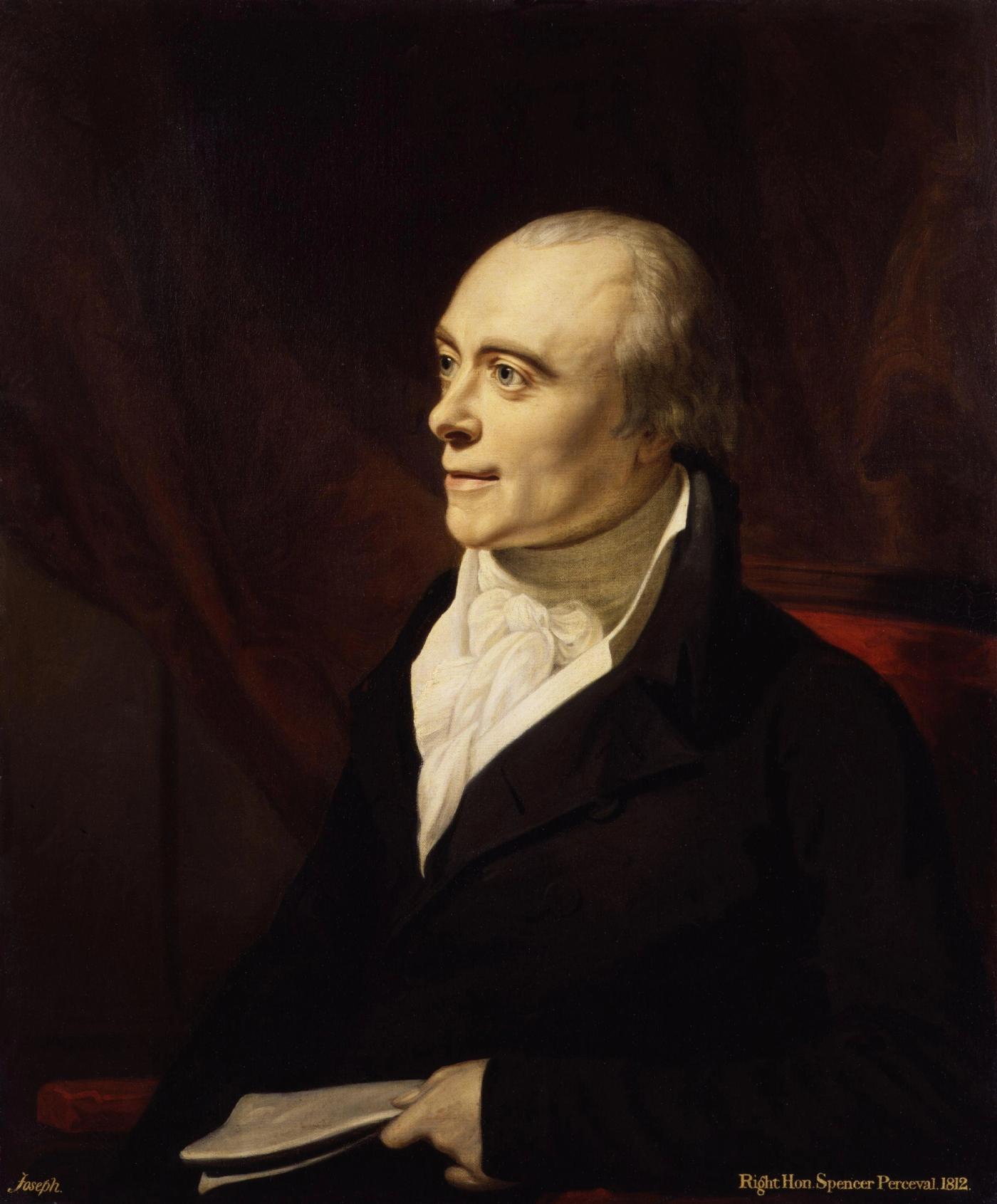
Politics intervened in March 1807. Grenville's ministry fell over Catholic relief, and Perceval and Eldon entered the Duke of Portland's new government. Five thousand copies of the book stood ready for sale.[39] They were suppressed, and the text did not reach the public until reprints appeared in 1813, one of them advertised as "superintended through the press" by Perceval.[40] Pearce suspected a private bargain. Whitbread later said that publication had been held back until Eldon and Perceval had kissed hands on taking office, though he also said that Perceval proclaimed her innocence until his death.[41]
The new cabinet paid its debt in official language. A minute of Council dated April 22, 1807, attended by Eldon and Canning among others, called the charges of pregnancy and delivery "completely disproved." It found the remaining charges "either satisfactorily contradicted" or resting on evidence "undeserving of credit." It advised that she be admitted "with as little delay as possible" and received in a manner due to her rank. It also proposed that the inquiry papers be sealed up. Castlereagh later described this as little more than a confirmation of what Grenville's cabinet had concluded. A further minute recommended that she be given apartments in a royal palace.[42] The crown's lawyers were satisfied that Lady Douglas had perjured herself but saw difficulties in proving it, and they advised no prosecution.[43]
Caroline attended a drawing-room, where the king received her warmly. At a royal birthday party soon afterward, she and the prince met in the center of the room while the company fell silent. They exchanged a few words that no one could hear and passed on. The often-quoted phrase "stately as an iceberg" comes from the later writer John Doran, and it should be read as his image of the prince. According to Pearce, the two never met again.[44]
The government had vindicated her in every way it could without a trial, yet suspicion remained. Caroline did little to dispel it. In later years, by the account of Lady Charlotte Campbell (later Bury), she claimed to have answered a question about Willikin's parentage with the words "Prove it, and he shall be your king." She swore that he was not her son, but she also teased that he was not really William Austin, and Lady Charlotte did not know what to believe.[45] The commissioners' finding rests on far better evidence than this talk.
Two Houses on the Heath
While the affair was still unresolved, her family's world collapsed. Her father, the Duke of Brunswick, was mortally wounded in the Prussian defeat of October 1806, and the French occupied his duchy. Her mother, Augusta, George III's elder sister, reached Gravesend on July 7, 1807, a few weeks short of seventy, and stayed at first with Caroline.[46]
The two women had not lived together since Caroline's marriage, and they did not manage it for long. Each, Caroline wrote after a month, liked "to live her own way." By September the duchess had moved next door to Chesterfield House, which became known as Brunswick House and is now Ranger's House. A "private communication" joined the two properties.[47] The arrangement proved useful, because Charlotte could now see her mother once a week at her grandmother's. Caroline described the routine dryly. The girl came to dinner at three on Saturdays to meet "old and steady people," Caroline joined them at four, and Charlotte left at six.[48]
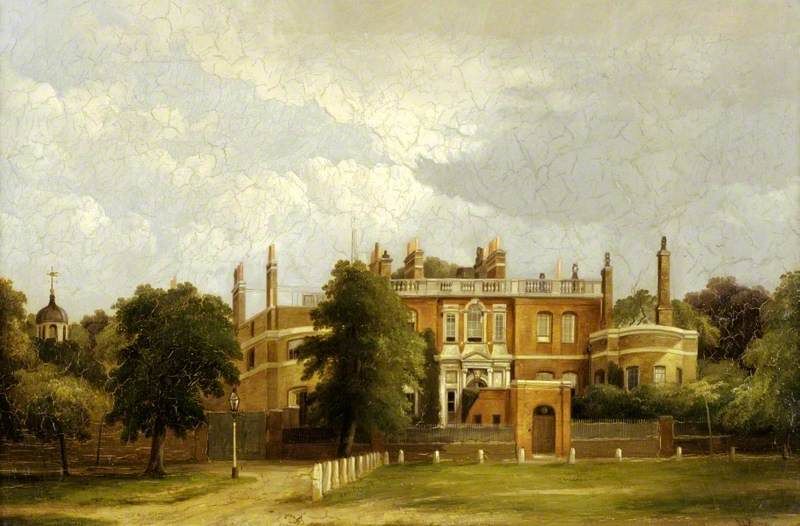
Caroline continued to entertain on a large scale. In June 1808 she gave a grand fete that used both houses, with a temporary ballroom a hundred feet long and a covered way leading to the supper room at her mother's.[49] Her access to her daughter remained narrow. When Charlotte fell ill, in about 1808, Caroline went to Warwick House despite the prohibition. When she proposed to return after the girl recovered, the prince wrote that the illness had been an exception and could no longer serve as an excuse.[50] He also ruled that her unfinished apartments at Kensington gave her no right to come. By Pearce's account, she increasingly lived in those apartments from then on, while keeping Montague House as well.[51]
News from Germany
By 1809 public attention had moved elsewhere. That winter a Commons inquiry into the sale of army commissions by Mary Anne Clarke, the Duke of York's mistress, gave the country a new royal scandal and forced the duke to resign as commander in chief. Caroline later judged that the session had to some degree lessened the royal family's quarrels, since they now had reason to hang together.[52] Her own affairs had gone quiet.
On Monday, August 7, 1809, Caroline sat down to write to her thirteen-year-old daughter. She passed on the first news of the British expedition to the Scheldt and gave thanks that few lives had been lost. She also confessed a horror of capitulations, which she said generally ended in very bad conventions. Then she added, "I have heard nothing from Germany, which rather surprises me." She was about to leave for Strawberry Hill, Horace Walpole's old house, and she signed herself Charlotte's attached mother.[53]
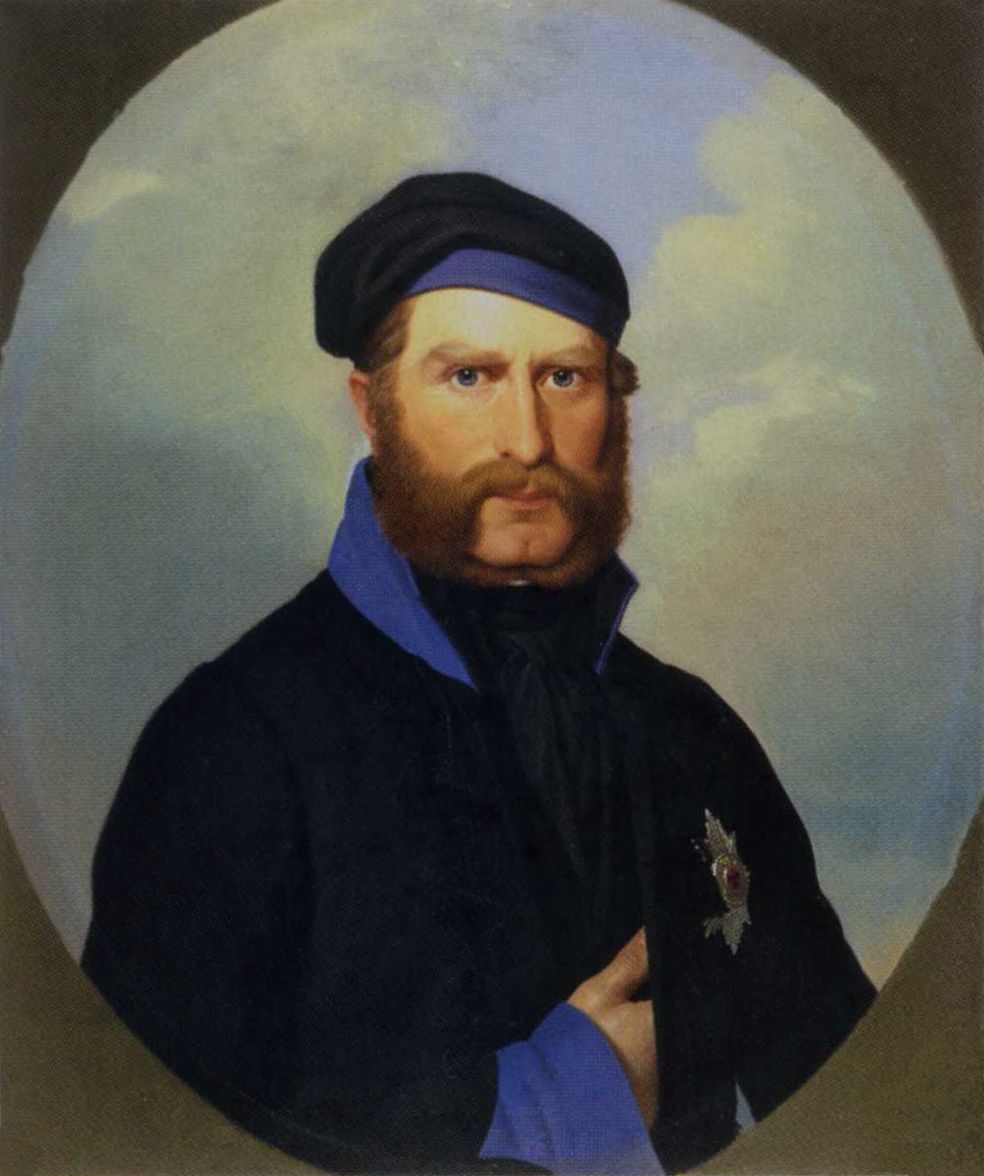
Her brother was then reaching the end of a remarkable march. Frederick William, the new Duke of Brunswick, had raised a volunteer corps with Austrian support, and he refused to stop when Austria signed an armistice. He led his black-uniformed men across northern Germany and fought his way past Westphalian troops outside his own lost capital. In the first days of August he reached the Weser, where a British naval raid had just destroyed a battery at the river's mouth, and his corps embarked for England.[54] Caroline did not say whose news she was awaiting, but her brother was the member of her family then fighting in Germany. By one newspaper report, he dined with her at Kensington Palace on August 18.[55] Napoleon's wars had now driven her mother and her brother from their duchy, and both had found refuge near her in England.
The visit to Strawberry Hill offers a last view of her at the close of these years. Mary Berry, Walpole's friend, was staying with the owner of the house, Anne Damer. Berry was no admirer, yet she thought that, at her best, the princess had more natural cleverness than any of her rank she had met. She also regretted that Caroline had "not a grain of common sense." The princess had brought Willikin, then seven or eight years old, and Berry noted with disapproval what people would inevitably say about her taking the boy everywhere.[56] After a secret inquiry and a search of hospital registers, Caroline was still taking him out in public. Her reasons may have been defiance, affection, or simple heedlessness. Any of the three would fit what she had done since leaving Carlton House.
A Question of State
The Blackheath years mattered because they turned a failed marriage into a public question. A commission meeting in private had treated a woman's friendships, jokes, and adopted child as evidence bearing on the succession. A decade later the government would send another commission to gather evidence about her, this time in Milan. The commissioners and cabinets had cleared her of the great charge but left a record of lesser ones that any later minister could reopen. Her letter of complaint brought the matter before Parliament in March 1813, when Whitbread protested that the old evidence was being raked up again.[57] The suppressed book reached print that same year. Public opinion would take her side still more strongly during the proceedings of 1820.
The child who danced at Charlton in 1797 had become, by 1809, the object of a contest that neither parent would give up. She now received her mother's war news by letter from a few miles away. The prince had wanted to be rid of his wife, and the inquiry had not given him that. Caroline had wanted her daughter and her place at court. She had gained only the second, and only in form. She kept the house on the heath for a few more years, and it was pulled down after she left England in 1814.
Places in this Story
The places this story moves through, in order — follow them on the interactive map →
- Montague House, Blackheath, London 1797 to 1814
Caroline's main home on the edge of Greenwich Park, where Lord Minto dined in the garden in 1798 and where the Douglases were neighbors.
- Charlton, London 1796 to 1797
The house Caroline moved to after leaving Carlton House. Princess Charlotte spent the prince's thirty-fifth birthday here in August 1797.
- Carlton House, London 1796
The prince's London palace, which Caroline left after the separation. Accounts of her departure disagree about whether her rooms were stripped.
- Warwick House, London 1805 to 1808
Princess Charlotte's residence, which the prince treated as part of Carlton House and barred his wife from visiting.
- Brownlow Street Hospital, London July 11, 1802
The lying-in hospital where the commissioners found William Austin had been born, to Sophia Austin, which settled the central charge.
- Ranger's House, Greenwich, London 1807 to 1813
Then Chesterfield House, taken by Caroline's mother Augusta in September 1807 and joined to Montague House by a private communication.
- Kensington Palace, London 1808 to 1809
The apartments Caroline increasingly lived in after the prince ruled they gave her no right to visit Charlotte.
- Strawberry Hill, Twickenham, London August 1809
Horace Walpole's old house, where Caroline went with William Austin and where Mary Berry judged her clever but without a grain of common sense.
Frequently Asked Questions
Who was Caroline of Brunswick?
Caroline of Brunswick was the German princess who married her cousin George, Prince of Wales, in 1795 and was separated from him within a year. From 1797 she lived apart at Blackheath, keeping her title and income but losing most access to their only child, Princess Charlotte.
Why did Caroline of Brunswick live at Blackheath?
After the separation of 1796 she left Carlton House and leased Montague House on the edge of Greenwich Park, which became her main home and what the Royal Collection calls her alternative court. George III encouraged her and by September 1805 had made her ranger of Greenwich Park.
What was the Delicate Investigation of 1806?
It was a secret inquiry ordered by George III on May 29, 1806, in which four privy counselors examined a charge that the Princess of Wales had borne an illegitimate son. Lord Grenville, Lord Erskine, Earl Spencer, and Lord Ellenborough heard the witnesses, and Samuel Romilly wrote down the testimony.
Who was William Austin, the boy raised by Caroline of Brunswick?
William Austin, called Willikin in the household, was the son of a Deptford dockyard worker who had lost his job, and he came to Caroline as a baby in November 1802. The 1806 commissioners found he had been born at the Brownlow Street hospital on July 11, 1802, to Sophia Austin.
What did the 1806 commissioners conclude about Caroline of Brunswick?
Their report of July 14, 1806, expressed a perfect conviction that there was no foundation for believing the child was hers, and found nothing to show she had been pregnant in 1802. They added that other statements about her conduct must be credited until contradicted, which left her reputation damaged.
Who was Lady Douglas and what did she accuse Caroline of?
Charlotte, Lady Douglas was a Blackheath neighbor whose friendship with Caroline broke in 1804, over a drawing about her and Sir Sidney Smith and over reports that she was saying the princess had secretly given birth. She repeated the charge in a deposition sworn on June 1, 1806.
What was The Book about Caroline of Brunswick?
Spencer Perceval gathered the 1806 report, depositions, and correspondence into a volume meant to force her vindication, and five thousand copies stood ready for sale. They were suppressed when Perceval joined the government in 1807, and the text only reached the public in 1813 reprints.
Bibliography
Primary and Nineteenth-Century Sources
Ashton, John. "Caroline Amelia Elizabeth." In Dictionary of National Biography, vol. 9. London: Smith, Elder, 1887. Consulted as transcribed at ThePeerage. Accessed November 5, 2026. https://thepeerage.com/e598.htm.
Bedfordshire Archives. Lord Brougham to Samuel Whitbread II, March 17, 1813. W1/2770. Catalogue summary. Accessed November 5, 2026. https://bedsarchivescat.bedford.gov.uk/Details/archive/110493796.
[Bury, Lady Charlotte]. Diary Illustrative of the Times of George the Fourth. Vol. 1. Paris-printed copy, 1838. Internet Archive. Accessed November 5, 2026. https://archive.org/details/diarygeorgeiv01buryuoft.
Elliot, Gilbert, First Earl of Minto. Life and Letters of Sir Gilbert Elliot, First Earl of Minto, from 1751 to 1806. Edited by the Countess of Minto. Vol. 3. London: Longmans, Green, 1874. Internet Archive. Accessed November 5, 2026. https://archive.org/details/lifelettersofsir03mintuoft.
The Genuine Book: An Inquiry, or Delicate Investigation into the Conduct of Her Royal Highness the Princess of Wales. Reprinted from an authentic copy, superintended through the press by the Right Hon. Spencer Perceval. London: Printed by R. Edwards and published by W. Lindsell, 1813. Internet Archive. Accessed November 5, 2026. https://archive.org/details/genuinebookinqui00perciala.
"The Book," Complete: Being the Whole of the Depositions on the Investigation of the Conduct of the Princess of Wales. London: Sherwood, Neely, and Jones, 1813. Internet Archive. Accessed November 6, 2026. https://archive.org/details/thebookcompleteb00perciala.
Great Britain. Parliament. House of Commons. "The Princess of Wales." HC Deb, March 4, 1813, vol. 24. Hansard. Accessed November 5, 2026. https://api.parliament.uk/historic-hansard/commons/1813/mar/04/the-princess-of-wales.
Great Britain. Parliament. House of Commons. "The Princess of Wales." HC Deb, March 5, 1813, vol. 24, cols. 1131–55. Hansard. Accessed November 5, 2026. https://api.parliament.uk/historic-hansard/commons/1813/mar/05/the-princess-of-wales.
Great Britain. Parliament. House of Commons. Debate of March 17, 1813. Hansard. Accessed November 5, 2026. https://hansard.parliament.uk/html/Commons/1813-03-17/CommonsChamber.
Georgian Papers Programme. Essay on Princess Charlotte of Wales. Accessed November 6, 2026. https://georgianpapers.com/?p=16567.
Hamilton, J. A. "George IV." In Dictionary of National Biography, vol. 21. London: Smith, Elder, 1890. Consulted in a Wikisource transcription. Accessed November 6, 2026. https://kwx.liehendr.com/content/wikisource_en_all_maxi_2022-09/A/Page%3ADictionary_of_National_Biography_volume_21.djvu/203.
Marshall, John. "Stuart, George." In Royal Naval Biography. Wikisource. Accessed November 5, 2026. https://en.wikisource.org/wiki/Royal_Naval_Biography/Stuart,_George.
Weigall, Lady Rose. A Brief Memoir of the Princess Charlotte of Wales. London: John Murray, 1874. Internet Archive. Accessed November 6, 2026. https://archive.org/details/briefmemoirofpri0000lady.
Later Sources
English Heritage. "The Real Bridgerton: A Royal Duchess at Ranger's House." Accessed November 5, 2026. https://www.english-heritage.org.uk/visit/places/rangers-house-the-wernher-collection/history-and-stories/a-royal-duchess.
Houghton, Roger. "Queen Caroline." In A Peoples' History 1793–1844 from the Newspapers. Accessed November 5, 2026. https://houghton.hk/queen-caroline/.
Pearce, Charles E. The Beloved Princess: Princess Charlotte of Wales, the Lonely Daughter of a Lonely Queen. London: Stanley Paul, n.d. Internet Archive. Accessed November 5, 2026. https://archive.org/details/belovedprincessp00pear.
Royal Collection Trust. "Caroline, Princess of Wales, and Princess Charlotte." RCIN 407292. Accessed November 5, 2026. https://col.rct.uk/collection/407292/caroline-princess-of-wales-and-princess-charlotte.
Walker, Eric C. "Adoption, Narrative, and Nation, 1800–1850: The Case of William Austin." Journal of British Studies 53, no. 4 (2014): 960–91. Accessed November 5, 2026. https://www.cambridge.org/core/journals/journal-of-british-studies/article/abs/adoption-narrative-and-nation-18001850-the-case-of-william-austin/1791D0219FC01A0E53F2178A71567BA6.
Citations
- Miss Hayman, quoted in Charles E. Pearce, The Beloved Princess: Princess Charlotte of Wales, the Lonely Daughter of a Lonely Queen (London: Stanley Paul, n.d.), 76–77. Pearce places this letter in 1797, following Lady Rose Weigall; the year could not be checked against Hayman's original. ↑
- Pearce, Beloved Princess, 76. ↑
- Pearce, Beloved Princess, 67–71, quoting Lady Charlotte Campbell (later Bury) and Hayman's letter to Miss Williams Wynn; [Lady Charlotte Bury], Diary Illustrative of the Times of George the Fourth, vol. 1 (1838), 26. Bury's page is from a digitized Paris-printed copy and is approximate; other editions paginate differently. ↑
- John Ashton, "Caroline Amelia Elizabeth," in Dictionary of National Biography, vol. 9 (London: Smith, Elder, 1887); Pearce, Beloved Princess, 73. ↑
- Pearce, Beloved Princess, 73, following Weigall. ↑
- Pearce, Beloved Princess, 75–76. ↑
- Pearce, Beloved Princess, 68, 77. ↑
- Minto, letter of December 7, 1798, in Life and Letters of Sir Gilbert Elliot, First Earl of Minto, ed. Countess of Minto, vol. 3 (London: Longmans, Green, 1874), 33. ↑
- Ashton, "Caroline Amelia Elizabeth"; Minto, Life and Letters, 3:10, 14; Royal Collection Trust, "Caroline, Princess of Wales, and Princess Charlotte," RCIN 407292. ↑
- Minto, letters of June 28 and July 14, 1798, in Life and Letters, 3:10, 14. ↑
- Minto, letter of December 15, 1798, in Life and Letters, 3:36; Pearce, Beloved Princess, 83–84. ↑
- Minto, Life and Letters, 3:60–61; Pearce, Beloved Princess, 84–85. Minto gives "a certain Sunday dinner" in August 1799. Minto's text has "He" where Pearce prints "The Prime Minister" before the reply. ↑
- Royal Collection Trust, RCIN 407292, which gives the canvas as 302.2 by 203.2 centimeters and dates the portrait 1801. ↑
- "Queen Caroline," in Roger Houghton, A Peoples' History 1793–1844 from the Newspapers, summarizing a newspaper of September 4, 1813; Pearce, Beloved Princess, 122–23. ↑
- Minto, letter of September 17, 1805, in Life and Letters, 3:371; Pearce, Beloved Princess, 89–90. English Heritage, "The Real Bridgerton: A Royal Duchess at Ranger's House," gives 1806. ↑
- Pearce, Beloved Princess, 91–95; J. A. Hamilton, "George IV," in Dictionary of National Biography, vol. 21 (London: Smith, Elder, 1890). ↑
- Hamilton, "George IV"; Georgian Papers Programme, essay on Princess Charlotte; Pearce, Beloved Princess, 96, 138–39. The sources conflict on when she began living at Warwick House: Pearce, 96, has her there before 1805, while Lady Rose Weigall, A Brief Memoir of the Princess Charlotte of Wales (London: John Murray, 1874), 47, 61, keeps her chiefly at Windsor and places her establishment at Warwick House in the Regency years. ↑
- Pearce, Beloved Princess, 95. ↑
- Ashton, "Caroline Amelia Elizabeth." ↑
- [Bury], Diary, 1:20–21 (approximate). ↑
- Report of the Commissioners, July 14, 1806, in HC Deb, March 4, 1813, vol. 24, col. 1120; Eric C. Walker, "Adoption, Narrative, and Nation, 1800–1850: The Case of William Austin," Journal of British Studies 53, no. 4 (2014), n. 14; Pearce, Beloved Princess, 118, 161. ↑
- Pearce, Beloved Princess, 119–20, quoting Lady Douglas's narrative. ↑
- Ashton, "Caroline Amelia Elizabeth." ↑
- Houghton, "Queen Caroline," summarizing the Bombay Courier of October 21, 1820. ↑
- Pearce, Beloved Princess, 120; Ashton, "Caroline Amelia Elizabeth." ↑
- HC Deb, March 5, 1813, vol. 24, cols. 1136–37, 1141 (Romilly's statement and the list of documents); "The Book," Complete (London: Sherwood, Neely, and Jones, 1813), 58, printing the princess's letter to the king, for December 3, 1805. The same volume's Historical Preface, lii, reads 1803, and its contents date Lady Douglas's statement December 3, 1806; these appear to be errors. ↑
- HC Deb, March 5, 1813, vol. 24, cols. 1136–37. The list dates Cole's declarations to January and February, Robert Bidgood's to April 4, Sarah Bidgood's to April 23, and Lloyd's to May 12. ↑
- Brougham to Samuel Whitbread, March 17, 1813, Bedfordshire Archives, W1/2770, catalogue summary. ↑
- HC Deb, March 5, 1813, vol. 24, cols. 1133–36, 1138–39. ↑
- HC Deb, March 5, 1813, vol. 24, cols. 1141–42. ↑
- The Genuine Book: An Inquiry, or Delicate Investigation into the Conduct of Her Royal Highness the Princess of Wales (London: R. Edwards for W. Lindsell, 1813), 29, printing Caroline's letter to the king; HC Deb, March 5, 1813, vol. 24, cols. 1132–33, 1137. Hansard's list of documents and the petition in HC Deb, March 17, 1813, agree with the sworn line in "The Book," Complete, 7: "Sworn before us... June 1, 1806." That volume's contents list Sir John's deposition as sworn June 6, in error. The Genuine Book's page numbers come from uneven OCR and are approximate. ↑
- Minto, letter of June 9, 1806, in Life and Letters, 3:387–88; Pearce, Beloved Princess, 121–22. Minto dates the French princes' dinner "on Sunday (yesterday)"; Pearce, 121, misprints it as Tuesday. ↑
- HC Deb, March 5, 1813, vol. 24, cols. 1137, 1139, whose list dates the register extracts to June 23; Genuine Book, 7–8; HC Deb, March 4, 1813, vol. 24, cols. 1119–20. ↑
- Genuine Book, 9; HC Deb, March 4, 1813, vol. 24, col. 1121. ↑
- HC Deb, March 5, 1813, vol. 24, cols. 1132, 1142–44; Houghton, "Queen Caroline," on the men not being examined. Hansard prints "entirety," an evident misprint for "entirely." ↑
- Genuine Book, 25, 31–32, 37, 39, listing the letter under October 2, 1806; HC Deb, March 5, 1813, vol. 24, cols. 1132, 1150–51. Cochrane Johnstone gave the date as October 9 in the Commons, and Romilly doubted that those lawyers wrote the protest: col. 1142. ↑
- Pearce, Beloved Princess, 124–27. ↑
- Minto, Life and Letters, 3:391–92, in the Countess of Minto's narrative; Pearce, Beloved Princess, 127–28. ↑
- Pearce, Beloved Princess, 128–29. ↑
- Genuine Book, title page; HC Deb, March 5, 1813, vol. 24, cols. 1144–46. ↑
- Pearce, Beloved Princess, 129; HC Deb, March 5, 1813, vol. 24, cols. 1146–47. ↑
- Minute of Council, April 22, 1807, in HC Deb, March 4, 1813, vol. 24, cols. 1121–23, with the wider finding at col. 1122; HC Deb, March 5, 1813, vol. 24, col. 1148; Pearce, Beloved Princess, 129–30. ↑
- HC Deb, March 5, 1813, vol. 24, col. 1139. ↑
- Pearce, Beloved Princess, 130, quoting Doran. ↑
- Pearce, Beloved Princess, 131–32, quoting a reminiscence of which Lady Charlotte Campbell (later Bury) was the recipient. The remark is secondhand. ↑
- English Heritage, "A Royal Duchess"; Pearce, Beloved Princess, 134–37. Sources differ on where she first stayed: English Heritage says Montague House, while Pearce mentions a villa at Charlton. ↑
- English Heritage, "A Royal Duchess." ↑
- Pearce, Beloved Princess, 137. ↑
- English Heritage, "A Royal Duchess." ↑
- Pearce, Beloved Princess, 138–39. Pearce gives no year, saying only that Charlotte was taken ill "in the following year." The sentence follows events of 1807, so about 1808 is an inference. ↑
- Pearce, Beloved Princess, 139, 157; English Heritage, "A Royal Duchess." ↑
- Pearce, Beloved Princess, 55. ↑
- Caroline to Princess Charlotte, August 7, 1809, in Pearce, Beloved Princess, 159–60. ↑
- John Marshall, Royal Naval Biography, s.v. "Stuart, George," which places the embarkation a few days after an action of July 26, 1809. ↑
- Houghton, "Queen Caroline," summarizing the Bombay Courier Extraordinary of February 19, 1810. The entry gives no year; 1809 is inferred from the date of the paper. ↑
- Pearce, Beloved Princess, 160–61, quoting Berry's journal. Berry's entry as quoted by Pearce carries no date, but Caroline's letter says she was about to set out. ↑
- HC Deb, March 5, 1813, vol. 24, cols. 1145–47. ↑