A major turning point in the history of the State of the Union Address came in the early 20th century, when President Woodrow Wilson revived the tradition of delivering it to Congress in person after more than a century of written reports. Between 1913 and 1920, his speeches, for better or worse, reshaped the address into the modern presidential event we recognize today.
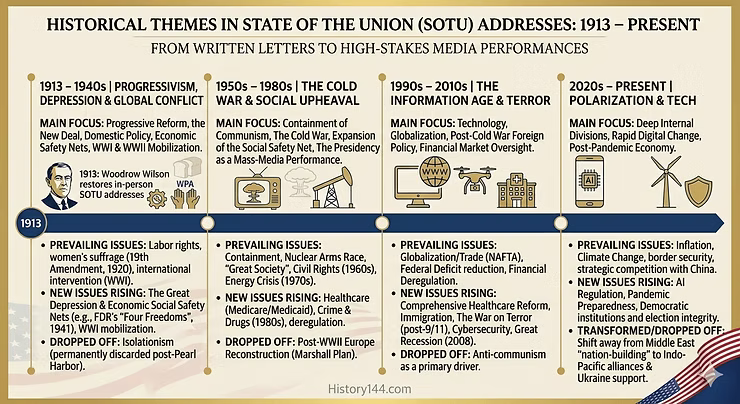
Woodrow Wilson Begins Delivering the State of the Union Address In Person
On December 2, 1913, Woodrow Wilson started the American tradition of delivering the State of The Union Address(then called The Annual Message) to Congress in person after taking office in March 1913. The tradition of delivering the speech in person had been discontinued since 1800, when John Adams gave his last State of Union Address before Thomas Jefferson became president. Jefferson's presidency ended what historians call the 'Federalist Era', and Jefferson denounced the practice, comparing it to the British monarch's speech from the throne.
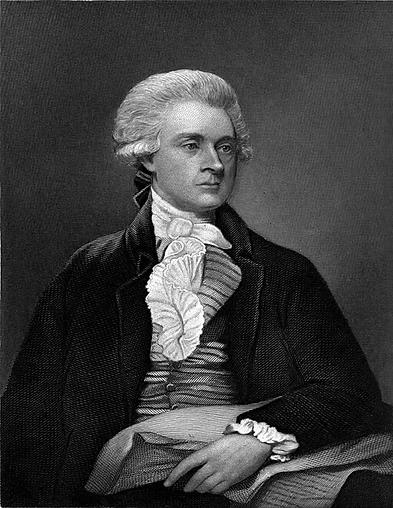
The address had been delivered in writing since 1801, but in 1913, President Wilson revived the oral tradition, using it as an opportunity to engage the public more visibly. During his presidency, he continued delivering the speech in person, except for 1917, when he was ill on the day of the address and until he suffered a debilitating stroke on October 2, 1919. Due to the stroke, both his 1919 and 1920 addresses were delivered in writing and read aloud by another. Following Wilson's stroke, the White House was largely run by his second wife, Edith Wilson, who some people "unofficially" call the first female president.
The year 1920 also marked the age of the radio, when the first broadcasts of presidential election results were aired, and since then, the president has had a direct line to the American people, making it even more beneficial to deliver the State of the Union Address in person. Warren G. Harding delivered his 1921 and 1922 addresses in person; the 1922 speech was also the first to be broadcast via radio to a small audience. Just a year later, in 1923, radio technology had improved enough for President Calvin Coolidge to deliver the first State of the Union Address from the House Chamber and via radio to an audience numbering in the millions. Coolidge assumed the presidency following Harding's unexpected death.
Woodrow Wilson's 1913 State of the Union Address
During his first address to Congress in 1913, Wilson began by stating,
I shall ask your indulgence if I venture to depart in some degree from the usual custom of setting before you in formal review the many matters which have engaged the attention and called for the action of the several departments of the Government or which look to them for early treatment in the future, because the list is long, very long, and would suffer in the abbreviation to which I should have to subject it.[1]
President Wilson closed his 1913 address with this paragraph.
May I now express the very real pleasure I have experienced in cooperating with this Congress and sharing with it the labors of common service to which it has devoted itself so unreservedly during the past seven months of uncomplaining concentration upon the business of legislation? Surely it is a proper and pertinent part of my report on "the state of the Union" to express my admiration for the diligence, the good temper, and the full comprehension of public duty which has already been manifested by both the Houses; and I hope that it may not be deemed an impertinent intrusion of myself into the picture if I say with how much and how constant satisfaction I have availed myself of the privilege of putting my time and energy at their disposal alike in counsel and in action.[2]
At another point in the speech, he is quoted as saying this in the context of providing certain work benefits to railroad workers. Here we see Wilson's willingness to engage the government in the practice of "social justice." It should be noted that social justice had a different connotation in 1913 than it does today, but nonetheless, it was a term that does not truly describe justice.
We ought to devote ourselves to meeting pressing demands of plain justice like this as earnestly as to the accomplishment of political and economic reforms. Social justice comes first. Law is the machinery for its realization and is vital only as it expresses and embodies it.[3]
Key Highlights of Wilson’s 1913 Annual Message
- The "Peace" Illusion: Wilson opened with a hopeful declaration that the world had reached a state of permanent stability—ironically, just months before the outbreak of World War I.
- The "Cooling-Off" Treaties: He advocated for new arbitration treaties designed to force nations into a period of investigation and debate before they could legally resort to war.
- The Mexico Crisis: Taking a moral stand against General Victoriano Huerta, Wilson labeled his regime illegitimate and insisted that regional peace depended on Huerta’s removal from power.
- Bolstering Antitrust Laws: A core pillar of his "New Freedom" platform, Wilson demanded more specific legislation to close loopholes in the Sherman Antitrust Act and prevent unfair business monopolies.
- National Presidential Primaries: In a major Progressive push, he urged Congress to strip power from "party bosses" by establishing a national system of direct primaries to select presidential nominees.
- Direction for the Territories: Wilson framed the U.S. role in Hawaii, Puerto Rico, and the Philippines as a "trustee" rather than a conqueror, moving toward a policy of eventual self-governance.
- Unlocking Alaska: To develop the "great North," he proposed a government-funded rail system and updated ports to make Alaska’s vast mineral resources accessible to the rest of the world.
- Safety in the Mines: Wilson called for the Bureau of Mines to shift its focus, arguing that making mines safer for workers was just as important as making them more profitable.
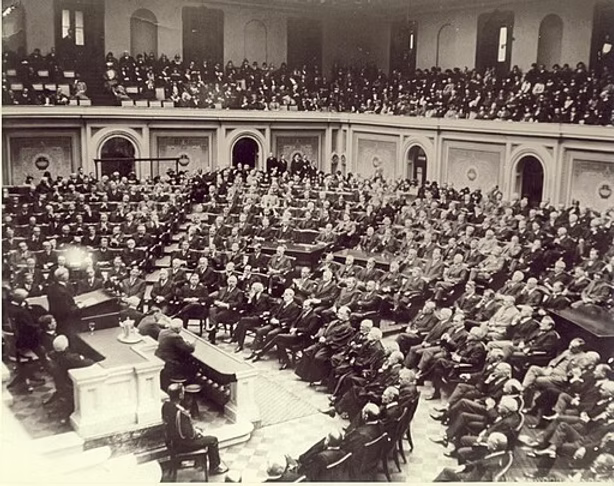
Last but not least, he addressed the need to pass the Federal Reserve Act which would create the Federal Reserve central bank. The Federal Reserve Act was passed on December 23, 1913. Here is what he said.
You already have under consideration a bill for the reform of our system of banking and currency, for which the country waits with impatience, as for something fundamental to its whole business life and necessary to set credit free from arbitrary and artificial restraints. I need not say how earnestly I hope for its early enactment into law. I take leave to beg that the whole energy and attention of the Senate be concentrated upon it till the matter is successfully disposed of. And yet I feel that the request is not needed-that the Members of that great House need no urging in this service to the country.[4]
Woodrow Wilson also shared in his message how he believed that the Federal Reserve Act along with intervention from the Agricultural Department would help farmers by providing them with the financial credit they need to operate their business.
How the State of the Union Address became an annual presidential speech - YouTube Short
Woodrow Wilson's 1919 State of the Union Address
The 1919 address is the first address following the Treaty of Versailles that brought WWI to a close. There is a marked shift in Wilson's tone and rhetoric. He bluntly confesses that America's position in the world has changed, thanks to transitioning from a debtor nation before the war, to the world's largest creditor nation after the war.
The problem is not an easy one. A fundamental change has taken place with reference to the position of America in the world’s affairs...Whatever, therefore, may have been our views during the period of growth of American business concerning tariff legislation, we must now adjust our own economic life to a changed condition growing out of the fact that American business is full grown and that America is the greatest capitalist in the world.[5]
Ironically, Wilson saw the need to address the complex nature of income tax. The United States was only in its sixth year since Wilson passed the Revenue Act of 1913 following the legalization of income taxes thanks to the 16th Amendment. Already, Wilson was asking for the tax code to be simplified.
I trust that the Congress will give its immediate consideration to the problem of future taxation. Simplification of the income and profits taxes has become an immediate necessity. These taxes performed indispensable service during the war. They must, however, be simplified, not only to save the taxpayer inconvenience and expense, but in order that his liability may be made certain and definite.[6]
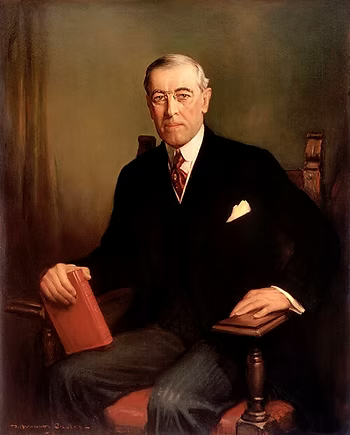
During the 1919 address, Woodrow Wilson argued that World War I fundamentally transformed the United States from a debtor nation into the world’s dominant financial power. He asserts that the long-standing political battles between protectionists and free-traders must be set aside in favor of a new global reality: because the U.S. had transitioned from owing the world money to becoming its primary creditor—having loaned over $9 billion to foreign governments—it could no longer afford to use tariffs.[7] Wilson explains that since Europe lacked the gold to settle its massive debts, the only way for foreign nations to pay for American exports was by selling their own goods in American markets. He warned that maintaining high tariffs would inadvertently stifle American productivity, as blocking imports would eventually force a collapse in exports, leading to industrial stagnation and unemployment at home. Ultimately, Wilson concluded that because American business is now "full grown" and the nation is the "greatest capitalist in the world," the U.S. must adopt a policy of economic reciprocity, famously stating that if the country wants to sell, it must also be prepared to buy.
Key Highlights of Wilson’s 1919 Annual Message
- Establishment of a Federal Budget System: Wilson urged Congress to create a centralized budget process under executive authority to ensure that national expenditures were planned as a single, comprehensive budget.
- Tax Simplification and Reduction: He called for the immediate simplification of income and excess profits taxes to reduce taxpayer burden. Crucially, he warned that maintaining high peace-time tax rates could "discourage the energy" that otherwise leads to greater productivity.
- Veteran Relief and Re-employment: Wilson advocated for robust support for returning soldiers, specifically through a Department of Labor organization to help them find work and a Department of the Interior plan to help veterans settle and cultivate undeveloped land.
- Strategic Chemical and Dyestuff Industries: He argued for protecting the American chemical industry (specifically dyestuffs), noting that before the war, the U.S. was dangerously dependent on German monopolies. He linked this industry directly to national security and the production of explosives.
- Rural Development and Agriculture: Wilson pushed for increased food production and the improvement of rural life through federal participation in building "good roads," better support for country schools, and improved rural sanitation and medical facilities.
- Forestry and Resource Preservation: He recommended better forestry methods on private lands and the extension of publicly owned forests to preserve the nation's natural resources.
- Causes of Political Unrest: He addressed the "political restlessness" in the country (referencing the Red Scare period), attributing it to the delay in reaching a permanent peace treaty, "heartless profiteering" that increased the cost of living, and the influence of radical theories from Europe.
- Public Health: The need for the federal government to take a larger role in protecting public health, particularly in rural districts where medical facilities were lacking.
- Labor and Capital Relations: He dedicated significant time to the "right of labor" and the need for a "genuine democratization of industry" to prevent social unrest and ensure fair treatment for workers.[8]
Woodrow Wilson's 1920 State of the Union Address
On December 7, 1920, Woodrow Wilson delivered his last State of the Union Address in writing. This was his opening paragraph.
When I addressed myself to performing the duty laid upon the President by the Constitution to present to you an annual report on the state of the Union, I found my thought dominated by an immortal sentence of Abraham Lincoln's--"Let us have faith that right makes might, and in that faith let us dare to do our duty as we understand it"--a sentence immortal because it embodies in a form of utter simplicity and purity the essential faith of the nation, the faith in which it was conceived, and the faith in which it has grown to glory and power. With that faith and the birth of a nation founded upon it came the hope into the world that a new order would prevail throughout the affairs of mankind, an order in which reason and right would take precedence over covetousness and force; and I believe that I express the wish and purpose of every thoughtful American when I say that this sentence marks for us in the plainest manner the part we should play alike in the arrangement of our domestic affairs and in our exercise of influence upon the affairs of the world.[9]
This was the closing paragraph.
I have not so much laid before you a series of recommendations, gentlemen, as sought to utter a confession of faith, of the faith in which I was bred and which it is my solemn purpose to stand by until my last fighting day. I believe this to be the faith of America, the faith of the future, and of all the victories which await national action in the days to come, whether in America or elsewhere.[10]
Something of note from Wilson's 1920 speech is how he addressed the national budget. The numbers then (in the low billions), compared to now serve as a reminder of inflation's effect on the value of fiat currency.
The nation’s finances have shown marked improvement during the last year. The total ordinary receipts of $6,694,000,000 for the fiscal year 1920 exceeded those for 1919 by $1,542,000,000, while the total net ordinary expenditures decreased from $18,514,000,000 to $6,403,000,000. The gross public debt, which reached its highest point on August 31, 1919, when it was $26,596,000,000, had dropped on November 30, 1920, to $24,175,000,000.[11]
Key Highlights: Wilson’s Final Annual Message (1920)
- The Trial of Democracy: Wilson framed the post-war era as a "final test" for democracy, urging the U.S. to lead the world by proving the system’s moral and spiritual strength.
- Fiscal Responsibility: He pushed for a unified national budget system and a "rigid economy" to manage and retire the massive debts accumulated during World War I.
- Tax Simplification: Recognizing the complexity of wartime levies, he recommended simplifying income and profits taxes to reduce the burden and uncertainty for American taxpayers.
- Veteran Rehabilitation: Wilson called for "ample provision" for disabled veterans, prioritizing medical care and vocational training as a non-negotiable national debt of honor.
- Consumer Price Marking: To combat inflation and price gouging, he proposed that producers be required to mark the original price of goods on all products shipped across state lines.
- Philippine Independence: Stating that the Philippines had successfully established a stable government, Wilson urged Congress to fulfill the U.S. promise and grant them full independence.
- The Armenian Loan: He requested that Congress authorize a loan to the people of Armenia to support their struggling new government following the devastation of the war.
The American Empire and the 1919-1920 Addresses
Historians frequently note a striking irony in Woodrow Wilson’s final years: while he was at his most physically vulnerable following a debilitating stroke, his 1919 and 1920 addresses radiated a supreme, almost defiant confidence. Delivered in the immediate shadow of the Treaty of Versailles, these messages functioned as far more than mere administrative updates. As biographer Arthur S. Link argues, they were ideological manifestos that signaled the precise moment the United States emerged as the world’s preeminent power. It was here that "Wilsonianism" was truly codified—the conviction that America possesses a moral mandate to export democracy and that American interests are inherently synonymous with global peace.[12]
John Milton Cooper Jr. identifies this era as the birth of the "Indispensable Nation." Decades before the term was popularized in the 1990s, Cooper’s thesis suggests that the aftermath of World War I marked a fundamental pivot from the "Old World" of secret treaties to a "New World" dependent on American leadership. While the U.S. Senate would ultimately retreat from this role by rejecting the League of Nations, the geopolitical reality had already shifted. Even as the British Empire reached its zenith, the global center of gravity was moving across the Atlantic.
When Wilson declared the United States the "greatest capitalist in the world" and noted a "fundamental change" in America’s global standing, he was acknowledging a historic changing of the guard. Just as the British Empire was peaking, the economic and moral mantle had effectively passed. The era of the "rhetorical" and "indispensable" American presidency had begun.
The Impact of the State of Union Address on American Politics Today
The State of the Union Address has fundamentally reshaped the landscape of American politics, serving as a primary catalyst for the "rhetorical presidency." While this shift is not the sole factor behind the modern political darkness we find ourselves in since 1913, it has functioned as a persistent accelerant. By transforming a constitutional mandate into an event, the address has drifted far from its intended purpose, contributing to an era where the performance of leadership often outweighs the substance of governance.
The central crisis of contemporary American politics is that it is now largely fueled by a rhetorical arms race between parties. This environment fosters deep-seated division and perpetual infighting, leaving little room for legislative achievement. Today’s political class often finds itself unable to agree on the means of governance, or even the ultimate ends. When the foundational goals of a society become the subject of partisan dispute, finding a path forward becomes an exercise in futility—an unfortunate reality of our current institutional decay.
What role did the State of the Union Address play in this fragmentation? A substantial amount of scholarly analysis has been dedicated to the address’s evolution since 1913, much of it identifying the spoken SOTU as a detrimental turning point. By shifting from a written report to an eventual televised spectacle, the address has moved away from a tool of transparency and toward a tool of mass mobilization. To understand how this annual tradition began to undermine the very system it was meant to support, one must look at the critiques of the "rhetorical" and "cult-like" nature of the modern executive.
In The Rhetorical Presidency, Jeffrey K. Tulis argues that Wilson created a "second constitution" that supplanted the founders' original design, fundamentally altering the nature of American governance. While the Framers intended for the President to communicate primarily with Congress through formal, written reports to ensure cool-headed deliberation, Tulis suggests that the 20th-century shift toward direct popular appeal—exemplified by the oral State of the Union Address—has fostered a culture of demagoguery. By "going public" to rally mass support, modern presidents often bypass the legislative process and create a climate where political soundbites replace substantive policy negotiation. This reliance on presidential rhetoric has expanded executive power and destabilized the constitutional balance by prioritizing public sentiment over institutional reason, making true governance more difficult.[13]
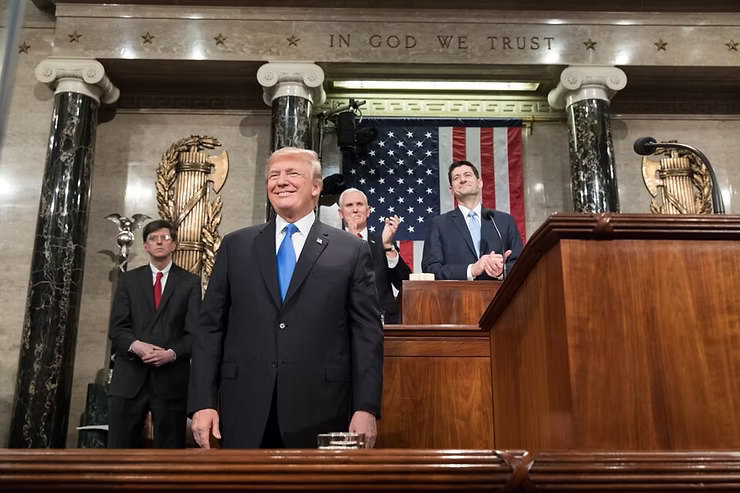
In The Cult of the Presidency, Gene Healy contends that the modern State of the Union has evolved into a "high holy day" of a secular national religion, reflecting a dangerous expansion of executive expectations. He argues that the address has shifted from a constitutional duty into a monarchical spectacle, exactly what had concerned President Jefferson. Now the president is cast as a "national savior" responsible for everything from the health of the economy to the moral state of the union. This "cult-like" devotion creates a paradoxical burden: it encourages the public to look toward a single individual for solutions to all societal ills, which inevitably results in deep public disillusionment when the president fails to meet these impossible, quasi-religious standards. By centering the American political identity on the personhood of the president, Healy suggests we have eroded the self-reliance of local communities and the legislative authority of Congress, trading a modest republic for an imperial office defined by pomp and unattainable promises.[14]
Ultimately, the transformation of the State of the Union since 1913 represents more than a mere shift in medium; it marks the steady devolution of a constitutional duty into a hollow mockery of the American political process. What was intended as a sober accounting of the nation’s affairs has been replaced by a planned display of partisan posturing, where the primary objective is no longer to inform, but to perform. As Republicans and Democrats compete in a performative theater of "out-applauding" one another, the American public is left with a spectacle that deepens division rather than providing direction. This annual display of tribalism serves as a reminder that when a republic trades institutional reason for rhetorical spectacle, the casualty is not just civil discourse, but, in part, the very capacity to govern.
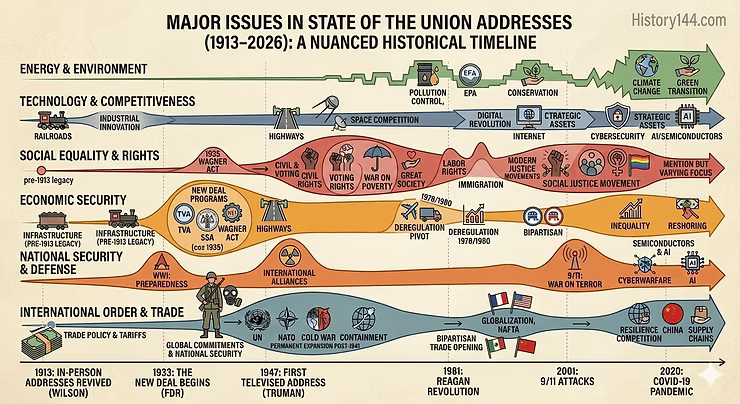
Analyzing SOTU Speeches Since 1913: Themes and Trends
Top 10 Recurring Themes in SOTU Addresses Since 1913
| Rank | Theme | SOTU Times Mentioned | Key Words/Subjects |
|---|---|---|---|
| 1 | Economy / Jobs / Growth | 105–110 | Employment, inflation, business, taxes, or economic growth. |
| 2 | National Security / Defense / War | 95–100 | World Wars, Cold War, terrorism, military readiness, and global conflicts. |
| 3 | Budget / Taxes / Federal Spending | 90–95 | Deficits, taxation, debt, and fiscal policy. |
| 4 | Foreign Policy / Diplomacy | 85–90 | Alliances, trade relations, diplomacy, and global leadership. |
| 5 | Healthcare / Social Welfare | 75–85 | Social Security, Medicare, Medicaid, healthcare reform, and public health. |
| 6 | Education | 70–80 | Schools, universities, workforce training, and competitiveness. |
| 7 | Infrastructure / Transportation / Energy | 65–75 | Roads, bridges, rail, energy independence, and public works. |
| 8 | Immigration | 55–65 | Illegal Immigration |
| 9 | Civil Rights / Equality | 50–60 | Voting rights, racial equality, women’s rights, and broader civil liberties. |
| 10 | Environment / Climate / Natural Resources | 40–55 | Conservation to modern concerns like pollution and climate change. |
SOTU Address Word-Count Between Democrat and Republican Since 1913
| No. of Spoken Speeches | Average Word Count | Median Word Count | Total Word Count | |
|---|---|---|---|---|
| All Spoken Addresses | 91 speeches | 5,828 words | 5,348 words | 530,332 words |
| Republican Spoken Addresses | 44 speeches | 6,266 words | 5,170 words | 275,702 words |
| Democrat Spoken Addresses | 47 speeches | 5,418 words | 5,400 words | 254,630 words |
SOTU Address Written Speeches Since 1913
- 1917 – Woodrow Wilson: A written message was submitted because Wilson fell ill with a severe case of the flu shortly before the scheduled date.
- 1919–1920 – Woodrow Wilson: Wilson’s health had significantly declined following a major stroke in late 1919, making a live address physically impossible.
- 1925–1928 – Calvin Coolidge: After speaking his first two messages, Coolidge, or "Silent Cal" as he was nicknamed, returned to the written tradition for the rest of his term to provide more technical and detailed legislative recommendations.
- 1929–1932 – Herbert Hoover: Hoover opted for written reports throughout his entire presidency, preferring the formal detail and efficiency of the written word over public oratory.
- 1945 – Franklin D. Roosevelt: This was submitted in writing due to the heavy logistical demands of World War II and Roosevelt's failing health just months before his death.
- 1946 – Harry S. Truman: Truman sent a massive combined SOTU and Budget message; at over 25,000 words, it remains one of the longest documents ever submitted to Congress.
- 1953 – Harry S. Truman: Truman chose a written format for his final message before leaving office.
- 1956 – Dwight D. Eisenhower: Recovering from a heart attack, Eisenhower sent a written message to avoid the physical strain of a public speech.
- 1961 – Dwight D. Eisenhower: Following the tradition of Truman, Eisenhower submitted his final message in writing as a farewell just before the 1961 inauguration.
- 1973 – Richard Nixon: Nixon broke the address into a series of themed written messages throughout the year to focus on technical policy issues like the economy and energy.
- 1981 – Jimmy Carter: Carter submitted the last exclusively written SOTU to date—a 33,667-word accounting of his administration—days before his term ended.
Important Dates
Woodrow Wilson delivers the first in-person State of the Union (then called the Annual Message) since the early 1800s, reviving the oral tradition.
The Federal Reserve Act is signed into law after Wilson strongly urged its passage in his annual message.
The outbreak of World War I shatters the international stability Wilson had hoped for in his 1913 address.
Wilson suffers a debilitating stroke that effectively ends his ability to govern actively and prevents future in-person addresses.
Wilson's first post-stroke State of the Union is submitted in writing, emphasizing America's emergence as the world's leading creditor nation.
The first commercial radio broadcasts of U.S. presidential election returns mark the beginning of direct mass communication between presidents and the public.
Wilson delivers his final State of the Union message in writing, outlining his vision for democracy, fiscal responsibility, and international leadership.
Warren G. Harding delivers his first State of the Union in person, continuing Wilson's revived tradition.
Harding's State of the Union becomes the first to be broadcast by radio, allowing Americans outside Washington to hear the president's message.
Calvin Coolidge delivers the first State of the Union broadcast nationwide by radio to millions of listeners, cementing the address as a mass-media presidential event.
Frequently Asked Questions
When Did Presidents Start Delivering the State of the Union Address in Person?
Woodrow Wilson revived the tradition of delivering the State of the Union Address in person on December 2, 1913. Before Wilson, presidents had submitted written messages to Congress for more than a century following Thomas Jefferson’s decision to end the practice in 1801.
Why Was Woodrow Wilson’s 1913 State of the Union Address Important?
Wilson’s 1913 address transformed the State of the Union into a public presidential event rather than a formal written report. Historians often view this moment as the beginning of the modern “rhetorical presidency,” where presidents increasingly appealed directly to the American public.
What Did Woodrow Wilson Say About the Federal Reserve in 1913?
During his 1913 address, Wilson urged Congress to quickly pass banking and currency reform legislation that later became the Federal Reserve Act. He argued that reforming the financial system was essential for expanding credit and supporting American business and agriculture.
Why Were Wilson’s 1919 and 1920 State of the Union Addresses Delivered in Writing?
After suffering a debilitating stroke in October 1919, Woodrow Wilson was physically unable to deliver the addresses in person. Both the 1919 and 1920 messages were therefore submitted in writing and read aloud by another individual.
How Did World War I Change Wilson’s 1919 State of the Union Address?
Wilson’s 1919 address reflected America’s new role as the world’s leading creditor nation following World War I. He argued that the United States had entered a new era of global economic leadership and warned against policies that could restrict international trade.
Why Do Historians Call the Modern Presidency a “Rhetorical Presidency”?
Political scholars argue that modern presidents increasingly govern through public speeches, media appearances, and direct appeals to voters rather than quiet negotiations with Congress. The spoken State of the Union Address is often cited as a major turning point in the rise of this rhetorical style of leadership.
How Has the State of the Union Address Changed Since 1913?
Since Wilson revived the in-person address in 1913, the State of the Union has evolved into a nationally broadcast political event carried on radio, television, and the internet. Modern addresses now serve not only as constitutional reports to Congress but also as major opportunities for presidents to shape public opinion and promote policy agendas.
Citations
- Wilson, Woodrow. “First Annual Message,” The American Presidency Project, accessed September 10, 2023, https://www.presidency.ucsb.edu/documents/first-annual-message-18 ↑
- Wilson, “First Annual Message.” ↑
- Wilson, “First Annual Message.” ↑
- Wilson, “First Annual Message.” ↑
- Wilson, Woodrow. "State of the Union Address." December 2, 1919. Teaching American History. Accessed May 7, 2026. https://teachingamericanhistory.org/document/state-of-the-union-address-108/. ↑
- Wilson, Woodrow. "State of the Union Address." December 2, 1919. Teaching American History. ↑
- Cabanes, Bruno, Jennifer Siegel, and Aaron Retish. "The Long Legacy of World War I." Origins: Current Events in Historical Perspective, October 2017. https://origins.osu.edu/article/long-legacy-world-war-i ↑
- Wilson, Woodrow. "State of the Union Address." December 2, 1919. Teaching American History. ↑
- Wilson, Woodrow. “Annual Message to Congress (1920).” Teaching American History, April 12, 2023. https://teachingamericanhistory.org/document/state-of-the-union-address-109/ ↑
- Wilson, “Annual Message to Congress (1920).” ↑
- Wilson, “Annual Message to Congress (1920).” ↑
- Link, Arthur S. Woodrow Wilson: Revolution, War, and Peace. Arlington Heights, IL: AHM Publishing Corp, 1979. p 104-128. ↑
- Jeffrey K. Tulis, The Rhetorical Presidency (Princeton: Princeton University Press, 1987), 95. ↑
- Healy, Gene. The Cult of the Presidency: America's Dangerous Devotion to Executive Power. Washington, D.C.: Cato Institute, 2008. 134-136. ↑