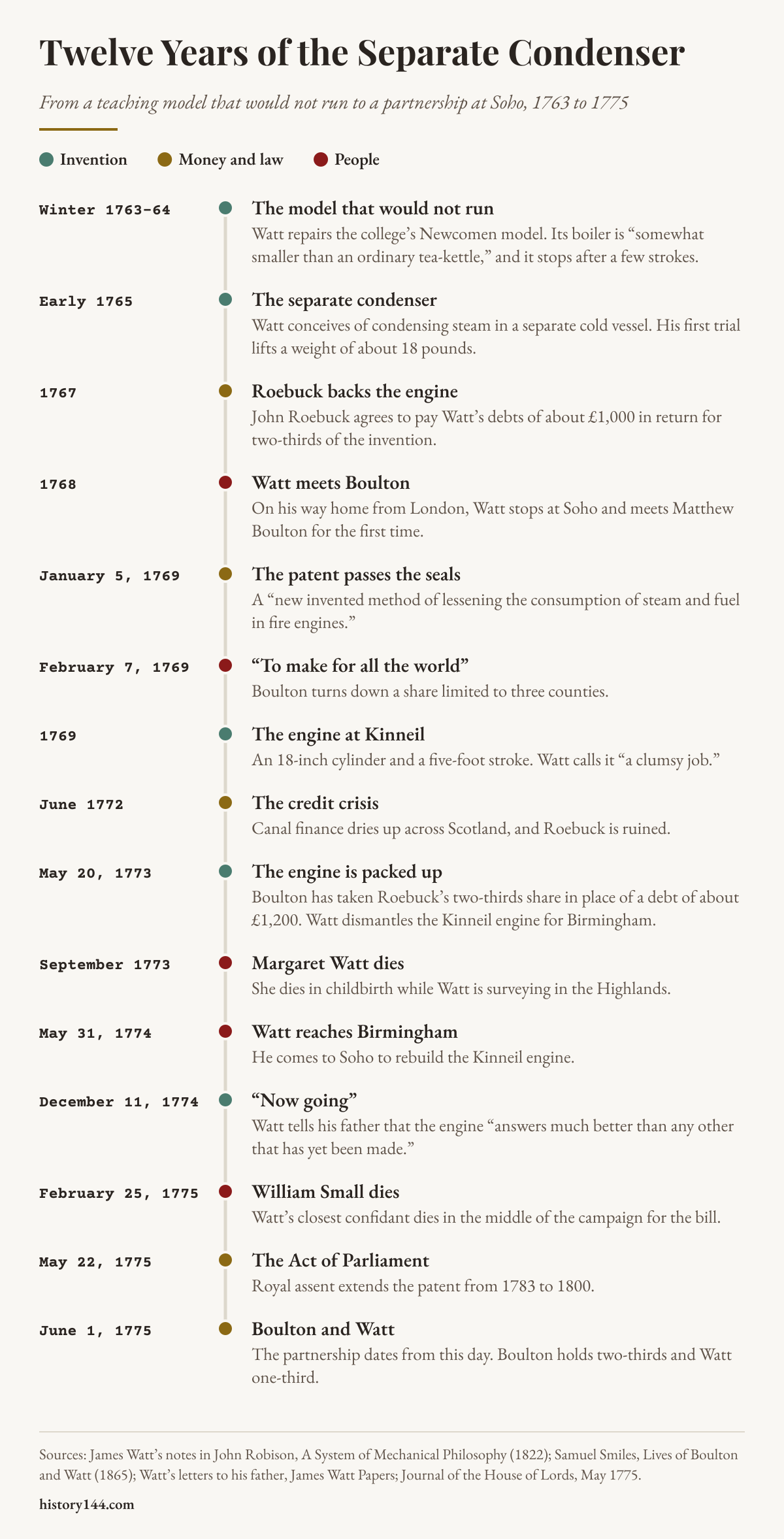
In the winter of 1763–64, a small working model of a steam engine lay on a workbench at the University of Glasgow. It belonged to the natural philosophy class, which used it to show students how the great pumping engines of the coalfields worked. The university had earlier sent it to the London instrument maker Jonathan Sisson, and its governing body had voted money "to recover the steam-engine from Mr. Sisson." John Anderson, the professor of natural philosophy, gave it to the young man who kept the college's instruments in order. The machine was a miniature of the engine that Thomas Newcomen had devised half a century earlier. Its cylinder was only two inches across with a six-inch stroke, and its boiler, as one Victorian biographer put it, was "somewhat smaller than an ordinary tea-kettle." It would run for a few strokes and then stop. Watt himself dated the work to that winter, though some later accounts place it in 1763 and others in 1764.[1]
The repairman was James Watt, then in his late twenties. Within about two years he had found out why the little engine failed and had conceived a remedy, the separate condenser, which would eventually let a steam engine do the same work on roughly a third of the coal under comparable conditions.[2] Turning the idea into a business took another ten years. Along the way came failed trials, the bankruptcy of his first backer, the death of his wife, and an Act of Parliament. The famous inspiration on a Sunday walk was the easy part, and the hard part was everything that followed. This is the story of those twelve years.
The Fire Engine and Its Waste
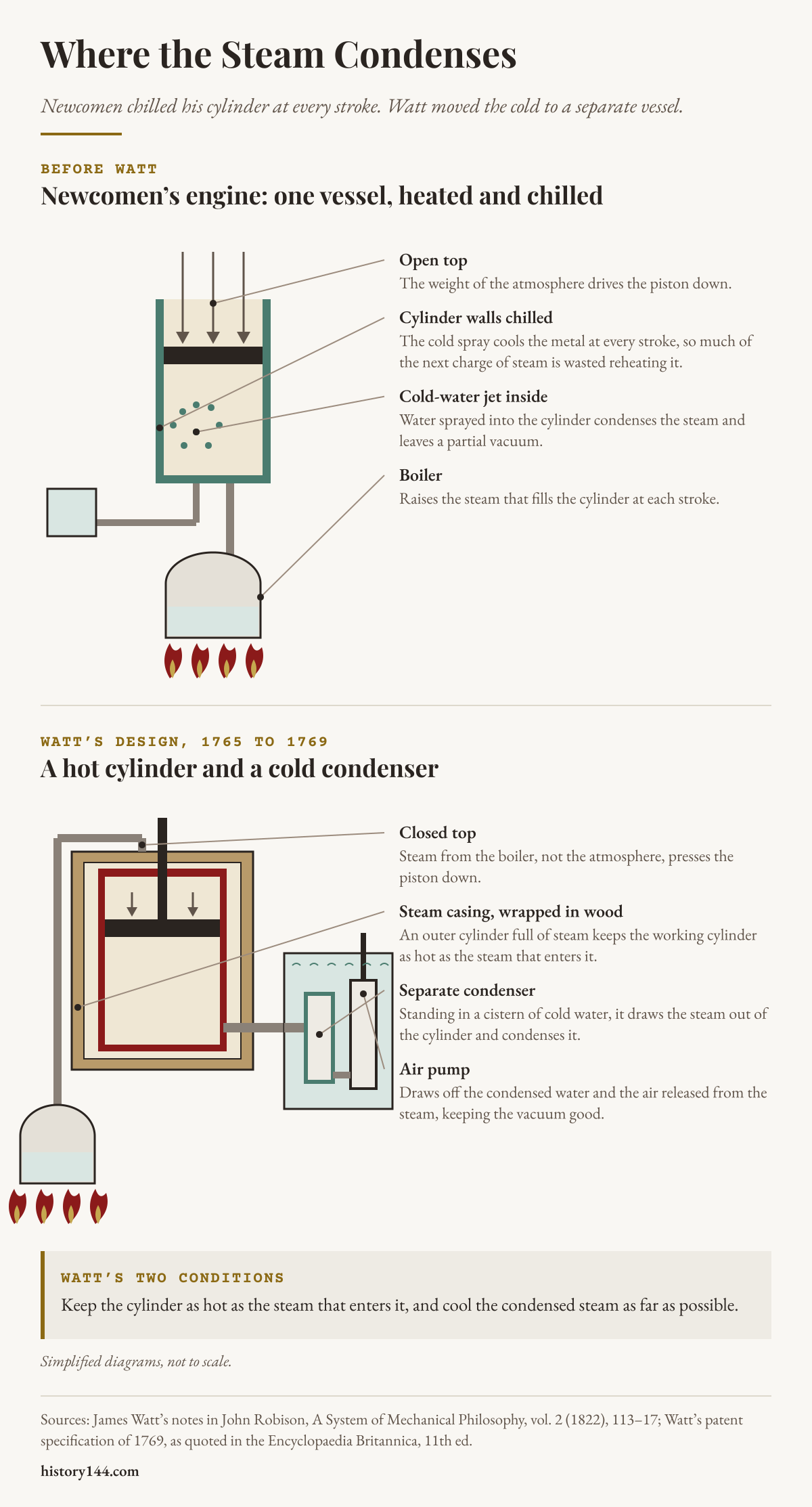
The machine on Watt's bench was a scale copy of what eighteenth-century Britons called a "fire engine." Newcomen's design, first set to work in 1712, was the only practical source of mechanical power in the country that did not depend on wind, water, or muscle. By the 1760s many such engines were draining coal and tin mines. Steam from a boiler filled a large vertical cylinder beneath a piston. A jet of cold water was then sprayed into the cylinder, the steam condensed, and a partial vacuum formed under the piston. The weight of the atmosphere pressing on the open top of the piston drove it down, and that stroke, carried through a great rocking beam, worked the pumps in the mine shaft. Steam did not push the piston at all. It served only to create the vacuum that let the air do the work.
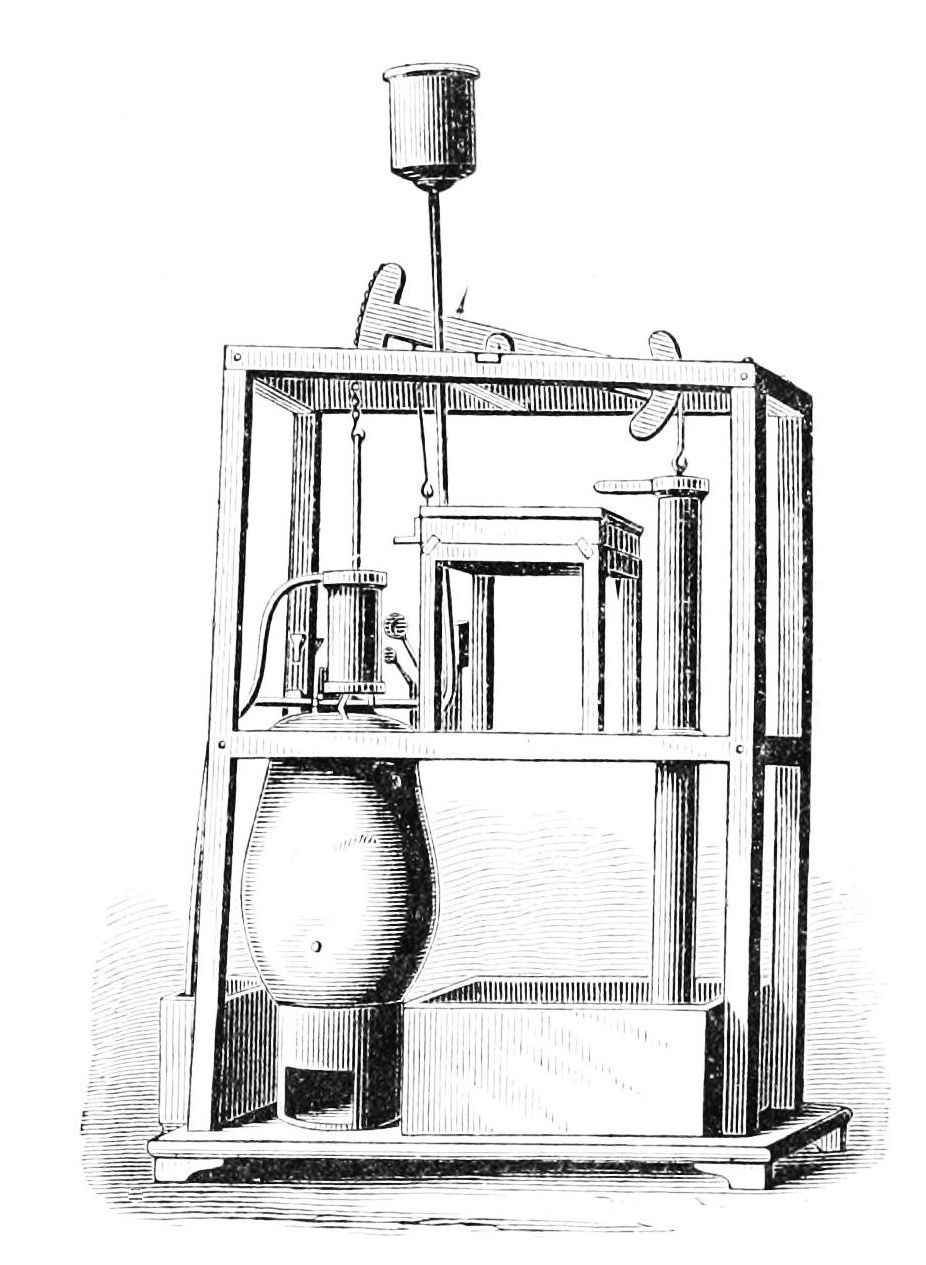
The weakness of the arrangement lay in the cold-water spray. Each time the spray condensed the steam, it also chilled the cylinder. When the next charge of steam entered, much of it condensed at once on the cold walls, and the engine had to spend steam reheating its own metal before a useful vacuum could form again. In a full-sized engine the loss was large. In a model it was overwhelming, because a small cylinder has a great deal of surface for its volume. That was why the Glasgow model would not run: its tiny boiler could not make steam fast enough to replace what the cylinder devoured.
Watt was well placed to notice the problem and badly placed to profit from it. A native of Greenock, he had learned the instrument maker's trade in London and returned to Scotland in 1756. According to the traditional account, the Glasgow corporation of hammermen would not let him set up shop in the city, because he was neither a burgess's son nor a man who had served his apprenticeship there. Some historians have since questioned how serious that opposition was. In any case the university gave him rooms and the title of mathematical instrument maker to the college. By the early 1760s he also kept a shop in the town. For a craftsman, he was unusually well connected. Among his friends at the college was the chemist Joseph Black. Another was John Robison, a former student some three years younger than Watt, who in 1759 had first suggested to him that steam might drive wheeled carriages.[3]
A Kettle, a Professor, and a Hidden Heat
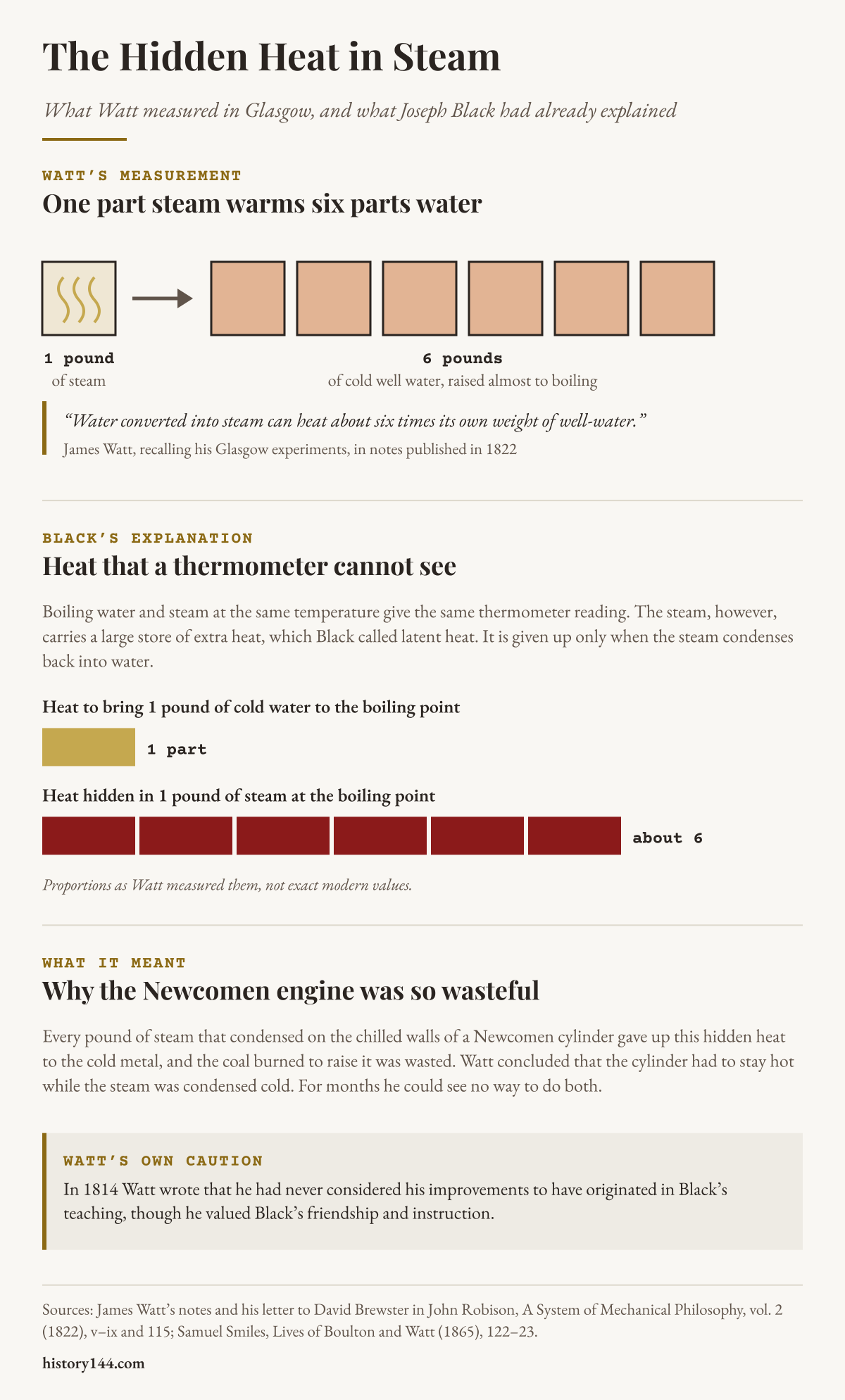
Watt's response to the model's failure was characteristic. Instead of tinkering with its parts, he set out to measure what was happening inside it. He built his own apparatus and measured how much water a boiler could evaporate, how much steam a cylinder consumed at each stroke, and how much cold water was needed to condense it. The last measurement surprised him. Water turned into steam, he found, could heat about six times its own weight of cold well water almost to the boiling point. A small quantity of steam carried a great quantity of heat that no thermometer revealed.
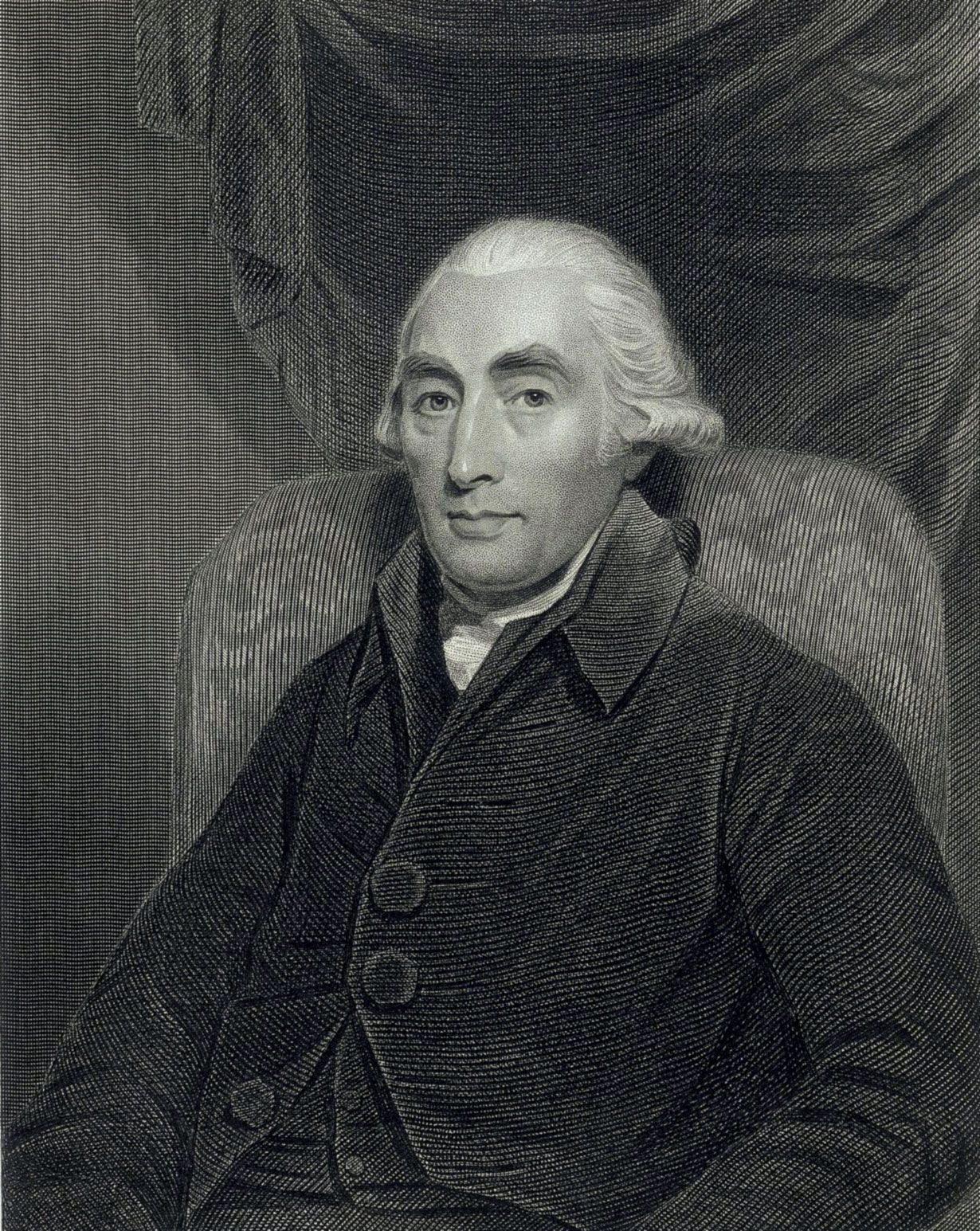
Puzzled, Watt took the finding to Joseph Black. Black had already explained this kind of hidden heat, which he called latent heat. It is the heat that a substance absorbs or gives up when it changes state, as water does when it becomes steam, without any change in its temperature. In Watt's own account, Black "explained to me his doctrine of latent heat," and Watt realized that he had "stumbled upon one of the material facts" on which Black's theory rested.[4] In 1814, however, Watt wrote that he had never considered his improvements to have originated in Black's teaching, although he valued Black's friendship and instruction.[5]
The practical meaning of his measurements was sobering. Every pound of steam that condensed on the chilled walls of a Newcomen cylinder wasted a large store of heat, and the coal that had been burned to raise it was wasted too. Watt concluded that an economical engine had to meet two conditions at once. The cylinder had to stay as hot as the steam entering it, so that none would condense too early. The steam, however, had to be cooled to a low temperature when it did condense, or the vacuum would be weak and the stroke feeble. In Newcomen's engine these demands contradicted each other, because the cylinder was both the place where the steam did its work and the place where it was condensed. For months Watt could see no way to reconcile them.
A Sunday on Glasgow Green
In July 1764 Watt married his cousin Margaret Miller, and he brought her to a house in Delftfield Lane, near the pottery in which he had taken a share.[6]
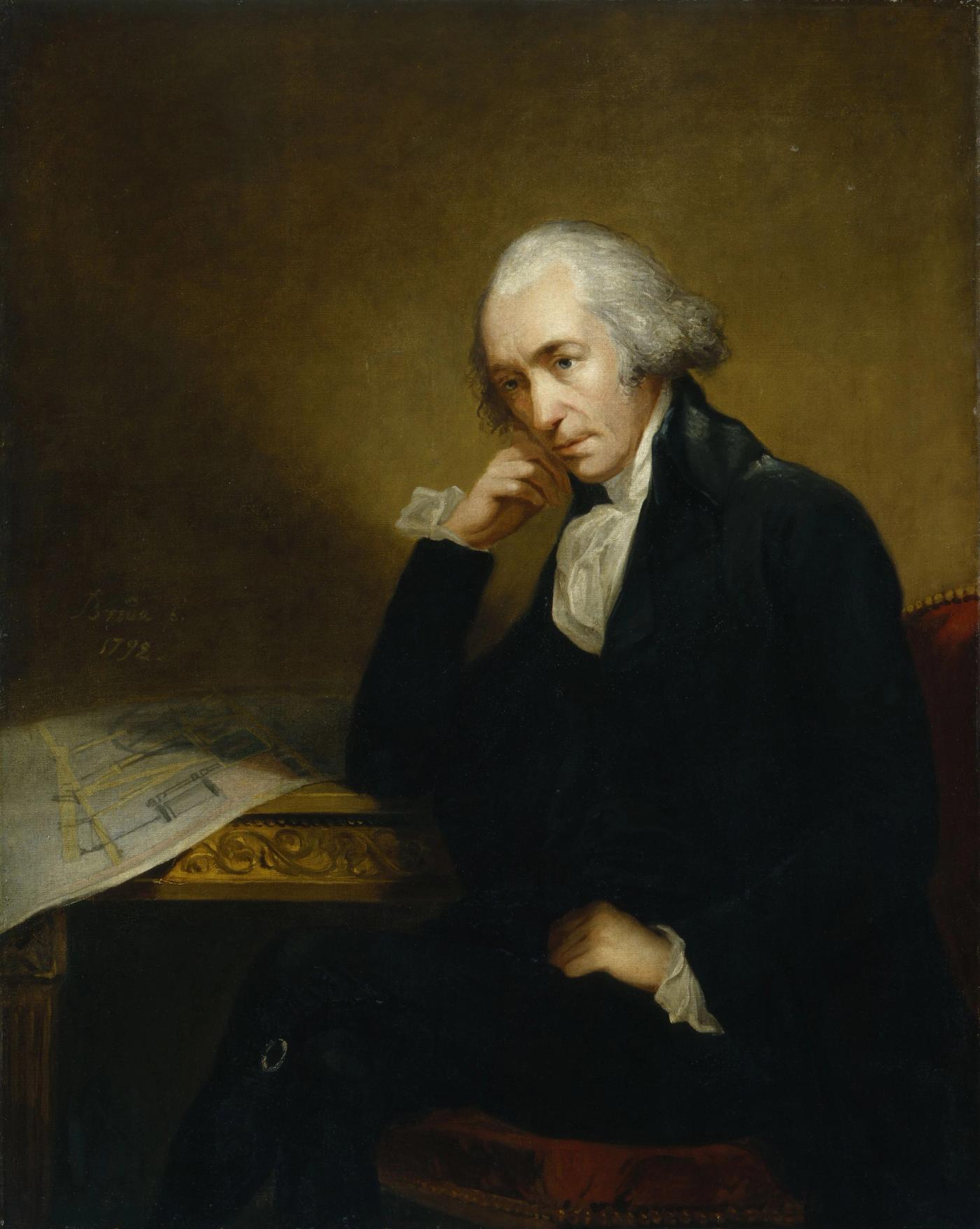
The solution to the engine problem came early in 1765. The best-known account of the moment rests on a conversation recorded long afterward. Around 1813 or 1814, the Glasgow engineers John and Robert Hart met the elderly Watt and asked him where the idea had first struck him. Another record of their talks dates them to 1817. Robert Hart wrote up his recollections and read them to the Glasgow Archaeological Society in 1857. According to Hart, Watt said that he had gone for a walk on a fine Sabbath afternoon. He entered Glasgow Green, the common pasture beside the River Clyde, by the gate at the foot of Charlotte Street. While he was thinking about the engine, the idea came into his mind that steam, being an elastic body, would rush into a vacuum. If a separate vessel were kept empty of air and connected to the cylinder, the steam would flow into it and could be condensed there without cooling the cylinder at all. "I had not walked further than the Golf-house," Watt is reported to have said, "when the whole thing was arranged in my mind."[7] Hart's paper reached print in 1859, nearly half a century after the conversation and more than ninety years after the walk. Watt's own written account, prepared in 1814, says only that the idea occurred to him "early in 1765," so the setting on the Green is best understood as an old man's memory of his youth.
The idea itself was simple. The steam would be condensed in a separate vessel, the condenser, which was kept permanently cold, while the cylinder remained permanently hot. Because the condenser would gradually fill with water and with air released from the steam, Watt added a pump to draw both out and keep the vacuum good. He also proposed to close the top of the cylinder and enclose it in an outer casing filled with steam, itself wrapped in wood, so that cold air would no longer touch the piston or the cylinder walls. With the top closed, steam pressure above the piston would push it down, while the separate condenser kept a vacuum beneath it. According to Watt, the scheme was complete in his mind within a day or two, and he set about testing it immediately. The trial apparatus was improvised and lacked the steam casing, but when he opened the connection between cylinder and condenser, the piston rose at once and lifted a weight of about eighteen pounds.[8] Hart placed this experiment in Watt's workshop in a small court off King Street, at the north end of the Beef Market.[9]
In April 1765 Watt wrote to his friend James Lind that his whole thoughts were "bent on this machine. I can think of nothing else."[10] Later that year, after the college vacation, John Robison called on him and found him sitting before the fire with "a little tin cistern" on his knee. When Robison began to talk about steam, Watt told him, "You need not fash yourself any more about that, man; I have now made an engine that shall not waste a particle of steam." Then, as Robison remembered it, he pushed the cistern under the table with his foot.[11]
Roebuck and the Engine at Kinneil
Watt had a principle and a small working apparatus, but turning them into a full-scale engine that could drain a mine required capital, workshops, and skilled metalworkers, none of which he possessed. His instrument business could not pay for the experiments, and he had already run up debts.
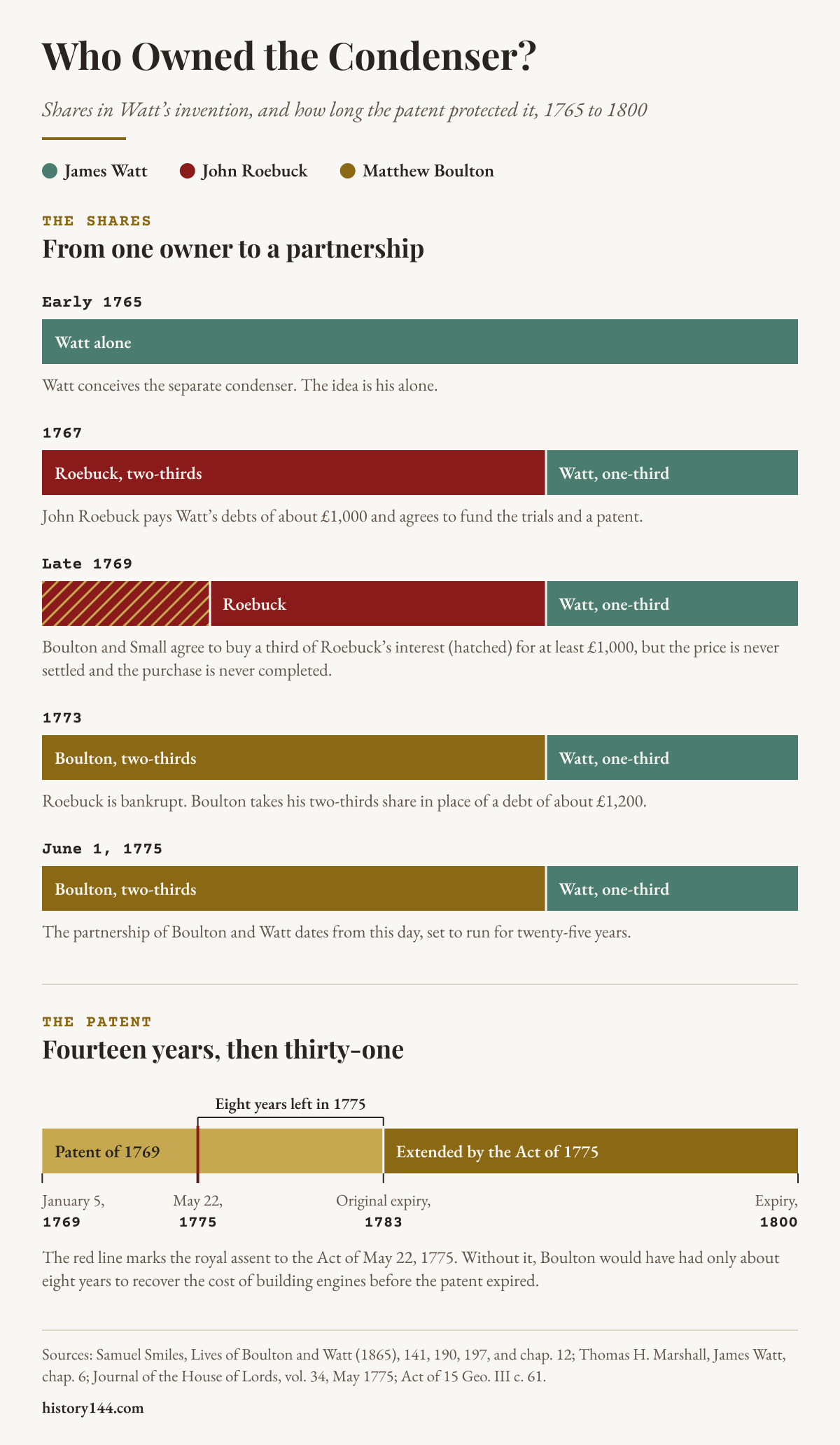
Black supplied both money and an introduction. He lent Watt what he could, and he told John Roebuck about the engine. Roebuck was a physician turned industrialist who had founded the Carron ironworks near Falkirk. He also worked coal mines and salt pans at Bo'ness on the Firth of Forth, where his pits needed constant pumping. He lived at Kinneil House, an old mansion above the town, and he had every reason to want a cheaper pumping engine. The two men began corresponding in 1765, and that November Watt sent Roebuck a drawing of an inverted cylinder to be cast and bored at Carron.[12] In 1767 they reached an agreement. Roebuck would pay Watt's debts of about £1,000, fund further trials, and bear the cost of a patent. In return he would receive two-thirds of the property in the invention.[13]
Progress was slow. Watt was also earning his living as a surveyor, and the trials were dogged by poor materials. In 1768 a model engine failed when the mercury used to seal it ran into the cylinder and, as Watt put it, "played the devil with the solder."[14] That November he suggested to Roebuck that the best place for a larger trial engine would be "a small house in the glen behind Kinneil." A workshop was built there, and its roofless shell still stands.[15] The engine built there in 1769 had a cylinder eighteen inches in diameter and a stroke of five feet. Watt himself called it "a clumsy job." The cylinder supplied from Carron was badly cast, and no packing he tried, whether cork, oiled rags, or tow, would keep the piston tight against its walls. A second trial did no better. "It is a damned thing for a man to have his all hanging by a single string," Watt wrote to his friend William Small.[16]
The Patent of 1769
The patent proved a trial of its own. Watt spent part of 1768 in London attending to the formalities, irritated by delays and fees. He made his formal declaration before a Master in Chancery at Berwick-upon-Tweed, and the patent passed the seals on 5 January 1769 for "a new invented method of lessening the consumption of steam and fuel in fire engines."[17] The specification, enrolled in April, was framed as a set of principles rather than a description of a particular machine. Its second principle was the heart of the matter: in engines worked by the condensation of steam, "the steam is to be condensed in vessels distinct from the steam-vessels or cylinders, although occasionally communicating with them; these vessels I call condensers."[18] The other principles covered the steam casing, the air pump, the use of steam's expansive force in place of the atmosphere, and several ideas that Watt never developed. He apparently drew up the document without legal advice, and its loose wording would expose the patent to serious challenge in the courts a quarter of a century later.[19]
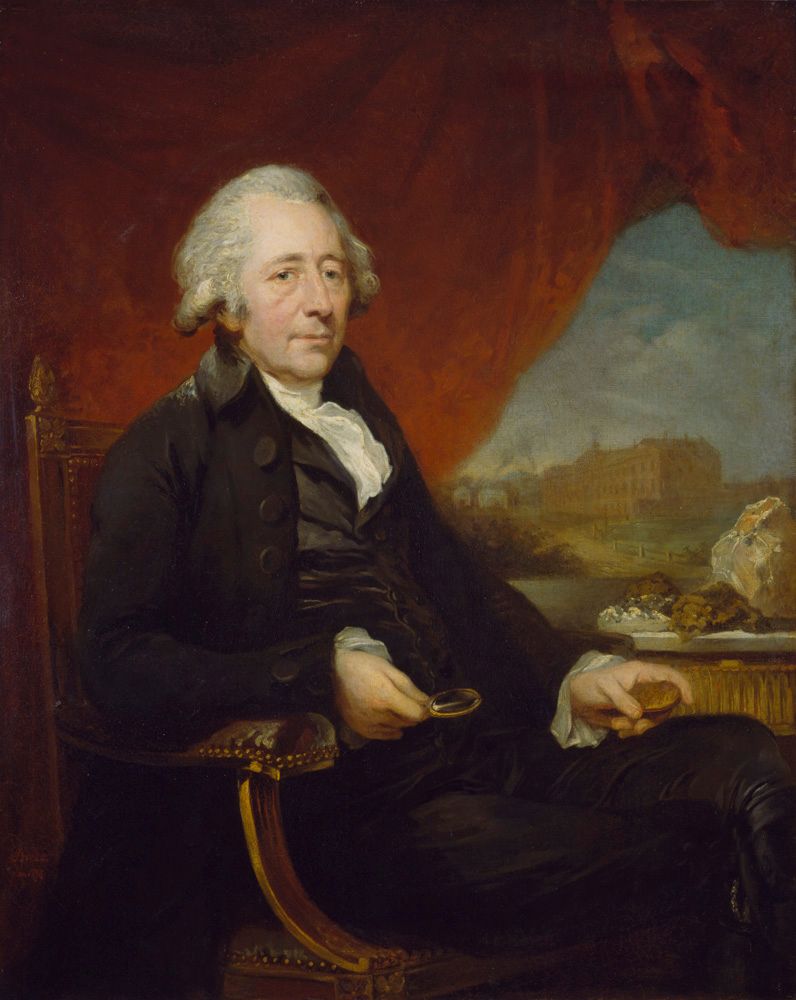
Watt's journeys to London also took him through Birmingham. In 1767 he had visited the Soho Manufactory, the large works where Matthew Boulton made buttons, buckles, and other fine metal goods. Boulton was away, and Watt was shown around by Boulton's partner John Fothergill and by William Small, Boulton's friend and physician. Small had come to Birmingham from Virginia, where he had taught Thomas Jefferson. On his way home from London in 1768, Watt stopped at Soho again and this time met Boulton himself. The two men took to each other at once. Watt explained his engine to a manufacturer who had already been thinking about steam power for his own works. "I had much conversation with Mr Boulton," he recalled long afterward.[20] Boulton had the capital, the workshops, and the skilled workmen that Watt lacked. Roebuck, however, would offer Boulton a share only for the three counties of Warwick, Stafford, and Derby. Boulton declined. In a letter of 7 February 1769 he told Watt that he had been moved to offer his help by "love of you, and love of a money-getting ingenious project." It would not be worth his while to make engines for three counties only, he wrote, though it might be worth his while "to make for all the world."[21] Late in 1769 Boulton and Small did agree to buy a third of Roebuck's interest for at least £1,000, but the price was never settled, and the purchase was never completed.[22]
Surveyor by Necessity
For the next four years the separate condenser made little progress. Roebuck's finances were stretched, the Kinneil engine would not work well, and Watt had a family to support. He turned increasingly to the work that paid, laying out canals, harbours, and bridges for Scottish clients. Around 1770 he became superintendent of the works on the Monkland Canal, which was to bring coal into Glasgow, at a salary of £200 a year. In the autumn of 1770 he surveyed a route for the Strathmore Canal, forty miles of rough country. Three years later, in the autumn of 1773, he surveyed the line of the proposed Caledonian Canal through the Great Glen, a route later built by Thomas Telford. "An incessant rain," he wrote, "kept me for three days as wet as water could make me."[23]
Watt disliked the work. He once told Boulton that he would rather face a loaded cannon than settle an account or make a bargain. His letters to Small in these years are among the gloomiest he ever wrote. In January 1769 he complained that he had "much contrived and little executed." To Small he also wrote that "of all things in life, there is nothing more foolish than inventing." In January 1770, as he entered his thirty-fifth year, he reflected that he had "hardly yet done thirty-five pence worth of good in the world."[24]
Collapse and Rescue, 1772–1774
The turning point came through misfortune. In June 1772 the failure of the London banking house of Neale, James, Fordyce and Down set off a financial panic that spread quickly to Scotland, where the Ayr Bank stopped payment later that month. The crisis disrupted the financing of canal schemes across Scotland, and Watt's employment on the Monkland Canal came to an end in the months that followed, though accounts differ on exactly when and why. Roebuck, already overextended in coal, salt, and other ventures, was ruined, and by 1773 he was bankrupt. "My heart bleeds for him," Watt wrote, "but I can do nothing to help him."[25]
Among Roebuck's creditors was Boulton, who was owed some £1,200. Rather than press his claim, Boulton offered to take Roebuck's two-thirds share of the engine patent in place of the debt. The other creditors, as Smiles put it, "did not value the engine as worth one farthing," and the transfer went ahead.[26] On 20 May 1773 Watt wrote from Kinneil that he had taken the engine to pieces and packed up its ironwork, cylinder, and pump. The crates went south that summer aboard a vessel called the Duchess of Hamilton, bound for London, in boxes marked "M.B., Birmingham."[27]
Watt himself remained in Scotland for another year, partly to finish his surveys. In September 1773, while he was in the Highlands on the Caledonian survey, news reached him that his wife was ill. When he got home, he found that she had died in childbirth, leaving him with two young children.[28] The loss weighed heavily on him, and it removed much of what still bound him to Glasgow. In the spring of 1774 he settled his affairs, and around 20 May he left Scotland, stopping at Kinneil to take leave of the Roebucks. By 31 May he was approaching Birmingham.[29]
Soho
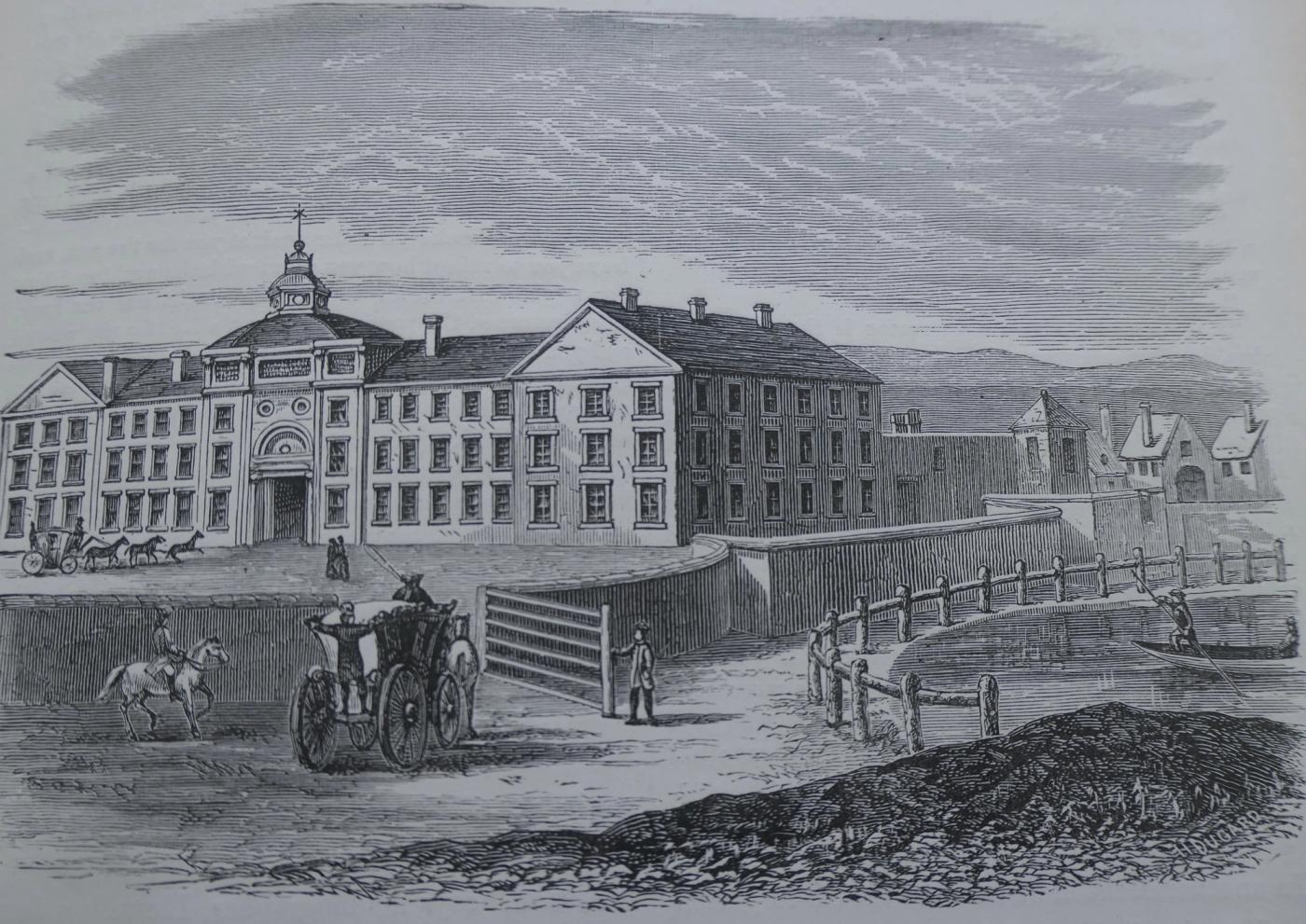
At Soho, the engine that had failed at Kinneil was rebuilt under far better conditions. It was set up to pump water back into the pool that fed the manufactory's waterwheel, and Watt spent the second half of 1774 making it run. On 11 December he wrote to his father in Greenock that "the fire engine I have invented is now going, and answers much better than any other that has yet been made."[30] Early in 1775 the cylinder of hammered tin that Watt had brought from Kinneil, a replacement for the faulty Carron casting, was discarded. In its place Boulton obtained an eighteen-inch iron cylinder from the ironmaster John Wilkinson, whose new boring mill at Bersham in North Wales could produce cylinders far truer than anything Watt had been able to obtain in Scotland.[31]
A working engine created a new problem. The patent of 1769 would expire in 1783. Before then Boulton would have to pay for tools and workshops to build engines, and mine owners would need years of persuasion before they trusted the new design. The eight years that remained were too few to recover that outlay. At the same time, Watt was being tempted elsewhere. Through Robison, who had taught in Russia, he received an offer of a post in the service of the Russian government at about £1,000 a year. "Your going to Russia staggers me," Boulton wrote, and he urged Watt to stay.[32] The two men agreed that their partnership would go ahead only if the term of the patent could be extended, and the obvious way to extend it was to ask Parliament for a private Act.
The Act of 1775
Watt went to London early in 1775 to manage the application, and the bill was before the House of Commons by the end of February. Boulton, who knew many members of Parliament through his business and his political friends, organized the lobbying that carried it. The bill proposed to carry the patent to 1800. In the middle of the effort, on 25 February, William Small died in Birmingham. He had been Watt's closest confidant through the lean years and was to have had a place in the partnership.[33]
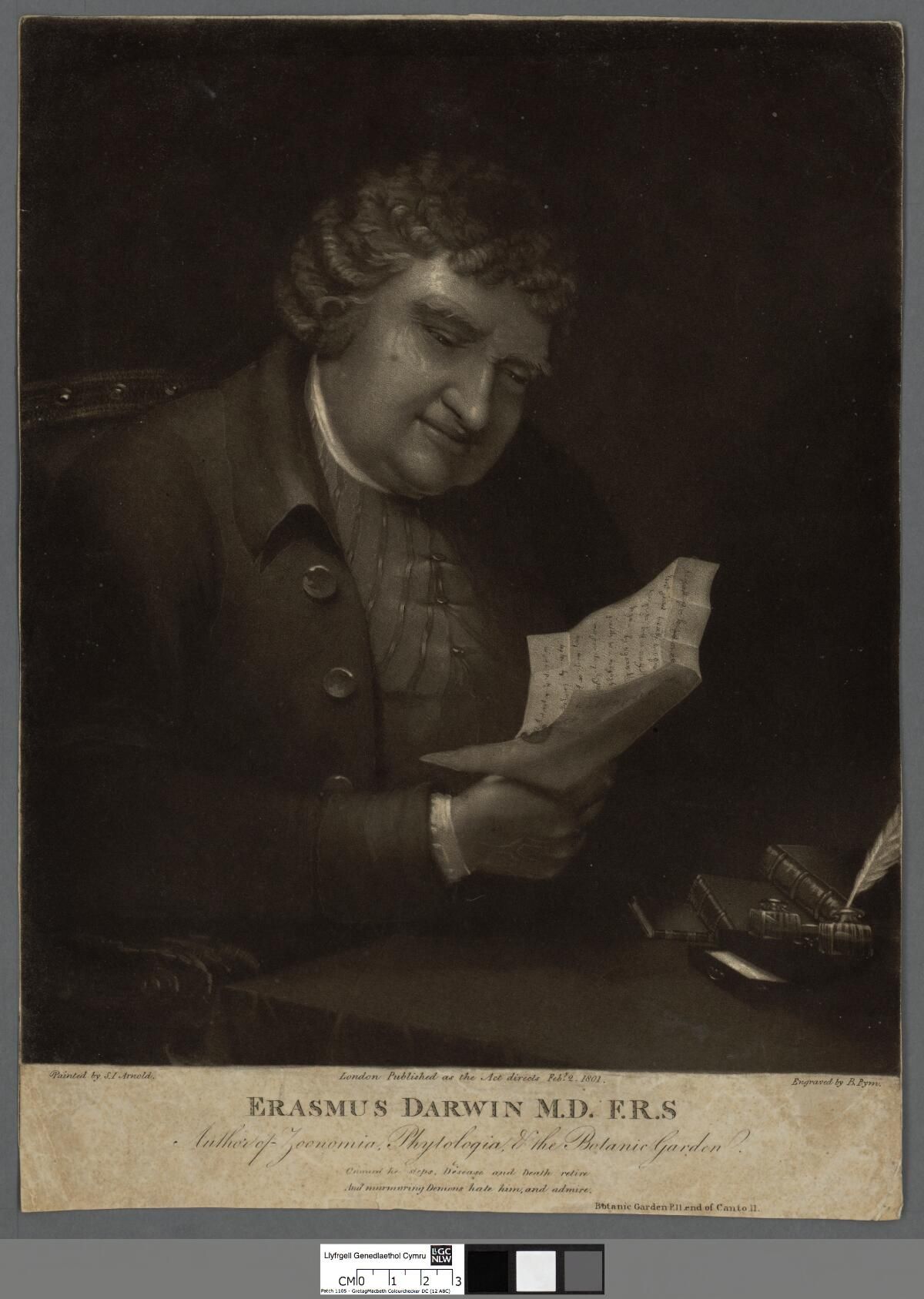
The bill met resistance. Mining interests feared that a long monopoly would leave them paying whatever Boulton and Watt cared to charge, and opponents raised the cry of "No monopoly." Erasmus Darwin, one of Boulton's circle, wrote to Watt in late March that he hoped the bill would meet "no further Obstruction."[34] It was committed on 13 March, recommitted on 7 April, and reported on 25 April. The House of Lords passed it without amendment on 2 May, and it received the royal assent on 22 May 1775.[35]
The most famous name associated with the opposition is that of Edmund Burke, who is often said to have spoken against the bill in the name of liberty and free trade. Smiles counted him among its strongest opponents and thought he was influenced by mining interests near Bristol, his constituency. The historian Eric Robinson wrote that the opposition was "led by Edmund Burke himself." A more recent study by the legal historian Phillip Johnson has challenged this account. Johnson found no evidence that Burke spoke in the debates or led the opposition. That role, he suggested, belonged to General Conway, and he noted that the bill passed without a division. He accepted that Burke opposed the bill at some point, but concluded that his reasons remain unclear and that his opposition was not a matter of principle.[36]
The Act, cited as 15 Geo. III c. 61, extended Watt's rights for twenty-five years, to 1800. Its title describes it as vesting in Watt and his executors, administrators, and assigns the sole use and property of his engines "throughout His Majesty's Dominions." The 1769 patent had covered only England, Wales, and the town of Berwick-upon-Tweed. Its significance has been argued over ever since. Robinson suggested that the extension "might be considered the most important single event in the Industrial Revolution," because it gave Boulton the security he needed to commit Soho to engine building. Critics have argued that the long monopoly held back other inventors.[37] Watt himself had no illusions about what it had cost. On 8 May he wrote to his father that the affair had been "attended with great expence," and that without the help of many influential friends he could never have carried it through.[38]
The partnership of Boulton and Watt dated from 1 June 1775, although the formal deed was not completed until later. Boulton held two-thirds of the property in the invention and Watt one-third, and the agreement was to run for twenty-five years, matching the term of the Act.[39] Within a year the first Boulton and Watt engines were pumping water at Bloomfield Colliery in Staffordshire and blowing the furnaces of Wilkinson's ironworks at New Willey, near Broseley in Shropshire.[40]
Twelve Years
When Watt took the college model onto his workbench in the winter of 1763–64, he was a craftsman of modest means with a habit of asking precise questions, and the machine before him could not even keep itself running. Eleven years later he was a partner in a firm that would dominate steam engineering for the rest of the century, and an Act of Parliament protected his invention. The idea took perhaps two years to reach, through careful measurement and a mind prepared by Black's science, although Watt later insisted that the solution was his own. Turning that idea into a working engine took ten more years. That struggle was won less by inspiration than by money, skilled labour, accurate machine tools, and political influence, all of which Watt lacked and Boulton supplied.
The separate condenser did not create the steam engine. For many years its chief use was the one Newcomen's engine had served, pumping water out of mines. By keeping the cylinder hot and condensing the steam in a vessel distinct from it, Watt's engine could do the same work as the old one on about a third of the coal under comparable conditions. That saving made steam power affordable where fuel was dear, and in time it opened the way to the rotary engines that would drive Britain's mills. In 1775 all of that still lay ahead. The years since 1763 had produced the principle and the partnership to exploit it. Both had grown out of a model whose boiler was smaller than a tea-kettle.
Places in this Story
The places this story moves through, in order — follow them on the interactive map →
- University of Glasgow, Scotland Winter 1763 to 1764
Watt repaired the natural philosophy class's Newcomen model, which ran for a few strokes and then stopped.
- Glasgow Green, Scotland Early 1765
By one late account Watt entered the common pasture by Charlotte Street and had the whole thing arranged before the Golf-house.
- Carron Ironworks, Falkirk November 1765
Watt sent Roebuck a drawing of an inverted cylinder to be cast and bored at the works Roebuck had founded.
- Kinneil House, Bo'ness 1769
A workshop in the glen behind the house held the trial engine with an eighteen-inch cylinder that Watt called a clumsy job.
- Berwick-upon-Tweed, England 1768
Watt made his formal declaration for the patent before a Master in Chancery here on his way back from London.
- Great Glen, Scottish Highlands Autumn 1773
Watt surveyed the line of the proposed Caledonian Canal and was kept three days as wet as water could make him.
- Soho Manufactory, Birmingham May 31, 1774
Watt was approaching Birmingham on the last day of May 1774, coming to rebuild the engine that had failed at Kinneil.
- Bersham Ironworks, Wrexham Early 1775
John Wilkinson's new boring mill supplied an eighteen-inch iron cylinder truer than anything Watt had obtained in Scotland.
- Palace of Westminster, London May 22, 1775
The bill extending Watt's patent to 1800 passed the Lords without amendment and received the royal assent.
Frequently Asked Questions
What was James Watt's separate condenser?
It was a second vessel, kept permanently cold and connected to the cylinder, in which the steam was condensed instead of being condensed inside the cylinder itself. That let the cylinder stay hot while the steam was cooled, which was the one thing a Newcomen engine could not do.
Why did the Newcomen engine waste so much coal?
Its cold-water jet condensed the steam inside the cylinder and chilled the metal at the same time, so the next charge of steam was spent reheating the walls. Watt found that the heat hidden in a pound of steam was about six times the heat needed to bring a pound of cold water to the boiling point.
Did James Watt invent the steam engine?
No. Thomas Newcomen's engine had been pumping water out of mines since 1712, and Watt's work was an improvement that let the same engine do the same job on roughly a third of the coal.
How did Joseph Black's latent heat relate to Watt's engine?
Watt measured that a small quantity of steam carried a great quantity of heat no thermometer revealed, and took the result to Black, who had already explained such hidden heat and called it latent heat. In 1814 Watt wrote that he had never considered his improvements to have originated in Black's teaching.
Why did James Watt need an Act of Parliament in 1775?
His patent of 1769 would have expired in 1783, too soon for Boulton to recover the cost of building workshops and persuading mine owners to trust the design. The Act of 22 May 1775 extended the rights for twenty-five years, to 1800.
Did Edmund Burke oppose the Watt patent bill of 1775?
Samuel Smiles counted Burke among the bill's strongest opponents, and Eric Robinson wrote that he led the opposition. The legal historian Phillip Johnson found no evidence that Burke spoke in the debates, and noted that the bill passed without a division.
Bibliography
Adam Matthew Publications. Industrial Revolution: A Documentary History, Series One, Part 2: The Boulton and Watt Archive and the Matthew Boulton Papers from Birmingham Central Library. Guide to the microfilm edition. Marlborough, UK: Adam Matthew Publications. https://webdoc.sub.gwdg.de/zdmdm/mifoguide/matthew/INDUSTRIAL_REVOLUTION_S1_p2.pdf. Accessed November 12, 2026.
Adam Matthew Publications. Industrial Revolution: A Documentary History, Series Three: The Papers of James Watt and His Family Formerly Held at Doldowlod House, Now at Birmingham Central Library, Part 1. Detailed listing. Marlborough, UK: Adam Matthew Publications. https://www.ampltd.co.uk/digital_guides/ind-rev-series-3-parts-1-to-3/detailed-listing-part-1.aspx. Accessed November 12, 2026.
Bramwell, Frederick. "Watt, James." In Dictionary of National Biography, edited by Sidney Lee, vol. 60. London: Smith, Elder, 1899. https://en.wikisource.org/wiki/Dictionary_of_National_Biography,_1885-1900/Watt,_James_(1736-1819). Accessed November 12, 2026.
Carnegie, Andrew. James Watt. New York: Doubleday, Page, 1905. Electric Scotland transcription. https://electricscotland.com/history/men/james_watt4.htm. Accessed November 13, 2026.
Darwin, Erasmus. Letter to James Watt, March 29, 1775. Revolutionary Players. https://www.revolutionaryplayers.org.uk/?p=501. Accessed November 12, 2026.
Friends of Kinneil. "250 Years Since James Watt Headed South." Kinneil House History, May 27, 2024. https://kinneil.org.uk/2024/05/27/250-years-since-james-watt-headed-south/. Accessed November 12, 2026.
Grace's Guide to British Industrial History. "James Watt." https://gracesguide.co.uk/James_Watt. Accessed November 12, 2026.
Hart, Robert. "Reminiscences of James Watt." Transactions of the Glasgow Archaeological Society 1, no. 1 (1859): 1–7. IntraText edition, with an introduction by John W. Stephens. https://www.intratext.com/IXT/ENG1220/_P2.HTM. Accessed November 12, 2026.
Historic Environment Scotland. "James Watt's Cottage and Boiler at Kinneil House, Bo'ness." Listed building record LB52435. https://portal.historicenvironment.scot/designation/LB52435. Accessed November 12, 2026.
Johnson, Phillip. "The Myth of Mr Burke and Mr Watt: For Want of a Champion!" Queen Mary Journal of Intellectual Property 6 (2016): 370–79. https://orca.cardiff.ac.uk/88178/. Accessed November 12, 2026.
Journal of the House of Commons. Vol. 35, November 29, 1774–October 15, 1776. Internet Archive. https://archive.org/details/sim_great-britain-house-of-commons-journal_november-29-1774-october-15-1776_35. Accessed November 14, 2026.
Journal of the House of Lords. Vol. 34, 1774–1776. London: His Majesty's Stationery Office, 1767–1830. British History Online. https://www.british-history.ac.uk/node/96535 and https://www.british-history.ac.uk/node/96537. Accessed November 14, 2026.
Lord, John. Capital and Steam-Power, 1750–1800. London: P. S. King & Son, 1923. https://thehopkinthomasproject.com/TheHopkinThomasProject/TimeLine/Wales/Steam/URochesterCollection/lord/8.htm. Accessed November 12, 2026.
Marshall, Thomas H. James Watt. IntraText edition. https://www.intratext.com/IXT/ENG1219/_P6.HTM. Accessed November 12, 2026.
Muirhead, James Patrick. The Origin and Progress of the Mechanical Inventions of James Watt, Illustrated by His Correspondence with His Friends and the Specifications of His Patents. 3 vols. London: John Murray, 1854.
National Records of Scotland. "James Watt (1736–1819)." Hall of Fame. https://nrscotland.gov.uk/research/learning/hall-of-fame/hall-of-fame-a-z/watt-james. Accessed November 12, 2026.
The National Archives (UK). Catalogue description of the James Watt papers, Birmingham Archives. https://beta.nationalarchives.gov.uk/catalogue/id/aeac3509-83c0-42aa-974a-85881ce2cc01. Accessed November 14, 2026.
Robinson, Eric. "Matthew Boulton and the Art of Parliamentary Lobbying." Historical Journal 7, no. 2 (1964): 209–29. https://www.cambridge.org/core/journals/historical-journal/article/ii-matthew-boulton-and-the-art-of-parliamentary-lobbying/69D1672CA91FFA2975C1DEBA7DC06D46. Accessed November 12, 2026.
Robison, John. A System of Mechanical Philosophy. Edited by David Brewster, with notes by James Watt. Vol. 2. London: John Murray, 1822. https://books.google.com/books?id=p-sDAAAAMAAJ. Accessed November 12, 2026.
Russell, Ben. "James Watt and the Separate Condenser." Science Museum Blog, January 5, 2019. https://blog.sciencemuseum.org.uk/james-watt-and-the-separate-condenser/. Accessed November 12, 2026.
Science Museum Group. "Model, Scale 1:12 of Bersham Boring Mill 1775." Object co46455. https://collection.sciencemuseumgroup.org.uk/objects/co46455/model-scale-1-12-of-bersham-boring-mill-1775. Accessed November 12, 2026.
Smiles, Samuel. Lives of Boulton and Watt: Principally from the Original Soho MSS. London: John Murray, 1865. https://archive.org/details/livesofboultonwa00smilrich. Accessed November 12, 2026.
University of Glasgow. "James Watt and the University of Glasgow." James Watt 2019. https://www.gla.ac.uk/events/jameswatt/jwanduofg. Accessed November 14, 2026.
William Symington Research. "William Symington and James Watt's Patent." https://sites.google.com/view/williamsymington/introduction-and-contents/watt-and-pirate-engines. Accessed November 14, 2026.
Citations
- University of Glasgow, "James Watt and the University of Glasgow"; James Watt, note in John Robison, A System of Mechanical Philosophy, ed. David Brewster, vol. 2 (London: John Murray, 1822), 113–14; Samuel Smiles, Lives of Boulton and Watt: Principally from the Original Soho MSS. (London: John Murray, 1865), 119, 121. Frederick Bramwell, "Watt, James," in Dictionary of National Biography, ed. Sidney Lee, vol. 60 (London: Smith, Elder, 1899), dates the repair to 1764. ↑
- Ben Russell, "James Watt and the Separate Condenser," Science Museum Blog, January 5, 2019. ↑
- Smiles, Lives of Boulton and Watt, 105–6, 113, 118; Bramwell, "Watt, James." ↑
- Watt, note in Robison, System of Mechanical Philosophy, 2:115; Smiles, Lives of Boulton and Watt, 122–23. ↑
- James Watt, letter to David Brewster, in Robison, System of Mechanical Philosophy, 2:v–ix. ↑
- National Records of Scotland, "James Watt (1736–1819)," Hall of Fame; Smiles, Lives of Boulton and Watt, 125–26. ↑
- Robert Hart, "Reminiscences of James Watt," Transactions of the Glasgow Archaeological Society 1, no. 1 (1859): 1–7; John W. Stephens, introduction to Hart, "Reminiscences of James Watt," IntraText edition; Smiles, Lives of Boulton and Watt, 127–28. ↑
- Watt, note in Robison, System of Mechanical Philosophy, 2:116–17. ↑
- Hart, "Reminiscences of James Watt," 1–7. ↑
- Watt to James Lind, April 1765, quoted in Smiles, Lives of Boulton and Watt, 135. ↑
- John Robison, quoted in Smiles, Lives of Boulton and Watt, 130–31. ↑
- Smiles, Lives of Boulton and Watt, 138–39; Historic Environment Scotland, "James Watt's Cottage and Boiler at Kinneil House, Bo'ness," listed building record LB52435. ↑
- Smiles, Lives of Boulton and Watt, 141. ↑
- Smiles, Lives of Boulton and Watt, 141. ↑
- Watt to John Roebuck, November 9, 1768, quoted in Historic Environment Scotland, listed building record LB52435. ↑
- Smiles, Lives of Boulton and Watt, 148–50; Bramwell, "Watt, James." ↑
- Smiles, Lives of Boulton and Watt, 143; Watt, note in Robison, System of Mechanical Philosophy, 2:119; Russell, "James Watt and the Separate Condenser." ↑
- Watt's patent specification of 1769, printed in full in J. P. Muirhead, The Origin and Progress of the Mechanical Inventions of James Watt, vol. 3 (London: John Murray, 1854), and quoted here from the enrolled specification of April 1769. ↑
- Bramwell, "Watt, James." ↑
- Smiles, Lives of Boulton and Watt, 185–86; James Watt, "Memorandum concerning Mr. Boulton, commencing with my first acquaintance with him," September 1809, quoted in Industrial Revolution: A Documentary History, Series One, Part 2 (Marlborough, UK: Adam Matthew Publications), guide to the microfilm edition. ↑
- Thomas H. Marshall, James Watt, chap. 6; Matthew Boulton to James Watt, February 7, 1769, in Muirhead, Origin and Progress, 1:43; Smiles, Lives of Boulton and Watt, 203–4. ↑
- Marshall, James Watt, chap. 6; Smiles, Lives of Boulton and Watt, 190. ↑
- Smiles, Lives of Boulton and Watt, 153–57. ↑
- Andrew Carnegie, James Watt (New York: Doubleday, Page, 1905), chap. 4; Smiles, Lives of Boulton and Watt, 150–51. ↑
- Smiles, Lives of Boulton and Watt, 158, 194; The National Archives (UK), catalogue description of the James Watt papers, Birmingham Archives. ↑
- Smiles, Lives of Boulton and Watt, 197. ↑
- Friends of Kinneil, "250 Years Since James Watt Headed South," Kinneil House History, May 27, 2024. ↑
- Smiles, Lives of Boulton and Watt, 157; Friends of Kinneil, "250 Years Since James Watt Headed South." ↑
- Friends of Kinneil, "250 Years Since James Watt Headed South"; Industrial Revolution: A Documentary History, Series Three: The Papers of James Watt and His Family Formerly Held at Doldowlod House, Part 1, detailed listing, JWP 4/60 (Marlborough, UK: Adam Matthew Publications). ↑
- James Watt to James Watt Sr., December 11, 1774, JWP 4/60, in Industrial Revolution: A Documentary History, Series Three, Part 1, detailed listing; John Lord, Capital and Steam-Power, 1750–1800 (London: P. S. King & Son, 1923), chap. 8. ↑
- Smiles, Lives of Boulton and Watt, 212–13; Grace's Guide to British Industrial History, "James Watt"; Science Museum Group, "Model, Scale 1:12 of Bersham Boring Mill 1775," object co46455. ↑
- Smiles, Lives of Boulton and Watt, 209–10. ↑
- Smiles, Lives of Boulton and Watt, 210–12; Phillip Johnson, "The Myth of Mr Burke and Mr Watt: For Want of a Champion!," Queen Mary Journal of Intellectual Property 6 (2016): 370–79; Eric Robinson, "Matthew Boulton and the Art of Parliamentary Lobbying," Historical Journal 7, no. 2 (1964): 209–29. ↑
- Smiles, Lives of Boulton and Watt, 210; Erasmus Darwin to James Watt, March 29, 1775, in Revolutionary Players. ↑
- Journal of the House of Commons, vol. 35, 280, 313, as cited in Johnson, "Myth of Mr Burke and Mr Watt," 370–79; Journal of the House of Lords, vol. 34, 422, 427, and sitting of May 22, 1775. ↑
- Smiles, Lives of Boulton and Watt, 210; Robinson, "Matthew Boulton and the Art of Parliamentary Lobbying," 209–29; Johnson, "Myth of Mr Burke and Mr Watt," 370–79. ↑
- Journal of the House of Lords, vol. 34, 422; William Symington Research, "William Symington and James Watt's Patent"; Robinson, "Matthew Boulton and the Art of Parliamentary Lobbying," 209; Johnson, "Myth of Mr Burke and Mr Watt," 370–79. ↑
- Industrial Revolution: A Documentary History, Series Three, Part 1, detailed listing, JWP 4/60; Robinson, "Matthew Boulton and the Art of Parliamentary Lobbying," 209–29. ↑
- Smiles, Lives of Boulton and Watt, chap. 12, 214–29. ↑
- Smiles, Lives of Boulton and Watt, 215–16; Lord, Capital and Steam-Power, chap. 8. ↑