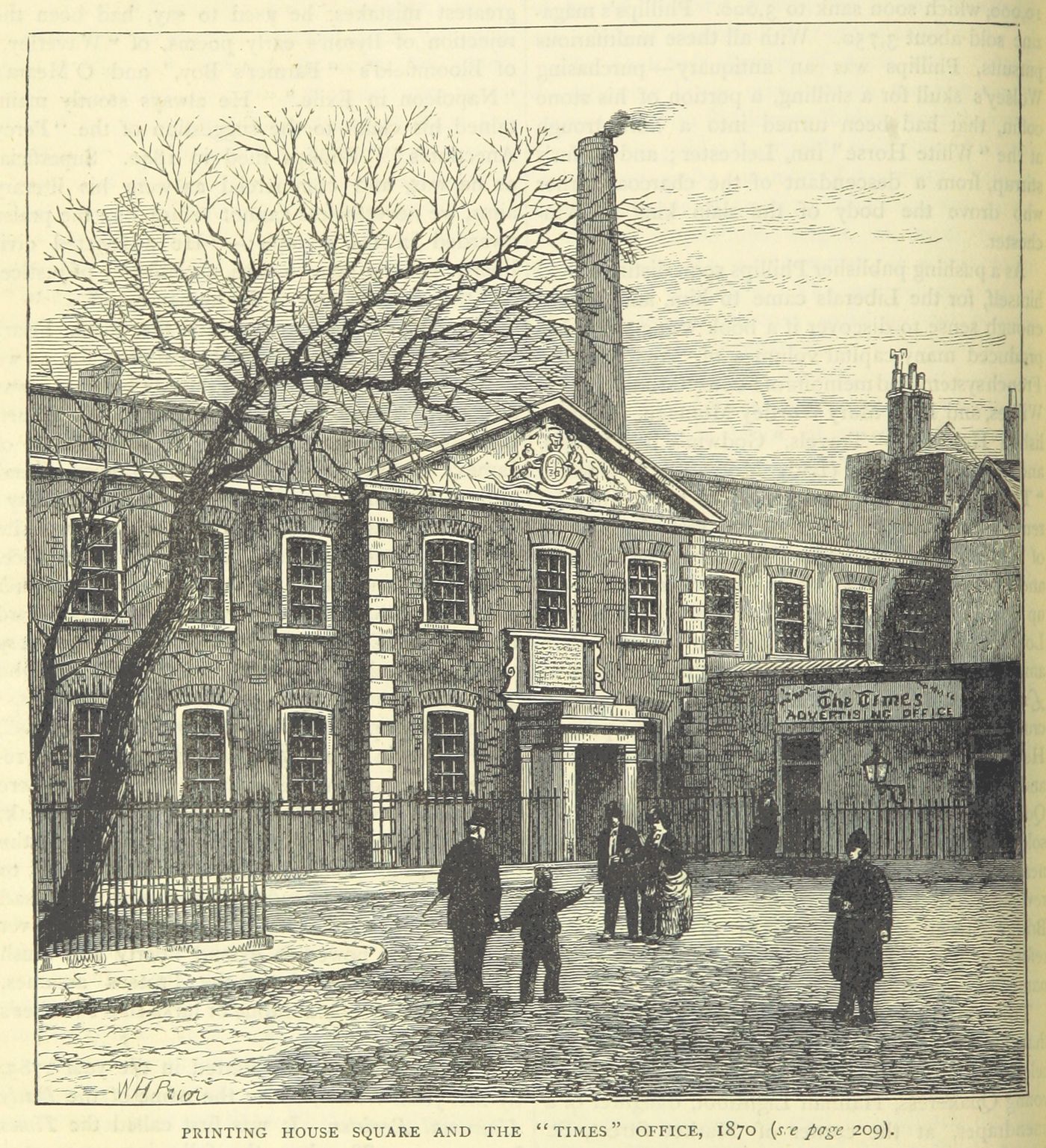
On the night of 28 November 1814, according to the account Samuel Smiles later assembled with help from the inventor's sons, the pressmen of The Times were told to wait in their pressroom at Printing House Square, near Blackfriars in London. Important news was expected from abroad, they were informed, and the paper would go to press late. They waited through the night. At six o'clock the next morning the proprietor, John Walter II, walked in among them and announced that The Times was already printed, and that it had been printed by steam. He knew the men had threatened violence against the foreign inventor and his machine, so he told them two things. If they attempted violence, a force was ready to suppress it. If they kept the peace, every one of them would go on receiving his wages until he found similar work. Then he handed out copies of the paper. Next door, in premises Walter had fitted up for the purpose, two double-cylinder machines designed by a German printer named Friedrich Koenig had printed the edition during the night, each rated at about 1,100 sheets an hour printed on one side. Walter had watched them at work all night. The best iron hand press of the day managed about 250 impressions an hour.[1]
The paper told its readers what they were holding. "Our Journal of this day," the leading article began, "presents to the public the practical result of the greatest improvement connected with printing since the discovery of the art itself."[2] The boast was large, but the paper had reason for it. The night at Printing House Square was also the midpoint of a longer and less triumphant story. Koenig had come to London in 1806 with an idea that no one in Germany or Russia would pay for. Between 1810, when he received his first English patent, and 1822, when the first presses built at his own factory were delivered to Berlin, he invented a workable steam-powered printing machine, saw it adopted by the most influential newspaper in Britain, lost control of its commercial use to the English partners who had financed it, and started over in a former monastery in Bavaria. The machine found commercial success before its inventor did, and recognition of his achievement took longer still. This is the story of those twelve years.
A Printer in Search of a Patron
Friedrich Koenig was born on 17 April 1774 at Eisleben, in Saxony, the town where Martin Luther had been born nearly three centuries earlier. His father farmed land while living in the town, a status German sources call Ackerbürger. The boy was bound apprentice for five years to Breitkopf and Härtel of Leipzig, one of the most respected printing houses in Germany, and according to the Victorian biographer Samuel Smiles, who drew on information from Koenig's sons, he was released after four and a quarter years because of his exceptional skill. He attended lectures at the University of Leipzig, worked in printing offices in Greifswald and Halle, and later enrolled for a year as a regular student at Leipzig.[3]
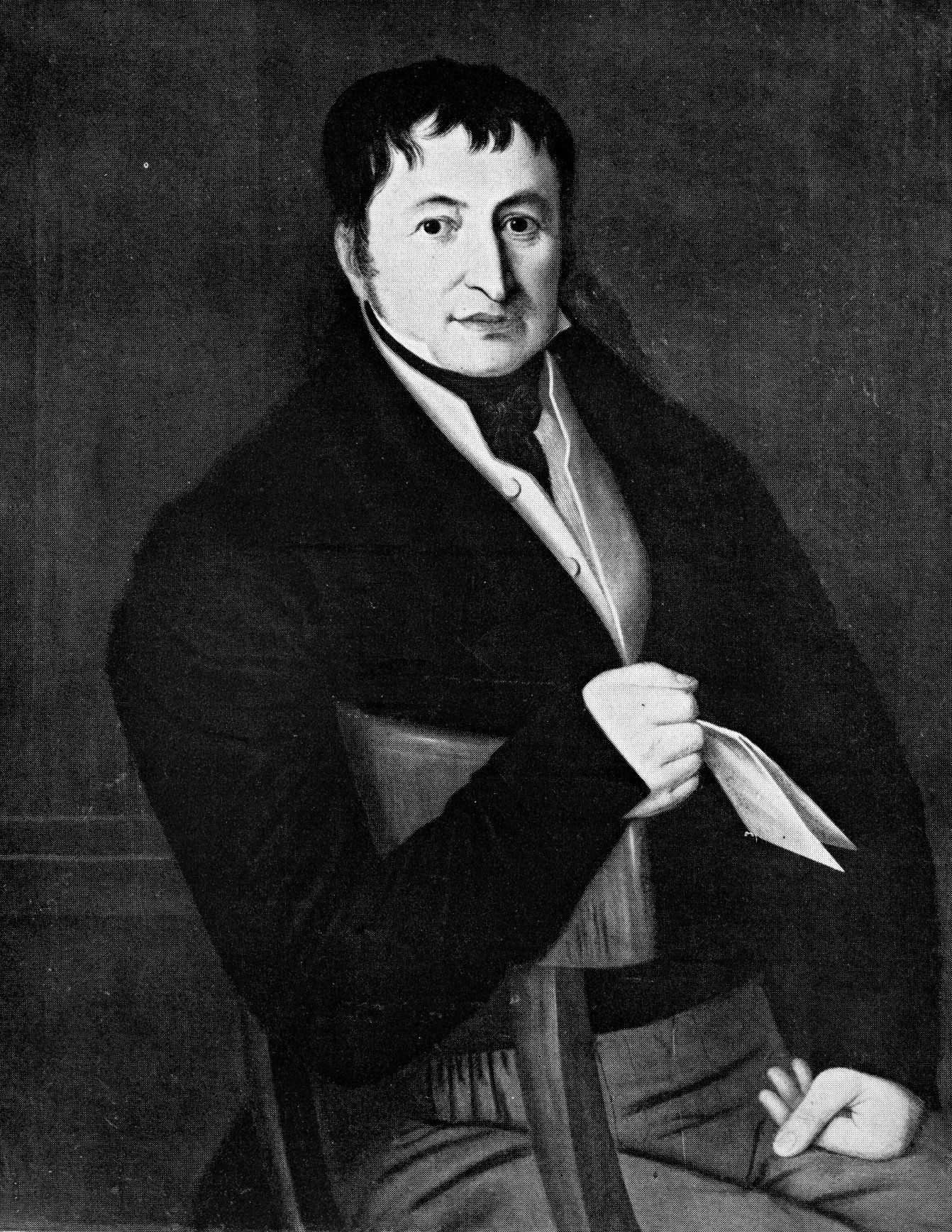
Printing in Koenig's youth was still done much as it had been in Gutenberg's workshop. A compositor set the type by hand, and the finished page of type, locked tight in an iron frame, was called a forme. A pressman inked the forme with leather-covered balls, laid a sheet of paper over it, and pulled a bar that brought a flat plate, the platen, down onto the paper. The work was slow and exhausting. Even the iron press perfected by Earl Stanhope, the best of its kind, took only about 250 impressions an hour. Newspaper offices that needed more copies set their type twice over and kept extra presses running, and on busy days they still could not meet the demand.
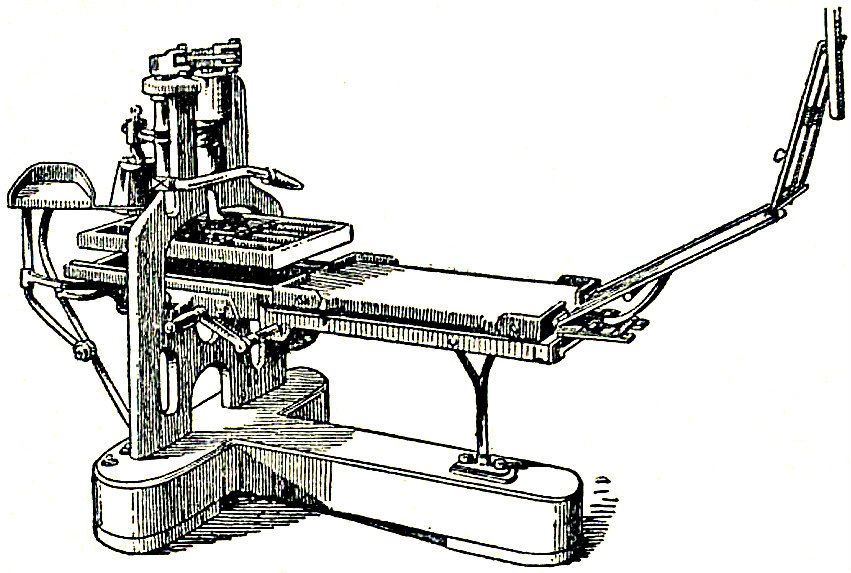
Koenig set out to abolish what Smiles called the "horse-work" of printing. By Koenig's own reckoning, the first idea of his invention came to him in about 1803, and he made his first experiments soon afterward in Saxony. At Suhl in Thuringia, working with a mechanic named Wolfgang Kummer, he built a press with a movable carriage for the type, rollers that inked it automatically, and a mechanical method of taking the impression. German printers found the machine too complicated and too costly, and men of capital, with war against France approaching, would not risk money on it. In the spring of 1806 Koenig accepted an invitation to organize a state printing office in St. Petersburg, but official obstruction there so disgusted him that he gave up the post. He later explained in print why he had turned to England. On the Continent, he wrote, inventors had no patent system to protect them and were obliged to petition governments for support, and "scarcely ever is an invention brought to maturity under such circumstances." Almost every invention, he concluded, sought refuge in England. He arrived in London in November 1806, short of money and with little English.[4]
Partners in Fleet Street
At first Koenig supported himself as a compositor, and for a time he set type in the printing office of Richard Taylor in Shoe Lane, off Fleet Street. Taylor would not take up the invention himself, but he introduced Koenig to Thomas Bensley of Bolt Court, Fleet Street. Bensley was a book printer of some standing. His office occupied premises once used by Edmund Allen, a friend of Samuel Johnson, and he had printed Thomas Macklin's seven-volume folio Bible of 1800. On 31 March 1807 the two men signed an agreement. Koenig undertook to communicate his "entire new Method of Printing by Machinery" to Bensley. If Bensley was satisfied that it worked, he would "purchase the Secret" or make some other arrangement; if he declined, he was bound not to use or reveal it, under a penalty of £6,000.[5] From the start, the commercial direction of the project lay with Bensley.
Progress was slow. In August 1809 Bensley reported that he had called on John Walter of The Times, who "declines our proposition altogether, having (as he says) so many engagements as to prevent him entering into more." Walter had already been disappointed by mechanical schemes. He had consulted the engineer Marc Isambard Brunel, who studied the problem and gave it up, and he had paid for a young compositor's self-acting press, which came to nothing. With no buyer in sight, Bensley needed more capital. In 1809 two other London printers, George Woodfall and Richard Taylor, joined the agreement, and Koenig's share of the enterprise was fixed at one quarter.[6]
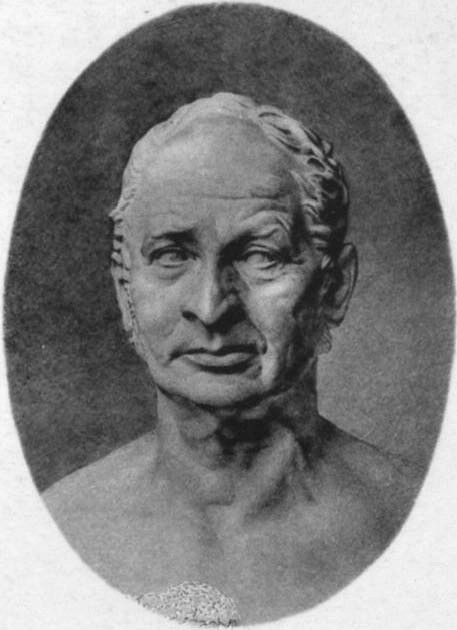
The most important partnership Koenig formed in London was not a financial one. Andreas Friedrich Bauer, born in Stuttgart in 1783, was a German mechanic working in London. Smiles judged that Bauer had the practical skill in which the inventor himself was "probably somewhat deficient." Koenig was the designer and Bauer the builder, and Koenig said so publicly, crediting his friend with contributing greatly to the machine's success "by the judgment and precision with which he executed my plans." Koenig dated that help from the start of work on his cylinder machine, around 1811, while the German biographer Hans Jaeger has Bauer helping to build the first machine as well.[7] Either way, the partnership between the two Germans would outlast every arrangement Koenig made with his English backers.
From Platen to Cylinder, 1810–1812
Koenig's first patent was dated 29 March 1810. The machine it described still printed with a flat platen, much like a hand press, but its movements were to be driven by a steam engine or some other source of power, and it replaced the pressman's inking balls with a set of cylinders covered in felt and leather that spread the ink and rolled it onto the type. In Koenig's words, it was "set to work in April, 1811." Its first job was sheet H of the Annual Register for 1810, printed in an edition of 3,000 copies, which Koenig believed to be "the first part of a book ever printed with a machine." Jaeger's biography rates the machine at 400 impressions an hour against the hand press's 250, though Koenig gave no figure for it himself and no contemporary account records one.[8]
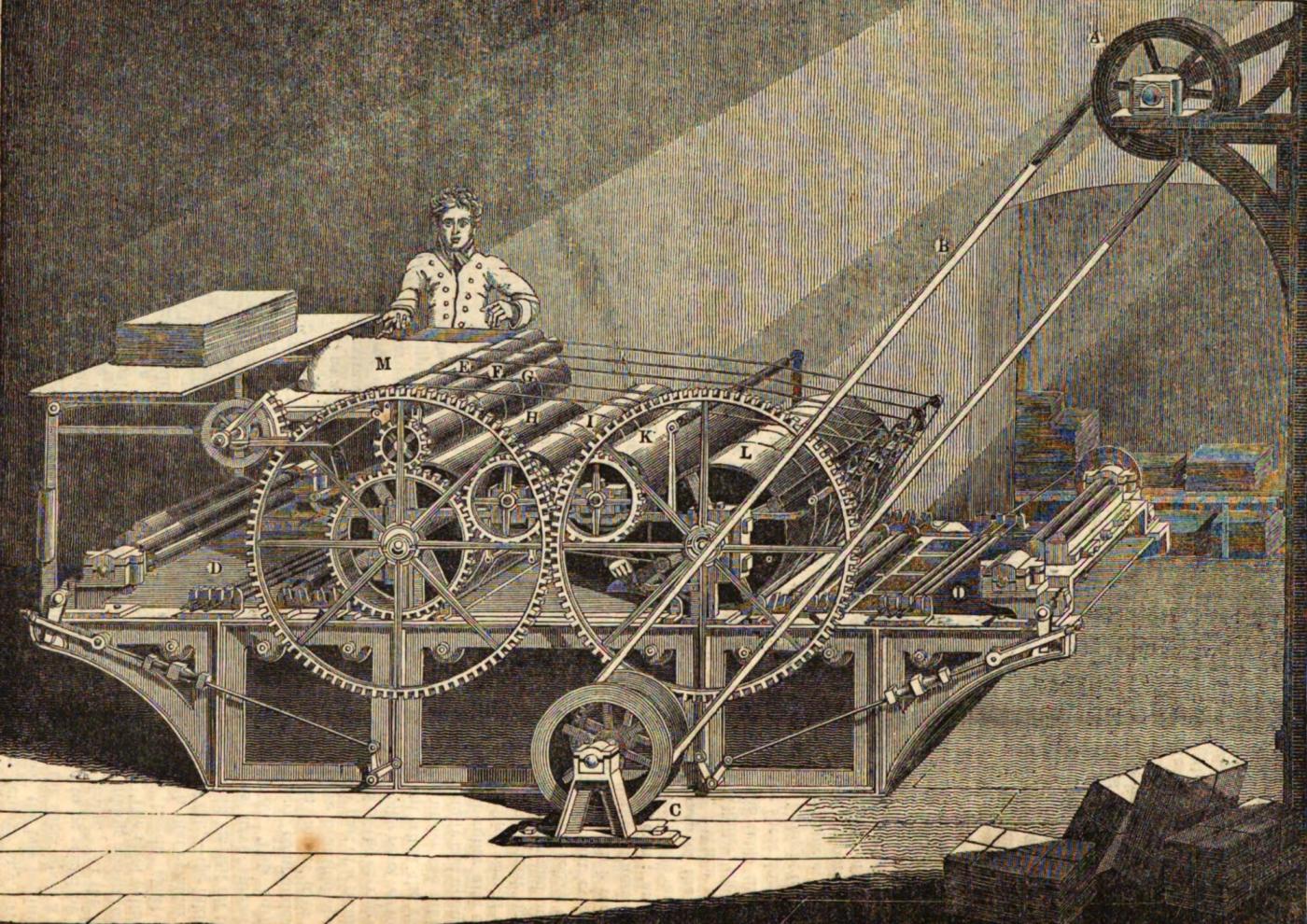
Using the machine soon showed Koenig its limits. A flat platen had to rise and fall with every sheet, and that motion set a ceiling on speed. Printing with cylinders had been proposed before. In 1790 William Nicholson had patented a scheme for printing from type fixed to a cylinder, but he never put it to use. Koenig's achievement was to bring these elements together in a working machine: a flat bed of type moving back and forth beneath an impression cylinder, with mechanical inking and powered operation. He kept the type flat on a moving bed and wrapped the sheet of paper around a cylinder, "making it, as it were, part of its periphery," so that the cylinder rolled the paper across the inked type as the forme passed beneath it. Pressure fell along one narrow line at a time instead of across the whole page at once. The new machine was completed in December 1812, after what Koenig called "great difficulties attending the cylindrical impression." Sheets G and X of the first volume of Thomas Clarkson's Life of William Penn were the first ever printed on it, and with two workers attending it, the machine produced 800 sheets an hour. By December 1814 about 160,000 sheets from it were in the hands of the public. He had patented the cylinder machine on 30 October 1811, and further patents followed on 23 July 1813, covering the double machine, and on 24 December 1814, covering improvements that led to his machine for printing both sides of a sheet.[9]
John Walter's Wager
The partners set up a workshop in Whitecross Street, on the northern edge of the City of London, and invited the proprietors of the leading newspapers to see the cylinder machine at work. James Perry of the Morning Chronicle would not even go to look at it; according to Smiles he regarded it as "a gimcrack." Walter, who had turned the partners away in 1809, came, watched the machine, and listened as Koenig explained how a double machine, with a second cylinder, could print a newspaper faster still. Before he left the premises he ordered two double machines for The Times. The contract, signed on 30 March 1813, set the price at £1,100 for each machine and £250 for each of two steam engines of two horsepower, and it allowed Walter to recover his money if the machines fell short of the promised speed.[10]
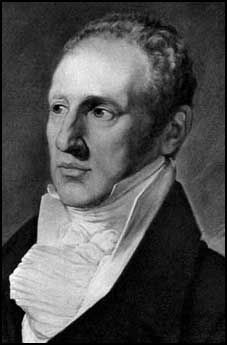
Walter had run The Times since 1803, and he did not bend to his workmen. In 1810, when his pressmen and compositors walked out together on a Saturday morning in a dispute over wages, he gathered apprentices from half a dozen quarters along with a few less skilled workmen, worked at the type case and the press himself for thirty-six hours, and brought the paper out on Monday as usual. He then had twenty-one of the strikers prosecuted, and nineteen were convicted.[11] He understood what a machine that reduced his dependence on skilled pressmen could mean.
Building the double machines took nearly two years. The workmen signed agreements under which they would forfeit £100 if they revealed anything about the machines, including whom they were for. The parts were made in Whitecross Street and carried as secretly as possible to the premises beside the Times office, where they were assembled. The secrecy did not hold. With the Luddite machine-breaking of 1811 and 1812 fresh in memory, the pressmen at Printing House Square learned enough to fear what was coming, and in Smiles's account they threatened Koenig with "destruction to him and his traps."[12]
The Night at Printing House Square
The machines printed their first full edition during the night of 28–29 November 1814. The leading article that morning described them with evident pride. "The reader of this paragraph now holds in his hand one of the many thousand impressions of The Times newspaper which were taken off last night by a mechanical apparatus," it said. Once the compositors had set the type, "little more remains for man to do than to attend upon and to watch this unconscious agent in its operations." The machine inked the forme, laid the paper against it, made the impression, and delivered the sheet to an attendant, "with such a velocity and simultaneousness of movement, that no less than 1,100 sheets are impressed in one hour." The article also named the inventor. Just as Sir Christopher Wren's noblest monument was the cathedral he built, it said, the best tribute to the inventor was the machine itself, and it went on to say that he was "a Saxon by birth; that his name is Koenig; and that the invention has been executed under the direction of his friend and countryman, Bauer." It added a modest admission: the newspaper's own share in the event "has, indeed, only been the application of the discovery, under an agreement with the patentees, to our own particular business."[13]
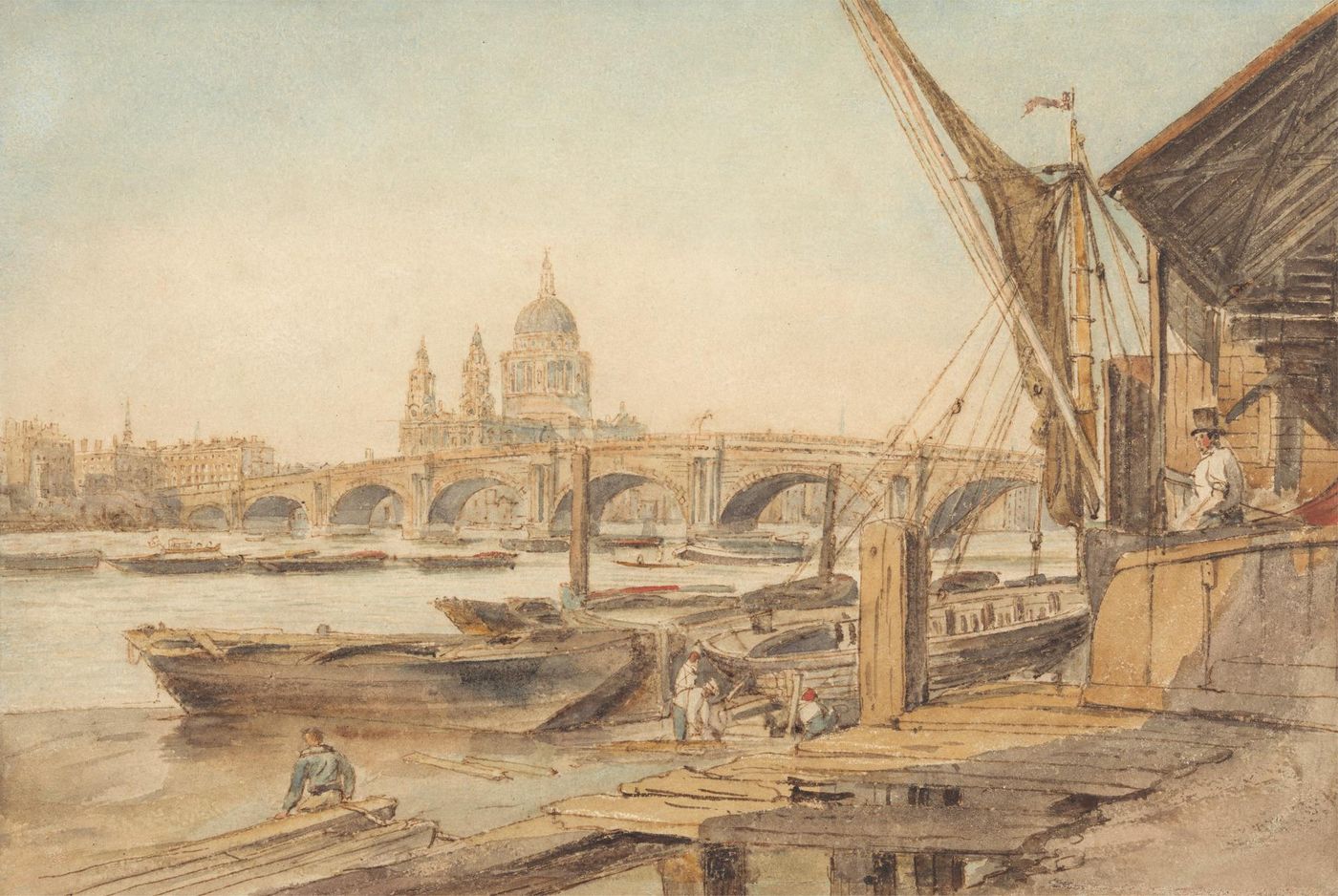
Four days later The Times returned to the subject. The machine, it reported, had been "whirling on its course ever since, with improving order, regularity, and even speed," and on the night of a long parliamentary debate it had let the paper finish its whole impression many hours ahead of its rivals. The article then turned to the pressmen, from whom the paper had received "dark and anonymous threats of vengeance." It told them that they could not stop a beneficial discovery, warned them against breaking the law, and recalled that the paper had already "encountered and crushed one conspiracy." It also corrected rumors about the dismissals. "We in fact employ only eight fewer workmen than formerly," the paper said, "whereas more than three times that number have been employed for a year and a half in building the machine."[14]
On 8 December Koenig published his own account in The Times, under the heading "To the Public." He wrote because confused statements had appeared in other newspapers, including a report that he had sold his interest to two other foreigners. He set out the history of the invention from his first experiments in Saxony, and he named his present partners as two Englishmen, Bensley and Taylor, whom he thanked publicly "for the persevering support which they have afforded me in long and very expensive experiments." Woodfall's name was absent, which suggests he had already left the syndicate. Koenig asked readers to be patient with defects in the printing, none of which, he insisted, was inherent "in the principle of the machine," and he hoped to correct them within two months.[15]
A Machine Without Its Maker
Koenig's inventive work went on. His later patents provided for an endless web to feed in the paper, a more exact register so that each page fell squarely on the back of the one before, and a machine that printed both sides of a sheet before delivering it. In 1816 he built such a machine for Bensley's book work. Smiles credits it with 1,000 sheets an hour printed on both sides and names Blumenbach's Physiology as the first complete book printed by steam. A similar machine went to Taylor for printing the Philosophical Magazine.[16]
The years after 1814 were nonetheless, in Smiles's words, "years to him of trouble and sorrow." His patents gave him little protection. Other mechanics studied his specifications, lodged new patents for modified designs, and built machines of their own. According to Smiles, Koenig's counsel advised him that he could sue the infringers with good prospects of success, but only if all the partners joined the action, and Bensley refused. Smiles also writes that Bensley, himself a book printer, obstructed Koenig's efforts to sell machines to other London printers. Koenig believed that his partner wanted to keep the advantage of the machine for his own printing house, and he suspected Bensley of having come to terms with the infringers. These accounts come mainly from Koenig's side, but one of the English partners backed them. Richard Taylor wrote in the Philosophical Magazine in 1847, in a passage Smiles quotes, that Koenig had left England "in disgust at the treacherous conduct of Bensley," whom Taylor called "always shabby and overreaching." According to Jaeger, Koenig had begun planning his return to Germany as early as 1814.[17]
The Times was loosening its ties to the inventor at the same time. A revised agreement of 19 November 1816, according to a modern account based on the contracts, left Walter free to hire anyone he wished to maintain or repair the machines. He soon found English engineers. Edward Cowper, a London printer and the partner and brother-in-law of Augustus Applegath, had patented curved stereotype plates in 1816, and in 1818 he patented a method of spreading ink evenly by moving the rollers sideways as well as turning them. Walter asked him to alter Koenig's machine at The Times to take advantage of it.[18]
Even the public account of the invention was shifting. On 3 January 1818 the Literary Gazette, a London weekly, announced that it would henceforth be printed by "Messrs. Bensleys' Patent Machine" and claimed to be the first weekly paper ever printed by a steam engine. The notice did not mention Koenig. A week later the Gazette printed a history of the machine. It still called "Mr. König, a Saxon," the inventor, but it said that his first machine had proved so unsatisfactory as to be rejected altogether, and it praised "the Patentees" for completing so arduous an undertaking. Koenig was no longer in London to reply. He had left England for good in August 1817.[19]
Starting Over in a Cloister
Koenig chose an unlikely place for a machine works. Oberzell, on the river Main near Würzburg, was a former house of Premonstratensian canons, secularized in the Napoleonic period and standing empty. It lay near the center of Germany on a navigable river. Koenig acquired it from the Bavarian state: Jaeger gives the purchase price as 35,000 gulden, and Smiles writes that the government, eager to encourage him, let him have it on easy terms. Koenig and Bauer agreed to divide the profits two-thirds and one-third, and the firm dates its founding to a contract signed on 9 August 1817. Bauer stayed in London to finish work there and followed about nine months later, bringing with him, according to Smiles, an order from Walter for an improved Times machine. In 1819 The Times had its machines rebuilt by the new firm to raise their output to 1,400 sheets an hour, but no other English printer placed an order.[20]
The difficulties at Oberzell were severe. The village offered only common labourers, and Koenig and Bauer had to teach them to use the hammer, the file, and the lathe, tools that, according to Smiles, most of them had never seen. Machinery for the workshop had to be gathered piece by piece, some of it from great distances, and the old monastery barn was turned into an iron foundry. Koenig remarked, as Jaeger records, that this was what happened when one undertook something beyond a country's stage of civilization. Some German printers already knew of his work. Johann Spener and George Decker of Berlin had written to him in London in 1815 asking about the machine, but they found it too expensive, and Decker ordered a Stanhope hand press through him instead, at a price of £95.[21]
The turn came in 1821 and 1822. The Bavarian state lent the firm 20,000 gulden, and the workforce grew to about forty. In 1822 the first machines built at Oberzell were delivered to Berlin, to the printing houses of Spener and of Decker, the Prussian court printer. Jaeger counts four machines in that first delivery; Karmarsch, writing in 1875, counted two. On 25 January 1823 the Haude- und Spenersche Zeitung of Berlin became the first newspaper on the Continent to be printed by machine, and in 1824 the Augsburg Allgemeine Zeitung followed. From about 1825 orders multiplied as the major printing houses of Germany converted to machine printing. Koenig married Fanny Jacobs in 1825. He died at Oberzell on 17 January 1833, at the age of fifty-eight, and was buried in the garden behind the old monastery church. When Bauer died in 1860, he was buried beside him.[22]
What the Twelve Years Changed
By 1822 the steam-powered cylinder press was established in two countries. In London it printed The Times, Bensley's books and periodicals, and Taylor's Philosophical Magazine, and English engineers were improving it without its inventor. Within a few years Cowper designed a four-cylinder machine for The Times that printed 4,000 to 5,000 sheets an hour.[23] In Bavaria the inventor had a factory, a workforce he had trained himself, and his first customers. The twelve years between his first patent and the first Berlin delivery had turned an idea that no continental patron would fund into a working industry on both sides of the Channel.
The importance of Koenig's work lay in the principles he established. Paper carried on a cylinder, type on a moving bed, mechanical inking, and a steam engine to drive the whole became the basis of newspaper printing for much of the nineteenth century. Faster presses let newspapers print more copies, later at night and at lower cost, and that capacity helped make possible the cheap, widely read press of the decades that followed. The effect on work was also more complicated than the pressmen of 1814 feared. The Times itself claimed that building its machines had employed more than three times as many men as running them displaced.
The story also shows how an inventor could lose control of an invention. Koenig went to England because its patent system protected inventors, and it did give him patents and partners with capital. It also gave those partners the power to block a lawsuit, and it did not prevent others from building on his specifications. The newspaper that named Koenig as the inventor in November 1814 was having its presses altered by English engineers within four years, while a London weekly advertised the same machine under Bensley's name. Later accounts went further. According to Smiles, the British Encyclopedia left Koenig's name out of its description of the printing machine, and in 1847 the Mechanics' Magazine credited the invention to the proprietors of The Times. Koenig, settled at Oberzell, remarked to Bauer that the people who had already robbed him of his invention were now trying to rob him of his reputation.[24]
On the morning of 29 November 1814 John Walter told his pressmen that the paper was already printed by steam, and his leading article gave the credit to the Saxon who had designed the machine. Eight years later that Saxon was building presses in a monastery on the Main, while in London his claim was being quietly worn away. Later writers did much to restore his reputation. Smiles took up Koenig's case in Macmillan's Magazine in 1869, using material supplied by Koenig's sons, and Theodor Goebel published a full biography at Stuttgart in 1883. By then Smiles could write that it was "generally admitted" that Koenig had been the first to apply steam power to printing in practice.[25] The firm Koenig founded in the cloister outlived him, and it is still in business, now in modern works across the river from the old monastery.
Places in this Story
The places this story moves through, in order — follow them on the interactive map →
- Bolt Court, Fleet Street, London 1816–1818
Koenig builds a machine for Bensley's book printing office that prints both sides of a sheet. By 1818 a London weekly advertises it as "Messrs. Bensleys' Patent Machine" without naming Koenig.
- Shoe Lane, off Fleet Street, London 1816
Richard Taylor, the printer who first employed Koenig in London, receives a similar machine for printing the Philosophical Magazine.
- Whitecross Street, London 1812–1814
In the partners' workshop Koenig completes his first cylinder machine in December 1812. Walter sees it at work and orders two double machines for The Times, whose parts are made here in secret.
- Printing House Square, Blackfriars, London November 29, 1814
Two double-cylinder machines print The Times by steam during the night, each at about 1,100 sheets an hour. At six in the morning John Walter tells his waiting pressmen the paper is already printed.
- Oberzell, near Würzburg, Bavaria August 1817
Koenig and Bauer found their firm in a former Premonstratensian monastery on the Main, training village labourers and turning the old barn into an iron foundry.
- Berlin, Prussia 1822
The first presses built at Oberzell are delivered to the Berlin printing houses of Spener and of Decker, the Prussian court printer.
Frequently Asked Questions
Who invented the steam-powered printing press?
Friedrich Koenig, a German printer born at Eisleben in 1774, working in London with the mechanic Andreas Friedrich Bauer. Koenig took his first English patent in 1810 and patented a cylinder machine in 1811. His double-cylinder machines printed The Times by steam for the first time on the night of 28–29 November 1814.
When was The Times first printed by steam?
On the night of 28–29 November 1814. Two of Koenig's double-cylinder machines, assembled in secret beside the Times office at Printing House Square, printed the whole edition, each at about 1,100 sheets an hour. At six the next morning the proprietor, John Walter II, told his waiting pressmen the paper had already been printed by steam.
How did Koenig's cylinder press work?
The type sat on a flat bed that moved back and forth beneath a cylinder. The sheet of paper was wrapped around the cylinder, which rolled it across the inked type, so pressure fell along one narrow line instead of the whole page at once. Rollers inked the type automatically, and a steam engine drove the whole machine.
How much faster was the steam press than a hand press?
An iron Stanhope hand press managed about 250 impressions an hour. Koenig's first cylinder machine, completed in December 1812, printed 800 sheets an hour, and each of the double machines built for The Times in 1814 printed about 1,100. Rebuilt by Koenig's firm in 1819, they reached 1,400 sheets an hour.
Why did Friedrich Koenig leave England?
His English partners controlled the business. According to Samuel Smiles, Thomas Bensley refused to join a lawsuit against printers who copied Koenig's designs and obstructed his sales to other printers, and The Times soon hired English engineers to alter his machines. Koenig left England for good in August 1817 and set up a factory with Bauer in a former monastery at Oberzell, near Würzburg.
What is Koenig & Bauer?
The printing-press maker founded by Friedrich Koenig and Andreas Bauer, which dates its founding to a contract of 9 August 1817. The two men set up their works in the former monastery of Oberzell on the river Main near Würzburg and delivered their first machines to Berlin printers in 1822. The company is still in business, with its works across the river from the old monastery.
Did the steam press put printers out of work?
The pressmen of The Times feared it would, and they threatened violence before the machines were first used. The paper answered that it employed only eight fewer workmen than before, while more than three times that number had spent a year and a half building the machines. John Walter also promised that every pressman would keep his wages until he found similar work.
Bibliography
"Bensley, Thomas." In Dictionary of National Biography, edited by Leslie Stephen, vol. 4. London: Smith, Elder, 1885. Wikisource transcription. Accessed October 20, 2026. https://en.wikisource.org/wiki/Dictionary_of_National_Biography,_1885-1900/Bensley,_Thomas.
Haenle. "König, Friedrich." In Allgemeine Deutsche Biographie, vol. 16, 506–7. Leipzig: Duncker & Humblot, 1882. Deutsche Biographie online edition. Accessed October 20, 2026. https://www.deutsche-biographie.de/gnd118564366.html#adbcontent.
Howard, Nick. "The Genius of Friedrich Koenig." PrintAction, April 2017. Accessed October 20, 2026. https://www.mydigitalpublication.com/article/Chronicle/2752517/397258/article.html.
Jaeger, Hans. "Koenig, Friedrich." In Neue Deutsche Biographie, vol. 12, 336–38. Berlin: Duncker & Humblot, 1980. Deutsche Biographie online edition. Accessed October 20, 2026. https://www.deutsche-biographie.de/gnd118564366.html#ndbcontent.
Karmarsch, Karl. "Bauer, Andreas Friedrich." In Allgemeine Deutsche Biographie, vol. 2, 138. Leipzig: Duncker & Humblot, 1875. Deutsche Biographie online edition. Accessed October 20, 2026. https://www.deutsche-biographie.de/118653679.html.
Koenig & Bauer. "200 Years Koenig & Bauer: Innovation-Lined Road from the First Cylinder Press to Digital Print." Press release, 2017. Accessed October 20, 2026. https://at.koenig-bauer.com/en/news/details/article/innovation-lined-road-from-the-first-cylinder-press-to-digital-print.
Koenig, Friedrich. "To the Public." The Times (London), December 8, 1814. Transcribed in Jeremy M. Norman, "Inventor of the Steam-Powered Press Friedrich Koenig Recounts the Early History of its Development," HistoryofInformation.com. Accessed October 20, 2026. https://www.historyofinformation.com/detail.php?id=4491.
Literary Gazette (London). No. 50 (January 3, 1818) and no. 51 (January 10, 1818). Internet Archive scans. Accessed October 20, 2026. https://archive.org/details/sim_literary-gazette_1818-01-03_50 and https://archive.org/details/sim_literary-gazette_1818-01-10_51.
Norman, Jeremy M. "Friedrich Koenig Invents the Steam-Powered Cylinder Flat-Bed Press, an Improved Cylinder Machine, and a Perfecting Machine." HistoryofInformation.com. Accessed October 20, 2026. https://www.historyofinformation.com/detail.php?id=4707.
Smiles, Samuel. Men of Invention and Industry. London: John Murray, 1890. First published 1884. Google Books. Accessed October 20, 2026. https://books.google.com/books?id=yP0qAAAAIAAJ.
Taylor, Richard. "On the Invention and First Introduction of Mr. Kœnig's Printing Machine." Philosophical Magazine, 3rd ser., 31, no. 208 (October 1847): 297–301. https://doi.org/10.1080/14786444708562645.
The Times (London). November 29, 1814, and December 3, 1814. Quoted in Smiles, Men of Invention and Industry.
Citations
- Samuel Smiles, Men of Invention and Industry (London: John Murray, 1890), 156, 166, 168–70, quoting The Times (London), November 29, 1814. Smiles's account, which draws on information from Koenig's sons, is the source of most later retellings of the scene. Page numbers for Smiles throughout are from this printing; the book was first published in 1884. ↑
- The Times, November 29, 1814, quoted in Smiles, Men of Invention and Industry, 169. ↑
- Smiles, Men of Invention and Industry, 156–57; Hans Jaeger, "Koenig, Friedrich," in Neue Deutsche Biographie, vol. 12 (Berlin: Duncker & Humblot, 1980), 336. Both give the birth date as April 17, 1774; the older entry by Haenle, "König, Friedrich," in Allgemeine Deutsche Biographie, vol. 16 (Leipzig: Duncker & Humblot, 1882), 506, gives 1775. ↑
- Friedrich Koenig, "To the Public," The Times (London), December 8, 1814; Smiles, Men of Invention and Industry, 158–60; Jaeger, "Koenig, Friedrich," 336. Koenig wrote in 1814 that the first idea "occurred to me 11 years ago"; Smiles dates it to 1802. ↑
- Smiles, Men of Invention and Industry, 160–61, quoting the agreement of March 31, 1807; "Bensley, Thomas," in Dictionary of National Biography, ed. Leslie Stephen, vol. 4 (London: Smith, Elder, 1885). ↑
- Bensley to Koenig, August 9, 1809, quoted in Smiles, Men of Invention and Industry, 162; Smiles, 164, 168; Jaeger, "Koenig, Friedrich," 336. ↑
- Smiles, Men of Invention and Industry, 162; Koenig, "To the Public"; Jaeger, "Koenig, Friedrich," 336. ↑
- Koenig, "To the Public"; Smiles, Men of Invention and Industry, 162–63. Jaeger, "Koenig, Friedrich," 336, gives the month as March 1811. ↑
- Koenig, "To the Public"; Smiles, Men of Invention and Industry, 164–65; Jeremy M. Norman, "Friedrich Koenig Invents the Steam-Powered Cylinder Flat-Bed Press, an Improved Cylinder Machine, and a Perfecting Machine," HistoryofInformation.com, drawing on James Moran's Printing Presses (1973), which gives the patent numbers as 3496 (October 30, 1811), 3725 (July 23, 1813), and 3868 (December 24, 1814). Smiles agrees on the first two dates but gives March 14, 1814, for the last, and the online transcription of Koenig's letter gives October 30, 1812, for the first. ↑
- Smiles, Men of Invention and Industry, 166–68; Nick Howard, "The Genius of Friedrich Koenig," PrintAction, April 2017, quoting the agreement of March 30, 1813. Howard reads the speed guarantee as 1,100 sheets an hour for the two machines together; the Times leader of November 29, 1814, and the Literary Gazette of January 10, 1818, give 1,100 sheets an hour for a single double machine. ↑
- Smiles, Men of Invention and Industry, chap. 7, "The Walters of 'The Times.'" ↑
- Smiles, Men of Invention and Industry, 166, 168–69. ↑
- The Times, November 29, 1814, quoted in Smiles, Men of Invention and Industry, 169–70. ↑
- The Times (London), December 3, 1814, quoted in Smiles, Men of Invention and Industry, 171–73. ↑
- Koenig, "To the Public." Smiles, 173, also dates the letter to December 8; one modern transcription gives December 9. The inference about Woodfall is the author's. ↑
- Smiles, Men of Invention and Industry, 165–66, 174. The Literary Gazette of January 10, 1818, gives a lower figure for the machine, about 900 sheets an hour printed on both sides. ↑
- Smiles, Men of Invention and Industry, 174–76, quoting Richard Taylor, "On the Invention and First Introduction of Mr. Kœnig's Printing Machine," Philosophical Magazine, 3rd ser., 31, no. 208 (October 1847): 297–301; Jaeger, "Koenig, Friedrich," 337. ↑
- Howard, "Genius of Friedrich Koenig"; Smiles, Men of Invention and Industry, 194–95. ↑
- Literary Gazette (London), no. 50 (January 3, 1818); "The Patent Completing Printing Machine," Literary Gazette, no. 51 (January 10, 1818): 23–24; Karl Karmarsch, "Bauer, Andreas Friedrich," in Allgemeine Deutsche Biographie, vol. 2 (Leipzig: Duncker & Humblot, 1875), 138. ↑
- Smiles, Men of Invention and Industry, 179; Jaeger, "Koenig, Friedrich," 337; Karmarsch, "Bauer, Andreas Friedrich," 138; Koenig & Bauer, "200 Years Koenig & Bauer: Innovation-Lined Road from the First Cylinder Press to Digital Print," press release, 2017. ↑
- Smiles, Men of Invention and Industry, 179–80; Jaeger, "Koenig, Friedrich," 337. Koenig's remark is paraphrased from Jaeger's German. Smiles spells Spener's name "Spencer." ↑
- Jaeger, "Koenig, Friedrich," 336–37; Haenle, "König, Friedrich," 506–7; Karmarsch, "Bauer, Andreas Friedrich," 138. Smiles, 180, names the Leipzig publisher Brockhaus as the firm's first customer and says two machines went to the Berlin "State printing office." Haenle dates the Allgemeine Zeitung's first machine-printed issue to July 12, 1824; other accounts give an earlier month. ↑
- Smiles, Men of Invention and Industry, 195–96. ↑
- Smiles, Men of Invention and Industry, 176–78. ↑
- Smiles, Men of Invention and Industry, 156; Jaeger, "Koenig, Friedrich," 338, for the date of Goebel's Friedrich Koenig und die Erfindung der Schnellpresse. ↑