The ratification of the Nineteenth Amendment in August 1920 is often celebrated as a singular triumph, yet it was the culmination of a decades-long struggle that redefined the American political landscape. The journey was forged through shifting battlegrounds—moving from the early abolitionist efforts of Susan B. Anthony and Elizabeth Cady Stanton to state-level victories in the West, and finally to the more radical tactics that began in 1913. Ultimately, by examining the ideological debates, the impact of World War I, and the ratification process, we can understand how the road to universal suffrage not only granted women the ballot but fundamentally altered the relationship between the American citizen, the family, and the state.
The Road to Universal Women's Suffrage
Women's Suffrage After the Civil War
Universal women's suffrage took effect in August 1920 with the ratification of the Nineteenth Amendment. The women's suffrage amendment was first introduced to Congress all the way back in January 1878 by California Senator Aaron Sargent.[1] Petitions for women's suffrage became common following the Civil War; some of the more famous women's suffragists at the time were Elizabeth Cady Stanton and Susan B. Anthony who were also staunch abolitionists before the Thirteenth Amendment was ratified in 1865. On February 14, 1866, Charles Sumner, the Republican Senator from Massachusetts stated “But I…do not think this is a proper time for the consideration of that question.”[2] Sumner had been a strong abolitionist as well, however, he believed there were more pressing issues to address following the Civil War.
The 1887 Women's Suffrage Vote
The years 1886-87 marked an important turning point in the fight for women’s suffrage. Since the Civil War, activists had pursued both state-level voting campaigns and a federal constitutional amendment guaranteeing women the right to vote. Led by Susan B. Anthony and Elizabeth Cady Stanton, the National Woman Suffrage Association increasingly focused national attention on what became known as the “Susan B. Anthony Amendment.”
After years of lobbying, the movement achieved a historic milestone on January 25, 1887(the debate took place in 1886), when the United States Senate voted on a women's suffrage amendment for the first time in American history. The proposal was decisively defeated, 16–34.[3]
Despite the loss, the vote carried long-term significance. The roll call revealed clear regional patterns of support and opposition, with stronger backing in parts of the West and North and substantial resistance in the South. The defeat also demonstrated that women’s suffrage had become a national political issue that senators could no longer avoid publicly addressing.
Another three decades of organizing, lobbying, state campaigns, and public protest would follow before ratification of the Nineteenth Amendment. However, the 1887 Senate vote marked an important early test of congressional support for a federal suffrage amendment.
Women's Suffrage at the State Level
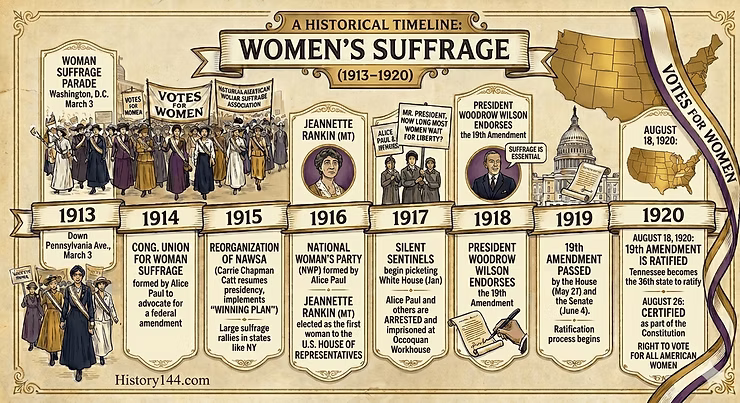
Although there are some who might believe that the passage of the Nineteenth Amendment in 1920 was the first time that women received the right to vote, this was not the case. Voting in 1920, as it is today, was primarily a states' rights issue under Article I of the Constitution; therefore, to establish a nationwide constitutional protection for women’s voting rights, a federal amendment was required. Congress was familiar with the constitutional amendment process as they had passed both the Sixteenth Amendment and the Seventeenth Amendment in 1913 and then the Eighteenth Amendment in 1919. Prior to 1913, nine states had granted women full voting rights and another seven states legalized women's suffrage between 1913 and 1920.
States and Territories Granting Full Women’s Suffrage Before 1920
Here is a list of states and territories granting full voting rights in state and federal elections before ratification of the Nineteenth Amendment.
- 1869: Wyoming Territory (Statehood: 1890)
- 1893: Colorado
- 1896: Idaho
- 1896: Utah
- 1910: Washington
- 1911: California
- 1912: Arizona, Kansas, Oregon
- 1913: Alaska Territory (became a state in 1959)
- 1914: Montana
- 1914: Nevada
- 1917: New York
- 1918: Michigan, Oklahoma, South Dakota [4]
The First Women's March: 1913
The year 1913 turned out to be a pivotal year for women's voting rights. In December 1912, the foundations were laid for what would later become the National Woman’s Party. That month, Lucy Burns and Alice Paul were appointed to the National American Woman Suffrage Association’s congressional committee. Although these two women were Americans, they were previously active in the fight for women's suffrage in England. While in England, they learned radical and militant protest tactics leading to confrontations with authorities, jail time, and hunger strikes. They hoped to bring these same tactics to the American fight in their new positions in NAWSA. Much of the argument against women's suffrage in England was the same as in America. There, they faced strong rhetorical arguments from skilled writers such as G.K. Chesterton, who wrote about the topic in his book titled What's Wrong with the World. In addition, prior to World War I, the young Winston Churchill opposed the idea as well.
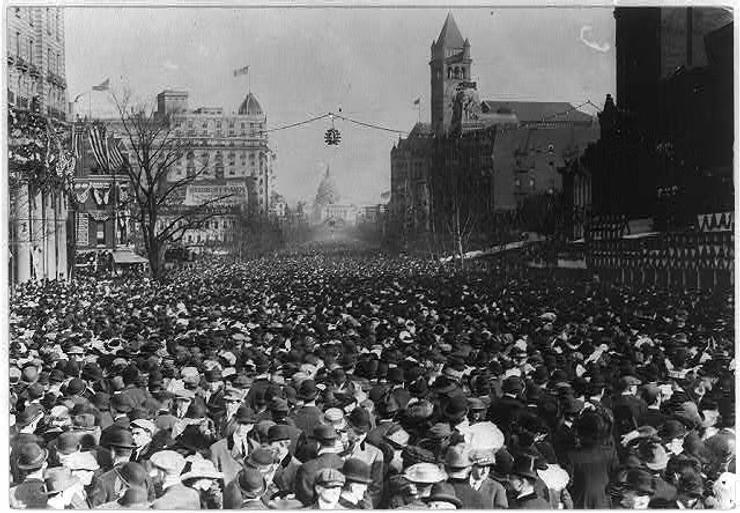
As Burns and Paul assumed their new roles within NAWSA, they increasingly emphasized a federal constitutional amendment rather than primarily relying on state-by-state campaigns to enfranchise women nationally.[5] In March 1913, Lucy Burns and Alice Paul organized the first Washington D.C. women's march with over 5,000 women attending the march. The march was held one day before President Wilson's inauguration and many visitors from around the nation, witnessed the women's march, creating a larger impact on society's overall perception. Woodrow Wilson's inauguration held record crowds at the time and over 250,000 flooded into Washington D.C. for the event. Wilson arrived to Washington D.C. the day before his inauguration and upon stepping off the train, asked, "Where are all the people?" He was answered, "Over on the Avenue, watching the suffrage parade."[6]
One of the inconvenient truths of the march is that its attendees were segregated between black women and white women. Many black women were pressured to march separately or toward the back of the procession in an effort to avoid alienating Southern supporters.[7]
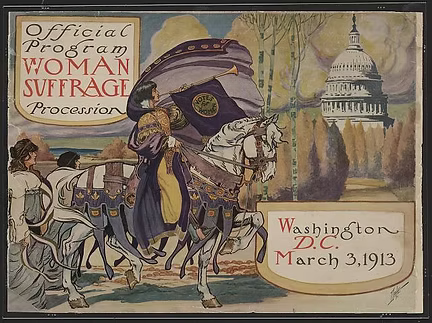
As the march began down Pennsylvania Avenue, it was carefully choreographed for maximum impact. Leading the procession was Inez Milholland, an activist and a lawyer, riding a white horse, whom some called "the most beautiful suffragist."[8] As the march continued, its signs and floats highlighted the various accomplishments of women. Tens of thousands were in attendance and instead of peacefully observing, they began to intentionally block the march until the women found themselves entirely surrounded. Most of the women remained in place, despite the chaos. Troops from nearby Fort Myer were eventually called in to help restore order, allowing the march to continue. The unintended result of the chaos was even greater national attention for the march.[9]
In June 1913, a few months after the march and Wilson's presidential inauguration, a Senate committee reported favorably on the federal women's suffrage amendment. Despite the recommendation and remarkable lobbying efforts by Senators and suffragists, the debate in the Senate continued throughout 1914. In March 1914, a vote was taken on the amendment in the Senate. The vote failed by a wide margin, but a silver lining for the suffragists, just as in 1887, was that it once again forced Senators to go on the record. The suffragists would use this against them for the next five years. In July 1914, World War I began and as the war escalated, people's attention was drawn away from the debate surrounding women's suffrage. But during the war, it was perceived that women played a more active role than in any previous war. America entered the war in 1917 and as men traveled overseas, women stepped into the gap by working in factories, helping to produce the required products for the war.
White House Picketing and The Night of Terror
The "White House picketing" and the "Night of Terror" represent the most radical, and physically brutal chapter of the American women’s suffrage movement. Led again by Alice Paul, Lucy Burns, and the National Woman’s Party (NWP), these events marked an even greater pivot away from the polite, state-by-state lobbying toward aggressive civil disobedience. By directly targeting President Woodrow Wilson and using the political rhetoric around World War I to expose American political hypocrisy, these women forced a constitutional showdown that altered the course of the nation.
The campaign began on January 10, 1917, when the NWP organized the first-ever political picket line outside the gates of the White House. Dubbed the "Silent Sentinels," a rotating group of over 2,000 women stood at the gates six days a week, in all weather conditions, completely silent. When the United States entered World War I in April 1917, the Sentinels refused to halt their activism. Instead, they began holding up highly controversial banners pointing out the hypocrisy of a president fighting for democracy abroad while denying it to women at home. One banner read:
Kaiser Wilson, have you forgotten your sympathy with the poor Germans because they were not self-governed? 20,000,000 American women are not self-governed. Take the beam out of your own eye.[10]
Public opinion turned fiercely against the women; crowds tore down their banners, and onlookers assaulted the women. Instead of arresting the women's attackers, the police began arresting the suffragists on the made-up charge of "obstructing traffic."
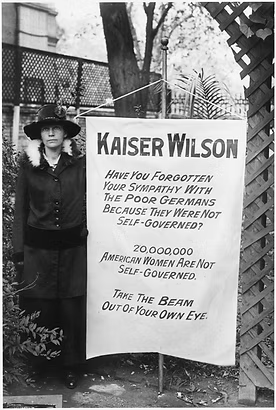
The escalating tension reached a climax on the night of November 14, 1917, a date now known in labor and women's history as the "Night of Terror." Having refused to pay what they deemed unjust fines, thirty-three arrested suffragists were sent to the notorious Occoquan Workhouse in Lorton, Virginia. Upon arrival, the women demanded to be recognized as political prisoners and refused to comply with standard prison intake. In response, the prison superintendent, W.H. Whittaker, ordered his guards to brutalize the women into submission. Guards physically beat, dragged, and choked the prisoners; Lucy Burns was handcuffed with her arms chained above her head to the bars of her cell, while Dora Lewis was thrown violently into a dark cell, striking her head on an iron bed-frame, knocking her unconscious.[11] [12]
In protest of this state-sponsored brutality, the battered women immediately launched a hunger strike. Prison doctors responded by strapping the women to chairs and force-feeding them raw eggs and milk through rubber tubes shoved down their throats or up their noses, causing pain and vomiting. Despite the guards' attempts to isolate the prisoners, secret notes detailing the torture and the squalid, worm-infested conditions of the prison were smuggled out on scraps of paper. These accounts were published in the NWP newsletter, The Suffragist, and quickly leaked to the broader mainstream press.
The resulting public outrage began to turn the political tide. The image of elite, educated, and elderly women being tortured by the state for peacefully holding banners shocked the American public and cornered the Wilson administration, politically. In March 1918, the D.C. Court of Appeals declared all of the suffragists' arrests unconstitutional. Under the pressure, Woodrow Wilson finally went before Congress just weeks later to declare his official support for the federal suffrage amendment, breaking the executive logjam and setting the stage for the amendment's ultimate ratification in 1920.
The Post-War Push For the 19th Amendment
On January 10, 1918, World War I was not yet over, however, the House of Representatives passed the Nineteenth Amendment 304 for and 89 against. On that day, women who attended the vote, left together singing.
Then, on December 2, 1918, not yet a month after The Great War had ended, Woodrow Wilson stood before Congress and delivered the State of the Union speech. This was Wilson's sixth State of the Union since starting the tradition of oral delivery in 1913. And for the first time, he publicly endorsed the Nineteenth Amendment.
And what shall we say of the women,-of their instant intelligence, quickening every task that they touched; their capacity for organization and cooperation, which gave their action discipline and enhanced the effectiveness of everything they attempted; their aptitude at tasks to which they had never before set their hands; their utter self-sacrifice alike in what they did and in what they gave? Their contribution to the great result is beyond appraisal. They have added a new lustre to the annals of American womanhood. The least tribute we can pay them is to make them the equals of men in political rights as they have proved themselves their equals in every field of practical work they have entered, whether for themselves or for their country. These great days of completed achievement would be sadly marred were we to omit that act of justice. . . [13]
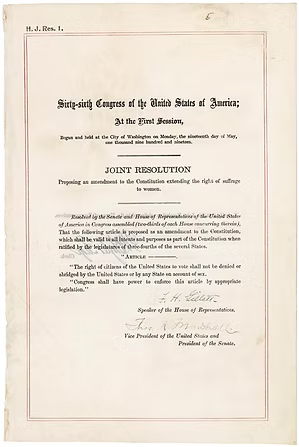
Although the House had already passed the bill, it had stalled in the Senate. On May 19, 1919, Wilson called a special session of Congress and urged the Senate once again to pass the amendment legislation. The Senate finally passed the amendment 56 to 25 on June 4, 1919, moving the legislation onto the states for ratification. When the Senate passed the bill, Wilson was at the Paris Peace Conference negotiating details following the war. He wired his "warmest congratulations" to representatives at NAWSA. All that was left was for 36 out of the 48 states to ratify the Amendment. Fourteen months after Congress passed the amendment, on August 18, 1920, the Nineteenth Amendment was ratified by the 36th state, Tennessee.[14]
The 19th Amendment states:
The right of citizens of the United States to vote shall not be denied or abridged by the United States or by any State on account of sex. Congress shall have power to enforce this article by appropriate legislation.[15]
The Tennessee Story
In the summer of 1920, Tennessee became the final, dynamic battleground for the ratification of the Nineteenth Amendment, earning the historical moniker of "The Perfect 36." By August of that year, 35 states had ratified the amendment, leaving the suffragists exactly one state short of the three-fourths majority required to ratify the amendment into the U.S. Constitution. Activists from across the country converged on Nashville, setting up competing headquarters at the Hermitage Hotel in what quickly devolved into a bitter, high-stakes standoff known as the "War of the Roses." Supporters of the amendment wore yellow roses to signal their allegiance, while the anti-suffrage forces—composed of political, corporate, and traditionalist interests—sported red roses, turning the state legislature into a sea of colorful political posturing.
The climax of the Tennessee story arrived on August 18, 1920, during a sweltering and seemingly deadlocked session of the Tennessee House of Representatives. After two consecutive 48-48 tie votes threatened to table and effectively kill the resolution, the chamber proceeded to a formal roll call on ratification. The fate of 17 million American women ultimately hung on Harry T. Burn, a 24-year-old freshman legislator from East Tennessee. Though Burn entered the floor wearing a red anti-suffrage rose on his lapel, he carried a seven-page letter from his mother, Febb Ensminger Burn, urging him to "be a good boy" and vote for suffrage. Shocking the gallery, Burn cast a decisive "aye" vote, breaking the tie and permanently shifting the course of American history. This is a good story that adds dramatic flair, but the fact is that several other states ratified the amendment following "The Perfect 36."[16]
The Historical Case Against Women's Suffrage
From 1878, when the Nineteenth Amendment was first proposed until its passage, there were many who argued against suffrage in various ways. Here are some of the arguments from those who tried to make the case against women's suffrage.
Suffrage For Bearing the Sword
One of the most prominent anti-suffrage arguments of the 19th and early 20th centuries was rooted in the "physical force" doctrine, which asserted that political rights were directly tied to military obligation. Opponents of women's suffrage argued that because women did not—and, by societal standards of the time, could not—serve in the military or fight on the front lines of war, they should not have a say in electing the government that declares war. This perspective viewed the ballot not just as an expression of opinion, but as a mandate backed by physical ability; therefore, those who could not physically enforce the laws or defend the nation in battle had no rightful claim to the franchise. Suffragists countered this "no conscription, no vote" logic by pointing out that women risked their lives giving birth to the nation's soldiers and contributed monumentally to war efforts through nursing, factory work, and domestic support, arguing that citizenship and civic value encompassed far more than just physical combat.
Here is a quote from James Caples who was a Democrat attending the California Constitutional Convention of 1878-79. He argues, that it is man's ability to fight which grants him the right to participate in his government. Whereas, since women do not engage in combat, they should therefore not receive the rights of suffrage. Whether you agree or disagree, this argument held a prophetic tone as World War I, where more women participated in the workforce became a key argument FOR the Nineteenth Amendment.
What is political sovereignty? It is the fruits of the sword. It has always been the fruits of the sword. . .The right to vote, the power of sovereignty, does rest right squarely upon the basis of the ability of men to wield the sword.[17]
The Private vs Public Sphere
Another prevalent argument against women's suffrage was the deeply ingrained fear that granting women the right to vote would dangerously blur the distinct social and biological boundaries between the sexes, upending the natural order of society. Rooted in the nineteenth-century doctrine of "separate spheres," this view held that men were naturally suited for the competitive, aggressive world of public life and politics, while women were destined for the private, nurturing sanctuary of the home. Anti-suffragists argued that entering the political arena would inevitably "unsex" women, stripping them of their feminine grace, moral purity, and domestic devotion by exposing them to the corrupting influence of politics. Conversely, they feared that dismantling these traditional roles would weaken masculine responsibilities, ultimately eroding the foundational differences between men and women, leading to the breakdown of the family unit and civilized society itself.
Here, Mr. Caples again tried to make his argument from natural law. This argument was made over a century ago and yet it remains prescient today. Mr. Caples stated:
This fungus growth upon the body of modern civilization is no such modest thing as the mere privilege of voting, by any means. . .The demand is for the abolition of all distinctions between men and women, proceeding upon the hypothesis that men and women are all the same. . . Gentlemen ought to know what is the great and inevitable tendency of this modern heresy, this lunacy, which of all lunacies is the mischievous and most destructive. It attacks the integrity of the family; it attacks the eternal decrees of God Almighty; it denies and repudiates the obligations of motherhood.[18]
Household Representation
Central to the anti-suffrage movement was the concept of "household suffrage," which argued that the fundamental unit of a stable society was the family, not the individual. Under this view, the household was seen as an integrated partnership with shared interests, and the husband, as the traditional head of the home, naturally acted as its legal and political representative. Opponents of women's suffrage contended that giving wives and daughters the ballot was not only redundant but dangerous; if a wife voted the same as her husband, her vote was merely a duplicate, and if she voted differently, it would introduce political discord directly into the domestic sanctuary, destroying family harmony. By holding that a man's vote inherently represented the collective well-being of his entire family, proponents of this argument maintained that women were already virtually represented in government without needing to step foot into the public political sphere. The following quote is from a pamphlet created by an anti-suffragist organization in the 1910s.
BECAUSE 90% of women do not want it, or do not care...BECAUSE 80% of the women eligible to vote are married and can only double or annul their husband's votes. BECAUSE it can be of no benefit commensurate with the additional expense involved. BECAUSE in some States more voting women than voting men will place the Government under petticoat rule.[19]
In another pamphlet titled Women Suffrage a Menace to the Nation, it states.
90 percent of the women either stay at home, vote as directed by their husbands, or vote under a wicked influence," concluding that "woman can exercise an even greater influence along educational lines without the ballot than she can with it.[20]
Political Machines and Urban Bosses
During the late 19th and early 20th centuries, urban political machines and party bosses held a complicated and often adversarial relationship with the women's suffrage movement. On one hand, anti-suffragists argued that the corrupting, rough-and-tumble environment of machine politics—which relied heavily on saloons, backroom deals, and patronage—was entirely unsuited for women and would degrade their moral purity. On the other hand, the political bosses themselves fiercely opposed giving women the vote out of sheer self-preservation. They feared that women voters, heavily aligned with the temperance and Progressive reform movements, would act as an unpredictable "moral broom" that would sweep away the profitable vices, immigrant voting blocs, and other systems that kept the machines in power. Consequently, political bosses used their immense legislative influence to block suffrage amendments, viewing the enfranchisement of women as a direct threat.
Corporate and Industrial Interests
Corporate and industrial titans of the early 20th century viewed women’s suffrage not as a matter of civil rights, but as a direct threat to their bottom lines. This opposition was mostly led by the liquor industry, which recognized that women were the driving force behind the temperance movement and rightly feared that giving them the ballot would guarantee the passage and strict enforcement of Prohibition. Beyond the breweries and distilleries, powerful textile mill owners, manufacturing giants, and railroad barons similarly aligned against the Nineteenth Amendment. These industrial interests feared that women voters would use their political power to mandate costly regulations, such as abolishing child labor, implementing minimum wage laws, and shortening the work week. To protect their unregulated profits and maintain a cheap, exploitable workforce, these corporate lobbies poured massive funding into anti-suffrage campaigns, weaponizing political influence to keep women away from the ballot box.
The liquor forces have developed an organized opposition, apparently supported by large funds, which has been an active factor in every campaign except two since 1890, and in those two we won. The Secretary of one of the State Liquor Associations recently said to a man of honor, that they would not allow another State to be carried for suffrage within the next ten years. Still another representative of the same force said to another man that they could gather 10 millions of dollars if necessary to throw into any State which gave indications of a suffrage victory.[21]
While "liquor forces" were against the amendment, others believed that corporate interests were generally for the women's suffrage amendment. The argument being that corporations believed it would bring a new flood of workers into the workforce driving down the cost of labor. G.K. Chesterton, although British, articulated this argument well. He argued that industrialists and employers were the true champions of women entering the workplace because it expanded the labor pool, thereby driving down wages for everyone. And so women working and "deserving" the vote was the next logical step in a capitalist society. In his 1910 book, What's Wrong with the World, he argued that capitalism sought to destroy the independence of the home so it could fully exploit the individual:
"Nineteen extensions of the franchise out of twenty are praise of capitalism. The modern alone says, 'Our commercialism is so cruel and dangerous that it is breaking up the family; let us therefore alter the family.'... The world has praised the independent woman because she is independent of the breadwinner, but not of the bank or the employer."[22]
To Chesterton, a woman working in a factory or an office wasn't achieving independence; she was merely changing masters from a husband (with whom she shared a domestic partnership) to a corporate boss (who viewed her strictly as a unit of production).
The "Anti-Woman"
The "Anti-Woman" argument—often pushed by extreme anti-suffrage factions and traditionalist commentators—was rooted in the paradoxical claim that women were inherently, biologically, and temperamentally unfit for the responsibilities of citizenship. Proponents of this view argued that women were governed by emotion, impulse, and hysteria rather than the logic and detached rationality required for sound governance and judicial thinking. They asserted that granting women the ballot would not elevate politics, but would instead introduce volatility into the legislative process. Furthermore, this line of reasoning weaponized a harsh double standard: it argued that if women were as morally superior and pure as the suffragists claimed, they would naturally stay out of the "dirty" and inherently corrupt world of politics. By entering the public arena, these critics argued, women would inevitably lose the very qualities that made them valuable to society, rendering them "anti-woman" in the eyes of traditionalists who believed a woman's true nature could only be fulfilled through submissive domesticity and motherhood.
Senator George G. Vest — U.S. Senate Floor Speech (January 25, 1887) Congressional Record, 49th Congress, 2nd Session
Women are essentially emotional. It is no disparagement to them they are so... The great evil in this country to-day is in emotional suffrage. The great danger to-day is in excitable suffrage. If the voters of this country could think always coolly, and if they could deliberate, if they could go by judgment and not by passion, our institutions would survive forever... What we want in this country is to avoid emotional suffrage, and what we need is to put more logic into public affairs and less feeling.[23]
He continued:
"I speak now respecting women as a sex. I believe that they are better than men, but I do not believe they are adapted to the political work of this world. I do not believe that the Great Intelligence ever intended them to invade the sphere of work given to men... I would not, and I say it deliberately, degrade woman by giving her the right of suffrage."[24]
Constitutional Legitimacy
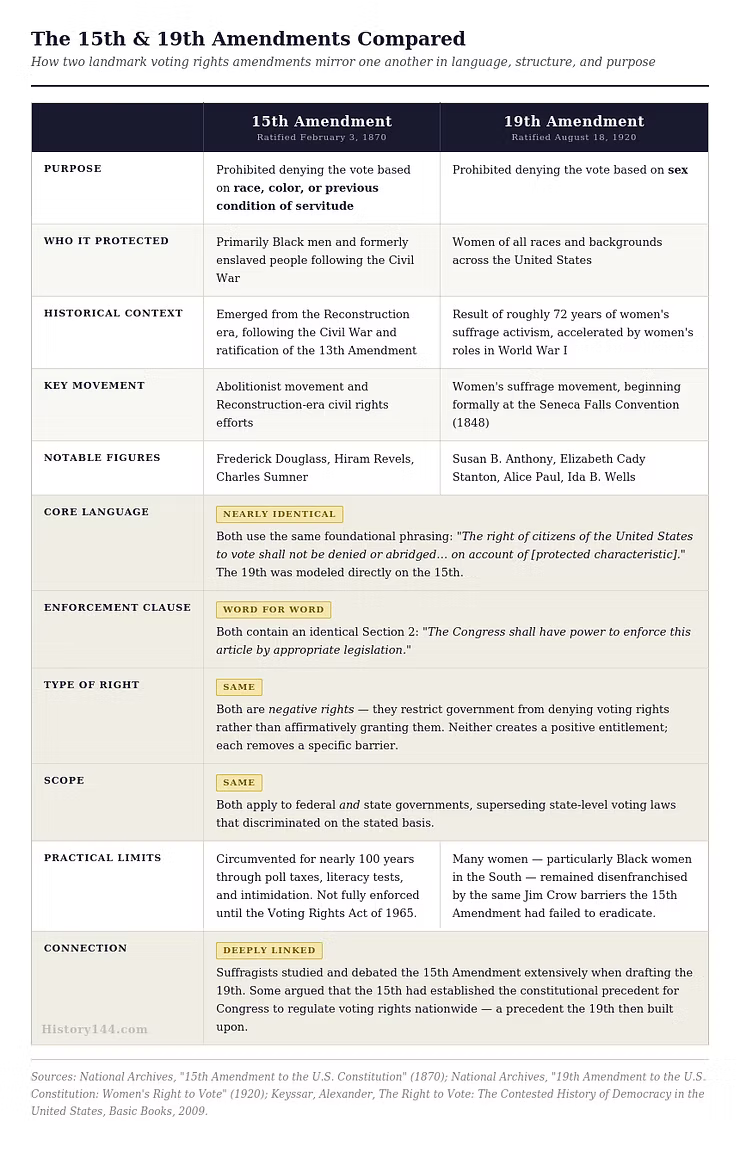
Others would try to make their argument from the Constitution rather than from natural law such as Henry St. George in 1916 who at the time, was a lawyer and former Representative from Virginia. George's argument had become a moot point as the 15th Amendment had long established the precedent that suffrage laws, although normally determined by states, can be overruled by the constitutional amendment process.
For three-fourths of the States to attempt to compel the other one-fourth of the States of the Union, by constitutional amendment, to adopt a principle of suffrage believed to be inimical to their institutions, because they may believe it to be of advantage to themselves and righteous as a general doctrine, would be to accomplish their end by subverting a principle which has been recognized from the adoption of the Constitution of the United States to this day, viz., that the right of suffrage — more properly the privilege of suffrage — is a State privilege, emanating from the State, granted by the State, and that can be curtailed alone by the State.[25]
The Historical Case For Women's Suffrage
Justice and Natural Rights (The "Justice" Argument)
The Justice and Natural Rights argument for women’s suffrage was rooted in the classical liberal philosophy of the Enlightenment, asserting that women were entitled to the ballot solely by virtue of their inherent, unalienable human rights. Popularized during the early phase of the movement by pioneers like Elizabeth Cady Stanton and Susan B. Anthony, this framework rejected the idea that voting was a privilege to be granted or earned. Instead, it positioned enfranchisement as a fundamental birthright, arguing that because women were human beings, they naturally possessed the exact same rights to liberty and self-governance as men.
To expose the hypocrisy of the American political system, suffragists strategically weaponized the nation’s own founding principles against the ruling class. They modeled the 1848 Declaration of Sentiments directly after the Declaration of Independence, highlighting that a government ruling over women without their consent—while simultaneously taxing their property—violated the core revolutionary tenets of "no taxation without representation" and the "consent of the governed." Following the Civil War, this philosophical argument transitioned into a constitutional battleground, as activists argued that the newly ratified Fourteenth Amendment automatically guaranteed women the right to vote as "persons" and citizens of the United States.
The Expediency Argument
The expediency argument (often referred to as the "social housekeeping" argument) marked a major tactical pivot in the American suffrage movement during the Progressive Era, shifting the focus from abstract natural rights to pragmatic societal utility. Rather than arguing that women should vote because they were identical to men in their human rights, leaders like Frances Willard and Carrie Chapman Catt argued that women should vote because they were fundamentally different. Suffragists posited that women possessed a distinct moral superior quality, a natural instinct for nurturing, and a unique responsibility for the home and children. As the industrial era forced governments to regulate municipal health, education, child labor, and food safety—areas traditionally under the domestic purview—suffragists argued that the state could not be properly managed without women's distinct domestic expertise. The expediency argument successfully broadened the movement's appeal, winning over conservative citizens and politicians who were otherwise indifferent to the philosophy of universal equality.
Wartime Patriotism
The wartime patriotism argument became a decisive tactical lever for the suffrage movement during World War I, as activists successfully capitalized on a national crisis to prove that women had fully earned the right to first-class citizenship. When the United States entered the conflict in 1917, mainstream suffragists under the leadership of Carrie Chapman Catt deliberately mobilized millions of women to support the home front, filling the labor vacuums in munitions factories, managing agricultural production, and driving ambulances. By demonstrating that the modern state depended entirely on female labor and civic sacrifice to function during wartime, suffragists effectively dismantled the traditional anti-suffrage claim that only men should vote because only men could defend the nation in battle. Furthermore, this massive mobilization exposed a glaring geopolitical contradiction for the Wilson administration; as President Woodrow Wilson framed the war as a global crusade to "make the world safe for democracy," suffragists argued that denying self-governance to twenty million American women at home crippled the nation's moral authority abroad, ultimately forcing the government to concede that women’s enfranchisement was a necessary war measure.
The Impact of the 19th Amendment Today
The Nineteenth Amendment has and will again rise to the surface in American political debates. Was the 19th Amendment a wise decision for America or was it a product of the feminist movement, rightfully receiving scrutiny? As these debates arise, it is important to begin the debate with the end in mind. That end, of course, is to administer a more perfect justice where women and men are treated equally under America's legal system. This is a very broad statement that encompasses innumerable nuances that won't be discussed here. However, to deny men and women's unique and valuable differences and how they have the potential to affect this end goal, both positively and negatively, is willful ignorance. It is also important that people realize that voting is but one small factor that affects justice in America and to focus solely on suffrage(although important) denies a full understanding of the American legal system.
Nonetheless, the following sections will analyze some of history's, as well as today's arguments against the Nineteenth Amendment, and how it has contributed to the problems facing America currently.
The Size and Scope of Government
Anyone who is at least a second-generation American can recognize that the American government has a size problem. It has grown too large; too bureaucratic. Modern economic and constitutional historians often view the ratification of the Nineteenth Amendment as a major structural turning point for the size and scope of the U.S. government.
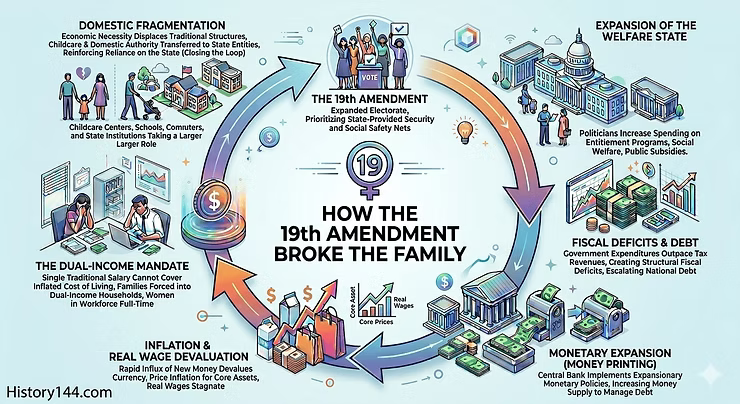
By suddenly doubling the electorate to include millions of women, the amendment fundamentally transformed the demographic landscape of American voters, introducing a constituency that historically favored a more robust federal role in social welfare, public health, and labor regulation. This massive influx of new voters created an immediate electoral incentive for politicians to expand the state, directly contributing to the first federal welfare legislation ever passed; the Sheppard–Towner Act of 1921, passed immediately following 1920. Over the ensuing decades, this shift permanently altered the ideological center of gravity in American politics, helping to build the broad popular mandate required to transition the federal government from a limited, late-19th-century framework into the massive, expansive regulatory state of the mid-20th century.
Many have examined the effect of the Nineteenth Amendment since 1920 and have come to this exact conclusion. Hans-Hermann Hoppe in Democracy: The God That Failed wrote about the direct connection between the massive welfare state and enfranchisement of women.[26] John Lott and Lawrence Kenny examined the evidence in their work titled, Did Women's Suffrage Change the Size and Scope of Government? The evidence seems to answer the question in the affirmative.
The empirical evidence strategy utilized in this paper shows that providing women with the right to vote increased government spending... Within 11 years after women’s suffrage, the typical state’s non-education expenditures had risen by an estimated 28 percent.[27]
The Compassion/Fear Gap
In contemporary political science and psychology, the term "compassion gap" describes the measurable divergence between men and women regarding public policy priorities, specifically driven by differing levels of support for social safety nets and welfare programs. The concept posits that women, on average, prioritize the immediate alleviation of suffering. When translated into the political sphere, this heightened orientation toward systemic empathy leads female electorates to disproportionately favor government intervention in areas like healthcare, education, poverty relief, and environmental protection. Consequently, the compassion gap, paired with an increased propensity to fear, serves as a primary explanatory framework for why women consistently vote in greater numbers for candidates and platforms that champion a more expansive, and protective state. This contrasts with the traditionally more male preference for concrete principles of justice, institutional authority, and strict fiscal constraint. This is a voting pattern in women that is, in part, also motivated by fear, not just compassion. Women are naturally more fearful and thus, are more likely to vote for the quick-fix, the short-term band-aid, rather than long-term fiduciary responsibility.
Loss of Long-Term Duty and Responsibility
Prior to universal suffrage, the political and social order was heavily rooted in decentralized, local, and familial networks where social safety nets were matters of personal obligation, religious charity, and civic duty. By enfranchising a massive new demographic that statistically favored institutional risk-aversion and state-mandated security over strict constitutional limitations, the amendment accelerated the transition toward a sprawling, centralized welfare state. Critics argue that as the federal government expanded to assume the role of universal caretaker—codifying empathy into bureaucratic entitlements—it systematically crowded out the necessity for private virtue and familial accountability. Over time, this reliance on the state transformed the cultural understanding of citizenship from an ethic of active, self-reliant responsibility into a passive expectation of government-provided rights and protections.
Breakdown of the Family
By shifting the foundational unit of political representation from the household—historically represented by a single vote cast on behalf of the family collective—to the individual, the amendment has, just as its original opponents had feared, inadvertently undermined the patriarchal and cohesive structure of the traditional nuclear family. Critics, observing sociological trends, contend that this political individualization accelerated the rise of the therapeutic state, as federal social programs gradually replaced the economic and protective functions traditionally provided by a husband and father. The expansion of the welfare state post-1920 created an alternative dependency structure where individuals look to bureaucratic institutions rather than familial bonds for security. Thereby contributing to the gradual decline of marriage rates, the rise of single-parent households, and the overall fragmentation of the traditional domestic sphere.
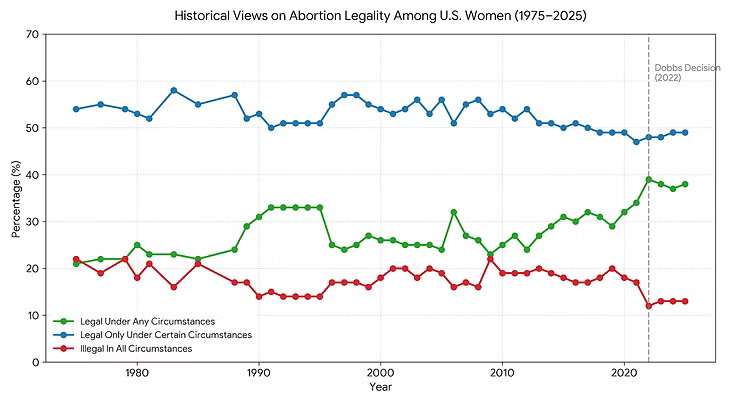
The chart below shows what percentage of women believe abortion should be legal, demonstrating how the family has been declining in importance for the past fifty years. The percentage of women who think it should be legal has continued to gradually rise since 1975.
Methodology Notes on the Source:
- Source: Gallup. "Abortion Trends by Gender." Gallup News. Accessed May 24, 2026. https://news.gallup.com/poll/245618/abortion-trends-gender.aspx.
- The Question Asked: Gallup has used the exact same question wording for its tracking since 1975 to ensure consistency: "Do you think abortions should be legal under any circumstances, legal only under certain circumstances or illegal in all circumstances?"
- Frequency: The data is pulled from Gallup’s annual nationwide tracking polls conducted every May. The trendline features gaps in the late 1970s and 1980s because Gallup did not conduct demographic subgroup polling on this specific question every single year during those decades.
- Sample Size and Margins: The data isolates the responses of U.S. women specifically, which typically carries a margin of sampling error of around ±4% to ±5% depending on the individual year's sample size.
Corporate Interests Over Family
The massive influx of women into the modern workforce—which reached historic highs in the early 2020s—is increasingly analyzed by heterodox economists and social critics as a phenomenon that paradoxically served corporate interests while restricting domestic choices. From this perspective, the hard-won victories of the 20th-century feminist movement, which sought to establish equality with men by securing professional autonomy for women, were rapidly co-opted by the market. By effectively doubling the global labor supply, the transition from single-income households to dual-income households put downward pressure on real wages, meaning that a single salary could no longer support an average family. Critics argue that corporate interests benefited enormously from this shift, gaining a vast pool of cheap labor and an expanded consumer base, while the economy structurally adjusted to require two earners just to cover basic living expenses, housing, and inflation. Consequently, the celebrated "freedom to work" has, for many women, transformed into a financial mandate; the economic baseline has shifted so drastically that the choice to stay home and raise a family has become an unattainable luxury, trapping many mothers in the very corporate machinery that promised liberation.
Conclusion
Ultimately, the legacy of the Nineteenth Amendment remains a complex arena where the idealism of natural rights and wartime patriotism collided with anxieties about the future of the family and women's role in the republic. While suffragists successfully weaponized Woodrow Wilson’s democratic rhetoric, critics of universal suffrage warned of long-term unintended consequences that continue to animate political discourse today. Traditionalists argue that enfranchising a demographic that is naturally compelled toward compassion along with fear, has structurally shifted the American electorate, driving an unprecedented expansion in the size and scope of the federal government. From this perspective, the transition from the household vote to the individual vote, systematically eroded the decentralized duties of personal and familial responsibility, inadvertently serving corporate interests by forcing a dual-income baseline that has eroded the traditional nuclear family. Ironically, women who find themselves longing for a bygone era of domesticated female duties, did not get to cast their vote.
Important Dates
The Seneca Falls Convention was held in Seneca Falls, New York, where reformers adopted the Declaration of Sentiments and formally launched the organized women's rights movement.
The U.S. Senate opened its first major debate on a federal women's suffrage amendment, setting the stage for the historic vote that followed in January 1887.
The U.S. Senate held its first-ever vote on a federal women's suffrage amendment, defeating the proposal 16–34 but establishing women's voting rights as a national political issue.
The first major Women's Suffrage Parade marched down Pennsylvania Avenue in Washington, D.C., drawing national attention to the demand for a federal suffrage amendment.
The National Woman's Party began the first-ever continuous picketing of the White House with the "Silent Sentinels" campaign.
The United States entered World War I, creating new opportunities for women to contribute to the war effort and strengthen the case for suffrage.
Suffragists displayed the controversial "Kaiser Wilson" banner, accusing President Wilson of hypocrisy for promoting democracy abroad while denying women the vote at home.
The "Night of Terror" occurred when imprisoned suffragists at Occoquan Workhouse were beaten and abused by prison guards.
The House of Representatives passed the women's suffrage amendment by a vote of 304 to 89.
President Woodrow Wilson personally addressed the Senate and urged senators to approve the suffrage amendment.
The Senate approved the Nineteenth Amendment by a vote of 56 to 25, sending it to the states for ratification.
Tennessee became the crucial 36th state to ratify the Nineteenth Amendment, securing the required three-fourths majority.
The Nineteenth Amendment was officially certified and became part of the U.S. Constitution, guaranteeing that voting rights could not be denied on the basis of sex.
Frequently Asked Questions
What was the Nineteenth Amendment and when was it ratified?
The Nineteenth Amendment to the U.S. Constitution prohibited states and the federal government from denying the right to vote based on sex. It was ratified on August 18, 1920, after a decades-long campaign led by the women's suffrage movement.
Who were the most important leaders of the women's suffrage movement?
Early leaders of the women's suffrage movement included Susan B. Anthony and Elizabeth Cady Stanton, who connected voting rights to broader principles of equality and natural rights. Later activists such as Alice Paul and Lucy Burns adopted more confrontational tactics that helped push the amendment toward ratification.
Which states granted women the right to vote before the Nineteenth Amendment?
Several western states and territories granted women full voting rights before 1920, beginning with Wyoming Territory in 1869. By the time the amendment was ratified, sixteen states and territories had already established full women's suffrage at the state level.
Why was the 1913 Women's Suffrage Parade important?
The 1913 Women's Suffrage Parade in Washington brought national attention to the suffrage movement and challenged political leaders to address women's voting rights. The event demonstrated the growing strength of the movement and marked the beginning of a more aggressive campaign for a federal amendment.
What was the "Night of Terror" in the women's suffrage movement?
The "Night of Terror" occurred on November 14, 1917, when imprisoned suffragists were subjected to brutal treatment at the Occoquan Workhouse after protesting for voting rights. Public outrage over the abuse helped generate sympathy for the suffrage cause and increased pressure on the federal government.
Why did President Woodrow Wilson eventually support women's suffrage?
Initially reluctant, Woodrow Wilson came to support the Nineteenth Amendment during and after World War I. He argued that women's contributions to the war effort demonstrated their equality as citizens and justified granting them full political rights.
Why does the impact of the Nineteenth Amendment remain debated today?
Supporters view the amendment as a landmark victory for equal rights, democratic participation, and constitutional justice. Critics continue to debate its long-term effects on government growth, family structure, voting behavior, and the relationship between citizens and the state.
Citations
- “Aaron A. Sargent (R-CA).” U.S. Senate: Aaron A. Sargent (R-CA), August 7, 2023. https://www.senate.gov/about/images/sargent-aaron-augustus.htm ↑
- “Woman Suffrage Centennial.” U.S. Senate: Woman Suffrage Centennial, March 10, 2020. https://www.senate.gov/artandhistory/history/People/Women/Part1_BestowtheBallot.htm ↑
- United States Senate. n.d. “Timeline: The Senate and the 19th Amendment.” Accessed May 23, 2026. https://www.senate.gov/about/women-of-the-senate/nineteenth-amendment-vertical-timeline.htm ↑
- Women’s suffrage in the U.S. by state - Rutgers University. Accessed October 25, 2023. https://tag.rutgers.edu/wp-content/uploads/2014/05/suffrage-by-state.pdf ↑
- “Visionaries | Selected Leaders of the National Woman’s Party | Articles and Essays | Women of Protest: Photographs from the Records of the National Woman’s Party | Digital Collections | Library of Congress,” The Library of Congress, accessed October 25, 2023, https://www.loc.gov/collections/women-of-protest/articles-and-essays/selected-leaders-of-the-national-womans-party/visionaries/ ↑
- Tina Cassidy, “Alice Paul, Woodrow Wilson, and the Battles for Liberty,” National Park Service, last modified May 15, 2019, https://www.nps.gov/articles/000/alice-paul-woodrow-wilson-and-the-battles-for-liberty.htm ↑
- “1913 Woman Suffrage Procession. U.S. National Park Service. ” accessed October 25, 2023, https://www.nps.gov/articles/woman-suffrage-procession1913.htm ↑
- 1913 Woman Suffrage Procession. US National Park Service. ↑
- 1913 Woman Suffrage Procession. US National Park Service. ↑
- Harris & Ewing, Photograph of Suffragist Allison Turnbull Hopkins with 'Kaiser Wilson' Banner, August 11, 1917, National Woman's Party Records, Library of Congress, Washington, DC, https://www.loc.gov/item/97511568/ ↑
- Doris Stevens, Jailed for Freedom (New York: Boni and Liveright, 1920), 190–210. ↑
- Affidavits of Dora Lewis and Lucy Burns, United States ex rel. Amanda Moore et al. v. W.H. Whittaker, Superintendent of Occoquan Workhouse, District Court of the United States for the Eastern District of Virginia (November 1917), National Woman's Party Records, Library of Congress. ↑
- “Sixth Annual Message | The American Presidency Project,” accessed October 25, 2023, https://www.presidency.ucsb.edu/documents/sixth-annual-message-6 ↑
- Catt, Carrie Chapman., Shuler, Nettie Rogers. Woman Suffrage and Politics: The Inner Story of the Suffrage Movement. United States: C. Scribner's Sons, 1923. 342. ↑
- “19th Amendment to the U.S. Constitution: Women’s Right to Vote (1920),” National Archives, February 8, 2022, accessed October 25, 2023, https://www.archives.gov/milestone-documents/19th-amendment ↑
- Carol Lynn Yellin and Janann Sherman, The Perfect 36: Tennessee Delivers Woman Suffrage, ed. Ilene Jones-Cornwell (Oak Ridge, TN: Iris Press, 1998), 45–60. ↑
- Keyssar, Alexander. The Right to Vote: The Contested History of Democracy in the United States. Ukraine: Basic Books, 2009. 191. ↑
- Keyssar, Alexander. The Right to Vote. 199. ↑
- Jewish Women's Archive. n.d. “Pamphlet Distributed by the National Association Opposed to Woman Suffrage.” Accessed May 23, 2026. https://jwa.org/media/pamphlet-distributed-by-national-association-opposed-to-woman-suffrage ↑
- David L. Bristow, “No Votes for Women—Nebraska Anti-Suffrage Propaganda,” History Nebraska (blog), Nebraska State Historical Society, accessed May 23, 2026, https://history.nebraska.gov/no-votes-for-women-nebraska-anti-suffrage-propaganda/ ↑
- U.S. Congress, Senate, Debate on Woman Suffrage in the Senate of the United States, 2d Session, 49th Congress, December 8, 1886, and January 25, 1887 (Washington, D.C.: Government Printing Office, 1887), Library of Congress, https://www.loc.gov/item/08004960/ ↑
- G. K. Chesterton, What's Wrong with the World (London: Cassell and Company, 1910), 111–135. ↑
- U.S. Congress, Senate, Debate on Woman Suffrage in the Senate of the United States, 2d Session, 49th Congress, December 8, 1886, and January 25, 1887 (Washington, D.C.: Government Printing Office, 1887), Library of Congress, https://www.loc.gov/item/08004960/ ↑
- U.S. Congress, Senate, Debate on Woman Suffrage in the Senate of the United States, 2d Session, 49th Congress, December 8, 1886, and January 25, 1887 (Washington, D.C.: Government Printing Office, 1887), Library of Congress. ↑
- Woman’s Suffrage By Constitutional Amendment, by Henry St. George Tucker. New Haven: Yale University Press, 1916. p 4. National American Woman Suffrage Association Collection. Rare Book & Special Collections Division. Via Library of Congress. ↑
- Hoppe, Hans-Hermann. "On Monarchy, Democracy, and the Idea of Natural Order." In Democracy: The God That Failed: The Economics and Politics of Monarchy, Democracy, and Natural Order, 77–149. New Brunswick, NJ: Transaction Publishers, 2001. ↑
- John R. Lott Jr. and Lawrence W. Kenny, "Did Women's Suffrage Change the Size and Scope of Government?" Journal of Political Economy 107, no. 6 (December 1999). p 1140. ↑