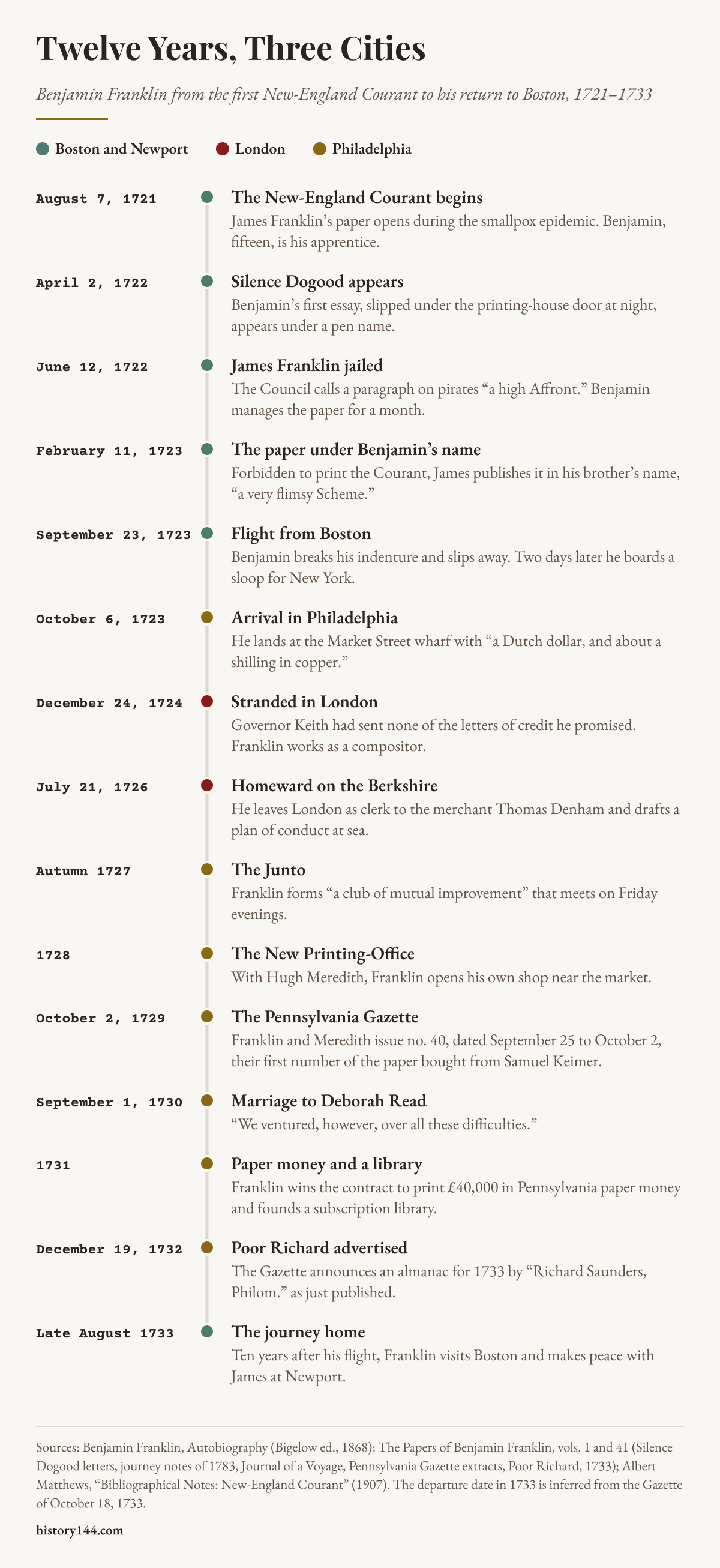
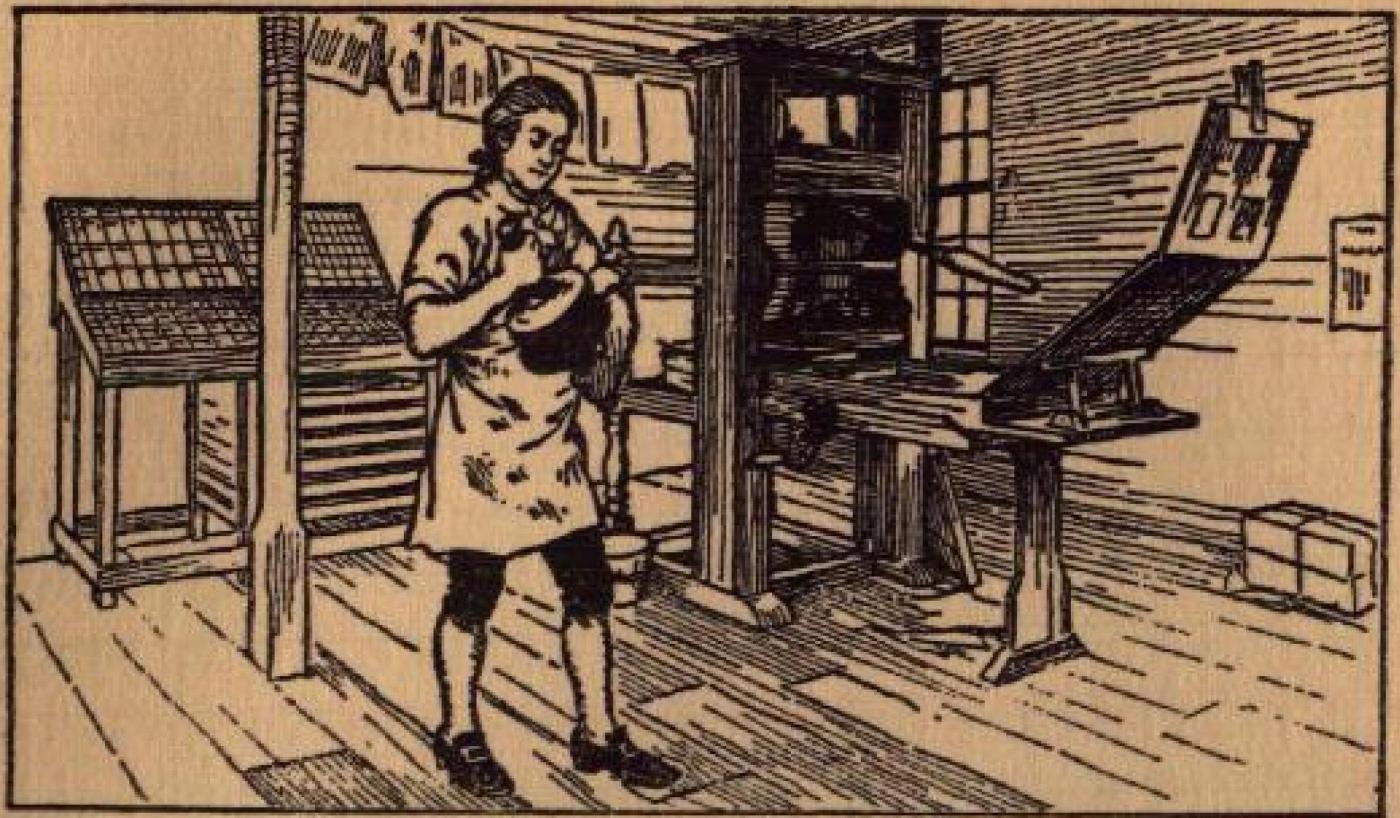
On Monday, August 7, 1721, a new weekly paper went on sale in Boston. The New-England Courant was the work of James Franklin, a young printer with a shop in Queen Street. It appeared during a smallpox epidemic and amid a bitter quarrel over how to fight it. The ministers Increase and Cotton Mather were urging inoculation, deliberately infecting healthy people with matter from smallpox sores to produce a milder case. The Courant opposed inoculation and used the controversy to attack the ministers who championed it, above all the Mathers. Its essays soon turned on the clergy, the magistrates, and Harvard College.[1] Among those who set the type and carried the sheets through the streets was James's younger brother Benjamin, fifteen years old and bound to him as an apprentice.[2]
Twelve years later, at the end of August 1733, Benjamin Franklin left Philadelphia for New England. He had fled Boston as a runaway apprentice ten years before. Now he was twenty-seven, the owner of a printing house near the Philadelphia market, the publisher of the Pennsylvania Gazette, the printer of the province's paper money, and the anonymous author of an almanac that had already been printed three times. Poor Richard: An Almanack for 1733, by "Richard Saunders, Philom.," had been advertised in the Gazette as just published on December 19, 1732.[3] On his way home Franklin stopped at Newport, Rhode Island, where James, now in failing health, was printing almanacs of his own under the name of Poor Robin, and the two brothers put their old quarrel behind them.[4] The journey closed a circle. Poor Richard's central device, an invented narrator who speaks with a straight face, was one Franklin had first tried out in his brother's shop. This is the story of those twelve years.
The Courant and the Smallpox
The Courant was the third newspaper published in Boston, and it was the private enterprise of its printer.[5] Franklin later misremembered it as "the second that appeared in America," but he also recalled that some of James's friends had judged one newspaper enough for the country.[6]
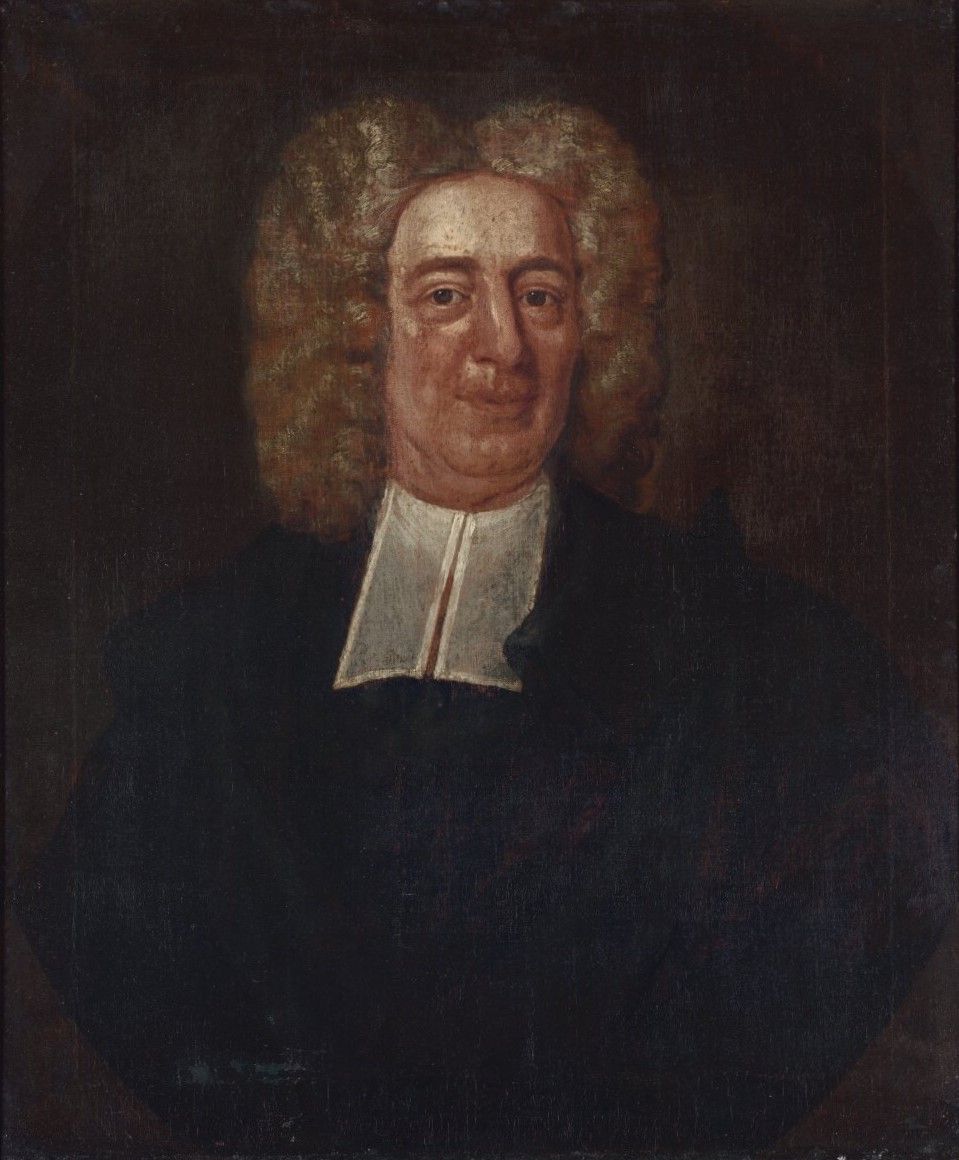
The quarrel over inoculation gave the paper its first cause. Smallpox had arrived on April 22, 1721, aboard HMS Seahorse from Barbados. That summer Cotton Mather persuaded a physician, Zabdiel Boylston, to try inoculation, which Mather had learned about partly from Onesimus, an enslaved West African man in his household. Boylston's published account later recorded that of 247 people he inoculated in 1721 and 1722, six died, about 2.4 percent. The Courant's writers nonetheless opposed the experiment and lampooned the ministers who championed it.[7] Later experience vindicated inoculation, but the controversy gave the paper a cause and an audience.
For Benjamin the shop was a school. He had been teaching himself to write by imitating the essays in Joseph Addison and Richard Steele's Spectator, rewriting their papers from his own notes and comparing the results with the originals.[8] The men who wrote for his brother were exactly the audience he wished to impress. He suspected, however, that James would refuse to print anything he knew to be Benjamin's.
Mrs. Silence Dogood
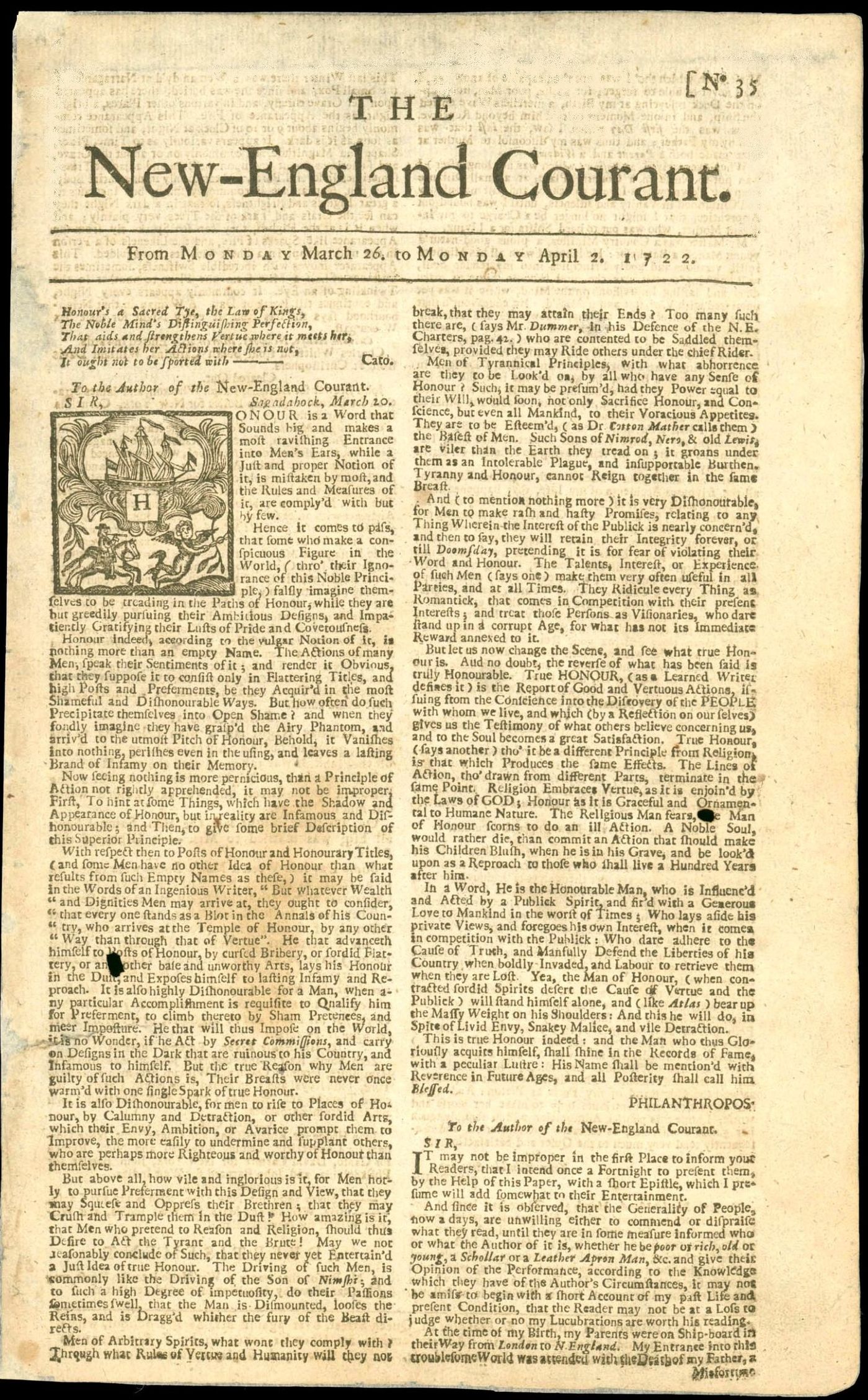
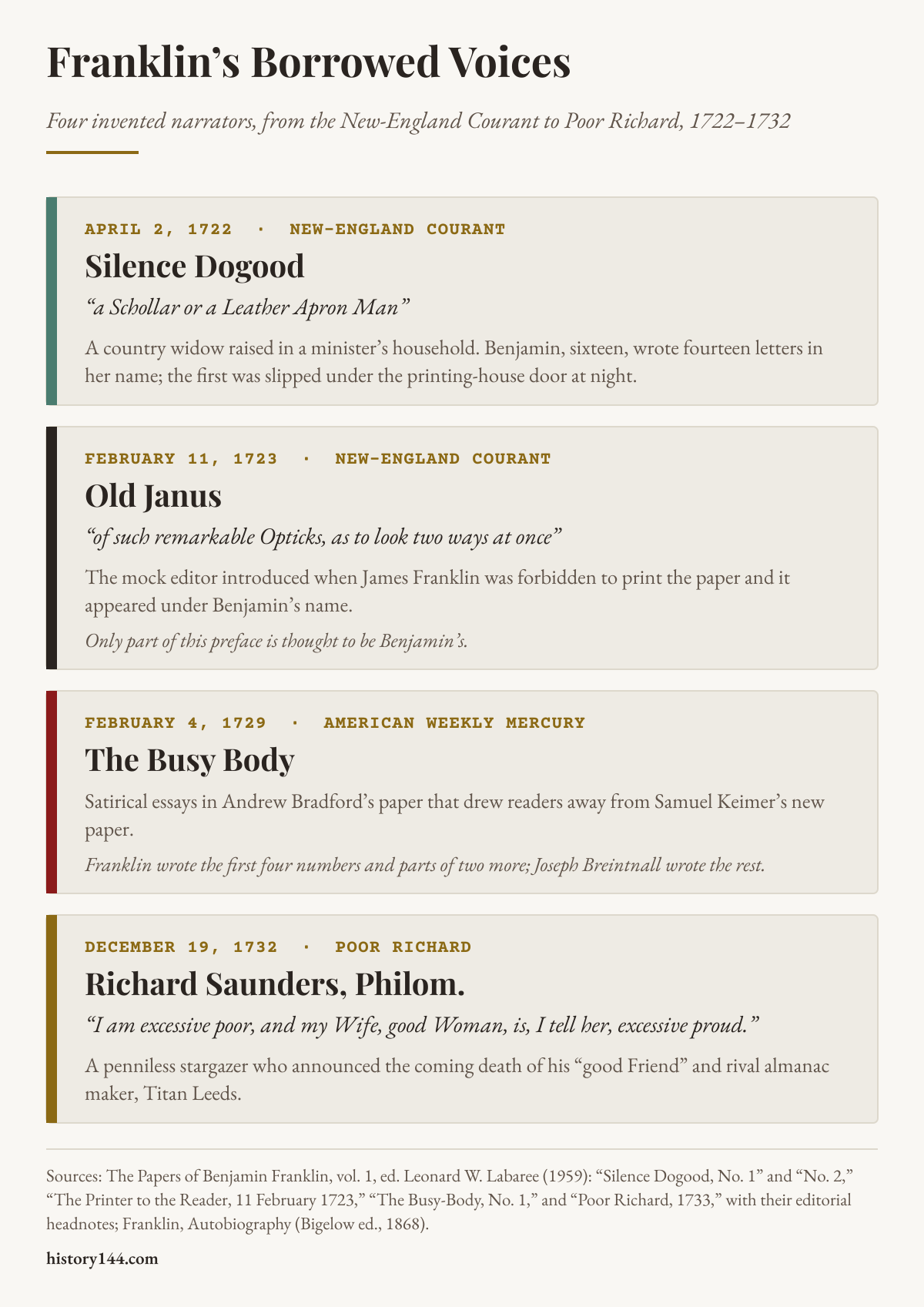
In the spring of 1722 Benjamin wrote an essay in a disguised hand and, as he later told it, "put it in at night under the door of the printing-house."[9] James and his friends read it, approved it, and printed it in the Courant of April 2, 1722. The writer introduced herself as Silence Dogood, a woman raised in the household of a country minister, and promised readers a short letter once a fortnight. Her second letter, two weeks later, revealed that she had married the minister and had been a widow for several years.[10] Since readers liked to know whether a writer was "a Schollar or a Leather Apron Man," a learned man or a tradesman, she began with her own history, recalling that in her youth she had "liv'd a chearful Country Life."[11] The first letter brought an invitation for more. Later letters could be left at the printing house or at the Blue Ball in Union Street, the house of the brothers' father, Josiah Franklin.[12] Fourteen Dogood letters appeared between April and October 1722.[13] Her first name seems to allude to the Spectator's famously silent narrator, and her surname to Cotton Mather's 1710 book Bonifacius: or, Essays to Do Good.[14]
Silence Dogood taught Franklin a technique he would use all his life. A fictional narrator with a history and opinions of her own could say things that a sixteen-year-old apprentice could not. Through her he made fun of Boston's manners and institutions, Harvard College among them, and he discovered that readers enjoyed an invented character as much as an argument.[15] The widow also kept her author's secret. Franklin revealed it only when, as he put it, his small stock of sense for such performances was nearly exhausted. After that he "began to be considered a little more" by his brother's friends, though he suspected that this "might be one occasion of the differences" that soon arose between the brothers.[16]
The Printer in the Jail
On June 11, 1722, the Courant printed a brief item reporting that "the Government of the Massachusetts are fitting out a Ship to go after the Pirates," and that the ship was expected to sail sometime that month if the weather allowed. The jab at official sluggishness was plain.[17] The next day the Council examined James Franklin, who "acknowledged himself the Publisher thereof." The Council charged that the paragraph was "grounded on a Letter pretended by him to be received from Rhode-Island" and resolved that it was "a high Affront to this Government." The House of Representatives concurred, and the sheriff of Suffolk County was ordered to "commit to the Goal in Boston, the Body of James Franklin Printer."[18] Benjamin was also brought before the Council. Because an apprentice could be expected to keep his master's secrets, the councillors "content'd themselves with admonishing me" and let him go.[19]
James remained in jail until the General Court was prorogued on July 7, about a month in all, and while he was there his brother "had the management of the paper."[20] On July 9, 1722, two days after James's confinement ended, the eighth Dogood letter opened with the remark, "I prefer the following Abstract from the London Journal to any Thing of my own." What followed was a long passage on freedom of speech from Cato's Letters, the essays of John Trenchard and Thomas Gordon. Its central sentence began, "Without Freedom of Thought, there can be no such Thing as Wisdom."[21] The Council, for its part, proposed that no weekly paper should be printed without first being "perused and allowed by the Secretary." The House of Representatives refused to concur.[22]
The truce did not last. In January 1723 the Courant printed an essay on hypocrites and other pieces that the Council said perverted the Holy Scriptures. A joint committee of the General Court recommended that "James Franklin the Printer and Publisher thereof, be strictly forbidden by this Court to Print or Publish" the paper unless it was first supervised by the secretary of the province. Both houses agreed, and on January 24 the Council ordered his arrest.[23] James and his friends then hit on what Benjamin later called "a very flimsy Scheme." Because the order named James alone, the paper would appear under Benjamin's name. To make the change look genuine, James handed back his brother's old indenture with a full discharge written on the back. At the same time the brothers signed new indentures for the rest of the term, which "were to be kept private."[24] The issue of February 11, 1723, announced that "The late Publisher of this Paper" had "intierely dropt the Undertaking." It also carried a mock preface introducing the paper's supposed new editor, old Janus, a man "of such remarkable Opticks, as to look two ways at once." The next day James gave himself up and posted bond to keep the peace.[25]
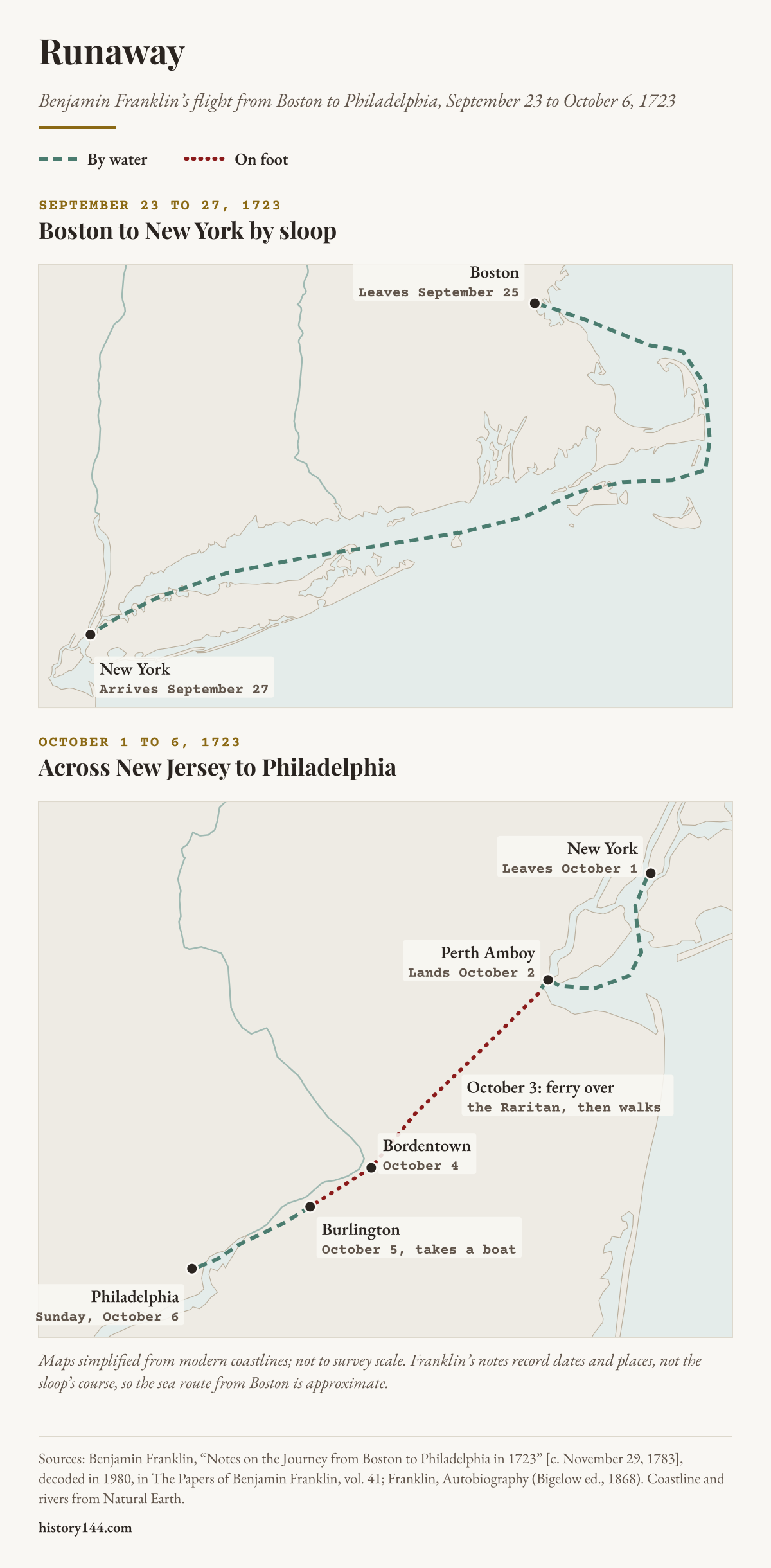
The arrangement placed in Benjamin's hands a weapon he soon decided to use. The brothers quarreled repeatedly, and by Benjamin's account James "was passionate, and had often beaten me." Knowing that James could not produce the secret indentures without exposing the scheme, Benjamin "took upon me to assert my freedom." Writing about it in 1771, he counted this as "one of the first errata of my life," borrowing the printer's word for a mistake in the type.[26] James then made sure that no other printer in Boston would hire him. On September 23, 1723, Benjamin slipped away from his brother's shop. He had sold some of his books to raise money, and a friend arranged his passage on a New York sloop, which he boarded two days later.[27] A week after that the Courant carried an advertisement: "James Franklin, Printer in Queen-Street, wants a likely lad for an Apprentice."[28]
A Dutch Dollar and Three Rolls
New York had only one printer, William Bradford, who had been the first printer in Pennsylvania. He had no work for the young man, but he reported that his son Andrew in Philadelphia had "lately lost his principal hand."[29] Franklin went on by boat and on foot across New Jersey and reached Philadelphia on Sunday morning, October 6, 1723, a date fixed only in 1980, when an editor of his papers decoded some cryptic notes he jotted down late in life.[30] He landed at the Market Street wharf in his working clothes, with his pockets "stuff'd out with shirts and stockings." All the money he had was "a Dutch dollar, and about a shilling in copper." He bought "three great puffy rolls" at a baker's and walked up Market Street with one under each arm, eating the third. Standing at the door of her father's house, a young woman named Deborah Read watched him pass and thought he made "a most awkward, ridiculous appearance."[31]
Andrew Bradford had no place for him, but a second printer had recently set up in town. Samuel Keimer had published a newspaper in London and been jailed there for debt and seditious printing before emigrating, and his shop, Franklin found, consisted of "an old shatter'd press, and one small, worn-out font of English." Franklin put the press in order and soon attracted the notice of the governor of the province, Sir William Keith.[32] Keith promised to set him up in business on his own and to send him to London with letters of credit to buy a press and type. Late in 1724 Franklin sailed for England with his friend James Ralph, a would-be poet who was leaving a wife and child behind.[33]
A Year and a Half in London
They arrived in London on December 24, 1724. Only then did Franklin discover that the governor had sent no letters for him at all. Thomas Denham, a Quaker merchant he had met on the voyage, heard the story and "laught at the notion of the governor's giving me a letter of credit, having, as he said, no credit to give." Keith, Franklin concluded, wished to please everybody, and "having little to give, he gave expectations."[34] At eighteen, Franklin was stranded in London.
He found work as a compositor, first at Samuel Palmer's printing house in Bartholomew Close and later at John Watts's larger shop near Lincoln's Inn Fields.[35] At Palmer's he helped set a new edition of William Wollaston's The Religion of Nature Delineated. Some of Wollaston's reasoning struck him as unsound, and in reply he wrote and printed a small pamphlet of his own, A Dissertation on Liberty and Necessity, Pleasure and Pain. It argued that "nothing could possibly be wrong in the world, and that vice and virtue were empty distinctions." Franklin later wrote, "My printing this pamphlet was another erratum."[36]
In the summer of 1726 Denham offered to take Franklin back to Philadelphia as his clerk, to keep his books and serve in his store, with the prospect of later sending him with a cargo to the West Indies.[37] They left London on July 21 aboard the Berkshire and landed at Philadelphia on October 11, 1726.[38] Franklin kept a journal on the voyage, and in it, he later said, he drew up a plan "for regulating my future Conduct in Life." The plan itself survives only in a later printing. Its first resolution read, "It is necessary for me to be extremely frugal for some time, till I have paid what I owe." He also resolved to apply himself to his business and not be diverted from it "by any foolish project of growing suddenly rich; for industry and patience are the surest means of plenty." Finally, he would speak ill of no one.[39] They read like a first sketch of Poor Richard.
The New Printing-Office near the Market
Denham's plans died with him. In February 1727 he and Franklin both fell seriously ill, and the merchant did not recover.[40] Franklin went back to Keimer as manager of his shop. He trained Keimer's unskilled hands, and when type ran short he "contrived a mould" and cast new letters himself.[41] In the autumn of 1727 he gathered his most promising friends, most of them young tradesmen, into "a club of mutual improvement" that met on Friday evenings to debate questions of morals, politics, and natural philosophy. They called it the Junto.[42]
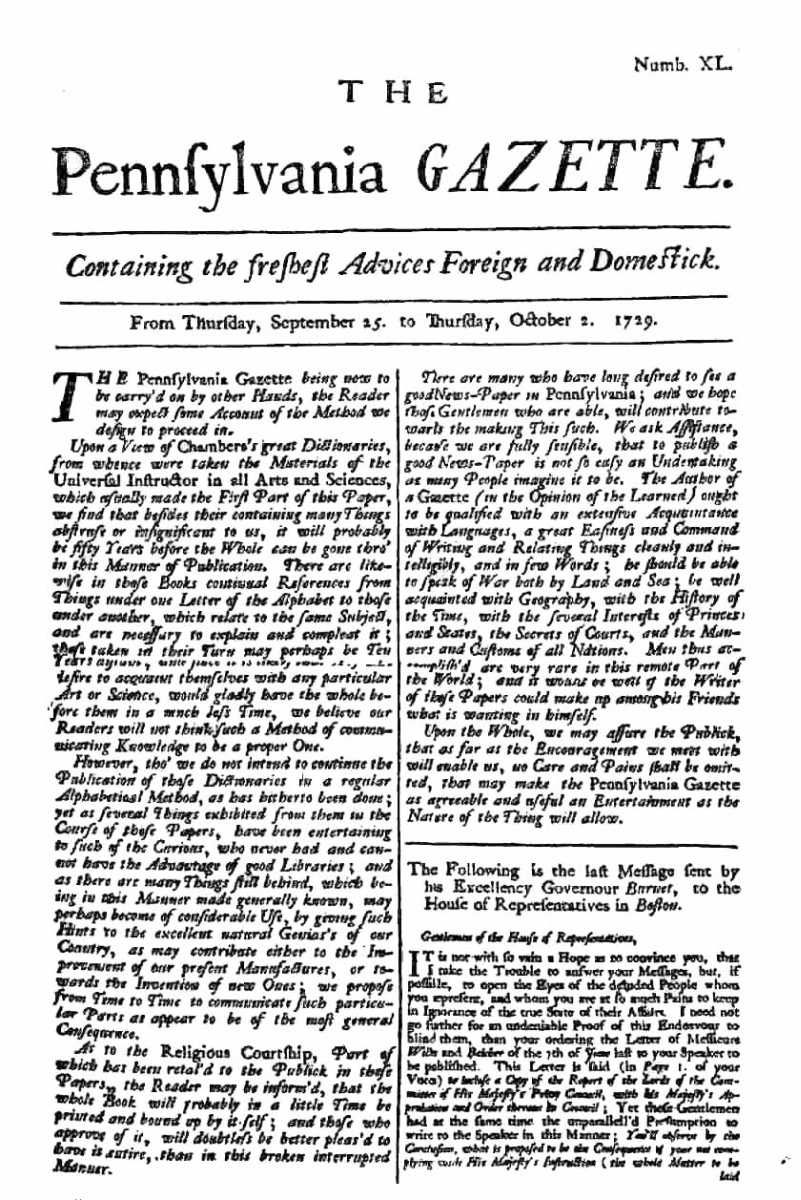
One of Keimer's workmen, Hugh Meredith, proposed that he and Franklin set up together, with money from Meredith's father. Franklin agreed, and in 1728 the partners hired a house near the market and opened what they called the New Printing-Office.[43] They intended to start a newspaper, but Franklin mentioned the plan to George Webb, who passed it on to Keimer. On October 1, 1728, Keimer forestalled them with proposals for a paper of his own, which he gave the grand title The Universal Instructor in All Arts and Sciences: and Pennsylvania Gazette.[44] Franklin answered with satirical essays signed "The Busy Body," which began on February 4, 1729, in Andrew Bradford's rival paper, the American Weekly Mercury. He wrote the first four and parts of two others, and his friend Joseph Breintnall continued the series. The essays drew readers to Bradford's paper and away from Keimer's.[45] Keimer's paper plodded on, reprinting Ephraim Chambers's Cyclopaedia one entry at a time. In June 1729 his creditors had him seized, and in September he announced that he was leaving Pennsylvania. Franklin and Meredith bought the paper and shortened its title. Their first number of the Pennsylvania Gazette, no. 40, was dated September 25 to October 2, 1729.[46] Their opening address held that a gazette writer needed the knack of "Relating Things cleanly and intelligibly, and in few Words."[47]
Franklin also learned that a printer could prosper by serving the government well. In the spring of 1729 the Pennsylvania Assembly was debating a new issue of paper money, a question the Junto had already argued over. On April 3 the New Printing-Office published Franklin's anonymous pamphlet A Modest Enquiry into the Nature and Necessity of a Paper-Currency. It argued that a plentiful currency would lower interest rates and encourage trade and shipbuilding. Andrew Bradford printed the £30,000 in bills that the Assembly voted that year. When the Assembly authorized £40,000 more in 1731, however, the contract went to Franklin, who called the work "a very profitable jobb and a great help to me."[48] By then he had already won the Assembly's notice. Bradford had printed an address of the House to the governor "in a coarse, blundering manner," so Franklin and Meredith reprinted it correctly and sent a copy to every member. The House then voted them its printers "for the year ensuing."[49] Meredith, who was "seldom sober," decided to go back to farming in North Carolina, and in 1730 the partnership was dissolved, leaving Franklin in sole charge of the business.[50]
Franklin cultivated an appearance to match his ambitions. "I drest plainly," he recalled, and he was seen at no places of idle diversion. To show that he was not above his business, he sometimes "brought home the paper I purchas'd at the stores thro' the streets on a wheelbarrow."[51]
A Wife, a Library, and an Apology
Deborah Read, who had watched the boy with the rolls walk past her door, had married a man named Rogers while Franklin was in London. The marriage soon failed. She refused "to cohabit with him or bear his name," since it was said that he had another wife. He later went off to the West Indies. There was "a report of his death," but "it was not certain," and he had left debts that a new husband might be called on to pay. "We ventured, however, over all these difficulties," Franklin wrote, and on September 1, 1730, he "took her to wife" in what amounted to a common-law marriage. He described the step as correcting "that great erratum," his neglect of her during his London years.[52]
In 1731 Franklin turned the Junto's habit of sharing books into what he called "my first project of a public nature," a subscription library. Each member paid forty shillings to begin and ten shillings a year to buy more books.[53] In the Gazette of June 10 that year, Franklin also explained how he saw a printer's place in public life. Printers, he argued in his "Apology for Printers," were bound to offend somebody, for "if all Printers were determin'd not to print any thing till they were sure it would offend no body, there would be very little printed." He added that he had seen a large printing of Robin Hood ballads sell out within a year while a small edition of the Psalms of David sat unsold on his shelves for twice as long.[54] People bought what amused them.
Richard Saunders, Philomath
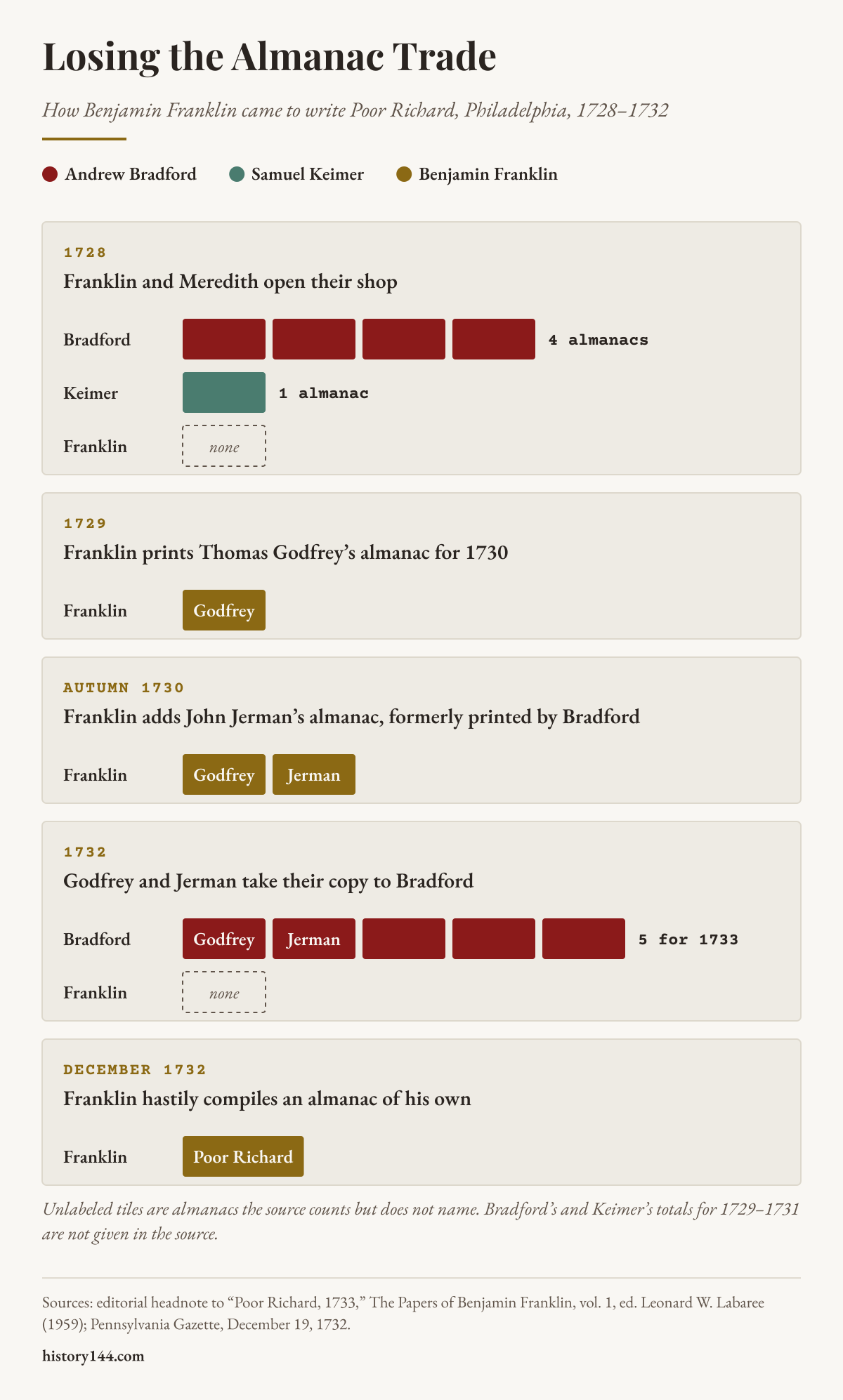
A successful almanac was a valuable source of income to a colonial printer, since readers bought a new one every year. When Franklin and Meredith opened their shop in 1728, Andrew Bradford was printing four almanacs and Keimer one. The New Printing-Office broke into the market in 1729 with Thomas Godfrey's almanac for 1730, and in the autumn of 1730 Franklin added John Jerman's, which Bradford had formerly printed. In 1732, however, both Godfrey and Jerman took their work to Bradford, who prepared to issue five almanacs for 1733. Franklin was left with none, and he hastily compiled one himself.[55]
He borrowed much of it. The name of his supposed author, Richard Saunders, belonged to a seventeenth-century English astrologer. The title was probably suggested by the Poor Robin almanac that James was printing at Newport, and the title page closely resembled Jerman's. About two-thirds of the sayings scattered through the almanacs over the years have been traced to English collections of proverbs and maxims, which Franklin shortened, balanced, and sharpened. James Howell's "The greatest Talkers are the least doers," for example, appeared in the 1733 almanac as "Great Talkers, little Doers."[56] What was his own was the voice he gave Saunders.
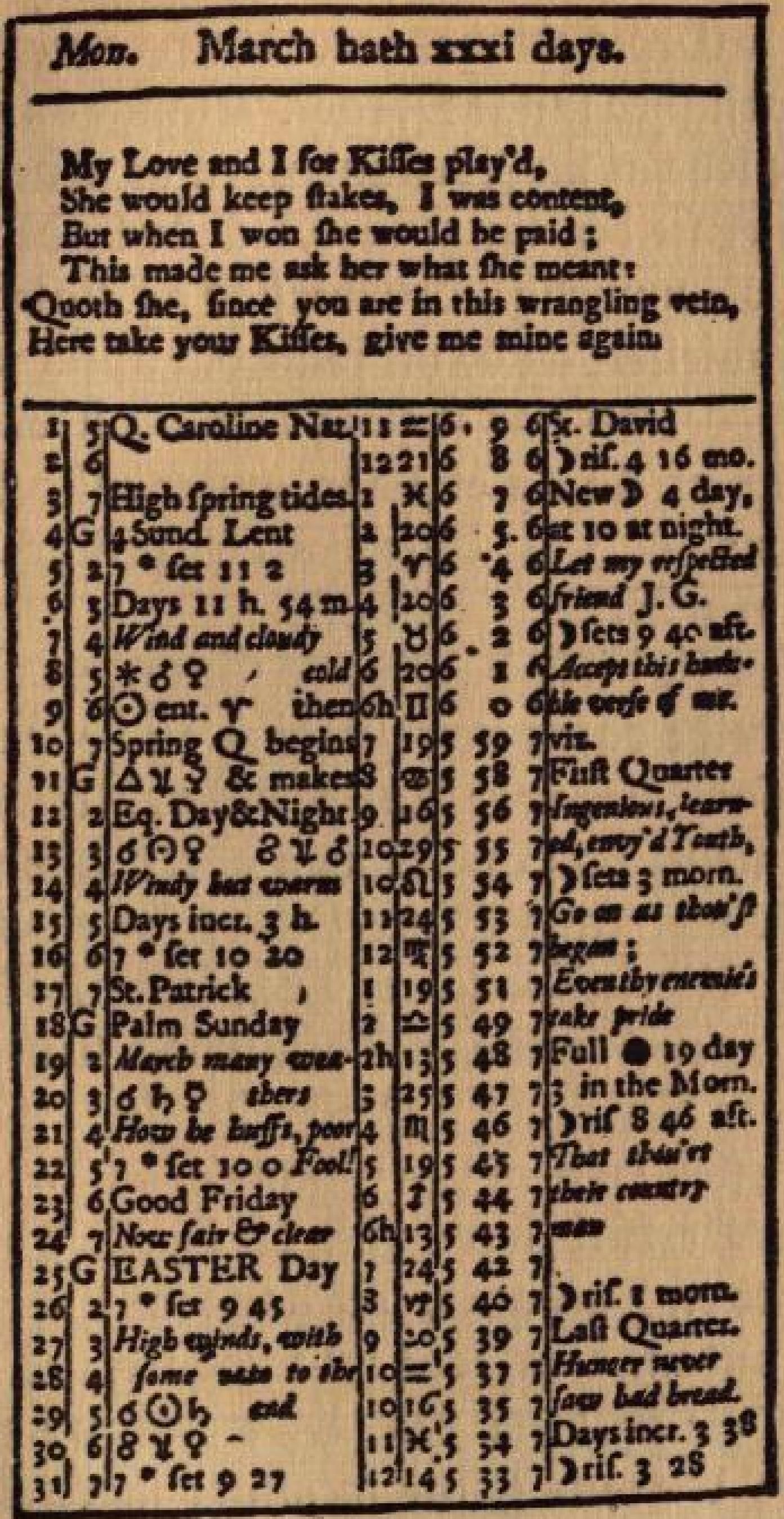
The almanac opened with an address to the "Courteous Reader" in which Richard Saunders confessed that he might pretend to write almanacs with no other view "than that of the publick Good," but that this would not be sincere. "The plain Truth of the Matter is, I am excessive poor, and my Wife, good Woman, is, I tell her, excessive proud." She "cannot bear, she says, to sit spinning in her Shift of Tow," a coarse linen garment, "while I do nothing but gaze at the Stars," and she had "threatned more than once to burn all my Books and Rattling-Traps," as she called his instruments, unless he made some profitable use of them.[57] Here was Silence Dogood's method applied to a new trade. Poor Richard was a hen-pecked, penniless stargazer, and readers could laugh at him while buying his almanac.
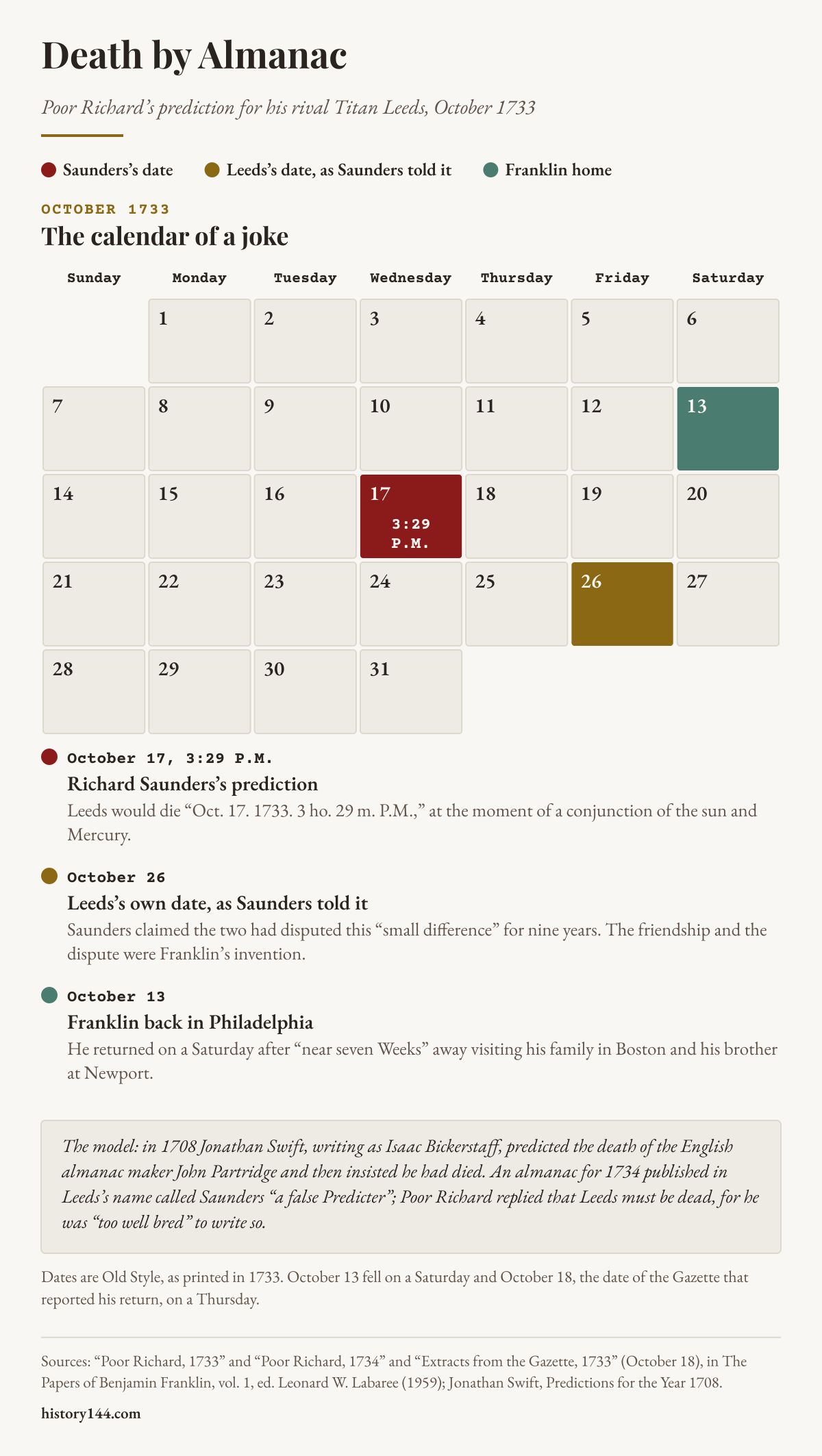
Saunders explained that only his reluctance to hurt his "good Friend and Fellow-Student, Mr. Titan Leeds," had kept him from publishing sooner. The friendship was Franklin's invention. Leeds was in fact his principal rival in the Philadelphia almanac trade. That obstacle, Saunders regretted to say, would soon be removed. By his calculation, made at Leeds's own request, his friend would die "on Oct. 17. 1733. 3 ho. 29 m. P.M.," at the very moment of a conjunction of the sun and Mercury. Leeds, Saunders added, had calculated that he would survive until October 26, and this "small difference between us we have disputed whenever we have met these 9 Years past."[58] The joke followed the model of Jonathan Swift, who in 1708 had predicted the death of the English almanac maker John Partridge and then insisted he was dead when Partridge protested that he was alive. Leeds rose to the bait. The almanac published in his name for 1734 called Saunders a false predicter, and Franklin answered in the preface to Poor Richard's second year that the real Leeds must indeed be dead, since he would never have written so rudely of a friend.[59]
The almanac sold briskly. On January 11, 1733, the Gazette announced a second edition for the following Saturday, adding that a few of the first copies had been printed with September and October transposed, a fault now corrected. A week later it announced a third impression.[60] Only three copies of the 1733 almanac are known today, and their identification is unsettled. Two belong to the third impression. The remaining copy, at the Rosenbach in Philadelphia, has traditionally been called a corrected first impression but may belong to the second, and no copy labeled as the second edition has been found.[61] Franklin would go on publishing Poor Richard for a quarter of a century. In his memoirs he recalled that it was "vending annually near ten thousand" and that he regarded it as "a proper vehicle for conveying instruction among the common people, who bought scarcely any other books."[62]
Ten Years' Absence
By 1733 Franklin had, as he put it, "become easy in my circumstances," and he could at last make the journey "to visit my relations, which I could not sooner well afford."[63] He set out from Philadelphia in the last days of August and was gone for nearly seven weeks. On October 18 the Gazette told its readers that "The Printer of this Paper returned but on Saturday last, from a Journey on which he was absent near seven Weeks." The same notice disowned anything offensive that had slipped into the paper while he was away.[64] Nearly forty years later he told his sister Jane that he had left Boston in 1723 and visited it in 1733, 1743, 1753, and 1763.[65]
In Boston he visited his relations. On the way back he stopped at Newport to see James, who had been printing there since 1727 and who was now "fast declining in his health." In Franklin's words, "Our former differences were forgotten, and our meeting was very cordial and affectionate." James asked that if he died, as he expected to before long, Benjamin would take his son, "then but ten years of age," and bring him up in the printing trade. Franklin promised. After James's death he sent the boy to school for a few years and then took him into his own shop, and in that way, he wrote, "I made my brother ample amends for the service I had depriv'd him of by leaving him so early."[66]
In the twelve years between the first Courant and the reunion at Newport, Franklin went from apprentice to master printer. In his brother's shop he discovered that a newspaper could challenge the authorities and survive, and that an invented voice could reach readers who would never listen to a sixteen-year-old boy. In Philadelphia he learned that public printing paid, that reputation was worth tending, and that a printer who amused his readers could also teach them. Poor Richard combined all of it. When Franklin visited his ailing brother at Newport in the autumn of 1733, the almanac that would make him famous was about to enter its second year. Its name echoed the Poor Robin almanacs James printed in Newport, and the mocking voice of its preface went back to the Courant, where the Franklin brothers had first learned to tease Boston's ministers and magistrates in print.
Places in this Story
The places this story moves through, in order — follow them on the interactive map →
- Queen Street, Boston, Massachusetts August 7, 1721
James Franklin printed the first New-England Courant here during the smallpox epidemic, with Benjamin setting type.
- Blue Ball, Union Street, Boston, Massachusetts Spring 1722
Readers were told that letters for Silence Dogood could be left at the Blue Ball, the house of Josiah Franklin.
- Boston Gaol, Massachusetts June 12, 1722
The sheriff of Suffolk County was ordered to commit the body of James Franklin, printer, to the gaol in Boston.
- Burlington, New Jersey October 5, 1723
Franklin crossed New Jersey by water and on foot, reaching the Delaware and taking a boat down to Philadelphia.
- Market Street Wharf, Philadelphia, Pennsylvania October 6, 1723
He landed on a Sunday morning in his working clothes with three great puffy rolls, one under each arm.
- Bartholomew Close, London, England 1725
Stranded by Governor Keith's empty promises, Franklin set type at Samuel Palmer's printing house here.
- Market Street, Philadelphia, Pennsylvania 1728
Franklin and Hugh Meredith hired a house near the market and opened what they called the New Printing-Office.
- Newport, Rhode Island Autumn 1733
On the way home Franklin stopped to see his brother James, failing in health, and their old quarrel was forgotten.
Frequently Asked Questions
Who was Silence Dogood?
Silence Dogood was a country widow invented by the sixteen-year-old Benjamin Franklin, who slipped her first letter under his brother's printing-house door at night in the spring of 1722. Fourteen letters appeared in the New-England Courant between April and October of that year.
Why was James Franklin jailed in 1722?
The Courant printed a paragraph suggesting the Massachusetts government was slow to fit out a ship against pirates, and the Council called it a high affront. James was committed to the Boston gaol and stayed there until the General Court was prorogued on July 7.
Why did Benjamin Franklin run away from Boston?
After the Council forbade James to print the paper, the brothers published it under Benjamin's name and signed secret indentures that James could not produce without exposing the scheme. Benjamin used that hold to assert his freedom and slipped away on September 23, 1723.
When did Benjamin Franklin arrive in Philadelphia?
He landed at the Market Street wharf on Sunday morning, October 6, 1723, with a Dutch dollar and about a shilling in copper. The date was fixed only in 1980, when an editor of his papers decoded notes he jotted down late in life.
Why did Benjamin Franklin write Poor Richard's Almanack?
Thomas Godfrey and John Jerman took their almanacs to Andrew Bradford in 1732, leaving Franklin with none to print in a trade where readers bought a new one every year. He hastily compiled one himself, and it was advertised as just published on December 19, 1732.
Did Poor Richard really predict Titan Leeds's death?
Richard Saunders predicted that his rival would die on October 17, 1733, at 3:29 in the afternoon, following a joke Jonathan Swift had played on the almanac maker John Partridge in 1708. Leeds rose to the bait, and Franklin replied that the real Leeds must indeed be dead.
Bibliography
Accardo, Peter X. "Three Bostonians and the Smallpox Epidemic of 1721." Houghton Library Blog, Harvard University, June 4, 2020. Accessed November 14, 2026. https://sites.harvard.edu/houghton-library/2020/06/04/three-bostonians-and-the-smallpox-epidemic-of-1721.
Boylston, Zabdiel. An Historical Account of the Small-Pox Inoculated in New England, upon All Sorts of Persons, Whites, Blacks, and of All Ages and Constitutions. London: S. Chandler, 1726. Wellcome Collection. Accessed November 14, 2026. https://wellcomecollection.org/works/gzx6c5qv.
Franklin, Benjamin. "Apology for Printers." Pennsylvania Gazette, June 10, 1731. In The Papers of Benjamin Franklin, vol. 1, January 6, 1706, through December 31, 1734, edited by Leonard W. Labaree. New Haven, CT: Yale University Press, 1959. Founders Online, National Archives. Accessed November 14, 2026. https://founders.archives.gov/documents/Franklin/01-01-02-0061.
Franklin, Benjamin. "Extracts from the Gazette, 1733." Pennsylvania Gazette, January 4 to December 31, 1733. In The Papers of Benjamin Franklin, vol. 1, edited by Leonard W. Labaree. New Haven, CT: Yale University Press, 1959. Founders Online, National Archives. Accessed November 14, 2026. https://founders.archives.gov/documents/Franklin/01-01-02-0106.
Franklin, Benjamin. "Journal of a Voyage, 1726." In The Papers of Benjamin Franklin, vol. 1, edited by Leonard W. Labaree. New Haven, CT: Yale University Press, 1959. Founders Online, National Archives. Accessed November 14, 2026. https://founders.archives.gov/documents/Franklin/01-01-02-0029.
Franklin, Benjamin. "Notes on the Journey from Boston to Philadelphia in 1723, [c. 29 November 1783]." In The Papers of Benjamin Franklin, vol. 41, edited by Ellen R. Cohn. New Haven, CT: Yale University Press, 2014. Founders Online, National Archives. Accessed November 14, 2026. https://founders.archives.gov/documents/Franklin/01-41-02-0161.
Franklin, Benjamin. "Plan of Conduct, 1726." In The Papers of Benjamin Franklin, vol. 1, edited by Leonard W. Labaree. New Haven, CT: Yale University Press, 1959. Founders Online, National Archives. Accessed November 14, 2026. https://founders.archives.gov/documents/Franklin/01-01-02-0030.
Franklin, Benjamin. "Poor Richard, 1733." In The Papers of Benjamin Franklin, vol. 1, edited by Leonard W. Labaree. New Haven, CT: Yale University Press, 1959. Founders Online, National Archives. Accessed November 14, 2026. https://founders.archives.gov/documents/Franklin/01-01-02-0093.
Franklin, Benjamin. "Poor Richard, 1734." In The Papers of Benjamin Franklin, vol. 1, edited by Leonard W. Labaree. New Haven, CT: Yale University Press, 1959. Founders Online, National Archives. Accessed November 14, 2026. https://founders.archives.gov/documents/Franklin/01-01-02-0107.
Franklin, Benjamin. "Silence Dogood, No. 1." New-England Courant, April 2, 1722. In The Papers of Benjamin Franklin, vol. 1, edited by Leonard W. Labaree. New Haven, CT: Yale University Press, 1959. Founders Online, National Archives. Accessed November 14, 2026. https://founders.archives.gov/documents/Franklin/01-01-02-0008.
Franklin, Benjamin. "Silence Dogood, No. 2." New-England Courant, April 16, 1722. In The Papers of Benjamin Franklin, vol. 1, edited by Leonard W. Labaree. New Haven, CT: Yale University Press, 1959. Founders Online, National Archives. Accessed November 14, 2026. https://founders.archives.gov/documents/Franklin/01-01-02-0009.
Franklin, Benjamin. "Silence Dogood, No. 8." New-England Courant, July 9, 1722. In The Papers of Benjamin Franklin, vol. 1, edited by Leonard W. Labaree. New Haven, CT: Yale University Press, 1959. Founders Online, National Archives. Accessed November 14, 2026. https://founders.archives.gov/documents/Franklin/01-01-02-0015.
Franklin, Benjamin. "The Busy-Body, No. 1." American Weekly Mercury, February 4, 1729. In The Papers of Benjamin Franklin, vol. 1, edited by Leonard W. Labaree. New Haven, CT: Yale University Press, 1959. Founders Online, National Archives. Accessed November 14, 2026. https://founders.archives.gov/documents/Franklin/01-01-02-0035.
Franklin, Benjamin. "The Nature and Necessity of a Paper-Currency, 3 April 1729." In The Papers of Benjamin Franklin, vol. 1, edited by Leonard W. Labaree. New Haven, CT: Yale University Press, 1959. Founders Online, National Archives. Accessed November 14, 2026. https://founders.archives.gov/documents/Franklin/01-01-02-0041.
Franklin, Benjamin. "The Printer to the Reader, 11 February 1723." New-England Courant, February 11, 1723. In The Papers of Benjamin Franklin, vol. 1, edited by Leonard W. Labaree. New Haven, CT: Yale University Press, 1959. Founders Online, National Archives. Accessed November 14, 2026. https://founders.archives.gov/documents/Franklin/01-01-02-0023.
Franklin, Benjamin. "The Printer to the Reader, 2 October 1729." Pennsylvania Gazette, October 2, 1729. In The Papers of Benjamin Franklin, vol. 1, edited by Leonard W. Labaree. New Haven, CT: Yale University Press, 1959. Founders Online, National Archives. Accessed November 14, 2026. https://founders.archives.gov/documents/Franklin/01-01-02-0042.
Franklin, Benjamin. Autobiography of Benjamin Franklin. Edited by John Bigelow. Philadelphia: J. B. Lippincott, 1868. Internet Archive. Accessed November 14, 2026. https://archive.org/details/autobiographyofb1868fran.
Franklin, Benjamin. Autobiography of Benjamin Franklin. Project Gutenberg, ebook no. 148. Accessed November 14, 2026. https://www.gutenberg.org/files/148/148-h/148-h.htm.
Franklin, Benjamin. Benjamin Franklin to Jane Mecom, April 13, 1772. In The Papers of Benjamin Franklin, vol. 19, edited by William B. Willcox. New Haven, CT: Yale University Press, 1975. Founders Online, National Archives. Accessed November 14, 2026. https://founders.archives.gov/documents/Franklin/01-19-02-0078.
Huth, Edward J. "Quantitative Evidence for Judgments on the Efficacy of Inoculation for the Prevention of Smallpox: England and New England in the 1700s." Journal of the Royal Society of Medicine 99, no. 5 (2006): 262–66. PubMed Central. Accessed November 14, 2026. https://pmc.ncbi.nlm.nih.gov/articles/PMC1457746.
Labaree, Leonard W., ed. The Papers of Benjamin Franklin. Vol. 1, January 6, 1706, through December 31, 1734. New Haven, CT: Yale University Press, 1959. Table of contents, Packard Humanities Institute. Accessed November 14, 2026. https://www.franklinpapers.org/toc?vol=1.
Massachusetts. Secretary of the Commonwealth. "1721 Boston Smallpox Epidemic." State House Tours: Did You Know? Accessed November 14, 2026. https://www.sec.state.ma.us/divisions/state-house-tours/did-you-know/smallpox.htm.
Matthews, Albert. "Bibliographical Notes: New-England Courant." In Check-List of Boston Newspapers, 1704–1780, by Mary Farwell Ayer. Publications of the Colonial Society of Massachusetts 9. Boston: Colonial Society of Massachusetts, 1907. Accessed November 14, 2026. https://www.colonialsociety.org/node/1582.
New-England Courant (Boston). No. 45, June 4–11, 1722. Transcription. The Electric Ben Franklin, Independence Hall Association. Accessed November 14, 2026. https://www.ushistory.org/franklin/courant/issue45.htm.
Sotheby's. "Poor Richard, 1733. An Almanack for the Year of Christ 1733... The Third Impression." Fine Books and Manuscripts, sale N08562, lot 68. New York, June 2009. Accessed November 14, 2026. https://www.sothebys.com/en/auctions/ecatalogue/2009/fine-books-and-manuscripts-n08562/lot.68.html.
Swift, Jonathan. The Bickerstaff-Partridge Papers. Project Gutenberg. Accessed November 14, 2026. https://www.gutenberg.org/ebooks/1090.
The Rhode-Island Almanack for the Year 1728. By Poor Robin. Newport, RI: Printed and sold by J. Franklin, [1727]. Wellcome Collection catalog record. Accessed November 14, 2026. https://wellcomecollection.org/works/xps3z6cw.
Trenchard, John, and Thomas Gordon. Cato's Letters. Wikisource. Accessed November 14, 2026. https://en.wikisource.org/wiki/Cato%27s_Letters.
University of Pennsylvania Libraries. Catalog record for The Pennsylvania Gazette. Philadelphia: B. Franklin and H. Meredith, 1729–1778. Accessed November 15, 2026. https://find.library.upenn.edu/catalog/9977053695903681.
University of Pennsylvania Libraries. Catalog record for Poor Richard, 1733. An Almanack for the Year of Christ 1733. The third impression. Philadelphia: B. Franklin, [1733]. Accessed November 14, 2026. https://find.library.upenn.edu/catalog/9936263193503681.
University of Virginia. "The Silence Dogood Essays." Introduction. Literature in Context: An Open Anthology. Accessed November 14, 2026. https://anthology.lib.virginia.edu/work/Franklin/franklin-dogood-1.
Citations
- Franklin, "Silence Dogood, No. 1," editorial headnote, which gives the date of the first issue and describes the Courant's opposition to the Mathers and its later targets; Matthews, "Bibliographical Notes: New-England Courant," which places James Franklin's shop in Queen Street. ↑
- Franklin, Autobiography, 102–3. Page numbers for the Bigelow edition are taken from the running heads of the Internet Archive's machine-readable transcription. Quotations were checked against Franklin, Autobiography of Benjamin Franklin (Project Gutenberg), which reproduces the same manuscript version, but the page numbers should be confirmed against the scanned volume. ↑
- Franklin, "Poor Richard, 1733," editorial headnote, which dates the Gazette advertisement to December 19, 1732; Franklin, "Extracts from the Gazette, 1733," entry for January 11, for the second edition; University of Pennsylvania Libraries, catalog record for Poor Richard, 1733, third impression, for the third. ↑
- Franklin, Autobiography, 243; Franklin, "Poor Richard, 1733," editorial headnote, which identifies James's Poor Robin almanac at Newport as the probable source of Franklin's title. ↑
- Matthews, "Bibliographical Notes: New-England Courant." ↑
- Franklin, Autobiography, 102. Franklin's memory was mistaken. The Boston News-Letter (1704) and the Boston Gazette (1719) both preceded the Courant, as did the American Weekly Mercury of Philadelphia (1719). ↑
- Massachusetts, Secretary of the Commonwealth, "1721 Boston Smallpox Epidemic," for the arrival of the Seahorse; Accardo, "Three Bostonians and the Smallpox Epidemic of 1721," for Mather, Boylston, and Onesimus; Huth, "Quantitative Evidence," 262–66, which reports the figures from the table in Boylston, Historical Account (1726), as 247 inoculated and six deaths. Published totals differ: Accardo gives 242 inoculations by Boylston, and other accounts give town-wide totals of about 280, which include patients of other practitioners. The sources consulted do not fully reconcile these figures. The page of Boylston's table was not confirmed. Franklin, "Silence Dogood, No. 1," editorial headnote, for the Courant's opposition. ↑
- Franklin, Autobiography, 94–96. These page numbers could not be confirmed in the transcription and are approximate. ↑
- Franklin, Autobiography, 103; Franklin, "Silence Dogood, No. 1," editorial headnote. ↑
- Franklin, "Silence Dogood, No. 1"; Franklin, "Silence Dogood, No. 2," April 16, 1722, in which she describes her marriage to her "Reverend Master" and says she has "remained in a State of Widowhood for several Years." ↑
- Franklin, "Silence Dogood, No. 1." ↑
- Franklin, "Silence Dogood, No. 1," editorial headnote and its note 6, which identifies the Blue Ball as the house of Josiah Franklin. ↑
- Franklin, "Silence Dogood, No. 1," editorial headnote, which counts fourteen letters; the fourteenth is "Silence Dogood, No. 14," printed October 8, 1722, in Labaree, Papers, 1:43. ↑
- University of Virginia, "The Silence Dogood Essays," introduction, which links the first name to Addison and Steele's "taciturn Mr. Spectator" and the surname to Mather's Bonifacius. Both are interpretations. ↑
- Franklin, "Silence Dogood, No. 1," editorial headnote, which names Harvard among the Courant's targets. ↑
- Franklin, Autobiography, 103–4. The page break between these passages could not be confirmed. ↑
- New-England Courant, no. 45, June 4–11, 1722, transcription by the Independence Hall Association; Matthews, "Bibliographical Notes: New-England Courant," which describes the paragraph as insinuating that the authorities were lukewarm in pursuing a pirate vessel. The captain named in the item is spelled "Papillion" in the transcription and "Papillon" in most modern accounts. ↑
- Matthews, "Bibliographical Notes: New-England Courant," quoting the Council's vote of June 12, 1722, as recorded in the Massachusetts House Journals, including the charge about the Rhode Island letter and the House's concurrence. The charge was the Council's; no independent evidence establishes whether such a letter existed. ↑
- Franklin, Autobiography, 104. ↑
- Matthews, "Bibliographical Notes: New-England Courant," which states that the imprisonment lasted until the General Court was prorogued on July 7, 1722; Franklin, Autobiography, 104; Franklin, "Silence Dogood, No. 8," editorial headnote. ↑
- Franklin, "Silence Dogood, No. 8," and its editorial note, which identifies the source. The abstract came from the London Journal, no. 80, February 4, 1720/21, which printed Cato's Letter No. 15, "Of Freedom of Speech: That the Same Is Inseparable from Publick Liberty"; Trenchard and Gordon, Cato's Letters. ↑
- Matthews, "Bibliographical Notes: New-England Courant," quoting the Council's resolve of July 5, 1722, and the House's nonconcurrence. ↑
- Matthews, "Bibliographical Notes: New-England Courant," which describes the offending issue, quotes the Council's charge that it perverted the Scriptures, prints the committee's report of January 1723 (dated 1722 in the Old Style), and records the Council's arrest order of January 24. ↑
- Franklin, Autobiography, 105; Franklin, "The Printer to the Reader, 11 February 1723," editorial headnote, which quotes the autobiography's "very flimsy Scheme" and "kept private." ↑
- Matthews, "Bibliographical Notes: New-England Courant," quoting the notice of February 11, 1723; Franklin, "The Printer to the Reader, 11 February 1723," for the description of Janus and for James's surrender on February 12. ↑
- Franklin, Autobiography, 105. Franklin dated the opening of the first part of his memoirs 1771. ↑
- Franklin, "Notes on the Journey from Boston to Philadelphia in 1723," editorial headnote, for the dates; Franklin, Autobiography, 106, for the sale of his books and the passage arranged by his friend John Collins. ↑
- Matthews, "Bibliographical Notes: New-England Courant," quoting the Courant of September 30, 1723. ↑
- Franklin, Autobiography, 107. ↑
- Franklin, "Notes on the Journey from Boston to Philadelphia in 1723," editorial headnote. ↑
- Franklin, Autobiography, 111–12. The page break in this passage is uncertain and could be off by a page. ↑
- Franklin, Autobiography, 115, 117; Franklin, "The Busy-Body, No. 1," editorial note 2, which describes Keimer as publisher of the London Post, "imprisoned several times for debt and seditious publications," before he emigrated in 1722. ↑
- Franklin, Autobiography, 136. Modern accounts usually date the sailing to November 1724; that month was not confirmed in the sources consulted. ↑
- Franklin, Autobiography, 138–40. ↑
- Franklin, Autobiography, 141, 146. ↑
- Franklin, Autobiography, 141–42. ↑
- Franklin, Autobiography, 153. ↑
- Franklin, "Journal of a Voyage, 1726," for the departure from London; Franklin, Autobiography, 155, for the landing. ↑
- Franklin, "Plan of Conduct, 1726," including its editorial headnote, which quotes the autobiography and notes that the plan is reprinted from an 1815–17 source because the manuscript is lost. ↑
- Franklin, Autobiography, 156. ↑
- Franklin, Autobiography, 157 and following. The page on which the type-casting passage falls was not confirmed. ↑
- Franklin, Autobiography, 168. The autumn of 1727 is the date generally given for the club's founding; Franklin's text says only "the autumn of the preceding year." ↑
- Franklin, Autobiography, 161, 167; Franklin, "Poor Richard, 1733," editorial headnote, which dates the opening of the New Printing-Office to 1728. ↑
- Franklin, "The Busy-Body, No. 1," editorial headnote, which records that Franklin "incautiously revealed" his plan to George Webb and that Keimer published his proposals on October 1, 1728; Franklin, Autobiography, 178. ↑
- Franklin, "The Busy-Body, No. 1," editorial headnote, quoting a marginal note, probably in Franklin's hand, that he "wrote the first four Numbers, part of No. 5, part of No. 8" and that Breintnall wrote the rest; Franklin, Autobiography, 178. ↑
- Franklin, "The Printer to the Reader, 2 October 1729," editorial headnote, which dates the first issue under the new management to October 2; University of Pennsylvania Libraries, catalog record for the Pennsylvania Gazette, for the numbering "No. 40 (Sept. 25-Oct. 2, 1729)"; Franklin, Autobiography, 178. ↑
- Franklin, "The Printer to the Reader, 2 October 1729." ↑
- Franklin, "The Nature and Necessity of a Paper-Currency," text and editorial headnote; Franklin, Autobiography, 186. ↑
- Franklin, Autobiography, 182. ↑
- Franklin, Autobiography, 184–85. ↑
- Franklin, Autobiography, 187. ↑
- Franklin, Autobiography, 191, for the difficulties, the venture, and the date. The account of Deborah Read's separation from Rogers comes earlier in the narrative; its page was not confirmed. ↑
- Franklin, Autobiography, 194. The subscription terms follow on the same or the next page. ↑
- Franklin, "Apology for Printers." ↑
- Franklin, "Poor Richard, 1733," editorial headnote. ↑
- Franklin, "Poor Richard, 1733," editorial headnote, which prints Howell's line beside Poor Richard's and states that about two-thirds of the sayings and half of the verses have been traced to their sources. ↑
- Franklin, "Poor Richard, 1733." A shift of tow was a coarse undergarment made from the short, rough fibers of flax or hemp. ↑
- Franklin, "Poor Richard, 1733," text and editorial headnote. The friendship and the nine-year dispute belong to Richard Saunders's fictional preface; nothing establishes that Franklin and Leeds had ever been fellow students. The transcription prints the conjunction with astronomical symbols. ↑
- Franklin, "Poor Richard, 1734," preface, which quotes and answers the almanac published in Leeds's name; Franklin, "Poor Richard, 1733," editorial headnote, which describes the hoaxes as "Swiftian"; Swift, "Predictions for the Year 1708" and "The Accomplishment of the First of Mr. Bickerstaff's Predictions," in The Bickerstaff-Partridge Papers. ↑
- Franklin, "Extracts from the Gazette, 1733," entry for January 11 and its note 5; University of Pennsylvania Libraries, catalog record for Poor Richard, 1733, third impression, which cites C. William Miller's bibliography for an announcement in the Gazette of January 18, 1733, that the third impression would be published "Saturday next." Dates are given as printed in the Gazette. Under the Old Style calendar then in use, the legal year began on March 25, so these January issues fell in the year 1732/33. ↑
- Sotheby's, "Poor Richard, 1733... The Third Impression," lot 68, which describes the copy rediscovered at the Berwick Historical Society, the Library Company copy of the third impression, and the Rosenbach copy, "traditionally described as a corrected issue [of] the first impression, but possibly the second impression." The Franklin Papers headnote, written before the Berwick copy came to light, says that only one copy each of the first and third printings was known. A bibliography published by the American Philosophical Society counts the copies differently, so the census of surviving copies should be treated as uncertain. ↑
- Franklin, Autobiography, 235–36. ↑
- Franklin, Autobiography, 243. ↑
- Franklin, "Extracts from the Gazette, 1733," entry for October 18, with the editors' note 7 identifying the journey as the visit to Boston and Newport. The departure date is inferred: "Saturday last" was October 13, 1733, and an absence of nearly seven weeks places Franklin's departure in the last week of August. ↑
- Franklin to Jane Mecom, April 13, 1772. ↑
- Franklin, Autobiography, 243–44; The Rhode-Island Almanack for the Year 1728, whose imprint reads "Newport... Printed and sold by J. Franklin" and which was issued in 1727. ↑