On June 21, 1776, the Colony of the Massachusetts Bay authorized £100,000 in new paper money. The bills, dated three days earlier, were printed on coarse paper by Benjamin Edes, one of the publishers of the patriot newspaper the Boston Gazette, in denominations running from three pence to eight dollars. The larger notes carried a small oval picture adapted from an earlier design by Paul Revere: an American soldier with a sword in his right hand and, in his left, a scroll marked with the initials of Magna Charta. A six-dollar bill entitled the bearer to receive thirty-six shillings in lawful money out of the treasury by June 18, 1778, and it "shall be received for that Sum in all Payments, agreeable to an Act of said Colony."[1] The bill made two separate commitments. The promise to pay lawful money by 1778 was an obligation of the treasury, which might or might not be able to meet it when the time came. The clause requiring the bill to be received in all payments was a command of law. It made the bill a legal tender, so that a creditor had to take it at face value, but no act of the legislature could make it hold its value in the market.
Independence was less than two weeks away, and the bill still called Massachusetts a colony. The habit it represented of paying public bills with paper promises and requiring everyone to take them would outlast the war. The United States began its independent life without a single chartered bank, without a national mint, and without any agreed way to raise revenue. It paid for its war by printing promises, and the states printed their own promises alongside Congress. Over the next twelve years the paper collapsed, Americans improvised their first true banks out of wartime desperation, a backlash against those banks nearly destroyed the oldest of them, and a fresh round of state paper money helped bring on a crisis that ended at the Constitutional Convention. By 1788 the country had a handful of working banks and a new constitution that forbade any state to "emit Bills of Credit" or to "make any Thing but gold and silver Coin a Tender in Payment of Debts," the very powers Massachusetts had used on that June day.[2] This is the story of those twelve years.
A Country Without Banks
The colonies had never had a bank in the modern sense, an incorporated institution that took deposits, made loans, and issued notes redeemable in coin. What they had instead was long experience with government paper. Colonial assemblies had issued bills of credit since Massachusetts printed the first ones in 1690. A bill of credit was a government note that bore no interest and circulated as money, to be retired later out of taxes. Its weakness was well known: assemblies tended to print more than their taxes could redeem, and the bills lost value.[3]
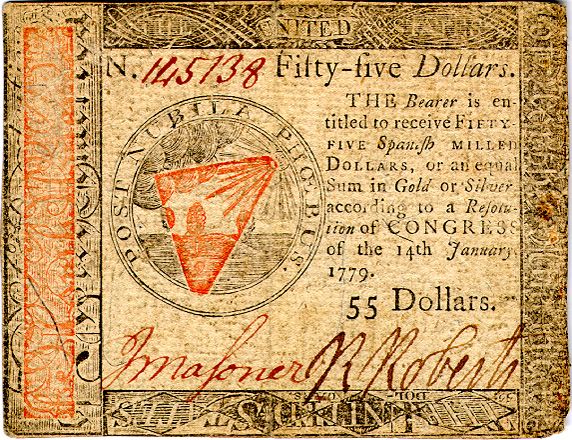
When fighting broke out in 1775, the old habit returned at once. Massachusetts was the first colony to issue bills of credit after Lexington and Concord, to pay its militia, and Connecticut issued bills of its own on June 7 and June 19, 1776, in the same weeks as the Massachusetts emission.[4] Massachusetts issued more that autumn, and the bills followed the turn of events. On notes dated November 17, 1776, a standing figure of an American on the back held a rolled document that read "Independance," the engraver’s misspelling, where an earlier version had read "Magna Charta."[5] Congress had begun its own Continental currency in June 1775, and on July 22, 1776, less than three weeks after it voted for independence, it ordered another five million dollars printed.[6] The bills came off the presses of Hall and Sellers in Philadelphia on paper made at Ivy Mills in Chester County, with blue fibers and flakes of mica pressed into it to frustrate counterfeiters. The emission left out the one-dollar bill, apparently because Congress expected a Continental coin to take its place.[7] Neither the states nor Congress could easily raise taxes in the middle of a rebellion against taxation, and paper was the quickest way to buy food, powder, and wagons. The sums grew large. Between 1775 and 1779 Congress authorized $241,552,780 in bills of credit, and the states issued another $209,524,776. These are face values added up across five years of emissions, not the amount of money circulating at any one time.[8]
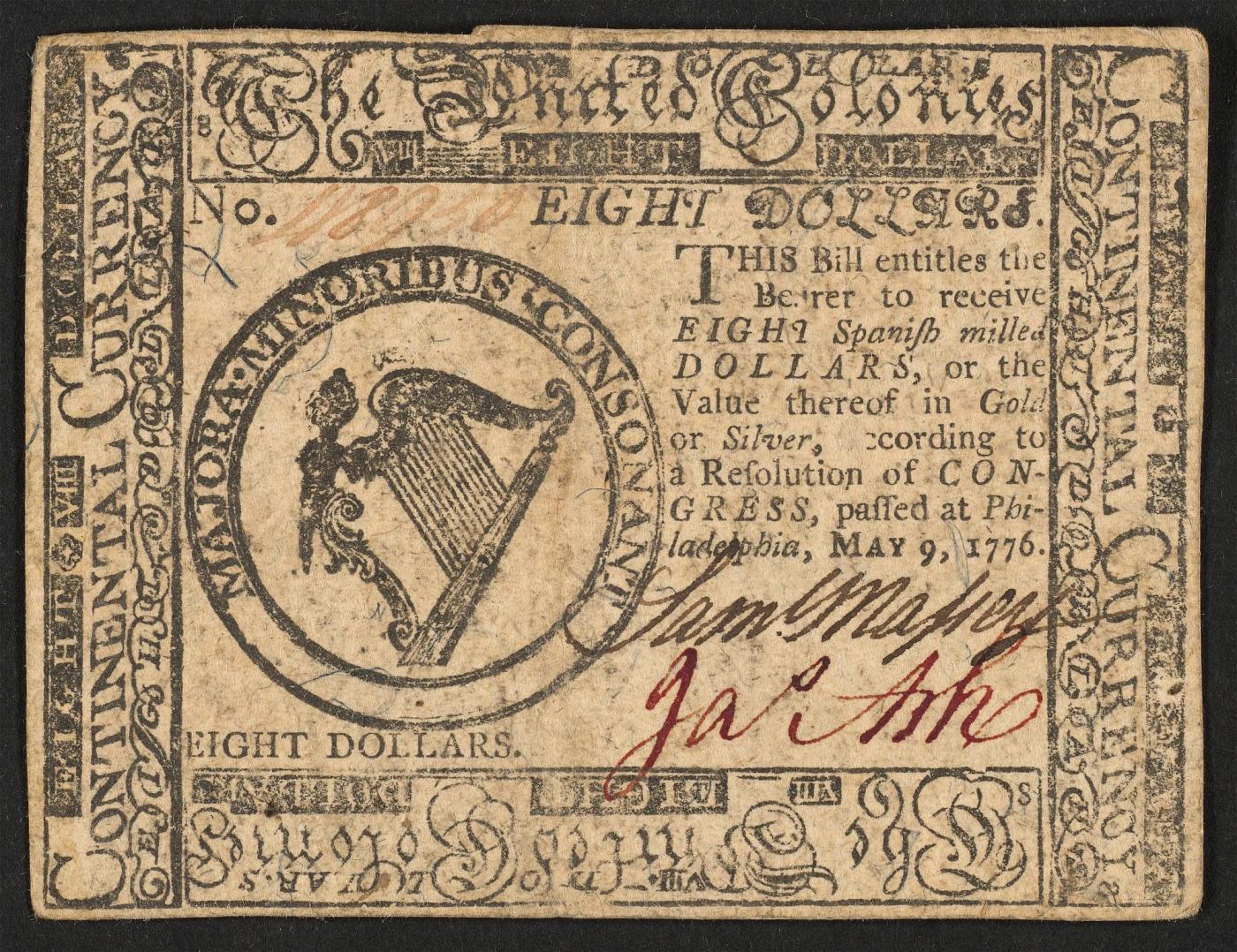
Two kinds of paper money were therefore competing for the same goods. The states issued their notes to meet their own expenses and used what little tax money they collected to redeem their own bills. They did not set aside much to retire the Continental currency, for which they were jointly responsible.[9] The Articles of Confederation, first drafted in July 1776, would not take effect until 1781, and in the meantime the money supply was governed by necessity rather than by any constitution.
Borrowing on Promise
By the autumn of 1776, Congress was already looking for a way to raise money without printing still more of it. On October 3 it resolved to borrow five million Continental dollars at four percent interest. It set up a loan office in each state, each under its own commissioner. Lenders would receive certificates promising repayment, with interest paid yearly at the same office, at the end of three years.[10] The loan offices were the closest thing the new nation had to a public financial institution. They depended entirely on public confidence that Congress would pay.
That confidence was thinning. Merchants and farmers had begun to price goods differently depending on whether they were paid in coin or in paper. On January 14, 1777, Congress tried to stop the practice by decree. It declared that all bills of credit issued by its authority should pass current in all payments at the value of the Spanish dollars printed on them. It also called for penalties against anyone who refused the bills or charged more for goods in paper than in coin.[11] A currency that has to be propped up by penalties is one that people have already stopped trusting, and the law did little to slow the slide. Later in 1777 Congress went further and asked the states to stop issuing currency of their own altogether.[12]
Each new emission made sense in the week it was ordered, but the cumulative effect was a steady rise in prices that fell hardest on soldiers paid in Continental dollars and on anyone owed a fixed sum. The decline was uneven from place to place. In January 1781 one dollar in coin traded for about seventy-five Continental dollars in most states, but for 110 in Maryland and 210 in North Carolina.[13] By then the bills had become a byword for worthlessness, captured in the saying "not worth a Continental."
A Wonderful Machine
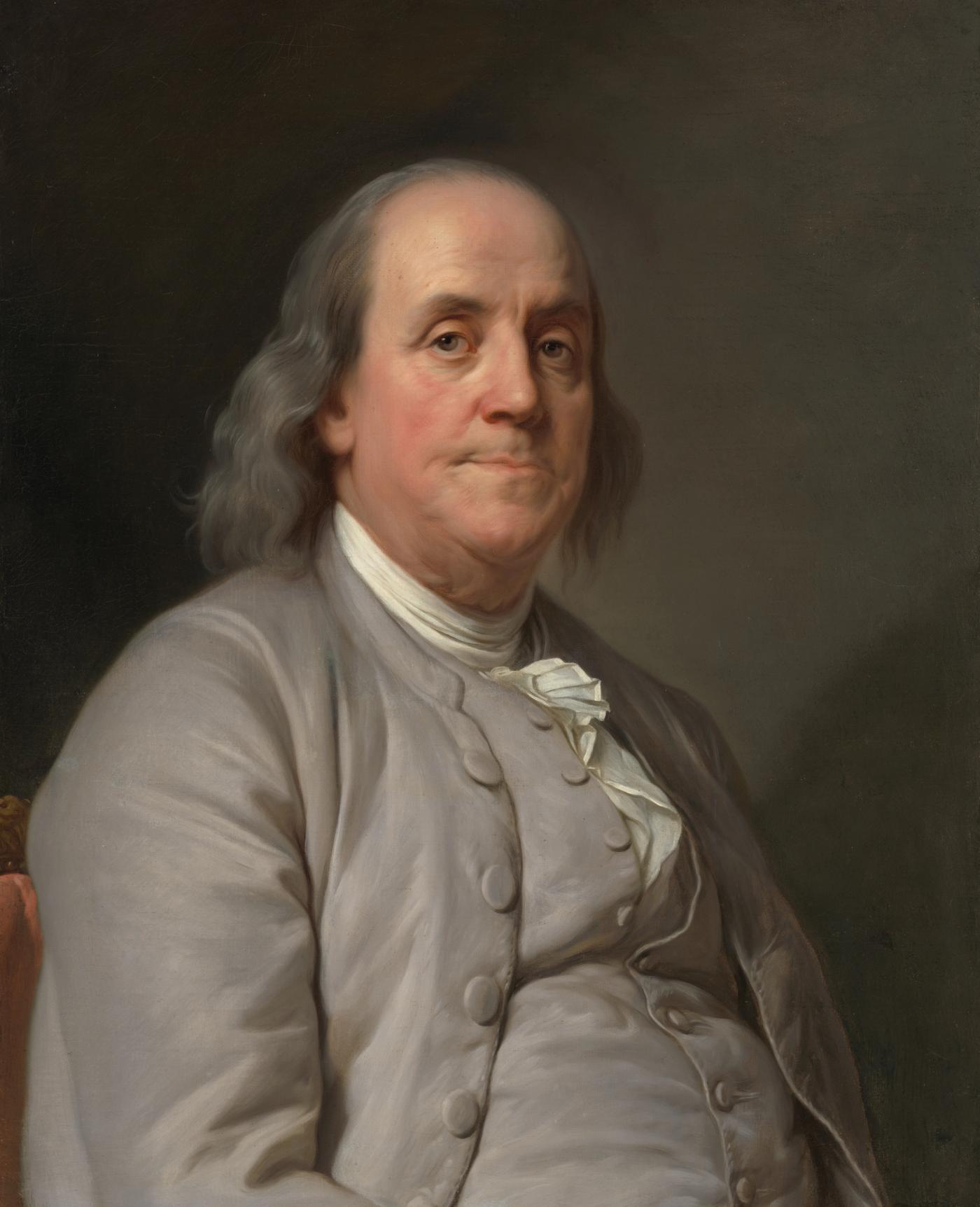
Benjamin Franklin, who had written in favor of colonial paper money as a young printer, watched the depreciation from his post in France with a mixture of resignation and wry admiration. Writing to the Boston minister Samuel Cooper on April 22, 1779, he observed that the currency, as Congress managed it, was "a wonderful Machine." It paid the troops and bought their supplies when it was issued, and then, as its value fell, it wore away the debt by itself. Franklin described the loss as "a Kind of imperceptible Tax," paid by everyone who had held the money while it declined.[14]
Franklin's description was accurate in its way, but the tax was neither fair nor imperceptible to those who bore the most of it. By early 1780 Congress concluded that the old currency could not be saved. On March 18, 1780, it adopted a plan to call in the outstanding Continental bills at a rate of forty paper dollars to one dollar in silver, and to replace them with a smaller issue of new notes backed by the states.[15] The "forty for one" act was, in effect, a partial repudiation, and it was understood that way at the time. It also left Congress without a reliable means of payment just as the war entered one of its hardest phases.
The new bills fared little better than the old ones, and by the spring of 1780 the army was short of food and clothing. The answer to that crisis came from a group of private citizens in Philadelphia.
The Subscription of 1780
In early June 1780 a letter from General George Washington was read to the Pennsylvania Assembly. Washington warned that among his troops "the appearance of mutiny and discontent were so strongly marked" that he feared what each hour might bring. Thomas Paine, then clerk of the Assembly, later described his own response in a pamphlet written to defend the bank, so his account is not a neutral one. He enclosed five hundred dollars in a letter to the Philadelphia merchant Blair M'Clenaghan, proposing that M'Clenaghan start a voluntary subscription among his friends for the army. M'Clenaghan presented the letter at a meeting at the Coffee-house, and the subscription began. According to Paine, the first list raised four hundred pounds in hard money and £101,360 in Continental paper.[16]
The donations were a gesture, but the merchants soon turned them into something more durable. On June 17, 1780, a meeting resolved to open a subscription "to the amount of three hundred thousand pounds, Pennsylvania currency, in real money." The money was to form a bank for supplying the army.[17] This Pennsylvania Bank, as it came to be called, had no charter of incorporation and existed to serve the army rather than ordinary commerce. It nonetheless did what Congress could not. In Paine's account, the army was supplied through the campaign by means of this bank.[18] The lesson was not lost on the men who organized it. Pooled private capital, backed by the reputations of solvent merchants, could command credit that the government itself no longer had.
Mr. Morris's Bank
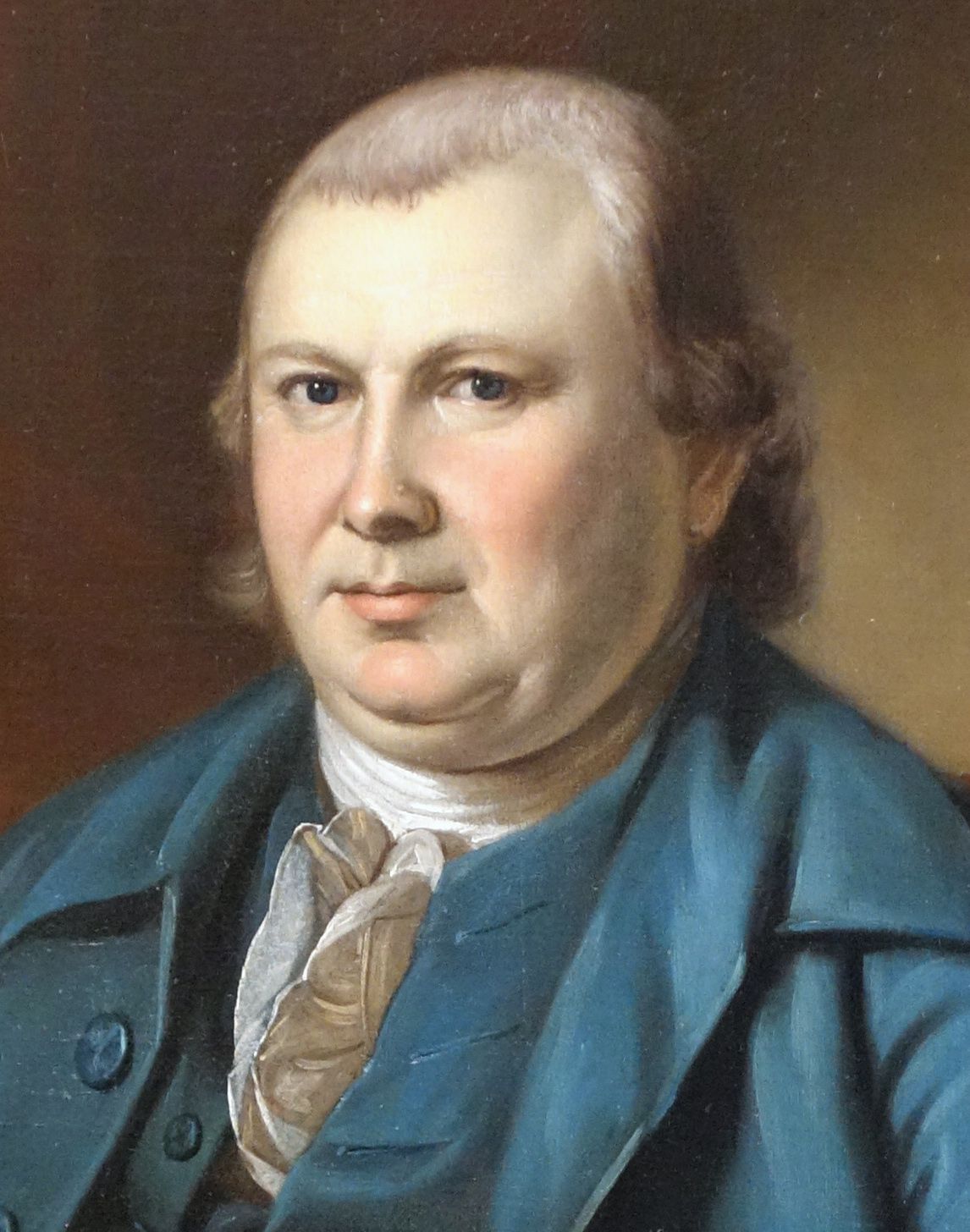
The leading figure among those merchants was Robert Morris, a Philadelphia merchant of great wealth and wide connections. In 1781 Congress, desperate for someone who could restore its credit, elected Morris to a new office, superintendent of finance. He accepted on terms that gave him wide control over federal spending, and he set out at once to build the institution the country lacked.
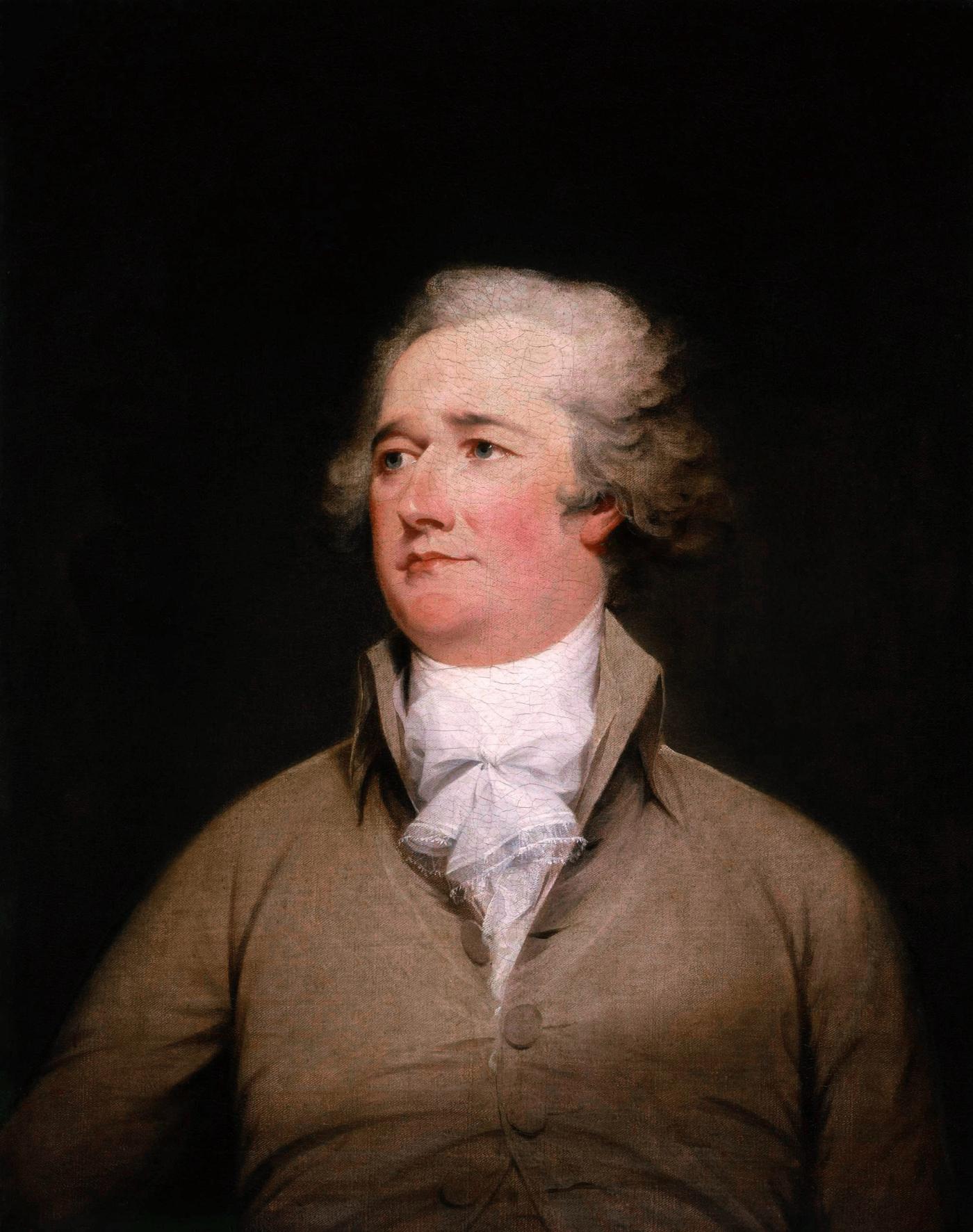
Others had been thinking along the same lines. On April 30, 1781, Alexander Hamilton, a young officer who had recently left Washington's staff, wrote Morris a long letter on the nation's finances. "I mean the institution of a National Bank," Hamilton wrote of the remedy he proposed, adding that he regarded such a bank "in some shape or other as an expedient essential to our safety and success."[19] Morris had his own plan. He laid it before Congress in a letter of May 17, 1781, and on May 26 Congress resolved to "approve of the plan for establishing a national bank in these United States." Under the plan, the subscribers would become a corporation called the Bank of North America once their subscriptions were filled.[20]
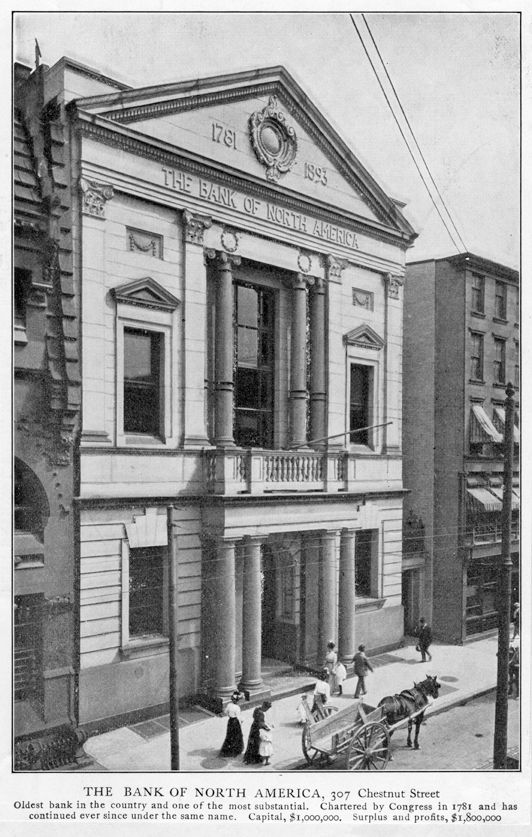
Congress granted the bank a charter of incorporation on December 31, 1781, and Pennsylvania granted one as well. The Bank of North America opened for business in January 1782 on Chestnut Street in Philadelphia, with Thomas Willing, Morris's former business partner, as its first president. It superseded the Pennsylvania Bank of 1780. The bank made loans to the government, discounted merchants' notes, and issued notes of its own that were redeemable in coin. The government itself held shares at the start, but Morris did not mean it to remain an owner. By April 1783 he had disposed of the last of the government-owned shares, and the bank became an entirely private institution.[21]
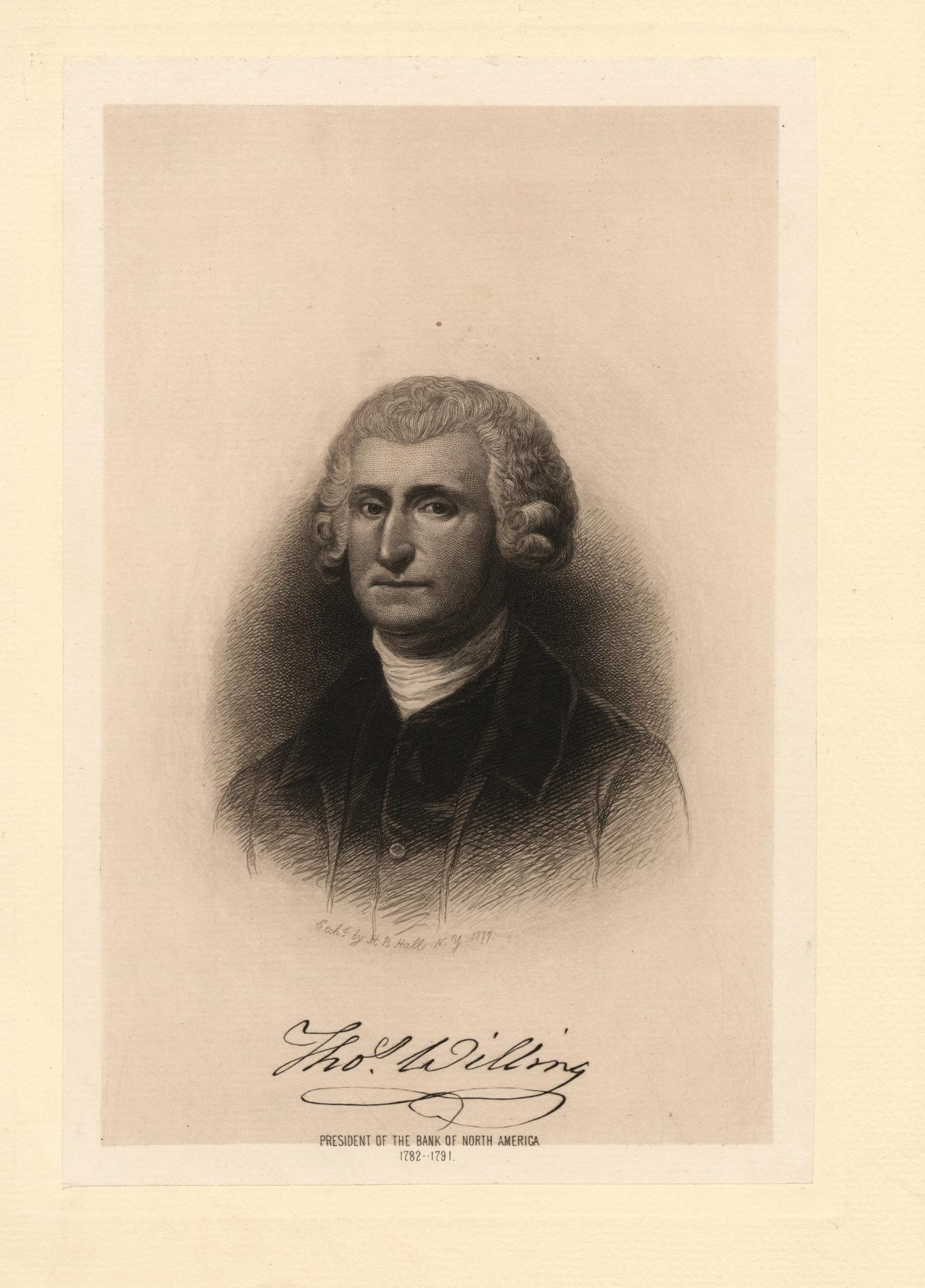
For its supporters, the Bank of North America was evidence that credit could be built on solid ground. For its critics, it would soon become something else: a concentration of private money and political influence in the hands of a few Philadelphia merchants.
Banks Multiply
Once the war ended, the example of the Bank of North America spread north. In Boston, a group of merchants obtained a charter for the Massachusetts Bank on February 7, 1784, signed by Governor John Hancock. The bank opened on July 5, 1784, in the Manufactory House near Boston Common, with a capital of $300,000. Its first president was James Bowdoin, a wealthy merchant and former leader of the patriot cause in Massachusetts.[22]
In New York the founding of a bank became a contest between two ideas of what a bank should be. Early in 1784 a group petitioned the New York legislature for an exclusive charter for a land bank, which would have issued notes secured by mortgages on real estate rather than by gold and silver. Hamilton, by then a lawyer in New York City, opposed the scheme as impractical. Its public sponsor was Stephen Sayre, but Hamilton suspected that Chancellor Robert R. Livingston "was the true father" of the plan. The city's merchants answered by opening a subscription for a bank founded on coin. Hamilton subscribed, helped revise its rules on stockholder voting, and was chosen a director.[23] The Bank of New York began operating in June 1784, with Alexander McDougall, a former Continental general, as its president.[24] Unlike the Massachusetts Bank, it would operate for years without a charter from the state legislature.
There were now three banks in the United States, one each in its three largest commercial cities. In Philadelphia, meanwhile, a rival bank was proposed in 1784. Rather than compete, the two sets of shareholders were merged, in what has been described as the first bank merger in American history.[25]
The Attack on the Bank
Pennsylvania's politics in the 1780s were bitterly divided between the eastern merchants of Philadelphia and the farmers of the western counties. To many westerners, the Bank of North America looked like an engine of privilege. Its opponents charged that it served merchants rather than farmers, that its directors held too much power for a private body, and that its preference for coin stood in the way of the paper money that indebted farmers wanted. In 1785 the Pennsylvania Assembly repealed the act that had incorporated the bank. The bank did not close. It obtained a charter from Delaware and continued to operate in Philadelphia without a Pennsylvania charter.[26]
The repeal set off one of the first great public debates over banking in the United States. Memorials asking the Assembly to restore the charter led to a long debate in 1786, and the speeches were published in Philadelphia that year under the title Debates and Proceedings of the General Assembly of Pennsylvania, on the Memorials Praying a Repeal or Suspension of the Law Annulling the Charter of the Bank.[27]
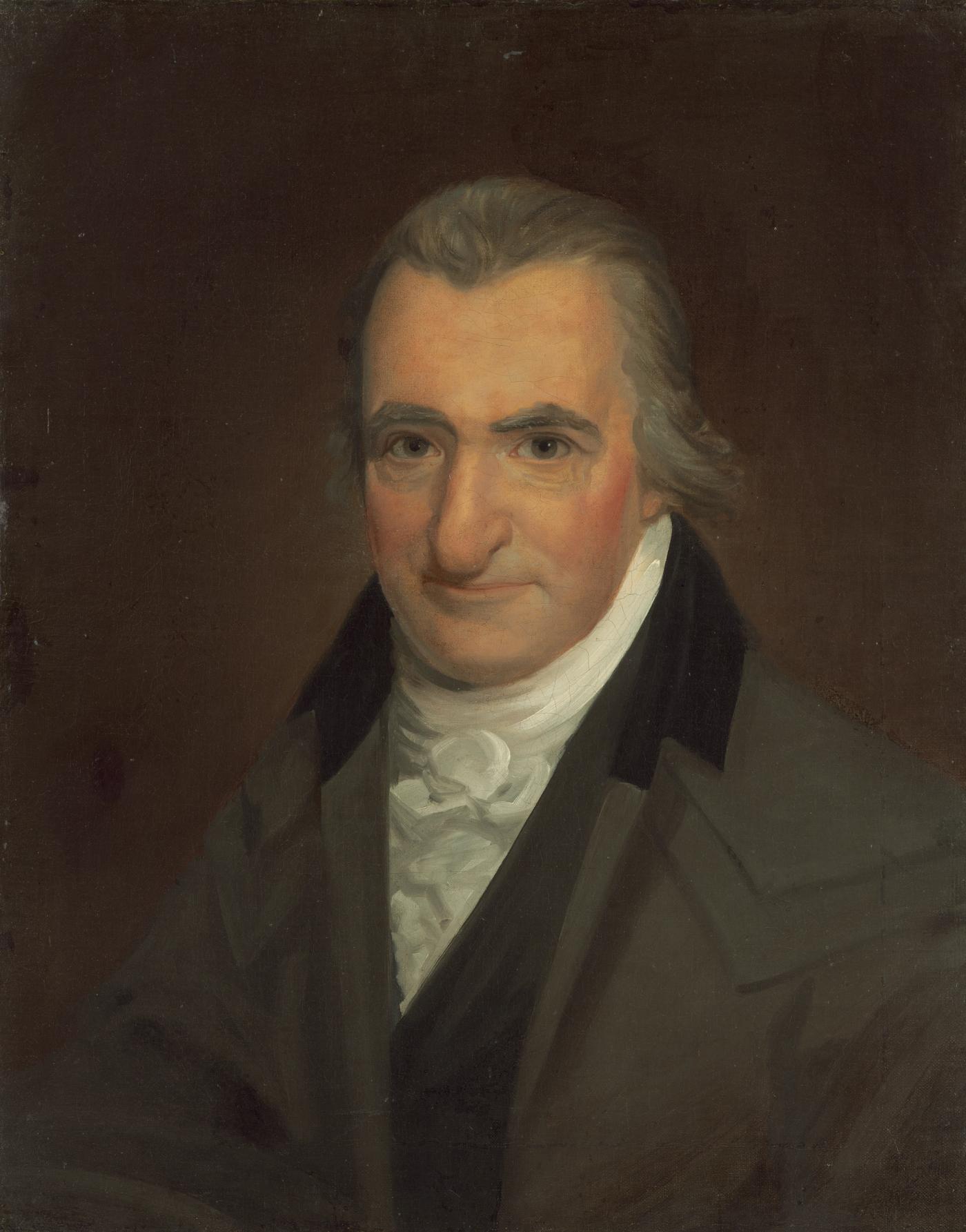
The most famous defender was Thomas Paine, whose early support for the subscription of 1780 gave him standing to speak. In a pamphlet dated February 18, 1786, Dissertations on Government; the Affairs of the Bank; and Paper Money, he called the repeal "the attack on the Bank, as a Chartered Institution," and argued that the government's only contribution to the bank had been to incorporate it. He reserved his sharpest language for the paper money that the bank's opponents hoped to issue. "AS to paper-money, in any light it can be viewed, it is at best a bubble," he wrote, and he called it the basest of all the sorts of base coin.[28] The author of Common Sense, the great pamphlet of popular revolution, had become a defender of hard money and corporate charters.
The bank's supporters eventually won. In March 1787 the Pennsylvania legislature restored the bank's charter, this time for a limited term of fourteen years.[29] The fight had shown how much a bank's standing within a state could depend on the votes of a single assembly.
Paper Money Returns
The debate over the bank in Pennsylvania was one part of a broader crisis. The peace of 1783 brought a flood of British imports, contributing to the outflow of gold and silver from the country. Merchants pressed their customers for payment in coin, creditors took debtors to court, and states that had to pay their war debts raised taxes. In several states, debtors and farmers demanded new issues of paper money and laws compelling creditors to accept it.
Rhode Island went furthest. In 1786 its legislature issued new paper bills and passed laws to punish anyone who refused them at face value. A Newport butcher named John Weeden refused to accept the paper from a customer, John Trevett, in payment for meat, and Trevett filed a complaint. The case came before the state's Superior Court at Newport in its September term of 1786. Weeden's lawyer, James Mitchell Varnum, argued that the penalty law violated the right to trial by jury and was therefore void. The judges dismissed the complaint. Accounts of exactly what the court held have differed, but the legislature evidently treated the judgment as a declaration that its law was unconstitutional. At its October session it summoned the judges to give their reasons "for adjudging an act of the General Assembly unconstitutional, and so void." Varnum published his argument the following year.[30]
In Massachusetts the legislature refused to issue paper money and kept up heavy taxes to pay the state's war debt, and the result was rebellion rather than a lawsuit. Farmers in the western counties faced tax bills, suits for private debts, and court costs at a time when coin was scarce. Through the summer and autumn of 1786, armed bands of them closed the courts that were hearing debt cases. James Bowdoin, the former president of the Massachusetts Bank, was now governor, and he took a hard line against the insurgents. The uprising, led in part by a former Continental captain named Daniel Shays, ended after a failed attack on the federal arsenal at Springfield in January 1787.
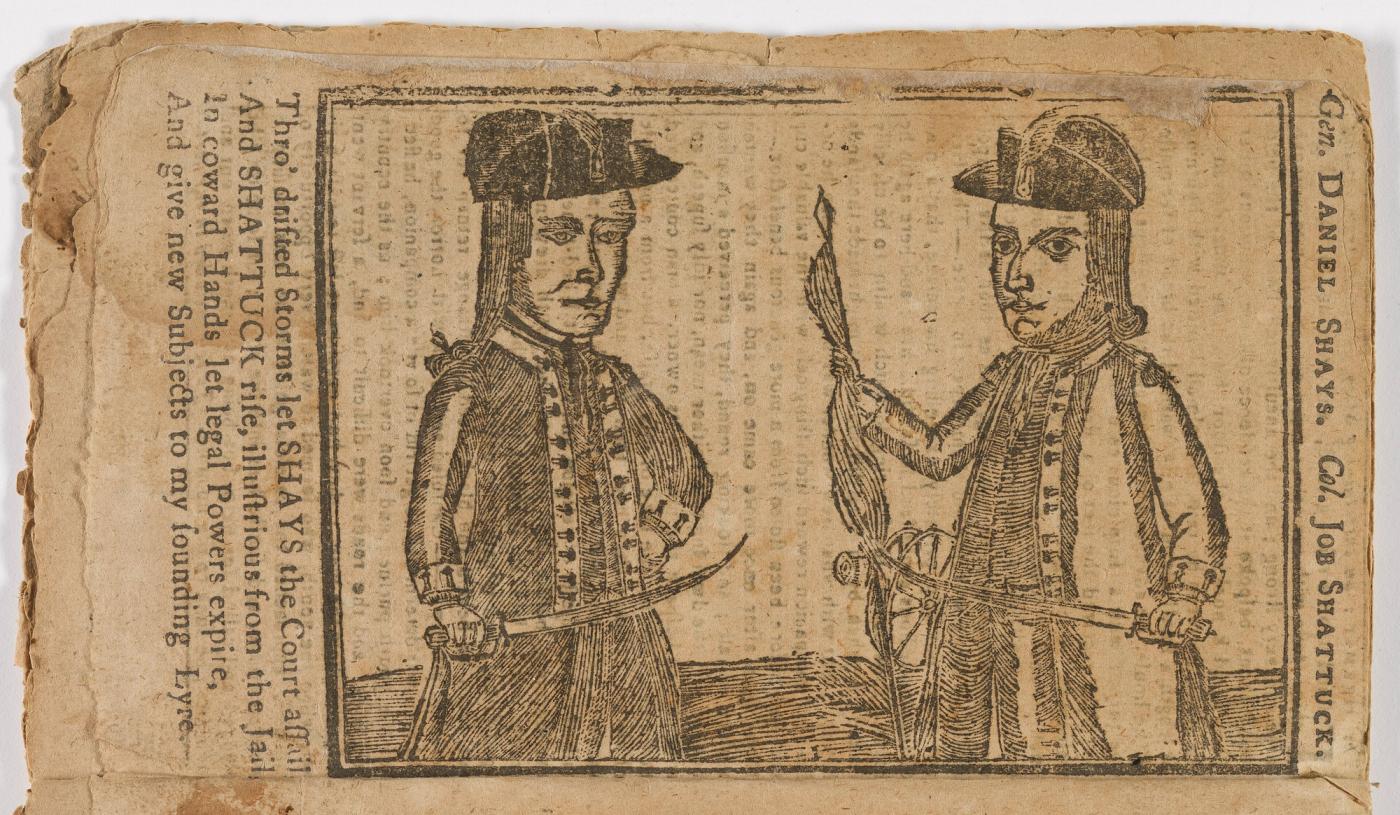
The rebellion alarmed men far from Massachusetts, and it shaped how they understood the paper money question. Henry Knox, the secretary at war, had just returned from Massachusetts, and he sent Washington a vivid and hostile account of what he had found. Washington passed it on to James Madison in a letter of November 5, 1786. According to Knox, the insurgents were "determined to anihilate all debts public & private" and to have agrarian laws, "which are easily effected by the means of unfunded paper money which shall be a tender in all cases whatever."[31] Knox wrote as an alarmed opponent of the insurgents rather than a neutral observer. To the men who would meet in Philadelphia the following summer, however, it tied paper money directly to disorder.
Shut and Bar the Door
The Constitutional Convention met in Philadelphia from May to September 1787, a few blocks from the Bank of North America. The first draft of the new constitution, reported in August, gave Congress the power to borrow money "and emit bills on the credit of the United States." On August 16, Gouverneur Morris of Pennsylvania moved to strike out the power to emit bills. "If the United States had credit such bills would be unnecessary," he argued; "if they had not, unjust & useless." Madison asked whether it would be enough to forbid making the bills a legal tender. Oliver Ellsworth of Connecticut thought it "a favorable moment to shut and bar the door against paper money." George Read of Delaware said the words, if kept, would alarm the public as much as "the mark of the Beast in Revelations." John Langdon of New Hampshire said he would rather reject the whole plan than keep them. The motion passed nine states to two, with only New Jersey and Maryland voting no. In a note to his record of the debate, Madison explained that he had voted for the motion because it would cut off the pretext for a paper currency, especially for making the bills a tender in public or private debts.[32]
On August 28 the delegates turned to the states. The draft forbade states to emit bills of credit or to make anything but gold and silver coin a tender, but only without the consent of Congress. James Wilson of Pennsylvania and Roger Sherman of Connecticut moved to make the ban absolute. Sherman thought it a "favorable crisis for crushing paper money." Eight states voted for the absolute ban on bills of credit, Virginia voted against it, and Maryland was divided. The ban on making anything but gold and silver a tender passed without dissent.[33] In its final form, Article I, Section 10 of the Constitution provided that "No State shall … coin Money; emit Bills of Credit; make any Thing but gold and silver Coin a Tender in Payment of Debts."[34]
Madison defended the clause during the ratification debate. Writing as "Publius" in The Federalist No. 44, first printed in the New York Packet on January 25, 1788, he wrote that the prohibition "must give pleasure to every citizen, in proportion to his love of justice and his knowledge of the true springs of public prosperity." He blamed "the pestilent effects of paper money" for the loss of confidence between citizens and in the public councils since the peace.[35] For Madison and his allies, the paper money of the 1780s had been an economic mistake and, worse, a threat to the trust on which republican government depended.
The Ninth State
On June 21, 1788, twelve years to the day after the Massachusetts act, New Hampshire became the ninth state to ratify the Constitution, meeting the threshold the document itself set for its establishment among the states that approved it. The new government would not begin operating until March 4, 1789, and North Carolina and Rhode Island had not yet ratified. With New Hampshire's vote, however, the settlement was fixed: once the Constitution went into operation, no state could emit bills of credit or make anything but gold and silver coin a legal tender. The age of state paper money as legal tender, which had begun with the Massachusetts emissions of 1690 and revived with such force in 1775, was coming to an end.
The twelve years that ended in 1788 had begun with a Massachusetts bill that promised lawful money its treasury did not have and required everyone to take it in all payments. They ended with a Constitution that prohibited the states from emitting bills of credit and from making anything but gold and silver coin a legal tender for debts. In between, Americans had learned in the hardest way what happened when governments paid their bills with paper that nothing stood behind. They had also learned, through the Pennsylvania Bank of 1780 and the Bank of North America, that credit could be built in another way. The Bank of North America combined private subscriptions and commercial lending with a public charter and a central role in government finance, and its notes could be presented for coin at its counter on any business day. By 1788 there were banks in Philadelphia, Boston, and New York, and the most famous of them had survived an attempt by its own state to destroy it.
What the period left unsettled was the role of the national government itself. The Constitution had removed the explicit power to emit bills of credit, but it said nothing about whether Congress could charter a bank. That question was left for the new government, and it was Hamilton, the young officer who had urged a national bank on Robert Morris in 1781, who would raise it in 1790 as secretary of the treasury. The banking system that emerged in the 1790s was built on foundations laid in these twelve years, on the wreckage of the Continental currency and on the narrow survival of the first American banks.
Places in this Story
The places this story moves through, in order — follow them on the interactive map →
- Boston, MA June 21, 1776
Massachusetts authorizes £100,000 in paper bills and makes them a legal tender in all payments.
- Baltimore, MD January 14, 1777
Congress, meeting in Baltimore, decrees that its bills must pass at face value and calls for penalties against anyone who refuses them.
- Passy, near Paris, France April 22, 1779
Benjamin Franklin calls the depreciating Continental currency "a wonderful Machine" and "a Kind of imperceptible Tax."
- Pennsylvania State House (Independence Hall), Philadelphia, PA March 18, 1780
Congress calls in the Continental bills at forty paper dollars to one dollar in silver.
- Chestnut Street, Philadelphia, PA January 1782
The Bank of North America, the first incorporated bank in the United States, opens with Thomas Willing as president.
- Pearl Street, New York, NY June 1784
The Bank of New York begins operating, with Alexander McDougall as president and Alexander Hamilton as a director.
- Manufactory House, Boston, MA July 5, 1784
The Massachusetts Bank opens near Boston Common with a capital of $300,000 and James Bowdoin as president.
- Pennsylvania State House (Independence Hall), Philadelphia, PA 1785–1787
The Pennsylvania Assembly repeals the Bank of North America's charter in 1785, debates it in 1786, and restores it in March 1787.
- Newport, RI September 1786
In Trevett v. Weeden, the Superior Court dismisses a complaint under Rhode Island's paper money penalty law.
- Springfield Armory, Springfield, MA January 1787
Shays's Rebellion ends after a failed attack on the federal arsenal at Springfield.
- Pennsylvania State House (Independence Hall), Philadelphia, PA August 28, 1787
The Constitutional Convention votes to forbid the states to emit bills of credit or make anything but gold and silver coin a legal tender.
- Concord, NH June 21, 1788
New Hampshire becomes the ninth state to ratify the Constitution, twelve years to the day after the Massachusetts act.
Frequently Asked Questions
What was the first bank in the United States?
The Bank of North America was the first incorporated bank in the United States. Congress approved Robert Morris's plan for it on May 26, 1781, granted it a charter on December 31, 1781, and the bank opened in January 1782 on Chestnut Street in Philadelphia, with Thomas Willing as its first president. It should not be confused with the First Bank of the United States, which Congress chartered in 1791.
What does "not worth a Continental" mean?
The phrase means "worthless." It comes from the Continental currency that the Continental Congress printed to pay for the American Revolution. Congress authorized more than $241 million in these bills between 1775 and 1779, and by January 1781 about seventy-five Continental dollars traded for one dollar in coin in most states, with far worse rates in Maryland and North Carolina.
Why did Continental currency lose its value?
Continental currency lost its value because Congress printed far more of it than it could ever redeem. Congress had no power to tax, so it paid for the war with new emissions, while the states printed more than $209 million in paper of their own. Price-control decrees failed, and on March 18, 1780, Congress called in the old bills at forty paper dollars to one dollar in silver, a partial repudiation.
What were the first three banks in America?
The first three American banks were the Bank of North America in Philadelphia, which opened in January 1782; the Bank of New York, which began operating in June 1784; and the Massachusetts Bank in Boston, chartered on February 7, 1784, and opened on July 5, 1784. By 1784 the country's three largest commercial cities each had a bank that issued notes redeemable in gold and silver.
Why did Pennsylvania revoke the Bank of North America's charter?
In 1785 the Pennsylvania Assembly repealed the bank's charter because many western farmers saw the bank as an engine of privilege that served Philadelphia merchants, concentrated power in private hands, and stood in the way of the paper money indebted farmers wanted. The bank kept operating under a charter from Delaware, and in March 1787 Pennsylvania restored its charter for fourteen years.
What was Trevett v. Weeden?
Trevett v. Weeden was a 1786 Rhode Island case over the state's paper money laws. A Newport butcher, John Weeden, refused paper bills offered by John Trevett, and the law punished such refusals without a jury trial. The Superior Court dismissed the complaint, and the legislature summoned the judges to explain why they had judged its act "unconstitutional, and so void," making the case an early precedent for judicial review.
Why does the Constitution forbid states from issuing paper money?
Article I, Section 10 of the Constitution forbids states to "emit Bills of Credit" or to make anything but gold and silver coin legal tender because the framers blamed state paper money for the crises of the 1780s, including Rhode Island's forced-tender laws and Shays's Rebellion. On August 28, 1787, the Constitutional Convention made the ban absolute, and James Madison defended it in The Federalist No. 44.
Did the Constitution give Congress the power to print paper money?
Not explicitly. On August 16, 1787, the Constitutional Convention voted nine states to two to strike the power to "emit bills on the credit of the United States" from the draft, and the Constitution said nothing about whether Congress could charter a bank. Alexander Hamilton raised the bank question in 1790, and the Supreme Court later upheld federal paper money as legal tender in the Legal Tender Cases of 1871 and 1884.
Bibliography
American Antiquarian Society. "Paper Money." Paul Revere Collection inventory. Accessed October 9, 2026. https://collections.americanantiquarian.org/revere/currency.htm.
"Bills of Credit." In Dictionary of American History. Encyclopedia.com. Accessed October 7, 2026. https://www.encyclopedia.com/social-sciences-and-law/law/law/bills-credit.
Carey, Mathew, ed. Debates and Proceedings of the General Assembly of Pennsylvania, on the Memorials Praying a Repeal or Suspension of the Law Annulling the Charter of the Bank. Philadelphia, 1786. Historical Society of Pennsylvania Digital Library. Accessed October 7, 2026. https://discover.hsp.org/Record/dc-13383/Details.
Continental Congress. Journals of the Continental Congress, 1774-1789. Edited by Worthington C. Ford et al. 34 vols. Washington, DC: Government Printing Office, 1904-37. Library of Congress. Accessed October 9, 2026. https://www.loc.gov/item/05000059/.
Franklin, Benjamin. Benjamin Franklin to Samuel Cooper, April 22, 1779. Founders Online, National Archives. Accessed October 7, 2026. https://founders.archives.gov/documents/Franklin/01-29-02-0298.
Hamilton, Alexander. Alexander Hamilton to John B. Church, March 10, 1784. Founders Online, National Archives. Accessed October 7, 2026. https://founders.archives.gov/documents/Hamilton/01-03-02-0336.
Hamilton, Alexander. Alexander Hamilton to Robert Morris, April 30, 1781. Founders Online, National Archives. Accessed October 7, 2026. https://founders.archives.gov/documents/Hamilton/01-02-02-1167.
Historical Society of Pennsylvania. "Bank of North America Records." Collection 1543, finding aid. Accessed October 7, 2026. https://www2.hsp.org/collections/manuscripts/b/BNA1543.pdf.
Madison, James. The Federalist No. 44. New York Packet, January 25, 1788. Avalon Project, Lillian Goldman Law Library, Yale Law School. Accessed October 7, 2026. https://avalon.law.yale.edu/18th_century/fed44.asp.
Madison, James. "Notes on the Debates in the Federal Convention," August 16, 1787. Avalon Project, Lillian Goldman Law Library, Yale Law School. Accessed October 7, 2026. https://avalon.law.yale.edu/18th_century/debates_816.asp.
Madison, James. "Notes on the Debates in the Federal Convention," August 28, 1787. Avalon Project, Lillian Goldman Law Library, Yale Law School. Accessed October 7, 2026. https://avalon.law.yale.edu/18th_century/debates_828.asp.
Massachusetts Historical Society. "Paper Currency of the Revolution, 1775-1781." Collection guide. Accessed October 7, 2026. https://www.masshist.org/collection-guides/view/fao0006.
National Archives. "The Constitution of the United States: A Transcription." Accessed October 7, 2026. https://www.archives.gov/founding-docs/constitution-transcript.
Newman Numismatic Portal. "Early Paper Money of America / Massachusetts / 1776 June 18." Washington University in St. Louis. Accessed October 9, 2026. Archived at https://web.archive.org/web/20260511051951/https://nnp.wustl.edu/library/imagecollection/514461.
New England Historical Society. "The Massachusetts Bank, 1784: The Second Commercial Bank in the U.S." Accessed October 7, 2026. https://newenglandhistoricalsociety.com/the-massachusetts-bank-1784-the-second-commercial-bank-in-the-u-s/.
NYC Archaeological Repository. "The Founding of the Bank of New York." NYC Timeline. Accessed October 7, 2026. https://archaeology.cityofnewyork.us/collection/nyc-timeline/the-founding-of-the-bank-of-new-york.
Paine, Thomas. Dissertations on Government; the Affairs of the Bank; and Paper Money. Philadelphia, 1786. Thomas Paine National Historical Association. Accessed October 7, 2026. https://www.thomaspaine.org/writings/1786/dissertations-on-government.
University of Notre Dame, Department of Special Collections. "Continental Currency: May 20, 1777." Colonial Currency. Accessed October 9, 2026. Archived at https://web.archive.org/web/20240719102051/https://coins.nd.edu/ColCurrency/CurrencyText/CC-05-20-77.html.
University of Notre Dame, Department of Special Collections. "Massachusetts: June 18, 1776." Colonial Currency. Accessed October 9, 2026. Archived at https://web.archive.org/web/20240921035223/https://coins.nd.edu/ColCurrency/CurrencyText/MA-06-18-76.html.
University of Notre Dame, Department of Special Collections. "Continental Currency: July 22, 1776." Colonial Currency. Accessed October 7, 2026. Archived at https://web.archive.org/web/20241011214001/https://coins.nd.edu/ColCurrency/CurrencyText/CC-07-22-76.html.
Varnum, James M. The Case, Trevett against Weeden: On Information and Complaint, for Refusing Paper Bills in Payment for Butcher's Meat, in Market, at Par with Specie. Providence: John Carter, 1787. Digitized by the Rhode Island State Law Library. HELIN Digital Commons. Accessed October 9, 2026. https://helindigitalcommons.org/lawarchive/1/.
Washington, George. George Washington to James Madison, November 5, 1786. Founders Online, National Archives. Accessed October 7, 2026. https://founders.archives.gov/documents/Washington/04-04-02-0299.
Citations
- Newman Numismatic Portal, "Early Paper Money of America / Massachusetts / 1776 June 18"; University of Notre Dame, "Massachusetts: June 18, 1776." The Newman entry identifies the bills as authorized by the act of June 21, 1776; the bills themselves are dated June 18. ↑
- National Archives, "The Constitution of the United States: A Transcription," art. I, sec. 10. ↑
- "Bills of Credit," Dictionary of American History. ↑
- Massachusetts Historical Society, "Paper Currency of the Revolution." ↑
- American Antiquarian Society, "Paper Money." ↑
- Continental Congress, Journals of the Continental Congress, 5:599. ↑
- University of Notre Dame, "Continental Currency: July 22, 1776." ↑
- "Bills of Credit," Dictionary of American History. ↑
- Massachusetts Historical Society, "Paper Currency of the Revolution." ↑
- Continental Congress, Journals of the Continental Congress, 5:845-46. ↑
- Continental Congress, Journals of the Continental Congress, 7:41. ↑
- Massachusetts Historical Society, "Paper Currency of the Revolution." ↑
- University of Notre Dame, "Continental Currency: May 20, 1777." ↑
- Franklin to Samuel Cooper, April 22, 1779, Founders Online. ↑
- Continental Congress, Journals of the Continental Congress, 16:262-68. The proceedings of March 18, 1780, begin on page 260; the currency resolutions, with their preamble, run from page 262 to the adjournment on page 268. ↑
- Paine, Dissertations on Government. Paine's account, written in 1786 in defense of the Bank of North America, is the main source for his own part in the subscription. ↑
- Paine, Dissertations on Government. ↑
- Paine, Dissertations on Government. ↑
- Hamilton to Robert Morris, April 30, 1781, Founders Online. ↑
- Continental Congress, Journals of the Continental Congress, 20:546. ↑
- Historical Society of Pennsylvania, "Bank of North America Records." The date of the congressional charter, December 31, 1781, is widely reported; the finding aid gives the founding as late 1781 and the opening as January 1782. ↑
- New England Historical Society, "The Massachusetts Bank, 1784." ↑
- Hamilton to John B. Church, March 10, 1784, Founders Online. ↑
- NYC Archaeological Repository, "The Founding of the Bank of New York." ↑
- Historical Society of Pennsylvania, "Bank of North America Records." ↑
- Historical Society of Pennsylvania, "Bank of North America Records." ↑
- Carey, Debates and Proceedings of the General Assembly of Pennsylvania. ↑
- Paine, Dissertations on Government. ↑
- Historical Society of Pennsylvania, "Bank of North America Records." ↑
- Varnum, The Case, Trevett against Weeden, title page, digitized by the Rhode Island State Law Library, HELIN Digital Commons. The quotation is from the title page's account of the legislature's summons. ↑
- Washington to James Madison, November 5, 1786, Founders Online, quoting a letter from Henry Knox. ↑
- Madison, "Notes on the Debates in the Federal Convention," August 16, 1787. ↑
- Madison, "Notes on the Debates in the Federal Convention," August 28, 1787. ↑
- National Archives, "The Constitution of the United States: A Transcription," art. I, sec. 10. ↑
- Madison, The Federalist No. 44. ↑