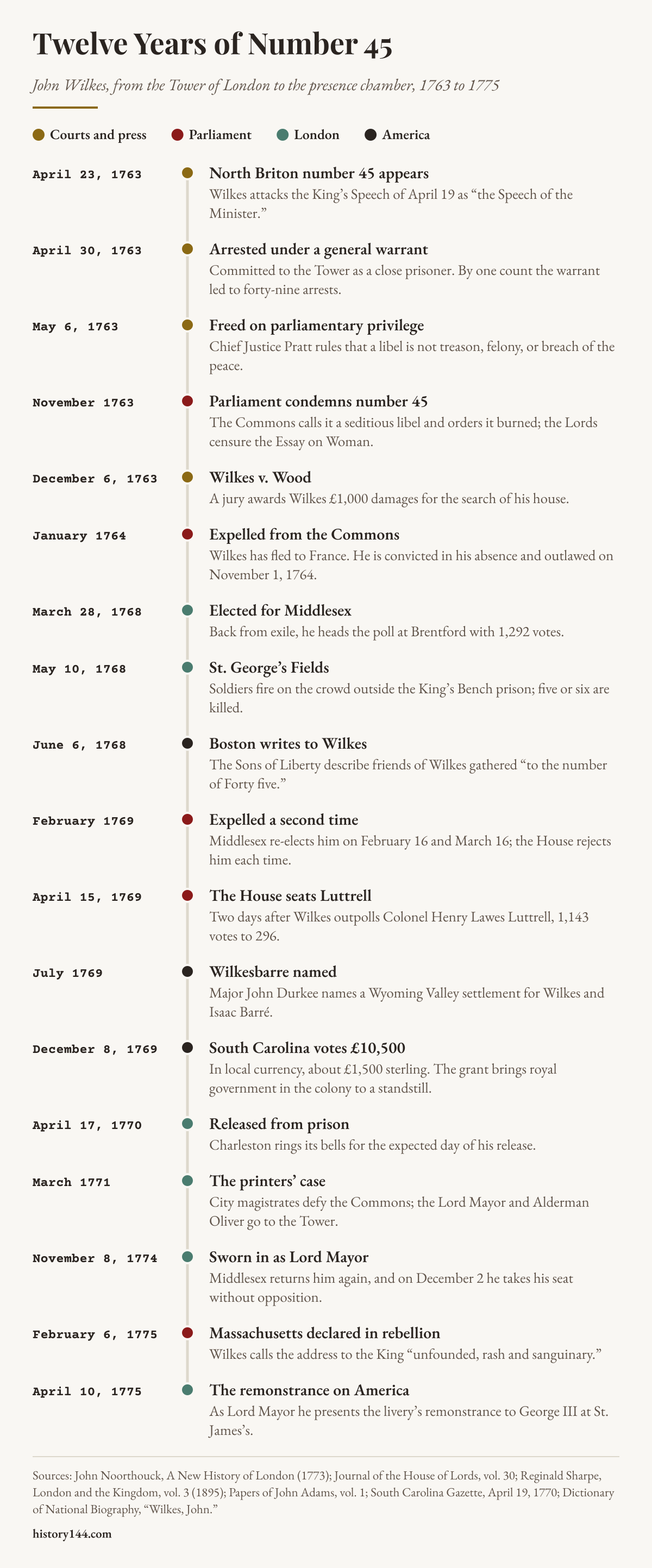
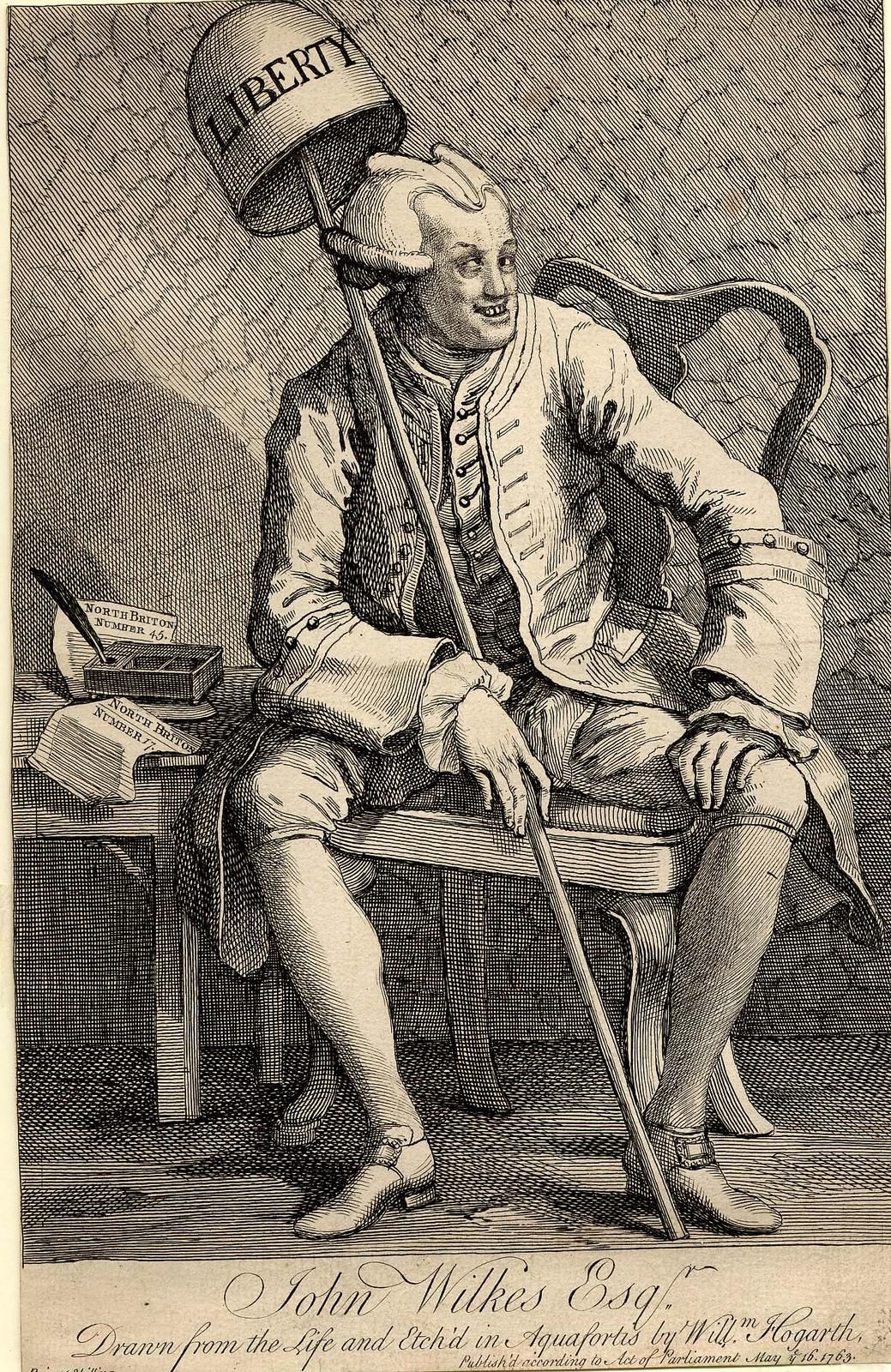
On Saturday, April 23, 1763, the forty-fifth number of a London weekly paper called the North Briton went on sale. Four days earlier King George III had closed the session of Parliament with a speech praising the peace just concluded with France and Spain. The anonymous writer of the North Briton took it apart. He began by observing that the King's Speech had always been treated, by Parliament and the public alike, "as the Speech of the Minister." With that shield raised, he called the peace "ignominious" and lamented that the honor of the Crown had been "sunk even to prostitution."[1] The writer was John Wilkes, member of Parliament for Aylesbury, a witty and heavily indebted gentleman of thirty-seven whose private life was a byword for dissipation. A week later he was a prisoner in the Tower of London.
Twelve years later, on Monday, April 10, 1775, the same John Wilkes stood in the presence chamber at St. James's Palace as Lord Mayor of London. He handed the King a remonstrance from the City's liverymen that condemned the government's measures against the American colonies and asked him to dismiss his ministers. The King passed the paper to a courtier and read a prepared answer from a sheet he took from his pocket.[2] In the years between, Wilkes had been arrested, wounded in a duel, expelled from the House of Commons, outlawed, and imprisoned. The voters of Middlesex had elected him four times in little more than a year, and four times the House had expelled him or refused to seat him. He had also become a symbol. "Wilkes and Liberty" was shouted in the streets of London, and the number 45 became a watchword for friends of liberty on both sides of the Atlantic. The government's repeated attempts to crush one disreputable man turned a quarrel over a newspaper into a running argument over the security of private papers, the freedom of the press, and the right of voters to choose their own representatives. By 1775 that argument had merged with America's. This is the story of those twelve years.
Number 45
Wilkes was not a natural tribune of the people. Born in 1725, the son of a prosperous Clerkenwell distiller, he had studied at Leiden, married Mary Mead, an heiress ten years older than himself, and lived well beyond his means.[3] He entered Parliament for Aylesbury in 1757 through an arrangement with his friend Thomas Potter and William Pitt.[4] In the spring of 1762 the young King made his favorite, the Earl of Bute, head of the Treasury, and the novelist Tobias Smollett launched a weekly called the Briton to defend him. Wilkes and the poet Charles Churchill answered it with a rival paper, the North Briton, whose first number appeared on June 5, 1762.[5] The title mocked both Smollett's paper and Bute's Scottish birth. Bute negotiated the peace that ended the Seven Years' War and then resigned early in April 1763, but number 45 showed that the paper's quarrel had outlived him.
The ministers took the paper as an attack on the King himself. On April 26 Lord Halifax, one of the two secretaries of state, issued a warrant for "Seizing & apprehending the authors, Printer & Publishers of a seditious and treasonable Paper." The warrant named none of them. In the language of the day it was a general warrant, which left the King's messengers to decide for themselves whom to arrest and whose houses to search. The next day the Attorney General condemned the paper's "libellous invective upon the King's Speech" and advised a prosecution for seditious libel.[6] The messengers rounded up printers, journeymen, and booksellers. By one count the warrant led to the arrest of forty-nine people and the search of at least five houses.[7] On the morning of April 30 they arrested Wilkes himself and seized his papers, and the secretaries of state committed him to the Tower as a close prisoner.[8]
His imprisonment lasted less than a week. Wilkes's friends obtained a writ of habeas corpus, and on May 6 Chief Justice Charles Pratt of the Court of Common Pleas ruled on his case. Pratt held that a libel was not treason, felony, or breach of the peace, and so could not override the privilege from arrest that every member of Parliament enjoyed. In the words of the London historian John Noorthouck, writing a decade later, "as a member of parliament therefore Mr. Wilkes was immediately discharged."[9] A government that had set out to silence a satirist had instead given him a grievance that touched everyone who owned a house or a writing desk.
General Warrants
Wilkes and the men arrested with him went to law against the officials who had seized them. The first of these suits was tried on July 6, 1763. Wilkes's own suit against Robert Wood, the under-secretary of state who had supervised the search of his house, came to trial before Pratt and a jury on December 6, 1763. Pratt told the jury that if the secretary of state truly possessed the power claimed in the warrant, "it certainly may affect the person and property of every man in this kingdom, and is totally subversive of the liberty of the subject." The jury found for Wilkes "with a thousand pounds damages."[10] After the verdict, according to a London report reprinted in Connecticut, a crowd gathered outside Wilkes's house in Great George Street. It played French horns for an hour and shouted "Pratt, Wilkes, and Liberty Forever" before moving on to the house of Lord Halifax.[11] Pratt's rulings condemned the kind of general warrant used against number 45. In April 1766 the House of Commons itself resolved that a general warrant to arrest the author, printer, or publisher of a libel was illegal, though attempts to outlaw such warrants by statute failed.[12]
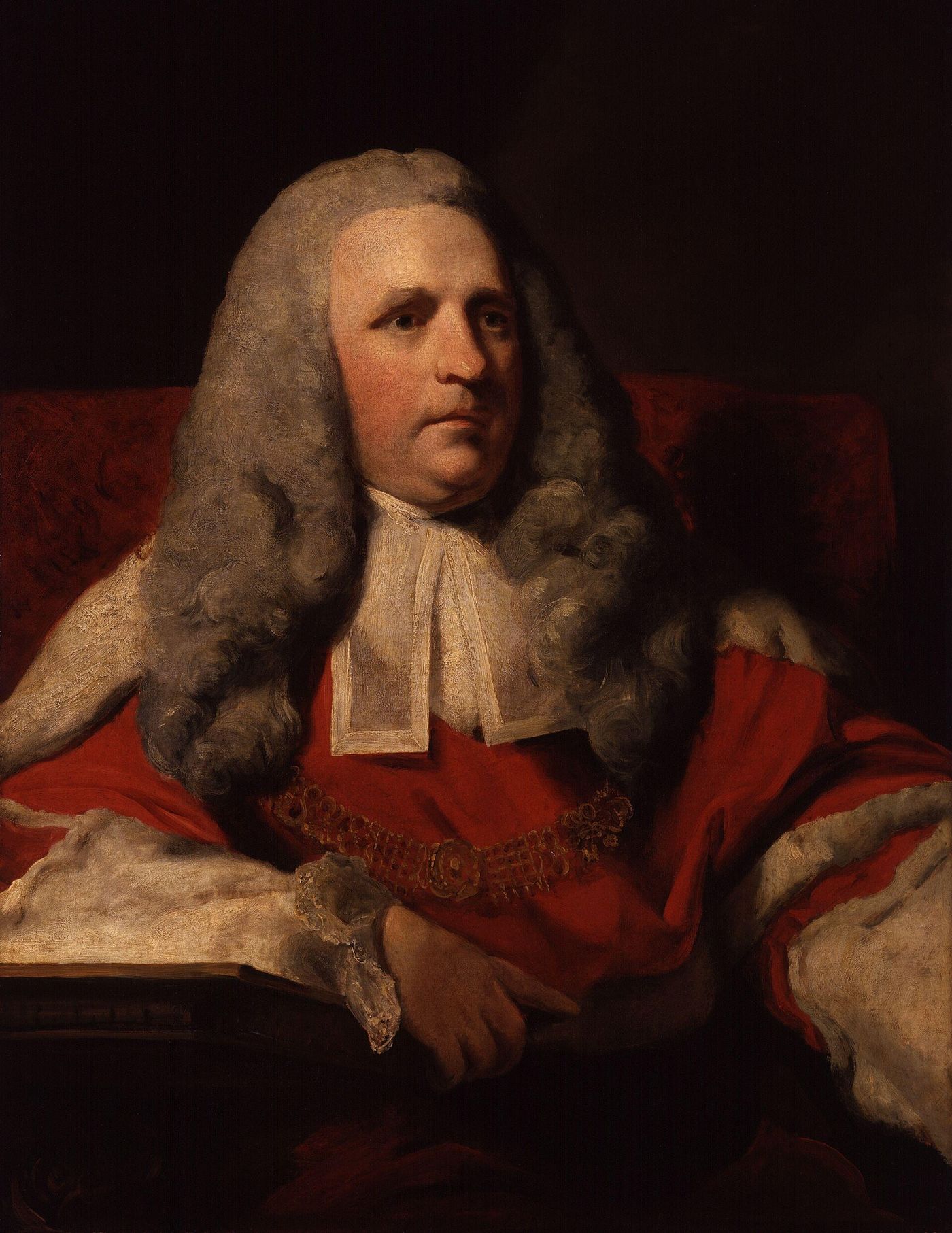
The City of London took up the cause as its own. The Court of Common Council thanked the City's members for trying to get Parliament to declare general warrants unlawful, voted Pratt the freedom of the City, and ordered his portrait hung in the Guildhall. Corporations elsewhere in England, and some in Ireland, followed its example. Noorthouck, no admirer of Wilkes's private conduct, recorded that in these months "No. 45 was continually chalked upon every wall in town."[13] The case would also have a long life across the Atlantic. The modern editors of The Founders' Constitution reprint Wilkes v. Wood among the English sources of the Fourth Amendment to the United States Constitution, which forbids unreasonable searches and seizures.[14]
The Hangman and the Exile
The ministers were losing in the courts, but they still commanded majorities in both houses, and when the new session opened on November 15, 1763, they turned to Parliament. That day the Commons declared number 45 "a false, scandalous, and seditious Libel" and ordered it "burnt, by the Hands of the Common Hangman." On November 24 it resolved that privilege of Parliament did not extend to the writing and publishing of seditious libels, and the Lords concurred in the resolutions on November 25 and 29.[15] On the opening day the House of Lords had also taken up the Essay on Woman, an obscene parody of Alexander Pope's Essay on Man. Its author appears to have been Wilkes's friend Thomas Potter. Wilkes, however, had printed about a dozen copies on a private press in his house, and one had reached the Earl of Sandwich, then a secretary of state. Passages were read to the House, and on Sandwich's motion the Lords condemned the poem as "a most scandalous, obscene, and impious Libel."[16] The next day Samuel Martin, a former secretary to the Treasury whom the North Briton had insulted, met Wilkes with pistols and gave him a dangerous wound in the stomach.[17]
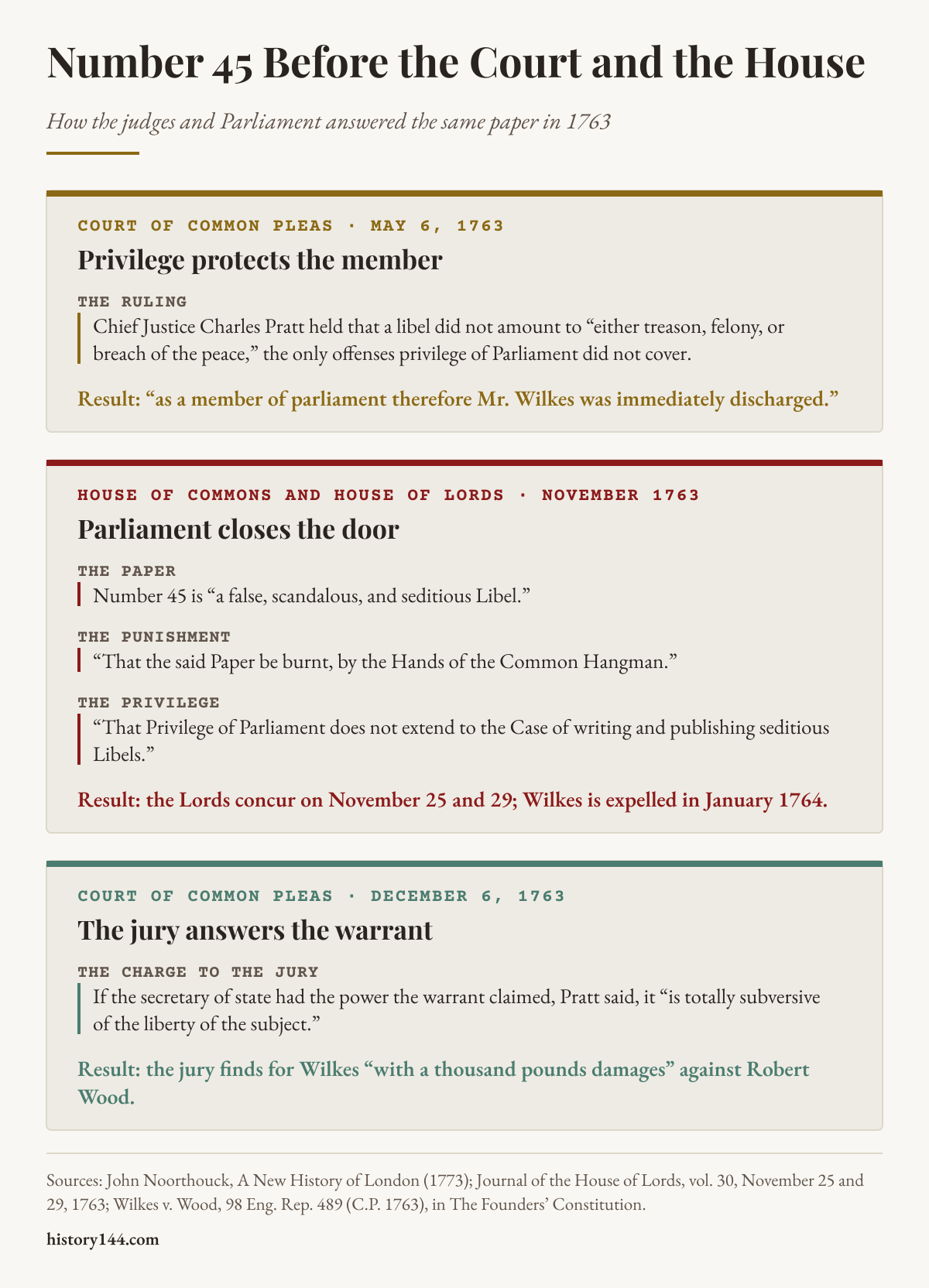
The burning of number 45 was set for December 3 at the Royal Exchange. According to Noorthouck, "a great mob assembled to obstruct the execution." The crowd pelted the hangman and the constables. It broke the front glass of Sheriff Thomas Harley's carriage and wounded him. Part of the paper was snatched from the fire and carried off. That evening at Temple Bar the crowd burned a large jackboot, a pun on the name of John Stuart, Earl of Bute, the former head of the Treasury.[18]
Wilkes, still recovering from his wound and facing prosecution for both the North Briton and the Essay on Woman, crossed to France around Christmas. In January 1764 the Commons expelled him.[19] On February 21 he was convicted in his absence before Lord Mansfield in the Court of King's Bench on both charges, and when he failed to appear for sentence he was declared an outlaw on November 1, 1764.[20] For the next four years he lived on the Continent in growing poverty and debt.[21] The government had won, but it had won in a way that left many people convinced the law had been bent to do it.
Middlesex
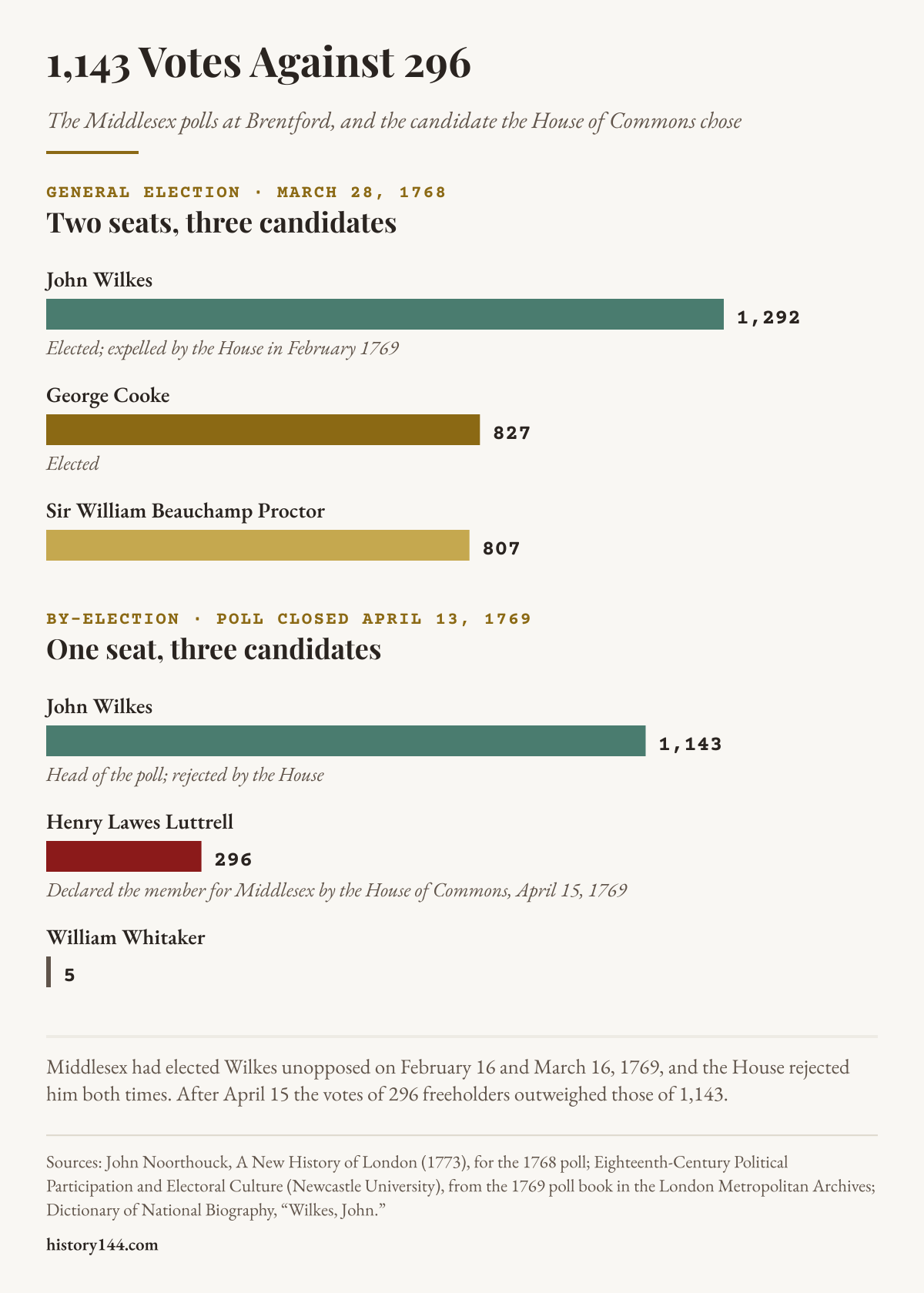
Wilkes slipped back into London on February 6, 1768, and when Parliament was dissolved in March for a general election, he saw his chance. He stood first for the City of London and finished last of seven candidates with 1,247 votes. He then turned to the county of Middlesex, the populous shire surrounding the capital, whose two members were chosen by its freeholders. At the hustings in Brentford on March 28 he headed the poll with 1,292 votes against 827 for George Cooke and 807 for Sir William Beauchamp Proctor.[22] That night, Noorthouck wrote, "all Mr. Wilkes's friends illuminated their houses," and crowds forced others to do the same.[23]
Wilkes was still an outlaw, and he chose to submit to the courts rather than wait to be taken. On April 27 Lord Mansfield committed him to the King's Bench prison in Southwark. As officers carried him across Westminster Bridge, a crowd stopped the coach, unhitched the horses, and dragged it toward Spitalfields. Wilkes calmed the people from an upper window of the Three Tuns tavern, then slipped away and gave himself up to the marshal of the prison.[24]
The prison stood beside St. George's Fields, an open space south of the Thames, and for days afterward crowds collected there to cheer him. On May 10, the day the new Parliament met, the crowd was larger still. According to Noorthouck, it expected Wilkes to be released and came "with an intention to conduct him to the house of commons." Additional guards were sent for, and the soldiers fired on the people.[25] Noorthouck counted "five or six" killed and about fifteen wounded, including two women. Among the dead was William Allen, the young son of the keeper of the Horseshoe inn in Blackman Street, who, Noorthouck wrote, "as appeared afterward was meerly a quiet spectator." In that account Allen was singled out, followed into a cowhouse by three soldiers, and shot dead. Later accounts instead have the soldiers chasing a man who had thrown a stone, losing him at the cowhouse, and shooting Allen in mistake for him.[26] Accounts of the toll differ, but the shooting quickly acquired a name. To Wilkes's supporters it was the Massacre of St. George's Fields.
On June 8 Mansfield reversed the outlawry on a technical point, but he upheld the convictions. Ten days later Wilkes was sentenced to twenty-two months' imprisonment and fined £1,000.[27] He settled into the King's Bench prison as its most famous inmate, receiving visitors, writing for the press, and using the prison's lax rules to run a political campaign from inside its walls.[28]
1,143 Votes Against 296
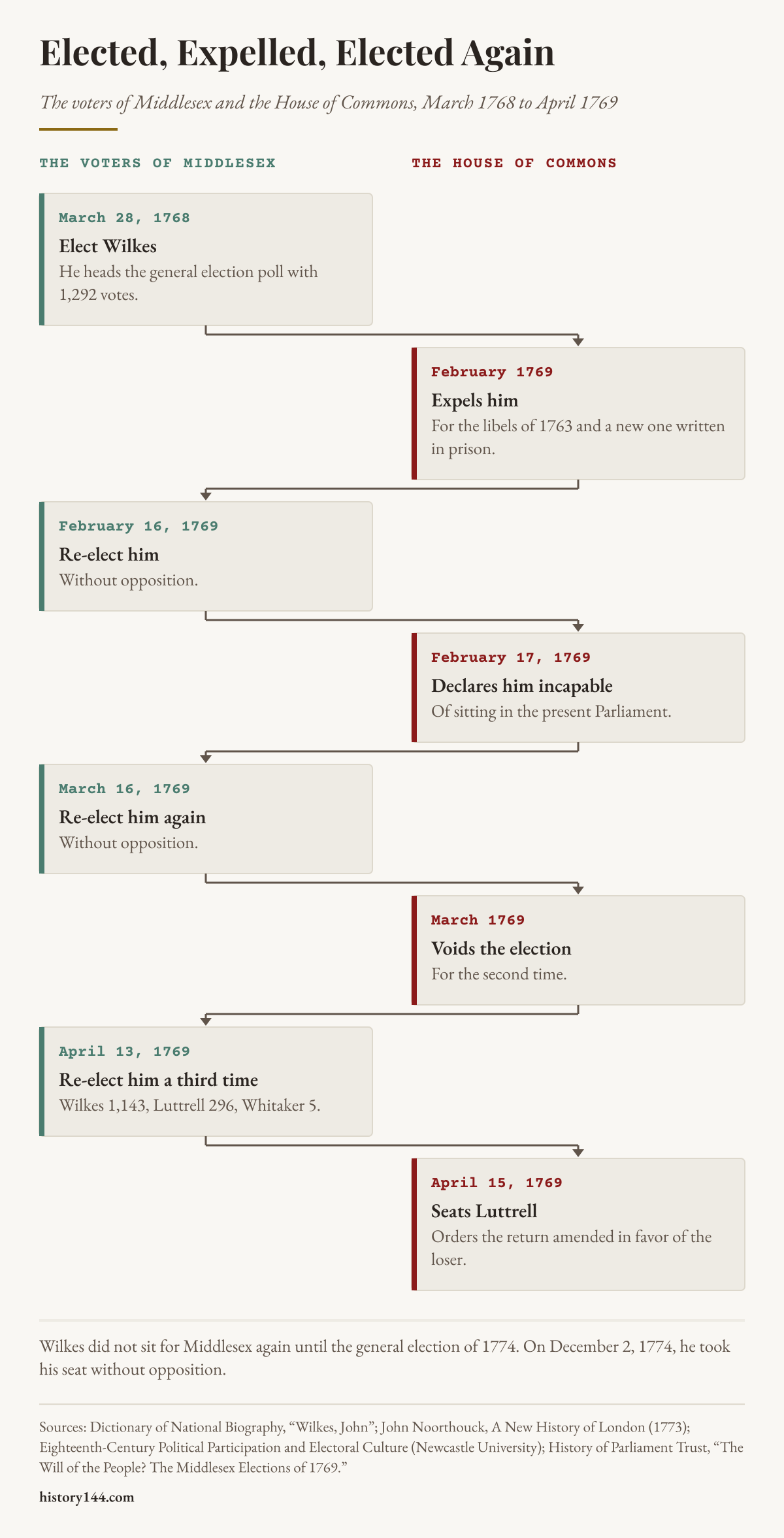
The City soon made Wilkes one of its own. On January 2, 1769, the ward of Farringdon Without elected him an alderman, and when the result was challenged as premature, a second wardmote on January 27 returned him again.[29] The House of Commons was less welcoming. Early in February 1769 it expelled him once more. The grounds included the libels of 1763 and a new one written from prison. Wilkes had printed, with his own angry commentary, Lord Weymouth's instructions to the chairman of the Lambeth quarter sessions, which told the magistrates to make prompt use of the military in a riot. The instructions were dated April 17, 1768, three weeks before the shooting in St. George's Fields.[30]
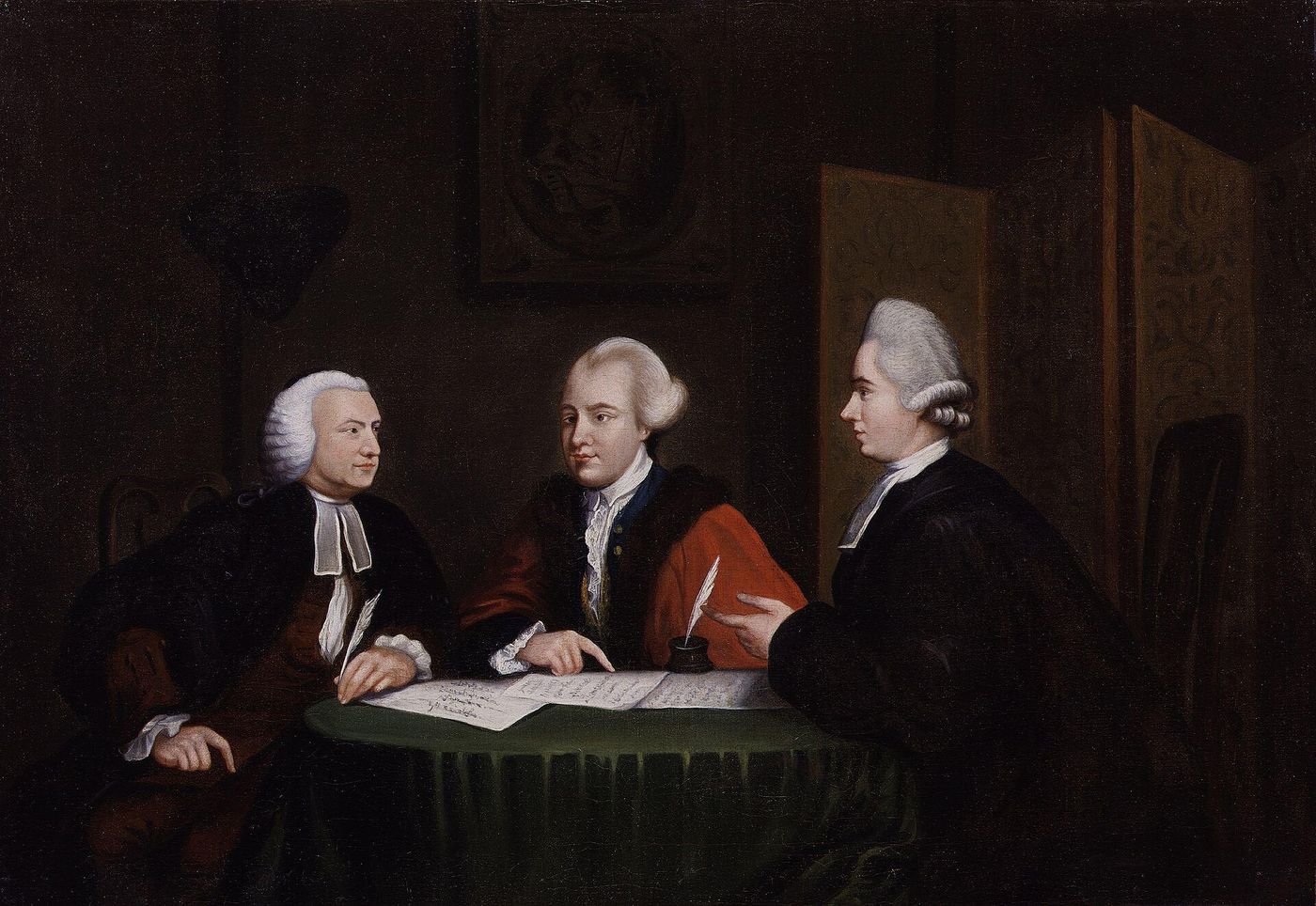
The freeholders of Middlesex re-elected him without opposition on February 16. The next day the Commons declared him incapable of sitting in that Parliament. The freeholders returned him again on March 16, and again the House voided the election. For the third by-election the government found a candidate willing to stand against him, Colonel Henry Lawes Luttrell. The poll at Brentford closed on April 13, 1769, with 1,143 votes for Wilkes, 296 for Luttrell, and 5 for a third candidate, William Whitaker.[31] Two days later the Commons resolved, by 197 votes to 143, that Luttrell was the member for Middlesex and ordered the return amended to seat him.[32] The House of Commons, which claimed to speak for the people of England, had overruled the voters of Middlesex.
The decision turned Wilkes's personal quarrel into a constitutional one. If the House could disqualify a man the electors had freely chosen and seat a candidate they had rejected, then the electors' right to choose their representatives depended on the pleasure of the majority. Earlier that year Wilkes's allies had founded the Society of Supporters of the Bill of Rights, named for the settlement of 1689 that had limited the power of the Crown. It devoted itself to paying off Wilkes's debts, and four years later it elected John Adams of Boston a member.[33]
Forty-Five in America
Americans had followed the Wilkes affair since 1763 in reprints from the London papers, and they saw parallels with their own quarrel with Parliament. In both cases the issue seemed to be whether a ministry backed by a compliant Parliament could override ancient rights. The historian Pauline Maier argued that colonial radicals came to treat Wilkes's fate as a test of whether British liberty could still protect them, and that his repeated defeats taught many of them to distrust the King's government itself.[34]
Boston opened a correspondence with Wilkes in the summer of 1768. On June 6 a committee of the town's Sons of Liberty, among them Joseph Warren, Benjamin Church, and the young lawyer John Adams, wrote to congratulate him on his return and his election. The letter opened by describing friends of "Liberty, Wilkes, Peace and good order" gathered at the Whig Tavern "to the number of Forty five." The colonists, the committee wrote, were determined that the King should have "Subjects but not Slaves" in America, and they enclosed a copy of John Dickinson's Letters from a Farmer in Pennsylvania, the widely reprinted essays against the Townshend duties.[35] Wilkes answered from prison, and the correspondence continued into the autumn of 1769.[36]
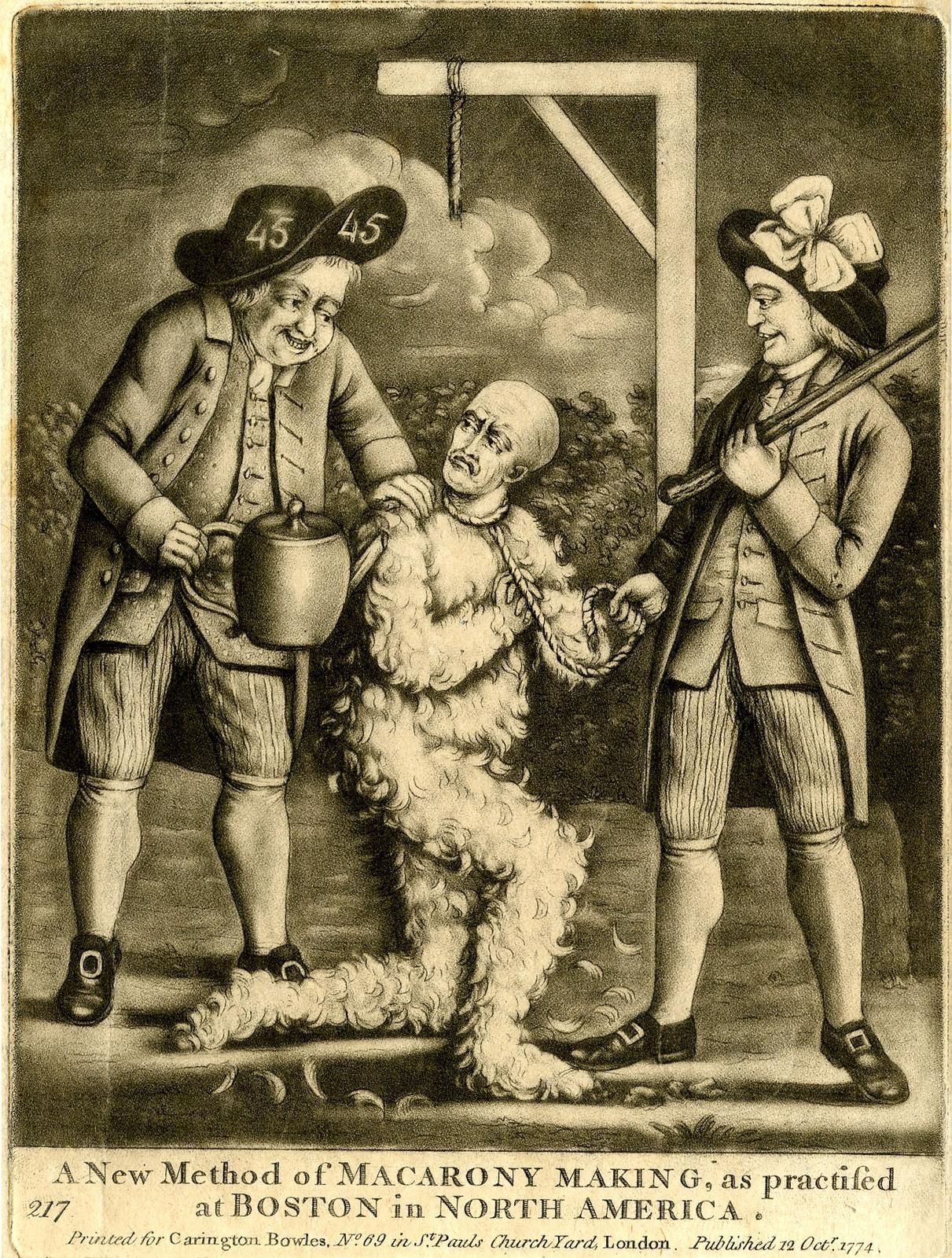
The most consequential gesture came from South Carolina. On December 8, 1769, as the last business before its Christmas adjournment, the Commons House of Assembly voted £10,500 in South Carolina currency, about £1,500 sterling, to be sent to the Society of Supporters of the Bill of Rights in London, which was paying off Wilkes's debts. In April 1770 the ministry answered with an additional instruction meant to stop the Assembly from issuing public money on its own order. The Assembly refused to give way and insisted on its customary right to spend the colony's money as it chose. No annual tax bill passed in South Carolina after 1769, and no legislation at all after 1771. A gift toward an English prisoner's debts had brought royal government in one of the richest colonies in America to a standstill.[37]
The enthusiasm took other forms as well. In the Wyoming Valley of northeastern Pennsylvania, settlers from Connecticut were contesting the land with Pennsylvania's claimants. In July 1769 their leader, Major John Durkee, began to call the settlement near his fort "Wilkesbarre," in honor of Wilkes and of Isaac Barré, the member of Parliament who had defended the colonies in the debate over the Stamp Act. Durkee had been active among the Sons of Liberty in Norwich, Connecticut, and the name survives in the city of Wilkes-Barre.[38] When Wilkes's sentence was due to end in April 1770, Charleston marked the day with "ringing of bells, displaying of colours," and celebrations by several companies at different houses.[39]
Release and the Printers
Wilkes walked out of the King's Bench prison on April 17, 1770. He had entered it a ruined man. He left it with his debts paid by his supporters, who spent more than £17,000 on them, and with a seat waiting for him on the City's Court of Aldermen.[40] He used that office in his next contest with the House of Commons, over the right to report what was said in Parliament.
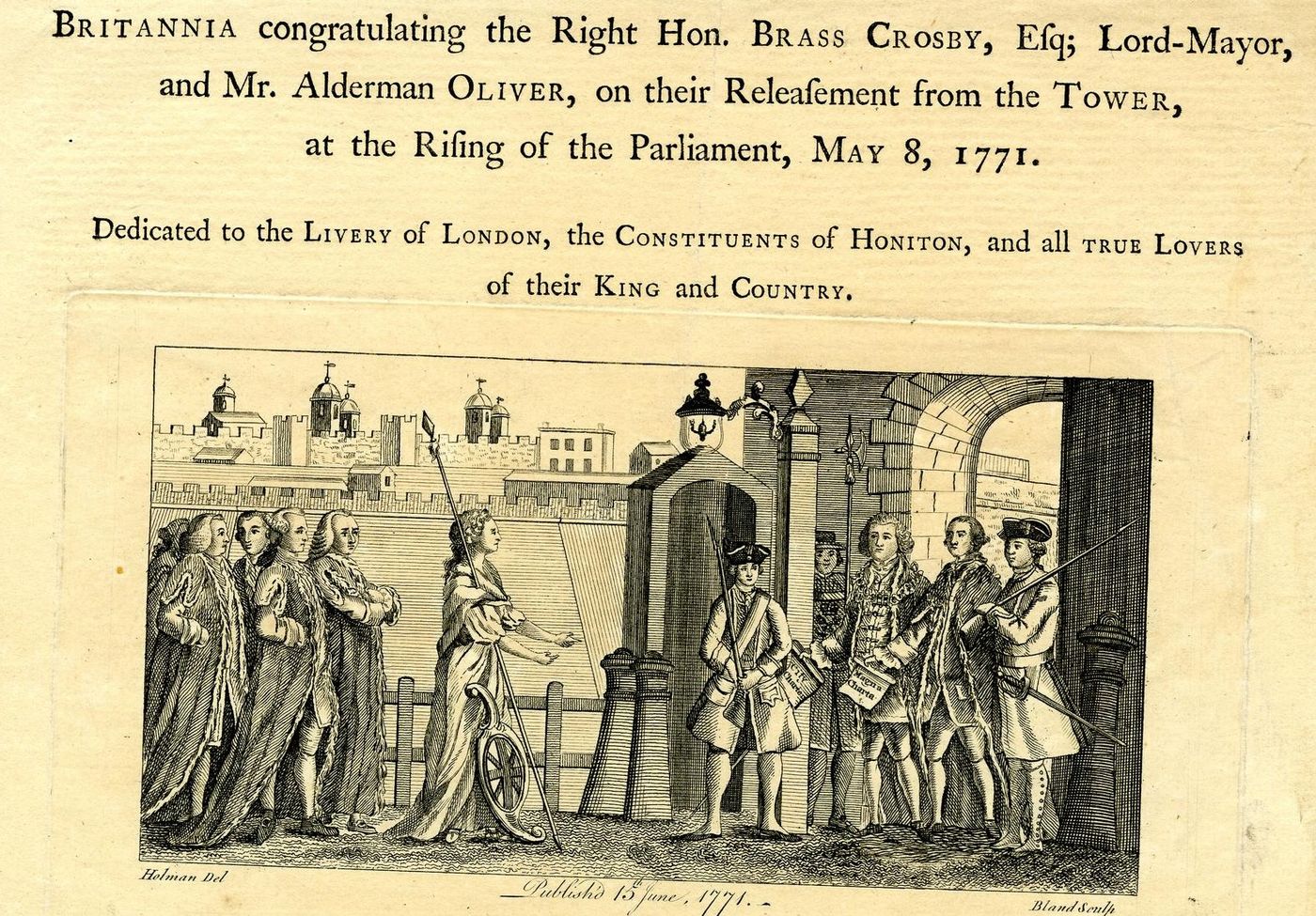
Publishing the debates of either house was then a breach of parliamentary privilege, but by 1771 several London papers, encouraged by Wilkes, were printing them anyway. In March the Commons moved against a group of printers, and Wilkes and his allies among the City magistrates were ready. On March 15 a printer named John Wheble, seized under a royal proclamation, was brought before Wilkes as the sitting alderman, and Wilkes discharged him. The same day a messenger of the House tried to seize another printer, John Miller, and was himself taken into custody. The Lord Mayor, Brass Crosby, sitting with Wilkes and Alderman Richard Oliver, declared the Speaker's warrant illegal, released Miller, and bound the messenger over to answer at the Quarter Sessions.[41]
The Commons sent Oliver to the Tower at the end of an all-night sitting on March 25. Crosby followed in the early hours of March 28, after a vote of 202 to 39. The King had written to Lord North, his chief minister, on March 17 that "now there is no retracting, the honour of the Commons must be supported." Crowds turned out in support of the two prisoners, who stayed in the Tower until Parliament was prorogued on May 8 and then went free.[42] The House let the printers alone, and from then on the newspapers reported its debates.[43] That summer the livery elected Wilkes one of the sheriffs of London and Middlesex.[44]
The Lord Mayor
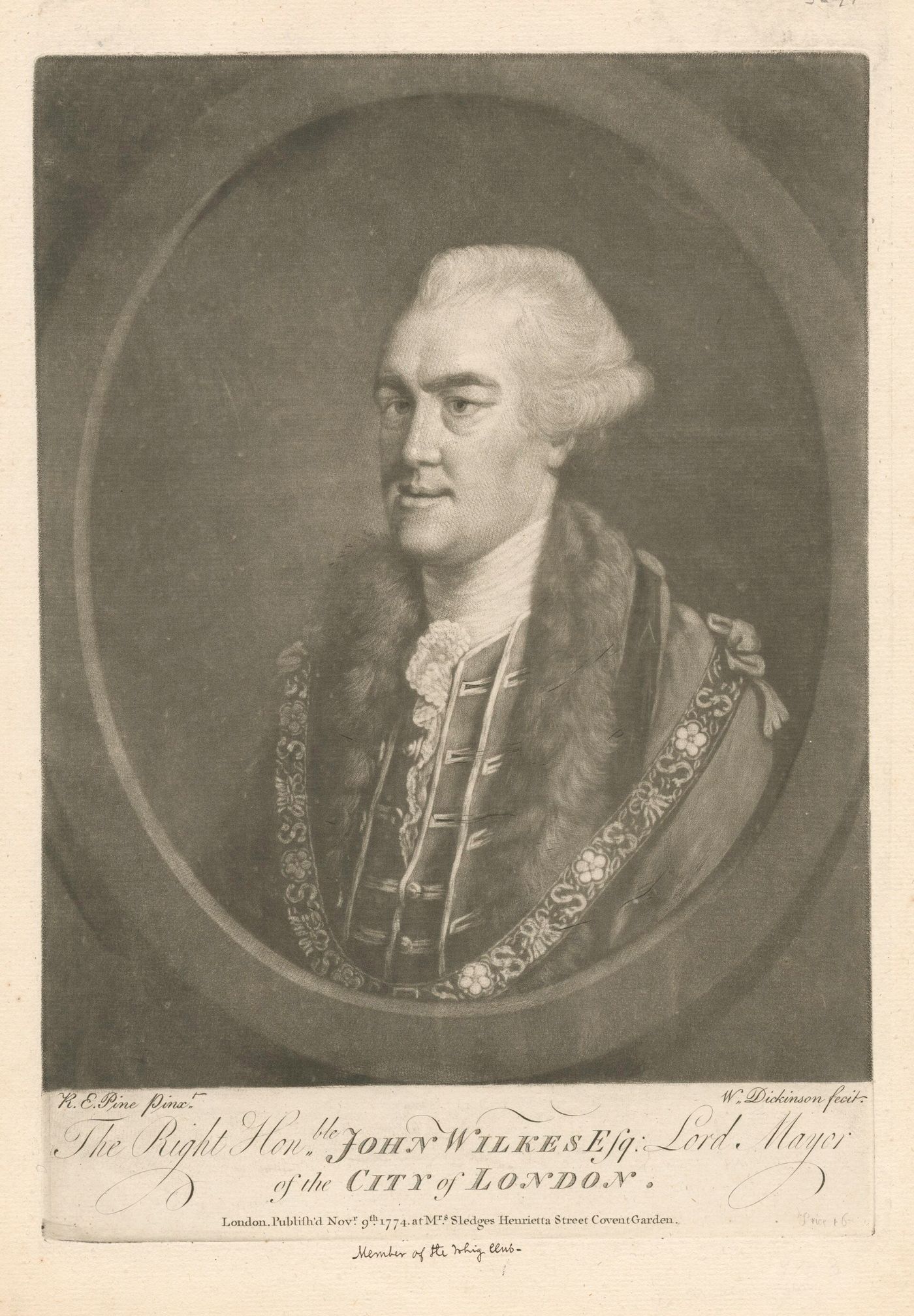
The livery of London, the members of the City's trading companies who chose its chief officers, returned Wilkes as one of two candidates for Lord Mayor in 1772 and again in 1773. Both times the Court of Aldermen chose the other man. In October 1774 the liverymen put him at the head of the poll once more, and this time the aldermen accepted him by eleven votes to two.[45] On November 8 he was sworn in at the Guildhall, where the chair and other emblems of the mayoralty were surrendered to him "in the accustomed Manner," as the government's own London Gazette reported.[46] At the general election that autumn the freeholders of Middlesex returned him again, and on December 2 he took his seat in the House of Commons without opposition.[47]
He entered the Commons as the American crisis reached its climax. Boston's port had been closed, the Massachusetts charter altered, and a Continental Congress had met at Philadelphia. On February 6, 1775, the House approved an address to the King declaring that a rebellion existed in Massachusetts.[48] Wilkes called the address "unfounded, rash and sanguinary." He warned that the colonists would "sooner declare themselves independent" than submit, and he wondered aloud whether "the independent Americans" might one day "celebrate the glorious era of the Revolution of 1775" as Englishmen celebrated that of 1688.[49]
The Remonstrance
At a Common Hall on April 5, 1775, the liverymen of London adopted an address, remonstrance, and petition to the King on American affairs. It declared their "abhorrence of the measures which have been pursued and are now pursuing" against their fellow subjects in America. It rehearsed the colonists' grievances, including taxation without representation, and asked the King to dismiss the ministers responsible as a first step toward redress.[50] Presenting it fell to the Lord Mayor.
On Monday, April 10, Wilkes went to St. James's. A London report reprinted in the Pennsylvania Ledger that June quoted a gentleman who had been in the presence chamber. When the paper had been read, Wilkes handed it to the King "with a half bent knee, and the most profound reverence." The King passed it to a lord in waiting and, deliberately taking a paper from his pocket, read his answer. "A silence of two minutes ensued," the account continued, after which the Lord Mayor bowed low and backed toward the door until the King moved his hat to him.[51] The answer itself was brief. "It is with the utmost astonishment," the King said, "that I find any of my subjects capable of encouraging the rebellious disposition which unhappily exists in some of my colonies in North America." He declared his confidence in Parliament and his intention to carry out the measures it had recommended.[52] Horace Walpole, who followed the City's doings closely, wrote that Wilkes "behaved with so much respect, that the King himself owned he had never seen so well-bred a Lord Mayor." Walpole added that many people thought Wilkes had been bought off.[53]
The courtesy lasted a day. On April 11 the Lord Chamberlain, the Earl of Hertford, informed Wilkes by the King's command that the King would no longer receive on the throne any address, remonstrance, or petition except from the corporation of the City. The ruling shut out the livery. Wilkes replied on May 2 that "on the most exact research" no instance could be found of such addresses being received in any other way, and he warned that the colonists might read the King's answer as a mark of anger. He made sure his letter was published.[54] Events had already overtaken the exchange, though London did not yet know it. On April 19, nine days after Wilkes bowed before the throne, British regulars and Massachusetts militiamen had exchanged fire at Lexington and Concord.
The Speech of the Minister
Wilkes was an unlikely champion, and he seems to have known it. He was a debtor, a libertine, and an opportunist who enjoyed the crowd's applause and borrowed freely against it. In later years he made an arch show of denying that he had ever been a Wilkite.[55] Yet the cause that carried his name was larger than he was, and its gains were real. The general warrant cases established that the King's ministers could not search a man's house and seize his papers on their own say-so. The printers' case opened Parliament's debates to the reading public. The Middlesex elections raised, more sharply than ever before, the question of whether the House of Commons answered to the voters or the voters to the House. Each of these contests was fought on ground where Wilkes could appeal to principle, and each drew in people who cared little for Wilkes himself.
Across the Atlantic the same contests looked like rehearsals of America's own. To many colonists, as Maier argued, Wilkes's defeats were evidence that Parliament would override the liberties of Englishmen at home as readily as those of Englishmen abroad. The South Carolina Assembly's grant to his supporters, meant as a gesture of sympathy, ended with royal government in that colony at a standstill.
The story began with a quarrel over a King's Speech. In 1763 Wilkes had defended his attack on the Crown's policy by insisting that the words in the King's mouth were really the minister's. In April 1775 the King answered the City's plea for America by reading aloud from a paper prepared in advance, and the man who stood before him to hear it was the Lord Mayor of London. Wilkes had traveled from the Tower to the presence chamber, and the argument he had started over number 45 had crossed the ocean, where it was about to be settled by force.
Places in this Story
The places this story moves through, in order — follow them on the interactive map →
- Tower of London, London, England April 30, 1763
Wilkes was arrested under a general warrant and committed to the Tower as a close prisoner, until Chief Justice Pratt freed him on May 6.
- Westminster Hall, London, England December 6, 1763
A jury before Pratt awarded Wilkes 1,000 pounds against Robert Wood, the under-secretary who had supervised the search of his house.
- Royal Exchange, London, England December 3, 1763
A crowd pelted the hangman and constables sent to burn number 45 and carried part of the paper off from the fire.
- Brentford, Middlesex, England March 28, 1768
Wilkes headed the poll for Middlesex with 1,292 votes, against 827 for George Cooke and 807 for Sir William Beauchamp Proctor.
- St. George's Fields, Southwark, England May 10, 1768
Soldiers fired on a crowd outside the King's Bench prison where Wilkes was held, killing several people.
- Palace of Westminster, London, England April 15, 1769
The House of Commons declared Henry Lawes Luttrell the member for Middlesex, although Wilkes had beaten him by 1,143 votes to 296.
- Boston, Massachusetts June 6, 1768
A committee of the Sons of Liberty wrote to congratulate Wilkes, describing friends gathered "to the number of Forty five."
- Charleston, South Carolina December 8, 1769
The Commons House of Assembly voted 10,500 pounds in local currency, about 1,500 pounds sterling, for Wilkes's cause, setting off a dispute that halted royal legislation in the colony.
- Guildhall, London, England November 8, 1774
Wilkes was sworn in as Lord Mayor of London after the aldermen accepted him by eleven votes to two.
- St. James's Palace, London, England April 10, 1775
As Lord Mayor, Wilkes presented the livery's remonstrance on America, and the King read a prepared answer from his pocket.
Frequently Asked Questions
What was North Briton number 45?
The forty-fifth number of John Wilkes's weekly paper, published on April 23, 1763, attacked the King's Speech praising the peace with France and Spain. The government prosecuted it as a seditious libel, and the number 45 became a watchword for Wilkes's supporters.
Why was John Wilkes arrested in 1763?
Lord Halifax issued a general warrant against the unnamed authors, printers and publishers of number 45, and Wilkes was seized under it on April 30 and sent to the Tower. Chief Justice Pratt freed him on May 6 because a libel did not override a member of Parliament's privilege from arrest.
What was Wilkes v. Wood?
It was Wilkes's suit against Robert Wood, the under-secretary of state who supervised the search of his house, tried before Pratt and a jury on December 6, 1763. The jury awarded Wilkes 1,000 pounds, and the case is now counted among the English sources of the Fourth Amendment.
What was the Middlesex election dispute?
The freeholders of Middlesex elected Wilkes in March 1768 and three more times in 1769, and each time the Commons expelled him or voided the result. After he beat Henry Lawes Luttrell by 1,143 votes to 296 in April 1769, the House seated Luttrell instead.
What was the Massacre of St. George's Fields?
On May 10, 1768, soldiers fired on a crowd that had gathered outside the King's Bench prison, where Wilkes was held. John Noorthouck counted five or six killed and about fifteen wounded, though accounts of the toll differ.
Why did South Carolina send money to John Wilkes?
In December 1769 the Commons House of Assembly voted 10,500 pounds in local currency, about 1,500 pounds sterling, for the Society of Supporters of the Bill of Rights, which was paying Wilkes's debts. The ministry answered with an instruction to stop the Assembly issuing money on its own order, and the deadlock halted royal legislation in the colony.
What did Wilkes do as Lord Mayor about America?
On April 10, 1775, he presented George III with the London livery's remonstrance against the government's American measures. The King read a prepared answer condemning anyone who encouraged the rebellious disposition in the colonies.
Bibliography
The Annual Register, or a View of the History, Politicks, and Literature, for the Year 1763. London: J. Dodsley, 1765. Internet Archive. Accessed November 13, 2026. https://archive.org/details/bim_eighteenth-century_the-annual-register-or-_1765.
Brooke, John. "Wilkes, John (1725–97)." In The History of Parliament: The House of Commons, 1754–1790, edited by Lewis Namier and John Brooke. London: Her Majesty's Stationery Office for the History of Parliament Trust, 1964. History of Parliament Online. Accessed November 12, 2026. https://www.historyofparliamentonline.org/volume/1754-1790/member/wilkes-john-1725-97.
Cobbett, William, ed. The Parliamentary History of England, from the Earliest Period to the Year 1803. Vol. 16, 1765–1771. London: T. C. Hansard, 1813. Internet Archive. Accessed November 13, 2026. https://archive.org/details/parliamentaryhi02parlgoog.
Cobbett, William, ed. The Parliamentary History of England, from the Earliest Period to the Year 1803. Vol. 18, 1774–1777. London: T. C. Hansard, 1813. Internet Archive. Accessed November 13, 2026. https://archive.org/details/parliamentaryhi00parlgoog.
Committee of the Boston Sons of Liberty. Committee of the Boston Sons of Liberty to John Wilkes, June 6, 1768. In Papers of John Adams, vol. 1, September 1755–October 1773, edited by Robert J. Taylor. Cambridge, MA: Belknap Press of Harvard University Press, 1977. Founders Online, National Archives. Accessed November 12, 2026. https://founders.archives.gov/documents/Adams/06-01-02-0070.
Committee of the Boston Sons of Liberty. Committee of the Boston Sons of Liberty to John Wilkes, November 4, 1769. In Papers of John Adams, vol. 1, September 1755–October 1773, edited by Robert J. Taylor. Cambridge, MA: Belknap Press of Harvard University Press, 1977. Founders Online, National Archives. Accessed November 12, 2026. https://founders.archives.gov/documents/Adams/06-01-02-0078.
Connecticut Gazette (New London). February 24, 1764. Report datelined London, December 8, 1763. In Performing Arts in Colonial American Newspapers, 1690–1783. Colonial Music Institute / Country Dance and Song Society. Accessed November 12, 2026. https://www.cdss.org/elibrary/PacanNew/CITATION/C0033/C0033506.htm.
Cuddihy, William J. "Wilkes Cases 19 Howell's State Trials (1763–1768)." In Encyclopedia of the American Constitution, edited by Leonard W. Levy, Kenneth L. Karst, and Dennis J. Mahoney. New York: Macmillan, 1986. Encyclopedia.com. Accessed November 12, 2026. https://www.encyclopedia.com/politics/encyclopedias-almanacs-transcripts-and-maps/wilkes-cases-19-howells-state-trials-1763-1768.
Eighteenth-Century Political Participation and Electoral Culture. "Middlesex, Apr 1769." Newcastle University. Accessed November 12, 2026. https://ecppec.ncl.ac.uk/case-study-constituencies/middlesex/election/Apr-1769/.
Great Britain. Board of Trade. Journal of the Commissioners for Trade and Plantations. Vol. 13, January 1768–December 1775. London: His Majesty's Stationery Office, 1937. "February 1770" and "April 1770." British History Online. Accessed November 13, 2026. https://www.british-history.ac.uk/jrnl-trade-plantations/vol13/pp166-174.
Great Britain. Parliament. House of Lords. Journal of the House of Lords. Vol. 30, 1760–1764. London, 1767–1830. "April 1763," 391–406. British History Online. Accessed November 13, 2026. https://www.british-history.ac.uk/lords-jrnl/vol30/pp391-406.
Great Britain. Parliament. House of Lords. Journal of the House of Lords. Vol. 30, 1760–1764. London, 1767–1830. "November 1763," 413–29. British History Online. Accessed November 13, 2026. https://www.british-history.ac.uk/lords-jrnl/vol30/pp413-429.
Great Britain. Secretaries of State. "The Humble Address, Remonstrance and Petition of the Lord Mayor, Aldermen and Livery of the City of London." April 8, 1775. SP 37/11/8, folios 18–19. State Papers Domestic, George III. The National Archives, Kew. Catalogue entry. Accessed November 12, 2026. https://beta.nationalarchives.gov.uk/catalogue/id/C17965835.
Great Britain. Secretaries of State. "The King's Answer to the Address from the City of London Presented 10 April 1775." SP 37/11/9, folio 20. State Papers Domestic, George III. The National Archives, Kew. Catalogue entry. Accessed November 12, 2026. https://beta.nationalarchives.gov.uk/catalogue/id/C17965836.
Greene, Jack P. "Bridge to Revolution: The Wilkes Fund Controversy in South Carolina, 1769–1775." Journal of Southern History 29, no. 1 (February 1963): 19–52.
Harvey, Oscar Jewell. A History of Wilkes-Barré, Luzerne County, Pennsylvania. Vol. 1. Wilkes-Barré, PA: Raeder Press, 1909. Internet Archive. Accessed November 12, 2026. https://archive.org/details/historyofwilkesba01harv.
History of Parliament Trust. "The Will of the People? The Middlesex Elections of 1769." The History of Parliament (blog), April 4, 2019. Accessed November 12, 2026. https://historyofparliament.com/2019/04/04/the-will-of-the-people-the-middlesex-elections-of-1769/.
Kurland, Philip B., and Ralph Lerner, eds. The Founders' Constitution. Vol. 5, Amendment IV, Document 4, Wilkes v. Wood, 98 Eng. Rep. 489 (C.P. 1763). Chicago: University of Chicago Press, 1987. Accessed November 12, 2026. https://press-pubs.uchicago.edu/founders/documents/amendIVs4.html.
London Gazette. No. 11508, November 8–12, 1774. Accessed November 12, 2026. https://www.thegazette.co.uk/London/issue/11508/page/2/data.pdf.
London Gazette. No. 11551, April 8–11, 1775. Accessed November 13, 2026. https://www.thegazette.co.uk/London/issue/11551/page/2/data.pdf.
Maier, Pauline. "John Wilkes and American Disillusionment with Britain." William and Mary Quarterly, 3rd ser., 20, no. 3 (July 1963): 373–95.
Massachusetts Historical Society. Papers of John Adams. Vol. 1, September 1755–October 1773, edited by Robert J. Taylor. Cambridge, MA: Belknap Press of Harvard University Press, 1977. List of illustrations. Adams Papers Digital Edition. Accessed November 12, 2026. https://www.masshist.org/publications/adams-papers/index.php/view/PJA01fd7.
National Archives (UK). "The Scandalous Case of The North Briton Number 45." By Chris Day. The National Archives Blog, June 15, 2022. UK Government Web Archive. Accessed November 13, 2026. https://webarchive.nationalarchives.gov.uk/ukgwa/20250613000000/https://blog.nationalarchives.gov.uk/the-scandalous-case-of-the-north-briton-number-45.
Noorthouck, John. A New History of London, Including Westminster and Southwark. London: R. Baldwin, 1773. Book 1, chapter 24, "1763–1769," 419–50. British History Online. Accessed November 12, 2026. https://www.british-history.ac.uk/no-series/new-history-london/pp419-450.
The North Briton, from No. I to No. XLVI. Inclusive. London, [1763?]. Thomas Fisher Rare Book Library, University of Toronto. Internet Archive. Accessed November 12, 2026. https://archive.org/details/thenorthbriton00unknuoft.
Pennsylvania Ledger. June 10, 1775. Report datelined London, April 15, 1775. In Performing Arts in Colonial American Newspapers, 1690–1783. Colonial Music Institute / Country Dance and Song Society. Accessed November 12, 2026. https://www.cdss.org/elibrary/PacanNew/CITATION/C0168/C0168985.htm.
Petrillo, F. Charles. "Naming of Wilkes-Barre." Wilkes University. Accessed November 12, 2026. https://wilkes.edu/about-wilkes/history/naming-wilkes-barre.aspx.
Rigg, J. M. "Wilkes, John." In Dictionary of National Biography, vol. 61, edited by Sidney Lee. London: Smith, Elder, 1900. Wikisource. Accessed November 12, 2026. https://en.wikisource.org/wiki/Dictionary_of_National_Biography,_1885-1900/Wilkes,_John.
Sharpe, Reginald R. London and the Kingdom: A History Derived Mainly from the Archives at Guildhall in the Custody of the Corporation of the City of London. Vol. 3. London: Longmans, Green, 1895. Project Gutenberg. Accessed November 12, 2026. https://www.gutenberg.org/ebooks/45759.
South Carolina Encyclopedia. "Wilkes Fund Controversy." University of South Carolina, Institute for Southern Studies. Accessed November 12, 2026. https://scencyclopedia.org/sce/?p=12250.
South Carolina Gazette (Timothy). April 19, 1770. In Performing Arts in Colonial American Newspapers, 1690–1783. Colonial Music Institute / Country Dance and Song Society. Accessed November 12, 2026. https://cdss.org/elibrary/PacanNew/CITATION/C0213/C0213886.htm.
UK Parliament. "John Wilkes: Liberty and Parliament." Living Heritage. Accessed November 12, 2026. https://www.parliament.uk/about/living-heritage/evolutionofparliament/houseofcommons/reformacts/overview/wilkeslib1/.
Walpole, Horace. Journal of the Reign of King George the Third, from the Year 1771 to 1783. Edited by John Doran. Vol. 1. London: Richard Bentley, 1859. Internet Archive. Accessed November 12, 2026. https://archive.org/details/journalofreignof01walpuoft.
Wilkes, John. The North Briton, no. 45. April 23, 1763. Transcription, Constitution Society. Accessed November 12, 2026. https://constitution.org/1-Constitution/cmt/wilkes/north_briton_45.html.
Citations
- Wilkes, North Briton, no. 45, April 23, 1763, in The North Briton, from No. I to No. XLVI; Wilkes, North Briton, no. 45, Constitution Society transcription; Great Britain, Parliament, House of Lords, Journal of the House of Lords, vol. 30, April 19, 1763, for the King's Speech. The page on which no. 45 begins in the Internet Archive copy could not be confirmed. ↑
- Great Britain, Secretaries of State, "The Humble Address, Remonstrance and Petition," SP 37/11/8; Great Britain, Secretaries of State, "The King's Answer to the Address from the City of London Presented 10 April 1775," SP 37/11/9; Pennsylvania Ledger, June 10, 1775, in Performing Arts in Colonial American Newspapers. ↑
- Brooke, "Wilkes, John (1725–97)"; Rigg, "Wilkes, John." Rigg gives the year of birth as 1727; the History of Parliament and most modern accounts give 1725. ↑
- History of Parliament Trust, "The Will of the People? The Middlesex Elections of 1769." ↑
- Rigg, "Wilkes, John"; National Archives (UK), "The Scandalous Case of The North Briton Number 45." ↑
- National Archives (UK), "The Scandalous Case of The North Briton Number 45," quoting the warrant of April 26, 1763, and the Attorney General's report of April 27. ↑
- Cuddihy, "Wilkes Cases." The precise number arrested varies among accounts. ↑
- Noorthouck, New History of London, bk. 1, ch. 24; Rigg, "Wilkes, John," which quotes the order that he be "kept close prisoner." The digitized text of Noorthouck does not show page breaks within the chapter, which runs from page 419 to page 450 of the printed volume. ↑
- Noorthouck, New History of London, bk. 1, ch. 24; Rigg, "Wilkes, John," which dates the discharge May 6. ↑
- Cuddihy, "Wilkes Cases," which dates the first trial, Huckle v. Money, to July 6, 1763; Wilkes v. Wood, 98 Eng. Rep. 489, 498–99 (C.P. 1763), in Kurland and Lerner, Founders' Constitution, vol. 5, Amendment IV, doc. 4; Annual Register for the Year 1763, Chronicle, which reports the verdict for the journeyman printer William Huckell early in July. ↑
- Connecticut Gazette (New London), February 24, 1764, report datelined London, December 8, 1763, in Performing Arts in Colonial American Newspapers. The report places the crowd "After the verdict was pronounced" but does not give the hour. ↑
- Cobbett, Parliamentary History, 16:207–10, recording the resolutions of April 22 and 25, 1766; Cuddihy, "Wilkes Cases." ↑
- Noorthouck, New History of London, bk. 1, ch. 24. ↑
- Kurland and Lerner, Founders' Constitution, vol. 5, Amendment IV, doc. 4. ↑
- Great Britain, Parliament, House of Lords, Journal of the House of Lords, vol. 30, November 25 and 29, 1763, recording the Commons resolutions communicated at conference and the Lords' agreement to them; Rigg, "Wilkes, John," and National Archives (UK), "The Scandalous Case of The North Briton Number 45," for the Commons votes of November 15 and 24. ↑
- Rigg, "Wilkes, John," which gives the size of the edition as "a dozen copies," names Potter as the probable author, and records that the Lords acted on Sandwich's motion; Great Britain, Parliament, House of Lords, Journal of the House of Lords, vol. 30, November 15, 1763, which records that "some Passages in the said printed Papers" were read. Tradition holds that Sandwich himself read them, but the Journal does not name the reader. ↑
- Rigg, "Wilkes, John," which dates the duel November 16, 1763. Some older accounts place the wound in the groin. ↑
- Noorthouck, New History of London, bk. 1, ch. 24. ↑
- Rigg, "Wilkes, John"; Brooke, "Wilkes, John (1725–97)." Rigg and Noorthouck date the expulsion January 19, 1764, and Brooke January 20. ↑
- Rigg, "Wilkes, John," for the conviction of February 21; National Archives (UK), "The Scandalous Case of The North Briton Number 45," for the outlawry. ↑
- Brooke, "Wilkes, John (1725–97)"; Rigg, "Wilkes, John." ↑
- Noorthouck, New History of London, bk. 1, ch. 24, which prints the full City and Middlesex polls; Rigg, "Wilkes, John," for the date of Wilkes's return to London. ↑
- Noorthouck, New History of London, bk. 1, ch. 24. ↑
- Rigg, "Wilkes, John," for the committal of April 27 and the rescue; Noorthouck, New History of London, bk. 1, ch. 24, for the bridge, Spitalfields, and the Three Tuns. ↑
- Noorthouck, New History of London, bk. 1, ch. 24; Rigg, "Wilkes, John," for the crowds in the days after his committal. ↑
- Noorthouck, New History of London, bk. 1, ch. 24, which reports "five or six" killed and about fifteen wounded, "among which were two women." Other accounts give different totals. Noorthouck has Allen “singled out”; later accounts, including the UK Parliament's, have the soldiers pursuing another man who had thrown a stone and shooting Allen in mistake for him. The soldier who fired was named as Donald Macleane and was tried at the Surrey assizes, not the Old Bailey. ↑
- Rigg, "Wilkes, John," which gives the sentence as one year and ten months. ↑
- Rigg, "Wilkes, John." ↑
- Noorthouck, New History of London, bk. 1, ch. 24. ↑
- Rigg, "Wilkes, John," which dates the expulsion February 4, 1769, and identifies the new libel as Wilkes's printing, in the St. James's Chronicle of December 10, 1768, of Lord Weymouth's instructions of April 17 to the chairman of the Lambeth quarter sessions. The constituency list in Cobbett, Parliamentary History, vol. 16, dates the expulsion and the new writ February 3. ↑
- Eighteenth-Century Political Participation and Electoral Culture, "Middlesex, Apr 1769," drawing on the poll book in the London Metropolitan Archives; Cobbett, Parliamentary History, vol. 16, for the re-elections of February 16 and March 16 and the House's votes the following days. ↑
- History of Parliament Trust, "The Will of the People?"; Cobbett, Parliamentary History, vol. 16, recording the resolution of April 15, 1769. Rigg dates the decision April 13, the day of the poll. ↑
- Society of the Supporters of the Bill of Rights to John Adams, London Tavern, September 21, 1773, a printed form notice telling him “you have this Day been duly elected a Member thereof,” in Papers of John Adams, vol. 1, Massachusetts Historical Society, https://www.masshist.org/publications/adams-papers/view/PJA01p353. Modern accounts date the society's founding to February 20, 1769; that date could not be confirmed in a period source. ↑
- Maier, "John Wilkes and American Disillusionment with Britain," 373–95. The note cites the article as a whole for its argument; specific pages were not checked. ↑
- Committee of the Boston Sons of Liberty to John Wilkes, June 6, 1768, in Papers of John Adams, 1:214–16. The page range is taken from the Massachusetts Historical Society's digital edition and should be checked against the printed volume. ↑
- Committee of the Boston Sons of Liberty to John Wilkes, November 4, 1769, in Papers of John Adams, vol. 1, with editorial notes referring to Wilkes's letter of March 30, 1769. ↑
- Great Britain, Board of Trade, Journal of the Commissioners for Trade and Plantations, vol. 13, February and April 1770, which gives the sum as "ten thousand, five hundred pounds" currency; Greene, "Bridge to Revolution," 19–52. ↑
- Harvey, History of Wilkes-Barré, 1:503–4, which dates the name to late June or early July 1769; Petrillo, "Naming of Wilkes-Barre." ↑
- South Carolina Gazette (Timothy), April 19, 1770, in Performing Arts in Colonial American Newspapers. The paper describes the celebrations as held "yesterday," April 18, the day expected for Wilkes's release; he was in fact discharged on April 17. ↑
- Rigg, "Wilkes, John," which reports that the committee managing his affairs "disposed of upwards of 17,000l." ↑
- Sharpe, London and the Kingdom, 3:ch. 38. The Project Gutenberg text does not reproduce the printed page numbers. ↑
- Sharpe, London and the Kingdom, 3:ch. 38, which quotes the King's letter to North. ↑
- Sharpe, London and the Kingdom, 3:ch. 38; UK Parliament, "John Wilkes: Liberty and Parliament." ↑
- Rigg, "Wilkes, John," which dates the election July 24, 1771. Sharpe, London and the Kingdom, 3:ch. 38, gives July 3. ↑
- Sharpe, London and the Kingdom, 3:ch. 38; Rigg, "Wilkes, John," which dates the election October 8, 1774. ↑
- London Gazette, no. 11508, November 8–12, 1774. ↑
- Rigg, "Wilkes, John," which dates his return for Middlesex October 29, 1774, and states that "On 2 Dec. he took his seat without opposition." ↑
- Cobbett, Parliamentary History, vol. 18, debate of February 6, 1775, which records that the debate ran until half past two in the morning before the address was agreed to. ↑
- Harvey, History of Wilkes-Barré, 1:557–58, printing extracts of the speech and dating it February 6, 1775. The speech is also printed, from the 1786 collection of Wilkes's speeches, in Cobbett, Parliamentary History, vol. 18, which reads "unfounded, rash, and sanguinary" and "the glorious æra of the revolution of 1775." ↑
- Sharpe, London and the Kingdom, 3:ch. 39, for the date of the Common Hall; Great Britain, Secretaries of State, "The Humble Address, Remonstrance and Petition," SP 37/11/8. ↑
- Pennsylvania Ledger, June 10, 1775, report datelined London, April 15, in Performing Arts in Colonial American Newspapers. The report says the paper was read by "the city council," probably a misprint for counsel, before Wilkes took it. The London Gazette, no. 11551, names the reader as John Silvester. ↑
- Great Britain, Secretaries of State, "The King's Answer," SP 37/11/9. The answer was also printed in the London Gazette, no. 11551, April 8–11, 1775. ↑
- Walpole, Journal of the Reign of King George the Third, 1:484. Sharpe, London and the Kingdom, 3:ch. 39, repeats the King's remark. ↑
- Sharpe, London and the Kingdom, 3:ch. 39. ↑
- Rigg, "Wilkes, John," which refers to Wilkes's "arch denial that he was ever a Wilkite." The often-repeated story that he made the remark to George III himself was not confirmed in the sources consulted. ↑