On the afternoon of Tuesday, July 9, 1776, the newly elected Provincial Congress of New York met in the county courthouse at White Plains, north of Manhattan. The deputies had come to Westchester County because New York City was no longer safe. In the last days of June a British fleet had appeared at the mouth of the harbor, and General William Howe's army was now ashore on Staten Island. That day the deputies took up a letter from their delegates in Philadelphia, accompanied by the Declaration of Independence, which the Continental Congress had adopted without New York's vote. A committee chaired by John Jay withdrew to consider it and returned in the afternoon with a resolution, which the deputies adopted unanimously. It declared the reasons Congress had given for independence "cogent and conclusive," lamented "the cruel necessity" that had made the step unavoidable, and pledged the members, at the risk of their lives and fortunes, to support it.[1] The next day the body changed its name from "the Provincial Congress of the Colony of New-York" to "the Convention of the Representatives of the State of New-York."[2]
New York City would serve as the first capital of the federal government and become, in time, the center of American commerce and finance, so it is easy to assume the state was eager for union from the start. It was the last colony to approve independence and the eleventh state to ratify the Constitution, and it ratified by three votes. New York became a state with an enemy army at its door, and that fact shaped nearly everything that followed. New York City stayed in British hands from September 1776 until November 1783, longer than any other American city, and the state government spent the war moving from town to town in the Hudson Valley. The struggle turned New York inward. It produced a cautious constitution, a popular governor who distrusted distant authority, and a state that, once peace came, guarded the revenue of its great port against all outside claims. The same years left New Yorkers divided between a commercial south that wanted a stronger union and an agrarian north that feared one. When the federal Constitution came before a convention at Poughkeepsie in 1788, news from New Hampshire and Virginia decided the outcome as much as any argument made in the room. This is the story of those twelve years.
Without New York's Vote
New York's hesitation had deep roots. The colony had a large Loyalist population, powerful merchant houses tied to British trade, and great landed families who feared disorder as much as they resented Parliament. In the spring of 1776 the third Provincial Congress, controlled by conservatives, had declined to give its delegates in Philadelphia new instructions on independence, and when Congress voted on July 2 the New Yorkers abstained. Only the fourth Provincial Congress, elected after Congress urged the colonies in May to form new governments, was ready to act.[3] Its approval at White Plains came just in time. Within weeks Howe defeated Washington on Long Island, and by mid-September the British held New York City. The convention retreated up the Hudson, moving through several towns before settling at Kingston early in 1777. It carried with it the unfinished business of creating a government.
That task had begun on August 1, 1776, when the convention appointed a committee of thirteen to draft a constitution. The war repeatedly interrupted the committee's work, and it did not report until March 12, 1777. The convention then debated the draft for almost six weeks in Kingston, the seat of Ulster County, on the west side of the Hudson.[4]
From a Barrel at Kingston
The constitution adopted at Kingston on April 20, 1777, with a single dissenting vote, was never submitted to the voters for approval.[5] Two days later the convention's secretary climbed onto a barrel outside the courthouse and read it aloud to the people of Kingston.[6] John Jay has traditionally received credit for writing it, and he certainly played a leading role, alongside Robert R. Livingston, Gouverneur Morris, James Duane, and Abraham Yates Jr., who chaired the drafting committee. The editors of Jay's papers are more cautious. Summarizing the work of an earlier scholar, they note that Jay's main contribution to the final text seems to have been "clarity and economy of language," and that several of its most distinctive features were added during debate.[7]
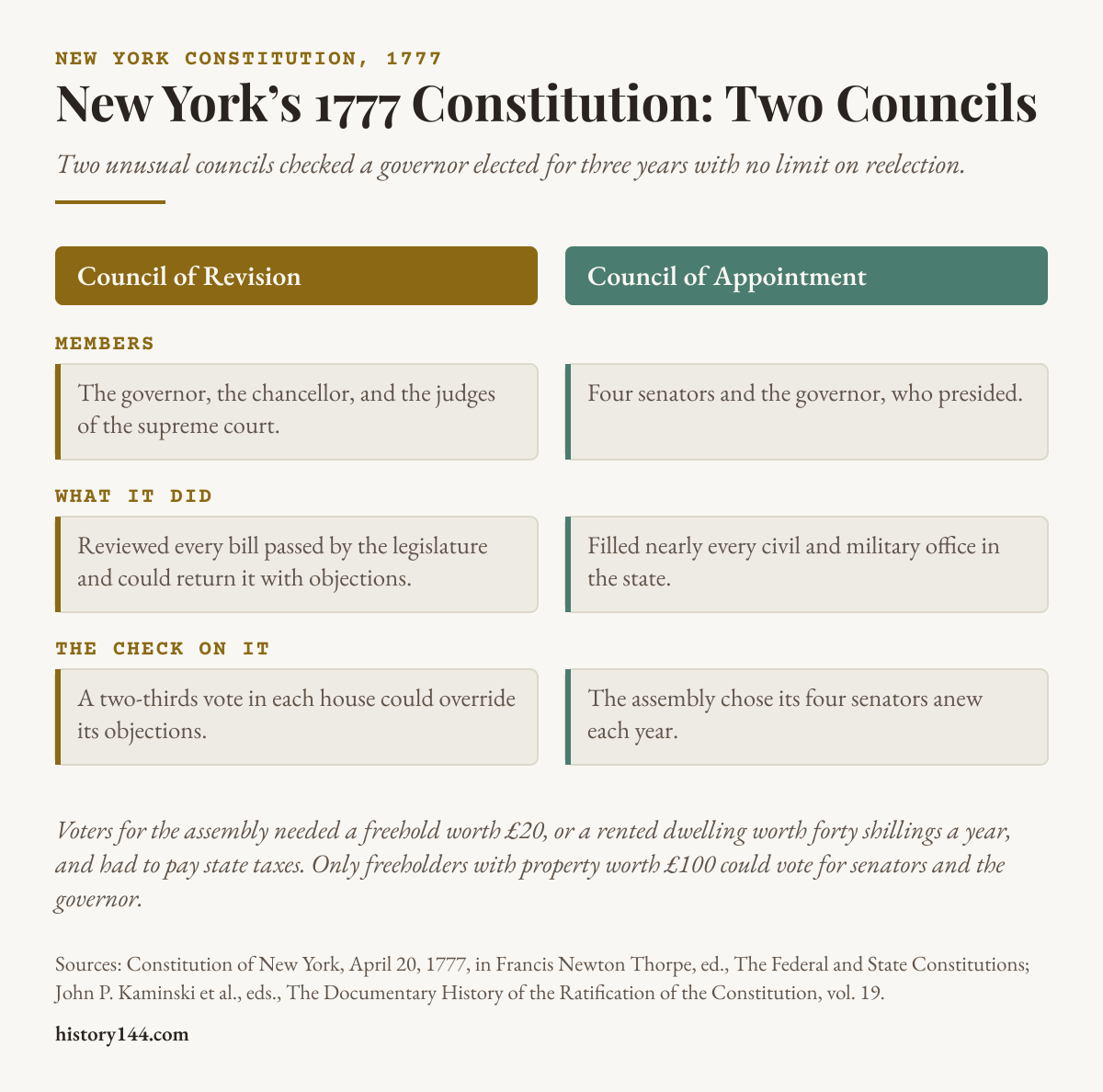
The document opened by quoting the Declaration of Independence at length and then announced that no authority should be exercised over the people except such as derived from them. In practice it was a cautious charter that kept political power in the hands of property holders. To vote for the assembly, a man had to own a freehold worth twenty pounds or rent a dwelling worth forty shillings a year and pay state taxes. Only freeholders with property worth one hundred pounds could vote for senators and the governor. Elections to the legislature would be by voice, as in colonial times, although the convention promised an experiment with the secret ballot once the war ended. The governor, by contrast, would be elected by ballot.[8]
The governor received a three-year term, as long as that of any state executive, with no limit on reelection.[9] He commanded the militia and could pardon most crimes, but two unusual councils checked his power. The Council of Revision, which joined the governor with the chancellor and the judges of the supreme court, reviewed every bill passed by the legislature and could return it with objections, which the legislature could override by a two-thirds vote in each house. The Council of Appointment, made up of four senators chosen each year by the assembly, with the governor presiding, filled nearly every civil and military office in the state.[10]
The constitution contained no separate bill of rights, but it protected trial by jury. It also abrogated every part of the inherited English and colonial law that could be construed to establish or maintain any particular denomination, ending the privileged legal position of the Church of England in New York.[11] It guaranteed the free exercise of religion "without discrimination or preference" and barred any minister or priest from holding civil or military office. It also required foreign-born residents seeking citizenship to renounce all foreign authority "in all matters, ecclesiastical as well as civil."[12] The convention had balanced its government carefully between the people and their betters. The first election would test whether voters would choose these men.
The Upstart Governor
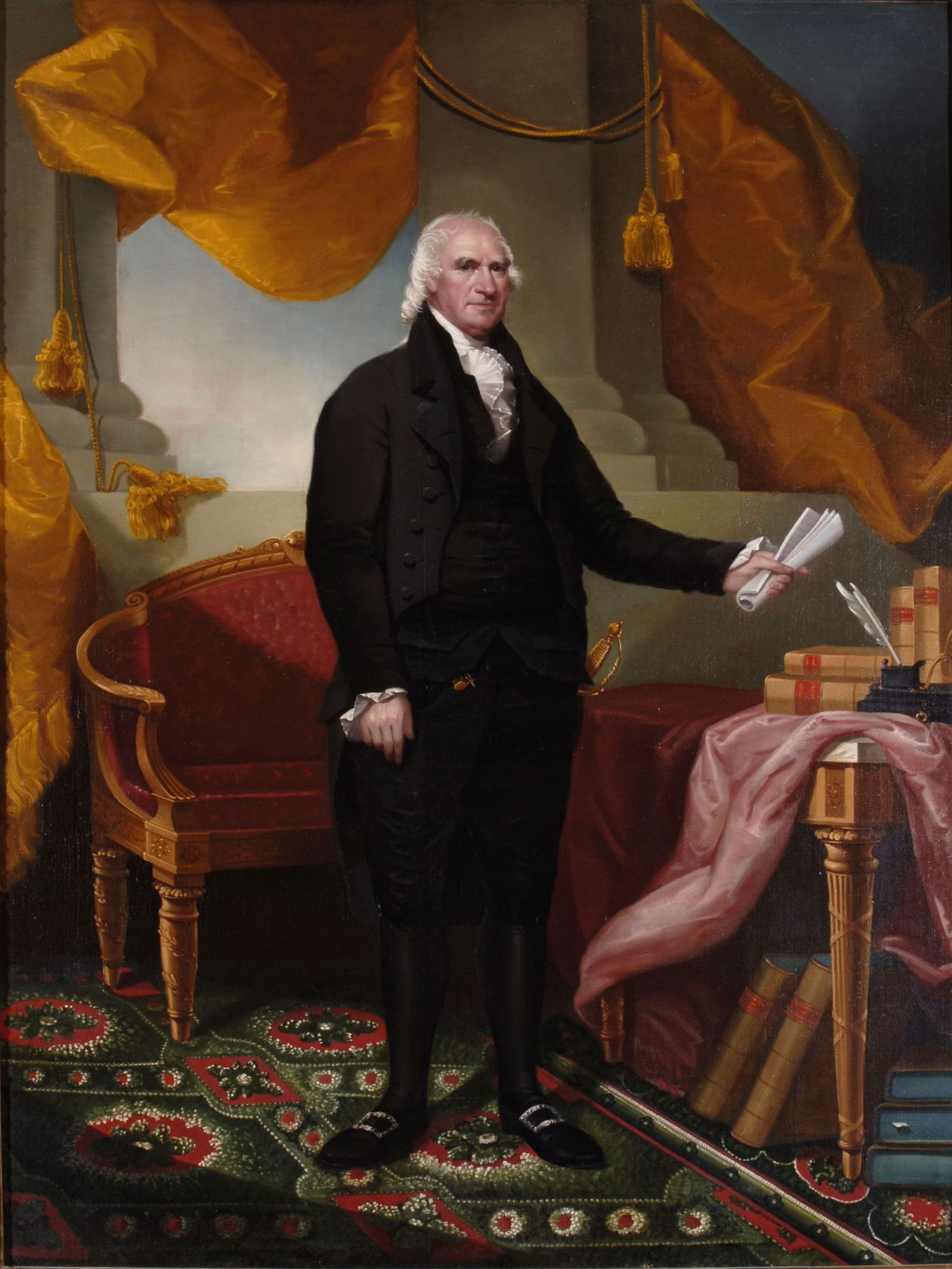
The first state elections took place in June 1777, in the middle of a military crisis, as General John Burgoyne's army advanced south from Canada toward Albany. The leading figures of the old order expected Philip Schuyler to become governor. Schuyler was a major general and a member of one of the great Albany families. His supporters expected George Clinton of Ulster County to take the lieutenant governorship. Clinton was a country lawyer and farmer's son who had served in the colonial assembly and now held commissions as a brigadier general in both the militia and the Continental Army. Schuyler's backers assumed that Clinton's votes would be divided between the two offices. Instead, Clinton won both. The final count for governor gave him 1,828 votes to Schuyler's 1,199, with John Morin Scott and John Jay far behind. Soldiers voted for Clinton overwhelmingly, 963 to 187. He resigned the lieutenant governorship, and Pierre Van Cortlandt later filled it.[13] The new assembly was filled with men who, like Clinton, had risen through county politics rather than the colonial elite. They became the foundation of his power for the next eighteen years.[14] Clinton took the oath of office at Kingston on July 30, 1777.[15]
The new government had little time to settle in. The Senate met in the house of a merchant, Abraham Van Gaasbeek, the Assembly in a tavern, and the supreme court in the courthouse.[16] In early October, Sir Henry Clinton sent a force up the Hudson from New York City to relieve pressure on Burgoyne. On October 6 the British stormed Forts Clinton and Montgomery in the Hudson Highlands, and Governor Clinton, who had commanded there in person, escaped capture.[17] Gouverneur Morris, writing from Kingston two days later to his friend Robert R. Livingston, admitted that "we are hellishly frightened."[18] On October 16 a British force under Major General John Vaughan landed at Kingston, whose residents had mostly fled, and burned it. Vaughan reported the next morning that he had marched on Esopus, as Kingston was often called, because it was "a nursery for almost every villain in the country." When the inhabitants fired on his men from their houses, he wrote, he had reduced the place to ashes, "not leaving a house." Even the merchant's house where the Senate had met was gutted by the fire and had to be rebuilt the following year. According to one modern account, the troops destroyed about 254 buildings, including the church, the courthouse, and the academy, and left as many as four thousand civilians homeless.[19] General Horatio Gates, writing to Vaughan a few days later, condemned his "unexampled cruelty."[20] Burgoyne surrendered his army at Saratoga on October 17, the day after Kingston burned. The danger from the north was over, but the state government had lost its capital. It reassembled later at Poughkeepsie, where New York would decide on the Union eleven years afterward.[21]
Seven Years Behind the Lines
Saratoga ended the threat from Canada, but it did not end the war in New York. British troops occupied New York City and parts of the surrounding counties for the rest of the war, cutting the state off from its chief port and the revenue its trade had once produced. On the frontier, Loyalists, British regulars, and their Iroquois allies raided settlements in the Mohawk and upper Hudson valleys, and the Continental Army retaliated by destroying Iroquois towns.[22] Much of the state's population lived under enemy occupation or within reach of enemy raids.
The war also bred a bitter campaign against the Loyalists. On October 22, 1779, the legislature passed "An Act for the forfeiture and sale of the estates of persons who have adhered to the enemies of this state." The act declared fifty-nine named individuals guilty of adhering to the enemy and forfeited their property to the state.[23] The list included two former royal governors, William Tryon and the Earl of Dunmore, as well as members of the DeLancey and Philipse families, among the wealthiest in the colony.[24] Over the following years the sale of confiscated Loyalist estates brought the state nearly four million dollars.[25] For a treasury cut off from its port, punishing the state's enemies had become a source of revenue.
Evacuation Day
The war in New York ended on November 25, 1783, when the last British troops left Manhattan. George Washington and Governor Clinton rode into the city together, marking the end of more than seven years of occupation.[26] That evening Clinton hosted a dinner for Washington and his officers at Fraunces Tavern.[27] The city they entered had been scarred by two great fires during the occupation, and thousands of Loyalists had already left with the British, many of them for Nova Scotia. When Congress, as the peace treaty required, recommended that the states make restitution to Loyalists, the New York legislature refused in March 1784.[28]
Peace also exposed how weak New York's hold on its own territory was. In 1777 the settlers of the New Hampshire Grants, led by Ethan and Ira Allen and their Green Mountain Boys, had declared themselves independent of both Great Britain and New York. New York appealed to Congress, but Congress did little, and by April 1784 the state's own delegates reported that Congress expected New York to accept Vermont as a separate state eventually.[29] In the west, New York had offered in 1780 to cede its claims beyond a new boundary line to Congress, the first state to make such an offer. Massachusetts then claimed much of western New York under its old colonial charter. Commissioners from the two states finally met at Hartford in late 1786 and reached a compromise. New York kept jurisdiction over the land, while Massachusetts received the right to sell it, depriving New York of revenue it had expected from land sales.[30] Five of the seven frontier forts that the British refused to give up were also on New York soil. In March 1784, Clinton secretly sent his own envoy to the British governor of Canada, in violation of the Articles of Confederation. When Congress could not act for New York, New York acted for itself.[31]
A Definitive Veto
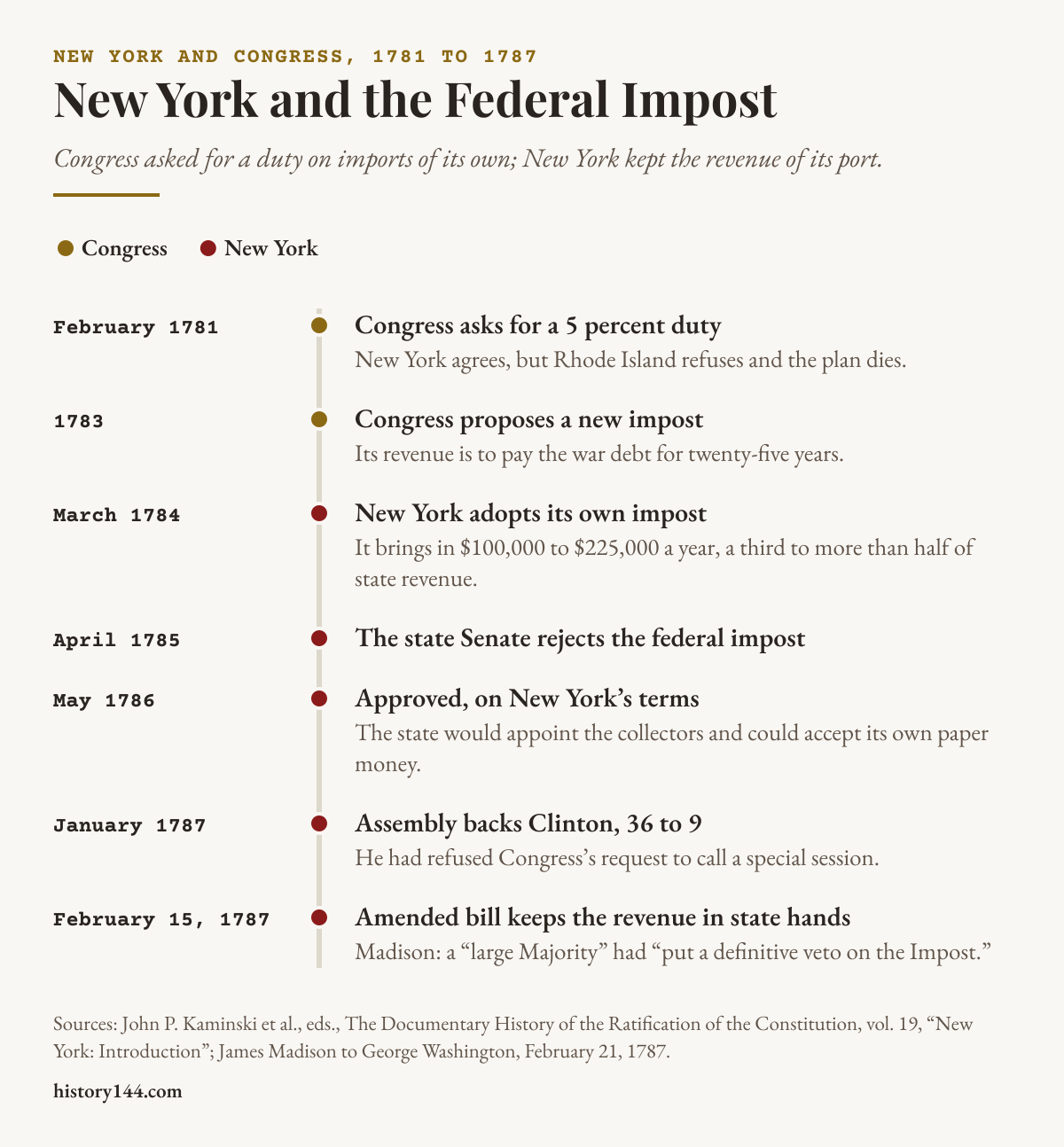
The issue that most sharply divided New York from the Union was money. Under the Articles, Congress could not tax. It could only ask the states for contributions and propose amendments, which required the consent of every state. In February 1781 Congress asked for the power to levy a five percent duty on imports. New York agreed, but Rhode Island refused, and the plan died.[32] Once the British left, the state levied its own import duties at the reopened port. Adopted in March 1784, the state impost brought in between $100,000 and $225,000 a year, from one-third to more than half of all state revenue. Because Connecticut and New Jersey imported much of their merchandise through New York City, consumers in those states paid a large share of the tax. The impost allowed New York to keep its other taxes low.[33]
Congress proposed a new impost in 1783, with the revenue dedicated to paying the war debt for twenty-five years. New York's Senate rejected it in April 1785. A year later, in May 1786, the legislature finally approved the impost, but only on condition that the state appoint and control the collectors and could accept its own paper money in payment. Congress judged that this did not comply and asked Clinton to call a special session of the legislature. He refused, and in January 1787 the Assembly approved his refusal by a vote of 36 to 9. On February 15 it passed an amended bill that still kept the revenue in state hands. James Madison, newly arrived in Congress, wrote to George Washington that "a large Majority" in the Assembly had "put a definitive veto on the Impost."[34] Melancton Smith, a Dutchess County merchant who had moved to New York City and become one of Clinton's closest allies, defended the state's position in pamphlets signed "A Republican."[35]
Behind the impost fight lay a deeper division. The Clintonians, strongest among the farmers of the Hudson Valley and the interior, saw the state's prosperity and independence as achievements to protect. In 1786 they issued £200,000 in state paper money, much of it lent to borrowers on the security of mortgages, and had the state take over part of the federal debt held by New Yorkers. The merchants, lawyers, and creditors of New York City, joined by Schuyler and his son-in-law Alexander Hamilton, increasingly saw the state's policies as narrow and dangerous. Hamilton and Schuyler were among the investors in the Bank of New York, founded in 1784, which opposed state paper money.[36]
Philadelphia and Publius
Hamilton was the most determined advocate of a stronger union in New York. In September 1786 he and Egbert Benson were the only New York commissioners to attend the Annapolis Convention, which called for a general meeting at Philadelphia the following May.[37] In February 1787 the Assembly, led by Hamilton, called for a convention to revise the Articles, and the Senate concurred by a margin of 10 to 9. The legislature then reduced the delegation to three, pairing Hamilton with two Clintonians, Robert Yates, a judge of the state supreme court, and John Lansing Jr., the mayor of Albany. Lansing defeated James Duane for the third seat by 26 votes to 23.[38] New York's delegates were authorized to act only "for the sole and express purpose of revising the Articles of Confederation."[39]
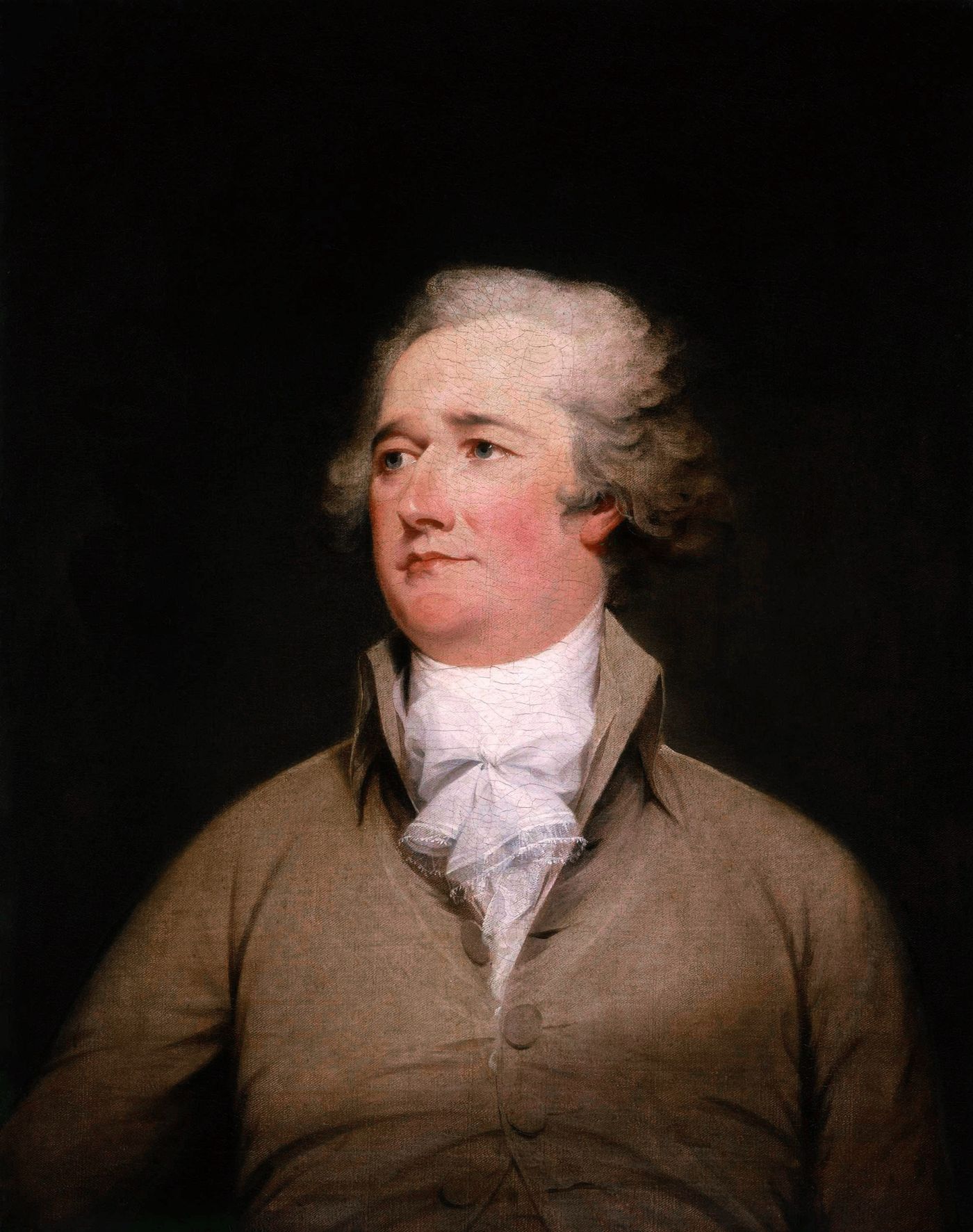
Yates and Lansing soon concluded that the convention was exceeding that mandate. Hamilton left Philadelphia at the end of June, and on July 10 Yates and Lansing departed for good, leaving New York with no vote for the rest of the summer. Hamilton returned to Philadelphia later and signed the finished Constitution in September as the only New Yorker to do so.[40] In a letter to Governor Clinton dated December 21, 1787, Yates and Lansing explained that they had opposed any plan that would consolidate the United States into one government, and recorded their "decided and unreserved dissent" from the Constitution.[41] The letter appeared in New York newspapers in January 1788 and was reprinted across the country.[42]
By then New York was the scene of the most famous newspaper debate in American history. On October 27, 1787, the Independent Journal printed the first of a series of essays signed "Publius" and addressed "To the People of the State of New York." Their author, Hamilton, soon enlisted Madison and Jay, and the series grew to eighty-five essays that later became known as The Federalist.[43] Antifederalists answered with essays of their own, signed with names such as "Cato" and "Brutus." Their authorship has never been firmly established, although Governor Clinton has long been suggested as "Cato."[44] For all their later fame, the essays did not stop an Antifederalist landslide in the spring elections.
The Courthouse at Poughkeepsie
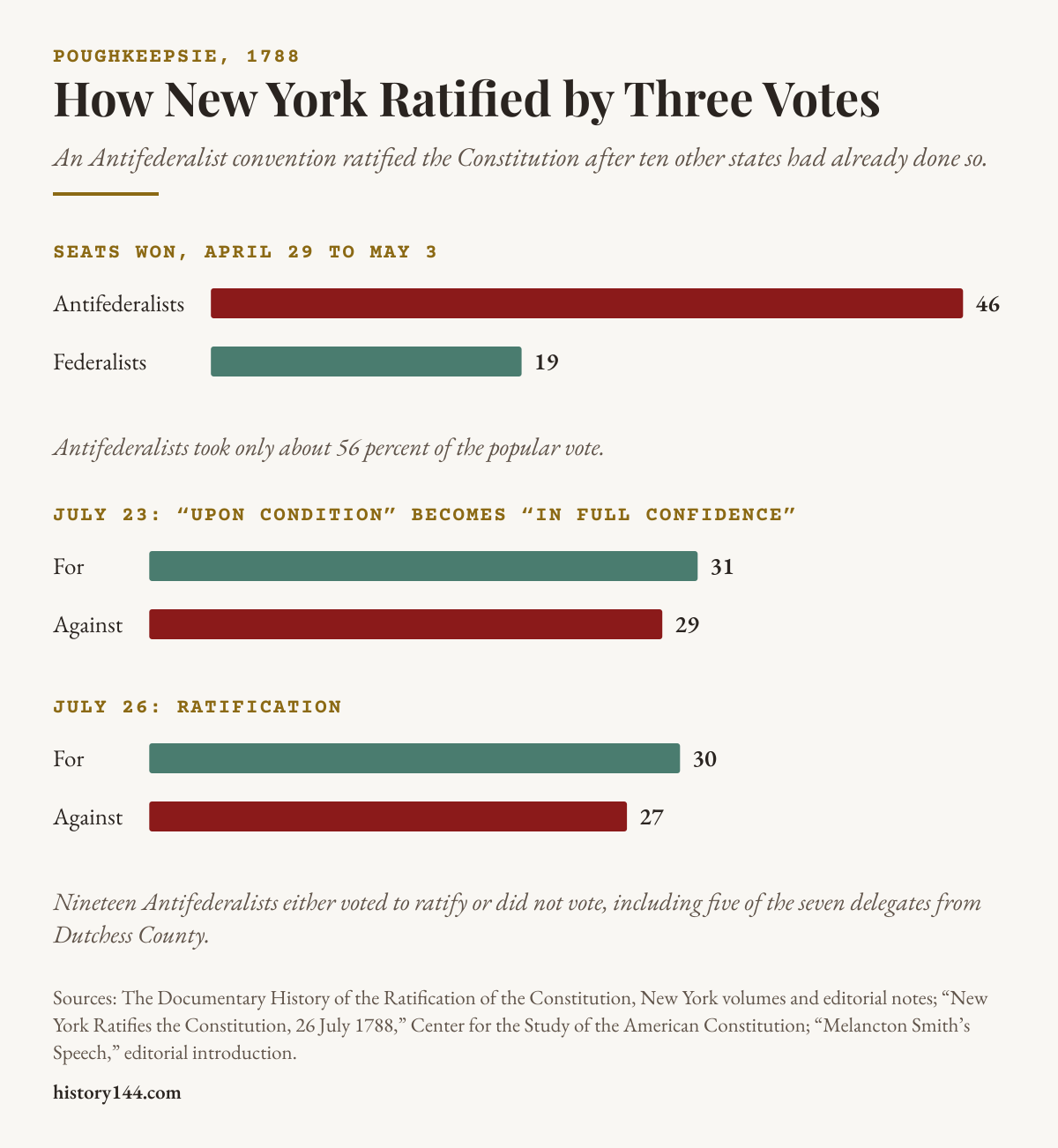
On January 31, 1788, the Assembly took up a resolution calling a state convention, and the legislature adopted it the next day. In a striking departure from New York's usual rules, it provided that "all free male citizens of the age of twenty-one years, and upwards" could vote for delegates, regardless of property.[45] The elections were held over five days, from April 29 to May 3, 1788. When the ballots were counted, Antifederalists had won forty-six of the sixty-five seats and Federalists only nineteen, although the Antifederalists had taken only about 56 percent of the popular vote. Federalist strength was concentrated in New York City, where a slate headed by Jay won easily, and the southern part of the state.[46] Melancton Smith, unable to win election in the Federalist city, ran successfully in Dutchess County.[47]
The convention opened on June 17 at the courthouse in Poughkeepsie, eighty-four miles up the Hudson from New York City, and chose Governor Clinton as its president. Hamilton, Jay, and Chancellor Robert R. Livingston led the outnumbered Federalists, while Smith acted as floor manager for the Antifederalists, with Lansing and Yates at his side. Eight states had already ratified when the delegates met. Expecting further news, the Federalists set up a relay of express riders and played for time, agreeing with their opponents to debate the Constitution paragraph by paragraph. On June 24 the convention learned that New Hampshire had become the ninth state to ratify, which meant the new government would go into effect with or without New York. On July 2 word arrived that Virginia had ratified as well.[48]
Those two reports changed the question before the convention. Antifederalists could no longer hope to block the Constitution. They could only decide whether New York would join the new union or stay outside it. Many still hoped to ratify on condition that amendments be adopted first. Federalists warned that such a ratification would amount to a rejection, and they hinted that the southern part of the state might not accept it. Writing to Washington at the end of May, Jay reported that "an Idea has taken air" that the southern counties would adhere to the Union at all events, even if that meant separating from the north.[49] In a speech on July 17, Hamilton told the delegates that the southern district was "warmly attached" to the new government.[50] In New York City, Federalists made the point visible. On July 23 about five thousand people marched in a Federal Procession stretching a mile and a half. After several postponements it had been delayed one final day so that the city's Jewish residents could take part, since July 22 fell on a Jewish fast day. At its center, drawn by ten horses, rolled the "Federal Ship Hamilton," a miniature frigate with a crew of about thirty, which fired a thirteen-gun salute to start the march.[51]
That same July 23 proved decisive in Poughkeepsie. Samuel Jones, an Antifederalist from Queens, moved to replace the words "upon condition" in the proposed form of ratification with "in full confidence," turning New York's amendments from conditions into recommendations. Smith supported the motion, and it carried by 31 votes to 29.[52] In a speech that day, Smith explained why he had abandoned his earlier position. Since Congress could not admit New York on terms different from those the other states had accepted, he argued, "a conditional adoption is a rejection," and New York's amendments should therefore be "recommendatory."[53] Lansing made one last attempt on July 24, moving that New York reserve the right to withdraw from the Union if its amendments were not considered within a set number of years. Hamilton answered by reading a letter from Madison, written four days earlier, in which Madison insisted that "the Constitution requires an adoption in toto, and for ever." The motion failed the next day by 31 votes to 28.[54]
On Saturday, July 26, 1788, the convention ratified the Constitution by 30 votes to 27. Only twenty-seven of the forty-six Antifederalists voted against it. The rest voted to ratify or did not vote, including five of the seven delegates from Dutchess County.[55] The ratification included a long declaration of rights and a list of recommended amendments.[56] According to a Poughkeepsie newspaper, Clinton then told the delegates that the Constitution's opponents would probably remain dissatisfied until a convention considered the amendments, but that he would "endeavour to keep up peace and good order among them." The delegates next unanimously approved a circular letter, drafted by a committee of Jay, Lansing, and Smith, that urged the other states to join in calling a second general convention to consider amendments, and Clinton signed it as president.[57]
In Full Confidence
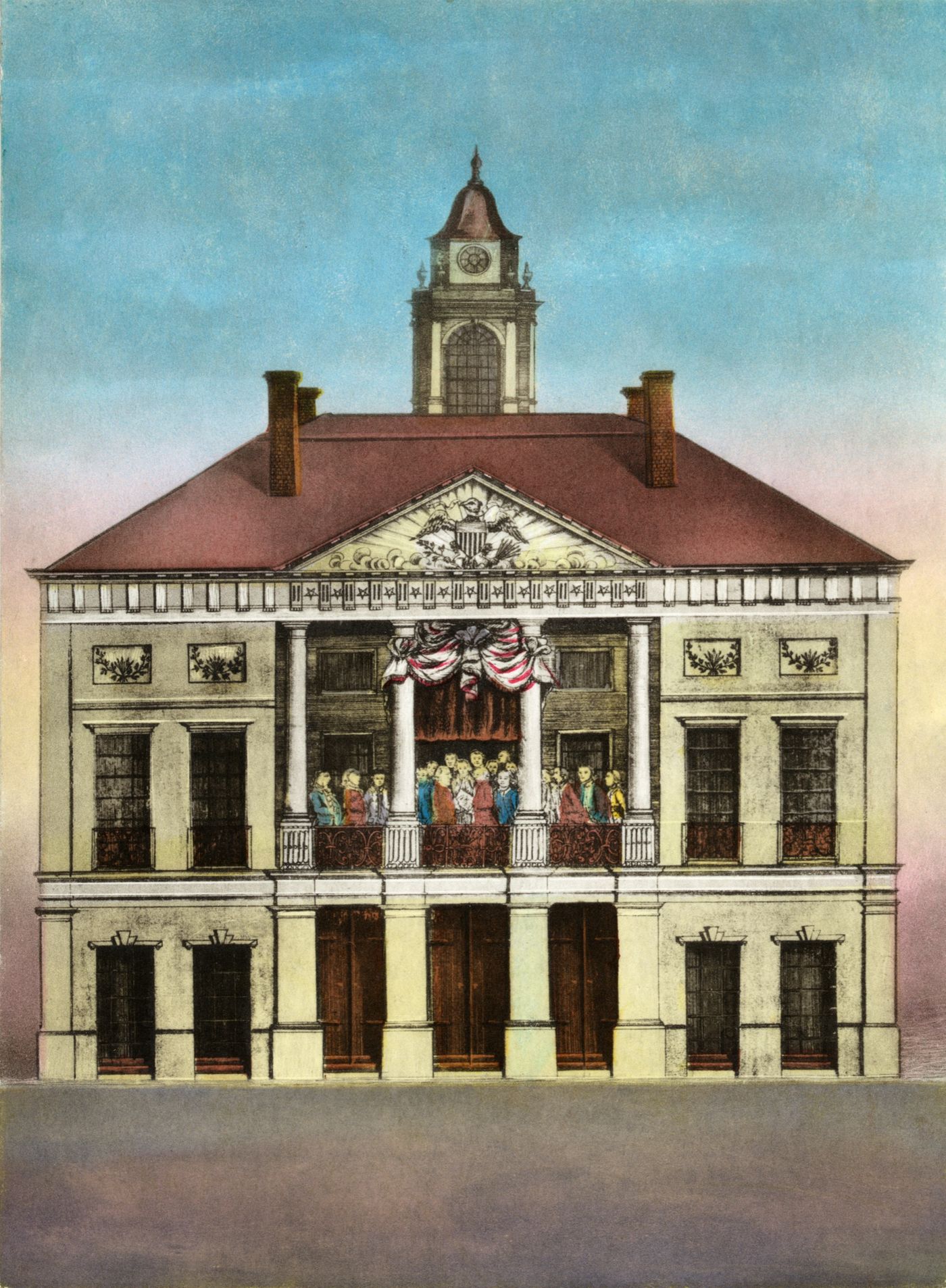
New York became the eleventh state to ratify, and the man who made it possible paid a political price for it. Many Antifederalists regarded Melancton Smith as a traitor, and although he remained in Clinton's circle, he never won federal office. His biographer has argued that his change of course secured New York's place in the Union and helped avoid the risk of civil war.[58] The circular letter for a second convention found little support in the other states, but the demand for amendments did not disappear. When the First Congress met in New York City in 1789, it drafted the amendments that became the Bill of Rights. New York City served as the first capital of the new government, and on April 30, 1789, Washington took the oath of office as president on the balcony of Federal Hall on Wall Street.
New York embraced independence late, wrote its constitution on the run, and governed itself for most of the war from small towns in the Hudson Valley while an enemy army held its greatest city. Under George Clinton it became a self-reliant state that collected its own customs revenue, conducted its own diplomacy, and offered Congress an impost only on its own conditions. That independence made New York prosperous, and it made the state the strongest obstacle to a national government with power to tax. In July 1776 the deputies at White Plains had unanimously approved independence, lamenting the "cruel necessity" that had made it unavoidable. A British army was already ashore on Staten Island. In July 1788 their successors at Poughkeepsie struck out "upon condition," wrote "in full confidence" in its place, and joined the Union by three votes, because ten other states had already decided. The most reluctant partner in the Union soon became the seat of its new government.
Places in this Story
The places this story moves through, in order — follow them on the interactive map →
- White Plains, New York July 9, 1776
The provincial congress endorsed the Declaration and changed its name to a convention of the state.
- Kingston, New York April 20, 1777
The convention adopted the state constitution with one dissenting vote and never put it to the voters.
- Fort Montgomery, New York October 6, 1777
The British stormed the Hudson Highlands forts and Governor Clinton, commanding in person, escaped.
- Poughkeepsie, New York July 26, 1788
The state convention ratified the federal Constitution by thirty votes to twenty-seven.
- Manhattan, New York November 25, 1783
The last British troops left the city after more than seven years of occupation.
- Hartford, Connecticut Late 1786
Commissioners agreed that New York would keep jurisdiction over the west while Massachusetts sold it.
- Annapolis, Maryland September 1786
Hamilton and Egbert Benson were the only New York commissioners to attend the convention.
- Philadelphia, Pennsylvania July 10, 1787
Yates and Lansing left the Federal Convention for good, leaving New York with no vote.
- Federal Hall, New York April 30, 1789
Washington took the oath of office as president on the balcony in the first capital of the new government.
Frequently Asked Questions
Why did New York not vote for the Declaration of Independence?
Its delegates had no instructions and abstained when Congress voted on July 2, 1776. The newly elected fourth Provincial Congress endorsed the Declaration at White Plains on July 9, calling the reasons given for it cogent and conclusive.
When did New York become a state?
On July 10, 1776, the body resolved that its style or title be changed from the Provincial Congress of the Colony of New-York to the Convention of the Representatives of the State of New-York.
What was unusual about the New York Constitution of 1777?
It was adopted at Kingston on April 20, 1777, with one dissenting vote and never submitted to the voters. It gave the governor a three-year term, as long as that of any state executive, and checked him with a Council of Revision and a Council of Appointment.
How did George Clinton become governor in 1777?
Philip Schuyler's supporters expected Clinton to take the lieutenant governorship and split his vote, but he won both offices. The count gave him 1,828 votes to Schuyler's 1,199, with the soldiers voting for him 963 to 187.
Why did the British burn Kingston in 1777?
Major General John Vaughan's force landed on October 16, 1777, and burned the town after its inhabitants fired from their houses. Vaughan reported that he had marched on Esopus because it was a nursery for almost every villain in the country.
Why did New York resist the federal impost?
Its own import duties at the reopened port brought in between $100,000 and $225,000 a year, from a third to more than half of all state revenue, much of it paid by consumers in Connecticut and New Jersey. Giving Congress the revenue would have meant taxing New Yorkers instead.
How did New York ratify the Constitution?
Antifederalists held forty-six of the sixty-five seats at Poughkeepsie, but news that New Hampshire and Virginia had ratified changed the question from whether to block it to whether to stay outside the Union. On July 26, 1788, the convention ratified by 30 votes to 27.
Bibliography
"Description of the New York Federal Procession." New York Daily Advertiser, August 2, 1788. Center for the Study of the American Constitution, University of Wisconsin. https://archive.csac.history.wisc.edu/description_of_the_new_york.pdf. Accessed November 9, 2026.
Constitution of New York, April 20, 1777. In The Federal and State Constitutions, Colonial Charters, and Other Organic Laws of the States, Territories, and Colonies Now or Heretofore Forming the United States of America, edited by Francis Newton Thorpe. Washington, DC: Government Printing Office, 1909. Avalon Project, Lillian Goldman Law Library, Yale Law School. https://avalon.law.yale.edu/18th_century/ny01.asp. Accessed November 8, 2026.
Hamilton, Alexander. The Federalist No. 1. Independent Journal (New York), October 27, 1787. The Papers of Alexander Hamilton, Founders Online, National Archives. https://founders.archives.gov/documents/Hamilton/01-04-02-0152. Accessed November 8, 2026.
Hamilton, Alexander. "New York Ratifying Convention. Second Speech of July 17, 1788." The Papers of Alexander Hamilton, Founders Online, National Archives. https://founders.archives.gov/documents/Hamilton/01-05-02-0012-0074. Accessed November 8, 2026.
"Introductory Note: New York Ratifying Convention, 17 June to 26 July 1788." The Papers of Alexander Hamilton, Founders Online, National Archives.
Jay, John. The Correspondence and Public Papers of John Jay. Edited by Henry P. Johnston. Vol. 3. New York: G. P. Putnam's Sons, 1891. Internet Archive. https://archive.org/details/correspondencepu03jayj. Accessed November 9, 2026.
"John Jay and the New York State Constitution of 1777." Editorial note. The Papers of John Jay, Founders Online, National Archives.
"John Jay at the New York Ratifying Convention." Editorial note. The Papers of John Jay, Founders Online, National Archives.
Journals of the Provincial Congress, Provincial Convention, Committee of Safety and Council of Safety of the State of New-York, 1775-1776-1777. 2 vols. Albany: Thurlow Weed, 1842.
Kaminski, John P. George Clinton: Yeoman Politician of the New Republic. Madison, WI: Madison House, 1993. Google Books. https://books.google.com/books?id=CzENUusPxfoC. Accessed November 9, 2026.
Kelly, Jack. "So Heavy a Trial: The Burning of New York's First Capital." Journal of the American Revolution, September 4, 2014. https://allthingsliberty.com/2014/09/so-heavy-a-trial-the-burning-of-new-yorks-first-capital/. Accessed November 8, 2026.
Madison, James. James Madison to George Washington, February 21, 1787. The Papers of George Washington, Founders Online, National Archives. https://founders.archives.gov/documents/Washington/04-05-02-0040. Accessed November 8, 2026.
Madison, James. James Madison to Alexander Hamilton, July 20, 1788. The Papers of James Madison, Founders Online, National Archives. https://founders.archives.gov/documents/Madison/01-11-02-0131. Accessed November 8, 2026.
New York Assembly. Proceedings, January 31, 1788. Teaching American History, Ashbrook Center.
New York Council of Safety. New York Council of Safety to George Washington, July 30, 1777. Editorial note. The Papers of George Washington, Founders Online, National Archives.
"New York Ratifies the Constitution, 26 July 1788." Center for the Study of the American Constitution.
"New York's Ratification Statement." Teaching American History, Ashbrook Center.
Poughkeepsie Country Journal. July 29, 1788.
"Resolutions of the New York Convention Approving the Declaration of Independence, 9 July 1776." The Papers of John Jay, Founders Online, National Archives. https://founders.archives.gov/documents/Jay/01-01-02-0163. Accessed November 8, 2026.
Schoonmaker, Marius. The History of Kingston, New York, from Its Early Settlement to the Year 1820. New York: Burr Printing House, 1888. Google Books. https://books.google.com/books?id=mlsjMujhHIcC. Accessed November 9, 2026.
Smith, Melancton. "Melancton Smith's Speech in the New York Convention, Wednesday, 23 July 1788." Center for the Study of the American Constitution, University of Wisconsin.
The Documentary History of the Ratification of the Constitution. University of Wisconsin Digital Collections.
The Documentary History of the Ratification of the Constitution. Vol. 19, Ratification of the Constitution by the States: New York. Edited by John P. Kaminski, Gaspare J. Saladino, Richard Leffler, Charles H. Schoenleber, and Margaret A. Hogan. Madison: Wisconsin Historical Society Press, 2003. Google Books. https://books.google.com/books?id=RxQO0gEACAAJ. Accessed November 9, 2026.
"The Election of 1777." Editorial note. The Papers of John Jay, Founders Online, National Archives.
"The First Constitution Brings the State of New York into Existence, April 20, 1777." Consider the Source NY, New York at 250.
The Scots Magazine 40 (March 1778).
Yates, Robert, and John Lansing Jr. Robert Yates and John Lansing Jr. to George Clinton, December 21, 1787. Teaching American History, Ashbrook Center. https://teachingamericanhistory.org/document/robert-yates-and-john-lansings-reasons-of-dissent-from-the-proposed-constitution/. Accessed November 8, 2026.
Laws of the State of New York, 1777-1801. Vol. 1. Albany: Weed, Parsons, 1886. Google Books. https://books.google.com/books?id=z5WvQgAACAAJ. Accessed November 9, 2026.
Public Papers of George Clinton, First Governor of New York, 1777-1795, 1801-1804. 10 vols. New York and Albany: State of New York, 1899-1914. Internet Archive. https://archive.org/details/publicpapers02newy. Accessed November 9, 2026.
Citations
- Resolutions of July 9, 1776, in Journals of the Provincial Congress, Provincial Convention, Committee of Safety and Council of Safety of the State of New-York, 1775-1776-1777 (Albany: Thurlow Weed, 1842), 1:518; "Resolutions of the New York Convention Approving the Declaration of Independence, 9 July 1776," with editorial note, The Papers of John Jay, Founders Online, National Archives. ↑
- Journals of the Provincial Congress, 1:519. ↑
- "New York: Introduction," from The Documentary History of the Ratification of the Constitution, vol. 19, Ratification of the Constitution by the States: New York, ed. John P. Kaminski et al. (Madison: Wisconsin Historical Society Press, 2003), Center for the Study of the American Constitution. This introduction is hereafter cited as CSAC, "New York: Introduction." ↑
- Journals of the Provincial Congress, 1:552 (August 1, 1776, naming the committee of thirteen "to take into consideration and report a plan for instituting and framing a form of government") and 1:833 (March 12, 1777, when "The committee for preparing and reporting a form or plan of government, brought in their report"); CSAC, "New York: Introduction." ↑
- Journals of the Provincial Congress, 1:892 (April 20, 1777), where the constitution "was agreed to by every member present, except Colo. Peter R. Livingston, who desired that his dissent thereto be entered on the minutes"; Constitution of New York, April 20, 1777, in Francis Newton Thorpe, ed., The Federal and State Constitutions, Colonial Charters, and Other Organic Laws of the States, Territories, and Colonies Now or Heretofore Forming the United States of America (Washington, DC: Government Printing Office, 1909), Avalon Project, editor's note. ↑
- Journals of the Provincial Congress, 1:898 (April 20, 1777), resolving "That the Constitution of this State be published at the Court House, at eleven of the clock on next Tuesday morning"; "The First Constitution Brings the State of New York into Existence, April 20, 1777," Consider the Source NY, New York at 250, for the secretary and the barrel. ↑
- "John Jay and the New York State Constitution of 1777," editorial note, The Papers of John Jay, Founders Online, National Archives; CSAC, "New York: Introduction." ↑
- Constitution of New York, 1777, preamble and arts. 1, 6, 7, 10, 17. ↑
- CSAC, "New York: Introduction." ↑
- Constitution of New York, 1777, arts. 3, 18, 23; CSAC, "New York: Introduction." ↑
- Constitution of New York, 1777, art. 35; CSAC, "New York: Introduction." ↑
- Constitution of New York, 1777, arts. 38, 39, 42. ↑
- "The Election of 1777," editorial note, The Papers of John Jay, Founders Online, National Archives; CSAC, "New York: Introduction"; Kelly, "So Heavy a Trial." ↑
- "The Election of 1777." ↑
- Journals of the Provincial Congress, 1:1021-22 (Council of Safety, Kingston, July 30, 1777), recording that Clinton "appeared in Council of Safety and took the oath of allegiance to the State, and also the oath of office of Governor," and printing the Council's proclamation of the same day; Jack Kelly, "So Heavy a Trial: The Burning of New York's First Capital," Journal of the American Revolution, September 4, 2014. ↑
- Kelly, "So Heavy a Trial." ↑
- Public Papers of George Clinton, First Governor of New York, vol. 2 (New York: State of New York, 1900), for Clinton's own letters on the storming of Forts Clinton and Montgomery on October 6, 1777 and his escape. ↑
- Gouverneur Morris to Robert R. Livingston, October 8, 1777, Robert R. Livingston Papers, New-York Historical Society, quoted in John P. Kaminski, George Clinton: Yeoman Politician of the New Republic (Madison, WI: Madison House, 1993), 33; Kelly, "So Heavy a Trial." ↑
- John Vaughan to Sir Henry Clinton, on board the Friendship off Esopus, October 17, 1777, in Marius Schoonmaker, The History of Kingston, New York, from Its Early Settlement to the Year 1820 (New York: Burr Printing House, 1888), 299; Public Papers of George Clinton, vol. 2, under Vaughan's raid on Kingston, for the governor's correspondence through those days. Accounts differ on the number of buildings destroyed, and the figure of about 254 comes from a modern reckoning rather than from any contemporary count. ↑
- Horatio Gates to John Vaughan, Albany, October 19, 1777, printed in full in Public Papers of George Clinton, vol. 2, in the editor's note on Vaughan's raid: "With unexampled cruelty, you have reduced the fine village of Kingston to ashes, and most of the wretched inhabitants to ruin." A contemporary broadside printed the letter as dated October 20, and The Scots Magazine 40 (March 1778): 140 printed it from the London papers. ↑
- Kelly, "So Heavy a Trial." ↑
- CSAC, "New York: Introduction." ↑
- An Act for the forfeiture and sale of the estates of persons who have adhered to the enemies of this state, October 22, 1779, 1779 N.Y. Laws, 3rd sess., ch. 25, printed in Laws of the State of New York, 1777-1801, vol. 1 (Albany: Weed, Parsons, 1886). ↑
- The fifty-nine persons are named in section 1 of the act itself, 1779 N.Y. Laws, 3rd sess., ch. 25, in Laws of the State of New York, 1777-1801, 1:173-74. ↑
- CSAC, "New York: Introduction." ↑
- "Order of the Procession, November 25, 1783" and "How the Americans Took Possession of the City," contemporary New York newspaper reports reprinted in Public Papers of George Clinton, 8:297-99. ↑
- Contemporary New York newspaper report of Evacuation Day, reprinted in Public Papers of George Clinton, 8:299-300, which records that the governor gave a public dinner at Fraunces Tavern, at which the commander in chief and other general officers were present, and lists the toasts drunk. ↑
- CSAC, "New York: Introduction." ↑
- CSAC, "New York: Introduction." ↑
- CSAC, "New York: Introduction." ↑
- CSAC, "New York: Introduction." ↑
- CSAC, "New York: Introduction." ↑
- CSAC, "New York: Introduction." ↑
- James Madison to George Washington, February 21, 1787, The Papers of George Washington, Founders Online, National Archives; CSAC, "New York: Introduction." ↑
- "Melancton Smith's Speech in the New York Convention, Wednesday, 23 July 1788," editorial introduction, Center for the Study of the American Constitution. ↑
- CSAC, "New York: Introduction." ↑
- CSAC, "New York: Introduction." ↑
- CSAC, "New York: Introduction." ↑
- Robert Yates and John Lansing Jr. to George Clinton, December 21, 1787, Teaching American History, Ashbrook Center. ↑
- CSAC, "New York: Introduction." ↑
- Yates and Lansing to Clinton, December 21, 1787. ↑
- "Commentaries on the Constitution, 28 January to 28 February 1788," The Documentary History of the Ratification of the Constitution, University of Wisconsin Digital Collections. ↑
- Alexander Hamilton, The Federalist No. 1, October 27, 1787, The Papers of Alexander Hamilton, Founders Online, National Archives. ↑
- The "Cato" and "Brutus" essays are printed with their editorial apparatus in The Documentary History of the Ratification of the Constitution, vol. 19, which sets out what is and is not known about their authorship. ↑
- New York Assembly proceedings, January 31, 1788, Teaching American History, Ashbrook Center; "Introductory Note: New York Ratifying Convention, 17 June to 26 July 1788," The Papers of Alexander Hamilton, Founders Online, National Archives. ↑
- "John Jay at the New York Ratifying Convention," editorial note, The Papers of John Jay, Founders Online, National Archives; "Delegates to the New York Convention," "The New York Convention, 17 June to 26 July 1788: Introduction," and "Convention Debates and Proceedings, 17 July 1788," editorial notes, The Documentary History of the Ratification of the Constitution, University of Wisconsin Digital Collections. ↑
- "Melancton Smith's Speech," editorial introduction. ↑
- "New York Ratifies the Constitution, 26 July 1788," Center for the Study of the American Constitution. ↑
- John Jay to George Washington, New York, May 29, 1788, in The Correspondence and Public Papers of John Jay, ed. Henry P. Johnston, vol. 3 (New York: G. P. Putnam's Sons, 1891), 334-35; quoted from the manuscript in "John Jay at the New York Ratifying Convention." ↑
- Hamilton, "New York Ratifying Convention. Second Speech of July 17, 17 July 1788," The Papers of Alexander Hamilton, Founders Online, National Archives. The text survives only as notes of the speech, not a verbatim report. ↑
- "Federal Procession: Introduction," quoting Peter Collin to Nicholas Low, July 16, 1788, The Documentary History of the Ratification of the Constitution, University of Wisconsin Digital Collections; "Description of the New York Federal Procession," New York Daily Advertiser, August 2, 1788, Center for the Study of the American Constitution. ↑
- "New York Ratifies the Constitution, 26 July 1788." ↑
- "Melancton Smith's Speech." The editors note that the surviving manuscript of the speech is a damaged draft, not in Smith's handwriting. ↑
- James Madison to Alexander Hamilton, July 20, 1788, The Papers of James Madison, Founders Online, National Archives; "New York Ratifies the Constitution, 26 July 1788." ↑
- "Melancton Smith's Speech," editorial introduction. ↑
- "New York's Ratification Statement," Teaching American History, Ashbrook Center. ↑
- Poughkeepsie Country Journal, July 29, 1788, quoted in "New York Ratifies the Constitution, 26 July 1788." ↑
- "Melancton Smith's Speech," editorial introduction. ↑