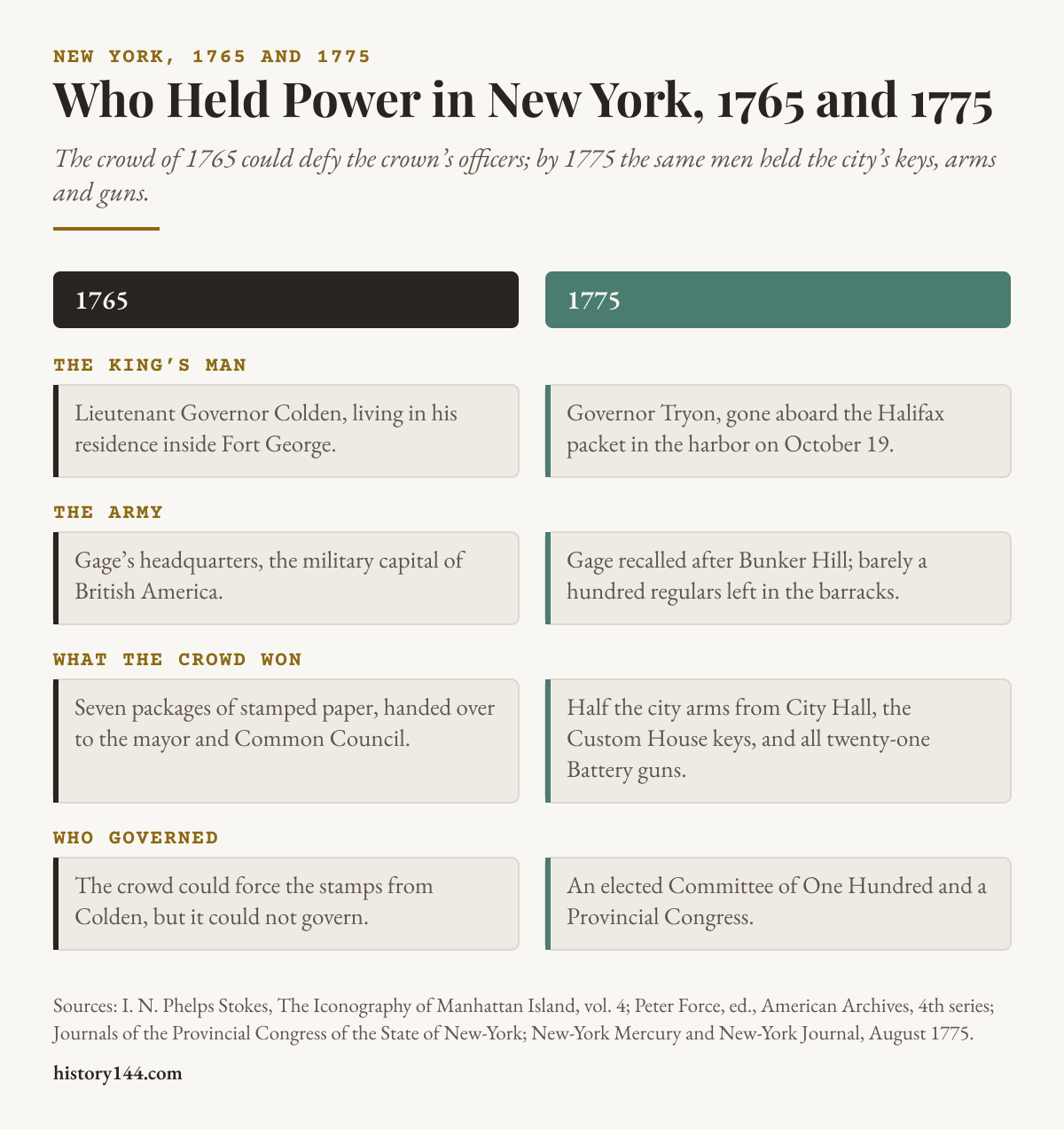
In November 1763 the guns of Fort George in New York City fired a salute as Sir Jeffery Amherst, the general who had conquered Canada, embarked for home. Major General Thomas Gage came down from Montreal to take over the command of the British army in North America. Amherst sailed from Sandy Hook on November 19, leaving his successor a set of papers titled "Papers Delivered by Major General Sir Jeffery Amherst, on his giving up the Command of the Troops in North America, to Major General Gage." Among them was a report suggesting that the commander in chief keep his headquarters at New York or Philadelphia.[1] Gage kept it at New York. For most of the next decade the city was the military capital of British America.[2]
Twelve years later, on October 19, 1775, the royal governor of New York, William Tryon, left his residence and went aboard the Halifax packet in the harbor. He would govern, so far as he governed at all, from the deck of a ship.[3] Gage had already sailed for England from Boston eight days earlier, recalled after Bunker Hill.[4] It is easy to assume that royal government would hold firmest in the city where the army kept its headquarters. In New York it ended up floating offshore. The city answered instead to a committee its own inhabitants had elected and to a Provincial Congress. Many of the men on that committee had first learned to act together in the streets, as Sons of Liberty, facing soldiers who answered to Gage. They had burned the lieutenant governor's coach under the guns of the fort, raised five liberty poles while soldiers cut down four of them, and emptied a sea captain's tea into the harbor. This is the story of those twelve years.
A Garrison City
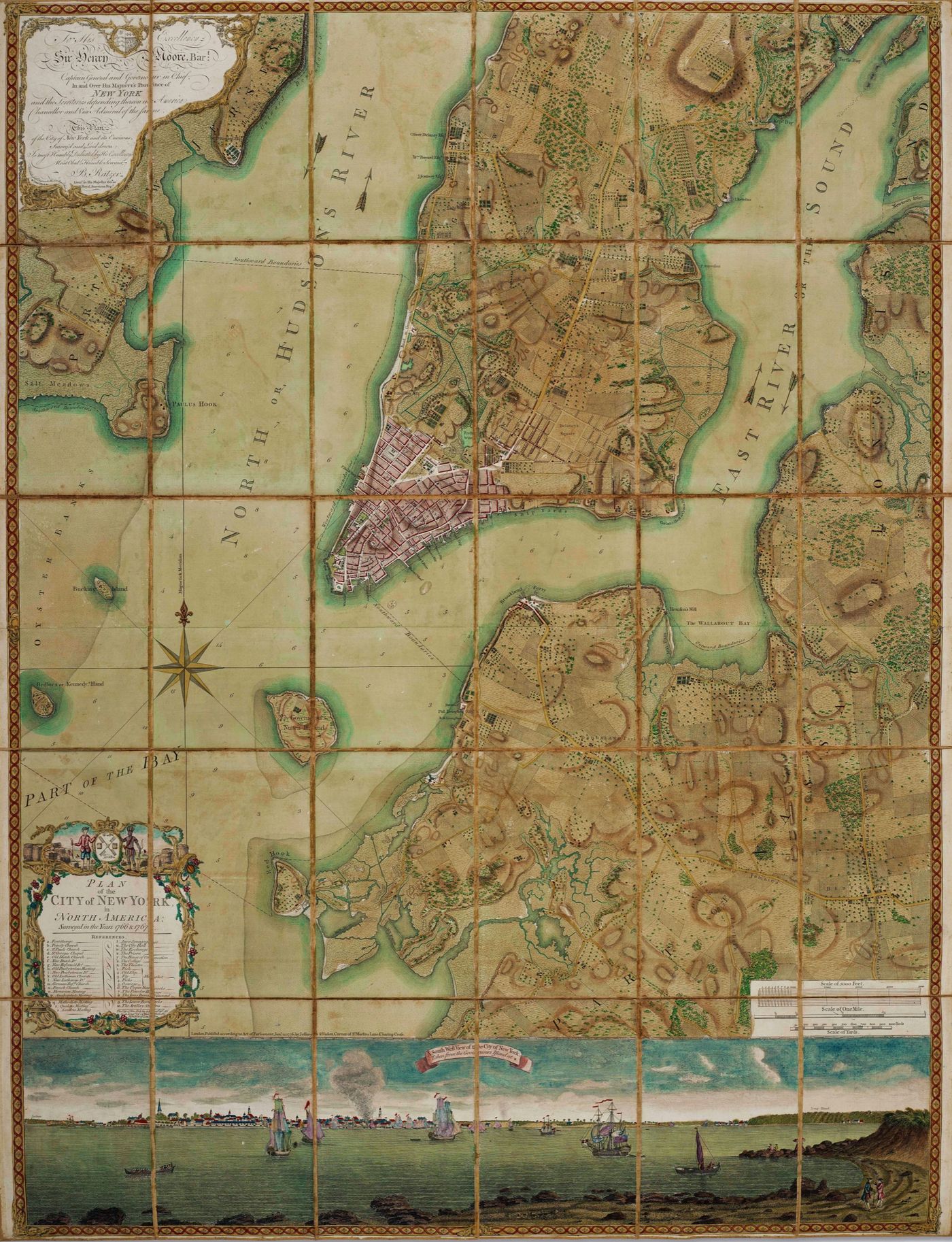
New York in 1763 was a busy port crowded into the lower end of Manhattan. The guns of Fort George stood at the Battery, and barracks for soldiers faced the common to the north, known simply as the Fields. The governor, Robert Monckton, delivered the seals of office to the lieutenant governor, Cadwallader Colden, and sailed for England on June 28, 1763. On July 8 Colden reported to the Board of Trade that he had taken over the administration.[5] Colden, an elderly Scot and a stubborn defender of royal authority, would become the first target of the crowds in this story.
The quarrel arrived with the Stamp Act, which Parliament passed on March 22, 1765. The Sugar Act of the year before had taxed goods arriving in colonial ports. The Stamp Act taxed paper used inside the colonies, the first internal tax Parliament had ever laid on them directly. Newspapers, legal documents, ship's papers, and many other printed items now had to carry a stamp bought from a government distributor.[6] The distributor named for New York, James McEvers, resigned at the end of August after hearing how a Boston crowd had wrecked the house of his Massachusetts counterpart, Andrew Oliver.[7] Colden took the opposite course. He moved into his residence in the fort and asked Gage for a force large enough to prevent sedition and tumult, and Gage undertook to supply what the available quarters would hold. To Sir William Johnson, Colden wrote that McEvers was terrified but that he himself would not be intimidated.[8]
In October the city became the meeting place of the continent's opposition. The Stamp Act Congress convened in City Hall on October 7, 1765, with delegates from nine colonies.[9] On the evening of October 22 a ship carrying the stamped paper reached the harbor. The next day about two thousand New Yorkers gathered along the Battery expecting to see it landed, but it was not landed then. A few days later, by Colden's account, the packages came ashore from the Garland "at noonday without a Guard" and were carried into Fort George.[10] On October 31, the day before the act took effect, the city's merchants agreed to stop importing British goods until it was repealed.[11]
Under the Fort Guns
The night of October 31 brought a warning. A crowd in three squads went through the streets crying "Liberty," breaking lamps and windows and promising to pull down houses the next night. The real protest came after dark on November 1, 1765, the day the act took effect, and it had plainly been planned. In the Fields a gallows had been raised, and on it hung an effigy of Colden with a stamped paper in its hand, which "he seem'd to court the People to receive." A drum hung at its back, and a label on its breast was "supposed to allude to some former Circumstances of his Life." Beside it hung "the grand Deceiver of Mankind," with a boot in his hand, as the newspaper report put it. A second party carried another effigy of Colden through the streets in a chair, broke open his coach house at the fort, took out his coach, and set the effigy on top of it.[12]
The two parties met and carried gallows, effigies, and coach in procession to the gate of Fort George. They knew the guns inside were loaded, and they could see soldiers lining the ramparts. Accounts describe men coming up to the walls and daring the garrison to fire. It held its fire.[13] The crowd then tore away the fence around the Bowling Green and piled the wood around the gallows. There, "under the muzzles of the Fort guns," it burned the effigies and the coach, along with a chaise and two sleighs from Colden's coach house, and reduced "the Coach, Gallows, Man, Devil, and all to Ashes."[14]
Part of the crowd then marched to Vauxhall, the house of Major Thomas James of the Royal Artillery, the officer in charge of the fort's guns. According to the New-York Gazette, James had "incurred the resentment of the public, by expressions imputed to him" during the dispute over the stamps. The crowd carried off or destroyed every article in the house.[15] A week later Colden sent him to London with his dispatches, telling the secretary of state that James would "be able Sir to inform you of everything that has passed." James afterwards gave evidence in London about the fort and the temper of the town.[16]
On November 2, Colden declared that he would "do nothing in relation to the Stamps" and would leave the matter to the new governor, Sir Henry Moore, on his arrival.[17] His council then advised him that the city was "in perfect annarchy" and that defending the fort would mean destroying the town. Colden asked Gage for his advice, and Gage agreed. On the evening of November 5, Colden handed the seven packages of stamped paper to Mayor John Cruger and the Common Council. They signed a receipt and had the packages carried to City Hall while a crowd estimated at five thousand cheered.[18] The act was never enforced in New York.
King Sears
The men who organized such crowds did not sit in the Assembly or on the council. The best known was Isaac Sears, a shipmaster who had made his name as a privateer during the Seven Years' War and afterwards traded out of New York to the West Indies. Colden told Sir William Johnson that the people of New York were "surprisingly excited to sedition by a few Men."[19] Captain John Montresor of the army engineers, keeping his journal in the city, called Sears a ringleader and once recorded a mob of two or three thousand on the common "headed by Sears."[20] No one in the city could bring a crowd into the street the way Sears could. His loyalist enemies came to call him "King Sears."
Two other men appear beside him again and again. John Lamb became the movement's most practiced writer and correspondent, and Alexander McDougall its most famous prisoner. None of the three sat among the families who expected to govern.[21]
When the merchants' boycott brought the opposition into the open, these men began to call themselves the Sons of Liberty, a phrase taken from a speech in Parliament by Isaac Barré, one of the colonies' few defenders there.[22] Montresor later recorded that the Sons called the pine post on the common, where they drilled daily, their Tree of Liberty.[23] In January 1766, when more stamped paper arrived by sea, a crowd boarded the ship, took the stamps, and burned them.[24] The rioting and threats went on until news of the act's repeal reached New York in May 1766.[25]
A Piece of Wood
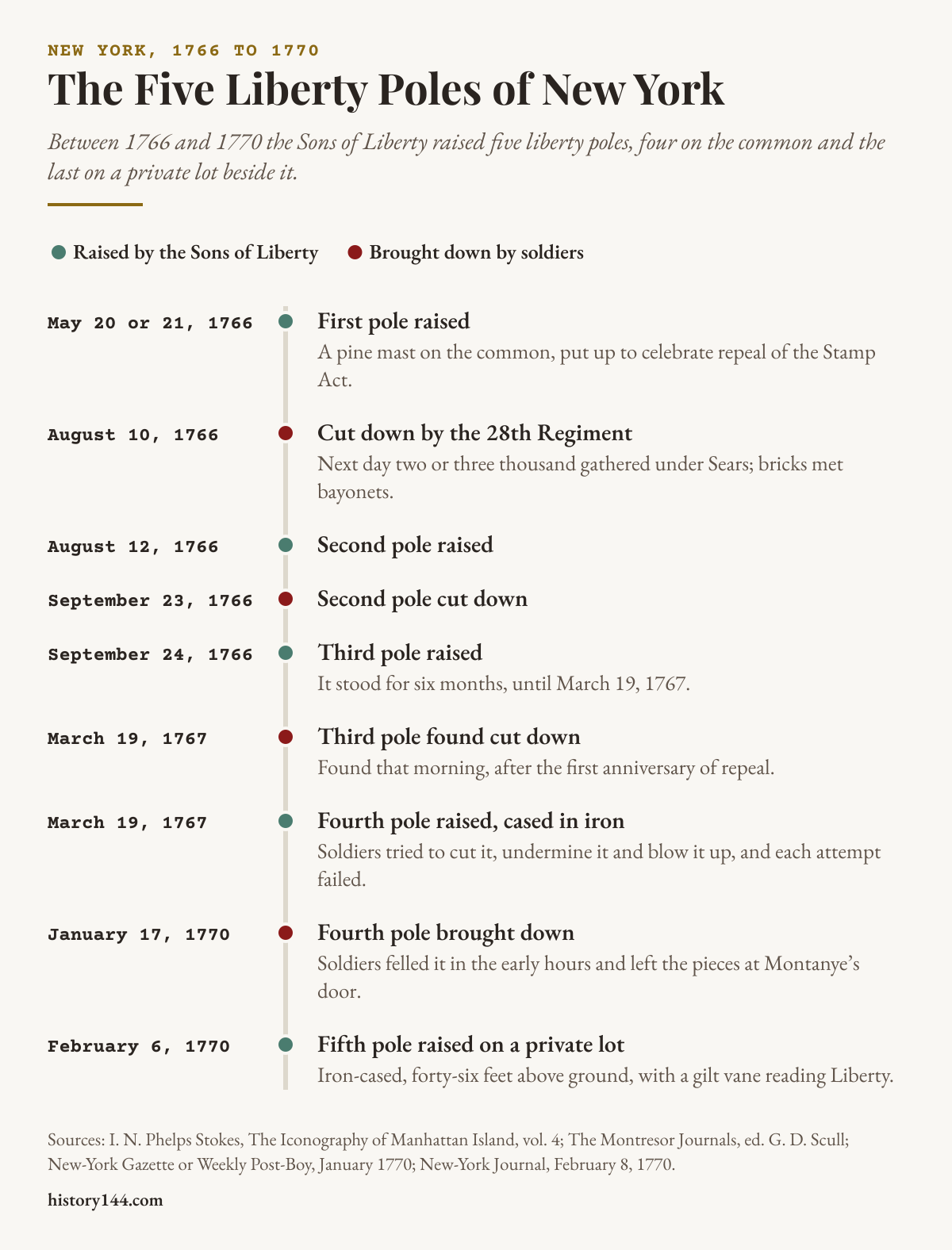
News of the repeal reached the city on May 20, 1766. Within a day or so the Sons had a tall pine mast standing on the common, in plain sight of the soldiers' barracks, inscribed to "his Majesty, Mr. Pitt, & Liberty." Many later accounts date it to the king's birthday on June 4, but Stokes, working from the newspapers, puts it on May 20 or 21. It was the first of five liberty poles the Sons would put up before the war. For the next four years the soldiers kept cutting them down.[26]
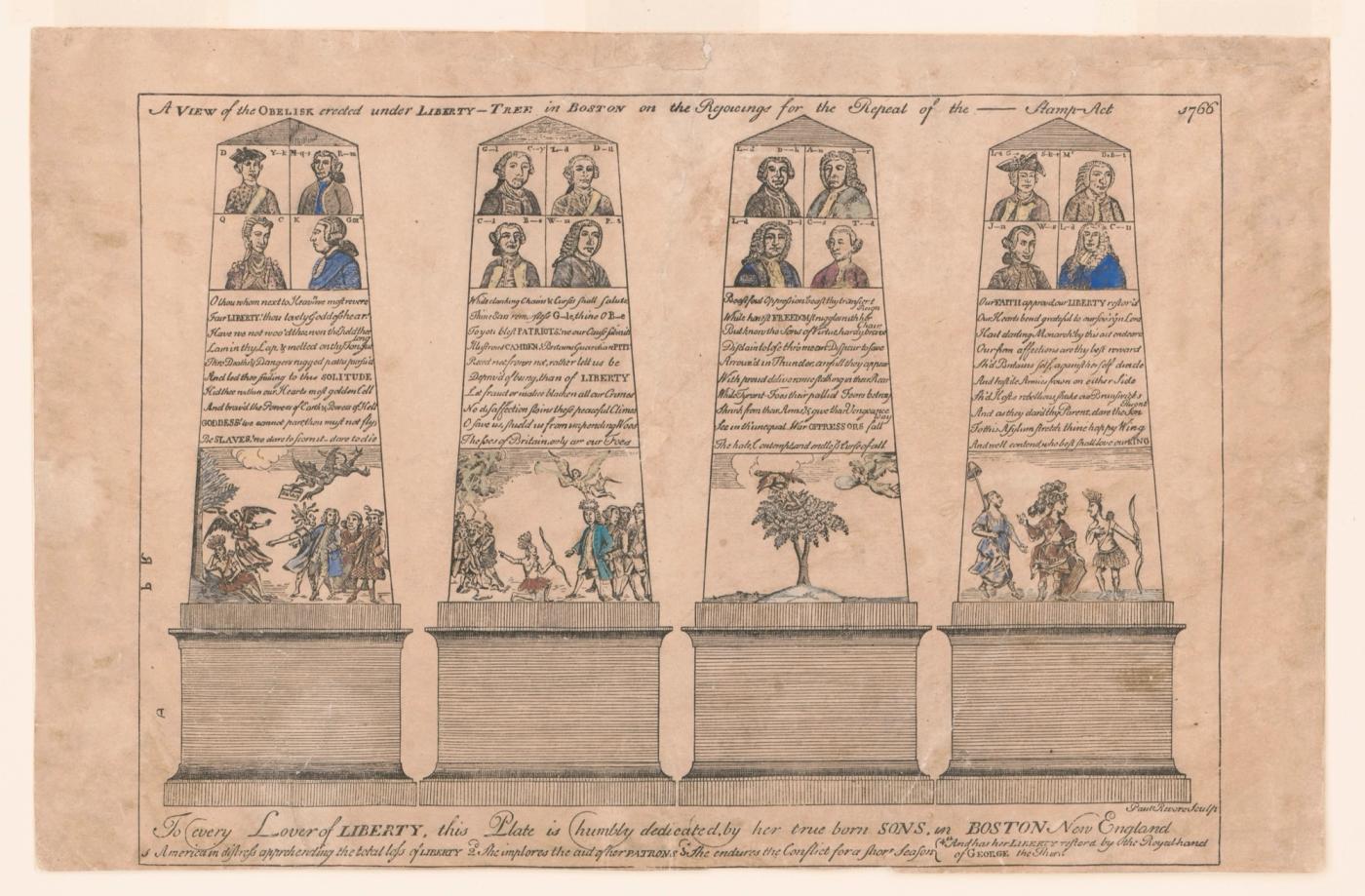
The soldiers of the 28th Regiment, quartered in the barracks, took the pole as an insult, and on the night of August 10 they cut it down. The next day, by Montresor's count, two or three thousand people gathered on the common with Sears at their head. Insults gave way to thrown bricks, and the soldiers answered with bayonets.[27] A second pole went up on August 12 and stood until September 23, when it too was cut down. A third rose the next day and lasted six months. On the morning of March 19, 1767, after the first anniversary of the repeal, it was found cut down. The Sons raised a fourth pole that same day and cased its lower part in iron. Soldiers tried to cut it, undermine it, and blow it up, and each attempt failed.[28]
The poles stood for a larger quarrel. The Quartering Act of 1765 required the colonies to supply British troops stationed among them with quarters and other necessities, and New York's Assembly refused to comply in full. In June 1767 Parliament answered with the New York Restraining Act, which forbade the Assembly to pass any law after October 1 until it had provided for the troops.[29] The Assembly gave enough ground that the suspension never took effect, but Parliament had claimed the power to silence a colonial legislature.[30] At the end of 1768 the Assembly approved petitions to the king, the Lords, and the Commons protesting against "suspending the legislative power of this colony."[31]
To the Betrayed Inhabitants
After two dissolutions, a new Assembly was elected in January 1769, and the faction of the De Lancey family controlled it. In December it voted two thousand pounds for the troops in the city, a grant the Sons of Liberty regarded as a surrender.[32] On December 16, 1769, a broadside signed "A Son of Liberty" appeared in the streets under the heading "To the Betrayed Inhabitants of the City and Colony of New-York." It warned that "the minions of tyranny and despotism in the mother country, and the colonies, are indefatigable in laying every snare that their malevolent and corrupt hearts can suggest, to enslave a free people." It went on to attack the De Lancey assemblymen and Colden himself.[33] The Assembly declared it a seditious libel. On December 20 Colden, who was again acting governor, offered a reward of one hundred pounds for the discovery of its author.[34]
The soldiers of the 16th Regiment of Foot answered in their own way. On the night of January 13, 1770, about forty of them tried to bore into the liberty pole and blow it up with powder. When they were discovered, they burst into Montanye's tavern, where the Sons met, "with drawn Swords and Bayonets." They beat the waiter and broke eighty-four panes of glass.[35] Two days later a broadside signed "Brutus" called a meeting at the pole. It protested against paying for soldiers who were "not kept here to protect but to enslave us." In the early hours of January 17 the soldiers brought the pole down and left the pieces at Montanye's door. About three thousand people met on the common that day. They resolved that soldiers found out of their barracks after dark, armed or insulting, should be treated as enemies to the peace of the city.[36]
Golden Hill
The soldiers replied in print. Their handbill mocked the Sons as men who "thought their freedom depended on a piece of wood."[37] On the morning of January 19, soldiers were posting it near the Fly Market when Sears seized one of them. Another Son of Liberty, Walter Quackenbos, took hold of a second. When a soldier drew his bayonet, Sears threw a ram's horn that struck him in the head, and the two men took their prisoners toward the mayor. Some twenty soldiers came from the lower barracks with cutlasses and bayonets and drew them at the mayor's door, demanding their comrades. The mayor ordered them back to their barracks, and a crowd followed them up to a rise near the present corner of John and William Streets, known as Golden Hill, where more soldiers joined them. A man in silk stockings and buckskin breeches, "suspected to have been an Officer in Disguise," gave the order: "Soldiers draw your Bayonets and cut your Way through them." Only six or seven of the townsmen had clubs or sticks, and those few held their ground.[38]
The New-York Gazette listed the injuries on February 5. Francis Field, a Quaker, was cut on the right cheek. A tea-water man, a fisherman, a sailor, a lamplighter, and a boy were cut. Another citizen lost two teeth in a second scuffle near the jail, and the next day a soldier ran his bayonet through a woman's cloak. One soldier took a bad cut to the shoulder, and the paper reported "Blood spilt on both Sides."[39] A letter printed later in a London newspaper claimed that a sailor had died. The New York accounts record wounds and no deaths, and nothing has been found to support the claim.[40] Because blood was drawn six weeks before the Boston Massacre, Golden Hill is often called the first bloodshed of the Revolution. The label came later, and it is not obvious it belongs here: Stokes, working from the newspapers, gave it to the fight at the first liberty pole on August 11, 1766, three and a half years earlier.
The Common Council refused, by nine votes to five, to allow another pole on either of the two public sites the Sons had asked for. Sears then bought a share of a private lot beside the old site, and on February 6, 1770, the Sons raised their last pole there. According to the New-York Journal, "a hole was dug 12 Feet deep, and a large Pitch Pine Mast erected." It was cased round with iron bars, riveted and hooped, and the wood between the bars driven as full of large nails as it would hold. Six horses drew it from the shipyards with three flags flying, the words on them Liberty and Property, and it went up while the French horns played God Save the King. It stood forty-six feet above ground, with a topmast of twenty-two more, and on that a gilt vane carrying the single word Liberty.[41] Two days later, after the printer James Parker and his apprentices had been arrested and examined, the authorities arrested McDougall as the author of the "Betrayed Inhabitants" broadside.[42] He refused to give bail and went to the new jail on the common. His supporters made him New York's John Wilkes, the London radical whose North Briton number 45 had made the number a symbol of liberty. On February 14, the forty-fifth day of the year, forty-five friends dined with him on forty-five pounds of beef steaks. On March 19, the anniversary of the repeal, a company celebrating in the city sent ten of its number to dine with him in the jail and drank forty-five toasts.[43] The friction eased through that summer.[44] When McDougall later refused to admit authorship before the Assembly, it committed him for breach of privilege, and in December 1770 he was still signing his letters from the "New-goal."[45]
At a Proper Hour
The early 1770s were quieter. Then the Tea Act of 1773 let the East India Company ship its tea directly to American consignees, cheaply enough to undersell smuggled Dutch tea while still paying the duty. The Sons of Liberty organized again. A document headed "The Association of the Sons of Liberty of New-York," dated November 29, 1773, laid down five resolutions. The first declared that anyone who should "aid or abet, or in any manner assist, in the introduction of tea" while it was subject to a parliamentary duty "shall be deemed an enemy to the liberties of America." The last promised that whoever broke the resolutions would be shunned: "we will not deal with, or employ, or have any connection with him."[46] Since the fall, New Yorkers had been speaking of "Mohawks" who would destroy any tea that came. According to the historian J. L. Bell, the name became regularly attached to the Boston Tea Party of December 16 only a century later.[47]
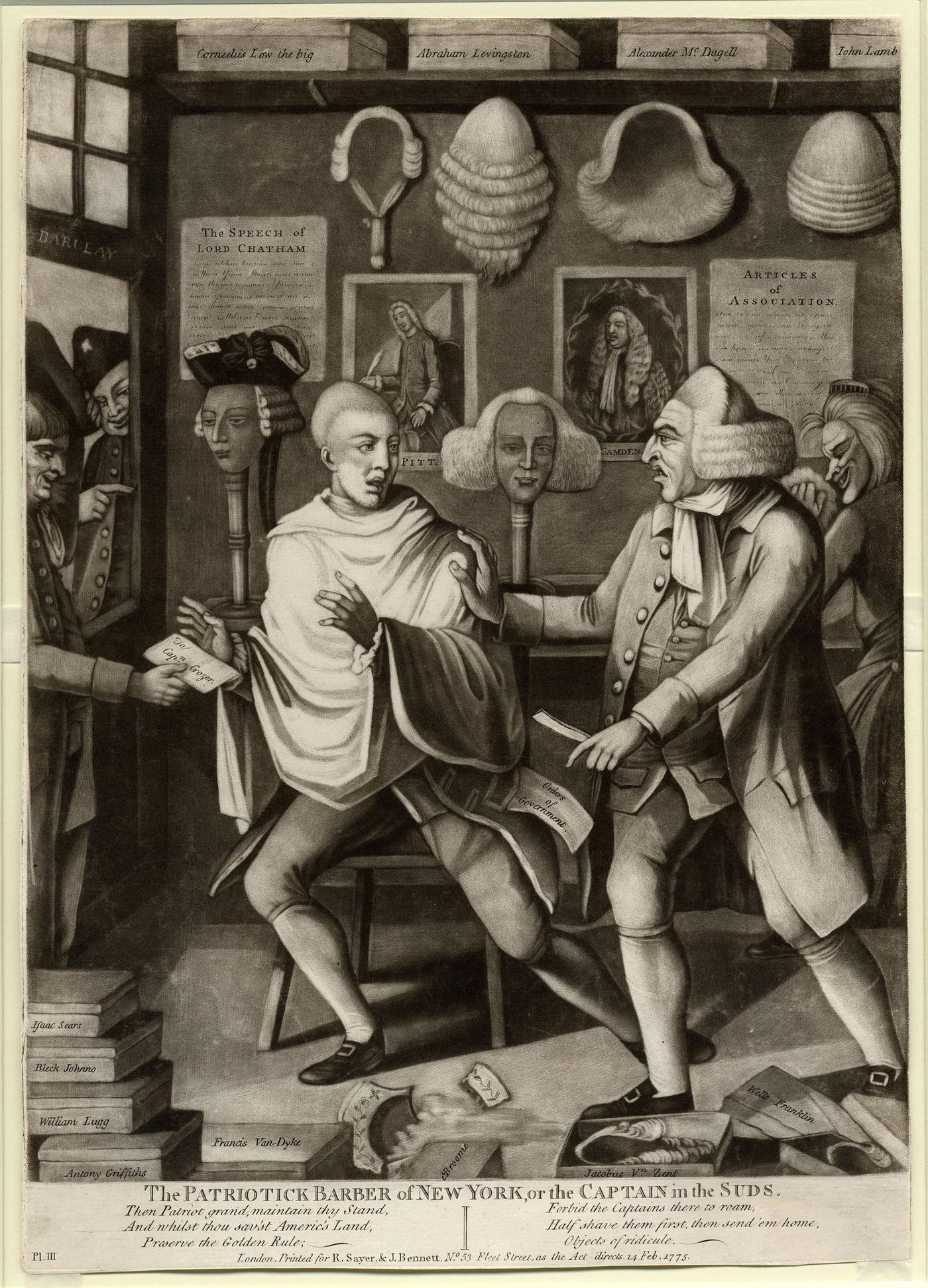
The company's tea ship for New York, the Nancy, under Captain Benjamin Lockyer, was delayed by storms. She did not reach Sandy Hook until the night of April 18, 1774. The pilot would not bring Lockyer up to the city until the committee gave leave, and the company's consignees would not receive the tea, so Lockyer came up only to get supplies for the voyage home.[48] That same day, word arrived from Philadelphia that Captain James Chambers of the London had taken eighteen boxes of tea aboard in London. The previous summer, in the words of the New-York Gazette, Chambers had been "one of the First who refused to take the India Company's Tea on Freight."[49] When the London came up to the wharf on April 22, Chambers denied carrying tea, then admitted it and declared that he owned it himself. The Gazette reported that "the Mohawks were prepared to do their Duty at a proper Hour," but the crowd would not wait. At about eight that evening men boarded the ship and emptied the chests into the harbor while a large crowd watched.[50] The next morning the city's bells rang, and a crowd gathered to see Lockyer off. "Where is he? where is he?" the people called for Chambers, who had barely escaped the crowd the night before. He left with Lockyer on the Nancy.[51]
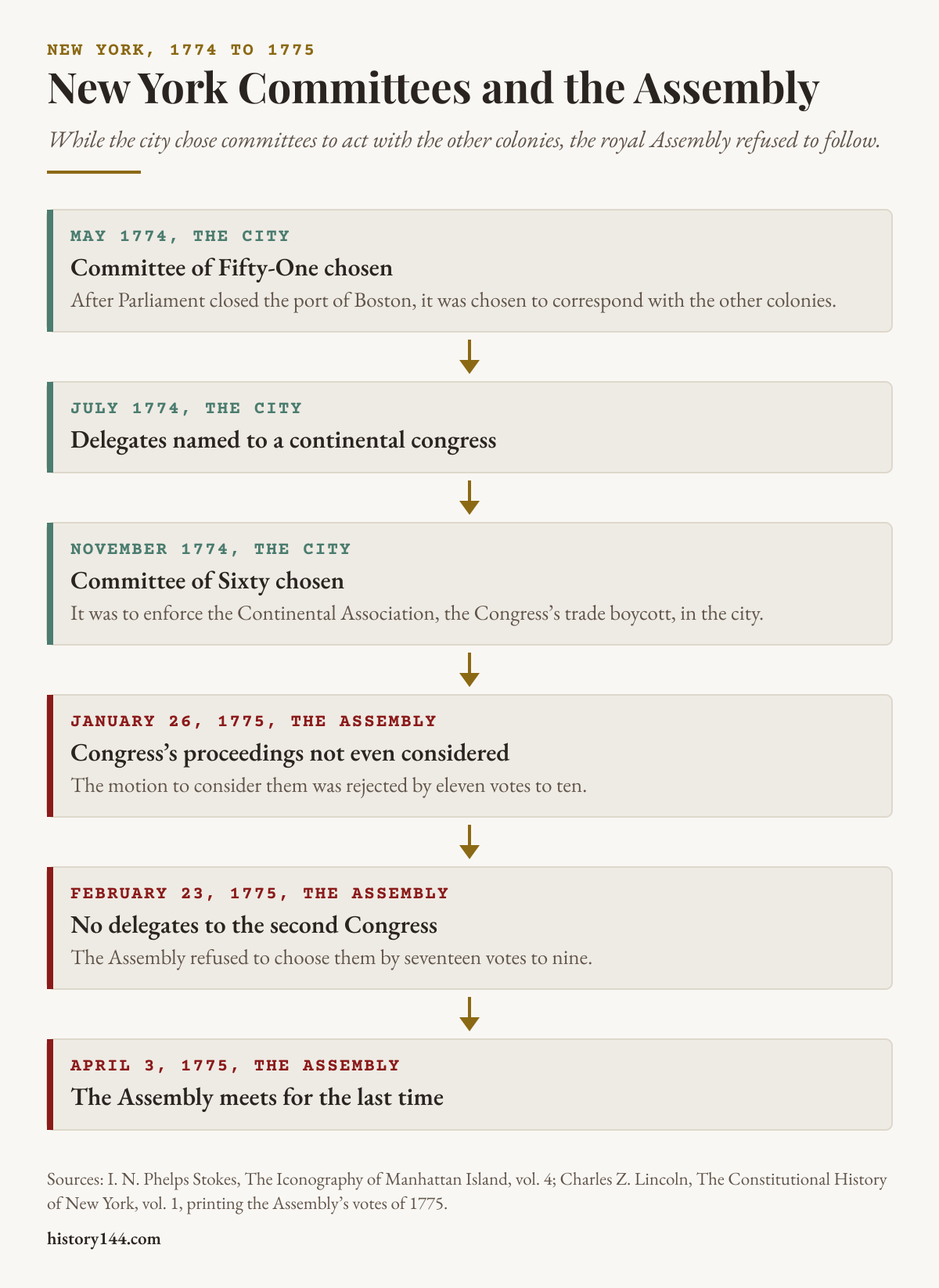
The tea crisis drew the merchants back into the movement. After Parliament closed the port of Boston, the city chose a Committee of Fifty-One in May 1774 to correspond with the other colonies, and in July it named delegates to a continental congress. Isaac Low chaired the committee, and Sears and McDougall sat on it beside merchants who had kept clear of the crowds.[52] In November a Committee of Sixty was chosen to enforce the Congress's trade boycott, the Continental Association, in the city. The Assembly, meanwhile, refused to follow. On January 26, 1775, it rejected by eleven votes to ten a motion even to consider the proceedings of the Congress. On February 23 it refused, by seventeen votes to nine, to choose delegates to the second Congress. It met for the last time on April 3, 1775.[53]
Four-and-Twenty Rounds
In the middle of April 1775, after Sears had moved at a meeting that "every man should provide himself with four-and-twenty rounds," the magistrates issued a warrant against him. He was carried before the mayor, bail was demanded and refused, and a mittimus was issued. On the way to the jail his friends took him from the officers and led him in triumph through the Fly, Wall Street, and Broadway to the liberty pole. There he mounted a rostrum in the Fields and put the question whether a Son of Liberty ought to give bail. It was carried in the negative, and Alexander McDougall, standing near him, joined the three huzzas.[54] Eight days later, at about noon on Sunday, April 23, an express rider brought word that British troops had fired on the militia at Lexington four days earlier. Two vessels from Newport carried the same news, and printed copies soon went up about the city.[55] Crowds stopped the mails and read the letters. They unloaded two sloops of flour meant for the soldiers at Boston. Toward evening they seized about half the city's arms at City Hall, and a guard of about a hundred men was posted there to secure the rest. Colden, again acting governor while Tryon was in England, called his council together. His council concluded the next day that it had "no Power" to act and could only try to dissuade the people from violence.[56]
Within days armed men were parading the town and forming themselves into companies. On April 28, according to the diary of the lawyer William Smith, Sears and some 360 armed men called on the customs collector, Andrew Elliot, and took the keys of the Custom House. The port was closed to trade under Parliament's regulations. The merchants, Smith wrote, were amazed but so humbled that they could only "sigh or complain in whispers."[57] The Committee of Sixty called for the election of a larger body. On May 1 the city elected a Committee of One Hundred, chaired by the merchant Isaac Low, and from then on the committee ran the city's affairs. It was a broader body than the Sons had ever been, with men like Low beside men like Sears. The city also chose deputies to a Provincial Congress, which first met on May 22.[58]
Two Arrivals
On Sunday, June 25, 1775, New York had two arrivals. Tryon returned from his year in England, and George Washington passed through the city on his way to take command of the new Continental Army outside Boston. Washington told Philip Schuyler, the general he left in command at New York, to watch Tryon but to refer any arrest to Congress, since seizing a governor was "quite a new thing, and of exceeding great importance." Sears had no such scruples. Soon afterward he proposed to seize Tryon and carry him off to Hartford, and he backed down only when Schuyler told him he had written orders from Washington on the subject.[59] The city corporation drew up the customary address of welcome, but the Provincial Congress objected, and on July 5 the corporation asked Tryon to excuse "their not waiting on him" to present it.[60] Royal government still existed, and many New Yorkers were loyal to it, but it no longer commanded.
The line between the two authorities was the harbor, where the British warship Asia lay at anchor. The Provincial Congress resolved that the cannon on the Battery should be removed. Late on the night of August 23, while Lamb's artillery company stood guard, Sears and a party of volunteers began hauling them away. A barge from the Asia exchanged musket fire with the men on shore, and the warship then fired her cannon. Drums beat to arms across the town. By morning the volunteers had carried off all twenty-one guns mounted on the Battery.[61] Tryon's position weakened through the autumn. Early in October he heard from Philadelphia that the Continental Congress had recommended that he be seized. On October 13 Tryon warned Mayor Whitehead Hicks that if he were seized, the commander of the warships in the harbor would demand him back and, if refused, "enforce the demand with their whole power." The city's assurances did not satisfy him. On October 19 he went aboard the Halifax, and later moved to the ship Duchess of Gordon. He governed from the water until the British army arrived the next summer.[62]
A Government on the Water
When Gage took up his papers in New York in November 1763, the city held the headquarters of an army that had just won a continent. When Tryon went aboard the Halifax, that army's commander had been recalled. The regulars left in the city's barracks that spring had numbered barely a hundred, and the king's governor could not safely sleep on land.[63] Between those two moments a waterfront crowd had become an organized movement and then something close to a government. The Sons quarreled among themselves and with the merchants and lawyers who joined the cause later, and many New Yorkers never accepted their authority. On November 23, 1775, a month after the window of this story closes, Sears and about seventy-five horsemen from Connecticut rode into the city and carried off the type of the loyalist printer James Rivington. The young Alexander Hamilton wrote that he could not help "disapproving and condemning this step."[64] The man who had led crowds against the king's soldiers could also lead one to silence a printer.
What changed in those twelve years was the source of authority in the city. In 1765 the crowd could burn a coach and force the lieutenant governor to give up the stamps, but it could not govern. By 1775 the same men, joined by merchants and lawyers who had once kept clear of the crowds, held the keys to the Custom House, the arms from City Hall, and the guns from the Battery. The king's officers no longer decided what would be done with them. The city's elected committee and the Provincial Congress did. In 1770 the soldiers had mocked the Sons as men who thought their freedom depended on a piece of wood. The poles were small things in themselves, but each time the army cut one down and the Sons raised another, the two sides were arguing over who controlled the city's public ground. By the autumn of 1775 that argument was settled, and the losing side was watching from a ship in the harbor.
Places in this Story
The places this story moves through, in order — follow them on the interactive map →
- New York City, New York November 19, 1763
Amherst sailed for England and Gage took over the army's command and kept its headquarters here.
- Fort George, New York October 22, 1765
The stamped paper arrived in the harbor, and a few days later Colden had it carried into the fort.
- Bowling Green, New York November 1, 1765
The crowd burned the lieutenant governor's coach under the muzzles of the fort guns.
- City Hall, New York November 5, 1765
Colden handed the seven packages of stamped paper to the mayor and the Common Council.
- The Common, New York August 11, 1766
Montresor counted two or three thousand on the common after the soldiers cut down the first pole.
- Golden Hill, New York January 19, 1770
Soldiers with bayonets and townsmen with clubs fought on the rise near John and William Streets.
- Murray's Wharf, New York April 23, 1774
Captain Lockyer was put aboard the pilot boat here to rejoin the tea ship Nancy, which sailed home with Captain Chambers as a passenger.
- The Battery, New York August 23, 1775
Sears and the volunteers carried off all twenty-one guns while the Asia fired on them.
- New York Harbor, New York October 19, 1775
Tryon went aboard the Halifax packet and governed from the harbor until the British army arrived in 1776.
Frequently Asked Questions
Who were the Sons of Liberty in New York?
They were the men who organized the city's crowds against the Stamp Act and after, led on the waterfront by Isaac Sears with John Lamb and Alexander McDougall. Colden described them to Sir William Johnson as a few men exciting the people to sedition.
What happened in New York on the night of November 1, 1765?
A crowd took the lieutenant governor's own coach from his coach house, paraded it with his effigy and a gallows to the gate of Fort George under the loaded guns, and then burned coach, gallows, and effigies on the Bowling Green. Another party went on to wreck Major James's house at Vauxhall.
When was the first liberty pole raised in New York?
On May 20 or 21, 1766, in celebration of the repeal of the Stamp Act. It was a mast on the common inscribed to his Majesty, Mr. Pitt and Liberty, and the soldiers cut it down on August 10.
What was the Battle of Golden Hill?
On January 19, 1770, soldiers posting a handbill against the Sons were seized near the Fly Market, and the quarrel ended in a fight with bayonets against clubs on a rise near John and William Streets. The New-York Gazette listed cuts and stabbings on both sides and no deaths.
What was the New York tea party of 1774?
Captain Chambers of the London denied carrying tea and then admitted it, and at about eight in the evening of April 22 men boarded the ship and emptied the chests into the harbor. The East India Company's own ship, the Nancy, was sent away without unloading.
What did New Yorkers do when news of Lexington arrived?
The express reached the city about noon on Sunday, April 23, 1775. Crowds unloaded two vessels of flour bound for the troops at Boston, seized about half the city's arms at City Hall, and within a week had stopped the Custom House.
Why did Governor Tryon move onto a ship?
He warned Mayor Hicks in October 1775 that the warships in the harbor would turn their whole power on the town if he were seized, and the city's assurances did not satisfy him. He went aboard the Halifax packet on October 19 and governed from the water.
Bibliography
Bell, J. L. "'The Mohawks were prepared to do their Duty.'" Boston 1775 (blog), August 29, 2018. https://boston1775.blogspot.com/2018/08/the-mohawks-were-prepared-to-do-their.html.
Clark, William Bell, ed. Naval Documents of the American Revolution. Vol. 1. Washington, DC: Government Printing Office, 1964. Google Books. https://books.google.com/books?id=NFZI0gEACAAJ. Accessed November 9, 2026.
The Colden Letter Books. Vol. 1, 1760-1765. Collections of the New-York Historical Society for the Year 1876. New York, 1877. Internet Archive. https://archive.org/details/coldenletterbook09newy. Accessed November 9, 2026.
Colden, Cadwallader. By the Honourable Cadwallader Colden... A Proclamation. December 20, 1769. New York: Hugh Gaine. Evans 11362. Google Books. https://books.google.com/books?id=ewChOwAACAAJ. Accessed November 9, 2026.
Force, Peter, ed. American Archives. 4th series, vol. 1. Washington, 1837. Internet Archive. https://archive.org/details/americanarchives41forc. Accessed November 9, 2026.
Hamilton, Alexander. Alexander Hamilton to John Jay, November 26, 1775. Founders Online, National Archives.
In Provincial Congress, New-York, August 29th, 1775. Broadside. New-York Historical Society. Google Books. https://books.google.com/books?id=j7iXDAEACAAJ. Accessed November 9, 2026.
Ingersoll, Jared. "Jared Ingersoll Papers, 1765-66." In Papers of the New Haven Colony Historical Society, vol. 9. New Haven, 1918. Internet Archive. https://archive.org/details/papersofnewhavenv9newh. Accessed November 9, 2026.
New-York Gazette or Weekly Post-Boy. January 22 and February 5, 1770.
New-York Gazette. February 5, 1770; April 25, 1774.
New-York Journal. February 8, 1770; August 31, 1775.
New-York Mercury. August 28, 1775.
Smith, William. Historical Memoirs from 16 March 1763 to 9 July 1776 of William Smith. Edited by William H. W. Sabine. New York, 1956. Google Books. https://books.google.com/books?id=jRewED5MSNgC. Accessed November 9, 2026.
The Colden Letter Books. Vol. 2, 1765-1775. Collections of the New-York Historical Society for the Year 1877. New York, 1878. Internet Archive. https://archive.org/details/coldenletterbook10newy. Accessed November 9, 2026.
Force, Peter, ed. American Archives. 4th series, vols. 2 and 3. Washington, 1837-1853. Internet Archive. https://archive.org/details/americanarchives42forc. Accessed November 9, 2026.
Journals of the Provincial Congress, Provincial Convention, Committee of Safety and Council of Safety of the State of New-York, 1775-1776-1777. Vol. 1. Albany: Thurlow Weed, 1842.
Lincoln, Charles Z. The Constitutional History of New York. Vol. 1. Rochester, NY: Lawyers Co-operative Publishing, 1906. Google Books. https://books.google.com/books?id=Rn44AAAAIAAJ. Accessed November 9, 2026.
McDougall, Alexander [A Son of Liberty]. To the Betrayed Inhabitants of the City and Colony of New-York. New York: James Parker, 1769. Evans 11319. Google Books. https://books.google.com/books?id=k3580AEACAAJ. Accessed November 9, 2026.
The Montresor Journals. Edited by G. D. Scull. Collections of the New-York Historical Society for the Year 1881. New York, 1882. Internet Archive. https://archive.org/details/montresorjourna00montgoog. Accessed November 9, 2026.
National Humanities Center. "First Blood: The Battle of Golden Hill, New York City, January 19, 1770." Primary source collection reproducing the New-York Gazette of February 5, 1770. https://americainclass.org/sources/makingrevolution/crisis/text5/goldenhillseidermassacre.pdf. Accessed November 9, 2026.
New-York, Sunday 23d April, 1775. The Following Interesting Advices, Were This Day Received Here. Broadside. New York, 1775. Library of Congress. http://hdl.loc.gov/loc.rbc/rbpe.10800500. Accessed November 9, 2026.
Sons of Liberty of New York. "The Association of the Sons of Liberty of New-York," 29 November 1773. The Avalon Project, Lillian Goldman Law Library, Yale Law School. https://avalon.law.yale.edu/18th_century/assoc_sons_ny_1773.asp. Accessed November 9, 2026.
Stokes, I. N. Phelps. The Iconography of Manhattan Island, 1498-1909. 6 vols. New York: Robert H. Dodd, 1915-28. Vol. 4. Internet Archive. https://archive.org/details/iconographyofman_a04stok. Accessed November 9, 2026.
The New York Restraining Act. 7 Geo. III c. 59. 1767.
The Stamp Act. 5 Geo. III c. 12. 1765.
Washington, George. George Washington to Philip Schuyler, October 4, 1775. Founders Online, National Archives.
Washington, George. Instructions to Major General Philip Schuyler, June 25, 1775. Editorial note. Founders Online, National Archives.
William L. Clements Library, University of Michigan. "Jeffery Amherst Papers, 1758-1764." Finding aid.
Citations
- William L. Clements Library, University of Michigan, "Jeffery Amherst Papers, 1758-1764," finding aid, for the schedule of papers Amherst delivered to Gage on giving up the command. ↑
- I. N. Phelps Stokes, The Iconography of Manhattan Island, 1498-1909, 6 vols. (New York: Robert H. Dodd, 1915-28), vol. 4, under November 1763, quoting the New-York Gazette of November 21, 1763, for Amherst embarking in the Weazle "under the Discharge of the Cannon on Fort-George" and Gage arriving from Montreal "to take upon him the Command of his Majesty's Forces in North-America"; Stokes cites Montresor's journal for Amherst having "sailed from the Hook" on November 19. ↑
- I. N. Phelps Stokes, The Iconography of Manhattan Island, 1498-1909, 6 vols. (New York: Robert H. Dodd, 1915-28), vol. 4, under October 19, 1775, for Tryon going aboard the Halifax packet. ↑
- Washington to Schuyler, October 4, 1775, Founders Online, National Archives, on the expectation that Gage would sail; Gage handed over to Howe on October 10 and sailed the next day. ↑
- Cadwallader Colden to the Lords Commissioners for Trade and Plantations, New York, July 8, 1763, in The Colden Letter Books, vol. 1, 1760-1765, Collections of the New-York Historical Society for the Year 1876 (New York, 1877), 218: "General Monckton left this Place the 28th of last Month in his return to England. Thereby the Administration of Government is again fallen into my hands"; Colden to the Earl of Egremont, July 8, 1763, ibid., 219, for Monckton "having delivered the Seals to me before he went." ↑
- The Stamp Act, 5 Geo. III c. 12 (1765). ↑
- Cadwallader Colden to Sir William Johnson, Spring Hill, August 31, 1765, in The Colden Letter Books, vol. 2, 1765-1775, Collections of the New-York Historical Society for the Year 1877 (New York, 1878), 27-28: McEvers "had accepted the office of Distributor of Stamps & enter'd into Bonds before me... Yesterday he sent me a Resignation of his office, being terrified by the suffering & ill usage the Stamp officer met with at Boston." ↑
- Colden to Johnson, August 31, 1765, in The Colden Letter Books, vol. 2, 1765-1775, Collections of the New-York Historical Society for the Year 1877 (New York, 1878), 27-28, for "I shall not be intimidated" and for the people of New York being "surprisingly excited to sedition by a few Men"; Colden's correspondence with Gage on troops and quarters runs through the same volume, 27-54. ↑
- I. N. Phelps Stokes, The Iconography of Manhattan Island, 1498-1909, 6 vols. (New York: Robert H. Dodd, 1915-28), vol. 4, under October 7, 1765, for the meeting of the Stamp Act Congress at the City Hall. ↑
- I. N. Phelps Stokes, The Iconography of Manhattan Island, 1498-1909, 6 vols. (New York: Robert H. Dodd, 1915-28), vol. 4, under October 23, 1765, quoting the newspaper accounts of the crowd at the Battery; Cadwallader Colden to H. S. Conway, New York, November 5, 1765, in The Colden Letter Books, vol. 2 (New York, 1878), 54-55, for the landing. ↑
- I. N. Phelps Stokes, The Iconography of Manhattan Island, 1498-1909, 6 vols. (New York: Robert H. Dodd, 1915-28), vol. 4, under October 31, 1765, for the merchants' non-importation agreement. ↑
- I. N. Phelps Stokes, The Iconography of Manhattan Island, 1498-1909, 6 vols. (New York: Robert H. Dodd, 1915-28), vol. 4, under November 1, 1765, quoting the contemporary newspaper account in full: the moveable gallows in the Fields, the effigy with a stamped paper in its hand, a drum at its back and a label on its breast, and the devil beside it; The Montresor Journals, ed. G. D. Scull, Collections of the New-York Historical Society for the Year 1881 (New York, 1882), 336, entry for October 31, 1765: "This night a mob in 3 squads went through the Streets crying 'Liberty' at the same time breaking the Lamps & threatening particulars that they would the next night pull down their Houses. Some thousands of windows Broke." ↑
- I. N. Phelps Stokes, The Iconography of Manhattan Island, 1498-1909, 6 vols. (New York: Robert H. Dodd, 1915-28), vol. 4, under November 1, 1765: the multitude "intrepidly marched with the Gallows, Coach, &c. up to the very Gate, where they knocked, and demanded Admittance," and the garrison did not fire; The Montresor Journals, ed. G. D. Scull, Collections of the New-York Historical Society for the Year 1881 (New York, 1882), 337, entry for November 1, 1765: the crowd "attempted some to get over the walls of the Fort, menacing the Troops to fire which the Governor prudently kept up"; Colden to H. S. Conway, November 5, 1765, in The Colden Letter Books, vol. 2 (New York, 1878), 55: the garrison was on the ramparts, "but not a single return was made in words or otherwise from any Man in the Fort." ↑
- I. N. Phelps Stokes, The Iconography of Manhattan Island, 1498-1909, 6 vols. (New York: Robert H. Dodd, 1915-28), vol. 4, under November 1, 1765: they tore away the palisades of the Bowling Green and burned the gallows, coach, "a Chaise and two Sleys, taken from the Governor's Coach House," on the green "still under the Muzzles of the Fort Guns." ↑
- I. N. Phelps Stokes, The Iconography of Manhattan Island, 1498-1909, 6 vols. (New York: Robert H. Dodd, 1915-28), vol. 4, under November 1, 1765, for the detachment that went on to Vauxhall, "now in the Occupation of Major James, of the Royal Regiment of Artillery," who "had unfortunately incurred the Resentment of the Public, by Expressions imputed to him." ↑
- Colden to H. S. Conway, New York, November 5, 1765, in The Colden Letter Books, vol. 2, 1765-1775, Collections of the New-York Historical Society for the Year 1877 (New York, 1878), 56: "This goes by Major James of the Royal Artillery ... He will be able Sir to inform you of everything that has passed"; The Montresor Journals, ed. G. D. Scull (New York, 1882), 339, entry for November 8, 1765, for James sailing in the Edward "with dispatches to the Secretary of State from the Lieutenant Governor and General." Major James gave evidence in London on the state of Fort George; the figures sometimes attached to his testimony are not borne out by any record consulted here, and are therefore not repeated. ↑
- The Montresor Journals, ed. G. D. Scull, Collections of the New-York Historical Society for the Year 1881 (New York, 1882), 337, entry for November 2, 1765: Colden "declared he would do nothing in relation to the Stamps but let it rest with Sir Henry Moore, the Governor duly Expected to do as he pleases on his arrival." ↑
- I. N. Phelps Stokes, The Iconography of Manhattan Island, 1498-1909, 6 vols. (New York: Robert H. Dodd, 1915-28), vol. 4, under November 5, 1765, for the delivery of the seven packages to Mayor Cruger and the Common Council, with the receipt they signed; Colden to Major Thomas James, Fort George, November 1765 (written the day after the handover), in The Colden Letter Books, vol. 2, 1765-1775, Collections of the New-York Historical Society for the Year 1877 (New York, 1878), 58-59, for the council's declaration "that the City appeared to be in perfect annarchy" and "that the defense of the Fort would involve the destruction of the City," and for Gage's concurring advice; The Montresor Journals, ed. G. D. Scull (New York, 1882), 338, entry for November 5, 1765: "Seven Boxes of Stamps were delivered and proceeded to the city Hall in Carts and deposited there attended by 5000 people." ↑
- Colden to Johnson, August 31, 1765, in The Colden Letter Books, vol. 2, 1765-1775, Collections of the New-York Historical Society for the Year 1877 (New York, 1878), 27-28. ↑
- The Montresor Journals, ed. G. D. Scull, Collections of the New-York Historical Society for the Year 1881 (New York, 1882), 382, entry for August 11, 1766. ↑
- I. N. Phelps Stokes, The Iconography of Manhattan Island, 1498-1909, 6 vols. (New York: Robert H. Dodd, 1915-28), vol. 4, under January 30 and February 2, 1770, where Van Zandt, Sears, Bull, Drake and McDougall sign the application to the mayor, which is the clearest contemporary list of the men who led the Sons. ↑
- Jared Ingersoll to Governor Thomas Fitch, London, February 11, 1765, in "Jared Ingersoll Papers, 1765-66," Papers of the New Haven Colony Historical Society, vol. 9 (New Haven, 1918), 306-12, reporting Barre's reply to Charles Townshend in the Stamp Act debate and his phrase "those Sons of Liberty" at 311. ↑
- The Montresor Journals, ed. G. D. Scull, Collections of the New-York Historical Society for the Year 1881 (New York, 1882), 382, which calls it "a pine post where they daily exercised, called by them the Tree of Liberty." ↑
- I. N. Phelps Stokes, The Iconography of Manhattan Island, 1498-1909, 6 vols. (New York: Robert H. Dodd, 1915-28), vol. 4, under January 1766, for the seizure and burning of the stamped paper from a second vessel. ↑
- I. N. Phelps Stokes, The Iconography of Manhattan Island, 1498-1909, 6 vols. (New York: Robert H. Dodd, 1915-28), vol. 4, under May 1766, for the arrival of the news of repeal. ↑
- I. N. Phelps Stokes, The Iconography of Manhattan Island, 1498-1909, 6 vols. (New York: Robert H. Dodd, 1915-28), vol. 4, summary of the five liberty poles: the first "was erected May 20 or 21, 1766... in celebration of the repeal of the Stamp Act. It was a 'mast erected on the Common,' inscribed to 'his Majesty, M. Pitt, & Liberty;' also referred to as a 'pine post.'" Stokes's dates and quoted phrases come from the contemporary newspapers. ↑
- The Montresor Journals, ed. G. D. Scull, Collections of the New-York Historical Society for the Year 1881 (New York, 1882), 382, entry for August 11, 1766: "A considerable mob assembled on the Common consisting of 2 or 3000 chiefly Sons of Liberty, headed by Sears... till a volley of Brick Bats ensued and wounded some, upon which they defended themselves with their Bayonets." Montresor names Major Brown as commanding officer of the 28th. ↑
- I. N. Phelps Stokes, The Iconography of Manhattan Island, 1498-1909, 6 vols. (New York: Robert H. Dodd, 1915-28), vol. 4, summary of the five liberty poles: the second erected August 12, 1766 and cut down September 23; the third erected September 24 and cut down March 19, 1767; the fourth erected the same day and "cased below with Iron to prevent such another Action," standing until January 17, 1770. ↑
- The New York Restraining Act, 7 Geo. III c. 59 (1767). ↑
- "An Act granting unto His Majesty the Sum of Three thousand Pounds for furnishing necessaries for the Troops Quartered within this Colony," passed June 9, 1767, in The Colonial Laws of New York from the Year 1664 to the Revolution (Albany: James B. Lyon, 1894), 4:947-48, directing payment to Thomas Gage, commander in chief. The grant was made before October 1, the day the Restraining Act would have taken effect. The same act compensated Captain Philip Martin for the losses he sustained in the house of Major James on November 1, 1765. ↑
- I. N. Phelps Stokes, The Iconography of Manhattan Island, 1498-1909, 6 vols. (New York: Robert H. Dodd, 1915-28), vol. 4, under December 1768, for the Assembly's petitions to the king, lords and commons against the suspension of its legislative power. ↑
- I. N. Phelps Stokes, The Iconography of Manhattan Island, 1498-1909, 6 vols. (New York: Robert H. Dodd, 1915-28), vol. 4, under December 1769, for the Assembly's grant for the troops and the reaction to it. ↑
- Alexander McDougall [A Son of Liberty], To the Betrayed Inhabitants of the City and Colony of New-York, broadside (New York: James Parker, 1769), Evans 11319. ↑
- Cadwallader Colden, By the Honourable Cadwallader Colden... A Proclamation, December 20, 1769 (New York: Hugh Gaine), Evans 11362, offering one hundred pounds for the discovery of the author. ↑
- New-York Gazette, February 5, 1770, printed in "First Blood: The Battle of Golden Hill," primary source collection, National Humanities Center. ↑
- New-York Gazette or Weekly Post-Boy, January 22 and February 5, 1770, for the "Brutus" broadside, the felling of the pole and the resolutions of the meeting; I. N. Phelps Stokes, The Iconography of Manhattan Island, 1498-1909, 6 vols. (New York: Robert H. Dodd, 1915-28), vol. 4, under January 17, 1770, which dates the destruction of the fourth pole to that night. ↑
- Handbill of the 16th Regiment of Foot, January 1770, printed in the New-York Gazette, February 5, 1770. ↑
- New-York Gazette, February 5, 1770, printed in full in "First Blood: The Battle of Golden Hill," National Humanities Center. ↑
- New-York Gazette, February 5, 1770, for the list of the wounded and for "Blood spilt on both Sides." ↑
- The New York accounts record wounds and no deaths; later London reports of a sailor killed are not borne out by them. I. N. Phelps Stokes, The Iconography of Manhattan Island, 1498-1909, 6 vols. (New York: Robert H. Dodd, 1915-28), vol. 4, in its summary of the liberty poles under February 6, 1770, gives the fight at the first liberty pole on August 11, 1766 as the first bloodshed, noting that Golden Hill "is usually referred to as the first." ↑
- Minutes of the Common Council, February 2, 1770, for the vote of nine to five against the two public sites, and the plot bought on February 3, both in I. N. Phelps Stokes, The Iconography of Manhattan Island, 1498-1909, 6 vols. (New York: Robert H. Dodd, 1915-28), vol. 4 under those dates; the raising is described in a letter printed in the New-York Journal, February 8, 1770, quoted there in full, which gives the twelve foot hole, the iron casing, the six horses, the three flags with "Liberty and Property," the forty six feet of mast and the gilt vane "with the Word Liberty." ↑
- I. N. Phelps Stokes, The Iconography of Manhattan Island, 1498-1909, 6 vols. (New York: Robert H. Dodd, 1915-28), vol. 4, under February 8, 1770, for McDougall's arrest as the author of the broadside. ↑
- I. N. Phelps Stokes, The Iconography of Manhattan Island, 1498-1909, 6 vols. (New York: Robert H. Dodd, 1915-28), vol. 4, under February 14 and March 19, 1770, for the forty-five diners and the forty-five toasts. ↑
- I. N. Phelps Stokes, The Iconography of Manhattan Island, 1498-1909, 6 vols. (New York: Robert H. Dodd, 1915-28), vol. 4, under the summer of 1770, for the easing of the friction between the soldiers and the town. ↑
- Alexander McDougall, To the Freeholders and Freemen of the City and Colony of New-York, signed "New-goal, Dec. 22. 1770," Evans 11710. ↑
- "The Association of the Sons of Liberty of New-York," November 29, 1773, broadside, Evans 12652; transcribed by the Avalon Project, Lillian Goldman Law Library, Yale Law School. ↑
- J. L. Bell, "'The Mohawks were prepared to do their Duty,'" Boston 1775, August 29, 2018, https://boston1775.blogspot.com/2018/08/the-mohawks-were-prepared-to-do-their.html: "New Yorkers had been referring to 'Mohawks' destroying tea since the preceding fall. (It took another century before that term became regularly linked to the Boston Tea Party.)" ↑
- Account dated New York, April 28, 1774, enclosed in Lieutenant Governor Colden's letter to the Earl of Dartmouth of May 4, 1774, in Peter Force, ed., American Archives, 4th ser. (Washington, 1837-1853), 1:249-51, for the Nancy's arrival at Sandy Hook, the pilot's refusal to bring Lockyer up without leave, the consignees' refusal of the cargo and Lockyer coming up to town; Colden's letter, ibid., 1:248-49, gives the arrival as the 19th. ↑
- New-York Gazette, April 25, 1774, for Chambers having been "one of the First who refused to take the India Company's Tea on Freight." ↑
- New-York Gazette, April 25, 1774: "the Mohawks were prepared to do their Duty at a proper Hour," and the crowd would not wait. ↑
- New-York Gazette, April 25, 1774, for the bells, the crowd that saw Lockyer off and the calls for Chambers. ↑
- The Committee of Fifty-One to the Boston Committee of Correspondence, New York, May 23, 1774, in Peter Force, ed., American Archives, 4th ser. (Washington, 1837-1853), 1:297-98: "Our citizens have thought it necessary to appoint a large Committee, consisting of fifty-one persons to correspond with our sister Colonies"; the committee list, ibid., 1:295-96, names "Isaac Low, Chairman" with Isaac Sears and Alexander McDougall among the members; I. N. Phelps Stokes, The Iconography of Manhattan Island, 1498-1909, 6 vols. (New York: Robert H. Dodd, 1915-28), vol. 4, under July 1774, for the naming of delegates. ↑
- Votes and Proceedings of the General Assembly of New-York, January 26, February 23 and April 3, 1775, with the division lists, in Peter Force, ed., American Archives, 4th ser. (Washington, 1837-1853), 1:1286-88, 1290, 1324; see also Charles Z. Lincoln, The Constitutional History of New York, vol. 1 (Rochester, NY: Lawyers Co-operative Publishing, 1906), 472-76. ↑
- Account of the proceedings at New York, April 1775, in Peter Force, ed., American Archives, 4th ser. (Washington, 1837-1853), 2:349-50, a hostile contemporary report which supplies the four-and-twenty rounds, the warrant, the refusal of bail, the mittimus, the rescue, the route through the Fly, Wall Street and Broadway to the liberty pole, the question put from the rostrum and McDougall's three huzzas. ↑
- New-York, Sunday 23d April, 1775. The Following Interesting Advices, Were This Day Received Here, by Two Vessels from Newport, and by an Express by Land, broadside (New York, 1775), Library of Congress; I. N. Phelps Stokes, The Iconography of Manhattan Island, 1498-1909, 6 vols. (New York: Robert H. Dodd, 1915-28), vol. 4, pl. 42A and p. 832, which reproduces it as the first news printed in New York of Lexington. ↑
- Letter from New-York to a gentleman in Philadelphia, April 24, 1775, in Peter Force, ed., American Archives, 4th ser. (Washington, 1837-1853), 2:358: "There were two Sloops here loaded with Flour for the Soldiers at Boston ... The people went, Sunday as it was, and unloaded them in a hurry. Towards evening they went and secured about half the City Arms." I. N. Phelps Stokes, The Iconography of Manhattan Island, 1498-1909, 6 vols. (New York: Robert H. Dodd, 1915-28), vol. 4, under April 23 and 24, 1775, for the stopping of the mails and the council's conclusion, from William Smith's diary, that "we had no Power to do any Thing." ↑
- William Smith, diary entry for Saturday, April 29, 1775, in William H. W. Sabine, ed., Historical Memoirs from March 16, 1763 to 9 July 1776 of William Smith (New York, 1956), 222, as printed in William Bell Clark, ed., Naval Documents of the American Revolution, vol. 1 (Washington: Government Printing Office, 1964), 249: "[Isaac] Sears yesterday afternoon with 360 Armed Men waited on [Andrew] Elliot the Collector and got the Keys of the Custom House to shut up the Port," and "The Merchants are amazed & yet so humbled as only to sigh or complain in whispers." John Sullivan at New York to the Portsmouth committee of correspondence, April 30, 1775, in Peter Force, ed., American Archives, 4th ser. (Washington, 1837-1853), 2:448: "yesterday six or seven thousand declared for Liberty at all hazards. They have stopped the Custom-House, and seized the City Arms." ↑
- Journals of the Provincial Congress, Provincial Convention, Committee of Safety and Council of Safety of the State of New-York, 1775-1776-1777, vol. 1 (Albany: Thurlow Weed, 1842), for the opening of the Provincial Congress on May 22, 1775. ↑
- Washington, Instructions to Major General Philip Schuyler, June 25, 1775, in Peter Force, ed., American Archives, 4th ser. (Washington, 1837-1853), 2:1085-86, and Founders Online, National Archives, with the editorial note quoting Schuyler on Sears's plan to seize Tryon. ↑
- I. N. Phelps Stokes, The Iconography of Manhattan Island, 1498-1909, 6 vols. (New York: Robert H. Dodd, 1915-28), vol. 4, under July 3 and 5, 1775, for the corporation's address of welcome, the Provincial Congress's objection to it, and the corporation's request that Tryon excuse "their not waiting on him ... as was proposed," citing Documents Relative to the Colonial History of the State of New-York, 8:593-95. ↑
- In Provincial Congress, New-York, August 29th, 1775, broadside, New-York Historical Society; New-York Mercury, August 28, 1775, and New-York Journal, August 31, 1775, for the removal of the twenty-one guns on the night of August 23 into the morning of the 24th and the fire from the Asia. ↑
- Tryon to Mayor Hicks, October 13, 1775, and Hicks to Tryon, October 14, 1775, in Peter Force, ed., American Archives, 4th ser. (Washington, 1837-1853), 3:1052-54; I. N. Phelps Stokes, The Iconography of Manhattan Island, 1498-1909, 6 vols. (New York: Robert H. Dodd, 1915-28), vol. 4, under October 19, 1775, for his going aboard the Halifax. ↑
- I. N. Phelps Stokes, The Iconography of Manhattan Island, 1498-1909, 6 vols. (New York: Robert H. Dodd, 1915-28), vol. 4, under April 1775, for the strength of the garrison left in the barracks near the Fields. ↑
- Hamilton to John Jay, November 26, 1775, Founders Online, National Archives, on the raid on Rivington's press; I. N. Phelps Stokes, The Iconography of Manhattan Island, 1498-1909, 6 vols. (New York: Robert H. Dodd, 1915-28), vol. 4, under November 23, 1775, quoting the Pennsylvania Journal of December 6, 1775, for the band of about seventy-five on horseback that "brought off the principal part of his types." ↑