A Message to Congress
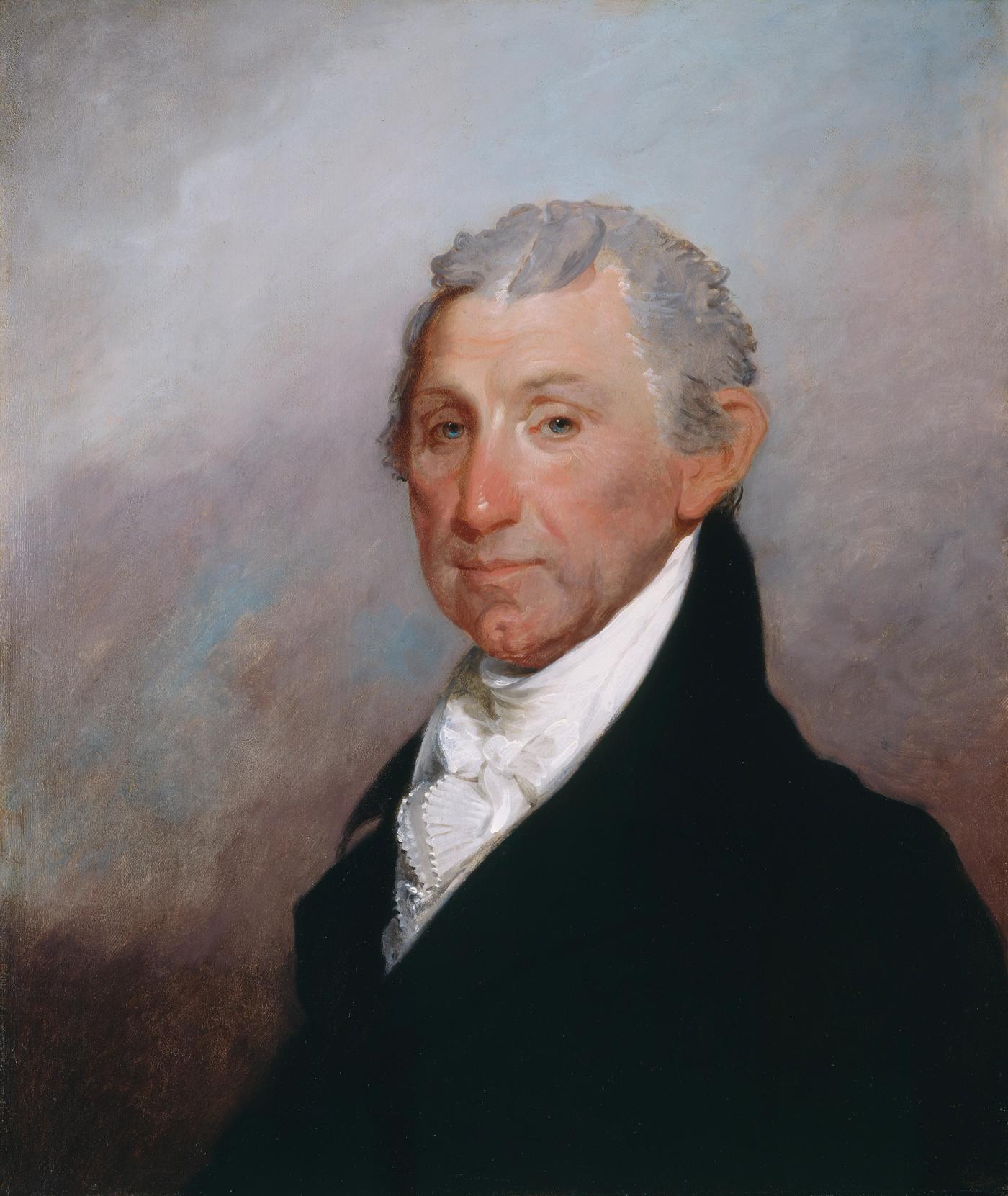
On December 2, 1823, President James Monroe sent his seventh annual message to the Eighteenth Congress. The passages that later made it famous were, in the National Archives' phrase, "buried in a routine annual message."[1] While reporting on negotiations with Russia over the Pacific coast of North America, Monroe declared that "the American continents, by the free and independent condition which they have assumed and maintain, are henceforth not to be considered as subjects for future colonization by any European powers." Turning to the new Latin American governments whose independence the United States had recognized, he warned that any attempt by the allied powers of Europe to extend their system to this hemisphere would be considered "dangerous to our peace and safety," and any European interference meant to oppress those governments or control their destiny would be read as "the manifestation of an unfriendly disposition toward the United States."[2]
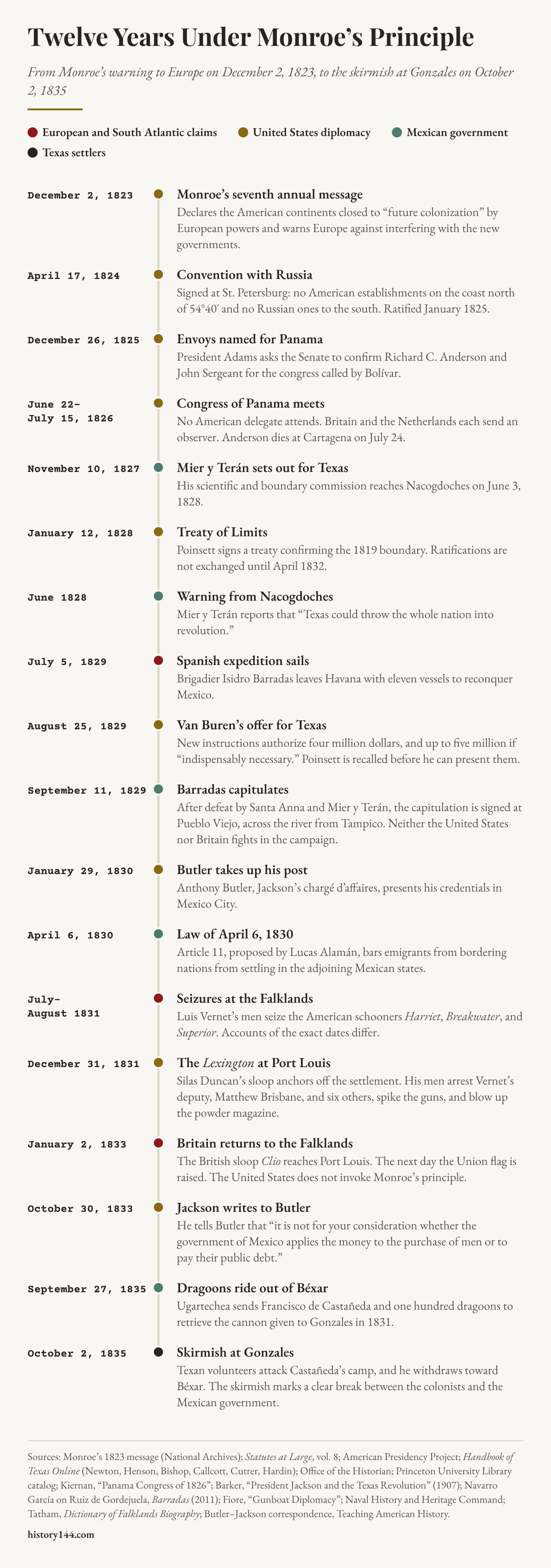
In 1823 these sentences committed the United States to a diplomatic position, not to any particular action. The message said what the United States would regard as unfriendly; it did not say what the United States would do about it, and the government had few means to do anything. As the editors of Encyclopaedia Britannica observe, a policy claiming to protect the entire Western Hemisphere could not have been sustained militarily in 1823.[3] For the next twelve years Monroe's principle went largely unenforced. Meanwhile, the most persistent outside pressure on the young Republic of Mexico came from the north, in the form of American diplomats trying to buy Texas and American settlers moving onto its land. By October 1835, when Mexican dragoons and Anglo-American colonists exchanged fire over a small cannon at Gonzales, the gravest threat to Mexico's hold on its northern frontier came from within the hemisphere Monroe had set out to shield. This is the story of those twelve years.
The Offer from London
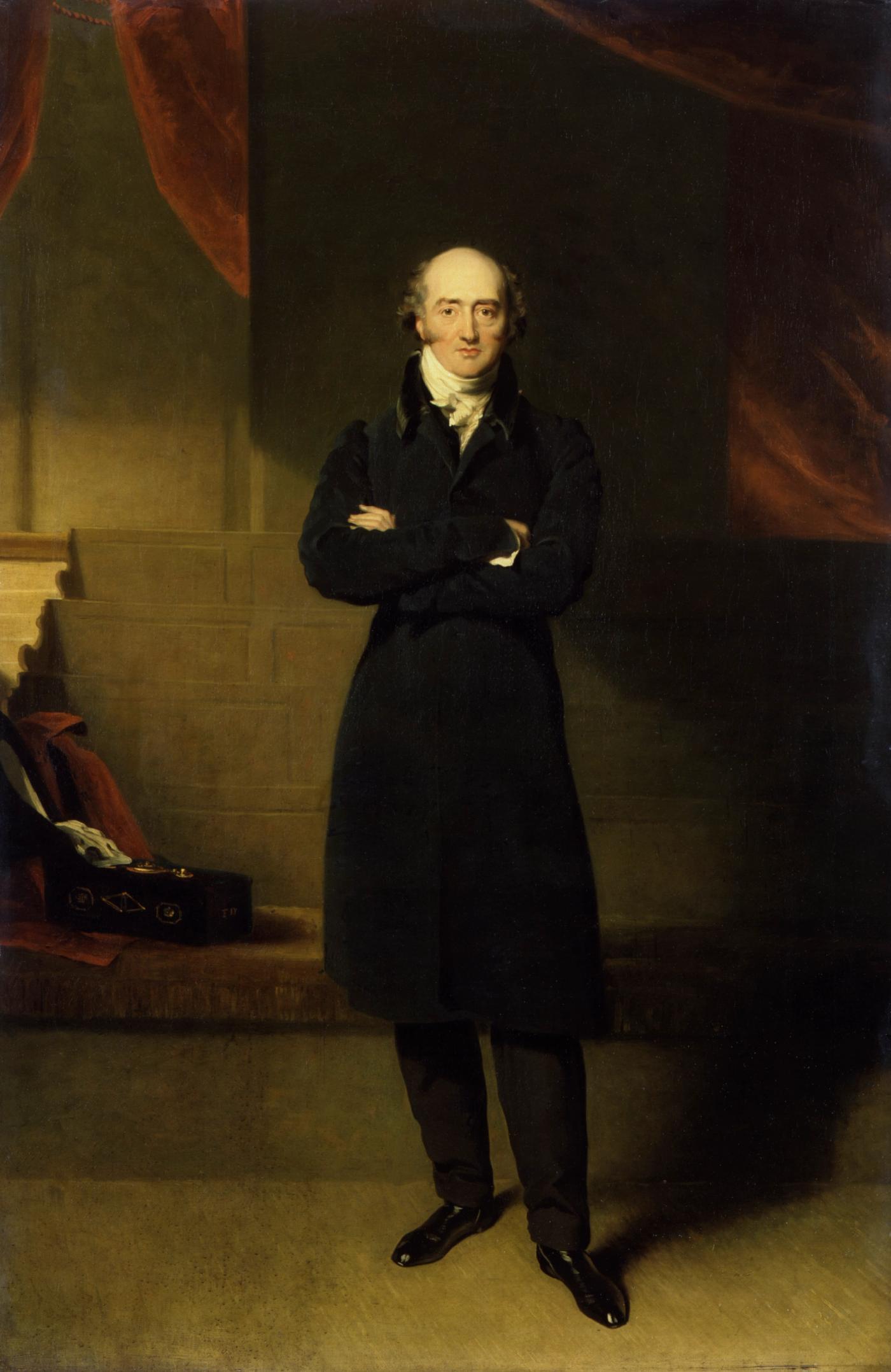
One source of the message was a proposal that the United States turned down. On August 20, 1823, the British foreign secretary, George Canning, wrote privately to Richard Rush, the American minister in London, suggesting that the two governments declare their views on Spanish America together. Canning set out those views in five short points. Among them, Britain considered the recovery of the colonies by Spain "hopeless"; it regarded their recognition as independent states as a question "of time and circumstances"; it declared, "We aim not at the possession of any portion of them ourselves"; and it could not see any of them transferred to another power "with indifference."[4]
Monroe was inclined to accept. Seeking advice from his predecessors, he told James Madison that "we had better meet the proposition fully, & decisively."[5] Thomas Jefferson called it "the most momentous" question put to him since independence and advised acceptance.[6]
Secretary of State John Quincy Adams argued the other way. According to the Office of the Historian of the State Department, he feared that a joint statement could limit American expansion in the future, and he doubted British motives, noting that Britain had not committed itself to recognizing the new republics.[7] At a cabinet meeting on November 7, as Adams recorded in his diary that day, he argued that "It would be more candid as well as more dignified to avow our principles explicitly to Russia and France, than to come in as a Cock-boat in the wake of the British man of War."[8] Monroe came around, and what London had proposed as a two-nation statement became a unilateral American one.[9]
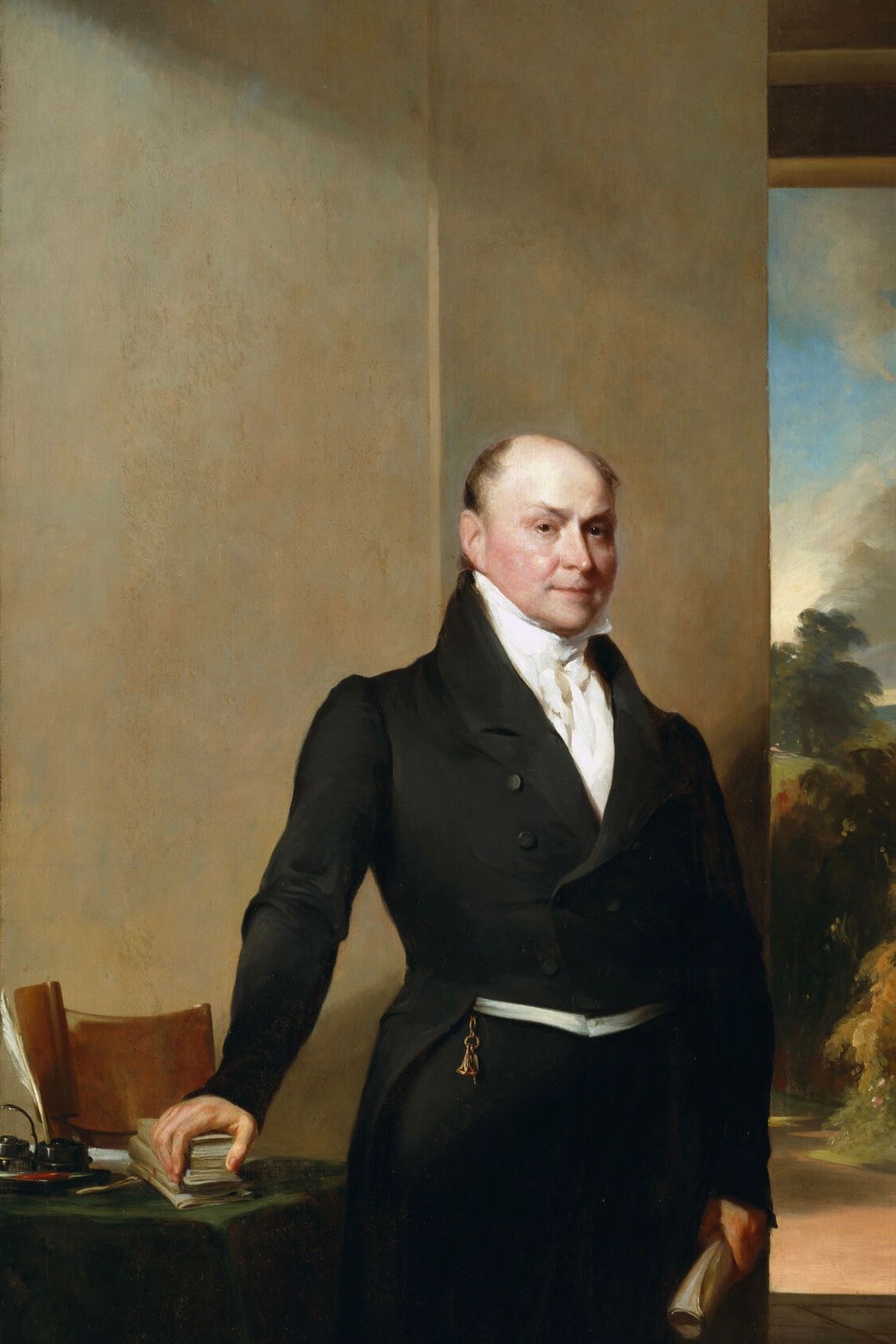
Adams's phrase was bolder than the situation allowed. Monroe and Adams knew that deterring a European expedition against Spanish America depended on the British fleet, and the statement was largely ignored outside the country.[10] Only in the late nineteenth century, the Office of the Historian notes, did American economic and military strength allow the United States to enforce it.[11] The statement was not known as the "Monroe Doctrine" for nearly thirty years.[12] Polk wrote of "Mr. Monroe's Doctrine" in his diary in 1845, but, as the historian Nicholas Guyatt notes, the phrase "Monroe Doctrine" became suddenly popular only in 1849, during American quarrels with Britain over the Mosquito Coast.[13]
Historians have weighed British and American influence differently. Leonard Axel Lawson, in a 1922 Columbia University dissertation, set out to show that the success of the American policy depended on the firmness of Britain's opposition to European intervention.[14] Others have paid more attention to what the message left unsaid. In Jay Sexton's account, as one reviewer summarized it, Monroe had no workable plan for halting European expansion, and his message was silent on whether its principles restrained the United States itself.[15] That second silence would matter more than the first in the years that followed.
The Northwest Coast
The noncolonization principle grew out of a dispute with Russia, and that dispute produced the clearest practical result associated with it. In September 1821 the Russian government issued a decree, or ukase, reserving trade and fishing on the Pacific coast from Bering Strait south to the 51st parallel for Russian subjects and forbidding foreign vessels to come within "100 Italian miles" of the Russian coasts. Adams protested in February 1822 that the president had "seen with surprise" a territorial claim reaching so far south.[16] On July 17, 1823, he told the Russian minister, Baron de Tuyll, "that we should contest the right of Russia to any territorial establishment on this continent," and that the United States would hold the American continents closed to new European colonial establishments.[17]
On April 17, 1824 (April 5 by the Russian calendar), the American minister, Henry Middleton, signed a convention in St. Petersburg with Count Nesselrode and Pierre de Poletica for Russia. Citizens of the United States would form no establishments on the coast or adjacent islands north of latitude 54°40′, and Russian subjects would form none to the south of that line. For ten years the ships of both nations could fish and trade with the native peoples along the coast. The convention was ratified in January 1825.[18]
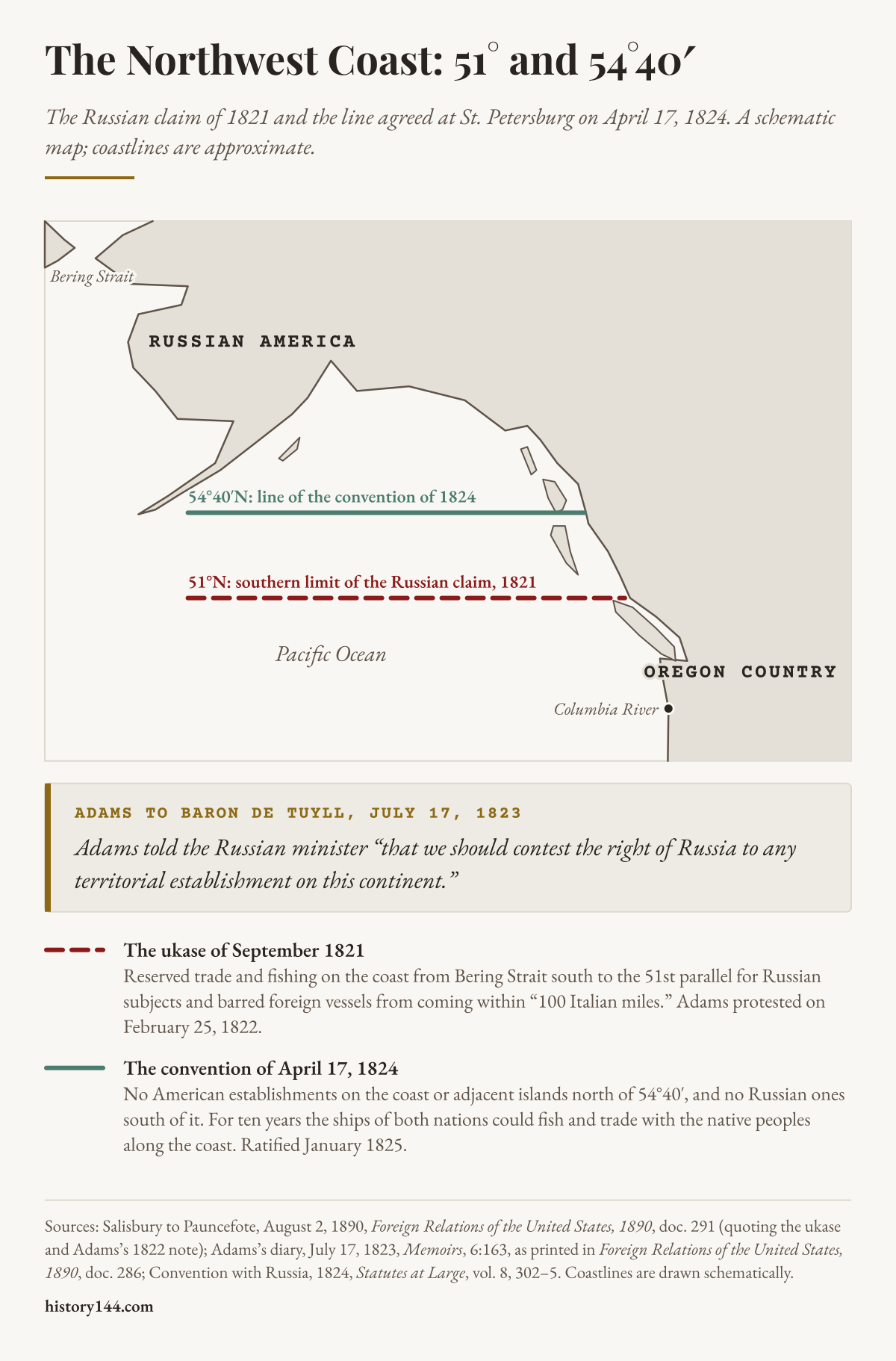
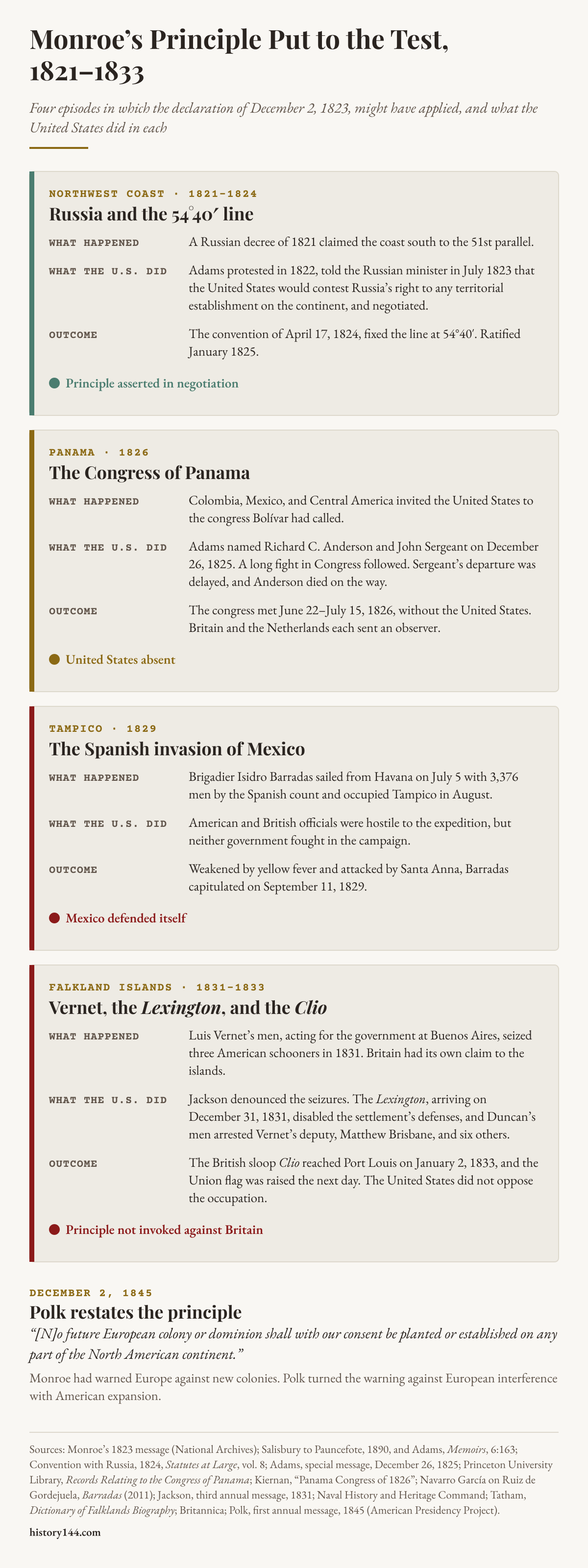
The negotiations had begun before Monroe announced his principle, and they settled the matter through ordinary diplomacy with a distant empire, in talks that Russia itself had proposed.[19] The episode showed that the noncolonization principle could serve as a negotiating position. It said nothing about what would happen if a European power chose to ignore it.
Panama, 1826
The next test came from Spanish America itself. Simón Bolívar called the newly independent states to a congress at Panama, and the governments of Colombia, Mexico, and Central America invited the United States to send representatives. On December 26, 1825, President John Quincy Adams asked the Senate to confirm Richard C. Anderson of Kentucky and John Sergeant of Pennsylvania as envoys. He presented acceptance as "a token of respect to the southern Republics."[20] The nominations set off a long fight in Congress.[21]
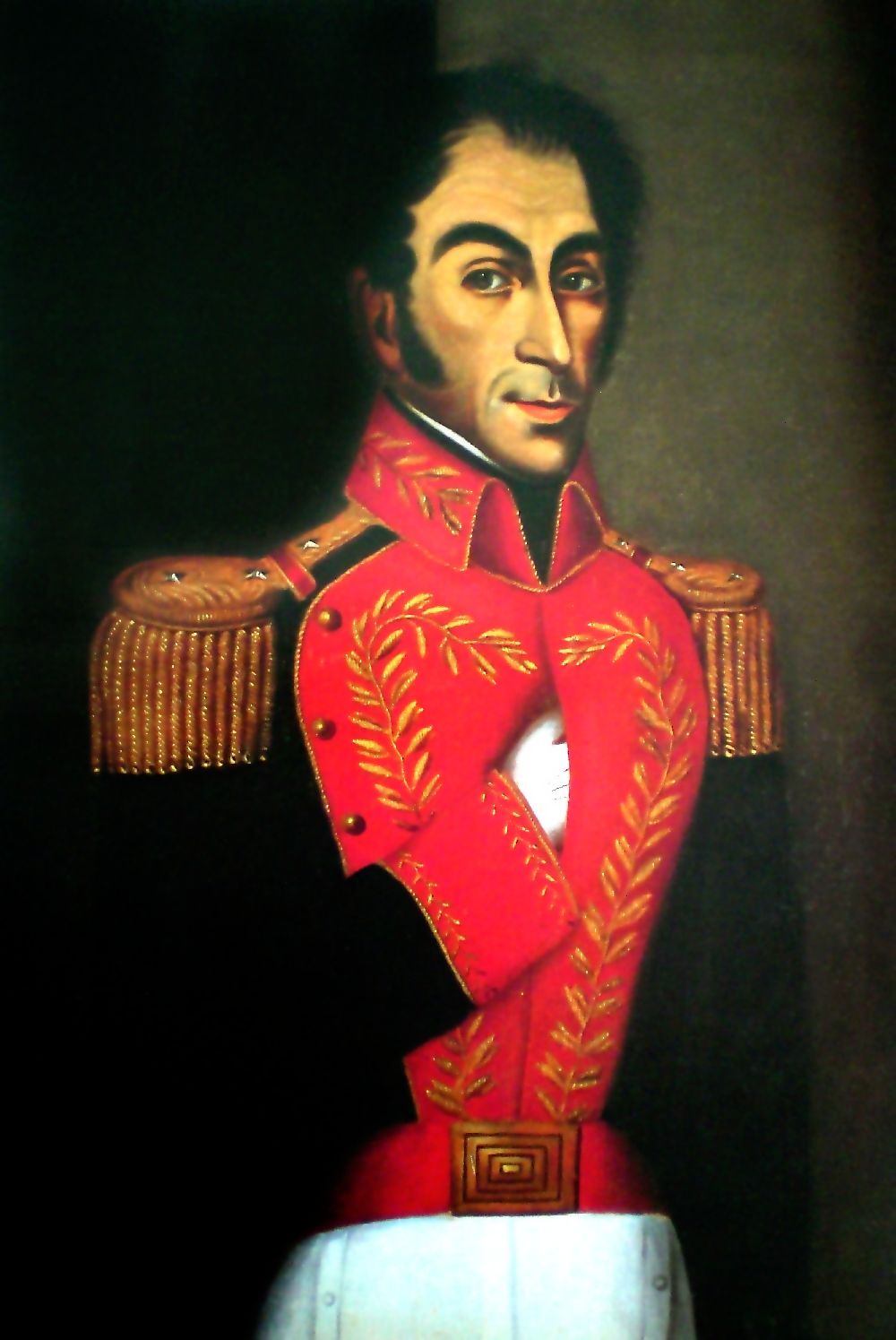
By the time the mission was approved, events had moved on without it. The Congress of Panama met from June 22 to July 15, 1826, with no American delegate present. Sergeant's departure had been delayed, and Anderson, then serving as minister to Colombia, died on the way,[22] at Cartagena on July 24, nine days after the congress adjourned.[23] Britain and the Netherlands, by contrast, each sent an observer.[24] It broke up with plans to reconvene at Tacubaya, near Mexico City, and Sergeant went to Mexico, but the meeting never resumed and he returned home.[25] The first gathering of the American republics, held in the shadow of Monroe's declaration, had a British observer and an empty American chair.
Poinsett and the Price of Texas
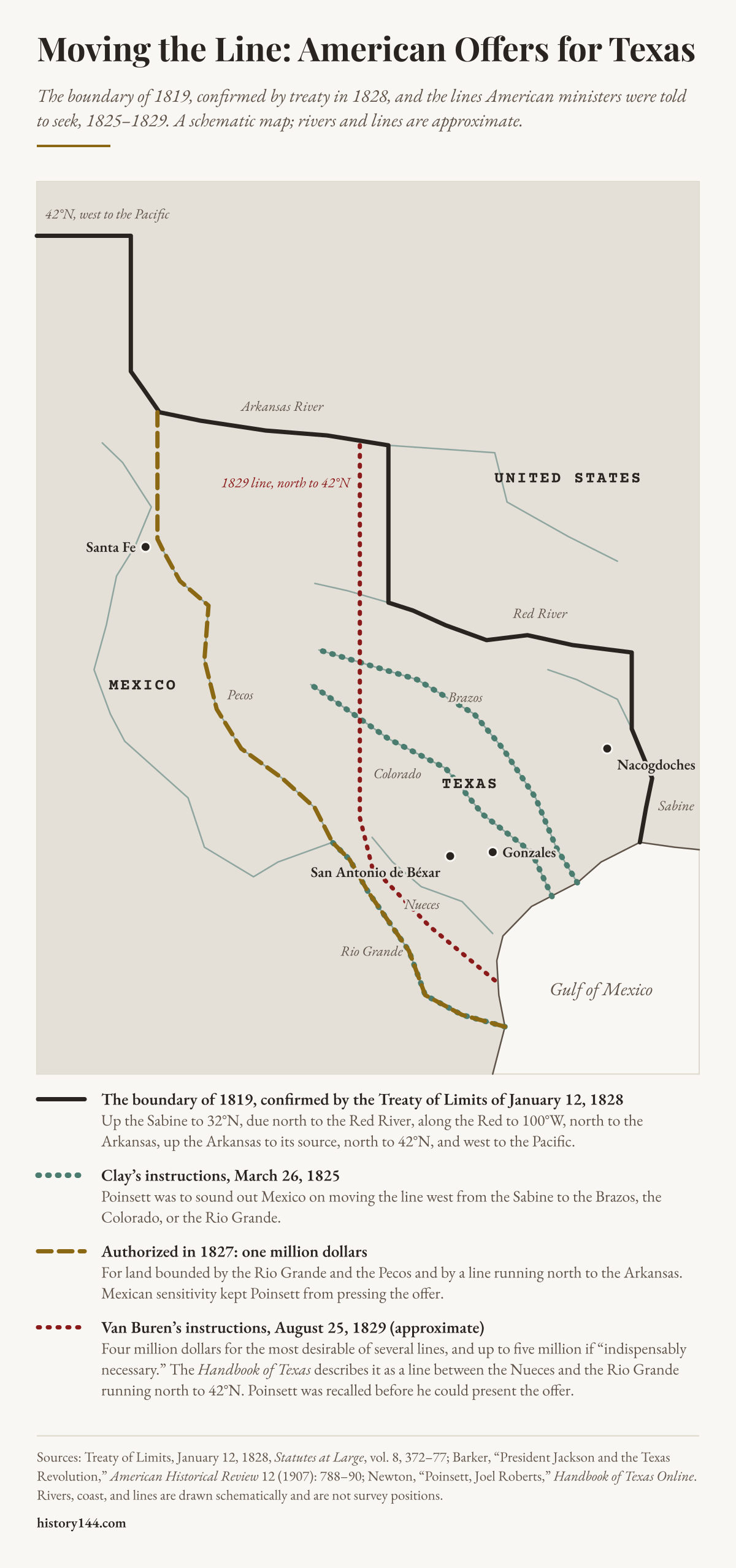
In Mexico, Washington's diplomacy was bound up with Texas from the start. Joel Roberts Poinsett, a widely traveled South Carolina legislator, became the first United States minister to Mexico in 1825.[26] His instructions from Secretary of State Henry Clay, dated March 26, 1825, asked him to sound out Mexico on moving the boundary fixed by the Adams-Onís Treaty of 1819 westward from the Sabine to the Brazos, the Colorado, or the Rio Grande.[27] In 1827 he was authorized to offer a million dollars for land bounded by the Rio Grande and the Pecos and by a line running north to the Arkansas River, but Mexican sensitivity on the subject was so great that he could not press the offer.[28] Instead, on January 12, 1828, he signed a Treaty of Limits that confirmed the old 1819 line, running from the mouth of the Sabine to the 42nd parallel. Ratifications were not exchanged until April 1832.[29]
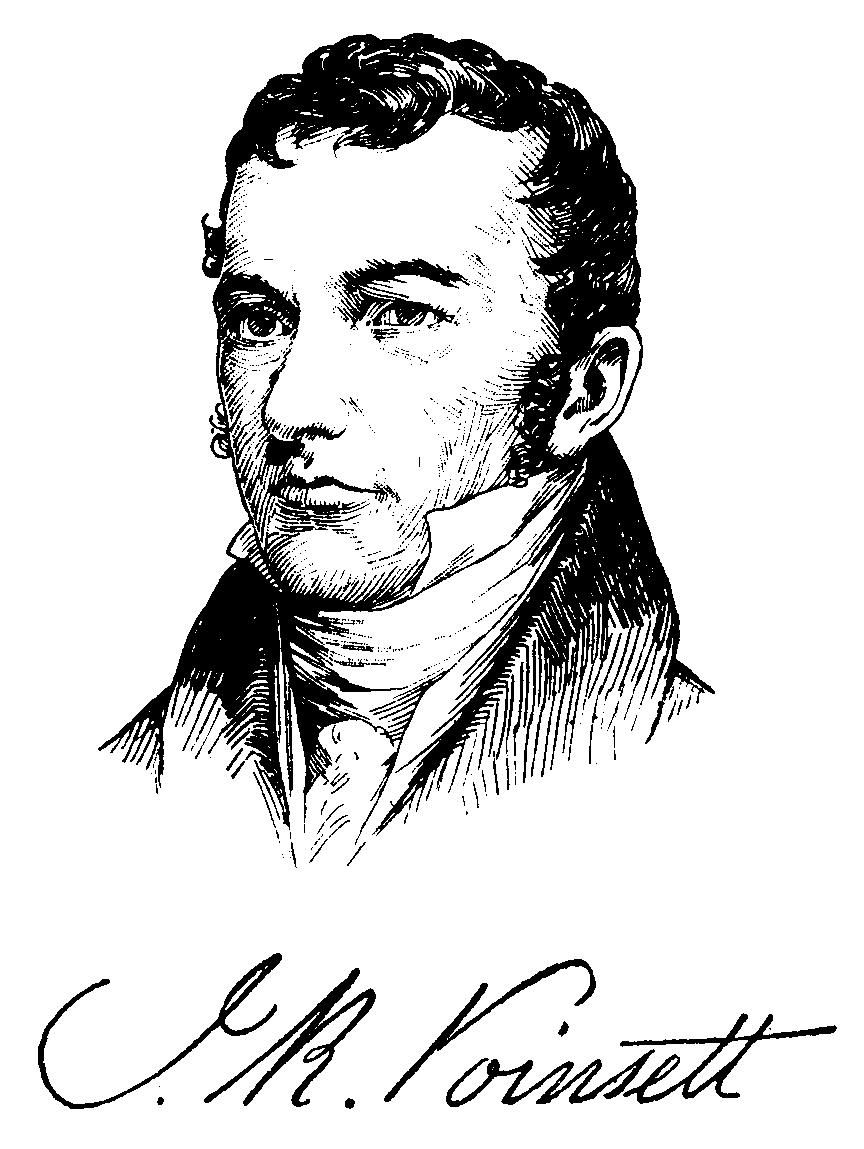
Poinsett's own view, as his biographer in the Handbook of Texas describes it, was that the peaceful settlement of Texas by Anglo-Americans would make the province easier to acquire later.[30] He was describing a movement Washington had not created. The settlers came under Mexico's own colonization laws, which offered land on terms no American government could match. The diplomats and the settlers acted independently, but by the late 1820s their activities were pushing in the same direction, and Mexican officials increasingly saw them as a single threat.
The clearest statement of that fear came from General Manuel de Mier y Terán, whom President Guadalupe Victoria sent north in 1827 at the head of a scientific and boundary commission. The general set out from Mexico City on November 10, 1827, in a large coach inlaid with silver, and reached Nacogdoches on June 3, 1828.[31] Writing from Nacogdoches that June, Mier y Terán reported that Mexican influence faded the farther one traveled from Béxar, until in the Nacogdoches country "the ratio of Mexicans to foreigners is one to ten." He warned that "Texas could throw the whole nation into revolution."[32] His report urged strong measures to keep the United States from acquiring Texas, among them new garrisons, closer trade with the Mexican interior, and the encouragement of Mexican and European settlers.[33] The Law of April 6, 1830, reflected several of his recommendations,[34] but its most consequential provision came from the foreign minister, Lucas Alamán, and Mier y Terán had doubts about its wisdom.[35] That eleventh article declared that "it is prohibited that emigrants, from nations bordering on this republic shall settle in the states" next to their own countries, in effect closing Texas to new settlers from the United States.[36] The general did not live to see where his fears led. In poor health, subject to depression, and despondent over the problems of colonization in Texas and the political turmoil at home, he took his own life at Padilla, Tamaulipas, on July 3, 1832.[37]
Poinsett, meanwhile, had worn out his welcome. Mexico forced his recall in 1829, before he could present new instructions from President Andrew Jackson's administration.[38] Those instructions, drafted by Secretary of State Martin Van Buren on August 25, 1829, authorized an offer of four million dollars for the most desirable of several possible boundaries, and up to five million if "indispensably necessary."[39]
Tampico, 1829
In the summer that Poinsett's mission was coming apart, Mexico faced exactly the kind of danger Monroe had named. Spain had never recognized Mexican independence, and in 1829 it attempted a reconquest. On July 5 an expedition under Brigadier Isidro Barradas sailed from Havana in eleven vessels. The Spanish records studied by the historian Jesús Ruiz de Gordejuela count 3,376 men and date a difficult landing near Punta Jerez to July 28. Marching north through villages emptied ahead of them, they occupied the port of Tampico on August 7.[40] Mexican accounts place the landing at Cabo Rojo, in northern Veracruz, and give round figures of about 3,000 men.[41]
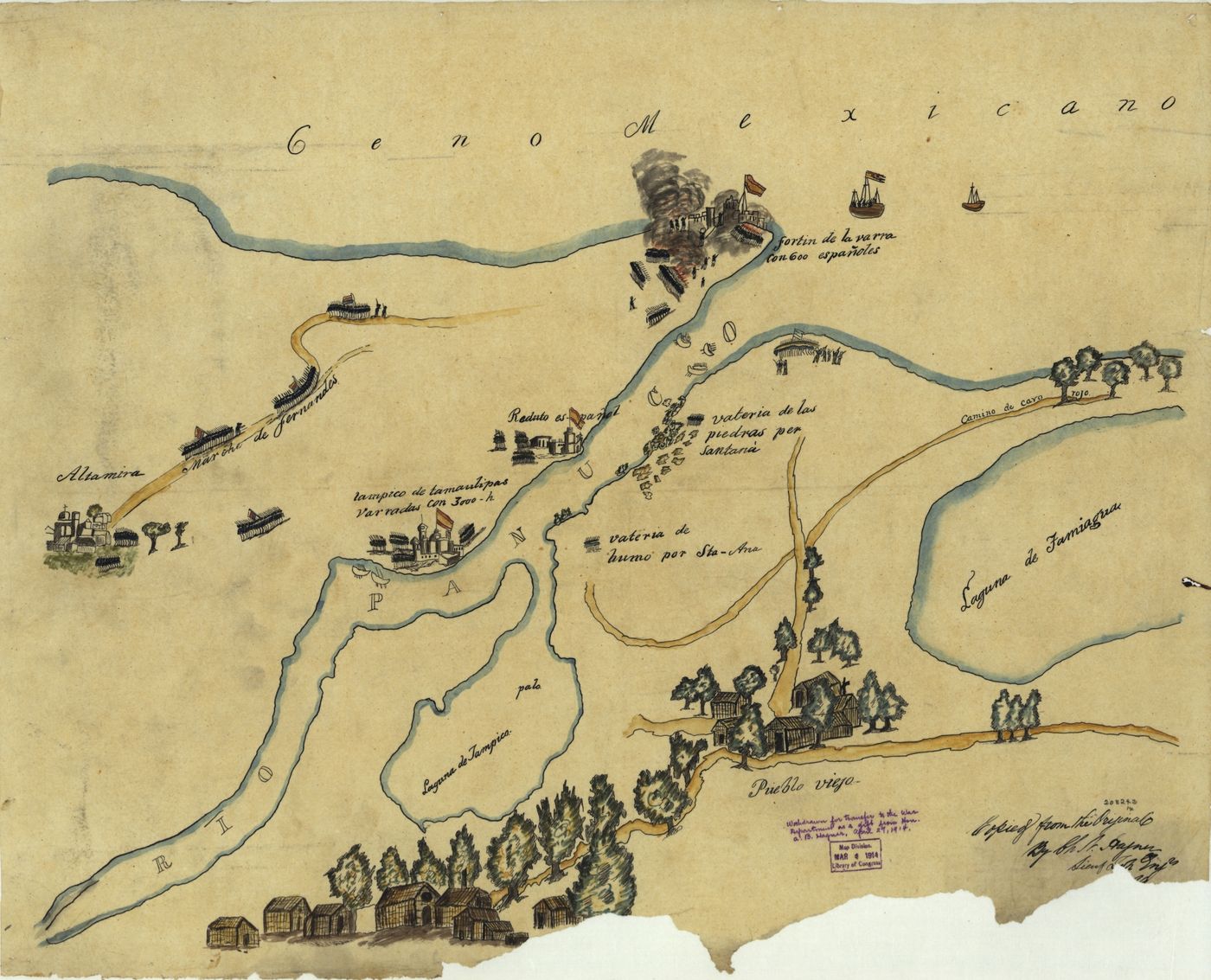
The Mexican response was led by Antonio López de Santa Anna, then governor of Veracruz, who pulled an army together quickly and with severely limited resources, with Mier y Terán as his second in command.[42] On August 20, while inland at Altamira, Barradas learned that Santa Anna had arrived at Tampico, and the next day the small force he had left there under Colonel Salomón held off a Mexican attack. Barradas's men had never been acclimatized, and yellow fever, in Ruiz de Gordejuela's words, reduced the division by a third.[43] The epidemic broke out in their camp on August 23, and by August 28 some seven hundred were in hospital. On the night of September 10 Santa Anna assaulted the fort at the bar of the Pánuco River. Its garrison held, but on the following day, September 11, Barradas capitulated. By the Spanish count, the expedition suffered 88 casualties in action and 1,871 from disease.[44] The surrender came at midday, and the capitulation was signed hours later at Mexican headquarters in Pueblo Viejo.[45] Accounts of the decisive date differ: the Handbook of Texas entry on Mier y Terán dates the expulsion of the Spanish to August 20.[46]
American and British officials were hostile to the expedition, but neither government fought in the campaign.[47] The victory over the last Spanish attempt to recover Mexico made Santa Anna a national hero and helped carry him to the presidency in 1833. Three years later he led the Mexican army into Texas.[48]
Butler's Mission
To replace Poinsett, Jackson chose his friend Anthony Butler, a War of 1812 colonel then living in Mississippi. Butler was appointed chargé d'affaires on October 12, 1829, and presented his credentials in Mexico City on January 29, 1830.[49] Justin H. Smith wrote that Butler's only qualifications were an acquaintance with Texas and a strong desire to see the United States obtain it. Butler had been through bankruptcy more than once, spoke no Spanish, and was ignorant of the forms of diplomacy. Smith concluded that he was "a national disgrace." Sam Houston judged in 1832 that "Such men as he is, would destroy a country, but take my word for it, he will never gain one!"[50] Among the documents Butler did sign was an additional article of April 5, 1831, that revived Poinsett's Treaty of Limits, the agreement confirming the very boundary he had been sent to move.[51]
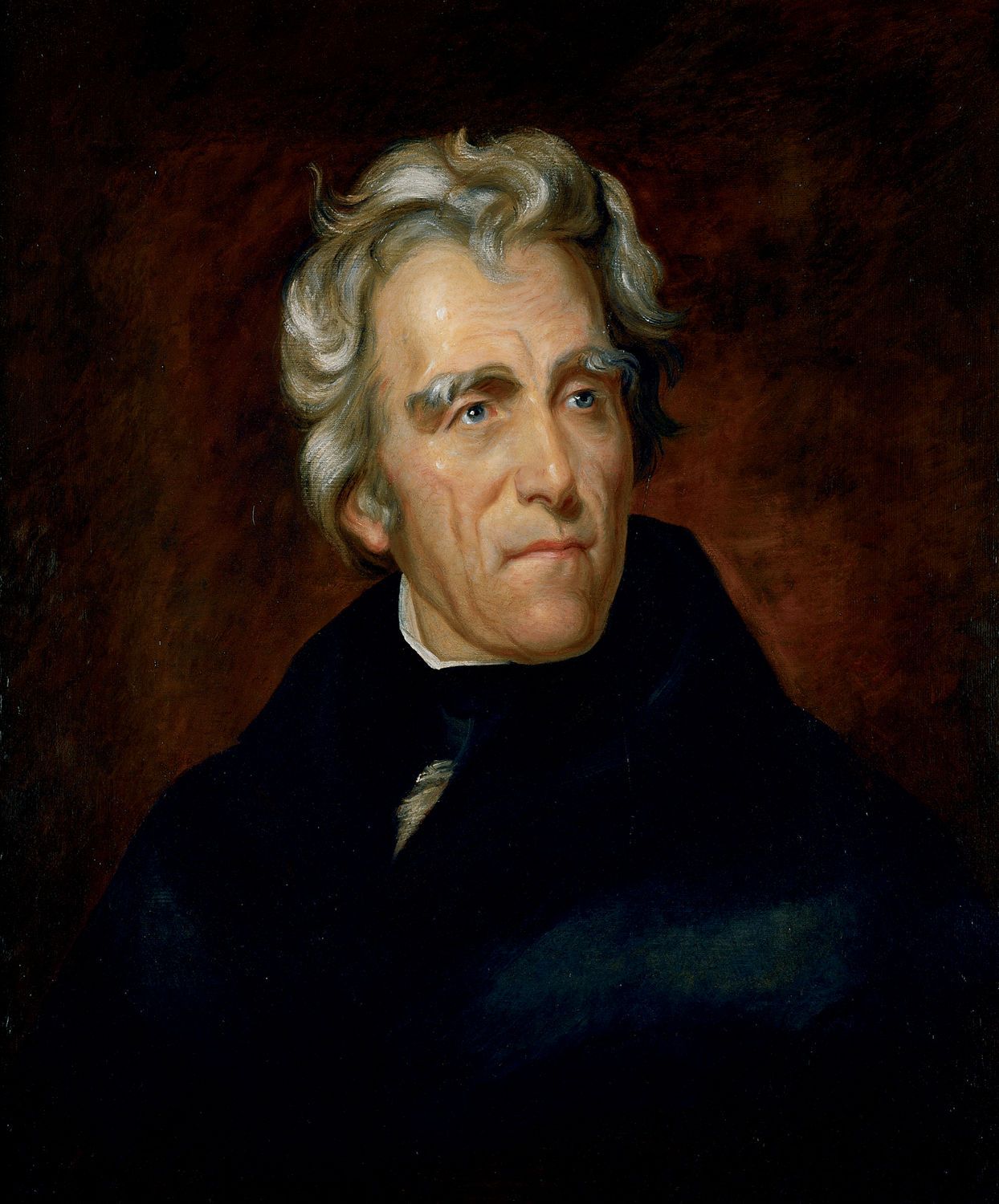
Butler's letters show how he meant to work. On January 2, 1833, he told Jackson that he had "one road" by which he hoped to reach the Mexican president and overcome his scruples, and that he had "the very man provided to do the underworking with him," an intermediary to work on the president behind the scenes. He promised: "I will succeed in uniting T[exas]—to our country before I am done with the subject or I will forfeit my head."[52] Jackson's private reply of October 30, 1833, told Butler to stay within his instructions and within the five million dollars authorized for the purchase, and added that "it is not for your consideration whether the government of Mexico applies the money to the purchase of men or to pay their public debt."[53]
Historians have read this exchange in different ways. Stephen F. Knott, who edited it for Teaching American History, argues that Jackson worried less about bribery than about Butler's habit of writing about it openly, and that keeping Butler at his post for six years sits poorly with the president's later disavowals.[54] Eugene C. Barker, writing in 1907, reached the opposite conclusion. When Butler reported later that autumn that a large sum would be needed to win over one important man, Jackson answered on November 27, 1833: "Let us have a boundary without the imputation of corruption." When Butler suggested in March 1834 that he could gain Texas without a blow if he were placed at the head of the troops that would occupy it, Jackson wrote on the letter, "What a scamp." Barker concluded that Jackson "heartily condemned" Butler's plotting.[55]
In his letter of October 30, denying a reported intimacy with Sam Houston, Jackson claimed that the government had kept a secret agent watching Houston's movements, ready to thwart any attempt to organize a force within the United States to aid a revolution in Texas.[56] Butler never obtained a cession. In July 1835 Secretary of State John Forsyth allowed him one final effort and told him to be back by December. On October 21, 1835, the Mexican government asked for his recall,[57] citing "intrigues unbecoming a diplomatic agent," and Jackson named Powhatan Ellis to succeed him.[58] Formally recalled in early January 1836, Butler stayed on in Mexico on his own authority and did not return to the United States until May 1836, by which time Texas had declared its independence.[59]
The Falklands, 1831–1833
American sealers had long worked the waters of the Falkland Islands, where Luis Vernet now held authority from the government at Buenos Aires and tried to regulate the hunt. In the southern winter of 1831 Vernet's men seized three American schooners, the Harriet, the Breakwater, and the Superior. The Navy's history credits the seizures to his deputy, Matthew Brisbane, in July, acting on Vernet's orders.[60] Jordan D. Fiore dates them from late July to August 19 and adds that the Breakwater's master retook his ship and sailed home, while Vernet carried the Harriet to Buenos Aires, arriving on November 19.[61] Jackson told Congress on December 6, 1831, that an American vessel engaged in "a trade which we have always enjoyed without molestation" had been captured near the islands. He had ordered an armed vessel to join the American squadron in those seas, promised to send a minister to inquire into the seizure and into Buenos Aires's claim to the islands, and asked Congress for the means of "providing a force adequate to the complete protection of our fellow citizens fishing and trading in those seas."[62]
The sloop of war Lexington was commanded by Silas Duncan, who had lost his right arm at the Battle of Lake Champlain in 1814. Within weeks of Jackson's message, on December 31, 1831, the Lexington anchored off Port Louis, intent on breaking up what Americans regarded as a "nest of pirates." Duncan's men arrested Brisbane and six others on charges of piracy, spiked the settlement's guns, and blew up its powder magazine. Duncan offered passage to anyone who wished to leave, and most of the population accepted, though some stayed. The raid opened a diplomatic quarrel between the United States and Buenos Aires that lasted for years.[63]
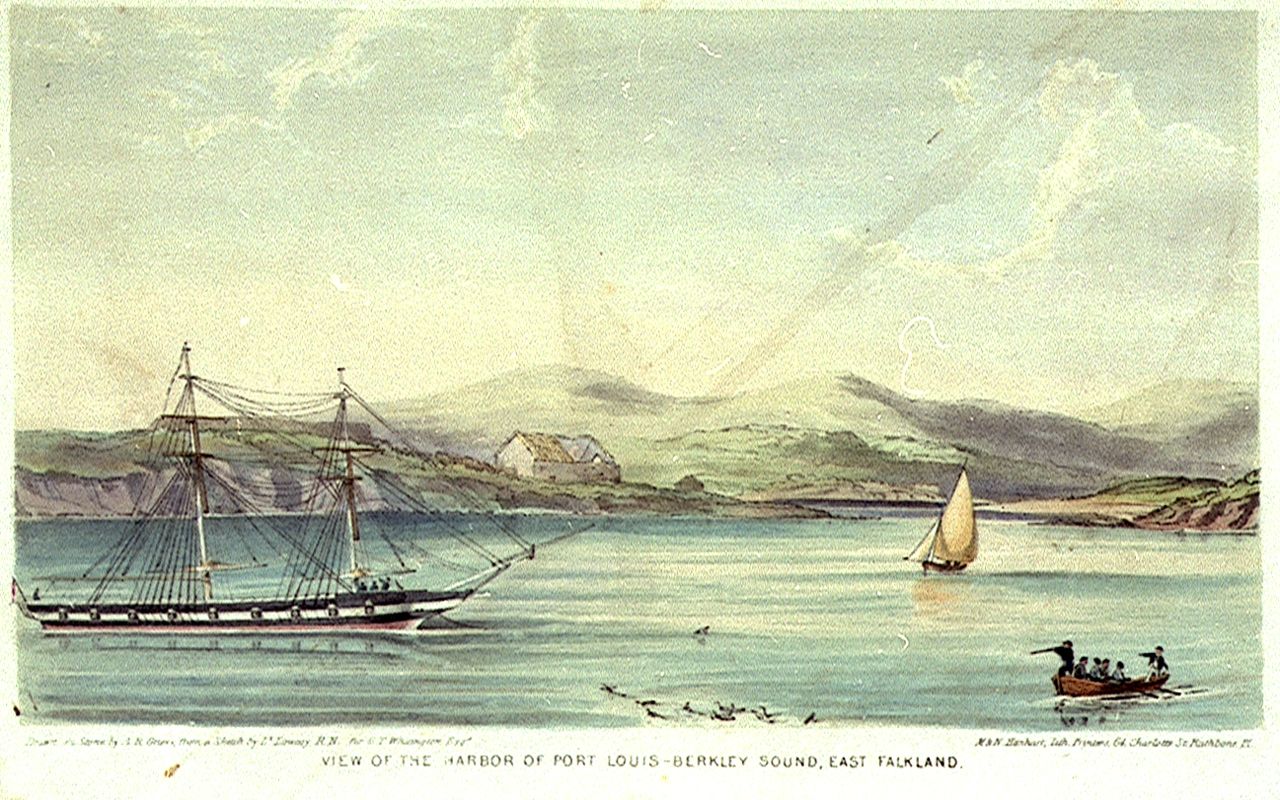
A year later Britain acted on its own claim to the islands. When the British sloop Clio arrived at Port Louis on January 2, 1833, her captain, John James Onslow, found an Argentine garrison and the schooner Sarandí under José María Pinedo. When Pinedo hesitated to haul down his flag, Onslow landed the next day, hoisted the Union flag, and had the Argentine colors lowered.[64] Argentine critics at the time and some later historians suggested that the United States had colluded with Britain or had cleared the way for it, a charge the historian Christian J. Maisch has tested against the Anglo-American diplomatic record.[65]
Here was a European power establishing itself on territory claimed by an American republic, the situation Monroe's language seemed designed to prevent. Jackson had denounced Vernet's seizures before Congress, and an American warship had disabled the settlement's defenses. But those actions defended American commerce, not Argentine sovereignty, and when Britain occupied the islands, the United States did not invoke Monroe's principle or oppose the occupation.[66] The episode suggests how Washington read Monroe's words in these years: as a statement of American interests, to be invoked when those interests called for it, and not as a pledge to defend another republic's claims.
Gonzales, 1835
By the mid-1830s the pressure on Mexico's northern frontier had little to do with Europe. In 1834 Santa Anna emerged as an autocratic centralist,[67] and in Texas the colonists' own grievances, more than any diplomat's offer, were driving events. The settlers of Gonzales, on the Guadalupe River, had been given a small cannon in 1831 for defense against Indian raids. When the military commander in Texas, Domingo de Ugartechea, learned that they refused to surrender it, he sent Francisco de Castañeda with one hundred dragoons to retrieve it, with orders to use force if necessary but to avoid open conflict if possible. The troops rode out of San Antonio de Béxar on September 27, 1835.[68]
Two days later they reached the Guadalupe opposite Gonzales and found the crossing blocked by high water and eighteen militiamen. As the townspeople summoned help from nearby settlements, Castañeda learned that at least 140 volunteers had gathered. He moved his camp seven miles upriver. On the night of October 1 the Texans crossed the river, and on the morning of October 2 they attacked. During a lull, Castañeda met the Texan commander, John Henry Moore, and asked why his men had been attacked without provocation. Moore answered that the Texans were fighting to keep their cannon and to uphold the federal Constitution of 1824. Castañeda replied that he was himself a Federalist and opposed to Santa Anna's policies, but that as a soldier he had to follow his orders. When the fighting resumed, outnumbered and outgunned, he withdrew toward Béxar. "Since the orders from your Lordship were for me to withdraw without compromising the honor of Mexican arms," he reported to Ugartechea, "I did so." The Handbook of Texas calls the affair really only a brief skirmish, but it marked a clear break between the colonists and the Mexican government.[69]
No American official had any part in the fight at Gonzales. The men who forced the issue were settlers who had come to Texas under Mexican law and who described their cause in the language of Mexican constitutional politics. Yet their rising accomplished what Poinsett had predicted and Butler had failed to buy. Within months Mexico had lost control of Texas, and ten years later the United States annexed it.
What the Doctrine Did and Did Not Do
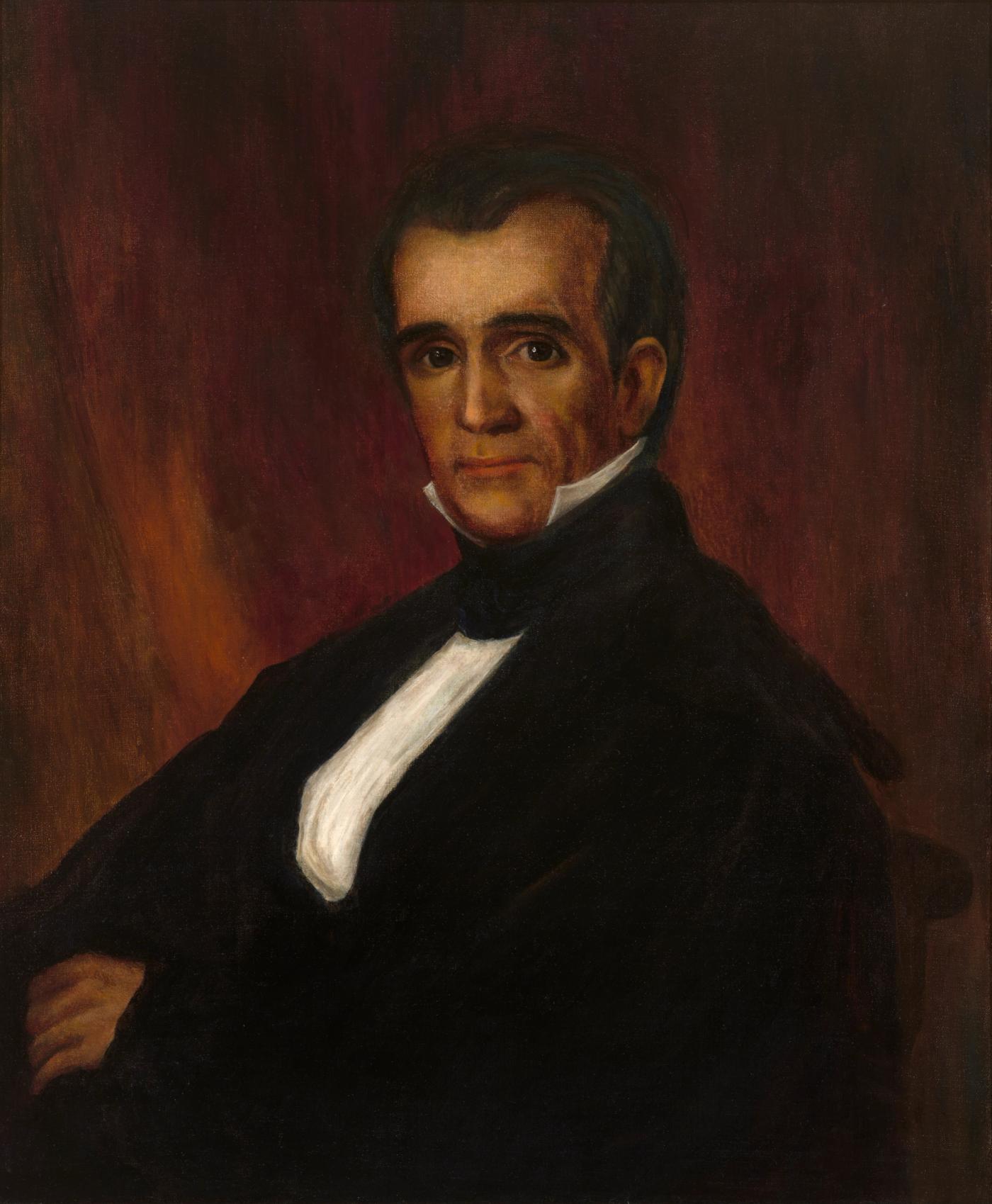
Exactly twenty-two years after Monroe's message, on December 2, 1845, President James K. Polk sent his first annual message to Congress. He reported that Texas had accepted annexation despite British and French interference. Then he recalled that "near a quarter of a century ago" one of his predecessors had declared the American continents closed to European colonization. Polk reaffirmed "the principle avowed by Mr. Monroe" and announced as settled policy that "no future European colony or dominion shall with our consent be planted or established on any part of the North American continent."[70] As Britannica's editors observe, Monroe had said only that the hemisphere was no longer open to European colonization, while Polk warned Europe against interfering with American expansion.[71]
The years between explain how that reinterpretation became possible. Between 1823 and 1835 the doctrine accomplished one concrete thing, a quiet boundary settlement with Russia. When the American republics met at Panama, the United States was absent. When Spain invaded Mexico, Mexico defended itself. When Britain occupied the Falklands, Washington did not object. In each case the declaration's real limits lay in what it had never promised: no alliance, no guarantee, and no commitment of force on anyone else's behalf.
What the message had also left unaddressed was the conduct of the United States itself. In those same years American envoys repeatedly tried to buy Mexican territory, while settlers from the United States, pursuing their own ends under Mexican law, built the communities that rose at Gonzales. Neither group was carrying out Monroe's policy, and neither directed the other. Together, however, American diplomatic pressure and the growing American population in Texas made the United States the most consequential foreign influence on Mexico's northern frontier in the very years when Monroe's declaration was supposed to shield the hemisphere from European interference.
On that December day in 1823, Monroe's message told Europe that it would not decide the destiny of the American continents. Twelve years later, on a riverbank in Texas, Europe still had not. The pressure on Mexico now came from within the hemisphere Monroe had claimed to protect, carried by people from the country that had issued the warning.
Places in this Story
The places this story moves through, in order — follow them on the interactive map →
- Washington, D.C. December 1823
Monroe sent his seventh annual message to Congress, declaring the American continents closed to future European colonization.
- London, England August 1823
George Canning privately proposed that Britain and the United States declare their views on Spanish America together.
- Saint Petersburg, Russia April 1824
Henry Middleton signed the convention fixing 54 degrees 40 minutes as the limit of Russian and American settlement on the Pacific coast.
- Panama City, Panama June 1826
The Congress of Panama met with a British and a Dutch observer present and the American chair empty.
- Mexico City, Mexico 1825
Joel Roberts Poinsett arrived as the first United States minister to Mexico, instructed to move the Texas boundary westward.
- Tampico, Tamaulipas, Mexico September 1829
Santa Anna forced the surrender of Isidro Barradas, ending the last Spanish attempt to reconquer Mexico, without foreign help.
- Port Louis, Falkland Islands December 1831
The USS Lexington under Silas Duncan spiked the settlement's guns, blew up its magazine, and carried off most of its people.
- Gonzales, Texas October 1835
Texian volunteers attacked Castañeda's dragoons rather than surrender a small cannon, and the Mexican force withdrew toward Béxar.
Frequently Asked Questions
What did the Monroe Doctrine actually say in 1823?
President Monroe told Congress that the American continents were no longer open to future European colonization, and that any attempt by Europe to extend its political system to this hemisphere would be dangerous to American peace and safety. The passage was buried in a routine annual message and committed the United States to no particular action.
Why did John Quincy Adams reject Canning's offer of a joint declaration?
Adams feared that a statement made jointly with Britain could limit American expansion later, and he doubted British motives because London had not yet recognized the new republics. He told the cabinet it would be more dignified to speak directly to Russia and France than to follow in the wake of the British navy.
Was the Monroe Doctrine enforced in the 1820s and 1830s?
Almost never, because the United States lacked the naval strength to enforce a claim over the whole hemisphere. The one concrete result was the boundary convention with Russia in 1824, and when Britain occupied the Falkland Islands in 1833 Washington did not object.
Why was the Monroe Doctrine not called that until the 1850s?
The 1823 message was treated as a statement of position rather than a standing policy, and it attracted little notice in Europe. Polk wrote of Mr. Monroe's doctrine in 1845, and the phrase became common only in 1849 during an Anglo-American quarrel over the Mosquito Coast.
What happened at the Congress of Panama in 1826?
Simón Bolívar called the new American republics together at Panama and the United States was invited, but a long fight in Congress delayed the mission. One envoy died on the way and the other arrived after the congress adjourned, so Britain and the Netherlands had observers there and the United States had none.
Did the United States try to buy Texas from Mexico?
Repeatedly. Joel Poinsett was authorized to offer a million dollars in 1827, and Anthony Butler carried authority for up to five million under Andrew Jackson, which he tried to win through an intermediary working on the Mexican president. Mexico never agreed to sell.
Did the Monroe Doctrine protect Mexico from Spain in 1829?
No. When Spain landed an expedition under Isidro Barradas near Tampico, Mexico defeated it alone under Santa Anna, helped by a yellow fever epidemic in the Spanish camp. American and British officials opposed the expedition but neither government took part in the fighting.
Bibliography
Adams, John Quincy. Memoirs of John Quincy Adams. Edited by Charles Francis Adams. Vol. 6. Philadelphia: J. B. Lippincott, 1875.
Adams, John Quincy. Diary, November 7, 1823. The Diaries of John Quincy Adams. Primary Source Cooperative, Massachusetts Historical Society. https://www.primarysourcecoop.org/publications/jqa/document/jqadiaries-v34-1823-11-p149--entry1.
Adams, John Quincy. Special message to the Senate, December 26, 1825. The American Presidency Project, edited by Gerhard Peters and John T. Woolley. https://www.presidency.ucsb.edu/documents/special-message-3658.
Barker, Eugene C. "President Jackson and the Texas Revolution." American Historical Review 12, no. 4 (July 1907): 788–809. https://penelope.uchicago.edu/Thayer/E/Journals/AHR/12/4/President_Jackson_and_the_Texas_Revolution*.html.
Bishop, Curtis. "Law of April 6, 1830." Handbook of Texas Online. https://www.tshaonline.org/handbook/entries/law-of-april-6-1830.
Blaine, James G., to Sir Julian Pauncefote, 1890. In Papers Relating to the Foreign Relations of the United States, 1890, doc. 286. Washington, DC: Government Printing Office, 1891. https://history.state.gov/historicaldocuments/frus1890/d286.
Callcott, Wilfred H. "Santa Anna, Antonio Lopez de." Handbook of Texas Online. https://www.tshaonline.org/handbook/entries/santa-anna-antonio-lopez-de.
"Convention between the United States of America and His Majesty the Emperor of All the Russias." April 5/17, 1824. In United States Statutes at Large, vol. 8, 302–5. https://www.govinfo.gov/link/statute/8/304.
"Correspondence between Anthony Butler and President Andrew Jackson." Edited and introduced by Stephen F. Knott. Teaching American History. https://teachingamericanhistory.org/document/correspondence-between-anthony-butler-and-president-andrew-jackson/.
Cutrer, Thomas W. "Butler, Anthony." Handbook of Texas Online. https://www.tshaonline.org/handbook/entries/butler-anthony.
The Editors of Encyclopaedia Britannica. "Monroe Doctrine: Application and Extension of the Monroe Doctrine." Encyclopaedia Britannica. https://www.britannica.com/event/Monroe-Doctrine/Application-and-extension-of-the-Monroe-Doctrine.
Fiore, Jordan D. "Research Note: Gunboat Diplomacy in the South Atlantic: The United States and the Falkland Island Crises, 1824–1832." Bridgewater Review 1, no. 3 (1983): 23–24. https://vc.bridgew.edu/br_rev/vol1/iss3/11/.
Ford, Worthington Chauncey. John Quincy Adams and the Monroe Doctrine (1823). Cambridge, MA: John Wilson and Son, 1902. Reprinted from Proceedings of the Massachusetts Historical Society, January 1902. https://hdl.handle.net/2027/uc2.ark:/13960/t00z75s5w.
Guyatt, Nicholas. "The Adams Doctrine and an 'Empire of States.'" Diplomatic History 47, no. 5 (November 2023): 823–44. https://doi.org/10.1093/dh/dhad052.
Hardin, Stephen L. "Gonzales, Battle of." Handbook of Texas Online. https://www.tshaonline.org/handbook/entries/gonzales-battle-of.
Henson, Margaret S. "Mier y Terán, Manuel de." Handbook of Texas Online. https://www.tshaonline.org/handbook/entries/mier-y-teran-manuel-de.
Howren, Allaine. "Causes and Origin of the Decree of April 6, 1830." Southwestern Historical Quarterly 16, no. 4 (April 1913): 381–410.
Jackson, Andrew. "Third Annual Message." December 6, 1831. The American Presidency Project, edited by Gerhard Peters and John T. Woolley. https://www.presidency.ucsb.edu/documents/third-annual-message-3.
Jefferson, Thomas, to James Monroe, October 24, 1823. Founders Online, National Archives. https://founders.archives.gov/documents/Jefferson/03-20-02-0221.
Kiernan, James Patrick. "Panama Congress of 1826." In Encyclopedia of Latin American History and Culture. Via Encyclopedia.com. https://www.encyclopedia.com/humanities/encyclopedias-almanacs-transcripts-and-maps/panama-congress-1826.
Kirkus Reviews. Review of The Monroe Doctrine: Empire and Nation in Nineteenth-Century America, by Jay Sexton. https://www.kirkusreviews.com/book-reviews/jay-sexton/monroe-doctrine/.
Lawson, Leonard Axel. The Relation of British Policy to the Declaration of the Monroe Doctrine. Studies in History, Economics and Public Law 103, no. 1. New York: Columbia University, 1922. https://hdl.handle.net/2027/uc2.ark:/13960/t3513ws8k.
Maisch, Christian J. "The Falkland/Malvinas Islands Clash of 1831–32: U.S. and British Diplomacy in the South Atlantic." Diplomatic History 24, no. 2 (April 2000): 185–209. https://doi.org/10.1111/0145-2096.00209.
Mexico. Decreto de 6 de abril de 1830. Broadside. Dolph Briscoe Center for American History, University of Texas at Austin. https://digitalcollections.briscoecenter.org/item/419409.
Monroe, James, to James Madison, October 17, 1823. Founders Online, National Archives. https://founders.archives.gov/documents/Madison/04-03-02-0147.
Monroe, James. Seventh annual message to Congress, December 2, 1823. Transcript in National Archives, "Monroe Doctrine (1823)," Milestone Documents. https://www.archives.gov/milestone-documents/monroe-doctrine.
National Archives. "Monroe Doctrine (1823)." Milestone Documents. https://www.archives.gov/milestone-documents/monroe-doctrine.
Naval History and Heritage Command. "Duncan I (Destroyer No. 46)." Dictionary of American Naval Fighting Ships. https://www.history.navy.mil/research/histories/ship-histories/danfs/d/duncan-i.html.
Navarro García, Luis. Review of Barradas: El último conquistador español. La invasión a México de 1829, by Jesús Ruiz de Gordejuela Urquijo. Temas Americanistas, no. 29 (2012): 287–90.
Newton, Lewis W. "Poinsett, Joel Roberts." Handbook of Texas Online. https://www.tshaonline.org/handbook/entries/poinsett-joel-roberts.
Office of the Historian, U.S. Department of State. "Anthony Butler." Department History, People. https://history.state.gov/departmenthistory/people/butler-anthony.
Office of the Historian, U.S. Department of State. "Monroe Doctrine, 1823." Milestones in the History of U.S. Foreign Relations. https://history.state.gov/milestones/1801-1829/monroe.
Office of the Historian, U.S. Department of State. "Richard Clough Anderson." Department History, People. https://history.state.gov/departmenthistory/people/anderson-richard-clough.
Polk, James K. "First Annual Message." December 2, 1845. The American Presidency Project, edited by Gerhard Peters and John T. Woolley. https://www.presidency.ucsb.edu/documents/first-annual-message-6.
Princeton University Library. Catalog record for Records Relating to the Congress of Panama. Digitized microfilm, U.S. National Archives. Farmington Hills, MI: Gale Cengage Learning, 2011. https://catalog.princeton.edu/catalog/9971599633506421.
Ruiz de Gordejuela Urquijo, Jesús. Barradas: El último conquistador español. La invasión a México de 1829. Mexico City: Instituto Nacional de Estudios Históricos de las Revoluciones de México, 2011. https://inehrm.gob.mx/recursos/Libros/Barradas_El_ultimo_conquistador.pdf.
Salisbury, Marquis of, to Sir Julian Pauncefote, August 2, 1890. In Papers Relating to the Foreign Relations of the United States, 1890, doc. 291. Washington, DC: Government Printing Office, 1891. https://history.state.gov/historicaldocuments/frus1890/d291.
Sanders, Ralph. "Congressional Reaction in the United States to the Panama Congress of 1826." The Americas 11, no. 2 (October 1954): 141–54.
Tatham, David. "Onslow, John James." Dictionary of Falklands Biography. https://www.falklandsbiographies.org/biographies/onslow_john.
Texas History for Teachers, University of North Texas. "Articles of the Decree of April 1830." https://legacy.education.texashistory.unt.edu/lessons/notebook/LawApril/docs/LawApril_Articles.pdf.
Texas History for Teachers, University of North Texas. "Primary Source Readings." Mexican National Era unit. https://education.texashistory.unt.edu/downloads/documents/7/units/mexican-national/lessons/growing-tension-extension/en/primary-source-readings.pdf.
"Treaty of Limits between the United States of America and the United Mexican States." January 12, 1828. In United States Statutes at Large, vol. 8, 372–77. https://www.govinfo.gov/link/statute/8/372.
Vera Pizaña, José Francisco. "Sueños de reconquista (1829)." BiCentenario: El ayer y hoy de México, no. 46, 22–31. https://revistabicentenario.com.mx/wp-content/uploads/2025/09/BiC_46_03_1829.pdf.
Citations
- National Archives, "Monroe Doctrine (1823)," Milestone Documents. ↑
- James Monroe, seventh annual message to Congress, December 2, 1823, transcript in National Archives, "Monroe Doctrine (1823)," Milestone Documents. The original is in Record Group 46, Records of the U.S. Senate, National Archives. ↑
- The Editors of Encyclopaedia Britannica, "Monroe Doctrine: Application and Extension of the Monroe Doctrine," Encyclopaedia Britannica. ↑
- George Canning to Richard Rush, August 20, 1823, as quoted in John Quincy Adams's draft instructions to Rush, November 29, 1823, printed in Worthington Chauncey Ford, John Quincy Adams and the Monroe Doctrine (1823) (Cambridge, MA: John Wilson and Son, 1902), reprinted from Proceedings of the Massachusetts Historical Society, January 1902. Page numbers in the reprint were not confirmed. ↑
- James Monroe to James Madison, October 17, 1823, Founders Online, National Archives. Original in Rives Collection, Madison Papers, Library of Congress. ↑
- Thomas Jefferson to James Monroe, October 24, 1823, Founders Online, National Archives. Original in Monroe Papers, Library of Congress. ↑
- Office of the Historian, U.S. Department of State, "Monroe Doctrine, 1823," Milestones in the History of U.S. Foreign Relations. ↑
- John Quincy Adams, diary, November 7, 1823, 149–51, in The Diaries of John Quincy Adams, Primary Source Cooperative, Massachusetts Historical Society. Ford prints the same passage in edited form. ↑
- Office of the Historian, "Monroe Doctrine, 1823." ↑
- Britannica, "Application and Extension of the Monroe Doctrine." ↑
- Office of the Historian, "Monroe Doctrine, 1823." ↑
- Britannica, "Application and Extension of the Monroe Doctrine." ↑
- Nicholas Guyatt, "The Adams Doctrine and an 'Empire of States,'" Diplomatic History 47, no. 5 (November 2023): 823n1. Guyatt cites Milo Milton Quaife, ed., The Diary of James K. Polk (Chicago, 1910), 65, 70–71. ↑
- Leonard Axel Lawson, The Relation of British Policy to the Declaration of the Monroe Doctrine, Studies in History, Economics and Public Law 103, no. 1 (New York: Columbia University, 1922), preface. ↑
- Kirkus Reviews, review of The Monroe Doctrine: Empire and Nation in Nineteenth-Century America, by Jay Sexton. ↑
- Marquis of Salisbury to Sir Julian Pauncefote, August 2, 1890, in Papers Relating to the Foreign Relations of the United States, 1890 (Washington, DC: Government Printing Office, 1891), doc. 291. Salisbury quotes the 1821 ukase and Adams's note of February 25, 1822. ↑
- John Quincy Adams, diary, July 17, 1823, in Memoirs of John Quincy Adams, ed. Charles Francis Adams, vol. 6 (Philadelphia: J. B. Lippincott, 1875), 163; the quoted sentence is also printed in James G. Blaine to Sir Julian Pauncefote, in Foreign Relations of the United States, 1890, doc. 286. ↑
- "Convention between the United States of America and His Majesty the Emperor of All the Russias," April 5/17, 1824, arts. 3–4, in United States Statutes at Large, vol. 8, 302–5. ↑
- Monroe, seventh annual message. ↑
- John Quincy Adams, special message to the Senate, December 26, 1825, The American Presidency Project, ed. Gerhard Peters and John T. Woolley. ↑
- Ralph Sanders, "Congressional Reaction in the United States to the Panama Congress of 1826," The Americas 11, no. 2 (October 1954): 141–54. ↑
- Princeton University Library catalog, record for Records Relating to the Congress of Panama (digitized microfilm, U.S. National Archives; Farmington Hills, MI: Gale Cengage Learning, 2011), summary note. ↑
- Office of the Historian, U.S. Department of State, "Richard Clough Anderson," Department History, People. ↑
- James Patrick Kiernan, "Panama Congress of 1826," in Encyclopedia of Latin American History and Culture, via Encyclopedia.com. ↑
- Princeton catalog, Records Relating to the Congress of Panama. ↑
- Lewis W. Newton, "Poinsett, Joel Roberts," Handbook of Texas Online. ↑
- Eugene C. Barker, "President Jackson and the Texas Revolution," American Historical Review 12, no. 4 (July 1907): 788–809. Barker quotes Clay's instructions of March 26, 1825, and March 15, 1827, and Van Buren's of August 25, 1829, from State Department manuscripts (788–90). ↑
- Newton, "Poinsett." ↑
- "Treaty of Limits between the United States of America and the United Mexican States," January 12, 1828, with additional article of April 5, 1831, in United States Statutes at Large, vol. 8, 372–77. ↑
- Newton, "Poinsett." ↑
- Margaret S. Henson, "Mier y Terán, Manuel de," Handbook of Texas Online. ↑
- Manuel de Mier y Terán, report from Nacogdoches, June 1828, in translation in "Primary Source Readings," Texas History for Teachers, University of North Texas. The excerpt is taken from a letter of June 30, 1828, to President Guadalupe Victoria, printed in Allaine Howren, "Causes and Origin of the Decree of April 6, 1830," Southwestern Historical Quarterly 16, no. 4 (April 1913): 381–410, at 395–98; the date and pages are as reported in a published reproduction and were not checked against the journal itself. ↑
- Henson, "Mier y Terán." ↑
- Henson, "Mier y Terán." ↑
- Curtis Bishop, "Law of April 6, 1830," Handbook of Texas Online. ↑
- Mexico, Decreto de 6 de abril de 1830, broadside, Dolph Briscoe Center for American History, University of Texas at Austin; English text of article 11 from "Articles of the Decree of April 1830," Texas History for Teachers, University of North Texas. ↑
- Henson, "Mier y Terán." ↑
- Newton, "Poinsett." ↑
- Barker, "President Jackson and the Texas Revolution." ↑
- Luis Navarro García, review of Barradas: El último conquistador español. La invasión a México de 1829, by Jesús Ruiz de Gordejuela Urquijo, Temas Americanistas, no. 29 (2012): 287–90. The book itself is available from INEHRM (see the bibliography); its campaign chapters, reportedly at pp. 146 and 154–55 for the troop count and landing, could not be checked directly for this article. ↑
- José Francisco Vera Pizaña, "Sueños de reconquista (1829)," BiCentenario: El ayer y hoy de México, no. 46, 22–31. The issue number is taken from the file name; the publication year could not be confirmed. Other accounts give strengths of 3,100 and 3,500. ↑
- Wilfred H. Callcott, "Santa Anna, Antonio Lopez de," Handbook of Texas Online; Henson, "Mier y Terán." ↑
- Jesús Ruiz de Gordejuela Urquijo, Barradas: El último conquistador español. La invasión a México de 1829 (Mexico City: Instituto Nacional de Estudios Históricos de las Revoluciones de México, 2011), 15. ↑
- Navarro García, review of Barradas. ↑
- Vera Pizaña, "Sueños de reconquista." ↑
- Henson, "Mier y Terán"; Navarro García, review of Barradas, 289–90. ↑
- Navarro García, review of Barradas. ↑
- Callcott, "Santa Anna." ↑
- Office of the Historian, U.S. Department of State, "Anthony Butler," Department History, People. ↑
- Thomas W. Cutrer, "Butler, Anthony," Handbook of Texas Online. ↑
- Treaty of Limits, 1828. ↑
- Anthony Butler to Andrew Jackson, January 2, 1833, in "Correspondence between Anthony Butler and President Andrew Jackson," ed. Stephen F. Knott, Teaching American History. Original in Andrew Jackson Papers, Library of Congress. ↑
- Andrew Jackson to Anthony Butler, October 30, 1833, in Knott, "Correspondence between Anthony Butler and President Andrew Jackson." Teaching American History gives its source as Correspondence of Andrew Jackson, ed. John Spencer Bassett, vol. 5 (Washington, DC: Carnegie Institution, 1931), 221–22; those pages were not checked against the printed volume. ↑
- Knott, introduction to "Correspondence between Anthony Butler and President Andrew Jackson." ↑
- Barker, "President Jackson and the Texas Revolution." ↑
- Jackson to Butler, October 30, 1833. ↑
- Office of the Historian, "Anthony Butler." ↑
- Barker, "President Jackson and the Texas Revolution," 797. ↑
- Cutrer, "Butler." ↑
- Naval History and Heritage Command, "Duncan I (Destroyer No. 46)," Dictionary of American Naval Fighting Ships. ↑
- Jordan D. Fiore, "Research Note: Gunboat Diplomacy in the South Atlantic: The United States and the Falkland Island Crises, 1824–1832," Bridgewater Review 1, no. 3 (1983): 24. ↑
- Andrew Jackson, "Third Annual Message," December 6, 1831, The American Presidency Project, ed. Gerhard Peters and John T. Woolley. ↑
- Naval History and Heritage Command, "Duncan I." ↑
- David Tatham, "Onslow, John James," Dictionary of Falklands Biography. ↑
- Christian J. Maisch, "The Falkland/Malvinas Islands Clash of 1831–32: U.S. and British Diplomacy in the South Atlantic," Diplomatic History 24, no. 2 (April 2000): 185–209. The characterization here is drawn from the article's published abstract. ↑
- Britannica, "Application and Extension of the Monroe Doctrine." ↑
- Callcott, "Santa Anna." ↑
- Stephen L. Hardin, "Gonzales, Battle of," Handbook of Texas Online. Castañeda's report to Ugartechea is quoted there. ↑
- Hardin, "Gonzales." ↑
- James K. Polk, "First Annual Message," December 2, 1845, The American Presidency Project, ed. Gerhard Peters and John T. Woolley. ↑
- Britannica, "Application and Extension of the Monroe Doctrine." ↑