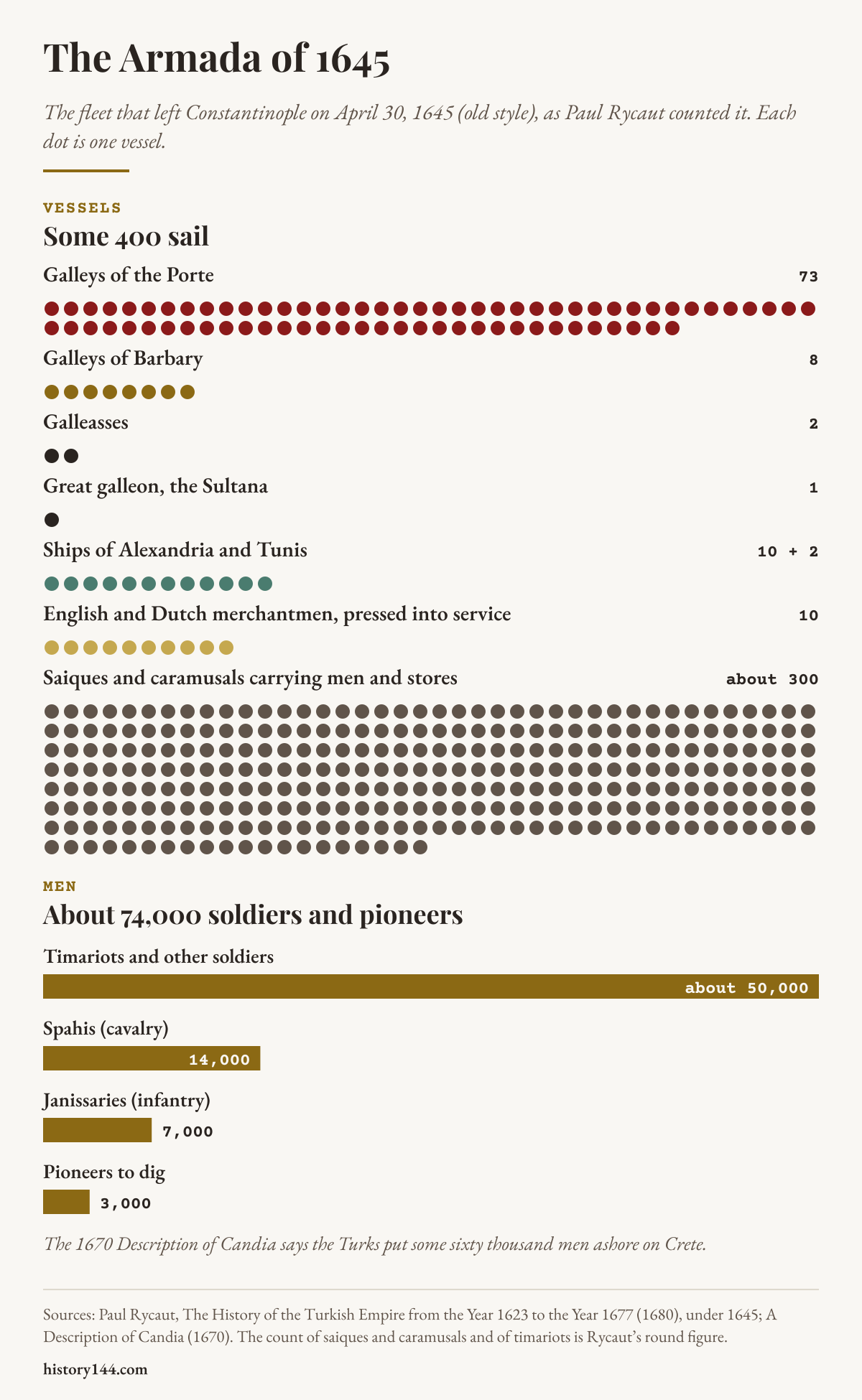
On the last day of April 1645, by the old-style calendar, the Ottoman fleet broke ground at Constantinople. It numbered seventy-three galleys of the Porte and eight of Barbary, two galleasses, and a great galleon called the Sultana. With them went ten ships out of Alexandria and two out of Tunis, ten English and Dutch merchantmen pressed into service as they lay in port for trade, and about three hundred saiques and caramusals, the small coasting craft of the Levant. These carried men, provisions, and the tools of war. On board were seven thousand janissaries, fourteen thousand spahis, and some fifty thousand timariots and other soldiers, with three thousand pioneers to dig.[1] Nobody aboard knew where they were going. The commission for the campaign had been handed to the commanders sealed, with orders not to open it until the fleet was past the Dardanelles. The whole armada was to gather at Scio, the name Italians and Englishmen then gave to the island of Chios, and it arrived there on May 7, 1645.[2]
Twelve years later, on May 3, 1657, a Venetian captain general named Lazzaro Mocenigo caught a squadron of Barbary warships in the channel of Scio and destroyed it.[3] Between those two days lies the first half of a war that ran until 1669. It outlasted the sultan who began it and most of the Venetian commanders who fought it. In those years Venice won most of the great fights at sea, burned Ottoman fleets, and for a time held the mouth of the Dardanelles itself. Crete passed into Ottoman hands all the same. The reason lies in what a navy could and could not do against an empire willing to feed men into a siege for as long as it took. This is the story of those twelve years.
The Chief Eunuch's Galleon
The war began with a piece of piracy in which the Venetians had no direct part. In 1644 the galleys of the Knights of Malta, the crusading order that waged a private war on Ottoman shipping from its island fortress, took a small Ottoman convoy at sea. Accounts of the prize differ. An English description of Candia published in 1670, compiled mostly from letters written by a man in Venetian service, says the Maltese took a "Sultana" who, with three million crowns, intended a pilgrimage to Mecca. The word could mean either a great Ottoman ship or a lady of the Sultan's household, and the author's "who" suggests the second.[4] Paul Rycaut, an English diplomat who spent years in the Ottoman Empire and later wrote its history, gives a fuller account. In his version the ships belonged to the Kuzlir Aga, the chief eunuch who governed the women of the Sultan's seraglio. He had been given leave to visit Mecca and then retire to Egypt, and he sailed with his treasure in a great galleon and smaller vessels, along with some three hundred and fifty slaves and thirty women. Rycaut gives no total for the treasure. He says only that the prize was very considerable.[5]
The two accounts agree on what happened next. Steering home with their booty, the Maltese put into a minor port on the south coast of Crete, forced there, says the 1670 account, by bad weather or a want of fresh water. Rycaut names the port as Calimene. They refreshed themselves there and went on to their own island.[6] Crete had been Venetian since the early thirteenth century, and by its standing agreements with the Porte the Republic had promised to deny the Knights shelter in its ports and harbors. The author of the 1670 description says as much.[7] Rycaut records the Sultan's complaint in similar terms: contrary to the articles of peace, the Venetians had given provisions and entertainment to his enemies in Candia.[8] Candia was the name Europeans then used for both the island of Crete and its capital city.
Neither source treats the grievance as the real cause. The author of the 1670 description cites a letter to the King of England from an English nobleman then living in Venice. According to the nobleman, the Turk had wanted the island ever since he conquered Rhodes and Cyprus. While the Christians held its harbors they kept a foothold in the eastern Mediterranean, and once they lost it the Sultan could turn on them in the west with less risk.[9] The Maltese galleys supplied the pretext, and the fleet of 1645 supplied the answer.
Malta or Candia
The Porte went to unusual lengths to hide its plans. Rycaut explains why. Against neighbors whose lands bordered his own, the Sultan was used to striking with little ceremony. Here he had to fight at sea, where he knew his forces were weaker than those of Venice, so he used every feigned artifice and show of friendship before he struck.[10] The rumor given out was that the armada was bound for Malta to punish the Knights. Before it sailed, the Venetian bailo, or resident ambassador, at Constantinople, Giovanni Soranzo, paid a courtesy call on the Captain Pasha, the admiral of the Ottoman fleet. He was received with every assurance of friendship and learned nothing certain. Even so, he warned the governor of Candia, Andrea Cornaro, that the storm might fall on that kingdom, and told him to be watchful but to show as little sign of alarm as possible.[11]
From Scio the fleet steered for Napoli di Romania, the Venetian name for Nafplio. A northerly wind scattered it, and its ships anchored at Micono and at Tino, a Venetian island in the Cyclades, where they watered by license of the Venetians themselves. The fleet was then seen off Cerigo, the island off the southern tip of the Morea that the Greeks call Kythera. On the way it took a saique laden with arms and ammunition from Venice, bound for the Cretan town of Retimo.[12] Only when he was off Cape Colonna did the Captain Pasha send a brigantine back to Constantinople with word that he would sail directly for Candia. The Porte then declared war. Soranzo was committed to prison, and orders went out through the whole Archipelago to destroy or enslave every subject of the Republic.[13]
The Landing at Gonia
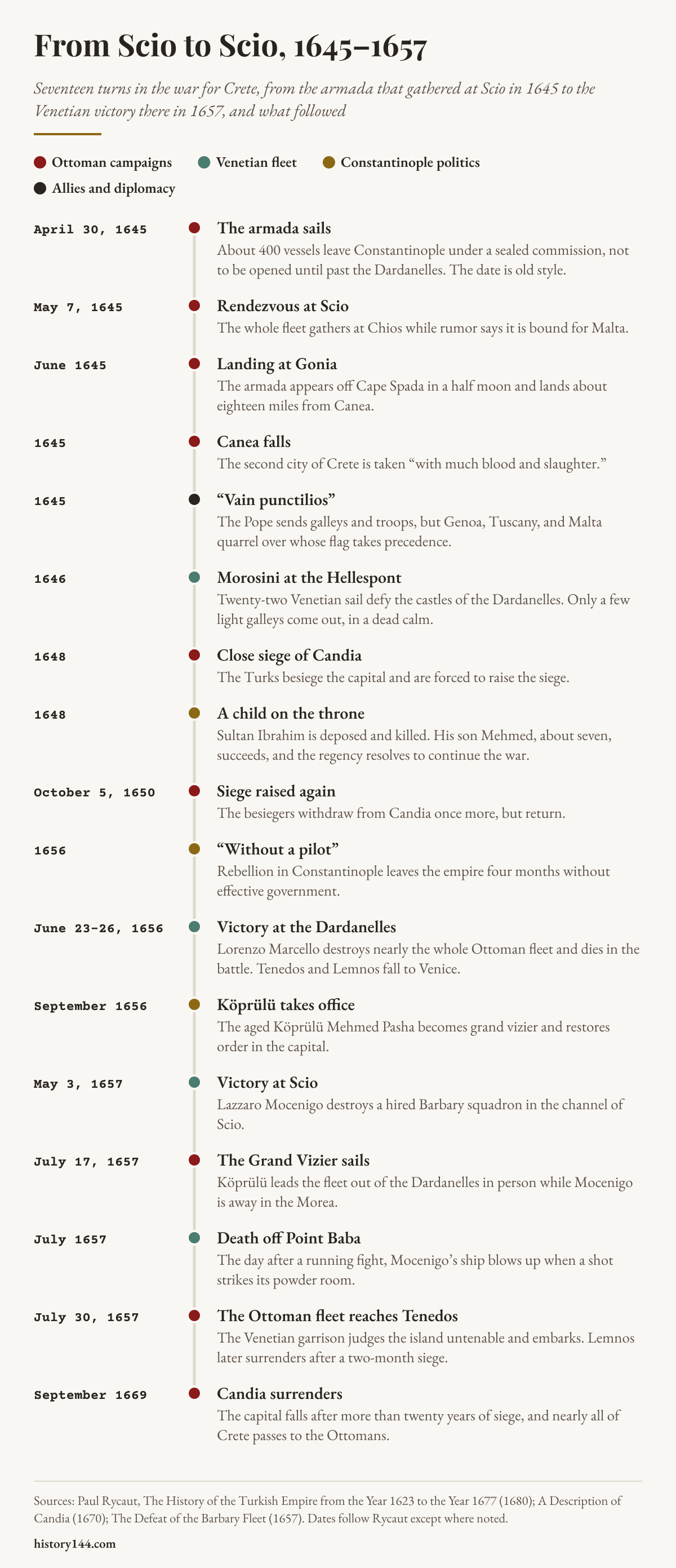
Soranzo still managed to send a warning. According to Rycaut he dropped a letter from the window of the house where he was held, and a fast vessel carried it to Crete.[14] By then the watchtowers along the coast had seen enough. Beacon fires gave a general alarm across the island, and the next morning, in June, the whole armada appeared off Cape Spada, the long promontory west of Canea. The fleet came on slowly in fair weather over a smooth sea, drawn up in the shape of a half moon and covering a great tract of water. It showed itself, in Rycaut's words, "with the greatest terror imaginable to the islanders." The Turks landed at Gonia, about eighteen miles from Canea.[15]
The island they had come for was the largest of Venice's overseas possessions. The Republic had acquired it in 1204, in the scramble that followed the Fourth Crusade's capture of Constantinople, when Boniface of Montferrat sold his claim to the island to the Venetians. Four and a half centuries later the island was still divided. According to the 1670 description, Greek was the common language, though gentlemen and merchants often spoke Italian as well. Most of the people belonged to the Greek Church, while Latin services were held in some parts of the island.[16] The ruling class was Venetian and Catholic, and the great majority of the population was Greek and Orthodox.
Canea and the Rock of St. Theodore
The Turks put some sixty thousand men ashore and, as the 1670 description puts it, sat down before Canea without any declaration of war.[17] Canea was the second city of the island and its chief port on the north coast. The Turks took it that same year, in Rycaut's words, "with much blood and slaughter."[18]
Rycaut dwelt less on the city than on the chance the Venetians let slip. The Ottoman fleet lay that season at St. Theodore, a rock opposite Canea, half disarmed and poorly supplied. It was believed, he wrote, that the whole fleet might have been burned there "had the occasion been improved." It was not. Between quarrels among their commanders and what Rycaut called their coldness and negligence, the Venetians let the Turkish vessels come and go. Toward the end of the year the proveditor general, Francesco Molino, went home, and Giovanni Cappello, a procurator of St. Mark, was appointed in his place. Rycaut was not sure whether illness or a recall by the Senate sent Molino home. He would say only that the Senate "seemed to be ill satisfied with his ill fortune, or his ill management."[19] Retimo soon fell as well. It was the third city of the island, on the north coast between Canea and Candia, and in its defense Andrea Cornaro, the governor Soranzo had warned to be watchful, was killed by a musket shot.[20]
Vain Punctilios
Venice appealed to the rest of Christendom and received a lesson in precedence. Pope Innocent X set a good example. He joined his own galleys to the Venetian fleet, pressed the princes of Italy to do the same, and granted the Republic a levy of a thousand foot soldiers from his own dominions, along with a double tithe on the goods of the clergy.[21] Naples, Tuscany, Malta, and Genoa were all expected to send ships, and on paper the combined force was formidable.
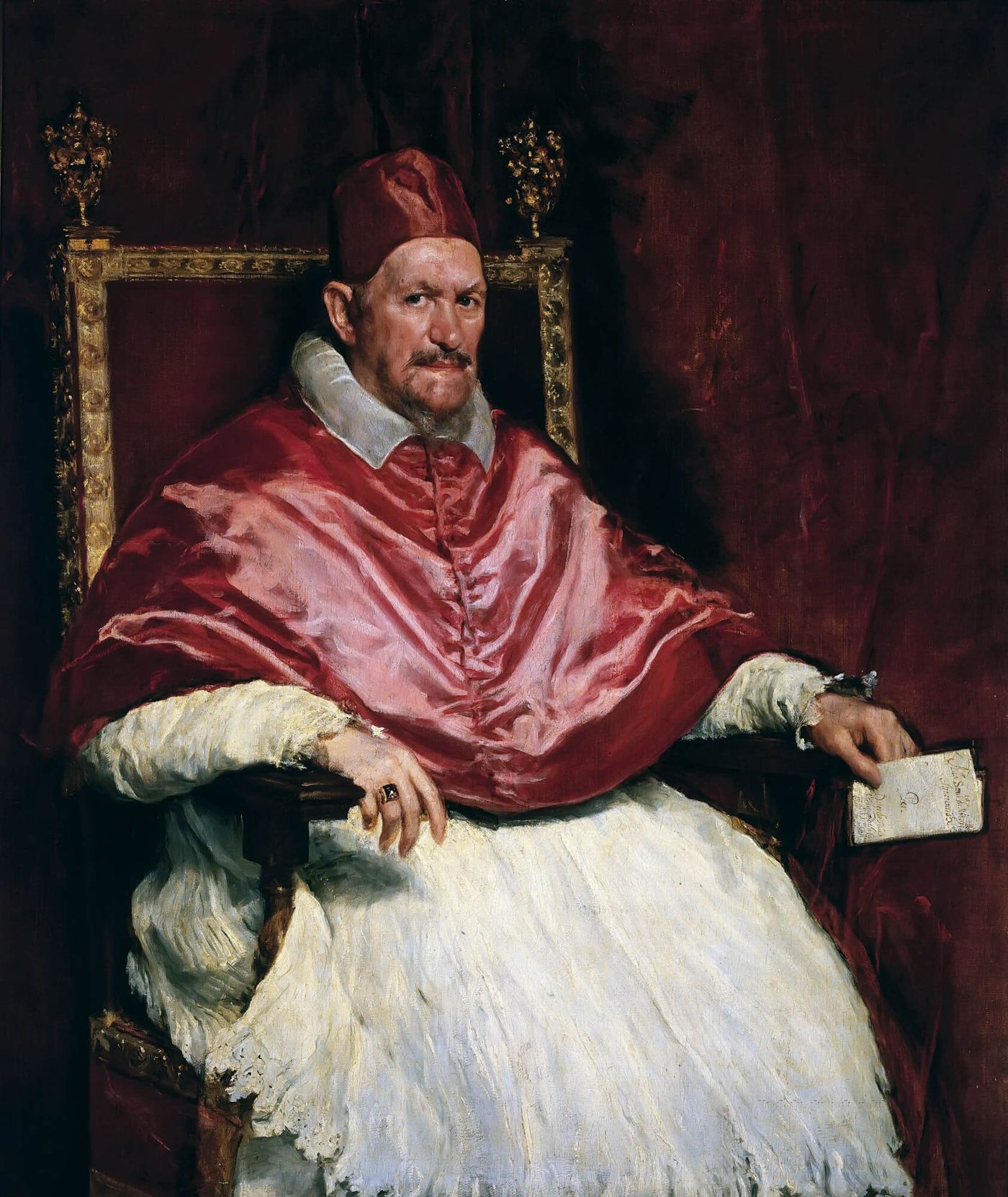
In practice the allies quarreled over flags. Genoa claimed precedence over the galleys of Tuscany and Malta. The Grand Duke of Tuscany answered that he was not inferior to Genoa in rank and was superior in title. The Knights of Malta claimed precedence at sea by long custom. The Pope proposed that all serve under his own flag as auxiliaries, which would spare everyone's honor. The Genoese were not satisfied. They used the occasion to ask the Pope to grant them the treatment of a royal court and the honors given to crowned heads.[22] The season passed with little done. Rycaut blamed "that leaven of vain punctilios," which, he wrote, had so often betrayed the Christian cause to the advantage of the Turk.[23]
The Mouth of the Dardanelles
Unable to drive the Turks from Crete, the Venetians went after their supply line. For the next decade much of the war was fought far from the island, at the mouth of the Dardanelles, more than three hundred miles to the north. The logic was simple. An Ottoman army on Crete had to be fed and reinforced from Constantinople, and nearly everything bound for Crete had to come out through the narrow strait past the two castles that guarded it. A Venetian fleet anchored at the mouth could starve the siege without ever having to raise it.
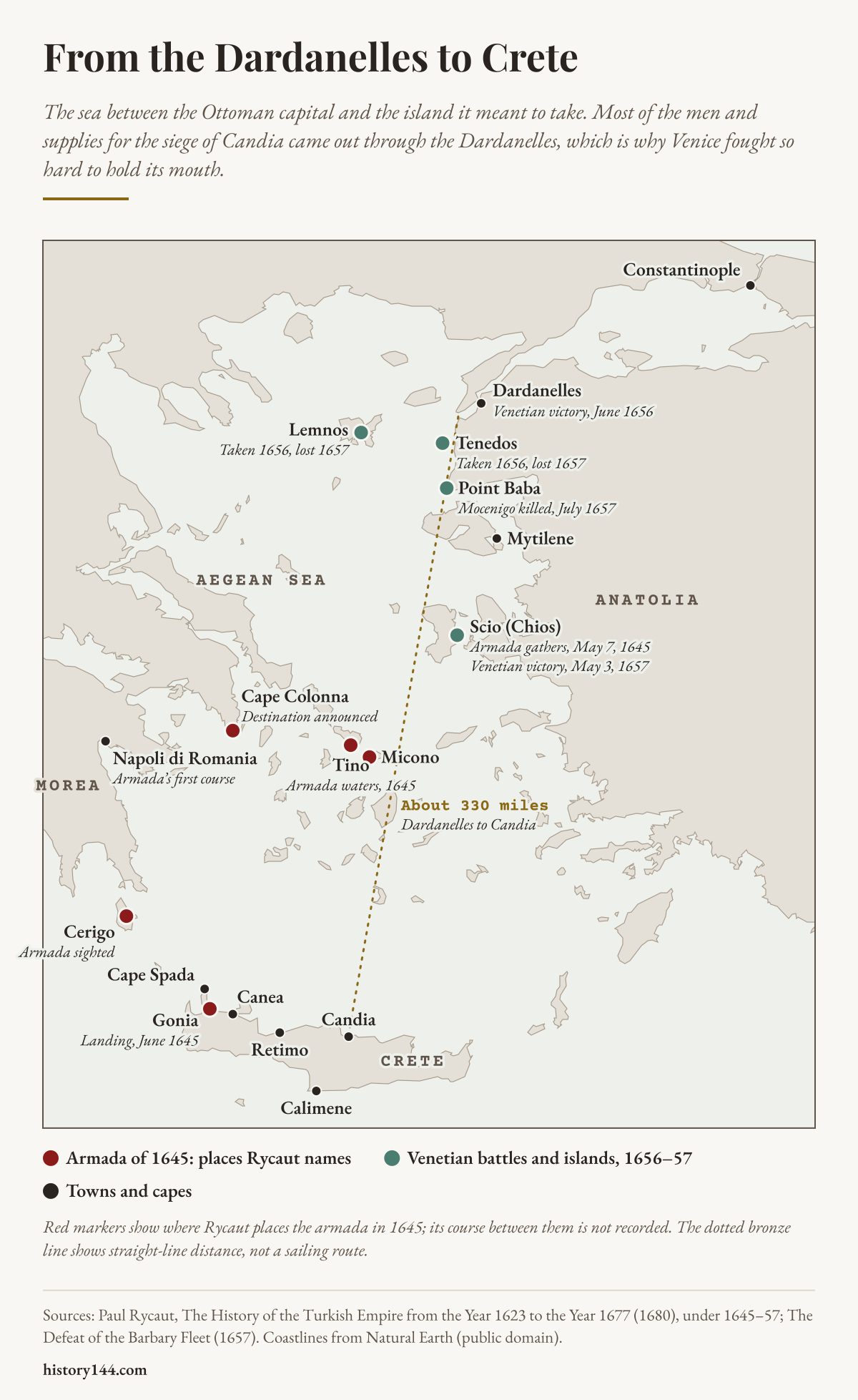
The Venetians began early. In 1646, Rycaut records, Tomaso Morosini, admiral of the Venetian sailing ships, appeared before the castles of the Hellespont with twenty-two sail, "with colours flying, and drums beating," in open defiance of the whole Ottoman power. At first nothing came out to answer him. Only in a dead calm did a few light galleys put out for what Rycaut called a seeming battle.[24] From then on the blockade was the Republic's standing strategy and the Porte's standing humiliation.
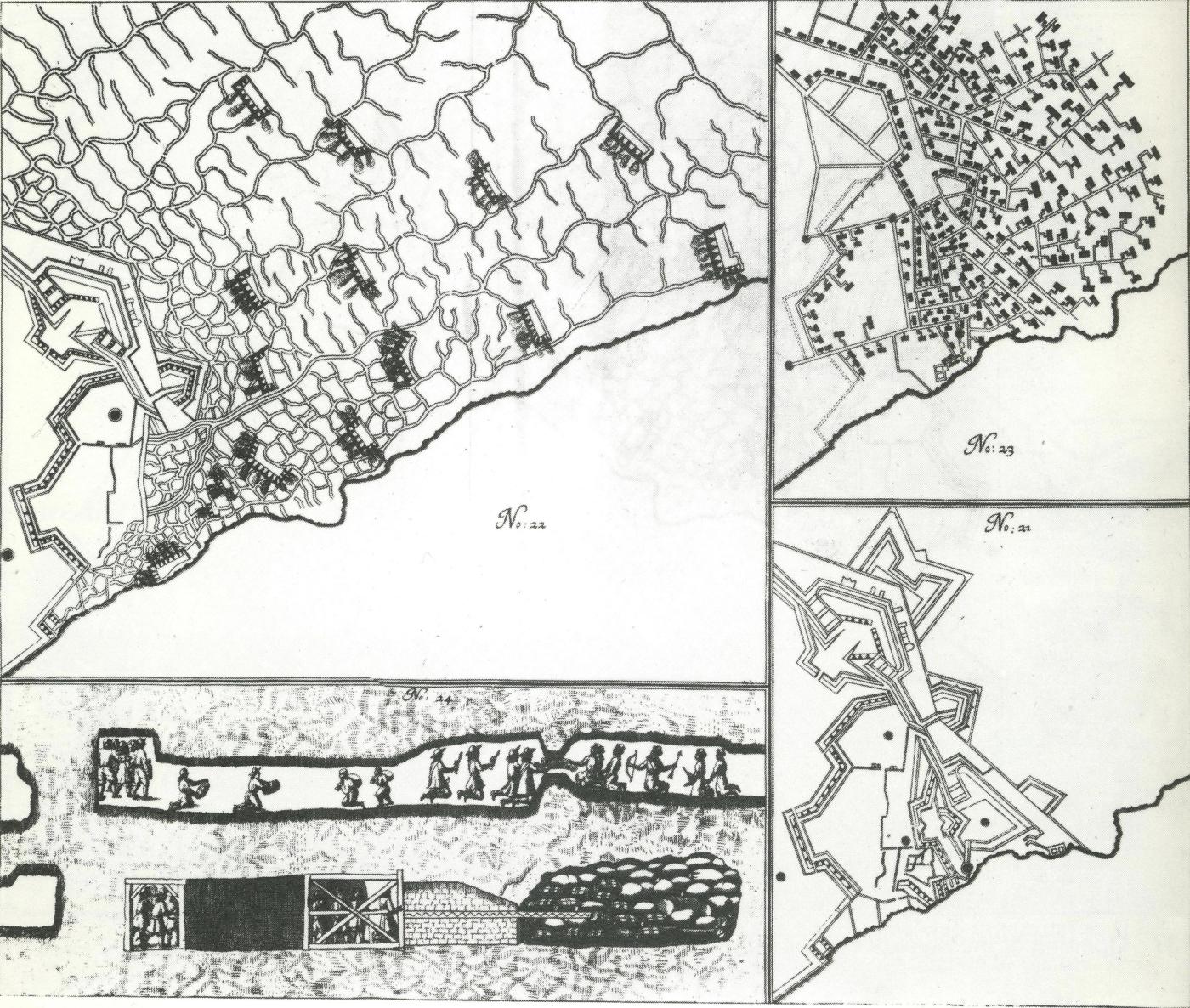
It also set the pattern of the whole war. The Venetian fleet could usually win at sea, but it could not dislodge an Ottoman army once that army was ashore, and the city of Candia would not fall. By 1648 the Turks lay in close siege before Candia itself. Rycaut records that they were at length forced to raise it "with dishonour."[25] They came back. In 1649 the Porte sent sixty galleys, thirty great ships, and twenty-five smaller vessels to Crete. On October 5, 1650, by the new-style calendar, the besiegers again had to withdraw.[26] Each time the Turks fell back on Canea and Retimo, refitted, and returned. The city held out until September 1669.
A Child on the Throne
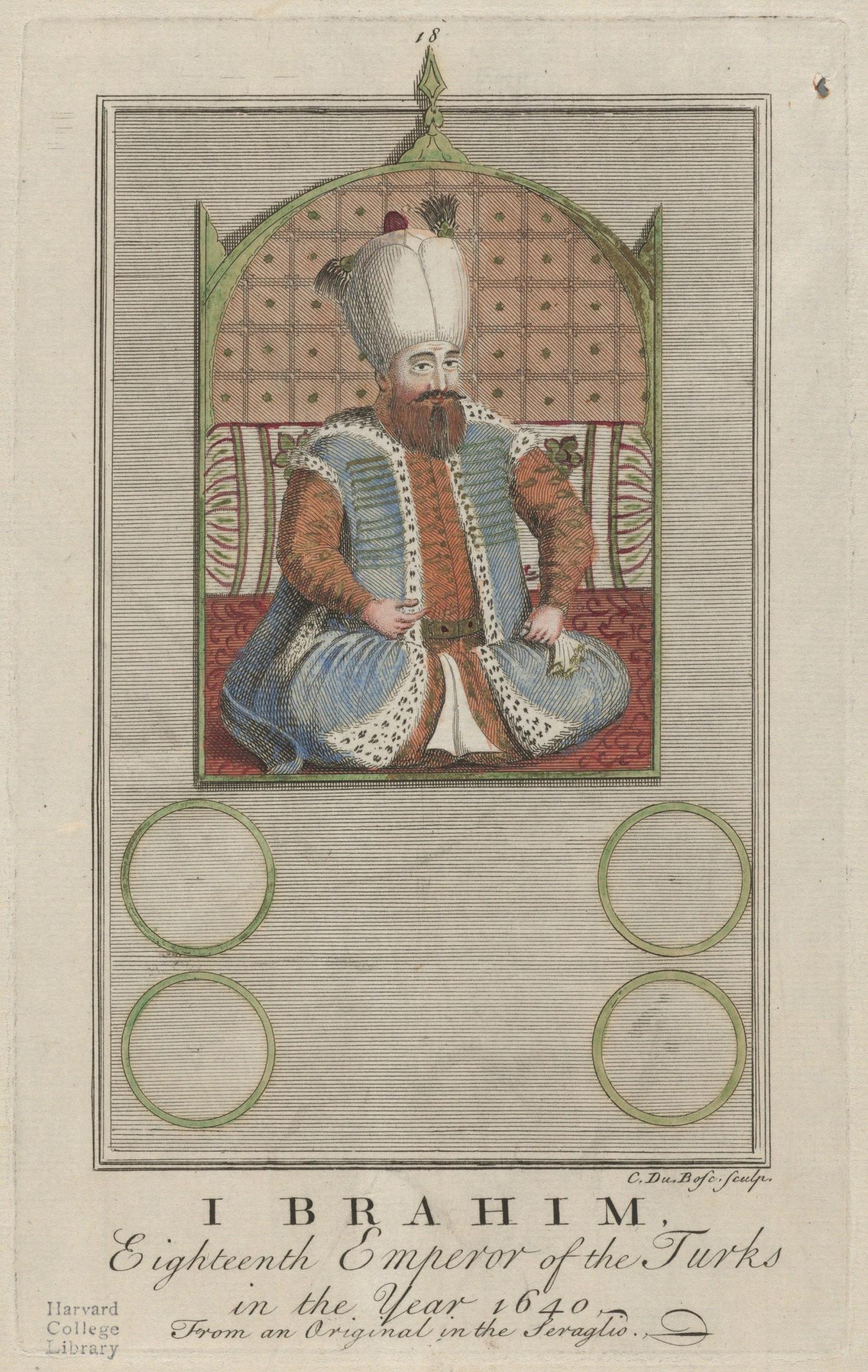
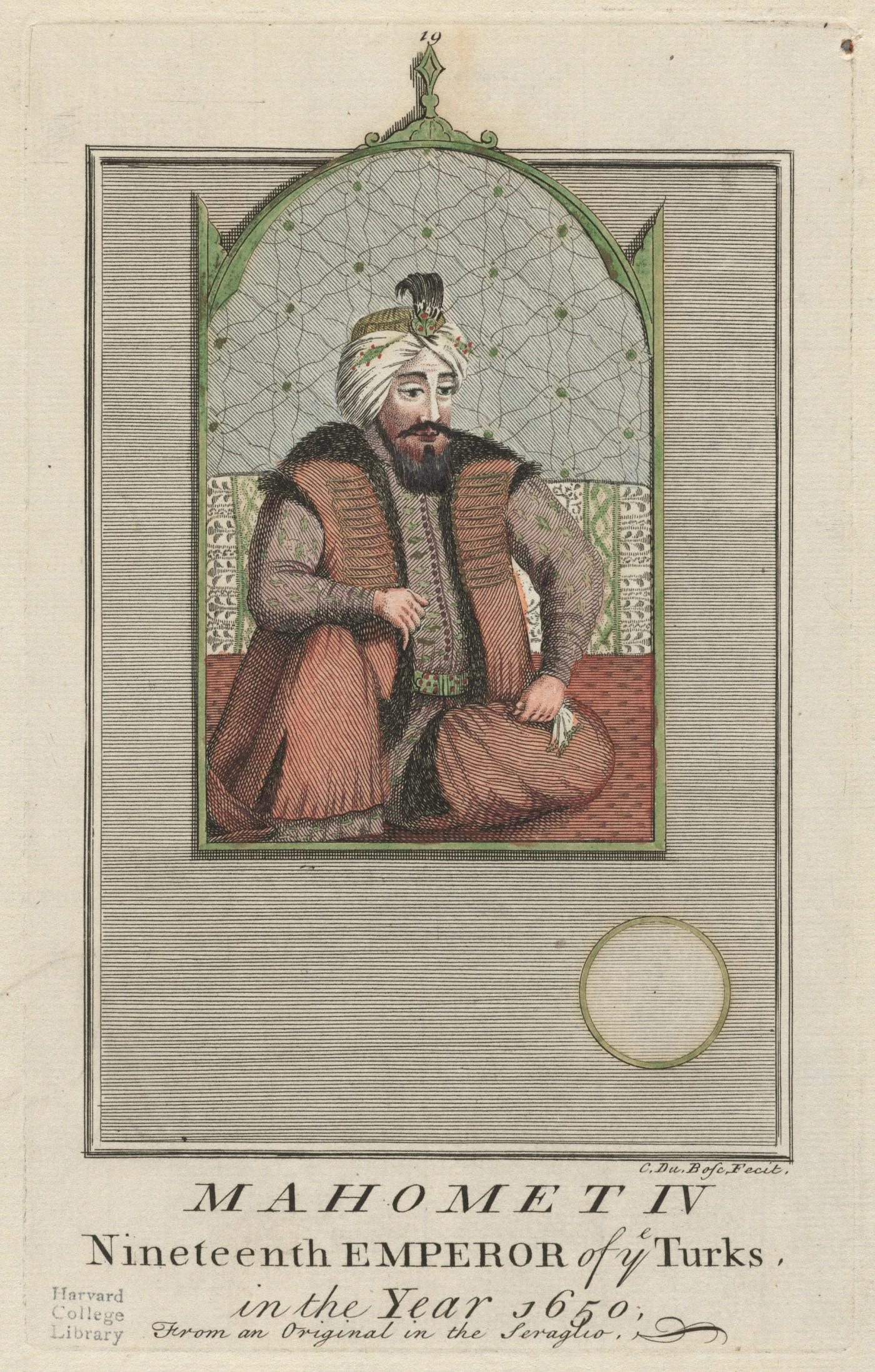
In 1648 the war's author fell. Sultan Ibrahim, whose erratic rule had alienated both the army and the officers of state, was deposed by the janissaries and later strangled. His eldest son, Mehmed, whom Rycaut describes in one place as "a child of seven years of age," succeeded him.[27] The war might have ended there, for Rycaut reports that Ibrahim had gone far toward a treaty of peace with the Venetian bailo before his fall.[28] The new government took a different view. According to Rycaut, the boy's mother took up the regency with the advice of a council of twelve pashas, and one of their first decisions was to continue the war against the Venetians.[29] No minister who governed in the child's name could afford to be the one who gave up Crete short of conquest.
Meanwhile the empire turned on itself. The spahis, the cavalry of the household, demanded the head of the grand vizier as the man responsible for the murder of their sovereign. The janissaries, who had carried out the deposition, defended him and declared that he had acted on their orders.[30] Through the early 1650s grand viziers rose and fell in quick succession. In 1656 the capital rose again. The rebels deposed one grand vizier, and the janissaries put in his place, in Rycaut's phrase, "a fellow of no understanding or reputation," who did not last long. For four months, Rycaut wrote, the empire was without a pilot. The turmoil gave the Venetians ease and respite in their war, but it did nothing to bring about a peace.[31]
Marcello at the Dardanelles
The Venetians made the most of the respite. In June 1656, while Constantinople was still in disorder, they won their greatest victory of the war at the mouth of the straits. From the twenty-third to the twenty-sixth of June the Venetian fleet held its station under fire from batteries the Turks had raised on both the Anatolian and the European shore. It then fell on the Ottoman fleet as it came out and destroyed nearly all of it. The Venetian commander, Lorenzo Marcello, was struck in the thigh by a cannonball and, as Rycaut put it, "gained the glory to die conquering." About five thousand Christian galley slaves were freed. Rycaut put the Venetian losses, besides their general, at not above three hundred killed and wounded.[32]
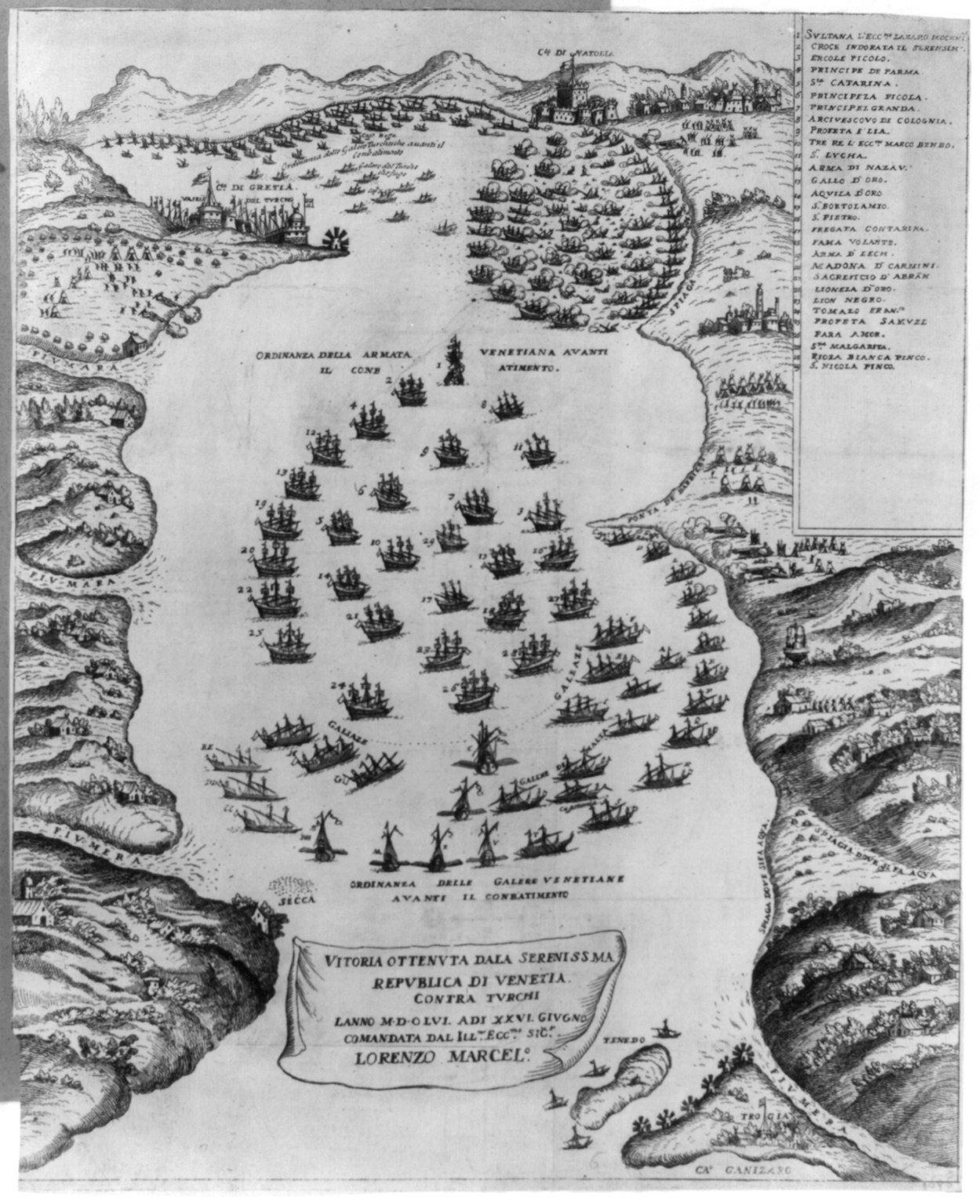
Conquest followed at once. Within four days the Venetians took Tenedos, the island just outside the mouth of the Dardanelles, and soon afterward they took Lemnos, which Rycaut calls Stalimene.[33] Venice now held the mouth of the straits and two islands that commanded the approaches to it. For the first time since 1645 the Republic had a real prospect of starving the siege of Candia.
A Pilot of Eighty
The disaster at the straits helped bring to power the man who would undo it. In September 1656 the Sultan called to the office of grand vizier a provincial governor who had held some of the weightiest posts in the empire and whom many thought the right man to cure its disorders. Rycaut calls him the Pasha of Damascus and describes him as "a person of eighty years of age," adding that this was "that famous Kuperlee" whose son later succeeded him in office.[34] Köprülü Mehmed Pasha, as modern historians know him, may not have been quite as old as Rycaut believed, but he was certainly an old man, and he had no intention of being a figurehead.
He brought the tumults of the capital to an end. After his appointment, Rycaut records, the Sultan rode through every part of Constantinople and had the leaders of the rebellion seized and executed in the sight of the people.[35] With the city quiet, Köprülü turned the whole weight of the state on the Dardanelles. A Venetian fleet at the mouth of the straits was the one thing that could keep the Porte from winning the war in Crete, and he meant to break it.
The Channel of Scio
He moved in the spring of 1657. An Ottoman fleet came out of the straits to retake Tenedos, but contrary winds and bad weather drove it into a neighboring port, where it waited for the galleys of the Beys to join it.[36] It was also counting on a squadron of warships from Barbary, the corsair states of North Africa, which had been hired for the Sultan's service. According to an English pamphlet published that year, the Barbary ships were expected at Scio with a good quantity of rials, the Spanish silver coin then current in the Levant. With them came Aidin Chaus, an envoy who had been sent from Constantinople to North Africa with money to hire the squadron.[37] Mocenigo, the Venetian captain general, resolved to prevent the junction. The pamphlet is a letter of advice written by a Venetian officer and signed only with initials. It says that Mocenigo left his sailing ships behind for the sake of speed and went after the enemy with nineteen galleys and six galleasses, the heavy, many-gunned hybrids of the galley fleet. He also hoped to starve Scio, which was already short of supplies.[38]
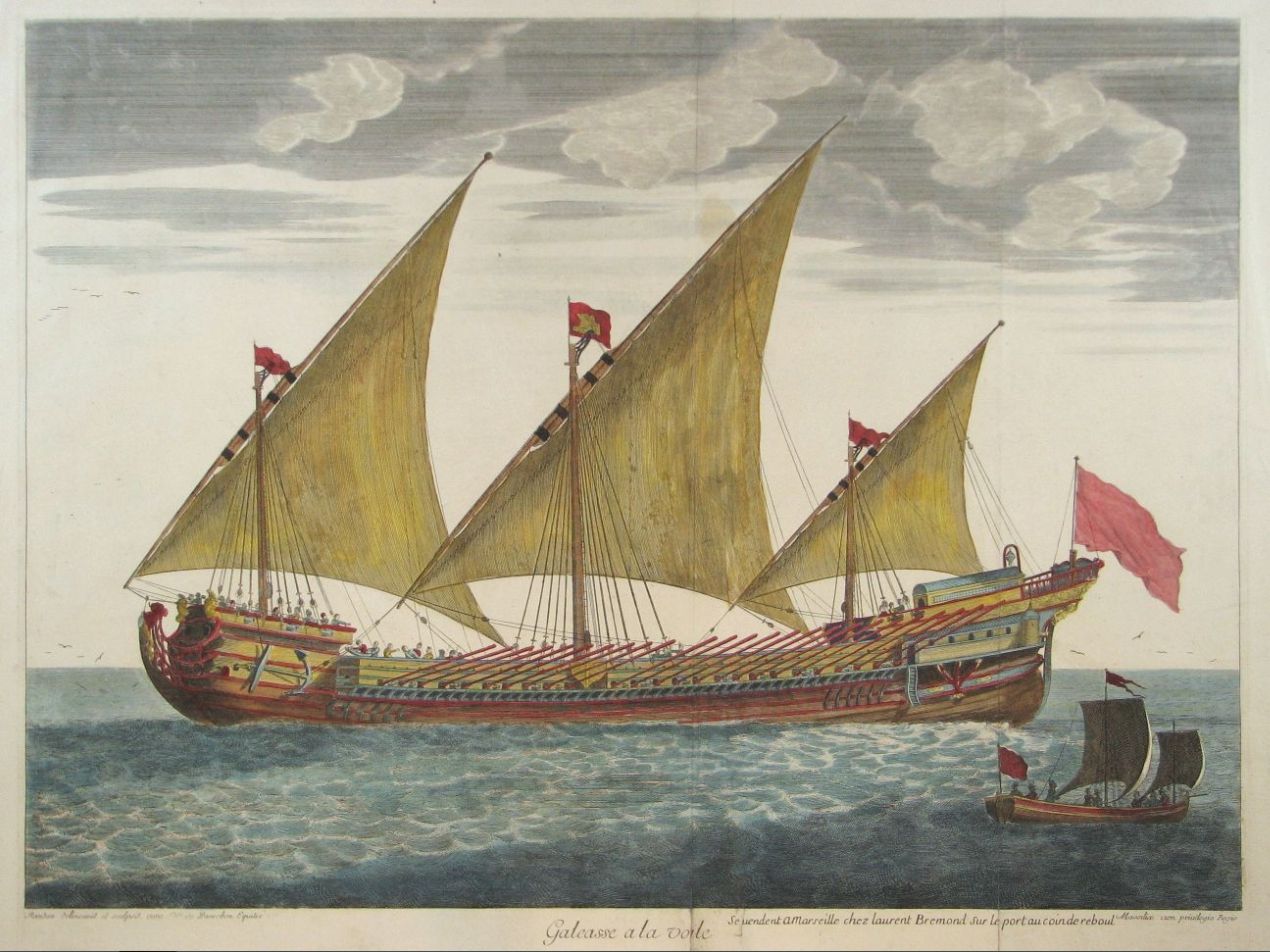
Early one morning the Venetians sighted the Ottoman fleet making sail for the strait of Samos and chased it with sail and oar, but the wind favored the Turks, who reached the channel first. That evening the Venetians took another saique and had word of nine Barbary ships making sail toward Scio on a weak wind, with six more left behind in the dark. They caught them in the channel of Scio. The galleys formed three squadrons, each with two galleasses, with Badoaro on the right, Michiel on the left, and Mocenigo in the center. The great guns of the fortress of Scio joined the action, and the cannonade lasted about three hours. As the wind died, in the letter's phrase, "the ships began to make use of legs for wings," and both sides took to their oars. Mocenigo then ordered his galleasses to board. The letter describes ship after ship carried by assault. The Barbary commander in chief, a renegade Hollander named Mehemet, was wounded in the leg and died the next day. Two Barbary ships were driven ashore and set on fire by their own side. Some of the men swam ashore, while others, the writer says, chose death over slavery.[39]
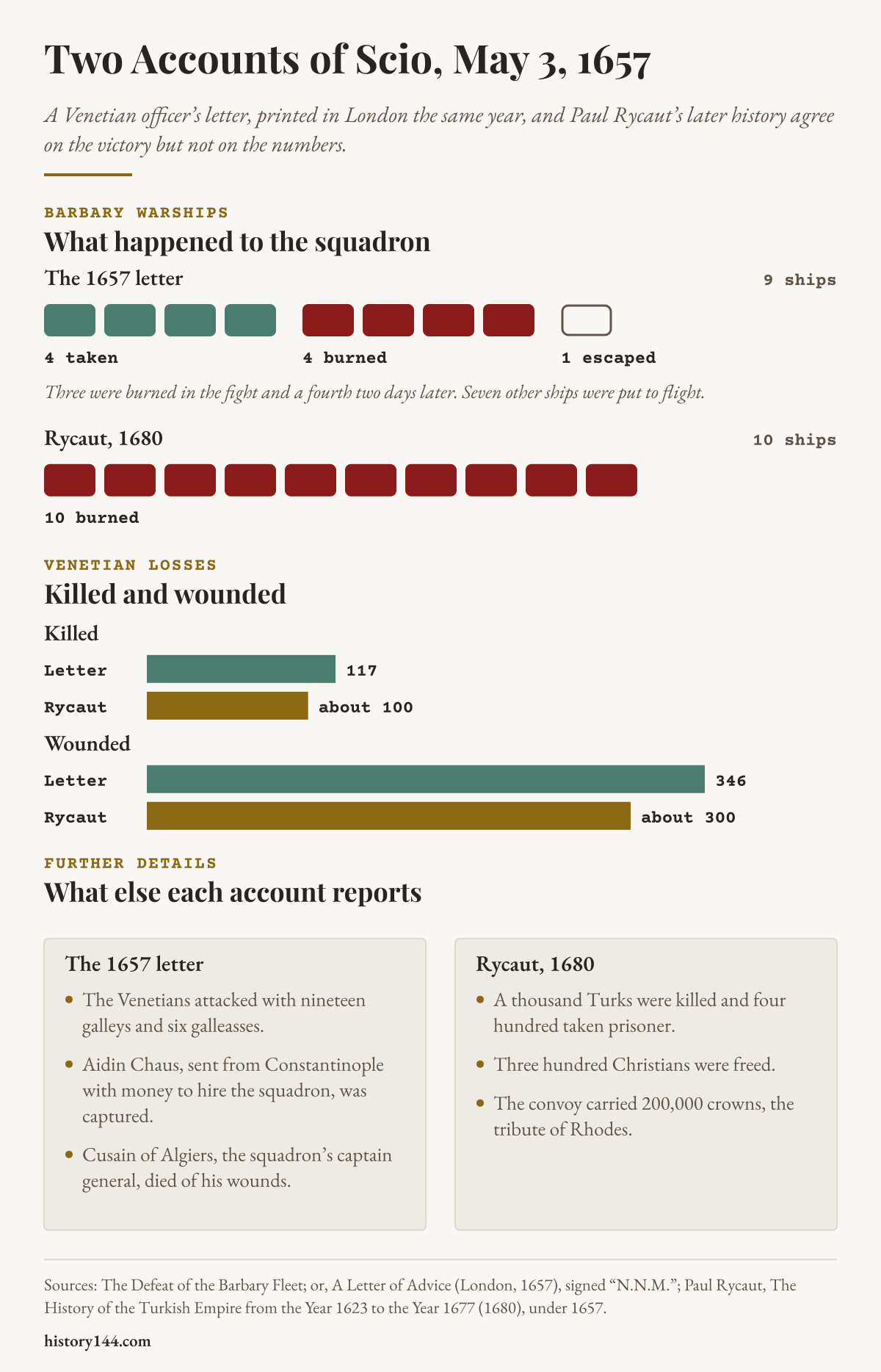
The surviving accounts of the result do not agree in every detail. The letter says that of nine Barbary vessels, four were taken, three were burned in the action, and a fourth was burned two days later, while one escaped and seven other ships were put to flight. Among the prisoners were Aidin Chaus and several Barbary officers, including Cusain of Algiers, the squadron's captain general, who soon died of his wounds. The writer counted 117 Venetian dead and 346 wounded.[40] Rycaut, writing later from other informants, says Mocenigo burned ten ships of war and many of the saiques they were convoying, fourteen of which were laden with provisions. By his count the Venetians killed a thousand Turks, took four hundred prisoners, and freed three hundred Christians, at a cost of about a hundred killed and three hundred wounded. He adds that the convoy carried two hundred thousand crowns, the tribute of Rhodes.[41] The letter was printed in London within the year, under a title that gave the date of the battle in full.[42]
Point Baba
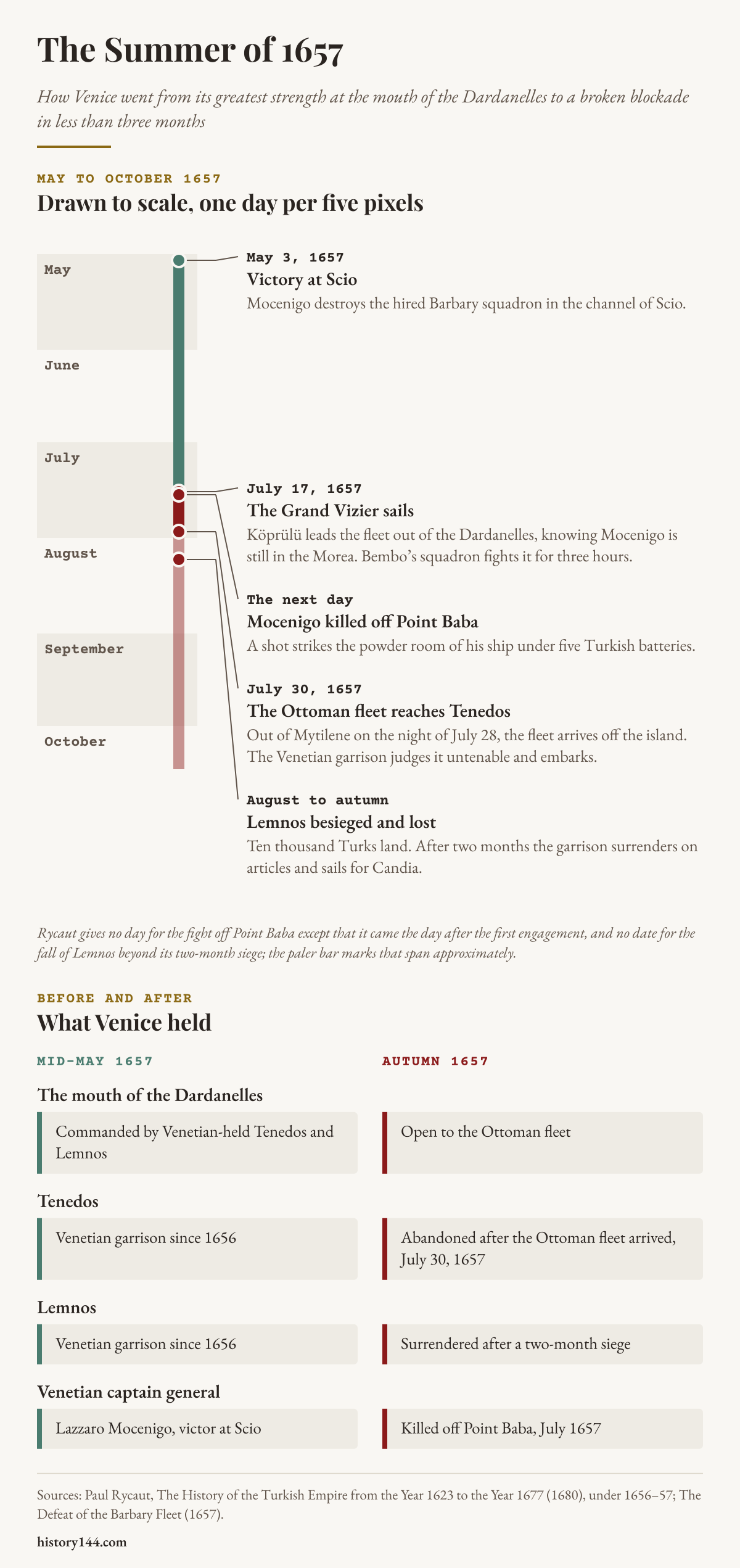
It was the high point of the Venetian war, and it lasted less than three months. Köprülü decided to go to Tenedos in person, and he waited until he had intelligence that Mocenigo had not yet returned from the Morea, where the captain general had spent some time chasing enemy ships. On July 17 the Grand Vizier sailed out of the Dardanelles with eighteen ships, thirty galleys, ten galleasses, and a great number of smaller craft, carrying, by Rycaut's figures, twenty thousand horse and eighty thousand foot.[43] He ran into a Venetian squadron of eighteen sail under Bembo. For three hours the Ottoman admiral and vice admiral lay board and board with Bembo's flagship, until at length the Turks were worsted and put to flight. Mocenigo, returning from the Morea, came up in time to drive the Turkish galleys back toward the Anatolian shore.[44]
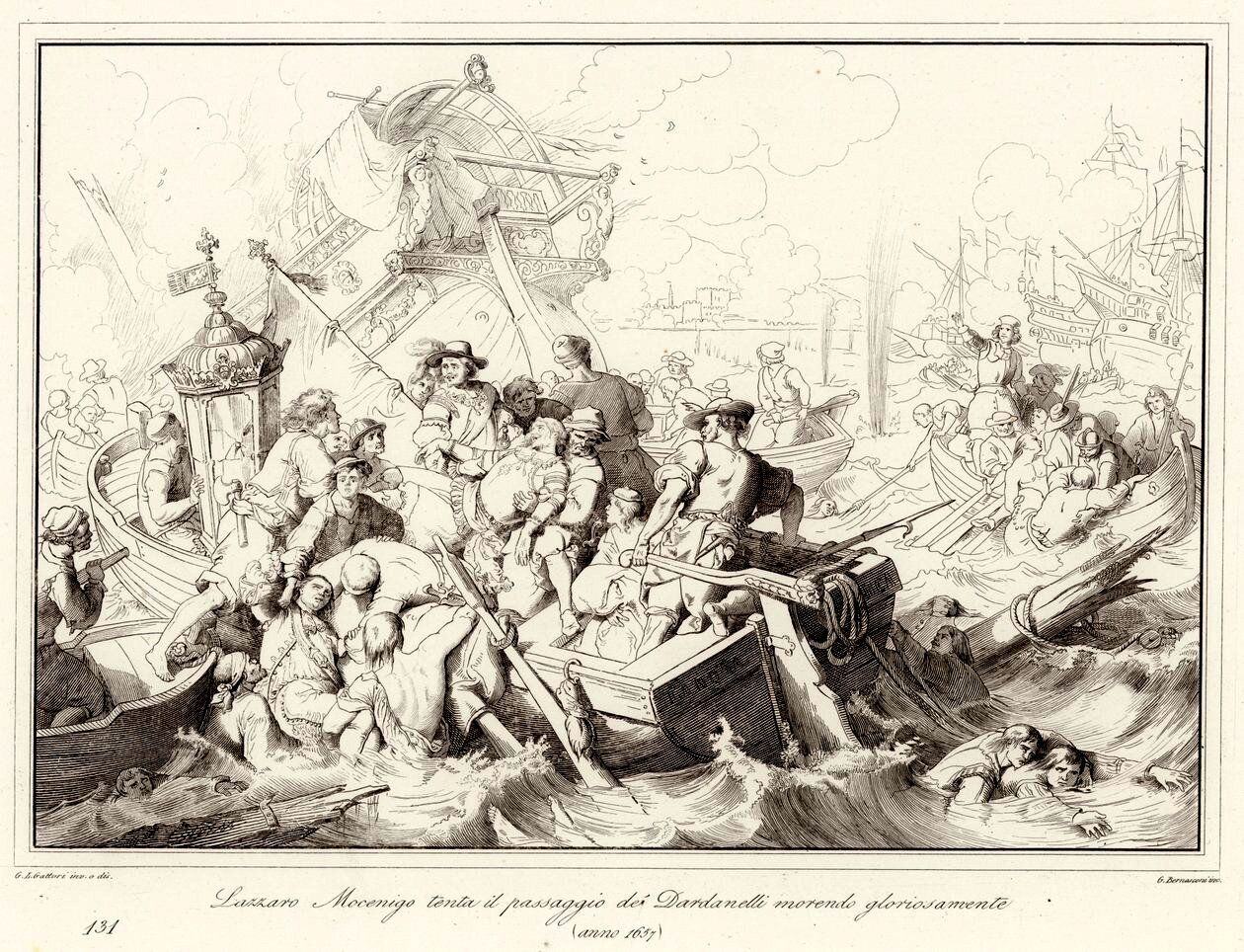
The next day, with a more favorable wind, the Venetians held a council of war and resolved to press their advantage. Mocenigo stood in toward Point Baba, the headland on the Anatolian coast south of Tenedos, to cut off Turkish vessels sheltering there under five batteries. A shot struck the powder room of his ship, and it blew up with him aboard.[45]
The loss of the captain general undid everything the summer had won. According to Rycaut, the Ottoman fleet refitted, left Mytilene on the night of the twenty-eighth of July, and arrived off Tenedos on the thirtieth. The Venetian garrison held a council of war, agreed that the island could not be held against so great a force, and embarked its men, ammunition, and artillery. The Turks then landed ten thousand men on Lemnos, which held out for two months before it surrendered on articles. The garrison marched out with its arms and baggage and was given liberty to sail for Candia.[46] The blockade was broken, and the road from Constantinople to Crete was open again.
Köprülü died in October 1661, and his son Ahmed succeeded him as grand vizier.[47] Under the son the Porte pressed the siege of Candia to its end. The city surrendered in September 1669, and with it went the last Venetian foothold of any size on the island the Republic had held for four and a half centuries.
From Scio to Scio
The twelve years from one Scio to the other show what sea power could and could not do in the seventeenth century. Venice won most of the great actions it fought in those years, often against long odds, and its admirals burned more Ottoman ships than the Porte could easily replace. Yet the Republic could not recover a single city on Crete. The thing the Venetians did best, closing a sea lane, worked only as long as they could keep a fleet in one place, and that depended on weather, sound ships, steady money, and commanders who survived. The thing the Ottomans did best, feeding men into a siege for as long as it took, needed only one season in which the sea lane came open. The Venetians had to hold the straits every year. The Turks had to break through only once.
The two days in the channel of Scio mark the turn. In 1645 the Porte kept its fleet's destination sealed until the ships were past the Dardanelles, and Venice could only guess where the blow would fall. In 1657 it was Köprülü who knew where his enemy was, and he sailed once he had learned that Mocenigo was still away in the Morea. In May Mocenigo had destroyed a hired squadron in the same channel where the armada of 1645 had gathered. Less than three months later he was dead off Point Baba, Tenedos and Lemnos were lost, and the straits were open. Everything the victory at Scio had bought was gone. The war that began with a sealed commission ended twelve years after Mocenigo's death, with Candia in Ottoman hands.
Places in this Story
The places this story moves through, in order — follow them on the interactive map →
- Valletta, Malta 1644
The galleys of the Knights took an Ottoman convoy at sea and carried the prize home to their island.
- Istanbul, Turkey April 1645
The commission was handed over sealed, and the rumor given out was that the fleet was bound for Malta.
- Chios, Greece May 7, 1645
The whole armada gathered here, and from Scio it steered for Napoli di Romania.
- Cape Spada, Crete June 1645
The fleet came on in fair weather drawn up in the shape of a half moon, covering a great tract of water.
- Chania, Crete 1645
Some sixty thousand men came ashore, and the second city of the island was taken with much blood and slaughter.
- Rethymno, Crete 1646
Retimo fell as well, and in its defense Andrea Cornaro was killed by a musket shot.
- Heraklion, Crete 1648
The Turks lay in close siege before Candia itself, and the city held out until September 1669.
- Canakkale, Turkey June 1656
Venice destroyed nearly the whole Ottoman fleet at the mouth of the straits and freed five thousand galley slaves.
- Chios Strait, Greece May 3, 1657
Mocenigo caught the hired Barbary squadron here and ordered his galleasses to carry ship after ship by assault.
- Bozcaada, Turkey July 30, 1657
The garrison judged Tenedos could not be held and embarked its men, and the road to Crete came open again.
Frequently Asked Questions
What started the Cretan War of 1645?
In 1644 the galleys of the Knights of Malta took an Ottoman convoy at sea and put into a port on the south coast of Crete on the way home. Venice had promised the Porte to deny the Knights shelter, and the Sultan used the breach as his occasion.
Where was the Ottoman fleet of 1645 actually going?
Nobody in the fleet knew. The commission was handed to the commanders sealed, with orders not to open it until they were past the Dardanelles, and the rumor given out was that the target was Malta.
When did the Ottomans land on Crete?
The armada appeared off Cape Spada in June 1645 and put its men ashore at Gonia, about eighteen miles from Canea. Paul Rycaut is the source for the landing, and the day of the month is not legible in the digitized copy of his history.
Why did the Venetians blockade the Dardanelles?
An Ottoman army on Crete had to be fed and reinforced from Constantinople, and nearly everything bound for the island came out through the narrow strait. Venice could not drive the Turks off Crete, so it tried to starve the siege from more than three hundred miles away.
Who was Lazzaro Mocenigo?
He was the Venetian captain general who destroyed a hired Barbary squadron in the channel of Scio on May 3, 1657. He was killed less than three months later off Point Baba, when a shot struck the powder room of his ship.
Who was Koprulu Mehmed Pasha?
He was the provincial governor whom the Sultan called to the office of grand vizier in September 1656 to end years of mutiny at Constantinople. Paul Rycaut calls him the Pasha of Damascus and a person of eighty years of age, and says he was that famous Kuperlee whose son later held the office.
Did Venice win the naval war against the Ottomans?
Venice won most of the great actions it fought, burned Ottoman fleets, and for a time held Tenedos and Lemnos at the mouth of the Dardanelles. It lost Crete all the same, because the blockade had to hold every year while the Ottomans needed the sea lane open only once.
How long did the siege of Candia last?
The Turks lay in close siege before the city by 1648, and it did not surrender until September 1669. The twelve years covered here are only the first half of that investment.
Bibliography
The Defeat of the Barbary Fleet; or, A Letter of Advice Relating the Late Glorious Victory, Which the Republique of Venice Obtaind against the Turk in the Chanel of Scio in the Archipelago, the 3d. of May 1657, under the Comand of the Lord Lazaro Mosenigo. London: printed for Richard Lowndes, 1657. Text Creation Partnership edition A89536. Distant Reader. Accessed November 15, 2026. https://distantreader.org/stacks/earlyprint/txt/A89536.txt.
A Description of Candia, in Its Ancient and Modern State: With an Account of the Siege Thereof. London: printed by F. C. for William Crook, 1670. Early English Books. Internet Archive. Accessed November 15, 2026. https://archive.org/details/bim_early-english-books-1641-1700_a-description-of-candia-_1670.
Rycaut, Paul. The History of the Turkish Empire from the Year 1623 to the Year 1677. London: printed by J. M. for John Starkey, 1680. Wellcome Collection copy. Internet Archive. Accessed November 15, 2026. https://archive.org/details/b30326953.
Citations
- Paul Rycaut, The History of the Turkish Empire from the Year 1623 to the Year 1677 (London: J. M. for John Starkey, 1680), under the year 1645. Rycaut dates the fleet's departure "the last day of April, 1645, old style." Rycaut arranges the work as annals, and the page numbers are not legible throughout the digitized copy cited here, so these notes locate passages by the year under which he enters them. Rycaut states in his preface that his account of Ibrahim's reign and the years before 1660 was drawn from other informants rather than from his own observation. Quotations from seventeenth-century sources are given with modernized spelling. ↑
- Rycaut, History of the Turkish Empire, under 1645. ↑
- The Defeat of the Barbary Fleet; or, A Letter of Advice Relating the Late Glorious Victory, Which the Republique of Venice Obtaind against the Turk in the Chanel of Scio in the Archipelago, the 3d. of May 1657 (London: printed for Richard Lowndes, 1657), title page. ↑
- A Description of Candia, in Its Ancient and Modern State (London: F. C. for William Crook, 1670), account of the causes of the war. The title page says the work was collected mostly from private letters written during the siege by one in the service of the Republic. ↑
- Rycaut, History of the Turkish Empire, under 1644. The 1670 Description says the Knights took a "Sultana, who with three Millions of Crowns design'd a Pilgrimage to Mecha." Rycaut calls him "the Kuzlir Aga, or Chief Eunuch which governs the Women in the Signior's Seraglio." ↑
- Description of Candia, account of the causes of the war, which says only "a by-Port of Candia"; Rycaut, History of the Turkish Empire, under 1644, which names the port as Calimene. ↑
- Description of Candia, account of the causes of the war. ↑
- Rycaut, History of the Turkish Empire, under 1644–45. ↑
- Description of Candia, account of the causes of the war. The author does not name the nobleman. ↑
- Rycaut, History of the Turkish Empire, under 1645. ↑
- Rycaut, History of the Turkish Empire, under 1645. Rycaut calls him "Signior Cornaro, then Governour of Candia." ↑
- Rycaut, History of the Turkish Empire, under 1645. Rycaut also reports the fleet near the Braccio di Maina, the Mani peninsula. ↑
- Rycaut, History of the Turkish Empire, under 1645. Rycaut names the places in this order; the course between them is not recorded. ↑
- Rycaut, History of the Turkish Empire, under 1645. ↑
- Rycaut, History of the Turkish Empire, under 1645. The day of the month on which the fleet appeared off Cape Spada is illegible in the digitized copy, so the date is given here only as June. ↑
- Description of Candia, description of the island and its inhabitants. ↑
- Description of Candia, account of the outbreak of the war. ↑
- Rycaut, History of the Turkish Empire, under 1645. ↑
- Rycaut, History of the Turkish Empire, under 1645. ↑
- Rycaut, History of the Turkish Empire, under 1645. Rycaut includes the loss of Retimo among the events of the war's first year; the digitized copy does not show a separate heading for 1646 at this point. ↑
- Rycaut, History of the Turkish Empire, under 1645. Rycaut does not name the Pope; Innocent X reigned from 1644 to 1655. ↑
- Rycaut, History of the Turkish Empire, under 1645. ↑
- Rycaut, History of the Turkish Empire, under 1645. ↑
- Rycaut, History of the Turkish Empire, narrative of 1646. The running head of the digitized page reads 1647, but the passage belongs to the campaign of 1646. Rycaut gives the name as "Tomaso Morosini," admiral of the ships. ↑
- Rycaut, History of the Turkish Empire, under 1648. ↑
- Rycaut, History of the Turkish Empire, under 1649 and 1650. ↑
- Rycaut, History of the Turkish Empire, under 1648–49. Rycaut says Ibrahim was later "strangled by four Mutes." He gives Mehmed's age inconsistently, as seven in one passage and "scarcely arrived to eight years of Age" in another. ↑
- Rycaut, History of the Turkish Empire, under 1649. ↑
- Rycaut, History of the Turkish Empire, under 1649. Rycaut writes that "his Mother, who was the first Sultana," took the regency. Most modern accounts give the regency of these years to Mehmed's grandmother, Kösem Sultan, and Rycaut himself, under 1651, describes a contest between "the Grand-mother, and Mother of the young Sultan" over the guardianship. ↑
- Rycaut, History of the Turkish Empire, under 1649. ↑
- Rycaut, History of the Turkish Empire, under 1656. ↑
- Rycaut, History of the Turkish Empire, under 1656. ↑
- Rycaut, History of the Turkish Empire, under 1656. ↑
- Rycaut, History of the Turkish Empire, under 1656. Rycaut's figure of eighty years is his own; the year of Köprülü's birth is uncertain. ↑
- Rycaut, History of the Turkish Empire, under 1656. ↑
- Rycaut, History of the Turkish Empire, under 1657. ↑
- Defeat of the Barbary Fleet, 1–6. ↑
- Defeat of the Barbary Fleet, 1–6. ↑
- Defeat of the Barbary Fleet, 1–6. The date of May 3 appears only in the pamphlet's title. The letter does not date the morning chase or the evening news of the Barbary ships, and does not say whether the battle came the next day. ↑
- Defeat of the Barbary Fleet, 1–6. The letter is signed "N.N.M." and dated from the galleass on May 30, 1655, an evident misprint for 1657. ↑
- Rycaut, History of the Turkish Empire, under 1657. ↑
- Defeat of the Barbary Fleet, title page. ↑
- Rycaut, History of the Turkish Empire, under 1657. ↑
- Rycaut, History of the Turkish Empire, under 1657. ↑
- Rycaut, History of the Turkish Empire, under 1657. ↑
- Rycaut, History of the Turkish Empire, under 1657. Rycaut dates the Ottoman fleet's arrival off Tenedos to July 30; this date could not be checked against another period source. ↑
- Rycaut, History of the Turkish Empire, under 1661. ↑