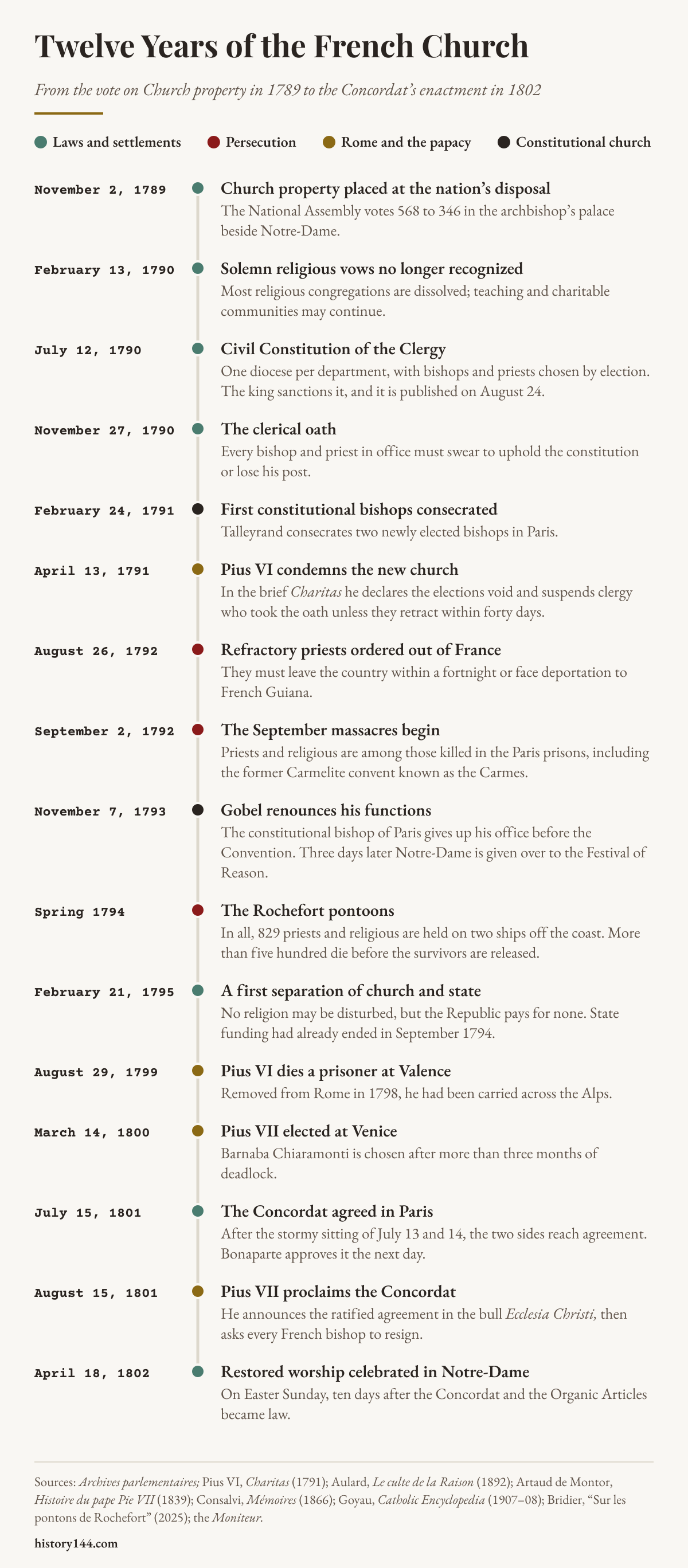
On November 2, 1789, the deputies of France's National Assembly gathered in the great hall of the archbishop's palace in Paris, a building that stood against the flank of Notre-Dame cathedral. They had met there for only two weeks, having followed Louis XVI from Versailles to the capital in October.[1] Their vote that day was one of the most consequential in the history of the French Church. By 568 votes to 346, the Assembly declared that all the property of the Catholic Church in France was "at the disposal of the nation," on condition that the nation pay for worship, support the clergy, and relieve the poor.[2] The idea had been put forward three weeks earlier by a bishop, Charles-Maurice de Talleyrand-Périgord of Autun, and the decree passed under the roof of one of the kingdom's most prominent prelates.[3] Only five weeks before, that same prelate, Archbishop de Juigné, had solemnly blessed the flags of the new Paris National Guard in Notre-Dame.[4] Before long Juigné would be an émigré, and a man elected under a new law would sit in his place as bishop of Paris.
The scene shows how the story began for the Church: with a Revolution that at first sought to reorganize Catholicism rather than abolish it, and with churchmen among the agents of the change. That project went badly wrong. The seizure of the Church's land led to a statute that remade the Church, the statute to an oath, and the oath to a schism. Exile, imprisonment, and a grudging separation of church and state followed. A pope died a prisoner of the French Republic, and it took his successor and Napoleon Bonaparte to find a way out. What follows is the Revolution as the Church lived it, through its clergy, its popes, and the believers caught between them. This is the story of those twelve years.
The Wealth of the First Estate
On the eve of the Revolution, the Catholic Church was the First Estate of the realm, a corporation with its own assemblies, courts, and revenues. It kept the registers of baptisms, marriages, and burials, operated a large share of the country's schools, hospitals, and charitable institutions, and collected the tithe, a levy on the harvest paid by nearly every landholder in France. It was also one of the largest property owners in the kingdom, mostly of farmland and buildings.[5] Across the Channel the position was reversed, and Catholics lived under heavy legal disabilities that barred them from Parliament and most public offices.
The clergy did not enter the Revolution as its enemy; in June 1789 many parish priests among its deputies sided with the commoners in creating the National Assembly. The cost came quickly all the same. In the night session of August 4 and the decrees that followed a week later, the Assembly abolished tithes of every kind without compensation, while promising to find other means of paying for worship, the clergy, the poor, and the upkeep of churches. Until then, the decree provided, tithes would still be collected.[6] If the nation was to pay the Church's expenses, the question became what the nation might take in return.
In these first months, relations between the Revolution and the Church were still warm. Hymns of thanksgiving rang out in Notre-Dame after the fall of the Bastille and again after the abolition of privileges.[7] On August 26 the Declaration of the Rights of Man and of the Citizen declared that no one should be troubled for his opinions, "even religious ones," so long as their expression did not disturb the public order established by law.[8] On September 24, in a long speech on the public finances, the deputy Pierre-Samuel du Pont de Nemours told his colleagues that the property of the clergy was "yours, that is to say the nation's."[9] Across the Atlantic in the same years, the American states were writing the free exercise of religion into their constitutions.
The Nation Takes the Land
Talleyrand gave the idea its decisive form on October 10, 1789. A worldly aristocrat who had served for years as the agent-general charged with defending the clergy's property, he now told the Assembly that the clergy did not own its property in the way other owners did. In his view the Church held its lands to fund its functions, and if the nation assumed those functions, it could take the property.[10] To many churchmen this was a betrayal by one of their own, and the former guardian of the Church's estates was denounced as an apostate. The comte de Mirabeau pressed the case in debate, and on November 2 the Assembly adopted his amended motion.[11] The decree was cautious in form, placing the property "at the disposal" of the nation rather than confiscating it outright.[12]
To raise money on the land before it could be sold, the Assembly began in December 1789 to issue assignats, notes secured on the church estates that buyers could use to purchase them.[13] Farms, abbeys, and town houses passed at auction to peasants, townspeople, and speculators, and the buyers' claims would hang over every later attempt at reconciliation. Secularization spread beyond France in the Napoleonic years, and an emptied Bavarian monastery later housed a factory building steam printing presses.
The Assembly moved next against the religious orders. On February 13, 1790, it ceased to recognize solemn religious vows and dissolved most religious congregations, while allowing certain communities devoted to teaching or charitable work to continue.[14]
A Church Remade by Statute
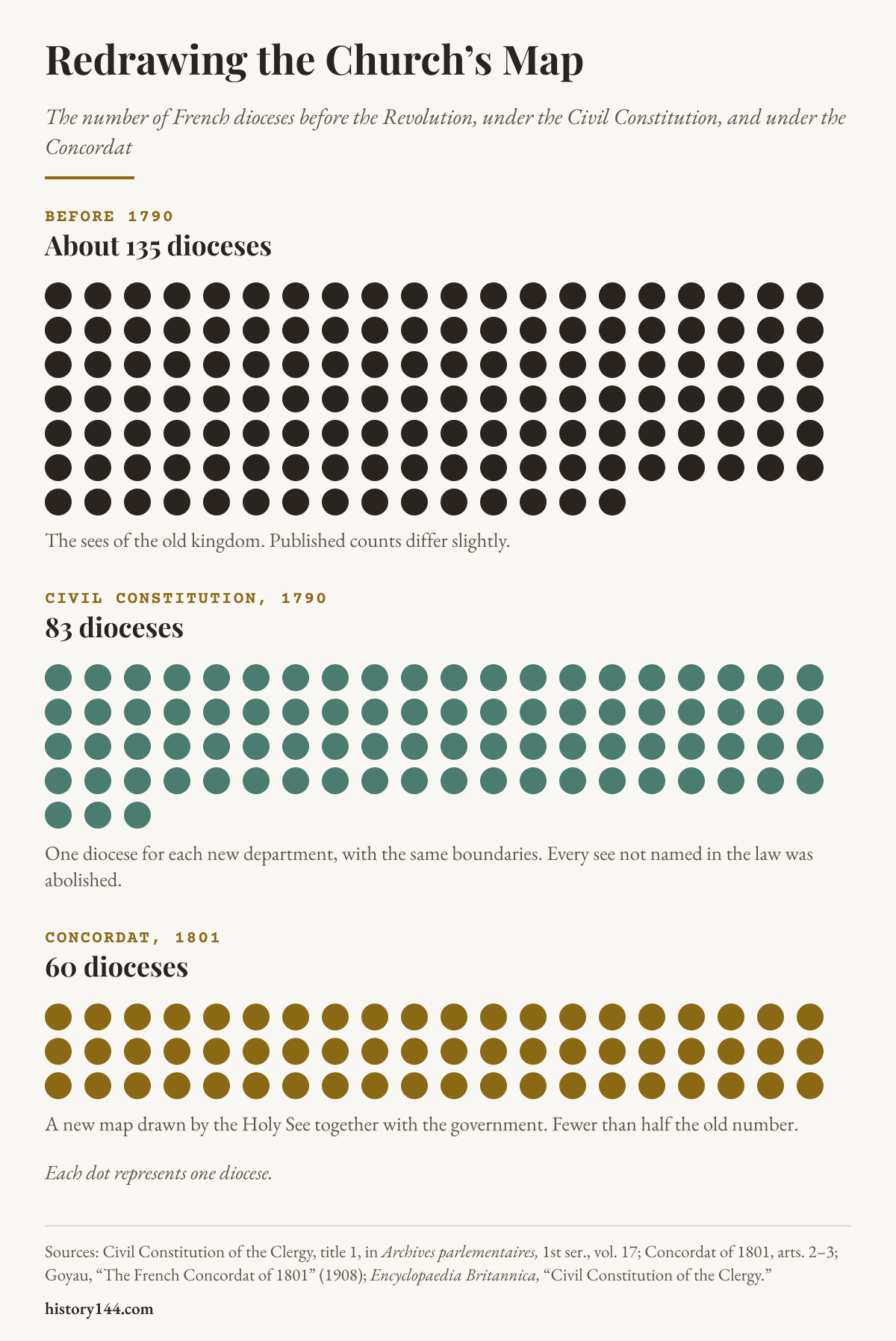
Having taken over the Church's finances, the deputies turned to its organization. The Civil Constitution of the Clergy, adopted on July 12, 1790, redrew the map of the French Church to match the new civil administration. Each department was to form a single diocese with the same boundaries, and every bishopric not named in the law was abolished; in all, the number of sees fell from about 135 to 83.[15]
The law's most radical provisions concerned how the clergy would be chosen and whom they would answer to. Bishops and parish priests were to be elected by the same assemblies that chose local officials. A newly elected bishop was forbidden to seek confirmation from the pope and was merely to write to him "as to the visible head of the universal Church." Before his consecration he was to swear, in public, to be loyal to the nation, the law, and the king, and to uphold the constitution decreed by the Assembly.[16]
To its authors, the Civil Constitution was a reform in the spirit of the early Church. To Pius VI and most of the French bishops, it was the work of an assembly of laymen, some of them Protestants and unbelievers, rewriting the Church's government without its consent. The pope had written to Louis XVI on July 9, 1790, urging him not to approve it.[17] The king, pious and uneasy, gave his sanction all the same, and the law was published on August 24.[18] That autumn some thirty bishops, led by Cardinal de La Rochefoucauld and the archbishop of Aix, set out their objections in a statement of principles and appealed to Rome. According to Pius VI, all but four of the kingdom's 131 bishops endorsed it.[19]
The Oath and the Schism
The breaking point came over the oath. Doubting the clergy's cooperation, the Assembly decreed on November 27, 1790, that every bishop and priest holding office must swear to uphold the constitution, and therefore, indirectly, the reorganized Church. Those who refused would lose their posts. The oath-taking began in January 1791. Only seven bishops took the oath, while roughly half of the parish clergy did so.[20] The French Church split into "constitutional" or juring clergy, who accepted the new order, and "refractory" or non-juring clergy, who did not. Some who swore tried to do so with private reservations. Cardinal de Loménie de Brienne, archbishop of Sens, took the oath and then wrote to the pope that it should not be read as his inner assent. Pius VI answered that unless he retracted, he would be stripped of his rank as cardinal.[21]
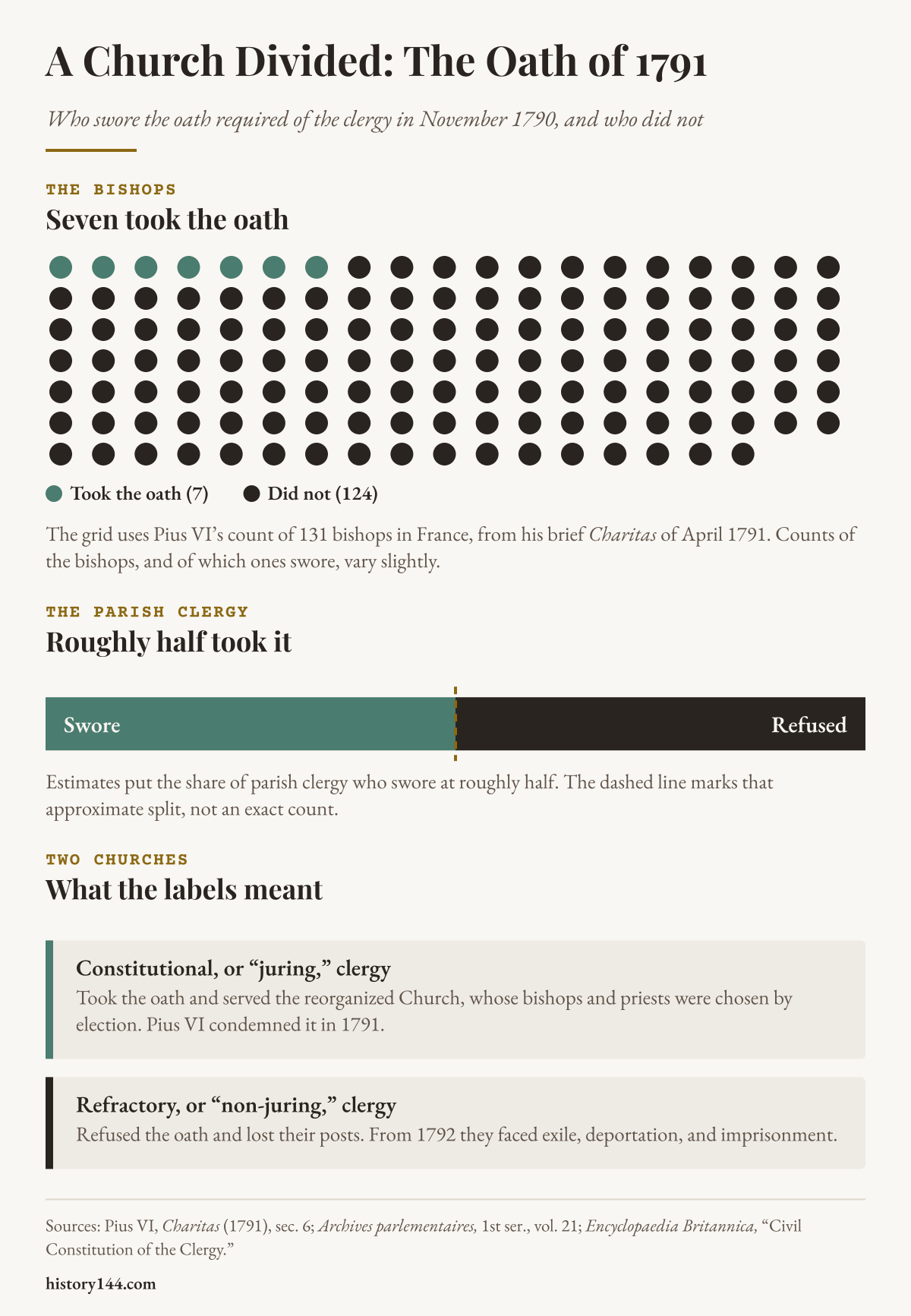
The schism became formal within weeks. The new constitutional sees needed bishops, and almost no existing bishop would consecrate them. On February 24, 1791, Talleyrand did so, consecrating two newly elected bishops in Paris, and the new men went on to consecrate others. Among the bishops elected under the new law was Jean-Baptiste Gobel, who became the constitutional bishop of Paris while Juigné, the archbishop recognized by Rome, was still alive.[22] Pius VI had already condemned the law in a brief of March 10. In a second, Charitas, dated April 13, 1791, he named the consecrators and the new bishops, declared the elections void, and suspended every cleric who had taken the oath unless he retracted it within forty days.[23] He had also ordered that the customary French payments to Rome no longer be collected, though the Assembly had already abolished the chief of them, the annates, in 1789; he presented the gesture as proof that his objections were religious rather than financial.[24]
For ordinary Catholics, the schism reached into the parish church. A village might lose a priest it had known for years to an elected stranger, and believers had to decide whose Mass to attend and who should baptize their children.
Exile, Prison, and Martyrdom
As the political crisis deepened, revolutionaries came to see the refractory clergy as allies of the counter-revolution. After the fall of the monarchy in August 1792, the Legislative Assembly passed a law on August 26 ordering every refractory priest to leave his department within eight days and the country within a fortnight, on pain of deportation to French Guiana. Most of the Norman priests whose fate the historian Bernard Bodinier has traced chose exile and hurried to obtain passports.[25]
For some, there was no time to leave. In the first days of September 1792, crowds broke into the Paris prisons and killed many of the inmates. Among the dead were priests and religious held in several prisons, including the former Carmelite convent known as the Carmes. In 1926 Pope Pius XI beatified 191 of the victims as martyrs, among them three bishops, 127 secular priests, 56 members of religious orders, and five laymen.[26] Later that month the Church lost another of its ancient functions, when the registers of births, marriages, and deaths were transferred from the parishes to the communes and civil marriage became the only form the law recognized.[27]
When the west rose in the rebellion of the Vendée in March 1793, religion was among its causes, and the Catholic historian Georges Goyau, writing in 1908, considered it the chief one. Among the priests prominent in those wars was Étienne-Alexandre Bernier, the parish priest of Saint-Laud in Angers, who would reappear eight years later as the First Consul's negotiator with Rome.[28]
The Assault on Christianity
In the autumn of 1793 the question became whether Christianity would survive at all. The campaign formed no part of the program of 1789; it grew out of foreign war, civil war, and local revolutionary zeal, which deputies sent from Paris sometimes led and sometimes followed. Militants closed churches, stripped them of bells and silver, and pressed priests to give up their ministry, including constitutional priests who had sworn every oath the Revolution had asked of them. On November 7, 1793, Gobel, the constitutional bishop of Paris, came before the Convention with his episcopal council and renounced his functions. He laid down his cross and ring, and when he was offered a red cap of liberty he put it on to applause.[29] Henri Grégoire, the constitutional bishop of Blois, was fetched from a committee room and pressed to do the same. He refused, to jeers and applause, and went on wearing his bishop's dress in the Convention until that assembly dissolved in 1795. The historian Alphonse Aulard, comparing the reports, suspected that Grégoire's later version of his speech had grown firmer in the retelling.[30] Three days later Notre-Dame was given over to the Festival of Reason. In the middle of the cathedral stood an artificial mountain crowned by a small Greek temple dedicated to philosophy, and processions of girls in white, with tricolor sashes and crowns of flowers, crossed the mountain to the altar of Reason. Liberty was represented by a performer, most likely a singer from the Opéra, though contemporaries disagreed about who she was.[31] Gobel's abdication did not save him. He was guillotined the following April.[32]
For the refractory clergy still in France, worse followed. In the spring of 1794, 829 priests and religious were sent to the port of Rochefort for deportation and held instead aboard two ships anchored off the coast, the Deux-Associés and the Washington. Forbidden to pray openly, they said "dry" Masses without a consecration and kept a few consecrated hosts hidden for the dying. Counts of the dead differ, but more than five hundred of the 829 died before the survivors were released. In 1995 Pope John Paul II beatified sixty-four of them.[33]
Robespierre opposed the atheism of the dechristianizers, but his remedy offered nothing to the Church. On May 7, 1794, the Convention adopted, on his report, a decree establishing the cult of the Supreme Being and a system of republican festivals.[34] The cult faded after his fall that July.[35]
The Convention that overthrew him did nothing for the constitutional church either; on September 18, 1794, it decreed that the Republic would no longer pay the costs or salaries of any form of worship, abolishing the budget that had supported the constitutional clergy since 1790.[36] The arrangement announced in the archbishop's hall had effectively collapsed: the state kept the property and withdrew the funding.
A Divided Church After the Terror
A formal settlement came on February 21, 1795. The Convention declared that the exercise of no religion could be disturbed, but that the Republic would pay for none, provide buildings for none, and recognize no ministers of any. Ceremonies were confined to the places worshipers chose for the purpose, and clergy could not appear in public in religious dress or display religious signs outside.[37] Together with the end of state funding the previous September, the decree created what is often called France's first separation of church and state.[38] The arrangement proved fragile. After the coup of 18 Fructidor in September 1797, the government turned again on the refractory clergy, and 328 political deportees, refractory priests among them, were sent to Guiana, a punishment that came to be called "the dry guillotine."[39]
Within these limits, both churches rebuilt. About thirty constitutional bishops had come through the Terror, and with Grégoire at their head they held a national council of 101 members in Paris from August to November 1797. The bishops in exile governed their dioceses through vicars general who directed the clergy loyal to them, and in Paris alone 191 priests were ordained between 1795 and 1797, many by the former bishop of Saint-Papoul. Citing a survey by the administration of national property, Grégoire claimed that, three years before the Concordat, more than thirty-four thousand churches were open. A government report from the Tarn in 1800–1801, quoted by the historian Jacques-Olivier Boudon, complained that refractory priests rebaptized and remarried people whom constitutional priests had baptized and married, and refused absolution to those who had bought national property.[40] The land voted away in 1789 had become a matter for the confessional.
Catholics who recovered their churches often had to share them with the republican festivals of the tenth day and with the Theophilanthropists, a new cult of family, reason, and love of neighbor. In Paris, after 1797, the Theophilanthropists met in Notre-Dame itself, alongside the constitutional bishop Royer, who now occupied Juigné's see.[41]
The Pope as Prisoner
By the Peace of Tolentino, which Bonaparte imposed on February 19, 1797, Pius VI renounced his claims to Avignon, ceded the northern provinces known as the Legations, and agreed to pay heavy indemnities in money and valuables. After the French general Duphot was killed in Rome in December 1797, French troops occupied the city in February 1798 and proclaimed a Roman Republic. The pope, who refused to recognize it, was removed from Rome by force. Held first at Siena and then near Florence, he was hurried north in the spring of 1799, though gravely ill, and taken across the Alps to Valence, where he died on August 29, 1799, a prisoner of the French Republic.[42]
The cardinals gathered at the Benedictine monastery of San Giorgio in Venice, under Austrian protection. After more than three months of deadlock, they elected Barnaba Chiaramonti, a Benedictine cardinal and the bishop of Imola, who took the name Pius VII on March 14, 1800. As bishop of Imola under French occupation in 1797, Chiaramonti had preached a Christmas homily telling his flock that a democratic form of government was not incompatible with the Church. The secretary of the conclave, Ercole Consalvi, became his cardinal secretary of state in August 1800.[43]
The First Consul and the Pope
Bonaparte, master of France since the coup of November 1799, treated religion as a question of public order: in Goyau's summary, he understood that religious peace was necessary for the peace of the country.[44] Passing through Vercelli on June 25, 1800, after his victory at Marengo, he asked the city's bishop, Cardinal Martiniana, to carry a message to the new pope. The First Consul, Martiniana was to say, wished to make Pius VII a present of thirty million French Catholics. He wanted fewer dioceses, the resignation of the émigré bishops, a new clergy free of past political commitments, and the restoration of the pope's spiritual jurisdiction.[45]
Pius VII sent Archbishop Giuseppe Spina, who reached Paris in November 1800, and Bonaparte chose as his negotiator Bernier, the priest who had made his name in the Vendée. The talks dragged through draft after draft, slowed in part by Talleyrand, now foreign minister. In the spring of 1801 an impatient Bonaparte threatened to break off talks, and Consalvi himself set out for Paris on June 6.[46]
On June 29, 1801, while Consalvi negotiated, Grégoire's second national council opened in Notre-Dame itself.[47] The fullest account of the final days is Consalvi's own, written in 1812. Shortly before four o'clock on the afternoon of July 13, Bernier collected the papal delegation and took them to the house of Joseph Bonaparte, assuring them that the signing would take a quarter of an hour. Comparing the French copy with his own, Consalvi found that it had been altered. Bernier, embarrassed, admitted that the First Consul had ordered the changes, on the principle that a text could be changed until it was signed.[48] Goyau, writing in 1908, cited a note from Bernier urging the cardinal to read the new text carefully as proof that the French side intended no deception.[49]
The negotiators argued, by Consalvi's reckoning, for nineteen hours without a break and parted after twenty-four, deadlocked over a single article. Joseph went to his brother and returned to report that Bonaparte, in an extreme fury, had torn the agreed text into a hundred pieces. That evening, at a dinner of some three hundred guests meant to celebrate both July 14 and the treaty, the First Consul met the cardinal with a flushed face and a burst of reproaches.[50] Goyau has Bonaparte throw the text into the fire; Consalvi says only that he tore it up. On July 15, after a final conference at Joseph's house that ran from noon to midnight, the two sides reached a definite agreement, and Bonaparte approved it the next day.[51] On August 16 the police minister, Joseph Fouché, ordered the constitutional council to disband.[52]
What the Concordat Said
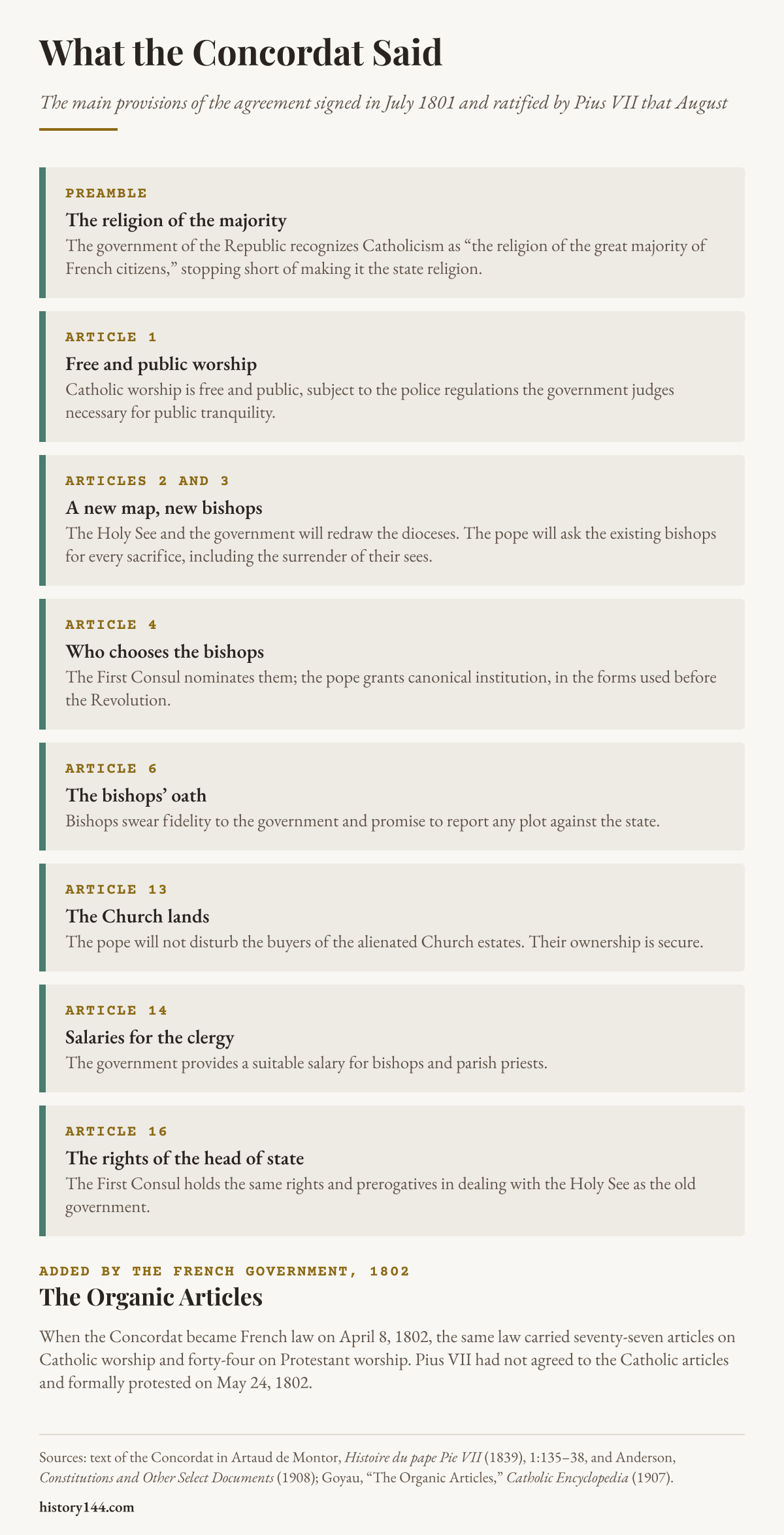
The government of the Republic recognized Catholicism as "the religion of the great majority of French citizens," stopping short of making it the state religion. Article 1 declared that Catholic worship would be free and public in France, subject to such police regulations as the government judged necessary for public tranquility.[53]
A new map of dioceses was to be drawn by the Holy See in concert with the government, and the pope undertook to tell the existing bishops that he expected every sacrifice from them for the sake of peace and unity, including the surrender of their sees. The resulting map gave France sixty dioceses, fewer than the constitutional church's eighty-three and fewer than half the old kingdom's number.[54] The First Consul would nominate the new bishops, and the pope would grant them canonical institution, following the forms used in France before the Revolution. Each bishop would swear fidelity to the government and promise to report any plot against the state that came to his knowledge.[55]
The article that mattered most to many French families was the thirteenth. The pope declared that neither he nor his successors would "disturb in any manner the purchasers of the alienated ecclesiastical estates," whose ownership would remain secure in their hands and those of their heirs. In exchange, Article 14 committed the government to provide a suitable salary for bishops and parish priests. Article 16 recognized in the First Consul the rights and prerogatives the old government had enjoyed in its relations with the Holy See.[56] Whether a revolution’s seizures of property would stand had already been tested in America, where the states sold off the confiscated property of Loyalists.
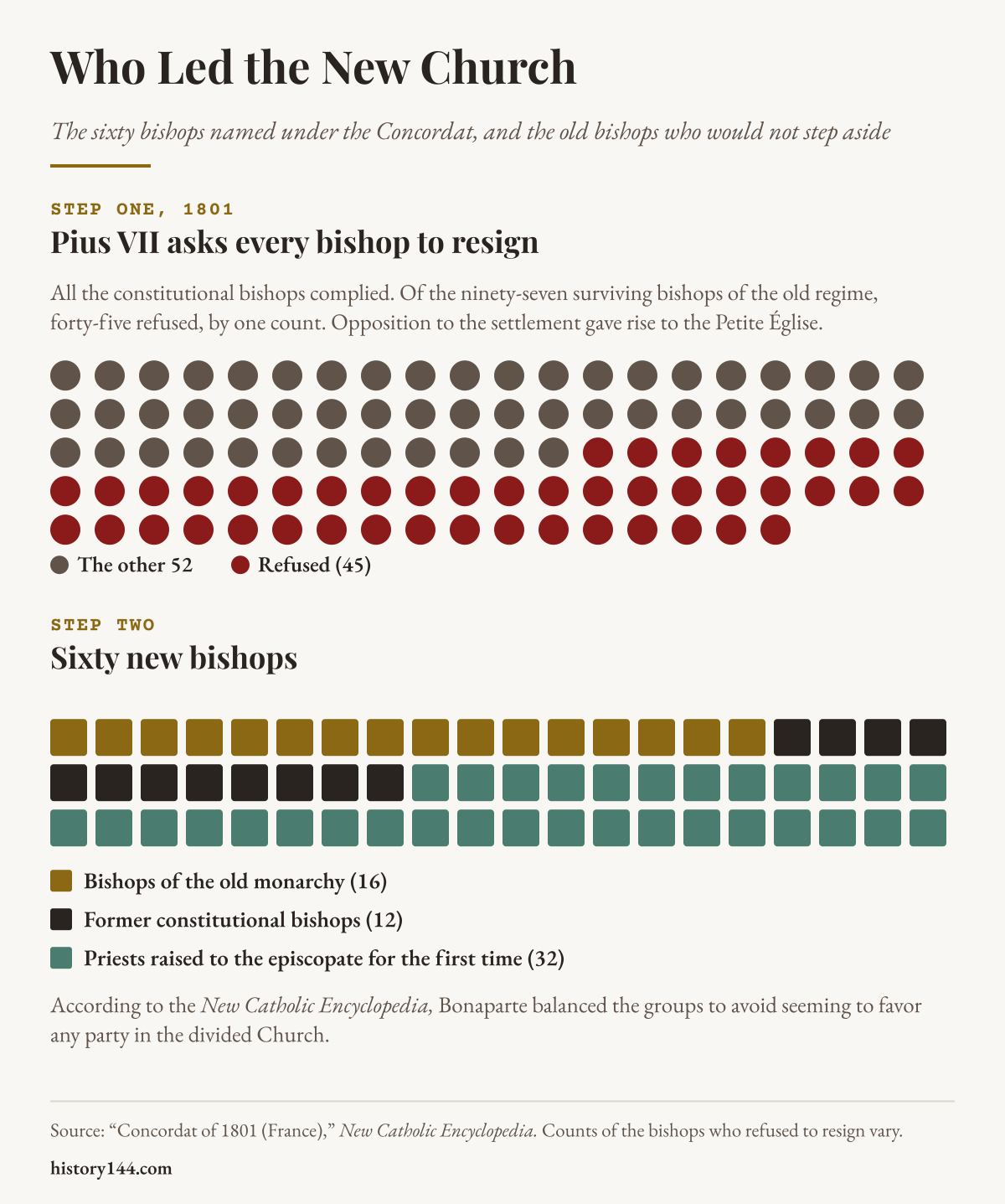
Pius VII ratified the agreement in August and announced it to the faithful in the bull Ecclesia Christi, dated August 15, 1801.[57] He then asked every bishop of France, old and constitutional alike, to resign so that the hierarchy could be rebuilt from the beginning.[58] The constitutional bishops complied, Grégoire among them; he resigned his see in October 1801 and was left out of the new episcopate.[59] The bishops of the old Church found the demand harder. By one count, forty-five of the ninety-seven surviving bishops of the old regime refused, and opposition to the settlement gave rise to a schismatic body known as the Petite Église. Of the sixty bishops the government named, sixteen had served under the old monarchy, twelve had been constitutional bishops, and thirty-two were priests raised to the episcopate for the first time.[60]
When the Concordat became French law on April 8, 1802, the same law carried seventy-seven "Organic Articles" on Catholic worship and forty-four more on Protestant worship. Pius VII had not agreed to the Catholic articles, which limited papal authority beyond anything the Concordat allowed, and on May 24 he formally protested that they had been issued without his knowledge. They remained a source of friction for a century.[61] On Easter Sunday, April 18, 1802, the restoration of public Catholic worship was celebrated in Notre-Dame.[62]
Conclusion: The Land and the Altar
The Concordat is often called a restoration, and in one sense it was: once it took effect in 1802, public worship regained official standing, the constitutional schism was formally closed, and the pope's authority was recognized again, though the Petite Église kept a remnant of resistance alive. But the Church of 1802 was a new institution, shaped by the Revolution and the Consulate together. It was no longer the First Estate. It no longer collected the tithe, controlled the civil registers of birth, marriage, and death, or possessed the great ecclesiastical estates that had supported it for centuries. Its bishops were nominated by the head of state, paid by the treasury, and sworn to report plots against the government. The Revolution had tried to bind the clergy to the state by legislating over the pope's head; Bonaparte achieved a different form of control by bringing the pope into the settlement.
What the Revolution had taken, the Church now formally renounced. The vote in the archbishop's hall on November 2, 1789, had placed the Church's property at the nation's disposal on the promise that the nation would pay for worship. Twelve years later, Article 13 of the Concordat accepted the alienation of that property as permanent, and Article 14 renewed the nation's promise to pay. In the spring of 1802 the restored worship was celebrated in Notre-Dame, the cathedral beside which the land had been voted away and in which, less than nine years earlier, the Revolution had enthroned Reason. The Concordat regime remained the basic framework for church-state relations in most of France until the separation law of 1905, and the question it answered, how an ancient faith should live alongside a modern state, has never entirely gone away.
Places in this Story
The places this story moves through, in order — follow them on the interactive map →
- Archbishop’s Palace, Paris, France November 2, 1789
The National Assembly votes 568 to 346 to place all Catholic Church property at the disposal of the nation.
- Carmes Prison, Paris, France September 1792
Crowds break into the Paris prisons. Pius XI later beatified 191 of the victims, among them three bishops and 127 secular priests.
- Angers, France March 1793
The Vendée rises with religion among its causes. Étienne-Alexandre Bernier of Saint-Laud returns eight years later as Bonaparte’s negotiator with Rome.
- Notre-Dame Cathedral, Paris, France November 10, 1793
Notre-Dame is given over to the Festival of Reason, three days after Bishop Gobel renounces his functions before the Convention.
- Rochefort, France Spring 1794
Of 829 priests and religious held aboard the Deux-Associés and the Washington, more than five hundred died. John Paul II beatified sixty-four of them in 1995.
- Tolentino, Italy February 19, 1797
Bonaparte imposes the Peace of Tolentino on Pius VI, who gives up Avignon and the Legations and pays heavy indemnities.
- Valence, France August 29, 1799
Pius VI dies at Valence, carried across the Alps though gravely ill, a prisoner of the French Republic.
- San Giorgio Maggiore, Venice, Italy March 14, 1800
After more than three months of deadlock the cardinals elect Barnaba Chiaramonti, bishop of Imola, who takes the name Pius VII.
- Vercelli, Italy June 25, 1800
Passing through after Marengo, Bonaparte asks Cardinal Martiniana to tell the new pope he wishes to make him a present of thirty million French Catholics.
- Paris, France July 15, 1801
After a final conference at Joseph Bonaparte’s house running from noon to midnight, the two sides reach the agreement known as the Concordat of 1801.
Frequently Asked Questions
What did the French Revolution do to the Catholic Church?
In November 1789 the National Assembly placed all Church property at the disposal of the nation, and in 1790 the Civil Constitution of the Clergy remade the Church to match the new civil administration. Every bishop and priest was then required to swear an oath to that settlement, which split the French Church in two.
What was the Civil Constitution of the Clergy of 1790?
It was a French law of July 12, 1790 that gave each department a single diocese and cut the number of sees from about 135 to 83. Bishops and parish priests were to be elected by the same assemblies that chose local officials, and a new bishop was forbidden to seek confirmation from the pope.
Why did French priests refuse the clerical oath of 1791?
The oath required them to uphold a constitution that had reorganized the Church without the pope’s consent. Only seven bishops swore it and roughly half the parish clergy, and Pius VI suspended those who did not retract within forty days.
What is the difference between constitutional and refractory clergy?
Constitutional or juring clergy took the oath of 1791 and served in the reorganized Church. Refractory or non-juring clergy refused, lost their posts, and after August 1792 faced exile or deportation.
How did Pope Pius VI die in 1799?
French troops occupied Rome in February 1798 and removed him by force after he refused to recognize the new Roman Republic. He was taken across the Alps to Valence, where he died on August 29, 1799, a prisoner of the French Republic.
What was the Concordat of 1801 between Napoleon and Pius VII?
It was the agreement reached on July 15, 1801 that recognized Catholicism as the religion of the great majority of French citizens and rebuilt the hierarchy around sixty dioceses. The First Consul nominated the bishops, the pope granted them canonical institution, and the state paid their salaries.
Did the Concordat of 1801 return the confiscated Church lands?
No. Article 13 bound the pope and his successors never to disturb the purchasers of the former ecclesiastical estates, leaving that land with the people who had bought it. Article 14 committed the government in exchange to pay a suitable salary to bishops and parish priests.
Bibliography
Allégret, Marc. "Grégoire, abbé Jean-Baptiste (1750–1831), comte, sénateur." Revue du Souvenir Napoléonien, October–November 1997. napoleon.org. Accessed October 5, 2026. https://www.napoleon.org/histoire-des-2-empires/biographies/gregoire-abbe-jean-baptiste-1750-1831-comte-senateur/.
Alméras, Louise. "2 septembre 1792 : le massacre du couvent des Carmes." Aleteia, September 2, 2017. Accessed September 29, 2026. https://fr.aleteia.org/2017/09/02/2-septembre-1792-115-pretre-et-religieux-sont-massacres-au-coeur-de-paris/.
Archives parlementaires de 1787 à 1860: Recueil complet des débats législatifs et politiques des chambres françaises. 1st ser. Edited by J. Mavidal and E. Laurent. Vols. 8, 9, 11, 17, 21, 49. Paris: Paul Dupont, 1875–96. Internet Archive. Accessed October 27, 2026. https://archive.org/details/archivesparlemen08pariuoft; https://archive.org/details/archivesparlemen09pariuoft; https://archive.org/details/archivesparlemen11pariuoft; https://archive.org/details/archivesparlemen17pariuoft; https://archive.org/details/archivesparlemen21pariuoft; https://archive.org/details/archivesparlemen49pariuoft.
Artaud de Montor, Alexis-François. Histoire du pape Pie VII. Vol. 1. Paris: A. Le Clere, 1839. Internet Archive. Accessed October 27, 2026. https://archive.org/details/histoiredupapepi01arta.
Assemblée nationale. "Les jalons historiques." Séparation des Églises et de l'État. Accessed September 29, 2026. https://www.assemblee-nationale.fr/dyn/histoire/separation-des-eglises-et-de-l-etat/les-jalons-historiques.
Aulard, F.-A. Le culte de la Raison et le culte de l'Être suprême (1793–1794): Essai historique. Paris: Félix Alcan, 1892. Internet Archive. Accessed October 5, 2026. https://archive.org/details/lecultedelaraiso00aulauoft.
Bodinier, Bernard. "Prêtres normands en exil pendant la Révolution." In Voyages et voyageurs: Actes du 130e Congrès national des sociétés historiques et scientifiques, La Rochelle, 2005. Paris: Éditions du CTHS, 2009. Persée. Accessed September 29, 2026. https://www.persee.fr/doc/acths_1764-7355_2009_act_130_7_1570.
Boudon, Jacques-Olivier. "L'état religieux de la France à la veille de la signature du Concordat." Revue du Souvenir Napoléonien, no. 432 (January 2001): 3–11. napoleon.org. Accessed October 5, 2026. https://www.napoleon.org/histoire-des-2-empires/articles/letat-religieux-de-la-france-a-la-veille-de-la-signature-du-concordat/.
Bridier, Iris. "Sur les pontons de Rochefort, les prêtres martyrs de la Révolution." France Catholique, October 3, 2025. Accessed October 5, 2026. https://www.france-catholique.fr/sur-les-pontons-de-rochefort-les-pretres-martyrs-de-la-revolution.html.
"Civil Constitution of the Clergy, July 12, 1790." In Readings in European History, edited by James Harvey Robinson, 2:423–27. Boston: Ginn, 1906. Hanover Historical Texts Project. Accessed September 29, 2026. https://history.hanover.edu/texts/civilcon.html.
"Concordat of 1801 (France)." In New Catholic Encyclopedia. Via Encyclopedia.com. Accessed October 5, 2026. https://www.encyclopedia.com/religion/encyclopedias-almanacs-transcripts-and-maps/concordat-1801-france.
"Concordat of 1801." Wikisource. Accessed September 29, 2026. https://en.wikisource.org/wiki/Concordat_of_1801.
Conférence des évêques de France. "Bienheureux martyrs des Carmes." Église catholique en France. Accessed September 29, 2026. https://eglise.catholique.fr/saint-du-jour/02/09/bienheureux-martyrs-carmes/.
Consalvi, Ercole. Mémoires du cardinal Consalvi. Edited by J. Crétineau-Joly. 2 vols. Paris: H. Plon, 1866. Vol. 1, Internet Archive. Accessed October 5, 2026. https://archive.org/details/mmoiresducard01cons.
Coppa, Frank J. "Concordat of 1801." In Europe 1789–1914: Encyclopedia of the Age of Industry and Empire. Via Encyclopedia.com. Accessed October 5, 2026. https://www.encyclopedia.com/philosophy-and-religion/christianity/roman-catholic-and-orthodox-churches-councils-and-treaties/concordat-1801.
"Cult of the Supreme Being." World History Encyclopedia. Accessed September 29, 2026. https://www.worldhistory.org/Cult_of_the_Supreme_Being/.
"Déclaration de Gobel abjurant ses fonctions d'évêque de Paris, lors de la séance du 17 brumaire an II (7 novembre 1793)." In Archives parlementaires de 1787 à 1860, 1st ser., vol. 78, 553. Paris, 1911. Persée. Accessed October 5, 2026. https://archives-parlementaires.persee.fr/prt/fdc92ac9-78c3-4b7c-917b-0bc4ddc96ab0.
"Décret du 3 ventôse an III." In Réimpression de l'ancien Moniteur, vol. 23, 551–52. Paris, 1862. Wikisource. Accessed September 29, 2026. https://fr.wikisource.org/wiki/D%C3%A9cret_du_3_vent%C3%B4se_an_III.
"Décret portant abolition du régime féodal, des justices seigneuriales, des dîmes, de la vénalité des offices, des privilèges, des annates, de la pluralité des bénéfices, etc." August 4–11, 1789. In La France: Les constitutions. Digithèque MJP, Université de Perpignan. Accessed September 29, 2026. https://mjp.univ-perp.fr/france/1789nuit4aout.htm.
"2 novembre 1789 : le décret qui nationalisa les biens de l'Église." RetroNews, Bibliothèque nationale de France, October 31, 2017. Accessed September 29, 2026. https://www.retronews.fr/religions/echo-de-presse/2017/10/31/2-novembre-1789-le-decret-qui-nationalisa-les-biens-de-leglise.
Encyclopaedia Britannica. "Assignat." Accessed September 29, 2026. https://www.britannica.com/topic/assignat.
Encyclopaedia Britannica. "Civil Constitution of the Clergy." Accessed September 29, 2026. https://www.britannica.com/event/Civil-Constitution-of-the-Clergy.
Encyclopaedia Britannica. "Jean-Baptiste-Joseph Gobel." Accessed October 5, 2026. https://www.britannica.com/biography/Jean-Baptiste-Joseph-Gobel.
Goyau, Georges. "The French Concordat of 1801." In The Catholic Encyclopedia, vol. 4. New York: Robert Appleton, 1908. New Advent. Accessed September 29, 2026. https://www.newadvent.org/cathen/04204a.htm.
Goyau, Georges. "The Organic Articles." In The Catholic Encyclopedia, vol. 1. New York: Robert Appleton, 1907. New Advent. Accessed October 30, 2026. https://www.newadvent.org/cathen/01756a.htm.
"La Guyane et la Révolution française #3. Les 328 déportés politiques du 18 Fructidor de l'An V (1797): L'expérience de la « guillotine sèche »." Manioc, Bibliothèque numérique Caraïbe Amazonie Plateau des Guyanes. Accessed September 29, 2026. https://www.manioc.org/blog/la-guyane-et-la-revolution-francaise-3-les-328-deportes-politiques-du-18-fructidor-de-lan-v.
"Making Peace with the Catholic Church, 1801–2." In Liberty, Equality, Fraternity: Exploring the French Revolution. Roy Rosenzweig Center for History and New Media and American Social History Project. From Frank M. Anderson, ed., The Constitutions and Other Select Documents Illustrative of the History of France, 2nd ed. (1908), 296–97. Accessed September 29, 2026. https://revolution.chnm.org/d/504.
Ott, Michael. "Pope Pius VI." In The Catholic Encyclopedia, vol. 12. New York: Robert Appleton, 1911. New Advent. Accessed September 29, 2026. https://www.newadvent.org/cathen/12131a.htm.
Pius VI. Charitas. April 13, 1791. Papal Encyclicals Online. Accessed September 29, 2026. https://www.papalencyclicals.net/pius06/p6charit.htm.
Ville de Paris. "L'Assemblée à Paris." Parcours Révolution. Accessed September 29, 2026. https://parcoursrevolution.paris.fr/fr/points-interet/56-l-assemblee-a-paris.
Ville de Paris. "Quand l'Assemblée nationale était près de Notre-Dame !" Parcours Révolution. Accessed September 29, 2026. https://parcoursrevolution.paris.fr/fr/points-interet/36-quand-l-assemblee-nationale-etait-pres-de-notre-dame.
Weber, Nicholas. "Pope Pius VII." In The Catholic Encyclopedia, vol. 12. New York: Robert Appleton, 1911. New Advent. Accessed September 29, 2026. https://www.newadvent.org/cathen/12132a.htm.
Citations
- Archives parlementaires, 1st ser., 9:457; Ville de Paris, "L'Assemblée à Paris." ↑
- Archives parlementaires, 1st ser., 9:649. The decree and the vote, 568 for and 346 against, appear on the same page. ↑
- Archives parlementaires, 1st ser., 9:398–404. ↑
- Ville de Paris, "Quand l'Assemblée nationale était près de Notre-Dame." ↑
- "2 novembre 1789 : le décret qui nationalisa les biens de l'Église." ↑
- Archives parlementaires, 1st ser., 8:397–98; "Décret portant abolition du régime féodal," art. 5. ↑
- Ville de Paris, "Quand l'Assemblée nationale était près de Notre-Dame." ↑
- Assemblée nationale, "Les jalons historiques." ↑
- Archives parlementaires, 1st ser., 9:147–52; the quoted phrase is at 152. ↑
- Archives parlementaires, 1st ser., 9:398; "2 novembre 1789 : le décret qui nationalisa les biens de l'Église." ↑
- "2 novembre 1789 : le décret qui nationalisa les biens de l'Église"; Archives parlementaires, 1st ser., 9:649 and index, s.v. "Biens ecclésiastiques." ↑
- Assemblée nationale, "Les jalons historiques." ↑
- Encyclopaedia Britannica, "Assignat." ↑
- Archives parlementaires, 1st ser., 11:591; Assemblée nationale, "Les jalons historiques." ↑
- Archives parlementaires, 1st ser., 17:55; Encyclopaedia Britannica, "Civil Constitution of the Clergy." ↑
- Archives parlementaires, 1st ser., 17:55–58; "Civil Constitution of the Clergy," in Robinson, Readings, 2:424–27. The English wording of the quotation follows Robinson's translation. ↑
- Pius VI, Charitas, §2. ↑
- Assemblée nationale, "Les jalons historiques." ↑
- Pius VI, Charitas, §6. ↑
- Archives parlementaires, 1st ser., 21:80; Encyclopaedia Britannica, "Civil Constitution of the Clergy." ↑
- Pius VI, Charitas, §10. ↑
- Pius VI, Charitas, §§13–14; Encyclopaedia Britannica, "Jean-Baptiste-Joseph Gobel." ↑
- Pius VI, Charitas, §§11, 13, 20–23. ↑
- Pius VI, Charitas, §3; Archives parlementaires, 1st ser., 8:398; "Décret portant abolition du régime féodal," title and art. 12. ↑
- Archives parlementaires, 1st ser., 49:8; Bodinier, "Prêtres normands en exil." ↑
- Conférence des évêques de France, "Bienheureux martyrs des Carmes" (for the breakdown by status); Alméras, "2 septembre 1792 : le massacre du couvent des Carmes." ↑
- Assemblée nationale, "Les jalons historiques." ↑
- Goyau, "French Concordat of 1801." ↑
- Aulard, Le culte de la Raison, 44–46; "Déclaration de Gobel abjurant ses fonctions d'évêque de Paris," 553. Page numbers for Aulard were worked out from the position of each passage in the Internet Archive scan, checked against the printed numbers in the OCR text for pp. 44–48; they could not be confirmed against a physical copy. ↑
- Aulard, Le culte de la Raison, 47–48. ↑
- Aulard, Le culte de la Raison, 52–56. ↑
- Encyclopaedia Britannica, "Jean-Baptiste-Joseph Gobel." ↑
- Bridier, "Sur les pontons de Rochefort." Bridier gives 829 prisoners and 547 dead; other published counts differ slightly in both figures. ↑
- Assemblée nationale, "Les jalons historiques." ↑
- "Cult of the Supreme Being," World History Encyclopedia. ↑
- Assemblée nationale, "Les jalons historiques." ↑
- "Décret du 3 ventôse an III." ↑
- Assemblée nationale, "Les jalons historiques." Historians differ over whether September 1794 or February 1795 marks the beginning of this first separation. ↑
- "La Guyane et la Révolution française #3." ↑
- Boudon, "L'état religieux de la France à la veille de la signature du Concordat," for the survey, the ordinations, and the Tarn report; Allégret, "Grégoire, abbé Jean-Baptiste," for the council of 1797. The figure counts open churches; it does not show how many had a resident priest. ↑
- Goyau, "French Concordat of 1801"; Ville de Paris, "Quand l'Assemblée nationale était près de Notre-Dame." ↑
- Artaud de Montor, Histoire du pape Pie VII, 1:33–34, 51–53, 69–71, 81; Ott, "Pope Pius VI." ↑
- Artaud de Montor, Histoire du pape Pie VII, 1:62, 72, 92; Weber, "Pope Pius VII." ↑
- Goyau, "French Concordat of 1801." ↑
- Goyau, "French Concordat of 1801"; Consalvi, Mémoires, 1:312–13. The passage in the 1866 edition confirms that Martiniana carried Bonaparte's wish to negotiate to the pope; the "thirty million" phrase and the list of demands rest on Goyau. It could not be determined whether this passage is Consalvi's own text or the editor's. ↑
- Goyau, "French Concordat of 1801." ↑
- Allégret, "Grégoire, abbé Jean-Baptiste." ↑
- Consalvi, Mémoires, 1:374–79. Page numbers for Consalvi are taken from the page map of the Internet Archive scan of the 1866 Plon edition. ↑
- Goyau, "French Concordat of 1801." ↑
- Consalvi, Mémoires, 1:375, 382–87, 391. ↑
- Consalvi, Mémoires, 1:395; Goyau, "French Concordat of 1801." ↑
- Allégret, "Grégoire, abbé Jean-Baptiste." ↑
- "Making Peace with the Catholic Church, 1801–2," preamble and art. 1; Artaud de Montor, Histoire du pape Pie VII, 1:135. ↑
- "Concordat of 1801," Wikisource, arts. 2–3; Artaud de Montor, Histoire du pape Pie VII, 1:135–36; Goyau, "French Concordat of 1801." ↑
- "Making Peace with the Catholic Church, 1801–2," arts. 4, 6; Artaud de Montor, Histoire du pape Pie VII, 1:136–37. ↑
- "Concordat of 1801," Wikisource, arts. 13, 14, 16; Artaud de Montor, Histoire du pape Pie VII, 1:138. ↑
- Assemblée nationale, "Les jalons historiques"; Goyau, "French Concordat of 1801." ↑
- Coppa, "Concordat of 1801." ↑
- Allégret, "Grégoire, abbé Jean-Baptiste"; "Concordat of 1801 (France)," New Catholic Encyclopedia. ↑
- "Concordat of 1801 (France)," New Catholic Encyclopedia. ↑
- Goyau, "Organic Articles"; Assemblée nationale, "Les jalons historiques." ↑
- Goyau, "French Concordat of 1801." ↑