In 1907 professional football in America was a disgrace and Jim Thorpe was an amateur. Twelve years later Thorpe had been stripped of two Olympic gold medals for having been paid, and professional football had rebuilt its reputation by paying him. The two stories are really one story, and they meet in Canton, Ohio.
The thing that ruined Thorpe was the thing the professional game needed. He had taken money to play a sport, which in 1913 was enough to have his Olympic records erased and his name removed from the books. Two years after that, a Canton car dealer named Jack Cusack worked out that the most notorious professional in the country was worth $250 a game at the gate, and the stigma turned into an asset.
This is the story of those twelve years, told as the collision between an amateur code that was mostly a class arrangement and a professional game that was mostly broke.
Two Beginnings in 1907
Professional football began the period at its lowest point. In 1906 the Canton Bulldogs and the Massillon Tigers, the two best teams in the country and bitter neighbors in Stark County, Ohio, met in a two-game series for the Ohio League championship. Afterwards a Massillon newspaper alleged that Canton's coach, Blondy Wallace, and the Massillon end Walter East had arranged to split the series so that a lucrative third game would be needed. Canton denied everything, nothing was ever proved, and it is still unknown whether any agreement existed.[1]
Proof did not matter. The accusation was enough. Many of the best players left Ohio, the top clubs fell back to the level of town teams staffed by local sandlotters, and the professional game in the state spent most of the next decade trying to look respectable again. That is the condition in which the sport enters our window: not a league, not an industry, but a collection of town teams under a cloud.
One of the people patching it back together was a machinist. Joe Carr worked on the Pennsylvania Railroad's Panhandle Division in Columbus and wrote sport for a local paper on the side. In 1907 he brought back the Columbus Panhandles and built them around the Nesser brothers, a family of railroad workers who played as a unit and who could travel cheaply because their employer gave them passes. Carr would go on to run the National Football League from 1921 until his death in 1939.[2] The man who would organize professional football and the player who would make it famous both start the story in the same autumn.
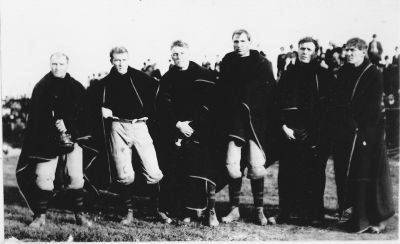
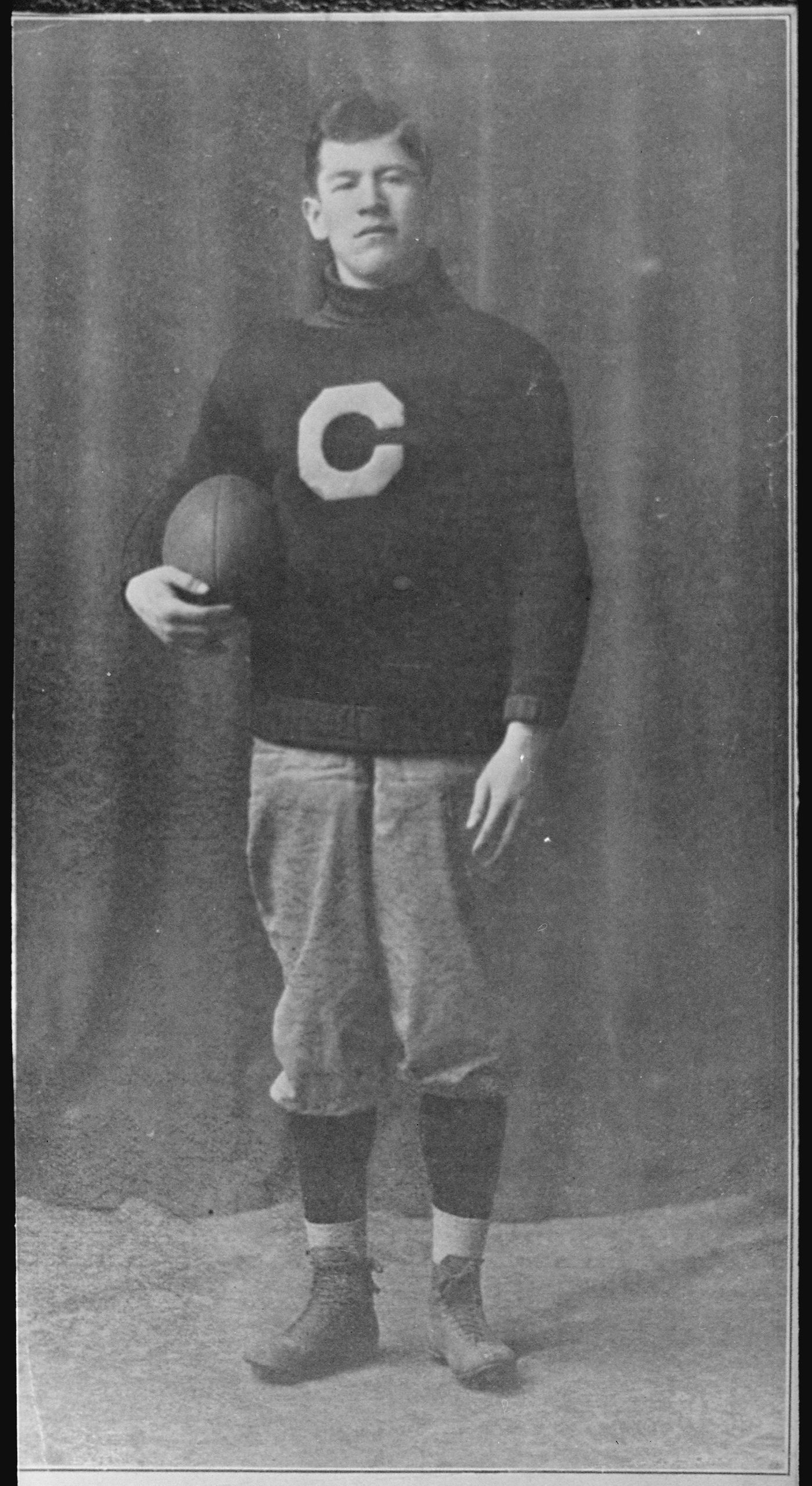
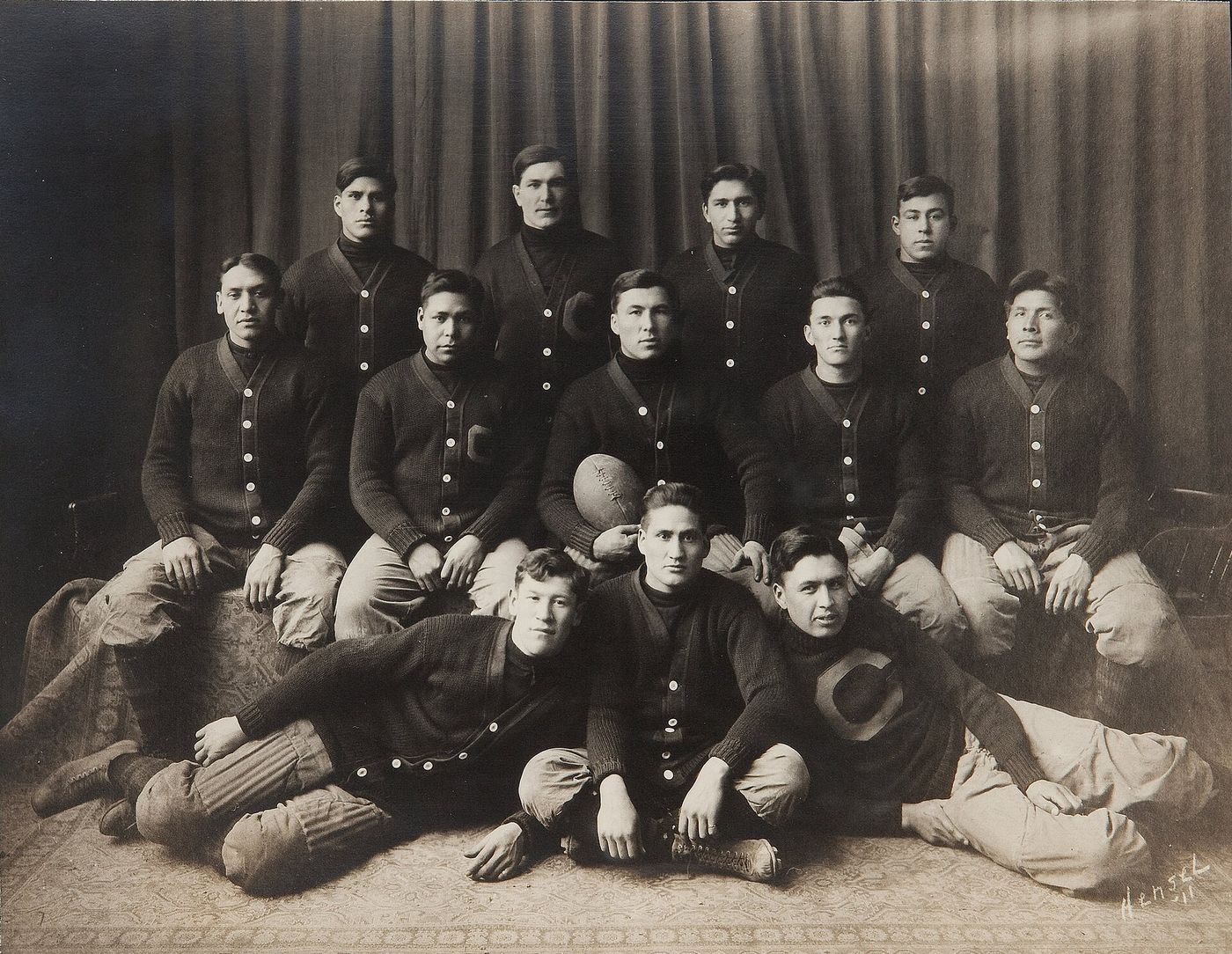
That autumn Thorpe made the varsity at Carlisle. He had arrived in 1904, aged sixteen, sent by his father to the Carlisle Indian Industrial School in Pennsylvania, a federally funded boarding school founded in 1879 whose purpose was assimilation. He was of Sac and Fox descent, which made him eligible for free tuition. He had been at Haskell Indian Institute in Kansas before that, and in Oklahoma Territory before that.[3]
The story of how he was discovered has been told so often that it has worn smooth. Walking past the track in overalls, he asked to try the high jump, cleared a height that was a school record, and was reported to Glenn Scobey Warner, the track and football coach universally known as Pop. Warner wanted to keep him for track. Thorpe wanted to play football, turned up to trials, and was too obviously good to refuse. He became a two-time All-American.[4] He stood six feet one and weighed 202 pounds.[5]
What the Professional Game Was Then
To see why a paid player was a scandal at all, it helps to know how young and how improvised the whole sport still was. The first intercollegiate game had been played in 1869 between Rutgers and the College of New Jersey, later Princeton, and it resembled soccer more than anything recognizable now; Rutgers won 6 to 4. The first man known to have been paid was William Heffelfinger, called Pudge, who took $500 from the Allegheny Athletic Association to play the Pittsburgh Athletic Club on November 12, 1892, and justified the outlay by scoring the only points in a 4 to 0 win. The following year Pittsburgh put a half-back, Grant Dibert, under contract for a whole season.[6]
The rules were still being argued over while Thorpe was at school, and what they were mostly being argued about was how many players the game was killing. Contemporary counts of the 1905 college season give eighteen or nineteen dead and well over a hundred seriously hurt, which brought Theodore Roosevelt into the question and produced the reforms of the following year.[7] The forward pass was legalized in 1906 as part of that settlement, though an incomplete pass surrendered possession and there was no such thing as pass interference, so almost everybody kept running the ball anyway. In 1909 a field goal came down from four points to three, and in 1912 a touchdown went up from five points to six, which is the moment the modern scoring balance between running the ball in and kicking it through arrives.[8]
The professional version of this sport was a town business. A club was a manager, a field, a gate, and whatever players he could afford that week, and men moved between teams for a single game if the money was right. The oldest surviving franchise in the NFL dates from this world: the Morgan Athletic Club, founded in Chicago in 1899 by Chris O'Brien, which became the Racine Cardinals, then the Chicago Cardinals, and is now the Arizona Cardinals.[9] Nobody in 1907 would have described any of this as a career.
The public followed all this at a distance that is hard to imagine now. On November 25, 1911, two weeks after Thorpe beat Harvard, Kansas played Missouri at Columbia and about a thousand people gathered in downtown Lawrence to follow the game off a Western Union wire, play by play, read out as it came in.[10] That is sometimes called the beginning of sports broadcasting, and it is worth holding onto as a measure of the appetite. A thousand people stood in the street in November to hear a description of a football game happening two hundred miles away. The gate receipts that would soon pay Jim Thorpe $250 an afternoon were drawn from the same well.
The Summers That Cost Him Everything
In 1909 Thorpe left Carlisle and went south. For two summers he played minor-league baseball in the Eastern Carolina League, at Rocky Mount and at Fayetteville, North Carolina, for small money. He played under his own name.
This was an ordinary thing for a college athlete to do and an extraordinarily dangerous one. The amateur code of the period held that a man who had been paid for playing any sport was a professional in all of them, for life. College players filled out summer rosters across the country every year and protected themselves with false names. Thorpe did not, and later said plainly that it had not occurred to him that it mattered.
The code itself deserves a harder look than it usually gets. Amateurism was not a moral principle that happened to exclude the poor; excluding the poor was substantially the point. A rule that you may compete only if you have never needed the money is a rule that reserves competition for men with means. Thorpe, an Indian boarding-school student from Oklahoma Territory, was exactly the kind of athlete the rule was built to keep out, and he walked into it without knowing it was there.
The Greatest Amateur in the World
He came back. In the autumn of 1911 Thorpe applied for readmission to Carlisle, returned to Warner's team, and had the season that made him famous. On November 11, 1911, Carlisle went to Cambridge and beat Harvard 18 to 15, with Thorpe kicking four field goals. Accounts differ on the rest of the scoring, some crediting him with all of Carlisle's points and others giving the touchdown to Alex Arcasa.[11] Harvard was the establishment of American football, and Carlisle was a government boarding school for Native children. The result was reported accordingly.
In the summer of 1912 he went to Stockholm and won both the pentathlon and the decathlon, a double nobody has matched since, helped by the fact that the Olympic pentathlon was abolished after 1924. His personal bests across the events give some idea of the range: 23 feet 6 inches in the long jump, 6 feet 5 inches in the high jump, 11 feet in the pole vault, 47 feet 9 inches in the shot, 163 feet in the javelin, 136 feet in the discus.[12] King Gustav V is supposed to have told him he was the greatest athlete in the world.
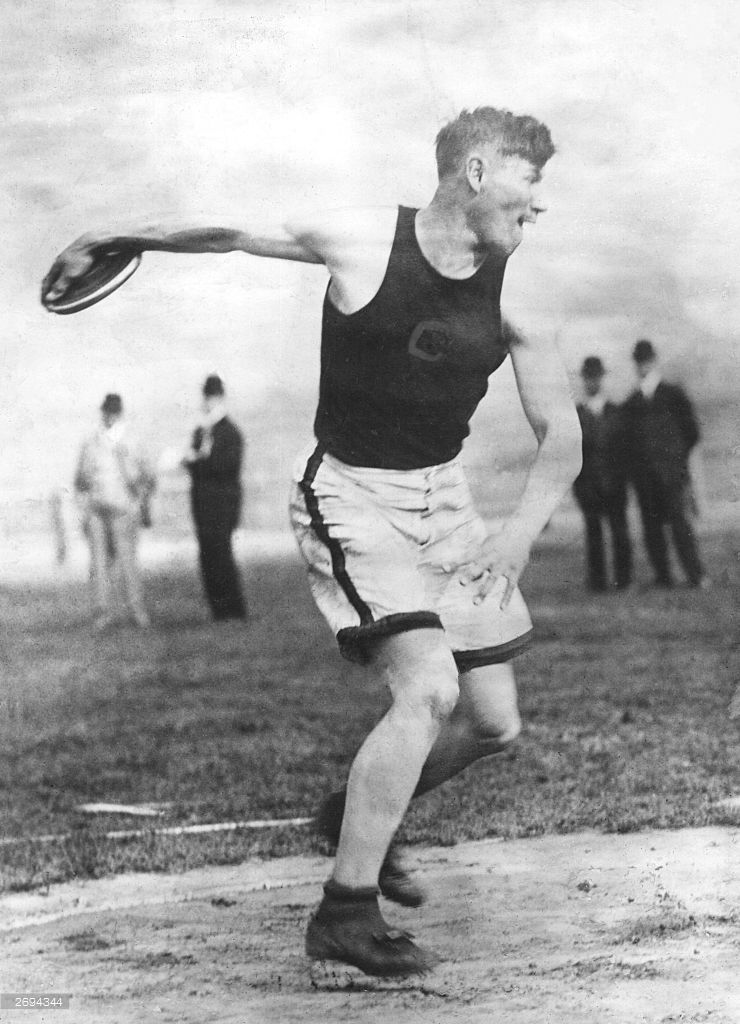
That autumn he went back to Carlisle and beat Army 27 to 6. The game is remembered partly because the Army side included a cadet named Dwight Eisenhower, and partly because Thorpe ran ninety-two yards for a touchdown, had it called back for a penalty, and then ran ninety-seven yards for another on the very next play.[13] In the space of eleven months he had beaten Harvard, won two Olympic titles and beaten Army. He was, by any measure anyone used at the time, the most celebrated amateur athlete alive.
January 1913
The story broke in the last week of January 1913, when newspapers reported that Thorpe had been paid to play baseball in North Carolina. A manager named Clancy was quoted saying Thorpe had played for Winston-Salem. Thorpe told Warner that part was not true, and then, as the coverage spread, went to the school authorities and told them everything.
On January 26 he wrote to James E. Sullivan, secretary of the Amateur Athletic Union. The letter was printed in full in the newspapers two days later, and it is the closest thing we have to Thorpe in his own voice at the worst moment of his life. It is quoted here exactly as it was printed, dropped word and all.
I played baseball at Rocky Mount, and at Fayetteville, N.C., in the summers of 1909 and 1910, under my own name. On the same team I played with were several college men from the North, who were earning money by ball playing during their vacations and who were regarded as amateurs at home. I did not play for the money there was in it, because my property brings me in enough money to live on, but because I liked to play ball.[14]
I was not very wise in ways of the world and did not realize this was wrong, and it would make me a professional in track sports, although I learned from the other players that it would be better for me not to let any one know that I was playing, and for that reason I never told any one at the school about it until today.
I hope I will partly excused by the fact that I was simply an Indian school boy, and did not know all about such things. In fact, I did not know that I was doing wrong, because I was doing what I knew several other college men had done, except that they did not use their own names.
I have always liked sport and only played or run races for the fun of the thing and never to earn money. I have received offers amounting to thousands of dollars since my victories last summer, but I have turned them all down because I did not care to make money from my athletic skill. I am very sorry, Mr. Sullivan, to have it all spoiled in this way, and I hope the Amateur Athletic Union and the people will not be too hard in judging me.
The man he was writing to mattered. James E. Sullivan was secretary of the Amateur Athletic Union and the dominant administrator in American athletics, the person who in practice decided who counted as an amateur and therefore who was allowed to compete at all. The AAU's power did not come from law. It came from controlling sanction: an athlete it declared professional could not enter the meets that mattered, and no appeal existed. Thorpe's letter is addressed to Sullivan personally because there was nobody else to address.
Sullivan and the AAU were not inclined to be lenient. They declared him a professional, struck his amateur records, and asked that his Olympic titles be returned. They were. The man who had been the greatest amateur in the world twelve months earlier was now, officially, a professional, and the professional sports that would have him were the ones the amateur world despised.
He went to them at once. In February 1913 he signed with John McGraw's New York Giants, because baseball paid better than anything else available.[15] He also played professional football that year for the Pine Village Pros in Indiana.[16] The distinction he had been punished for failing to observe no longer applied to him, and he never had to think about it again.
Canton Buys a Reputation
Ohio professional football revived in 1915. Massillon brought the Tigers back, Canton answered, and both clubs started hunting for names the public would pay to see. Canton's manager was Jack Cusack, who ran the club out of a hardware and car business and who understood exactly what he was buying.
Before the season-ending home-and-home series against Massillon, Cusack signed Thorpe for $250 a game.[17] It was an enormous figure for a town team and it was recouped immediately. Canton's paid attendance had been averaging somewhere between 1,200 and 1,500. The two Massillon games drew about 6,000 and about 8,000, and Massillon put its ticket prices up to seventy-five cents.[18]
Set against the gate, the fee was obviously worth paying. If eight thousand people paid seventy-five cents, the afternoon took in something near six thousand dollars, and Thorpe's wage was about four percent of it. The arithmetic is rough, since the clubs split receipts and nobody published accounts, but the direction is not in doubt: a player who multiplied the crowd by five was cheap at almost any price. This is the calculation that would eventually produce professional sport as an industry, and in 1915 it was being done for the first time, on the back of an envelope, in a hardware shop in Canton.
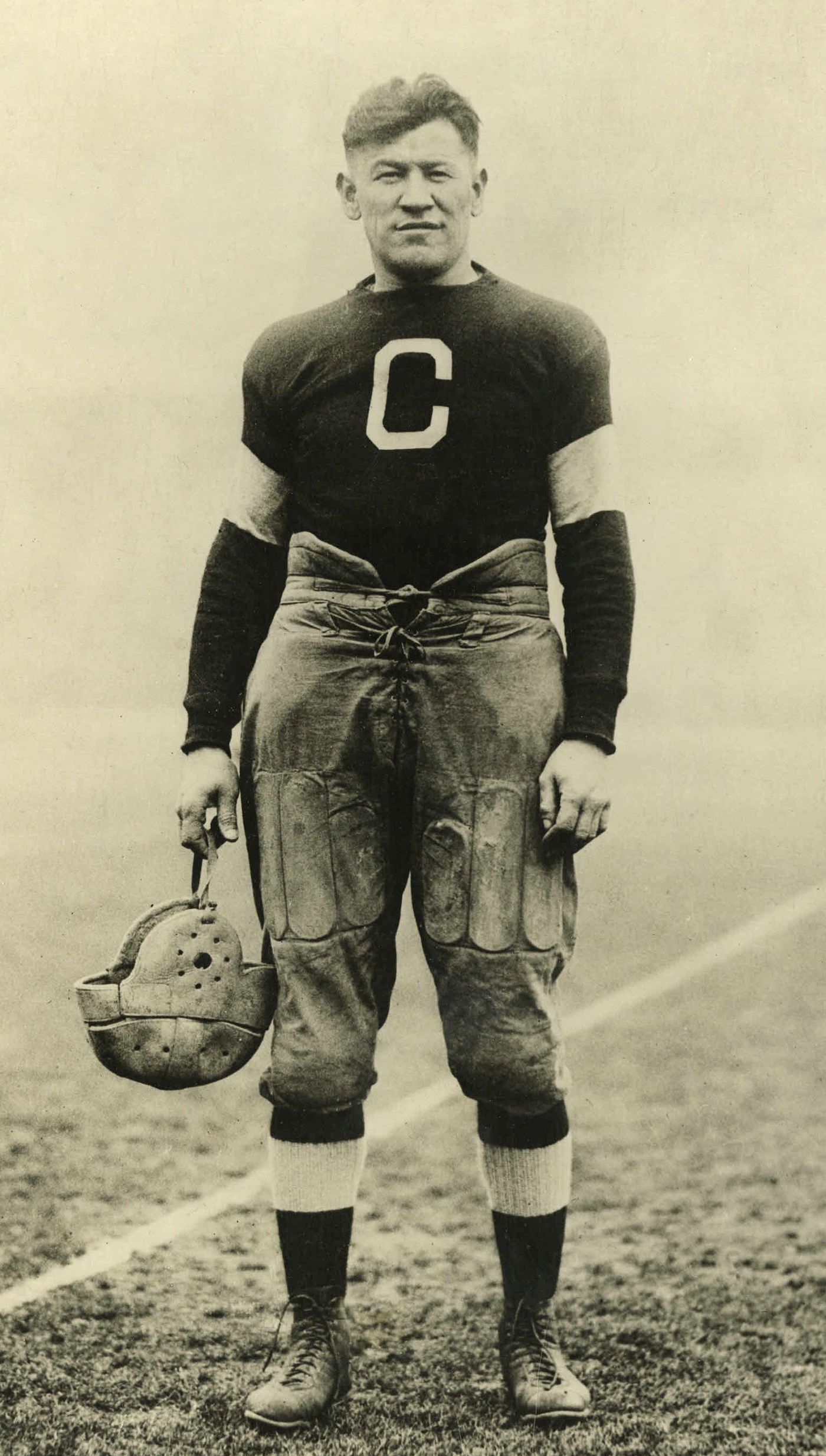
The first game did not go to plan. At Massillon on November 14, 1915, Canton lost 16 to 0. Thorpe ran for 70 yards including a 42-yard break, but he was outplayed by the Tigers' Gus Dorais, late of Notre Dame, who kicked three field goals from four attempts and set up the only touchdown with his passing.[19] It made no difference to the business logic. The crowds had come to see Thorpe lose, and they had still come.
That is the moment the two threads tie together. The professional game had been trying since 1906 to persuade the public that it was something other than a disreputable scuffle for money. It solved the problem not by becoming more respectable but by hiring the most famous victim of respectability in the country. Thorpe's presence said that a paid player could be a great one, which was precisely what the amateur code denied.
What Thorpe Actually Did
Because this period falls before the league kept records, the Thorpe legend has usually been taken on trust. It does not have to be. The Canton Repository printed play-by-play accounts of the Bulldogs' important games, and in 1990 Bob Gill went through them for the Professional Football Researchers Association and reconstructed the statistics for fourteen games against top opposition between 1915 and 1919.[20]
Thorpe played in thirteen of them. He carried 158 times for 768 yards, an average of 4.9 a carry, and seven touchdowns. He caught three passes for 54 yards and completed 13 of 53 of his own for 289 yards and two touchdowns against seven interceptions, which is poor even by the standards of a period when nobody could throw. He returned 17 punts for 251 yards and a touchdown, returned nine kickoffs for 177 yards, and punted 80 times for an average of 40.7 yards, which Gill reckons understates the real figure by a yard or so because of how the paper recorded short returns.[21]
The passing numbers look bad until you see what everyone else was doing. Over the same fourteen games Canton as a whole averaged 3.4 yards a carry and its opponents 1.5. Take Thorpe out of Canton's rushing and the rest of the team averaged 2.8 yards a carry; take him out of the punting and the average falls from 37.7 to 31.2 yards. On a field where the average run gained less than two yards against this defense, Thorpe was gaining five.[22]
The defense deserves its own sentence. Between 1916 and 1919 the Canton Bulldogs allowed 43 points in 30 games.[23] Canton claimed the Ohio League championship in 1916, in 1917 and again in 1919.
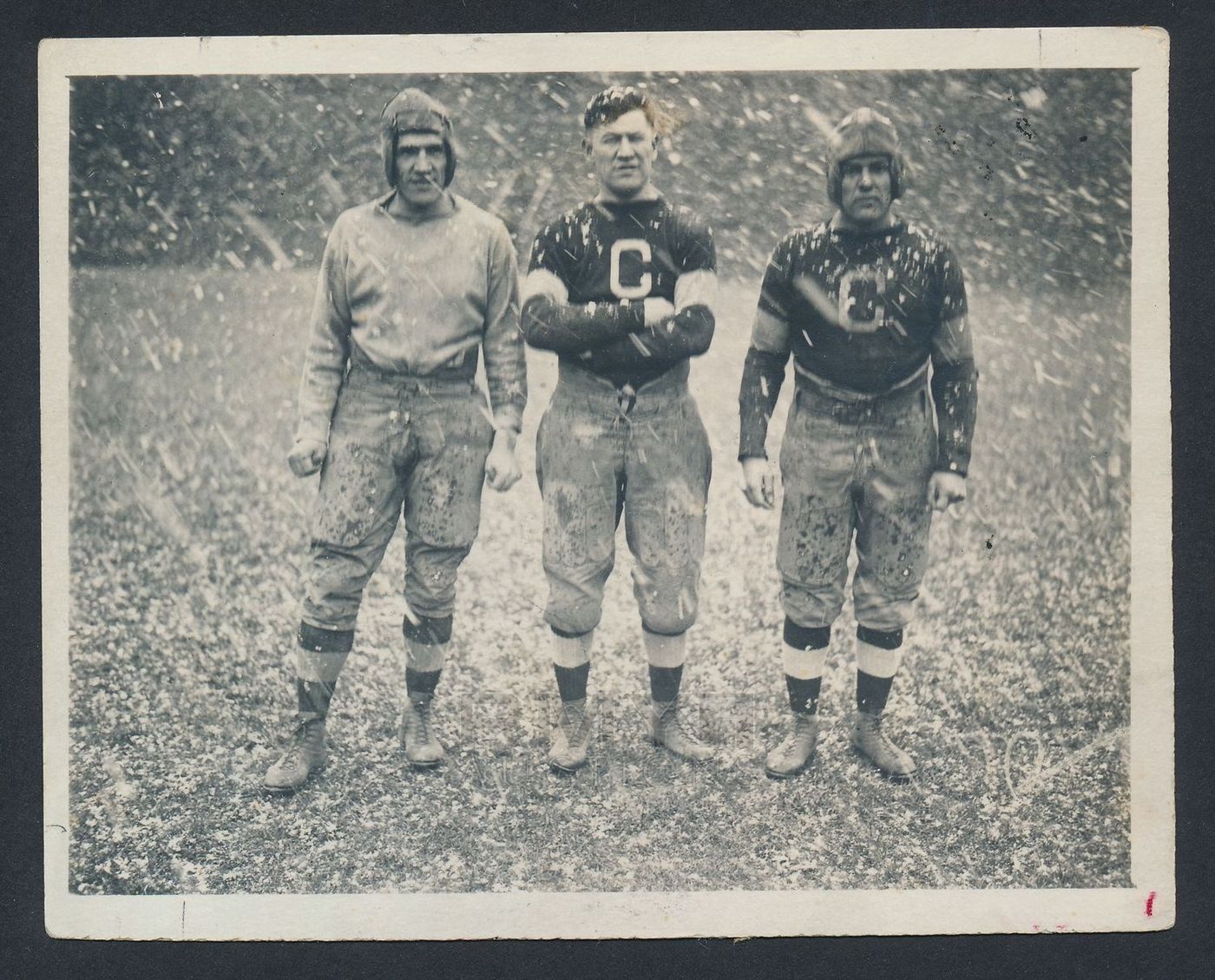
He was not carrying the team alone by the end. Pete Calac and Joe Guyon, both out of Carlisle, were in the Canton backfield by 1919, and Guyon averaged 3.7 yards a carry in the games Gill reconstructed against the best opposition in the country.[24] The Carlisle school had been built to strip Native children of their languages and train them for manual trades. What it actually supplied, by way of a football team it ran for its own prestige, was the backfield of the best professional side in America.
Football and baseball were not the whole of it, which is part of why the amateur ruling looks so strange in retrospect. In his last year at Carlisle, 1912, Thorpe won the national championship in ballroom dancing. In 1913 he considered playing professional hockey instead of football before deciding against it. In the 1920s he played professional basketball as well, touring with a side that carried his name.[25] The Associated Press would later vote him the greatest American athlete of the first half of the century. The code that barred him from the Olympics had been written on the assumption that a man who took money could not also be the best, and he spent twenty years demonstrating otherwise in four sports at once.
The Lost Season and the Last Summer
There was no proper 1918 season. Gill puts it down to the war: the draft took players and war work took others, and only a handful of towns in Ohio and Indiana fielded a team at all, Canton not among them. The influenza pandemic closing public gatherings that autumn cannot have helped a business that depended entirely on crowds. The same year ended the Carlisle school: the property had been the Carlisle Barracks, and it was transferred back to the War Department on September 1, 1918 for use as a military hospital. The institution that had produced Thorpe, Calac and Guyon simply stopped existing, in a wartime government that was requisitioning whatever it needed and building the apparatus to do it with.
Thorpe's baseball career, which had always been the paying job rather than the vocation, ran out at the same time. He was with the New York Giants in 1913, 1914 and 1915, spent 1916 at Milwaukee in the American Association, returned to the Giants for 1917 and 1918, and began 1919 with them before being traded mid-season to the Boston Braves.[26] Six major league seasons across seven years, most of them spent on a bench belonging to a manager who did not rate him.
He was a better athlete than anyone he played with and a worse hitter than most of them, which is the kind of fact that gets a man a reputation for wasting his gifts. The likelier explanation is duller: hitting a curveball is a specific skill, he came to it late, and he was learning it in public while McGraw sat him down. By 1919 he was thirty-two and football paid.
In the autumn of 1919 Canton won the Ohio League again. It was the last championship before the thing that had been missing all along arrived.
What Came Next
On September 17, 1920, in a car showroom in Canton, representatives of ten clubs formed the American Professional Football Association, and four more joined before the season was out. Jim Thorpe was its first president, which was an advertisement rather than a job: the league wanted his name on the letterhead. Teams were supposed to pay $100 a year in dues and most of them did not.[27] Joe Carr, the Columbus machinist who had rebuilt the Panhandles in 1907, took over the presidency in 1921, moved the office to Columbus, and ran the league for eighteen years. In 1922 it was renamed the National Football League.[28]
The continuity is easy to miss and worth naming. Four of the seven teams Canton played in 1919, Akron, Columbus, Detroit and Hammond, were in the APFA within a year, and with Canton itself that is five of the fourteen founding members. The men in that showroom were not inventing a circuit. They were writing down one that had just finished playing a season, and the clubs left outside it, Massillon among them, were the ones that had been on the wrong end of the fixture list.
Thorpe played on until 1928, finishing at forty-one with the Chicago Cardinals after stops at Cleveland, Oorang, Rock Island and New York, and his statistics over those years are those of a role player rather than a star.[29] The legend had been earned earlier, in the games nobody was keeping records of.
In 1950 the Associated Press voted him the greatest American athlete of the first half of the century. In 1951 he and Pop Warner were both in the inaugural class of the College Football Hall of Fame. The Olympic titles took longer and are still a sore subject: the IOC gave his family replica medals in 1982 and listed him as co-champion in 1983, and he was not restored as the sole winner of the 1912 pentathlon and decathlon until July 15, 2022, the 110th anniversary of the decathlon, sixty-nine years after his death.[30]
The twelve years from 1907 to 1919 had settled the argument in practice long before anyone settled it on paper. Professional football, which began the period unable to shake a betting scandal, ended it with a championship team, a national name and the organisation meeting in Canton the following September. Amateurism kept its rules and lost its best case. Thorpe, who had been punished for taking a few dollars a week to play baseball in North Carolina because he did not know he was supposed to lie about it, spent the rest of his life being paid openly to play, and the sport he was paid by became the largest in the country.
Places in this Story
The places this story moves through, in order — follow them on the interactive map →
- Canton, Ohio 1906
Allegations that the Bulldogs and the Massillon Tigers had fixed their championship series drove the best players out of Ohio and left professional football under a cloud for most of a decade.
- Columbus, Ohio 1907
Joe Carr, a machinist on the Pennsylvania Railroad, revived the Columbus Panhandles around the Nesser brothers. He would run the National Football League from 1921 until 1939.
- Carlisle, Pennsylvania 1907
Jim Thorpe made the varsity at the Carlisle Indian Industrial School, a federally funded boarding school, after reportedly clearing a school-record high jump in his overalls.
- Rocky Mount, North Carolina 1909
Thorpe played minor-league baseball here and at Fayetteville in the summers of 1909 and 1910, under his own name, for small money. Four years later it cost him his Olympic titles.
- Cambridge, Massachusetts November 11, 1911
Carlisle beat Harvard 18 to 15 with Thorpe kicking four field goals, the result that made his national reputation.
- Stockholm, Sweden July 1912
Thorpe won both the pentathlon and the decathlon at the Olympic Games, a double nobody has matched since, helped by the pentathlon being abolished after 1924.
- New York, New York February 1913
Days after the AAU declared him a professional, Thorpe signed with John McGraw's New York Giants, because baseball paid better than anything else open to him.
- Massillon, Ohio November 14, 1915
Thorpe made his Canton debut here in a 16 to 0 defeat, outplayed by Gus Dorais. The crowd came anyway, and professional football had found its draw.
- Canton, Ohio 1916 to 1919
The Bulldogs claimed Ohio League championships in 1916, 1917 and 1919, allowing 43 points in 30 games. There was no 1918 season for them to play.
- Boston, Massachusetts 1919
Traded mid-season to the Boston Braves, Thorpe played his last major league baseball. He was thirty-two, and football now paid.
Important Dates
Allegations of a fixed Canton-Massillon series left professional football in Ohio disgraced.
Joe Carr revived the Columbus Panhandles around the Nesser brothers, and Jim Thorpe made the Carlisle varsity.
Thorpe played paid minor-league baseball at Rocky Mount and Fayetteville, North Carolina, under his own name.
Carlisle beat Harvard 18 to 15 at Cambridge, Thorpe kicking four field goals.
Thorpe won the pentathlon and the decathlon at the Stockholm Olympics.
Carlisle beat Army 27 to 6, against a side that included cadet Dwight Eisenhower.
Thorpe wrote to AAU secretary James E. Sullivan admitting the baseball money; the letter was printed in the papers two days later.
Declared a professional and stripped of his Olympic titles, Thorpe signed with the New York Giants.
Jack Cusack signed Thorpe for the Canton Bulldogs at $250 a game, and attendance rose from about 1,200 to as many as 8,000.
Thorpe's Canton debut, a 16 to 0 loss at Massillon in which Gus Dorais kicked three field goals.
Canton claimed the Ohio League championship in each of its three seasons of play, allowing 43 points in 30 games between 1916 and 1919.
The Carlisle Indian Industrial School closed when its property reverted to the War Department.
The season was largely lost to the war. Only a handful of towns in Ohio and Indiana fielded a team, Canton not among them.
Canton won the Ohio League again, and Thorpe played his final major league baseball season with the Boston Braves.
Frequently Asked Questions
Why did Jim Thorpe lose his Olympic medals?
In January 1913 newspapers reported that he had been paid to play minor-league baseball at Rocky Mount and Fayetteville, North Carolina, in the summers of 1909 and 1910. The amateur code of the day held that payment in any sport made an athlete a professional in all of them, so the AAU struck his records and the Olympic titles were returned.
Did other college athletes do the same thing?
Routinely. Thorpe said in his letter to the AAU that he had played alongside college men from the North who were regarded as amateurs at home, and that the difference was simply that they did not use their own names.
What did Thorpe say in his own defense?
He wrote to AAU secretary James E. Sullivan on January 26, 1913 admitting the baseball and asking not to be judged too harshly. The letter includes the line that he hoped to be partly excused because he "was simply an Indian school boy, and did not know all about such things."
Why was professional football disreputable in 1907?
The 1906 series between the Canton Bulldogs and the Massillon Tigers ended in allegations that the games had been fixed for betting purposes. Nothing was ever proved, but the accusation drove the best players out of Ohio and left the professional game at town-team level for most of a decade.
How much was Jim Thorpe paid by the Canton Bulldogs?
Jack Cusack signed him for $250 a game before the season-ending Massillon series in 1915, an enormous figure for a town team. Canton had been drawing crowds of 1,200 to 1,500; the two Massillon games drew about 6,000 and 8,000.
Was Thorpe actually good at professional football, or just famous?
Both, and the record survives. Reconstructing fourteen games against top opposition from Canton Repository play-by-play, thirteen of them with Thorpe, Bob Gill found him averaging 4.9 yards a carry when the rest of Canton averaged 2.8 and opponents managed 1.5, and punting 40.7 yards against his teammates 31.2.
What happened to the Carlisle Indian Industrial School?
It closed in 1918 when the property, which had been the Carlisle Barracks, was transferred back to the War Department on September 1 for use as a military hospital. It had produced Thorpe, Pete Calac and Joe Guyon, who between them formed much of the best professional backfield in the country.
Why was there almost no 1918 football season?
Gill puts it down to the war: the draft took players and war work took others, and only a handful of towns in Ohio and Indiana fielded a team at all. The influenza pandemic closing public gatherings that autumn cannot have helped a business that lived on gate receipts.
Was Jim Thorpe the first president of the NFL?
He was the first president of the American Professional Football Association, formed at Canton in September 1920 and renamed the National Football League in 1922. The post was largely promotional; Joe Carr took over in 1921 and actually ran the league until 1939.
When were Thorpe's Olympic titles restored?
The IOC gave his family replica medals in 1982 and listed him as co-champion in 1983. He was not reinstated as the sole winner of the 1912 pentathlon and decathlon until July 15, 2022.
Bibliography
"Canton Bulldogs-Massillon Tigers betting scandal." Wikipedia. Accessed October 24, 2026. https://en.wikipedia.org/wiki/Canton_Bulldogs%E2%80%93Massillon_Tigers_betting_scandal
Gill, Bob. "A Legend Comes to Life: Jim Thorpe in the Days Before the NFL." The Coffin Corner 12, no. 2 (1990). Professional Football Researchers Association. https://profootballresearchers.com/archives/Website_Files/Coffin_Corner/12-02-396.pdf
Jensen, Don. "Jim Thorpe." Society for American Baseball Research BioProject. Accessed October 24, 2026. https://sabr.org/bioproj/person/jim-thorpe/
"Jim Thorpe." Pro Football Hall of Fame. Accessed October 24, 2026. https://www.profootballhof.com/players/jim-thorpe/
"Jim Thorpe Is Dead on West Coast at 64." The New York Times, March 29, 1953. https://www.nytimes.com/1953/03/29/archives/jim-thorpe-is-dead-on-west-coast-at-64-jim-thorpe-dead-on-the-coast.html
"Joseph Francis Carr." Wikipedia. Accessed October 24, 2026. https://en.wikipedia.org/wiki/Joseph_Francis_Carr
Klein, Christopher. "How Jim Thorpe Became America's First Multi-Sport Star." History.com, June 1, 2023. https://www.history.com/news/jim-thorpe-sports-native-american-athlete-olympics
NFL.com. "NFL 100: Original Towns." Accessed October 24, 2026. https://www.nfl.com/100/original-towns/
Pro Football Hall of Fame. Year-by-year history, 1913 and 1915. Accessed October 24, 2026. https://www.profootballhof.com/football-history/football-history/1869-1939/1915
Thorpe, Jim. Letter to James E. Sullivan, Carlisle, Pa., January 26, 1913. Transcribed as printed in "'Jim' Thorpe Professional, Pleads Guilty as Charged," The Washington Post, January 28, 1913. https://explorepahistory.com/kora/files/1/13/1-D-5B-200-ExplorePAHistory-a0k9z5-a_597.pdf
"1911 Carlisle Indians football team." Wikipedia. Accessed October 24, 2026. https://en.wikipedia.org/wiki/1911_Carlisle_Indians_football_team
Citations
- "Canton Bulldogs-Massillon Tigers betting scandal." The Massillon allegations named Canton coach Blondy Wallace and Massillon end Walter East. Nothing was ever proved, and it is still unknown whether a fix was agreed. https://en.wikipedia.org/wiki/Canton_Bulldogs%E2%80%93Massillon_Tigers_betting_scandal ↑
- "Joseph Francis Carr." Carr worked as a machinist on the Pennsylvania Railroad's Panhandle Division and wrote sport for a Columbus paper. He brought the Panhandles back in 1907 and built the team around the Nesser brothers, who also worked for the railroad. He was president of the NFL from 1921 until his death in 1939. https://en.wikipedia.org/wiki/Joseph_Francis_Carr ↑
- "Jim Thorpe." Pro Football Hall of Fame. Accessed October 24, 2026. https://www.profootballhof.com/players/jim-thorpe/ ↑
- Klein, Christopher. "How Jim Thorpe Became America's First Multi-Sport Star." History.com, June 1, 2023. https://www.history.com/news/jim-thorpe-sports-native-american-athlete-olympics ↑
- "Jim Thorpe." Encyclopaedia Britannica. Thorpe is given at 6 feet 1 inch and 202 pounds. https://www.britannica.com/facts/Jim-Thorpe-American-athlete ↑
- "1913." Pro Football Hall of Fame year-by-year history. Accessed October 24, 2026. https://www.profootballhof.com/football-history/football-history/1869-1939/1913 ↑
- On the football death toll that forced the 1906 reforms: contemporary counts of the 1905 college season give eighteen or nineteen players killed and well over a hundred seriously injured, the Chicago Tribune's tally being the one usually cited. Roosevelt convened college representatives at the White House on October 9, 1905. https://www.history.com/articles/how-teddy-roosevelt-saved-football ↑
- "1913." Pro Football Hall of Fame year-by-year history. Accessed October 24, 2026. https://www.profootballhof.com/football-history/football-history/1869-1939/1913 ↑
- "1913." Pro Football Hall of Fame year-by-year history. Accessed October 24, 2026. https://www.profootballhof.com/football-history/football-history/1869-1939/1913 ↑
- On the first play-by-play telegraphed football game, Kansas against Missouri, November 25, 1911: the game was played at Columbia and about a thousand people gathered in downtown Lawrence to follow it off a Western Union wire. Pro Football Hall of Fame year-by-year history. https://www.profootballhof.com/football-history/football-history/1869-1939/1913 ↑
- "1911 Carlisle Indians football team." Carlisle beat Harvard 18 to 15 at Cambridge on November 11, 1911, with Thorpe kicking four field goals. Accounts differ on whether Thorpe scored all of Carlisle's points or Alex Arcasa scored the touchdown. https://en.wikipedia.org/wiki/1911_Carlisle_Indians_football_team ↑
- "Jim Thorpe Is Dead on West Coast at 64." The New York Times, March 29, 1953. https://www.nytimes.com/1953/03/29/archives/jim-thorpe-is-dead-on-west-coast-at-64-jim-thorpe-dead-on-the-coast.html ↑
- On the 1912 Carlisle win over Army, 27 to 6, and the ninety-two yard touchdown run called back for a penalty, followed by a ninety-seven yard run on the next play. https://www.ncaa.com/news/football/article/2015-11-11/jim-thorpe-leads-carlisle-upset-harvard-1911 ↑
- Jim Thorpe to James E. Sullivan, Carlisle, Pa., January 26, 1913, transcribed as printed in "'Jim' Thorpe Professional, Pleads Guilty as Charged," The Washington Post, January 28, 1913. Transcription at ExplorePAHistory. https://explorepahistory.com/kora/files/1/13/1-D-5B-200-ExplorePAHistory-a0k9z5-a_597.pdf ↑
- Jensen, Don. "Jim Thorpe." Society for American Baseball Research BioProject. Accessed October 24, 2026. https://sabr.org/bioproj/person/jim-thorpe/ ↑
- "Jim Thorpe." Pro Football Hall of Fame. Accessed October 24, 2026. https://www.profootballhof.com/players/jim-thorpe/ ↑
- "1915." Pro Football Hall of Fame year-by-year history. Cusack signed Thorpe before the season-ending Massillon series for $250 a game. https://www.profootballhof.com/football-history/football-history/1869-1939/1915 ↑
- "1915." Pro Football Hall of Fame year-by-year history. Cusack signed Thorpe before the season-ending Massillon series for $250 a game. https://www.profootballhof.com/football-history/football-history/1869-1939/1915 ↑
- Gill, Bob. "A Legend Comes to Life: Jim Thorpe in the Days Before the NFL." The Coffin Corner 12, no. 2 (1990). Professional Football Researchers Association. Statistics reconstructed from play-by-play accounts printed in the Canton Repository. https://profootballresearchers.com/archives/Website_Files/Coffin_Corner/12-02-396.pdf ↑
- Gill, Bob. "A Legend Comes to Life: Jim Thorpe in the Days Before the NFL." The Coffin Corner 12, no. 2 (1990). Professional Football Researchers Association. Statistics reconstructed from play-by-play accounts printed in the Canton Repository. https://profootballresearchers.com/archives/Website_Files/Coffin_Corner/12-02-396.pdf ↑
- Gill, Bob. "A Legend Comes to Life: Jim Thorpe in the Days Before the NFL." The Coffin Corner 12, no. 2 (1990). Professional Football Researchers Association. Statistics reconstructed from play-by-play accounts printed in the Canton Repository. https://profootballresearchers.com/archives/Website_Files/Coffin_Corner/12-02-396.pdf ↑
- Gill, Bob. "A Legend Comes to Life: Jim Thorpe in the Days Before the NFL." The Coffin Corner 12, no. 2 (1990). Professional Football Researchers Association. Statistics reconstructed from play-by-play accounts printed in the Canton Repository. https://profootballresearchers.com/archives/Website_Files/Coffin_Corner/12-02-396.pdf ↑
- Gill, Bob. "A Legend Comes to Life: Jim Thorpe in the Days Before the NFL." The Coffin Corner 12, no. 2 (1990). Professional Football Researchers Association. Statistics reconstructed from play-by-play accounts printed in the Canton Repository. https://profootballresearchers.com/archives/Website_Files/Coffin_Corner/12-02-396.pdf ↑
- Gill, Bob. "A Legend Comes to Life: Jim Thorpe in the Days Before the NFL." The Coffin Corner 12, no. 2 (1990). Professional Football Researchers Association. Statistics reconstructed from play-by-play accounts printed in the Canton Repository. https://profootballresearchers.com/archives/Website_Files/Coffin_Corner/12-02-396.pdf ↑
- Klein, Christopher. "How Jim Thorpe Became America's First Multi-Sport Star." History.com, June 1, 2023. https://www.history.com/news/jim-thorpe-sports-native-american-athlete-olympics ↑
- Jensen, Don. "Jim Thorpe." Society for American Baseball Research BioProject. Accessed October 24, 2026. https://sabr.org/bioproj/person/jim-thorpe/ ↑
- NFL.com. "NFL 100: Original Towns." Accessed October 24, 2026. https://www.nfl.com/100/original-towns/ ↑
- "Joseph Francis Carr." Carr worked as a machinist on the Pennsylvania Railroad's Panhandle Division and wrote sport for a Columbus paper. He brought the Panhandles back in 1907 and built the team around the Nesser brothers, who also worked for the railroad. He was president of the NFL from 1921 until his death in 1939. https://en.wikipedia.org/wiki/Joseph_Francis_Carr ↑
- "Jim Thorpe." Pro Football Hall of Fame. Accessed October 24, 2026. https://www.profootballhof.com/players/jim-thorpe/ ↑
- The IOC gave Thorpe's family replica medals in 1982 and listed him as co-champion in 1983. He was reinstated as the sole winner of the 1912 pentathlon and decathlon on July 15, 2022, the 110th anniversary of the decathlon. https://www.clickondetroit.com/sports/2022/07/15/jim-thorpe-reinstated-as-sole-winner-for-1912-olympic-golds/ ↑