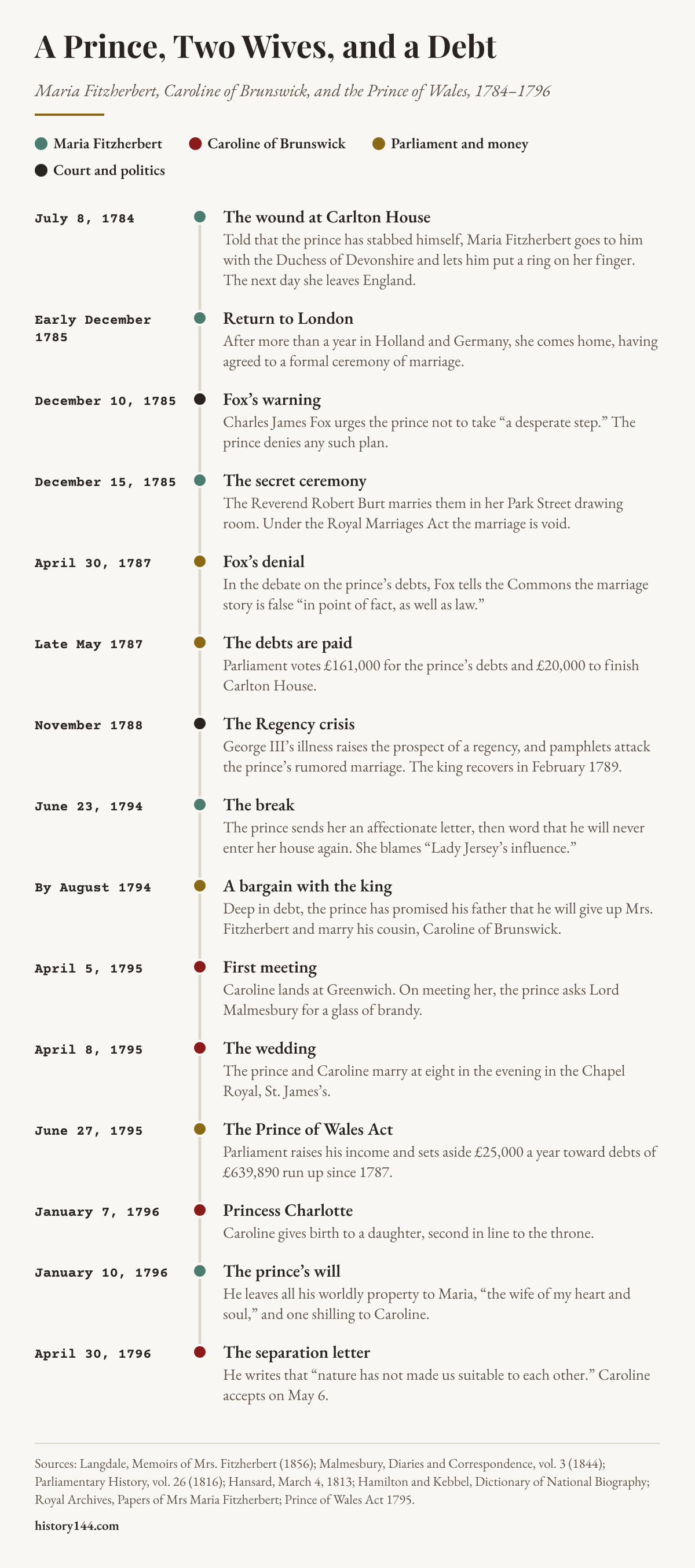
On 8 July 1784, a carriage pulled up in haste outside a house in Park Street, Mayfair, the London home of a twice-widowed Catholic woman named Maria Fitzherbert. Out stepped a surgeon, two peers, and Edward Bouverie, a friend of the Prince of Wales. They brought alarming news. The prince, they said, had stabbed himself at Carlton House, and only her presence could save his life. Mrs. Fitzherbert at first refused to set foot in Carlton House, and she gave way only on condition that the Duchess of Devonshire, the leading hostess of Whig society, go with her.[1] The duchess was sent for, and the two women went together.[2] There they found the heir to the throne pale and bloodied, declaring that he would not live unless Mrs. Fitzherbert promised to become his wife. She let him put a ring on her finger. The next day she left England.[3]
That strange evening began a twelve-year story of two marriages, one of them secret and void in law, the other public, legal, and miserable. It is usually told as a romance, and in part it was one. But it was just as much a story about money and about law. The Prince of Wales could not legally marry the woman he wanted, and in the end he could not clear his debts without marrying the woman his father chose. Between 1784 and 1796, those two facts pulled him back and forth until they produced a denial in the House of Commons, a disastrous wedding in the Chapel Royal, a will leaving one wife everything and the other a shilling, and a letter that ended a royal marriage within a year of its making. The two women paid far more for his choices than he did. This is the story of those twelve years.
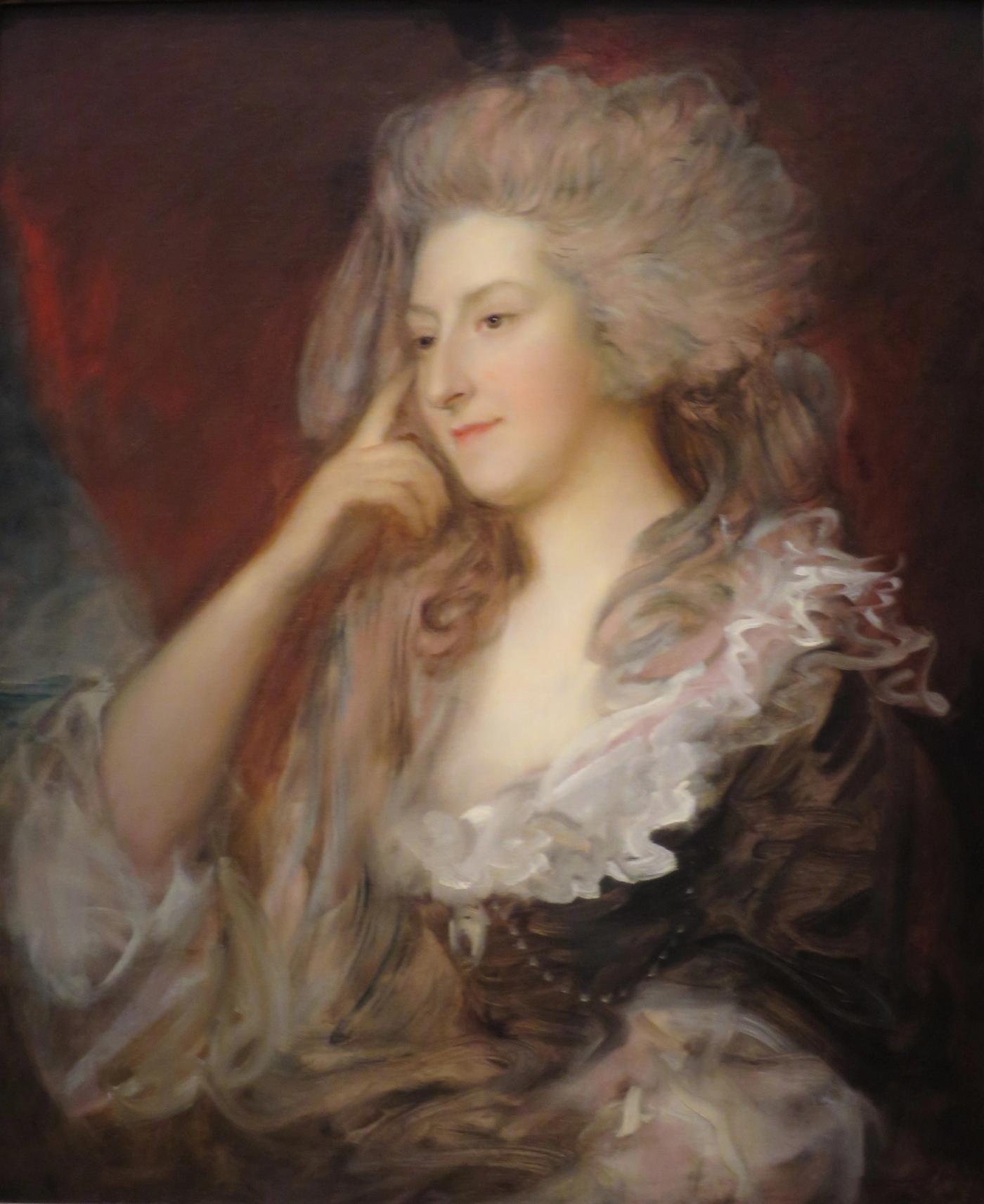
A Widow from Park Street
Maria Anne Smythe was born in 1756 into an old Catholic gentry family, the daughter of Walter Smythe of Brambridge in Hampshire. Catholics in eighteenth-century England lived under heavy legal disabilities. They could not sit in Parliament or hold most public offices, and their families tended to marry among themselves. Maria did exactly that. In 1775 she married Edward Weld of Lulworth Castle in Dorset, who died the same year. In 1778 she married Thomas Fitzherbert of Swynnerton in Staffordshire, and in 1781 she was a widow again, not yet twenty-five years old. Her second husband left her an income and the house in Park Street. Accounts of the size of that income differ. The Victorian Dictionary of National Biography gave it as £2,000 a year, while other accounts put it at a little over £1,000.[4] Either sum made her independent, and she settled into a life in Richmond and London society, where she soon became the center of an admiring circle.[5]
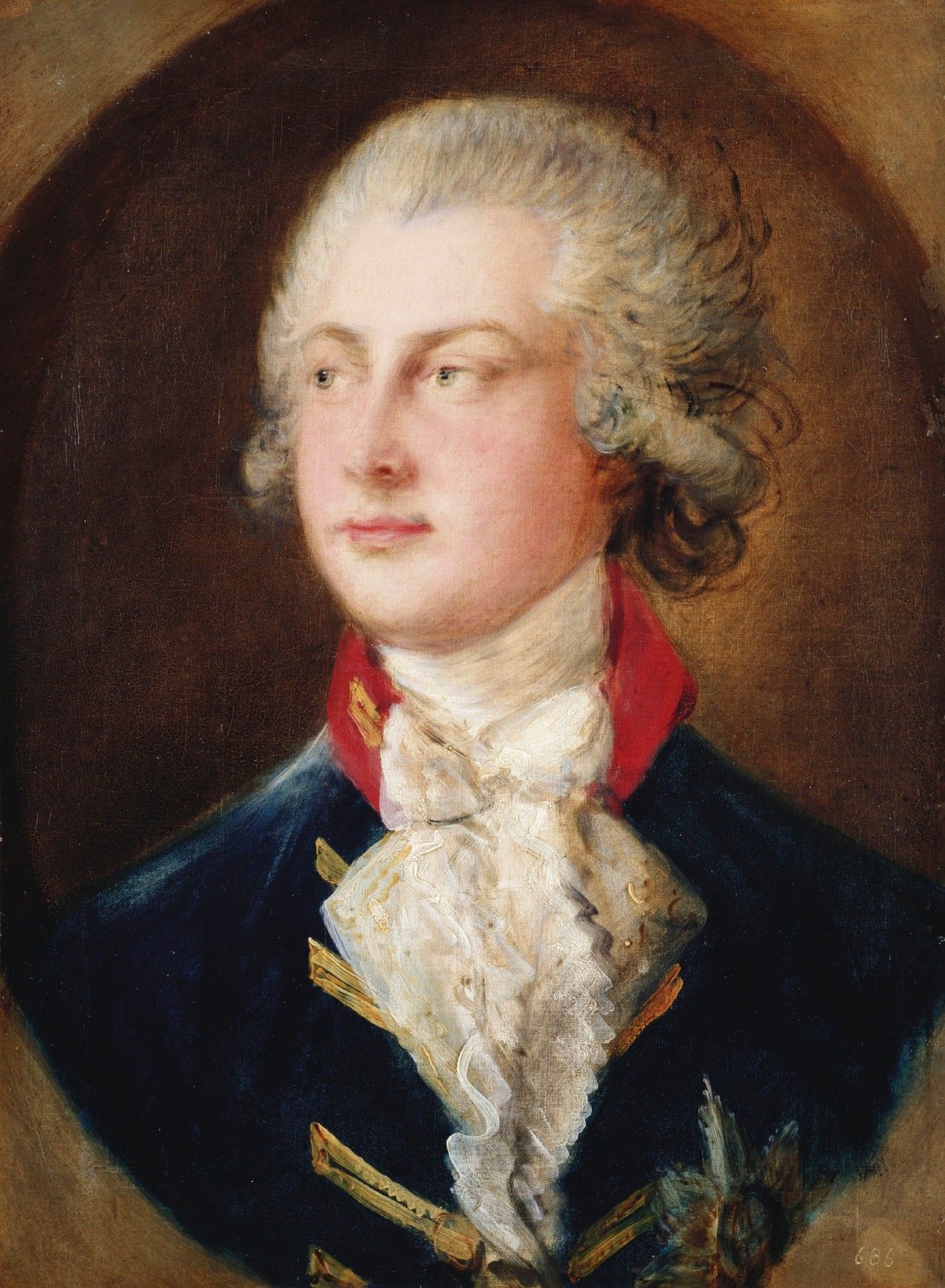
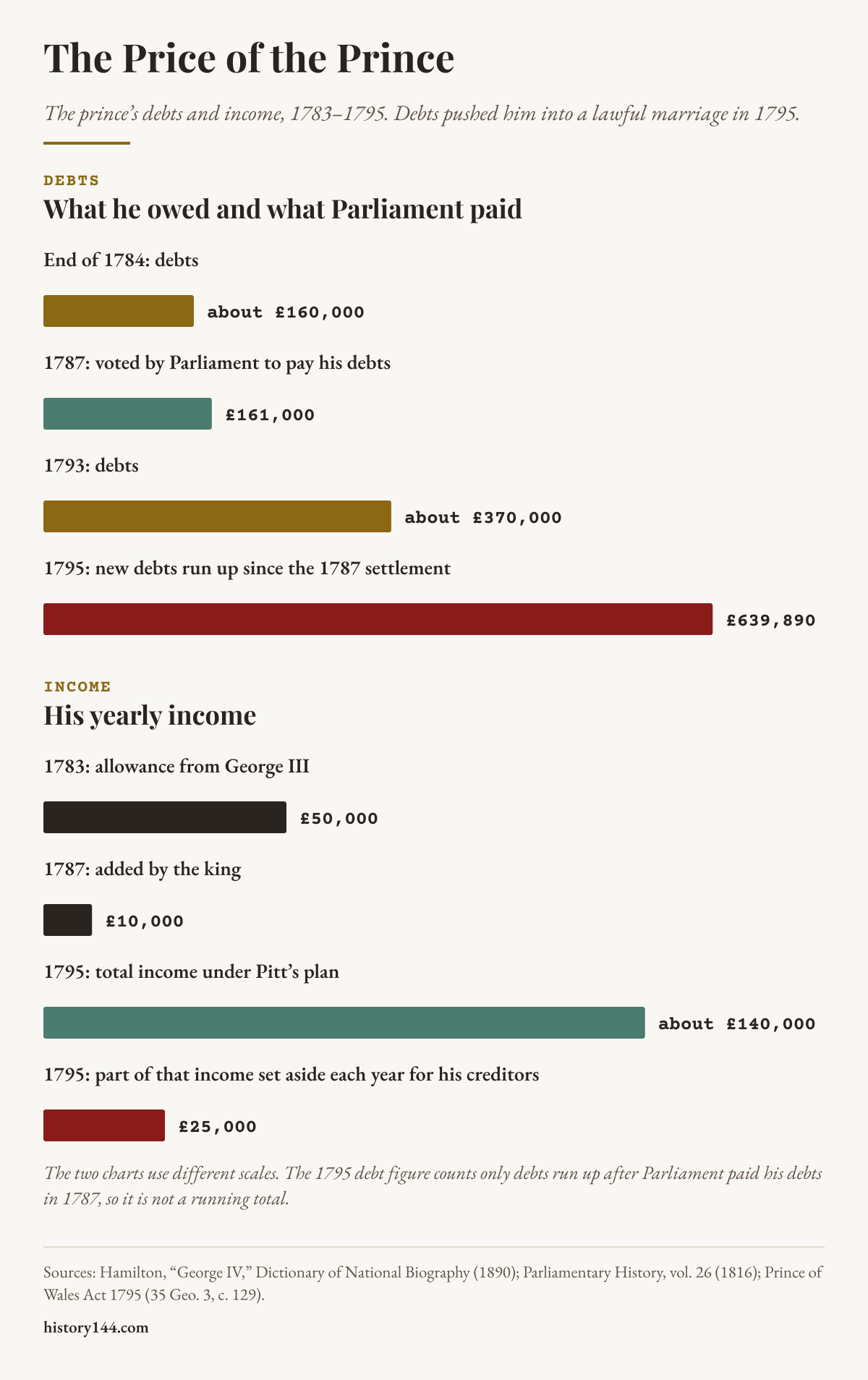
The young man who fell in love with her was in most ways her opposite. George, Prince of Wales, born in 1762, had grown up under a strict and secluded regime at Kew and had broken loose from it the moment he could. By his late teens he was drinking, gambling, and keeping company his father despised. He attached himself openly to Charles James Fox and the Whig opposition, and his partisanship deepened the king's hostility toward him. When he came of age in 1783, Parliament voted £30,000 to clear his existing debts, and George III granted him £50,000 a year. He moved into Carlton House on Pall Mall and began spending enormous sums on it. By the end of 1784 he owed about £160,000.[6]
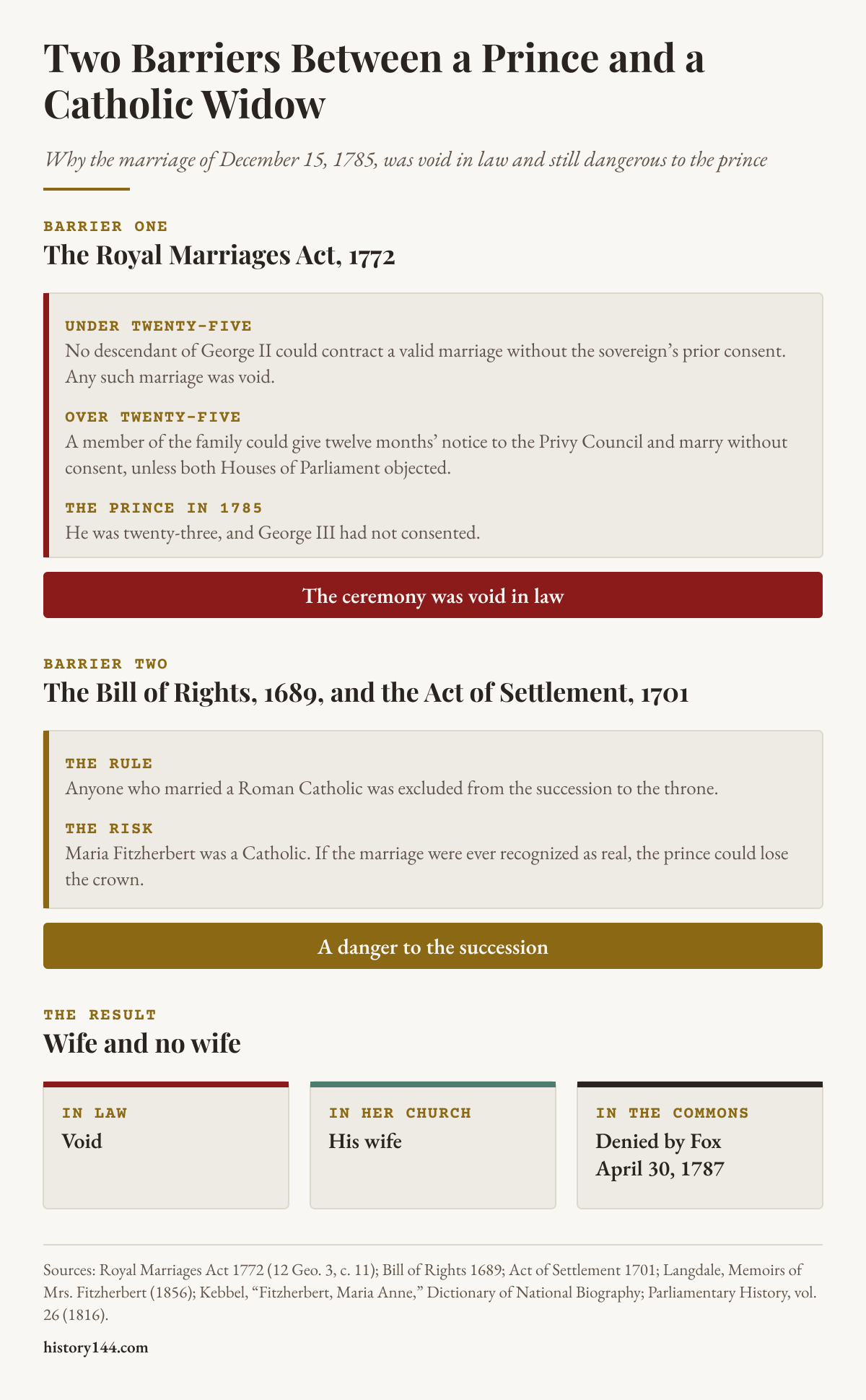
Two laws stood between the prince and any marriage to Mrs. Fitzherbert. The first was the Royal Marriages Act of 1772, which George III had pushed through Parliament after his brother the Duke of Cumberland married a commoner without his approval. It declared that no descendant of George II under the age of twenty-five could contract a valid marriage without the sovereign's prior consent; any such marriage was void. After twenty-five, a member of the family could give twelve months' notice to the Privy Council and marry without consent, unless both Houses of Parliament objected. The prince was twenty-one when he met her, and his father would never consent to a match with a commoner, still less a Catholic one. The second barrier was older and more dangerous. Under the Bill of Rights of 1689 and the Act of Settlement of 1701, anyone who married a Roman Catholic was excluded from the succession to the throne. A secret marriage with Mrs. Fitzherbert, if it were ever recognized as a real marriage, could cost the prince the crown. Maria understood all this, and when the prince began his pursuit, she refused him. While England kept those disabilities in force, the American states were writing religious liberty into their constitutions.
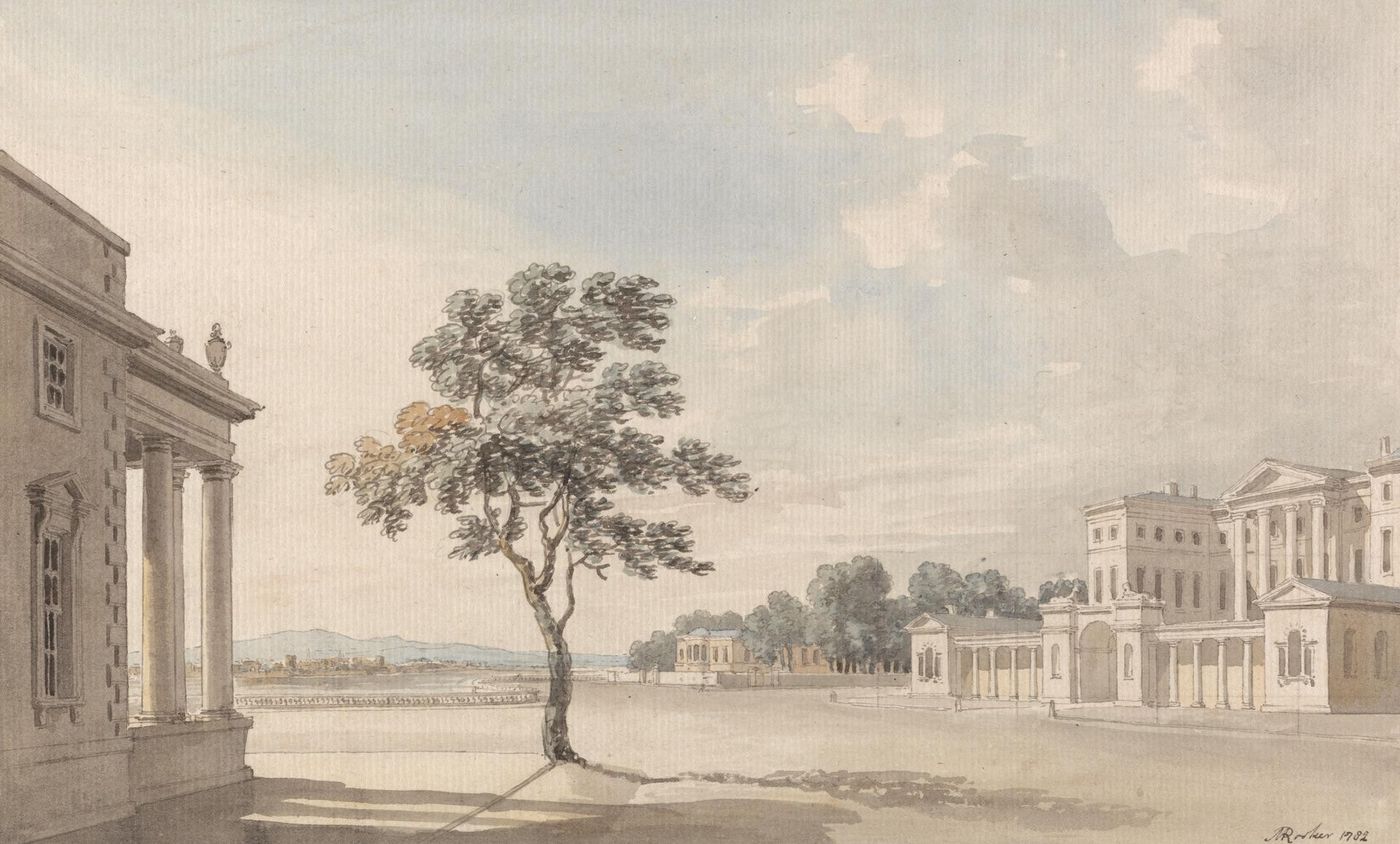
The Wound at Carlton House
According to J. A. Hamilton, who wrote the prince's entry in the Victorian Dictionary of National Biography, the two had become acquainted at Richmond earlier in 1784.[7] The prince was soon passionately in love, and she resisted him. The fullest account of the night at Carlton House comes from Mrs. Fitzherbert herself. Late in life she told the story to Lord Stourton, a relative by marriage, and his narrative was published in 1856 by his brother Charles Langdale, who wrote to defend her reputation.[8] In that telling, she refused to go without a chaperone, and the Duchess of Devonshire went with her. She found the prince covered in blood and allowed him to place a ring on her finger, which, according to the same account, may have been borrowed from the duchess.[9]
Later writers took the wound less seriously. Hamilton described the stabbing as a calculated act, in which the prince cut himself "so as to draw abundance of blood without risking his life," and then sent obliging friends to fetch her.[10] Whether the wound was a genuine act of despair or a piece of theater cannot be settled from the surviving evidence. Mrs. Fitzherbert's own conduct suggests that she did not regard a promise extracted under such pressure as binding, for she left for the Continent almost at once.[11]
She stayed abroad for more than a year, chiefly in Holland and Germany, and the prince did not let her forget him.[12] According to Hamilton, he sent courier after courier and wrote letter after letter. He would visit Elizabeth Armistead, Fox's mistress, to talk of his love, weeping by the hour, rolling on the floor, and falling into fits of hysterics.[13] One of his letters to Maria, written in 1785, ran to forty-two pages; she kept it for the rest of her life, along with their other papers.[14] He also threatened to leave England and join her abroad.[15] By late 1785 her resistance had given way. She agreed to come home on condition that they go through a formal ceremony of marriage.[16]
A Ceremony in the Drawing Room
Mrs. Fitzherbert returned to London in early December 1785.[17] Rumors of what the prince intended had already reached Fox, and on 10 December he wrote to the prince, urging him not to take what he called "a desperate step." One of his objections was the position in which it would leave Mrs. Fitzherbert, a wife who could never be acknowledged as one. The prince replied that there was no foundation for the reports and kept his friend in the dark.[18]
Finding a clergyman proved difficult, because anyone who helped solemnize a marriage forbidden by the Royal Marriages Act risked severe penalties. According to the Twickenham Museum's research on the officiant, three clergymen were approached before one agreed. He was the Reverend Robert Burt, who had been appointed one of the prince's chaplains in about June 1784.[19] A story repeated in many later accounts holds that Burt was a penniless curate whom the prince released from the Fleet debtors' prison by paying his debts of £500. The same research finds no basis for that story.[20]
The ceremony took place in the drawing room of the Park Street house. The witnesses were Maria's brother, John Smythe, and her uncle, Henry Errington. The two Victorian Dictionary of National Biography entries gave the date as 21 December, but the surviving document bearing the couple's signatures, now in the Royal Archives, is dated 15 December.[21] Burt signed a certificate, and the two witnesses attested it. According to Lord Holland, Mrs. Fitzherbert later tore off the witnesses' names, presumably to shield them from the law, and the surviving document has part missing.[22]
In law the ceremony was void. The prince was under twenty-five, and the king had not consented. Mrs. Fitzherbert regarded herself as his wife for the rest of her life, and her own Church took the same view. When Lord Stourton defended her memory in 1838, he described the ceremony as having taken place in her own drawing room, before a Protestant clergyman and two of her nearest relatives.[23] Stourton also maintained that the Church at Rome had sanctioned the union.[24] Lord Holland, writing from Fox's circle, claimed the opposite: that Mrs. Fitzherbert thought the ceremony nonsense and knew she was becoming the prince's mistress. Her defenders rejected the claim, and so did T. E. Kebbel, the author of her Dictionary of National Biography entry, who pointed to the respect she received from the royal family for the rest of her life.[25]
A Denial in the Commons
The marriage was supposed to be secret, but London soon knew. The prince and Mrs. Fitzherbert lived together openly, and among his friends she was treated as his wife.[26] The caricaturists went further. In March 1786 James Gillray published Wife & No Wife, or a Trip to the Continent, which set the wedding in a Catholic church abroad. There Edmund Burke, long suspected of Catholic sympathies, officiates; Fox gives the bride away; and Lord North dozes in a coachman's coat.[27]
The marriage might have remained an open secret if the prince had not run out of money. In 1786 he opened negotiations with the government for a parliamentary grant of £250,000. To put pressure on his father, who refused to help, he broke up his household, shut part of Carlton House, sold his horses and carriages at auction, and lived on borrowed money.[28] Early in 1787 his friends decided to appeal directly to Parliament, and Alderman Newnham, one of the members for the City of London, gave notice of a motion on the prince's debts. The leading Whigs, headed by the Duke of Portland, would not risk their party on the prince's cause. Fox alone was eager to support him.[29]
The rumored marriage now became a political weapon. John Rolle, member for Devon, answered Newnham's notice with dark hints that the House might need to inquire into the supposed marriage, and everyone understood what he meant.[30] On 30 April Fox rose in the Commons and denied the story "in point of fact, as well as law."[31] Hamilton believed that he spoke on the prince's authority and instructions, though Kebbel wrote that no one knew what authority Fox had for the statement.[32]
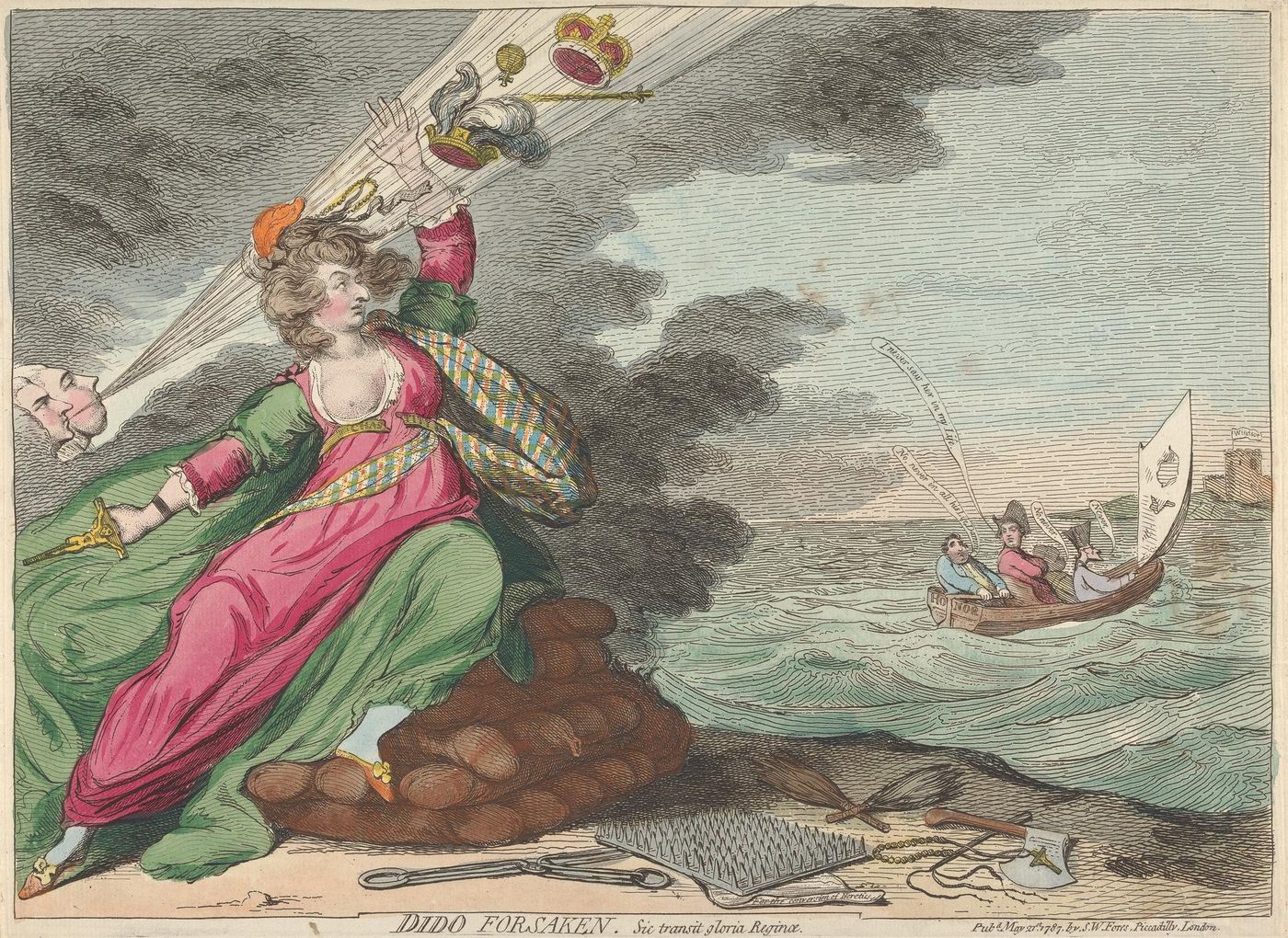
The denial secured the money but nearly destroyed the marriage. According to the account Mrs. Fitzherbert later gave Lord Stourton, the prince called on her the next morning at the house of her friend Mrs. Butler, took both her hands, and said, "Only conceive, Maria, what Fox did yesterday." She made no reply and turned pale.[33] Another version has him asking, "What do you think, Maria?"[34] Either way, he had disowned her in public and now affected outrage at the man who had spoken for him. On the day after the speech, Hamilton wrote, the prince admitted to Charles Grey that a ceremony had taken place and asked him to say something in the House to soften Fox's words. Grey refused.[35] In the end Richard Brinsley Sheridan made a guarded speech that tried to explain away Fox's statement without contradicting it, and the matter was allowed to drop.[36] Fox, unable to defend himself without calling the prince a liar, refused to speak to him for a year.[37] Gillray's print Dido Forsaken, published that year, showed Mrs. Fitzherbert as the abandoned queen of Carthage watching Aeneas sail away, a crucifix in her hand.[38]
In late May a royal message reached the Commons. Parliament voted £161,000 to pay the prince's debts and £20,000 to finish Carlton House, and the king added £10,000 a year to his income. The prince promised to be more careful in future.[39] He was not.
Brighton and the Lean Years
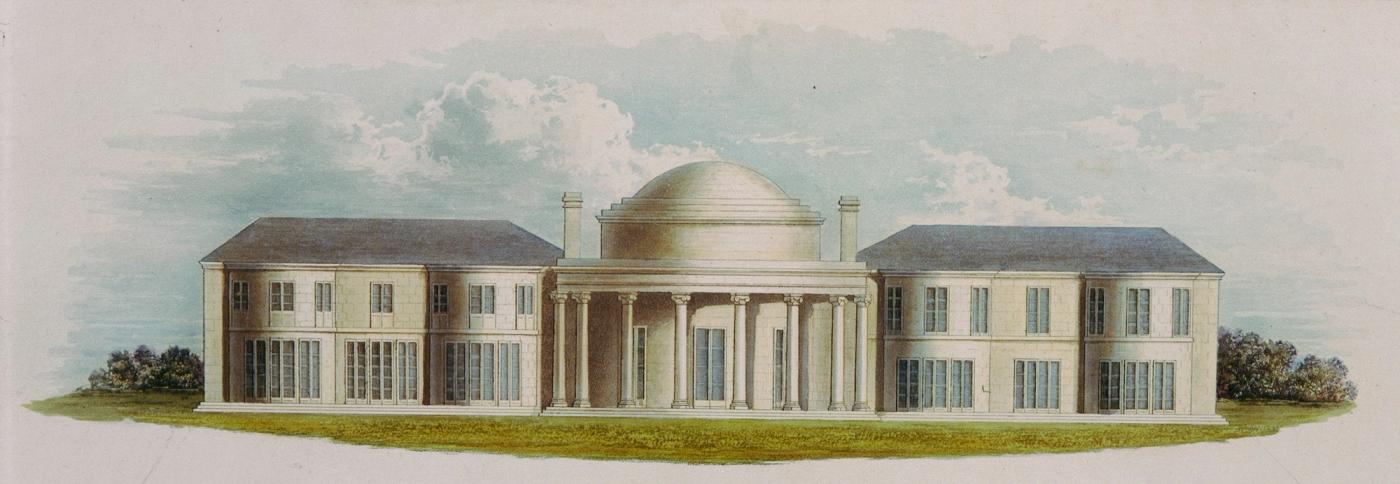
Mrs. Fitzherbert forgave him, and for the next several years the two lived as near to an ordinary married life as their situation allowed. Much of that life was spent at Brighton, the seaside town the prince had first visited in the early 1780s and where he was building the house that became his Pavilion. Mrs. Fitzherbert took a house of her own nearby, separated from his by a narrow strip of garden.[40] In about 1786 or 1787 the architect Robert Adam drew up designs for remodeling her Brighton house, which faced the Steine, the town's open green.[41] In London her standing was high. At the impeachment trial of Warren Hastings in 1788, observers noted that she drew more attention than the queen and the princesses.[42]
The marriage still carried political danger. When George III fell into his first prolonged bout of madness in November 1788, the prince was summoned from Brighton to Windsor, and for three months the Whigs expected him to become regent with full royal powers. His enemies used the rumored marriage against him. In 1789 the pamphleteer Philip Withers published attacks that took up the radical John Horne Tooke's description of Mrs. Fitzherbert as "Her Royal Highness the Princess of Wales," and argued that the prince was not eligible to serve as regent.[43] The king recovered in February 1789, and the crisis passed.
Money remained the constant strain. According to Hamilton, Mrs. Fitzherbert put her own jointure into the common household funds and was soon nearly penniless. On one occasion the prince pawned his diamonds to pay the bailiffs out of her house.[44] The prince, meanwhile, raised money on usurious terms against his future inheritance, and in 1788 he attempted a loan of £350,000 in Holland, secured on the revenues of the bishopric of Osnabrück. When the bonds fell due, his agents refused to pay, and in Hamilton's words the affair began to "wear the aspect of a deliberate fraud."[45] By 1793 his debts stood at about £370,000, and bailiffs were executing judgments in his house.[46]
Lady Jersey and the Price of Solvency
By the early 1790s the prince's attention had begun to wander. Frances Villiers, Countess of Jersey, was the wife of one of the prince's own circle, and by 1794 she had become his mistress and the dominant influence in his household. Mrs. Fitzherbert believed that Lady Jersey turned the prince against her.[47] The break came abruptly in June 1794. On the 23rd the prince wrote Mrs. Fitzherbert an affectionate note from Brighton, signed "ever thine," explaining that his sister wanted him at Windsor and that he had a regimental dinner to attend. On a slip she later attached to it, now lost, she wrote that she received this letter on the morning of the day "the Prince sent me word he would never enter my house," and she added in parentheses, "Lady Jersey's influence."[48]
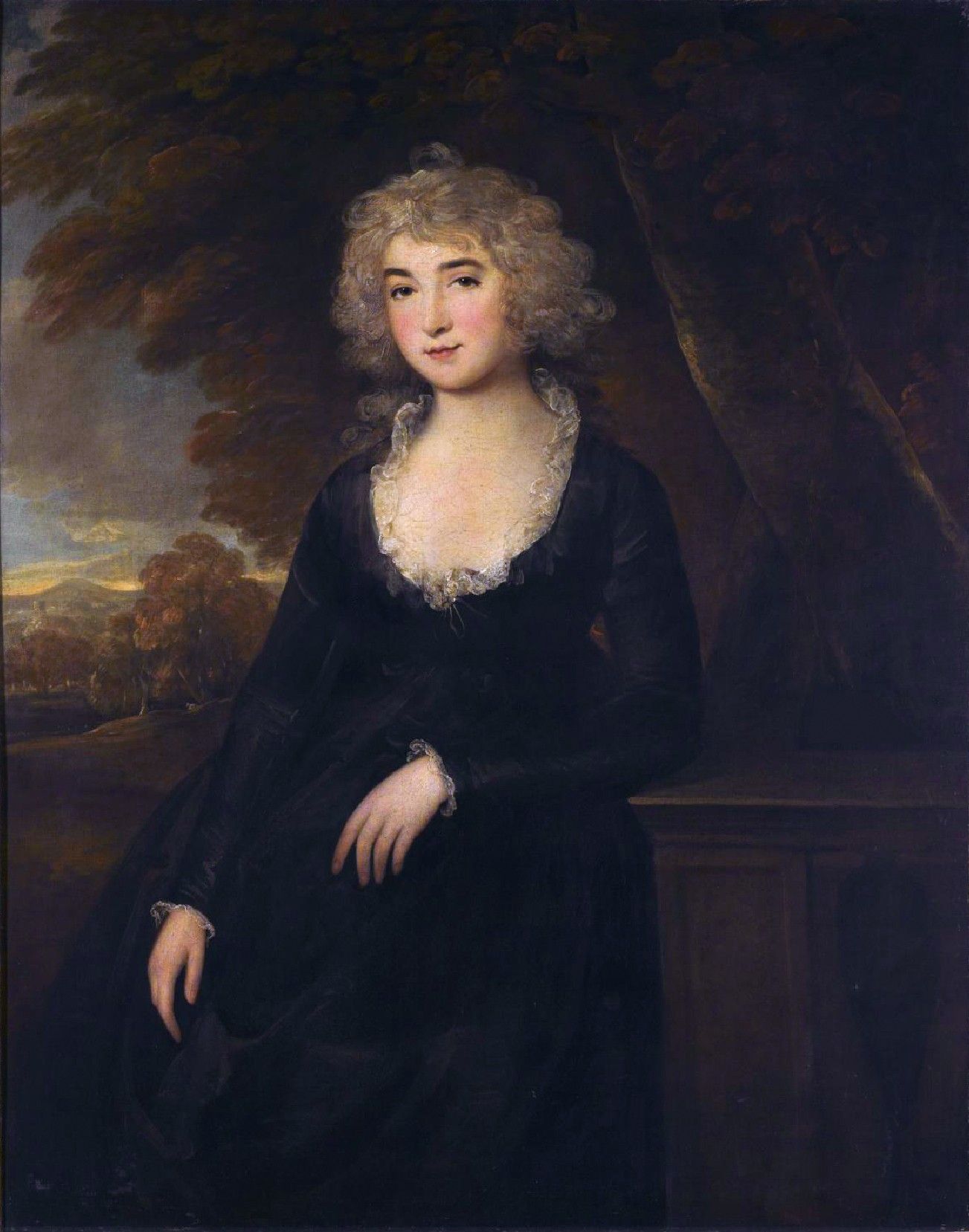
Lady Jersey was only part of the explanation. The prince was crushed by debt, and the king had made it plain that he would help only if his son made a proper marriage. By August 1794 the prince had promised his father that he would give up Mrs. Fitzherbert and marry his first cousin, Princess Caroline of Brunswick.[49] The Duke of York had suggested her, and the prince accepted on condition that his debts would be cleared and his income greatly increased.[50] He had never met her. In November 1794 the diplomat Lord Malmesbury was sent to Brunswick to make the formal proposal.[51]
Caroline
Caroline was twenty-six, the daughter of the Duke of Brunswick and of George III's sister Augusta. She had been brought up at a lively court and had a reputation for kindness and impulsiveness. Malmesbury, who spent months with her before and during the journey to England, liked her but judged that she had "a ready conception, but no judgment." He advised her on her conduct, her manners, and even her personal cleanliness.[52] She left Brunswick on 30 December 1794. The journey was slow. When the squadron sent to escort her turned back, she waited for weeks at Hanover, and she did not sail from Cuxhaven until 28 March 1795.[53]
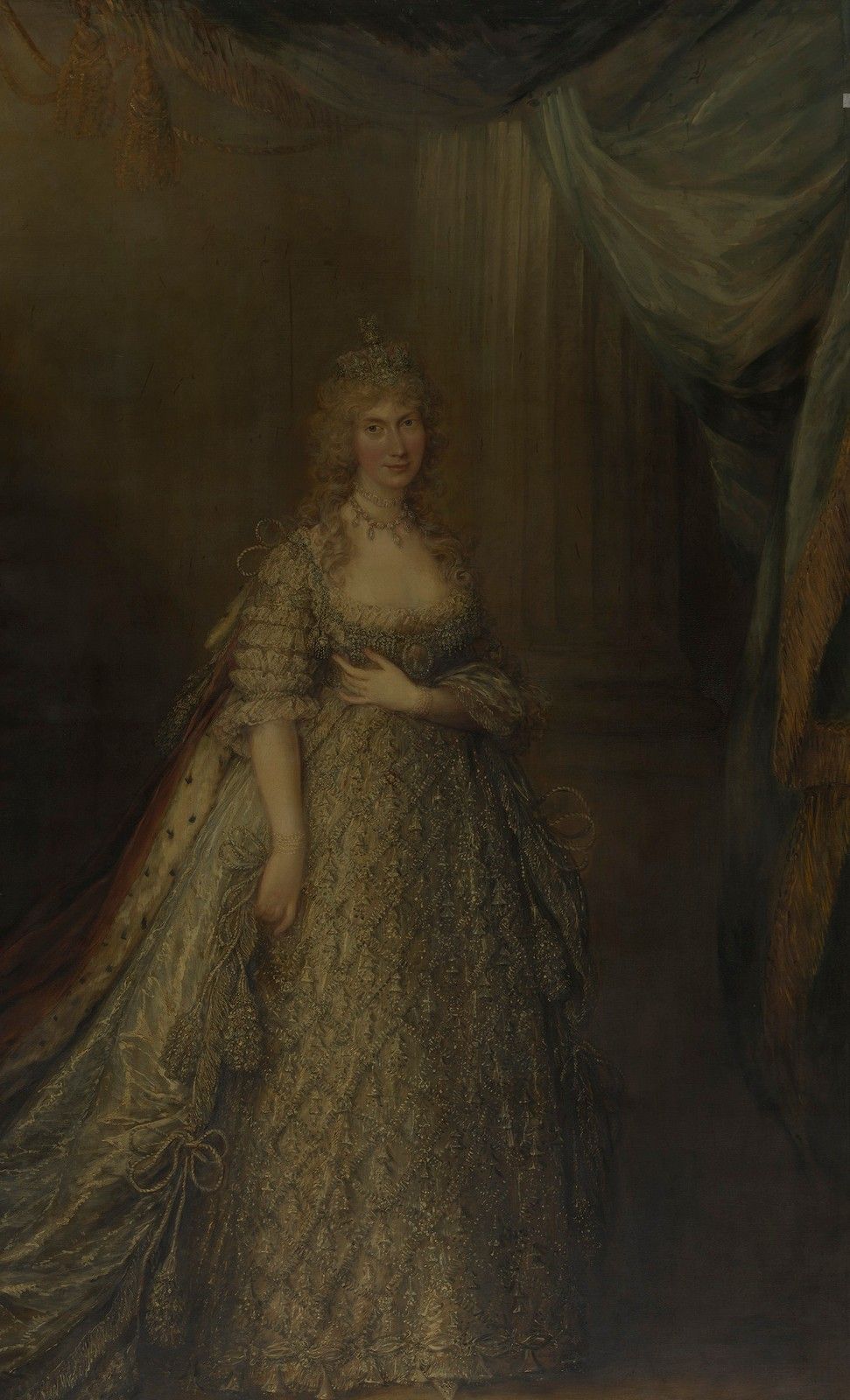
She landed at Greenwich on Easter Sunday, 5 April 1795. Waiting to meet her was Lady Jersey, whom the prince had appointed one of her ladies of the bedchamber, and who rode with her to St. James's.[54] There Malmesbury introduced her to her future husband. When she moved to kneel, the prince raised her and embraced her, said barely a word, then turned away to a distant part of the room and called the diplomat over. "Harris, I am not well," he said; "pray get me a glass of brandy." Then he left the room. Caroline, for her part, told Malmesbury that she found the prince very fat and not nearly as handsome as his portrait.[55] At dinner that evening she was flippant and made pointed remarks about Lady Jersey, which only made matters worse.[56]
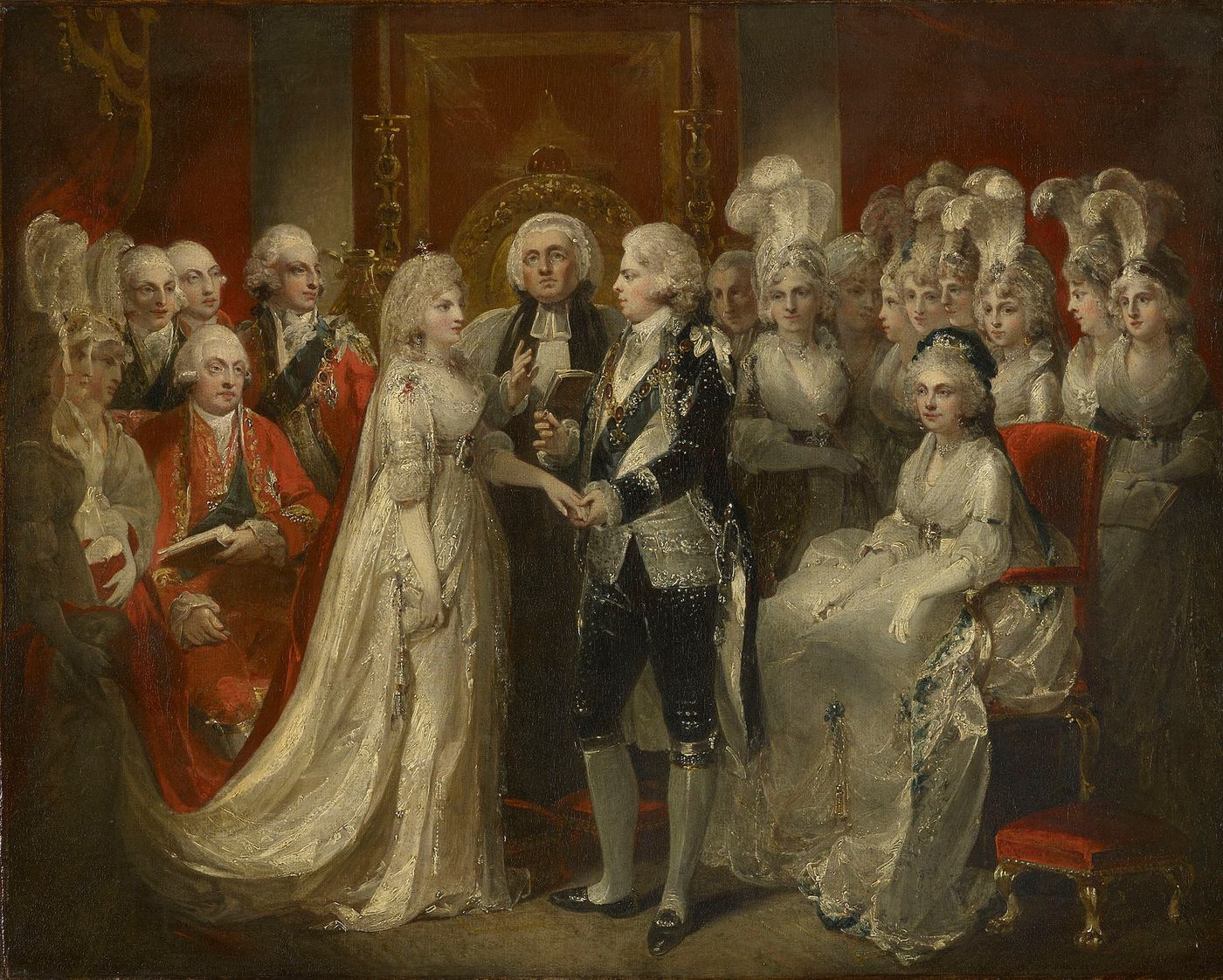
The wedding took place at eight in the evening on 8 April 1795, in the Chapel Royal at St. James's.[57] The prince got through the service only with prompting from his father, who knew the prayer book better than he did.[58] According to the diary of her lady-in-waiting Lady Charlotte Bury, Caroline complained of having had "a drunken husband on one's wedding-day," who spent much of his "bridal-night under the grate, where he fell, and where I left him."[59] The honeymoon was spent partly at Windsor and partly at Kempshott, a house in Hampshire where the prince had once lived with Mrs. Fitzherbert.[60]
Parliament now took up the prince's finances again. When the matter came before the Commons in the spring of 1795, his debts since the 1787 settlement amounted to £639,890. Britain was two years into its war with the French republic, a state created in part by the debts of the French monarchy. Pitt proposed to raise his income to about £140,000 a year and to set aside £25,000 a year to pay off his creditors. Grey, once his friend, moved to limit the parliamentary income to £100,000, and Fox questioned whether it was right to come to Parliament again after the pledges of 1787. Pitt's plan passed the Commons by 93 votes to 68 and became law at the end of June as the Prince of Wales Act.[61] A commission was set up to settle with his creditors, and its work caused much dissatisfaction. One creditor, the jeweler Nathaniel Jefferys, was so nearly ruined that a decade later he published a series of pamphlets attacking both the prince and Mrs. Fitzherbert.[62]
The Will and the Letter
Whatever the prince felt about his wife, the marriage did what the king and Parliament required. On 7 January 1796 Caroline gave birth to a daughter, Princess Charlotte, who was at once second in line to the throne. Three days later, the prince wrote a will leaving all his worldly property to Maria, whom he called "the wife of my heart and soul." To "her who is call'd the Princess of Wales" he left one shilling.[63] The will spoke of Maria throughout as his wife and directed that the miniature of her that he wore should be buried with him. According to the 1911 Encyclopaedia Britannica, he did not hand it to her until 1799.[64]
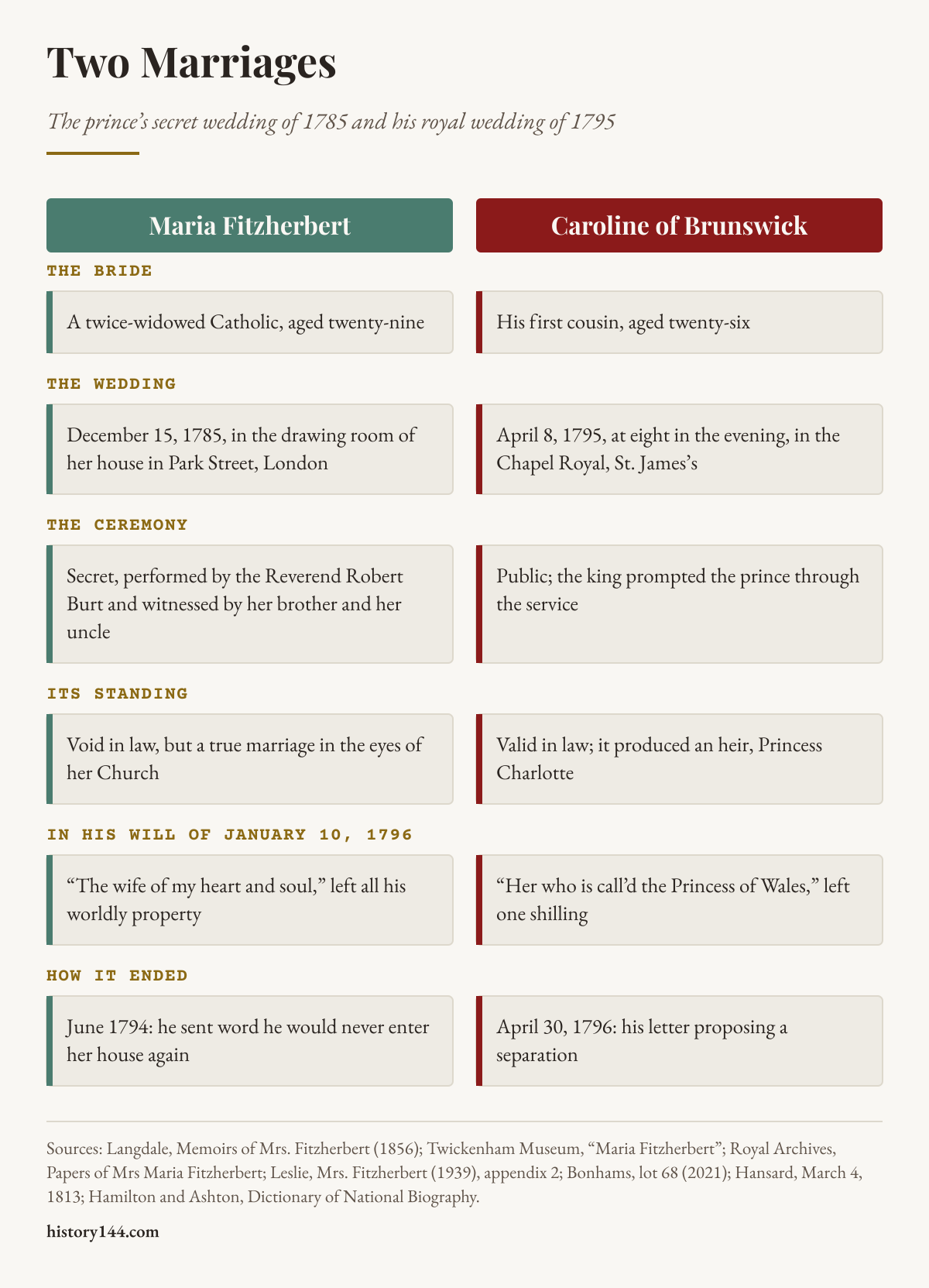
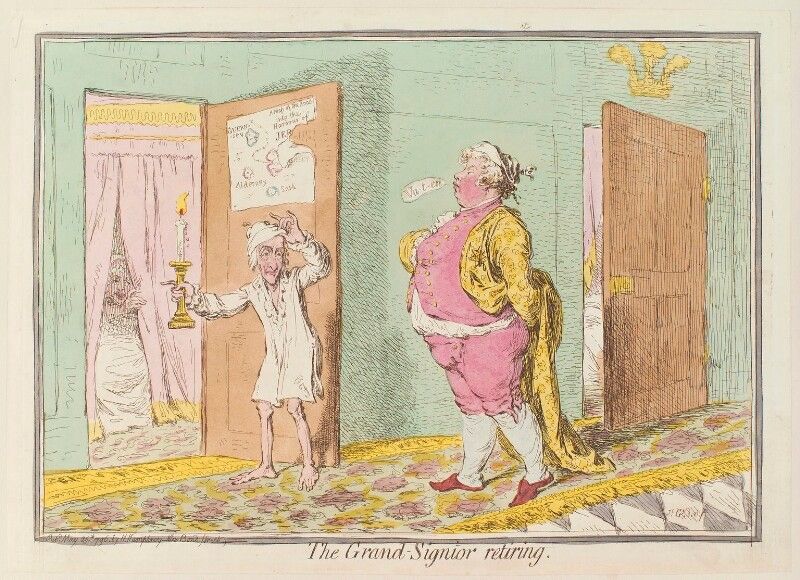
The marriage to Caroline did not survive the spring. After negotiations through Lord Cholmondeley, the prince wrote to his wife from Windsor Castle on 30 April 1796.[65] He told her that "nature has not made us suitable to each other," and that neither of them should be blamed for feelings they could not control.[66] He proposed that their relations be limited to civil companionship, and he promised that he would never seek a closer connection, even if something should happen to their daughter.[67] Caroline replied on 6 May. She accepted the separation, but she made sure the responsibility stayed with him. His letter was worded, she observed, so that it was "doubtful whether this arrangement proceeds from you or from me," and "the credit of it belongs to you alone." She added that she would send both his letter and her answer to the king, "as to my sovereign and my father."[68] The separation was formally agreed, and the king arranged that Caroline should have access to her child.[69] Within weeks, Gillray was publishing prints about the prince's affair with Lady Jersey; one, issued on 25 May 1796, showed her husband, the Earl of Jersey, lighting the prince's way to his wife's bed.[70]
The letter itself had a long afterlife. In 1813 it was printed in the parliamentary record during a dispute over Caroline's access to her daughter.[71] In 1820, when the prince, by then King George IV, tried to divorce her, her counsel Henry Brougham presented it to Parliament as evidence in her defense.[72]
What the Twelve Years Meant
By the spring of 1796, the triangle that began at Carlton House in 1784 had reached its lowest point. The prince was separated from his legal wife and estranged from the woman he called his true one, and his affair with Lady Jersey had made him a target for the caricaturists. Mrs. Fitzherbert did not take him back at once, and accounts differ on when she did. Hamilton wrote only that the prince resumed the relationship after Caroline moved to Blackheath. The 1911 Encyclopaedia Britannica dated the renewal to 1800, after Mrs. Fitzherbert had obtained a decision from Rome declaring that, in the eyes of her Church, she was his wife and could lawfully live with him.[73] Money was as short as ever. Once, returning from Brighton to London, they could not pay for the post-horses and had to borrow from an old servant. Yet she used to say that these were the happiest years of her life.[74]
The twelve years mattered because they showed how little the private wishes of a royal heir counted against law and money. The Royal Marriages Act, passed by George III to control the marriages of his family, did exactly what it was designed to do and made a sincere marriage legally invisible. The prince's debts then gave the king and Parliament the leverage to make him contract a lawful one. The Commons had turned the same power of supply outward a generation earlier in the taxation of the American colonies. That bargain produced a legitimate heir in Princess Charlotte and a bitter royal marriage that culminated, a quarter-century later, in the failed attempt to divorce Queen Caroline in 1820, one of the great public scandals of the age.
Provision was made for the prince's debts, but the cost fell on the two women. Caroline was brought to England to marry a man whose mistress had been placed in her household, and she was cast off within a year. Mrs. Fitzherbert was denied in the Commons by her husband's closest political friend, and then set aside so that he could make the lawful marriage his debts required. She outlived him by nearly seven years. When he died in 1830, he was wearing her portrait around his neck, and, as his will directed, the miniature was buried with him.[75] She had kept the documents of their marriage, including the certificate and the will of 1796, and in 1833 she arranged for them to be deposited at Coutts's Bank, so that one day the record would show what she had always maintained.[76] The ring the prince placed on her finger at Carlton House in the summer of 1784 never counted for anything in law, and in the end it meant far more to her than it had to him.
Places in this Story
The places this story moves through, in order — follow them on the interactive map →
- Park Street, Mayfair, London 1784 to 1785
Mrs. Fitzherbert’s London house. The prince’s friends came here in July 1784 to fetch her to Carlton House, and in December 1785 the secret marriage took place in its drawing room.
- Carlton House, Pall Mall, London July 8, 1784
The prince’s London residence. Here Mrs. Fitzherbert, accompanied by the Duchess of Devonshire, found him bloodied from a self-inflicted wound and let him place a ring on her finger.
- House of Commons, Westminster April 30, 1787
Charles James Fox denied the marriage here “in point of fact, as well as law,” clearing the way for Parliament to pay the prince’s debts.
- The Steine, Brighton 1786 to 1794
Mrs. Fitzherbert’s house faced the Steine, separated by a narrow strip of garden from the house the prince was building into his Pavilion.
- Brunswick, Germany November to December 1794
Lord Malmesbury came here to make the formal proposal to Princess Caroline, the prince’s cousin. She left for England on 30 December 1794.
- Greenwich April 5, 1795
Caroline landed here on Easter Sunday and was met by Lady Jersey, the prince’s mistress, whom he had appointed one of her ladies of the bedchamber.
- Chapel Royal, St. James’s Palace, London April 8, 1795
The prince married Caroline here at eight in the evening, getting through the service only with prompting from his father.
- Windsor Castle April 30, 1796
From Windsor the prince wrote to Caroline that “nature has not made us suitable to each other,” ending their married life within a year of the wedding.
Frequently Asked Questions
Who was Maria Fitzherbert?
Maria Fitzherbert, born Maria Anne Smythe in 1756, was an English Catholic widow who secretly married George, Prince of Wales, the future George IV, in December 1785. Twice widowed by 1781 and living in Park Street, Mayfair, she regarded herself as his wife until her death in 1837.
Did the Prince of Wales really marry Maria Fitzherbert?
Yes, a ceremony took place on 15 December 1785 in the drawing room of her Park Street house, performed by the Reverend Robert Burt before her brother John Smythe and her uncle Henry Errington. In English law, however, the marriage was void.
Why was the marriage of George IV and Maria Fitzherbert invalid?
The Royal Marriages Act of 1772 made void any marriage by a descendant of George II under twenty-five without the sovereign’s consent, and the prince was twenty-three with no consent given. Under the Bill of Rights and the Act of Settlement, marrying a Roman Catholic would also have excluded him from the throne.
Why did the Prince of Wales marry Caroline of Brunswick?
By 1794 the prince was deeply in debt, and George III made it plain he would help only if his son made a proper marriage. He broke with Mrs. Fitzherbert in June 1794 and married his first cousin Caroline of Brunswick at the Chapel Royal, St. James’s, on 8 April 1795.
What was in the Prince of Wales’s will of 1796?
On 10 January 1796, three days after Princess Charlotte was born, the prince wrote a will leaving all his worldly property to Maria Fitzherbert, “the wife of my heart and soul,” and one shilling to “her who is call’d the Princess of Wales.” He directed that the miniature of Maria he wore be buried with him, and when he died in 1830, it was.
When did George IV and Caroline of Brunswick separate?
The prince wrote to Caroline from Windsor Castle on 30 April 1796, saying that “nature has not made us suitable to each other” and proposing that their relations be limited to civil companionship. Caroline accepted on 6 May, noting that “the credit of it belongs to you alone.”
Did George IV go back to Maria Fitzherbert?
Yes, for a time. Accounts differ on the date, but the 1911 Encyclopaedia Britannica places the reunion in 1800, after Mrs. Fitzherbert obtained a decision from Rome that she was his wife in the eyes of her Church.
Bibliography
### Primary Sources
Bonhams. "George IV as Prince of Wales: Autograph Letter Signed ('ever thine') to Maria Fitzherbert, Brighton, 23 June 1794." Lot 68, sale 26774, September 15, 2021. Accessed October 29, 2026. https://www.bonhams.com/auction/26774/lot/68/george-iv-as-prince-of-wales-autograph-letter-signed-ever-thine-to-maria-fitzherbert-my-dear-love-complaining-that-his-sister-has-asked-him-to-go-to-windsor-brighton-23-june-1794/.
Bury, Lady Charlotte. Diary Illustrative of the Times of George the Fourth. Vol. 1. London: Henry Colburn, 1838. Published anonymously.
Great Britain. Parliament. House of Commons. "Letter from the Prince of Wales to the Princess of Wales." HC Deb, March 4, 1813, vol. 24, cols. 1123–28. Hansard. Accessed October 27, 2026. https://api.parliament.uk/historic-hansard/commons/1813/mar/04/letter-from-the-prince-of-wales-to-the.
Great Britain. Prince of Wales Act 1795. 35 Geo. 3, c. 129.
Great Britain. Royal Marriages Act 1772. 12 Geo. 3, c. 11. legislation.gov.uk. Accessed October 27, 2026. https://www.legislation.gov.uk/apgb/Geo3/12/11.
Jefferys, Nathaniel. A Review of the Conduct of the Prince of Wales in His Various Transactions with Mr. Jefferys. London, 1806.
Langdale, Charles. Memoirs of Mrs. Fitzherbert; with an Account of Her Marriage with H.R.H. the Prince of Wales, afterwards King George the Fourth. London: Richard Bentley, 1856. https://archive.org/details/memoirsofmrsfitz00languoft.
Malmesbury, James Harris, First Earl of. Diaries and Correspondence of James Harris, First Earl of Malmesbury. Edited by his grandson, the third Earl. 4 vols. London: Richard Bentley, 1844. Vol. 3: https://archive.org/details/diariescorrespon03malm.
The Parliamentary History of England, from the Earliest Period to the Year 1803. Vol. 26. London: T. C. Hansard, 1816. https://archive.org/details/10279134bsb.
Royal Archives, Windsor Castle. Papers of Mrs Maria Fitzherbert, 1785–1856. GEO/MAIN/50201–50259, 50832–50932; GEO/ADD/29. Royal Archives Online. Accessed October 28, 2026. https://ra.rct.uk/Record.aspx?src=CalmView.Catalog&id=FITZHERBERT%2f1%2f1.
UK Parliament Living Heritage. "Separation Letter from George to Caroline." Parliamentary Archives, HL/PO/JO/10/8/512, no. 218. Accessed October 27, 2026. https://www.parliament.uk/about/living-heritage/transformingsociety/private-lives/relationships/collections1/queen-caroline/separation-letter-/.
Wellcome Collection. "Maria Fitzherbert." Catalogue entries for Philip Withers, Alfred, or a Narrative of the Daring and Illegal Measures to Suppress a Pamphlet (1789) and History of the Royal Malady (1789). Accessed October 27, 2026. https://wellcomecollection.org/concepts/zydv2v34.
### Nineteenth- and Early Twentieth-Century Reference Works
Ashton, John. "Caroline Amelia Elizabeth." In Dictionary of National Biography, vol. 9. London: Smith, Elder, 1887. Accessed October 27, 2026. https://thepeerage.com/e598.htm.
"George IV." In Encyclopaedia Britannica, 11th ed., vol. 11. Cambridge: Cambridge University Press, 1910.
Hamilton, J. A. "George IV." In Dictionary of National Biography, vol. 21. London: Smith, Elder, 1890. Accessed October 27, 2026. https://thepeerage.com/e97.htm.
Kebbel, T. E. "Fitzherbert, Maria Anne." In Dictionary of National Biography, vol. 19. London: Smith, Elder, 1889. Accessed October 27, 2026. https://historyhome.co.uk/people/fitzherb.htm.
### Modern Sources
Christie's. "The Maria Fitzherbert Jewel." Lot 6083876, lot essay. Accessed October 29, 2026. https://www.christies.com/en/lot/lot-6083876.
Cosway, Richard. Maria Fitzherbert (née Smythe, previously Weld) (1756–1837). c. 1789. Royal Collection Trust, RCIN 420928. Collection record. Accessed October 29, 2026. https://www.rct.uk/collection/420928/mary-anne-fitzherbert-1756-1837.
Harris, Jocelyn. "Jane Austen, Caroline of Brunswick, and the Prince of Wales." Lewis Walpole Library, Yale University. Accessed October 27, 2026. https://walpole.library.yale.edu/sites/default/files/files/Harris.pdf.
Leslie, Shane. Mrs. Fitzherbert: A Life Chiefly from Unpublished Sources. London: Burns, Oates, 1939.
National Portrait Gallery, London. "Miniatures as Love Tokens." Accessed October 28, 2026. https://www.npg.org.uk/collections/explore/george-prince-of-wales/miniatures-as-love-tokens.
Orlando: Women's Writing in the British Isles from the Beginnings to the Present. "Maria Anne Fitzherbert." Cambridge University Press. Accessed October 27, 2026. https://orlando.cambridge.org/people/04f0c317-167c-4ddd-b364-72ce6ebcc783.
Royal Collection Trust. "Queen Caroline (1768–1821) when Princess of Wales." RCIN 420194. Accessed October 27, 2026. https://col.rct.uk/collection/420194/queen-caroline-1768-1821-when-princess-of-wales.
Sherry, Jim. "Dido Forsaken." James Gillray: Caricaturist. Accessed October 27, 2026. https://james-gillray.org/pop/dido-forsaken.html.
Sherry, Jim. "The Grand Signior Retiring." James Gillray: Caricaturist. Accessed October 27, 2026. https://james-gillray.org/pop/grand.html.
Sherry, Jim. "Wife & No Wife, or a Trip to the Continent." James Gillray: Caricaturist. Accessed October 27, 2026. https://james-gillray.org/pop/wife.html.
Sir John Soane's Museum. "Scheme for Mrs Fitzherbert's House, Brighton." SCHEME773. Accessed October 27, 2026. https://collections.soane.org/SCHEME773.
Twickenham Museum. "Maria Fitzherbert." Accessed October 27, 2026. https://twickenham-museum.org.uk/?p=1653.
Citations
- Charles Langdale, Memoirs of Mrs. Fitzherbert; with an Account of Her Marriage with H.R.H. the Prince of Wales, afterwards King George the Fourth (London: Richard Bentley, 1856), 118–19. ↑
- "Maria Anne Fitzherbert," Orlando: Women's Writing in the British Isles from the Beginnings to the Present, Cambridge University Press. ↑
- Langdale, Memoirs of Mrs. Fitzherbert, 119; J. A. Hamilton, "George IV," in Dictionary of National Biography, vol. 21 (London: Smith, Elder, 1890). ↑
- T. E. Kebbel, "Fitzherbert, Maria Anne," in Dictionary of National Biography, vol. 19 (London: Smith, Elder, 1889); "Maria Fitzherbert," Twickenham Museum. ↑
- Kebbel, "Fitzherbert, Maria Anne." ↑
- Hamilton, "George IV." ↑
- Hamilton, "George IV." Kebbel, "Fitzherbert, Maria Anne," dates the first meeting to 1785, which conflicts with the events of July 1784. ↑
- Langdale, Memoirs of Mrs. Fitzherbert, dedication and introductory matter. ↑
- Langdale, Memoirs of Mrs. Fitzherbert, 119. ↑
- Hamilton, "George IV." ↑
- Langdale, Memoirs of Mrs. Fitzherbert, 24, 119. ↑
- Kebbel, "Fitzherbert, Maria Anne"; Hamilton, "George IV"; Langdale, Memoirs of Mrs. Fitzherbert, 120. ↑
- Hamilton, "George IV." ↑
- Christie's, "The Maria Fitzherbert Jewel," lot 6083876, lot essay. A letter from the prince to Mrs. Fitzherbert dated 3 November 1785 survives among her papers: Royal Archives, Windsor Castle, Papers of Mrs Maria Fitzherbert, GEO/MAIN/50236–50258. The catalogue does not give its length. ↑
- "Scheme for Mrs Fitzherbert's House, Brighton," Sir John Soane's Museum Collections, SCHEME773. ↑
- Hamilton, "George IV." ↑
- Sir John Soane's Museum, "Scheme for Mrs Fitzherbert's House." ↑
- Jim Sherry, "Wife & No Wife, or a Trip to the Continent," James Gillray: Caricaturist; Hamilton, "George IV." ↑
- Royal Marriages Act 1772, 12 Geo. 3, c. 11, s. 3 (penalties for anyone solemnizing or assisting at such a marriage; repealed 1967); Twickenham Museum, "Maria Fitzherbert." ↑
- Twickenham Museum, "Maria Fitzherbert." The prison story appears, for example, in Christie's essay on the Maria Fitzherbert Jewel (see note 14). ↑
- Royal Archives, Windsor Castle, Papers of Mrs Maria Fitzherbert, GEO/MAIN/50210, "Signatures of George, Prince of Wales and Maria Fitzherbert verifying their marriage (part missing), 15 December 1785"; Hamilton, "George IV," and Kebbel, "Fitzherbert, Maria Anne," both give 21 December. ↑
- Langdale, Memoirs of Mrs. Fitzherbert, 12–13, quoting Lord Holland's account. Royal Archives, Papers of Mrs Maria Fitzherbert, GEO/MAIN/50210. ↑
- Langdale, Memoirs of Mrs. Fitzherbert, 43. ↑
- Langdale, Memoirs of Mrs. Fitzherbert, 47. ↑
- Kebbel, "Fitzherbert, Maria Anne." ↑
- Hamilton, "George IV." ↑
- Sherry, "Wife & No Wife." ↑
- Hamilton, "George IV." ↑
- Hamilton, "George IV." ↑
- The Parliamentary History of England, from the Earliest Period to the Year 1803, vol. 26 (London: T. C. Hansard, 1816), cols. 1047–50, printing Rolle's remarks in the debate of 27 April 1787; Hamilton, "George IV." Some later accounts date his first remark to 20 or 24 April. ↑
- Parliamentary History, 26:1069–70. ↑
- Hamilton, "George IV"; Kebbel, "Fitzherbert, Maria Anne." ↑
- Langdale, Memoirs of Mrs. Fitzherbert, 29–30. ↑
- Kebbel, "Fitzherbert, Maria Anne." ↑
- Hamilton, "George IV." ↑
- "George IV," in Encyclopaedia Britannica, 11th ed., vol. 11 (Cambridge: Cambridge University Press, 1910); Kebbel, "Fitzherbert, Maria Anne." ↑
- Hamilton, "George IV." ↑
- Jim Sherry, "Dido Forsaken," James Gillray: Caricaturist. ↑
- Hamilton, "George IV." ↑
- Hamilton, "George IV"; Sir John Soane's Museum, "Scheme for Mrs Fitzherbert's House." ↑
- Sir John Soane's Museum, "Scheme for Mrs Fitzherbert's House." ↑
- Kebbel, "Fitzherbert, Maria Anne." ↑
- "Maria Fitzherbert," Wellcome Collection, catalogue entries for Philip Withers, Alfred and History of the Royal Malady (1789). ↑
- Hamilton, "George IV." ↑
- Hamilton, "George IV." ↑
- Hamilton, "George IV." ↑
- Hamilton, "George IV"; Bonhams, "George IV as Prince of Wales: Autograph Letter Signed ('ever thine') to Maria Fitzherbert, Brighton, 23 June 1794," lot 68, sale 26774, September 15, 2021. ↑
- Bonhams, lot 68. ↑
- Hamilton, "George IV." ↑
- John Ashton, "Caroline Amelia Elizabeth," in Dictionary of National Biography, vol. 9 (London: Smith, Elder, 1887). ↑
- Hamilton, "George IV." ↑
- Ashton, "Caroline Amelia Elizabeth"; James Harris, First Earl of Malmesbury, Diaries and Correspondence of James Harris, First Earl of Malmesbury, ed. third Earl of Malmesbury, vol. 3 (London: Richard Bentley, 1844), 196, 207–11; Jocelyn Harris, "Jane Austen, Caroline of Brunswick, and the Prince of Wales," Lewis Walpole Library, Yale University. ↑
- Ashton, "Caroline Amelia Elizabeth." ↑
- Ashton, "Caroline Amelia Elizabeth"; Hamilton, "George IV." ↑
- Malmesbury, Diaries and Correspondence, 3:218. ↑
- Malmesbury, Diaries and Correspondence, 3:219. The printed text leaves the lady's name blank; she was Lady Jersey, who was present. ↑
- Ashton, "Caroline Amelia Elizabeth." ↑
- Hamilton, "George IV." ↑
- [Lady Charlotte Bury], Diary Illustrative of the Times of George the Fourth, vol. 1 (London: Henry Colburn, 1838), 36–37. ↑
- Hamilton, "George IV"; Harris, "Jane Austen, Caroline of Brunswick, and the Prince of Wales." ↑
- Hamilton, "George IV"; Prince of Wales Act 1795, 35 Geo. 3, c. 129 (royal assent 27 June 1795). ↑
- Hamilton, "George IV." Jefferys set out his case in A Review of the Conduct of the Prince of Wales in His Various Transactions with Mr. Jefferys (London, 1806). ↑
- "Queen Caroline (1768–1821) when Princess of Wales," Royal Collection Trust, RCIN 420194; Will of George, Prince of Wales, 10 January 1796, printed in Shane Leslie, Mrs. Fitzherbert: A Life Chiefly from Unpublished Sources (London: Burns, Oates, 1939), appendix 2, 372; Christie's, "The Maria Fitzherbert Jewel." The will, dated 10 January 1796, survives as Royal Archives, Papers of Mrs Maria Fitzherbert, GEO/MAIN/50214–50224. ↑
- "George IV," Encyclopaedia Britannica, 11th ed. ↑
- Hamilton, "George IV." ↑
- "Separation Letter from George to Caroline," UK Parliament Living Heritage, Parliamentary Archives HL/PO/JO/10/8/512, no. 218. ↑
- "Letter from the Prince of Wales to the Princess of Wales," HC Deb, March 4, 1813, vol. 24, cols. 1123–28, Hansard. ↑
- HC Deb, March 4, 1813, vol. 24, cols. 1123–28. ↑
- Ashton, "Caroline Amelia Elizabeth." ↑
- Jim Sherry, "The Grand Signior Retiring," James Gillray: Caricaturist. ↑
- HC Deb, March 4, 1813, vol. 24, cols. 1123–28. ↑
- UK Parliament Living Heritage, "Separation Letter from George to Caroline." ↑
- Hamilton, "George IV"; "George IV," Encyclopaedia Britannica, 11th ed.; Kebbel, "Fitzherbert, Maria Anne." The Royal Archives' own catalogue note, by contrast, states that after 1794 the prince "would never reunite with her": Royal Archives, Papers of Mrs Maria Fitzherbert, collection description. ↑
- Kebbel, "Fitzherbert, Maria Anne." ↑
- Kebbel, "Fitzherbert, Maria Anne"; "Miniatures as Love Tokens," National Portrait Gallery, London; Richard Cosway, Maria Fitzherbert (née Smythe, previously Weld) (1756–1837), c. 1789, Royal Collection Trust, RCIN 420928, collection record. ↑
- Sir John Soane's Museum, "Scheme for Mrs Fitzherbert's House." The memorandum of 24 August 1833 by the Duke of Wellington, Lord Albemarle and Lord Stourton survives as Royal Archives, Papers of Mrs Maria Fitzherbert, GEO/MAIN/50203; the papers were given to the Royal Archives by Edward VII in 1905. ↑