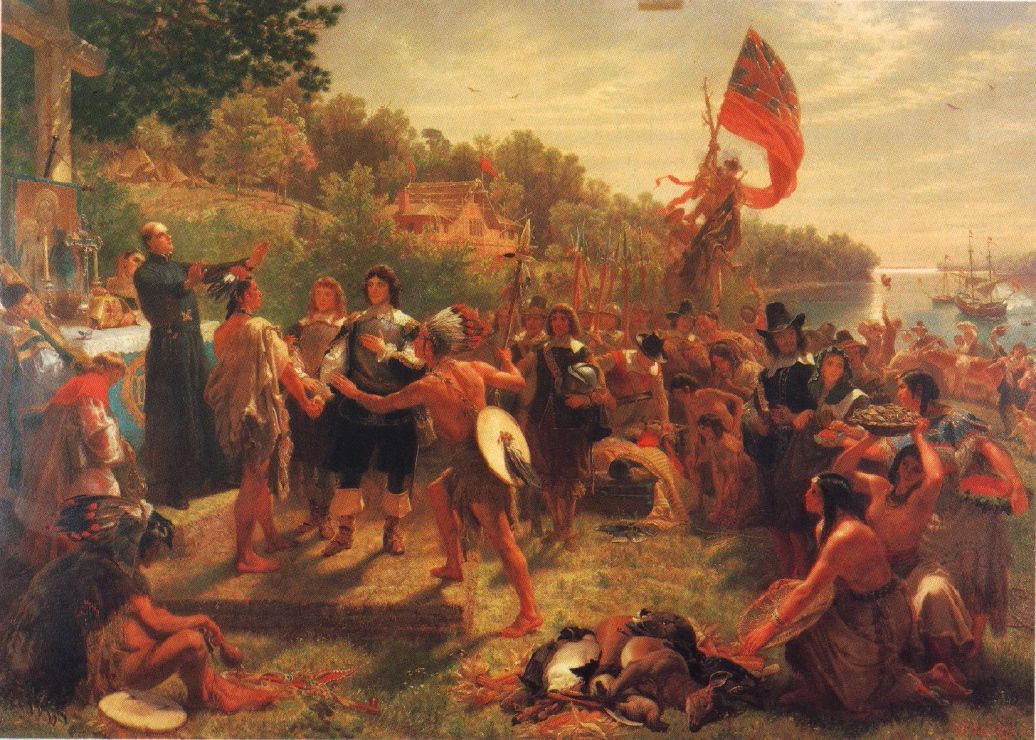
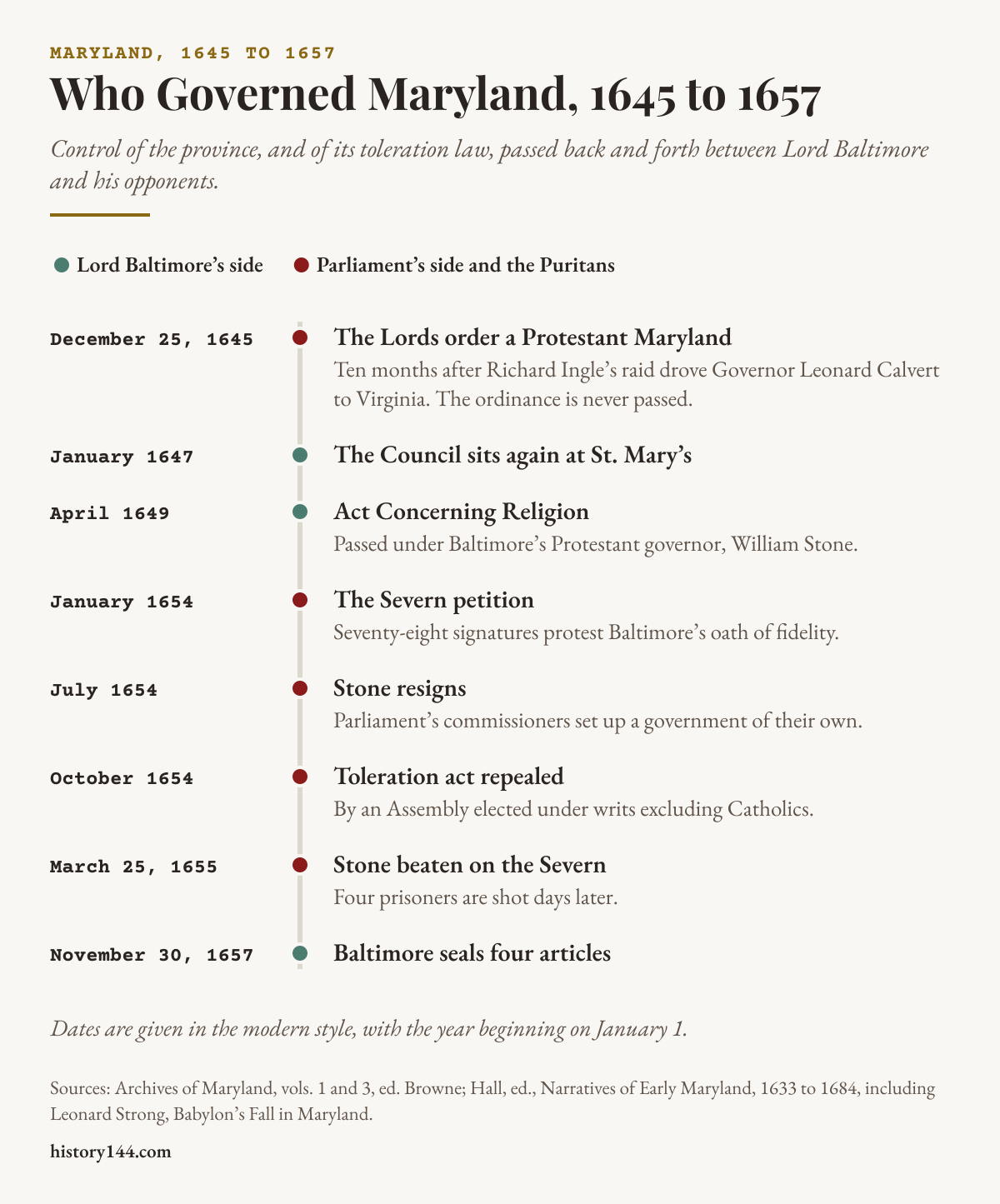
On Christmas Day 1645, a Thursday, the House of Lords sat at Westminster and gave an order about a colony three thousand miles away. "Ordered by the Lords in Parlyament assembled, That the Comittee for forraigne Plantations, doe drawe vp an Ordinance, and present it to this howse, for the setling of the Plantation of Maryland vnder the Comand of Protestants, and for the indempnity of those that haue or shall act in this bussines."[1]The first colonists had landed in Maryland not quite twelve years before. Its charter belonged to Cecil Calvert, second Lord Baltimore, an English Catholic who had built the province on a bargain. Catholics would be left alone there, and so would everyone else who professed Christianity. It was his policy from the first, though it was not written into law until 1649. Few other places in the English world offered Catholics as much. The Lords were proposing to end that bargain by ordinance.
Almost twelve years later, on November 30, 1657, Lord Baltimore set his hand and seal to articles that gave him the province back. The fourth and last of his promises was that he would never assent to the repeal of the law "whereby all persons professing to beleeue in Jesus Christ haue freedon of Conscience there."[2] Before the order came a plundering. Between the order and the articles came a lawsuit carried to the bar of the House of Lords, a toleration act, its repeal, and a battle fought on a Sunday on a neck of land in the Severn. It is easy to assume that Maryland's toleration was a settled principle, handed down by its proprietor and kept. It was neither settled nor kept. The Puritans it had sheltered repealed it within five years, and it came back only as a term in a bargain, the price Lord Baltimore paid for his province. This is the story of those twelve years.
A note on dates. Contemporaries began the year on March 25, so a document written in February 1645 by their reckoning is February 1646 by ours. Dates here are given in the modern style, with the original where it matters.
The Reformation in the St. Mary's River
In February 1645 a London ship master named Richard Ingle came into the St. Mary's River in the Reformation. He had been in Maryland before and had been arrested there for words spoken against the king. This time he came with letters of marque from Parliament, and he took the capital.
He gave his own account afterwards in a petition to the Lords. He had sailed "having taken the Covenant and going out with Lres of Marque as Capt of the ship the Reformacon of London." He had found the governor holding "a Comission from Oxford to seize vppon all ships and goods belonginge to London, and to execute a Tyrannicall power against the Protestants." He had thought himself "Conscientiously obliged to come into their assistance," and so he "did venter his life and fortunes in landing his Men."[3] The governor, Leonard Calvert, fled to Virginia. The Council's records for those years were lost or destroyed in the raid, which is why the Archives of Maryland carry a silence from January 1645 to January 1647 where the Council proceedings should be.[4]
Marylanders called the period that followed the Plundering Time. Houses were stripped and goods carried off, and the men who had governed the province were either in Virginia or in custody. Ingle himself did not stay. He sailed for England with what he had taken, and the fight over Maryland moved to Westminster.
The Case at the Bar
It moved there as a lawsuit. Thomas Cornwallis, one of the richest planters in Maryland and a member of Calvert's council, sued Ingle at common law, in part for the goods taken from his house, which he valued at £2,500 at the least. The case was set out in a paper filed in March 1646. Cornwallis "planted himselfe diuers yeares since in the Pvince of MaryLand in America." Ingle "came thither as M' of a London Shipp to trade in those parts," was accused of high treason for words against the king, and was arrested. Cornwallis, to show his loyalty to Parliament, had him freed "w'in 8 howers space."[5]
Ingle's answer was that the goods "were by force of warr iustly and lawfully taken from those wicked Papists and Malignants in Maryland, and with which hee releiued the poore distressed Protestants there, whoe otherwise must haue starued and bin rooted out." He asked the Lords to stop the suits, arguing that "such false and feyned accons for matters of warr, acted in fforreigne parts, are not by Lawe tryable att the Comon Lawe." On February 24, 1646, the Lords ordered the matter heard at their bar a week later and stayed all proceedings against him in the meantime.[6]
Nothing final came of either the ordinance or the hearing. When the Lords set a day to decide the case, Ingle did not attend, and Cornwallis complained that he was trying to get out of the realm. The Committee for Foreign Plantations had reported on November 28, 1645, that Baltimore "hath broken the trust reposed in him by the said Lres Patents" and that it would be "a very good seruice, to haue the said Plantacon and Gouernm' setled in Protestants hands, by Ordnce of Parliam'." The Earl of Warwick carried that paper to the Lords on December 25, 1645, and they ordered the committee to draw the ordinance up and present it to the House.[7] But Parliament had a civil war to finish, and the ordinance was never passed. Leonard Calvert was still in Virginia on July 30, 1646, when he commissioned Captain Edward Hill to govern in his absence. By January 1647 the Council was sitting at St. Mary's again, and the record resumes. Calvert died within months of the recovery.
Of Dangerous Consequence
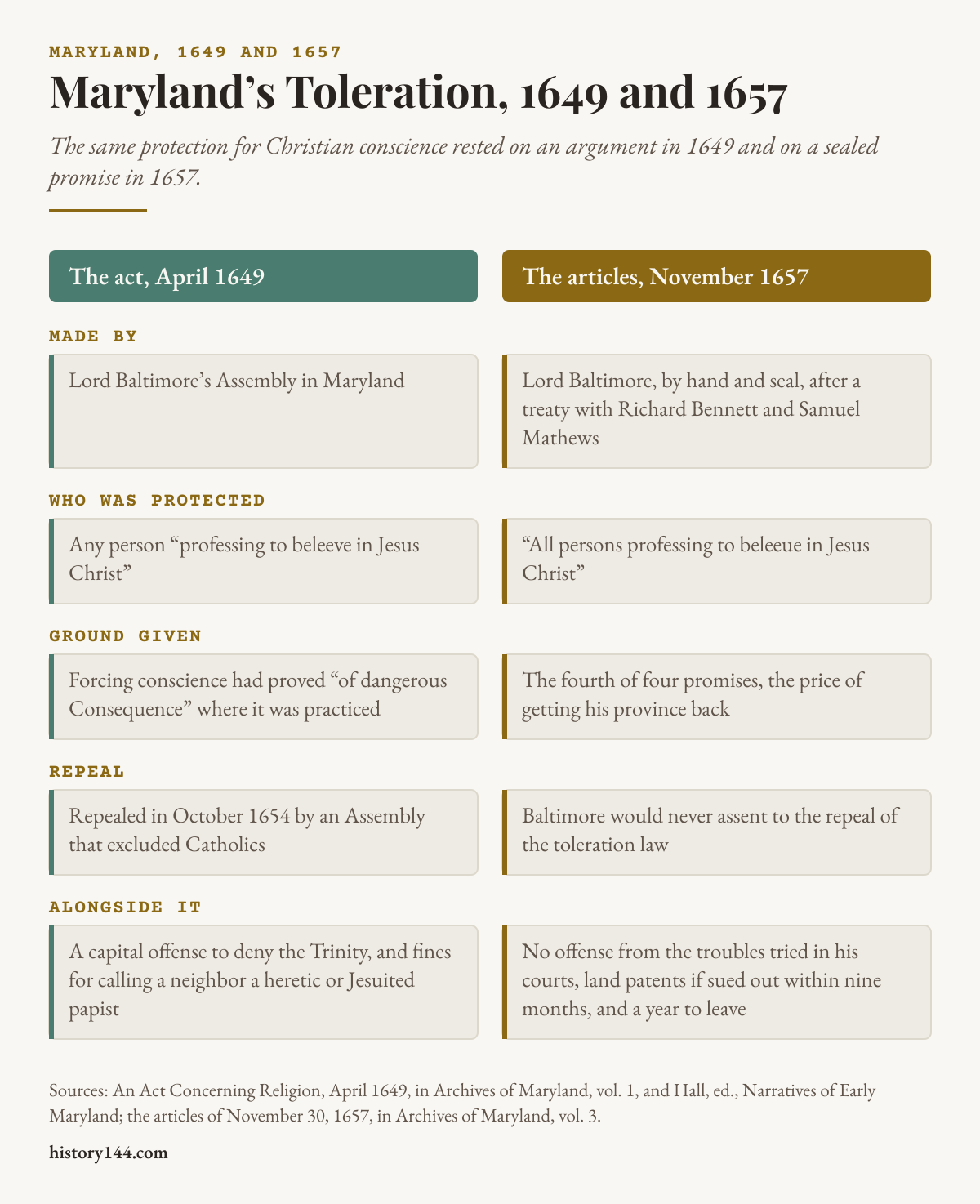
Baltimore's answer to the whole episode was to make the bargain explicit and to put a Protestant in charge of enforcing it. He appointed William Stone, a Protestant from Virginia, as his governor, and he encouraged Puritans who were being squeezed out of Virginia to settle on the Severn, in what became Anne Arundel County. Then, in April 1649, his Assembly passed an act. The act is remembered for one clause and is worth reading for two. It begins by making it a capital offense to deny the Trinity, and it fines anyone who calls a neighbor a heretic, a schismatic, an idolater, a Puritan, a Presbyterian, a Jesuit, a Jesuited papist, a Roundhead, or a Separatist in a reproachful manner. Then it reasons:
"And wheras the inforcing of the Conscience in matter of Religion hath frequently fallen out to bee of dangerous Consequence in those Commonwealths where it hath beene practised, and for the more quiet and peaceable Government of this Province, and the better to preserve mutuall love and unity amongst the Inhabitants here," no person "professing to beleeve in Jesus Christ shall from henceforth be any waies troubled, molested or discountenanced, for or in respect of his or her Religion, nor in the free Exercise thereof."[8]The penalty for breaking the clause was treble damages to the injured party and twenty shillings. The protection covered only those who professed belief in Jesus Christ, and only "so as they be not unfaithful to the Lord Proprietary." The reasoning is the remarkable part. It makes no claim that conscience is sacred. It argues from the record. Forcing conscience had proved dangerous in the commonwealths that tried it, and Maryland wanted to be governed in quiet.
The Liberty of Our Consciences
The settlers Stone had invited in Baltimore's name did not think they owed him much. In January 1654 the county commissioners and inhabitants of the Severn petitioned Parliament's commissioners for Virginia and Maryland against an oath of fidelity that Baltimore required of them on pain of losing their lands. They had come, they said, "with promise of enjoying the liberty of our Consciences in matter of Religion, and all other priviledges of English Subjects," and would not now "Swear absolute subjection to a Government, where the Ministers of State are bound by Oath to countenance and defend the Roman Popish Religion." The petition carried seventy-eight signatures.[9]
The commissioners, Richard Bennett and William Claiborne, had been sent out by Parliament in 1651 to reduce Virginia and the Chesapeake plantations to obedience. They had reduced Virginia in 1652. In July 1654 they returned to Maryland, published a declaration, took Stone's resignation, and set up a government of their own. The Assembly they summoned was elected under writs that barred Catholics, and anyone who had borne arms against Parliament, from voting or sitting. In October 1654 it repealed the Act Concerning Religion and enacted a new one that withheld the liberty from "popery or prelacy" and from those who practiced "Licentiousness."[10]The new act still protected Protestants who differed from the doctrine publicly held forth. What it ended was the liberty of Catholics and of the Church of England. The act of 1649 had lasted five years, and it was repealed by its own beneficiaries within months of their gaining the power to do it.
Sunday the Twenty-Fifth of March
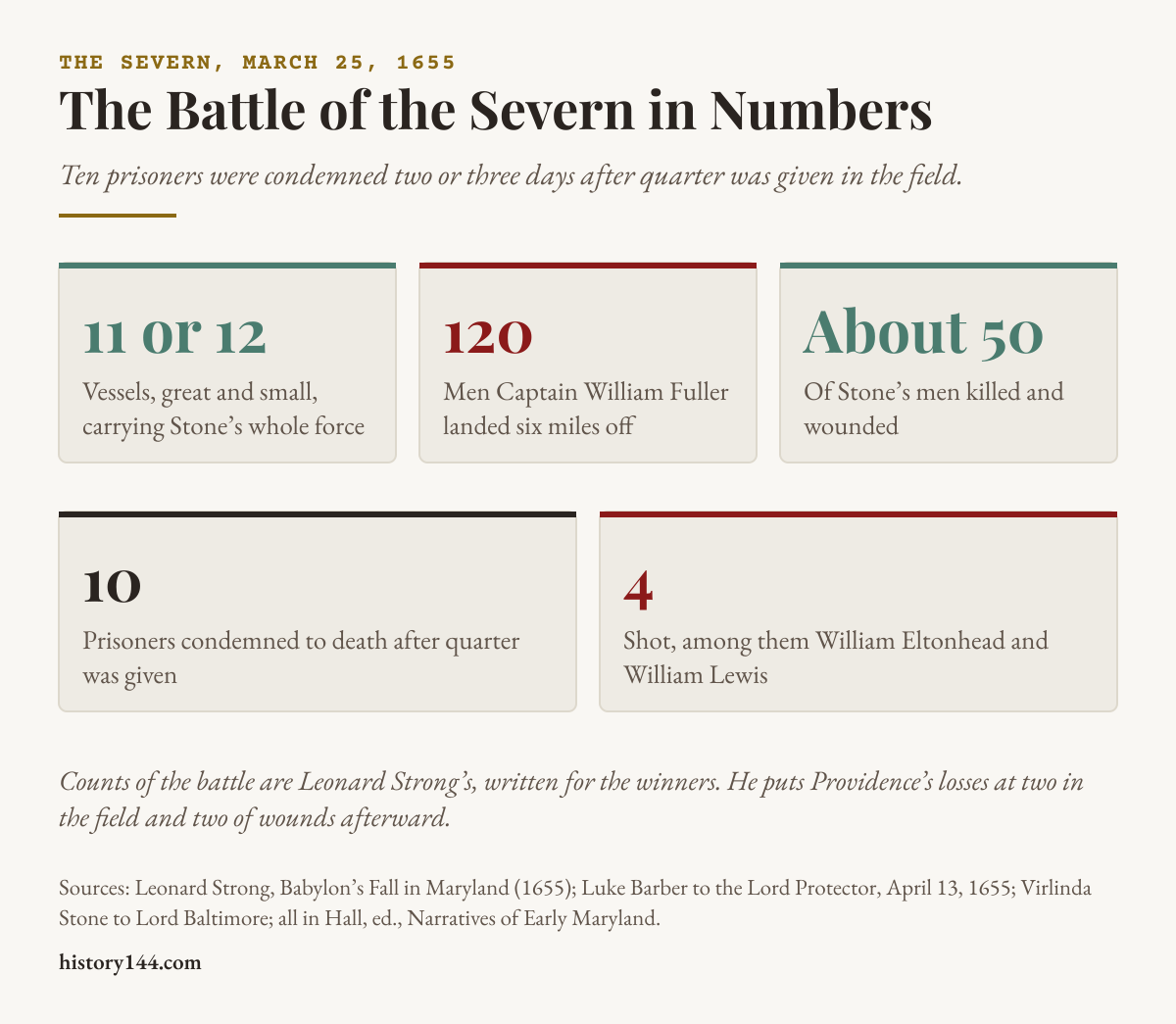
In March 1655 Stone, holding a letter from Lord Baltimore and believing he had the Protector's backing, marched up the bay with a party of men to recover the government. Leonard Strong, who wrote the winners' account within the year, counted eleven or twelve vessels, great and small, carrying Stone's whole force. The Puritans at Providence on the Severn had something better than numbers: a merchant ship, the Golden Lion, lying at anchor in the river under a master named Roger Heamans. The Puritan secretary William Durand went aboard and fixed a proclamation to the mainmast requiring Heamans, in the name of the Lord Protector, to assist them. Heamans "at first was unwilling; but afterwards seeing the equity of the Cause," agreed. The ship fired on Stone's boats as they came up that evening, and in the night they ran into a creek out of its reach. In the morning a small bark with two guns was set across the creek mouth to keep them there.[11]
The fight came that same day, Sunday, March 25, 1655. Strong says the Marylanders appeared on the neck "with Drums and shoutings" calling "Come ye Rogues, come ye Rogues, Roundheaded Dogs." Captain William Fuller landed a hundred and twenty men six miles off and marched on them, ordering his own men on pain of death not to fire first. The Marylanders fired five or six guns and killed a man in the front rank. Then, Strong writes, "the word was given In the name of God fall on; God is our Strength, that was the word for Providence; the Marylanders Word was Hey for Saint Maries."[12]
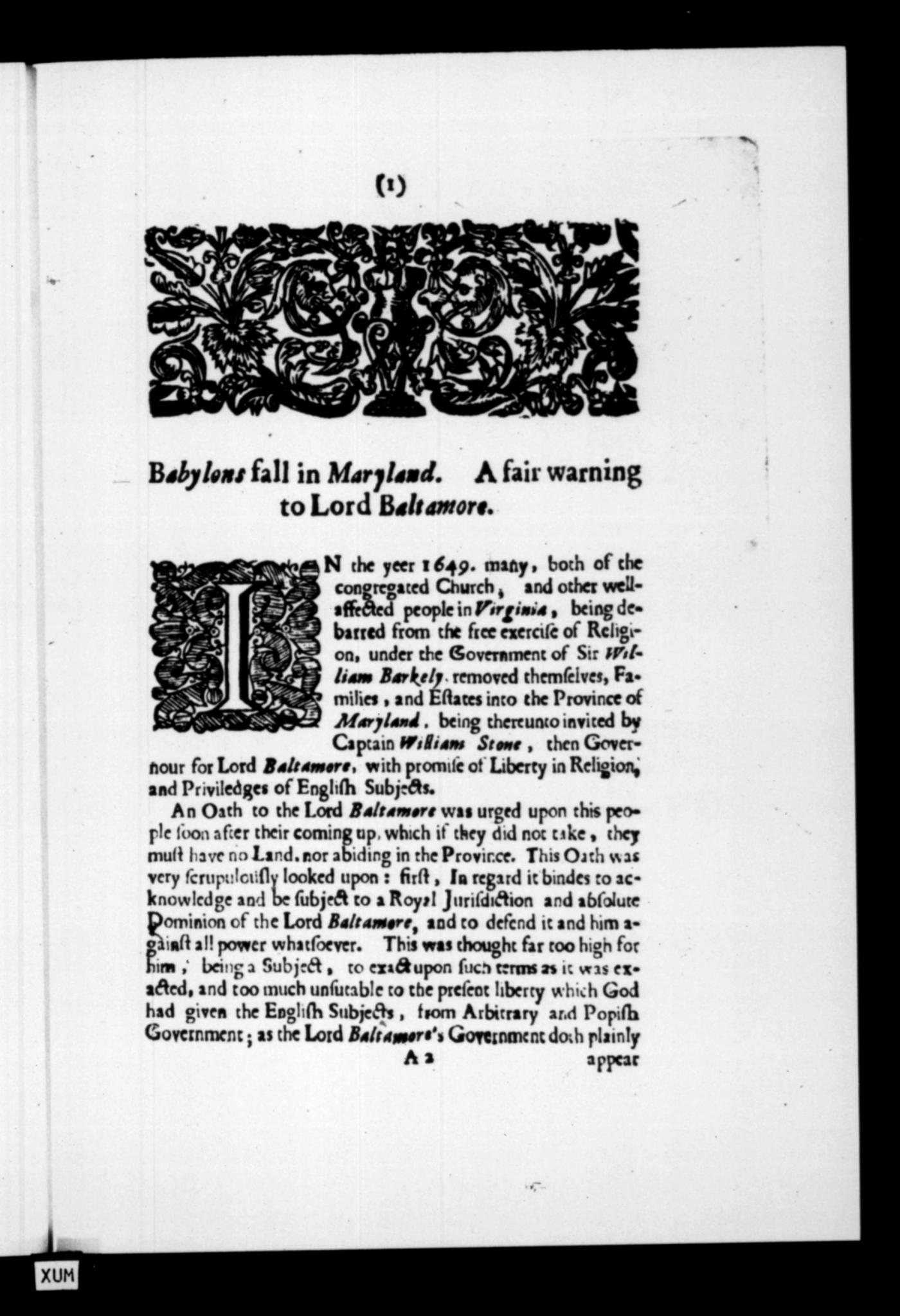
Strong called the charge "fierce and sharp for the time," and then the Marylanders "were all routed, turned their backs, threw down their Arms, and begged mercy." He counts about fifty of Stone's men killed and wounded and nearly all the rest taken, with only four or five escaping. Providence lost two in the field and two of wounds afterward. Virlinda Stone, writing to Lord Baltimore, agreed with the shape of it. She wrote that "upon Sunday the 25. of March they did ingage with the people of Anne-Arundell, and lost the field, and not above five of our men escaped." Her husband took a wound in the shoulder.[13]
Shot in Cold Blood
Strong's pamphlet ends with the victory and says nothing of what came after. Two letters from Stone's side do. Luke Barber, a doctor who had marched with Stone, wrote to Cromwell from Maryland on April 13, 1655. The governor, he said, "upon quarter given him and all his company in the field, yielded to be taken Prisoners. But two or three dayes after the Victors condemnd ten to death, and executed fowre, and had executed all had not the incessant Petitioning and begging of some good women sav'd some, and the souldiers others; the Governour himselfe being condemn'd by them and since begd by the Souldiers, some being sav'd just as they were leading out to execution."[14]
Virlinda Stone named the dead: "onely Master William Eltonhead was shot to death, whose death I much lament, being shot in cold bloud; and also Lieutenant William Lewis, with one Mr Leggat and a Germane." Sentence had been passed on her husband to be shot, "but was after saved by the Enemies owne Souldiers, and so the rest of the Councellors were saved by the Petitions of the Women."[15]
The Jesuits, writing their annual letter for 1655 and 1656, put the same facts in the language of martyrdom. Safety had been guaranteed on conditions, they wrote, but "in treacherous violation of the conditions, four of the captives, and three of them Catholics, out of extreme hatred of our religion were pierced with leaden balls." The priests themselves escaped by boat to Virginia and lived there "in a mean hut, low and depressed, not much unlike a cistern, or even a tomb," without wine enough to say mass.[16]Barber's letter is the more striking document because he was not pleading for a religion. He was telling the Protector that men who had set out crying that they went "to reduce the Country and bring it under the obedience of your Highnesse and the Lord Proprietary" were being sequestered as malignants. He added that the prisoners were not allowed to write even to their wives without having the letters opened.
Hand and Seal
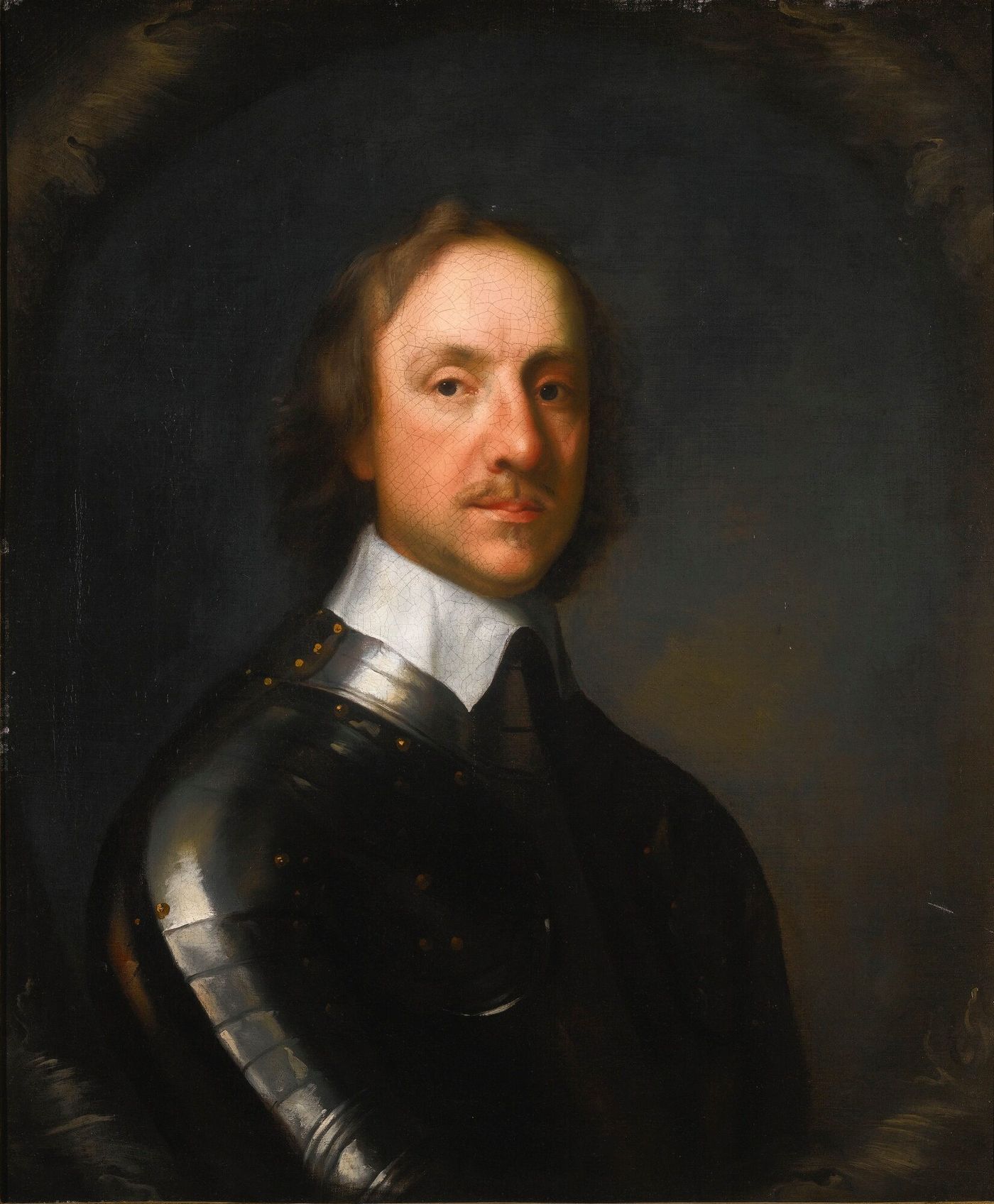
The contest then went back to London, where it had started, and was settled there by exhaustion rather than by judgment. Baltimore complained to the Protector. The matter went first to the commissioners Whitelocke and Widdrington, then to the Committee for Trade, which reported on September 16, 1656. From there it went to the Protector and Council. The articles record with some candor that "by reason of theyr greate affaires haueing not as yett leasure to consider of the said report the same remaines yett vndetermined." Meanwhile the inhabitants of the province "remaine in a very sad distracted & vnsetled condicon."[17]
Baltimore had already instructed his lieutenant and council, on October 23, 1656, that the act concerning religion be "duly observed" by all the inhabitants. Then the parties settled it themselves. On November 30, 1657, after a treaty with Richard Bennett and Samuel Mathews brought about by Edward Digges, Lord Baltimore sealed four promises. No offense arising out of the troubles would be questioned in his courts. Those were left to the Protector and his Council. The people in opposition would have patents for their land as though nothing had happened, provided they sued them out within nine months, took the oath of fidelity in its amended form, and paid their arrears of rent. Any who wished to leave Maryland had a year to do it. And he would never assent to the repeal of the toleration act.[18]
The articles were published at St. Mary's in February 1658 and read at St. Leonard's Creek in Patuxent River the following month. There Captain William Fuller, Richard Preston, and the rest of the Puritan government came to hand over the records and the great seal. Wind and weather held them back two days, and then Sunday was judged not fit to treat of business, though a Sunday had not stopped Fuller on the Severn three years before. On Monday the lieutenant, Josias Fendall, read the articles and demanded "the Records, Greate seale, & the whole Government to be resigned vp into his hands." Two days later, on March 24, Fendall and Philip Calvert signed further articles with Fuller's commissioners, promising an indemnity on both sides and a simple engagement in place of the oath of fidelity. The province changed hands again, and an Assembly that met at St. Leonard's on April 27 enacted that those articles be inviolably observed.[19]
What the Province Kept
Nothing about the settlement was a victory for principle. Baltimore got his province back because he was patient, because he had a charter, and because the Protector's council never found the leisure to consider the report. The Puritans on the Severn kept their land and their lives and gave up the government. Four men stayed dead, and the indemnity of March 1658 meant that nobody would be tried for them. What survived was the clause. It had been enacted under a Catholic proprietor to protect Catholics, repealed by Protestants the moment they could, ordered observed again by its proprietor, and fixed by treaty as the price of a restoration. In 1649 it had been an argument from experience, that forcing conscience had proved "of dangerous Consequence in those Commonwealths where it hath beene practised." By 1657 it was a term in a settlement, binding because a man who wanted his province back had put his seal to it.
That is a poorer foundation than a right and a sturdier one than a majority. An Assembly that disliked the clause had repealed it once, and a proprietor who needed it had revived it. On Christmas Day 1645 the Lords had ordered Maryland settled under the command of Protestants. Twelve years later the Protestants of the Severn still held their land, four men lay dead, and the liberty a Catholic proprietor had granted stood again under his hand and seal.
Places in this Story
The places this story moves through, in order — follow them on the interactive map →
- St. Mary's City, Maryland February 1645
Richard Ingle came into the river in the Reformation and took the capital of the province.
- Westminster, London December 25, 1645
The Lords ordered an ordinance drawn to settle Maryland under the command of Protestants.
- Jamestown, Virginia July 1646
Leonard Calvert, still in exile in Virginia, commissioned Captain Edward Hill to govern in his absence.
- Annapolis, Maryland January 1654
The settlers of Providence petitioned against the oath of fidelity Lord Baltimore required of them.
- Severn River, Maryland March 25, 1655
Captain Fuller landed a hundred and twenty men and routed Governor Stone's force on a neck of land.
- Patuxent River, Maryland March 1658
At St. Leonard's Creek the Puritan government handed over the records and the great seal.
- Whitehall, London September 16, 1656
The Committee for Trade reported on Maryland and the Protector's council never found leisure to consider it.
- City of London, England November 30, 1657
Lord Baltimore set his hand and seal to the four promises that gave him back the province.
Frequently Asked Questions
What was the Plundering Time in Maryland?
It was the period that began when Richard Ingle took St. Mary's City in February 1645 with letters of marque from Parliament. Houses were stripped and the Council's records were lost or destroyed, which is why the Council proceedings fall silent until January 1647.
Who was Richard Ingle?
He was a London ship master who had been arrested in Maryland for words spoken against the king and came back in the Reformation with letters of marque from Parliament. He told the House of Lords he had taken the Covenant and felt conscientiously obliged to assist the Protestants there.
What did the Maryland Act Concerning Religion say?
Passed in April 1649, it forbade anyone professing to believe in Jesus Christ to be troubled or molested for their religion or its free exercise. Its reasoning was practical, that forcing conscience had proved of dangerous consequence in the commonwealths that tried it.
Who won the Battle of the Severn?
The Puritans of Providence under Captain William Fuller routed Governor William Stone's Maryland force on Sunday, March 25, 1655. Fuller landed a hundred and twenty men and had the help of a merchant ship, the Golden Lion, which fired on Stone's boats as they came up the river.
What happened to the prisoners after the Battle of the Severn?
Quarter had been given in the field, but the victors afterwards condemned ten men and shot four, among them William Eltonhead and Lieutenant William Lewis. Luke Barber told Cromwell that all would have been executed but for the incessant petitioning of some good women and the intercession of the soldiers.
How did Lord Baltimore get Maryland back in 1657?
The Protector referred the dispute to the commissioners Whitelocke and Widdrington and then to the Committee for Trade, but his council never decided it, so the parties settled it themselves. On November 30, 1657, Baltimore sealed articles promising that his courts would not try offenses from the troubles, that his opponents would have patents for their land and a year to leave if they wished, and that he would never assent to the repeal of the toleration act.
Was Maryland's toleration act ever repealed?
An Assembly elected under writs that excluded Catholics repealed it in October 1654 and enacted a new law withholding the liberty from popery and prelacy. Lord Baltimore never accepted the repeal, ordered the act observed in 1656, and promised in 1657 never to assent to its repeal.
Bibliography
Browne, William Hand, ed. Archives of Maryland. Vol. 1, Proceedings and Acts of the General Assembly of Maryland, January 1637/8-September 1664. Baltimore: Maryland Historical Society, 1883. Internet Archive. https://archive.org/details/archivesofmaryla01brow. Accessed November 12, 2026.
Browne, William Hand, ed. Archives of Maryland. Vol. 3, Proceedings of the Council of Maryland, 1636-1667. Baltimore: Maryland Historical Society, 1885. Internet Archive. https://archive.org/details/archivesofmaryla03brow. Accessed November 9, 2026.
Hall, Clayton Colman, ed. Narratives of Early Maryland, 1633-1684. Original Narratives of Early American History. New York: Charles Scribner's Sons, 1910. Internet Archive. https://archive.org/details/narrativesofearl0013hall. Accessed November 9, 2026.
Journal of the House of Lords. Vol. 8, 1645-1647. British History Online. https://www.british-history.ac.uk/lords-jrnl/vol8/pp66-69. Accessed November 13, 2026.
Langford, John. A Just and Cleere Refutation of a False and Scandalous Pamphlet Entituled Babylons Fall in Maryland. London, 1655. Reprinted in Hall, Narratives of Early Maryland, pp. 254-75. Internet Archive. https://archive.org/details/narrativesofearl0013hall/page/254. Accessed November 13, 2026.
Strong, Leonard. Babylon's Fall in Maryland: A Fair Warning to Lord Baltamore. London, 1655. Google Books. https://books.google.com/books?id=rPJmAAAAcAAJ. Accessed November 13, 2026. Reprinted in Hall, Narratives of Early Maryland, pp. 235-46.
Citations
- Archives of Maryland, vol. 3, Proceedings of the Council of Maryland, 1636-1667, ed. William Hand Browne (Baltimore: Maryland Historical Society, 1885), p. 165, printing the House of Lords Journal entry "Die Jouis, 25° Decembr: 1645." ↑
- Archives of Maryland, 3:334, the fourth article of the agreement sealed by Lord Baltimore on November 30, 1657. ↑
- "The humble Peticon of Richard Ingle," Archives of Maryland, 3:165-66. ↑
- Archives of Maryland, 3:ix-x (preface) and 3:xiii, noting the gap in the records "due to the loss or destruction of the records during Ingle's raid." ↑
- "Cornewallis, Ingle: Cap' Ingle his papers," March 2, 1645[/6], Archives of Maryland, 3:166-67. ↑
- "The humble Peticon of Richard Ingle" and "Die Martis, 24° Februarie 1645[/6]," Archives of Maryland, 3:165-66. ↑
- Report of the Committee of Lords and Commons for Foreign Plantations, read "Die Veneris, 28 Novem: 1645," Archives of Maryland, 3:164-65. The Lords' order of "Die Jouis, 25to Decembr: 1645" directing the committee to draw up the ordinance is ibid., 3:165; the Journal of the House of Lords, 8:66-69, enters the same day's business under the head of an ordinance for the indemnity of those who should act in reducing the plantation. For Leonard Calvert's commission to Captain Edward Hill, given in Virginia on July 30, 1646, see Archives of Maryland, 3:171-72; the Council record resumes in January 1646[/7]. Cornwallis's petition of March 31, 1646, complaining that Ingle had not attended and was trying to leave the realm, is at Archives of Maryland, 3:170-71. ↑
- An Act Concerning Religion, April 1649, printed in Clayton Colman Hall, ed., Narratives of Early Maryland, 1633-1684 (New York: Charles Scribner's Sons, 1910), pp. 272-73, from John Langford's Refutation of Babylon's Fall; the engrossed original is in Archives of Maryland, 1:244-47. ↑
- "The Humble Petition of the Commissioners and Inhabitants of Severne, alias Ann Arundel County," Severn River, January 30, 1653[/4], in Hall, Narratives of Early Maryland, pp. 218-19. ↑
- "An Act Concerning Religion," October 1654, Archives of Maryland, 1:340-41, providing "that this Liberty be not Extended to popery or prelacy," and 1:351, listing the "Act concerning Religion" among the "Acts Repealed"; for the exclusion of Catholics from voting and sitting, the commissioners' order of July 22, 1654, that "all such shall be disabled to give any Vote, or to be Elected Members thereof, as have born Arms in War against the Parliament, or do profess the Roman Catholick Religion," in Hall, Narratives of Early Maryland, p. 228; see also Hall, p. 216 n. 2. ↑
- Leonard Strong, Babylon's Fall in Maryland (London, 1655), in Hall, Narratives of Early Maryland, pp. 242-43. ↑
- Strong, Babylon's Fall, in Hall, Narratives of Early Maryland, pp. 243-44. Luke Barber, who was with Stone, was told that the Golden Lion's fire had killed one of Stone's men that morning, before the fight began. Barber to the Lord Protector, April 13, 1655, in Hall, p. 264. ↑
- Strong, Babylon's Fall, in Hall, Narratives of Early Maryland, p. 244; Virlinda Stone to Lord Baltimore, in Hall, pp. 265-66. ↑
- Luke Barber to the Lord Protector, Maryland, April 13, 1655, printed in John Langford, A Just and Cleere Refutation of a False and Scandalous Pamphlet (London, 1655), in Hall, Narratives of Early Maryland, pp. 263-65. ↑
- Virlinda Stone to Lord Baltimore, in Hall, Narratives of Early Maryland, pp. 265-66. ↑
- Annual letter of the Jesuits for 1655 and 1656, in Hall, Narratives of Early Maryland, pp. 141-42. ↑
- Archives of Maryland, 3:332-33, reciting the reference to Whitelocke and Widdrington, the report of the Committee for Trade of September 16, 1656, and the delay. ↑
- Archives of Maryland, 3:333-34, the four articles. For the instructions of October 23, 1656, see 3:324-25. ↑
- Archives of Maryland, 3:332 and 334-35, the proceedings at St. Mary's in February and at St. Leonard's in March 1657[/8]. The articles of March 24, 1657[/8], and the Assembly's act confirming them are in Archives of Maryland, 1:369-71. ↑