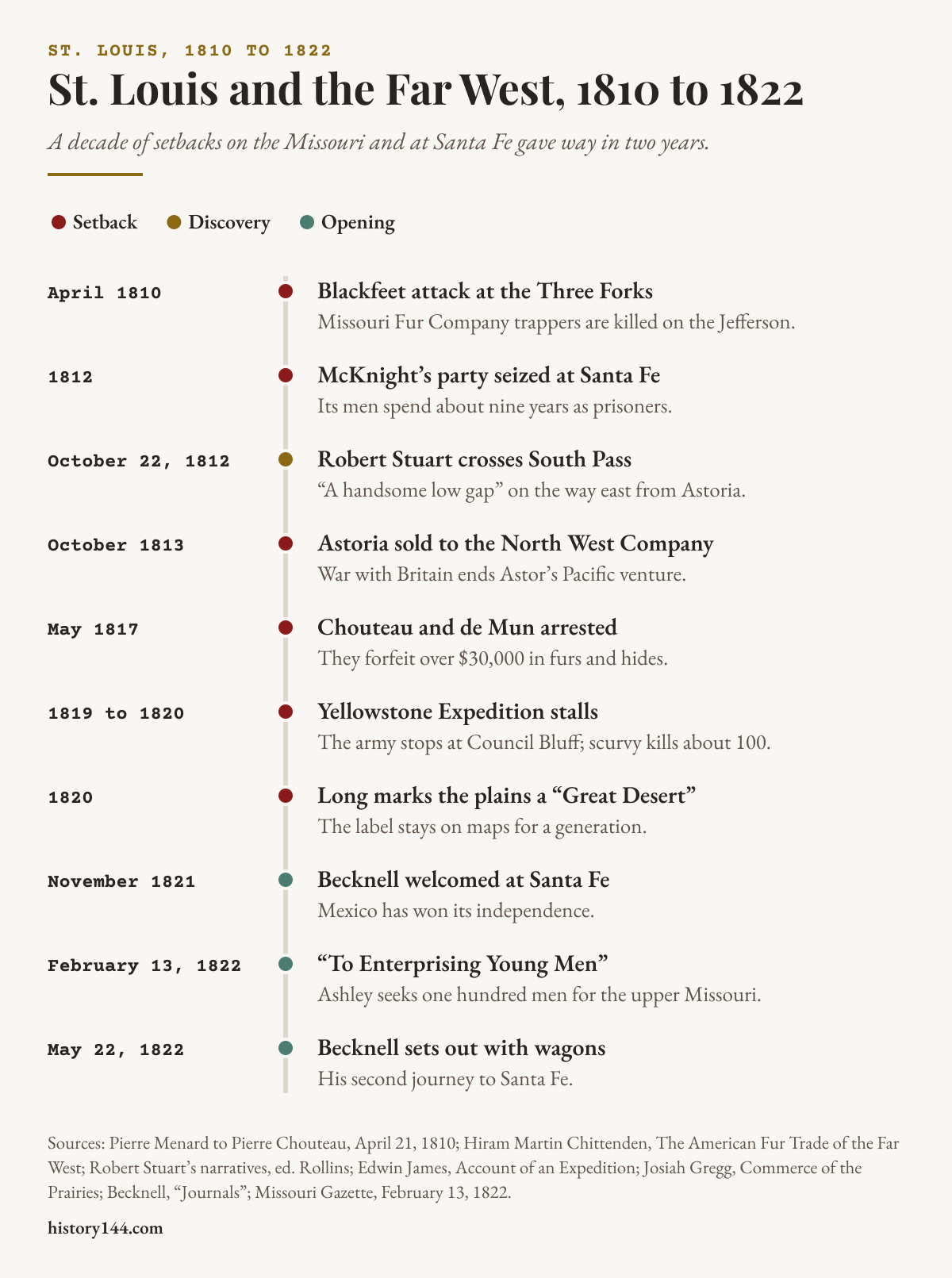
On April 21, 1810, at a newly built stockade near the place where the Jefferson, Madison, and Gallatin Rivers join to form the Missouri, the trader Pierre Menard wrote a letter to his partner Pierre Chouteau in St. Louis. Nine days earlier a Blackfeet war party had attacked a group of the company's trappers on the Jefferson and killed two men, James Cheeks and a man named Ayres. The raiders carried off the party's beaver, many of its traps, some ammunition, and seven horses. Three other men were missing, and the survivors had recovered only forty-four traps and three horses. The hunters were discouraged, and Menard had to send them out again in a body of thirty, each man carrying only three traps. Unless the company could make peace with the Blackfeet or see them destroyed, he wrote, there was no point in keeping a post at the Three Forks at all. Yet he could not let go of what he had seen. "The resources of this country in beaver fur are immense," he told Chouteau.[1]
Menard's letter sets out the problem St. Louis faced for the next twelve years. Its merchants knew that the Far West held great wealth: beaver in the northern Rockies and on the Columbia, and a hungry market for manufactured goods in the Spanish towns of New Mexico. They tried repeatedly to reach it, and almost every attempt failed. Blackfeet warriors drove them from the upper Missouri, a war with Britain wrecked their Pacific venture, Spanish officials seized their goods and locked them in prison, and government expeditions sent to clear the way stalled on the river or returned with discouraging reports. Then, in 1821 and 1822, it opened within a few months. A debtor from the Missouri town of Franklin found a welcome in Santa Fe where earlier traders had found a jail, and a St. Louis politician placed a newspaper advertisement that launched the Rocky Mountain fur trade. Debt and hard times in Missouri pushed men to try again, but the change that made the difference came from Mexico City. This is the story of those twelve years.
The Lure of Santa Fe
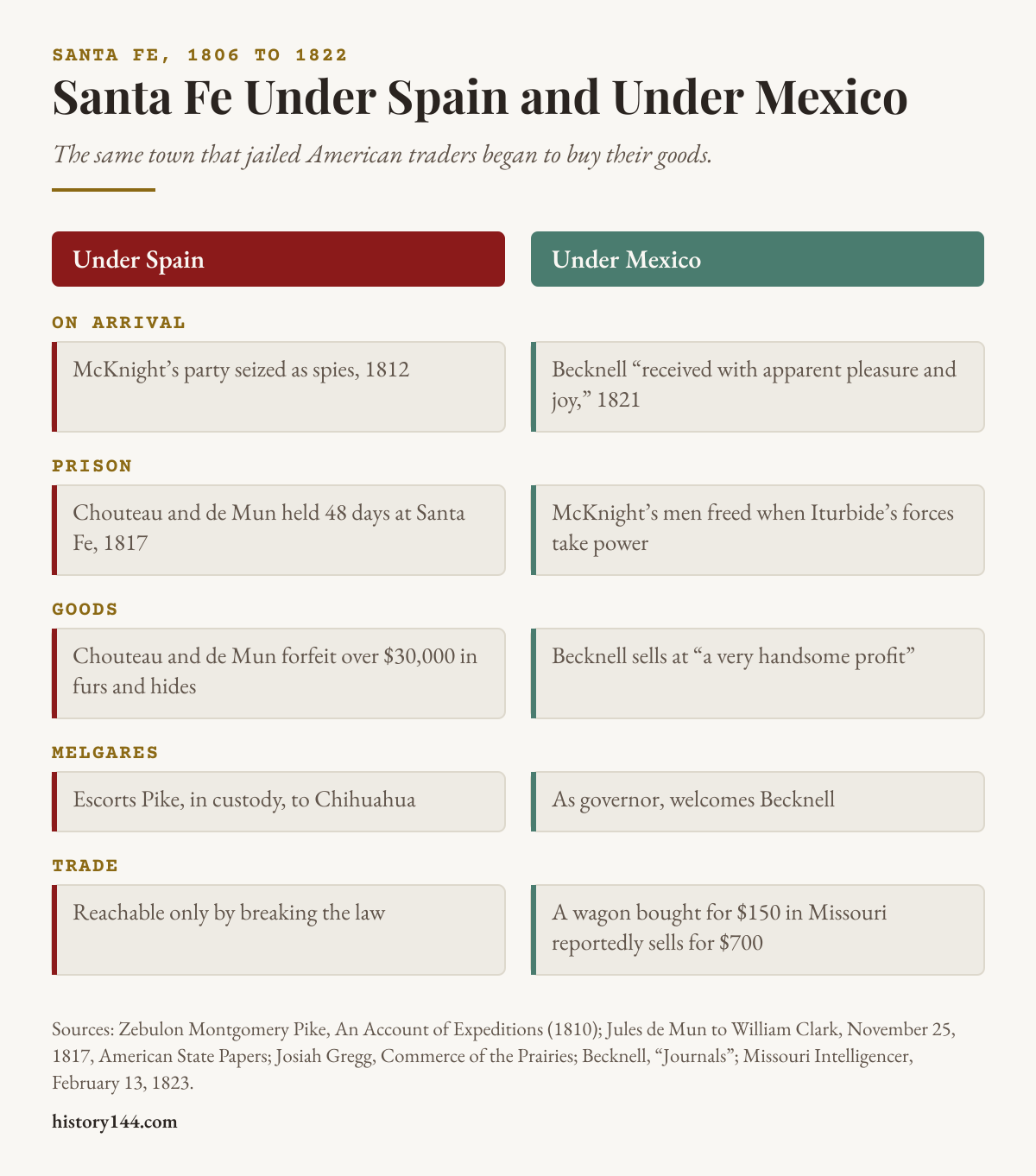
The same year Menard wrote from the Three Forks, a Philadelphia firm published Zebulon Montgomery Pike's account of his western expeditions. In 1806 and 1807 Pike had led a small army party across the plains to the southern Rockies, where Spanish soldiers took him into custody and carried him to Santa Fe and then south to Chihuahua. The officer in charge of him was Lieutenant Facundo Melgares, who the previous year had led a large Spanish force onto the plains to assert Spain's claims against the Americans. Pike wrote that Melgares received him with "the most manly frankness." The two men conversed in French, traveled together for weeks, and parted as friends, Pike leaving Melgares a shotgun as a gift.[2]
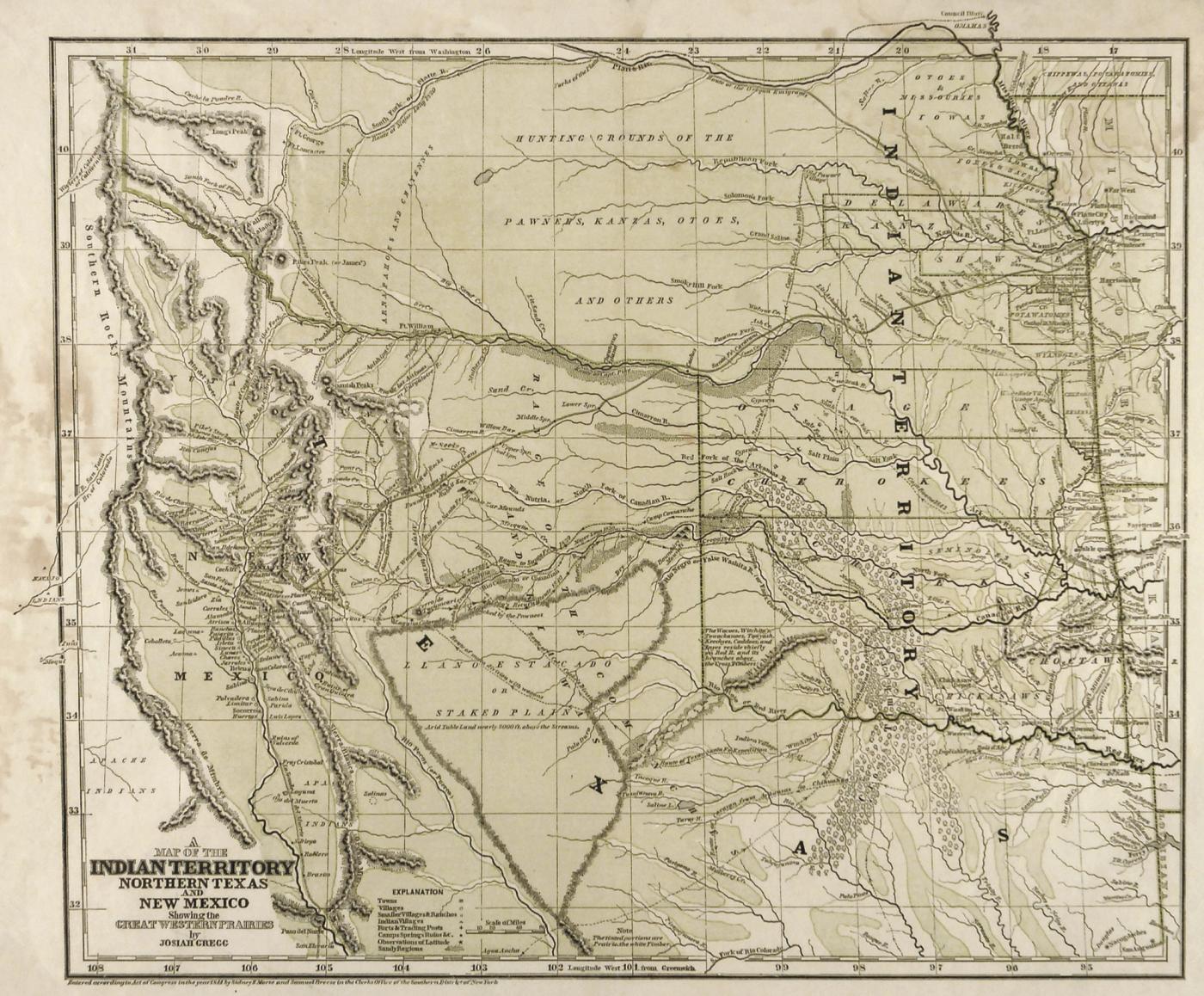
Pike's book reached a public eager for news of the Spanish borderlands. His descriptions of the people and economy of New Mexico interested enterprising merchants in the Mississippi valley, who saw in them a guide to opening trade. As the historian Leo Oliva has written, trading expeditions inspired by the book were being outfitted by 1812.[3] Writing three decades later, the Santa Fe trader Josiah Gregg recalled how Pike's "exciting descriptions of the new El Dorado" had spread through the western country.[4]
The difficulty was Spanish law. New Spain closed its northern provinces to foreign traders, and American parties who approached Santa Fe were arrested by Spanish soldiers. Many were taken south toward the interior of Mexico to serve long prison terms.[5] Pike himself had been escorted out of the country. Until Spanish rule ended, the trade he described could be reached only by breaking the law.
Driven from the Three Forks
The St. Louis Missouri Fur Company, organized in 1809 by Manuel Lisa, members of the Chouteau family, William Clark, and other partners, was the town's most ambitious attempt on the northern beaver country. Its men reached the Three Forks in the spring of 1810, and the Blackfeet resisted them at once. The Blackfeet resented the company's trade with their enemies, and in April the trappers on the Jefferson were overwhelmed, according to one report, because "the Indians were too numerous." Accounts of the losses differ. Menard's letter named two dead and three missing, while a report printed in the Louisiana Gazette that July listed five men killed.[6]
Worse followed in early May. George Drouillard, the hunter and interpreter who had served Lewis and Clark, went out against the advice of others in the camp, who expected danger. Some two miles from the post he and two of his companions were ambushed and killed. According to the Gazette, Drouillard made a breastwork of his horse and fought until he too was overwhelmed, and a high wind kept the sound of the firing from reaching help nearby. By the newspaper's estimate the company had lost upwards of $12,000 in furs, although it still sent down roughly fifty packs of beaver.[7] Among the men who left the mountains that year was Thomas James, a young trapper who had gone upriver with the company in 1809, quit it, and trapped near the Three Forks with two companions. He suffered snow blindness and attacks by grizzly bears, and he reached St. Louis in August 1810 with little to show for the venture.[8] A decade later he went west again, this time to Santa Fe.
Andrew Henry, Menard's fellow partner, stayed on. In the fall of 1810 he led a party across the Continental Divide in search of more peaceful tribes and better trapping. He spent a hard winter on the north fork of the Snake River, a stream later named Henry's Fork. His men lived on roots and dressed in skins, but Henry brought back enough beaver for a modest profit. When he returned to St. Louis in the fall of 1811, however, he withdrew from the fur trade. He went back to the lead mines of Washington County, Missouri.[9] The company that had sent him out was reorganized early in 1812 with fewer partners, and the expedition it sent upriver that year came back with few furs and little profit.[10]
Astor's Overland Gamble
While Lisa's men fought for the upper Missouri, John Jacob Astor of New York planned to build a Pacific Fur Company with its headquarters at the mouth of the Columbia, supplied by sea and connected to St. Louis by an overland chain of posts. One party sailed around Cape Horn and founded Fort Astoria in 1811. A second party, under Astor's partner Wilson Price Hunt, came to St. Louis to organize the overland journey. Hunt was a merchant with no experience of wilderness travel. He gathered men in Canada and St. Louis in the fall of 1810 and went into winter camp at the mouth of the Nodaway River before starting up the Missouri the next spring.[11]
Hunt avoided the Blackfeet country that Lewis and Clark had crossed. His party went up the Missouri to the Grand River, turned west across present-day South Dakota, traveled across the Powder River Basin and the Bighorn Mountains, crossed the Continental Divide at Union Pass, and descended the Hoback River to the Snake. On the Snake, Hunt left his horses behind and put the party into fifteen dugout canoes. At a stretch of rapids the Astorians called Caldron Linn, in present-day southern Idaho, a canoe capsized and a voyageur drowned. It became clear that the river could not be navigated. The party broke into smaller groups and struggled on foot toward the Columbia through the late autumn and winter.[12] The overland Astorians straggled into the fort through January and February 1812. Hunt's own group arrived on February 15.[13]
Astoria survived barely two years. When news of war with Britain reached the Columbia, the partners there feared the arrival of British warships. In October 1813 some seventy-five traders of the Montreal-based North West Company came down the river. The Astorians sold out to them, and the post became Fort George.[14] Before then, a party from Astoria had found a new way across the mountains. On June 29, 1812, a small party under Robert Stuart set out eastward from Astoria for St. Louis. In mid-August, in present-day southwestern Idaho, Stuart met the Shoshone guide who had led Hunt's men and paid him to show a shorter route. On October 22, 1812, after what Stuart's journal called a "hard tramp," the seven men "passed thro a handsome low gap" in the mountains, the passage later known as South Pass. They wintered on the North Platte and reached St. Louis on April 30, 1813.[15] South Pass later carried the Oregon Trail, but with Astoria lost and the country at war, St. Louis made no use of it for another decade.
The War on the Missouri
The War of 1812 drove the remaining St. Louis traders off the upper river. After another disappointing season the Missouri Fur Company was dissolved and reorganized yet again, and the war interrupted its trade with the upper Missouri tribes until 1816. In the meantime the company worked closer to home, building a new post, Fort Lisa, five or six miles below the Council Bluff, in what is now north Omaha.[16] The company's upriver post above the mouth of the Knife River, in present-day North Dakota, was abandoned when the war broke out.[17]
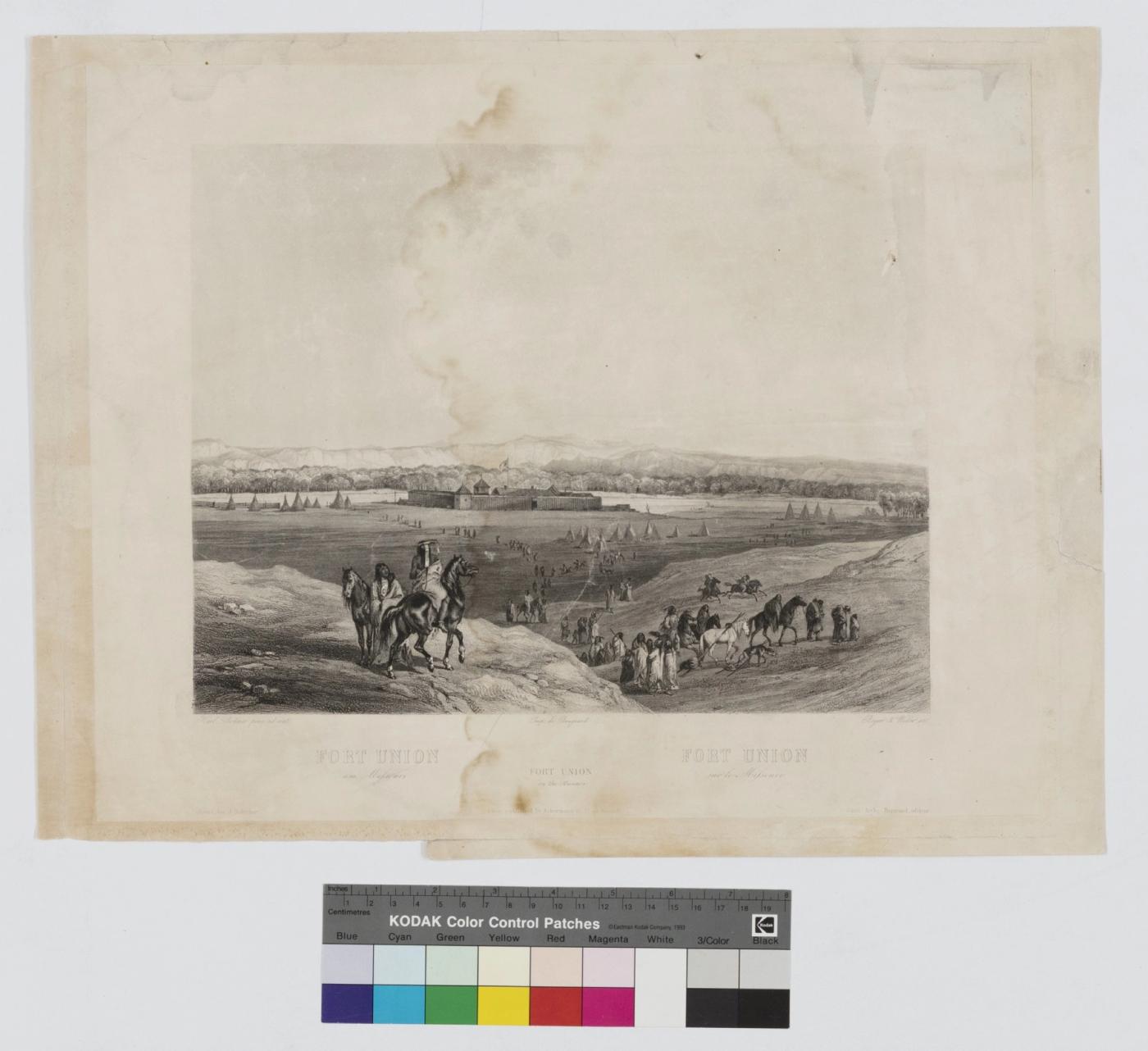
During the war Lisa served the government as well as the company. William Clark, governor of the Missouri Territory, appointed him an Indian subagent, a representative of the federal government to the tribes, at a time when the war made their loyalties a matter of real concern.[18] After the war the company was reorganized once more, in 1819. Lisa led one final expedition upriver that year, returned in the spring of 1820, and died unexpectedly that August.[19] The Three Forks, where the company had built its stockade in 1810, still had no American post.
Prisoners of New Spain
The southern route was no safer. In 1812, about a dozen men under Robert McKnight, James Baird, and Samuel Chambers loaded a pack train with goods and set out for Santa Fe, following the route Pike had described. They reached the town safely, but Spanish authorities seized them as spies, confiscated their goods, and sent them south to Chihuahua. According to Gregg, they remained prisoners there for about nine years.[20] They arrived soon after the royal government had crushed the revolt Miguel Hidalgo began in 1810 and executed Hidalgo in 1811, and it was in no mood to tolerate American visitors.
Five years later two men from leading St. Louis families met the same treatment. Auguste Pierre Chouteau and Jules de Mun had spent two years trapping and trading on the upper Arkansas and among the tribes near the mountains. In May 1817, Spanish troops arrested them and their party on the charge of entering Spanish territory illegally. De Mun later reported to Governor William Clark that they spent forty-eight days in prison at Santa Fe before facing a court-martial. The men forfeited furs and hides worth more than $30,000 and were banished from New Mexico.[21] A young trader from Kentucky, David Meriwether, was captured during a skirmish between New Mexican troops and Pawnees, held for about a month in the prison of the Palace of the Governors, and expelled. Accounts date his capture to 1819 or 1820.[22] So long as Spain ruled New Mexico, American traders who went there risked prison and the loss of their goods.
The Government Tries and Fails
In 1818 the federal government decided to do what private enterprise could not. Secretary of War John C. Calhoun planned a military expedition up the Missouri to establish posts as far as the mouth of the Yellowstone, keep British traders out of American territory, and win over the Native nations of the northern plains. The Yellowstone Expedition was an early experiment with steamboats on the Missouri. Of the five boats the contractor provided, there is no record that two ever entered the Missouri. The Jefferson gave out thirty miles below Franklin, and the Expedition and the Johnson wintered at Cow Island, a little above the mouth of the Kansas River. A small army steamboat built for the expedition carried Long's scientific party as far as Fort Lisa, but the troops got no farther than Council Bluff, far short of the Yellowstone. In the winter of 1819 and 1820 scurvy struck more than three hundred soldiers at Camp Missouri and killed about one hundred. The Panic of 1819, the contractor's failures, and the steamboats' poor performance persuaded Congress to restrict further funding.[23]
What remained was a small scientific party under Major Stephen H. Long. In 1820 Long led it up the Platte to the Rocky Mountains and returned by way of the Arkansas and Canadian Rivers.[24] The expedition added a good deal to what Americans knew of the plains. Long's map marked the high plains as the "Great Desert." The expedition's findings, published in 1823 in an account compiled by Edwin James, pronounced the region "almost wholly unfit for cultivation" and therefore uninhabitable by an agricultural people.[25] The report put this down to "the scarcity of wood and water, almost uniformly prevalent," which "will prove an insuperable obstacle in the way of settling the country."[26] How far the label actually discouraged settlement is harder to measure. Frank Schubert, a historian of the army's western explorations, notes that Long went down in history as the author of the "Great American Desert" myth and as a delaying influence on western settlement. His map, desert and all, remained the standard map of the region for a generation.[27] For St. Louis in 1820, the government's effort to open the West had produced a post at Council Bluff and a map that called the plains a desert.
Boom and Bust in the Boonslick
The Missourians who would finally break through came not from St. Louis itself but from the Boonslick country along the Missouri River in the center of the territory. A few settlers had arrived before the War of 1812, and many more came after it. Howard County and the town of Franklin, on the Missouri River bottom, were established in 1816.[28] In April 1819 the Missouri Intelligencer and Boon's Lick Advertiser began publication there.[29]
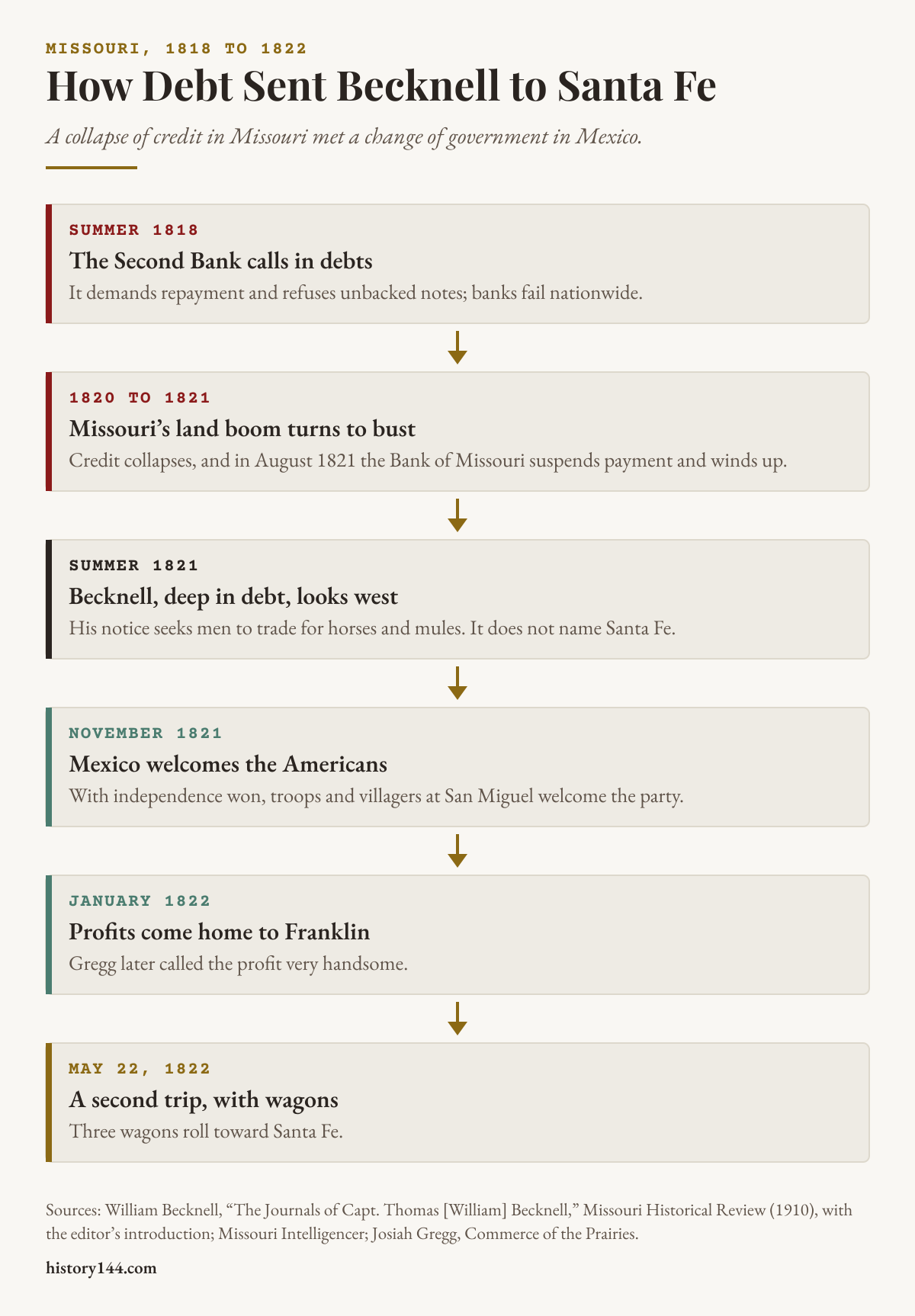
Like much of the West, Franklin had grown on credit. Across the country, speculation in land and easy loans after the War of 1812 had concealed the weakness of an economy in which many state banks issued notes with little hard money behind them. In the summer of 1818 the Second Bank of the United States began demanding repayment of debts and refusing unbacked notes, and banks and businesses failed across the nation. In Missouri, a boom in land bought on credit turned to bust.[30] The Bank of Missouri suspended specie payments on August 4, 1821, and its directors decided to wind up its business, in the same month that Missouri became a state.[31] Hard money almost vanished.
Among the Boonslick's debtors was William Becknell, who had served as a soldier in the War of 1812. In the summer of 1821, in debt and with the Missouri economy in collapse, he looked west for a way out.[32]
Becknell's Gamble
In July 1821 Becknell advertised in the Intelligencer for men to join "a company of men destined to the westward for purposes of trading for Horses and Mules, and catching Wild Animals of every description."[33] The notice did not mention Santa Fe. The historian F. F. Stephens concluded that the plan included trapping as well as trading, since ten dollars a man would have bought too few goods to make a Santa Fe venture worthwhile, and two early traders, Gregg and Alphonso Wetmore, both said that Becknell turned toward Santa Fe only after falling in with Mexicans on the plains.[34] A company of seventeen men met at the home of Ezekiel Williams in August and elected Becknell their captain. How many actually made the journey is uncertain, and Becknell's journal gives no count. Stephens thought the party numbered from twenty to thirty men, while Gregg, writing more than twenty years later, remembered Becknell and "four trusty companions."[35] On September 1, 1821, they crossed the Missouri near the Arrow Rock ferry and rode west.[36]
Becknell's journal of the trip is terse. The party crossed the plains to the Arkansas, followed it toward the mountains, and turned south. On November 13 they met a party of Spanish troops, who treated them with evident kindness.[37] Earlier American traders had been arrested at such meetings, but these soldiers camped with the Missourians that night, and the next day the party reached the village of San Miguel on the Pecos, whose people made them welcome. They went on to Santa Fe, where Becknell recorded that they were "received with apparent pleasure and joy."[38] Spanish rule had ended. Agustín de Iturbide's Plan of Iguala had opened the last campaign for independence in February 1821, the Treaty of Córdoba was signed in August, and Iturbide's army entered Mexico City at the end of September, seven weeks before Becknell reached Santa Fe. The new authorities were inclined to welcome commerce that the royal government had forbidden.
The governor who received Becknell was Facundo Melgares, the same officer who had escorted Pike to Chihuahua fourteen years earlier. He had governed New Mexico since 1818, and Oliva suggests that his friendship with Pike was one reason he welcomed American traders.[39] Becknell found him "well informed and gentlemanly in manners," and wrote that the governor hoped the Americans would keep up an intercourse with the country. Becknell's goods sold at what Gregg called "a very handsome profit."[40] He had reached Santa Fe in mid-November, about two weeks ahead of Thomas James, the onetime Three Forks trapper, who arrived on December 1 with a party of eleven men and about $10,000 in goods. James's trading venture failed.[41]
Becknell reached Franklin again in January 1822, forty-eight days after setting out for home.[42] How much he brought back is uncertain. The figures usually quoted belong to the next season. In February 1823 the Intelligencer answered a speech in which John Floyd of Virginia had told Congress that a wagon returned from Santa Fe the previous summer "bringing with it $10,000." The paper agreed that $10,000 or more had come into Missouri from Santa Fe that summer, but insisted that it had come on packhorses rather than in a wagon.[43] A bystander later recalled seeing rawhide packages of silver dollars dumped on the sidewalk at Franklin.[44] Whatever the truth of that scene, silver from Santa Fe was welcome in a town where hard money had become scarce. Becknell's own debts took time to settle.[45] From January to May 1822 the Intelligencer still carried notices of a suit by attachment against him for $495.75, brought by Henry V. Bingham as administrator of an estate. The editor who later published Becknell's journal concluded that the matter was no doubt satisfactorily arranged before he set out again.[46]
Wagons and Enterprising Young Men
Becknell set out on his second journey on May 22, 1822. His journal records a company of twenty-one men with three wagons.[47] Wagons could carry far more than a pack train, and they could be sold at the end of the trip. One wagon that cost $150 in Missouri reportedly sold in Santa Fe for $700.[48] After traveling eight days up the Arkansas, the party left the river and struck southwest across the dry plains. It reached San Miguel, which Becknell called St. Michael, twenty-two days after leaving the Arkansas.[49]
Gregg tells a well-known story about this crossing. According to him, the men ran out of water on the arid plain between the Arkansas and the Cimarron and were reduced to killing their dogs and cutting the ears off their mules in the vain hope of quenching their thirst with blood. They were saved, in Gregg's telling, when they killed a buffalo that had just drunk from the Cimarron and drank the water from its stomach.[50] Gregg's account should be read with caution. He wrote that the party then turned back to the Arkansas and reached New Mexico by way of Taos, but Becknell's own journal shows that he crossed the dry country. Gregg also called an 1824 caravan the first attempt to bring wagons on the trail, two years after Becknell's.[51] By 1831, when Gregg made his first trip, caravans regularly made the same dry crossing from the Arkansas to the Cimarron, though there was still no road or even a trail across it.[52]
The 1812 prisoners were freed in the same years. According to Gregg, McKnight and his companions were released from Chihuahua only when Iturbide's forces came to power, after some nine years in confinement, and in September 1822 a St. Louis paper reported James McKnight home again after "a good part of ten years" as a prisoner.[53] Santa Fe, where they had been arrested, was now open to American trade.
Early in 1822, in St. Louis, Andrew Henry formed a partnership with William H. Ashley, a St. Louis businessman then serving as Missouri's lieutenant governor, with Henry as the principal field agent and Ashley managing the business.[54] On February 13, 1822, Ashley placed a notice in the St. Louis newspapers addressed "To Enterprising Young Men." He wished to engage one hundred men to ascend the Missouri to its source and work there for one, two, or three years. He directed those interested to Major Andrew Henry, who would command the party.[55] Many of the young men who answered went on to become the mountain men of the Rocky Mountain fur trade. Instead of relying mainly on trading posts and on furs bought from the tribes, they trapped the streams themselves in small parties, though they still depended on Native knowledge and trade. The approach Henry and Ashley worked out would change the way the American fur business operated.[56]
Henry led the expedition upriver that spring. His goal was the Three Forks, the place from which he had been driven twelve years earlier. After losing many horses to an Assiniboine raiding party, however, he went only as far as the mouth of the Yellowstone, where he sent trappers out.[57] In February 1824 a party of Ashley's men under Jedediah Smith, wintering with the Crow on the Wind River, found the mountains to the north too deep in snow to cross. They took a southern course instead, and that spring they reached the Green River, which the Indians called the Siskadee, by way of the gap that Robert Stuart had found in 1812.[58]
The Gateway Built on Failure
The St. Louis that greeted Becknell's success and Ashley's advertisement was the same town that had sent out Menard, Hunt, McKnight, and Chouteau. Twelve years of failed ventures had taught its traders a great deal about the Arkansas and the Platte, South Pass and the Snake, prices and officials in Santa Fe, and which tribes would trade and which would fight. Men like Thomas James and Andrew Henry carried that experience from one venture to the next, and when conditions changed they were ready to use it.
Most of what changed came from outside Missouri. The end of the war with Britain reopened the upper river, and the collapse of the Missouri economy drove men like Becknell to take risks they might otherwise have avoided. Above all, Mexican independence turned Santa Fe from a place where Americans were jailed into a market that welcomed them. The Mexican silver that followed proved especially important to a state whose banking system had just collapsed.[59] Long's "Great Desert" stayed on the maps, though traders were already taking wagons across it.
Pierre Menard had written from the Three Forks in 1810 that the beaver resources of the country were immense, and that without peace there was no point in staying. Twelve years later the beaver were still there, and so were the Blackfeet. In the spring of 1822 Andrew Henry went back up the Missouri with Ashley's enterprising young men, and William Becknell took his wagons toward Santa Fe. Both ventures drew on what St. Louis traders had learned in twelve years of failure.
Places in this Story
The places this story moves through, in order — follow them on the interactive map →
- Three Forks, Montana April 21, 1810
Pierre Menard wrote that the beaver of the country was immense and that without peace the post could not be held.
- Santa Fe, New Mexico November 1821
Becknell was received with apparent pleasure and joy where earlier Americans had been arrested.
- Astoria, Oregon February 15, 1812
Wilson Price Hunt's overland party straggled in after losing a man at the rapids on the Snake.
- South Pass, Wyoming October 22, 1812
Robert Stuart's seven men passed through a handsome low gap on their way east from the Columbia.
- Chihuahua, Mexico 1812
The McKnight party was sent south as spies and held for about nine years.
- Council Bluff, Nebraska 1819
The Yellowstone Expedition got no further, and scurvy killed about one hundred soldiers.
- Franklin, Missouri January 1822
Becknell came home forty-eight days out of Santa Fe to a town that had nearly forgotten hard money.
- Arrow Rock, Missouri September 1, 1821
Becknell's company crossed the Missouri near the ferry and rode west.
- St. Louis, Missouri February 13, 1822
Ashley advertised for one hundred enterprising young men to ascend the Missouri to its source.
Frequently Asked Questions
Why did the Missouri Fur Company abandon the Three Forks?
Blackfeet war parties attacked its trappers through the spring of 1810, killing several men including George Drouillard of the Lewis and Clark expedition. Pierre Menard wrote that without peace with the Blackfeet there was no point in keeping a post there at all.
What happened to John Jacob Astor's Pacific Fur Company?
One party founded Fort Astoria at the mouth of the Columbia in 1811 and a second crossed overland under Wilson Price Hunt. When war with Britain reached the Columbia the partners sold out to the North West Company in October 1813.
Who found South Pass and when?
A small party under Robert Stuart, traveling east from Astoria, passed through a handsome low gap in the mountains on October 22, 1812. With Astoria lost and the country at war, St. Louis had no use for the discovery for another decade.
Why were American traders imprisoned in Santa Fe?
New Spain closed its northern provinces to foreign traders, so parties that reached Santa Fe were seized as spies and sent south. According to Gregg, the men of the 1812 McKnight party spent about nine years in Chihuahua.
What was the Yellowstone Expedition?
It was Secretary of War Calhoun's plan to put army posts as far up the Missouri as the Yellowstone. The steamboats failed, the army got no further than Council Bluff, and scurvy killed about one hundred soldiers in the winter of 1819 and 1820.
Why did William Becknell go to Santa Fe in 1821?
He was heavily in debt in a Missouri whose banking system had just collapsed. He advertised for men to trade for horses and mules, crossed the Missouri on September 1, 1821, and found that Mexican independence had made Americans welcome.
What did Ashley's advertisement of 1822 start?
On February 13, 1822, William H. Ashley asked for one hundred enterprising young men to ascend the Missouri to its source. Many of the men who answered trapped the streams themselves in small parties and became the mountain men of the Rocky Mountain fur trade.
Bibliography
American State Papers: Foreign Relations. Vol. 4. Washington, DC: Gales and Seaton, 1834.
Becknell, William. "The Journals of Capt. Thomas [William] Becknell from Boone's Lick to Santa Fe, and from Santa Cruz to Green River." Missouri Historical Review 4, no. 2 (January 1910): 65-84. https://www.npshistory.com/publications/safe/mhr-v4n2-1910.pdf. Accessed November 6, 2026.
Cable, John Ray. The Bank of the State of Missouri. New York: Columbia University, 1923. Google Books. https://books.google.com/books?id=DYPPAAAAMAAJ. Accessed November 9, 2026.
Camp, Charles L., ed. James Clyman, American Frontiersman, 1792-1881. San Francisco: California Historical Society, 1928. Google Books. https://books.google.com/books?id=NCwmMwEACAAJ. Accessed November 9, 2026.
Chittenden, Hiram Martin. The American Fur Trade of the Far West. 3 vols. New York: Francis P. Harper, 1902.
Franchère, Gabriel. Narrative of a Voyage to the Northwest Coast of America in the Years 1811, 1812, 1813, and 1814. Translated and edited by J. V. Huntington. New York: Redfield, 1854. Internet Archive. https://archive.org/details/narrativevoyage00franrich. Accessed November 9, 2026.
Gregg, Josiah. Commerce of the Prairies. 2 vols. New York: Henry G. Langley, 1844.
James, Edwin, comp. Account of an Expedition from Pittsburgh to the Rocky Mountains, Performed in the Years 1819 and '20. 2 vols. Philadelphia: H. C. Carey and I. Lea, 1823. Internet Archive. https://archive.org/details/accountofexpedit02jame. Accessed November 8, 2026.
James, Thomas. Three Years Among the Indians and Mexicans. Edited by Walter B. Douglas. St. Louis: Missouri Historical Society, 1916. Internet Archive. https://archive.org/details/threeyearsamongi00jame. Accessed November 9, 2026.
Louisiana Gazette (St. Louis). July 26, 1810.
Missouri Gazette and Public Advertiser (St. Louis). February 13, 1822.
Missouri Intelligencer (Franklin). February 13, 1823.
Morrow, Lynn. "Franklin in the New West: It Rose with Fictitious Splendor, Part 2." Boone's Lick Heritage Quarterly 22, no. 2 (Summer 2023). https://www.boonslickhistoricalsociety.org/wp-content/uploads/2023/07/BLH_V22_No2_Summer_2023.pdf. Accessed November 6, 2026.
National Park Service, Jefferson National Expansion Memorial. The Mountainmen of the American West. 1989.
Oliva, Leo E. "Enemies and Friends: Zebulon Montgomery Pike and Facundo Melgares in the Competition for the Great Plains, 1806 to 1807." Kansas History: A Journal of the Central Plains 29 (Spring 2006): 34-47. https://www.kansashistory.gov/publicat/history/2006spring_oliva1.pdf. Accessed November 6, 2026.
"Opening of the Santa Fe Trail: William Becknell's First Two Expeditions from Franklin to Santa Fe, 1821 to 1822." Boone's Lick Heritage Quarterly 20, no. 3 (Fall 2021): 4-8. https://www.boonslickhistoricalsociety.org/wp-content/uploads/2021/09/BLH_V20_No3_Fall2021_SFT.pdf. Accessed November 6, 2026.
Pike, Zebulon Montgomery. An Account of Expeditions to the Sources of the Mississippi, and through the Western Parts of Louisiana. Philadelphia: C. and A. Conrad, 1810. Google Books. https://books.google.com/books?id=Lkl1MgAACAAJ. Accessed November 9, 2026.
Rollins, Philip Ashton, ed. The Discovery of the Oregon Trail: Robert Stuart's Narratives of His Overland Trip Eastward from Astoria in 1812-13. New York: Charles Scribner's Sons, 1935. Google Books. https://books.google.com/books?id=3UUrPwAACAAJ. Accessed November 9, 2026.
Schubert, Frank N. Vanguard of Expansion: Army Engineers in the Trans-Mississippi West, 1819-1879. Washington, DC: Office of the Chief of Engineers, 1980. Google Books. https://books.google.com/books?id=R2r9Z79v7akC. Accessed November 9, 2026.
Stephens, F. F. "Missouri and the Santa Fe Trade." Missouri Historical Review 11, nos. 3-4 (April-July 1917): 289-312.
Citations
- Pierre Menard to Pierre Chouteau, April 21, 1810, printed in English translation in Hiram Martin Chittenden, The American Fur Trade of the Far West, 3 vols. (New York: Francis P. Harper, 1902), vol. 3, appendix A. ↑
- Zebulon Montgomery Pike, An Account of Expeditions to the Sources of the Mississippi, and through the Western Parts of Louisiana (Philadelphia: C. and A. Conrad, 1810), 228-29, 250, for Melgares receiving him "with the most manly frankness and the politeness of a man of the world," their conversation, and their parting; Leo E. Oliva, "Enemies and Friends: Zebulon Montgomery Pike and Facundo Melgares," Kansas History 29 (Spring 2006): 45, for the conversation in French and Pike's gift of a shotgun. ↑
- Pike, Account of Expeditions, for the descriptions of New Mexico that merchants in the Mississippi valley read; Leo E. Oliva, "Enemies and Friends: Zebulon Montgomery Pike and Facundo Melgares," Kansas History 29 (Spring 2006): 34-47, for the trading expeditions the book inspired. ↑
- Josiah Gregg, Commerce of the Prairies, 2 vols. (New York: Henry G. Langley, 1844), 1:19. ↑
- Gregg, Commerce of the Prairies, 1:19-20, on the arrest and imprisonment of American parties who approached Santa Fe. ↑
- Menard to Chouteau, April 21, 1810, in Chittenden, American Fur Trade, vol. 3, appendix A; Louisiana Gazette (St. Louis), July 26, 1810, which lists five men killed. The report is reprinted in Thomas James, Three Years Among the Indians and Mexicans, ed. Walter B. Douglas (St. Louis: Missouri Historical Society, 1916), appendix. ↑
- Louisiana Gazette, July 26, 1810, for Drouillard's death, the breastwork of his horse, the high wind, the estimate of about $12,000 in furs lost and the fifty packs of beaver sent down. ↑
- James, Three Years Among the Indians and Mexicans, chaps. 1-5, his own account of going upriver in 1809, quitting the company, trapping near the Three Forks, the snow blindness, the grizzly bears, and his return to St. Louis in August 1810. ↑
- Andrew Henry to Francois Valle, June 5, 1810, printed in James, Three Years Among the Indians and Mexicans, ed. Douglas, 282, and the editor's biographical sketch of Henry at 265; Chittenden, American Fur Trade, vol. 1, for the crossing of the divide and the winter on Henry's Fork. ↑
- Chittenden, American Fur Trade, vol. 1, on the reorganization of the Missouri Fur Company in 1812 and the poor returns of that season. ↑
- Chittenden, American Fur Trade, vol. 1, on Astor's plan, the voyage round Cape Horn, the founding of Astoria and Hunt's gathering of men at the Nodaway. ↑
- Chittenden, American Fur Trade, vol. 1, for Hunt's route, the canoes on the Snake, the drowning at Caldron Linn and the breaking up of the party. ↑
- Gabriel Franchère, Narrative of a Voyage to the Northwest Coast of America in the Years 1811, 1812, 1813, and 1814, trans. and ed. J. V. Huntington (New York: Redfield, 1854), 150-51, the account of a clerk at Astoria, for Hunt's arrival on February 15 "with thirty men, one woman, and two children"; Chittenden, American Fur Trade, vol. 1, for the arrival of the overland parties through January and February 1812. ↑
- Franchère, Narrative of a Voyage, 190-93, for the North West Company's flotilla and its camp "of about seventy-five men" beside the post, and the bargain "signed by both parties on the 23d of October," and 200-201, for the renaming of Astoria as Fort George; see also Chittenden, American Fur Trade, vol. 1. ↑
- Robert Stuart, journal entry for October 22, 1812, in The Discovery of the Oregon Trail: Robert Stuart's Narratives of His Overland Trip Eastward from Astoria in 1812-13, ed. Philip Ashton Rollins (New York: Charles Scribner's Sons, 1935), for the hard tramp, the handsome low gap and the arrival at St. Louis on April 30, 1813. ↑
- Chittenden, American Fur Trade, vol. 1, on the war years, the dissolution and reorganization of the company and the building of Fort Lisa near Council Bluff. ↑
- Chittenden, American Fur Trade, vol. 3, 956-57, on Lisa's fort above the mouth of the Big Knife and its abandonment at the outbreak of the War of 1812. ↑
- Chittenden, American Fur Trade, vol. 1, on Lisa's appointment as subagent by William Clark. ↑
- Chittenden, American Fur Trade, vol. 1, on the reorganization of 1819, Lisa's last voyage and his death in August 1820. ↑
- Gregg, Commerce of the Prairies, 1:19-20, for the McKnight, Baird and Chambers party and their nine years in Chihuahua. ↑
- Jules de Mun to William Clark, November 25, 1817, printed in American State Papers: Foreign Relations, vol. 4 (Washington, DC: Gales and Seaton, 1834), 211-13, for the arrest, the forty-eight days in prison at Santa Fe, the court martial and the loss of furs and hides worth more than $30,000. ↑
- The capture and month's imprisonment of David Meriwether rest on his own recollections, recorded long afterwards, and the accounts differ on whether it happened in 1819 or 1820; the text follows that uncertainty rather than resolving it. ↑
- Edwin James, comp., Account of an Expedition from Pittsburgh to the Rocky Mountains, Performed in the Years 1819 and '20, 2 vols. (Philadelphia: H. C. Carey and I. Lea, 1823), vol. 1, for the organization of the expedition and the steamboats, and 195, for Camp Missouri, where "more than three hundred soldiers are, or have been sick, and nearly one hundred have died" of scurvy; Chittenden, American Fur Trade, vol. 2, on the failure of the Yellowstone Expedition, the contractor's five boats, of which there is "no record that the last two were able to enter the Missouri at all," the Jefferson giving out thirty miles below Franklin, the Expedition and Johnson wintering at Cow Island, and the arrival of Long's boat at Fort Lisa. ↑
- James, Account of an Expedition, vol. 1, for Long's march up the Platte in 1820 and the return by the Arkansas and the Canadian. ↑
- James, Account of an Expedition, vol. 2, chap. 18, sec. 5 (pp. 350-61), for the judgment that the region is "almost wholly unfit for cultivation" and uninhabitable by a people depending on agriculture, and for the map's Great Desert. ↑
- James, Account of an Expedition, vol. 2, 361, for "the scarcity of wood and water, almost uniformly prevalent," as "an insuperable obstacle in the way of settling the country." ↑
- Frank N. Schubert, Vanguard of Expansion: Army Engineers in the Trans-Mississippi West, 1819-1879 (Washington, DC: Office of the Chief of Engineers, 1980), chap. 1, for Long's reputation and for his map becoming standard for a generation. ↑
- Lynn Morrow, "Franklin in the New West," Boone's Lick Heritage Quarterly 22, no. 2 (Summer 2023), on the founding of Howard County and Franklin in 1816. ↑
- The Missouri Intelligencer and Boon's Lick Advertiser began publication at Franklin in April 1819; the paper is the source for most of what follows about Becknell. ↑
- "Opening of the Santa Fe Trail," Boone's Lick Heritage Quarterly 20, no. 3 (Fall 2021), on the Panic of 1819 in Missouri and the flight of specie. ↑
- John Ray Cable, The Bank of the State of Missouri (New York: Columbia University, 1923), 68-69, citing the Missouri Intelligencer of August 22, 1821, for the suspension of specie payments on August 4, 1821, and the directors' decision to liquidate the bank. ↑
- F. F. Stephens, "Missouri and the Santa Fe Trade," Missouri Historical Review 11, nos. 3-4 (April-July 1917): 289-312, at 291, for Becknell's service as a soldier in the War of 1812; William Becknell, "The Journals of Capt. Thomas [William] Becknell from Boone's Lick to Santa Fe, and from Santa Cruz to Green River," Missouri Historical Review 4, no. 2 (January 1910): 65-84, editor's introduction, 66, for his financial troubles and the suit for debt brought against him at the November term of 1821. ↑
- Notice in the Missouri Intelligencer, July 25, 1821, reprinted in "Opening of the Santa Fe Trail," Boone's Lick Heritage Quarterly 20, no. 3 (Fall 2021): 5. ↑
- F. F. Stephens, "Missouri and the Santa Fe Trade," Missouri Historical Review 11, nos. 3-4 (April-July 1917): 293-94, on the purpose of the expedition, citing Gregg, Commerce of the Prairies, 1:21, and Alphonso Wetmore to John Scott, August 19, 1824. ↑
- Becknell's notice in the Missouri Intelligencer, August 14, 1821, reprinted in "Opening of the Santa Fe Trail," 5, and in F. F. Stephens, "Missouri and the Santa Fe Trade," Missouri Historical Review 11, nos. 3-4 (April-July 1917): 293, for the seventeen men who met at Ezekiel Williams's on August 4 and chose Becknell captain; Gregg, Commerce of the Prairies, 1:21, for Becknell and his four trusty companions. ↑
- Becknell, "Journals," 71, for the crossing of the Missouri near the Arrow Rock ferry on September 1, 1821. ↑
- Becknell, "Journals," 77, for the meeting with a party of Spanish troops on November 13. ↑
- Becknell, "Journals," 77, for the reception at San Miguel and at Santa Fe, where the party was "received with apparent pleasure and joy." ↑
- Oliva, "Enemies and Friends," 35, 47, on Melgares as governor and on his friendship with Pike. ↑
- Becknell, "Journals," 77-78, for the governor's manners and his hope that the Americans would keep up an intercourse with the country; Gregg, Commerce of the Prairies, 1:21, for the very handsome profit. ↑
- James, Three Years Among the Indians and Mexicans, ed. Douglas, chaps. 3-4, 97-98, 136, his own account of setting out with goods to the value of $10,000 and a company of eleven, of entering Santa Fe on December 1, 1821, and of the failure of the venture. ↑
- Becknell, "Journals," 78-79, for leaving San Miguel on December 13, 1821, and reaching home forty-eight days later. ↑
- Missouri Intelligencer, February 13, 1823, reprinted in the editor's introduction to Becknell, "Journals," 68-69, for Floyd's figure of $10,000 and the paper's insistence that the money came on packhorses rather than in a wagon. ↑
- The story of rawhide packages of silver dollars dumped on the Franklin sidewalk is a later recollection, not a contemporary report. ↑
- Becknell, "Journals," editor's introduction, 66, on his financial troubles. ↑
- Editor's introduction to Becknell, "Journals," 66, for the suit by attachment for $495.75 carried in the Intelligencer from January to May 1822. ↑
- Becknell, "Journals," 79, for the second journey of May 22, 1822 and the company of twenty-one men with three wagons. ↑
- Missouri Intelligencer, February 13, 1823, reprinted in the editor's introduction to Becknell, "Journals," 69, for the wagon that cost $150 in Missouri and sold for $700 in Santa Fe. ↑
- Becknell, "Journals," 80, for the eight days up the Arkansas and the twenty-two days from the river to St. Michael. ↑
- Gregg, Commerce of the Prairies, 1:23, for the dogs, the mules' ears and the buffalo's stomach. ↑
- Gregg, Commerce of the Prairies, 1:23-25, against Becknell, "Journals," 79-80, which shows that Becknell crossed the dry country rather than turning back to the Arkansas, and that wagons were on the trail in 1822 and not first in 1824. ↑
- Becknell, "Journals," 80, for the southwest course from the Arkansas; Gregg, Commerce of the Prairies, 1:22-23, for the crossing of the arid plains toward the Cimarron, and 1:70-71, 77, for his own caravan's crossing in 1831 of "the famous plain, extending between the Arkansas and Cimarron rivers," over which there was "not even a trail," to "the usual point of approach" on the Cimarron. ↑
- Gregg, Commerce of the Prairies, 1:19-20, for the release of McKnight and his companions when Iturbide's forces came to power; St. Louis Enquirer, quoted in the Missouri Intelligencer, September 17, 1822, reprinted in the editor's introduction to Becknell, "Journals," 67-68, for "Mr. Jas. M'Night, who had been a prisoner for a good part of ten years." ↑
- James, Three Years Among the Indians and Mexicans, ed. Douglas, 265, biographical sketch of Andrew Henry, for the partnership with Ashley; Chittenden, American Fur Trade, vol. 1. ↑
- Missouri Gazette and Public Advertiser (St. Louis), February 13, 1822, the notice addressed "To Enterprising Young Men," reproduced in National Park Service, Jefferson National Expansion Memorial, The Mountainmen of the American West (1989). ↑
- Chittenden, American Fur Trade, vol. 1, on the change from trading with the tribes to trapping the streams in small parties. ↑
- James, Three Years Among the Indians and Mexicans, ed. Douglas, 265; Chittenden, American Fur Trade, vol. 1, for Henry's expedition of 1822, the loss of horses to the Assiniboine and the post at the mouth of the Yellowstone. ↑
- Chittenden, American Fur Trade, vol. 1, on the American traders in the Green River valley in 1823 and 1824; James Clyman's narrative, in Charles L. Camp, ed., James Clyman, American Frontiersman, 1792-1881 (San Francisco: California Historical Society, 1928), 29-30, for the winter with the Crow, the failed attempt in February 1824 to cross north of the Wind River range, and the southern course, and Camp's introduction for the spring crossing to the Green River. ↑
- "Opening of the Santa Fe Trail," Boone's Lick Heritage Quarterly 20, no. 3 (Fall 2021), on Governor John Miller's statement in 1828 that most of the silver coin circulating in western Missouri came from the Santa Fe trade, and on the failure of Missouri's banks. ↑