A Book in the Strand
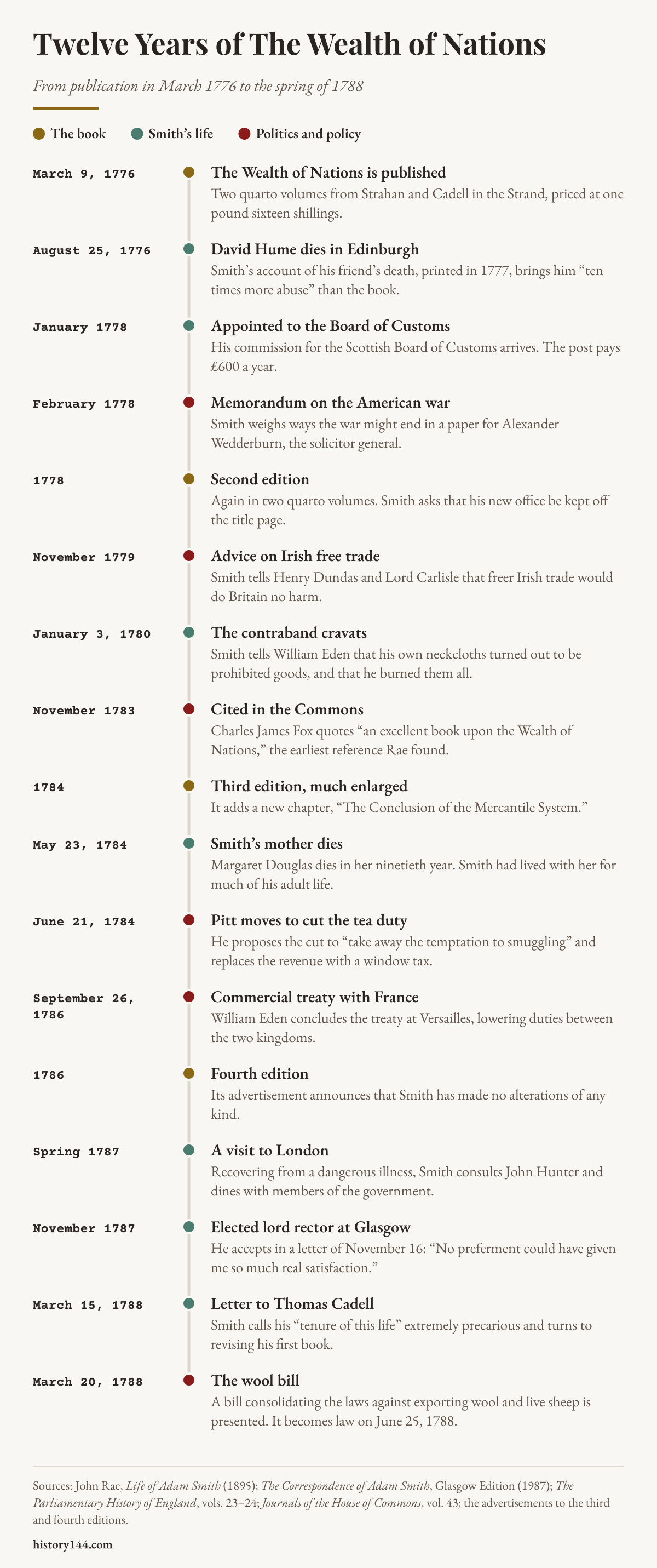
On Saturday, the 9th of March 1776, a new work in two quarto volumes went on sale in London. Its title page read An Inquiry into the Nature and Causes of the Wealth of Nations. The author was described as "Adam Smith, LL.D. and F.R.S., Formerly Professor of Moral Philosophy in the University of Glasgow," and the book was "Printed for W. Strahan; and T. Cadell, in the Strand."[1] The set cost one pound sixteen shillings in boards. The full terms of Smith's agreement with his publishers have not survived, but by November he had received "three hundred pounds of the copy money of the first edition."[2] Smith was fifty-two. He had spent most of the previous decade on the book. Much of it was written in his mother's house in Kirkcaldy, a small port on the Firth of Forth, and since 1773 he had lived in London while he revised the manuscript.[3]
The book was long, wide-ranging, and confident. It opened with the division of labor in a pin factory and closed with a chapter on public debts. In between, it challenged most of the ways in which Britain tried to make itself rich: bounties on exported corn, bans on imported goods, the chartered trading companies, and the monopoly of colonial trade. Smith called this body of policy the "mercantile system." He argued that it served a small number of merchants and manufacturers at the expense of everyone else. Within twelve years the book would be translated into several European languages, quoted in the House of Commons, and read by the men who ran the government. Its author, meanwhile, would become a customs officer, charged with enforcing many of the laws he had condemned.
This is the story of those twelve years. It runs from the day the book went on sale to a day in March 1788, when Smith, sixty-four and recovering from a serious illness, told the same London publisher that he was uncertain he would live to finish anything new.
"Euge! Belle!"
David Hume was the reader whose opinion Smith most wanted. The two philosophers had been close friends for about twenty-five years, and Hume had followed the slow progress of the manuscript for years. By 1776 Hume was dying. In a short autobiography written that spring, he recorded that in 1775 he had been "struck with a disorder in my bowels," which he now believed had "become mortal and incurable."[4] On the 1st of April 1776 he wrote to Smith from Edinburgh. He opened with a Latin cheer, "Euge! Belle!", and confessed that reading the book "has taken me from a state of great anxiety." He praised its "depth and solidity and acuteness," but he expected that a work demanding so much attention would win readers slowly. He also raised an objection. He did not believe that rent formed part of the price of produce, and he hoped to argue the point in person.[5]
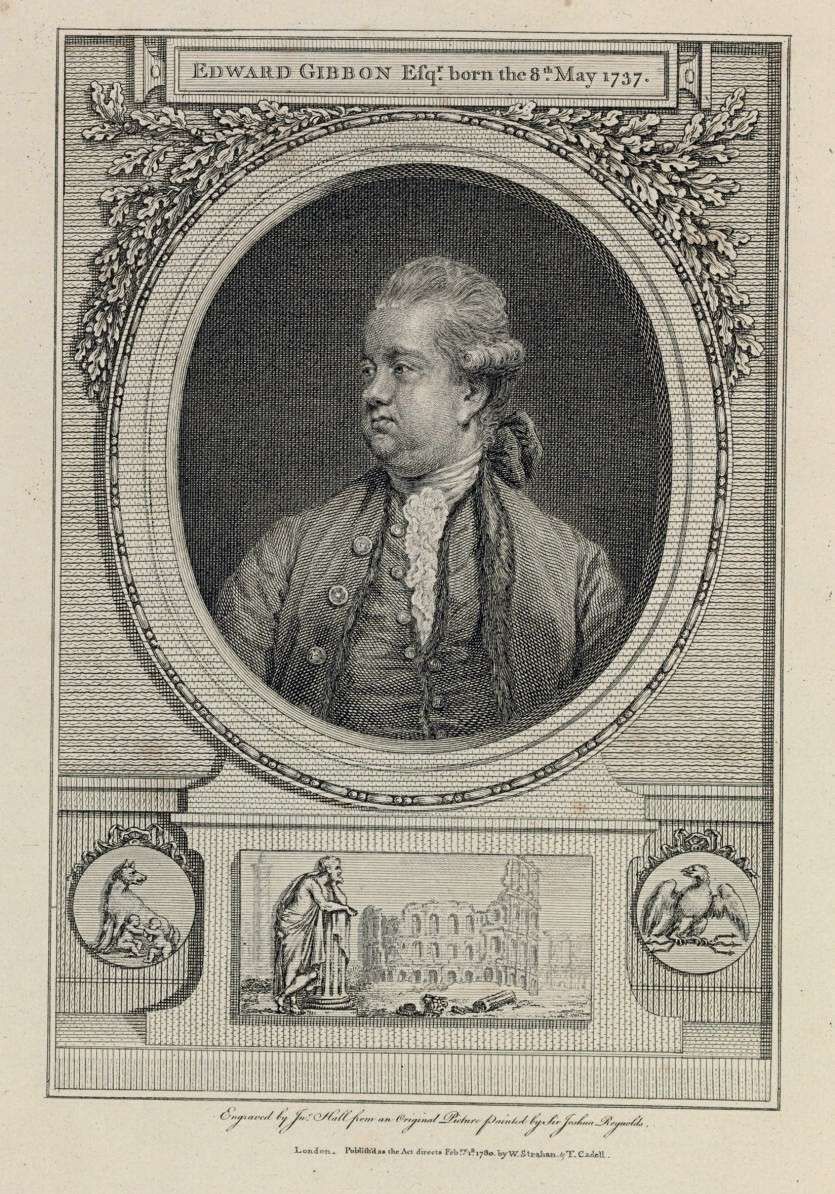
Edward Gibbon wrote to the Edinburgh philosopher Adam Ferguson on the same day. Strahan and Cadell had published the first volume of Gibbon's Decline and Fall of the Roman Empire only a few weeks earlier. "What an excellent work is that with which our common friend Mr. Adam Smith has enriched the public!" Gibbon wrote. He called it "an extensive science in a single book."[6] Hume's fears about sales proved unfounded. The first edition sold better than the publishers had expected and was exhausted within six months.[7]
A book's reception is easier to describe than its influence, and in 1776 the influence was hard to see. Parliament did not repeal the Navigation Acts, and the merchants whose privileges Smith had described kept them. What the book offered at once was a single, organized argument against policies that critics had previously attacked piece by piece. Its effect on policy would come slowly, and Smith would watch much of it from an office in Edinburgh.
The Death of a Friend
Smith returned to Scotland that spring. He spent part of the summer in Edinburgh to be near Hume. At Hume's own request he then went home to Kirkcaldy, on the understanding that Hume would send for him if he wished.[8] Hume met death with a calm good humor that impressed his friends and troubled the devout, for he made no secret of his religious skepticism. "An habitual diarrhoea of more than a year's standing would be a very bad disease at any age," he told Smith. "At my age it is a mortal one." He joked with Smith about the excuses he might offer Charon, the ferryman of the dead, for a short delay, among them that he had been "correcting my works for a new edition." He died in Edinburgh on the 25th of August 1776. The next day the chemist Joseph Black wrote to Smith with the news: "Yesterday, about four o'clock, afternoon, Mr. Hume expired."[9]
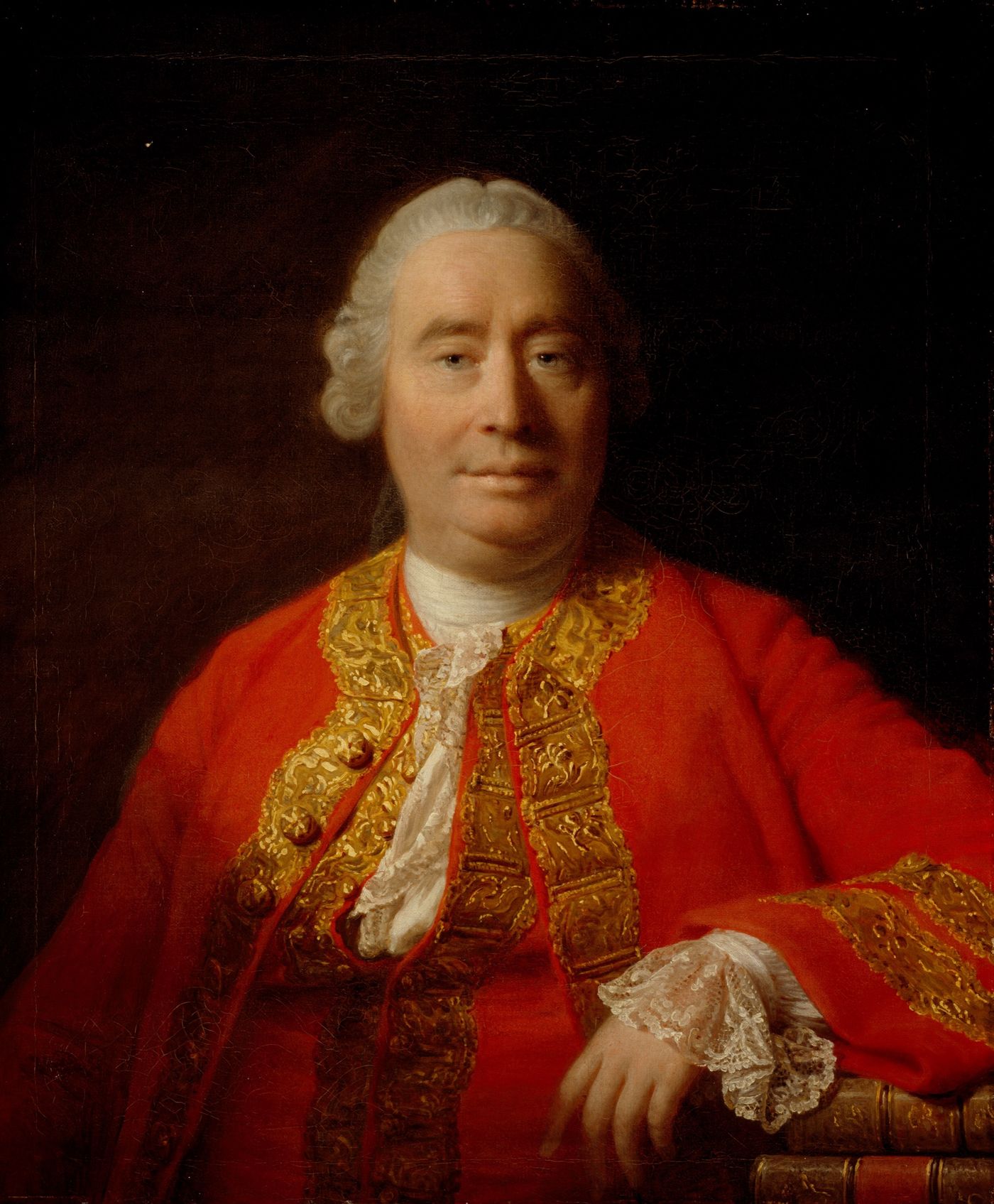
Hume left a short autobiography, My Own Life, and Smith agreed to add an account of his friend's last illness for publication with it. He wrote the account as a letter to Strahan, dated from Kirkcaldy on the 9th of November 1776. It closed with a sentence that Smith's critics never forgot: "Upon the whole, I have always considered him, both in his lifetime and since his death, as approaching as nearly to the idea of a perfectly wise and virtuous man, as perhaps the nature of human frailty will permit."[10] The two pieces appeared together in 1777 as The Life of David Hume, Esq. Written by Himself. Many readers took Smith's letter as a defense of unbelief. George Horne, President of Magdalen College, Oxford, and later Bishop of Norwich, answered it that year with an anonymous pamphlet addressed to Smith. He signed it only "One of the People Called Christians."[11] Smith never replied in public.[12]
Smith learned from the episode how unevenly the public distributed its anger. Four years later he told a Danish correspondent that his account of Hume's death had "brought upon me ten times more abuse than the very violent attack I had made upon the whole commercial system of Great Britain."[13] The comparison was fair. The book that challenged the commercial foundations of the empire had been received with respect, while a few pages praising a skeptic had made its author a target.
An Empire in Imagination
The war in America gave Smith's arguments about the colonies an immediate application. He had written at length on the subject, and his conclusions offered little comfort to a government that had just sent an army across the Atlantic. In his view, the monopoly of colonial trade distorted British commerce, raised prices at home, and tied the country to the cost of defending distant provinces. The book's closing paragraph put the case bluntly. "The rulers of Great Britain have, for more than a century past, amused the people with the imagination that they possessed a great empire on the west side of the Atlantic," Smith wrote. "This empire, however, has hitherto existed in imagination only." If the colonies could not be made to contribute to their own defense, Britain should free itself of that expense and "endeavour to accommodate her future views and designs to the real mediocrity of her circumstances."[14]
Smith also gave advice in private. In February 1778, after news of the British surrender at Saratoga had reached London, he wrote a memorandum for Alexander Wedderburn, the Solicitor General, on the ways in which the war might end. Among the possibilities he weighed was a union in which the colonies would send members to Parliament, a plan that he observed seemed "scarce to have a single advocate." The paper stayed among Wedderburn's papers and was not published until the twentieth century.[15] Its existence shows that by 1778 the author of The Wealth of Nations was someone whose views ministers wanted to hear.
The Philosopher at the Custom House
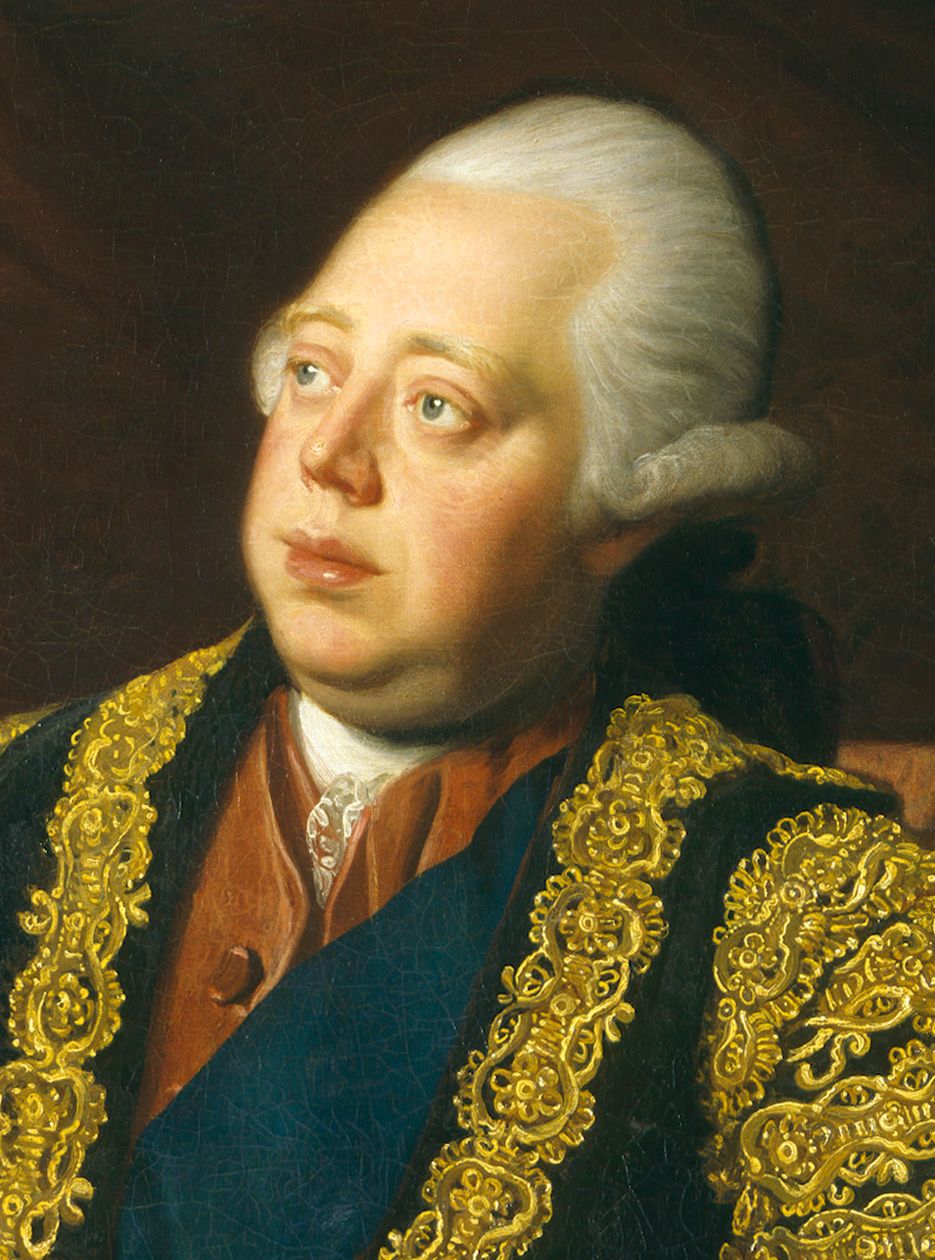
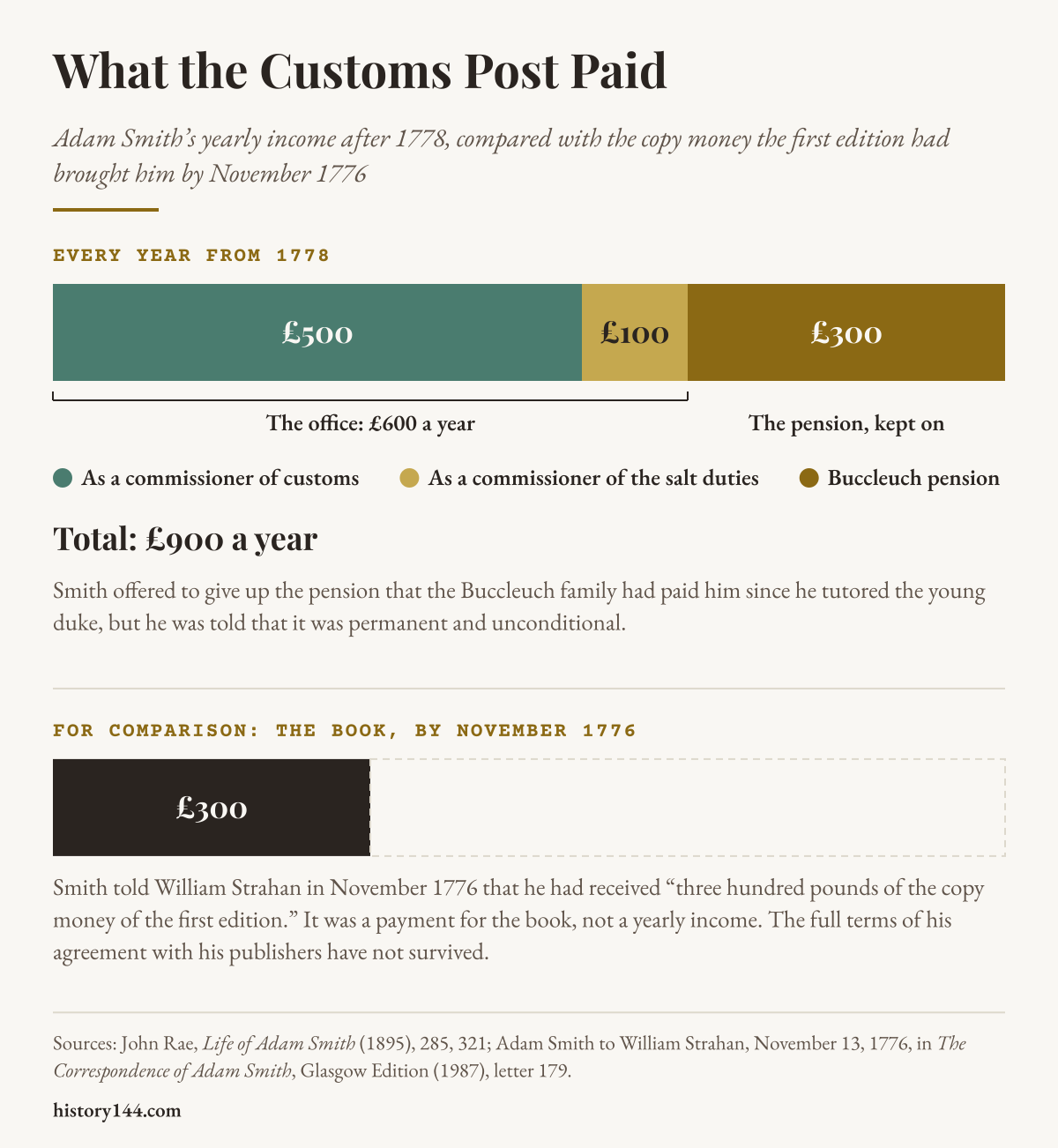
The plainest sign of Smith's new standing came at the end of 1777. A seat on the Board of Customs in Scotland fell vacant on the death of Archibald Menzies, and Lord North's government gave it to Smith. The appointment was probably settled in November, and the commission arrived in January 1778.[16] Dugald Stewart, Smith's first biographer, wrote that the post was given "at the request of the Duke of Buccleuch," Smith's former pupil, while Smith himself thanked Sir Grey Cooper of the Treasury.[17] The office paid £600 a year, £500 as a Commissioner of Customs and £100 as a Commissioner of the Salt Duties. Smith also kept the annual pension of £300 that the Buccleuch family had paid him since he tutored the young duke. He offered to give it up, but he was told that it was permanent and unconditional.[18] John Rae, Smith's Victorian biographer, believed that the post was a reward for the book itself, which North had drawn on in framing his wartime budgets.[19]
A second edition appeared in 1778. It was again in two quarto volumes, now priced at two guineas. Smith asked Strahan to present bound copies to Lord North and Sir Grey Cooper, but he did not want his new office displayed in the book. "I would not make any alteration in my title-page on account of my new office," he wrote.[20]
Smith moved to Edinburgh and took Panmure House, an old mansion in the Canongate. He lived there for the rest of his life with his mother and his cousin Janet Douglas.[21] The Board of Customs met in the Royal Exchange, and according to Rae, Smith attended its meetings with "uncommon diligence."[22]
The new post had its ironies. In the book Smith had described the smuggler as a man who "would have been, in every respect, an excellent citizen, had not the laws of his country made that a crime which nature never meant to be so."[23] Now he sat on the board that directed the officers sent to catch such men. In January 1780 he told William Eden, a member of Parliament, what had happened a week after he took office. He had looked over the list of prohibited goods that hung in every custom house and then examined his own clothes. "To my great astonishment," he found "that I had scarce a stock, a cravat, a pair of ruffles, or a pocket handkerchief which was not prohibited to be worn or used in G. Britain." He "wished to set an example and burnt them all," and he advised Eden not to inspect his own household too closely.[24] Whether Smith really burned his neckcloths, or was writing with dry humor, cannot be settled. The letter does show the position he now occupied. He administered the system faithfully while regarding much of it as foolish.
His office did not keep him out of policy debates. In 1779 Ireland, emboldened by the war, demanded the right to trade on equal terms with Britain. The Board of Trade sought Smith's views twice over. Its president, Lord Carlisle, asked through Adam Ferguson, and its secretary, William Eden, asked through Henry Dundas. Smith urged generosity in both replies. He told Dundas that he could not believe that British manufacturers would "for a century to come suffer much from the Rivalship of those of Ireland." To Carlisle he wrote that he had "never believed that the monopoly of our Plantation trade was really advantageous to Great Britain," and he argued that opening that trade to the Irish would do Britain no harm.[25]
A Book Abroad
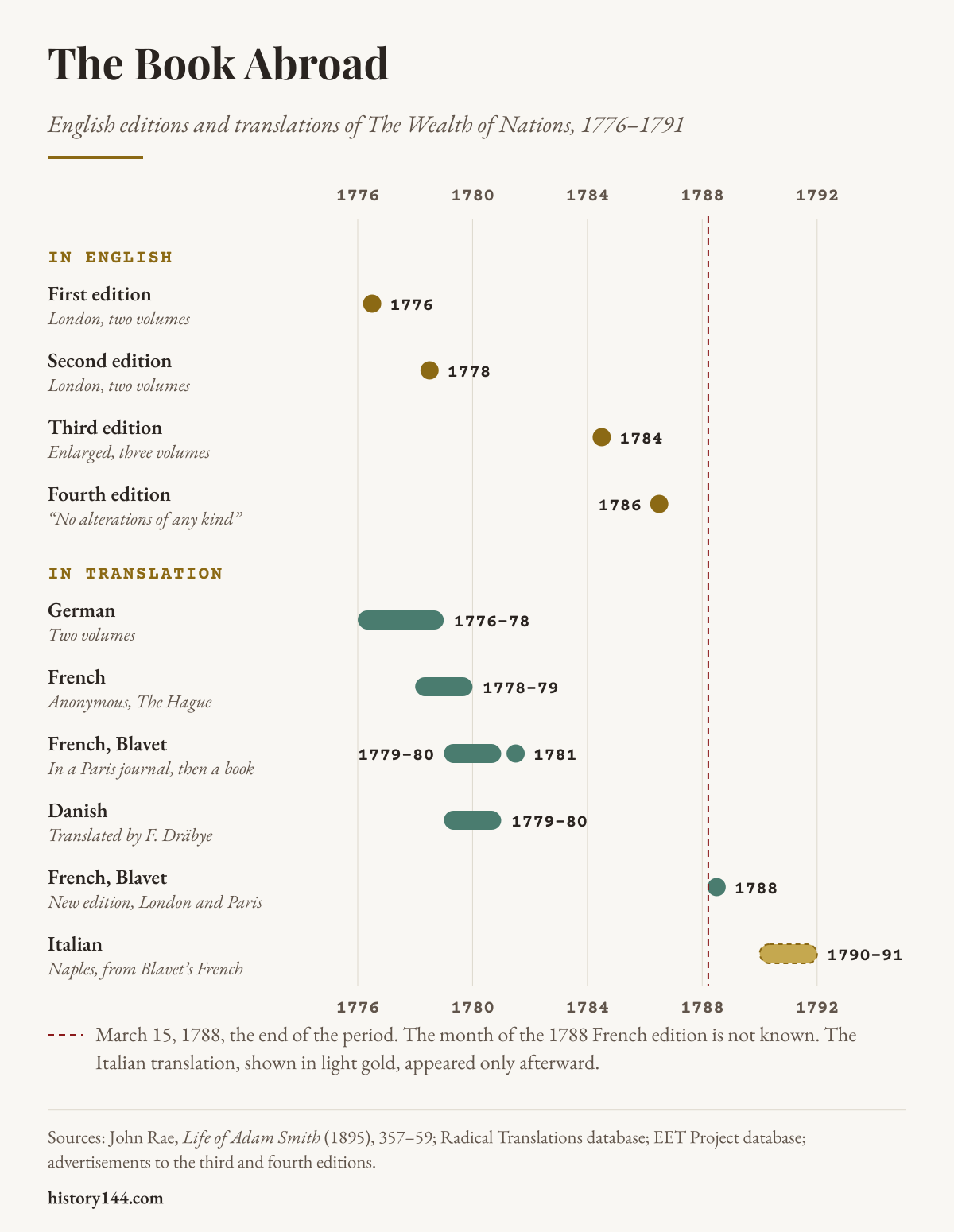
While Smith settled into the Custom House, the book spread across Europe. A German translation appeared in two volumes in 1776 and 1778, and a Danish version by F. Dräbye followed in 1779 and 1780. In French, an anonymous translation was published at The Hague in 1778 and 1779. The Abbé Blavet's version then ran in installments through a Paris journal of agriculture and commerce in 1779 and 1780, and it appeared as a book in 1781. Italian readers waited longer. The first Italian translation, made from Blavet's French, began to appear in Naples only in 1790.[26] Smith had admirers in Denmark, and it was to one of them, Andreas Holt of the Danish Board of Trade and Economy, that he made his remark about Hume and the "very violent attack."
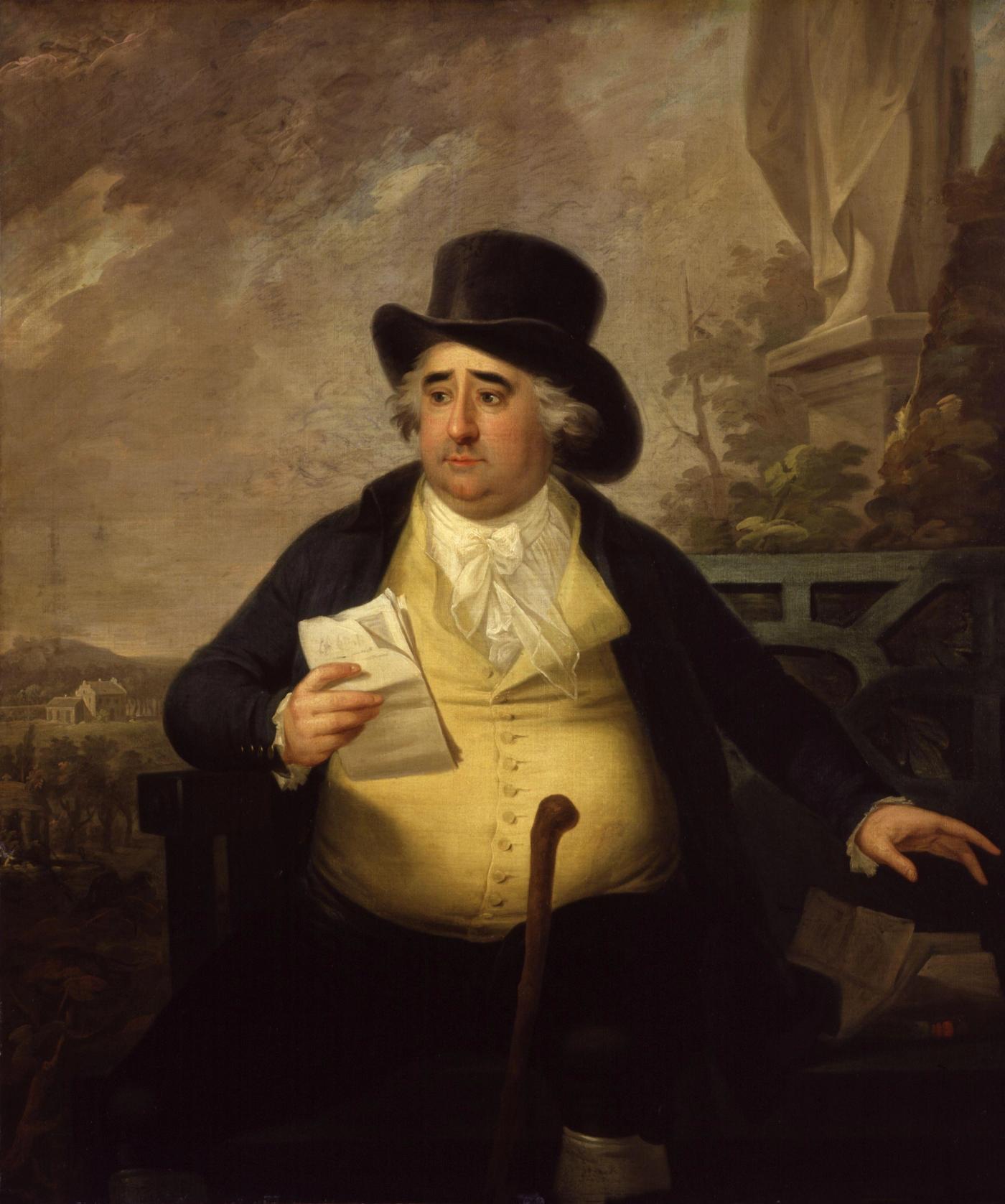
In Britain the book's political career began slowly. The first reference in Parliament that Rae could find came in November 1783, by which time two editions had appeared. The speaker was Charles James Fox, who was urging economy in peacetime. He cited "a maxim laid down in an excellent book upon the Wealth of Nations": that the only way to become rich was to make income exceed expenses. Rae judged the quotation "of the most unimportant character."[27] Within weeks, however, the King dismissed the coalition in which Fox served and made William Pitt, then twenty-four, First Lord of the Treasury. Pitt would become one of the book's most attentive readers.
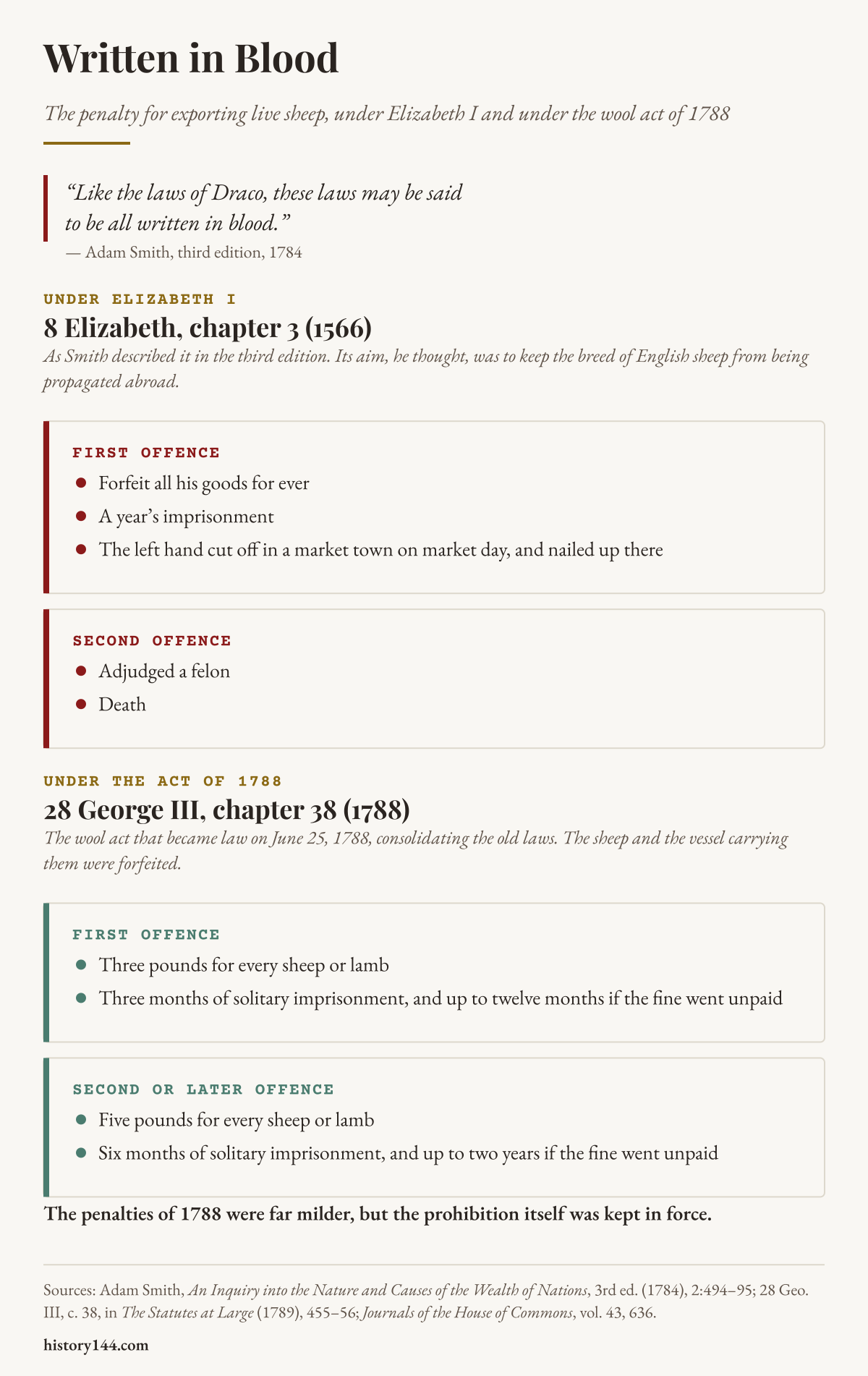
In 1784 Smith sent Strahan and Cadell a much enlarged third edition. In a new advertisement he listed the main additions. They included new material on drawbacks and bounties, a section on the trading companies, and an entirely new chapter, "The Conclusion of the Mercantile System."[28] That chapter sharpened his case against protection. One target was the old body of laws forbidding the export of wool and live sheep. In Smith's account, the woolen manufacturers had persuaded Parliament to give them a monopoly against the growers of wool, and he described the penalties these laws had once carried. Under a statute of Elizabeth I, an exporter of sheep was for a first offense to forfeit his goods, suffer a year's imprisonment, and "then to have his left hand cut off in a market town upon a market day, to be there nailed up." The aim of that law, Smith thought, had been to keep the breed of English sheep from "being propagated in foreign countries." "Like the laws of Draco," Smith wrote, "these laws may be said to be all written in blood."[29] He would have reason to recall the passage four years later.
The year of the third edition also brought a private loss. Smith's mother, Margaret Douglas, died on the 23rd of May 1784 in her ninetieth year. Smith had lived with her for much of his adult life, and his friends were struck by the depth of his grief.[30] A fourth edition followed in 1786. In its advertisement Smith announced that he had made no alterations of any kind.[31]
Pitt's Scholar
Pitt took office with a public debt swollen by the American war and a trade still disrupted by it. In 1784 his government cut the duty on tea, which Pitt explained was meant to "take away the temptation to smuggling," and made up the lost revenue with a new tax on windows. In 1786 it negotiated a commercial treaty with France, Britain's chief rival in trade. The negotiator was the same William Eden to whom Smith had described his contraband cravats. The treaty, concluded at Versailles on the 26th of September 1786, lowered duties on a long list of goods passing between the two kingdoms. The next year an act of Parliament repealed the existing customs and excise duties, granted new ones in their place, and admitted French goods under the treaty.[32] When the treaty came before Parliament in 1787, Robert Thornton cited Smith's book in its favor. In the same year George Dempster read an extract from the book during a debate on the post-horse duties.[33]
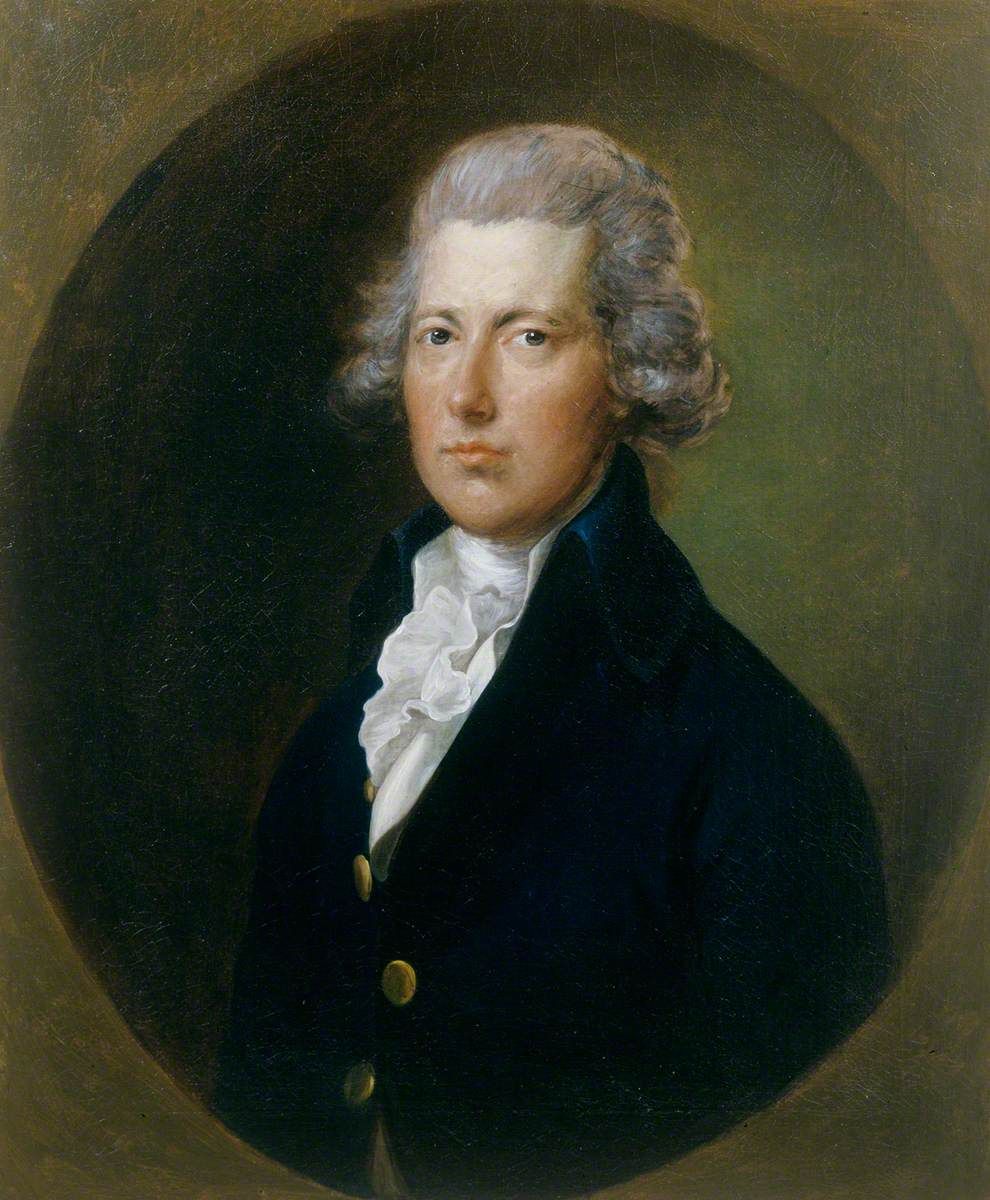
How much Pitt owed to Smith is still debated. Many reforms of the 1780s grew out of administrative necessity and the work of officials who never read political economy. Rae's list of parliamentary references to the book in its first dozen years is short. By 1787, however, the book had become part of the vocabulary of government, and its author was about to meet the men who used it.
The Grand Climacteric
The winter of 1786–87 nearly killed Smith. Rae describes the illness as a chronic obstruction of the bowels, and the historian William Robertson wrote to Gibbon that Smith's friends feared they would lose him. In March 1787 Smith wrote to Bishop Douglas to introduce the writer Robert Beatson. In passing he mentioned that he was in his "grand climacteric," the age of sixty-three, or seven times nine, which tradition held to be especially dangerous, and that his health had been "a good deal worse than usual."[34]
By April he had recovered enough to travel to London to consult John Hunter, the leading surgeon of the day. Rae writes that Smith looked very ill on this visit and was "wasted to a skeleton." He nevertheless stayed in the capital for a considerable time and dined with members of the government.[35] The best-known story of the visit was first printed in 1838 in John Kay's collection of Edinburgh portraits. According to Kay, Smith arrived late for dinner at Henry Dundas's house at Wimbledon, where Pitt, Grenville, and Henry Addington were among the guests. The company rose when he entered. Smith apologized and asked them to sit, but they replied, "we will stand till you are seated, for we are all your scholars."[36] Rae thought the story rested on Edinburgh tradition, and it reached print nearly fifty years after Smith's death, so it should be treated with caution.[37] A remark that Addington later recalled points in the same direction. After a dinner with Pitt, Smith is said to have told him, "What an extraordinary man Pitt is; he understands my ideas better than I do myself."[38]
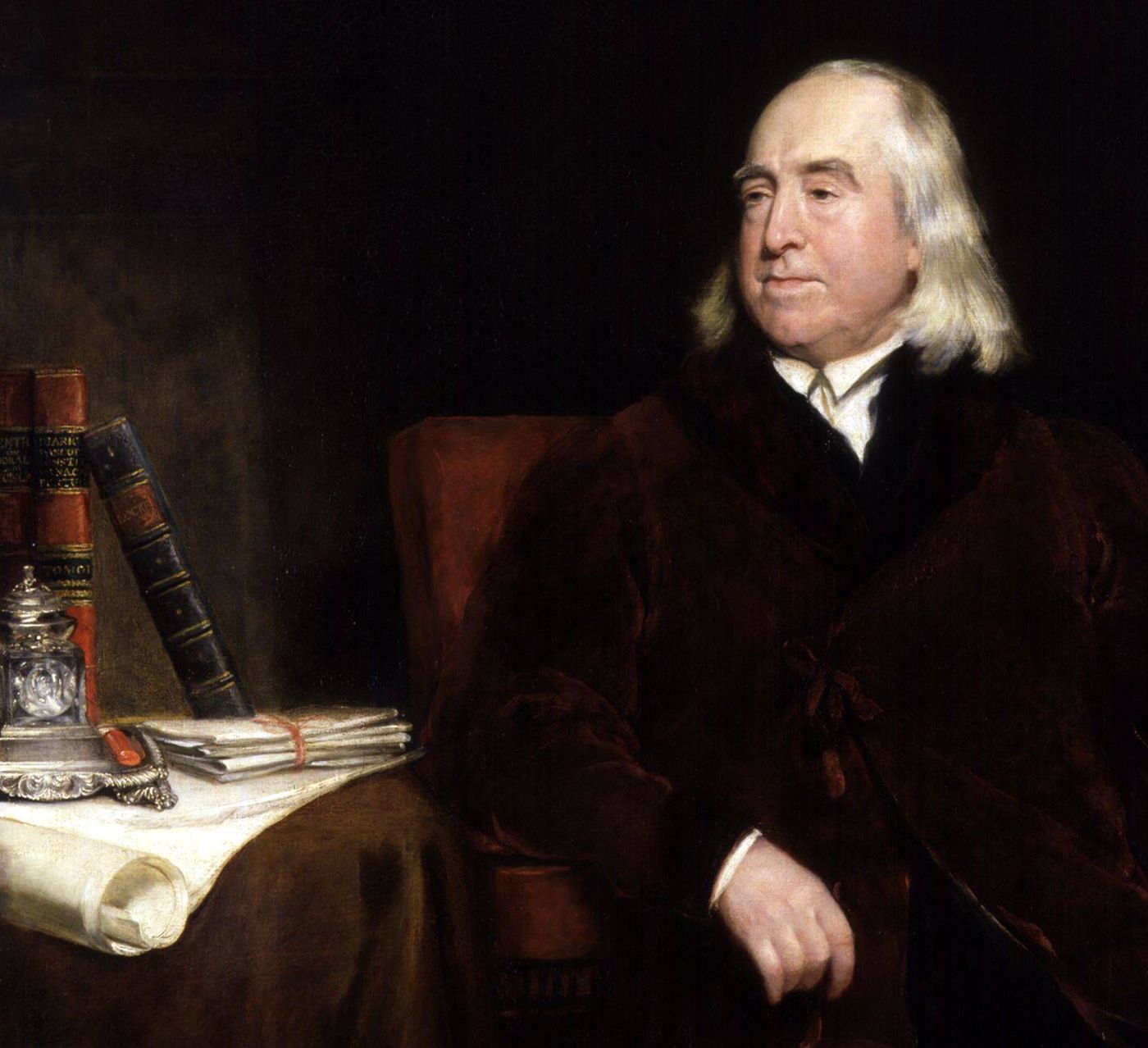
Not every reader was a disciple. In January 1787, at Crichoff in White Russia, Jeremy Bentham began a series of letters on the laws against usury. He published them later that year as Defence of Usury. According to Rae, the work was written to "controvert Smith's recommendation of a legal limitation of the rate of interest," and its last letter was addressed directly "To Dr. Smith."[39] Smith took the criticism well. Two years later he reportedly called the book "the work of a very superior man."[40]
In November 1787 the University of Glasgow, where Smith had studied as a youth and later taught for thirteen years, elected him Lord Rector. He accepted in a letter of the 16th of November to the Principal, Archibald Davidson. "No preferment," he wrote, "could have given me so much real satisfaction."[41]
March 1788
By the spring of 1788 Smith was well enough to work, but he had no illusions about how much time remained. On the 15th of March he wrote to Thomas Cadell, the publisher whose name had appeared on the title page twelve years earlier. He reported that he had "taken leave of my Colleagues for four months" and was "giving the most intense application" to a new edition of his first book, The Theory of Moral Sentiments. Then he explained why he had chosen that task over the other works he had planned. "As I consider my tenure of this life as extremely precarious," he wrote, "and am very uncertain whether I shall live to finish several other works which I have projected and in which I have made some progress, the best thing, I think, I can do is to leave those I have already published in the best and most perfect state behind me."[42]
The letter marks a change in Smith's priorities. He had made progress on other works, but he now gave priority to bringing his published books to their best condition. Meanwhile, The Wealth of Nations continued to move beyond his control. In 1788 Pierre Duplain issued a new two-volume edition of Blavet's French translation under a London and Paris imprint.[43] Smith's letter on Hume's death also continued to circulate, and that same year it was reprinted with a Latin translation on facing pages.[44] According to Rae, a member named Hussy quoted the book in the House of Commons during debate on a measure its author would have recognized at once.[45] On the 20th of March 1788, five days after Smith's letter to Cadell, a bill to gather the old wool laws into a single act was presented in the House of Commons and read for the first time. A pamphlet published while it was pending described its purpose as "the better to prevent the exportation of live sheep, wool, &c."[46] The bill became law in June.[47] The statutes that Smith had compared to the code of Draco were consolidated, amended, and continued in force.
Twelve years after its publication, then, the book was being cited at Westminster while Parliament went on passing the kind of laws it condemned. A board on which its author sat enforced those laws in Scotland. The author himself was spending his remaining strength on revising his first book.
Why the Twelve Years Mattered
Smith lived a little more than two years after writing to Cadell. The revised Theory of Moral Sentiments appeared in 1790, and he died at Panmure House on the 17th of July that year. About a week before his death, he asked his friends Joseph Black and James Hutton to burn sixteen volumes of his manuscripts. They did so without asking what the volumes contained. A friend who was present remembered Smith's regret that he had done so little. "But I meant," Smith said, "to have done more."[48]
The book he had published in 1776 did not need anything more from him. Between 1776 and 1788 it grew from one man's long argument into a common point of reference for anyone who wished to discuss trade, taxes, and empire seriously. It found readers in Denmark, the German states, and France. It supplied a maxim to Fox in opposition and a body of doctrine to Pitt's circle in office, and it was cited in Parliament in support of the commercial treaty with France. All the while, its author sat on a board that directed the seizure of contraband and the prosecution of smugglers.
That tension gives the period its shape. In March 1776 Smith published a book arguing that a nation's wealth lay in the industry of its people rather than in the protections granted to its merchants. By March 1788 the argument had reached Parliament, the Treasury, and the presses of Europe, often in forms Smith could not control and sometimes in debates it could not yet win. Smith seems to have understood this. Writing to the publisher who had first sold the book in the Strand, he left the argument to its readers. He would spend his remaining time making sure that what he had already written would last.
Places in this Story
The places this story moves through, in order — follow them on the interactive map →
- The Strand, London March 9, 1776
Strahan and Cadell put An Inquiry into the Nature and Causes of the Wealth of Nations on sale in two quarto volumes.
- Edinburgh, Scotland April 1, 1776
David Hume, already dying, wrote to Smith with a Latin cheer and one objection about rent.
- Kirkcaldy, Scotland November 9, 1776
From his mother's house Smith wrote the account of Hume's death that his critics never forgave.
- Saratoga, New York February 1778
News of the British surrender reached London, and Smith drew up a memorandum on how the war might end.
- Panmure House, Edinburgh 1778
Smith took an old mansion in the Canongate and lived there for the rest of his life.
- The Hague, Netherlands 1778
An anonymous French translation appeared here, the first of several that carried the book across Europe.
- Versailles, France September 26, 1786
Pitt's government concluded a commercial treaty with France that lowered duties on a long list of goods.
- Wimbledon, London 1787
At Henry Dundas's house the company is said to have risen for Smith, telling him they were all his scholars.
- Westminster, London March 20, 1788
A bill gathering the old wool laws into a single act was read for the first time in the Commons.
Frequently Asked Questions
When was The Wealth of Nations published?
It went on sale in London on March 9, 1776, in two quarto volumes costing one pound sixteen shillings in boards. Adam Smith was fifty-two and had spent most of the previous decade writing it.
What did Adam Smith mean by the mercantile system?
It was his name for the body of British policy that favored merchants and manufacturers, including bounties on exported corn, bans on imported goods, the chartered trading companies, and the monopoly of colonial trade. Smith argued that it served a small number of men at the expense of everyone else.
Why did Adam Smith become a customs commissioner?
Lord North's government gave him a seat on the Scottish Board of Customs at the end of 1777, paying £600 a year. His biographer John Rae believed the post was a reward for the book itself, which North had drawn on in framing his wartime budgets.
What did Adam Smith write about David Hume's death?
He described his friend's last illness in a letter to the publisher William Strahan, calling Hume as near to a perfectly wise and virtuous man as human frailty permits. Smith later said the passage brought him ten times more abuse than his attack on Britain's whole commercial system.
Did William Pitt the Younger read The Wealth of Nations?
Pitt became one of the book's most attentive readers after taking office in late 1783, and members cited Smith in debates on the French commercial treaty and the post-horse duties. How much his reforms actually owed to Smith is still debated.
What did Jeremy Bentham write against Adam Smith?
Bentham published Defence of Usury in 1787 to contest Smith's support for a legal limit on interest rates, addressing its final letter to Smith directly. Smith reportedly called it the work of a very superior man.
What was Adam Smith's grand climacteric?
It was the age of sixty-three, or seven times nine, which tradition held to be especially dangerous. Smith nearly died in the winter of 1786 and 1787 and went to London to consult John Hunter, the leading surgeon of the day.
Bibliography
An Act for Repealing the Several Duties of Customs and Excise, and Granting Other Duties in Lieu Thereof. 27 Geo. III, c. 13. 1787. In The Statutes at Large. London, 1789. Internet Archive. https://archive.org/details/bim_eighteenth-century_the-statutes-at-large-f_great-britain_1789. Accessed November 7, 2026.
An Act to Explain, Amend, and Reduce into One Act of Parliament, Several Laws Now in Being for Preventing the Exportation of Live Sheep, Rams, and Lambs, Wool, &c. 28 Geo. III, c. 38. 1788. In The Statutes at Large. London, 1789. Internet Archive. https://archive.org/details/bim_eighteenth-century_the-statutes-at-large-f_great-britain_1789. Accessed November 6, 2026.
"Adam Smith's Own Copy of Wealth of Nations Comes to Auction Estimated at £500,000–800,000." Antiques Trade Gazette, via Learn Antiques. https://learnantiques.com.au/adam-smiths-own-copy-of-wealth-of-nations-comes-to-auction-estimated-at-500000-800000/. Accessed November 6, 2026.
Bentham, Jeremy. Defence of Usury; Shewing the Impolity of the Present Legal Restraints on the Terms of Pecuniary Bargains. In a Series of Letters to a Friend. To Which Is Added, a Letter to Adam Smith, Esq; LL.D. London: T. Payne and Son, 1787. Digitized copy, Wellcome Collection. https://wellcomecollection.org/works/fcwjfa3j. Accessed November 6, 2026.
EET Project Portal Database. "Ricerche sulla natura e le cagioni della ricchezza delle nazioni." Naples: Giuseppe Policarpo Merande, 1790–91. Database entry. https://eet.pixel-online.org/database_scheda.php?art_id=664. Accessed November 7, 2026.
An Epitome of the Bill Now Depending in Parliament, the Better to Prevent the Exportation of Live Sheep, Wool, &c. and a Comparative View of That Bill, with the Laws Now in Being for the Like Purposes. London: Stafford and Davenport, 1788. Catalog record, Folger Shakespeare Library. https://catalog.folger.edu/record/819356. Accessed November 6, 2026.
[Horne, George]. A Letter to Adam Smith LL.D. on the Life, Death, and Philosophy of His Friend David Hume Esq. By One of the People Called Christians. Oxford: Clarendon Press, 1777. Digitized copy, Wellcome Collection. https://wellcomecollection.org/works/vn495upx. Accessed November 6, 2026.
Hume, David. The Life of David Hume, Esq. Written by Himself. London: W. Strahan and T. Cadell, 1777. Includes "Letter from Adam Smith, LL.D. to William Strahan, Esq." Internet Archive. https://archive.org/details/lifedavidhumees00stragoog. Accessed November 7, 2026.
Journals of the House of Commons. Vol. 43, 15 November 1787 to 25 September 1788. Internet Archive. https://archive.org/details/sim_great-britain-house-of-commons-journal_november-15-1787-september-25-1788_43. Accessed November 6, 2026.
The Journal and Correspondence of William, Lord Auckland. Vol. 1. London: Richard Bentley, 1861. HathiTrust. https://hdl.handle.net/2027/uc2.ark:/13960/t48p5zs5g. Accessed November 6, 2026.
Kay, John. A Series of Original Portraits and Caricature Etchings, with Biographical Sketches and Illustrative Anecdotes. Vol. 1. Edinburgh: Hugh Paton, 1838. Digitized copy, Wellcome Collection. https://wellcomecollection.org/works/xxndd5hj. Accessed November 6, 2026.
The Parliamentary History of England, from the Earliest Period to the Year 1803. Vol. 23. London: T. C. Hansard, 1814. Internet Archive. https://archive.org/details/10279131bsb. Accessed November 6, 2026.
The Parliamentary History of England, from the Earliest Period to the Year 1803. Vol. 24. London: T. C. Hansard, 1815. Internet Archive. https://archive.org/details/10279132bsb. Accessed November 7, 2026.
Pellew, George. The Life and Correspondence of the Right Hon. Henry Addington, First Viscount Sidmouth. 3 vols. London: John Murray, 1847.
Radical Translations. "Recherches sur la nature et les causes de la richesse des nations." Database entry. https://radicaltranslations.org/database/resources/5337/. Accessed November 6, 2026.
Radical Translations. "Ricerche sulla natura, e le cagioni della ricchezza delle nazioni." Database entry. https://radicaltranslations.org/database/resources/5336/. Accessed November 7, 2026.
Rae, John. Life of Adam Smith. London: Macmillan, 1895. Internet Archive. https://archive.org/details/lifeofadamsmith00raejuoft. Accessed November 6, 2026.
Shinohara, Hisashi. "The Practical System of Morality in Adam Smith." In Adam Smith: International Perspectives, edited by Hiroshi Mizuta and Chuhei Sugiyama. London: Macmillan, 1993. https://doi.org/10.1007/978-1-349-22520-0_2.
Smith, Adam. The Correspondence of Adam Smith. Edited by Ernest Campbell Mossner and Ian Simpson Ross. Glasgow Edition of the Works and Correspondence of Adam Smith 6. Indianapolis: Liberty Fund, 1987.
Smith, Adam. An Inquiry into the Nature and Causes of the Wealth of Nations. 2 vols. London: W. Strahan and T. Cadell, 1776. HathiTrust. https://catalog.hathitrust.org/Record/001308522. Accessed November 6, 2026.
Smith, Adam. An Inquiry into the Nature and Causes of the Wealth of Nations. 3rd ed. 3 vols. London: W. Strahan and T. Cadell, 1784. Digitized copy, Wellcome Collection. https://wellcomecollection.org/works/fh4wrzx4. Vol. 2 also at Internet Archive. https://archive.org/details/bim_eighteenth-century_an-inquiry-into-the-natu_smith-adam_1784_2. Accessed November 7, 2026.
Smith, Adam. An Inquiry into the Nature and Causes of the Wealth of Nations. 4th ed. 3 vols. London: W. Strahan and T. Cadell, 1786. Internet Archive. https://archive.org/details/bim_eighteenth-century_an-inquiry-into-the-natu_smith-adam_1786_1. Accessed November 6, 2026.
Smith, Adam. Letter from Adam Smith, LL.D. to William Strahan, Esq. English text with Latin translation on facing pages. [Edinburgh?], 1788. Digitized copy, Wellcome Collection. https://wellcomecollection.org/works/bxs7npyy. Accessed November 6, 2026.
Smith, Adam. Recherches sur la nature et les causes de la richesse des nations. Translated by [Jean-Louis Blavet]. 2 vols. Londres; Paris: Duplain, 1788.
Stewart, Dugald. "Account of the Life and Writings of Adam Smith, LL.D." Transactions of the Royal Society of Edinburgh 3 (1794): 55–137. Internet Archive. https://archive.org/details/transactionsofro03murr. Accessed November 6, 2026.
Citations
- Adam Smith, An Inquiry into the Nature and Causes of the Wealth of Nations, 2 vols. (London: W. Strahan and T. Cadell, 1776), 1: title page. ↑
- John Rae, Life of Adam Smith (London: Macmillan, 1895), 285; Adam Smith to William Strahan, 13 November 1776, letter 179 in The Correspondence of Adam Smith, ed. Ernest Campbell Mossner and Ian Simpson Ross, Glasgow Edition of the Works and Correspondence of Adam Smith 6 (Indianapolis: Liberty Fund, 1987), 221–22; the letter is also quoted in "Adam Smith's Own Copy of Wealth of Nations Comes to Auction Estimated at £500,000–800,000," Antiques Trade Gazette, via Learn Antiques. ↑
- Dugald Stewart, "Account of the Life and Writings of Adam Smith, LL.D.," Transactions of the Royal Society of Edinburgh 3 (1794): 104; Rae, Life of Adam Smith, 257, 264. ↑
- David Hume, "My Own Life," in The Life of David Hume, Esq. Written by Himself (London: W. Strahan and T. Cadell, 1777), 30. ↑
- David Hume to Adam Smith, 1 April 1776, quoted in Rae, Life of Adam Smith, 286. ↑
- Edward Gibbon to Adam Ferguson, 1 April 1776, quoted in Rae, Life of Adam Smith, 287. ↑
- Rae, Life of Adam Smith, 285. ↑
- Adam Smith to William Strahan, 9 November 1776, in Life of David Hume, 37–62. ↑
- Smith to Strahan, 9 November 1776, in Life of David Hume, 37–62, quoting Hume's words to Smith and Joseph Black to Smith, 26 August 1776. ↑
- Smith to Strahan, 9 November 1776, in Life of David Hume, 37–62. ↑
- [George Horne], A Letter to Adam Smith LL.D. on the Life, Death, and Philosophy of His Friend David Hume Esq. By One of the People Called Christians (Oxford: Clarendon Press, 1777). ↑
- Rae, Life of Adam Smith, 312. ↑
- Adam Smith to Andreas Holt, 26 October 1780, letter 208 in Correspondence of Adam Smith, 251. ↑
- Smith, Wealth of Nations (1776), 2:587. ↑
- Adam Smith, "Smith's Thoughts on the State of the Contest with America, February 1778," in Correspondence of Adam Smith, appendix B, prepared by David Stevens. ↑
- Rae, Life of Adam Smith, 320. ↑
- Stewart, "Account," 127; Rae, Life of Adam Smith, 320. ↑
- Rae, Life of Adam Smith, 321. ↑
- Rae, Life of Adam Smith, 320. ↑
- Adam Smith to William Strahan, 14 January 1778, letter 190 in Correspondence of Adam Smith, 230–31; quoted in Rae, Life of Adam Smith, 323, where the letter is dated 1777. ↑
- Rae, Life of Adam Smith, 325. ↑
- Rae, Life of Adam Smith, 329–30. ↑
- Smith, Wealth of Nations (1776), 2:520. ↑
- Adam Smith to William Eden, 3 January 1780, letter 203 in Correspondence of Adam Smith, 244–46. ↑
- Adam Smith to Henry Dundas, 1 November 1779, letter 201, and Adam Smith to Lord Carlisle, 8 November 1779, letter 202, in Correspondence of Adam Smith, 240–44; both quoted in Rae, Life of Adam Smith, 350–54. ↑
- Rae, Life of Adam Smith, 357–59; Radical Translations, "Recherches sur la nature et les causes de la richesse des nations" and "Ricerche sulla natura, e le cagioni della ricchezza delle nazioni," database entries; EET Project Portal Database, "Ricerche sulla natura e le cagioni della ricchezza delle nazioni" (Naples: Merande, 1790–91). ↑
- The Parliamentary History of England, vol. 23 (London: T. C. Hansard, 1814), col. 1152, quoted in Rae, Life of Adam Smith, 290. ↑
- Adam Smith, "Advertisement to the Third Edition," in An Inquiry into the Nature and Causes of the Wealth of Nations, 3rd ed., 3 vols. (London: W. Strahan and T. Cadell, 1784). ↑
- Smith, Wealth of Nations, 3rd ed. (1784), 2:494–95. ↑
- Rae, Life of Adam Smith, 393. ↑
- Adam Smith, "Advertisement to the Fourth Edition," in An Inquiry into the Nature and Causes of the Wealth of Nations, 4th ed., 3 vols. (London: W. Strahan and T. Cadell, 1786), vol. 1. ↑
- The Parliamentary History of England, vol. 24 (London: T. C. Hansard, 1815), cols. 1008–10; The Journal and Correspondence of William, Lord Auckland, vol. 1 (London: Richard Bentley, 1861), 495–515; An Act for Repealing the Several Duties of Customs and Excise, and Granting Other Duties in Lieu Thereof, 27 Geo. III, c. 13 (1787), in The Statutes at Large (London, 1789), 260. ↑
- Rae, Life of Adam Smith, 290. ↑
- Rae, Life of Adam Smith, 402–3; Adam Smith to Bishop John Douglas, 6 March 1787, letter 266 in Correspondence of Adam Smith, 301–2. ↑
- Rae, Life of Adam Smith, 404–5. ↑
- John Kay, A Series of Original Portraits and Caricature Etchings, with Biographical Sketches and Illustrative Anecdotes, vol. 1 (Edinburgh: Hugh Paton, 1838), 75. ↑
- Rae, Life of Adam Smith, 405. ↑
- George Pellew, The Life and Correspondence of the Right Hon. Henry Addington, First Viscount Sidmouth, vol. 1 (London: John Murray, 1847), 151, quoted in Rae, Life of Adam Smith, 405. ↑
- Jeremy Bentham, Defence of Usury; Shewing the Impolity of the Present Legal Restraints on the Terms of Pecuniary Bargains (London: T. Payne and Son, 1787), letter 1, p. 1, and letter 13, p. 129; Rae, Life of Adam Smith, 423. ↑
- George Wilson to Jeremy Bentham, 4 December 1789, quoted in Rae, Life of Adam Smith, 423. ↑
- Adam Smith to Archibald Davidson, 16 November 1787, letter 274 in Correspondence of Adam Smith, 308; quoted in Rae, Life of Adam Smith, 411. ↑
- Adam Smith to Thomas Cadell, 15 March 1788, letter 276 in Correspondence of Adam Smith, 310–11; quoted in Hisashi Shinohara, "The Practical System of Morality in Adam Smith," in Adam Smith: International Perspectives, ed. Hiroshi Mizuta and Chuhei Sugiyama (London: Macmillan, 1993). ↑
- Adam Smith, Recherches sur la nature et les causes de la richesse des nations, trans. [Jean-Louis Blavet], 2 vols. (Londres; Paris: Duplain, 1788); Radical Translations, "Recherches sur la nature et les causes de la richesse des nations," database entry. ↑
- Adam Smith, Letter from Adam Smith, LL.D. to William Strahan, Esq., with Latin translation ([Edinburgh?], 1788). ↑
- Rae, Life of Adam Smith, 290. ↑
- Journals of the House of Commons, vol. 43, 20 March 1788, 333; An Epitome of the Bill Now Depending in Parliament, the Better to Prevent the Exportation of Live Sheep, Wool, &c. (London: Stafford and Davenport, 1788). ↑
- An Act to Explain, Amend, and Reduce into One Act of Parliament, Several Laws Now in Being for Preventing the Exportation of Live Sheep, Rams, and Lambs, Wool, &c., 28 Geo. III, c. 38 (1788), in The Statutes at Large (London, 1789), 455; Journals of the House of Commons, vol. 43, 25 June 1788, 636. ↑
- Rae, Life of Adam Smith, 434. ↑