A Fight on London Bridge
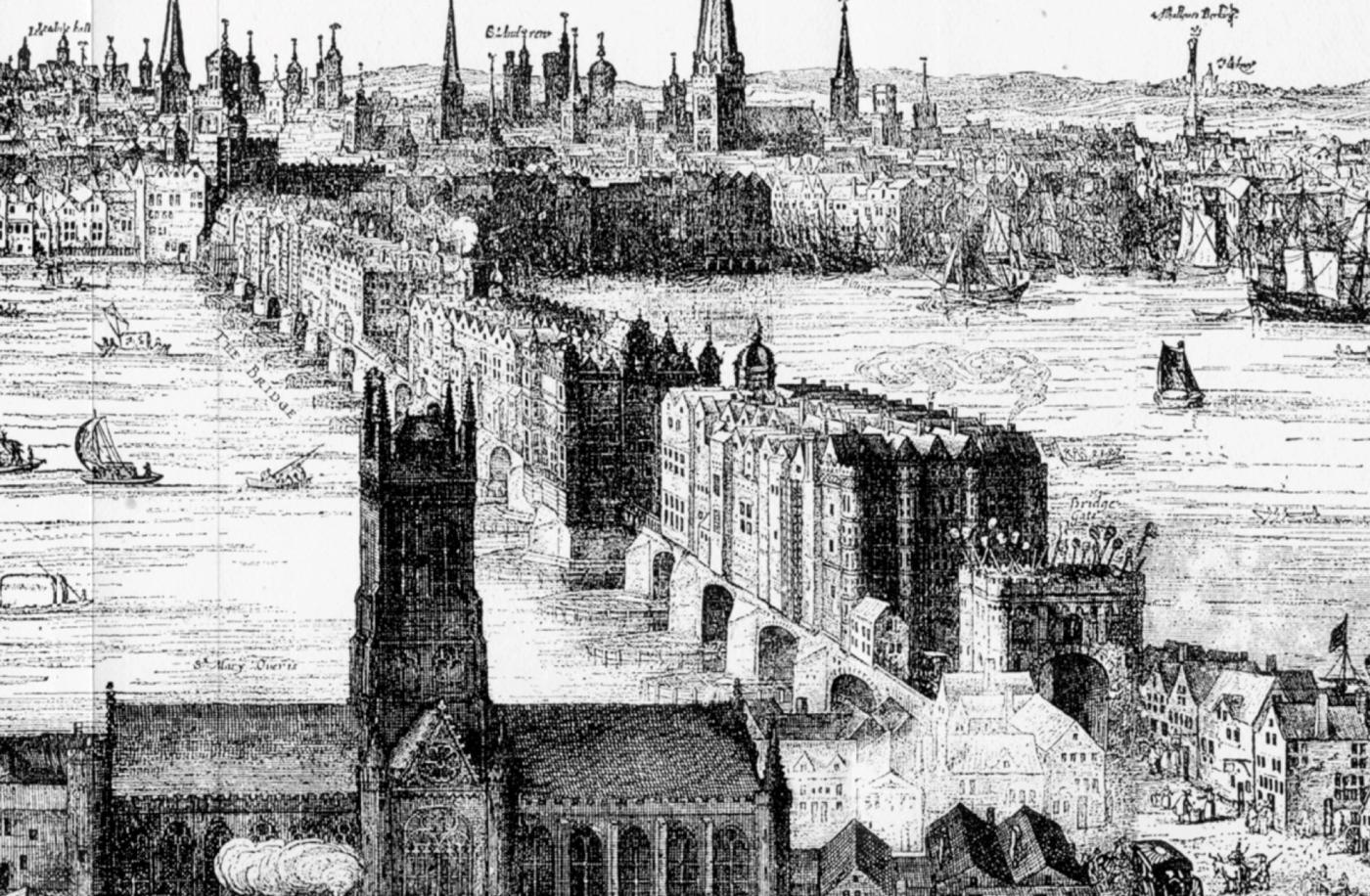
On Friday, February 28, 1634, searchers employed by a company of soap makers chartered at Westminster went through London with the king's authority to break into any house where they suspected soap was being made illegally. In Southwark, at the southern end of London Bridge, they forced their way into one house and met a man whom the newsletter writer Edmund Rossingham called "a lusty stowt fellew." He beat one of the searchers soundly before he was overpowered and led away across the bridge toward a magistrate. Partway over, according to Rossingham, "a whole squadron of weemen" tried to rescue him. When they failed, a crowd of apprentices arrived and drove the searchers, prisoner and all, to take shelter in a private house, until the two sheriffs of London came and dispersed the crowd.[1]
It was a small scuffle, and nearly the whole quarrel was in it. The man on the bridge apparently belonged to a trade that a royal patent had made illegal for anyone outside the new company. Rossingham did not record who the women were, but in the preceding months the laundresses, servants, and housewives who washed London's linen had made it plain that they considered the king's new soap worse than the old. The searchers acted under a proclamation dated January 26, 1634, and proclaimed in London early in February. Behind all of them stood Charles I, who had governed without Parliament since 1629 and who needed money that did not depend on the consent of the House of Commons.
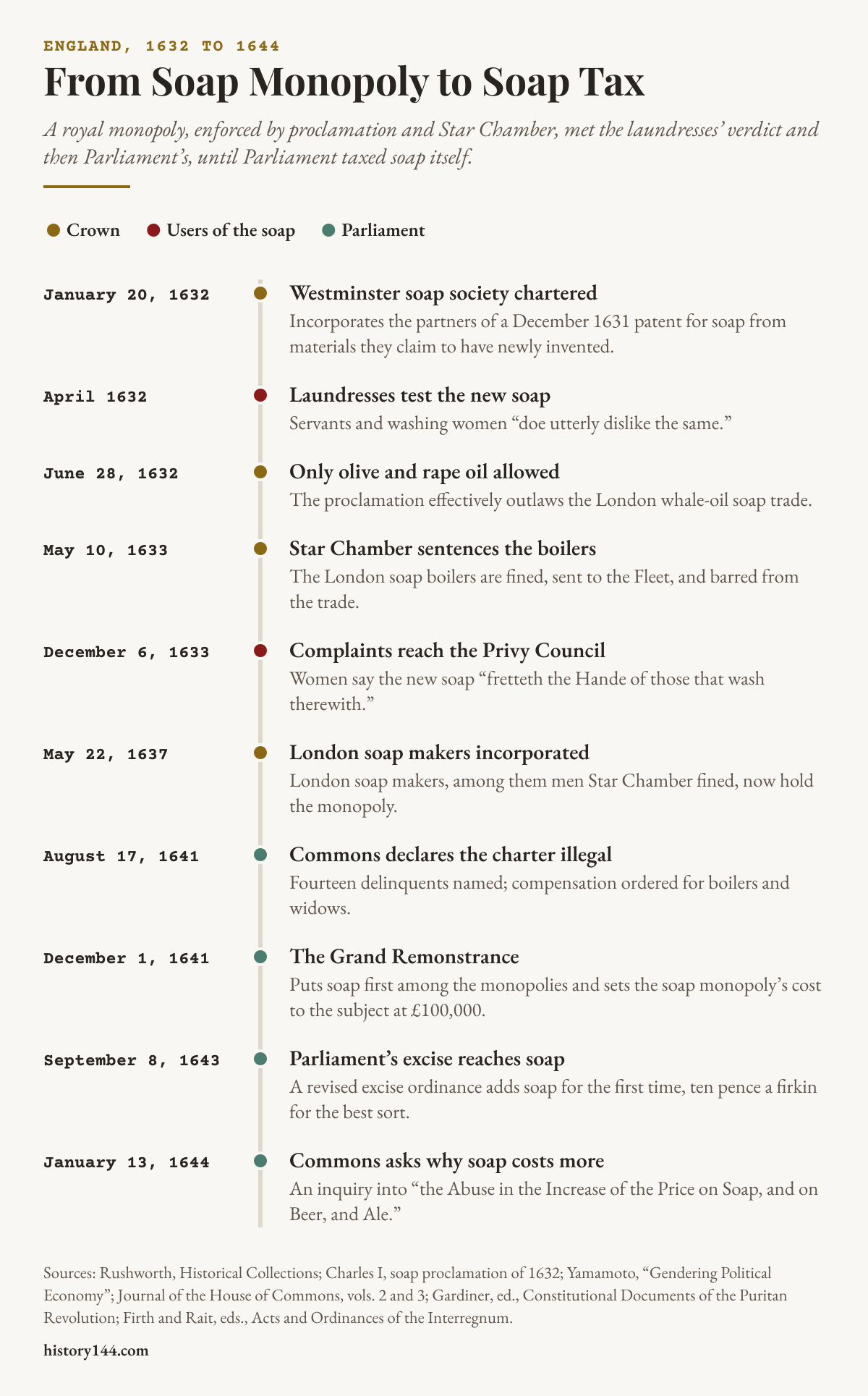
It is easy to file the soap monopoly of the 1630s among the minor scandals of the king's Personal Rule, a story of greedy courtiers and bad soap. It was larger than that. The crown's search for revenue reached into ordinary households, and the people who washed with its soap resisted for years. The soap boilers the Star Chamber had ruined came back to hold the monopoly themselves. The Long Parliament condemned the whole business in 1641, and within three years Parliament itself was taxing soap to pay for its war against the king. The question that the soap business raised, whether a government could lay charges on the most common necessities of life, did not end with the monopoly. This is the story of those twelve years.
Twenty Thousand Pounds a Year
When Charles dissolved Parliament in March 1629, he gave up the ordinary means by which English kings raised large sums: parliamentary subsidies. The government turned instead to a range of devices that rested on the royal prerogative, among them fines for failing to take up knighthood, the revival of forest boundaries, and grants of monopoly. Monopolies had been restricted by the Statute of Monopolies of 1624, but the statute left room for patents protecting genuinely new methods of manufacture, and the crown's lawyers framed a number of the new grants to fit that exception.[2]
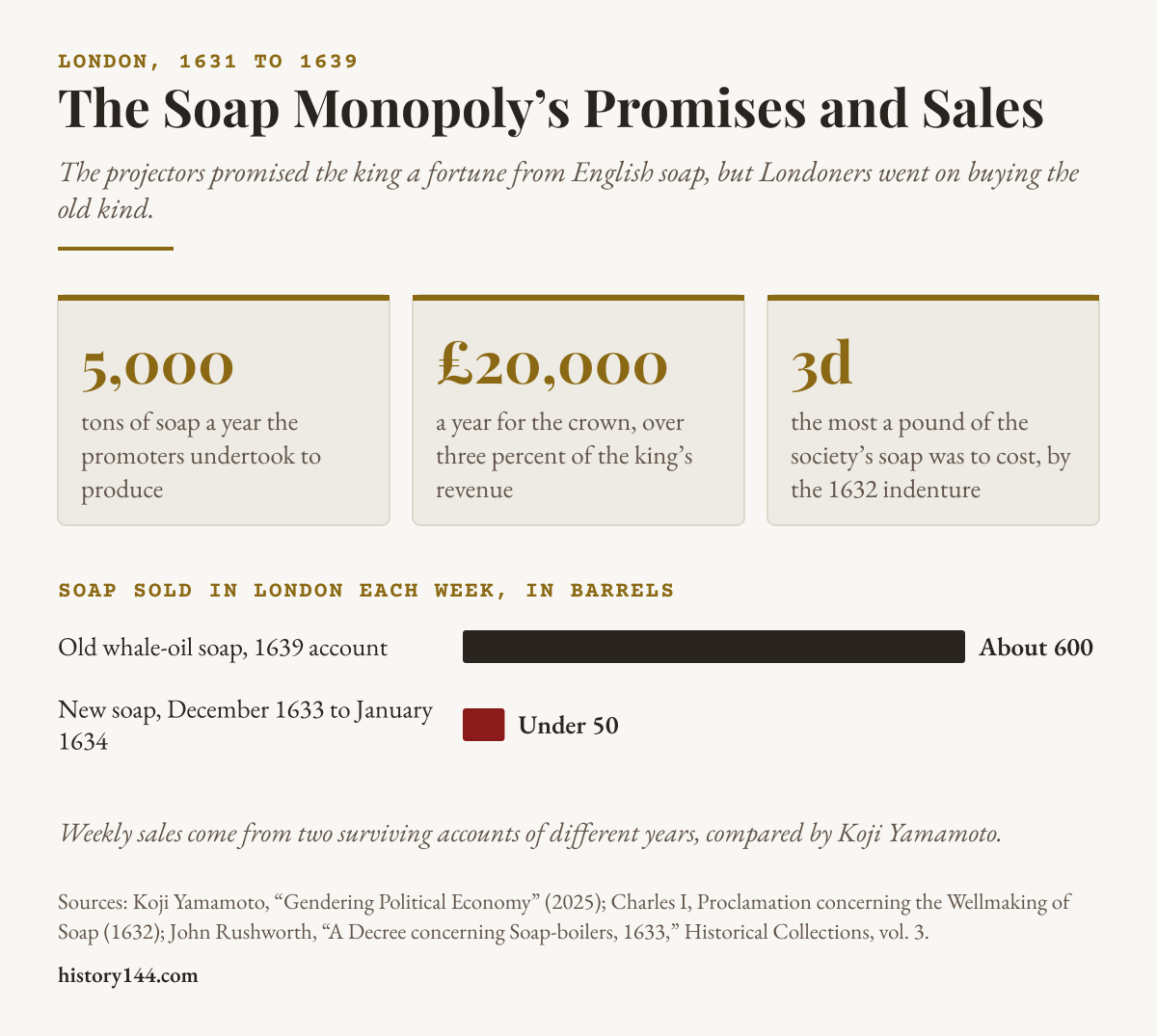
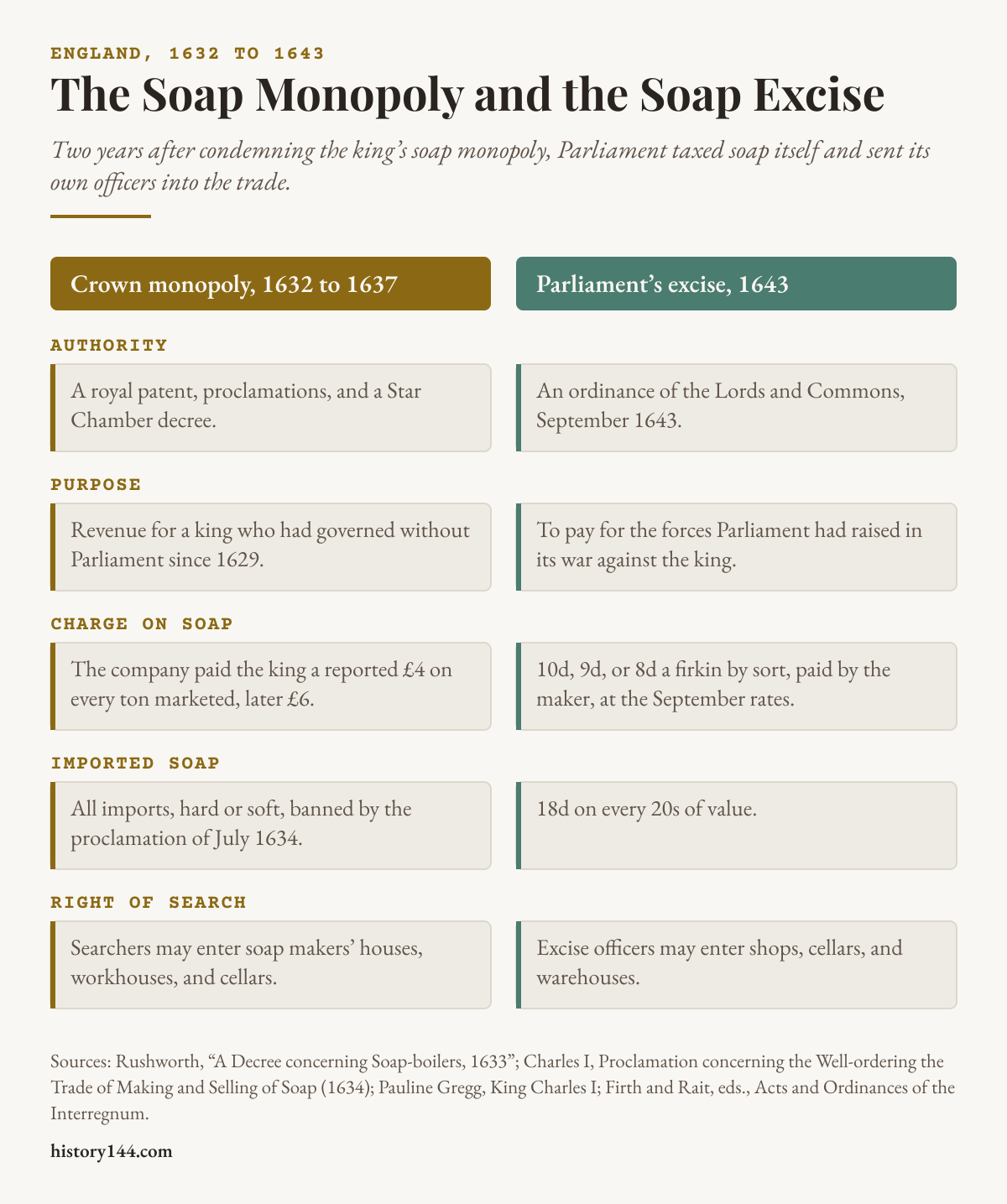
Soap was an attractive target. Every household used it, and most of the soft soap sold in London was made by a small number of boilers using whale oil brought home by the Greenland trade and potash imported from the Baltic. A group of investors proposed to replace the Baltic potash with ash burned in England and the whale oil with other oils, and to pay the king for the privilege. According to Koji Yamamoto's recent study, the promoters undertook to produce five thousand tons of soap a year and to raise twenty thousand pounds annually for the crown, a figure equal to more than three percent of the king's revenue.[3] The Venetian ambassador counted it among the "devices and subtleties, never practised in the past" by which the crown was raising money without "the more and more detested means of parliament." Archbishop William Laud later referred to the soap affair as business of great consequence.[4] The rate the company paid to the king is reported as four pounds on every ton of soap marketed, later raised to six.[5]
On December 17, 1631, Charles granted a fourteen-year patent to Roger Jones, Andrew Palmer, and a group of partners that included Sir William Russell, Sir Basil Brooke, Sir Richard Weston, Sir Edward Stradling, and George Gage. The grant gave them the sole right to make hard and soft soap with materials they claimed to have newly invented, and to burn potash from bean straw, pea straw, fern, kelp, and other plants found in the king's own dominions.[6] On January 20, 1632, a second patent incorporated the investors as the Governors, Assistants, and Fellows of the Society of Soapmakers within the City of Westminster, and the original privilege was assigned to the new body. On May 3, 1632, the society signed an indenture with the king, promising to supply the kingdom with good soap at no more than three pence a pound.[7]
The investors' identities quickly became part of the controversy. The corporation was widely believed to be a Catholic enterprise at a time when anti-Catholic feeling ran high in London, and its product was soon mocked as "popish soap."[8] Modern accounts sometimes identify the Sir Richard Weston named in the patent with the Lord Treasurer, Richard Weston, Earl of Portland. The contemporary record suggests caution. The patent of 1631 lists a knight, not a peer. A royal proclamation of December 1637, two years after Portland's death, still allowed Sir Richard Weston, Knight, to make his assigned quantity of soap, and the House of Commons named a Sir Richard Weston among the soap "delinquents" in 1641.[9] What is clear is that the project enjoyed protection at the highest level of the court. Ronald Asch notes that after Portland's death in 1635, Lord Cottington, another of the king's leading financial ministers, managed to keep the Westminster company's patent in force.[10]
Stamped with a Fleur-de-Lis
The patent alone did not make a monopoly. The projectors first had to show that their soap was good, and then the king had to use his power of proclamation against everyone else in the trade. In April 1632, while the terms of the scheme were still under consideration, the promoters arranged for laundresses to wash with the new soap in a public demonstration. The test did not go as they hoped. A letter from a group of London citizens to the lord mayor and aldermen reported that their servants and other washing women "doe utterly dislike the same." The scheme went ahead anyway.[11] Yamamoto traces the trouble to the raw material. Good potash required burning great quantities of hardwood, and England's forests were already depleted. Potash made from straw, fern, and bracken was harsher and more caustic than the Baltic product, and soap made with it could crack and burn the hands of the women who used it day after day.[12]
On June 28, 1632, a royal proclamation commanded all soap makers, whether members of the Westminster society or not, to use no oil except olive oil and rape oil. Since the London soft-soap trade depended on whale oil, the order effectively outlawed it. The same proclamation forbade anyone to sell soap, potash, or soap ashes until searchers chosen by the society had tested the goods and stamped them with a fleur-de-lis. It named Francis Coningsby as the first assay master, the official responsible for keeping a sample firkin of the society's soap as the standard against which all other soap would be judged.[13]
Fined Out of the Trade
The established soap boilers of London did not accept the new order. They went on making soap from whale oil, refused to let the assay master test it, and met in taverns to agree on prices. On November 22, 1632, the king's attorney general, William Noy, filed an information against them in the Court of Star Chamber, the prerogative court that sat without a jury.[14] The case was heard on May 10, 1633, and John Rushworth's printed reports record the charges. The defendants had used great quantities of fish oil, and some had added oil of spike to disguise its smell. Three had refused to let the assay master try their soap, and several had agreed together at taverns not to sell their second-best soap under fifty-four shillings a barrel. All were committed to the Fleet prison. Edwin Griffin was fined fifteen hundred pounds; Thomas Overman the elder and Edmund Whitwell one thousand pounds each; four others one thousand marks each; and nine more five hundred pounds each. Every one of them was barred, along with his servants and agents, from ever practising the trade again.[15]
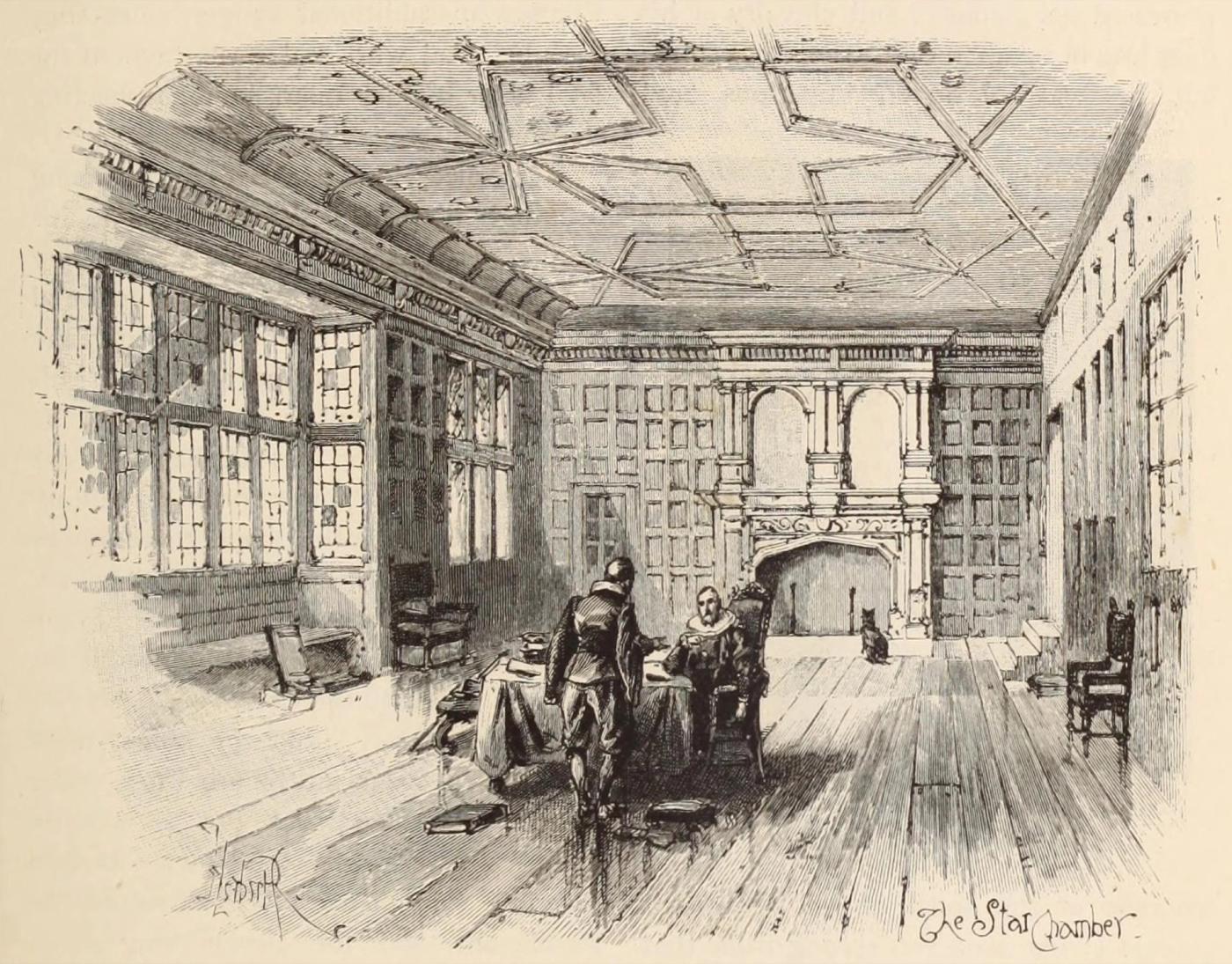
The sentence was followed by a general decree of the Star Chamber dated August 23, 1633. It recited a certificate from Sir Robert Ducy, a former lord mayor, that the Westminster soap exceeded the best London soap in goodness, and it fixed the price of soft soap at three pounds four shillings a barrel. The decree authorized the assay master and searchers, with a constable if they wished, to enter the houses, workhouses, and cellars of any soap maker. It confined soap making to London, Westminster, and Bristol, or within a mile of those cities, and it placed every soap maker in the kingdom under the government of the Westminster society. Anyone who had not been in the trade on November 22, 1632, was forbidden to begin without the court's permission, a provision aimed at people who had tried to keep the condemned men's works going in their names.[16] Yamamoto, drawing on a pamphlet printed in 1641, reports that two of the sentenced soap boilers died under arrest.[17] When the Commons later ordered compensation, it named the widows of three of the men, William Barber, John Revill, and Thomas Washer, as well as the widow of Thomas Overman the younger.[18]
Fretteth the Hande
The monopoly's most stubborn opponents were the people who used the soap. Laundry in seventeenth-century London was overwhelmingly women's work, much of it paid, and the women who did it knew better than anyone how a soap behaved in the tub.[19] In October 1633, Coningsby himself went to Bristol with the new soap and a party of washerwomen to test the local product. The Bristol soap boilers' own minutes record that washerwomen from both cities did the washing, and that Coningsby was forced to admit that the Bristol soap was "as good in all respects" as the soap he had brought.[20]
In London, the complaints grew loud enough to reach the Privy Council. At its meeting on December 6, 1633, the council heard that certain "turbulent" persons had raised up women "of meane condicon" to declare openly in the streets that the patentees' soap did not wash as white or as sweet as the old, did not go as far, spoiled and burned the linen, and "fretteth the Hande of those that wash therewith."[21] The council referred the matter to the lord mayor, Sir Ralph Freeman, who returned petitions bearing two or three hundred names.[22] Freeman was himself a Greenland merchant who had long sold whale oil to the soap boilers, and the king was not pleased with his handling of the affair. Rossingham reported that on December 23 the mayor was summoned to court and rebuked by the king and the lords for favoring the old soap. George Garrard, writing to Sir Thomas Wentworth in Ireland on January 9, 1634, said that the mayor had received "a shrewd Reprimand" for being afraid of "a Troop of Women that clamorously petitioned him against the new Soap."[23] The story traveled far. The Dorchester diarist William Whiteway recorded that the king had called the mayor an "old foole" for speaking on behalf of "the Sopeboilers and Laundresses of London." He also recorded that on February 13 the king invited himself to dine with the mayor to make amends.[24]
The authorities answered with more trials. Commissioners joined with the mayor and some aldermen held two general washing days at Guildhall, and most of them gave their verdict for the new soap. Garrard reported that complaints nonetheless continued: that the soap burned linen, scalded laundresses' fingers, and wasted in keeping.[25] A royal proclamation dated January 26, 1634, dismissed the petitions as clamor from people who had no experience of the soap. It cited certificates from more than eighty women, among them laundresses and many ladies and gentlewomen of great credit. Rossingham had already doubted those certificates in December. Most of the ladies who had signed, he wrote, had their own linen washed with Castile soap, the fine imported hard soap that the wealthy could still buy.[26]
At least some of the protesting women can be identified. When the Privy Council investigated the petitions, it examined Edward Quarrington, a tallow chandler who had delivered one of them to the mayor. Quarrington said that his customers complained of the badness of the new soap and asked him to present their petition. Pressed for names, he gave three women from Thames Street: Ursula Gosse, Elizabeth Tucker, and Anne Banner.[27] Yamamoto has traced Tucker in later church-court records. In 1638 she was a poor widow of the riverside parish of St Martin Vintry who described herself as living by nursekeeping and "but little worth." In 1636 the churchwardens had sent her into a plague-stricken house to care for the dying.[28] Two years before that, a tallow chandler had given her name to the Privy Council as one of the women who complained of the king's soap.
Searchers at the Door
The proclamation of January 1634 also widened the company's powers. It authorized searchers to enter soap makers' houses, ordered seizure of unmarked soap, and required unlicensed makers to pull up their pans and vessels by March 25. The fight on London Bridge took place in the first weeks of this new regime, in Southwark, a district where many soap boilers lived and worked.[29]
A further proclamation, given at Theobalds on July 13, 1634, complained that the king's opponents had found new ways to defeat the scheme: dissolving Castile, Venetian, and Smyrna soaps to stretch them, smuggling fish-oil soap from Scotland, France, and Holland, and teaching householders to make their own. It claimed that the price of old soap had risen to six pence a pound in London and to eight, ten, and even twelve pence elsewhere, where it had once sold for three pence or three pence halfpenny. It also accused the old soap boilers of deliberately falsifying the new white soap to bring it into dislike. It forbade anyone outside the licensed trade to make soap in a private house, even for household use, and it banned the import of any soap, hard or soft.[30] Outside London the resistance continued. A merchant's agent in Hull wrote in July 1634 that people in Hull and York refused to surrender seized soap to the officers and openly defended selling the old speckled soap.[31]
On January 25, 1635, another proclamation ordered the society's officers to "break, deface, or destroy all Pans, Pots, Lee-Tubs, Fats, Cisterns, and other Vessels" used by unlicensed makers. It authorized the company to reward its informers out of the soap they seized, and it declared that the owners and occupants of any house where soap was made illegally would be prosecuted in Star Chamber.[32] Resistance hardened in turn. Yamamoto cites a certificate of October 1636 describing soap makers who resolved to die rather than yield and met the searchers with naked swords, pistols, and a great mastiff.[33]
The pressure did not create a market. Yamamoto's comparison of surviving accounts shows the scale of the failure, though the two accounts come from different years. One for the old whale-oil soap, from 1639, records London sales approaching six hundred barrels a week. The new soap's account for December 1633 and January 1634 shows fewer than fifty.[34] The searchers could break a rival's pans. They could not make Londoners buy the new soap.
Sunday at Theobalds
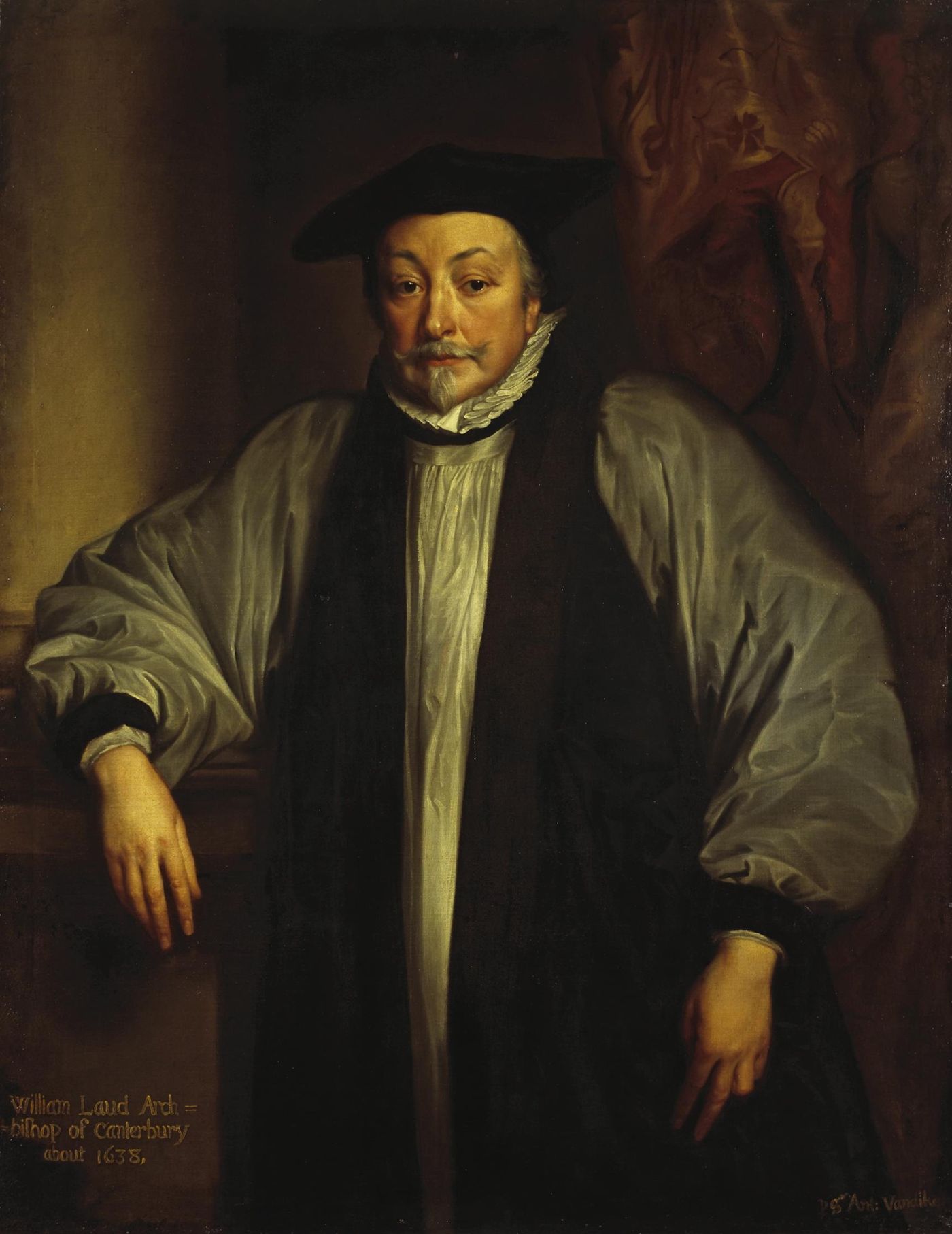
Laud's diary, printed by Rushworth, records the moment of decision. On Sunday, July 12, 1635, at Theobalds, the soap business was "ended, and settled again upon the new Corporation," against Laud's own offer on behalf of the old soap boilers. Laud added, with evident bitterness, that his offer had nonetheless doubled the king's profit. He left it to whoever held the Treasurer's staff to see the bargain kept.[35] The Westminster company survived. In April 1636 it entered into a new indenture of covenants with the king. In December the Privy Council issued a commission to Sir John Hales and John Howe under which suspected soap makers were held, examined on oath, and fined.[36]
The end came the next year. According to Asch, the Westminster soap makers were induced to surrender their patent in May 1637.[37] On May 22, 1637, the king incorporated Edward Bromfield, then lord mayor of London, together with the London soap makers, as the Society of Soapmakers of London. A proclamation of December 28, 1637, announced the change. The Westminster society had resigned its grant, the king had canceled it, and all the proclamations and decrees made in its favor were repealed. The new company received the same sweeping powers of search, seizure, and destruction as the old one. It was, however, permitted to make the familiar whale-oil soap. It was to sell that soap at three pence halfpenny a pound, and the best olive and rape oil soap at four pence halfpenny.[38] The proclamation exempted the soap makers of Bristol and several western counties, as well as Sir Richard Weston, from the new restrictions, allowing them to make the quantities already assigned to them.[39]
The settlement rewarded the king's earlier victims, and it rewarded the king more. Pauline Gregg describes the independent soap makers' last move as an offer to pay the crown a larger annual sum than the Westminster society was paying, which bought out the monopoly.[40] Asch notes that the London company paid even more to the king for the same privileges.[41] A hostile pamphlet published in 1646 alleged that the London men had given the king forty thousand pounds for their patent. The figure comes from an opponent writing nearly a decade later and should be treated with caution.[42] Either way, the London soap makers, among them men whom the Star Chamber had fined and imprisoned in 1633, now held the monopoly themselves, although not every independent maker was admitted. Soap remained a royal monopoly.
Illegal from the Start
When the Long Parliament met in November 1640, the soap business was among the first grievances it took up. On February 2, 1641, when the Commons sent the general business of monopolies to one committee, it left the monopolies of salt, soap, and leather with a committee of their own.[43] In the same year the bookseller Nicholas Bourne published A Short and True Relation concerning the Soap-busines. It reprinted the patents and proclamations and described soap makers fined, imprisoned for months at a time, and ruined, with their pans and vats broken. It also preserved the old complaint that the new white soap spoiled and burned linen and fretted the hands of the women who washed it.[44]
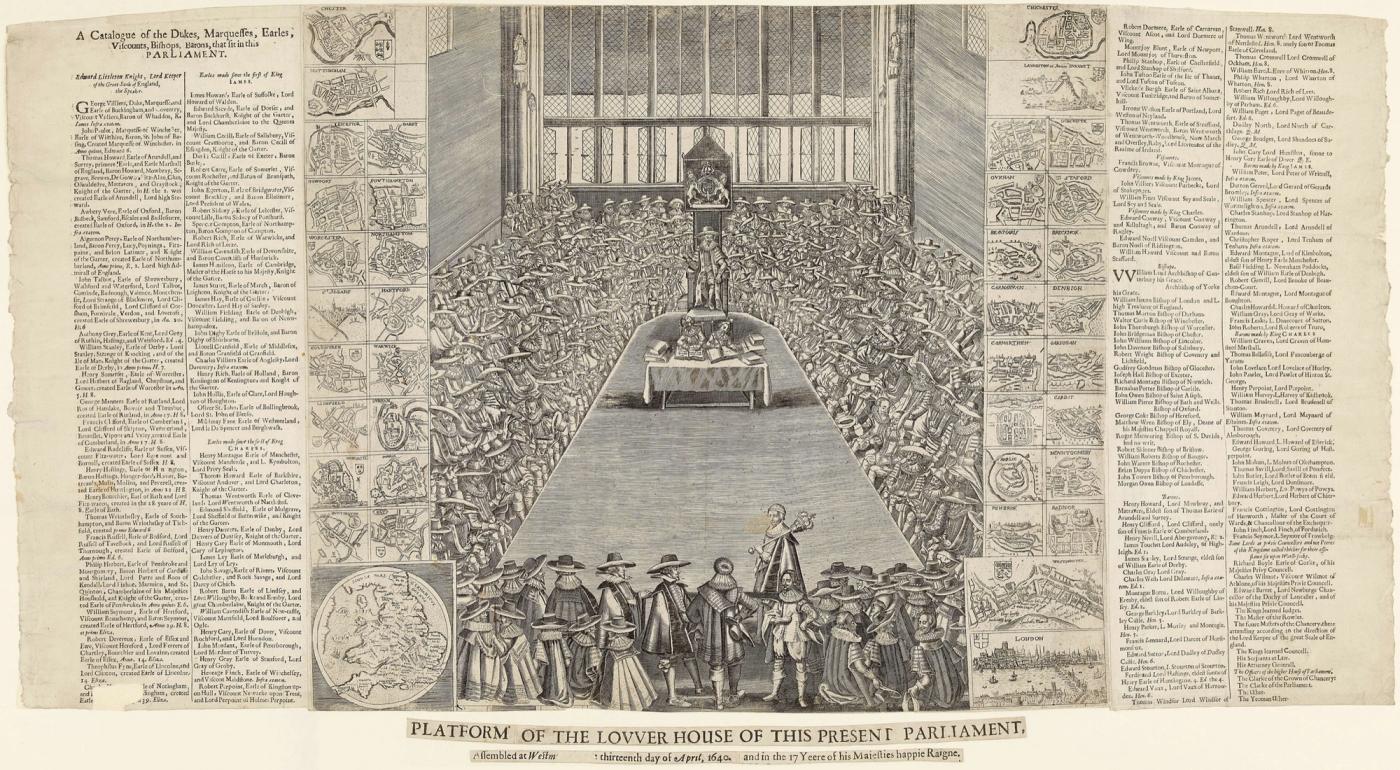
On August 17, 1641, Mr. King reported the soap business to the House on the committee's behalf. The Commons resolved that the Westminster soap makers' charter and their indenture with the king were "a Monopoly, and illegal in the Creation." It also resolved that the proclamation of June 1632 was against the law and the liberty of the subject, and that the Star Chamber prosecution of Overman and his fellow soap boilers was illegal and its sentence ought to be reversed. It named fourteen men as delinquents, Sir Richard Weston, Sir Basil Brooke, and George Gage among them, and ordered that the surviving soap boilers and the widows of the dead be compensated for their imprisonment, lost trade, and broken vats and pans. It declared the Star Chamber decree of August 1633 illegal, a measure tending to "the Introducing of an arbitrary Government."[45] On October 30 the House went further, condemning the proclamations of 1634 and 1635, the Privy Council orders that had enforced them, the commission to Hales and Howe, and the bonds by which the imprisoned London soap boilers had been forced to promise never to make soap again without the Westminster company's license. It also declared Fitzwilliam Coningsby, the member for Herefordshire, a monopolist and issued a writ to replace him.[46]
The Grand Remonstrance, presented to the king on December 1, 1641, placed soap at the head of its list of oppressive monopolies, which named soap, salt, wine, leather, sea-coal, and "in a manner of all things of most common and necessary use." Among Parliament's achievements, it claimed to have suppressed the monopolies, which had cost the subject more than a million pounds a year, and it put the soap monopoly's share at one hundred thousand pounds.[47] The same document condemned, as an earlier abuse of the reign, an "unjust and pernicious attempt to extort great payments from the subject by way of excise."[48]
By the Authority of Parliament
That condemnation did not last. War broke out between king and Parliament in 1642, and Parliament soon faced the same problem that had driven Charles to the soap patent: how to pay for government without the old sources of revenue. On July 22, 1643, the two Houses passed an ordinance imposing a charge, or "new impost," on a schedule of commodities to maintain the forces raised "for the Defence of the King and Parliament."[49] This was the excise, a tax on goods rather than on land or income. A revised ordinance of September 8, 1643, replaced it and, for the first time, added soap to the list. Every firkin of soap made in England and Wales was to pay ten pence for the best sort, nine pence for the second, and eight pence for the worst, payable by the maker. Imported soap was to pay eighteen pence on every twenty shillings of value. The same ordinance authorized officers of the excise to enter the shops, cellars, and warehouses of those who bought and sold the taxed goods to search for evasion.[50] The searchers were back at the door, this time sent by Parliament.
By the start of 1644, the burden was already provoking complaint. On January 13, 1644, the solicitor general presented to the Commons an ordinance for increasing the excise on soap, but "nothing was done upon it." The House ordered the Committee of Excise to inquire into "the Abuse in the Increase of the Price on Soap, and on Beer, and Ale," and to report back.[51] In September 1644 Parliament extended the rules for collecting the excise for a further year.[52] The excise, introduced as a wartime expedient, outlived the war and became a lasting part of English public finance.
The soap makers adapted to the new regime as they had to the old. In 1646 a pamphlet titled A Looking-Glass for Sope-Patentees accused the London soap company of proposing to Parliament that it be allowed to collect the excise on potash and farm the excise on soap. In return it offered one thousand pounds a year more than the state then received. The author charged that the same men who had once sought a monopoly "by the Authority of the King's Majesty" were now seeking one "by the Authority of Parliament." He also complained that their proposals were aimed at poor soap boilers whom the company itself described as working in corners.[53] Whether or not the charge was fair, it was the old quarrel under a new master.
Judged at the Washtub
The soap monopoly did not cause the English Civil War; it was one grievance among many. But it shows the Personal Rule at close range. A financial project designed at court to raise revenue without Parliament required, in practice, a patent, a string of proclamations, a Star Chamber prosecution, a general decree, the imprisonment of more than a dozen tradesmen, and searchers with the right to break into houses and destroy equipment. Even so, it failed to persuade the women who used the soap, and the crown finally took a better offer from the men it had punished.
Twelve years after the Westminster society was chartered, Parliament was taxing soap, and its own members were inquiring into the rising price of a necessity of life. Soap would remain a target of monopolies and taxes in England until William Gladstone's budget abolished the duty on soap made in Great Britain in 1853.[54] In February 1634 a crowd of women on London Bridge had tried to take a prisoner away from the king's searchers, and failed. The quarrel they joined was settled elsewhere, at the washtub, where the people whose hands the king's soap fretted judged it and found it wanting.
Places in this Story
The places this story moves through, in order — follow them on the interactive map →
- London Bridge, England February 28, 1634
A squadron of women tried to free the searchers' prisoner, and a crowd of apprentices drove the searchers to take shelter in a house.
- Westminster, London January 20, 1632
The investors were incorporated as the Society of Soapmakers within the City of Westminster.
- Greenwich, England June 28, 1632
A proclamation forbade every soap maker to use any oil but olive and rape, outlawing the whale oil trade.
- Fleet Prison, London May 10, 1633
The London soap boilers were fined, committed to prison and barred from their trade for life.
- Bristol, England October 1633
Washerwomen from both cities tested the new soap against Bristol's, and the assay master conceded.
- Guildhall, London December 1633
The lord mayor returned petitions against the new soap bearing two or three hundred names.
- Southwark, London March 1634
Unlicensed makers had until March 25 to pull up their own pans, while searchers entered houses to seize unmarked soap.
- Hull, England July 1634
People in Hull and York refused to surrender seized soap and openly defended selling the old sort.
- Theobalds, England July 12, 1635
The king settled the soap business again upon the Westminster corporation, against Laud's offer.
Frequently Asked Questions
What was the soap monopoly of the 1630s?
In December 1631 Charles I granted a group of investors the sole right to make soap by what they claimed was a new method, and in January 1632 incorporated them as the Society of Soapmakers of Westminster. Royal proclamations then outlawed the whale oil soap that the established London boilers made.
Why was it called popish soap?
The Westminster corporation was widely believed to be a Catholic enterprise at a time when anti-Catholic feeling ran high in London. The nickname stuck to the product rather than to any proven conspiracy.
Why did London laundresses object to the new soap?
They said it did not wash as white or as sweet, did not go as far, spoiled and burned the linen, and fretted the hands of those who washed with it. Potash made from straw and bracken rather than hardwood was harsher and more caustic than the Baltic product.
What did Star Chamber do to the London soap boilers?
On May 10, 1633 it committed them to the Fleet prison, fined them sums from five hundred to fifteen hundred pounds, and barred every one of them from the trade for life. A general decree that August put all soap makers in the kingdom under the Westminster society's government.
How did the soap monopoly end?
The Westminster men surrendered their patent in 1637, and on May 22 the king incorporated the London soap makers instead, on terms that let them use whale oil again. The men Star Chamber had fined and imprisoned now held the monopoly themselves.
What did Parliament say about the soap monopoly in 1641?
On August 17, 1641 the Commons resolved that the Westminster charter was a monopoly and illegal in its creation, that the proclamation of 1632 was against the liberty of the subject, and that the Star Chamber sentence should be reversed. It ordered compensation for the ruined soap boilers and the widows of the dead.
When did Parliament start taxing soap?
The revised excise ordinance of September 1643, which replaced the first excise of that July, charged eight to ten pence on every firkin of soap made in England and Wales. By January 1644 the Commons was inquiring into the rising price of soap, beer and ale.
Bibliography
A Looking-Glass for Sope-Patentees. London, 1646. EarlyPrint transcription. https://distantreader.org/stacks/earlyprint/txt/A88529.txt. Accessed October 25, 2026.
A Short and True Relation concerning the Soap-busines. London: Nicholas Bourne, 1641. Google Books. https://books.google.com/books?id=N76gnQEACAAJ. Accessed November 9, 2026.
Asch, Ronald G. "The Revival of Monopolies: Court and Patronage during the Personal Rule of Charles I, 1629-1640." In Princes, Patronage, and the Nobility, edited by Ronald G. Asch and Adolf M. Birke, 357-92. Oxford: Oxford University Press, 1991.
Calendar of State Papers Venice. Vol. 23, 1632-1636. Google Books. https://books.google.com/books?id=5EKozQEACAAJ. Accessed November 9, 2026.
Charles I. By the King. A Proclamation concerning the Wellmaking of Soap. London: Robert Barker and the assigns of John Bill, 1632. EarlyPrint transcription. https://distantreader.org/stacks/earlyprint/txt/B13055.txt. Accessed October 25, 2026.
Charles I. By the King. A Proclamation concerning the Well-ordering the Trade of Making and Selling of Soap. London: Robert Barker and the assigns of John Bill, 1634. EarlyPrint transcription. https://distantreader.org/stacks/earlyprint/txt/B13081.txt. Accessed October 25, 2026.
Charles I. By the King. A Proclamation for the Well Ordering and Settling the Manufacture of Soap, under a Rule and Government. London: Robert Barker and the assigns of John Bill, 1635. EarlyPrint transcription. https://distantreader.org/stacks/earlyprint/txt/A22586.txt. Accessed October 25, 2026.
Charles I. By the King. A Proclamation touching the Corporation of Sope-makers of London. London: Robert Barker and the assigns of John Bill, 1637. EarlyPrint transcription. https://distantreader.org/stacks/earlyprint/txt/B13138.txt. Accessed October 25, 2026.
Firth, C. H., and R. S. Rait, eds. Acts and Ordinances of the Interregnum, 1642-1660. London: His Majesty's Stationery Office, 1911. British History Online. https://prod.british-history.ac.uk/no-series/acts-ordinances-interregnum. Accessed October 25, 2026.
Gardiner, Samuel Rawson, ed. The Constitutional Documents of the Puritan Revolution, 1625-1660. 3rd ed. Oxford: Clarendon Press, 1906. https://constitution.org/1-History/eng/conpur043.htm. Accessed October 25, 2026.
Gregg, Pauline. King Charles I. Berkeley: University of California Press, 1984. http://ark.cdlib.org/ark:/13030/ft9v19p2p6. Accessed October 25, 2026.
Gregory, James. "Soap and the Victorians: Cleanliness Is Next to Godliness." University of Plymouth. https://www.plymouth.ac.uk/courses/undergraduate/ba-history-2-2/soap-and-the-victorians. Accessed October 25, 2026.
Journal of the House of Commons. Vol. 2, 1640-1643. London: His Majesty's Stationery Office, 1802. British History Online. https://archive.british-history.ac.uk/node/3262. Accessed October 25, 2026.
Journal of the House of Commons. Vol. 3, 1643-1644. London: His Majesty's Stationery Office, 1802. British History Online. https://archive.british-history.ac.uk/node/2693. Accessed October 25, 2026.
Knowler, William, ed. The Earl of Strafforde's Letters and Dispatches. Vol. 1. London, 1739.
Larkin, James F., ed. Stuart Royal Proclamations. Vol. 2. Oxford: Clarendon Press, 1983. Google Books. https://books.google.com/books?id=1FhnAAAAMAAJ. Accessed November 9, 2026.
Laud, William. The Works of William Laud. Vol. 3. 1853.
Matthews, Harold Evan, ed. Proceedings, Minutes and Enrolments of the Company of Soapmakers, 1562-1642. Bristol: Bristol Record Society, 1940. Google Books. https://books.google.com/books?id=jO_kMgEACAAJ. Accessed November 9, 2026.
McClurkin, Daniel T. "Traces of England's Fretful Soap Monopoly of the 1630s." Virginia Fox Stern Center for the History of the Book in the Renaissance, Johns Hopkins University. https://sterncenter.library.jhu.edu/early-book-collections/english-popish-soap-controversy/. Accessed October 25, 2026.
Rushworth, John. Historical Collections of Private Passages of State. Vol. 2, 1629-38. London: D. Browne, 1721. British History Online. https://www.british-history.ac.uk/rushworth-papers/vol2/pp287-318. Accessed October 25, 2026.
Rushworth, John. Historical Collections of Private Passages of State. Vol. 3, 1639-40. London: D. Browne, 1721. British History Online. https://prod.british-history.ac.uk/rushworth-papers/vol3. Accessed October 25, 2026.
Steele, Robert. A Bibliography of Royal Proclamations of the Tudor and Stuart Sovereigns and of Others Published under Authority, 1485-1714. 2 vols. Oxford: Clarendon Press, 1910.
Whiteway, William. William Whiteway of Dorchester: His Diary 1618 to 1635. Dorset Record Society 12. 1991. Google Books. https://books.google.com/books?id=B-IWAQAAIAAJ. Accessed November 9, 2026.
Yamamoto, Koji. "Gendering Political Economy: Laundry, Washerwomen and the Fall of the Westminster Soap Company in Charles I's London." CIRJE Discussion Paper F-1242. Tokyo: University of Tokyo, 2025. https://www.cirje.e.u-tokyo.ac.jp/research/dp/2025/2025cf1242.pdf. Accessed October 25, 2026.
Citations
- Edmund Rossingham to the Earl of Huntingdon, March 7, 1633/4, Bodleian Library, Carte MS 77, fol. 346, quoted in Koji Yamamoto, "Gendering Political Economy: Laundry, Washerwomen and the Fall of the Westminster Soap Company in Charles I's London," CIRJE Discussion Paper F-1242 (Tokyo: University of Tokyo, 2025), 29-30; on the proclamation, dated January 26, 1633/4 and proclaimed on February 5, see 22, 28, and Robert Steele, A Bibliography of Royal Proclamations of the Tudor and Stuart Sovereigns, vol. 1 (Oxford, 1910), no. 1668. ↑
- Daniel T. McClurkin, "Traces of England's Fretful Soap Monopoly of the 1630s," Virginia Fox Stern Center for the History of the Book in the Renaissance, Johns Hopkins University. ↑
- Charles I, By the King. A Proclamation concerning the Wellmaking of Soap (London: Robert Barker and the assigns of John Bill, 1632), for the undertaking to make five thousand tons; Yamamoto, "Gendering Political Economy," 13-15, 22, for the payment to the crown and its share of the king's revenue. ↑
- Vicenzo Gussoni to the Doge and Senate, London, December 23, 1633, in Calendar of State Papers Venice, vol. 23, 1632-1636, ed. Allen B. Hinds (London: His Majesty's Stationery Office, 1921), no. 231, 176; William Laud, diary, July 12, 1635, in The Works of William Laud, vol. 3 (Oxford: John Henry Parker, 1853), 223-24. ↑
- Pauline Gregg, King Charles I (Berkeley: University of California Press, 1984), 217-18. ↑
- John Rushworth, "A Decree concerning Soap-boilers, 1633," in Historical Collections of Private Passages of State, vol. 3, 1639-40 (London: D. Browne, 1721), 109-15. ↑
- Rushworth, "Decree concerning Soap-boilers," 109-15; Charles I, By the King. A Proclamation concerning the Wellmaking of Soap (London: Robert Barker and the assigns of John Bill, 1632). ↑
- McClurkin, "Traces of England's Fretful Soap Monopoly." ↑
- Rushworth, "Decree concerning Soap-boilers," 109-15; Charles I, Proclamation touching the Corporation of Sope-makers of London (1637); Journal of the House of Commons, vol. 2, 1640-1643 (London: His Majesty's Stationery Office, 1802), August 17, 1641, 259-61. ↑
- Ronald G. Asch, "The Revival of Monopolies: Court and Patronage during the Personal Rule of Charles I, 1629-1640," in Princes, Patronage, and the Nobility, ed. Ronald G. Asch and Adolf M. Birke (Oxford: Oxford University Press, 1991), 357-92. ↑
- Sir John Gore and others to the Lord Mayor and Court of Aldermen, 1632, The National Archives, SP 16/215, fol. 213, quoted in Yamamoto, "Gendering Political Economy," 16-17. ↑
- Yamamoto, "Gendering Political Economy," 14-15. ↑
- Charles I, Proclamation concerning the Wellmaking of Soap (1632). ↑
- Rushworth, "Decree concerning Soap-boilers," 109-15. ↑
- John Rushworth, "Star Chamber Reports: 9 Charles I," in Historical Collections of Private Passages of State, vol. 3, 1639-40 (London: D. Browne, 1721), 53-69. ↑
- Rushworth, "Decree concerning Soap-boilers," 109-15. ↑
- Yamamoto, "Gendering Political Economy," 14, citing A Short and True Relation concerning the Soap-busines (London: Nicholas Bourne, 1641), 10, 16. ↑
- Journal of the House of Commons, vol. 2, August 17, 1641, 259-61. ↑
- Yamamoto, "Gendering Political Economy," 11-12. ↑
- Harold Evan Matthews, ed., Proceedings, Minutes and Enrolments of the Company of Soapmakers, 1562-1642 (Bristol: Bristol Record Society, 1940), 194-95, quoted in Yamamoto, "Gendering Political Economy," 17. ↑
- Privy Council order, December 6, 1633, The National Archives, SP 16/252, fol. 40, quoted in Yamamoto, "Gendering Political Economy," 18. ↑
- Certificate of Ralph Freeman and others, December 24, 1633, The National Archives, SP 16/254, fol. 74, quoted in Yamamoto, "Gendering Political Economy," 19-20. ↑
- Edmund Rossingham to Sir Thomas Puckering, December 31, 1633, British Library, Harley MS 7000, quoted in Yamamoto, "Gendering Political Economy," 1-2, 20; George Garrard to Thomas Wentworth, January 9, 1633/4, in William Knowler, ed., The Earl of Strafforde's Letters and Dispatches, vol. 1 (London, 1739), 176. ↑
- William Whiteway of Dorchester: His Diary 1618 to 1635, Dorset Record Society 12 (1991), 139, quoted in Yamamoto, "Gendering Political Economy," 20. ↑
- George Garrard to Thomas Wentworth, January 9, 1633/4, in William Knowler, ed., The Earl of Strafforde's Letters and Dispatches, vol. 1 (London, 1739), 176. ↑
- Yamamoto, "Gendering Political Economy," 26-27, citing James F. Larkin, ed., Stuart Royal Proclamations, vol. 2 (Oxford: Clarendon Press, 1983), and Rossingham to Puckering, December 31, 1633, British Library, Harley MS 7000, fol. 352. ↑
- Examination of Edward Quarrington, February 10, 1634, The National Archives, SP 16/260, fol. 102, quoted in Yamamoto, "Gendering Political Economy," 34. ↑
- Yamamoto, "Gendering Political Economy," 38-40. ↑
- Yamamoto, "Gendering Political Economy," 28-29. ↑
- Charles I, By the King. A Proclamation concerning the Well-ordering the Trade of Making and Selling of Soap (London: Robert Barker and the assigns of John Bill, 1634). ↑
- Anthony Kyrle to John Howe, July 8, 1634, The National Archives, SP 16/271, fol. 91, quoted in Yamamoto, "Gendering Political Economy," 32. ↑
- Charles I, By the King. A Proclamation for the Well Ordering and Settling the Manufacture of Soap, under a Rule and Government (London: Robert Barker and the assigns of John Bill, 1635). ↑
- Yamamoto, "Gendering Political Economy," 33, citing "The humble Certificate of Sir Thomas Jay," October 7, 1636, The National Archives, SP 16/333, fol. 53. ↑
- Yamamoto, "Gendering Political Economy," 23. ↑
- William Laud, diary, July 12, 1635, in The Works of William Laud, vol. 3 (Oxford: John Henry Parker, 1853), 223-24, printed from the manuscript; Rushworth prints the entry, with a garbled clause about the king's profit, in Historical Collections of Private Passages of State, vol. 2, 1629-38 (London: D. Browne, 1721), 287. ↑
- Journal of the House of Commons, vol. 2, October 30, 1641, 299-300. ↑
- Asch, "Revival of Monopolies," 357-92. ↑
- Charles I, By the King. A Proclamation touching the Corporation of Sope-makers of London (London: Robert Barker and the assigns of John Bill, 1637). ↑
- Charles I, Proclamation touching the Corporation of Sope-makers of London (1637). ↑
- Gregg, King Charles I, 217-18. ↑
- Asch, "Revival of Monopolies," 357-92. ↑
- A Looking-Glass for Sope-Patentees (London, 1646). ↑
- Journal of the House of Commons, vol. 2, February 2, 1641. ↑
- A Short and True Relation concerning the Soap-busines (London: Nicholas Bourne, 1641), as described and quoted in McClurkin, "Traces of England's Fretful Soap Monopoly." ↑
- Journal of the House of Commons, vol. 2, August 17, 1641, 259-61. ↑
- Journal of the House of Commons, vol. 2, October 30, 1641, 299-300. ↑
- "The Grand Remonstrance, with the Petition Accompanying It," clauses 27 and 115-16, in Samuel Rawson Gardiner, ed., The Constitutional Documents of the Puritan Revolution, 1625-1660, 3rd ed. (Oxford: Clarendon Press, 1906). ↑
- "Grand Remonstrance," clause 10, in Gardiner, Constitutional Documents. ↑
- "July 1643: An Ordinance for the Speedy Rising and Leavying of Moneys, Set by Way of Charge or New Impost," in Acts and Ordinances of the Interregnum, 1642-1660, ed. C. H. Firth and R. S. Rait (London: His Majesty's Stationery Office, 1911), 202-14. ↑
- "September 1643: An Ordinance for the Speedy Raising and Leavying of Moneys by Way of Charge and New-Impost," in Firth and Rait, Acts and Ordinances, 274-83. ↑
- Journal of the House of Commons, vol. 3, 1643-1644 (London: His Majesty's Stationery Office, 1802), January 13, 1644, 365-66. ↑
- "September 1644: An Ordinance for the Continuance of a Former Ordinance concerning the Excise," in Firth and Rait, Acts and Ordinances, 513. ↑
- Looking-Glass for Sope-Patentees. ↑
- James Gregory, "Soap and the Victorians: Cleanliness Is Next to Godliness," University of Plymouth. ↑