On October 17, 1784, a fifteen-year-old cadet from Corsica left the royal military school at Brienne, in Champagne, for Paris, accompanied by Father Berton of the school's staff and four classmates. Napoleone Buonaparte had spent five years at Brienne holding a king's scholarship, one of the places the crown reserved for sons of noble families too poor to pay for an officer's education. He had just passed the examination that admitted him to the École Militaire, the great military academy beside the Champ de Mars. Accounts differ on whether he reached the capital on October 19 or October 21. On October 22 he began his studies there as a gentleman cadet.[1]
The kingdom that paid for his schooling looked rich and powerful. It had just helped the American colonies win their independence, humbling Britain in the process. Yet the government was living on borrowed money. Less than a year earlier, on November 3, 1783, Louis XVI had appointed a new controller-general of finances, Charles-Alexandre de Calonne, and within weeks Calonne had floated a loan of one hundred million livres in life annuities.[2] Over the next twelve years the French state tried three ways of paying its bills. The monarchy borrowed until lenders and the courts would carry it no further. The Revolution made confiscated land the nominal backing for paper money, then issued so much of it that the paper became nearly worthless. Finally a republic strained by war and financial collapse came to depend more and more on the gold and silver its armies seized abroad. Each failure helped shape the next crisis, and the last of them placed the Republic's finances, and much of its future, in the hands of the cadet who had walked into the École Militaire in 1784. This is the story of those twelve years.
The King's Scholar and the Controller-General

Calonne's critics accused him of spending freely to keep up an appearance of solvency that would reassure lenders, while some later writers have argued that much of his spending simply kept a kingdom burdened by war debts afloat.[3] Not everyone at court trusted him. Queen Marie Antoinette had opposed his appointment, and her lady-in-waiting Jeanne-Louise-Henriette Campan later recalled the queen remarking, in front of Calonne's own friends, that the finances of France seemed to pass alternately from the hands of an honest man without talent into those of a skillful knave. During the hard winter of 1783–84, when Louis XVI set aside three million livres for the relief of the poor, Calonne offered to let the queen distribute one million of it in her own name. She refused, and told Campan afterward that the minister would complete the ruin of the national finances.[4] Campan, who wrote long afterward and was devoted to the queen's memory, is not a neutral witness.

The cadet at the École Militaire had troubles of his own the next year. His father, Charles Bonaparte, died at Montpellier in February 1785, and Napoleon learned of it only on March 23. In September he was one of 58 candidates, out of 137, to pass the final examination, placing forty-second and earning a commission as a second lieutenant of artillery. He was posted to the Régiment de La Fère at Valence and left Paris on the Lyon coach on October 30, 1785, a sixteen-year-old officer whose father's death had left his mother with seven other children to raise.[5]
"None But Little Minds"

While the treasury borrowed, Paris was absorbed in a quarrel over a comedy. Pierre-Augustin Caron de Beaumarchais had finished The Marriage of Figaro some years before, but the censors kept it off the stage, and it circulated instead through private readings in fashionable houses. Beaumarchais had armed his hero with a line that made opposition look petty, having Figaro remark that none but little minds dreaded little books. Under pressure from courtiers who wanted the play performed, Louis XVI decided to judge it himself. According to Campan, he had her read the manuscript aloud to him and the queen in the queen's private apartment. When she reached Figaro's long soliloquy attacking the government, and especially its state prisons, the king rose and declared the play detestable. "The Bastille must be destroyed before the license to act this play can be any other than an act of the most dangerous inconsistency," he said, as Campan remembered it. When the actors later prepared a private performance, the king banned it by written order that same morning, and the disappointed audience, Campan wrote, treated the prohibition as an attack on public liberty.[6]
The king eventually gave way. The Marriage of Figaro opened at the Comédie-Française on April 27, 1784, and ran for sixty-eight consecutive performances, a record for the company at the time.[7] It kept drawing crowds afterward, and the critic Friedrich Melchior Grimm reported the house as full on the seventy-second night as on the first. Its warmest protectors at court had been nobles of the queen's own circle, among them the Baron de Breteuil and the friends of the Duchesse de Polignac.[8] The episode was a small sign of a larger weakness. If the crown could not keep a comedy off the stage once fashionable society had taken it up, it would find it harder still to make the same privileged people pay new taxes.
The Necklace
A year later a swindle did more damage to the monarchy's standing than any play. The court jewelers Charles Boehmer and Paul Bassenge had assembled a necklace of several rows of the finest diamonds they could find, reportedly first intended for Louis XV's mistress, Madame du Barry. They offered it to Louis XVI and Marie Antoinette more than once. The price was 1,600,000 livres, and the jewelers later complained in a memorandum to the queen that the piece had cost them more than that to make. Both the king and the queen declined it.[9] An adventuress who called herself the Comtesse de La Motte-Valois then persuaded Cardinal Louis de Rohan, a prince of the Church whom the queen disliked, that Marie Antoinette secretly wanted the necklace and would pay for it in installments through him. Using forged letters, she induced the cardinal to buy it on credit. The stones were taken apart and sold, some of them in London.
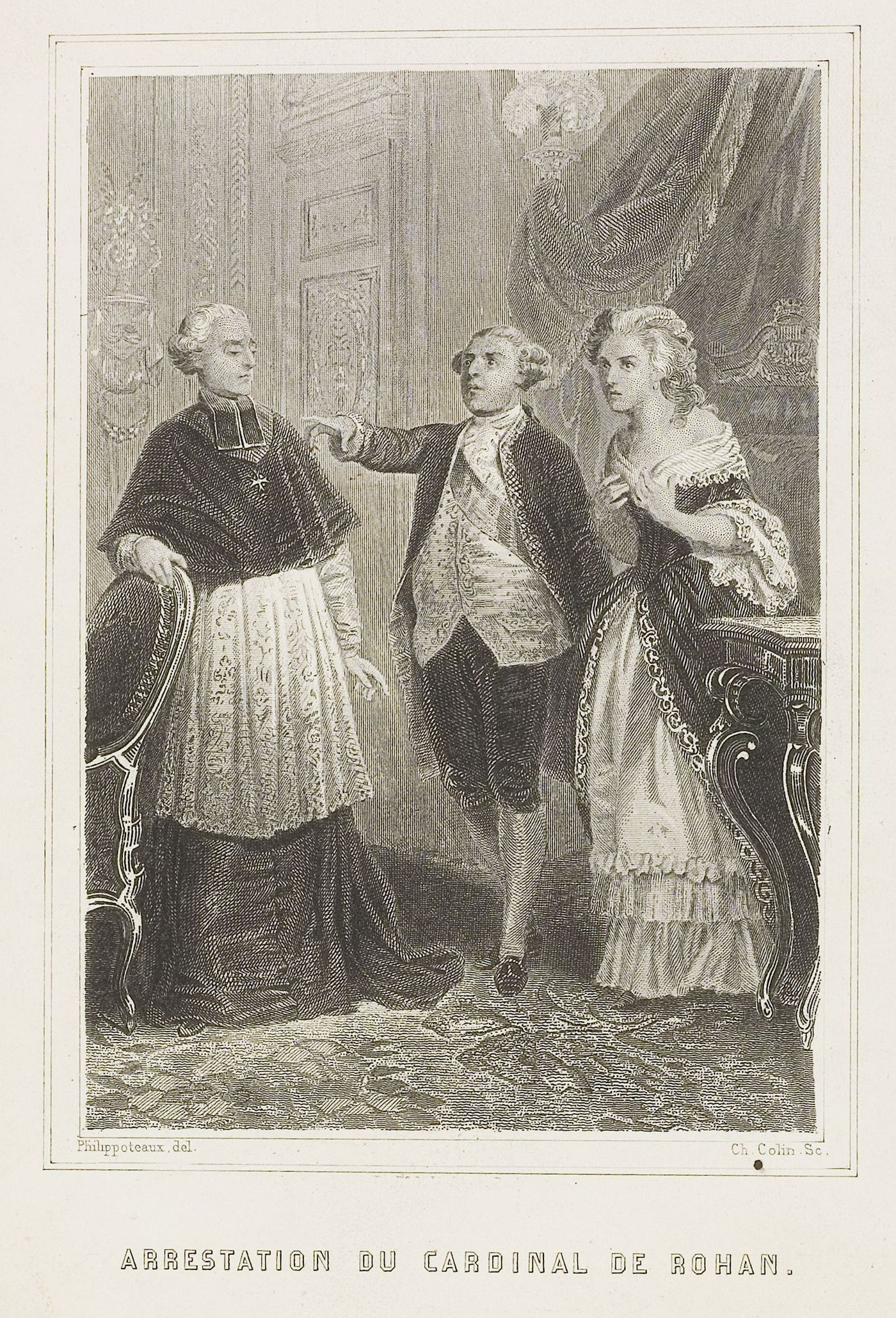
The fraud came apart in the summer of 1785, when Boehmer, still unpaid, began asking questions. On August 15, 1785, the Feast of the Assumption, as Rohan stood in his pontifical robes ready to celebrate Mass at Versailles, he was summoned to the king's study and questioned in front of the queen. In Campan's account of the interview, the cardinal answered, "I see plainly that I have been duped." He was arrested and taken to the Bastille.[10] The king then made what Campan considered a grave mistake by sending the case to the Parlement of Paris for trial. On May 31, 1786, the court acquitted the cardinal, while Madame de La Motte was sentenced to be whipped, branded, and imprisoned.[11] When she later escaped from prison, many Parisians concluded that the queen had been involved after all. Campan insisted that Marie Antoinette had never met the woman, and historians have found no evidence that she did, but the verdict and the escape reinforced an image of a frivolous queen surrounded by intrigue and extravagance at the very moment the government was about to ask the nation for money.[12]
Monsieur Deficit
By 1786 Calonne had concluded that reform could no longer be put off.[13] He proposed a sweeping program, the heart of which was a single land tax to be paid by every landowner, privileged or not. Knowing the Parlement would reject it, he persuaded the king to summon a hand-picked Assembly of Notables, which opened at Versailles on February 22, 1787.[14] "These abuses oppress the wealth-producing, laboring class," Calonne told the notables, attacking exemptions that shifted the burden onto everyone else. By then the shortfall amounted to roughly one-sixth of the royal budget.[15] On March 2 it was estimated at 112 million livres for the year.[16]

The notables were not persuaded. Many of them suspected that the minister who had borrowed so freely was himself the cause of the shortfall, and pamphlets in Paris began calling him Monsieur Deficit, while the queen, blamed for the court's extravagance, was already being called Madame Deficit.[17] Calonne was forced out in April 1787. His successor, Archbishop Étienne-Charles de Loménie de Brienne, brought forward a modified version of the same plan and met the same resistance. When the Parlement of Paris refused to accept the new land tax, the king exiled it to Troyes in August 1787, then recalled it a month later and abandoned the tax. In Paris in October 1787 the English agricultural writer Arthur Young dined with a company whose talk was entirely political and recorded their shared opinion "that they are on the eve of some great revolution in the government," with a deficit that could not be met without the Estates-General.[18] In the summer of 1788 the government gave way altogether. On August 8 it promised to convene the Estates-General, an assembly of clergy, nobles, and commoners that had not met since 1614, and on August 16 it began paying part of its obligations in interest-bearing notes, which the Fondation Napoléon's chronology describes as amounting to a confession of bankruptcy. Later that month Jacques Necker, the Genevan banker who had managed the finances earlier in the reign, was recalled to office.[19]
Lieutenant Bonaparte spent much of this period away from his regiment. He took a long leave in Corsica from September 1786 to September 1787, spent that autumn in Paris, and returned to Corsica for a second leave in January 1788. That June he rejoined his regiment, now stationed at Auxonne in Burgundy. In the spring of 1786 he had drafted a history of Corsica that complained bitterly of the French occupation.[20] His sympathies at the time lay with his island rather than with France.
Land Into Paper
The Estates-General opened at Versailles on May 5, 1789, and by the end of the summer the commoners' deputies had declared themselves a National Assembly, Parisians had stormed the Bastille, and noble privilege had been abolished. The young artillery officer saw the upheaval from the provinces. In April 1789 he helped suppress a riot at Seurre in Burgundy, in July he took part in defending the château at Auxonne during rioting there, and on August 23 he swore the new oath of allegiance to "the Nation, the King and the Law."[21]
None of this solved the financial problem, and the Revolution soon turned to a remedy that the monarchy had never dared to attempt. On November 2, 1789, the Assembly placed the property of the Church at the disposal of the nation, and on December 19 it created the assignat, a note that could be used to buy the confiscated lands.[22] The first assignats bore interest at five percent, and not everyone believed in them. Gouverneur Morris, an American then living in Paris on private business, wrote to George Washington on January 24, 1790, that "Mr Necker is a very poor financier" and that "these Assignats bearing five perCent must be below Par." Buyers, he explained, would have "some Doubt about the Title to these Lands, at least till the Revolution is compleated," and in any case "there is not Money to buy them in this Country."[23] The Church's estates were nonetheless enormous. Andrew Dickson White, the American historian and diplomat who studied these notes in the nineteenth century, estimated them at between a quarter and a third of all the real property in France and at least two thousand million livres in value. In April 1790 the Assembly turned the notes into a general currency, authorizing four hundred million livres in assignats that bore interest at three percent and were secured on the Church lands. The notes carried the king's portrait, and their margins showed how much interest each would earn per day.[24]

At first the notes did what their supporters promised, paying creditors and reviving trade. Within five months, however, the government had spent the four hundred million and was again in distress, and the question of a second issue divided the Assembly. Honoré-Gabriel de Mirabeau, its most celebrated orator, had once called paper money "a nursery of tyranny, corruption and delusion," but he now argued that notes backed by land were safer than notes backed by gold and urged a new issue. Charles-Maurice de Talleyrand, the bishop who had done more than anyone to carry the confiscation of Church property, warned that a law could compel a man to accept a thousand livres in paper for a thousand in coin but could never compel anyone to give a thousand in coin for a thousand in paper. On September 29, 1790, the Assembly voted 508 to 423 to issue eight hundred million livres more, this time without interest, and solemnly declared that no more than twelve hundred million should ever be in circulation.[25] Necker, who opposed a second issue, had already resigned on September 4 and left France.[26]
War and the Printing Press

The ceiling did not hold. As silver and copper coins disappeared from circulation, hoarded by people who preferred metal to paper, the government issued assignats in ever smaller denominations, eventually down to a single sou, and melted down church bells for copper coin. A further six hundred million livres in notes followed in June 1791 and another large issue that December. By early February 1792 an assignat with a face value of one hundred livres was worth only about sixty livres in coin, and later that month only about fifty-three.[27] In April 1792 France went to war with Austria, and from then on the needs of the army drove the printing presses.
Napoleon was in Paris in the summer of 1792, trying to clear himself over a long absence from his regiment, and on August 10 he watched the crowd storm the Tuileries Palace and bring down the monarchy.[28] The Republic, proclaimed that September, paid for its war the same way, with more paper. As the notes lost value, prices rose, and the government responded with force. In September 1793 the Convention imposed the Law of the Maximum, which fixed the price of each necessary article at one-third above its price in 1790 and capped wages at half again their 1790 level.[29] For a few months the notes even recovered, rising from below thirty percent of face value in September to above fifty in December, though White credited military victories rather than the Maximum. Many farmers held back their produce rather than sell at a loss, and with war and requisitions adding to the strain, the cities were put on rations. Penalties for refusing assignats or accepting them at a discount grew steadily harsher, and according to White, in May 1794 the Convention made it a capital offense to ask, before a bargain was concluded, what kind of money would be used to pay.[30]
Meanwhile Toulon had made the young officer's reputation. In August 1793 the port surrendered to a British fleet, and in September Napoleon, now a captain, was appointed to command the artillery of the republican army besieging it. His plan to drive the British ships from the harbor with concentrated cannon fire was adopted, the British evacuated the town on December 18, and four days later he was promoted to brigadier general at the age of twenty-four.[31]
The Louis d'Or Keeps Count
The fall of Robespierre in July 1794 began the dismantling of the Terror, and within months the new leaders of the Convention abolished the Maximum. The result was not relief but a collapse in the value of the currency. The harvest of 1794 was a good one, yet scarcity returned that autumn and real hunger came with the winter. Toward the end of 1794 about seven thousand million livres in assignats were in circulation, by the end of May 1795 ten thousand million, and by the end of July fourteen thousand million. In July 1795 an assignat of one hundred livres was officially reckoned to be worth eight livres in coin.[32] By then the franc had replaced the livre as the unit of account.[33] The gold louis d'or, a coin worth twenty-four livres before the Revolution, gave a steady measure of the fall in the new paper francs. White's figures put it at 920 francs on August 1, 1795, 2,600 in November, and 7,200 by February 1796. A pair of shoes that had cost five francs in 1790 cost two hundred in 1795, and a measure of flour rose from two francs to 225. Wages lagged far behind. A man who had borrowed ten thousand francs in 1790 could repay the whole debt in 1796 for the value of about thirty-five.[34]
The losses fell hardest on those least able to protect themselves. Merchants and speculators could turn depreciating paper into land, buildings, and goods, while wage earners had few such ways to shield their savings. The German historian Heinrich von Sybel, whom White followed closely, concluded that by the end of 1795 most of the remaining paper was in the hands of working people, clerks, and others of small means.[35] The exact distribution of the notes cannot be known, and White, who first presented his study in 1876 as a warning against unbacked paper money, had a case to make, though his figures came from the official tables.
In October 1795, as royalist sections of Paris rose against the Convention, Paul Barras, who commanded the troops defending it, gave Napoleon the task of suppressing the insurrection, and his guns cleared the streets.[36] The five-man Directory took power that autumn and found the treasury empty. On December 22, 1795, the Directory decreed that the total issue would be limited to forty thousand million and that the copper plates would then be broken.[37]
Place Vendôme
In February 1796 the presses, plates, and paper used for printing assignats were carried into the Place Vendôme in Paris and broken and burned before a large crowd, on the spot where the column celebrating Napoleon's victories later rose. Accounts disagree on whether this happened on the eighteenth or the nineteenth, and White himself gave different dates in different editions. By then the notes had lost roughly 99.7 percent of their original value. By one official count more than forty-five thousand million livres had been issued in less than six years, more than thirty-six thousand million of them still circulating.[38] The Directory tried once more with new notes, the mandats territoriaux, which could be exchanged directly for national lands and were promised to be as good as gold. Even before they could be printed, White wrote, they had fallen to about a third of their face value, and within months they were worth only a few percent.[39]
The government that burned its printing plates still had armies to pay, and it looked to the wealth of Italy.[40] On March 2, 1796, the Directory appointed Napoleon commander in chief of the Army of Italy. He married Joséphine de Beauharnais in Paris on March 9 and left for his army two days later.[41] The force he took over in the hills above Nice was ragged, unpaid, and short of nearly everything. In the version of his address that his chief of staff, Louis-Alexandre Berthier, reported to the Directory, later printed in government publications of 1797, Bonaparte told the troops that they were without uniforms, without shoes, and without pay but rich in courage, and pointed them toward the plains of Piedmont and Lombardy. The far better known wording, "Soldiers, you are naked, poorly fed," with its promise to lead them "into the richest plains in the world," comes from the memoirs he dictated on St. Helena some twenty years later. The historian Peter Hicks of the Fondation Napoléon has shown that this famous text is a polished reworking of the original.[42]
The campaign that followed was swift. Napoleon defeated an Austrian force at Montenotte on April 12, signed an armistice with the king of Sardinia at Cherasco on April 28 without first consulting the Directory, beat the Austrians again at Lodi on May 10, and entered Milan on May 15.[43] Victory brought money. At Milan in May, against the Directory's advice, Napoleon paid his troops in gold and silver while other republican armies were still paid in depreciated paper, and he soon sent several million francs to Paris.[44] He sent more than money. In May he asked the Directory to appoint commissioners to choose works of art from Italian collections for Paris, in July he announced a fresh dispatch of silverware, jewelry, and coin to the government, and in October the French commissioners were ordered to sell silver taken from Italian churches for the benefit of the army.[45]

In Paris the regime faced danger from the left as well. On May 10, 1796, the same day as the victory at Lodi, the police arrested François-Noël Babeuf and the leaders of the so-called Conspiracy of the Equals, who had planned an insurrection to establish a society of absolute equality and reckoned their supporters in Paris at seventeen thousand. An informer had betrayed them. Babeuf was tried the following year and guillotined.[46] The Directory contained its radicals with the help of the police, and it eased its bankruptcy partly with money from its generals, who proved much harder to do without. By the time Napoleon defeated the Austrians at Arcole in mid-November 1796, the government's finances and much of its prestige increasingly depended on the Army of Italy.[47]
Why the Twelve Years Mattered
In 1784 the French crown paid for the education of a poor Corsican cadet at a time when it was already borrowing to cover what its taxes failed to bring in. Twelve years later that cadet was sending coin, plate, and paintings from Italy to a republic that had abolished the crown, confiscated the Church's lands, issued, by one official count, more than forty-five thousand million livres in paper, and destroyed its printing plates in public. The thread that connects the two scenes is money. The monarchy's fiscal crisis, rooted in war debts and in privileges that kept many of the richest landowners lightly taxed, drove the crown first to the Assembly of Notables and then to the Estates-General. The Revolution met the same crisis by turning Church land into paper, and for a time the remedy worked. Repeated issues, the demands of war, and the refusal of farmers and merchants to treat paper as the equal of coin then undid it, and price controls, which briefly steadied the notes, ended in evasion, shortages, and hardship for the people the Revolution claimed to serve.
A government that could neither tax effectively nor issue money that people trusted came to depend on generals who could pay their own troops from conquered territory. In February 1797 the Directory gave up on paper altogether and declared that neither assignats nor mandats would any longer be legal tender. Writing a century later, White judged that the experiment "ended in the complete financial, moral and political prostration of France," a prostration, he added, "from which only a Napoleon could raise it."[48] That verdict came with hindsight and from an advocate, and it gives too little weight to the war, the divisions within the Republic, and the choices of the men who governed it. Financial necessity did not make Napoleon's rise inevitable, but it helped create the conditions in which military success could become political power. Three years later the general from the Army of Italy took power in France itself, and within months he founded the Bank of France. Later still, when a coalition had formed against his empire and paper money was proposed, he wrote to a minister, according to White, "While I live I will never resort to irredeemable paper."[49] The cadet who had arrived in Paris in 1784 on a king's scholarship had become a ruler who rejected a return to paper money.
Places in this Story
The places this story moves through, in order — follow them on the interactive map →
- Royal military school, Brienne-le-Château October 17, 1784
Fifteen-year-old Napoleone Buonaparte, a king's scholar for five years, leaves Brienne for Paris.
- École Militaire, Paris October 22, 1784
Bonaparte begins his studies as a gentleman cadet. In September 1785 he passes forty-second of 58 successful candidates.
- Comédie-Française (Théâtre-Français), Paris April 27, 1784
The Marriage of Figaro opens after years of censorship and runs for sixty-eight consecutive performances.
- Palace of Versailles August 15, 1785
Cardinal de Rohan, about to celebrate Mass, is questioned before the king and queen over the diamond necklace and taken to the Bastille.
- Valence, Dauphiné Late 1785
Second Lieutenant Bonaparte joins the La Fère artillery regiment.
- Troyes, Champagne August 1787
The king exiles the Parlement of Paris here after it refuses the new land tax.
- Auxonne, Burgundy 1788–1789
Bonaparte rejoins his regiment and helps put down rioting in the summer of 1789.
- Tuileries Palace, Paris August 10, 1792
Bonaparte watches the crowd storm the palace and bring down the monarchy.
- Toulon December 18, 1793
The British evacuate the port after Captain Bonaparte's guns drive their ships from the harbor; four days later he is a brigadier general.
- Place Vendôme, Paris February 1796
The presses, plates, and paper for printing assignats are broken and burned before a large crowd.
- Bridge of Lodi May 10, 1796
Bonaparte defeats the Austrians; the same day police in Paris arrest Babeuf and the Conspiracy of the Equals.
- Milan May 15, 1796
Bonaparte enters the city, pays his troops in gold and silver, and soon sends millions of francs to Paris.
Frequently Asked Questions
What were assignats in the French Revolution?
Assignats were paper notes created by the National Assembly in December 1789 and secured on the lands it had confiscated from the Church. The first ones paid interest and could be used to buy those lands. From April 1790 they became a general currency, and as the government printed more and more of them to cover its expenses and pay for the war, they lost almost all their value.
Why did the assignats lose their value?
The government issued far more of them than the confiscated lands could support. In September 1790 the Assembly promised that no more than 1,200 million livres would ever circulate, but by early 1796 more than 45,000 million had been issued. People hoarded coin, farmers held back produce, and price controls failed, until a 100-livre note was worth well under one livre in coin.
What was the Diamond Necklace Affair?
A swindle of 1784–85 in which the self-styled Comtesse de La Motte persuaded Cardinal de Rohan that Marie Antoinette secretly wanted a diamond necklace priced at 1,600,000 livres. The cardinal bought it on credit, and the stones were broken up and sold. The Parlement of Paris acquitted Rohan in May 1786, and although no evidence linked the queen to the fraud, the scandal badly damaged her reputation.
Why was Calonne called "Monsieur Deficit"?
Charles-Alexandre de Calonne, controller-general of finances from 1783, borrowed heavily to keep the crown afloat. When he revealed a yearly shortfall of more than 100 million livres to the Assembly of Notables in 1787 and proposed a land tax on all landowners, many suspected his own borrowing had caused the deficit, and Paris pamphlets nicknamed him Monsieur Deficit. He was forced out in April 1787.
What was the Law of the Maximum?
A law of September 29, 1793, by which the National Convention capped the price of necessary goods at one-third above their 1790 level and wages at half again their 1790 level. It briefly steadied the assignats, but many farmers withheld their produce rather than sell at a loss. The Convention abolished it in December 1794, and the currency then collapsed.
What happened to the assignats in February 1796?
In February 1796 the presses, plates, and paper used to print assignats were broken and burned in the Place Vendôme in Paris. By then the notes had lost about 99.7 percent of their value. The Directory replaced them with mandats territoriaux, which also lost most of their value within months, and in February 1797 both were withdrawn as legal tender.
How did Napoleon's Italian campaign help the French Republic?
After taking command of the Army of Italy in March 1796, Napoleon won victories at Montenotte, Lodi, and elsewhere and entered Milan in May. He paid his troops in gold and silver, sent millions of francs in coin to Paris along with silver and works of art, and made the bankrupt Directory increasingly dependent on his army.
Bibliography
"Babeuf, François-Noel." In Encyclopædia Britannica, 9th ed., vol. 3. Edinburgh: A. and C. Black, 1875. Wikisource. Accessed October 22, 2026. https://en.wikisource.org/wiki/Encyclop%C3%A6dia_Britannica,_Ninth_Edition/Babeuf,_Fran%C3%A7ois-Noel.
Campan, Jeanne-Louise-Henriette. Memoirs of the Court of Marie Antoinette, Queen of France. Vol. 1. Boston: L. C. Page, 1900. Google Books. Accessed October 22, 2026. https://books.google.com/books?id=NucOAAAAYAAJ. Also available as Project Gutenberg e-text, vol. 4, https://www.gutenberg.org/ebooks/3887. First published as Mémoires sur la vie privée de Marie-Antoinette, Paris, 1823.
Château de Versailles. "The Affair of the Diamond Necklace, 1784–1785." Accessed October 22, 2026. https://en.chateauversailles.fr/discover/history/key-dates/affair-diamond-necklace-1784-1785.
Citéco (Cité de l'Économie). "An Assignat Press from the French Revolution." Published January 9, 2014, updated June 13, 2024. Accessed October 22, 2026. https://www.citeco.fr/en/assignat-press-french-revolution.
"Depreciation of French Assignats in the Years 1789–1796: Economic and Social Considerations." Łódź University Press. Accessed October 22, 2026. https://www.press.uni.lodz.pl/index.php/wul/en/catalog/book/1404.
Editors of Encyclopaedia Britannica. "Charles-Alexandre de Calonne." Encyclopaedia Britannica. Accessed October 22, 2026. https://www.britannica.com/print/article/90127.
Editors of Encyclopaedia Britannica. "François-Noël Babeuf." Encyclopaedia Britannica. Accessed October 22, 2026. https://www.britannica.com/print/article/47448.
Fondation Napoléon. "1769–1793: Napoleon Bonaparte's Early Years." Extract from a timeline by Irène Delage in Correspondance générale de Napoléon Bonaparte, vol. 1. napoleon.org. Last modified June 7, 2019. Accessed October 22, 2026. https://www.napoleon.org/en/history-of-the-two-empires/timelines/1769-1793-napoleon-bonapartes-early-years/.
Fondation Napoléon. "Napoleon I." napoleon.org. Accessed October 22, 2026. https://www.napoleon.org/en/history-of-the-two-empires/biographies/napoleon-i/.
Fondation Napoléon. "Pierre Branda: Napoléon et l'argent (2007)." Interview. napoleon.org. Last modified September 7, 2020. Accessed October 22, 2026. https://www.napoleon.org/magazine/interviews/pierre-branda-napoleon-et-largent-2007/.
Hicks, Peter. "Talking Point with Peter Hicks: 'Soldiers, You Are Naked!'" Fondation Napoléon, napoleon.org. Last modified January 22, 2021. Accessed October 22, 2026. https://www.napoleon.org/en/history-of-the-two-empires/articles/talking-point-with-peter-hicks-soldiers-you-are-naked/.
Liberty, Equality, Fraternity: Exploring the French Revolution. "Calonne, 'Programs of Reform,' Address to Assembly of Notables (1787)." Roy Rosenzweig Center for History and New Media and American Social History Project. Accessed October 22, 2026. https://revolution.chnm.org/d/258.
Liberty, Equality, Fraternity: Exploring the French Revolution. "Memorandum to Her Majesty the Queen Concerning the Diamond Necklace Affair (1786)." Roy Rosenzweig Center for History and New Media and American Social History Project. Accessed October 22, 2026. https://revolution.chnm.org/d/263.
Liberty, Equality, Fraternity: Exploring the French Revolution. "One Hundred Livres–Assignats Worth Eight Livres in Metal Currency." July 1795. Roy Rosenzweig Center for History and New Media and American Social History Project. Accessed October 22, 2026. https://revolution.chnm.org/d/942.
Liberty, Equality, Fraternity: Exploring the French Revolution. "The Maximum." September 29, 1793. Roy Rosenzweig Center for History and New Media and American Social History Project. Accessed October 22, 2026. https://revolution.chnm.org/d/415.
Llewellyn, Jennifer, and Steve Thompson. "The Affair of the Diamond Necklace." Alpha History, September 30, 2019, updated November 7, 2023. Accessed October 22, 2026. https://alphahistory.com/frenchrevolution/affair-of-the-diamond-necklace/.
Mark, Harrison W. "Assembly of Notables of 1787." World History Encyclopedia. Accessed October 22, 2026. https://www.worldhistory.org/Assembly_of_Notables_of_1787/.
McClain, Sandra C. "First Performance of The Marriage of Figaro." EBSCO Research Starters. Accessed October 22, 2026. https://ebsco.com/research-starters/drama-and-theater-arts/first-performance-marriage-figaro.
McGill University Library. "Napoleon: Timeline." Napoleon Collection. Accessed October 22, 2026. https://digital.library.mcgill.ca/napoleon/english/timeline.htm.
Morgan Library & Museum. La folle journée, ou, Le mariage de Figaro: comédie en cinq actes, en prose, by Pierre-Augustin Caron de Beaumarchais. Catalog record, PML 129476. Accessed October 22, 2026. https://www.themorgan.org/printed-books/231508.
Morris, Gouverneur. Gouverneur Morris to George Washington, January 24, 1790. Founders Online, National Archives. Accessed October 22, 2026. https://founders.archives.gov/documents/Washington/05-05-02-0030. Original source: The Papers of George Washington, Presidential Series, vol. 5, 16 January 1790–30 June 1790, edited by Dorothy Twohig et al. Charlottesville: University Press of Virginia, 1996.
Napoléon & Empire. "Napoleonic Timeline of 1796." Accessed October 22, 2026. https://www.napoleon-empire.org/en/chronology/chronology-1796.php.
Napoléon & Empire. "Napoleon's Biography." Accessed October 22, 2026. https://napoleon-empire.net/en/napoleon-biography.php.
White, Andrew Dickson. Fiat Money Inflation in France: How It Came, What It Brought, and How It Ended. New York: D. Appleton, 1896. Google Books. Accessed October 22, 2026. https://books.google.com/books?id=JCkOAAAAYAAJ.
White, Andrew Dickson. Fiat Money Inflation in France: How It Came, What It Brought, and How It Ended. Revised edition with a foreword by John Mackay. Toronto, 1914. Project Gutenberg, 2004. Accessed October 22, 2026. https://www.gutenberg.org/ebooks/6949.
Young, Arthur. Arthur Young's Travels in France during the Years 1787, 1788, 1789. Edited by Matilda Betham-Edwards. London: George Bell and Sons, 1892. Internet Archive. Accessed October 22, 2026. https://archive.org/details/arthuryoungstrav00youn. First published 1792.
Citations
- Fondation Napoléon, "1769–1793: Napoleon Bonaparte's Early Years," entries for 1779 and for September 22 to October 22, 1784. The timeline gives his arrival in Paris as "19 (or 21?) October." ↑
- Fondation Napoléon, "Early Years," entries for November 3 and December 10, 1783. ↑
- Mark, "Assembly of Notables of 1787." ↑
- Campan, Memoirs of the Court of Marie Antoinette, 1:301. Campan's memoirs were published posthumously in 1823; page references are to the 1900 L. C. Page English edition, whose text matches the Project Gutenberg e-text. ↑
- Fondation Napoléon, "Early Years," entries for 1769–79 (the Bonaparte children) and for 1785. The timeline gives the date of Charles Bonaparte's death as "20 or 24 February." ↑
- Campan, Memoirs, 1:309–11. The quotation is from the English translation of Campan's memoirs and reproduces her recollection of the king's words, not a contemporary record. ↑
- McClain, "First Performance of The Marriage of Figaro"; Morgan Library & Museum, catalog record for La folle journée, ou, Le mariage de Figaro, which transcribes the title page's statement that the play was first performed on Tuesday, April 27, 1784. Grimm's remark about the seventy-second night, quoted in the editor's note to Campan, refers to performances after the first consecutive run. ↑
- Campan, Memoirs, 1:309, 313, including the editor's note quoting Grimm's Correspondance. ↑
- Campan, Memoirs, 1:317–18; "Memorandum to Her Majesty the Queen Concerning the Diamond Necklace Affair (1786)," Liberty, Equality, Fraternity. The necklace's original intended purchaser, Madame du Barry, is reported as hearsay in the editorial notes to Campan's memoirs. The installment arrangement follows Llewellyn and Thompson, "The Affair of the Diamond Necklace." ↑
- Campan, Memoirs, 1:329–31. Campan narrates the interview in detail but does not state that she was present. ↑
- Fondation Napoléon, "Early Years," entry for August 15, 1785; Château de Versailles, "The Affair of the Diamond Necklace, 1784–1785." ↑
- Campan, Memoirs, 1:339–41; Château de Versailles, "Affair of the Diamond Necklace." The statement that no evidence links the queen to La Motte follows Llewellyn and Thompson, "The Affair of the Diamond Necklace." ↑
- "Calonne, 'Programs of Reform,' Address to Assembly of Notables (1787)," Liberty, Equality, Fraternity, editorial introduction. ↑
- "Calonne, 'Programs of Reform,' Address to Assembly of Notables (1787)," Liberty, Equality, Fraternity. The site dates the address to February 22, 1787; the text of the address outlines the general land tax. ↑
- "Calonne, 'Programs of Reform,'" Liberty, Equality, Fraternity. The figure of one-sixth comes from the site's editorial introduction. ↑
- Fondation Napoléon, "Early Years," entry for March 2, 1787. The figure is an estimate of the annual shortfall, not of the accumulated royal debt. Britannica, "Calonne," describes the deficit Calonne revealed as more than 100 million livres a year. ↑
- Mark, "Assembly of Notables of 1787." ↑
- Young, Arthur Young's Travels in France, 96–97, journal entry for October 17, 1787, Paris. The editor's footnote on page 97 puts the annual deficit at about 115 million livres. ↑
- Fondation Napoléon, "Early Years," entries for February 22 and August 15–20, 1787, and August 8, 16, and 27, 1788. The timeline gives April 9, 1787, for Calonne's departure; other sources date his formal dismissal later in the spring. ↑
- Fondation Napoléon, "Early Years," entries for 1786–88. ↑
- Fondation Napoléon, "Early Years," entries for April 1, July 19–22, and August 23, 1789. ↑
- Fondation Napoléon, "Early Years," entries for November 2 and December 19, 1789. ↑
- Gouverneur Morris to George Washington, January 24, 1790, Founders Online. Morris's spelling is preserved. The letter is printed in The Papers of George Washington, Presidential Series, vol. 5. ↑
- White, Fiat Money Inflation, rev. ed., pt. 1; compare White, Fiat Money Inflation (1896), 5–6, 10–11. ↑
- White, Fiat Money Inflation, rev. ed., pt. 1; White, Fiat Money Inflation (1896), 16, 21–22, 26. Mirabeau's phrase comes from his letter to Cerutti of January 1789, as quoted by White; the version of Talleyrand's argument given here paraphrases White's quotation of it. The vote of 508 to 423 is White's figure. ↑
- Fondation Napoléon, "Early Years," entry for September 4, 1790; White, Fiat Money Inflation, rev. ed., pt. 1. ↑
- White, Fiat Money Inflation, rev. ed., pts. 1–2; compare White, Fiat Money Inflation (1896), 29, 33. The February 1792 values are from the revised edition. ↑
- Fondation Napoléon, "Early Years," entries for May 28 and August 10, 1792. ↑
- "The Maximum," Liberty, Equality, Fraternity, art. 8, translated from the law of September 29, 1793, in John Hall Stewart, A Documentary Survey of the French Revolution (New York: Macmillan, 1951), 499–500. The one-third rule for prices follows White, Fiat Money Inflation, rev. ed., pt. 2, which is also the source for the movement of the notes in late 1793. ↑
- White, Fiat Money Inflation, rev. ed., pt. 2; compare White, Fiat Money Inflation (1896), 53–54, 61. White cites no decree for the May 1794 penalty. ↑
- Fondation Napoléon, "Early Years," entries for August 27 to December 22, 1793. ↑
- "One Hundred Livres–Assignats Worth Eight Livres in Metal Currency," Liberty, Equality, Fraternity, item dated July 1795. ↑
- Citéco, "An Assignat Press from the French Revolution." Citéco dates the change to the start of 1795. ↑
- White, Fiat Money Inflation, rev. ed., pt. 2; White, Fiat Money Inflation (1896), 62, 65. The prices of the louis d'or, shoes, and flour appear only in the revised edition. ↑
- White, Fiat Money Inflation (1896), 67, citing Heinrich von Sybel's History of the French Revolution, vol. 4, p. 222; White, Fiat Money Inflation, rev. ed., pt. 2. The precise distribution of the notes cannot be established from these sources. ↑
- Napoléon & Empire, "Napoleon's Biography." ↑
- White, Fiat Money Inflation, rev. ed., pt. 2. This decree does not appear in the 1896 edition. ↑
- White, Fiat Money Inflation (1896), 63, 68; White, Fiat Money Inflation, rev. ed., pt. 2; Citéco, "An Assignat Press"; "Depreciation of French Assignats in the Years 1789–1796," Łódź University Press. White's 1896 edition dates the breaking of the plates to February 19, 1796, while his revised edition gives nine o'clock on February 18 and adds the detail of the Place Vendôme and the later column. Citéco gives February 18; the Łódź University Press description gives February 19 and the figure of about 99.7 percent. Citéco puts the nominal total issued between 1789 and 1795 at about 40 billion livres, against White's figure of more than 45 billion. ↑
- White, Fiat Money Inflation (1896), 69, 71; White, Fiat Money Inflation, rev. ed., pt. 3. White's figures for the mandats differ between editions: the 1896 text says they fell to thirty percent before they could be issued and then to fifteen and five percent, while the revision says thirty-five percent, then fifteen, five, and about three percent by August 1796. White does not distinguish between the promissory notes issued in advance of the mandats and the mandats themselves. ↑
- Fondation Napoléon, "Pierre Branda: Napoléon et l'argent (2007)," interview. Branda describes the Directory as short of money once the paper currency had ended. ↑
- Napoléon & Empire, "Napoleonic Timeline of 1796." ↑
- Hicks, "Talking Point with Peter Hicks: 'Soldiers, You Are Naked!'" The quoted words are Hicks's English translations; the Berthier version is paraphrased here. ↑
- Napoléon & Empire, "Napoleonic Timeline of 1796"; Fondation Napoléon, "Napoleon I." ↑
- Fondation Napoléon, "Pierre Branda: Napoléon et l'argent." Branda gives no exact figure for the sums sent to Paris. ↑
- Napoléon & Empire, "Napoleonic Timeline of 1796," entries for May 11, July 2, and October 25, 1796. ↑
- "Babeuf, François-Noel," Encyclopædia Britannica, 9th ed.; Editors of Encyclopaedia Britannica, "François-Noël Babeuf." The figure of seventeen thousand adherents comes from the ninth edition and reflects the conspirators' own reckoning, not an independent count. ↑
- McGill University Library, "Napoleon: Timeline," entry for November 15–17, 1796. ↑
- White, Fiat Money Inflation, rev. ed., pt. 3. This sentence was added in the revised edition and does not appear in the 1896 text. On the campaign purposes of the essay's earlier editions, see White's introduction to the revision. ↑
- White, Fiat Money Inflation (1896), 82. White gives the remark in English without dating the letter, naming the minister, or citing the original; in the revised edition he credits David A. Wells for his facts on French finance under Napoleon. It should be treated as a reported saying rather than an authenticated statement. ↑