On the morning of Monday, December 31, 1787, twenty-six delegates gathered in the state house at Augusta, which had served off and on as Georgia's capital through most of the decade. The proposed federal Constitution had been read to them on the preceding Saturday, and after a single day of debate they now adopted it without a dissenting voice. Two days later, on January 2, 1788, every delegate present signed the formal deed of ratification, and as the last name went onto the document, gunners at two field pieces posted opposite the state house fired thirteen salutes.[1] January 2, 1788, is the date usually given for Georgia's ratification.[2]
The salute marked a remarkable reversal. Almost exactly nine years earlier, a British expedition had captured Savannah, and its commander, Lieutenant Colonel Archibald Campbell, had declared his ambition to be the first officer "to take a stripe and star from the rebel flag of Congress."[3] By the summer of 1779 a royal governor was back in Savannah, and Georgia became the only one of the rebellious states formally restored to the king's peace.[4] Even as the Augusta delegates met, the state was fighting for its survival on another front. In November, Governor George Mathews had reported to Congress that Creek warriors had killed thirty-one settlers since August and burned the town and courthouse of Greensboro.[5] George Washington, writing from Mount Vernon in January 1788, put the matter bluntly. If a weak state with powerful Indian nations in its rear and the Spanish on its flank did not embrace a strong general government, he wrote, there must be "either wickedness or insanity in their conduct."[6]
Georgia's path to statehood was shaped far more by weakness than by confidence. The youngest and most exposed of the thirteen colonies built one of the most democratic governments of the Revolution, saw its capital and coast retaken by the British, endured years of rival governments and savage civil war, and emerged from the conflict poor, divided, and locked in a struggle with the Creek Nation over land. Those experiences taught its leaders the lesson Washington had drawn from a distance, that Georgia could not survive alone. This is the story of those twelve years.
A Reluctant Province
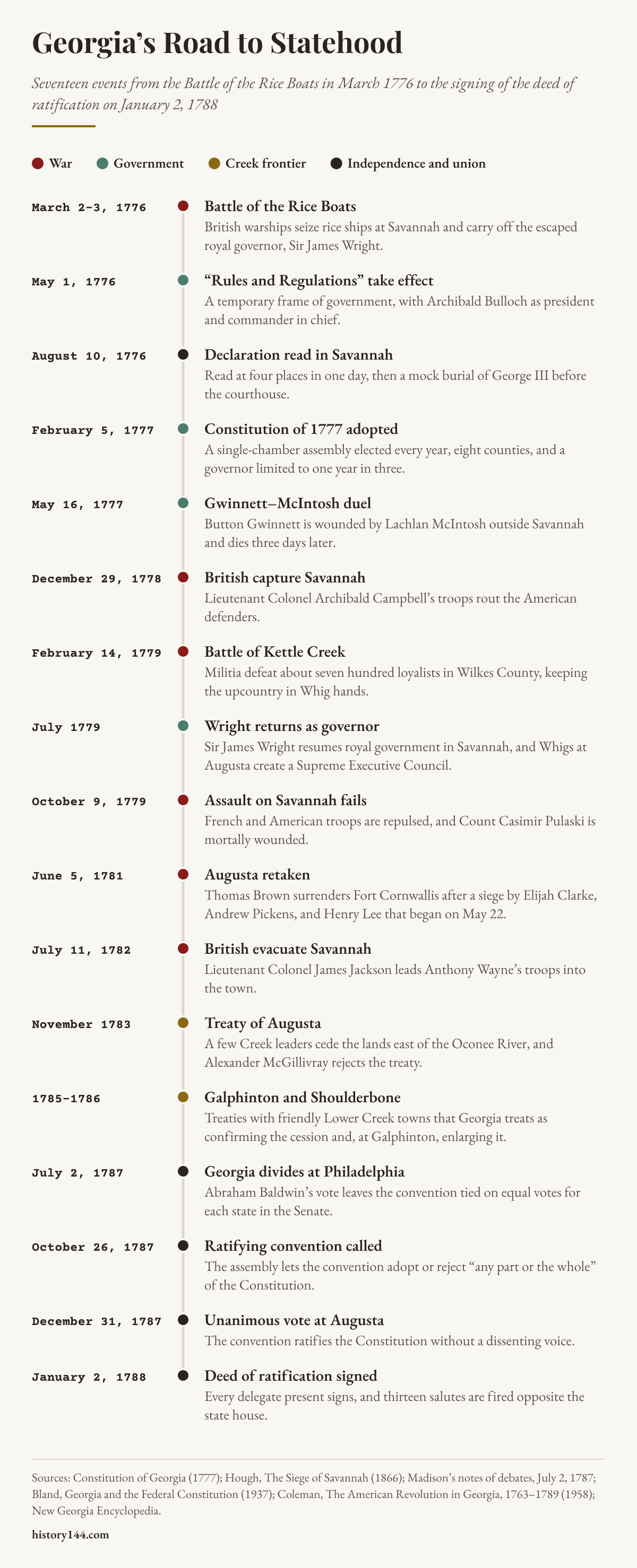
Georgia came to the Revolution late and hesitantly. The colony had prospered under royal rule, and many settlers believed they needed British troops to protect them from the powerful Indian nations on their frontier. Georgia sent no delegates to the First Continental Congress in 1774, and only in 1775 did a provincial congress begin to take government into its own hands. The crisis came in January 1776, when British warships appeared in the Savannah River. The revolutionary Council of Safety placed the royal governor, Sir James Wright, under house arrest and gave Colonel Lachlan McIntosh charge of the town's defense. On March 2 and 3, British ships seized rice-laden merchant vessels in the harbor in what became known as the Battle of the Rice Boats, and when the fleet sailed it carried away both the rice and the escaped governor. In his absence a provincial congress elected Archibald Bulloch president and commander in chief and adopted a temporary frame of government, the "Rules and Regulations," which took effect on May 1, 1776. George Walton joined Lyman Hall and Button Gwinnett in Philadelphia in time to sign the Declaration of Independence.[7]
News of independence reached Savannah that summer, and the town marked it on August 10, 1776, with a day of ceremony. According to a newspaper account printed in Philadelphia that autumn, President Bulloch and his council read the Declaration first in their council chamber, then to a crowd in the square before the Assembly House, then at the Liberty Pole, and finally at the battery in the old Trustees' Garden, with volleys after each outdoor reading. The officials and militia officers, Lachlan McIntosh among them, dined under the cedar trees. That evening the town was illuminated, and a mock funeral procession with muffled drums, attended by more people than had ever gathered in the province, marched to the courthouse, where George III was ceremonially "interred." The burial service committed the king's "political existence to the ground," in hope that he would never again rule over the United States of America.[8] Burying a king, however, was easier than building a state to take his place.
The Constitution of 1777
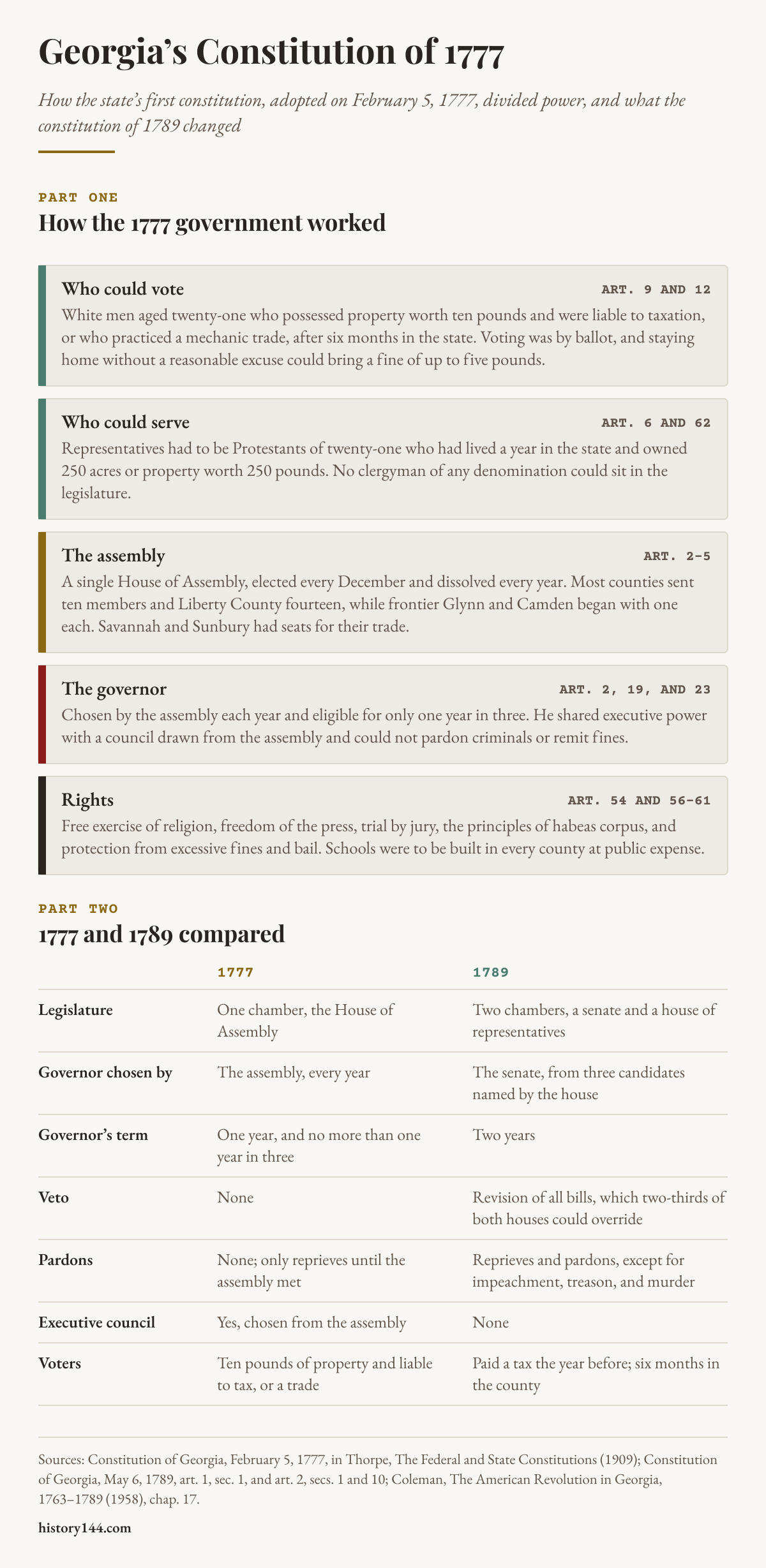
That work fell to a convention that met in Savannah in October 1776, with delegates from the colony's twelve parishes and from the trading towns of Savannah and Sunbury.[9] After four months of deliberation, the convention unanimously adopted a constitution on February 5, 1777. It was never submitted to the voters for approval.[10] The document turned the old parishes into eight counties. Seven were named for British statesmen who had defended the colonists, and the eighth, Liberty County, honored the early zeal of St. John's Parish for American rights.[11]
The radical leaders of the local committees dominated the convention, and they produced a constitution more democratic than any other state's.[12] Any white man aged twenty-one who possessed property worth ten pounds and was liable to taxation, or who practiced a "mechanic trade," could vote after six months' residence. Voting was by ballot, and a citizen who stayed home without a reasonable excuse could be fined up to five pounds. Power rested in a single-chamber House of Assembly elected every year. The assembly elected the governor and chose an executive council from its own members, and the governor could serve only one year out of three. He could not pardon criminals or remit fines. The constitution guaranteed the free exercise of religion, freedom of the press, trial by jury, and the principles of habeas corpus, and it called for public schools in every county. Representatives had to be Protestants owning 250 acres or property worth 250 pounds, and one blunt article declared that "no clergyman of any denomination shall be allowed a seat in the legislature." Because the vote belonged only to "male white inhabitants," women, free Black men, and enslaved Georgians all stood outside this political world.[13] The convention had designed a government to prevent tyranny. Whether such a government could also fight a war remained to be seen.
Party and Dissension
Archibald Bulloch died early in 1777, and Button Gwinnett, who had served as speaker of the constitutional convention, succeeded him as president.[14] Gwinnett led the radical faction, whose members suspected many conservative Whigs of secret loyalty to the crown. His bitterest rival was Lachlan McIntosh, now a brigadier general commanding Georgia's Continental troops. The feud deepened when Gwinnett had McIntosh's brother George arrested. Gwinnett then planned an invasion of British East Florida, insisted that as president he commanded the militia, and refused to cooperate with McIntosh and his Continentals. The expedition collapsed.[15] When the assembly investigated the failure and sided with Gwinnett, McIntosh denounced him as "a Scoundrell & lying Rascal." Gwinnett challenged him, and on the morning of May 16, 1777, the two men met outside Savannah and fired at close range. Both were wounded. McIntosh recovered, and Gwinnett died three days later.[16]
The duel left Georgia's revolutionaries more divided than before. In August, George Walton asked Washington to take McIntosh into the main army, explaining that he feared the dead man's friends "would again blow up the embers of party & dissention." McIntosh spent the following winter at Valley Forge.[17] Another expedition against Florida, the third since 1776, failed in 1778 for the same lack of coordination. In the view of one modern account, the Whigs accomplished little in their first three years of independence beyond survival. They did, however, gain experience in self-government and a stubborn determination not to give it up.[18]
A Star Taken
By 1778 the war in the North had settled into stalemate, and the British high command turned south. Royal officials assured London that hundreds of loyalists in the Georgia backcountry were waiting only for the king's troops. Campbell's expedition sailed from New York with the 71st Highlanders, two Hessian battalions, four loyalist battalions, and a detachment of artillery, and arrived off Tybee Island on December 23. His official report to Lord George Germain, reprinted in an 1866 documentary collection, describes how his troops landed below Savannah on December 29 and found the American army drawn up across the road. A Black man named Quamino Dolly, persuaded by a small reward, guided British light infantry along a private path through the swamp and into the rear of the American right. The defense collapsed. By the British count, about one hundred Americans were killed or drowned while trying to escape and more than 450 were captured, at a cost of seven British killed and nineteen wounded.[19]
Campbell pushed upriver and took Augusta on January 31, 1779, where about 1,400 men swore allegiance to the king. The reconquest then began to unravel. On February 14, militia under Andrew Pickens, John Dooly, and Elijah Clarke surprised roughly seven hundred loyalists marching under Colonel Boyd at Kettle Creek in Wilkes County, killing Boyd and scattering his force. That same day Campbell, threatened by approaching North Carolina troops, abandoned Augusta. Kettle Creek kept the upcountry in Whig hands, but on March 3 the British routed the Americans at Brier Creek, and lower Georgia remained firmly under royal control. Civil government was restored in March, and Sir James Wright returned as governor in July.[20]
The Americans' best chance to recover Savannah came that autumn, when a French fleet under the Comte d'Estaing appeared unexpectedly off the coast. D'Estaing landed several thousand troops and, on September 16, demanded the town's surrender. The British commander, General Augustine Prevost, asked for twenty-four hours to consider. During that interval Lieutenant Colonel John Maitland brought about eight hundred men from Beaufort, guided through the marshes and creeks where, a loyalist journal recorded, they were "often up to the Middle in Mud and Water." Prevost then refused to surrender.[21] After more than two weeks of siege, including five days of bombardment that wrecked houses and killed civilians, the allies stormed the British lines before dawn on October 9. An aide to General Prevost who hurried to the scene afterward wrote that the ditch was "filled with Dead" and that the field in front was covered with the slain. Among the mortally wounded was Count Casimir Pulaski, the Polish cavalry commander serving with the Americans.[22]
Accounts of the losses differ widely. A loyalist journal published in New York reported British losses on the day of the assault as one captain and fifteen men killed and thirty-five wounded, and recorded allied estimates of anywhere from seven hundred to eighteen hundred casualties. A writer at the British general hospital reported 661 French and 633 American killed and wounded.[23] A modern reference work puts the allied loss in the assault at 752 and the British at eighteen killed and thirty-nine wounded.[24] Whatever the figures, the assault was among the bloodiest of the war, and its failure was decisive. The French sailed away, Lincoln retreated to South Carolina, and Governor Wright proclaimed a day of thanksgiving. In March 1780 the Treasury in London ordered customs officers, those in Ireland among them, to reopen trade with Georgia, since the province had been declared once again in the peace of the king.[25] The star Campbell had boasted of taking appeared to be gone.
Three Governments and a Civil War
For a time Georgia had more governments than it could support. In July 1779 an ad hoc committee in Augusta created a "Supreme Executive Council," which chose John Wereat, an ally of the McIntosh family, as its president. Radical leaders refused to recognize it. That autumn George Walton organized elections, an assembly chose him governor, and Wereat's council refused to recognize Walton in turn. War-ravaged Georgia thus had two Whig governments in Augusta and a royal one in Savannah. Walton's administration also produced a lasting scandal. The assembly voted to ask Congress to remove McIntosh from Georgia a second time, but the letter went out over the name of its speaker, William Glascock, after Glascock had left Augusta, and Walton never denied signing it for him. George Wells, who had been Gwinnett's second in the fatal duel and who later acted as governor, was killed in a duel with James Jackson, a friend of Wereat.[26] When a committee of the postwar assembly looked back on this period, it reported that from December 1778 to January 1783 no legislature could be convened according to the constitution, and that various bodies had simply acted as assemblies and executives as seemed best at the time.[27]
The war itself grew more savage. After Charleston fell to the British in May 1780, the royal council in Savannah declared that peace had been restored, and British garrisons occupied the backcountry. Elijah Clarke attacked Augusta that September but was driven off. Tradition long blamed the loyalist commander, Thomas Brown, for hanging thirteen prisoners afterward, though the order more likely came from the loyalist officer John Harris Cruger, enforcing Lord Cornwallis's policy toward men who took up arms after swearing allegiance.[28] In the spring of 1781 Clarke returned, joined by Andrew Pickens and Lieutenant Colonel Henry Lee's Continental legion. Their siege of Brown's Fort Cornwallis began on May 22. Lee's men built a wooden tower tall enough for a cannon to fire into the fort, and Brown surrendered on June 5, 1781. The capture of Augusta gave American diplomats in Paris grounds to insist on Georgia's independence even though Savannah stayed in British hands.[29] A loyalist physician, Dr. Thomas Taylor, who was in Augusta when the siege began, later wrote that Brown had been obliged to surrender after fourteen days. He described how, the next day, the captured loyalist Colonel Grierson was murdered in the midst of the American troops, and he complained that executing a man in cold blood had acquired a nickname, "giving a Georgia Parole."[30]
Evacuation and Reckoning
In January 1782 General Nathanael Greene sent Brigadier General Anthony Wayne into Georgia to press the British garrison at Savannah. On May 4 the legislature passed the Confiscation and Banishment Act, declaring scores of loyalists guilty of treason and seizing their property. In June orders arrived for the British to evacuate, and on July 11, 1782, they left Savannah. Lieutenant Colonel James Jackson had the honor of leading Wayne's troops into the town.[31] Two days later the assembly convened in a town hardly ready to receive a government, meeting first in a church before moving to the long room of Mrs. Tondee's tavern.[32]
The reckoning that followed was uneven and remains difficult to measure. A modern encyclopedia account estimates that as many as two thousand white Georgians and twice that number of Black people left with the British for East Florida, and that about four hundred whites and five thousand Black people went to Jamaica.[33] The historian Kenneth Coleman arrived at much lower figures, concluding that no more than 1,250 to 1,500 white loyalists left the state, along with about 3,500 enslaved people. Sources differ even on the number of people named in the confiscation act, which the encyclopedia gives as 277 and Coleman as 279. The assembly began softening the act almost at once. In August 1782 it allowed ninety-three named people to escape confiscation by paying the state eight or twelve percent of their property or by serving as soldiers. It rewarded its heroes with land and confiscated plantations, including Mulberry Grove outside Savannah for General Greene. It also freed a small number of enslaved men for their wartime service, among them a soldier named Austin, praised for actions that "would have honored a freeman."[34]
A State Without Money or Peace
Independence did not bring order. The capital wandered between Savannah and Augusta, with the executive moving ten times between the two towns from 1783 to 1785, until the assembly decreed in January 1786 that a new capital called Louisville would be built and that government would sit at Augusta in the meantime. Assemblies struggled to meet. Of twenty sessions scheduled between 1782 and 1789, only eleven secured a quorum. Wartime paper money had become nearly worthless. By the state's own table of depreciation, it took more than eight thousand pounds in paper to equal one hundred pounds in specie by June 1780.[35]
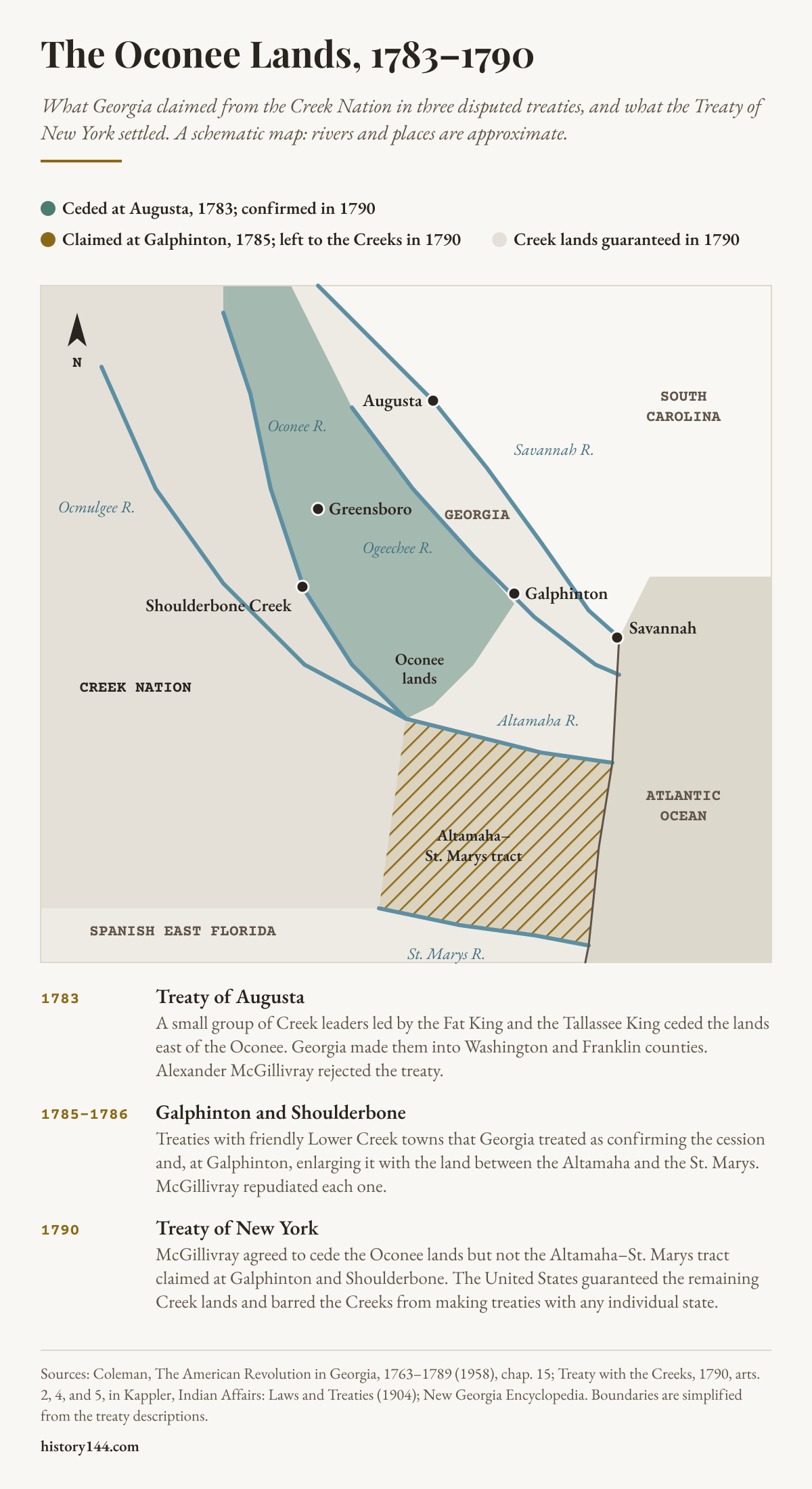
The greatest problem was land. Georgia claimed territory stretching to the Mississippi, but the Creek Nation actually held most of it. At Augusta in November 1783, a small group of Creek leaders led by the Fat King and the Tallassee King ceded the lands east of the Oconee River, and Georgia promptly organized the cession into Washington and Franklin counties. Alexander McGillivray, the leader of the Creeks who opposed Georgia, rejected the treaty. He argued that the signers had been threatened and that only the whole nation could give up its land. Georgia obtained further treaties from friendly Lower Creek towns at Galphinton in 1785 and Shoulderbone Creek in 1786, treating them as confirming the cession and, at Galphinton, enlarging it. McGillivray repudiated each one, and with ammunition supplied through Spanish Florida, Creek warriors fought to drive settlers off the disputed lands. In 1787 the conflict spiraled. After one raid, Georgia militiamen crossed the Oconee in revenge and killed the first twelve Creeks they met. The dead turned out to be friendly Lower Creeks who had taken no part in the raid. By autumn many Georgians believed a full-scale war had begun.[36]
A letter from Augusta dated October 15, 1787, reported that the legislature could barely gather a quorum because lowcountry members were slow to arrive and upcountry members were "engaged in defending their families and property on the frontiers," and that an army of at least two thousand men was needed. Governor Mathews told the governor of the breakaway State of Franklin that he hoped their combined efforts would "crush the power of that insidious people."[37]
Georgians at Philadelphia
While the frontier burned, Georgia's delegates sat in the Constitutional Convention. The assembly had chosen six men in February 1787, and four attended: Abraham Baldwin, a Yale-educated former army chaplain who had moved from Connecticut a few years earlier; William Few, a largely self-taught lawyer from the backcountry; William Pierce, a Savannah merchant and veteran; and William Houstoun, son of a royal councilor. Baldwin spoke eight times, Houstoun seven, Pierce four, and Few not at all.[38] Pierce also left a lively set of character sketches of his fellow delegates. He credited Few with "a strong natural Genius" and Baldwin with "superior abilities," but he was unsparing toward Houstoun, of whom he wrote that "Nature seems to have done more for his corporeal than mental powers."[39]
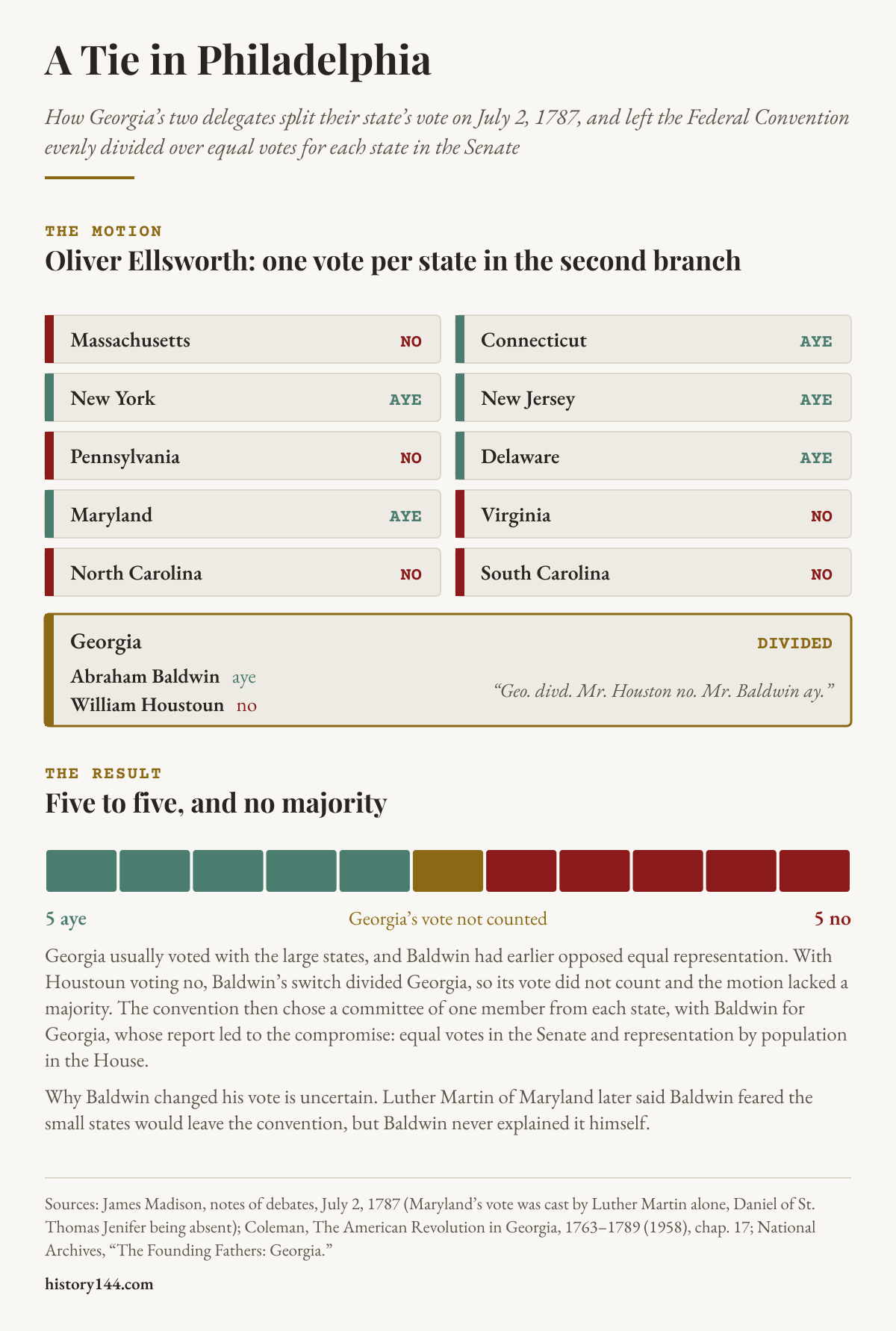
Georgia's most important moment in Philadelphia came on July 2, 1787, during the convention's gravest crisis, the dispute between large and small states over representation in the Senate. Oliver Ellsworth of Connecticut moved that each state have one vote in the second branch. Georgia usually voted with the large states, and Baldwin had earlier opposed equal representation. This time Baldwin voted for the motion and Houstoun against it, and Madison recorded the result tersely: "Geo. divd. Mr. Houston no. Mr. Baldwin ay." With Georgia's vote lost, the states stood evenly divided. The convention appointed a committee, with Baldwin as Georgia's member, whose report led to the compromise giving the states equal votes in the Senate and proportional representation in the House.[40] Why Baldwin changed his vote remains uncertain. Neither he nor Houstoun ever explained it. Luther Martin of Maryland later said that Baldwin feared the small states would leave the convention if equal representation failed, and Baldwin's close ties to the Connecticut delegation may also have influenced him, but there is no direct proof beyond Martin's statement. Baldwin also joined the South Carolinians in defending the foreign slave trade, which the final Constitution protected until 1808. Few and Baldwin signed the finished document.[41]
Ratification at Augusta
The Constitution reached Georgia in October 1787 by two routes. Baldwin and Few sent a copy to Governor Mathews in Augusta, and Pierce, arriving at Savannah by sloop from New York on October 10, brought another. The assembly had been called into special session because of the Indian war, and it spent its first week on military measures. On October 26, with no recorded debate, it adopted resolutions calling a ratifying convention to be elected on December 4 and to meet in Augusta on Christmas Day. In a provision that the modern editors of the ratification records describe as unlike any other state's, Georgia empowered its convention "to adopt or reject any part or the whole" of the Constitution.[42] That provision, which opened the way to partial ratification, was what drew Washington's comment about wickedness and insanity.[43]
The convention reached a quorum on December 28 and elected John Wereat, the former president of the Supreme Executive Council, as its presiding officer. Its journal records only formal actions, and no delegate is known to have opposed the Constitution.[44] The most detailed criticism came from outside the convention. Lachlan McIntosh, Gwinnett's old adversary, wrote to Wereat from Skidaway Island on December 17 that the legislature had acted "rather precipitately." He urged ratification for a limited term so that the Southern states, which he predicted would always be "the minority in Congress," could later reconsider. He praised the convention method itself as a better way of settling public differences than "the old way of cutting one another's throats." He also warned that the northern states meant to abolish slavery when they could and urged Georgia to keep the timing "in our own power."[45] The delegates did not adopt his proposal. Georgians had good reasons to want a stronger union. They hoped a national government would help them against the Creeks. The twenty-year protection of the slave trade removed a possible objection, and coastal merchants and frontier settlers could agree on the need for federal strength.[46] Some reservations surfaced only afterward. In April 1788 a newspaper writer signing himself "A Planter" took issue with William Pierce's argument that juries were unnecessary in civil cases, a matter on which the new Constitution was silent.[47]
The Meaning of the Fourth Star
Ratification set off a second transformation at home. Using the new federal charter as a model, conventions meeting in Augusta in 1788 and 1789 replaced the Constitution of 1777 with a much shorter charter that created a two-house legislature and a governor who served two-year terms and held a veto.[48] Georgia's presidential electors cast their votes for Washington, and the state sent Few and James Gunn to the Senate and Baldwin, Mathews, and Jackson to the House. Federal power soon delivered part of what Georgians had hoped for. In the Treaty of New York in 1790, McGillivray agreed to cede the Oconee lands Georgia had claimed since 1783, though not the territory taken at Galphinton and Shoulderbone. The Creeks placed themselves under the protection of the United States, which guaranteed their remaining lands and barred them from making treaties with any individual state. Georgia had gained the land it most wanted, at the Creeks' expense, but it had also given up its own Indian diplomacy to the national government it had embraced.[49]
The thirteen guns fired at Augusta in January 1788 therefore marked the end of a long and uneven passage. The young state of 1777 had tried to govern itself through a powerful, annually elected assembly and a deliberately weak executive. War strained that experiment almost to the breaking point. A British army and a royal governor reclaimed the coast, rival Whig governments quarreled in the interior, and neighbors killed one another in the backcountry while factional leaders settled their disputes with pistols. Peace brought confiscation, debt, a wandering capital, and a frontier war Georgia could not win alone. Campbell had boasted of taking a star from the American flag. Twelve years after the Council of Safety arrested the royal governor in Savannah, Georgians restored that star by their own choice, persuaded by hard experience that their independence would be safest inside a stronger Union.
Places in this Story
The places this story moves through, in order — follow them on the interactive map →
- Savannah, Georgia January 1776
The Council of Safety put the royal governor Sir James Wright under house arrest, and in March British ships seized the rice fleet in the Savannah River.
- Savannah, Georgia February 1777
A convention sitting in Savannah adopted the Georgia Constitution of 1777, turning the old parishes into eight counties under a single-chamber assembly.
- Thunderbolt, Georgia May 1777
Button Gwinnett and Lachlan McIntosh fired at close range in a field east of Savannah. Both were hit, and Gwinnett died three days later.
- Tybee Island, Georgia December 1778
Archibald Campbell’s expedition from New York arrived off Tybee Island on December 23 and landed below Savannah six days later.
- Augusta, Georgia January 1779
Campbell took Augusta on January 31, 1779, where about 1,400 men swore allegiance to the king, and abandoned it a fortnight afterward.
- Kettle Creek, Georgia February 1779
Militia under Andrew Pickens, John Dooly and Elijah Clarke scattered roughly seven hundred loyalists under Colonel Boyd, keeping the Georgia upcountry in Whig hands.
- Savannah, Georgia October 1779
The French and American assault on the British lines failed before dawn on October 9, 1779. Count Casimir Pulaski was mortally wounded and the ditch was left filled with the dead.
- Augusta, Georgia June 1781
Elijah Clarke, Andrew Pickens and Henry Lee besieged Thomas Brown in Fort Cornwallis, and Brown surrendered on June 5, 1781.
- Savannah, Georgia July 1782
The British evacuated Savannah on July 11, 1782, and James Jackson led Anthony Wayne’s troops into the town.
- Philadelphia, Pennsylvania July 1787
Abraham Baldwin split Georgia’s vote on equal representation in the Senate on July 2, 1787, leaving the states evenly divided and forcing a committee compromise.
- Greensboro, Georgia November 1787
Creek warriors burned the town and courthouse of Greensboro, one of the raids Governor George Mathews reported to Congress that November.
- Augusta, Georgia January 1788
Twenty-six delegates adopted the federal Constitution at the state house, and thirteen salutes were fired as the deed was signed on January 2, 1788.
Frequently Asked Questions
When did Georgia ratify the United States Constitution?
Georgia ratified on January 2, 1788, the date on the signed deed sent to Congress, and became the fourth state to join the Union. Its convention at Augusta had voted to adopt the Constitution two days earlier without a dissenting voice.
Why was Georgia the only state restored to British rule in the Revolution?
A British expedition under Archibald Campbell captured Savannah in December 1778 and took Augusta a month later. Royal civil government was restored in March 1779 and Sir James Wright returned as governor that July.
What was the Georgia Constitution of 1777?
Adopted on February 5, 1777, it was one of the most democratic state constitutions of the Revolution, with a single-chamber assembly elected every year and a governor the assembly itself chose. It guaranteed free exercise of religion, freedom of the press and trial by jury, but limited the vote to white men.
What happened in the Button Gwinnett and Lachlan McIntosh duel?
Gwinnett and McIntosh met in a field east of Savannah on the morning of May 16, 1777, after McIntosh called him a scoundrel and a lying rascal, and both men were wounded. McIntosh recovered and Gwinnett died three days later.
Who represented Georgia at the Constitutional Convention of 1787?
Georgia chose six delegates and four attended: Abraham Baldwin, William Few, William Pierce and William Houstoun. Only Baldwin and Few remained to sign the finished Constitution.
Why did Abraham Baldwin vote for equal representation in the Senate?
Baldwin had opposed equal representation but voted for it on July 2, 1787, splitting Georgia in two and leaving the states evenly divided, which forced the convention into committee and the Great Compromise. He never explained the switch, and the usual account comes from Luther Martin, who said Baldwin feared the small states would walk out.
How did the Creek War shape Georgia’s support for the Constitution?
Creek warriors led by Alexander McGillivray fought settlers on the disputed Oconee lands through 1787, and Governor George Mathews reported thirty-one settlers killed in a few months. Georgians hoped a stronger national government would help them, and the Treaty of New York in 1790 delivered the Oconee cession.
Bibliography
Primary Sources
"A Planter." Gazette of the State of Georgia, April 3, 1788. In The Documentary History of the Ratification of the Constitution Digital Edition, edited by John P. Kaminski, Gaspare J. Saladino, Richard Leffler, Charles H. Schoenleber, and Margaret A. Hogan. Charlottesville: University of Virginia Press, 2009. Center for the Study of the American Constitution. https://archive.csac.history.wisc.edu/ga_a_planter.pdf. Accessed October 27, 2026.
Bland, Julia M., comp. Georgia and the Federal Constitution: Proceedings of the State Constitutional Convention, and Proceedings of the State Legislature with Respect to the Amendments Proposed by the United States Congress on September 25, 1789, March 4, 1794 and December 9, 1803. Washington, DC: Government Printing Office, 1937. Digital Library of Georgia. https://dlg.usg.edu/record/dlg_zlgb_gb0310. Accessed October 31, 2026.
Constitution of Georgia, February 5, 1777. In The Federal and State Constitutions, Colonial Charters, and Other Organic Laws of the States, Territories, and Colonies Now or Heretofore Forming the United States of America, edited by Francis Newton Thorpe. Washington, DC: Government Printing Office, 1909. Avalon Project, Lillian Goldman Law Library, Yale Law School. https://avalon.law.yale.edu/18th_century/ga02.asp. Accessed October 27, 2026.
Constitution of Georgia, May 6, 1789. Founders' Library, Claremont Institute. https://founding.com/?p=1765. Accessed October 31, 2026.
Hough, Franklin B., ed. The Siege of Savannah, by the Combined American and French Forces, under the Command of Gen. Lincoln and the Count d'Estaing, in the Autumn of 1779. Albany: J. Munsell, 1866. Digital Library of Georgia. https://dlg.usg.edu/record/dlg_zlgb_gb0138. Accessed October 27, 2026.
Kappler, Charles J., ed. "Treaty with the Creeks, 1790." In Indian Affairs: Laws and Treaties. Vol. 2, Treaties. Washington, DC: Government Printing Office, 1904. Avalon Project, Lillian Goldman Law Library, Yale Law School. https://avalon.law.yale.edu/18th_century/cre1790.asp. Accessed October 31, 2026.
Madison, James. Notes of debates in the Federal Convention, July 2, 1787. Avalon Project, Lillian Goldman Law Library, Yale Law School. https://avalon.law.yale.edu/18th_century/debates_702.asp. Accessed October 27, 2026.
McIntosh, Lachlan. Lachlan McIntosh to John Wereat, Skidaway Island, December 17, 1787. In The Documentary History of the Ratification of the Constitution Digital Edition, edited by John P. Kaminski, Gaspare J. Saladino, Richard Leffler, Charles H. Schoenleber, and Margaret A. Hogan. Charlottesville: University of Virginia Press, 2009. Center for the Study of the American Constitution. https://archive.csac.history.wisc.edu/ga_macintosh_to_wereat.pdf. Accessed October 27, 2026.
National Humanities Center. "Celebrating the Declaration of Independence: Selections from American Newspapers, July–October 1776." Making the Revolution: America, 1763–1791. https://www.americainclass.org/sources/makingrevolution/rebellion/text8/decindepcelebrations.pdf. Accessed October 27, 2026.
Pierce, William. "Notes of Major William Pierce (Georgia) in the Federal Convention of 1787." In Documents Illustrative of the Formation of the Union of the American States, edited by Charles C. Tansill. Washington, DC: Government Printing Office, 1927. Avalon Project, Lillian Goldman Law Library, Yale Law School. https://avalon.law.yale.edu/18th_century/pierce.asp. Accessed October 27, 2026.
"Ratification of the Constitution by the State of Georgia; January 2, 1788." Avalon Project, Lillian Goldman Law Library, Yale Law School. https://avalon.law.yale.edu/18th_century/ratga.asp. Accessed October 27, 2026.
Taylor, Thomas. Thomas Taylor to John Wesley, February 28, 1782. In "A Georgia Loyalist's Perspective on the American Revolution: The Letters of Dr. Thomas Taylor," edited by Robert S. Davis Jr. Georgia Historical Quarterly 81, no. 1 (Spring 1997): 118–38. Excerpted by the American Battlefield Trust. https://www.battlefields.org/learn/primary-sources/thomas-brown-obligd-surrender-5th-june. Accessed October 27, 2026.
Teaching American History. "The Georgia State Convention." Ashbrook Center. https://teachingamericanhistory.org/document/the-georgia-state-convention/. Accessed October 27, 2026.
Walton, George. George Walton to George Washington, August 5, 1777. Founders Online, National Archives. https://founders.archives.gov/documents/Washington/03-10-02-0532. Accessed October 27, 2026.
Washington, George. George Washington to Samuel Powel, January 18, 1788. Founders Online, National Archives. https://founders.archives.gov/documents/Washington/04-06-02-0034. Accessed October 27, 2026.
Secondary Sources
Center for the Study of the American Constitution. "Georgia Chronology, 1786–1788." From The Documentary History of the Ratification of the Constitution Digital Edition. University of Wisconsin–Madison. https://csac.history.wisc.edu/wp-content/uploads/sites/281/2017/07/ga_chronology.pdf. Accessed October 27, 2026.
Coleman, Kenneth. The American Revolution in Georgia, 1763–1789. Athens: University of Georgia Press, 1958. Reissued 2021. https://ugapress.manifoldapp.org/projects/the-american-revolution-in-georgia-1763-1789. Accessed October 27, 2026.
"Committee Report on George McIntosh, 9 October 1777." Editorial note. Founders Online, National Archives. https://founders.archives.gov/documents/Adams/06-05-02-0182. Accessed October 27, 2026.
"The Founding Fathers: Georgia." America's Founding Documents. National Archives. https://www.archives.gov/founding-docs/founding-fathers-georgia. Accessed October 27, 2026.
"Georgia Constitution." New Georgia Encyclopedia. Georgia Humanities and University of Georgia Press. https://www.georgiaencyclopedia.org/articles/government-politics/georgia-constitution. Accessed October 27, 2026.
Justice, George. "Constitutional Conventions." New Georgia Encyclopedia. Georgia Humanities and University of Georgia Press. https://www.georgiaencyclopedia.org/articles/government-politics/constitutional-conventions. Accessed October 27, 2026.
"Revolutionary War in Georgia." New Georgia Encyclopedia. Georgia Humanities and University of Georgia Press. https://www.georgiaencyclopedia.org/articles/history-archaeology/revolutionary-war-georgia. Accessed October 27, 2026.
Citations
- Kenneth Coleman, The American Revolution in Georgia, 1763–1789 (Athens: University of Georgia Press, 1958; reissued 2021), chap. 17, "Georgia and the Federal Constitution, 1787–1789." Citations to Coleman are to the chapter in the University of Georgia Press online edition; print page numbers could not be verified. On Augusta's role as capital, see also chap. 12, "Politics and Finance, 1782–1789." ↑
- Center for the Study of the American Constitution, "Georgia Chronology, 1786–1788," from The Documentary History of the Ratification of the Constitution Digital Edition; "Ratification of the Constitution by the State of Georgia; January 2, 1788," Avalon Project, Lillian Goldman Law Library, Yale Law School; "Georgia Constitution," New Georgia Encyclopedia. ↑
- Archibald Campbell, quoted in Coleman, American Revolution in Georgia, chap. 7, "British Return to Georgia, 1779." ↑
- "Revolutionary War in Georgia," New Georgia Encyclopedia, Georgia Humanities and University of Georgia Press. ↑
- Coleman, American Revolution in Georgia, chap. 15, "Indian Relations, 1782–1789." ↑
- George Washington to Samuel Powel, January 18, 1788, Founders Online, National Archives. ↑
- "Revolutionary War in Georgia," New Georgia Encyclopedia. ↑
- "Savannah, August 10," Pennsylvania Evening Post, October 8, 1776, reprinted in National Humanities Center, "Celebrating the Declaration of Independence: Selections from American Newspapers, July–October 1776," Making the Revolution: America, 1763–1791. ↑
- George Justice, "Constitutional Conventions," New Georgia Encyclopedia. ↑
- Constitution of Georgia, February 5, 1777, in Francis Newton Thorpe, ed., The Federal and State Constitutions, Colonial Charters, and Other Organic Laws of the States, Territories, and Colonies Now or Heretofore Forming the United States of America (Washington, DC: Government Printing Office, 1909), Avalon Project, editor's note; "Georgia Constitution," New Georgia Encyclopedia. ↑
- Constitution of Georgia, 1777, art. 4; "Revolutionary War in Georgia," New Georgia Encyclopedia. ↑
- "Revolutionary War in Georgia," New Georgia Encyclopedia. ↑
- Constitution of Georgia, 1777, arts. 2, 6, 9, 12, 19, 23, 54, 56, 60, 61, 62. ↑
- Editorial note to "Committee Report on George McIntosh, 9 October 1777," Founders Online, National Archives; "Revolutionary War in Georgia," New Georgia Encyclopedia. ↑
- "Revolutionary War in Georgia," New Georgia Encyclopedia. ↑
- Editorial note to George Walton to George Washington, August 5, 1777, Founders Online, National Archives. ↑
- Walton to Washington, August 5, 1777; "Revolutionary War in Georgia," New Georgia Encyclopedia. ↑
- "Revolutionary War in Georgia," New Georgia Encyclopedia. ↑
- Franklin B. Hough, ed., The Siege of Savannah, by the Combined American and French Forces, under the Command of Gen. Lincoln and the Count d'Estaing, in the Autumn of 1779 (Albany: J. Munsell, 1866), 7–15; Coleman, American Revolution in Georgia, chap. 7; "Revolutionary War in Georgia," New Georgia Encyclopedia. ↑
- Coleman, American Revolution in Georgia, chap. 7. ↑
- "Journal of the Siege of Savannah," Royal Gazette (New York), December 11, 1779, in Hough, Siege of Savannah, 29–32; Hough, Siege of Savannah, 19–20; "Revolutionary War in Georgia," New Georgia Encyclopedia. ↑
- T. W. Moore to his wife, November 4, 1779, Royal Gazette (New York), December 29, 1779, in Hough, Siege of Savannah, 84–87; "Journal of the Siege of Savannah," in Hough, Siege of Savannah, 32–36, 41. ↑
- "Journal of the Siege of Savannah," in Hough, Siege of Savannah, 41–43; extract of a letter from a gentleman of the General Hospital at Savannah, November 24, 1779, in Hough, Siege of Savannah, 80–81. ↑
- "Revolutionary War in Georgia," New Georgia Encyclopedia. The same article calls the repulse one of the bloodiest battles of the war. ↑
- Coleman, American Revolution in Georgia, chap. 7; John Robinson to the Commissioners of the Revenue, Ireland, March 8, 1780, Royal Gazette (New York), May 31, 1780, in Hough, Siege of Savannah, 114–16. ↑
- "Revolutionary War in Georgia," New Georgia Encyclopedia. ↑
- Coleman, American Revolution in Georgia, chap. 12. ↑
- "Revolutionary War in Georgia," New Georgia Encyclopedia. ↑
- Ibid. ↑
- Thomas Taylor to John Wesley, February 28, 1782, in Robert S. Davis Jr., ed., "A Georgia Loyalist's Perspective on the American Revolution: The Letters of Dr. Thomas Taylor," Georgia Historical Quarterly 81, no. 1 (Spring 1997): 118–38, excerpted by the American Battlefield Trust. The page on which this letter appears within the article could not be verified. ↑
- "Revolutionary War in Georgia," New Georgia Encyclopedia. ↑
- Coleman, American Revolution in Georgia, chap. 11, "Independence a Reality, 1782–1785." ↑
- "Revolutionary War in Georgia," New Georgia Encyclopedia. ↑
- Coleman, American Revolution in Georgia, chap. 11; "Revolutionary War in Georgia," New Georgia Encyclopedia. ↑
- Coleman, American Revolution in Georgia, chap. 12. ↑
- "Revolutionary War in Georgia," New Georgia Encyclopedia; Coleman, American Revolution in Georgia, chap. 15. ↑
- Extract of a letter from Augusta, October 15, 1787, and George Mathews to John Sevier, October 10, 1787, in "The Georgia State Convention," Teaching American History, Ashbrook Center. ↑
- Coleman, American Revolution in Georgia, chap. 17; "The Founding Fathers: Georgia," America's Founding Documents, National Archives. ↑
- William Pierce, "Characters in the Convention of the States Held at Philadelphia, May, 1787," in Charles C. Tansill, ed., Documents Illustrative of the Formation of the Union of the American States (Washington, DC: Government Printing Office, 1927), Avalon Project. ↑
- James Madison, notes of debates, July 2, 1787, Avalon Project; Coleman, American Revolution in Georgia, chap. 17; "Founding Fathers: Georgia," National Archives. ↑
- Coleman, American Revolution in Georgia, chap. 17. ↑
- Resolutions of the Georgia House of Assembly, October 26, 1787, in Julia M. Bland, comp., Georgia and the Federal Constitution: Proceedings of the State Constitutional Convention, and Proceedings of the State Legislature with Respect to the Amendments Proposed by the United States Congress on September 25, 1789, March 4, 1794 and December 9, 1803 (Washington, DC: Government Printing Office, 1937), 2; journal of the Georgia ratifying convention, December 1787, in Bland, Georgia and the Federal Constitution, 4; "Ratification of the Constitution by the State of Georgia; January 2, 1788"; "The Georgia State Convention," Teaching American History. The judgment that the provision was unlike any other state's comes from the editors' introduction reproduced by Teaching American History, not from the Georgia records themselves. ↑
- Washington to Powel, January 18, 1788. ↑
- Coleman, American Revolution in Georgia, chap. 17; "Revolutionary War in Georgia," New Georgia Encyclopedia. ↑
- Lachlan McIntosh to John Wereat, Skidaway Island, December 17, 1787, in The Documentary History of the Ratification of the Constitution Digital Edition, ed. John P. Kaminski et al. (Charlottesville: University of Virginia Press, 2009), Center for the Study of the American Constitution. ↑
- Coleman, American Revolution in Georgia, chap. 17. ↑
- "A Planter," Gazette of the State of Georgia, April 3, 1788, in Documentary History of the Ratification of the Constitution Digital Edition, Center for the Study of the American Constitution. ↑
- Constitution of Georgia, May 6, 1789, art. 1, sec. 1, and art. 2, secs. 1 and 10, Founders' Library, Claremont Institute; Justice, "Constitutional Conventions"; "Georgia Constitution," New Georgia Encyclopedia; Coleman, American Revolution in Georgia, chap. 17. ↑
- Coleman, American Revolution in Georgia, chaps. 15 and 17; "Treaty with the Creeks, 1790," arts. 2, 4, and 5, in Charles J. Kappler, ed., Indian Affairs: Laws and Treaties, vol. 2, Treaties (Washington, DC: Government Printing Office, 1904), Avalon Project. ↑