A Colonel at Hanau
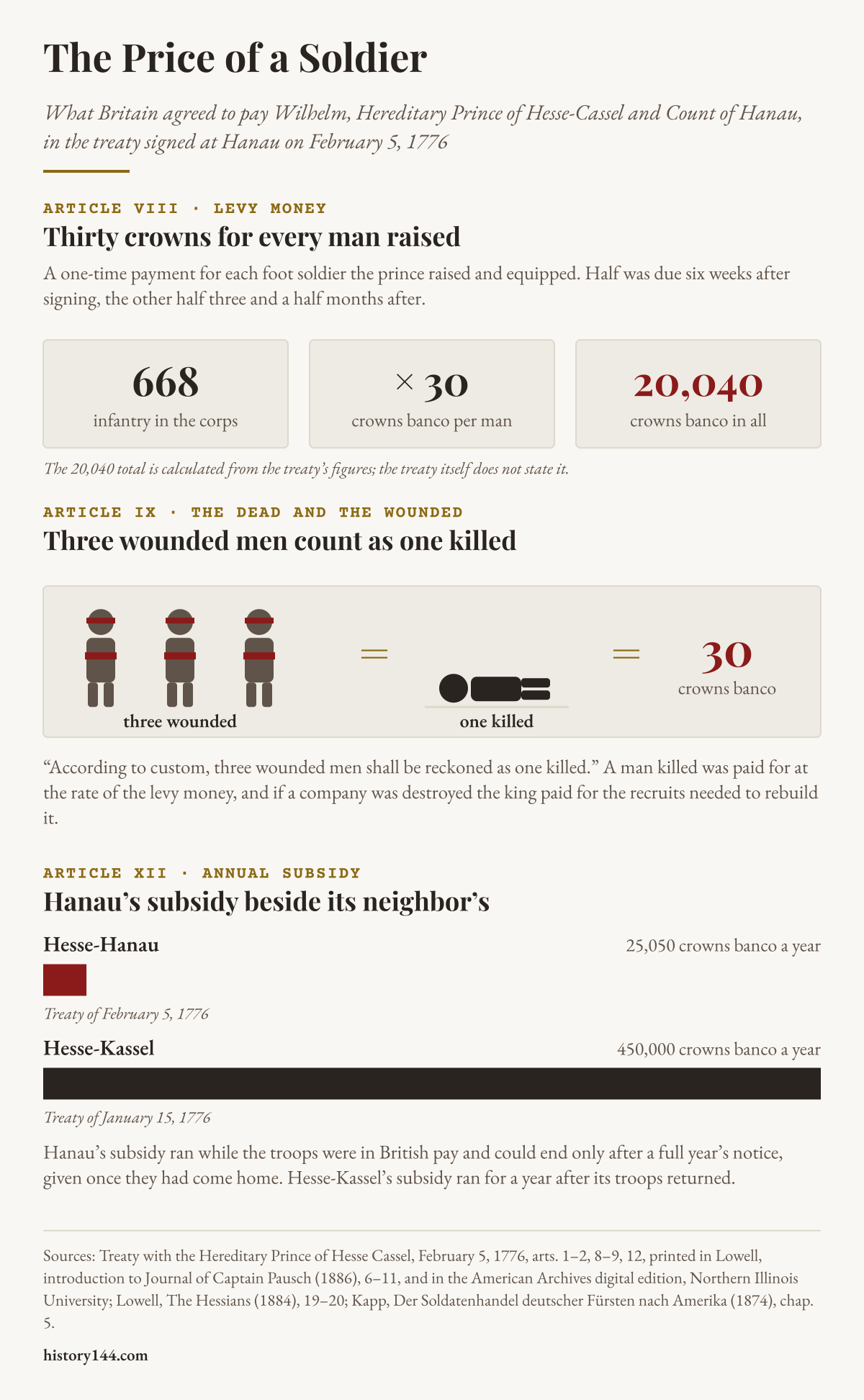
On the 4th of February 1776, a British officer, Colonel William Faucitt, arrived at Hanau, a small residence town on the river Main about a dozen miles upstream from Frankfurt.[1] He had come to conclude a treaty on behalf of George III, and on the following day he did so. The other party was Wilhelm, Hereditary Prince of Hesse-Cassel and reigning Count of Hanau, then thirty-two years old. Under the treaty the prince placed a corps of 668 infantry at the king's disposal, ready to march by the 20th of March at the latest. Britain would pay thirty crowns banco in "levy money," a one-time payment for each foot soldier raised, together with an annual subsidy of 25,050 crowns for as long as the men remained in British pay. Article IX set out what would happen when men fell. A soldier killed was to be paid for at the levy-money rate, and "according to custom, three wounded men shall be reckoned as one killed."[2]
The prince had not waited to be asked. On the 19th of August 1775, two months after the battle of Bunker Hill, he had written in French to George III, his first cousin, to offer his infantry regiment of five hundred men. He added that he wished he could offer twenty thousand. Edward Lowell, the nineteenth-century American historian of the German troops, noted that he made the offer "without making the smallest condition." The Earl of Suffolk, the secretary of state responsible for the German courts, wrote to the British ambassador at The Hague that the "nobleness of sentiment" behind the offer "cannot be sufficiently admired."[3] The Hanau treaty was one of the smaller subsidy agreements Britain signed with German princes that winter, and it was soon overshadowed by the far larger treaty that Wilhelm's father had signed at Cassel three weeks earlier. Even so, it marks the beginning of Wilhelm's rise. In 1776 he was a minor prince waiting for an inheritance. By 1788 he was Landgrave of Hesse-Kassel and master of one of the largest treasuries in Germany, a fortune built over generations of renting out Hessian troops, to which the American war made a large late addition.
One of the men who would later help manage that fortune lived a dozen miles away, in the Jewish quarter of Frankfurt. Mayer Amschel Rothschild was a dealer in old coins who had sold pieces to the prince and held a modest title from his court. The trade in the prince's English bills, which was where the subsidy money was turned into cash, belonged to older and larger Frankfurt houses, and as late as 1785 Mayer had no part in it.[4] His story runs along the edge of Wilhelm's in these years, and it matters chiefly for what came afterward. This is the story of those twelve years, from a treaty signed at Hanau in February 1776 to a birth in a narrow house in the Frankfurt Judengasse in April 1788.
A Prince in Waiting
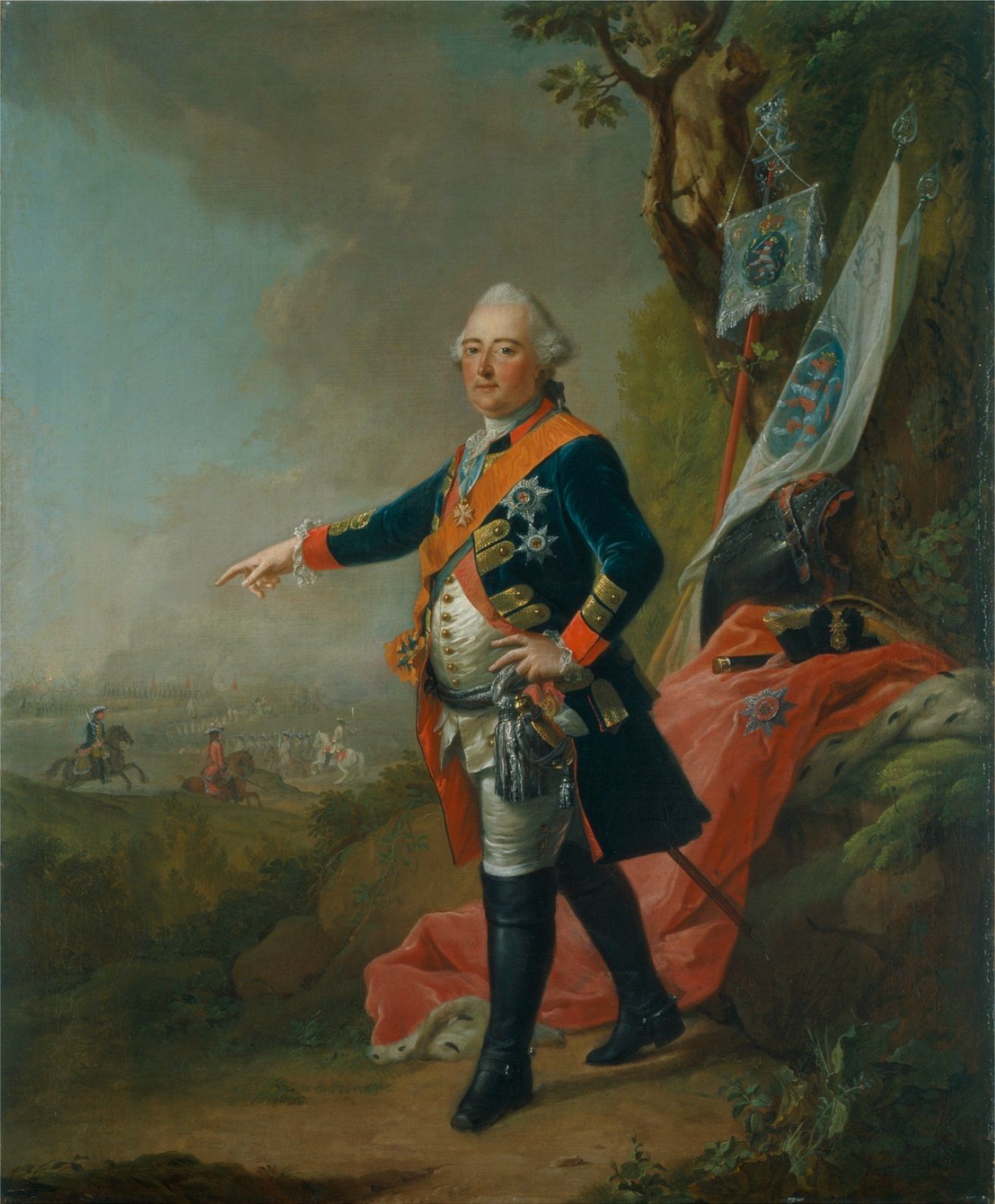
Wilhelm owed his small state to a family quarrel over religion. In 1749 his father, Frederick, heir to the landgraviate of Hesse-Kassel, secretly converted to Roman Catholicism.[5] When Landgrave William VIII learned of it, he moved to protect the Protestant church in Hesse. Under an Act of Assurance of 1754, Frederick had to give up the county of Hanau, which passed at William VIII's death to Frederick's eldest surviving son. The purpose was to keep the heir independent of his Catholic father. Frederick's wife, Princess Mary of Great Britain, a daughter of George II, had separated from him over his conversion.[6] Frederick succeeded as Landgrave Frederick II in 1760. Mary governed Hanau as guardian for her son until 1764, and on the 22nd of October that year Wilhelm and his Danish bride made their entry into Hanau, where he took over the government himself.[7]
Lowell described Frederick II as the Catholic ruler of a Protestant country. He kept a French theater and opera and founded schools and museums, and "like all his family" he "loved costly buildings." Even so, he left a full treasury at his death.[8] That treasury rested on an old Hessian business. The landgraves had been hiring out their troops to foreign powers since 1687. According to Kapp, Hesse drew £1,249,699 from Britain between 1730 and 1750 alone, and in the Seven Years' War some twenty thousand Hessians served in Britain's army in Westphalia.[9] On the 15th of January 1776 Frederick agreed to furnish Britain with twelve thousand men.[10] Britain paid levy money for each man and an annual subsidy of 450,000 crowns banco, which was to continue for a year after the troops returned to Hesse. Frederick also used the negotiation to press an old claim dating from the Seven Years' War.[11] Over the course of the war Hesse-Kassel sent 16,992 men to America, and Hesse-Hanau sent 2,422.[12]
Wilhelm proved as hard a bargainer as his father. Lowell, drawing on the German historian Friedrich Kapp, wrote that the prince who had offered his regiment without conditions "obtained in the end a larger price per man furnished than any one of his competitors, except his most serene father." When Wilhelm pressed for more, Suffolk pointed out that he was "already paid as highly per man" as the landgrave.[13] According to Kapp, Wilhelm received about £12,000 a year in subsidy, yet he remitted no taxes except to the wives and parents of his soldiers.[14] In his introduction to the journal of a Hanau artillery officer, Lowell summed him up as "a heartless pedant, fond of money and of pleasure."[15]
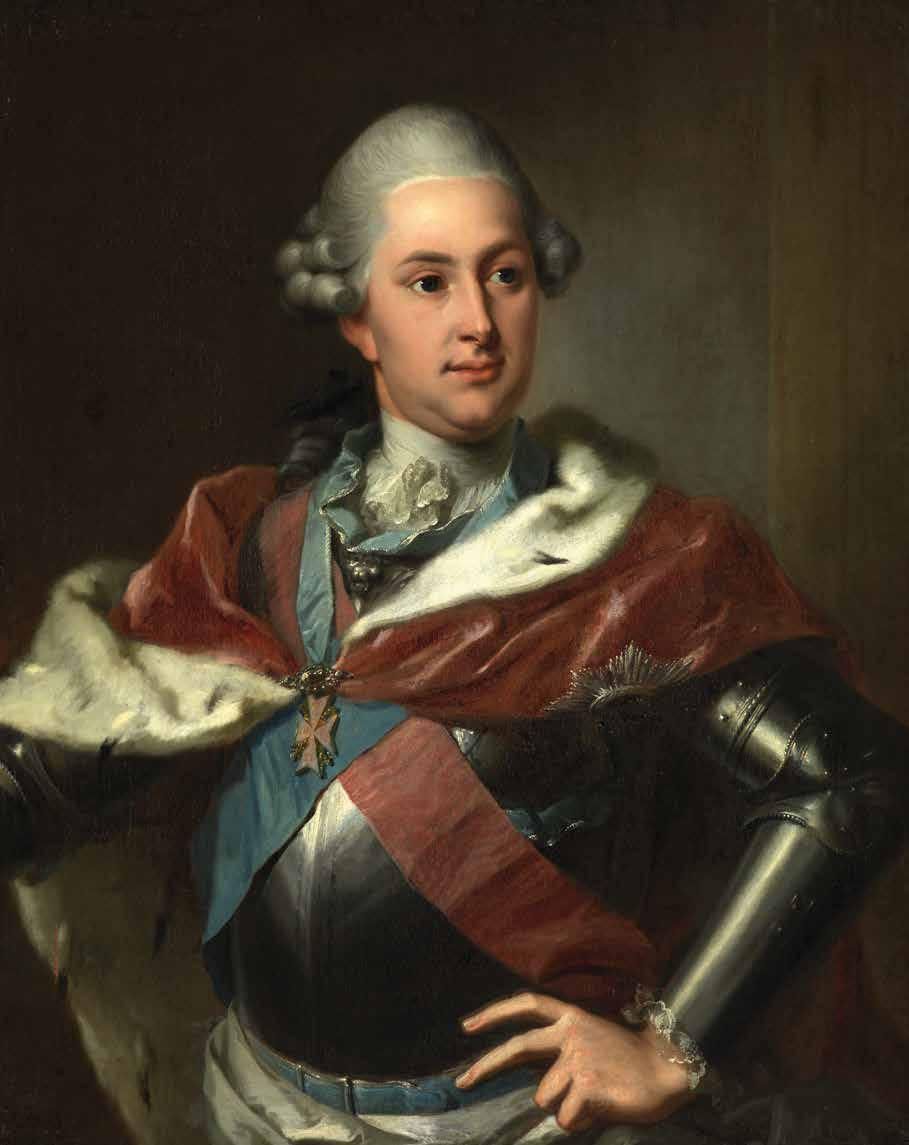
Wilhelm had married Princess Wilhelmina Caroline of Denmark in 1764, but he kept a succession of mistresses. Kapp reported that, to provide for his natural children, the prince raised the price of salt by a kreutzer a sack and settled the income on the newborn child. Kapp counted seventy-four of them.[16] That figure should be treated with caution. Niall Ferguson, the modern historian of the Rothschilds, counts at least twelve illegitimate children by at least three mistresses, all given noble-sounding names. On the prince's chief failing the sources agree. Ferguson calls avarice his "besetting sin."[17]
The Coin Dealer of the Judengasse
Among Wilhelm's interests was a large collection of coins and medals, and this hobby brought him into contact with Mayer Amschel Rothschild. Mayer was born in 1744, by the usual reckoning, in the Frankfurt Judengasse, the walled street to which the city confined its Jewish population. His father, Amschel Moses Rothschild, changed money and dealt in cloth there, and Ferguson says next to nothing is known of how the business fared. After his father died in 1755 and his mother in 1756, Mayer was apprenticed in 1757 to the firm of Wolf Jakob Oppenheim in Hanover. In 1763 he returned to Frankfurt and became a dealer in rare coins, a trade whose customers were almost all well-born collectors.[18] The prince's privy purse recorded a payment of 38 gulden and 30 kreuzer to a “Jew Meyer” in June 1765, one of many small purchases he made from various dealers as he built up his collection. A frequently repeated story credits General Emmerich von Estorff, a collector Mayer had met in Hanover, with introducing him to the prince, but Ferguson dismisses it as apocryphal. However the two men met, Wilhelm became a customer.[19]
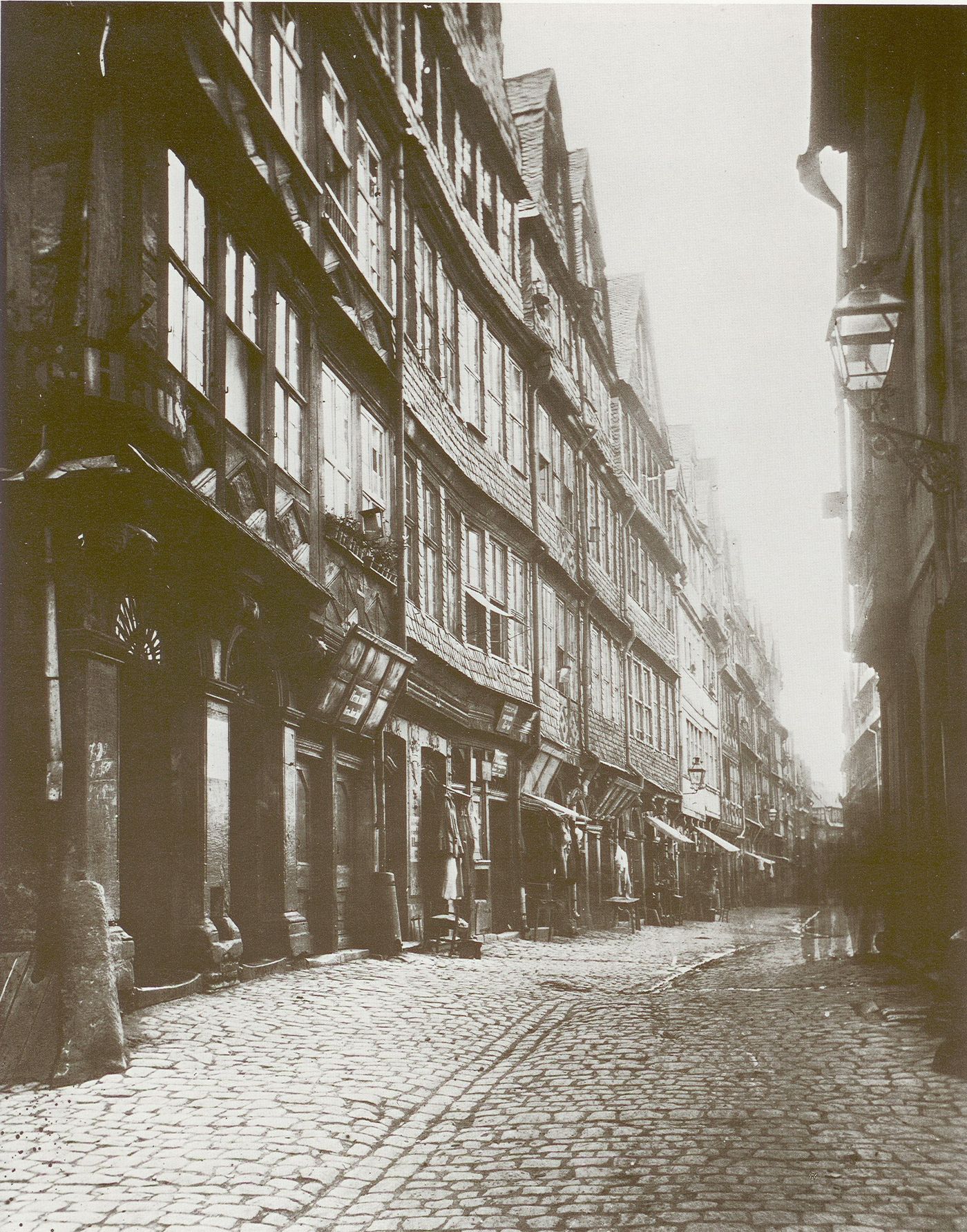
In 1769 Mayer submitted a humble petition for a title. It mentioned earlier deliveries that had pleased the prince, and on the 21st of September he was named court factor to the princely house of Hesse-Hanau.[20] The title was worth having, but it did not lift the rules of the Judengasse. Its gates were locked every night and on Sundays and religious holidays, so its residents could leave only on working days. When the Jewish community petitioned in 1769 to be allowed out on Sundays, the city rejected the request as an attempt to put themselves on an equal footing with Christian residents.[21] On the 29th of August 1770 he married the sixteen-year-old Gutle Schnapper, daughter of Wolf Salomon Schnapper, himself court agent to the Prince of Saxe-Meiningen. She brought a dowry of 2,400 gulden. Their children came in quick succession, among them Amschel in 1773 and Salomon in 1774.[22]
Mayer's business in the 1770s was modest. Christian Wilhelm Berghoeffer, the Frankfurt librarian who wrote the first documented study of his career in 1922, found ten of his sale catalogues. All were small octavo booklets of eight to sixteen pages, and the six from the 1770s offered almost nothing but thalers.[23] When a Frankfurt trade directory first listed Mayer, in 1778, it described him only as a seller of antiques, medals and showpieces. Berghoeffer concluded that coins, medals and antiques remained his main business through the 1770s and 1780s and that dealing in bills of exchange was secondary.[24] He had no part in the negotiations at Hanau.
Down the Main
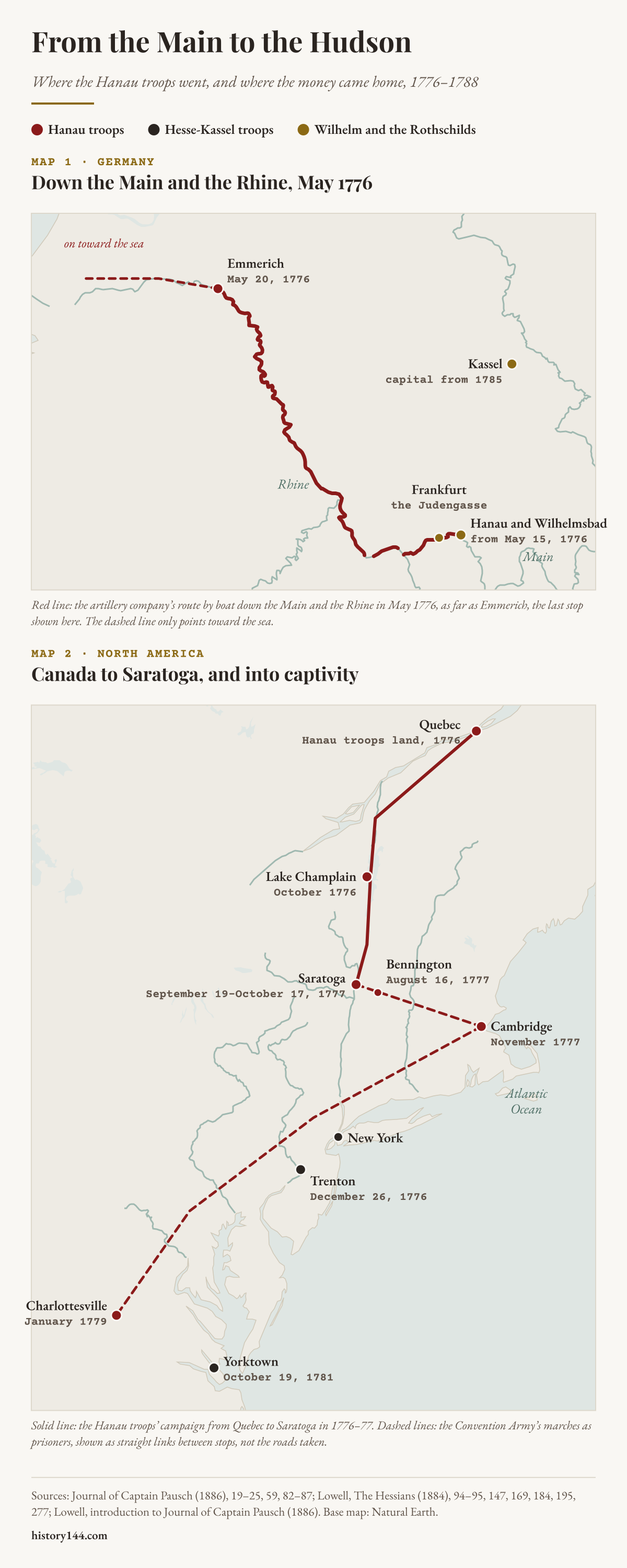
The Hanau regiment marched out on the 15th of March 1776. Two days later Wilhelm wrote to report its departure and to offer an artillery company of 120 men, which Faucitt had not been authorized to accept. The offer caused a long discussion, but the company was eventually taken into British pay.[25] Its commander, Captain Georg Pausch, kept a journal. On the 15th of May 1776 the gunners embarked on boats at Hanau, and the prince rode with them "for quite a long distance down the right bank of the river Main." There he "bade us farewell," and the boats went on to Offenbach, where they anchored for the night.[26] Wilhelm's attention to money followed them. On the 20th Pausch produced "the Prince's order relating to the refunding of 42 ducats at Emmerich," money that had been taken from the Hanau regiment at that Prussian river town, and he asked for a paper certifying that the refund had been made.[27]
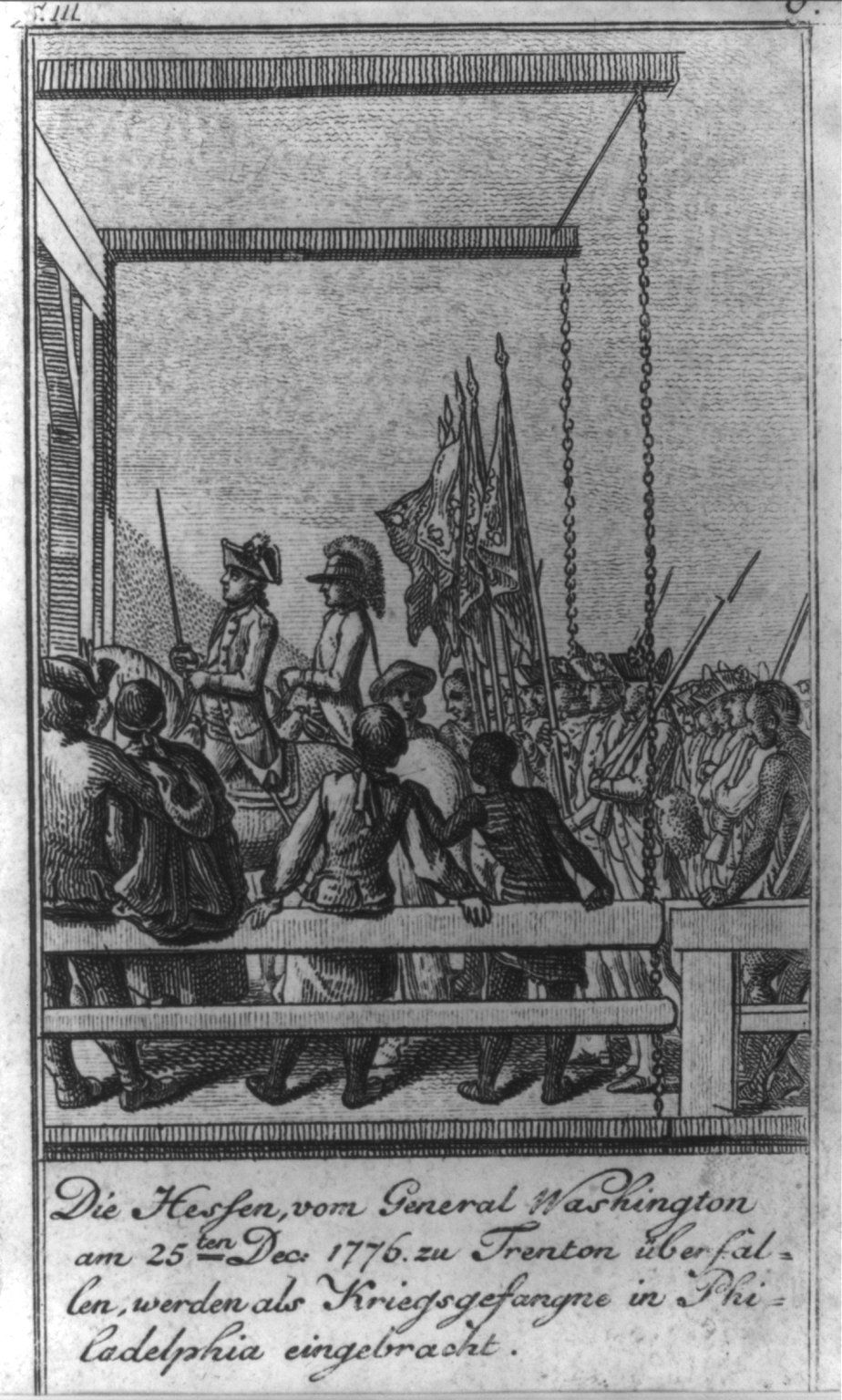
The Hanau troops were bound for Canada and the army of General John Burgoyne. Pausch's company reached the province of Quebec after a long Atlantic crossing, and that autumn some of his gunners served in armed boats on Lake Champlain. In the fighting there in October, a cannoneer named Rosemer was shot dead. Pausch wrote that Lieutenant Dufais's batteau "came back burning" and full of water, and Lowell reported that a boat carrying Hanau artillery was sunk by American fire.[28] The much larger Hesse-Kassel corps went to New York, where it fought on Long Island and at Fort Washington. Its best-known engagement came at the end of the year. On the morning of the 26th of December 1776, George Washington's army crossed the Delaware and fell on the brigade of Colonel Johann Rall at Trenton. Rall was mortally wounded, and his regiments laid down their arms. Washington reported twenty-three officers and 886 men taken prisoner, and men found later in the town raised the total to about a thousand.[29] Under the treaties, every man killed or wounded also had a price.
Saratoga
Burgoyne's army moved south from Canada in the summer of 1777, aiming for Albany and the Hudson. The Hanau infantry served as the Regiment Erbprinz, a name that means "hereditary prince," under the field command of Colonel Wilhelm Rudolf von Gall.[30] It marched with the German contingent under the Brunswick general Friedrich Adolf von Riedesel, and Pausch's company went with it. On the 16th of August a detachment under Lieutenant Colonel Friedrich Baum, sent to seize supplies near Bennington, was destroyed by New England militia under John Stark. Of Baum's original command, 365 Germans did not return to camp.[31] A separate relief column under Lieutenant Colonel Heinrich von Breymann, which included Hanau gunners with two English six-pounders, lost another 231 killed, wounded and missing.[32]
In Frankfurt, a month later, Gutle Rothschild gave birth to a third son. Nathan Mayer Rothschild was born in the Judengasse on the 16th of September 1777.[33] Three days later, on the upper Hudson, Burgoyne's army fought the first battle of Saratoga at Freeman's Farm. Late in the day a call for guns came from Riedesel's adjutant, and Pausch set out with "two cannon, ammunition and a cart containing shovels, picks, etc." English officers and men and the Brunswick chasseurs grasped the ropes and helped haul the guns up the hill, and Pausch fired a dozen or more rounds into the Americans at close range.[34] Lowell judged that Pausch's two six-pounders and Riedesel's infantry "finally turned the tide of battle" that afternoon.[35] The price was high. Pausch counted more than thirty men of the Royal Artillery among the dead and wounded and wrote that "the losses on our side are very considerable."[36]
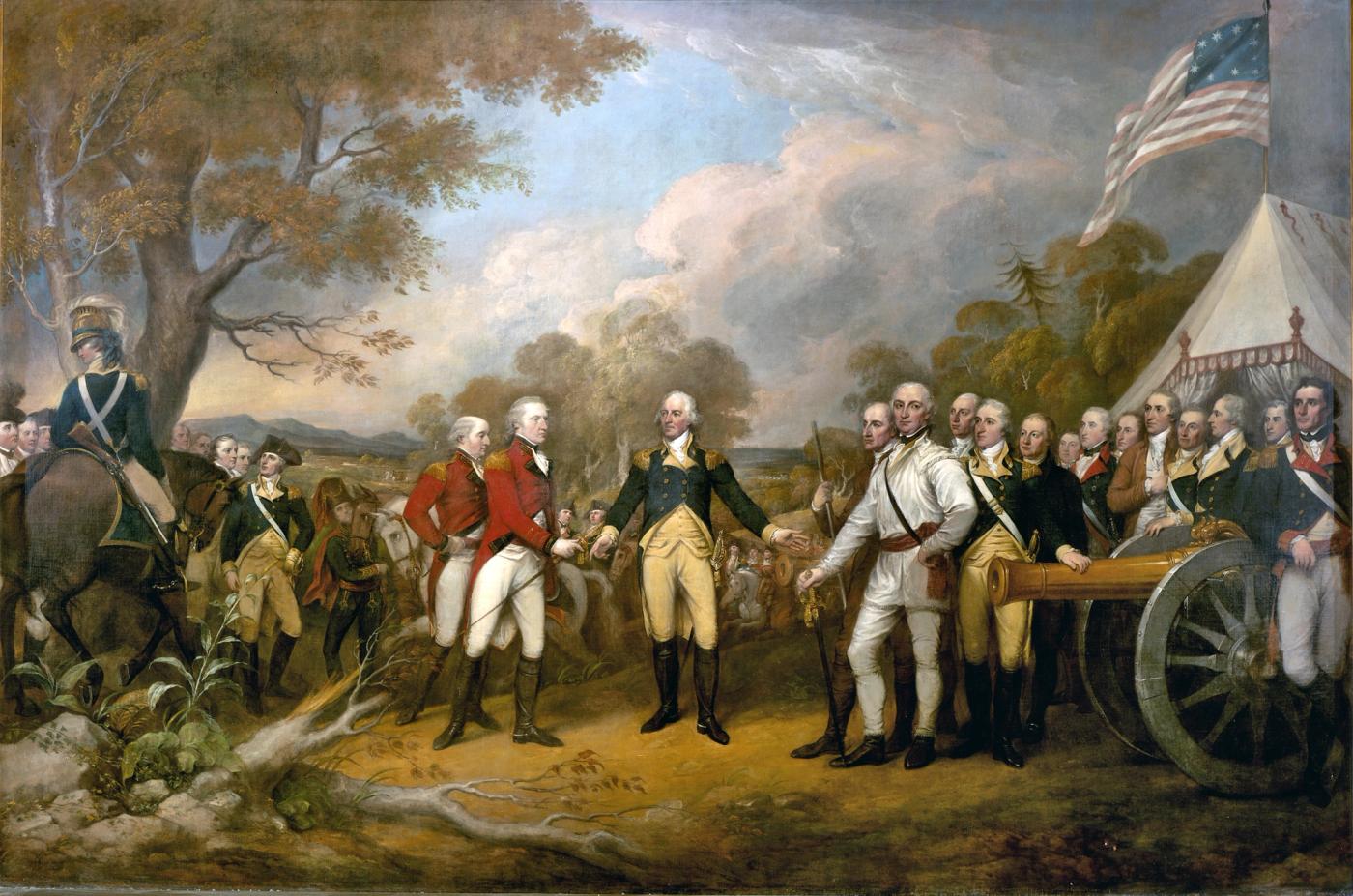
The second battle, on the 7th of October, went badly for Burgoyne. Breymann was shot dead when the Americans struck his position in flank and rear. Pausch, by his own account, was left "alone, isolated, and almost surrounded by the enemy," with the road he was to retreat by already in American hands.[37] Ten days later Burgoyne surrendered. The convention signed at Saratoga covered 5,791 men, of whom 2,431 were Germans by the count of the German historian Max von Eelking.[38] The Hanau regiment and artillery went into captivity with the rest of what became known as the Convention Army. The prisoners marched to Cambridge, Massachusetts, between the 17th of October and the 7th of November. They were later moved south, and in mid-January 1779 the Germans reached Charlottesville, Virginia, where they had to build their own huts.[39] Not until November 1782 could Sir Guy Carleton, the British commander in New York, tell the Hereditary Prince that the Hanau corps and artillery taken under the Saratoga convention had been exchanged or paroled and sent to Canada.[40]
A Ruin by the Braubach
While his regiment was in captivity, Wilhelm was building. Mineral springs had been found in a quarry near Hanau, and from 1777 Wilhelm and his engineer, Franz Ludwig Cancrin, raised a row of late Baroque spa buildings along a promenade, set in a landscape park of 37.5 hectares.[41] The spa took the prince's name. Its centerpiece was a private retreat. Between 1779 and 1781 Wilhelm had a residential tower built on an island in the Braubach stream, designed to look like the ruin of a medieval castle. Its exterior feigned decay, and moss was encouraged to suggest age, while the rooms inside were decorated in the early neoclassical taste. The state palaces administration of Hesse calls it the earliest European example of a pseudo-medieval castle ruin in a landscape garden.[42] The park also held a hermitage, a grotto, a hedge theater and a swaying "Devil's Bridge." Its carousel, built in 1779 and 1780, is described by the park as the oldest carousel in the world.[43]
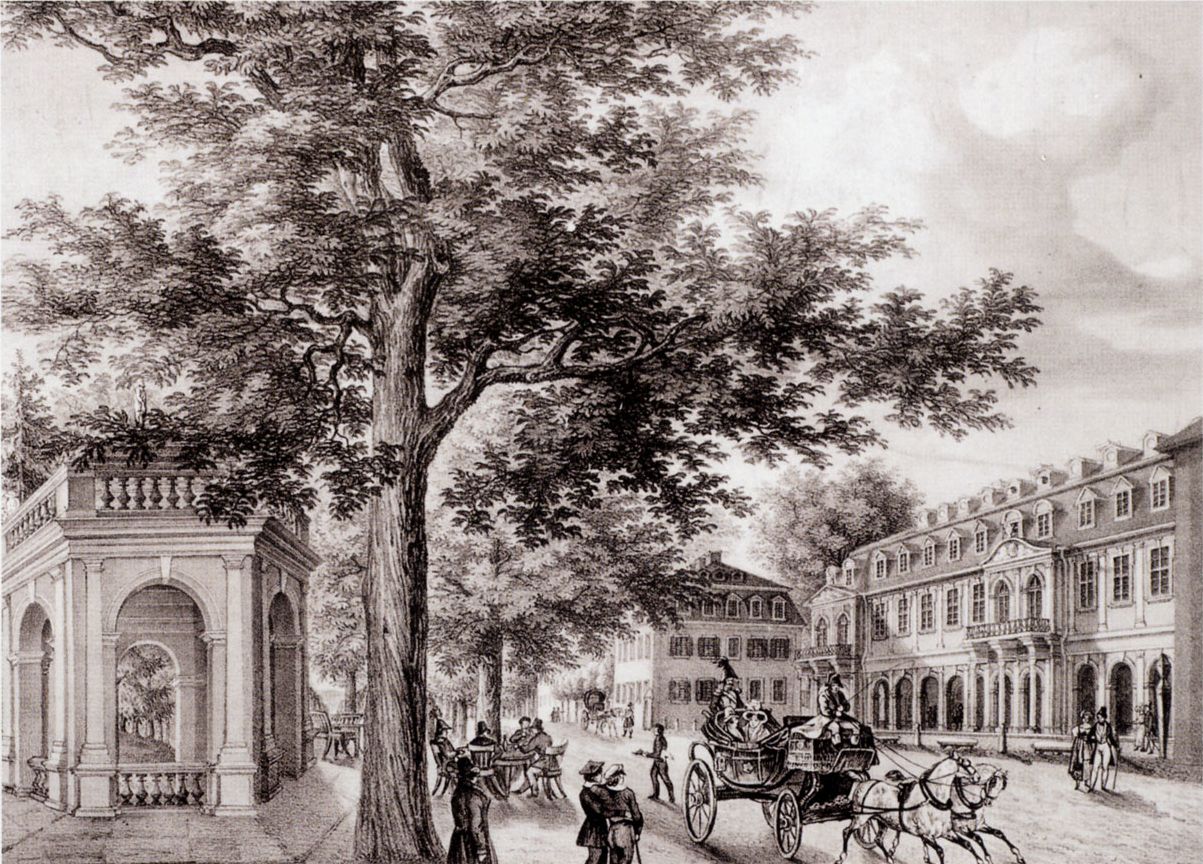
Wilhelmsbad was meant to be visited, and visitors came. An anonymous pamphlet of 1780, Letters of a Swiss on Wilhelmsbad near Hanau, advertised a "wonderful mixture of people from the nobility and the bourgeoisie, Christians and Jews, old and young."[44] Local tradition holds that the spa was paid for with the British subsidies. The timing makes the connection plausible, since British money was reaching the Hanau treasury throughout the years of construction, but the claim rests on inference rather than on published accounts. In the summer of 1782 the spa hosted a gathering of a different kind. Duke Ferdinand of Brunswick, grand master of the Freemasons of the Strict Observance, presided over a convention of delegates from lodges across Europe, which he had planned with Wilhelm's younger brother, Prince Carl of Hesse. Its minutes run from the 15th of July to the 1st of September 1782. The delegates gave up the order's claim to descend from the medieval Knights Templar and ended the old system of the Strict Observance. In its place they endorsed a reformed system adopted at Lyon in 1778, the Chevaliers Bienfaisants de la Cité Sainte.[45] Ferdinand's elder brother, Duke Charles I, had rented out the Brunswick regiments that marched to Saratoga beside Wilhelm's men.
One of Wilhelm's mistresses in these years was Rosalie Dorothea Ritter, who by Ferguson's count bore him seven children. Their tutor, Karl Friedrich Buderus, moved into the prince's financial administration at Hanau in 1783 and in 1792 transferred to the war treasury at Kassel. In later years he steered Hessian business toward Rothschild and eventually became a sleeping partner in the firm.[46] Wilhelm's legitimate family left its own mark on the park. When his son Friedrich died in 1784 at the age of eleven, he had a pyramid raised there in the boy's memory, modelled on the tomb of Cestius in Rome.[47]
Yorktown and the Reckoning
For most of the German troops the war ended in the south. When Cornwallis surrendered at Yorktown in October 1781, his army of some seven thousand included not quite 1,100 men from Ansbach-Bayreuth and rather more than 850 from Hesse-Kassel.[48] Among the Hessian units was a Hesse-Kassel regiment also called Erbprinz, a different unit from the Hanau regiment captured at Saratoga, and the regiment von Bose.[49] Knyphausen counted 142 Hessians killed and wounded at Yorktown, not including the chasseurs posted across the York River at Gloucester or the Ansbach-Bayreuth men. The capitulation was signed on the 19th of October, and the garrison marched out with cased colors.[50] The last Hessians sailed from New York on the 25th of November 1783. Some soldiers stayed in America with the consent of the authorities, and some officers and men received grants of land in Nova Scotia.[51]
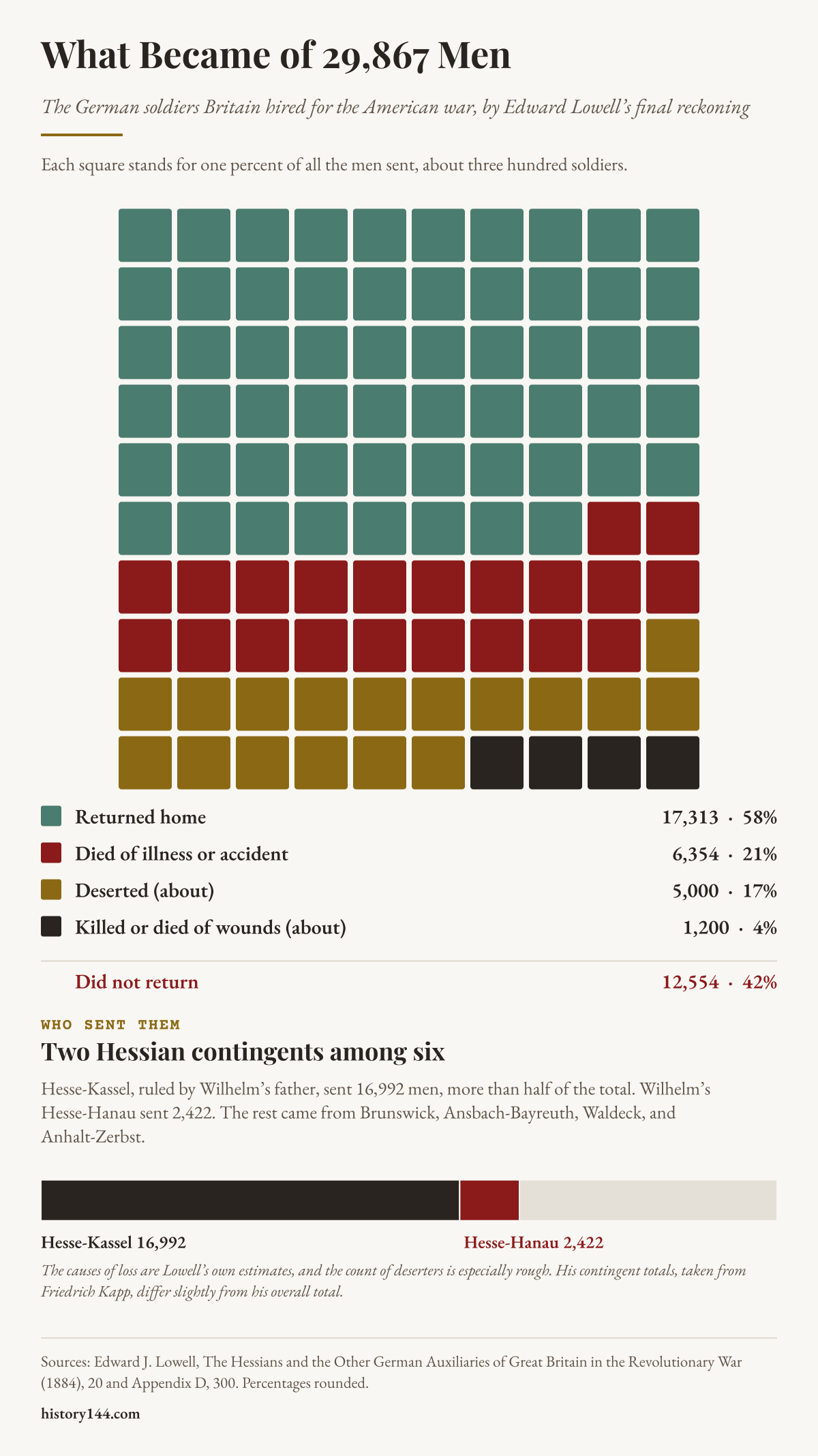
Lowell's final accounting shows what the treaties cost the men who served under them. Of 29,867 German soldiers sent to America, 17,313 returned. Of the 12,554 who did not, Lowell estimated that about 1,200 were killed or died of wounds, 6,354 died of illness or accident, and about 5,000 deserted.[52] The figures are estimates, and the count of deserters is especially uncertain, but disease plainly killed far more men than battle did. Under treaties like Hanau's, a man killed in action had a price in crowns banco, and three wounded men counted as one killed. The subsidies did not stop with the peace. The Hanau treaty required a full year's notice before payment ended, and that notice could be given only after the troops had returned home.[53]
The House at the Green Shield
For Mayer Rothschild the early 1780s were years of slow and careful growth, and Berghoeffer's catalogues show the change. The four from the 1780s added Greek, Roman and other coins to the thalers, along with antiquities, and one from 1786 offered a collection of antique cut stones. The totals rose as well, from between about 1,700 and 2,900 gulden in the earlier catalogues to as much as 5,074 gulden in the later ones.[54] In August 1780 he wrote to Friedrich Justin Bertuch, secretary to the Duke of Weimar, to report that he had bought a large collection of mostly Saxon coins and medals, and he enclosed one of his catalogues.[55] In 1783 he applied for a special pass to leave the Judengasse on Sundays.[56] By then, according to Ferguson, he had begun to deal in English bills of exchange, the form in which the British subsidies reached Hesse. The court sold these bills for cash, and the business was dominated by established houses such as the Bethmanns and Rüppell & Harnier.[57]
His prosperity showed in a new home. Mayer bought the house called Zum Grünen Schild, the Green Shield, at Judengasse 148, in two halves, in December 1783 and November 1785. Berghoeffer found that the family could not take possession until the 1st of October 1786, although some accounts date the move earlier.[58] The house was narrow, about 4.7 meters across the front, and the Rothschilds shared it with the Schiff family, who occupied the other half. It had its own water pump, which was considered a great luxury at the time.[59] The family came to regard the house as its home, and Gutle lived there until her death in 1849.[60]
Landgrave Wilhelm IX
Frederick II died at Weissenstein, his summer palace above Kassel, on the 31st of October 1785, and Wilhelm succeeded him the same day as Landgrave Wilhelm IX of Hesse-Kassel.[61] He left Hanau for Kassel, and Wilhelmsbad began a slow decline.[62] His inheritance was extraordinary. Most of his fellow German princes were often short of money, but Ferguson estimates Hesse-Kassel's wealth at Wilhelm's accession at between thirty and forty million gulden, and the state's assets could hardly be distinguished from the prince's own.[63] Lowell put the source of that money plainly. Hesse was a poor land whose people lived by the plough, he wrote, but "the Landgraves were in business," and the ware they let out was men. England was the best customer, and there was generally money in the treasury.[64]
Wilhelm turned at once to the palace in which his father had died. Weissenstein stood on the hillside below the great Hercules monument raised by Wilhelm's great-grandfather, Landgrave Carl. His first design for a replacement, drawn up in 1786 with the court architect Simon Louis du Ry, was for a new palace built as an artificial ruin, an idea that echoed his tower at Wilhelmsbad. Du Ry eventually prevailed, and the palace was built in a classical style modeled on ancient Rome.[65] The side wings of the old palace came down in 1786 and its main block in 1790.[66] The first wing of the new palace, now called the Weissenstein wing, went up between 1786 and 1790. In 1787 the landgrave decided to add a matching second wing. A central block designed by Heinrich Christoph Jussow followed in the 1790s, and the palace later known as Wilhelmshöhe was not finished until the end of the decade.[67] Wilhelm also put his treasure to work. By 1806 his assets exceeded forty-six million gulden, and more than half of that sum, 28.8 million, was out on loan to other German princes.[68]
For Mayer Rothschild the move to Kassel brought no immediate advantage. When Wilhelm took up residence there, Ferguson writes, Mayer was still "to all intents and purposes a nobody."[69] Berghoeffer found that Mayer's dealings with the landgrave resumed only in 1789, after a long interruption, when he was again allowed to handle English bills.[70] Even then he broke into the Kassel market only by offering to pay more than the established local firms. His first line of credit was £800, while the leading broker, Feidel David, had £25,000, and the title of senior court agent did not come until 1803.[71] In the late 1780s Mayer was a Frankfurt merchant with a growing family, a good eye for coins and an ambition that the Hessian treasury had not yet noticed.
April 1788
On the 24th of April 1788, in his father's recently purchased house at the Green Shield, Kalman Rothschild was born. Known in later life as Carl, he was Mayer and Gutle's fourth son.[72] Mayer was forty-four, the same age as the landgrave in Kassel, whose new palace was then rising above the city. Beyond a coin dealer's title and some past sales, nothing yet connected the two men's fortunes.
That connection came later and belongs to another story. In the 1790s, with help from Buderus, Mayer won a growing share of the Hessian bill business. After Napoleon drove Wilhelm into exile in 1806, part of the landgrave's fortune passed through Rothschild hands, and Nathan, the son born three days before Freeman's Farm, bought British government stock with it. The Rothschild Archive puts the sum at £550,000 in securities and bullion. Ferguson, counting nine purchases of consols down to the end of 1813, gives £664,850.[73] In 1821 Carl, the son born in April 1788, set up the family's business in Naples.[74]
Why the Twelve Years Mattered
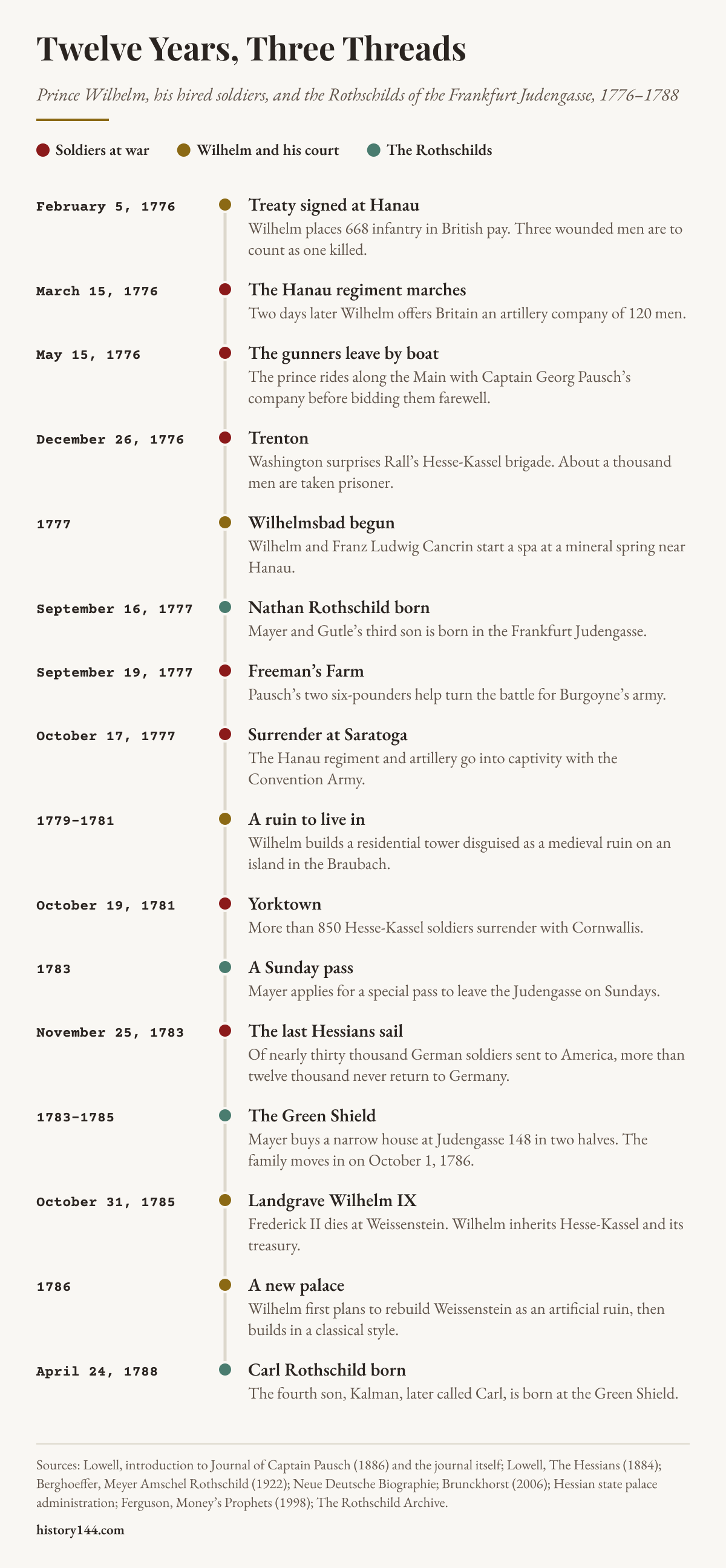
The years between 1776 and 1788 turned a minor prince into one of the richest rulers in Europe. The Hanau treaty of February 1776 put a price on every soldier who marched down the Main, and Article IX put a price on the dead and the wounded. Some of the money went into a spa with a counterfeit ruin at its heart, and some into a new palace above Kassel. Much of it stayed in the treasury and grew. The soldiers who earned it fought at Trenton, Freeman's Farm and Yorktown, and of the nearly thirty thousand German soldiers who crossed the Atlantic, more than twelve thousand never returned to Germany.
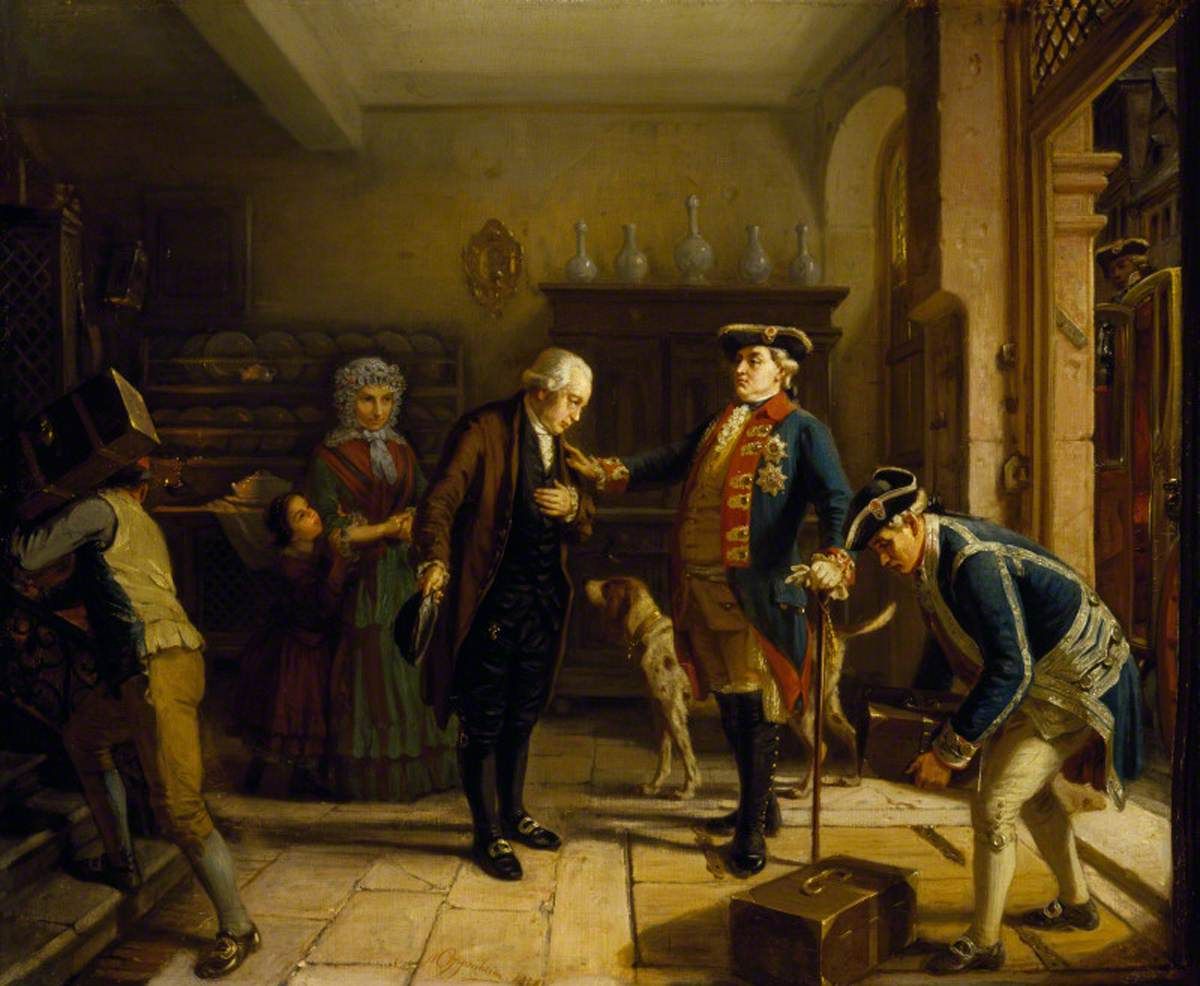
Mayer Rothschild had no share in that bargain. He spent these years selling coins, printing catalogues, raising children and moving to a better house in the same narrow street. His title came from the Hanau court, and his first real business with Wilhelm's treasury did not come until 1789. Later writers wove the two stories together. The best known tale has Mayer hiding the landgrave's treasure from Napoleon's soldiers. In the version that first reached print, in Brockhaus's German encyclopedia of 1827, he buried it in his garden as the French entered Frankfurt, and lost everything of his own. Ferguson calls the story fiction with a very small grain of truth in it. Wilhelm's movable wealth was in fact scattered among caches at his own country houses, and it was Buderus, not Rothschild, who carried the most valuable bonds through the French lines.[75] The record of these twelve years shows something slower. The soldier trade built a great treasury, and a patient coin dealer who had once sold its owner coins for his collection prepared himself to manage part of it. By April 1788 the money was in Kassel, and four of the five sons who would carry the Rothschild business across Europe had been born. The fifth, James, followed in 1792.[76]
Places in this Story
The places this story moves through, in order — follow them on the interactive map →
- Hanau, Germany February 5, 1776
Colonel Faucitt signed for 668 infantry at the prince's residence town on the Main.
- Frankfurt Judengasse, Germany September 21, 1769
Mayer Amschel Rothschild was named court factor to the princely house of Hesse-Hanau.
- Offenbach am Main, Germany May 15, 1776
The gunners anchored for the night after the prince rode with them down the bank.
- Emmerich am Rhein, Germany May 20, 1776
Pausch asked for a paper certifying the refund of 42 ducats taken from the regiment.
- Saratoga, New York October 17, 1777
Burgoyne surrendered, and the Hanau regiment and artillery went into captivity.
- Charlottesville, Virginia January 1779
The German prisoners reached Virginia and had to build their own huts.
- Wilhelmsbad, Hanau, Germany 1777
Wilhelm and Cancrin began a spa whose centrepiece was a tower built to look like a ruin.
- Yorktown, Virginia October 19, 1781
Cornwallis surrendered with more than 850 Hesse-Kassel soldiers in his army.
- Kassel, Germany October 31, 1785
Frederick II died at Weissenstein and Wilhelm inherited Hesse-Kassel and its treasury.
Frequently Asked Questions
How much did Britain pay for a Hessian soldier?
Under the Hanau treaty of February 5, 1776, Britain paid thirty crowns banco in levy money for each foot soldier raised, about seven pounds four shillings. A man killed was paid for at the same rate.
What did the Hanau treaty say about wounded soldiers?
Article IX said that according to custom three wounded men should be reckoned as one killed. If a company of the corps was entirely destroyed, the king paid the cost of the recruits needed to rebuild it.
Did the Rothschilds get rich from the Hessian soldier trade?
Not in these years. Mayer Amschel Rothschild held a court factor's title from Hanau from 1769, but he broke into the Kassel market for English bills only in 1789, on a credit line of 800 pounds against the leading broker's 25,000.
What was Wilhelmsbad?
A spa that Prince Wilhelm and his engineer Franz Ludwig Cancrin built near Hanau from 1777, with a landscape park, a hermitage and a tower disguised as a medieval ruin. Local tradition holds that British subsidy money paid for it.
How many German soldiers died in the American Revolution?
Edward Lowell reckoned that of 29,867 German soldiers sent to America, 17,313 returned. Of the rest he estimated about 1,200 killed or dead of wounds, 6,354 dead of illness or accident, and about 5,000 deserted.
What happened to the Hanau regiment at Saratoga?
It served in Burgoyne's army as the Regiment Erbprinz and went into captivity under the convention signed on October 17, 1777. Not until November 1782 could Sir Guy Carleton report that the Hanau corps had been exchanged or paroled.
Bibliography
"Actes du convent national des trois provinces des Gaules, tenu à Lyon du 20 novembre au 10 décembre 1778." Fonds Willermoz, Bibliothèque municipale de Lyon. Catalogue collectif de France record. https://ccfr.bnf.fr/portailccfr/ark:/16871/004b79173056. Accessed November 13, 2026.
ADAC Maps. "Staatspark Hanau-Wilhelmsbad." https://maps.adac.de/poi/staatspark-hanau-wilhelmsbad-kesselstadt. Accessed November 13, 2026.
Backhaus, Fritz. "Rothschild, Carl Freiherr von (eigentlich Kalman) Mayer." In Neue Deutsche Biographie 22 (2005), 134–35. Online version, Deutsche Biographie. https://www.deutsche-biographie.de/gnd116641797.html#ndbcontent. Accessed November 13, 2026.
Berghoeffer, Christian Wilhelm. Meyer Amschel Rothschild, der Gründer des Rothschildschen Bankhauses. Frankfurt am Main: Englert und Schlosser, 1922. Digitized copy, ZBW EconBiz. https://digi.econbiz.de/viewer/fullscreen/1016729413/18. Accessed November 13, 2026.
Both, Wolf von. "Friedrich II." In Neue Deutsche Biographie 5 (1961). Online version, Deutsche Biographie. https://www.deutsche-biographie.de/gnd130249424.html#ndbcontent. Accessed November 13, 2026.
Brunckhorst, Friedl. "'… alle Sonntage große Cour …': Die Gesellschaftsräume in Schloss Wilhelmshöhe." Burgen und Schlösser, no. 1 (2006): 32–35. https://journals.ub.uni-heidelberg.de/index.php/bus/article/download/53985/47646/167426. Accessed November 13, 2026.
Carleton, Sir Guy, to the Hereditary Prince of Hesse-Cassel. New York, 12 November 1782. Guy Carleton, 1st Baron Dorchester: Papers, PRO 30/55/54/27. The National Archives, Kew. Catalogue entry. https://beta.nationalarchives.gov.uk/catalogue/id/C16423476. Accessed November 13, 2026.
Deutsche Digitale Bibliothek. "Schloss Wilhelmshöhe." Object record. https://www.deutsche-digitale-bibliothek.de/item/PRPYO6RNVRZAFGKDGVTNTUCGZVKBQRTE. Accessed November 13, 2026.
Ferguson, Niall. The House of Rothschild: Money's Prophets, 1798–1848. New York: Viking, 1998.
"Gall, von, Wilhelm Rudolf." Hessische Truppen im Amerikanischen Unabhängigkeitskrieg (HETRINA). Landesgeschichtliches Informationssystem Hessen (LAGIS). https://www.lagis-hessen.de/en/subjects/idrec/sn/hetrina/id/63543. Accessed November 13, 2026.
Hammermayer, Ludwig. Der Wilhelmsbader Freimaurer-Konvent von 1782. Wolfenbütteler Studien zur Aufklärung 5/2. Heidelberg: Lambert Schneider, 1980.
Holtmeyer, Alois. Die Bau- und Kunstdenkmäler im Regierungsbezirk Cassel. Vol. 4, Kreis Cassel-Land. Marburg: Elwert, 1910. Digitized section "Wilhelmshöhe," Universitätsbibliothek Paderborn. https://digital.ub.uni-paderborn.de/download/pdf/8306989.pdf. Accessed November 13, 2026.
Jewish Museum Frankfurt. "Gutle Rothschild." Judengasse Frankfurt metahub. https://metahubfrankfurt.de/en/jmf/stories/gutle-rothschild/. Accessed November 13, 2026.
Jewish Museum Frankfurt. "House Grünes Schild." Judengasse Frankfurt metahub. https://metahubfrankfurt.de/en/jmf/locations/house-gr%C3%BCnes-schild/. Accessed November 13, 2026.
Jewish Museum Frankfurt. "Judengasse, Judenmauer, Tore." Judengasse Frankfurt metahub. https://metahubfrankfurt.de/en/jmf/stories/judengasse-judenmauer-gates/. Accessed November 13, 2026.
Jewish Museum Frankfurt. "Mayer Amschel Rothschild." Judengasse Frankfurt metahub. https://metahubfrankfurt.de/en/jmf/stories/mayer-amschel-rothschild/. Accessed November 13, 2026.
Journal of Captain Pausch, Chief of the Hanau Artillery during the Burgoyne Campaign. Translated and annotated by William L. Stone. Introduction by Edward J. Lowell. Albany: Joel Munsell's Sons, 1886. Internet Archive. https://archive.org/details/journalofcaptain00pausuoft. Accessed November 13, 2026.
Kapp, Friedrich. Der Soldatenhandel deutscher Fürsten nach Amerika: Ein Beitrag zur Kulturgeschichte des achtzehnten Jahrhunderts. 2nd ed. Berlin: Julius Springer, 1874. Project Gutenberg. https://www.gutenberg.org/ebooks/47054. Accessed November 13, 2026.
Lowell, Edward J. The Hessians and the Other German Auxiliaries of Great Britain in the Revolutionary War. New York: Harper and Brothers, 1884. Google Books. https://books.google.com/books?id=f0yIkJJU2tEC. Accessed November 13, 2026.
"Meyer Amschel Rothschild, Court Factor and Coin Dealer." Translated by Christina Schlögl. CoinsWeekly. https://coinsweekly.com/?p=60559. Accessed November 13, 2026.
New York State Office of Parks, Recreation and Historic Preservation. "Primary Sources, Battle of Bennington." Part 1. https://parks.ny.gov/documents/historic-sites/BenningtonBattlefieldBrunswickSources1of2.pdf. Accessed November 13, 2026.
New York State Office of Parks, Recreation and Historic Preservation. "Primary Sources, Battle of Bennington: Brunswick Forces." Part 2. https://parks.ny.gov/documents/historic-sites/BenningtonBattlefieldBrunswickSources2of2.pdf. Accessed November 13, 2026.
Reinalter, Helmut, Reinhard Markner, Claus Oberhauser, and Peter Volk, eds. Aktenedition über den Wilhelmsbader Freimaurer-Konvent 1782. Vol. 1. Basel: Schwabe, 2018.
Review of Der Wilhelmsbader Freimaurer-Konvent von 1782, by Ludwig Hammermayer. Francia 9 (1981): 787–88. https://journals.ub.uni-heidelberg.de/index.php/fr/article/download/51024/44513/160210. Accessed November 13, 2026.
The Rothschild Archive. "Carl Mayer (Carl) von Rothschild (1788–1855)." Rothschild Family website. https://family.rothschildarchive.org/people/28-carl-mayer-carl-von-rothschild-1788-1855. Accessed November 13, 2026.
The Rothschild Archive. "House of the Green Shield." Rothschild Family website. https://family.rothschildarchive.org/estates/68-house-of-the-green-shield. Accessed November 13, 2026.
The Rothschild Archive. "Mayer Amschel Rothschild (1744–1812)." Rothschild Family website. https://family.rothschildarchive.org/people/21-mayer-amschel-rothschild-1744-1812. Accessed November 13, 2026.
The Rothschild Archive. "Nathan Mayer Rothschild's Bill-Case, 1831." Archivist's Choice, March 2016. https://www.rothschildarchive.org/collections/archivists_choice/march_2016_nathan_mayer_rothschilds_bill_case_1831. Accessed November 13, 2026.
The Rothschild Archive. "Origins of the Rothschild Banking Business." https://rothschildarchive.org/business. Accessed November 13, 2026.
The Rothschild Archive. "Rothschild Timeline." https://www.rothschildarchive.org/exhibitions/timeline. Accessed November 13, 2026.
The Rothschild Archive. "The Rothschild Name and Arms." https://rothschildarchive.org/family/the_rothschild_name_and_arms. Accessed November 13, 2026.
Staatliche Schlösser und Gärten Hessen. "Hanau-Wilhelmsbad State Park." https://www.schloesser-hessen.de/en/wilhelmsbad. Accessed November 13, 2026.
Staatliche Schlösser und Gärten Hessen. "History." Hanau-Wilhelmsbad State Park. https://www.schloesser-hessen.de/en/wilhelmsbad/geschichte. Accessed November 13, 2026.
"Treaty with the Hereditary Prince of Hesse Cassel, Signed February 5, 1776." American Archives digital edition. Northern Illinois University Libraries. https://digital.lib.niu.edu/islandora/object/niu-amarch%3A87499. Accessed November 13, 2026.
Universität Kassel, Universitätsbibliothek. "Kassel: Weißenstein." Landgraf Moritz Online. https://www.uni-kassel.de/ub/ueber-uns/projekte/dfg-landgraf-moritz-online-praesentation/die-zeichnungen/orte-in-hessen/kassel/weissenstein.html. Accessed November 13, 2026.
Citations
- Edward J. Lowell, introduction to Journal of Captain Pausch, Chief of the Hanau Artillery during the Burgoyne Campaign, trans. William L. Stone (Albany: Joel Munsell's Sons, 1886), 5. ↑
- Treaty between Great Britain and the Hereditary Prince of Hesse-Cassel, 5 February 1776, arts. 1–2, 8–9, 12, printed in Lowell, introduction to Journal of Captain Pausch, 6–11; "Treaty with the Hereditary Prince of Hesse Cassel, Signed February 5, 1776," American Archives digital edition, Northern Illinois University Libraries. The 1886 printing gives the corps as "six hundred sixty-eight men," and Friedrich Kapp, Der Soldatenhandel deutscher Fürsten nach Amerika, 2nd ed. (Berlin: Julius Springer, 1874), 73, also gives 668; the online transcription reads "six hundred and sixty men." ↑
- Prince Wilhelm to George III, Hanau, 19 August 1775, and Suffolk's reply, in Lowell, introduction to Journal of Captain Pausch, 3–4; Edward J. Lowell, The Hessians and the Other German Auxiliaries of Great Britain in the Revolutionary War (New York: Harper and Brothers, 1884), 7. ↑
- Niall Ferguson, The House of Rothschild: Money’s Prophets, 1798–1848 (New York: Viking, 1998), chap. 2. ↑
- Wolf von Both, "Friedrich II.," in Neue Deutsche Biographie 5 (1961). ↑
- Christian Wilhelm Berghoeffer, Meyer Amschel Rothschild, der Gründer des Rothschildschen Bankhauses (Frankfurt am Main: Englert und Schlosser, 1922), 8; Lowell, Hessians, 5. ↑
- Berghoeffer, Meyer Amschel Rothschild, 8. ↑
- Lowell, Hessians, 5–6. ↑
- Kapp, Soldatenhandel, 21–22. ↑
- Lowell, Hessians, 2, 19. ↑
- Lowell, Hessians, 19–20. ↑
- Lowell, Hessians, 20. ↑
- Lowell, Hessians, 7; Lowell, introduction to Journal of Captain Pausch, 13. ↑
- Lowell, Hessians, 7–8; Kapp, Soldatenhandel, 79. ↑
- Lowell, introduction to Journal of Captain Pausch, 2. ↑
- Lowell, Hessians, 7; Kapp, Soldatenhandel, 71. Kapp names the Haynau brothers, Wilhelm's sons by Rosa Dorothea Ritter, among the seventy-four. ↑
- Niall Ferguson, The House of Rothschild: Money's Prophets, 1798–1848 (New York: Viking, 1998), chap. 2. ↑
- The Rothschild Archive, "Mayer Amschel Rothschild (1744–1812)," Rothschild Family website. The usual date of birth is 23 February 1744, and Ferguson’s account, which has Mayer aged twenty-six at his marriage in August 1770, agrees; some sources give 1743. Berghoeffer gives the Hanover firm as Oppenheim, as Ferguson does; other accounts write Oppenheimer. On Amschel Moses and on the clientele of the coin trade, see Ferguson, Money's Prophets, chap. 1; Ferguson writes that next to nothing is known of the father's business. ↑
- "Meyer Amschel Rothschild, Court Factor and Coin Dealer," trans. Christina Schlögl, CoinsWeekly; Ferguson, Money's Prophets, chap. 1 and chap. 1, n. 4. The June 1765 entry is in William's privy purse accounts; Ferguson identifies the “Jew Meyer” of that entry with Mayer Amschel as an assumption rather than a certainty. ↑
- Berghoeffer, Meyer Amschel Rothschild, 8. ↑
- Jewish Museum Frankfurt, "Judengasse, Judenmauer, Tore," Judengasse Frankfurt metahub; Ferguson, Money’s Prophets, chap. 1. Ferguson notes that the community petitioned again in 1784, and that the rules on leaving the lane on Sundays and holidays were tightened rather than relaxed in 1787. ↑
- Ferguson, Money’s Prophets, chap. 1; Jewish Museum Frankfurt, "Gutle Rothschild," Judengasse Frankfurt metahub; The Rothschild Archive, "Rothschild Timeline." ↑
- Berghoeffer, Meyer Amschel Rothschild, 10. ↑
- Berghoeffer, Meyer Amschel Rothschild, 11. ↑
- Lowell, introduction to Journal of Captain Pausch, 11–12, 17. ↑
- Journal of Captain Pausch, 19–20. ↑
- Journal of Captain Pausch, 25. ↑
- Journal of Captain Pausch, 59, 82–87; Lowell, Hessians, 123. ↑
- Lowell, Hessians, 94–95. ↑
- "Gall, von, Wilhelm Rudolf," Hessische Truppen im Amerikanischen Unabhängigkeitskrieg (HETRINA), Landesgeschichtliches Informationssystem Hessen (LAGIS). ↑
- Lowell, Hessians, 147. ↑
- Lowell, Hessians, 147; New York State Office of Parks, Recreation and Historic Preservation, "Primary Sources, Battle of Bennington: Brunswick Forces," part 2; New York State Office of Parks, Recreation and Historic Preservation, "Primary Sources, Battle of Bennington," part 1, Hesse-Hanau sources, including Bach's letter of 3 October 1782. Two Hanau detachments served at Bennington. Lieutenant Johann Michael Bach commanded the two guns with Baum and was captured; Lieutenant Spangenberg commanded Breymann's two six-pounders, was wounded, and had to abandon them. ↑
- The Rothschild Archive, "Nathan Mayer Rothschild's Bill-Case, 1831," Archivist's Choice, March 2016. ↑
- Journal of Captain Pausch, 135–38. ↑
- Lowell, Hessians, 153. ↑
- Journal of Captain Pausch, 140–41. ↑
- Lowell, Hessians, 158; Journal of Captain Pausch, 168. ↑
- Lowell, Hessians, 169. ↑
- Lowell, Hessians, 184, 195. ↑
- Sir Guy Carleton to the Hereditary Prince of Hesse-Cassel, New York, 12 November 1782, Guy Carleton, 1st Baron Dorchester: Papers, PRO 30/55/54/27, The National Archives, Kew. ↑
- Staatliche Schlösser und Gärten Hessen, "History," Hanau-Wilhelmsbad State Park. The English page gives the park as 37.5 hectares; the administration’s own German visitor brochure gives 28.9. ↑
- Staatliche Schlösser und Gärten Hessen, "History"; ADAC Maps, "Staatspark Hanau-Wilhelmsbad." ↑
- Staatliche Schlösser und Gärten Hessen, "History"; Staatliche Schlösser und Gärten Hessen, "Hanau-Wilhelmsbad State Park." ↑
- Briefe eines Schweizers über das Wilhelmsbad bei Hanau (1780), quoted in Staatliche Schlösser und Gärten Hessen, "History." ↑
- Helmut Reinalter, Reinhard Markner, Claus Oberhauser, and Peter Volk, eds., Aktenedition über den Wilhelmsbader Freimaurer-Konvent 1782, vol. 1 (Basel: Schwabe, 2018), ix–xiii; Ludwig Hammermayer, Der Wilhelmsbader Freimaurer-Konvent von 1782 (Heidelberg: Lambert Schneider, 1980), as summarized in the review in Francia 9 (1981): 787–88. On the Lyon convention of November–December 1778, see "Actes du convent national des trois provinces des Gaules, tenu à Lyon du 20 novembre au 10 décembre 1778," Fonds Willermoz, Bibliothèque municipale de Lyon, record in Catalogue collectif de France. ↑
- Ferguson, Money's Prophets, chap. 2. Ferguson calls her Rosalie Dorothea Ritter and a Swiss woman; Kapp and Lowell write Rosa Dorothea Ritter. ↑
- Staatliche Schlösser und Gärten Hessen, "History." ↑
- Lowell, Hessians, 277. ↑
- Lowell, Hessians, 297. ↑
- Lowell, Hessians, 278, 280–81. ↑
- Lowell, Hessians, 282, 291. ↑
- Lowell, Hessians, 300. ↑
- "Treaty with the Hereditary Prince of Hesse Cassel," art. 12; Lowell, introduction to Journal of Captain Pausch, 10. ↑
- Berghoeffer, Meyer Amschel Rothschild, 10. ↑
- Berghoeffer, Meyer Amschel Rothschild, 10. ↑
- Ferguson, Money's Prophets, chap. 2. ↑
- Ferguson, Money's Prophets, chap. 2. ↑
- Ferguson, Money's Prophets, chap. 1, n. 5; Berghoeffer, Meyer Amschel Rothschild, 21. For the later dates, see The Rothschild Archive, "The Rothschild Name and Arms" (1784); The Rothschild Archive, "Rothschild Timeline" (1785); Jewish Museum Frankfurt, "House Grünes Schild," Judengasse Frankfurt metahub (1785); Jewish Museum Frankfurt, "Gutle Rothschild" (1780). ↑
- Jewish Museum Frankfurt, "House Grünes Schild"; The Rothschild Archive, "Rothschild Timeline"; The Rothschild Archive, "House of the Green Shield." ↑
- Jewish Museum Frankfurt, "Mayer Amschel Rothschild," Judengasse Frankfurt metahub; Jewish Museum Frankfurt, "House Grünes Schild." ↑
- Both, "Friedrich II."; Berghoeffer, Meyer Amschel Rothschild, 8. ↑
- Staatliche Schlösser und Gärten Hessen, "History." ↑
- Ferguson, Money's Prophets, chap. 2. ↑
- Lowell, Hessians, 1–2. ↑
- Friedl Brunckhorst, "'… alle Sonntage große Cour …': Die Gesellschaftsräume in Schloss Wilhelmshöhe," Burgen und Schlösser, no. 1 (2006): 32. ↑
- Alois Holtmeyer, Die Bau- und Kunstdenkmäler im Regierungsbezirk Cassel, vol. 4, Kreis Cassel-Land (Marburg: Elwert, 1910), 246. ↑
- Brunckhorst, "Gesellschaftsräume," 33–34; Universität Kassel, Universitätsbibliothek, "Kassel: Weißenstein," Landgraf Moritz Online; Deutsche Digitale Bibliothek, "Schloss Wilhelmshöhe," object record. Brunckhorst dates the central block 1791–99, the Deutsche Digitale Bibliothek 1791–98, and the University of Kassel gives the whole building campaign as 1786–1801. ↑
- Ferguson, Money's Prophets, chap. 2. ↑
- Ferguson, Money's Prophets, chap. 2. ↑
- Berghoeffer, Meyer Amschel Rothschild, 11. ↑
- Ferguson, Money's Prophets, chap. 2. ↑
- The Rothschild Archive, "Carl Mayer (Carl) von Rothschild (1788–1855)," Rothschild Family website; Fritz Backhaus, "Rothschild, Carl Freiherr von (eigentlich Kalman) Mayer," in Neue Deutsche Biographie 22 (2005), 134–35. ↑
- The Rothschild Archive, "Origins of the Rothschild Banking Business"; Ferguson, Money's Prophets, chap. 2. Ferguson works from the purchase records and is the better figure; the two accounts also cover different spans. ↑
- The Rothschild Archive, "Origins of the Rothschild Banking Business"; The Rothschild Archive, "Rothschild Timeline." ↑
- Ferguson, Money's Prophets, introduction and chap. 2. ↑
- The Rothschild Archive, "Rothschild Timeline." ↑