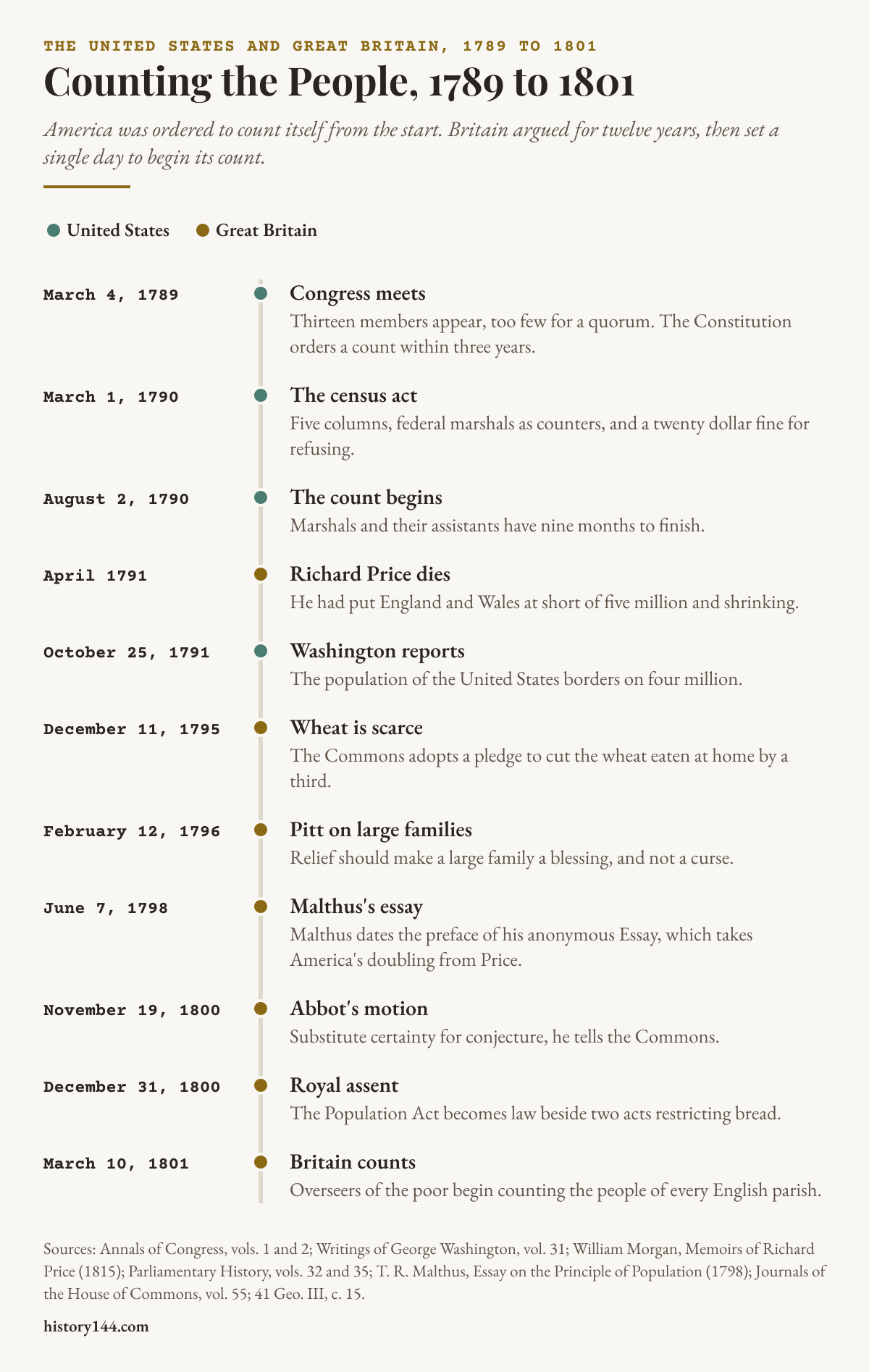
On Wednesday, March 4, 1789, the day fixed for the meeting of the new Congress, thirteen members of the House of Representatives appeared in New York and took their seats. It was not enough for a quorum, so the House adjourned until the next morning, and then the next.[1] The Constitution those men had come to put into force required them to do something few governments had attempted. Representatives and direct taxes were to be divided among the states according to their numbers. "The actual enumeration," it said, "shall be made within three years after the first meeting of the Congress of the United States, and within every subsequent term of ten years."[2] A Congress that could not yet count to a quorum was obliged to count a nation.
It is easy to assume that Britain, older and richer than the new republic, already knew how many people it had. It did not. Its most respected writer on the subject, the dissenting minister Richard Price, a friend of Benjamin Franklin and of the American cause, had told the public that England and Wales held fewer than five million people and were losing them. Over the next twelve years the United States counted itself twice. In Britain the argument over its numbers ran on through a poor law debate, two failed harvests, and an anonymous essay by a young Cambridge fellow, Thomas Robert Malthus, whose name would attach itself to the whole question. Malthus took his proof that population could double every twenty-five years from America, but not from the American count. When the count finally came, it owed something to a young man's paper and more to a member of Parliament who could not believe that a great nation did not know its own size. On March 10, 1801, the overseers of the poor began the count. This is the story of those twelve years.
Short of Five Millions
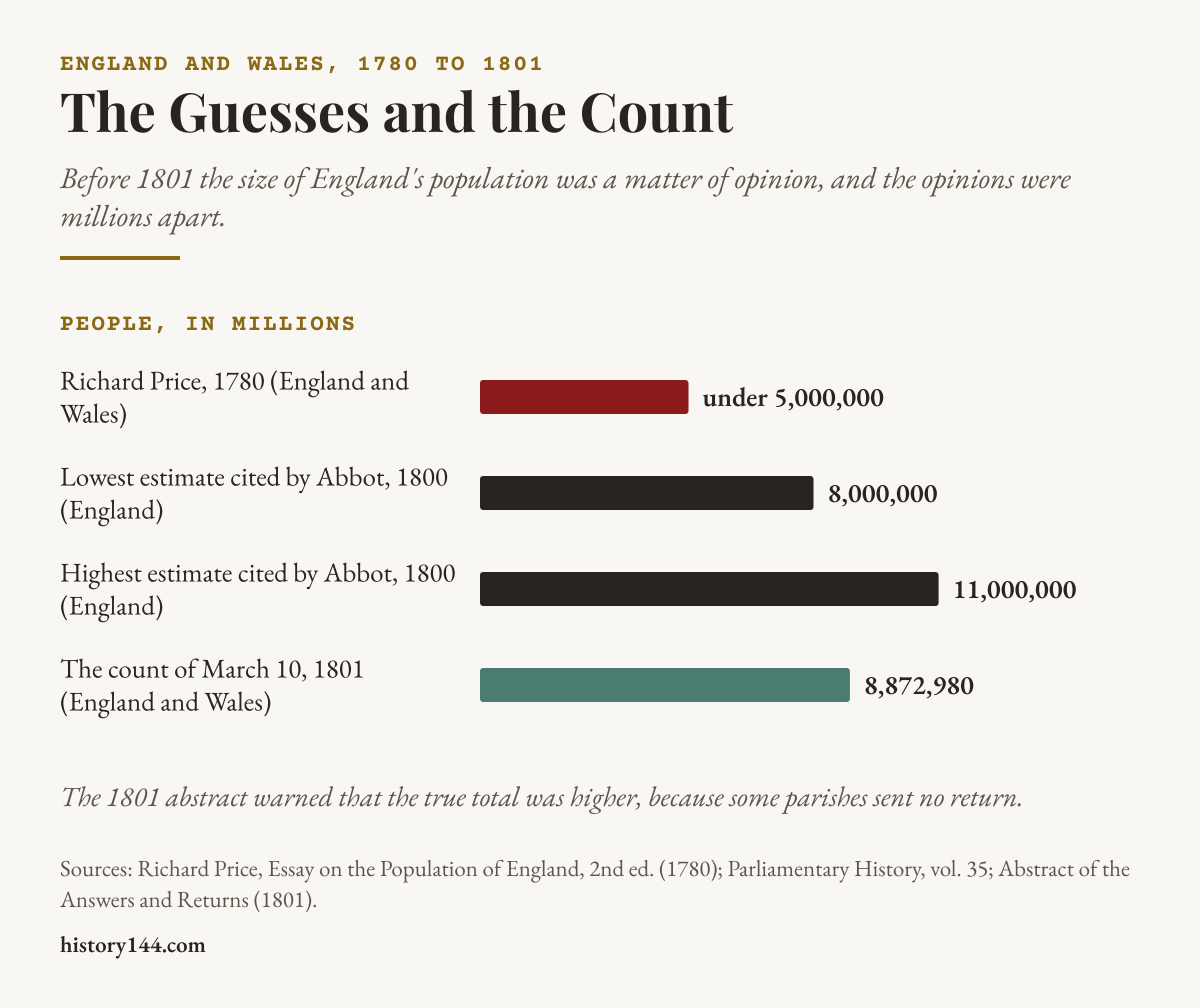
Price had made his case in 1780, in An Essay on the Population of England. The tax office surveyors had returned 952,734 houses in England and Wales for 1777, and Price, allowing fewer than five people to a house, concluded that "the number of inhabitants in England and Wales must be short of FIVE MILLIONS."[3] He compared them with the 1,319,215 houses that Charles Davenant had reckoned from the hearth-tax books at the Revolution of 1688, and argued that "our people, therefore, since that æra, have decreased near a quarter." He blamed the army and navy, a "devouring capital" in London, three long continental wars, emigration to the colonies, the engrossing of farms, the high price of provisions, and "above all" luxury, public taxes, and debts.[4]
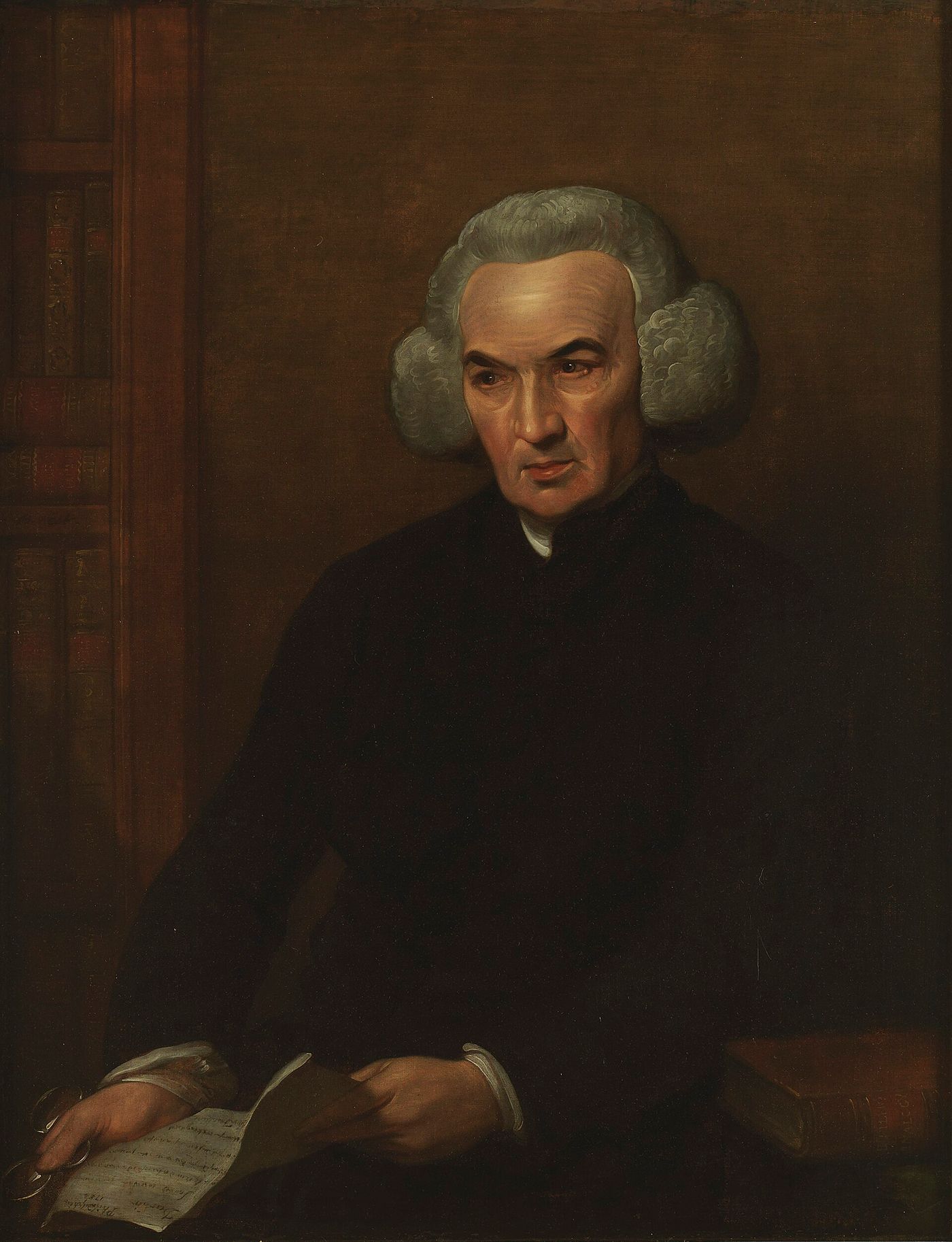
Price was no crank. He was a Fellow of the Royal Society and the author of Observations on Reversionary Payments, a treatise on annuities and life assurance. His nephew and biographer, William Morgan, recalled that his views of public affairs could be "particularly gloomy and desponding," and that depopulation, in his opinion, "was making rapid advances."[5] His opponents, John Howlett among them, answered that the surveyors had missed the cottages exempt from the tax and that five people to a house was too few.[6] No one could settle the matter, because no one had counted.
Price did not live to see it settled. In the cold of February 1791 he attended a friend's funeral at Bunhill Fields. On his return he remarked that "this method of conducting funerals was the sure way of sending the living after the dead." A month later he attended the burial of another friend there, and, his nephew wrote, "the event unfortunately proved the truth of his late observation." He fell ill and died that April, months before the first American returns were printed.[7]
Facts, Instead of Assertions
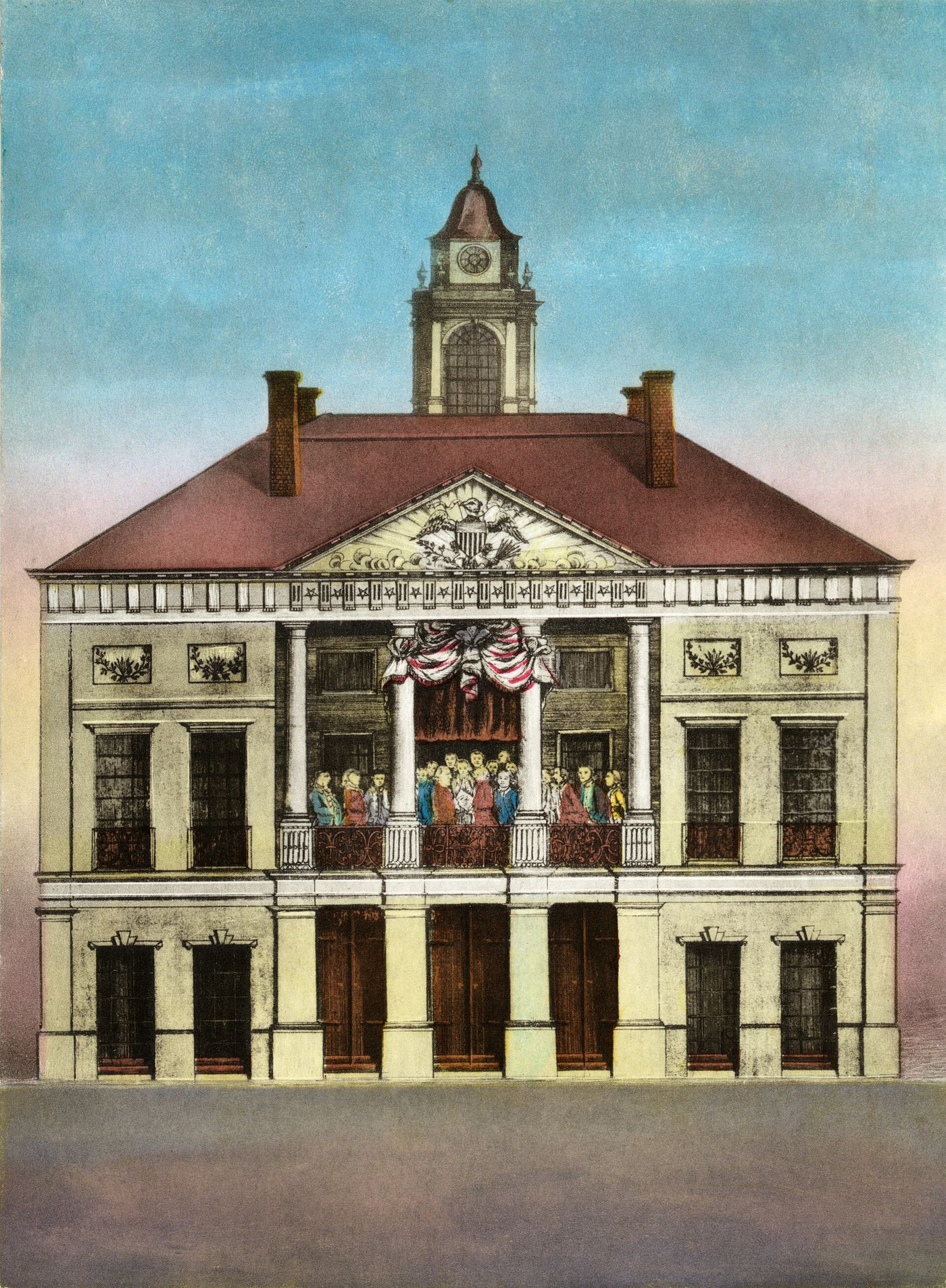
In New York, the House took up a census bill in January 1790. On January 25, James Madison asked the committee of the whole to pass over the bill's schedule so that he could draft a fuller one. A census, he said, gave Congress the chance to learn "the description of the several classes into which the community is divided," so that it could provide for the "agricultural, commercial, and manufacturing interests" in due proportion. This kind of information, he observed, "all Legislatures had wished for," but it "had never been obtained in any country."[8]
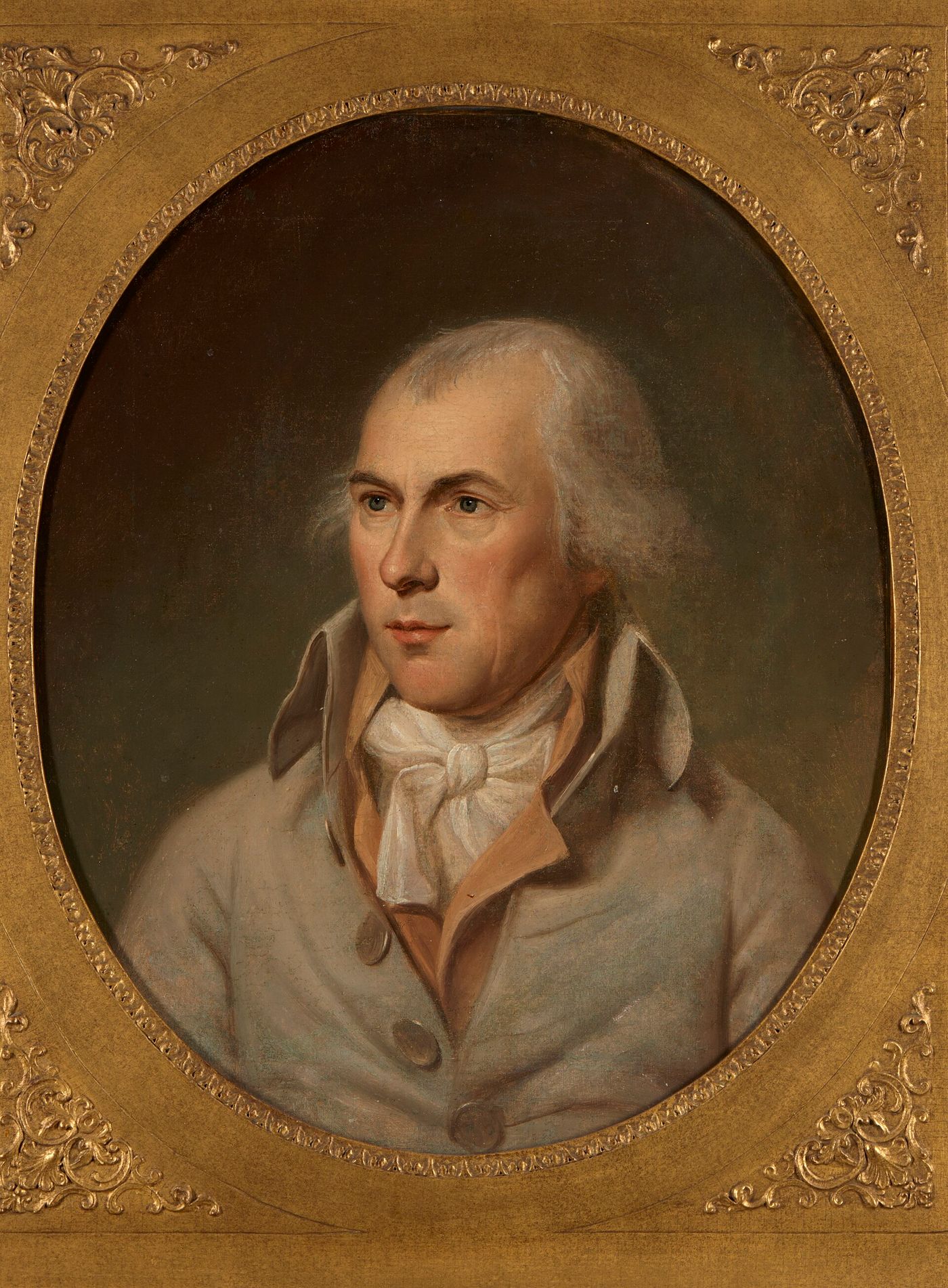
When the revised bill came back on February 2, Samuel Livermore of New Hampshire objected. His constituents followed two, three, or four trades by season, weaving in spring and summer and making shoes in fall and winter. A government so curious about their occupations, he warned, would be suspected of measuring "their ability to bear the burthen of direct or other taxes." Madison answered that Congress had been legislating for farmers, merchants, and manufacturers without knowing how many of each there were. With returns in hand, members "might rest their arguments on facts, instead of assertions and conjectures."[9]
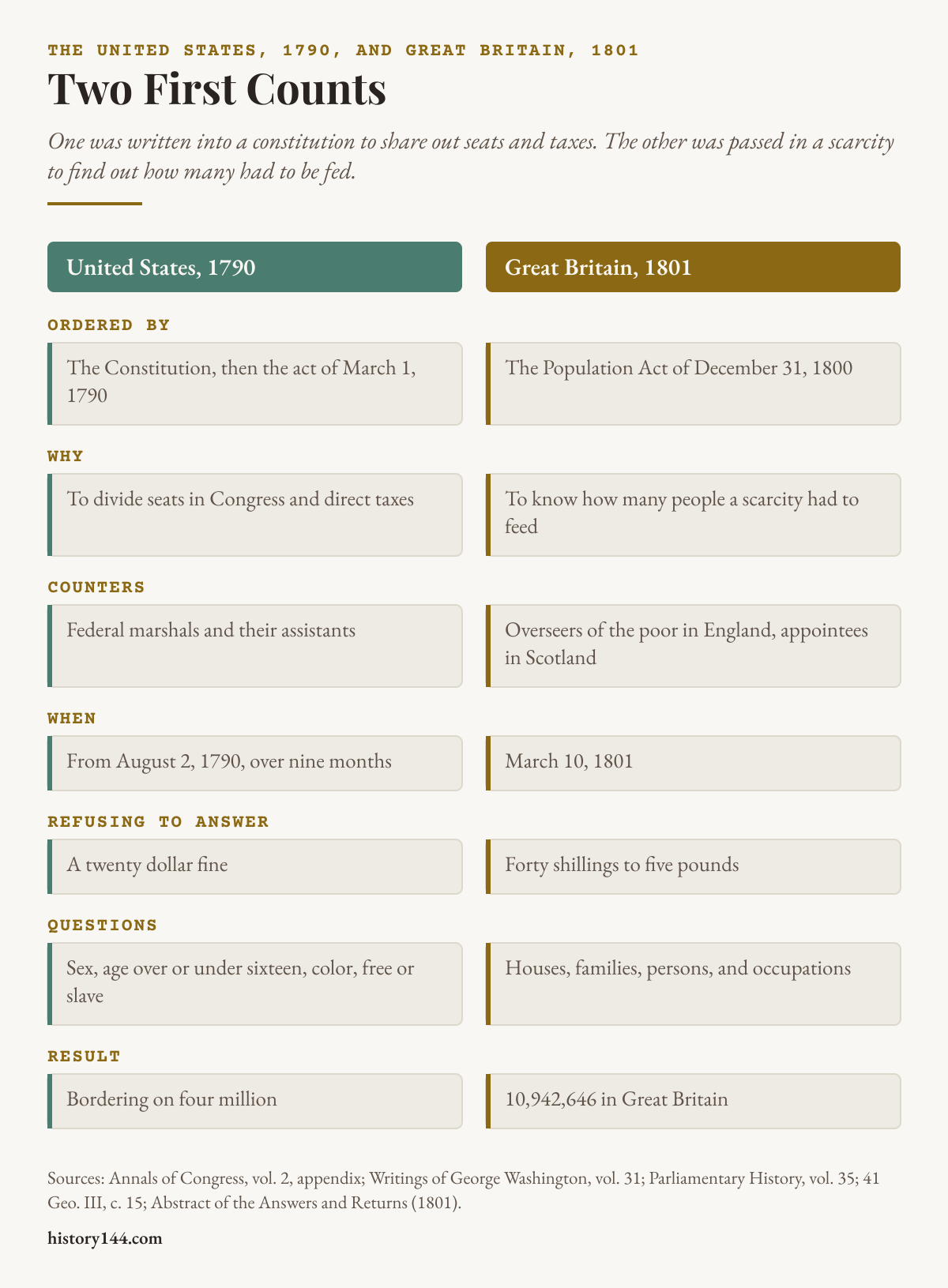
The House approved his schedules, but the act George Washington signed on March 1, 1790, contained none of them. Leaving out "Indians not taxed," its schedule had just five columns, for free white males of sixteen and upward, free white males under sixteen, free white females, all other free persons, and slaves. Federal marshals and their assistants were to begin on the first Monday in August and finish within nine months. Anyone over sixteen who refused to give an account of the household forfeited twenty dollars. Before sending his returns on, each assistant had to post a signed copy in two public places in his division.[10]
Through a Magnifying Glass
The count began on August 2, 1790. In December, Washington told Gouverneur Morris that the numbers "will not fall short, it is said, of five millions, some think more," a total that would "astonish Europe."[11] By the following summer he had to correct himself. On July 28, 1791, he wrote to Morris that the estimate had rested on the claims of congressmen, "each of whom (as was very natural) looking thro' a magnifying glass would speak of the greatest extent" their states might reach. The returns showed that "we shall hardly reach four millions," and he was sure even that figure fell short. He explained why.
> "the religious scruples of some, would not allow them to give in their lists; the fears of others that it was intended as the foundation of a tax induced them to conceal or diminished theirs, and thro' the indolence of the people, and the negligence of many of the Officers numbers are omitted."[12]
In October he told Congress that the population "borders on four Millions of persons."[13] Thomas Jefferson, as secretary of state, certified the printed Return of the Whole Number of Persons within the Several Districts of the United States as "truly stated from the original Returns deposited in the Office of the Secretary of State."[14] The United States now had a printed count of its people, district by district. It had one because seats in Congress depended on it.
A Blessing, and Not a Curse
In Britain the argument about population turned in the 1790s from how many people there were to how they were to be fed. On December 11, 1795, with wheat scarce and dear, the House of Commons resolved that measures should be taken to reduce the consumption of wheat. Members were invited to sign an engagement to cut the wheat eaten in their own households by at least a third, either by limiting fine bread or by eating bread mixed with other grain.[15] Two weeks later James Gillray published a print dedicated to the "Charitable Committee for reducing the high price of Corn, by providing Substitutes for Bread in their own Families." It showed the king's ministers gorging on plates of gold coins. On the wall behind them hung their own list of substitutes for bread, which ran from venison and roast beef to Burgundy, Champagne, and Tokay. Through the window, a hungry crowd held up a placard that read "Grant us the Crumbs which drop from your Table."
On February 12, 1796, Samuel Whitbread asked the Commons to let magistrates set minimum wages for farm laborers, citing Price on how far wages had fallen behind the price of meat. William Pitt opposed the bill. No single rate could suit every household, he argued. Fixed for a small family, it would leave the man "with a large family, who had done most service to his country," with too little. He proposed instead that relief to large families should be "a matter of right and an honour," so as to make a large family "a blessing, and not a curse."[16] Such fathers, he said, had "enriched their country with a number of children."
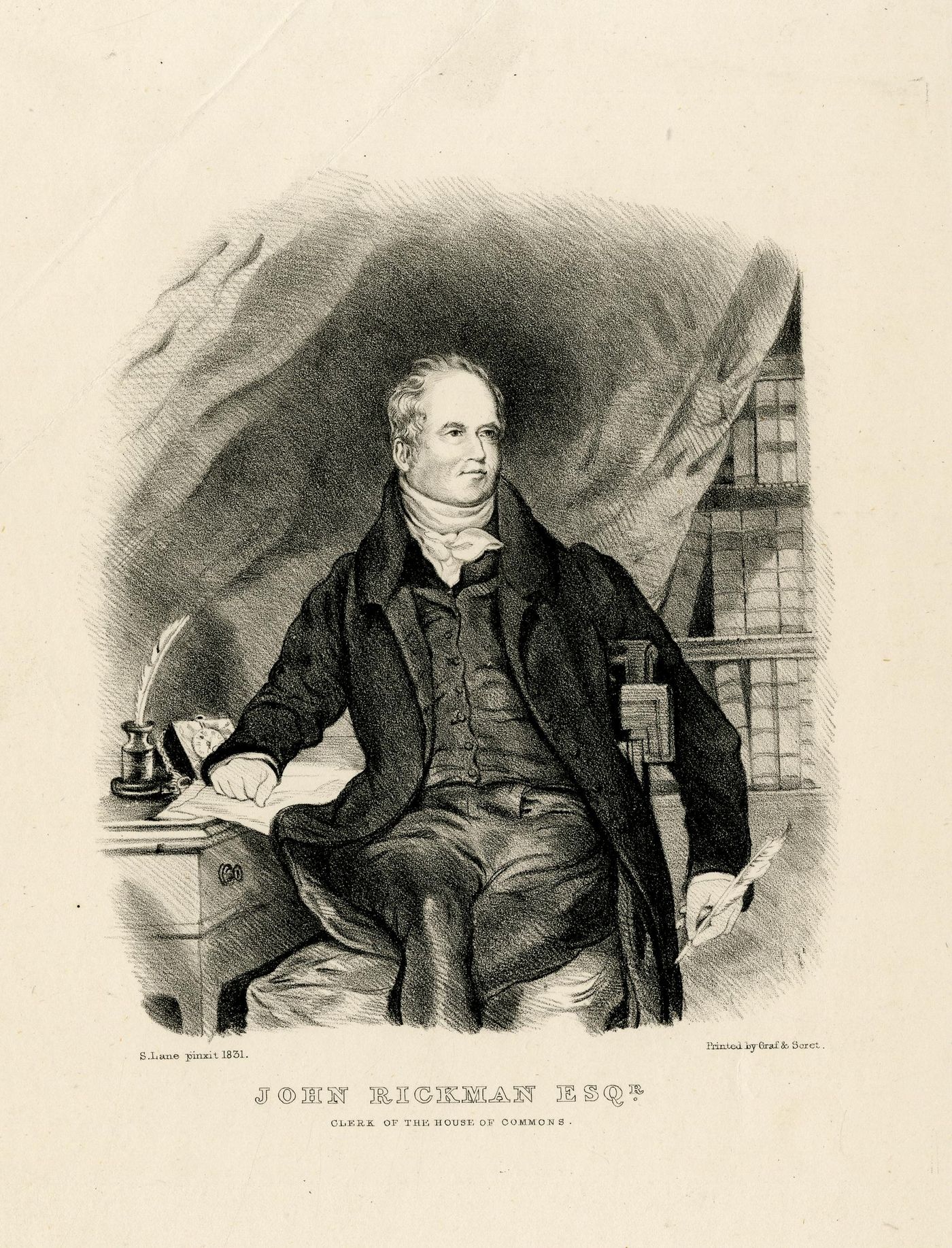
That same year, at Burton, a young man named John Rickman wrote a paper he called "Thoughts on the Utility and Facility of a general Enumeration of the People of the British Empire." His biographer found it dry. It set out the economic advantages of a count, pointed to "the probability of its being far higher than the usual estimate," and explained how easily it could be made. George Rose, the member of Parliament for Christchurch, passed the paper to Charles Abbot, "the future Speaker, who was also interested in the subject."[17] Nothing came of it for four years.
A Melancholy Hue
In 1798 J. Johnson of St. Paul's Churchyard published An Essay on the Principle of Population, as It Affects the Future Improvement of Society, with Remarks on the Speculations of Mr. Godwin, M. Condorcet, and Other Writers. It carried no author's name. Its preface, dated June 7, 1798, said the essay "owes its origin to a conversation with a friend" about an essay by William Godwin. The preface also conceded that "the view which he has given of human life has a melancholy hue."[18] The author was Thomas Robert Malthus, born in Surrey in 1766 and a fellow of Jesus College, Cambridge.[19]
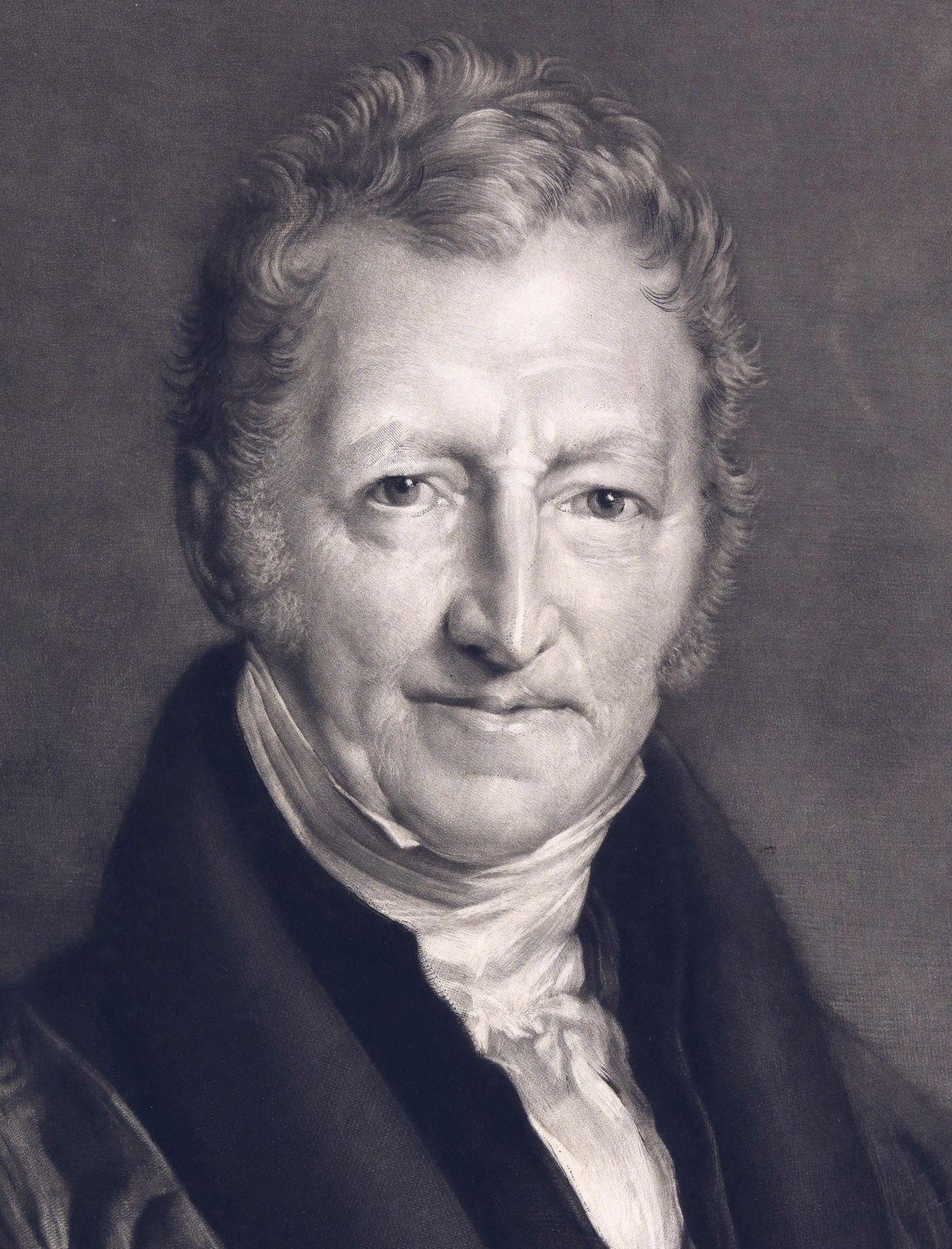
Malthus put the argument in two sentences. "Population, when unchecked, increases in a geometrical ratio. Subsistence increases only in an arithmetical ratio." For the first he needed proof, which he found in the United States, "where the means of subsistence have been more ample, the manners of the people more pure, and consequently the checks to early marriages fewer, than in any of the modern states of Europe." There, he wrote, "the population has been found to double itself in twenty-five years."[20]
His American figures did not come from the American census. Malthus wrote that New England had grown from 21,200 settlers in 1643 to half a million by 1760, and that "the population of the thirteen American States before the war was reckoned at about three millions." He took the numbers, he explained, "from Dr Price's two volumes of Observations," not having by him the pamphlet by Ezra Stiles from which Price had quoted them.[21] The book that made population the great question of the age rested its American case on the colonial estimates of the man who believed England was emptying.
Malthus did not accept Price's claim about England either. "It is difficult," he wrote, "to conceive that the population of England has been declining since the Revolution," although "every testimony concurs to prove that its increase, if it has increased, has been very slow." On the arguments alone, he judged that "Dr Price's point is nearer being proved than Mr Howlett's."[22] On Pitt's poor bill he had changed his mind. He confessed that he had once thought its allowance of a shilling a week for every child above three "would be highly beneficial," but further reflection convinced him that it would only divide the same produce among more people. The poor laws, he argued, tempted men to marry without the means to keep a family, and "dependent poverty ought to be held disgraceful."[23]
According to his friend William Otter, the book "was received with some surprise, and excited considerable attention, and while the minds of the generality were in suspense, the author left the country in search of materials to complete it."[24]
Bark Bread in Sweden
In 1799 Malthus sailed for Hamburg with three other members of his college. The party split up in Sweden, and Malthus and Otter continued at a leisurely pace through Sweden, Norway, Finland, and part of Russia, "these being the only countries at the time open to English travellers."[25] In the Swedish province of Värmland, beside the Norwegian border, a drought had brought something close to famine. In July, Malthus wrote, the people there were reduced to "two most miserable substitutes for bread," one made "of the inner bark of the fir" and the other "of the common sorrel dried, and powdered."[26]
He came home to a dearth in England. The harvest of 1799 was bad, and wheat rose almost at once to twenty pounds a load. When he "returned from the North in the beginning of November," he judged that the price was already high enough and would not rise much further. "In this conjecture," he later admitted, "it appears that I was much mistaken." In 1800 he published An Investigation of the Cause of the Present High Price of Provisions, signed only "by the author of the Essay on the Principle of Population." He blamed "the attempt in most parts of the kingdom to increase the parish allowances in proportion to the price of corn." The poor rates in many parishes, he wrote, rose "from four shillings in the pound to twelve," and the price of wheat kept pace until it stood at "nearly forty pounds a load." Without the allowances, he thought, it "would not have exceeded twenty or twenty-five."[27] More money in the hands of the poor, without more bread for them to buy, could only bid the price higher.
Neither Malthus nor anyone else could say how many mouths the harvest had to feed.
Certainty for Conjecture
The king's speech opening a new session of Parliament in November 1800 urged the members to provide against the scarcity. On November 19, Charles Abbot rose in the Commons to ask leave to bring in a bill "to ascertain the population of Great Britain." The knowledge would serve, he said, "so many important purposes of wise legislation and good government." It was "matter of surprise and astonishment, that a great, powerful, and enlightened nation like this should have remained hitherto unacquainted with the state of its population." When the subsistence of the people was in question, he said, "this knowledge becomes of the highest importance."[28]
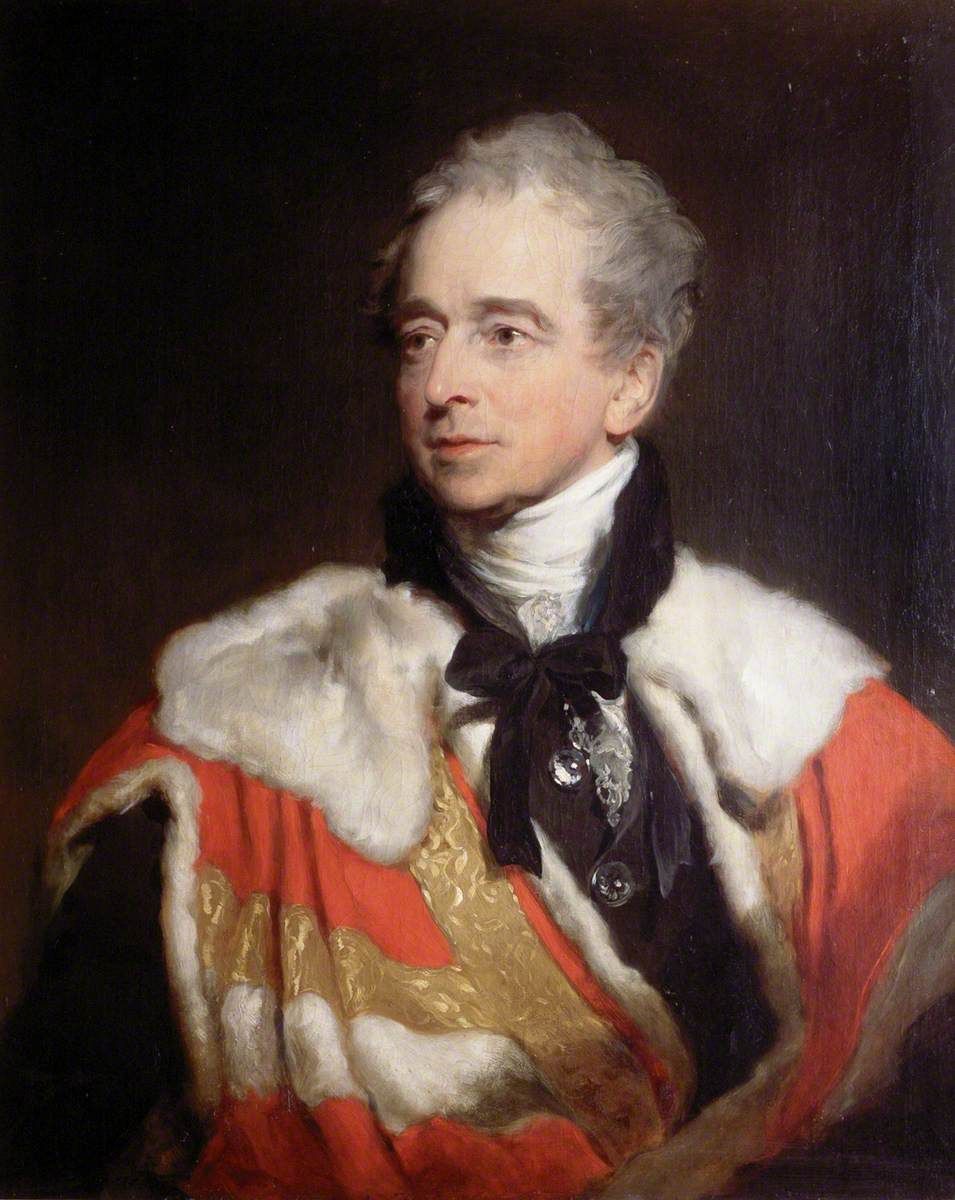
Abbot laid out the confusion. England's people had been estimated from subsidy rolls, bishops' returns, musters, and parish registers. "Some desponding men," he said, in words that fit Price, "have asserted that the population afterwards decreased by a million and a half between the Revolution and the peace of Paris in 1763." The best modern opinions still put England's present numbers anywhere from eight million to eleven million. Other nations had done better. Sweden had required a count since 1749, and Spain had taken a complete census in 1768 and again in 1787. The Americans had counted "in 1791" (it was in fact 1790) and had "again directed the same process to be carried into execution upon a still more extensive plan." Britain, he said, should "do as other great nations have done, and substitute certainty for conjecture."[29]
William Wilberforce seconded the motion, and leave was given.[30] Sir Frederick Morton Eden, whose State of the Poor had appeared three years earlier, published An Estimate of the Number of Inhabitants in Great Britain and Ireland while the bill was before Parliament. "The proposed enumeration of the people," he wrote, "will supersede the use of ingenious guesses and plausible speculations." He trusted that it would "prove, beyond the possibility of doubt, that, among the distresses of the times, we have not to deplore a declining population."[31]
That Part of Great Britain Called England
The Commons passed Abbot's bill on December 5 and sent it to the Lords. It came back on December 18 with a long list of amendments. Line after line, the Lords had inserted "that Part of" before "Great Britain" and "called England" after it, struck out the Scottish stewartries, and rewritten the title to match. The Lords' version would have counted England alone.[32]
The Commons would not have it. On December 19 the House put off the Lords' amendments until December 31 and gave Abbot leave to bring in a new bill "for taking an Account of the Population of Great Britain, and of the Increase or Diminution thereof." He presented it the same day. It passed its third reading on December 22 and went through the Lords without amendment. On December 31, 1800, it received the royal assent.[33]
Two of the other acts that received the royal assent that day show why it was needed. One forbade millers to dress wheat into fine flour and bakers to make bread from fine wheaten flour alone. Another banned the sale of any bread that had not been baked for twenty-four hours.[34] On the last day of the eighteenth century, Parliament ordered the people counted on the same day it told them what bread they could eat.
The Tenth Day of March
The schedules went out through the county magistrates. In England the high constables collected them at the quarter sessions in January 1801 and handed one to the minister and one to an overseer of the poor in every parish. On "the tenth Day of March" 1801, the overseers were to count every person "at that Time being within the Limits" of the parish. They could call on the churchwardens and the constables for help, and they could go "together or separately from House to House, or otherwise." Anyone who refused to answer their questions, or answered falsely, forfeited between forty shillings and five pounds. In Scotland the sheriffs and justices appointed the counters.[35] The parish clergy had questions of their own to answer from their registers. They reported baptisms and burials for every tenth year from 1700 and for every year since 1780, and marriages since 1754.[36]
Abbot offered the supervision of the returns to John Rickman, the author of the 1796 paper, who was given an office in the Cockpit and authority to choose his own clerks.[37] The abstract of the returns for England and Wales was ordered printed on December 21, 1801. Its summary listed 8,331,434 people in England, 541,546 in Wales, and 1,599,068 in Scotland. With the army and militia, the navy, the seamen in registered shipping, and the convicts on the hulks, Great Britain came to 10,942,646. The abstract added that the true total must be higher, because some parishes had sent no return.[38]
Price had put England and Wales at short of five million. The overseers found 8,872,980. More than thirty years later Rickman recalled that the result was "adverse to the opinions of those who had taken a gloomy view of national resources," and that "insinuations were not wanting against the accuracy of the enumeration."[39]
But the guessing was over. The United States, whose Congress had met in 1789 without enough members to do business, had by then counted its people twice. Britain had done it once, and found itself nearly twice the size its most famous pessimist had said it was.
Places in this Story
The places this story moves through, in order — follow them on the interactive map →
- Bunhill Fields, London February 1791
Richard Price, who said England was shrinking, caught his last illness at a friend's burial here.
- Federal Hall, New York February 2, 1790
Madison urged the House to count Americans by occupation so it could rest its arguments on facts.
- Philadelphia, Pennsylvania July 28, 1791
Washington admitted the count would hardly reach four million and blamed religious scruples, fear of a tax, and negligence.
- St. Paul's Churchyard, London June 7, 1798
J. Johnson published the anonymous Essay on the Principle of Population.
- Värmland, Sweden July 1799
Malthus found villagers eating bread made of fir bark and dried sorrel.
- Palace of Westminster, London November 19, 1800
Charles Abbot asked the Commons to count the people of Great Britain.
- The Cockpit, Whitehall, London 1801
John Rickman and his clerks turned the parish returns into the first abstract.
Frequently Asked Questions
When was the first census taken in Britain?
Britain's first census was taken on March 10, 1801, under a Population Act that received the royal assent on December 31, 1800. Overseers of the poor counted the people of every parish in England and Wales, and appointed counters did the same in Scotland.
Who proposed the British census of 1801?
Charles Abbot, later Speaker of the House of Commons, moved the bill on November 19, 1800, urging members to substitute certainty for conjecture. John Rickman's 1796 paper arguing for a general enumeration had reached him through George Rose.
What was the population of Great Britain in 1801?
The first abstract counted 8,331,434 people in England, 541,546 in Wales, and 1,599,068 in Scotland. With the army, navy, registered seamen, and convicts, Great Britain came to 10,942,646.
Why did Richard Price think England's population was falling?
Tax office returns showed 952,734 houses in England and Wales in 1777, and Price allowed fewer than five people to each. He concluded that the population was short of five million and had fallen by nearly a quarter since 1688.
What did Malthus argue in his 1798 Essay on the Principle of Population?
He argued that population, when unchecked, increases in a geometrical ratio while subsistence increases only in an arithmetical ratio. His evidence for the first was America, where population was said to double every twenty-five years.
When was the first United States census taken?
The count began on August 2, 1790, under an act of March 1, 1790, because the Constitution required an enumeration to divide seats and direct taxes. Washington told Congress the population bordered on four million.
Did Malthus use the 1790 American census?
No. His 1798 Essay took its American figures from Richard Price's Observations, which relied on colonial estimates, and put the thirteen states before the Revolution at about three million.
Bibliography
Abstract of the Answers and Returns Made Pursuant to an Act, Passed in the Forty-first Year of His Majesty King George III, Intituled "An Act for Taking an Account of the Population of Great Britain." London, 1801. https://archive.org/details/10212900bsb
Debates and Proceedings in the Congress of the United States. Vols. 1 and 2. Washington: Gales and Seaton, 1834. https://archive.org/details/sim_united-states-congress-debates-and-proceedings_march-3-1789-march-3-1791_1
Eden, Frederick Morton. An Estimate of the Number of Inhabitants in Great Britain and Ireland. London: J. Wright, 1800. https://archive.org/details/bim_eighteenth-century_an-estimate-of-the-numbe_eden-frederick-morton-_1800
Journals of the House of Commons. Vol. 55. London, 1800. https://archive.org/details/sim_great-britain-house-of-commons-journal_september-24-1799-december-31-1800_55
Malthus, Thomas Robert. An Essay on the Principle of Population, as It Affects the Future Improvement of Society. London: J. Johnson, 1798. https://www.gutenberg.org/ebooks/4239
Malthus, Thomas Robert. An Investigation of the Cause of the Present High Price of Provisions. 2nd ed. London: J. Johnson, 1800. https://archive.org/details/thomas-malthus-an-investigation-of-the-cause-of-the-present-high-price-of-provisions
Morgan, William. Memoirs of the Life of the Rev. Richard Price. London: R. Hunter, 1815. https://archive.org/details/memoirsliferevr01morggoog
Otter, William. "Memoir of Robert Malthus." In T. R. Malthus, Principles of Political Economy. 2nd ed. London: William Pickering, 1836. https://archive.org/details/principlesofpoli00malt
The Parliamentary History of England. Vols. 32 and 35. London: T. C. Hansard, 1818-19. https://archive.org/details/10279143bsb
Price, Richard. An Essay on the Population of England, from the Revolution to the Present Time. 2nd ed. London: T. Cadell, 1780. https://archive.org/details/bim_eighteenth-century_an-essay-on-the-populati_price-richard-dd_1780
Return of the Whole Number of Persons within the Several Districts of the United States. Philadelphia: Childs and Swaine, 1791. https://archive.org/details/returnofwholenum00unitrich
The Statutes at Large, from the Thirty-ninth Year of the Reign of King George the Third. Vol. 14. London, 1801. https://archive.org/details/bim_eighteenth-century_the-statutes-at-large-f_great-britain_1800_14
Washington, George. The Writings of George Washington. Edited by John C. Fitzpatrick. Vol. 31. Washington: Government Printing Office, 1939. https://archive.org/details/writingsofgeorge31wash
Williams, Orlando. Life and Letters of John Rickman. London: Constable, 1912. https://archive.org/details/lifelettersofjoh00willuoft
Citations
- Debates and Proceedings in the Congress of the United States [Annals of Congress], vol. 1 (Washington: Gales and Seaton, 1834), 99-100. ↑
- Constitution of the United States, art. 1, sec. 2. ↑
- Richard Price, An Essay on the Population of England, from the Revolution to the Present Time, 2nd ed. (London: T. Cadell, 1780), 14. ↑
- Price, Essay on the Population of England, 18, 29-30. ↑
- William Morgan, Memoirs of the Life of the Rev. Richard Price (London: R. Hunter, 1815), 46. ↑
- Frederick Morton Eden, An Estimate of the Number of Inhabitants in Great Britain and Ireland (London: J. Wright, 1800), 1-2; T. R. Malthus, An Essay on the Principle of Population (London: J. Johnson, 1798), chap. 16. ↑
- Morgan, Memoirs of the Life of the Rev. Richard Price, 174-78. ↑
- Annals of Congress, 1:1115. ↑
- Annals of Congress, 1:1143-47. ↑
- "An Act providing for the enumeration of the inhabitants of the United States," March 1, 1790, in Annals of Congress, vol. 2 (Washington: Gales and Seaton, 1834), appendix, 2202-6. ↑
- George Washington to Gouverneur Morris, December 17, 1790, in The Writings of George Washington, ed. John C. Fitzpatrick, vol. 31 (Washington: Government Printing Office, 1939), 174. ↑
- Washington to Morris, July 28, 1791, in Writings of George Washington, 31:328-29. ↑
- Washington, Third Annual Address to Congress, October 25, 1791, in Writings of George Washington, 31:399-400. ↑
- Return of the Whole Number of Persons within the Several Districts of the United States (Philadelphia: Childs and Swaine, 1791). ↑
- The Parliamentary History of England, vol. 32 (London: T. C. Hansard, 1818), 687-95. ↑
- Parliamentary History, 32:700-711. ↑
- Orlando Williams, Life and Letters of John Rickman (London: Constable, 1912), 39-40. ↑
- [T. R. Malthus], An Essay on the Principle of Population, as It Affects the Future Improvement of Society (London: J. Johnson, 1798), preface. ↑
- William Otter, "Memoir of Robert Malthus," in T. R. Malthus, Principles of Political Economy, 2nd ed. (London: William Pickering, 1836), xx-xxi, xxvi-xxvii, xxxv. ↑
- Malthus, Essay on the Principle of Population (1798), chaps. 1-2. ↑
- Malthus, Essay on the Principle of Population (1798), chap. 6. ↑
- Malthus, Essay on the Principle of Population (1798), chap. 16. ↑
- Malthus, Essay on the Principle of Population (1798), chaps. 5 and 7. ↑
- Otter, "Memoir of Robert Malthus," xxxvi. ↑
- Otter, "Memoir of Robert Malthus," xxxvi-xxxvii. ↑
- [T. R. Malthus], An Investigation of the Cause of the Present High Price of Provisions, 2nd ed. (London: J. Johnson, 1800), 1-3. ↑
- Malthus, Investigation of the Cause of the Present High Price of Provisions, 3-12. ↑
- The Parliamentary History of England, vol. 35 (London: T. C. Hansard, 1819), 597-99. ↑
- Parliamentary History, 35:599-601. ↑
- Parliamentary History, 35:601; Journals of the House of Commons, vol. 55 (London, 1800), 870-71. ↑
- Eden, Estimate of the Number of Inhabitants, 1-4. ↑
- Journals of the House of Commons, 55:893, 913-16. ↑
- Journals of the House of Commons, 55:916-17, 924, 926, 928-29. ↑
- Journals of the House of Commons, 55:928-29; 41 Geo. III, c. 16, in The Statutes at Large, from the Thirty-ninth Year of the Reign of King George the Third, vol. 14 (London, 1801), 568-69. ↑
- "An Act for taking an Account of the Population of Great Britain, and of the Increase or Diminution thereof," 41 Geo. III, c. 15 (December 31, 1800), secs. 1-3, in Statutes at Large, 14:560-62. ↑
- Abstract of the Answers and Returns Made Pursuant to an Act, Passed in the Forty-first Year of His Majesty King George III, Enumeration, Part 1, England and Wales (London, 1801), schedule of questions. ↑
- Williams, Life and Letters of John Rickman, 40. ↑
- Abstract of the Answers and Returns, Enumeration, summary and observations. ↑
- Williams, Life and Letters of John Rickman, 42, quoting Rickman's preface to the population abstract of 1833. ↑