On the afternoon of August 24, 1814, the household staff of the President's House in Washington went about their work as though the day might still end normally. Dolley Madison had ordered dinner for three o'clock, as usual, and the enslaved and free servants of the house were preparing it. Among them was Paul Jennings, an enslaved teenager of about fifteen, born on the Madisons' Virginia plantation, who many years later wrote down what he saw that day.[1] The meal was never served to the people it was meant for. A few miles northeast of the city, at the village of Bladensburg, a British force was scattering the Americans sent to stop it, and by midafternoon a messenger had reached the house with word that Dolley Madison must leave at once. British troops arrived at about eleven that night and found the house deserted, its furnishings and food still in place. One officer, James Scott, later remembered that no nectar had ever tasted better than the Madeira he drank "at Madison's expense."[2] George Robert Gleig, a young officer who took part in the expedition, recalled in a narrative published in 1821 that the soldiers found the dining table laid for a large party and sat down to the meal before setting the building on fire.[3] The house had been occupied for less than fourteen years.
Almost from the start, the house and the city around it had served as a stage for ideas about what republican government should look like. When Congress assembled in December 1801, Thomas Jefferson broke with the example of George Washington and John Adams, who had delivered their annual messages in person. On December 8 he sent his message to Congress in writing instead. Some historians believe he thought a president addressing the legislature too closely resembled a British monarch opening Parliament, though other explanations have been offered.[4] Presidents followed his example until Woodrow Wilson revived the spoken address in 1913. A few weeks later, on New Year's Day 1802, a delegation led by the Baptist preacher John Leland formally presented Jefferson with a cheese of more than 1,200 pounds from Cheshire, Massachusetts. It was engraved with a motto Jefferson himself used on his personal seal. Because Jefferson's policy was not to accept gifts in office, he paid Leland $200 for it on January 4.[5] The same day, he wrote to the Baptists of Danbury, Connecticut, that the First Amendment had built "a wall of separation between Church & State."[6]
Washington had been created to embody the new republic, but the reality never matched the symbol, and two tensions ran through the next twelve years. Jefferson stripped away monarchical ceremony, yet under the Madisons the same house became the center of an elaborate political society. And a capital meant to express the permanence of the Union remained unfinished, politically dependent, and badly exposed to attack. Both converged on August 24, 1814. The fire tested whether the experiment of a purpose-built capital would survive, and the final answer came not from the British but from Congress, which had to decide, amid the ruins, whether to stay. This is the story of those twelve years.
A Capital on Paper
In the spring of 1802, Washington was a capital more in plan than in fact. The federal government had moved there from Philadelphia at the end of 1800, into a city whose grand avenues existed mostly as surveyors' lines through fields and woods. It was less an established city than a federal outpost set down in a rural landscape, its monumental plan far ahead of the town that was supposed to fill it. The President's House stood more than a mile west of the Capitol along Pennsylvania Avenue, with scattered boardinghouses and taverns in between. The city had no municipal government of its own. Presidentially appointed commissioners handled the sale of lots and the construction of public buildings, but the city had little capacity of its own for paving streets or keeping order.
That changed on May 3, 1802, when Congress passed an act incorporating the City of Washington. The law provided for an elected council but gave the president the power to appoint the mayor each year.[7] Jefferson acted within a month. On June 3 he wrote to Robert Brent, a local justice of the peace who had married into the family of Notley Young, one of the original owners of the land on which the city was laid out. Jefferson asked whether Brent would accept the appointment and invited him to dine at the President's House two days later. Brent answered the same day. He admitted doubts about his fitness for the work but accepted out of a sense of public duty.[8] The office carried no salary, and Brent soon wanted out of it. In May 1809 he told the new president, James Madison, that he could not serve again. Madison reappointed him anyway, and he served until 1812, when the office became elective.[9]
The arrangement showed where power lay. Washington's residents could elect a council, but the man who ran their city served at the pleasure of the president, and the city's economy depended heavily on the federal presence. Growth was steady but modest. The census of 1810 counted 8,208 people in the City of Washington, far fewer than in nearby Baltimore.[10]
Mr. Jefferson's Household
Jefferson had lived in the President's House since March 1801, and for his first years there he shared it with his private secretary, a young army captain from Virginia named Meriwether Lewis. The great audience room at the east end of the house, today's East Room, was still unfinished, and workmen put up wood-framed partitions of sailcloth at its south end to give Lewis an office and a bedroom. Jefferson wrote to one of his daughters that he and Lewis lived in the enormous house "like two mice in a church."[11] Lewis left in 1803 to prepare for the western expedition that would make his name.
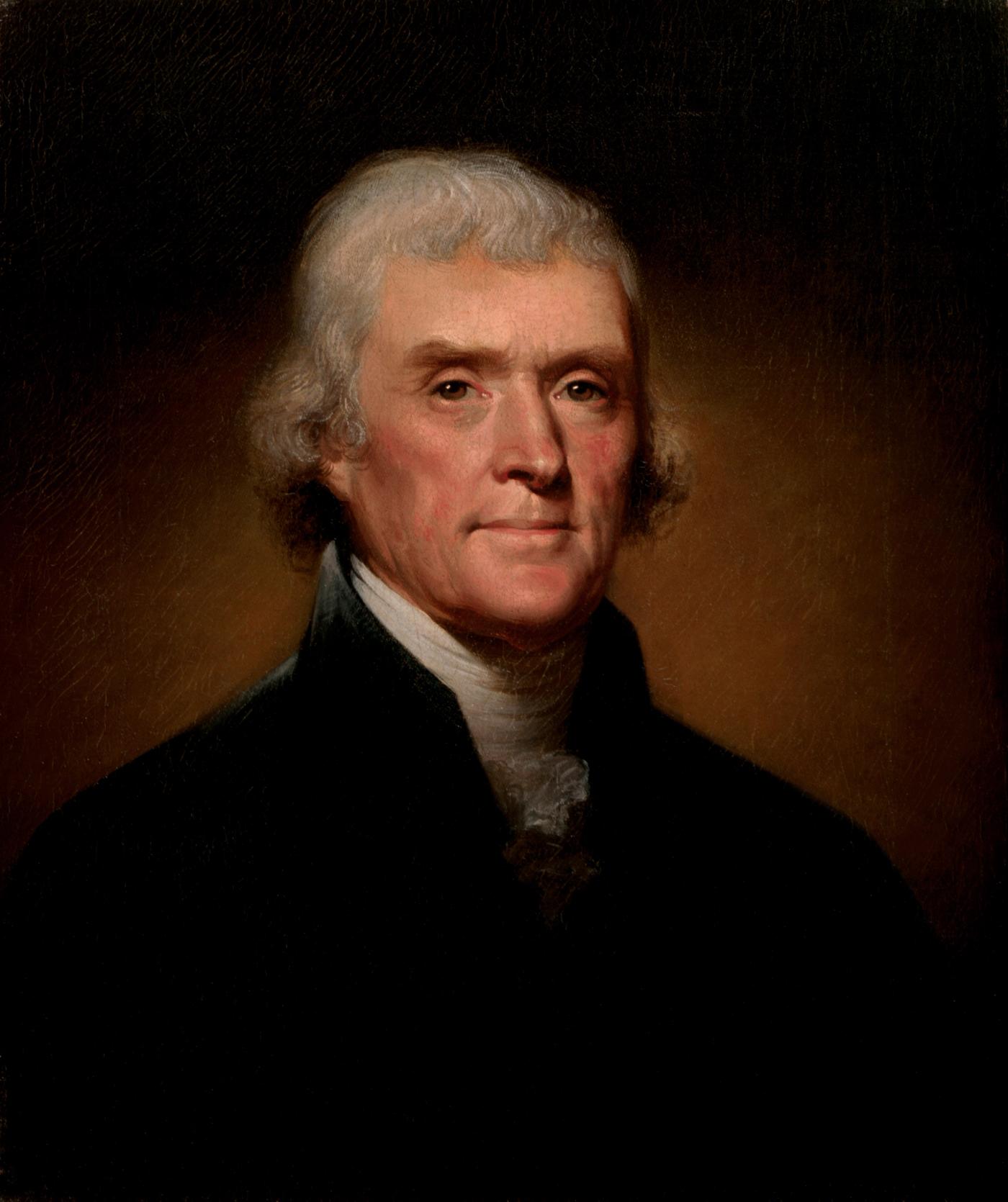
Jefferson used the house to reject the ceremony of European monarchies. He usually entertained about a dozen guests at a time, used a round table to discourage any sense of rank, and kept servants out of the room during the meal so that talk could flow freely.[12] He did away with formal toasts, and under the practice that became known as "pell-mell," guests went in to dinner as they happened to arrive rather than in order of precedence. Jefferson put the principle in writing, declaring that at public ceremonies foreign ministers and their families would take their places with other guests, without any order of rank. The British minister Anthony Merry, who arrived in late 1803, presented himself for his first audience in full diplomatic uniform and was received by a president in "slippers down at the heels." Merry took it as an insult to himself and his king.[13] Denied his accustomed precedence at dinner, he withdrew from official society, but Jefferson did not give way. In society, he insisted, all were equal, regardless of nationality, title, or office.[14]
Slavery was an ordinary, legal part of life in the capital. The District had been carved from Maryland and Virginia, both slaveholding states, and the census of 1800 counted 3,244 enslaved people within it.[15] Jefferson and Madison, like much of Virginia's governing class, were slaveholders. The institution was not beyond debate even then: in March 1807 Jefferson signed the law ending the importation of enslaved Africans into the United States as of January 1, 1808.[16]
To run the house, Jefferson combined hired French staff with servants brought from Monticello. He engaged the chef Honoré Julien and the maître d'hôtel Étienne Lemaire, and in the fall of 1802 he brought a fifteen-year-old enslaved girl, Edith Hern Fossett, to train under Julien in the President's House kitchen. Her sister-in-law, Frances Gillette Hern, known as Fanny, joined her in 1806. The free staff drew wages; the two young women received a customary gratuity of two dollars a month. Working at an open hearth, they turned out French-style meals for parties of ten to fourteen people and stayed until Jefferson left office in 1809.[17] Guests said that such dinners had never before been given in the President's House.
Jefferson's private life reached the newspapers in his second year in office. On September 1, 1802, the Richmond Recorder published an article by the journalist James Thomson Callender under the title "The President, Again." Callender claimed that the president had for many years kept one of his own slaves, a woman named Sally, as his concubine, and that her eldest son resembled the president himself.[18] Callender had once been one of the Republicans' most useful partisan writers and had been jailed under the Sedition Act for attacking the Federalists. When Jefferson did not reward him with an office such as the postmastership of Richmond, he felt betrayed and turned on his former patron.[19] Jefferson was at Monticello when the story broke, and no written response from him to the charge has been found.[20]
Federalist papers repeated the story for the rest of his presidency, and historians debated it for nearly two centuries. A 1998 DNA study linked the Jefferson male line to a descendant of Sally Hemings's youngest son, Eston,[21] and in 2000 a committee of the Thomas Jefferson Foundation concluded that Jefferson was very likely the father of her children, a finding another committee disputed.[22] Genomic research announced in September 2026 added considerably stronger evidence,[23] though its scientific paper had not completed peer review when the results were released.[24]
Latrobe and the Public Buildings
While Jefferson set the tone inside the house, he also tried to give the capital buildings that were worthy of its ambitions. In March 1803 he hired the English-born architect and engineer Benjamin Henry Latrobe as Surveyor of the Public Buildings. His principal task was the Capitol's south wing, for the House of Representatives, but he was also responsible for work at the President's House and the Navy Yard.
At the President's House, Latrobe repaired a badly leaking roof, installed a grand staircase, solved a drainage problem, built water closets, landscaped the grounds, and worked with Jefferson on classical east and west colonnades, from which the present wings of the White House descend.[25] The work involved constant negotiation with a president who had strong architectural opinions of his own. In May 1805 Latrobe complained to the clerk of works, John Lenthall, that Jefferson's fondness for old French architecture books was cramping his designs. Jefferson opened one of Latrobe's letters to Lenthall by mistake, and explained that he had stopped reading when he saw whom it was meant for.[26] The Capitol absorbed most of his energy. The south wing was completed in 1807, and Latrobe then began reconstructing the interior of the older north wing. After 1810, Congress withheld further construction funds, and by July 1811 Latrobe's employment had ended. He would return in 1815 to rebuild the Capitol after the British burned it.[27] When war came, the Capitol consisted only of its two wings, connected by a wooden walkway across the space intended for the central building. The capital's public buildings increasingly projected permanence while the city around them remained unfinished.
Mrs. Madison's Drawing Rooms
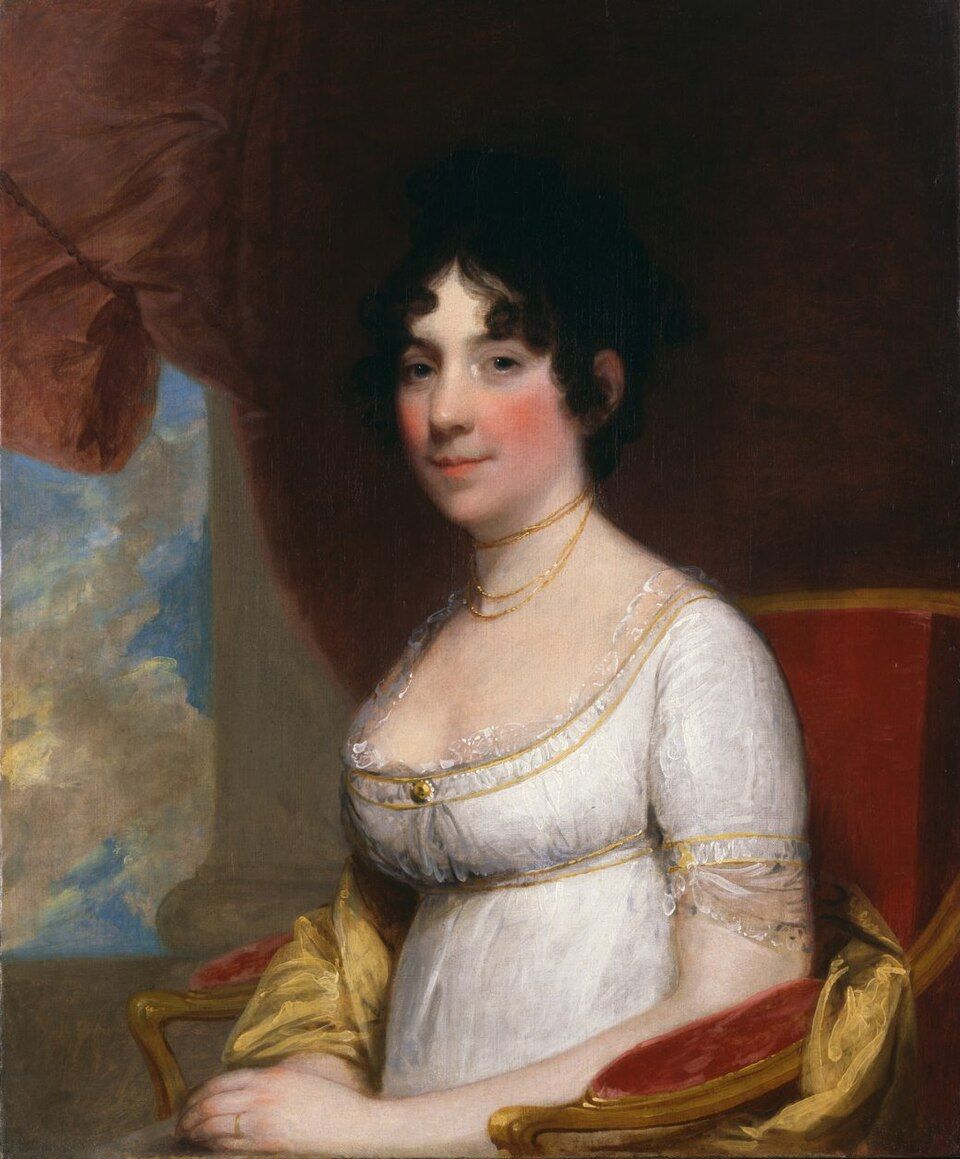
James Madison succeeded Jefferson in March 1809. Jefferson had made the house republican by stripping away royal ceremony. Dolley Madison made it republican in a different way, by opening it to the political society of the capital. Jefferson, a widower, had often relied on his daughters to act as hostess. Now the house had a mistress of its own. Finding it furnished with worn pieces from earlier administrations, Dolley Madison engaged Latrobe to refurbish the principal rooms of the state floor, and he designed furniture specifically for the large oval room at the center of the south side.[28] For that room she preferred bold red velvet draperies, and Latrobe produced a suite of Grecian-inspired chairs and sofas with crimson cushions.[29]
On May 31, 1809, she held the first of the weekly Wednesday evening receptions known as her "drawing rooms," and the finished oval room was ready for the president's New Year's Day reception in 1810.[30] The historian Catherine Allgor has argued that in a young capital with little established society and few formal channels for political business, the social world that women like Dolley Madison built became an essential part of how the government actually worked.[31] Members of Congress, cabinet officers, and diplomats met on neutral ground in her rooms, and her hospitality built goodwill for her husband's administration. The house was also where Madison conducted the business of a growing nation. On October 27, 1810, after American settlers in Spanish West Florida had rebelled against Spanish rule, he signed a proclamation in Washington ordering the United States to take possession of the territory between the Mississippi and Perdido Rivers.
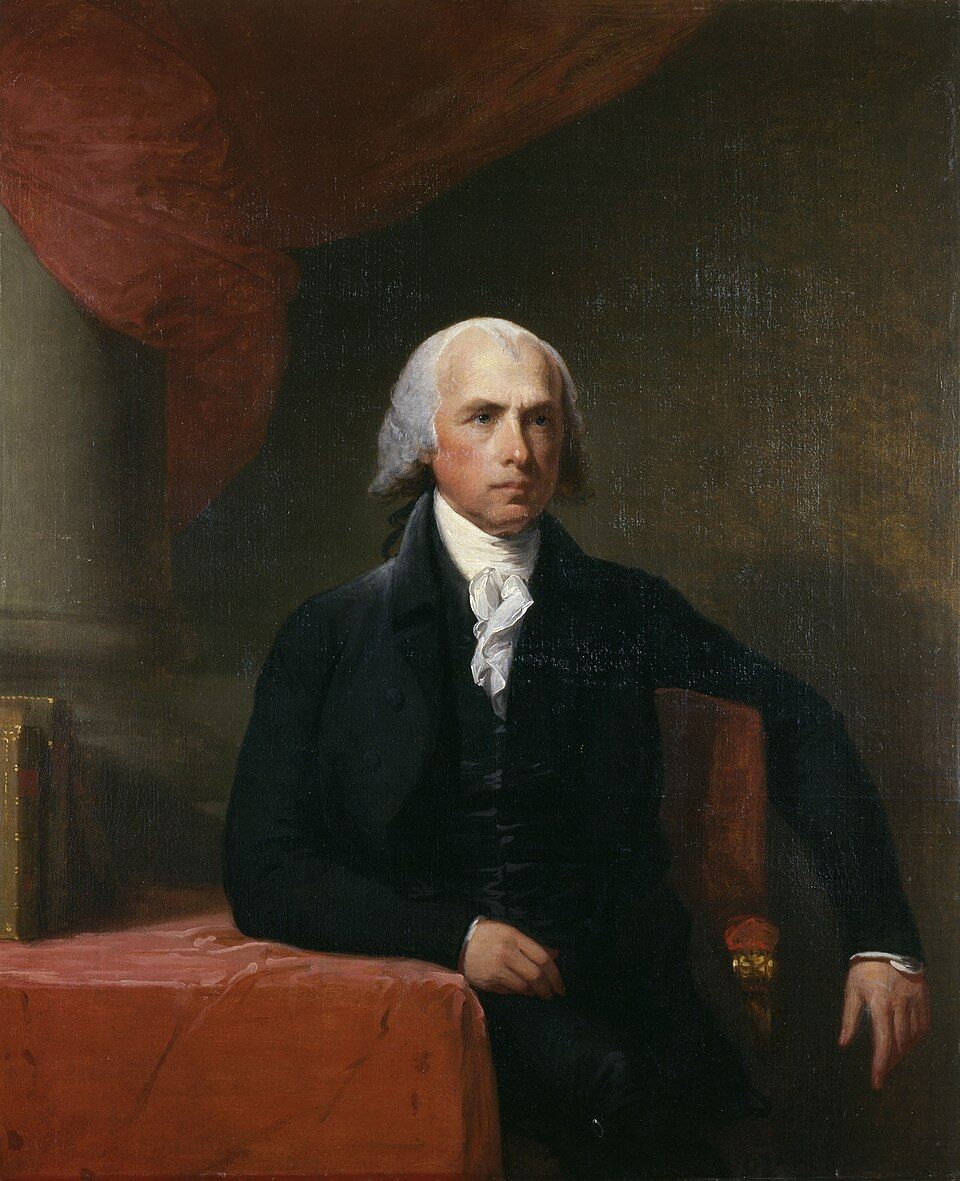
The Madisons' household staff mixed paid employees and enslaved servants. Paul Jennings, born into slavery at Montpelier in 1799, served James Madison as a personal attendant. Looking back half a century later, Jennings called Madison "one of the best men that ever lived" and wrote that he never saw Madison strike any of the more than one hundred people he enslaved, nor allow an overseer to do so. Jennings remained enslaved until after Madison's death, when he bought his freedom from Dolley Madison with $120 advanced by Daniel Webster.[32] John Freeman, a footman who had served in the President's House under Jefferson, remained part of the household, and several paid employees were French immigrants, among them the doorkeeper Jean Pierre Sioussat.[33]
The War Comes Up the Chesapeake
After the United States declared war on Great Britain in June 1812, the fighting stayed far from the capital for two years. That began to change in April 1813, when Rear Admiral George Cockburn began a campaign of lightning raids around the Chesapeake Bay. Still, Britain's main strength remained tied up in Europe fighting Napoleon.
The strategic balance around Washington shifted in the spring of 1814. At the end of March, word arrived that allied armies had invaded France, raising the prospect of Napoleon's defeat. Since December 1813 an American embargo had kept the country's ships in port, a measure that had grown unpopular at home. On March 31 Madison abruptly asked Congress to loosen the restrictions, and the House and Senate voted for repeal within two weeks.[34] Madison signed it on April 14. Two days later he signed a law authorizing four captains and twelve lieutenants for a flotilla of gunboats to contest the shallow waters of the Chesapeake with the Royal Navy.[35]
Britain was preparing for a new phase of the war. On April 2, from Bermuda, Vice Admiral Sir Alexander Cochrane issued a proclamation addressed to Americans who wished to leave the United States, and it was aimed squarely at the enslaved. It offered them service in the British army or navy, or passage as free settlers to British territory in North America or the West Indies. Men who escaped to British ships formed a unit called the Colonial Marines, which fought alongside British forces in the Chesapeake that summer.[36] When Madison learned of the proclamation in May, he took it as a sign of deep British hostility toward the Southern states.[37]
On May 9, 1814, news reached Washington that Napoleon had abdicated. Britain was now free to send veteran troops and more ships to America, turning a distant coastal threat into a possible attack on the capital. Madison understood the danger. On May 20, writing from Montpelier, he warned his secretary of war, John Armstrong, to prepare for the worst the enemy could do, adding that "the Seat of Govt. can not fail to be a favorite" target.[38] Armstrong did not agree. He insisted that the British would go after Baltimore, a rich port and a base for privateers, rather than a small capital of little military value.[39]
On July 1, 1814, Madison called an emergency cabinet meeting at the President's House to discuss the defense of the city. He brought a written estimate of the forces that would be needed,[40] and the cabinet agreed that the president should ask Pennsylvania, Virginia, and Maryland to hold thousands of militia ready to march. Madison then placed Washington, Baltimore, and the surrounding region in a new Tenth Military District under Brigadier General William Winder. Maryland's governor, Levin Winder, was the general's uncle, but Baltimore, Annapolis, and the Maryland shore were as exposed as the capital, and he was reluctant to send his militia away to defend Washington.[41]
In July British raiders struck the town of St. Leonard and Leonardtown, Maryland, without meeting resistance. On July 18, Washington's mayor, James Blake, and the city council petitioned Madison to protest the lack of work on the city's defenses. According to the White House Historical Association, on July 28 an angry crowd gathered outside the President's House and warned that they would not let the president and his family flee the city. By the beginning of August, the capital's defenses remained fragmented and incomplete. The city lacked an effective system of outposts and messengers to track British movements, and little had been done to obstruct the roads and bridges leading into it.[42]
The Night of August 24
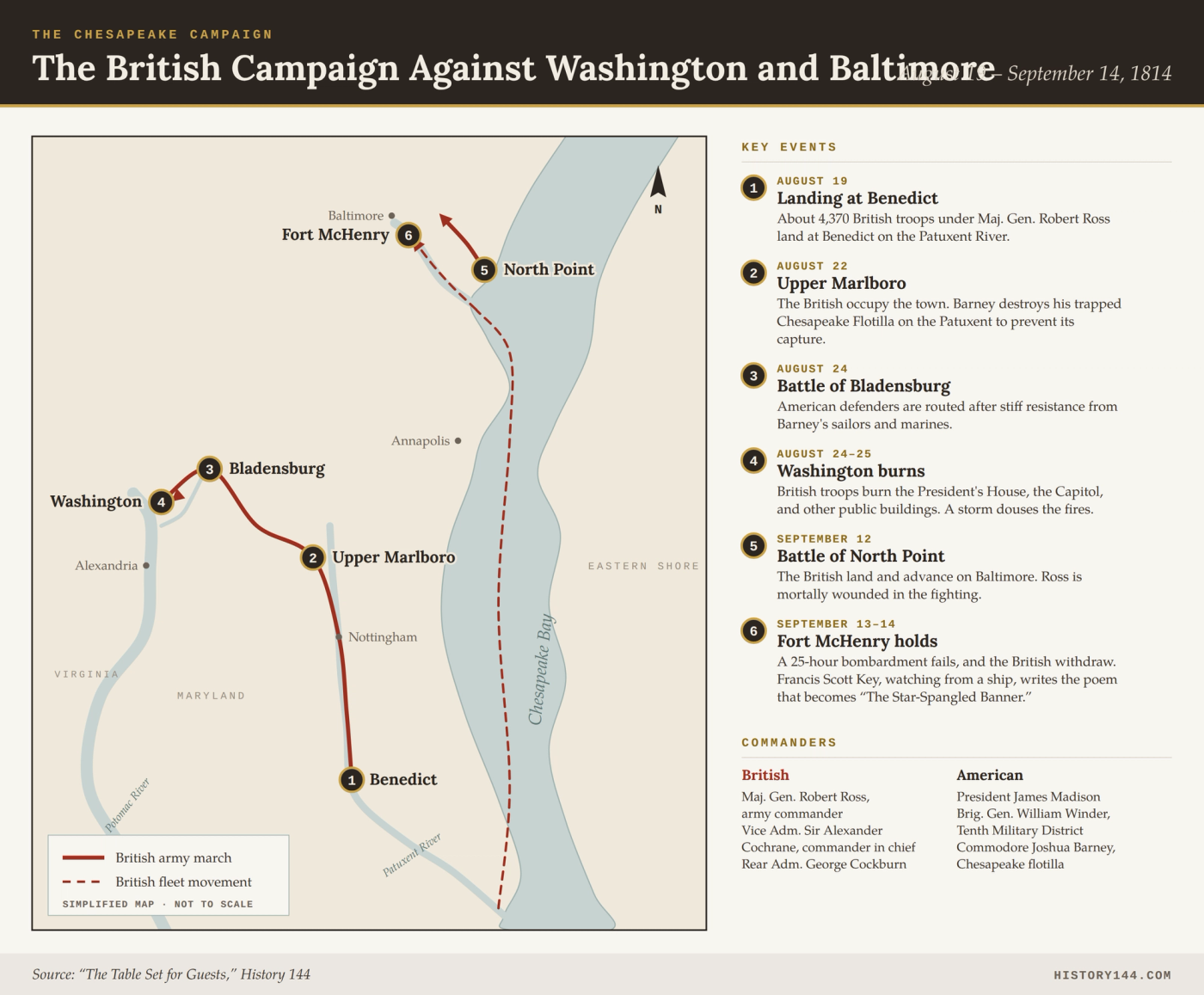
The British expedition arrived in mid-August. On August 19, a force of about 4,370 men under Major General Robert Ross landed at Benedict, Maryland, on the Patuxent River, roughly fifty miles southeast of the capital. Cockburn had persuaded Ross and Cochrane, now the naval commander, to strike Washington first.[43] On August 22, Commodore Joshua Barney destroyed the small American gunboat flotilla that had been trapped in the Patuxent to keep it out of British hands, and Secretary of State James Monroe, scouting the enemy's movements, sent Madison a note warning that the British were marching on Washington and advising him to "remoove the records."[44]
Dolley Madison spent August 23 packing cabinet papers into trunks. In a letter to one of her sisters, she wrote that she was ready to leave at a moment's warning but was determined not to go until she saw her husband safe.[45] That letter poses a problem for historians, because the original does not survive. Its text comes from excerpts she later shared with the writer Margaret Bayard Smith, and its dramatic tone has led researchers at Montpelier to caution that the surviving text may have been polished after the fact. Even the sister to whom it was addressed is named differently in different sources.[46]
On the morning of August 24, Madison rode out to the army and reached Bladensburg about noon. The battle that followed was a rout. The American defenders, mostly militia with smaller contingents of regulars and Joshua Barney's sailors and marines, gave way before a British force of roughly 4,500, and the Royal Marines' Congreve rockets, though inaccurate, spread disorder through the American lines. When defeat was clear, Madison sent James Smith, a free Black servant, back to the President's House to tell Mrs. Madison to leave. Smith arrived about three o'clock. When Madison himself reached the house about an hour later, his wife was gone. He declined food, took a glass of wine, and left the city.[47]
The most famous episode of the afternoon is also one of the most disputed. Before leaving, Dolley Madison insisted that the full-length portrait of George Washington in the dining room be saved. Stories soon circulated that she had cut the canvas from its frame with her own hands. Paul Jennings, writing many years later, rejected that story, saying she had no time for it, and credited Sioussat and the gardener with taking the picture down. Other accounts differ over who first proposed the rescue and who removed the painting.[48] The portrait itself provides important physical evidence. It shows no sign of having been cut from its stretcher, a detail consistent with Dolley Madison's own statement that she ordered the frame broken and the canvas taken out.[49] Jennings also recalled that John Freeman, by then the Madisons' butler, drove off in a carriage with his wife and child and a feather bed lashed on behind, and that apart from part of the silver and the portrait of Washington, that bed was all the furniture saved. Jennings had been sent to fetch a carriage from a stable on Fourteenth Street.[50]
The British set fire to the President's House, the Capitol, and other public buildings that night. The blaze destroyed Latrobe's state rooms along with every piece of furniture bought for presidential use since 1789,[51] and by morning the President's House was a roofless shell.[52] The next afternoon a violent storm, including a tornado, swept through the city, and heavy rain doused the fires. The British withdrew soon afterward.
Four Walls
The British occupation lasted barely a day, and Madison was back in the city by August 27.[53] Less than three weeks later the same British force was turned back at Baltimore. Ross was killed at North Point on September 12, and when a twenty-five-hour bombardment failed to subdue Fort McHenry, the British withdrew on September 14, ending their Chesapeake campaign.
The fire was not the final test. The Madisons never returned to the President's House, but they did not abandon the capital. On September 8 they moved into the Octagon, a private house a few blocks away, and on September 21 Dolley Madison held her first Wednesday reception there. Before long the crowds at the Octagon resembled those that had filled the President's House.[54] When Congress reconvened on September 19, it met in cramped quarters in the former Blodgett's Hotel, then home to the Patent Office and the only public building to have survived the attack. On September 26 the city of Philadelphia offered to house Congress.[55] That day in the House, Representative Jonathan Fisk of New York proposed a committee to consider moving the government somewhere safer and more convenient.[56]
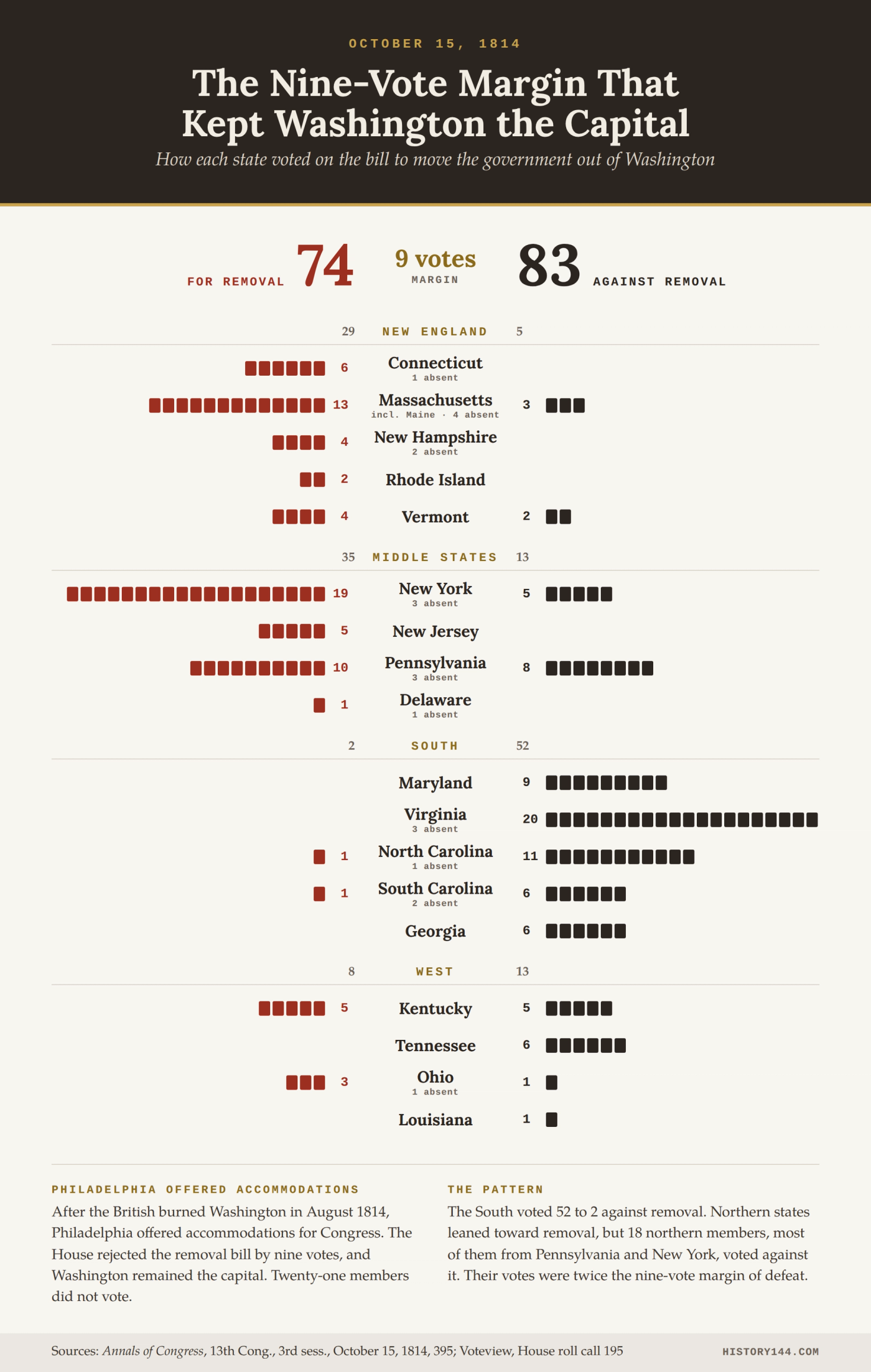
The debate that followed exposed the political weakness that had shadowed the capital since its founding. It was strongly sectional. Many northern members favored moving the government to Philadelphia or another established northern city, while southern members generally defended Washington. Washington's own residents, whose businesses and investments depended on the federal presence, had the most to lose, and they raised $25,000 to put up a temporary building where Congress could meet.[57] In October, by nine votes, 83 to 74, the House rejected the bill for the government's temporary removal, and Congress instead passed a separate bill providing for the rebuilding of Washington.[58] James Hoban, who had designed the original President's House, was ordered to rebuild it as it had been, and the work was finished in 1817. The war itself ended in a draw rather than a victory for either side. Negotiators signed a peace treaty at Ghent on Christmas Eve 1814 that restored the prewar boundaries. The Senate approved it unanimously on February 16, 1815, and Madison signed it at the Octagon.[59]
Seen from 1814, the twelve years after Jefferson offered Robert Brent the mayoralty look less like the steady rise of a capital than a long, uncertain experiment. Washington acquired a city government, an architect for its public buildings, a fashionable society, and a president's house that had become a symbol in its own right. It did not acquire the population, the wealth, or the defenses that would have made it safe, and the fire exposed all of that at once. The British could burn the symbols of the government, but they could not determine where the American government would sit. That decision belonged to Congress, and by nine votes, in a borrowed hotel, it chose to keep the experiment going. The dinner laid on the afternoon of August 24 was set for guests who never came. The house that burned that night was rebuilt on the same site for the presidents who came after.
Important Dates
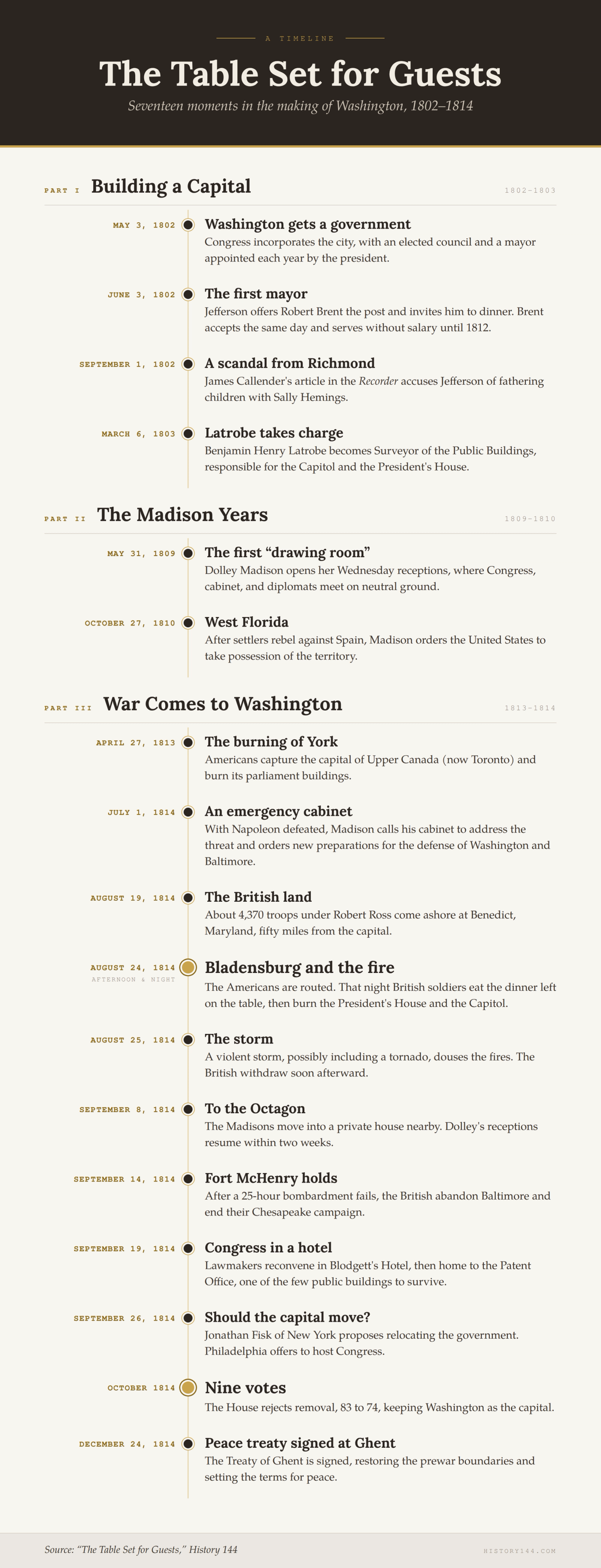
Congress passed an act incorporating the City of Washington, which gave the capital its first municipal government: an elected city council and a mayor appointed each year by the president.
Jefferson wrote to Robert Brent, a local justice of the peace, offering him the post of Washington's first mayor and inviting him to dine at the President's House two days later. Brent accepted the same day and went on to serve without salary until 1812.
The journalist James Thomson Callender, a former ally who turned on Jefferson after being denied a federal post, published an article in the Richmond Recorder claiming that the president had long kept an enslaved woman named Sally as his concubine and had children with her.
Jefferson hired the English-born architect Benjamin Henry Latrobe as Surveyor of the Public Buildings, putting him in charge of building the Capitol's south wing and repairing and improving the President's House.
Dolley Madison held the first of her Wednesday evening "drawing rooms" in the newly refurbished President's House, beginning weekly receptions where members of Congress, cabinet officers, and diplomats met on neutral social ground.
After American settlers in Spanish West Florida rebelled against Spanish rule, Madison signed a proclamation in Washington ordering the United States to take possession of the territory between the Mississippi and Perdido Rivers.
American forces captured York (now Toronto), the capital of Upper Canada. During the occupation that followed, they burned the colony's parliament buildings. The British later pointed to this when they burned Washington's public buildings in 1814.
Alarmed by Napoleon's defeat, which freed Britain to send veteran troops to America, Madison called an emergency cabinet meeting at the President's House, where he presented a written estimate of the forces needed to defend the capital.
British troops routed the American defenders at Bladensburg, entered Washington that night, ate the dinner left on the President's House table, and set fire to the house, the Capitol, and other public buildings.
After a 25-hour bombardment failed to subdue Fort McHenry, the British withdrew from Baltimore, ending their Chesapeake campaign. Their commander, Robert Ross, had been killed two days earlier at North Point.
With the Capitol in ruins, Congress reconvened in cramped rooms in the former Blodgett's Hotel, which then housed the Patent Office and was the only public building to have survived the British attack.
By a margin of just nine votes, 83 to 74, the House rejected a bill to move the government temporarily out of Washington. Congress instead passed a bill to rebuild the city, keeping the capital where it stood.
American and British negotiators signed the Treaty of Ghent, which ended the War of 1812 and restored the borders as they stood before the war.
Frequently Asked Questions
When did the British burn the White House?
British troops set fire to the President's House, as the White House was then called, on the night of August 24, 1814, during the War of 1812. They had routed the American defenders at Bladensburg, Maryland, earlier that day. By morning the building was a roofless shell, and a violent storm the next day helped put out the fires.
Who saved the portrait of George Washington from the White House?
Dolley Madison insisted the full-length portrait be saved before she fled on August 24, 1814. The popular story that she cut it from the frame herself is likely false. Paul Jennings, an enslaved member of the household, credited the doorkeeper Jean Pierre Sioussat and the gardener. The painting shows no cuts, which suggests the frame was broken and the canvas removed whole.
Did Congress almost move the capital out of Washington, D.C.?
Yes. After the British burned Washington in 1814, northern members of Congress pushed to move the government, possibly back to Philadelphia. In October 1814 the House rejected the removal bill by just nine votes, 83 to 74, and Congress voted to rebuild Washington instead.
Who was the first mayor of Washington, D.C.?
Robert Brent became the first mayor of the City of Washington in June 1802, appointed by President Thomas Jefferson after Congress incorporated the city that May. The office carried no salary. Brent served through annual reappointments until 1812, when the office became elective.
What were Dolley Madison's "drawing rooms"?
Dolley Madison's drawing rooms were weekly Wednesday evening receptions at the President's House. She began them on May 31, 1809. Members of Congress, cabinet officers, and diplomats met there on neutral ground, and historians credit the gatherings with building political goodwill for James Madison's administration.
Why did Thomas Jefferson stop giving the State of the Union in person?
On December 8, 1801, Jefferson sent his annual message to Congress in writing instead of delivering it as a speech. Some historians believe he thought a president addressing Congress too closely resembled a British monarch opening Parliament, though other explanations have been offered. Presidents followed his example until Woodrow Wilson revived the spoken address in 1913.
When was the White House rebuilt after the fire of 1814?
James Hoban, the house's original architect, was ordered to rebuild it as it had been. The work was finished in 1817, in time for President James Monroe to move in. In the meantime, James and Dolley Madison lived at the Octagon, a private house nearby.
Bibliography
Allgor, Catherine. Parlor Politics: In Which the Ladies of Washington Help Build a City and a Government. Charlottesville: University Press of Virginia, 2000.
Architect of the Capitol. "Benjamin Henry Latrobe." Accessed September 25, 2026. https://www.aoc.gov/about-us/history/architects-of-the-capitol/benjamin-henry-latrobe.
Beirne, Francis F. The War of 1812. New York: E. P. Dutton, 1949. Transcribed at LacusCurtius, University of Chicago. Accessed September 25, 2026. https://penelope.uchicago.edu/Thayer/E/Gazetteer/Places/America/United_States/_Topics/history/_Texts/BEI1812/22*.html.
Callender, James Thomson. "The President, Again." Recorder; or, Lady's and Gentleman's Miscellany (Richmond), September 1, 1802. Transcribed in Encyclopedia Virginia, Virginia Humanities. Accessed September 25, 2026. https://encyclopediavirginia.org/primary-documents/the-president-again-by-james-thomson-callender-september-1-1802/.
Cochrane, Alexander. Proclamation, April 2, 1814. Reproduced in "Alexander Cochrane: Proclamation," American Battlefield Trust. Accessed September 25, 2026. https://www.battlefields.org/learn/primary-sources/alexander-cochrane-proclamation.
Costanzo, Adam. "The Washingtonians Who Fought to Keep Their City as the Nation's Capital." What It Means to Be American, October 15, 2018. Accessed September 25, 2026. https://whatitmeanstobeamerican.org/places/the-washingtonians-who-fought-to-keep-their-city-as-the-nations-capital/.
Foster, Eugene A., et al. "Jefferson Fathered Slave's Last Child." Nature 396 (November 5, 1998): 27–28.
Gibson, Campbell. "Population of the 100 Largest Cities and Other Urban Places in the United States: 1790 to 1990." Population Division Working Paper No. 27. Washington, DC: U.S. Bureau of the Census, 1998. Accessed September 25, 2026. https://www2.census.gov/library/working-papers/1998/demographics/pop-twps0027/tab04.txt.
Gleig, George Robert. A Narrative of the Campaigns of the British Army at Washington and New Orleans, under Generals Ross, Pakenham, and Lambert, in the Years 1814 and 1815; with Some Account of the Countries Visited. By an Officer Who Served in the Expedition. London: John Murray, 1821. https://archive.org/details/narrativeofcampa00gleiuoft.
James Madison's Montpelier. "The Great Portrait Rescue: A Historical Whodunit." Accessed September 25, 2026. https://www.montpelier.org/the-great-portrait-rescue/.
James Madison's Montpelier. "The Paul Jennings Memoir in Context." Accessed September 25, 2026. https://www.montpelier.org/projects/jennings-annotations/.
Jennings, Paul. A Colored Man's Reminiscences of James Madison. Brooklyn: George C. Beadle, 1865. Electronic edition, Documenting the American South, University of North Carolina at Chapel Hill. Accessed September 25, 2026. https://docsouth.unc.edu/neh/jennings/jennings.html.
Klapthor, Margaret Brown. "Benjamin Latrobe and Dolley Madison Decorate the White House, 1809–1811." Bulletin of the United States National Museum, no. 241 (1965): 153–64. https://repository.si.edu/items/62cd52c0-e4a6-47cf-9cfe-4735275bb355.
Kurin, Richard. "Did Thomas Jefferson Father Sally Hemings' Children? After More Than a Decade of Research, the Answer Is Finally Firmly in Hand." Smithsonian Magazine, September 22, 2026. Accessed September 25, 2026. https://www.smithsonianmag.com/smithsonian-institution/did-thomas-jefferson-father-sally-hemings-children-after-more-than-decade-research-answer-finally-firmly-hand-180989331/.
Large, Arlen J. "The President's Secretary." Discover Lewis & Clark, Lewis and Clark Fort Mandan Foundation. Accessed September 25, 2026. https://lewis-clark.org/the-trail/eastern-beginnings/presidents-secretary/.
Madison, James. "Estimate of Force and Preparation for the Defence of the City of Washington." Memorandum to the cabinet, July 1, 1814. James Madison Papers. Library of Congress, Washington, DC. Accessed September 25, 2026. https://www.loc.gov/item/mjm022891/.
Martin, Michel, and Adriana Gallardo. "New DNA Analysis Adds Evidence Jefferson Fathered Children with Sally Hemings." NPR, September 22, 2026. Accessed September 25, 2026. https://www.npr.org/2026/09/22/nx-s1-5791513/thomas-jefferson-sally-hemings-dna-hair-smithsonian.
National Archives and Records Administration. "Federal Census Records for the District of Columbia Relating to Slavery, 1800–1860." Accessed September 25, 2026. https://www.archives.gov/files/research/census/african-american/slavery-in-dc-1800-1860.pdf.
National Archives and Records Administration. Founders Online. Accessed September 25, 2026. https://founders.archives.gov/.
National Archives and Records Administration. "Slave Manifests." National Archives at Atlanta. Accessed September 25, 2026. https://www.archives.gov/atlanta/finding-aids/slave-manifests.
National Geographic. "Inside the 18th-Century Contest to Build the White House." Accessed September 25, 2026. https://www.nationalgeographic.com/history/history-magazine/article/building-the-white-house.
National Park Service. "Invasion of Washington, D.C." Star-Spangled Banner National Historic Trail. Accessed September 25, 2026. https://home.nps.gov/stsp/learn/historyculture/invasion-of-washington-dc.htm.
National Park Service. "War's End." Star-Spangled Banner National Historic Trail. Accessed September 25, 2026. https://www.nps.gov/stsp/learn/historyculture/war-s-end.htm.
Peters, Gerhard, and John T. Woolley. "Annual Messages to Congress on the State of the Union (Washington 1790–the Present)." The American Presidency Project, University of California, Santa Barbara. Accessed September 25, 2026. https://www.presidency.ucsb.edu/documents/presidential-documents-archive-guidebook/annual-messages-congress-the-state-the-union.
Roy Rosenzweig Center for History and New Media, George Mason University. "Why Did Congress Almost Leave Washington in 1814?" Histories of the National Mall. Accessed September 25, 2026. https://mallhistory.org/explorations/show/1814.
Thomas Jefferson Foundation. "Dining at the President's House." Thomas Jefferson Encyclopedia. Accessed September 25, 2026. https://www.monticello.org/encyclopedia/dining-presidents-house.
Thomas Jefferson Foundation. "Dinner Etiquette." Thomas Jefferson Encyclopedia. Accessed September 25, 2026. https://www.monticello.org/encyclopedia/dinner-etiquette.
Thomas Jefferson Foundation. "Mammoth Cheese." Thomas Jefferson Encyclopedia. Accessed September 25, 2026. https://www.monticello.org/encyclopedia/mammoth-cheese.
Thomas Jefferson Foundation. "Thomas Jefferson and Sally Hemings: A Brief Account." Accessed September 25, 2026. https://www.monticello.org/slavery/jefferson-and-sally-hemings/a-brief-account.
U.S. Capitol Visitor Center. "A Bill for the Temporary Removal of the Seat of Government from Washington, October 13, 1814." Accessed September 25, 2026. https://www.visitthecapitol.gov/artifact/bill-temporary-removal-seat-government-washington-october-13-1814.
U.S. Capitol Visitor Center. "Resolution of the City of Philadelphia Offering Accommodation . . . , September 26, 1814." Accessed September 25, 2026. https://www.visitthecapitol.gov/artifact/resolution-city-philadelphia-offering-accommodation-september-26-1814.
United States Statutes at Large. Vol. 3. https://www.govinfo.gov/app/collection/statute.
We the People (James Madison's Montpelier). "Who Really Saved the Portrait of George Washington?" Fall 2014, 10. Accessed September 25, 2026. https://www.montpelier.org/wp-content/uploads/2024/11/WeThePeople_Fall2014_FINAL.pdf.
White House Historical Association. "America Under Fire: Timeline." Accessed September 25, 2026. https://www.whitehousehistory.org/america-under-fire-timeline.
White House Historical Association. "The Blue Room." Accessed September 25, 2026. https://www.whitehousehistory.org/white-house-tour/the-blue-room.
White House Historical Association. "Dressing Down for the Presidency." Accessed September 25, 2026. https://www.whitehousehistory.org/dressing-down-for-the-presidency.
White House Historical Association. "Furnishing the White House." Accessed September 25, 2026. https://www.whitehousehistory.org/press-room/press-timelines/decorating-the-white-house.
White House Historical Association. "The Octagon." Accessed September 25, 2026. https://www.whitehousehistory.org/the-octagon.
White House Historical Association. "Slavery and French Cuisine in Jefferson's Working White House." Accessed September 25, 2026. https://www.whitehousehistory.org/slavery-and-french-cuisine-in-jeffersons-working-white-house.
Zielinski, Sarah. "The Tornado That Saved Washington." Smithsonian Magazine, August 25, 2010. Accessed September 25, 2026. https://www.smithsonianmag.com/science-nature/the-tornado-that-saved-washington-33901211/.
Citations
- Jennings, Colored Man's Reminiscences. ↑
- "Invasion of Washington, D.C." ↑
- [Gleig], Narrative of the Campaigns. ↑
- Peters and Woolley, "Annual Messages to Congress." ↑
- "Mammoth Cheese." ↑
- "Mammoth Cheese." ↑
- Jefferson to Brent, June 3, 1802. ↑
- Brent to Jefferson, June 3, 1802. ↑
- Brent to Madison, May 19, 1809. ↑
- Gibson, "Population of the 100 Largest Cities," table 4. ↑
- Large, "President's Secretary." ↑
- "Dining at the President's House." ↑
- "Dressing Down for the Presidency." ↑
- "Dinner Etiquette." ↑
- "Federal Census Records for the District of Columbia." ↑
- "Slave Manifests." ↑
- "Slavery and French Cuisine." ↑
- Callender, "The President, Again." ↑
- Editorial note on Callender, Papers of Thomas Jefferson, vol. 29. ↑
- Barnes to Jefferson, August 31, 1802. ↑
- Foster et al., "Jefferson Fathered Slave's Last Child," 27. ↑
- "Thomas Jefferson and Sally Hemings: A Brief Account." ↑
- Kurin, "Did Thomas Jefferson Father Sally Hemings' Children?" ↑
- Martin and Gallardo, "New DNA Analysis." ↑
- "Inside the 18th-Century Contest." ↑
- Jefferson to Lenthall, [May 5, 1805]. ↑
- "Benjamin Henry Latrobe." ↑
- "Furnishing the White House." ↑
- "The Blue Room." ↑
- Klapthor, "Benjamin Latrobe and Dolley Madison," 156, 161. ↑
- Allgor, Parlor Politics. ↑
- Jennings, Colored Man's Reminiscences, iv, 15. ↑
- Jennings, Colored Man's Reminiscences, iv, 15. ↑
- Madison to Congress, March 31, 1814. ↑
- Act for the Flotilla Service, 3 Stat. 124 ↑
- Cochrane, proclamation, April 2, 1814. ↑
- Madison to Armstrong, May 20, 1814. ↑
- Madison to Armstrong, May 20, 1814. ↑
- "America Under Fire: Timeline." ↑
- "America Under Fire: Timeline." ↑
- Beirne, War of 1812, 268–70. ↑
- "America Under Fire: Timeline." ↑
- "America Under Fire: Timeline." ↑
- Monroe to Madison, [August 22, 1814]. ↑
- "America Under Fire: Timeline." ↑
- "Great Portrait Rescue." ↑
- "America Under Fire: Timeline." ↑
- "Great Portrait Rescue." ↑
- "Who Really Saved the Portrait," 10. ↑
- Jennings, Colored Man's Reminiscences. ↑
- "Furnishing the White House." ↑
- "Invasion of Washington, D.C." ↑
- Zielinski, "Tornado That Saved Washington." ↑
- "The Octagon." ↑
- "Resolution of the City of Philadelphia." ↑
- Costanzo, "Washingtonians Who Fought." ↑
- "Why Did Congress Almost Leave Washington?" ↑
- "Bill for the Temporary Removal." ↑
- "War's End." ↑