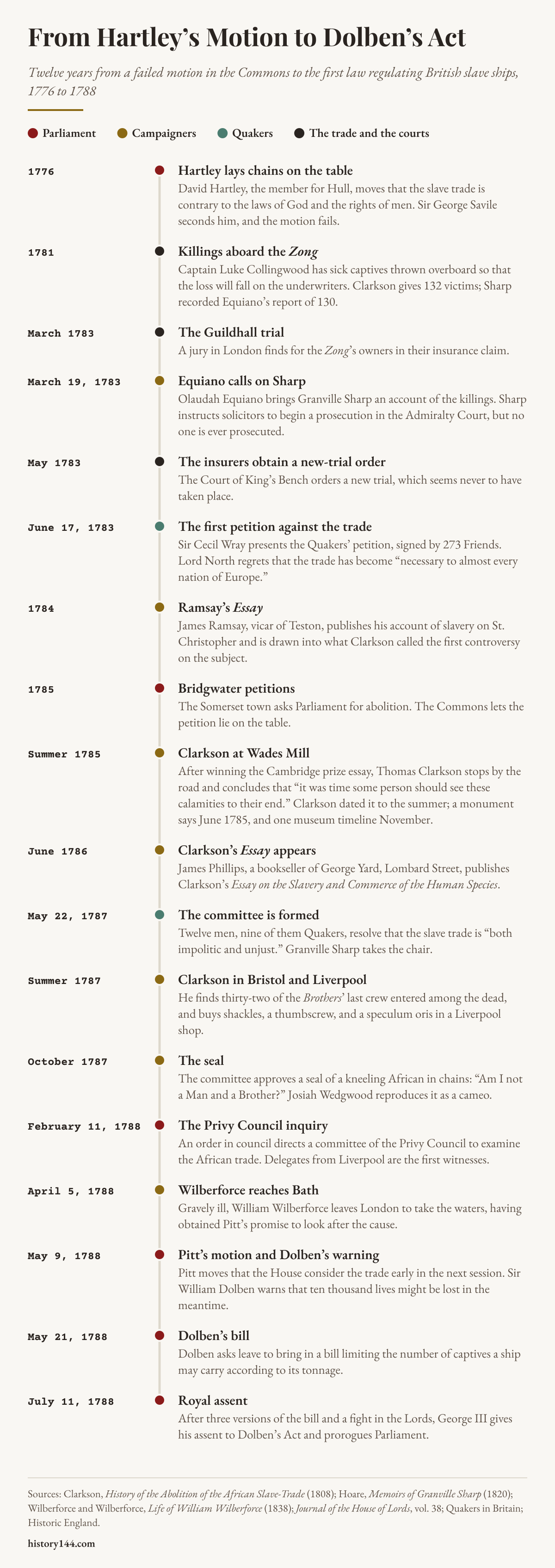
In 1776, while Britain's quarrel with its American colonies was turning into open war, David Hartley, the member for Hull, brought an unusual exhibit into the House of Commons. He had obtained some of the chains used to confine Africans aboard slave ships and laid them on the table of the House. He then moved that the Commons declare "That the Slave-trade was contrary to the laws of God, and the rights of men." Sir George Savile, the member for Yorkshire, seconded it, and it failed.[1] Hartley was the first member to argue in the Commons for ending the trade, and for years afterward nothing in Parliament seemed to follow from his gesture.[2]
Twelve years later, on July 11, 1788, King George III sat on the throne in the House of Lords and gave his assent to "An Act to regulate for a limited Time the shipping and carrying Slaves in British Vessels from the Coast of Africa."[3] The act did not abolish the slave trade or promise to. It left the traffic legal while trying to make the passage less deadly. Yet Thomas Clarkson, the campaign's researcher and later its historian, called it "the first bill that ever put fetters upon" the slave trade, and its passage showed how far the question had traveled since Hartley's chains lay on the table.[4] Between those two moments, a scattered set of critics became an organized movement with a committee, a printer, a spokesman in Parliament, and a researcher in the docks. They did not win what they wanted in 1788. They won a hearing, and a small law that conceded, for the first time, that the conditions of the trade were Parliament's business. This is the story of those twelve years.
A Motion Before Its Time
Hartley was an unusual figure to carry the question into Parliament. The son of the philosopher of the same name, he had pursued chemistry and mechanics alongside politics. He spoke often against the war with the American colonists and was a close friend of Benjamin Franklin, and in 1783 he signed the peace with the new United States as Britain's negotiator.[5] His constituency mattered too. Hull's trade looked mainly to the Baltic, and the town profited little from the transatlantic slave trade. Members for the great slaving ports of Liverpool and Bristol, by contrast, faced powerful merchant interests whose fortunes depended heavily on the trade.[6]
The idea Hartley put before the House was not new. Bishops had condemned the trade in sermons before the Society for the Propagation of the Gospel, and John Wesley had published his Thoughts on Slavery in 1774.[7] In 1776 Adam Smith added an argument from self-interest in The Wealth of Nations, observing that "the work done by freemen comes cheaper in the end than that performed by slaves."[8] The most practical of the early opponents was Granville Sharp, who resolved to give up two or three years to the study of English law so that he could defend Africans held in England. His campaign culminated in the case of James Somerset in 1772. Clarkson and many of his contemporaries understood the judgment to mean that enslaved people became free on entering England, although Lord Mansfield's ruling was narrower: a master could not forcibly remove an enslaved person from England to be sold abroad.[9] Immediately afterward, Sharp wrote to the prime minister, Lord North, urging him to abolish both the trade and slavery itself.[10]
None of this amounted to a political force. Clarkson praised Hartley and Savile as men to whom no motive of party or faction could be imputed, which hints at the problem.[11] Two members had raised a moral question in a House preoccupied with war, with no organization behind them and no systematic body of evidence. Clarkson later listed the interests that stood ready to defend it: the merchant, the planter, the mortgagee, the manufacturer, the politician, the legislator, and the cabinet minister.[12] A motion that touched all of them at once had no chance in 1776.
The Zong
The event that most unsettled those already uneasy took place at sea in late 1781 and reached the public in 1783. The ship Zong, owned by Gregson and other Liverpool merchants and commanded by Luke Collingwood, was carrying enslaved Africans to Jamaica when sickness spread through the ship. According to Clarkson, sixty of the captives had already died when Collingwood put a proposal to his officers. If the sick died a natural death, he reasoned, the loss would fall on the ship's owners, but if they were thrown alive into the sea, it would fall on the underwriters who had insured them as cargo. He picked out 132 of the most sickly, and over the following days they were thrown overboard in groups. The captain's defense was that the ship had missed its port and was short of water, yet no one had been put on short allowance, and rain fell for three days after the second group was killed.[13] Other accounts differ: Sharp recorded Equiano's report of 130 deaths, while the London Museum gives both 130 and 133.[14]
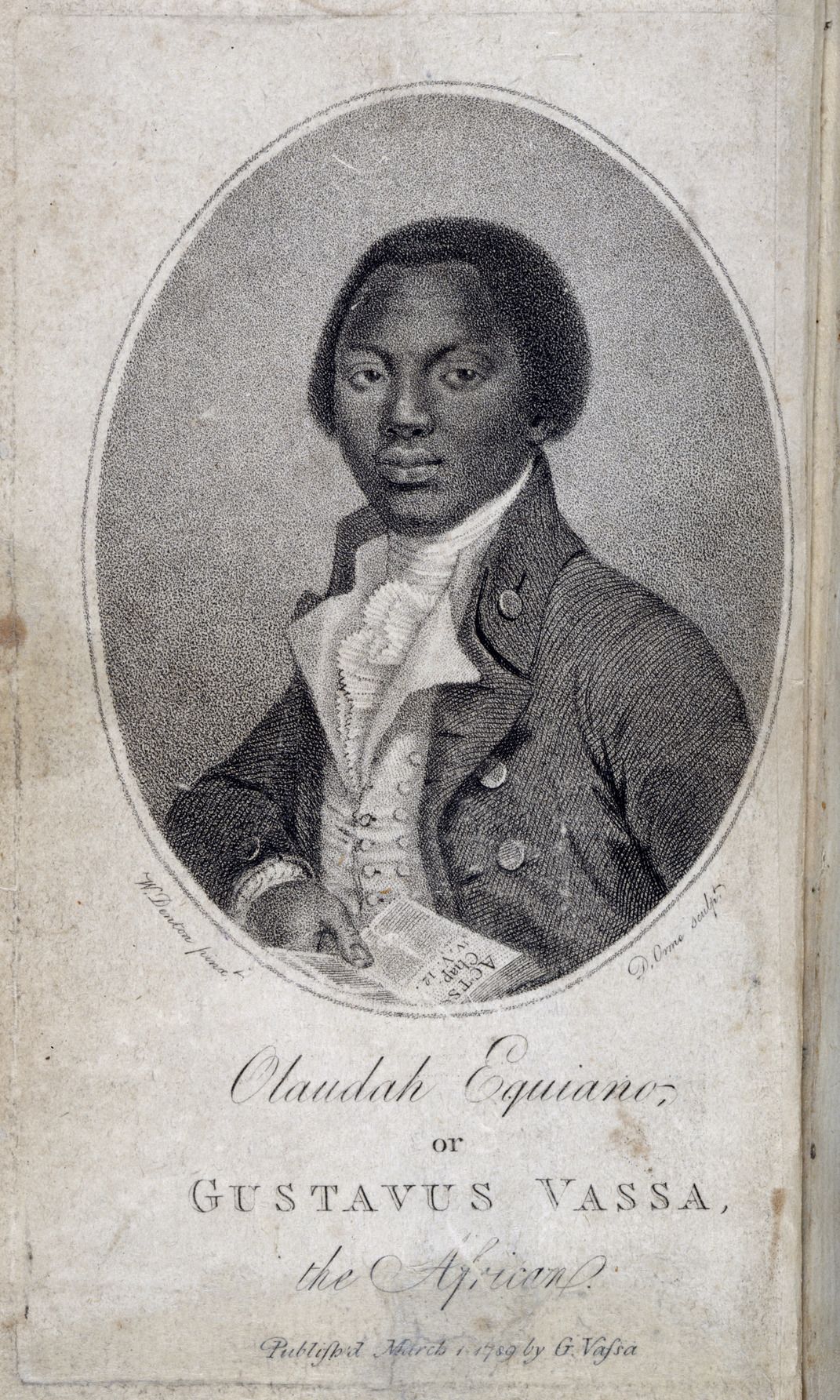
The case came to court because the owners claimed the value of the dead from their insurers, who refused to pay. A jury at the Guildhall in London found for the owners in March 1783. On March 19, Olaudah Equiano, a formerly enslaved African living in London, called on Sharp. Sharp's notebook records the visit: "Gustavus Vasa, a Negro, called on me, with an account of one hundred and thirty Negroes being thrown alive into the sea." Within days Sharp had instructed solicitors to begin a prosecution in the Admiralty Court. In May he attended the Court of King's Bench with a shorthand writer while the insurers' appeal was heard, and the court granted them a new trial.[15] Sharp sent his account to the Lords of the Admiralty and to the Duke of Portland, then head of the government, and Clarkson recorded that "no notice however was taken" by either.[16] No one was ever prosecuted, and a second trial seems never to have taken place, so it is not clear how the dispute was finally settled.[17]
The legal question was whether drowning people could be treated like throwing goods overboard to save a ship, and that a court would hear the matter in those terms was itself the revelation. Sharp's account in the newspapers, Clarkson wrote, "made such an impression upon others, that new coadjutors rose up." Thomas Day published an antislavery letter he had written in 1776, and Beilby Porteus, the bishop of Chester, preached a sermon on behalf of the enslaved before the Society for the Propagation of the Gospel.[18]
The Quakers Organize
The religious society best placed to turn sentiment into pressure was the Society of Friends, the Quakers. In the 1780s they numbered about fifty thousand members, with a network of some 150 correspondents across the country.[19] As early as 1727 their Yearly Meeting in London declared the importing of Africans by Friends "not a commendable nor allowed practice," and in 1758 it warned members against "reaping the unrighteous profits arising from the iniquitous practice of dealing in Negro or other slaves."[20]
On June 17, 1783, the Yearly Meeting carried the question to Parliament. A bill then before the Commons would have barred the officers of the African Company from exporting enslaved people, and the Quakers asked that "this restriction may be extended to all persons whomsoever." Sir Cecil Wray presented the petition and said he hoped to see the day when not a slave would remain in the king's dominions. Lord North, seconding, called the petition a credit to "the most benevolent society in the world" but said it was too late in the session to consider it, and he regretted that the trade had become, in a commercial view, "necessary to almost every nation of Europe." Clarkson described it as the first petition ever presented to Parliament for the abolition of the slave trade.[21] It had been signed by 273 Friends the day before.[22]
Other voices followed. In 1784 James Ramsay, the vicar of Teston in Kent, published An Essay on the Treatment and Conversion of African Slaves in the British Sugar Colonies. Ramsay had lived for nineteen years on the island of St. Christopher. It provoked angry replies from the colonial interest and drew Ramsay into what Clarkson called "the first controversy ever entered into on this subject."[23] In 1785 the town of Bridgwater in Somerset petitioned for abolition, and the Commons let the petition lie on the table.[24]
A Student's Resolve
The man who would give the campaign its evidence entered it by accident. In 1785 Peter Peckard, the vice-chancellor of Cambridge University, set the senior bachelors of arts a Latin essay question: "Anne liceat invitos in servitutem dare?", or "Is it right to make slaves of others against their will?" Thomas Clarkson, then twenty-five, had won a Latin prize the year before, and he later admitted that he entered chiefly to protect his reputation.[25] Knowing nothing of the subject, he saw a newspaper advertisement for the Philadelphia Quaker Anthony Benezet's Historical Account of Guinea and hurried to London to buy it.[26] He won the first prize and read his essay in the Senate House. Riding back toward London, he stopped near Wades Mill in Hertfordshire. "I sat down disconsolate on the turf by the roadside and held my horse. Here a thought came into my mind, that if the contents of the Essay were true, it was time some person should see these calamities to their end," he wrote.[27]
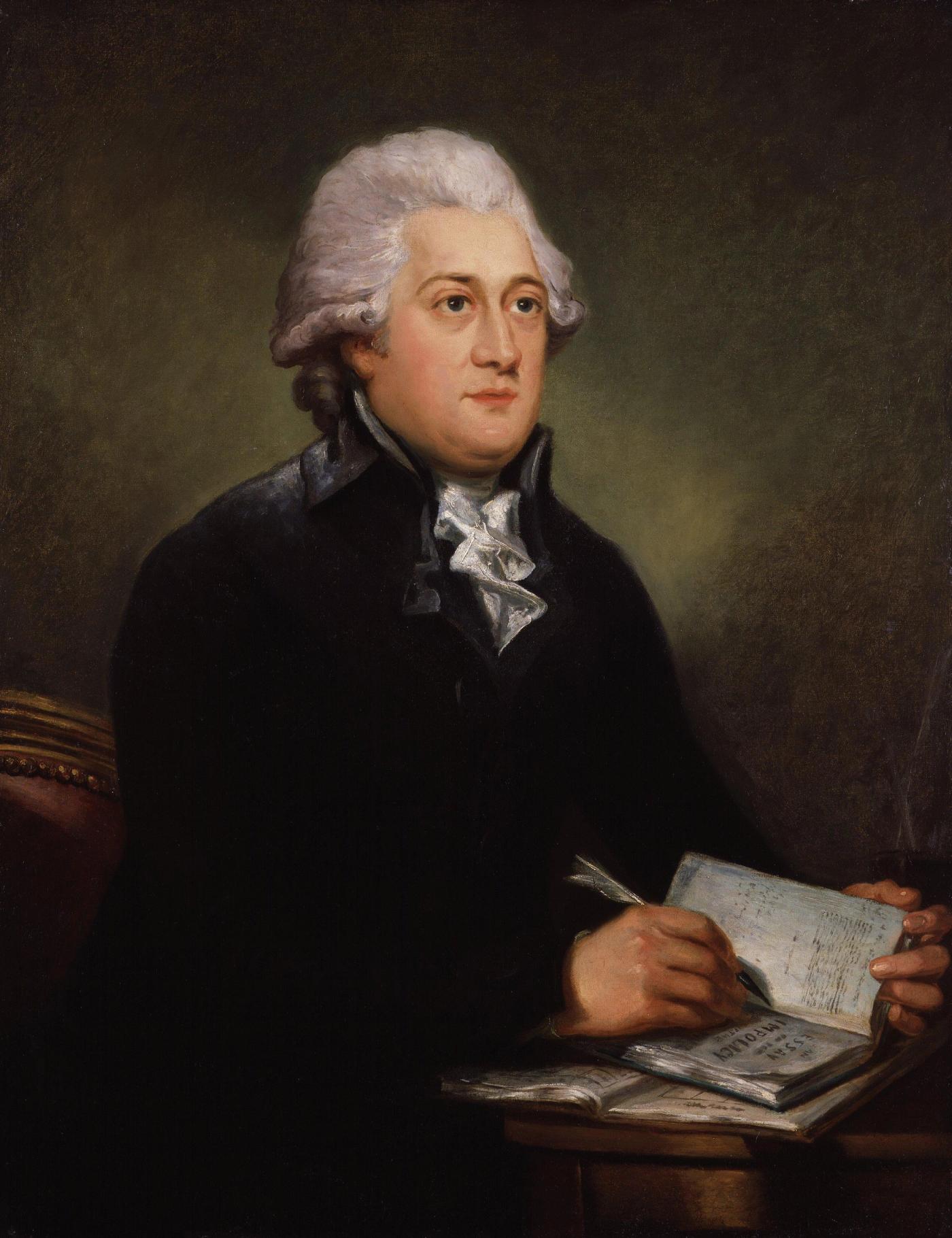
In 1879 a local landowner put up a monument near the spot whose inscription states that there, in June 1785, Clarkson "resolved to devote his life to bringing about the abolition of the slave trade."[28] The date is commemorative tradition rather than settled fact. In his retrospective account Clarkson dated the roadside episode to the summer of 1785, although one modern museum timeline places it in November.[29] His own account also describes months of doubt and solitary walks before he committed himself.[30] He translated and enlarged the essay, and when the bookseller Thomas Cadell predicted a respectable circulation among "persons of taste," Clarkson was disappointed, because he wanted readers who would act. Walking past the Royal Exchange the same day, he met a Quaker acquaintance, Joseph Hancock, who took him to the bookseller James Phillips of George Yard, Lombard Street. Clarkson offered Phillips the book on the spot.[31] An Essay on the Slavery and Commerce of the Human Species, Particularly the African appeared in June 1786, and it brought him into the Quaker network that would sustain the campaign.[32]
Twelve Men at George Yard
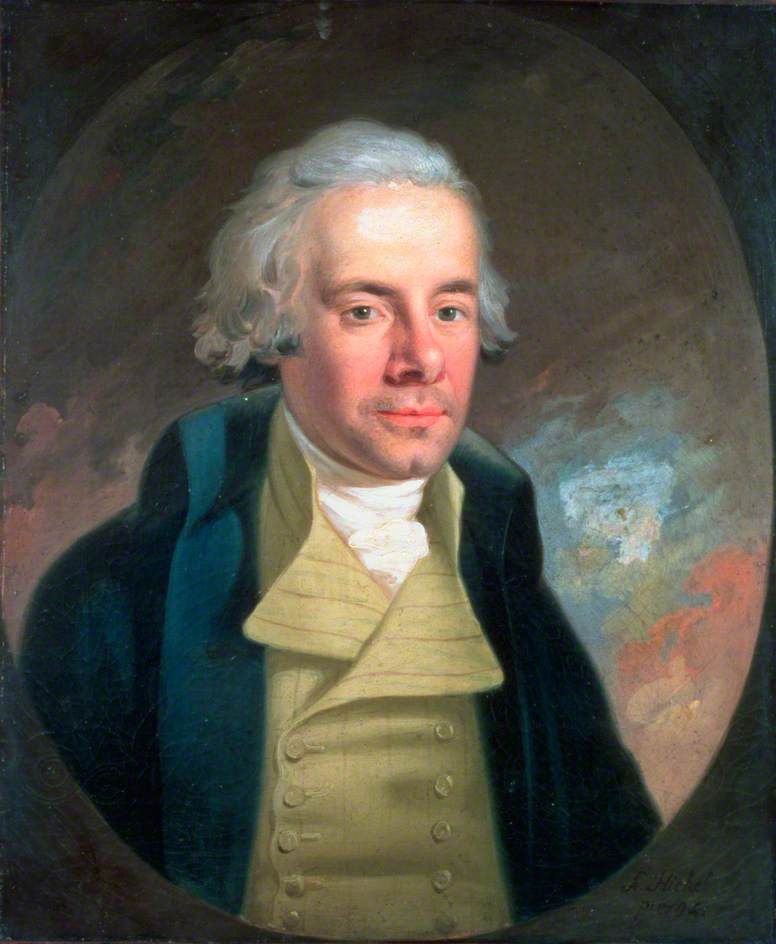
Over the following months Clarkson canvassed members of Parliament, and the one he most hoped to enlist was William Wilberforce, the young member for Yorkshire and a close friend of the prime minister, William Pitt.[33] Wilberforce had undergone an evangelical conversion in 1785.[34] The decisive moment, in Clarkson's telling, came at a dinner given by Bennet Langton, where the guests included Sir Joshua Reynolds and James Boswell. William Windham declared, "Rather let Liverpool and the Islands be swallowed up in the sea, than this monstrous system of iniquity be carried on." Langton then put the question to Wilberforce "in the shape of a delicate compliment," and Wilberforce replied that he had no objection to bringing the measure forward in Parliament when he was better prepared, "provided no person more proper could be found."[35] Wilberforce himself later remembered a different scene: a conversation with Pitt "in the open air at the root of an old tree at Holwood," Pitt's house in Kent, after which he resolved to give notice in the Commons.[36]
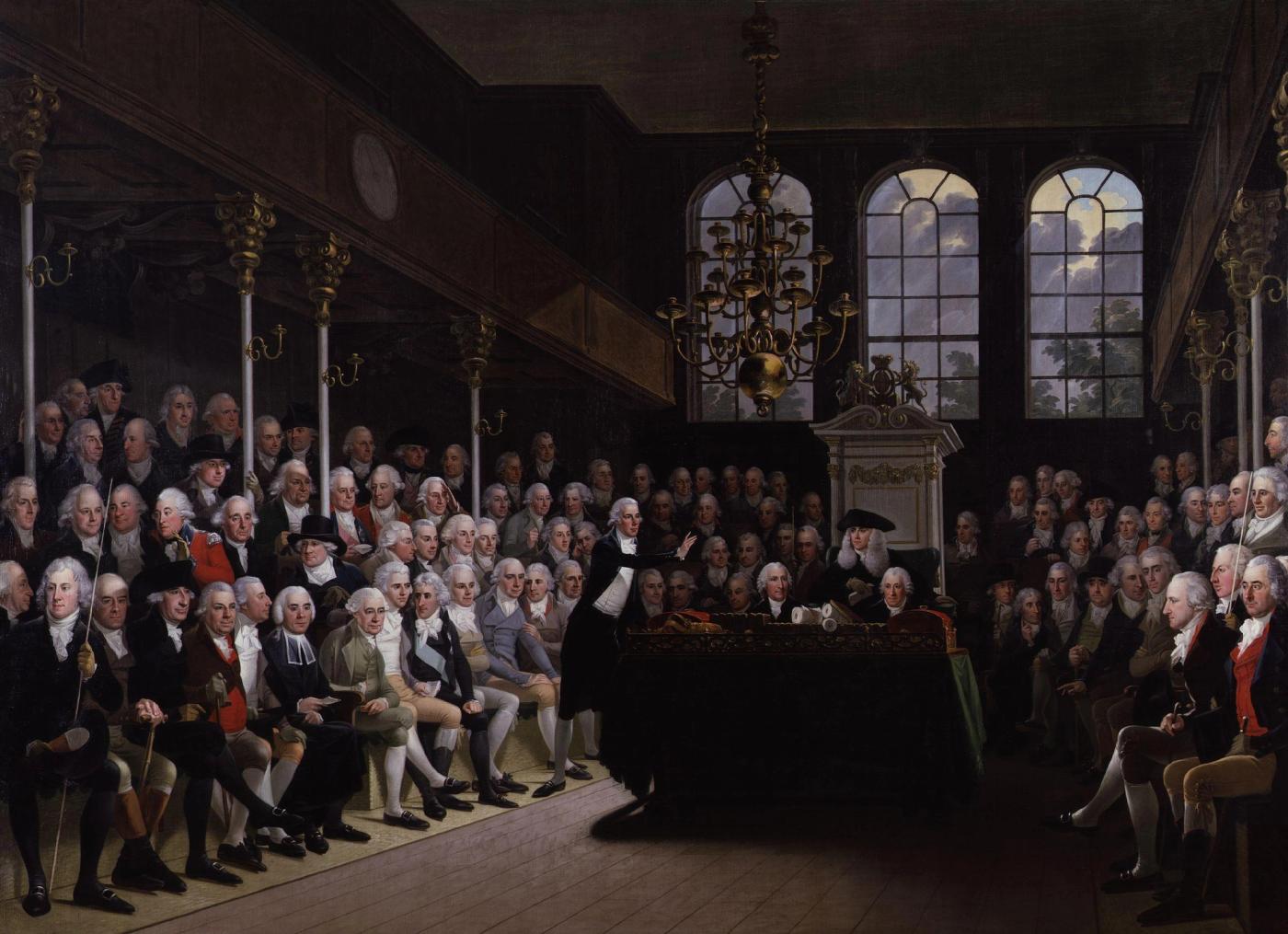
On May 22, 1787, twelve men met and resolved unanimously "That the Slave-trade was both impolitic and unjust." Granville Sharp, whom Clarkson called "the father of the cause in England," took the chair.[37] They gathered at James Phillips's premises at 2 George Yard, and nine of the twelve were Quakers.[38] The committee soon made a strategic choice that shaped the next twenty years. It would aim at ending the trade, not at freeing those already enslaved. To aim at both, the members concluded, "would be to aim at too much, and that by doing this we might lose all." If planters could no longer buy new captives from Africa, they reasoned, they would have to treat better the people they already held.[39] By late October Wilberforce had written in his journal, "God Almighty has set before me two great objects, the suppression of the slave trade and the reformation of manners."[40]
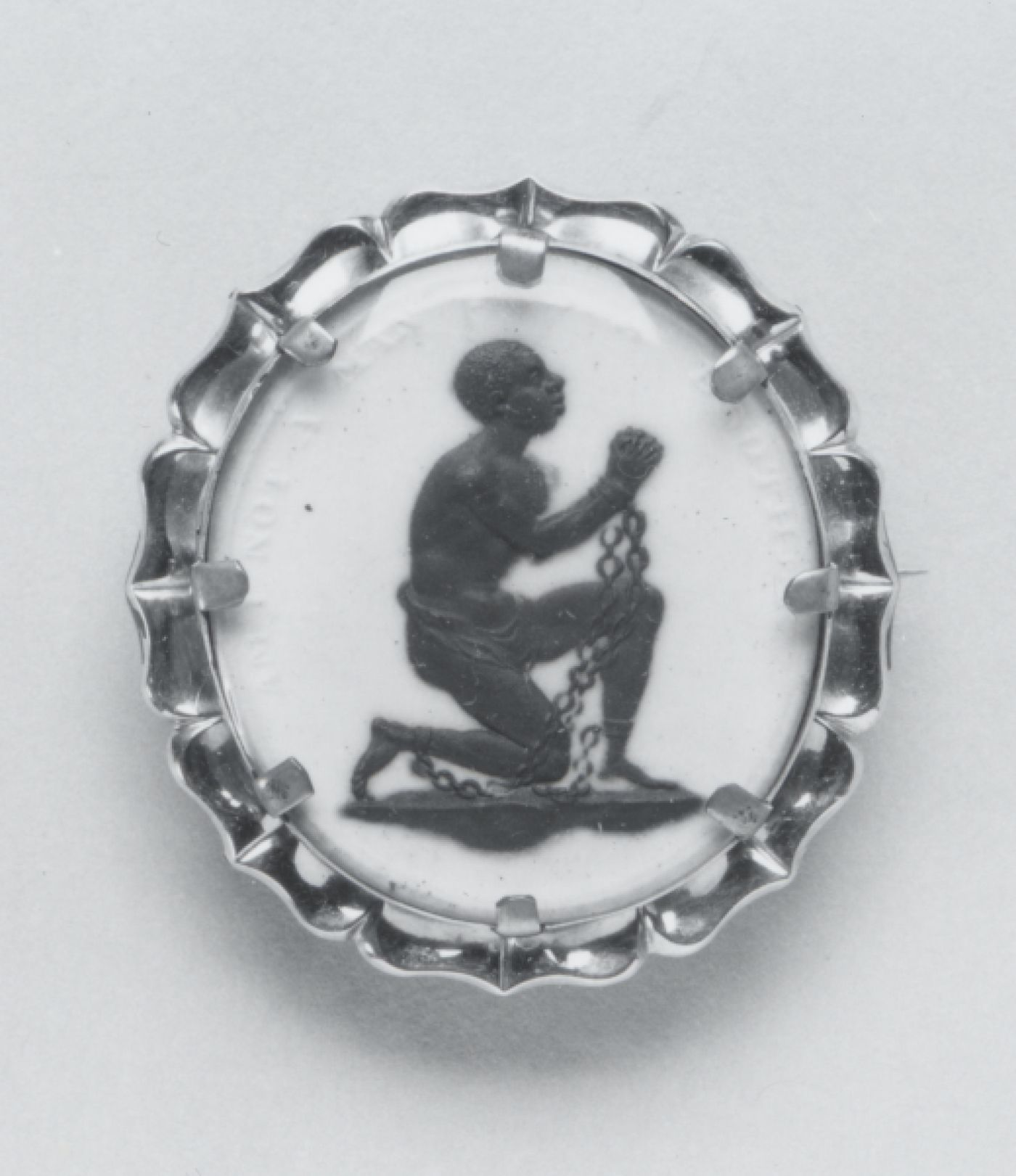
Phillips printed the committee's literature, and the Quaker network carried it around the country.[41] In the summer of 1787 the potter Josiah Wedgwood joined the committee, and in October it approved a seal showing an African in chains, kneeling with his hands raised, and the words "Am I not a Man and a Brother?"[42] Wedgwood reproduced the design as a cameo and gave the cameos away by the hundred. Some owners, Clarkson recalled, had them inlaid in gold on the lids of snuffboxes, while ladies wore them in bracelets and as pins for their hair.[43] The chains that Hartley had laid on the table of the Commons now appeared, in miniature, on the wrists of fashionable women.
Evidence from the Docks
Moral argument had failed in 1776. The committee resolved that this time the case would rest on facts, and it sent Clarkson to find them. In the summer of 1787 he set out for Bristol, then one of the country's leading slaving ports. Coming within sight of the city at about eight in the evening, with the church bells ringing, he "began now to tremble, for the first time, at the arduous task I had undertaken."[44] He found a guide in Thompson, the landlord of the Seven Stars, who boarded sailors between voyages but refused to send them into the slave trade, saying the credit of his house would be ruined. Between midnight and three in the morning, Thompson led him through the public houses of Marsh Street where the mates of slave ships picked up their crews.[45]
The most damaging evidence concerned the sailors themselves. Through a friend Clarkson obtained the muster roll, the official list of crew, of the ship Brothers, and found that thirty-two of her last crew had been entered among the dead.[46] Such findings mattered because the trade's defenders called it a nursery of seamen for the navy. The Bristol museums observe that public disgust with the trade at first grew more from the sailors' plight than from that of the enslaved, and the abolitionists learned to use both.[47]
In Bristol Clarkson also met two surgeons willing to talk. James Arnold had made two slaving voyages and agreed to sail on another and keep a journal for the committee, and Alexander Falconbridge had made four.[48] In Liverpool, the largest slaving port of all, Clarkson noticed iron instruments in a shop window and bought handcuffs, leg shackles, a thumbscrew, and a speculum oris, a surgical device used, the seller told him, to force open the mouths of captives who refused to eat. He bought them, he wrote, "to show the fact" that the captives did not leave their country willingly.[49] He received anonymous letters warning that he would never leave the town alive, and he never went out without Falconbridge, who, he learned only later, went armed. One day on the pier-head a group of eight or nine men closed around him and pushed him to within a yard of the edge before he broke through them, "not without blows."[50]
Parliament Takes Notice
By early 1788 the pressure was beginning to tell. Petitions were arriving from across the country, and on February 11 the king, by an order in council, directed a committee of the Privy Council sitting as a board of trade to examine the state of the African trade.[51] Meeting Pitt soon afterward, Clarkson found that he had "but little knowledge" of the subject and doubts on many points.[52] The first witnesses before the council were delegates from Liverpool, who denied that Africans were kidnapped or that wars were fought to procure them.[53]
Then the campaign lost its leader in the Commons. Wilberforce fell ill at the end of January, recovered briefly, and relapsed in February. By March a consultation of physicians had told his family that he "had not stamina to last a fortnight." Before leaving to take the waters at Bath, where he arrived on April 5, he obtained Pitt's promise to look after the cause.[54] On April 8 Pitt wrote that he wished the question "should come forward in your hands rather than any other," but that this was impracticable that year, and he urged his friend to put it out of his mind.[55] From Bath came word that his doctors would not let him read any letter on the subject.[56]
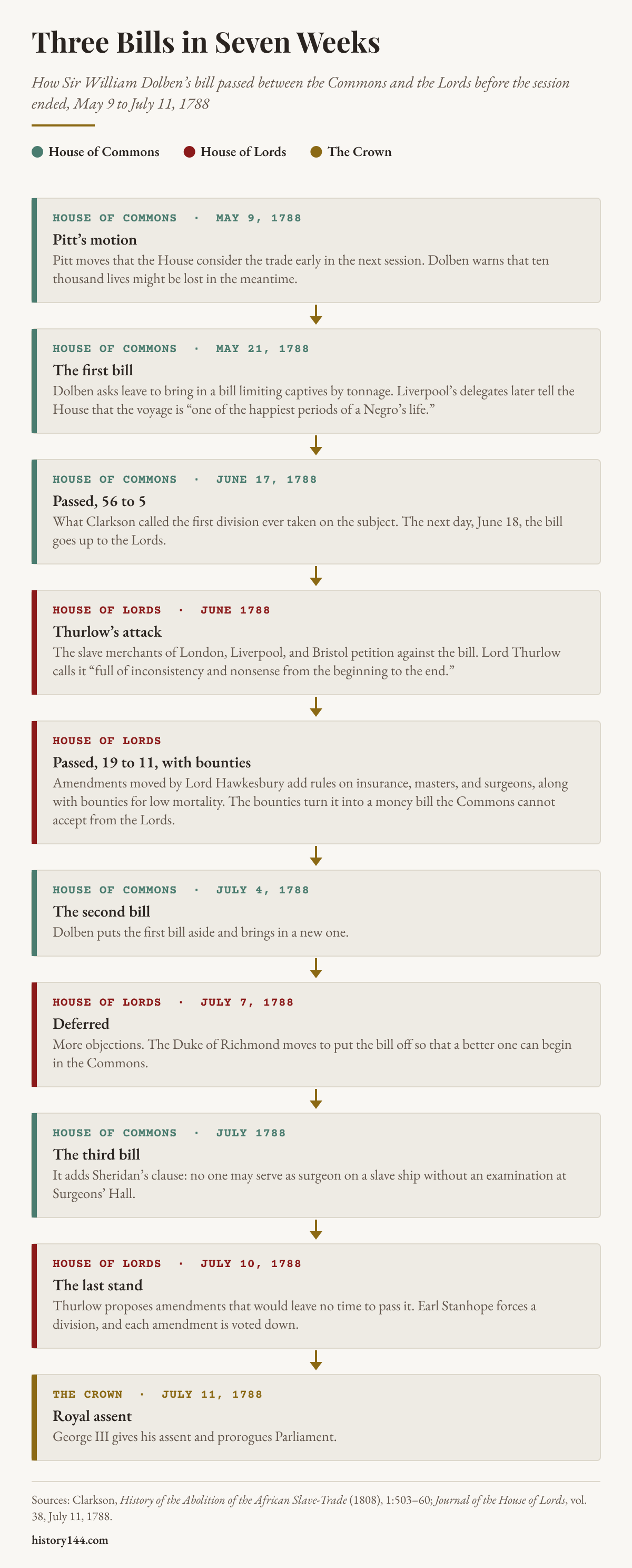
Pitt kept his promise. After a statement in the Commons on May 5, he moved on May 9 that the House would consider the slave trade early in the next session, and he took care, he said, to give no opinion of his own.[57] During the debate Sir William Dolben rose to speak of "that intermediate state of tenfold misery" the Africans suffered in their passage. They were chained together, he said, and packed so close that each had no more than a foot and a half of breadth: "crammed together like herrings in a barrel, they contracted putrid and fatal disorders." If nothing were done before the next session, he warned, ten thousand lives might be lost.[58]
Sir William Dolben's Bill
Dolben was not an obvious reformer. A baronet of sixty-one and the son of a clergyman, he had sat for Oxford University since 1780. He had generally voted with the ministries of Grafton and North, though he grew heartily tired of the American war, and after 1784 he regularly supported Pitt.[59] According to the historian Adam Hochschild, Dolben and some other members had gone aboard a slave ship being fitted out in the Thames.[60] On May 21 he asked leave to bring in a bill to relieve Africans from the hardships of their passage. He did not mean to sanction the trade, he told the House, for it "would be always wicked and unjustifiable." He meant only to limit the number of people a ship could carry according to its tonnage, its measured cargo capacity, until Parliament could take up the whole question.[61]
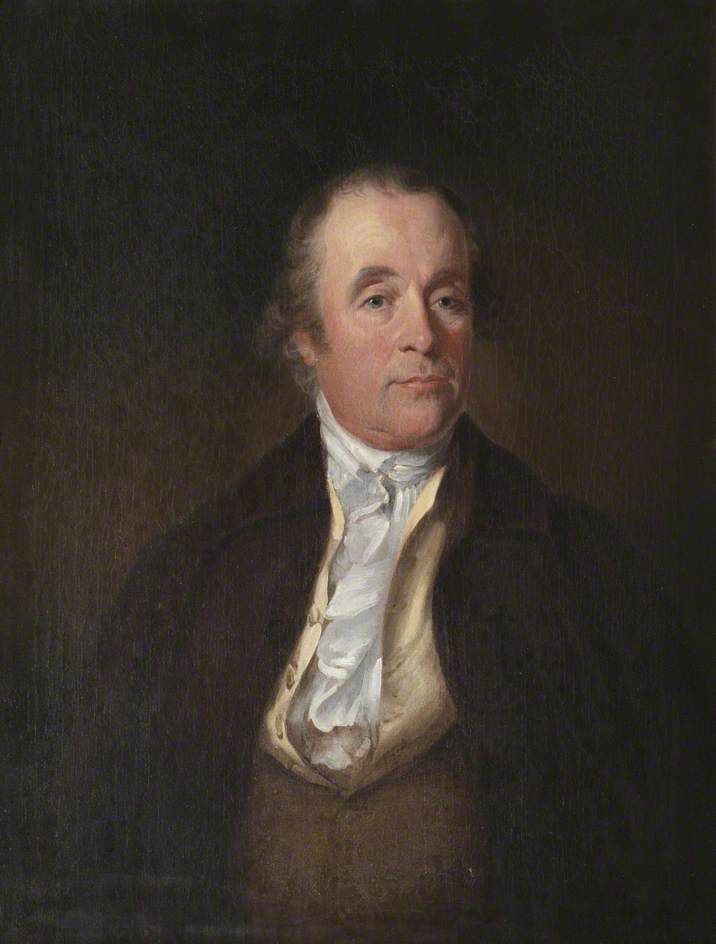
The Liverpool members had said they would not oppose such a measure, but the town's merchants did. Their delegates told the House that the captives had room, air, and food enough, that they amused themselves with dancing on deck, and that the voyage "was one of the happiest periods of a Negro's life." If merchants could not carry at least two full-grown Africans or three smaller ones to a ton, they argued, the trade would be ruined.[62] Pitt sent a naval officer, Captain Parrey, to Liverpool to measure slave ships so that their claims could be tested.[63] In Bristol, the city's largest slave merchant, James Jones, calculated that his nine ships would have to cut their human cargoes by nearly a quarter.[64] The bill passed the Commons by fifty-six votes to five, in what Clarkson called the first division ever taken on the subject.[65]
In the House of Lords it met harder resistance. The slave merchants of London, Liverpool, and Bristol petitioned against it, and the lord chancellor, Lord Thurlow, called it "full of inconsistency and nonsense from the beginning to the end."[66] The Earl of Sandwich argued that the trade was no more fatal to seamen than the Newfoundland trade and some others, a claim Clarkson later tested against muster rolls.[67] Pitt told Wilberforce that the measure "meets just now with some rub in the House of Lords, even in the temporary regulation respecting the conveyance, which I wonder how any human being can resist."[68] The peers passed it by nineteen votes to eleven,[69] but their amendments added bounties for masters and surgeons, which turned it into a money bill that the Commons could not accept from the Lords. Dolben had to begin again with a new bill, and when that one also drew objections in the Lords, a third. The third version added a clause, moved by Richard Brinsley Sheridan, that no one could serve as surgeon on a slave ship without passing an examination at Surgeons' Hall.[70] On July 10, the day before the session was to end, Thurlow proposed amendments that would have sent the bill back to the Commons with no time left to pass it. Stanhope forced a division, and the amendments were voted down one by one.[71] The next day the king gave his assent and prorogued Parliament.[72]
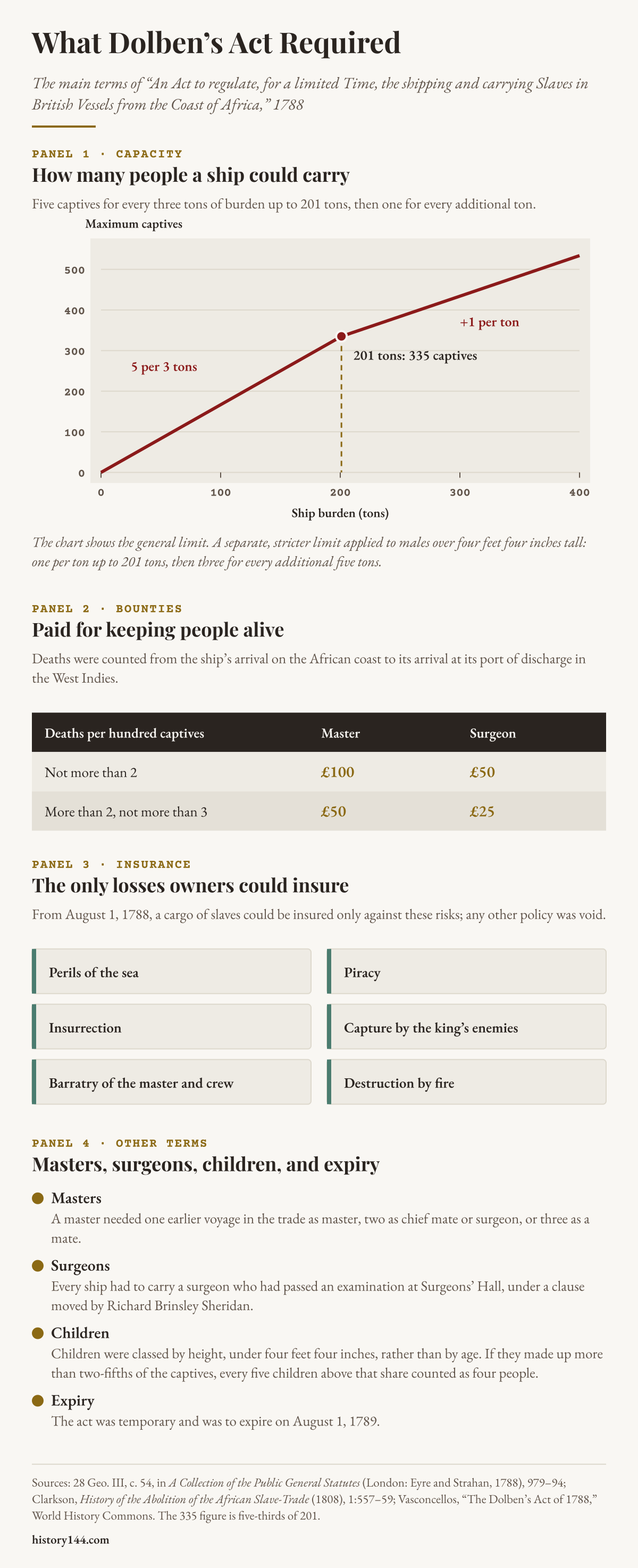
The act allowed five captives for every three tons of a ship's burden up to 201 tons, and one for every ton beyond, with a stricter limit for males over four feet four inches tall. It set minimum experience for masters, and it paid bounties for keeping people alive. The master received £100 and the surgeon £50 if deaths between the ship's arrival on the African coast and its arrival at its port of discharge in the West Indies did not exceed two in a hundred, and half those sums if the rate exceeded two but not three. It was to expire on August 1, 1789.[73] Another clause barred owners from insuring a cargo of slaves against any loss except the perils of the sea, piracy, insurrection, capture by the king's enemies, barratry by the master and crew, and fire.[74] The act used height rather than a specified age to classify children, and the editor of one modern edition argues that because it never defined a child by age, it encouraged traders to carry more young people between twelve and eighteen.[75]
What Regulation Meant
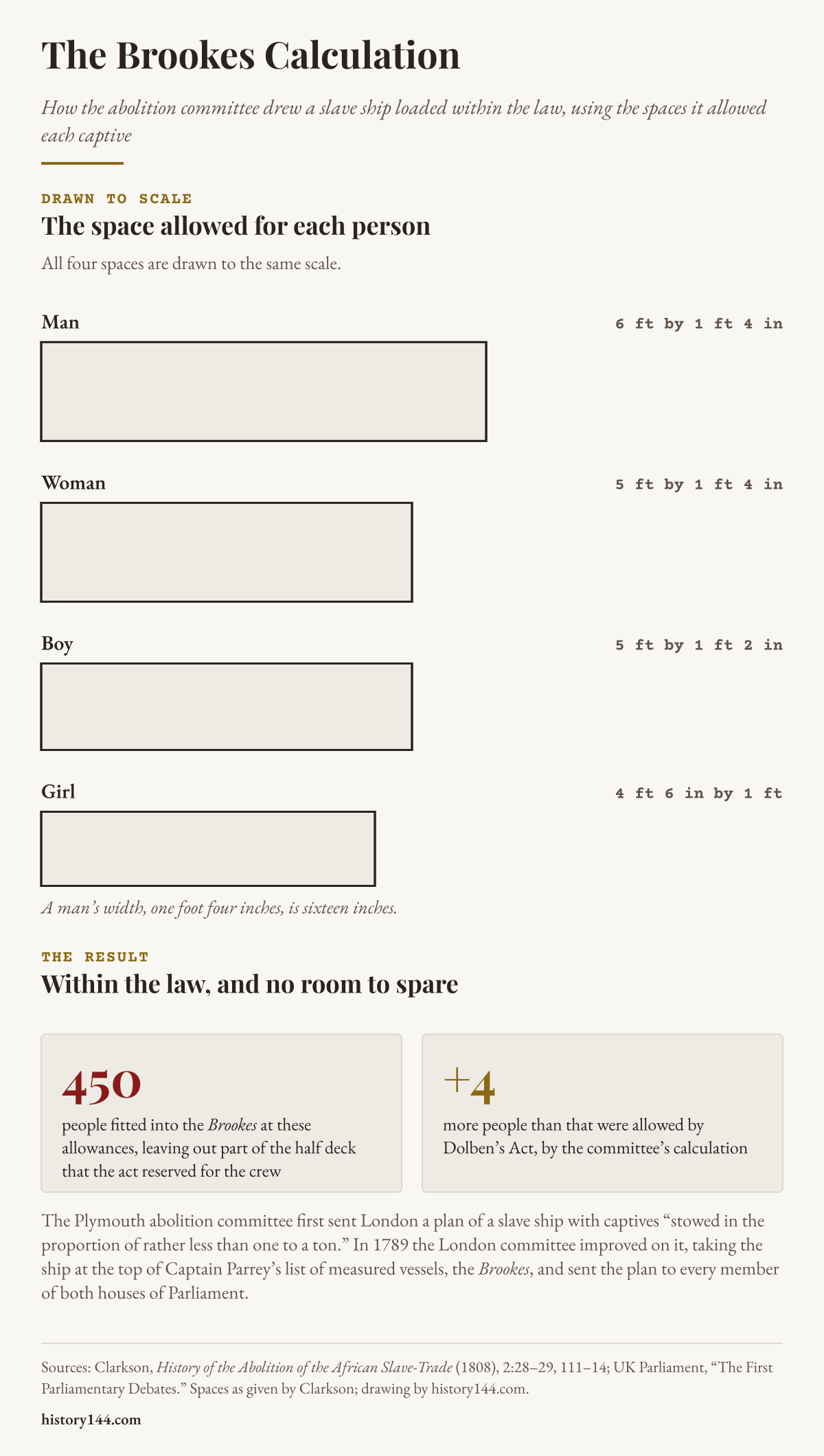
Dolben's Act left the trade legal, and a trade that killed fewer people might be defended more easily. The abolitionists turned its own terms into their most effective propaganda. The committee at Plymouth first sent London an engraving of a slave ship with the captives "stowed in the proportion of rather less than one to a ton."[76] The London committee improved on it the following year. It took the ship at the top of Captain Parrey's list, the Brookes, allowed six feet by one foot four inches for each man and smaller spaces for women, boys, and girls, and left out part of the half deck that Dolben's act reserved for the crew. On those terms, 450 people could be fitted into her. The act, they calculated, allowed her to carry four more than that.[77] The plan was sent to every member of both houses of Parliament and became the best-known image of the Middle Passage.[78]
Yet the act also marked a real change. Five years after the Zong hearings had treated drowned captives as lost cargo, Parliament offered surgeons a bounty for keeping captives alive and narrowed the losses that owners could insure. The law also gave the question an established place in Parliament's business. The Privy Council was gathering evidence, Pitt had committed the House to a debate, and the traders had been forced to argue in public about how many people could be packed into a ship.
Hartley's chains in 1776 had been the gesture of a lone member with no organization behind him and nothing to show the House except the chains themselves. By the summer of 1788 the cause had a committee, a printer, a seal, a researcher with muster rolls and shackles bought in Liverpool, a prime minister pledged to bring it forward, and a champion in the Commons recovering at Bath. It still lacked a majority, and the trade would survive for nearly two more decades. But the question Hartley had asked the House to answer, whether the trade could be squared with the laws of God and the rights of men, was one that Parliament could no longer decline to consider.
Places in this Story
The places this story moves through, in order — follow them on the interactive map →
- Westminster, London 1776
Hartley laid slave-ship chains on the table of the Commons and moved that the trade was contrary to the laws of God and the rights of men.
- Kingston upon Hull, England 1776
Hartley's constituency, whose trade looked to the Baltic and profited little from the transatlantic traffic, unlike Liverpool and Bristol.
- Guildhall, London March 1783
A jury found for the Zong's owners against their insurers. Olaudah Equiano brought word of the killings to Granville Sharp on March 19.
- Devonshire House, London June 17, 1783
The Quaker Yearly Meeting sent Parliament what Clarkson called the first petition ever presented for abolition, signed by 273 Friends.
- Wades Mill, Hertfordshire 1785
Clarkson stopped by the roadside here and thought it was time some person saw these calamities to their end. A monument was raised in 1879.
- George Yard, Lombard Street, London May 22, 1787
Twelve men met at the printer James Phillips's premises and resolved that the slave trade was both impolitic and unjust.
- Bristol, England Summer 1787
Clarkson found the muster roll of the Brothers showing thirty-two of her crew dead, and met the surgeons Arnold and Falconbridge.
- Liverpool, England 1787
Clarkson bought handcuffs, shackles, a thumbscrew and a speculum oris, and was nearly pushed off the pier-head by a group of men.
Frequently Asked Questions
What was Dolben's Act of 1788?
Dolben's Act was the first British law to regulate the slave trade, receiving royal assent on July 11, 1788. It did not abolish the traffic but limited how many captives a ship could carry by its tonnage and paid bounties to masters and surgeons who kept deaths below two in a hundred.
Who was David Hartley and what did he do about the slave trade?
David Hartley, the member for Hull, was the first MP to argue in the Commons for ending the slave trade, laying slave-ship chains on the table of the House in 1776. His motion that the trade was contrary to the laws of God and the rights of men was seconded by Sir George Savile and failed.
What was the Zong massacre?
In late 1781 the crew of the Liverpool ship Zong threw sick captives alive into the sea so the loss would fall on the underwriters rather than the owners. The case reached a London court in 1783 as an insurance claim, which is what made it notorious, and no one was ever prosecuted.
Who was Thomas Clarkson?
Thomas Clarkson won a Cambridge Latin essay prize on slavery in 1785 and resolved to devote himself to ending the trade. He became the campaign's researcher, gathering muster rolls in Bristol and buying shackles and a speculum oris in Liverpool to show what the trade required.
When did the campaign to abolish the slave trade begin?
Twelve men met at James Phillips's premises at 2 George Yard, London, on May 22, 1787, and resolved that the slave trade was both impolitic and unjust. Nine of the twelve were Quakers, and Granville Sharp took the chair.
Why did the abolition committee target the trade and not slavery itself?
The committee judged that attacking both at once would be to aim at too much, and that by doing so they might lose all. They reasoned that planters unable to buy new captives would have to treat better the people they already held.
What was the Brookes slave ship diagram?
The London committee took the Liverpool ship Brookes from Captain Parrey's survey and drew the captives packed into her at the spacing Dolben's Act allowed, showing 450 people aboard. Sent to every member of both houses, it became the best-known image of the Middle Passage.
Bibliography
"An Act to regulate, for a limited Time, the shipping and carrying Slaves in British Vessels from the Coast of Africa." 28 Geo. III, c. 54. In A Collection of the Public General Statutes (session of 1787–88), 979–94. London: Charles Eyre and Andrew Strahan, 1788. HathiTrust Digital Library. Accessed November 7, 2026. https://babel.hathitrust.org/cgi/pt?id=nyp.33433035256316.
Carey, Brycchan. "William Wilberforce: Biography and Further Reading." Brycchan Carey. Accessed October 4, 2026. https://brycchancarey.com/abolition/wilberforce.htm.
Clarkson, Thomas. The History of the Rise, Progress, and Accomplishment of the Abolition of the African Slave-Trade by the British Parliament. 2 vols. London: Longman, Hurst, Rees, and Orme, 1808. Online edition with original pagination, Online Library of Liberty, Liberty Fund. Accessed November 7, 2026. Vol. 1: https://oll.libertyfund.org/titles/clarkson-the-history-of-the-abolition-of-the-african-slave-trade-vol-1; vol. 2: https://oll.libertyfund.org/titles/clarkson-the-history-of-the-abolition-of-the-african-slave-trade-vol-2.
"David Hartley." Online Library of Liberty, Liberty Fund. Accessed November 7, 2026. https://oll.libertyfund.org/people/david-hartley.
Discovering Bristol. "Historic Site, Seven Stars Pub." Bristol Museums. Accessed October 4, 2026. https://discoveringbristol.org.uk/browse/slavery/historic-site-seven-stars-pub/.
Discovering Bristol. "Legislation in Parliament." Bristol Museums. Accessed November 7, 2026. https://www.discoveringbristol.org.uk/slavery/against-slavery/campaign-against-slave-trade/legal-framework/legislation/.
"Dolben, Sir William, 3rd Bt. (1727–1814), of Finedon, Northants." In The History of Parliament: The House of Commons 1754–1790, edited by L. Namier and J. Brooke. 1964. Online edition, History of Parliament Trust. Accessed November 7, 2026. https://www.historyofparliamentonline.org/volume/1754-1790/member/dolben-sir-william-1727-1814.
Georgian Society for East Yorkshire. "Hull and the Abolitionist Cause." March 14, 2024. Accessed November 7, 2026. https://gsey.org.uk/hull-and-the-abolitionist-cause/.
Gray, William. "Quaker Petition to Parliament for the Abolition of the Slave Trade 1783." William Gray (blog), September 16, 2017. Accessed November 7, 2026. https://williamgray101.wordpress.com/2017/09/16/quaker-petition-to-parliament-for-the-abolition-of-the-slave-trade-1783/.
Historic England. "Clarkson Monument on High Cross Hill." National Heritage List for England, list entry 1281321. Accessed November 7, 2026. https://historicengland.org.uk/listing/the-list/list-entry/1281321.
Hoare, Prince. Memoirs of Granville Sharp, Esq. London: Henry Colburn, 1820. Internet Archive. Accessed November 7, 2026. https://archive.org/details/memoirsofgranvil00hoar.
Hochschild, Adam. Bury the Chains: Prophets and Rebels in the Fight to Free an Empire's Slaves. Boston: Houghton Mifflin, 2005.
Journal of the House of Lords. Vol. 38, 1787–1790. July 1–11, 1788, pp. 251–63. British History Online. Accessed November 7, 2026. https://www.british-history.ac.uk/lords-jrnl/vol38/pp251-263.
Kaufmann, Miranda. "Somerset Case." In Encyclopedia of Blacks in European History and Culture, edited by Eric Martone, 2:504–5. Westport, CT: Greenwood, 2008. Excerpt on the author's website. Accessed November 7, 2026. https://www.mirandakaufmann.com/somerset.html.
Lombard Churches. "The Abolitionist Movement." Accessed October 4, 2026. https://www.lombardchurches.org/abolitionist-movement.
London Museum. "The Zong Massacre Trial." London Stories. Accessed November 7, 2026. https://www.londonmuseum.org.uk/collections/london-stories/zong-massacre-trial/.
Quakers in Britain. "Abolition Journeys." Britain Yearly Meeting, 2007. Accessed November 7, 2026. https://www.quaker.org.uk/documents/journeysabolitionspecial032007.
Quakers in the World. "Quaker Organisation and Anti-Slavery Campaigning." Accessed November 7, 2026. https://www.quakersintheworld.org/quakers-in-action/59/Quaker-organisation-and-Anti-Slavery-campaigning.
Smith, Adam. An Inquiry into the Nature and Causes of the Wealth of Nations. 1776. Edited by Edwin Cannan. London: Methuen, 1904. Library of Economics and Liberty. Accessed November 7, 2026. https://www.econlib.org/library/Smith/smWN.html?chapter_num=11.
UK Parliament. "The First Parliamentary Debates." Living Heritage. Accessed November 7, 2026. https://www.parliament.uk/about/living-heritage/transformingsociety/tradeindustry/slavetrade/overview/the-first-parliamentary-debates/.
University of Hull. "David Hartley, George Hammond: Anti-Slavery, Recognising American Independence and the First British Ambassador to the United States." Far Horizons. Accessed November 7, 2026. https://farhorizons.hull.ac.uk/david-hartley-george-hammond-anti-slavery-recognising-american-independence-and-the-first-british-ambassador-to-the-united-states/.
Vasconcellos, Colleen A., ed. "The Dolben's Act of 1788." World History Commons. Transcribed from Elizabeth Donnan, ed., Documents Illustrative of the History of the Slave Trade to America, vol. 2 (New York: Octagon Books, 1965), 583–87. Accessed November 7, 2026. https://worldhistorycommons.org/dolbens-act-1788.
Wilberforce, A. M., ed. Private Papers of William Wilberforce. London: T. Fisher Unwin, 1897. Internet Archive. Accessed November 7, 2026. https://archive.org/details/privatepapersofw00wilbrich.
Wilberforce, Robert Isaac, and Samuel Wilberforce. The Life of William Wilberforce. 5 vols. London: John Murray, 1838. Vol. 1, Internet Archive. Accessed November 7, 2026. https://archive.org/details/lifewilliamwilb13wilbgoog.
"Wilberforce, William (1759–1833)." In The History of Parliament: The House of Commons 1754–1790, edited by L. Namier and J. Brooke. 1964. Online edition, History of Parliament Trust. Accessed October 4, 2026. https://www.historyofparliamentonline.org/volume/1754-1790/member/wilberforce-william-1759-1833.
Citations
- Clarkson, History, 1:84–85. ↑
- "David Hartley," Online Library of Liberty. ↑
- Journal of the House of Lords, 38:263. ↑
- Clarkson, History, 1:560. ↑
- University of Hull, "David Hartley, George Hammond." ↑
- Georgian Society for East Yorkshire, "Hull and the Abolitionist Cause." ↑
- Clarkson, History, 1:58, 61, 83. ↑
- Smith, Wealth of Nations, bk. 1, chap. 8; Clarkson, History, 1:86. ↑
- Kaufmann, "Somerset Case." ↑
- Clarkson, History, 1:71, 77, 79. ↑
- Clarkson, History, 1:84. ↑
- Clarkson, History, 1:25. ↑
- Clarkson, History, 1:95–97. ↑
- Hoare, Memoirs, 236; London Museum, "The Zong Massacre Trial." ↑
- Hoare, Memoirs, 236. ↑
- Clarkson, History, 1:97. ↑
- London Museum, "The Zong Massacre Trial." ↑
- Clarkson, History, 1:97–98. ↑
- Quakers in the World, "Quaker Organisation and Anti-Slavery Campaigning." ↑
- Clarkson, History, 1:113. ↑
- Clarkson, History, 1:118–20. ↑
- Quakers in Britain, "Abolition Journeys"; Gray, "Quaker Petition to Parliament." (Gray transcribes the petition's signing date from the Yearly Meeting minutes.) ↑
- Clarkson, History, 1:100–103. ↑
- Clarkson, History, 1:105–7. ↑
- Clarkson, History, 1:205–6. ↑
- Clarkson, History, 1:207. ↑
- Clarkson, History, 1:209–10. ↑
- Historic England, "Clarkson Monument on High Cross Hill." ↑
- Clarkson, History, 1:210; Wisbech & Fenland Museum, "Thomas and John Clarkson Abolition and Peace Timeline." ↑
- Clarkson, History, 1:210–11. ↑
- Clarkson, History, 1:212–13. ↑
- Clarkson, History, 1:217. ↑
- Clarkson, History, 1:243, 251. ↑
- Carey, "William Wilberforce." ↑
- Clarkson, History, 1:252–54. ↑
- Wilberforce and Wilberforce, Life, 1:150–51. ↑
- Clarkson, History, 1:255–56. ↑
- Lombard Churches, "The Abolitionist Movement"; Quakers in the World, "Quaker Organisation and Anti-Slavery Campaigning." ↑
- Clarkson, History, 1:284–86. ↑
- Wilberforce and Wilberforce, Life, 1:149; "Wilberforce, William," History of Parliament: The House of Commons 1754–1790. ↑
- Quakers in the World, "Quaker Organisation and Anti-Slavery Campaigning." ↑
- Clarkson, History, 1:445, 450–51. ↑
- Clarkson, History, 2:191–92. ↑
- Clarkson, History, 1:293. ↑
- Clarkson, History, 1:322–23. ↑
- Clarkson, History, 1:298. ↑
- Discovering Bristol, "Historic Site, Seven Stars Pub." ↑
- Clarkson, History, 1:338, 344, 348. ↑
- Clarkson, History, 1:375–77. ↑
- Clarkson, History, 1:409–10. ↑
- Clarkson, History, 1:470–71, 507. ↑
- Clarkson, History, 1:472. ↑
- Clarkson, History, 1:479–80. ↑
- Wilberforce and Wilberforce, Life, 1:167–69. ↑
- Pitt to Wilberforce, April 8, 1788, in Wilberforce, Private Papers, 17–18. ↑
- Clarkson, History, 1:501. ↑
- UK Parliament, "The First Parliamentary Debates"; Clarkson, History, 1:503–7. ↑
- Clarkson, History, 1:519–20. ↑
- "Dolben, Sir William, 3rd Bt.," History of Parliament: The House of Commons 1754–1790. ↑
- Hochschild, Bury the Chains, 140. ↑
- Clarkson, History, 1:527–29. ↑
- Clarkson, History, 1:529, 536. ↑
- Clarkson, History, 1:535. ↑
- Discovering Bristol, "Legislation in Parliament." ↑
- Clarkson, History, 1:551. ↑
- Clarkson, History, 1:551–52. ↑
- Clarkson, History, 2:5. ↑
- Pitt to Wilberforce, June 28, 1788, in Wilberforce, Private Papers, 20. ↑
- Clarkson, History, 1:557. ↑
- Clarkson, History, 1:557–59. ↑
- Clarkson, History, 1:559–60. ↑
- Journal of the House of Lords, 38:263. ↑
- "An Act to regulate, for a limited Time, the shipping and carrying Slaves in British Vessels from the Coast of Africa," 28 Geo. III, c. 54, in A Collection of the Public General Statutes (1788), 979–94; the bounty clause is at 987. See also Vasconcellos, "The Dolben's Act of 1788." ↑
- "An Act to regulate, for a limited Time, the shipping and carrying Slaves in British Vessels from the Coast of Africa," 28 Geo. III, c. 54, sec. 12, in A Collection of the Public General Statutes (1788), 986. ↑
- Vasconcellos, "The Dolben's Act of 1788." ↑
- Clarkson, History, 2:28–29. ↑
- Clarkson, History, 2:111–14. ↑
- UK Parliament, "The First Parliamentary Debates." ↑