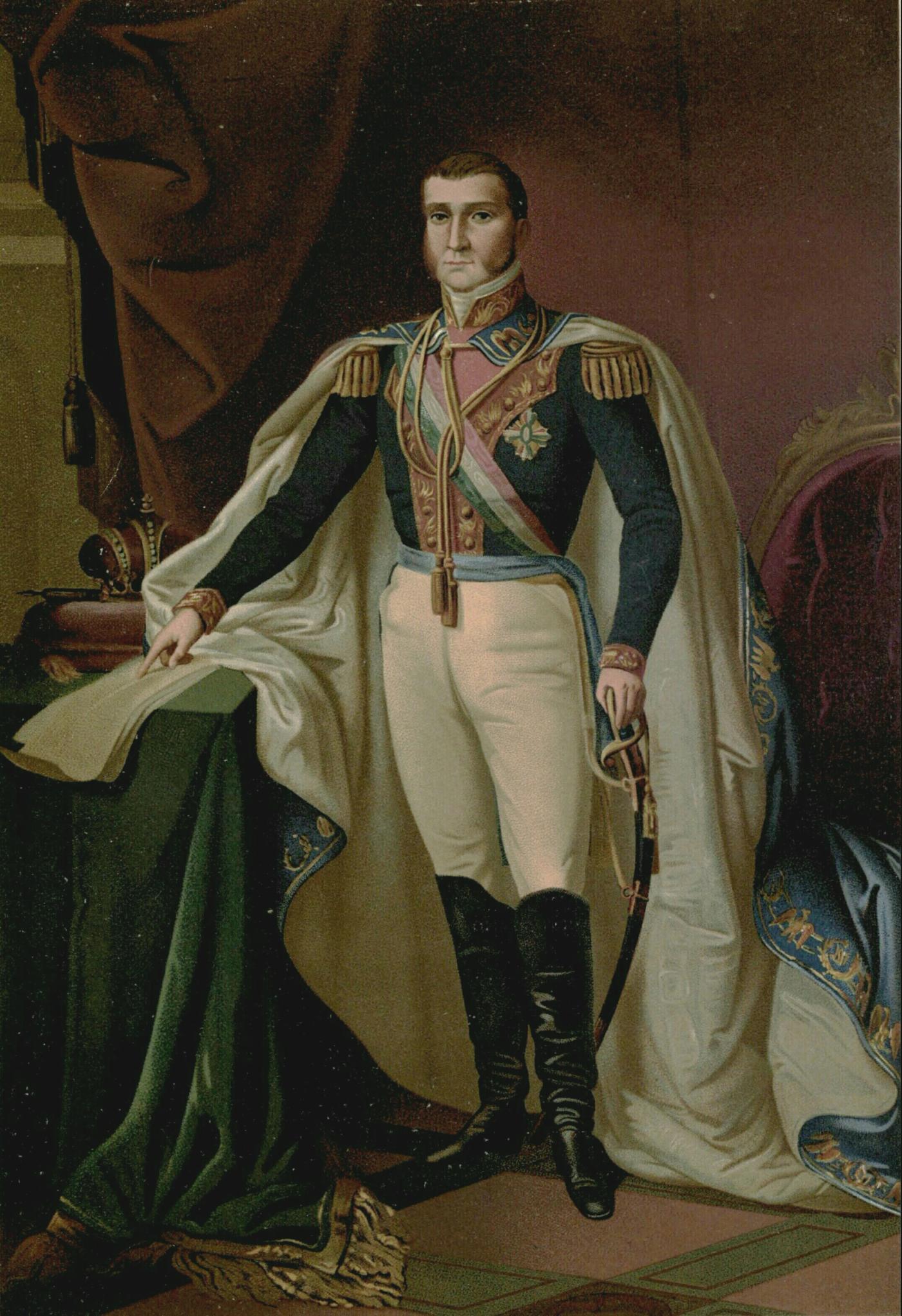
In the first days of January 1823, in Mexico City, the emperor Agustín de Iturbide signed a colonization law that a twenty-nine-year-old American from Missouri had spent months pressing on the imperial government. Stephen F. Austin had come to the capital because Mexico, newly independent of Spain, had refused to honor the Spanish grant that his late father, Moses Austin, had obtained to settle three hundred families in Texas. Settlers recruited on the strength of that grant were already arriving on the Brazos and Colorado Rivers, and their claims had no secure legal footing. Through what his biographer Eugene C. Barker called unremitting attention, Austin persuaded Iturbide's rump legislature, the junta instituyente, to finish a general colonization law, and the emperor signed it.[1] Austin was no admirer of the regime he was petitioning. While in the capital he wrote and circulated manuscript tracts in Spanish urging republican government, and he later recalled that he had "serious fears" Iturbide would succeed in making himself an absolute monarch.[2] Within three months events overtook those fears. Iturbide's empire collapsed, the emperor abdicated, and the law fell with him. Austin stayed on, and in April 1823 the government that succeeded Iturbide confirmed his right to settle three hundred families under the terms of the annulled law.[3]
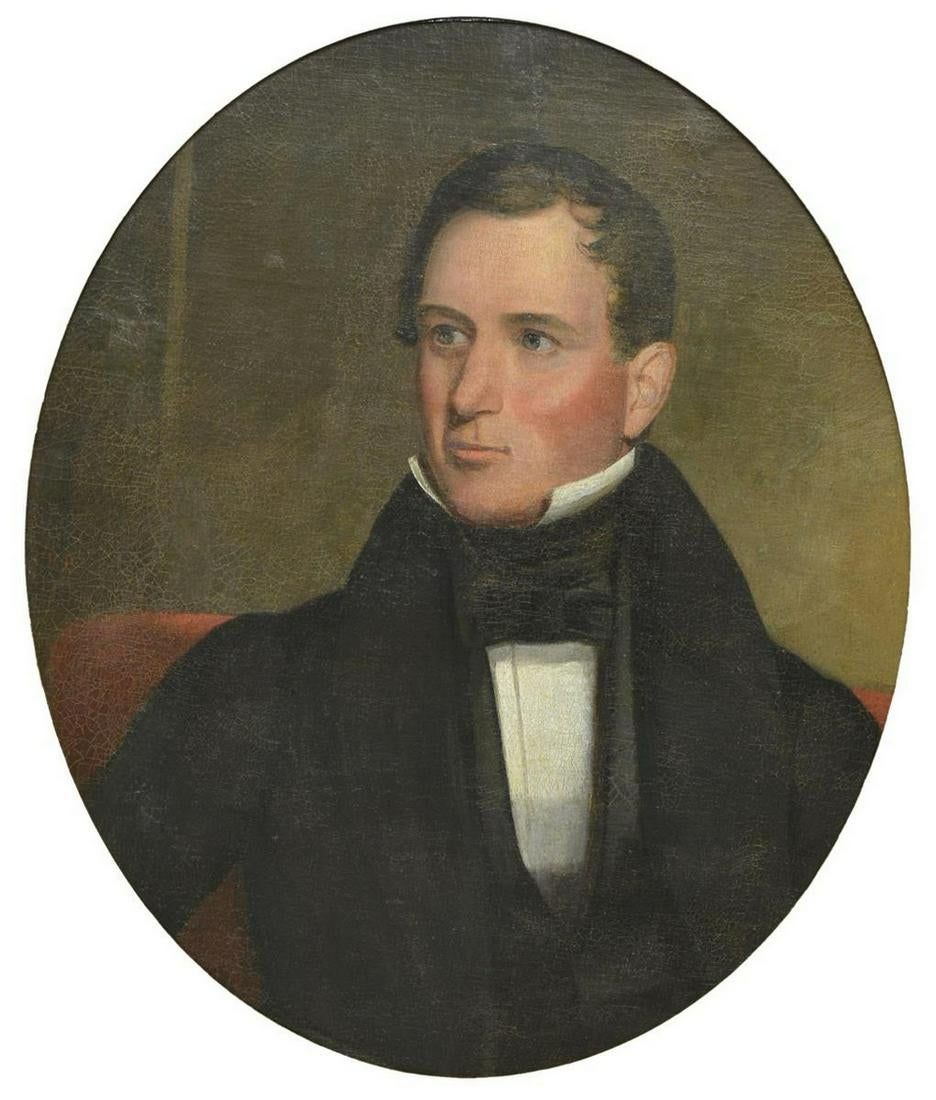
That season in Mexico City set the pattern for what followed. Austin succeeded in Texas because he learned to work inside Mexican politics, patiently and at close range, and his colony survived because the Mexican government wanted it to survive. Mexico invited Americans into Texas under a policy meant to strengthen the young republic's hold on a thinly settled frontier, and that policy produced the population that broke Texas away. Austin went to Mexico City in 1822 as a petitioner, returned to it in 1834 as a prisoner, and came home in 1835 to lead armed Texans against the government that had made him an empresario. This is the story of those twelve years.
Mexico Opens the Door
The imperial law set the template for Mexican colonization. It required its settlers to be Catholic and worked through agents called empresarios, who contracted to bring in families in units of two hundred. Land was measured in Spanish units: the labor, about 177 acres, for farming, and the league or sitio, about 4,428 acres, for grazing; a family that farmed and raised stock could receive one of each. An empresario could earn roughly 67,000 acres of premium land for every two hundred families he settled. One article, by inference, allowed immigrants to bring slaves, while declaring that children born to slaves in Mexico would be free at fourteen.[4]
After Iturbide's fall, Mexico adopted a federal system and rebuilt its colonization policy to match. The national law of August 18, 1824, gave most authority over public land to the states but kept important powers in Mexico City. No grants could be made within twenty leagues of an international border or ten leagues of the coast without federal approval, and Congress reserved the right to stop immigration from any particular nation in the interest of national security. Texas was joined to Coahuila as a single state, whose legislature passed its own colonization law in March 1825. Each immigrant head of family could receive a league of land for a modest fee paid in installments, empresarios earned five leagues for every hundred families, and colonists were to be free of taxes for ten years.[5]
The reasoning behind this generosity was practical. Texas was so sparsely populated that it formed a single department of the new state, governed from San Antonio, and Mexican officials hoped that farmers drawn by cheap land, and by the cotton boom along the Gulf Coast, would bring prosperity to an exposed northern frontier.[6] Repeated American efforts to buy Texas, territory many in the United States had once claimed as part of the Louisiana Purchase, sharpened Mexican anxiety as the colonies grew.[7] Austin won his contract in the year President James Monroe warned Europe against further colonization in the Americas, a declaration that said nothing about the pressure the United States would itself put on Mexico's northern frontier. In both capitals, the question of who would ultimately control Texas was being deferred rather than settled.
Building the Colony: Land, Law, and Fees
Austin largely fulfilled his first contract and, under the state law, obtained three more, in 1825, 1827, and 1828, to settle nine hundred additional families in and around his original colony. Each married settler received a league of land and owed the state thirty dollars within six years.[8] For most of the 1820s Austin was effectively the government of his colony. Until 1828 he held complete civil and military authority, subject only to nominal supervision from San Antonio and Monterrey. He let the colonists elect their own militia officers and alcaldes, local magistrates roughly like American justices of the peace, and wrote a simple civil and criminal code for their courts. Because Mexican practice issued titles on loose sheets with no permanent record, he won permission to record them in a bound volume with the force of the originals.[9]
Money was a constant strain. Austin had originally proposed to charge colonists 12½ cents an acre for surveying, titling, and the other services an empresario provided, and the first settlers welcomed those terms. When the imperial law promised empresarios compensation in land instead, some refused to pay, and the political chief at San Antonio upheld them. Austin then arranged privately to share the land commissioner's fee for signing titles, and under the 1825 state law he required colonists to pay, or promise to pay, first sixty and then fifty dollars a league. Barker concluded that nearly all of the money went to public expenses no one else would cover.[10] The settlers who refused to pay plainly saw the matter differently.
Loyal Mexicans: The Fredonian Test
The first serious test of Anglo-American loyalty came in East Texas. On April 14, 1825, Haden Edwards received an empresario grant to settle as many as eight hundred families around Nacogdoches, an old settlement with existing landholders. Edwards arrived on September 25, 1825, and posted notices on street corners announcing that previous landowners must prove their claims or forfeit their land to new settlers. Probably few titles were actually at risk, but the threat divided old residents from newcomers. A disputed election for alcalde that December deepened the split, and by the middle of 1826 the authorities had declared Edwards's grant forfeit.[11]
Edwards and his brother Benjamin chose rebellion. On December 21, 1826, they and their followers signed a declaration of independence for a republic they called Fredonia, sixteen years after American settlers had declared a republic in Spanish West Florida. Their flag carried two bars, red and white, meant to represent an alliance of Indians and whites, and bore the words "Independence, Liberty, Justice." The rebels signed a treaty with the Cherokee leaders Richard Fields and John Dunn Hunter, but the Cherokee support never materialized. Lieutenant Colonel Mateo Ahumada marched from San Antonio with Mexican troops and enlisted Austin, who sided firmly with the government. When the Mexican force, joined by militia from Austin's colony, reached Nacogdoches on January 31, 1827, the Fredonians fled across the Sabine River into the United States.[12]
Austin rallied his colonists in blunt terms. In an address to the colony's inhabitants on January 22, 1827, he warned that the rebels threatened "Indian Massacre and the plunder of our property" and declared that "they are no longer Americans, for they have forfeited all title to that high name."[13] He led the militia from the Brazos and Colorado in person. Before 1832 his settled policy was to take no part in Mexico's political convulsions, a stance he summed up in 1831 when he advised Samuel May Williams to "play the turtle, head and feet within your own shell."[14] Yet a rebellion by Anglo-Americans, however quickly suppressed, also confirmed the fears of Mexican officials watching the American population of Texas grow.
Mier y Terán's Warning and the Law of April 6, 1830
The government sent an observer to see for itself. On November 10, 1827, General Manuel de Mier y Terán, an engineer by training and a veteran of the independence war, left Mexico City at the head of a boundary commission charged with fixing the border with the United States, observing the land and Indian peoples of Texas, and assessing the number and attitudes of its American settlers. He traveled with a military escort in a large coach inlaid with silver, accompanied by scientists including the naturalist Jean Louis Berlandier. The commission reached San Antonio on March 1, 1828, San Felipe on April 27, and Nacogdoches on June 3, and Mier y Terán remained in East Texas until January 16, 1829.[15] Writing from Nacogdoches to President Guadalupe Victoria on June 30, 1828, he warned that Mexican influence faded almost to nothing as one traveled east, and that "Texas could throw the whole nation into revolution."[16] His report urged new garrisons around the settlements, closer trade ties with the Mexican interior, and the encouragement of Mexican and European settlers.[17]
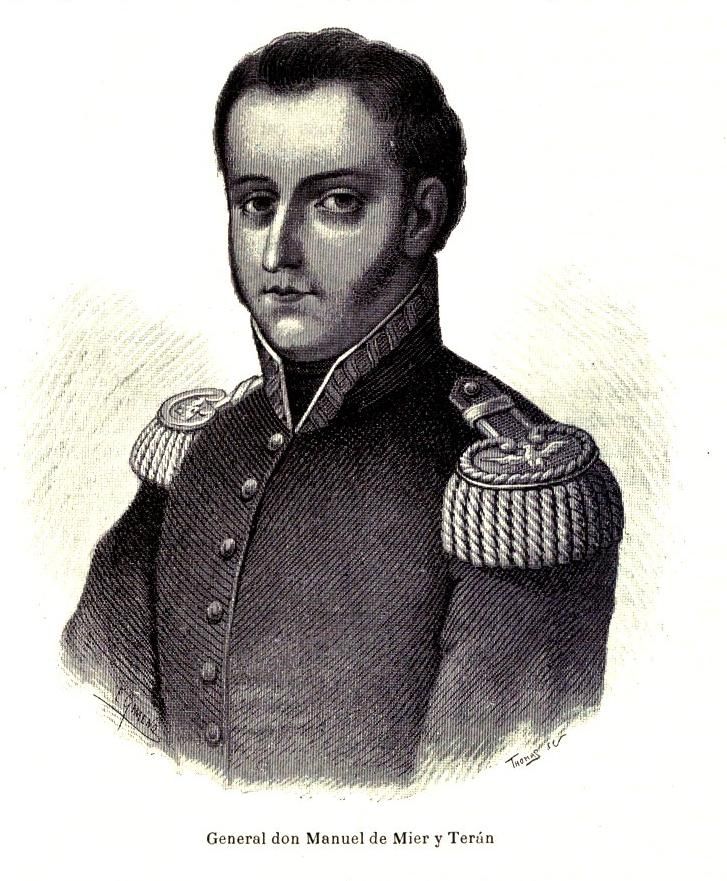
Those recommendations fed into the Law of April 6, 1830, initiated by the minister of foreign relations, Lucas Alamán. The law authorized a loan to transport colonists to Texas, opened the coastal trade to foreign ships for four years, created a federal commissioner of colonization, and forbade the further introduction of slaves. Its eleventh article, which came from Alamán rather than from Mier y Terán, was meant to prohibit or limit immigration from the United States. Mier y Terán doubted Article 11 and the provisions on slavery and passports, though he accepted the post of commissioner.[18]
The law alarmed Austin. He tried to calm his colonists while protesting to Mier y Terán and to President Anastasio Bustamante, and through what Barker called an ingenious and somewhat tortuous reading of Articles 10 and 11 he secured an exemption for his own colonies and for that of his neighbor Green DeWitt. Immigration from the United States continued through that loophole, and Austin worked for years to have Article 11 repealed.[19] The law shook his belief in the goodwill of the Mexican government. In poor health and increasingly despondent over colonization and Mexican politics, Mier y Terán took his own life on July 3, 1832, at Padilla in Tamaulipas, where Iturbide had been executed in 1824.[20]
Slavery: The Guerrero Decree and Austin's Shifting Position
Slavery ran through every stage of the colonization of Texas, and Austin's position on it moved with circumstances. Expecting most colonists to come from the slave states, he offered eighty acres for each slave a settler brought under the terms he first announced in 1821, and in Mexico City he persuaded the imperial junta to legalize slavery in the colonization law.[21] The Constitution of Coahuila and Texas of 1827 then forbade slavery after its promulgation and barred any further introduction of slaves after six months.[22] At Austin's suggestion the legislature evaded the ban with a law permitting labor contracts with nominally emancipated slaves, under which settlers brought enslaved people into Texas as indentured servants under contract to their former owners.[23] For a time he seemed to change his mind. On June 16, 1830, explaining the new federal law to a group of prospective settlers, he wrote that he had once favored a limited admission of slaves to get the colony started, and when he came to the question of whether Texas would become a slave state, he answered, "I will be candid with you on this point, and say that I hope it never may."[24] The colonists were not persuaded, and Austin's own conviction did not last. Writing from Matamoros in May 1833, on his way to Mexico City, he told a correspondent, "I have now, and for the last six months, changed my views of that matter." Texas, he went on, "must be a slave country. Circumstances and unavoidable necessity compels it."[25] Barker, a broadly sympathetic biographer, concluded that whatever Austin's private convictions were, they gave way to what seemed the present needs of Texas.[26]
The most alarming moment for slaveholding colonists had come in 1829. On September 15 of that year President Vicente Guerrero issued a decree abolishing slavery throughout Mexico except in the Isthmus of Tehuantepec. His motives remain uncertain. He may have acted under the influence of José María Tornel, who hoped the decree would check American immigration, or he may have issued it for personal reasons, because his enemies accused him of partial African descent. When it reached Texas on October 16, the political chief, Ramón Músquiz, withheld its publication because it violated the colonization laws' guarantees of security in persons and property. After Texans petitioned, the secretary of relations, Agustín Viesca, wrote on December 2 that slaves in Texas would be left as they were. The decree never took effect there, but it left many colonists convinced that their interests were not safe under Mexican rule.[27]
Economics lay beneath this anxiety. As quoted by the historian Andrew J. Torget, Austin wrote that cotton would lift the colonists out of poverty and that they could not grow it "without the help of slaves."[28] How central slavery was to the revolt that followed is genuinely debated among historians. Torget argues that repeated clashes over slavery between Texans and abolitionists in the Mexican government culminated in the Texas Revolution, and that the Republic of Texas was built on cotton and slavery.[29] Randolph B. Campbell's history of slavery in Texas, the first comprehensive study of the subject, treats the institution as central to Texas history from the colonial period onward and gives a separate chapter to its place in the revolution.[30] An older tradition, represented by Barker, explains the break mainly through political grievances: the ban on American immigration, the enforcement of tariffs, the demand for separate statehood, and the turmoil of Mexican national politics.[31]
Anahuac and the Conventions, 1832–1833
The Law of April 6, 1830, brought soldiers and customs collectors to the Texas coast, and with them the first armed clash. On October 26, 1830, Colonel Juan Davis Bradburn landed with about forty officers and men near the mouth of the Trinity River to establish a garrison and a town, which became Anahuac. His orders were to prevent smuggling and enforce the immigration restrictions. Friction over land titles and customs duties sharpened when Bradburn gave asylum to two or three runaway slaves from Louisiana. William M. Logan of Louisiana hired William B. Travis, a young lawyer, to recover the fugitives, and Travis appears to have tried to trick Bradburn with a false warning that Logan had returned with a large force. Bradburn arrested Travis and his law partner, Patrick C. Jack, and held them first in a guardhouse and then in brick kilns.[32] A rescue force of perhaps two hundred men from the Brazos settlements reached Turtle Bayou, six miles north of Anahuac, on June 9, 1832.[33] On June 13 they adopted the Turtle Bayou Resolutions, which justified their uprising by "the arbitrary, and unconstitutional measures" of Bustamante's administration and aligned them with the Federalist revolt of General Antonio López de Santa Anna.[34] Bradburn's superior soon removed him, and the prisoners were released.[35]
Austin was away at Saltillo, serving in the state legislature, when the trouble began. From there, in a letter of April 9, 1832, to his secretary, Samuel May Williams, he had defended his caution against critics who called it weakness: "Some men in the world hold the doctrine that it is degrading and corrupt to use policy in anything," he wrote, but "there is no degradation in prudence and a well tempered and well timed moderation."[36] The uprising forced him to abandon his policy of aloofness and declare for Santa Anna against Bustamante. Santa Anna won, and the colonists expected a reward for their support. By 1832 Austin's colonies counted about eight thousand people, and others had brought in many more, which made his cautious leadership harder to sustain. The Convention of 1832 met in October and asked for repeal of the immigration ban, an extension of the tariff exemption, and separation from Coahuila as a state. Austin presided but doubted the wisdom of the meeting, in part because San Antonio's Mexican residents sent no delegates, and for reasons that remain unclear its petitions were never presented. A second convention met at San Felipe on April 1, 1833, repeated the requests, and drafted a constitution for the proposed state. Although Austin thought the movement ill-timed, the delegates chose him to carry their petitions to Mexico City.[37]
The Saltillo Arrest and Twenty-Eight Months Away
Austin left San Felipe in April 1833 and reached Mexico City in July. Cholera and civil war delayed the business of Congress, and his patience gave out.[38] On October 2, 1833, he wrote to the ayuntamiento of San Antonio urging every town council in Texas to begin communicating at once so that a local government for Texas, organized as a state of the federation, would be ready to act if Congress refused its approval. Texas, he warned, was lost unless its inhabitants took their affairs into their own hands.[39] The San Antonio council forwarded the letter to state authorities. On December 11, 1833, J. Miguel Falcón, the secretary of state of Coahuila and Texas, sent a copy to the alcalde of San Antonio, José Miguel de Arciniega, warning that it contained subversive ideas capable of sparking a revolution, and ordered Austin's arrest.[40]
Meanwhile Austin's mission appeared to succeed. In November 1833 he reported that both houses of Congress had voted to repeal Article 11, although at Santa Anna's request the repeal would not take effect until May 21, 1834.[41] Santa Anna would not approve a separate state government for Texas, but the government promised reforms in local administration, and Austin started home in December reasonably satisfied.[42] On January 3, 1834, he was arrested on his arrival at Saltillo by the commandant general on an order from the minister of war, as he described it in a letter written from Monterrey nine days later.[43] He was eventually taken back to Mexico City. No charges were filed against him, and no court would accept jurisdiction over his case. He was moved from prison to prison until December 1834, when he was released on bond and confined to the Federal District.[44] In his prison diary he wrote on February 22, 1834, "What a horrible punishment is solitary confinement," and insisted that his intentions had been pure.[45]
While Austin was held in the capital, the political ground in Mexico shifted beneath Texas. Santa Anna, who had risen as the champion of the Federalists, turned toward the Centralists, who favored a strong national government and weak states. In June 1834 a rump group of state deputies at Monclova declared against Santa Anna's Plan of Cuernavaca, and Coahuila split between rival governments at Monclova and Saltillo, locked in a quarrel over the capital and over control of the government. General Martín Perfecto de Cos, the federal military commander, backed Saltillo and ordered troops to disband the legislature at Monclova, which adjourned hastily on April 21, 1835. Governor Agustín Viesca, the same official who had reassured Texans about slavery in 1829, resolved to make San Antonio the capital and on May 25 left Monclova with the state archives. Turned back before he could cross the Rio Grande, he tried to slip away a second time and was captured. In the judgment of the historian Jesús F. de la Teja, this overthrow of constitutional government, together with Viesca's arrest, brought long-smoldering resistance in Texas into the open.[46]
Texans were divided. When customs collection resumed at Anahuac in 1835, a merchant named Andrew Briscoe deliberately provoked the new commander, Captain Antonio Tenorio, who arrested him. Travis raised volunteers, and on June 20, 1835, Tenorio surrendered his small garrison to twenty-five insurgents. Travis had acted without real community support, however, and he felt obliged to apologize publicly so as not to endanger Austin, who was still in Mexico City.[47] Freed by a general amnesty law in July, Austin returned by way of New Orleans and reached Texas at the end of August.[48]
Brazoria, Gonzales, and the End of Patience
Austin had been gone twenty-eight months. He came home to find that an unofficial call had gone out for a convention, to be known as the Consultation. Barker thought he could probably have quashed it. Instead, at a dinner given in his honor at Brazoria on September 8, 1835, he told his listeners that he had no doubt the federal constitution would be destroyed and a central government established. "I see but one way," he said, "and that is by a general consultation of the people."[49] Through September and early October he chaired a central committee at San Felipe, in effect the civil head of Anglo-American Texas.[50] On September 19, as reports arrived that General Cos was bringing more troops to San Antonio, the committee issued a circular over Austin's signature urging every district to organize and drill its militia. "War is our only resource," it declared.[51]
The fighting began over a small cannon. In 1831 the settlement of Gonzales had received a cannon for defense against Indian raids. When the colonists refused to give it up, Domingo de Ugartechea, the military commander in Texas, sent Francisco de Castañeda with one hundred dragoons to retrieve it, with instructions to use force if necessary but to avoid open conflict if possible. Castañeda left San Antonio on September 27, 1835, and two days later found the Guadalupe crossing at Gonzales blocked by high water and eighteen militiamen. After Castañeda moved upriver, the Texans crossed on the night of October 1 and attacked his camp the next morning. During a lull, the Texan commander, John Henry Moore, said they were fighting to keep their cannon and uphold the federal Constitution of 1824. Castañeda answered that he was a Federalist himself but bound by his orders, and, outnumbered, withdrew toward San Antonio. The engagement was only a brief skirmish, but it marked a clear break between the colonists and the Mexican government.[52]
On October 11 the volunteers gathered at Gonzales chose Austin "without opposition" as their commander-in-chief,[53] and he led them against the Mexican army at San Antonio. The Consultation organized on November 3, 1835, and that month the provisional government chose Austin as one of three commissioners to the United States, charged with raising loans, volunteers, and supplies and with seeking American recognition. He returned in June 1836, lost the presidential election that September, served as secretary of state, and died on December 27, 1836, at forty-three.[54]
Why the Twelve Years Mattered
In July 1836, a few months before his death, Austin described the prosperity of Texas as "the idol of my existence," a cause that had guided his thoughts and actions for fifteen years.[55] His loyalty to Mexico was real, but it was bound up with the safety and growth of the colony he had built. As long as the Mexican government offered land, tolerated slavery in practice, and left the colonists largely to govern themselves, he could hold both loyalties together. The Law of April 6, 1830, the Guerrero Decree, the soldiers at Anahuac, his own imprisonment, and finally the dismantling of the federal system pulled them apart.
The Mexican policy of 1823 to 1825 did what it was designed to do in one sense: it filled Texas with settlers. For a decade many of them were loyal Mexican citizens. Most of them, however, came from the American South, and many brought slaves and the habits of a slave society with them.[56] When the national government moved first to restrict immigration and then to centralize power, the population it had invited had both the numbers and the organization, built up through conventions, committees, and militia companies, to resist. Historians continue to debate how much of that resistance concerned constitutional rights and how much concerned the protection of slavery and the cotton economy, and the evidence suggests that the two concerns were intertwined rather than separate.[57]
Austin's career traces the larger story. In January 1823 he waited in Mexico City for an emperor's signature, a petitioner whose entire enterprise depended on Mexican goodwill. Eleven years later he sat in a Mexican cell without charge, held for a letter urging Texans to act on their own. In the autumn of 1835 he led armed volunteers out of Gonzales toward San Antonio. The same policy, generous in intent and fateful in result, set him on each of those journeys.
Places in this Story
The places this story moves through, in order — follow them on the interactive map →
- Mexico City, Mexico January 1823
Emperor Agustín de Iturbide signed the imperial colonization law Austin had spent months pressing on the junta instituyente.
- San Felipe de Austin, Texas 1824
Austin governed his colony from San Felipe, writing its civil and criminal code and recording land titles in a bound volume.
- Nacogdoches, Texas December 1826
Haden Edwards and his followers declared the Republic of Fredonia, and Austin led militia from the Brazos against them.
- San Antonio, Texas March 1828
General Manuel de Mier y Terán's boundary commission reached San Antonio, the seat of government for the department of Texas.
- Padilla, Tamaulipas, Mexico July 1832
Mier y Terán took his own life at Padilla, where Iturbide had been executed in 1824, despondent over colonization and Mexican politics.
- Anahuac, Texas June 1832
Colonel Juan Davis Bradburn jailed William B. Travis and Patrick C. Jack, and a rescue force adopted the Turtle Bayou Resolutions nearby.
- Matamoros, Tamaulipas, Mexico May 1833
On his way to Mexico City, Austin wrote that Texas must be a slave country, reversing the position he had taken in 1830.
- Saltillo, Coahuila, Mexico January 1834
Austin was arrested on his way home from Mexico City on an order from the minister of war, and held without charge for months.
- Monclova, Coahuila, Mexico April 1835
Troops under General Cos forced the Coahuila and Texas legislature to adjourn, and Governor Agustín Viesca was arrested weeks later trying to reach Texas.
- Brazoria, Texas September 1835
At a dinner in his honor Austin told Texans he saw but one way forward, a general consultation of the people.
- Gonzales, Texas October 1835
Texians attacked Francisco de Castañeda's camp rather than give up a small cannon, and the volunteers elected Austin their commander.
Frequently Asked Questions
Why did Mexico invite American settlers into Texas?
Texas was a thinly populated northern frontier, and Mexico hoped that farmers drawn by cheap land would bring prosperity and security to it. The imperial law of 1823 offered a family a labor of farmland, a league of grazing land, or both, and the state law of 1825 added a league for a small fee and ten years free of taxes.
Who was Stephen F. Austin and what did an empresario do?
Stephen F. Austin was an American from Missouri who took over his father's Texas colonization grant and settled the first three hundred families on the Brazos and Colorado Rivers. An empresario contracted with the Mexican government to recruit settlers in units of one or two hundred families, earning premium land for each group he delivered.
What was the Law of April 6, 1830?
It was a Mexican law that forbade the further introduction of slaves, created a federal commissioner of colonization, and in its eleventh article sought to stop immigration from the United States. Austin won an exemption for his own colonies through a strained reading of the law, so settlement continued.
Why was Stephen F. Austin arrested in 1834?
He had written to the town council of San Antonio in October 1833 urging Texans to organize a state government without waiting for approval from Congress. Coahuila's secretary of state called the letter subversive and ordered his arrest, which came at Saltillo on January 3, 1834.
Was slavery legal in Mexican Texas?
The Constitution of Coahuila and Texas banned slavery in 1827, and President Guerrero's decree of September 1829 abolished it across Mexico, though the decree was withheld in Texas and never took effect there. Colonists evaded the ban by bringing enslaved people in as indentured servants bound by labor contracts to their former owners.
What was the Fredonian Rebellion?
Haden Edwards and his followers declared an independent republic called Fredonia at Nacogdoches in December 1826 after Mexico revoked his empresario grant. Austin sided with the government and led militia from his colony against the rebels, and the rebels fled across the Sabine River in January 1827.
What happened at the Battle of Gonzales in 1835?
Mexican dragoons were sent to retrieve a small cannon the settlement had been given for defense against Indian raids, and the colonists refused to surrender it. Texians attacked the Mexican camp on October 2, 1835, and the brief skirmish marked the opening of the Texas Revolution.
Bibliography
Primary Sources
Austin, Stephen F. Prison diary, 1834–35. Dolph Briscoe Center for American History, University of Texas at Austin. Digital item 419392. https://digitalcollections.briscoecenter.org/item/419392.
Barker, Eugene C., ed. The Austin Papers. Vol. 2. Annual Report of the American Historical Association for the Year 1922, vol. 2. Washington, DC: Government Printing Office, 1928. Digitized at Texas History Trust. https://archive.texashistorytrust.org/view/1068778431.
Barker, Eugene C., ed. The Austin Papers. Vol. 3. Austin: University of Texas, 1927. Digitized at Texas History Trust. https://archive.texashistorytrust.org/view/1069188110.
"Decreto de 6 de Abril de 1830." Broadside. Dolph Briscoe Center for American History, University of Texas at Austin.
Digital Austin Papers. University of North Texas Department of History and Portal to Texas History. https://digitalaustinpapers.org.
Falcón, J. Miguel. Letter to José Miguel de Arciniega, December 11, 1833. Dolph Briscoe Center for American History, University of Texas at Austin.
Mirabeau B. Lamar Papers. Archives and Information Services Division, Texas State Library and Archives Commission, Austin. Selections reproduced in "Texas Treasures." https://www.tsl.texas.gov/treasures/.
"Sobre el Establecimiento colonial." March 20, 1823. Dolph Briscoe Center for American History, University of Texas at Austin. Digital item 419385. https://digitalcollections.briscoecenter.org/item/419385.
Texas History for Teachers. "Growing Tension in Texas: Primary Source Readings." University of North Texas. https://education.texashistory.unt.edu/downloads/documents/7/units/mexican-national/lessons/growing-tension-extension/en/primary-source-readings.pdf.
Secondary Sources
Barker, Eugene C. "Austin, Stephen Fuller." Handbook of Texas Online. Texas State Historical Association. Originally published 1952; revised February 25, 2021. https://www.tshaonline.org/handbook/entries/austin-stephen-fuller.
Barker, Eugene C. "Mexican Colonization Laws." Handbook of Texas Online. Texas State Historical Association. Originally published 1952; revised July 30, 2020. https://www.tshaonline.org/handbook/entries/mexican-colonization-laws.
Bishop, Curtis. "Law of April 6, 1830." Handbook of Texas Online. Texas State Historical Association. Originally published 1952; revised May 4, 2016. https://www.tshaonline.org/handbook/entries/law-of-april-6-1830.
Blake, Robert Bruce. "Guerrero Decree." Handbook of Texas Online. Texas State Historical Association. Originally published 1952; revised August 2, 2020. https://www.tshaonline.org/handbook/entries/guerrero-decree.
Bullock Texas State History Museum. "Arresting Stephen F. Austin." https://www.thestoryoftexas.com/artifact-stories/arresting-stephen-f-austin/.
Campbell, Randolph B. An Empire for Slavery: The Peculiar Institution in Texas, 1821–1865. Baton Rouge: Louisiana State University Press, 1989.
de la Teja, Jesús F. "Coahuila and Texas." Handbook of Texas Online. Texas State Historical Association. Originally published 1952; revised June 17, 2021. https://www.tshaonline.org/handbook/entries/coahuila-and-texas.
Hardin, Stephen L. "Gonzales, Battle of." Handbook of Texas Online. Texas State Historical Association. Originally published 1952; revised August 2, 2020. https://www.tshaonline.org/handbook/entries/gonzales-battle-of.
Henson, Margaret S. "Anahuac Disturbances." Handbook of Texas Online. Texas State Historical Association. Originally published 1952; revised September 8, 2020. https://www.tshaonline.org/handbook/entries/anahuac-disturbances.
Henson, Margaret S. "Mier y Terán, Manuel de." Handbook of Texas Online. Texas State Historical Association. Originally published 1952; revised July 28, 2017. https://www.tshaonline.org/handbook/entries/mier-y-teran-manuel-de.
Howren, Alleine. "Causes and Origin of the Decree of April 6, 1830." Southwestern Historical Quarterly 16 (April 1913).
McDonald, Archie P. "Fredonian Rebellion." Handbook of Texas Online. Texas State Historical Association. Originally published 1952; revised October 22, 2020. https://www.tshaonline.org/handbook/entries/fredonian-rebellion.
McDonald, Archie P. "Travis, William Barret." Handbook of Texas Online. Texas State Historical Association. Originally published 1952; revised February 24, 2026. https://www.tshaonline.org/handbook/entries/travis-william-barret.
McKay, S. S. "Constitution of Coahuila and Texas." Handbook of Texas Online. Texas State Historical Association. Originally published 1952; revised December 1, 1994. https://www.tshaonline.org/handbook/entries/constitution-of-coahuila-and-texas.
"San Felipe de Austin, TX." Handbook of Texas Online. Texas State Historical Association. Accessed November 1, 2026. https://www.tshaonline.org/handbook/entries/san-felipe-de-austin-tx.
Swanson, Doug J. "History Review: Seeds of Empire: Cotton, Slavery, and the Transformation of the Texas Borderlands, 1800–1850, by Andrew J. Torget." Dallas Morning News, February 19, 2016. https://www.dallasnews.com/arts/books/2016/02/19/history-review-seeds-of-empire-cotton-slavery-and-the-transformation-of-the-texas-borderlands-1800-1850-by-andrew-j-torget.
Torget, Andrew J. Seeds of Empire: Cotton, Slavery, and the Transformation of the Texas Borderlands, 1800–1850. Chapel Hill: University of North Carolina Press, 2015.
Citations
- Eugene C. Barker, "Austin, Stephen Fuller," Handbook of Texas Online. Barker and the Handbook date the emperor's signature January 3, 1823; the Dolph Briscoe Center's description of Austin's 1823 grant, "Sobre el Establecimiento colonial," dates the law January 4. ↑
- Stephen F. Austin, note on his "Plan for the Organization of Congress for the Empire of Mexico," April 8, 1823, copy in Mirabeau B. Lamar Papers #47, Texas State Library and Archives Commission, reproduced in "Texas Treasures." The surviving text is Lamar's transcription; the date of Austin's note is not given. ↑
- Barker, "Austin, Stephen Fuller"; Eugene C. Barker, "Mexican Colonization Laws," Handbook of Texas Online. ↑
- Barker, "Mexican Colonization Laws." ↑
- Barker, "Mexican Colonization Laws." Barker dates the state law March 25, 1825; some accounts give March 24. ↑
- Jesús F. de la Teja, "Coahuila and Texas," Handbook of Texas Online; Andrew J. Torget, Seeds of Empire: Cotton, Slavery, and the Transformation of the Texas Borderlands, 1800–1850 (Chapel Hill: University of North Carolina Press, 2015). The summary of Torget's argument follows the publisher's description of the book; page numbers could not be verified. ↑
- Barker, "Austin, Stephen Fuller." ↑
- Barker, "Austin, Stephen Fuller." ↑
- Barker, "Austin, Stephen Fuller." ↑
- Barker, "Austin, Stephen Fuller." ↑
- Archie P. McDonald, "Fredonian Rebellion," Handbook of Texas Online. ↑
- McDonald, "Fredonian Rebellion." ↑
- Stephen F. Austin, address to the inhabitants of the colony, January 22, 1827, Mirabeau B. Lamar Papers #67, Texas State Library and Archives Commission, reproduced in "Texas Treasures." ↑
- Stephen F. Austin to Samuel M. Williams, Saltillo, February 19, 1831, in Eugene C. Barker, ed., The Austin Papers, vol. 2 (Washington, DC: Government Printing Office, 1928), 599–604; transcription in Digital Austin Papers, document APB4154. Barker's Handbook entry renders the phrase as "head and feet within our own shells"; the wording here follows the letter. The Digital Austin Papers labels the printed source "Vol. 1, Part 2," but the letter appears in the second volume of the edition, published in 1928. ↑
- Margaret S. Henson, "Mier y Terán, Manuel de," Handbook of Texas Online. ↑
- Manuel de Mier y Terán to Guadalupe Victoria, Nacogdoches, June 30, 1828, as excerpted in "Growing Tension in Texas: Primary Source Readings," Texas History for Teachers, University of North Texas. Classroom reproductions attribute the English translation to Alleine Howren, "Causes and Origin of the Decree of April 6, 1830," Southwestern Historical Quarterly 16 (April 1913), and give pages 395–98; those pages have not been checked against the journal, and the translation has not been collated with the Spanish original. ↑
- Henson, "Mier y Terán, Manuel de." ↑
- Curtis Bishop, "Law of April 6, 1830," Handbook of Texas Online. The printed decree survives as "Decreto de 6 de Abril de 1830," broadside, Dolph Briscoe Center for American History, University of Texas at Austin. ↑
- Bishop, "Law of April 6, 1830"; Barker, "Austin, Stephen Fuller." ↑
- Henson, "Mier y Terán, Manuel de." ↑
- Barker, "Austin, Stephen Fuller." ↑
- S. S. McKay, "Constitution of Coahuila and Texas," Handbook of Texas Online. ↑
- Barker, "Austin, Stephen Fuller"; Margaret S. Henson, "Anahuac Disturbances," Handbook of Texas Online. ↑
- Stephen F. Austin to Richard Ellis et al., San Felipe de Austin, June 16, 1830, in Barker, Austin Papers, 2:421–23; transcription in Digital Austin Papers, document APB1965. The quotation follows the Digital Austin Papers transcription. ↑
- Stephen F. Austin to Wily Martin, Matamoros, dated "May 30, 1831 [1833]," in Barker, Austin Papers, 2:977–81; transcription in Digital Austin Papers, document APB4574. The text survives only as an 1854 newspaper reprint dated 1831; the bracketed 1833 is Barker's editorial correction, which is consistent with the letter's place of writing, since Austin was at Matamoros in late May 1833 on his way to Mexico City and other letters he wrote there are dated May 31, 1833. See also Barker, "Austin, Stephen Fuller." ↑
- Barker, "Austin, Stephen Fuller." ↑
- Robert Bruce Blake, "Guerrero Decree," Handbook of Texas Online. ↑
- Austin, quoted in Torget, Seeds of Empire, as reported in Doug J. Swanson, "History Review: Seeds of Empire," Dallas Morning News, February 19, 2016. Austin's original letter, which a University of North Texas teaching resource describes as written to a Tejano friend early in the 1820s, could not be located; the page number in Torget could not be verified. ↑
- Torget, Seeds of Empire, especially the chapter "Cotton, Slavery, and the Secession of Texas, 1829–1836." Page numbers could not be verified; the summary follows the publisher's description of the book. ↑
- Randolph B. Campbell, An Empire for Slavery: The Peculiar Institution in Texas, 1821–1865 (Baton Rouge: Louisiana State University Press, 1989), chap. 1, "The Colonial Period, 1821–1835," and chap. 2, "Slavery in the Texas Revolution, 1835–1836." Page numbers could not be verified. ↑
- Barker, "Austin, Stephen Fuller." ↑
- Archie P. McDonald, "Travis, William Barret," Handbook of Texas Online. Henson, "Anahuac Disturbances," says only that "a man, perhaps Travis" delivered the warning. ↑
- Henson, "Anahuac Disturbances." ↑
- Henson, "Anahuac Disturbances"; Turtle Bayou Resolutions, address to Col. José Antonio Mexía, June 13, 1832, Mirabeau B. Lamar Papers #157, Texas State Library and Archives Commission, reproduced in "Texas Treasures." ↑
- Henson, "Anahuac Disturbances." ↑
- Barker, "Austin, Stephen Fuller"; Stephen F. Austin to Samuel M. Williams, Leona Vicario [Saltillo], April 9, 1832, in Barker, Austin Papers, 2:762–63, digitized at Texas History Trust. ↑
- Barker, "Austin, Stephen Fuller." ↑
- Stephen F. Austin to Samuel M. Williams, Mexico, August 28, 1833, in Barker, Austin Papers, 2:1003; Austin to the Ayuntamiento of Béxar, October 2, 1833, in Barker, Austin Papers, 2:1007–8 (Spanish text from a copy certified by J. Miguel Falcón, Monclova, March 18, 1834). Both letters describe cholera and civil war stalling public business; Barker's Handbook entry refers only to "unavoidable delays." ↑
- Austin to the Ayuntamiento of Béxar, October 2, 1833, in Barker, Austin Papers, 2:1007–8; "Arresting Stephen F. Austin," Bullock Texas State History Museum. The summary paraphrases the Spanish text. ↑
- J. Miguel Falcón to José Miguel de Arciniega, December 11, 1833, Dolph Briscoe Center for American History, University of Texas at Austin, as quoted and described in "Arresting Stephen F. Austin," Bullock Texas State History Museum. ↑
- Stephen F. Austin to Samuel M. Williams, Mexico, November 26, 1833, in Barker, Austin Papers, 2:1016. Barker's Handbook entry dates the repeal December 1833, and his entry on the colonization laws dates it May 1834; Austin's letter shows that the repeal passed in late 1833 and took effect in May 1834. ↑
- Barker, "Austin, Stephen Fuller." ↑
- Stephen F. Austin to Samuel M. Williams, Monterrey, January 12, 1834, in Barker, Austin Papers, 2:1024. ↑
- Barker, "Austin, Stephen Fuller." ↑
- Stephen F. Austin, prison diary, entry of February 22, 1834, Dolph Briscoe Center for American History, University of Texas at Austin, digital item 419392; quoted in "Arresting Stephen F. Austin," Bullock Texas State History Museum. ↑
- de la Teja, "Coahuila and Texas"; Henson, "Anahuac Disturbances"; Stephen L. Hardin, "Gonzales, Battle of," Handbook of Texas Online. The adjournment date follows de la Teja; some accounts place it in May 1835. ↑
- Henson, "Anahuac Disturbances." ↑
- Barker, "Austin, Stephen Fuller." ↑
- Stephen F. Austin, speech at Brazoria, September 8, 1835, in Eugene C. Barker, ed., The Austin Papers, vol. 3 (Austin: University of Texas, 1927), 116–19, from a clipping of the Telegraph and Texas Register; digitized at Texas History Trust. ↑
- Barker, "Austin, Stephen Fuller." ↑
- Stephen F. Austin for the Committee of Safety, circular, San Felipe, September 19, 1835, Mirabeau B. Lamar Papers #229, Texas State Library and Archives Commission, reproduced in "Texas Treasures." ↑
- Hardin, "Gonzales, Battle of." ↑
- P. W. Grayson to Stephen F. Austin, Camp at Gonzales, October 11, 1835, in Barker, Austin Papers, 3:173. ↑
- Barker, "Austin, Stephen Fuller." ↑
- Stephen F. Austin to Edmund P. Gaines, Peach Point, July 27, 1836, in Barker, Austin Papers, 3:403, from Austin's letter book; digitized at Texas History Trust. ↑
- Campbell, Empire for Slavery, chap. 1. Page numbers could not be verified. ↑
- Torget, Seeds of Empire; Campbell, Empire for Slavery, chaps. 1–2. ↑