In January 1822, a twenty-eight-year-old man waited near the mouth of the Colorado River on the Texas coast for a ship that did not come. Stephen F. Austin had ridden overland from Louisiana with ten men to meet the schooner Lively, which had sailed from New Orleans in late November carrying provisions, arms, ammunition, farming tools, and the first party of settlers for the colony he had promised to found. For nearly three weeks he and his companions waited in the area, living on catfish and wild onions, with no bread or salt. At last he gave up hope of meeting the vessel and followed the river upstream toward the crossing of the road to La Bahía.[1] He set these details down himself by 1824, writing in the third person, in a family register his father had begun.
That scene on the riverbank is a useful place to begin, because it captures something easily lost in the later image of Austin as the "Father of Texas." He came to Texas as a debtor, a failed land speculator, a frontier judge who had served only briefly, and a law student living on a friend's generosity. He had joined his father's Texas scheme with little enthusiasm and inherited it when his father died. Nearly everything he attempted between 1810 and 1822 went wrong. That is how he acquired the skills that would make him the most successful colonizer in Mexican Texas, among them a knowledge of land law, experience in politics, patience with officials, and a stubborn capacity to absorb disappointment. This is the story of those twelve years.
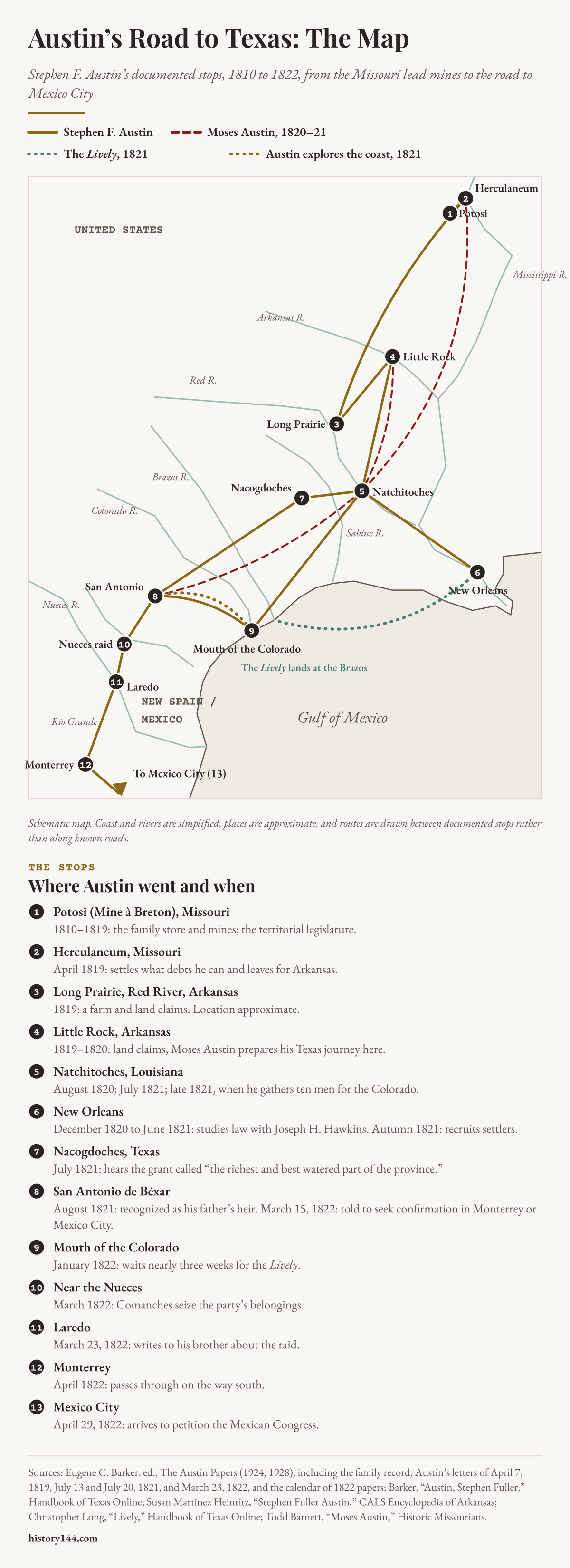
The Heir to Mine à Breton
Stephen Fuller Austin was born at the lead mines of southwestern Virginia on November 3, 1793, and in 1798 his father, Moses Austin, moved the family west to Mine à Breton in Spanish Upper Louisiana, near present-day Potosi, Missouri.[2] Moses was an aggressive businessman whose Virginia lead enterprise had sunk into debt. In Missouri he built a second fortune. Using an efficient reverberatory furnace, a design he had learned from English smelters, he gained control of virtually all the smelting in the district and, by his biographer David B. Gracy's estimate, amassed a fortune of $190,000.[3] For four consecutive years beginning in 1805 his mine produced more than 800,000 pounds of lead.[4]
At eleven Stephen was sent east to Bacon Academy in Colchester, Connecticut, where he studied from 1804 to 1807, and he then spent two years at Transylvania University in Lexington, Kentucky.[5] He returned to Missouri in the spring of 1810, at sixteen, and went to work in the family's general store at Potosi. Over the following years he took over the management of most of the lead business as well.[6]
The inheritance he was being prepared to receive was already weakening. Beginning in 1807 the price of lead shot fell sharply, a large consignment of lead sat in New Orleans for more than a year after Moses's agent there took his own life, and lawsuits with a local rival, John Smith T, drained money. Moses responded, characteristically, by borrowing and expanding. He laid out the river town of Herculaneum on the Mississippi and built a shot tower there, but workers drifted away from Mine à Breton to newer diggings, and the War of 1812 disrupted trade across the frontier. In 1812 the mine produced roughly half of what it had yielded in 1808. When Maria Austin, Stephen's mother, traveled to Philadelphia in 1811 with the younger children, Emily and James (called Brown), the money ran out, and they lived on the charity of others for two years before Moses could bring them home.[7]
Young Stephen, meanwhile, was entering public life. In September 1813 he enlisted as a private in the First Regiment of Mounted Militia, ending a brief term of service in October as a quartermaster sergeant, and he became a Freemason, joining the first Masonic lodge west of the Mississippi.[8] He also became adjutant of a militia regiment, although the date is uncertain. The Encyclopedia of Arkansas places his commission in May 1813, while a 1918 essay in the Southwestern Historical Quarterly says that Governor William Clark commissioned him in 1815. A militia report addressed to him as adjutant of the Sixth Regiment, dated September 1, 1814, shows that he held the post by then. For his legislative service, both the Encyclopedia of Arkansas and the 1918 essay say he was elected to the Missouri territorial legislature in 1813 and reelected through 1819, while the Handbook of Texas says only that he sat "for several years."[9]
Banker, Legislator, and Debtor
Austin's most consequential legislative work concerned money. Scarce currency had hampered business on the frontier for years, and Moses Austin joined other Missouri men in founding the Bank of St. Louis, the first bank west of the Mississippi. In the legislature Stephen was influential in securing its charter, and he later served as one of its directors.[10]
In 1816 Moses Austin moved to Herculaneum and returned to merchandising.[11] The family record notes that on April 20 of that year he left Mine à Breton and handed Stephen Durham Hall, the plantation, the mines and furnaces, and the enslaved people who worked them.[12] According to the State Historical Society of Missouri, Moses had already tried leasing a large number of enslaved laborers to work the mines, which only deepened the debt, and placing Stephen in charge did not reverse the decline.[13] The bank itself was soon in difficulty, and it failed in 1819, the year of the panic that swept the western economy.[14]
Austin's letters from the spring of 1819 show him trying to settle his affairs and get out. On April 5, writing from Herculaneum to William M. O'Hara, a partner in land speculations, he complained that the bank had pressed hard terms on his father. He warned that he would distance himself from it if it became "an instrument of oppression to ruin men without necessity." He was, he added, "in great sperits as to getting the seat of Government at little Rock," where he and O'Hara hoped to hold land.[15] Two days later he apologized that he could not repay a loan of $150, sent instead a power of attorney to sell three shares of bank stock, and explained that he was "very much embarrased, as every cent I owe in the Country must be paid before I can start." His father, he added, had undertaken to pay Stephen's own debt to the bank.[16]
A New Start on the Red River
In 1819 Austin left Missouri for the newly created Arkansas Territory.[17] He acquired land at Long Prairie on the Red River, in what is now far southwestern Arkansas, and set up a farm stocked in part with goods brought from Missouri.[18] He also pursued claims at Little Rock, which was soon chosen as the territorial capital.[19]
Politics followed him south. When the territory held its first election for a delegate to Congress in November 1819, Austin stood as a candidate and lost to James Woodson Bates.[20] The following summer Governor James Miller found a place for him. On July 10, 1820, at the Post of Arkansas, Miller commissioned Austin judge of the first judicial circuit of the territory, and the next day Austin swore before Judge Andrew Scott to support the Constitution and perform the duties of the office.[21] He held court only briefly. By the end of August he was in Natchitoches, Louisiana, and by December he was in New Orleans.[22]
The collapse in Missouri had meanwhile reached its bottom. Creditors filed a wave of lawsuits against Moses Austin, and on March 11, 1820, he was arrested and jailed for debt. Ten days later Mine à Breton was seized, and it was eventually sold to satisfy part of what he owed. In May he sold the shot tower at Herculaneum for $2,000 and used the money to finance a new and much larger gamble.[23]
He had developed a plan to settle a colony of Americans in Spanish Texas, and after the Adams-Onís Treaty of 1819 clarified Spain's title to the province, he resolved to carry it out.[24] He spent several months preparing in Arkansas, where Stephen was living, and in the autumn of 1820 he set out for San Antonio. He traveled with Richmond, a man enslaved by Stephen, and a memorandum dated November 27 lists Stephen's gray horse, Richmond, a mule, and cash for expenses, all of which Moses promised to account for to his son or return.[25] Stephen did not go with him, and by the Handbook of Texas's account he was not enthusiastic about the venture.[26]
Hard Times in New Orleans
When Austin arrived in New Orleans late in 1820 he had almost nothing. In a letter to his mother, which the editor of his papers dates January 20, 1821, he described his situation with unusual frankness. He had offered to hire himself out "as clerk, as an overseer, or anything else," but business was so slow that hundreds of young men were glad to work merely for their board. He had given his Arkansas property to his father, and he worried that his Missouri creditors might pursue him even there. "My reputation is all I have on earth," he wrote.[27]
His rescue came from a stranger. Joseph H. Hawkins was a Kentucky lawyer who had served in the state legislature and briefly in the United States Congress before moving to New Orleans in 1819 to practice law and trade.[28] Hawkins offered Austin board, the use of his law library, and money for clothes, and promised to teach him until he was ready to practice, charging nothing for board or books and waiting for repayment of the money until Austin could earn it. The offer, Austin told his mother, came from a man "who two months ago was a stranger to me" and had "almost made me change my opinion of the human race." He resolved to accept, expecting to need eighteen months to learn Louisiana's civil law and French. Meanwhile he was helping to edit a newspaper, the Louisiana Advertiser. He used an advance from Hawkins to ship a few groceries upriver to his mother and sister, and promised to keep them supplied with sugar and coffee when he could.[29]
The precise beginning of the friendship is uncertain. The Handbook of Texas dates the meeting to early January 1821, but Austin's own letter implies that he had known Hawkins for about two months, and Hawkins wrote in late June that Austin had been part of his household for the previous eight months.[30] In early 1821, Austin was on course to become a Louisiana lawyer. Events in San Antonio changed that.
A Father's Last Request
Moses Austin reached San Antonio in December 1820. The Handbook of Texas gives his arrival as December 23, while the family record places it about the tenth of the month.[31] Governor Antonio María Martínez at first rejected his petition. By what has become one of the best-known coincidences in Texas history, Moses then encountered the Baron de Bastrop, a San Antonio resident whom he had met by chance in New Orleans nineteen years earlier and who was on good terms with Spanish officials. Bastrop accompanied him back to the governor, and on December 26 Martínez endorsed the plan and forwarded it to his superiors.[32]
The return journey nearly killed Moses. According to the family record, his party's provisions failed, their powder proved too damaged to kill game, and he went eight days without food before reaching settlements on the Sabine. He lay ill for three weeks at the house of Hugh McGuffin, twenty miles west of Natchitoches, and reached Herculaneum in March 1821.[33] Soon afterward he learned that Joaquín de Arredondo, the commandant general of the Eastern Interior Provinces, had approved his petition to settle three hundred families in Texas.[34] He threw himself into preparations and neglected his health.[35] Late that spring, after catching cold at Mine à Breton, he reached his daughter Emily Bryan's home at Hazel Run, where the cold became an inflammation of the lungs.[36]
On June 8 Maria Austin wrote to Stephen describing his father's condition. Moses, she said, had called her to his bedside and "with much distress an difficulty of speech, beged me to tell you to take his place," praying that if he were prevented from finishing his plans, God would enable Stephen "to go on with the business in the same way he would have done."[37] Moses Austin died on June 10, 1821.[38] He was still about $15,000 in debt.[39] The more famous version of his last words comes from a second letter, which Maria wrote to Stephen on August 25, after the death. In it she recalled that Moses "drew me down to him" and "told me it was two late," and that he asked her to "tell dear Stephen that it is his dieing fathers last request to prosecute the enterprise he had Commenced."[40] Mary Austin Holley, Stephen's cousin, repeated the substance of that request in the account of the colony she published in 1833.[41]
Stephen was already on the move before these letters could reach him. Hawkins had agreed to take a joint interest in the Texas grant. An earlier letter from Maria then arrived, enclosing one from her son-in-law, James Bryan, that urged Stephen in his father's name to carry the work forward while illness kept Moses at home. The two men decided that he should leave at once to meet the Spanish officers waiting at Natchitoches. Hawkins advanced the money. Stephen left New Orleans about June 17 with eight or ten men.[42]
The news of his father's death overtook him on the road. On July 13, writing from Natchitoches, he told his mother that he had already crossed the Sabine when Hawkins's express reached him, and that he had turned back to settle some business with the Spanish agent before setting out again. "He was one of the most feeling and affectionate Fathers that ever lived," he wrote, "his faults I now say, and always have, were not of the heart." The Spanish officers believed the death would not delay the settlement, and he told his mother that he still hoped "great good" would come from his father's "astonishing perseverence and fatigue last winter."[43]
Eight days earlier, at Natchitoches, he had authorized an agent to sell Richmond, the man who had traveled with Moses to San Antonio, for no less than $650, with part of the proceeds to pay a note Stephen had signed that day.[44] Whether the sale took place is not recorded in that document, but from its first weeks the enterprise was carried forward on borrowed money and on the value of an enslaved man.
Into Texas
Austin crossed into Texas with his party, now grown to sixteen Americans, and two prominent residents of San Antonio, Erasmo Seguín and Juan Martín de Veramendi, who had been sent to conduct his father to the grant before word of the death reached them.[45] On July 18, 1821, with Agustín de Iturbide's movement for independence in control of most of Mexico, Martínez was forced to order the oath of allegiance to Iturbide.[46] Austin reached San Antonio in August. Martínez received him as his father's heir and authorized him to carry the colonizing enterprise forward under the original grant.[47]
Under the terms they settled, the colonists would receive 640 acres for the head of a family, 320 for a wife, 160 for each child, and 80 for each slave, and Austin would be allowed to collect 12½ cents an acre for his services.[48] With the governor's permission, Austin then explored the coastal plain. According to the family record, he examined the country from Matagorda Bay to the Colorado and Brazos Rivers and chose the land between those two rivers, running from the San Antonio–Nacogdoches road down to the sea, as the best site for a flourishing colony.[49] Before he saw it, he had been assured at Nacogdoches by a traveler that the grant was "the richest and best watered part of the province." He passed the judgment along in a letter to a New Orleans correspondent, apparently Hawkins, and it soon appeared in the New Orleans and Arkansas newspapers.[50]
All of this was done through an interpreter. Writing eight years later, Austin recalled that in 1821 he "did not understand one word of Spanish."[51] Back in New Orleans that autumn, he published the terms and invited settlers, promising lands on the Brazos and Colorado. The long depression in the western states, the Panic of 1819, and changes in the federal land system made many Americans eager to move.[52] Letters of inquiry soon reached him from Arkansas, Kentucky, Virginia, Missouri, and Mississippi, some from families too poor to pay their own passage.[53]
On November 14, 1821, Austin and Hawkins formalized their partnership. Austin acknowledged receiving $4,000 from Hawkins, and Hawkins became entitled to half the lands and profits of the venture.[54] The Handbook of Texas judges that Hawkins probably did not advance the full sum, but he exhausted his resources on the colony, buying and outfitting the Lively among other outlays, and he died bankrupt in October 1823.[55] Nathaniel Cox, writing to Austin the following June, reported that the money Hawkins had put into the venture "Exceeds Thirty Thousand dollars."[56]
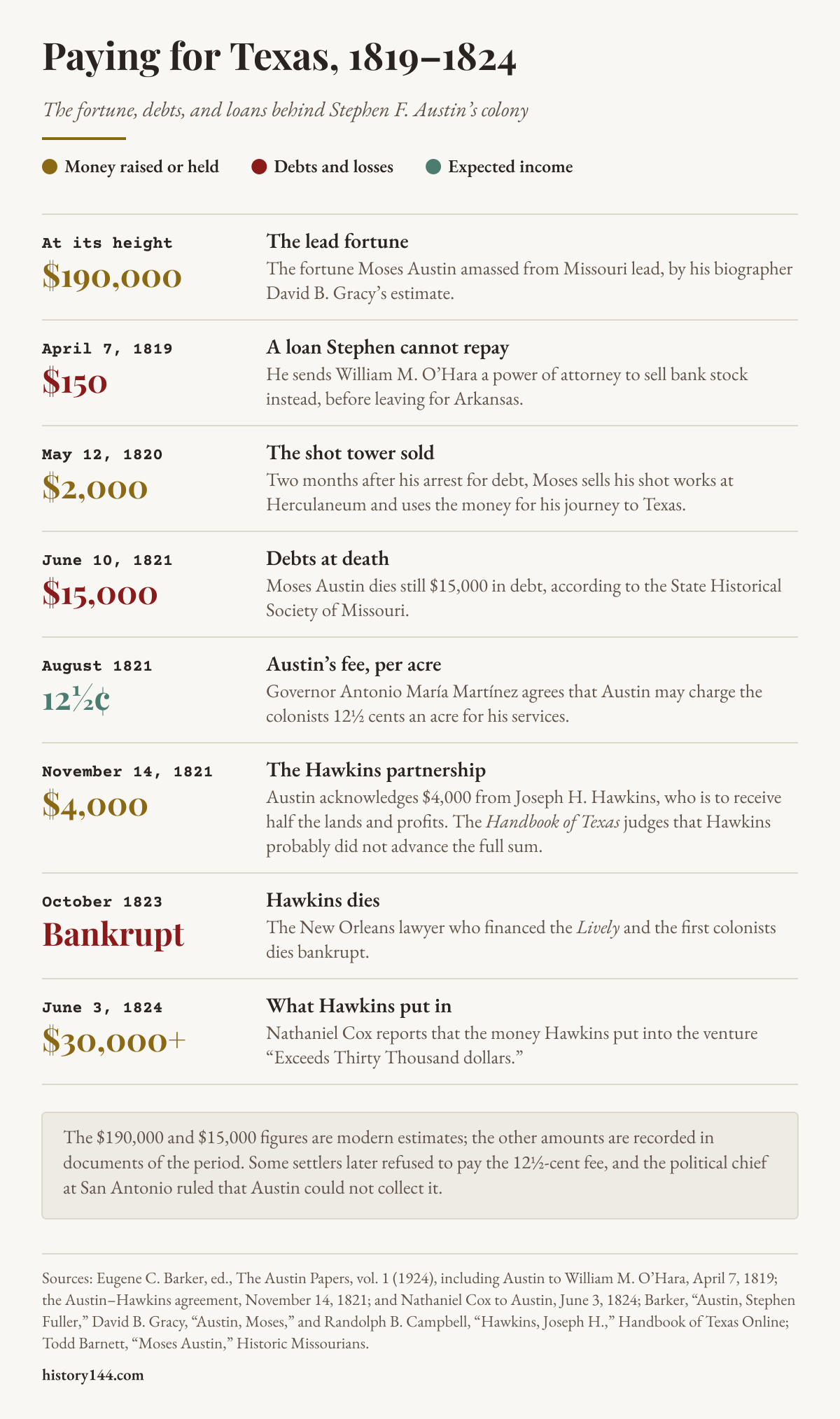
The Lost Ship and the First Settlers
The Lively left New Orleans about November 20, 1821, and Austin set out by land the following day.[57] Sources disagree on how many men were aboard. Austin's family record says eighteen, while the Handbook of Texas entry on the ship gives approximately twenty.[58] The plan was for the schooner to sail to the mouth of the Colorado, where the men would ascend the river, plant corn, and build a stockade and cabins. Austin gathered ten more men at Natchitoches and made his way through the wilderness to the coast, arriving in January.[59]
The Lively never arrived at the Colorado. Bad weather pushed it off course, and its passengers, mistaking the Brazos for the Colorado, landed at the wrong river. They moved up the Brazos, built a log house, and planted corn, but with their food nearly exhausted and no contact with Austin, all but two or three eventually returned to the United States. Austin, waiting in vain at the Colorado, concluded that the ship had been lost. Rumors that the vessel had gone down spread through the settlements and found their way into early histories of Texas. The Lively had in fact returned to New Orleans. It sailed again in May or June 1822 and on that voyage was wrecked on the western end of Galveston Island; according to one passenger, those aboard were rescued and landed near the Colorado.[60] Holley's account of 1833, which records that one of two cargoes of provisions shipped from New Orleans for the first settlers "was lost on the coast," may refer to this second voyage.[61]
Other settlers were already on their way. The first colonists began arriving by land and sea in December 1821.[62] Austin later recalled that in the winter of 1821–1822 he reached the Brazos with about forty families, saw them settled to their satisfaction, and then went to San Antonio to report to the governor.[63] The family record gives a slightly different sequence. After leaving the Colorado, it says, he met his younger brother, Brown, at the La Bahía crossing. Brown had come from Missouri to join him, and the two reached San Antonio on March 15, 1822, Stephen "much fatigued and reduced in flesh."[64]
The Road to Mexico City
In San Antonio, Austin learned that his authority rested on uncertain ground. The provisional government established after Mexican independence would not approve the Spanish grant to Moses Austin, preferring to regulate colonization through a general immigration law.[65] Martínez advised him to go first to Monterrey and, if necessary, on to the capital to lay his case before the new national congress.[66] Austin found the news "unexpected and rather discouraging," he wrote later, because his families were "in an entire wilderness" and his presence among them was badly needed.[67] He left San Antonio on March 20 with an interpreter and Dr. Robert Andrews, whom he had known in his Arkansas land dealings.[68]
The road south nearly ended the journey. On March 23 Austin wrote to his brother from Laredo that about six miles past the Nueces a band of Comanches had "charged upon us a little before sun rise," surrounded him while he was alone at camp, and "took possession of every article we had." He believed that "nothing saved our lives but being Americans."[69] Holley's later account, probably drawn from Austin himself, adds that he talked the chief into returning most of what had been taken, and that a Spanish grammar he had been carrying was lost.[70] He reached Mexico City on April 29, 1822, and presented a memorial to Congress asking that the grant made to his father be confirmed.[71] A version dated May 13 also asked for titles for the colonists and permission to bring more families, and offered in return to map the coast.[72]
He found a government in turmoil. Within weeks of his arrival Iturbide was proclaimed emperor. "The various revolutions and political changes of the eventful 1822 and 1823," Austin later wrote, "detained me in that city one year before my affairs were finally despatched."[73] He settled in to wait and to lobby. He also set about teaching himself Spanish, and a grammar he purchased in 1822 survives in the Briscoe Center for American History.[74] Holley described him laboring in the capital as "a foreigner, a total stranger, and ignorant of the language of the country."[75]
On January 3, 1823, Iturbide signed a colonization law completed by the imperial junta instituyente.[76] When Iturbide fell soon afterward, Austin, fearing that the acts of the empire might be challenged, waited for the restored Congress and petitioned it to confirm his documents, which it did in April 1823.[77] He returned to Texas that summer after an absence of fifteen months.[78] The young man who had left Missouri in debt had become, by force of circumstance and stubbornness, the agent of a foreign government for the settlement of its northern frontier. Americans had planted settlements on contested ground before, from the State of Franklin onward. Austin would build his under the authority of the government that claimed the land.
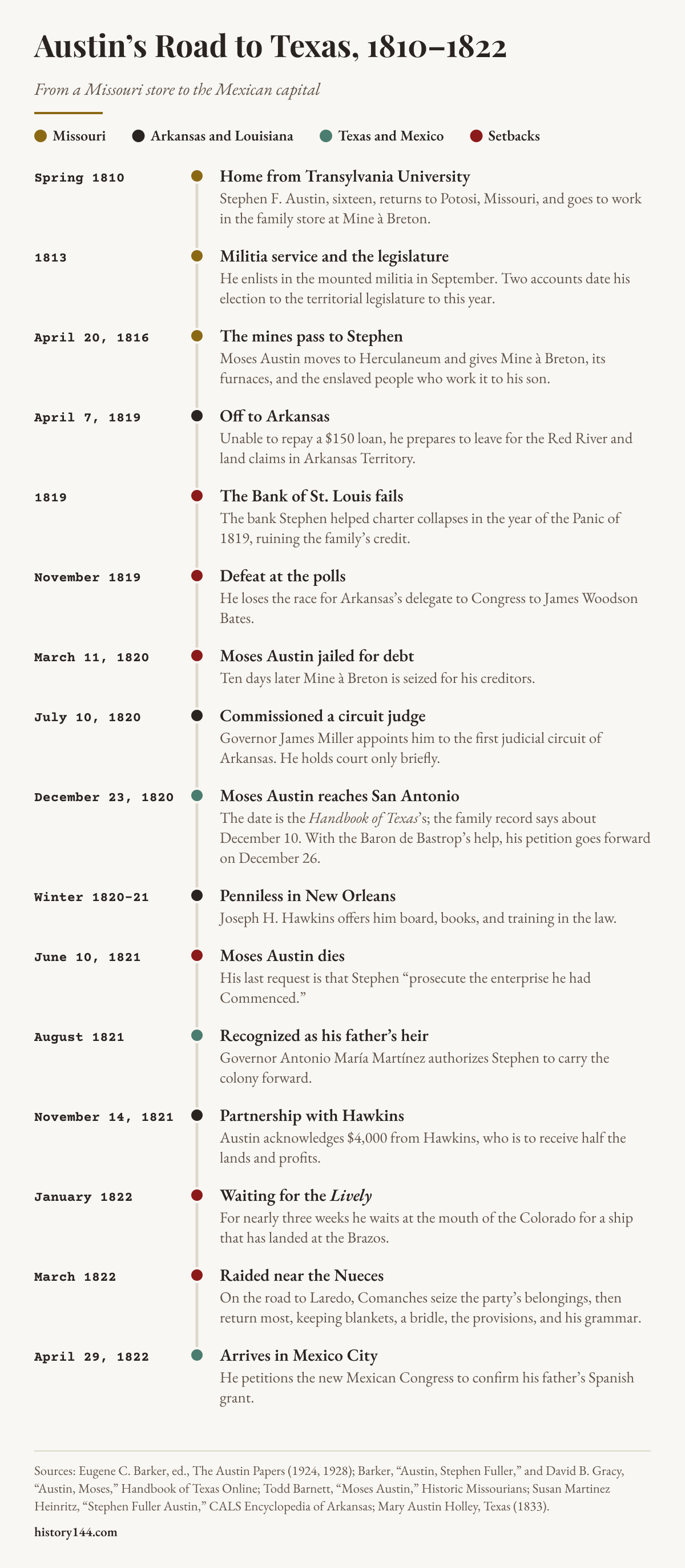
What the Twelve Years Made
Austin's years before Texas are easily read as a prologue of failures, but the failures were themselves the preparation. In Missouri he had learned how a legislature operated. He had seen at first hand how credit, banking, and debt could make or destroy a family, and later in the decade he would press successfully for a state law shielding Texas colonists from creditors in the United States.[79] He had speculated in land claims in Missouri and Arkansas, which taught him surveys, titles, and the disputes over both. It was the same business that had lately convulsed Georgia's western lands. In New Orleans he had begun studying the civil law that also underlay Spanish and Mexican legal practice.
He had also learned to endure. His father was jailed for debt, the family estate was seized, and Stephen himself offered to work as a clerk or an overseer. He came to his father's Texas venture at a moment when he had little to lose, and he carried it forward with money from a friend who would die bankrupt in its service. The enterprise was also bound up from the start with slavery, from the proposed sale of Richmond at Natchitoches to the land allowances for enslaved people written into the first terms of settlement, an inheritance that would shape Texas for decades.
The man who waited for the Lively at the mouth of the Colorado in January 1822, eating catfish and wild onions, had spent the previous twelve years watching his prospects disappear in much the same way. When the ship failed to come, he did not go home. He turned upriver, joined his brother, and kept going, first to San Antonio and then, past the Comanches on the Nueces, to Mexico City. In that persistence, more than in any single plan, lay the beginnings of Anglo-American Texas.
Places in this Story
The places this story moves through, in order — follow them on the interactive map →
- Potosi, Missouri 1798 to 1819
Moses Austin's lead mines at Mine à Breton, where Stephen grew up, clerked in the family store, and took over Durham Hall and the furnaces in 1816.
- Herculaneum, Missouri 1816 to 1820
The river town Moses Austin laid out, with its shot tower. He sold the tower for $2,000 in May 1820 to finance the Texas venture.
- Little Rock, Arkansas 1819 to 1820
Austin farmed at Long Prairie on the Red River, pursued land claims at the new territorial capital, and lost the 1819 race for delegate to Congress to James Woodson Bates.
- New Orleans, Louisiana 1820 to 1821
Austin arrived with almost nothing and wrote that his reputation was all he had on earth. Joseph H. Hawkins took him in and offered him a law library and board.
- Natchitoches, Louisiana July 1821
Austin authorized the sale of Richmond, the enslaved man who had traveled to San Antonio with his father, here on July 5, 1821. He learned of his father's death just past the Sabine and returned here to write to his mother.
- San Antonio, Texas August 1821
Governor Antonio María Martínez received Austin as his father's heir and authorized him to carry the colonizing grant forward.
- Matagorda, Texas January 1822
Austin waited near the mouth of the Colorado for the schooner Lively, living on catfish and wild onions, before giving up and turning upriver.
- Mexico City, Mexico April 1822
Austin reached the capital on April 29, 1822, and petitioned Congress to confirm his father's grant. Iturbide was proclaimed emperor within weeks of his arrival.
Frequently Asked Questions
Who was Stephen F. Austin before he came to Texas?
Before Texas, Austin was a Missouri storekeeper and lead miner, a territorial legislator, a director of the failed Bank of St. Louis, and briefly a circuit judge in Arkansas Territory. By the start of 1821 he was so deep in debt that he offered to hire himself out in New Orleans as a clerk or an overseer.
What did Moses Austin do in Missouri?
Moses Austin ran the lead mines at Mine à Breton near present-day Potosi, where an efficient reverberatory furnace gave him control of nearly all the smelting in the district and a fortune his biographer estimates at $190,000. Falling lead prices, lawsuits, and the War of 1812 destroyed it, and he was jailed for debt in March 1820.
Why did Stephen F. Austin go to Texas?
He went because his father, Moses, had won permission to settle three hundred American families in Spanish Texas but fell ill before he could carry out the plan. Stephen set out in June 1821 and learned on the road that his father had died. Maria Austin wrote that Moses had asked on his deathbed that his son take his place and prosecute the enterprise.
Who was Joseph H. Hawkins?
Joseph H. Hawkins was a Kentucky lawyer and former congressman who took the penniless Austin into his New Orleans household in the winter of 1820, giving him board, a law library, and money for clothes. He financed the first colony, bought and outfitted the schooner Lively, and died bankrupt in October 1823.
What happened to the schooner Lively?
The Lively sailed from New Orleans about November 20, 1821, carrying the first settlers and supplies, but bad weather pushed it off course and its passengers landed on the Brazos instead of the Colorado. Austin waited nearly three weeks at the Colorado, living on catfish and wild onions, before concluding the ship was lost.
Why did Stephen F. Austin go to Mexico City in 1822?
Mexico's provisional government refused to honor the Spanish grant made to Moses Austin and wanted colonization settled by a general immigration law instead. Governor Martínez advised Austin to take his case to the new national congress, and he reached the capital on April 29, 1822.
When was Stephen F. Austin's Texas grant confirmed?
Iturbide signed an imperial colonization law on January 3, 1823, but when the empire fell Austin petitioned the restored Congress, which confirmed his documents in April 1823. He returned to Texas that summer after fifteen months away.
Bibliography
Barker, Eugene C. "Austin, Stephen Fuller." Handbook of Texas Online. Texas State Historical Association. Revised February 25, 2021. https://www.tshaonline.org/handbook/entries/austin-stephen-fuller. Accessed November 3, 2026.
Barker, Eugene C., ed. The Austin Papers. Vol. 1, pts. 1 and 2. Annual Report of the American Historical Association for the Year 1919, vol. 2. Washington, DC: Government Printing Office, 1924. Digitized by the Texas History Trust. https://archive.texashistorytrust.org/view/1069473048/ and https://archive.texashistorytrust.org/view/1069284432/. Accessed November 3, 2026.
Barker, Eugene C., ed. The Austin Papers. Vol. 2. Annual Report of the American Historical Association for the Year 1922, vol. 2. Washington, DC: Government Printing Office, 1928. Digitized by the Texas History Trust. https://archive.texashistorytrust.org/view/1068778431/. Accessed November 3, 2026.
Barnett, Todd. "Moses Austin." Historic Missourians. State Historical Society of Missouri. https://historicmissourians.shsmo.org/austin-moses/. Accessed November 3, 2026.
Bullock Texas State History Museum. "Austin's Copy of Grammar of the Spanish Language." https://www.thestoryoftexas.com/artifacts/austins-copy-grammar-spanish-language/. Accessed November 3, 2026.
Campbell, Randolph B., rev. "Hawkins, Joseph H." Handbook of Texas Online. Texas State Historical Association. Revised April 29, 2022. https://www.tshaonline.org/handbook/entries/hawkins-joseph-h. Accessed November 3, 2026.
Goodwyn, Frank. "Martínez, Antonio María." Handbook of Texas Online. Texas State Historical Association. Revised August 2, 2020. https://www.tshaonline.org/handbook/entries/martinez-antonio-maria. Accessed November 3, 2026.
Gracy, David B. "Austin, Moses." Handbook of Texas Online. Texas State Historical Association. Revised November 20, 2019. https://www.tshaonline.org/handbook/entries/austin-moses. Accessed November 3, 2026.
Heinritz, Susan Martinez. "Stephen Fuller Austin (1793–1836)." CALS Encyclopedia of Arkansas. Central Arkansas Library System. Last updated December 17, 2025. https://encyclopediaofarkansas.net/entries/stephen-fuller-austin-2433/. Accessed November 3, 2026.
Holley, Mary Austin. Texas: Observations, Historical, Geographical and Descriptive, in a Series of Letters. Baltimore: Armstrong & Plaskitt, 1833. Transcription by the Women Writers Project, Northeastern University. https://wwo.wwp.northeastern.edu/WWO/xq/view/holley.texas.xml. Accessed November 3, 2026.
Long, Christopher. "Lively." Handbook of Texas Online. Texas State Historical Association. Revised June 19, 2020. https://www.tshaonline.org/handbook/entries/lively. Accessed November 3, 2026.
Southwestern Historical Quarterly. Vol. 22, no. 1 (July 1918). Lead article on Stephen F. Austin's early career, reprinted from the Mississippi Valley Historical Review (June 1918). Portal to Texas History. https://texashistory.unt.edu/ark:/67531/metapth117156/. Accessed November 3, 2026.
Citations
- "Record of Moses Austin and Family," in The Austin Papers, ed. Eugene C. Barker, vol. 1, pt. 1, Annual Report of the American Historical Association for the Year 1919, vol. 2 (Washington, DC: Government Printing Office, 1924), 4–5. The editor notes that this portion of the record was written by Stephen F. Austin (3n1, 5n1); his entries run to July 1824. ↑
- Eugene C. Barker, "Austin, Stephen Fuller," Handbook of Texas Online, Texas State Historical Association, revised February 25, 2021. ↑
- David B. Gracy, "Austin, Moses," Handbook of Texas Online, Texas State Historical Association, revised November 20, 2019. ↑
- Todd Barnett, "Moses Austin," Historic Missourians, State Historical Society of Missouri. ↑
- Susan Martinez Heinritz, "Stephen Fuller Austin (1793–1836)," CALS Encyclopedia of Arkansas, Central Arkansas Library System, last updated December 17, 2025. ↑
- Barker, "Austin, Stephen Fuller." ↑
- Barnett, "Moses Austin." ↑
- Heinritz, "Stephen Fuller Austin." ↑
- Heinritz, "Stephen Fuller Austin"; Southwestern Historical Quarterly 22, no. 1 (July 1918): 1, reprinted from the Mississippi Valley Historical Review (June 1918); calendar entry for militia report to Stephen F. Austin, adjutant of the Sixth Regiment, September 1, 1814, Austin Papers, 1:1740; Barker, "Austin, Stephen Fuller." ↑
- Gracy, "Austin, Moses"; Barker, "Austin, Stephen Fuller"; Heinritz, "Stephen Fuller Austin." ↑
- Gracy, "Austin, Moses." ↑
- "Record of Moses Austin and Family," Austin Papers, 1:3. ↑
- Barnett, "Moses Austin." ↑
- Gracy, "Austin, Moses"; Barnett, "Moses Austin." ↑
- Stephen F. Austin to William M. O'Hara, April 5, 1819, Austin Papers, 1:341. The spelling is Austin's. ↑
- Stephen F. Austin to William M. O'Hara, April 7, 1819, Austin Papers, 1:342. ↑
- "Record of Moses Austin and Family," Austin Papers, 1:3. ↑
- Heinritz, "Stephen Fuller Austin." ↑
- Stephen F. Austin to William M. O'Hara, April 5, 1819, Austin Papers, 1:341. The spelling is Austin's. ↑
- Heinritz, "Stephen Fuller Austin." ↑
- Commission of Stephen F. Austin as circuit judge, July 10, 1820, and certificate of oath by Andrew Scott, July 11, 1820, Austin Papers, 1:366. ↑
- Barker, "Austin, Stephen Fuller"; Heinritz, "Stephen Fuller Austin." ↑
- Barnett, "Moses Austin." ↑
- Gracy, "Austin, Moses." ↑
- Barnett, "Moses Austin"; "Memorandum and Itinerary," November 27, 1820, Austin Papers, 1:368. ↑
- Barker, "Austin, Stephen Fuller." ↑
- Stephen F. Austin to Maria Austin, [January 20, 1821], Austin Papers, 1:373–74. The editor prints the letter from a copy made by Mirabeau B. Lamar. ↑
- Randolph B. Campbell, rev., "Hawkins, Joseph H.," Handbook of Texas Online, Texas State Historical Association, revised April 29, 2022. ↑
- Stephen F. Austin to Maria Austin, [January 20, 1821], Austin Papers, 1:373–74. The editor prints the letter from a copy made by Mirabeau B. Lamar. ↑
- Campbell, "Hawkins, Joseph H."; Stephen F. Austin to Maria Austin, [January 20, 1821], Austin Papers, 1:374; Joseph H. Hawkins to Maria Austin, June 27, 1821, Austin Papers, 1:397. ↑
- Gracy, "Austin, Moses"; "Record of Moses Austin and Family," Austin Papers, 1:3. ↑
- Gracy, "Austin, Moses"; Barnett, "Moses Austin." ↑
- "Record of Moses Austin and Family," Austin Papers, 1:3. ↑
- "Record of Moses Austin and Family," Austin Papers, 1:3; Barnett, "Moses Austin." ↑
- Gracy, "Austin, Moses." ↑
- "Record of Moses Austin and Family," Austin Papers, 1:3–4. ↑
- Maria Austin to Stephen F. Austin, June 8, 1821, Austin Papers, 1:394–95. ↑
- Gracy, "Austin, Moses." ↑
- Barnett, "Moses Austin." ↑
- Maria Austin to Stephen F. Austin, August 25, 1821, Austin Papers, 1:408–9. ↑
- Mary Austin Holley, Texas: Observations, Historical, Geographical and Descriptive, in a Series of Letters (Baltimore: Armstrong & Plaskitt, 1833), 102. ↑
- Joseph H. Hawkins to Maria Austin, June 27, 1821, Austin Papers, 1:397–98. ↑
- Stephen F. Austin to Maria Austin, July 13, 1821, Austin Papers, 1:401–2. ↑
- Authority to sell Richmond, a slave, July 5, 1821, Austin Papers, 1:401. ↑
- "Record of Moses Austin and Family," Austin Papers, 1:4. ↑
- Frank Goodwyn, "Martínez, Antonio María," Handbook of Texas Online, Texas State Historical Association, revised August 2, 2020. ↑
- Barker, "Austin, Stephen Fuller." ↑
- Barker, "Austin, Stephen Fuller." ↑
- "Record of Moses Austin and Family," Austin Papers, 1:4. ↑
- Stephen F. Austin to [Joseph H. Hawkins], July 20, 1821, Austin Papers, 1:402. The recipient's name is the editor's attribution; the text survives as extracts printed in the Arkansas Gazette, October 6, 1821, from the Louisiana Advertiser, September 3, 1821. ↑
- Stephen F. Austin to James W. Breedlove, October 12, 1829, in The Austin Papers, ed. Eugene C. Barker, vol. 2, Annual Report of the American Historical Association for the Year 1922, vol. 2 (Washington, DC: Government Printing Office, 1928), 266–67. The editor prints the letter from an unidentified newspaper clipping. ↑
- Barker, "Austin, Stephen Fuller." ↑
- Calendar entries for Robert Andrews to Austin, November 3, 1821; J. M. Arthur to Austin, December 4, 1821; Samuel Parker to Austin, December 7, 1821; James Beatty to Austin, January 5, 1822; James Bryan to Austin, January 15, 1822; and John J. Clarke to Austin, February 25, 1822, Austin Papers, 1:1747–49. ↑
- Agreement between Stephen F. Austin and Joseph H. Hawkins, November 14, 1821, Austin Papers, 1:426; Campbell, "Hawkins, Joseph H." ↑
- Campbell, "Hawkins, Joseph H." ↑
- Nathaniel Cox to Stephen F. Austin, June 3, 1824, Austin Papers, 1:807–8. ↑
- "Record of Moses Austin and Family," Austin Papers, 1:4–5. ↑
- "Record of Moses Austin and Family," Austin Papers, 1:4; Christopher Long, "Lively," Handbook of Texas Online, Texas State Historical Association, revised June 19, 2020. ↑
- "Record of Moses Austin and Family," Austin Papers, 1:4–5. ↑
- "Record of Moses Austin and Family," Austin Papers, 1:4; Christopher Long, "Lively," Handbook of Texas Online, Texas State Historical Association, revised June 19, 2020. ↑
- Holley, Texas (1833), 103. ↑
- Barker, "Austin, Stephen Fuller." ↑
- Stephen F. Austin to James W. Breedlove, October 12, 1829, in The Austin Papers, ed. Eugene C. Barker, vol. 2, Annual Report of the American Historical Association for the Year 1922, vol. 2 (Washington, DC: Government Printing Office, 1928), 266–67. The editor prints the letter from an unidentified newspaper clipping. ↑
- "Record of Moses Austin and Family," Austin Papers, 1:4–5. ↑
- Barker, "Austin, Stephen Fuller." ↑
- "Record of Moses Austin and Family," Austin Papers, 1:4–5. ↑
- Stephen F. Austin to James W. Breedlove, October 12, 1829, in The Austin Papers, ed. Eugene C. Barker, vol. 2, Annual Report of the American Historical Association for the Year 1922, vol. 2 (Washington, DC: Government Printing Office, 1928), 266–67. The editor prints the letter from an unidentified newspaper clipping. ↑
- "Record of Moses Austin and Family," Austin Papers, 1:5; Stephen F. Austin to William M. O'Hara, April 7, 1819, Austin Papers, 1:342. ↑
- Stephen F. Austin to James E. B. Austin, March 23, 1822, Austin Papers, 1:487. ↑
- Holley, Texas (1833), 91–94, 105–6. ↑
- "Record of Moses Austin and Family," Austin Papers, 1:4–5. ↑
- Calendar entry for Austin's memorial to Congress, May 13, 1822, Austin Papers, 1:1750. ↑
- Stephen F. Austin to James W. Breedlove, October 12, 1829, in The Austin Papers, ed. Eugene C. Barker, vol. 2, Annual Report of the American Historical Association for the Year 1922, vol. 2 (Washington, DC: Government Printing Office, 1928), 266–67. The editor prints the letter from an unidentified newspaper clipping. ↑
- "Austin's Copy of Grammar of the Spanish Language," Bullock Texas State History Museum. ↑
- Holley, Texas (1833), 91–94, 105–6. ↑
- Barker, "Austin, Stephen Fuller." ↑
- Stephen F. Austin to James W. Breedlove, October 12, 1829, in The Austin Papers, ed. Eugene C. Barker, vol. 2, Annual Report of the American Historical Association for the Year 1922, vol. 2 (Washington, DC: Government Printing Office, 1928), 266–67. The editor prints the letter from an unidentified newspaper clipping. ↑
- "Record of Moses Austin and Family," Austin Papers, 1:4–5. ↑
- Barker, "Austin, Stephen Fuller." ↑