On the afternoon of July 5, 1814, Brigadier General Winfield Scott was preparing to put his brigade through an afternoon drill. The army had crossed the Niagara River into Upper Canada two days earlier, and the Fourth of July had been spent in a running fight along the river road. Now a belated holiday dinner had reached the brigade from the American shore, and Scott had ordered a parade for what he called "grand evolutions in the cool of the afternoon." Then Major General Jacob Brown rode past at full gallop and called out to him, "You will have a battle!"[1] Scott's men were already under arms for their daily drill. Brown, by Cullum's account, ordered him forward, and Scott led his brigade across the bridge over Street's Creek toward the plain where the British were forming.[2]
The British commander, Major General Phineas Riall, had taken those troops for militia. Scott's men wore gray coats, which he had been obliged to accept because there was no blue cloth to be had, and the color misled Riall at first. According to Scott's own later account, Riall dismissed them as "nothing but a body of Buffalo militia." When he saw them cross the bridge steadily under artillery fire, he changed his mind and exclaimed, "Why, these are regulars!"[3] The remark has been retold ever since, but it cannot be confirmed, and Donald Graves, a modern historian of the battle, has used it chiefly to show how badly Riall underestimated the Americans.[4] What the story captured was real enough. By evening the British had been driven back across the Chippawa, and American regulars had beaten a roughly equal force of British regulars in open battle.
The victory had roots that ran back exactly twelve years and a day, to July 4, 1802, when a small military academy formally opened at West Point on the Hudson. The connection between the two events is easy to exaggerate. Scott had never attended West Point, and in 1814 its graduates were too few and too junior to command brigades. The academy and the brigade at Chippawa nevertheless grew out of the same slow and halting discovery, that the United States could not fight a modern war with officers who had never studied their profession or soldiers who had never been drilled. This is the story of those twelve years.
A School for Engineers
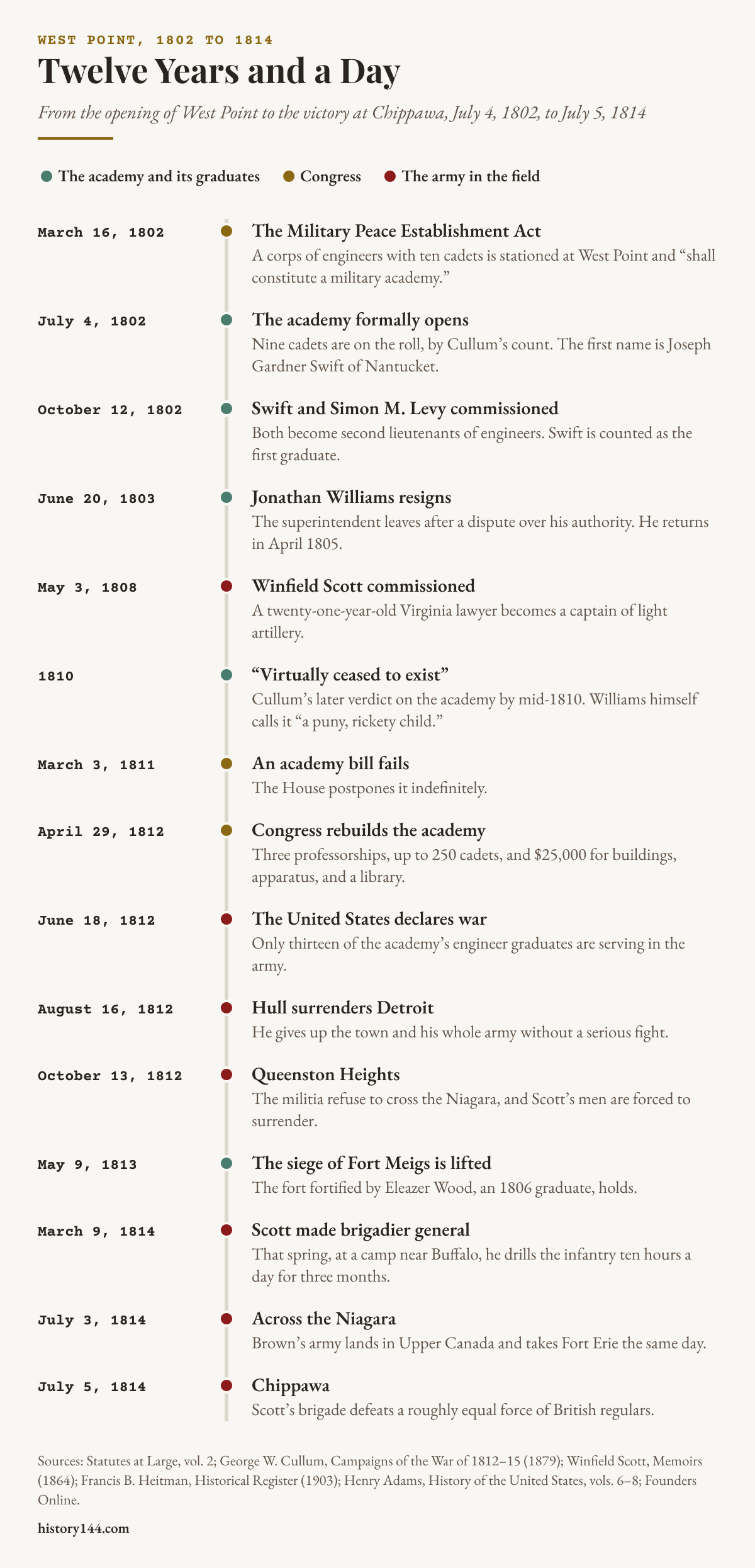
The academy began as an afterthought to a law that cut the army. The Military Peace Establishment Act, signed by President Thomas Jefferson on March 16, 1802, reduced the army to one regiment of artillerists and two of infantry. Its final sections allowed the president to organize a small corps of engineers made up of a major, six assistant engineers, and ten cadets paid sixteen dollars a month, with the whole corps never to exceed twenty officers and cadets. The corps, the act declared, "shall be stationed at West Point in the state of New York, and shall constitute a military academy," and its principal engineer was to be the superintendent.[5]
The first man to hold that post was Major Jonathan Williams, a grandnephew of Benjamin Franklin. He had joined Franklin in England in 1770, spent most of the next fifteen years in England and France, and came home with him in 1785. In 1788 he became a member and secretary of the American Philosophical Society, and he was better known as a man of science than as a soldier.[6] In May 1801, two months after Jefferson's inauguration, Secretary of War Henry Dearborn announced that the president had "decided on the immediate establishment of a military school at West Point," and Williams was appointed to make the arrangements.[7] He had large ambitions for it. He urged one of his engineer officers to "never lose sight of our leading star, which is not a little mathematical school, but a great National Establishment."[8] The reality was much smaller. The academy formally opened for instruction on July 4, 1802, with nine cadets, according to the roll later compiled by George W. Cullum, the academy's great nineteenth-century chronicler. The first name on that list was Joseph Gardner Swift of Nantucket.[9] On October 12, 1802, Swift and a second cadet, Simon M. Levy, were commissioned second lieutenants of engineers. Swift, who headed the academy's register, is counted as its first graduate.[10]
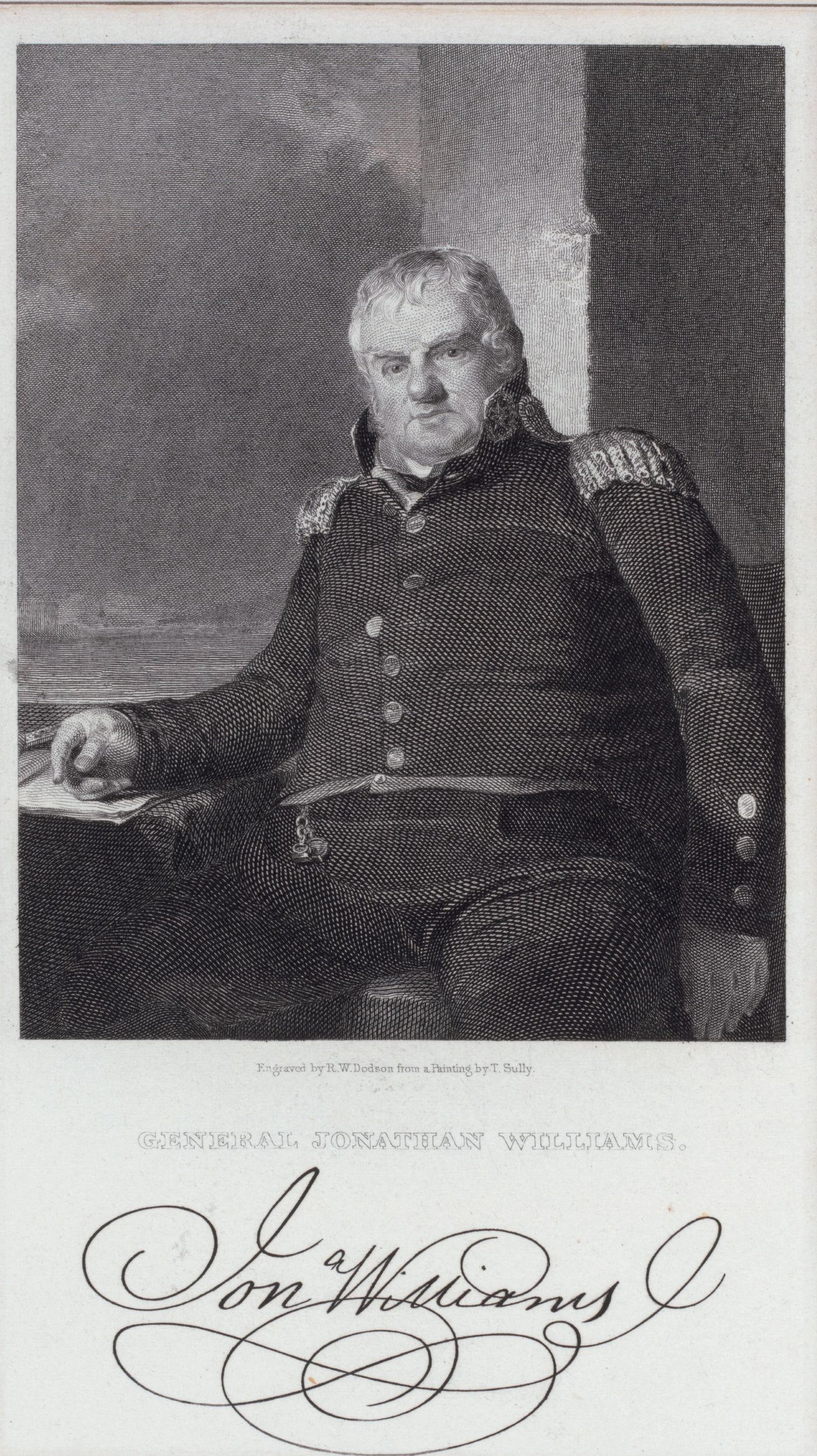
Jefferson's sponsorship of the academy has puzzled historians. As secretary of state in 1793, he had opposed a proposed academy in Washington's cabinet "as unauthorised by the constn."[11] The historian Theodore Crackel has argued that the act of 1802 belonged to a broader effort to remake an officer corps dominated by Federalists by opening commissions to young men from Republican families and binding the army more closely to the new administration.[12] Whatever the mix of motives, the school's first superintendent thought of it as a scientific institution. At a meeting of the engineer corps on November 12, 1802, Williams and his officers founded the United States Military Philosophical Society. Its motto was Scientia in Bello Pax, which Williams translated as "science in war is the guarantee of peace." The society met twice a month in the academy's hall, and in December Williams sent Jefferson a copy of its constitution and asked him to be its patron.[13]
Years of Neglect
The academy's first decade was a struggle simply to exist. On June 20, 1803, Williams resigned his commission after Dearborn declined to sustain his authority over the troops at West Point. He regarded the limit placed on an engineer's right to command as insulting, and he wrote that he could no longer hold his commission "without a sense of humiliation."[14] He was persuaded to return in April 1805 and resumed command of the academy. In the twenty-two months he had been gone, only two cadets had graduated.[15]
In March 1808 Jefferson sent Congress a report by Williams proposing to enlarge the academy and move it to Washington. A bill to that effect was introduced in the Senate and then postponed indefinitely.[16] Meanwhile Secretary of War William Eustis made no new appointments and sent existing cadets off on other duties. By the middle of 1810, in Cullum's judgment, the academy "except in name, had virtually ceased to exist."[17] On June 13, 1810, Williams wrote to the new president, James Madison, that the academy lacked "necessary Buildings, requisite professors, and almost everything," and that he despaired of any change that would raise it to what it should be. He asked that the current session be the last in which he would have to superintend "this inadequate Establishment" in person.[18] In September he told Jefferson that the academy still lived, but that compared with what it ought to be, it was "a puny, rickety child."[19]
Treasury Secretary Albert Gallatin, reviewing a draft of Madison's annual message that November, urged the president to stress the need to put the military schools on a respectable footing. "It is now worse than none," he wrote, adding that no teacher but a drawing master was allowed from outside the engineer corps.[20] Madison's message of December 5, 1810, told Congress that the corps of engineers and the academy were "entitled to the early attention of Congress." He reported that its buildings were too decayed to serve and asked for professorships in the main branches of military instruction. Such schools, he argued, could provide for the public defense at little expense and consistently with public liberty.[21] On February 27, 1811, with a new bill pending, Williams told Madison that he would spend the whole day in the House in the hope that it would be called up, though he described its situation as "almost forlorn." On March 3 the House postponed it indefinitely.[22]
The army that the academy was supposed to serve had meanwhile grown, and the growth exposed how few trained officers it had. When war with Britain began to seem likely in 1808, Congress added new regiments, and the administration filled them with appointments from civilian life. One of the new officers was a twenty-one-year-old Virginia lawyer named Winfield Scott, whose commission as a captain of light artillery was dated May 3, 1808. Scott later recalled the army he entered with contempt. The old officers, he wrote, had "very generally, sunk into either sloth, ignorance, or habits of intemperate drinking," and the new appointments consisted generally of "swaggerers, dependants, decayed gentlemen," and others fit for nothing else. West Point, he noted, had as yet graduated but few cadets.[23] Scott's own outspokenness earned him a year's suspension from the army in 1810, and he spent much of it reading at the home of his friend Benjamin Watkins Leigh.[24]
The Law of 1812 and a War Begun Badly
Congress finally acted on the academy seven weeks before it declared war. An act of April 29, 1812, "making further provision for the corps of engineers," gave the academy three professorships of its own: natural and experimental philosophy, mathematics, and the art of engineering. Cadets of every branch of the army were limited to two hundred and fifty, to be admitted between the ages of fourteen and twenty-one and required to be well versed in reading, writing, and arithmetic. They were to be arranged into companies and encamped for at least three months of each year, and Congress appropriated twenty-five thousand dollars for buildings, apparatus, a library, and other expenses.[25] On paper, the United States now had a real military academy.
The man who had fought for it did not stay to see it built. In June the president ordered that engineer officers could be assigned to command troops of the line, and when officers in New York protested, General Joseph Bloomfield suspended the order. Williams had already complained that while he could not command a subaltern, he could be made to serve where a subaltern commanded. On July 10, 1812, less than a month after war was declared, he tendered his resignation as chief engineer, and it was accepted at the end of August.[26] His successor as chief engineer, and therefore as superintendent of the academy, was Swift, the first graduate, who took over on July 31, 1812.[27] The academy's graduates were very few. By Cullum's count, there were only thirteen engineer graduates of the academy in the army when war was declared.[28]
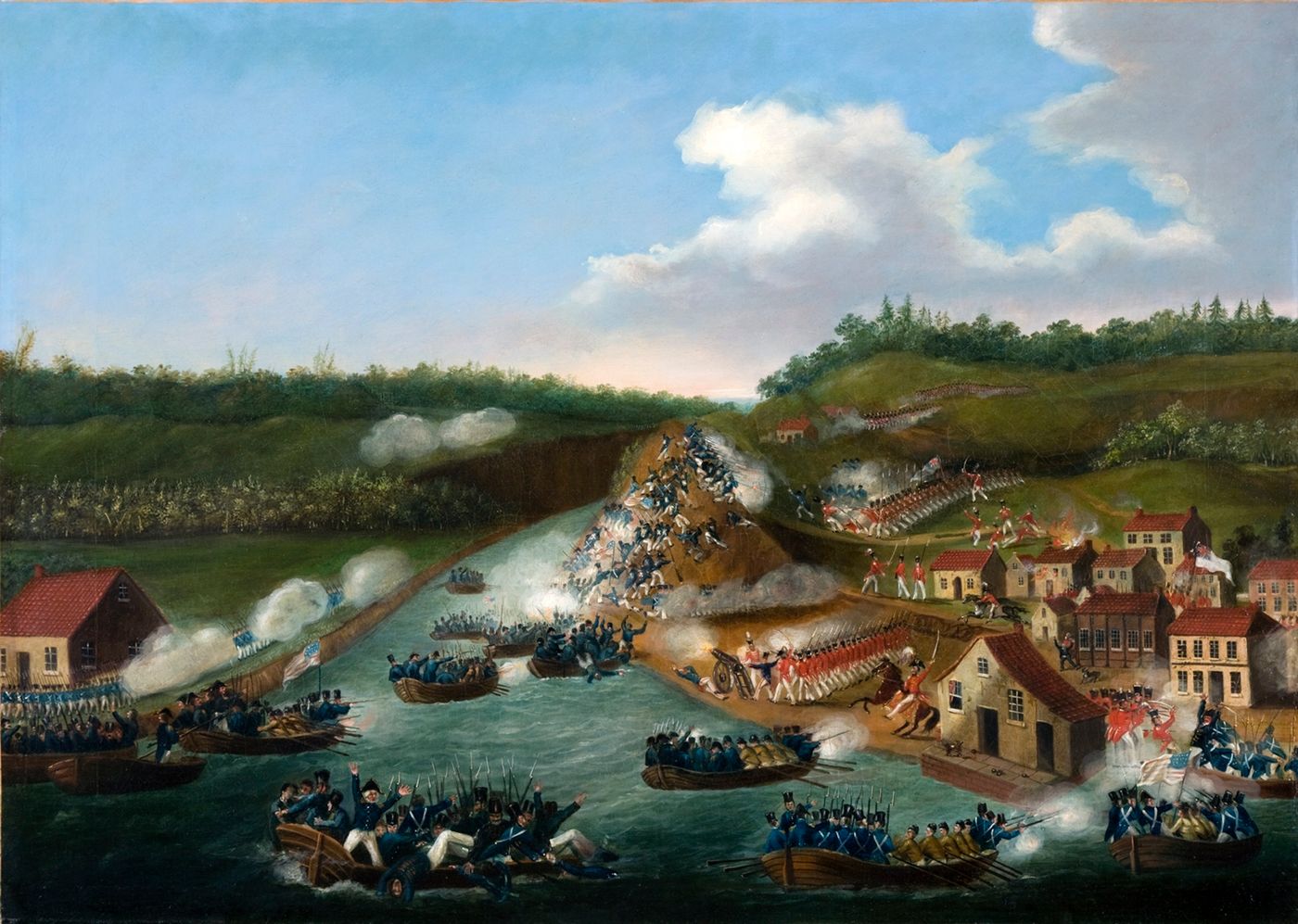
The first campaigns showed what an army without trained leaders could do. In August 1812 General William Hull surrendered Detroit and his whole army without a serious fight. In October an American force crossed the Niagara River and seized the heights above the village of Queenston, and Scott, now a lieutenant colonel, went over to take command on the heights. As the British counterattacked, the militia waiting on the American shore refused to cross. Their commander, General Stephen Van Rensselaer, wrote to the American commander on the Canadian side: "I have passed through my camp. Not a regiment, not a company is willing to join you. Save yourselves by a retreat, if you can." Scott was taken prisoner, as he later put it, "because certain militia would not cross the Niagara to my rescue."[29] The afternoon showed how little courage could accomplish without training and discipline.
Engineers in the Field
In 1813 the academy's graduates began to show what they could do, mostly in the work they had been trained for, building and defending fortifications. The most celebrated was Eleazer Derby Wood, born at Lunenburg, Massachusetts, in December 1783. Wood graduated from West Point and was commissioned a second lieutenant of engineers on October 30, 1806.[30] By the spring of 1813 he was, in Cullum's words, "virtually the Chief Engineer" of General William Henry Harrison's army in northwestern Ohio. Harrison reported that the task of fortifying Fort Meigs, on the Maumee River, had fallen to Wood, and the fort withstood a British and Indian siege that spring. Cullum later called him "the indefatigable Wood" and judged that in knowledge of the art of war he had no superior in that army.[31] On the Niagara front in May, Joseph G. Totten, another early graduate, served as an engineer at the capture of Fort George and was commended in the commanding general's report.[32]
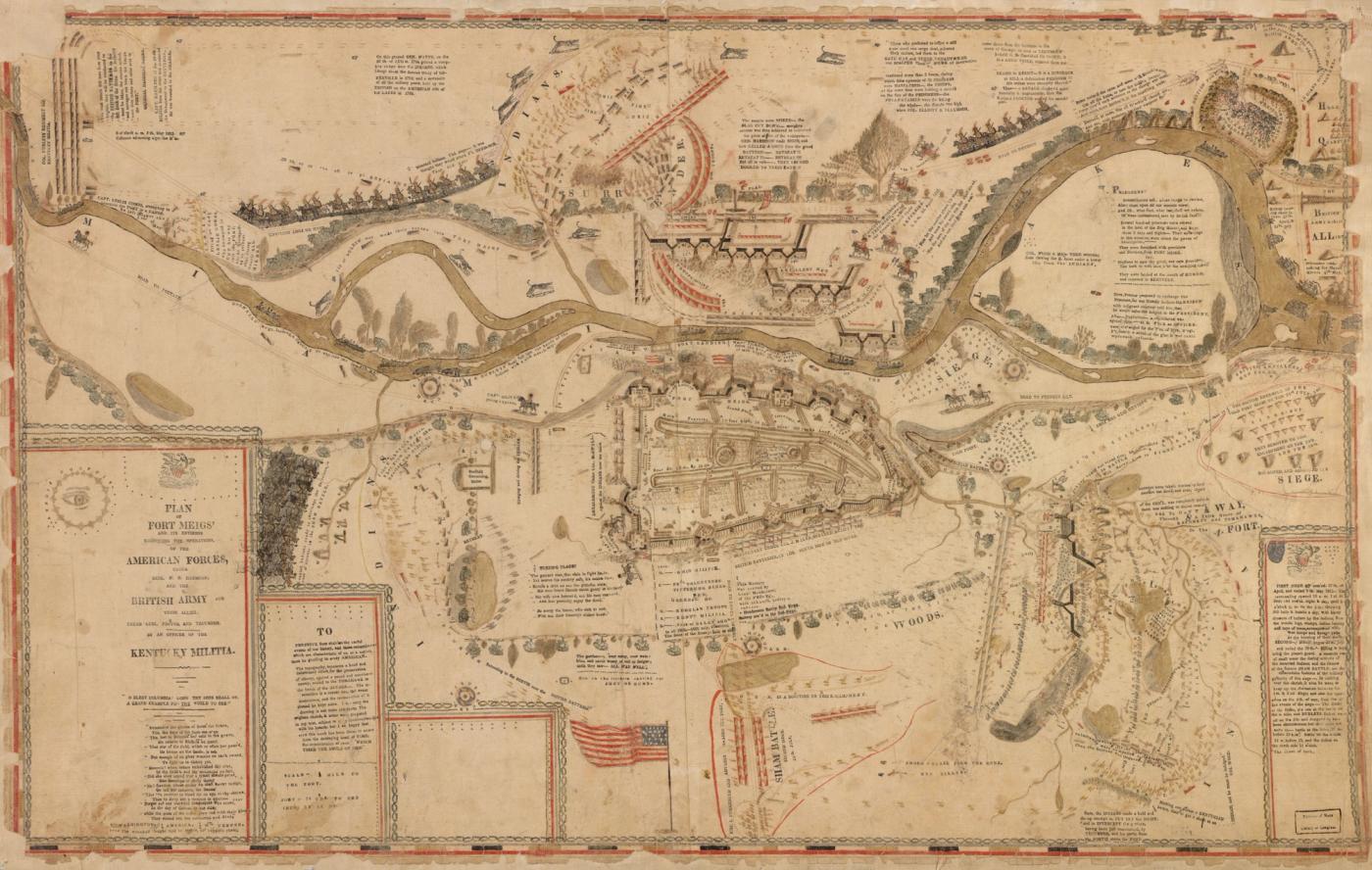
These were real contributions, but they were the work of staff officers. Apart from Swift, the chief engineer, most of the academy's graduates were lieutenants and captains, a handful of men in an army of thousands. The generals who led that army were still drawn from politicians, militia officers, and veterans of the Revolution. Scott, exchanged after his capture, led the advance at Fort George as a colonel. As he approached, one of the fort's magazines exploded, and splinters threw him to the ground with a broken collarbone, but by his own account he was still the first to enter.[33] The American advance on Montreal that autumn collapsed, and the older generals who led it were discredited.
The Camp at Buffalo
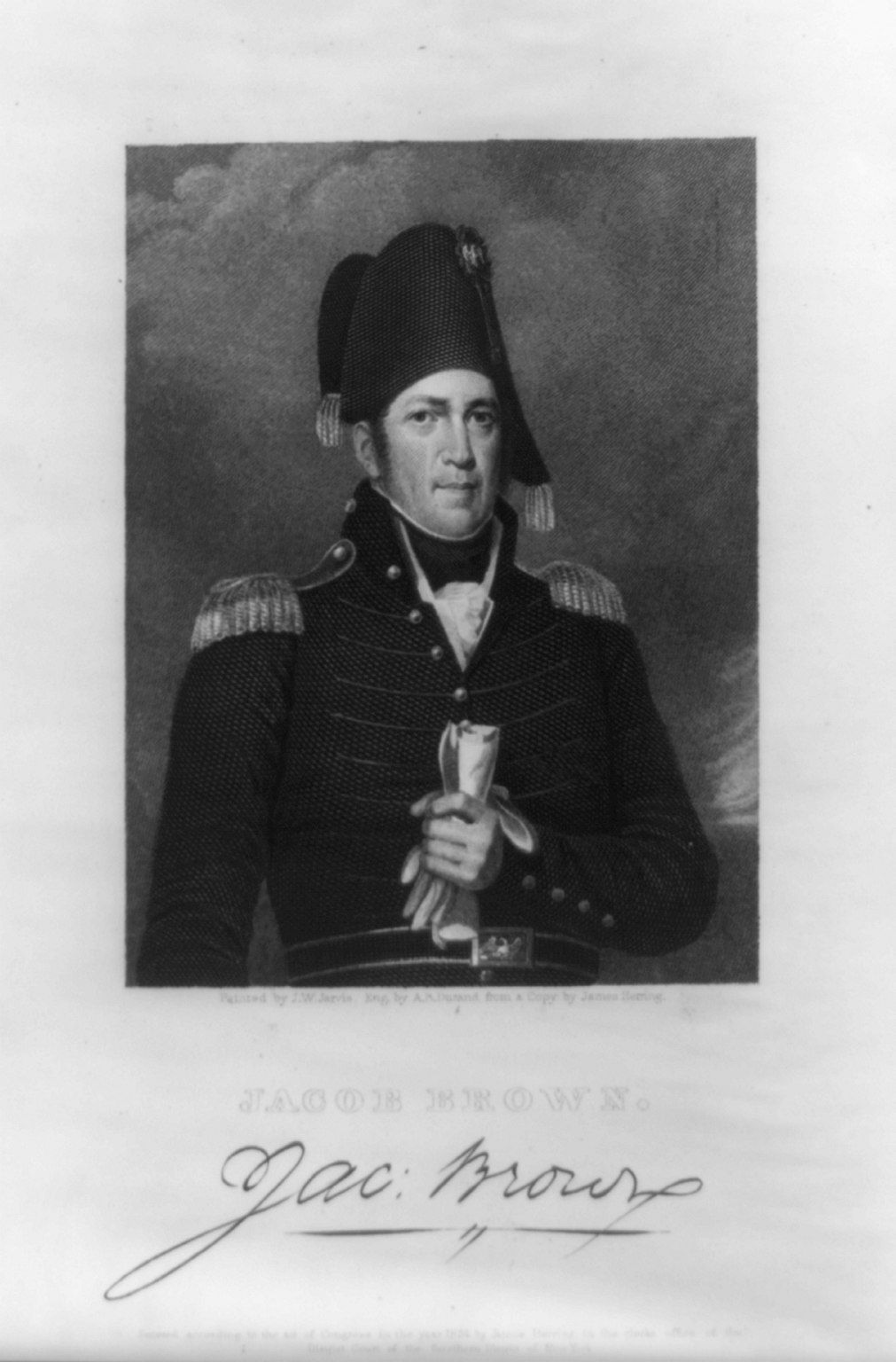
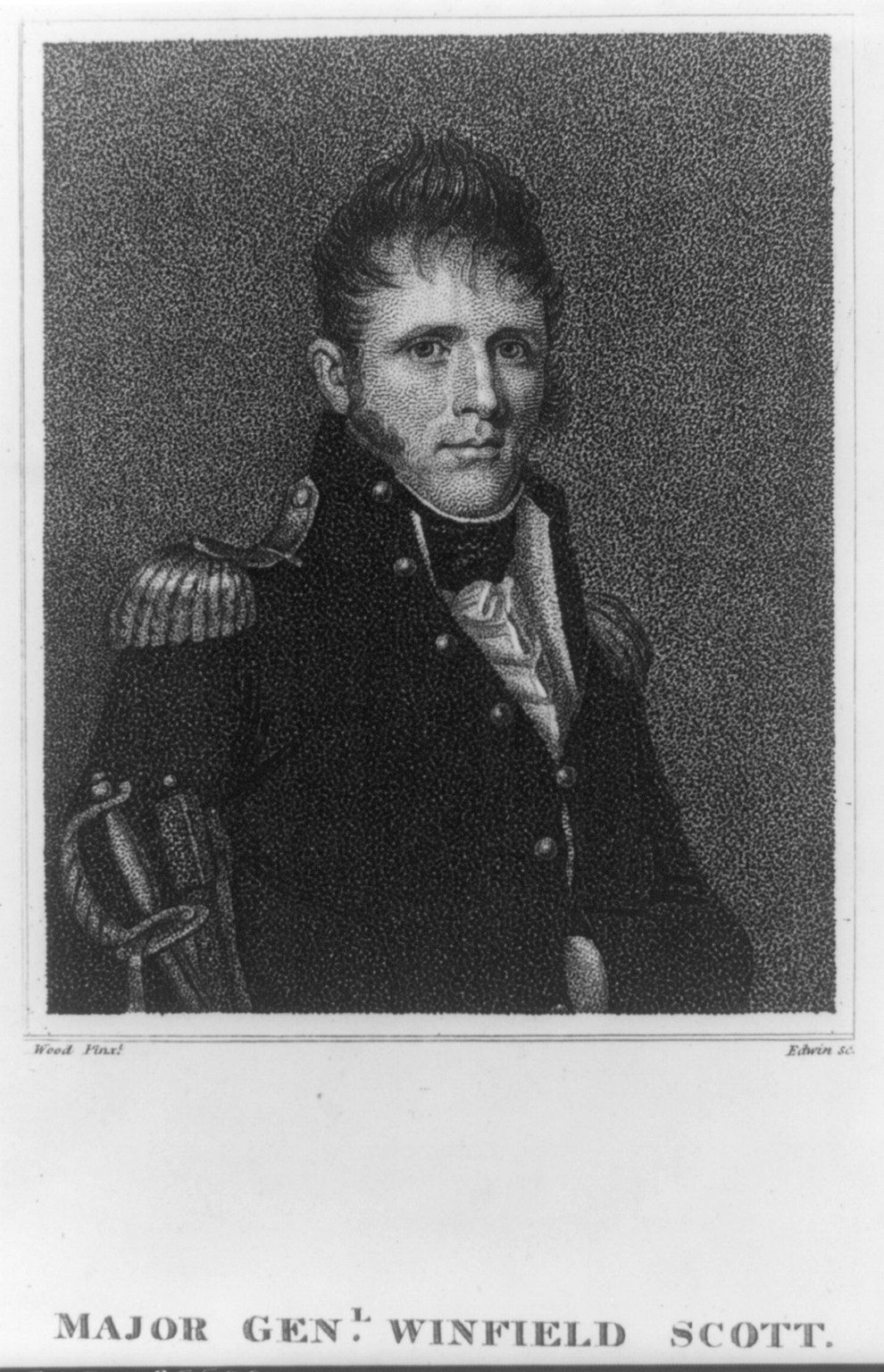
Command on the northern frontier passed to younger men. Jacob Brown was born in Pennsylvania in 1775 of Quaker parentage and began life as a schoolmaster. He bought a large tract of land near Sackets Harbor, became a leading citizen of that part of New York, and was made a brigadier of militia in 1811, with no military education. His defense of the naval base at Sackets Harbor on May 29, 1813, won him a brigade in the regular service, and by February 1814 the Secretary of War had designated him to command the force that became the Army of the Niagara.[34] Scott was made a brigadier general to rank from March 9, 1814, at the age of twenty-seven, and was given the task of preparing Brown's infantry for the coming campaign.[35]
That spring Scott formed a camp of instruction near Buffalo. According to his own account, the drill ran ten hours a day in tolerable weather for three months, and "nothing but night or a heavy fall of snow or rain" was allowed to interrupt it. He also laid down a system of what he called "sanitary police," governing kitchens and the cleanliness of the camp. For the drill itself he adopted the French system, of which he had a copy in the original language; the English version available in camp, he wrote, was "a bad translation."[36] Scott began with the officers. "There was not an old officer in the two brigades of infantry," he recalled, and so he formed the officers of all grades into squads and drilled them himself, so that they could in turn drill their men.[37] The regiments remained small, because recruiting had gone badly, and Scott described them as "still but skeletons."[38]
In time, Scott wrote, the evolutions of many battalions were exhibited daily "for the first time by an American army," and "Confidence, the dawn of victory, inspired the whole line."[39] At Buffalo, Scott accomplished in one sense what Williams had tried and failed to do at West Point. He turned the education of an army into a system, with fixed standards, a common manual, and officers who had studied their work before they were asked to lead.
Chippawa
Brown's army crossed the Niagara River on July 3, 1814. Scott was in the first boat, with about a hundred and fifty men. Thinking the water near the shore was less than knee-deep, he jumped out and nearly drowned. Fort Erie was surrounded and surrendered the same day.[40] On the Fourth, Scott's brigade, made up of the 9th, 11th, 22nd, and 25th Infantry with Nathan Towson's company of artillery and other light batteries, pushed north along the river road. As the British rearguard fell back, it tore up the flooring of bridge after bridge, and Scott's men had to relay the planks under fire in what he called a running fight "of some twelve hours."[41] By sunset the British were behind Chippawa Creek, and Scott's brigade halted for the night behind the smaller Street's Creek, a short distance to the south.[42]
Riall had about two thousand men, including British regulars of the 1st, 8th, and 100th Regiments of Foot, Canadian militia, and First Nations warriors. Having scattered American militia on the frontier the winter before, he underestimated the force in front of him. Through much of the day, British light troops, Canadian militia, and Indian allies sniped at the American outposts from the woods west of the plain. At about four in the afternoon, Brown sent New York and Pennsylvania volunteers and Six Nations warriors under the New York militia general Peter B. Porter to clear the woods. They ran directly into Riall's advance and were driven back in disorder, leaving the left of Scott's brigade exposed.[43] It was then that Brown galloped past Scott with his warning.
Scott's brigade crossed the Street's Creek bridge under the fire of the British field guns and deployed on the plain. As he rode along the line, Scott later recalled, he called out to his men, "Let us make a new anniversary for ourselves!"[44] Towson's guns, posted on the American right near the river, dueled with the British artillery as Riall's infantry advanced in line. On the left, Major Thomas Jesup led the 25th Infantry forward under heavy fire to cover the exposed flank, and the two lines closed to short range. Scott then threw forward part of his line. The battalions of Major Henry Leavenworth, with the 9th and 22nd, and Major John McNeil, with the 11th, formed an obtuse angle in the center of the plain, and Towson's battery fired along the length of the opposing flank.[45] After a short and close fight the British line wavered, and Riall ordered a withdrawal. His men recrossed the Chippawa and took up the bridge behind them. Henry Adams writes that Riall regained the protection of his lines without further loss, while the editors of Madison's papers, summarizing Brown's report, describe Scott's men pursuing a fleeing enemy to his fortifications. The decisive fighting had lasted less than an hour, though the skirmishing and maneuvering before it had filled much of the afternoon.[46]
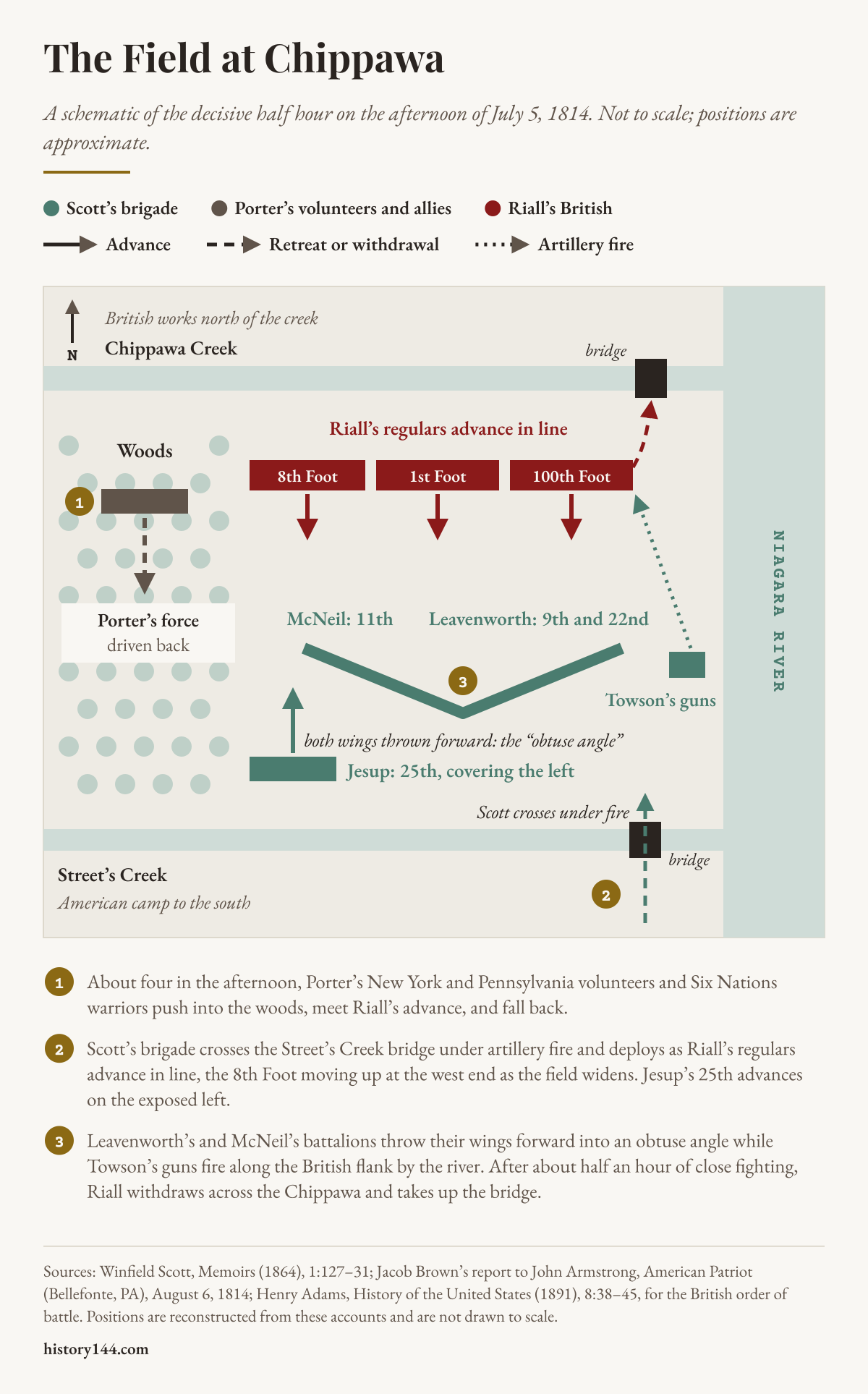
Riall reported a total loss of five hundred and fifteen in killed, wounded, and missing, not counting Indians, and his regular regiments and artillery lost 137 killed and 305 wounded. Scott and Porter reported 297 between them, of which Scott's brigade lost 48 killed and 227 wounded. The returns of the time do not entirely agree.[47] Brown wanted to press on and storm the British works across the creek. Major Eleazer Wood, the engineer who had fortified Fort Meigs, rode down to the creek with one of Brown's aides to examine them. Their report, the lateness of the hour, and the advice of Scott and Wood persuaded Brown to return to camp.[48] In the days that followed, Wood and William McRee, Brown's chief engineer and a West Point graduate of 1805, found an old, disused road leading to the mouth of Lyon's Creek, a tributary of the Chippawa. They made it passable for artillery and wagons in a single day. The road let Brown threaten Riall's right flank, and Riall abandoned his entrenchments on the Chippawa and fell back toward Queenston.[49]
Gray Coats and Long Memories
Chippawa changed little on the map. The campaign that followed brought the bloody, inconclusive Battle of Lundy's Lane on July 25 and a long siege at Fort Erie, and by November the Americans had withdrawn from Canada. The battle's importance lay elsewhere. It was the only battle of the war in which roughly equal bodies of regular troops met face to face in the open, and the Americans won it.[50] Scott, writing in old age, counted Chippawa among the few battles that had wrought a great change in the feelings of a nation. After it, he wrote, "the pulse of Americans recovered a healthy beat."[51]
The engineers who served at Chippawa did not all survive the campaign. In his report of September 29, 1814, on the defense of Fort Erie, Brown wrote that McRee and Wood had rendered the army "services the most important." Wood, he added, "brave, generous and enterprising, died as he had lived."[52] Wood had been killed on September 17 while leading a charge during a sortie from the fort. In September 1816 Brown wrote to Swift asking that an obelisk to Wood's memory be raised at West Point.[53] It stands today in the West Point Cemetery. Its inscription records that Lieutenant Colonel E. D. Wood of the Corps of Engineers "fell while leading a Charge at the Sortie of Fort Erie," calls him "A Pupil of This Institution," and names Major General Jacob Brown, his commander, among those who raised it.[54]
The gray coats left a memorial of a different kind. In his memoirs Scott wrote, "In compliment to the battle of Chippewa, our military cadets have worn gray coats ever since."[55] The documentary record tells a plainer tale. By 1815 Captain Alden Partridge was running the academy as acting superintendent, and Swift, as chief engineer, retained authority over it.[56] In November 1815 Swift sent the secretary of war a description of the cadets' uniform, "which has been grey for the last fifteen months." Cloth of that color, he wrote, "looks military," and at eighteen to twenty dollars it "better suits the finances of Cadets than one of Blue would." He recommended that the uniform be confirmed.[57] The secretary of war approved it in January 1816, and a detailed uniform order followed in September.[58] If Swift's count is taken literally, the cadets had been in gray since about August 1814, a few weeks after Chippawa. His letter explains why the color was kept, but it does not say why the cadets first changed to it. Nothing in the record shows that the glory of Chippawa played a part, and Scott's claim is best treated as one of the battle's legends.
Two Anniversaries
When the war ended, the academy's great period still lay ahead. In 1817 Sylvanus Thayer, a graduate of the class of 1808, became superintendent. Over the next sixteen years he built the rigorous program that made West Point the country's leading school of engineering and, in time, the main source of the army's officers. Scott himself credited Thayer with having given "development and great excellence to that institution."[59] After the war Scott also oversaw the writing of a new drill manual for the army, carrying to the whole service the kind of system he had taught on the fields outside Buffalo.[60]
The academy's direct part in the victory was small. West Point in 1814 was still struggling. Its first superintendent had resigned twice, and its graduates had served the war mainly as engineers. The brigadier whose men carried the day at Chippawa had learned much of his trade on his own and from the humiliation of Queenston, and his men had learned theirs in three months of drill. The academy and the camp at Buffalo nevertheless grew from the same conviction, which the defeats of 1812 and 1813 had forced on a reluctant republic. The defense of the United States could not depend on courage and improvisation alone, and the art of war had to be studied and taught. Henry Adams, writing his history of the Madison years at the end of the century, concluded that during the critical campaign of 1814, "the West Point engineers doubled the capacity of the little American army for resistance."[61]
The two dates sit almost side by side on the calendar. On July 4, 1802, a few cadets reported to a run-down post on the Hudson to begin a course of study that barely existed. On July 5, 1814, a brigade of drilled regulars in gray coats crossed a bridge under fire and made, as Scott had urged them, a new anniversary of their own. Within weeks, if Swift's count is right, the academy that would eventually supply the army with its officers was dressing its cadets in the same color. It was kept to save money, but legend soon gave it a more glorious origin. In time the gray uniform and the tradition behind it came to stand for the idea that both events had expressed in their different ways, that a professional army is made, not born.
Places in this Story
The places this story moves through, in order — follow them on the interactive map →
- Washington, D.C. March 16, 1802
Jefferson signed the act that cut the army and put a corps of engineers at West Point.
- West Point, New York July 4, 1802
The academy opened with nine cadets on the roll, the first of them Joseph Gardner Swift.
- Queenston, Ontario October 1812
The militia refused to cross the Niagara, and Scott's men, driven off the heights to the riverbank, had to surrender.
- Perrysburg, Ohio Spring 1813
Eleazer Wood fortified Fort Meigs on the Maumee, and it withstood a British and Indian siege.
- Sackets Harbor, New York May 29, 1813
Brown's defense of the naval base brought him a general's commission in the regular army.
- Buffalo, New York Spring 1814
Scott drilled the infantry ten hours a day for three months in a camp of instruction.
- Fort Erie, Ontario July 3, 1814
Brown's army crossed the Niagara and the fort surrendered the same day.
- Chippawa, Ontario July 5, 1814
Scott's brigade crossed Street's Creek under fire and beat a roughly equal force of British regulars.
- Niagara Falls, Ontario July 25, 1814
Lundy's Lane followed three weeks later, bloody and inconclusive.
Frequently Asked Questions
Why does West Point date from 1802?
The Military Peace Establishment Act of March 16, 1802, cut the army and, in its last sections, created a corps of engineers to be stationed at West Point that would constitute a military academy. The school formally opened on July 4, 1802.
Who was the first graduate of West Point?
Joseph Gardner Swift of Nantucket headed the academy's register and was commissioned a second lieutenant of engineers on October 12, 1802. He later became chief engineer of the army and superintendent of the academy.
What was the Battle of Chippawa?
On July 5, 1814, Winfield Scott's brigade crossed Street's Creek under artillery fire and beat a roughly equal force of British regulars on the plain beyond it. Henry Adams called it the only battle of the war in which equal bodies of regular troops met face to face in the open.
Did a British general really call Scott's men regulars?
Scott's memoirs, published in 1864, say that Phineas Riall took the gray coats for Buffalo militia and then exclaimed that they were regulars. The remark cannot be confirmed, though the historian Donald Graves uses it to show how badly Riall underestimated the Americans.
How many West Point engineers were in the army when the War of 1812 began?
By Cullum's count only thirteen engineer graduates of the academy were in the army when war was declared in June 1812. Only seven of them were available for service on the Canadian frontier, where each won one or two brevets.
Where did Winfield Scott train his brigade?
At a camp of instruction near Buffalo in the spring of 1814. He drilled the infantry ten hours a day for three months and began by forming the officers into squads and drilling them himself.
Who was Eleazer Derby Wood?
An 1806 graduate of West Point who fortified Fort Meigs for William Henry Harrison and served as an engineer in the Niagara campaign. He was killed leading a charge at Fort Erie in September 1814, and an obelisk to his memory stands at West Point.
Bibliography
Adams, Henry. History of the United States of America during the First Administration of James Madison. Vol. 2. New York: Charles Scribner's Sons, 1890. Vol. 6 of History of the United States of America. Internet Archive. Accessed November 15, 2026. https://archive.org/details/historyofuniteds06adamuoft.
Adams, Henry. History of the United States of America during the Second Administration of James Madison. Vol. 1. New York: Charles Scribner's Sons, 1891. Vol. 7 of History of the United States of America. Internet Archive. Accessed November 15, 2026. https://archive.org/details/historyofuniteds07adamiala.
Adams, Henry. History of the United States of America during the Second Administration of James Madison. Vol. 2. New York: Charles Scribner's Sons, 1891. Vol. 8 of History of the United States of America. Internet Archive. Accessed November 15, 2026. https://archive.org/details/historyofuniteds08adamuoft.
Adams, Henry. History of the United States of America during the Second Administration of James Madison. Vol. 3. New York: Charles Scribner's Sons, 1921. Vol. 9 of History of the United States of America. Project Gutenberg. Accessed November 15, 2026. https://www.gutenberg.org/ebooks/73741.
Bahrno Products. "West Point Lore." Accessed November 15, 2026. https://bahrnoproducts.com/WestPointLore.htm.
Brown, Jacob, to John Armstrong. [July 7, 1814]. Report on the Battle of Chippawa, with return of killed, wounded, and missing. American Patriot (Bellefonte, PA), August 6, 1814, 2. Pennsylvania Newspaper Archive. Accessed November 15, 2026. https://panewsarchive.psu.edu/lccn/sn85054582/1814-08-06/ed-1/seq-2.pdf.
Crackel, Theodore J. "Jefferson, Politics, and the Army: An Examination of the Military Peace Establishment Act of 1802." Journal of the Early Republic 2, no. 1 (Spring 1982): 21–38.
Crackel, Theodore J. Mr. Jefferson's Army: Political and Social Reform of the Military Establishment, 1801–1809. New York: New York University Press, 1987.
Cullum, George W. Biographical Register of the Officers and Graduates of the U.S. Military Academy at West Point, N.Y. 3rd ed. Vol. 1. Boston: Houghton, Mifflin, 1891. Transcribed at LacusCurtius. Accessed November 16, 2026. https://penelope.uchicago.edu/Thayer/E/Gazetteer/Places/America/United_States/Army/USMA/Cullums_Register/1*.html.
Cullum, George W. Campaigns of the War of 1812–15, against Great Britain, Sketched and Criticised; with Brief Biographies of the American Engineers. New York: James Miller, 1879. Internet Archive. Accessed November 15, 2026. https://archive.org/details/campaignsofwarof01cull.
Dupuy, R. Ernest. "Mutiny at West Point." American Heritage 7, no. 1 (December 1955). Accessed November 15, 2026. https://www.americanheritage.com/mutiny-west-point.
Forman, Sidney. "The United States Military Philosophical Society, 1802–1813." William and Mary Quarterly, 3rd ser., 2, no. 3 (July 1945): 273–85. Transcribed at LacusCurtius. Accessed November 15, 2026. https://penelope.uchicago.edu/Thayer/E/Journals/WMQ/3d_ser/2/3/US_Military_Philosophical_Society*.html.
Founders Online. Albert Gallatin to James Madison, November 30, 1810. National Archives. Accessed November 15, 2026. https://founders.archives.gov/documents/Madison/03-03-02-0050.
Founders Online. Henry Dearborn to Thomas Jefferson, October 7, 1802. National Archives. Accessed November 15, 2026. https://founders.archives.gov/documents/Jefferson/01-38-02-0414.
Founders Online. James Madison to James Monroe, [July 14, 1814], with editorial notes. National Archives. Accessed November 15, 2026. https://founders.archives.gov/documents/Madison/03-08-02-0034.
Founders Online. Jonathan Williams to James Madison, February 27, 1811, with editorial notes. National Archives. Accessed November 15, 2026. https://founders.archives.gov/documents/Madison/03-03-02-0250.
Founders Online. Jonathan Williams to James Madison, June 13, 1810, with editorial notes. National Archives. Accessed November 15, 2026. https://founders.archives.gov/documents/Madison/03-02-02-0466.
Founders Online. Jonathan Williams to Thomas Jefferson, December 12, 1802, with editorial notes. National Archives. Accessed November 15, 2026. https://founders.archives.gov/documents/Jefferson/01-39-02-0134.
Founders Online. List of Army Appointments, January 10, 1803. National Archives. Accessed November 15, 2026. https://founders.archives.gov/documents/Jefferson/01-39-02-0256-0002.
Founders Online. Thomas Jefferson, Notes of Cabinet Meeting on the President's Address and Messages to Congress, November 28, 1793, with editorial notes. National Archives. Accessed November 15, 2026. https://founders.archives.gov/documents/Jefferson/01-27-02-0422.
Hayes, Geoffrey. Review of Red Coats and Grey Jackets: The Battle of Chippawa, 5 July 1814, by Donald E. Graves. Canadian Book Review Annual Online. Accessed November 15, 2026. https://cbra.library.utoronto.ca/items/show/6624.
Heitman, Francis B. Historical Register and Dictionary of the United States Army, from Its Organization, September 29, 1789, to March 2, 1903. Vol. 1. Washington: Government Printing Office, 1903. Internet Archive. Accessed November 16, 2026. https://archive.org/details/historicalregist01heitrich.
Historical Marker Database. "Wood Monument." West Point, New York. Accessed November 15, 2026. https://www.hmdb.org/m.asp?m=22843.
Madison, James. "Second Annual Message." December 5, 1810. Presidential Speeches, Miller Center, University of Virginia. Accessed November 15, 2026. https://millercenter.org/the-presidency/presidential-speeches/december-5-1810-second-annual-message.
McBarron, H. Charles, Jr., and Detmar H. Finke. "Cadets, U.S. Military Academy, 1816–1817." In Military Uniforms in America, vol. 2, Years of Growth, 1796–1851. San Rafael, CA: Presidio Press for the Company of Military Historians, 1977. Not consulted directly; cited from "West Point Lore."
Rickey, V. Frederick. "Eleazer Derby Wood, USMA 1806." 2001. Accessed November 15, 2026. https://fredrickey.info/dms/00017-Wood.htm.
Scott, Winfield. Memoirs of Lieut.-General Scott, LL.D., Written by Himself. Vol. 1. New York: Sheldon, 1864. Internet Archive. Accessed November 15, 2026. https://archive.org/details/memlieutgen01scotrich.
The Public Statutes at Large of the United States of America. Vol. 2. Boston: Charles C. Little and James Brown, 1845. GovInfo. Accessed November 15, 2026. https://www.govinfo.gov/link/statute/2/132; https://www.govinfo.gov/link/statute/2/720.
United States Military Academy. "Cadet Uniforms: A Tradition of Excellence." West Point. Accessed November 15, 2026. https://www.usma.edu/about/history-of-west-point/cadet-uniforms.
United States Military Academy. The Centennial of the United States Military Academy at West Point, New York, 1802–1902. Vol. 1. Washington: Government Printing Office, 1904. Internet Archive. Accessed November 16, 2026. https://archive.org/details/centennialofunit01unit.
Citations
- Scott, Memoirs, 1:127–28. The dinner and the parade are on p. 127, and Brown's warning is on p. 128. ↑
- Cullum, Campaigns of the War of 1812–15, 205–6. ↑
- Scott, Memoirs, 1:128–29. The digitized text reads "nothing out a body," an evident misreading of "but." ↑
- Hayes, review of Red Coats and Grey Jackets, which calls the line "unconfirmed but significant" and says Graves uses it to conclude that Riall underestimated the Americans. Graves's book itself was not consulted. ↑
- "An Act fixing the military peace establishment of the United States," March 16, 1802, secs. 1, 26–28, in Public Statutes at Large, 2:132, 137. ↑
- Cullum, Campaigns of the War of 1812–15, 13–19. ↑
- Dearborn to James Wilkinson, May 12, 1801, in The Centennial of the United States Military Academy at West Point, New York, 1802–1902 (1904), 1:218–19. ↑
- Cullum, Campaigns of the War of 1812–15, 23. ↑
- Cullum, Campaigns of the War of 1812–15, 22–23. Other accounts give the number of cadets present at the opening as ten, the number authorized by law. ↑
- Henry Dearborn to Thomas Jefferson, October 7, 1802, and List of Army Appointments, January 10, 1803, both Founders Online, which give Swift and Levy the rank of second lieutenant of engineers from October 12, 1802; Cullum, Biographical Register, nos. 1–2. ↑
- Thomas Jefferson, Notes of Cabinet Meeting on the President's Address and Messages to Congress, November 28, 1793, Founders Online. Washington replied that if the question was doubtful he would refer it to Congress. ↑
- Crackel, "Jefferson, Politics, and the Army." Crackel develops the argument at greater length in Mr. Jefferson's Army. No specific page was confirmed for this summary. ↑
- Forman, "United States Military Philosophical Society," 273–75, 285n1; Jonathan Williams to Thomas Jefferson, December 12, 1802, Founders Online, with editorial note. ↑
- Cullum, Campaigns of the War of 1812–15, 24–25; Forman, "United States Military Philosophical Society," 276–77. ↑
- Cullum, Campaigns of the War of 1812–15, 34. ↑
- Editorial note to Jonathan Williams to James Madison, June 13, 1810, Founders Online. Jefferson's message was dated March 18, 1808. ↑
- Cullum, Campaigns of the War of 1812–15, 40. ↑
- Williams to Madison, June 13, 1810, Founders Online. ↑
- Cullum, Campaigns of the War of 1812–15, 40–41, quoting Williams to Jefferson, September 15, 1810. ↑
- Albert Gallatin to James Madison, November 30, 1810, Founders Online. ↑
- Madison, "Second Annual Message," December 5, 1810. ↑
- Jonathan Williams to James Madison, February 27, 1811, Founders Online, with editorial note. ↑
- Scott, Memoirs, 1:29, 31, 35. ↑
- Scott, Memoirs, 1:41–42. The court-martial, which found his remarks about his commanding general, James Wilkinson, "unofficer-like" and suspended him for twelve months, is described in the same volume, 1:37–39. ↑
- "An Act making further provision for the corps of engineers," April 29, 1812, secs. 2–3, 5, in Public Statutes at Large, 2:720–21. ↑
- Cullum, Campaigns of the War of 1812–15, 51, 53–57. Page numbers for this part of the book are read from the running heads of the digitized text and may be off by one. ↑
- Cullum, Campaigns of the War of 1812–15, 151; Cullum, Biographical Register, no. 1. ↑
- Cullum, Campaigns of the War of 1812–15, 65. ↑
- Scott, Memoirs, 1:56–60, 63; Adams, History of the United States of America during the First Administration of James Madison, 2:329, 334, which puts Hull at Detroit with about a thousand effectives on the early morning of August 16, 1812, and has him take "no measure to impede the enemy's advance" before sending a flag across the river to negotiate. ↑
- Cullum, Campaigns of the War of 1812–15, 102. ↑
- Cullum, Campaigns of the War of 1812–15, 104, 108, 113. Cullum (pp. 107–12) dates the siege from April 28 to May 9, 1813, when Henry Procter withdrew. ↑
- Cullum, Campaigns of the War of 1812–15, 79. Cullum does not name the commanding general here; the commander of the operation was Henry Dearborn. ↑
- Scott, Memoirs, 1:86–90. ↑
- Adams, History of the United States of America during the Second Administration of James Madison, 1:408, which says that Brown "had no military education, and was taken directly from the militia," and gives his Quaker parentage, his schoolmastering, his land near Sackett's Harbor, and his militia commissions of 1809 and 1811; Cullum, Campaigns of the War of 1812–15, 124, which says that Brown "had, as early as February 1814, been designated by the Secretary of War as the General-in-Chief of the force which subsequently became the Army of the Niagara." ↑
- Heitman, Historical Register, 1:21–22; Scott, Memoirs, 1:117. Scott's birth on June 13, 1786, is common knowledge, so he was twenty-seven at the time. ↑
- Scott, Memoirs, 1:119–20. ↑
- Scott, Memoirs, 1:120. ↑
- Scott, Memoirs, 1:121. ↑
- Scott, Memoirs, 1:121. ↑
- Scott, Memoirs, 1:122–23; Cullum, Campaigns of the War of 1812–15, 125, where "the first step did not take place till July 3d, when the Niagara was crossed by Brown and Fort Erie captured"; Adams, History, 2:39, which says the fort "capitulated at five o'clock in the afternoon." ↑
- Scott, Memoirs, 1:125–26. Scott writes that the British were "never allowed time to destroy the sleepers," the timbers that carried the flooring. ↑
- Scott, Memoirs, 1:124–26; Adams, History, 2:40, for the twelve-hour march, the halt behind Street's Creek, and the arrival of Brown and Ripley at eleven at night. ↑
- Brown to John Armstrong, [July 7, 1814], American Patriot (Bellefonte, PA), August 6, 1814, 2; Scott, Memoirs, 1:127; Scott, Memoirs, 1:128–29, and Hayes, review of Red Coats and Grey Jackets, for Riall's underestimate; Adams, History, 2:41, for Riall's line and his six hundred militia and Indians in the woods. The time and the makeup of Porter's force are from Brown's report. Adams, History, 2:40, puts Porter's advance at about half-past four. The newspaper text is machine-read and partly garbled, and the report's date line is not legible; the Madison editors date it July 7 (editorial note to James Madison to James Monroe, [July 14, 1814], Founders Online). ↑
- Scott, Memoirs, 1:129. ↑
- Scott, Memoirs, 1:130–31, where the 9th and 22nd form one consolidated battalion; Brown to Armstrong, American Patriot, for Jesup, Leavenworth, and McNeil and their regiments; Adams, History, 2:42–43, for Towson's three twelve-pounders near the river on the extreme right, the three battalions, and Riall's own report, in which he placed his guns against the right of the American position, formed the Royal Scots and the Hundredth for a movement on the American left, and "immediately moved up the King's regiment to the right." ↑
- Adams, History of the United States of America during the Second Administration of James Madison, 2:43, which says that "the battle had lasted less than an hour," and 2:45, where "Riall regained the protection of his lines without further loss"; editorial note to Madison to Monroe, [July 14, 1814]. Scott, Memoirs, 1:127, for the afternoon's skirmishing; Cullum, Campaigns, 208, for the bridge. ↑
- Adams, History, 2:44–45, gives Riall's reported loss as "five hundred and fifteen men, not including Indians," Scott's and Porter's combined loss as 297, Riall's regular regiments and artillery at 137 killed and 305 wounded, and Scott's brigade at 48 killed and 227 wounded. The return printed with Brown's report lists 60 American enlisted men killed and a total American loss of 328 killed, wounded, and missing (Brown to Armstrong, American Patriot). The editors of the Madison papers give 51 Americans killed, about 245 wounded, and 9 missing, and 145 British killed, 321 wounded, and 46 missing (editorial note to Madison to Monroe, [July 14, 1814]). ↑
- Brown to Armstrong, American Patriot, which names the aide as Captain Austin; editorial note to Madison to Monroe, [July 14, 1814], Founders Online. ↑
- Cullum, Campaigns of the War of 1812–15, 203, 208–9. ↑
- Adams, History, 2:45, which calls Chippawa "the only occasion during the war when equal bodies of regular troops met face to face." ↑
- Scott, Memoirs, 1:133–34. ↑
- Cullum, Campaigns of the War of 1812–15, 221, quoting Brown's report of September 29, 1814. ↑
- Historical Marker Database, "Wood Monument," for the date and manner of Wood's death; Rickey, "Eleazer Derby Wood, USMA 1806," describing Brown to Swift, September 12, 1816. The letter itself was not consulted. ↑
- Historical Marker Database, "Wood Monument"; Rickey, "Eleazer Derby Wood, USMA 1806." The two transcriptions of the last face differ ("Friends & Commander" and "Friend & Commander"), and Rickey records Swift telling Sylvanus Thayer on August 17, 1818, that the monument was finished. ↑
- Scott, Memoirs, 1:129. ↑
- Dupuy, "Mutiny at West Point"; Swift's title is given as academy inspector in the West Point bulletin quoted in "West Point Lore." ↑
- Joseph G. Swift to the secretary of war, November 1815, as reproduced in McBarron and Finke, "Cadets, U.S. Military Academy, 1816–1817," and quoted in "West Point Lore." The letter is dated November 15 in one caption on that page and November 28 in another, and the McBarron and Finke plate itself was not consulted. ↑
- United States Military Academy, "Cadet Uniforms." That page dates the uniform order only to September. A date of September 4, 1816, given by some writers, was not confirmed. ↑
- Scott, Memoirs, 1:32. Thayer's superintendency from 1817 to 1833 is common knowledge. ↑
- Scott, Memoirs, 1:120. ↑
- Adams, History of the United States of America during the Second Administration of James Madison, 3:236 (vol. 9 of the full work). ↑