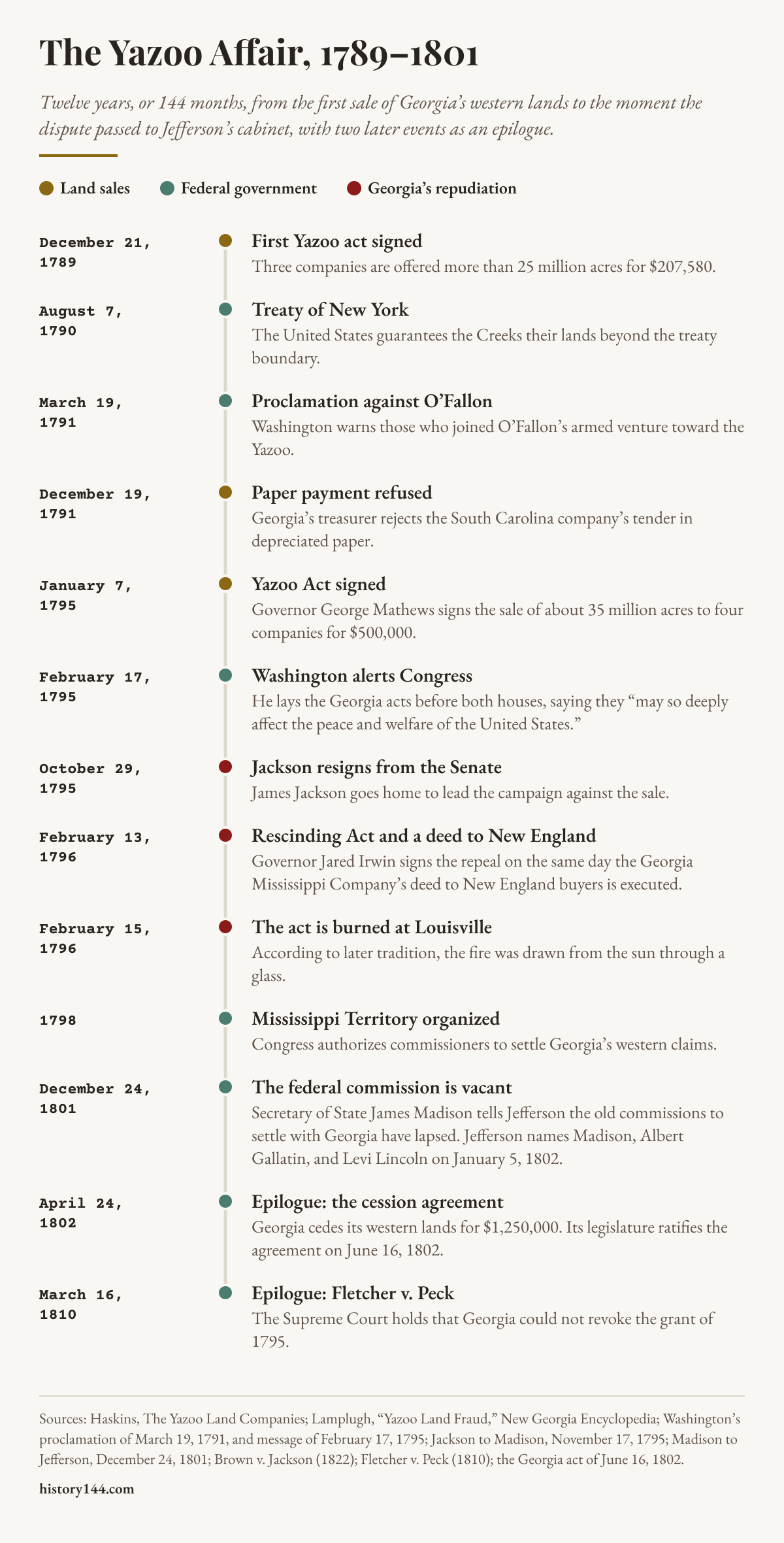
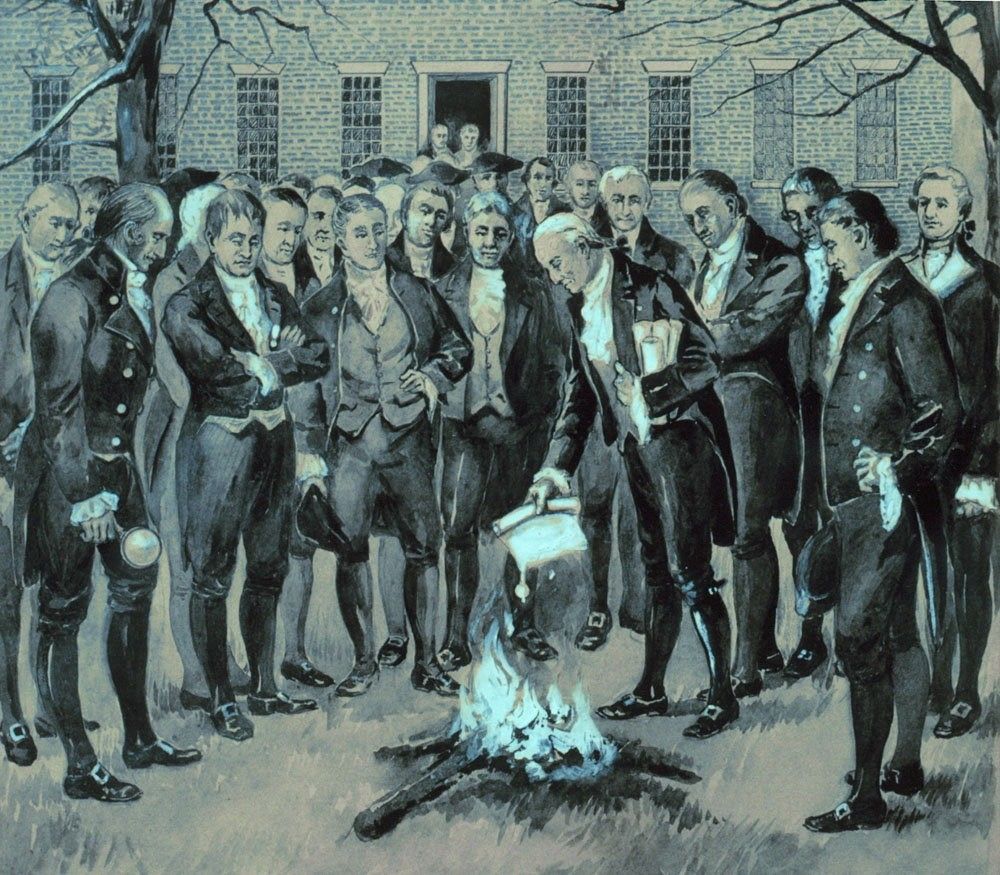
On February 15, 1796, the officers of the State of Georgia gathered before the statehouse at Louisville, the inland town that had just become the state's capital, to destroy a law. The law was the act of January 7, 1795, by which the previous legislature had sold most of what is now Alabama and Mississippi to four companies of land speculators. Two days earlier the new legislature's repeal of that act had become law, declaring it null and void and ordering every record of it expunged. Now the act itself was publicly burned. According to a tradition recorded only in later accounts, the flame was drawn down from the sky through a burning glass, so that the corrupt act would be consumed by "fire from heaven."[1]
The ceremony was meant to wipe the slate clean, but it erased far less than its authors hoped. On the very day the repeal became law, one of the Yazoo companies conveyed eleven million acres to New England buyers, and the paper title to Georgia's western lands was already passing from hand to hand across the Northeast.[2] James Jackson, the former United States senator who led the campaign against the sale, had warned James Madison three months earlier that land speculation had "over leaped all moderate bounds, and stops nothing short of the purchase of Nations."[3] The Yazoo affair began with a sale in 1789 that failed after a colonizing scheme tangled in Spanish intrigue and a dispute over payment in depreciated paper, and it reached a second, far larger sale in 1795 that was bought with bribes. Its unwinding drew in the president, Congress, and eventually the Supreme Court, and it ended with Georgia surrendering its western country to the United States. This is the story of those twelve years.
A Kingdom on Paper
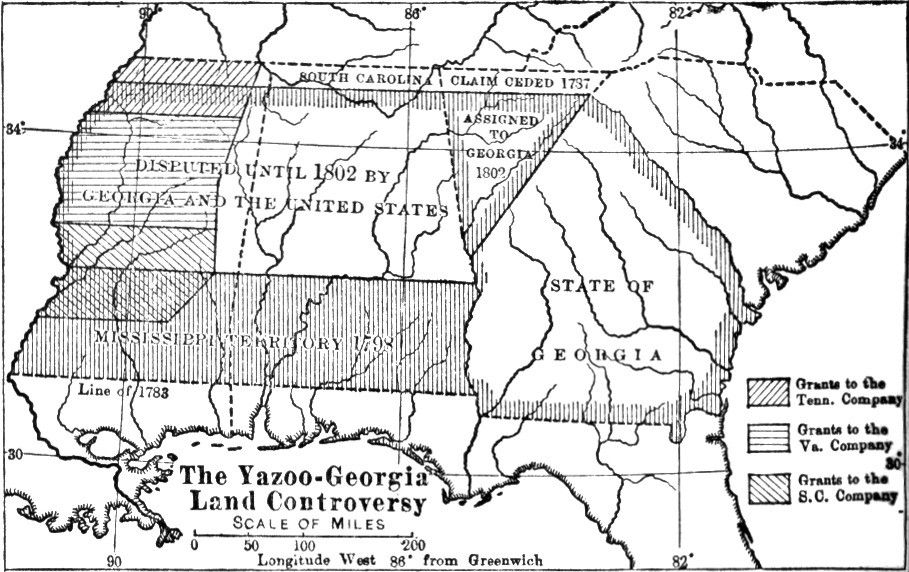
At the close of the Revolution, Georgia's hold on the country between the Chattahoochee River and the Mississippi rested chiefly on its own assertion. South Carolina claimed the region under its colonial charter until 1787. The United States argued that the Crown had withdrawn it from the colonies before the war. Spain held Natchez and the Gulf Coast and denied any American title south of latitude 32° 30′. Above all, the land was home to the Chickasaws, Choctaws, Cherokees, and Creeks, over whom the federal government claimed a protectorate. As the historian Henry Adams put it, in a passage Charles Homer Haskins quoted in 1891, no one could say what Georgia's title was worth, because its value depended on the state's power to dispossess the Indians.[4]
Georgia could claim the western country, but it could neither settle nor defend it, and Spain controlled the river that gave the land its commercial value. Under those conditions, Haskins concluded, the state was ready to take a small financial gain on the first offer of favorable terms.[5] The federal government soon made Georgia's weakness explicit. In the Treaty of New York, signed on August 7, 1790, by Secretary of War Henry Knox, Alexander McGillivray, and more than twenty other Creek leaders, the United States "solemnly guarantee[d] to the Creek Nation, all their lands within the limits of the United States" west and south of a boundary that ran from the upper Savannah River down the Oconee and Altamaha. The Creeks in turn agreed not to hold any treaty with an individual state.[6]
The First Sale, 1789
The first buyers came chiefly from South Carolina. Their leading promoter was a Georgian known as Major Thomas Washington, whose real name was Walsh. He was later hanged in Charleston for counterfeiting South Carolina debt certificates. With Alexander Moultrie, William Clay Snipes, and Isaac Huger, he organized the South Carolina Yazoo Company, and McGillivray himself later joined it.[7] On November 20, 1789, the company petitioned the Georgia legislature, promising that once its application was granted, "an affrican trade and European Commerce" would "take place at the Yazoo to an immense and vast amount."[8] Of two other applicants, the Virginia Yazoo Company counted Patrick Henry among its partners, and the Tennessee Company sought land along the Tennessee River near Muscle Shoals.[9]
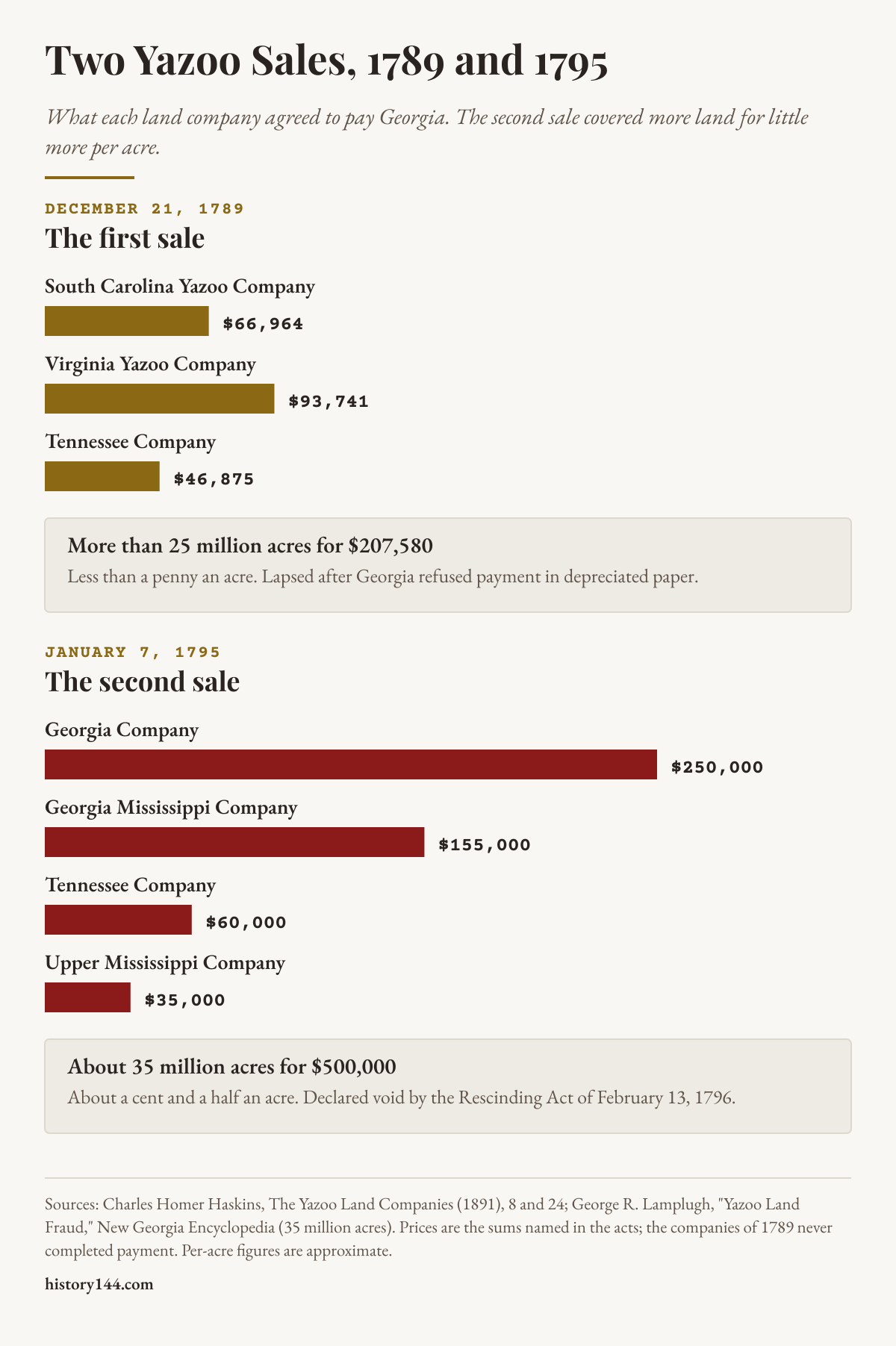
When the bill reached the house, a fourth group offered a much higher price, but every attempt to add it or to raise the payment failed, and the governor signed the act on December 21, 1789. The South Carolina company received more than ten million acres in what is now southern Mississippi and Alabama for $66,964. The Virginia company received 11,400,000 acres north of the thirty-third parallel for $93,741. The Tennessee Company received four million acres for $46,875. The state reserved the lands to the buyers for two years, after which grants would issue if the money had been paid. Georgia would bear no expense in keeping peace with the Indians or in extinguishing their title. In all, more than twenty-five million acres were offered for $207,580, less than a penny an acre.[10]
O'Fallon's Battalion
The South Carolina company moved first. As its western agent it chose Dr. James O'Fallon, a Revolutionary soldier, and instructed him to go to Kentucky, take four or five hundred settlers down to the Walnut Hills near the mouth of the Yazoo (the site of present-day Vicksburg), and then seek the goodwill of the Spanish government at New Orleans.[11] In Kentucky, O'Fallon fell in with General James Wilkinson, who was secretly intriguing with Spain and, by most accounts, in its pay. Wilkinson had already told Esteban Miró, the Spanish governor of Louisiana, that he would place "the whole control of this affair" in Miró's hands, and that Miró could "break up the projected settlement, by inciting the Choctaws to incommode the colonists."[12]
O'Fallon went further still. In a letter to Miró dated May 24, 1790, he claimed that he had "insensibly prevailed upon" the company's members to accept his political views and had "led them to consent to be the slaves of Spain, under the appearance of a free and independent colony." Miró was wary. He doubted the wisdom of "taking a foreign state to board," and he reported to Madrid that he had secured the opposition of all the Indian nations to the three companies and promised them powder and ball to defend their lands. How far the company's directors shared O'Fallon's designs remains uncertain. Haskins judged that O'Fallon may have exceeded his authority, though his appeal to secret instructions cast strong suspicion on his employers.[13]
O'Fallon was soon raising what he called a battalion, and in September 1790 he wrote to President Washington asking permission to arrange trade with the Indians and buy more land.[14] Washington had already issued proclamations that August requiring obedience to the federal Indian treaties. On March 19, 1791, acting on a joint opinion from Thomas Jefferson and Attorney General Edmund Randolph, he issued another, aimed at O'Fallon by name. It declared that O'Fallon was "levying an armed force" in Kentucky, and it warned "those who have incautiously associated themselves" with him that all who violated the treaties "shall be prosecuted with the utmost rigor of the law."[15]
The expedition dissolved. Wilkinson deserted O'Fallon, his associates fell away, and O'Fallon married a sister of George Rogers Clark and settled in Kentucky. The proclamation did its work, though Spain and the Indians had also prepared to resist. A traveler named John Halley, who left Boonesboro, Kentucky, in the spring of 1791, recorded in his diary that at a new Spanish post near the Yazoo the governor asked what had become of Dr. O'Fallon and his company. The commandant then showed Halley the artillery and pointed to a twenty-four-pounder, saying it was meant for the doctor.[16] The Tennessee Company fared no better. Early in 1791, in spite of warnings from the president, eighteen of Zachariah Cox's men built a blockhouse near Muscle Shoals, but they withdrew when a party of Cherokees arrived.[17]
Paper and Specie
The first Yazoo sale finally died over money. The companies had expected to pay in Georgia's depreciated paper and certificates, which could be bought for a fraction of their face value. In June 1790 the legislature directed the state treasurer to accept only gold and silver after the following August. On December 19, 1791, just before its two years ran out, the South Carolina company tendered the balance in South Carolina paper money, Continental currency of 1776, and assorted Georgia certificates. The treasurer refused it, and the state held that the act had contemplated payment in specie only.[18]
The speculators did not necessarily lose. Arthur Campbell, an enemy of Patrick Henry, told Jefferson in 1791 that the purchasers were content to let the bargain drop, because the public paper they had bought at half a crown in the pound had risen enough to repay them as well as the land would have. Haskins thought Henry probably profited, but he accepted William Wirt Henry's conclusion that the gain had not changed Henry's politics.[19]
The Augusta Bargain
In November 1794 the legislature, then sitting at Augusta, began receiving new offers. The first came on November 12 from John Wereat, acting as agent for Albert Gallatin, Alexander J. Dallas, and Jared Ingersoll of Pennsylvania, who afterward disclaimed any further connection with his proposals. Four companies then petitioned for most of the state's western territory at a combined price of $500,000.[20] The legislature passed a bill embodying their proposal, but Governor George Mathews, a Revolutionary veteran, vetoed it. He did not consider the bill unconstitutional. He objected that the time for selling had not arrived, that monopoly was a bad principle, that the price was too low, and that too little land was reserved for the state and its citizens. The legislature hurried through a bill framed to meet his objections, and on January 7, 1795, Mathews signed it.[21]
The Georgia Company received about seventeen million acres stretching from the Mississippi to the Alabama River for $250,000. The Georgia Mississippi Company paid $155,000 for the southwest, the Tennessee Company $60,000 for much the same tract it had sought in 1789, and the Upper Mississippi Company $35,000 for a strip in the far northwest. The price came to about a cent and a half an acre, and only part of it was paid down. The act required the Georgia Company to pay $50,000 before receiving its grant, which was issued on January 13, with the remaining $200,000 secured by a mortgage due on November 1, 1795.[22]
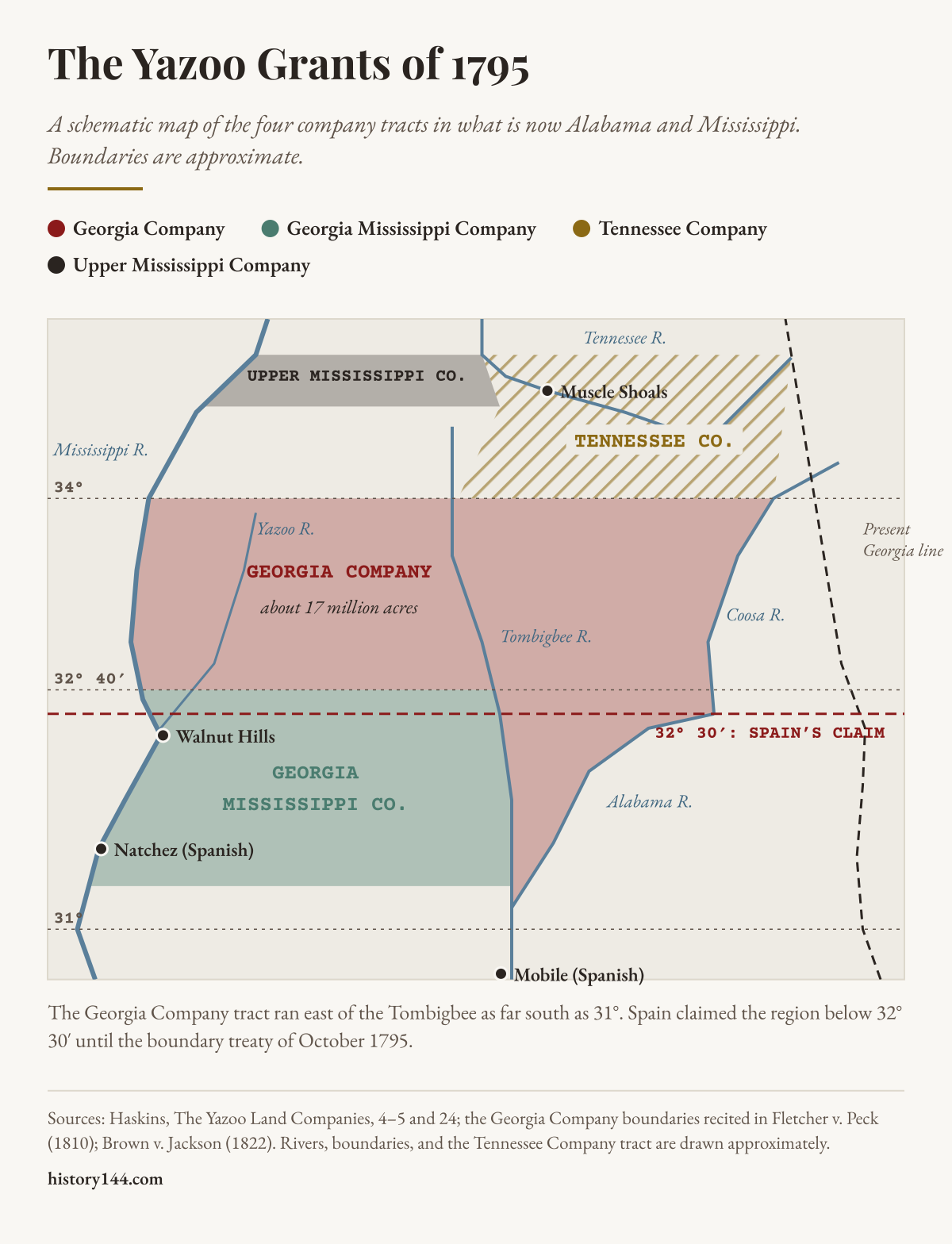
The list of buyers read like a register of the early republic's political class. James Gunn, a United States senator from Georgia, led the Georgia Company, and his associate Matthew McAllister was the federal district attorney. Congressmen Robert Goodloe Harper and Thomas P. Carnes, the federal judge Nathaniel Pendleton, and Justice James Wilson of the United States Supreme Court, who held shares covering at least a million acres, all had a stake.[23] Francis Watkins, reporting to Patrick Henry on why the Virginians had been shut out, wrote that their opponents had come "full handed" and paid down $100,000, and that "Gunn, Pendleton & Cox … have done the business Judge Wilson & others the money."[24] The business included the legislators themselves. Comparing the recorded votes with the shareholder lists later printed in the American State Papers, Haskins found that with a single exception every member who voted for the sale held shares in one or more of the companies.[25]
"So Infamous a Barter"
Opposition began even before the bill became law. A remonstrance reached Mathews from citizens of Columbia County, among them the future treasury secretary William H. Crawford. Once the sale was public, Georgia filled with petitions, grand jury presentments, and newspaper attacks, and, in a phrase Haskins borrowed from an earlier writer, Georgia "became a perilous residence for all concerned in the speculation." Senator Gunn was burned in effigy in several places.[26] President Washington sent copies of the Georgia acts to Congress on February 17, 1795, warning that they "may so deeply affect the peace and welfare of the United States" that he thought it necessary to lay them before Congress.[27] On March 3 Congress asked the president to have the attorney general collect the charters, treaties, and other documents bearing on the title to the lands claimed under the Georgia law.[28]
Mathews explained himself in a letter to the secretary of war that April. "The sale of the lands," he wrote, "was never pleasing to me; but the cause arises from a full conviction, that large monopolies are against the interest of the Citizens in general, and not from any doubts I entertained of the right of this State to the lands in question."[29] Suspicion followed him regardless, though his signature has generally been attributed to weakness rather than corruption.[30] A state constitutional convention that met in May 1795 received many petitions against the sale but merely referred them to the next legislature. At least fifteen of its fifty-five members were themselves shareholders.[31]
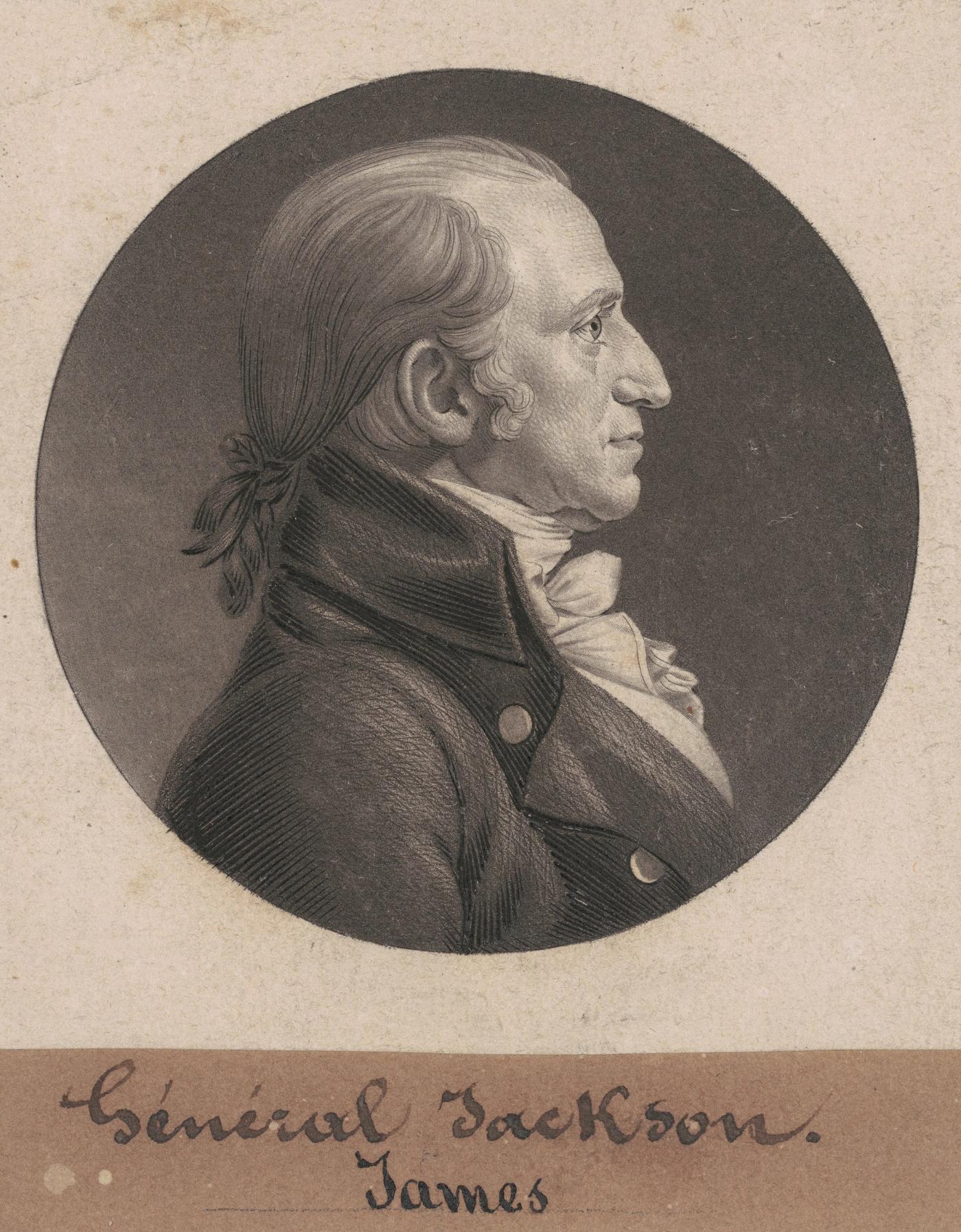
The man who turned public anger into political power was James Jackson. A Revolutionary officer and Jeffersonian Republican, Jackson had served in the first House before entering the Senate. In August 1795 he attacked the sale in a series of public letters signed "Sicilius," and on October 29 he resigned his Senate seat to run for the Georgia legislature.[32] Madison's modern editors note that Jackson had himself received Yazoo grants as a senator and helped expedite their sale before turning against the speculators.[33] On November 17 Jackson explained his resignation to Madison. The people of Georgia, he wrote, were resolved that "so infamous a barter of their rights" should be annulled, "even should they be driven to the necessity of arming to effect it," and his fellow citizens had called on him to help break down "this Babel of monopoly." He added that Georgians linked the sale to Jay's Treaty. Rumors circulated at the time that Gunn had voted for the treaty in exchange for a promise that the administration would not investigate the sale.[34]
The Rescinding Act
The elections of 1795 turned on Yazoo, and anti-Yazoo candidates won on all sides. When the new legislature met in January 1796, the house appointed a committee of nine, with Jackson as chairman, to examine the validity of the grant. A week later it reported a bill along with evidence of corruption, which the house ordered entered in its journal.[35] Governor Jared Irwin signed the measure on February 13, 1796.[36] It was titled "An act declaring null and void a certain usurped act passed by the last legislature of this state at Augusta," and it declared that the sale, having been "made without constitutional authority, and fraudulently obtained," was of "no binding force or effect on this state, or the people thereof." Further sections ordered the act and all related deeds and contracts expunged from the state's records, offered to repay purchase money still in the treasury if it was claimed within eight months, and prohibited any application to Congress for the extinguishment of the Indian claim.[37]
Fully three-quarters of the act was preamble, and it bore unmistakable marks of Jackson's hand. The preamble argued that the legislature of 1795 had violated the state constitution by wasting public resources and creating monopolies hostile to republican government, and that the power to alienate public land had never been delegated to the legislature at all but could be exercised only by the people in convention.[38] The act stated Georgia's position forcefully, but it could not by itself settle whether a legislature might undo a completed grant, or what became of titles already sold to others.
Fire from Heaven
Two days after Irwin signed the act, the burning took place. Haskins reported only that "tradition says" the fire was drawn down by a sun-glass.[39] A fuller version appears in the memoirs of William H. Sparks, a Georgian born twenty days after Washington's death, who published his recollections in 1870. Sparks wrote that Jackson led the legislature and a crowd in procession to the public square at Louisville, where the law and the fagots were piled. There, according to Sparks, Jackson denounced as bribed villains the members who had voted for the act, the men who had bribed them, and the governor who had signed it, declared that "fire from heaven only could sanctify the indignation of God and man in consuming the condemned record of accursed crime," and then lit the pile with "a Promethean or convex glass condensing the sun's rays."[40] Sparks admitted that he wrote from memory and an old journal, and he could not have witnessed the scene himself.[41]
Georgia meant the destruction to be permanent. A state convention in 1798 wrote the rescission into the new state constitution, declaring the companies' purchases void and directing the legislature to arrange repayment. Gunn and a fellow delegate named Glascock refused to sign the new constitution because of those provisions.[42]
The Paper Travels North
The legislature could burn its own records, but it could not reach the deeds already in circulation. Agents of the companies had opened an office in Boston, where buyers paid chiefly in notes and prices rose by the day. Under an agreement of January 20, 1796, the Georgia Mississippi Company's trustees executed a deed, held in escrow, on February 13, the same day Irwin signed the rescinding act. It conveyed a tract estimated at 11,380,000 acres to trustees for the New England buyers who formed the New England Mississippi Land Company, at a price that was to reach ten cents an acre. According to contemporary travelers, "every class of men, even watch-makers, hair-dressers, and mechanics of all descriptions," joined the rush, and Boston alone sank more than two million dollars into Yazoo lands.[43]
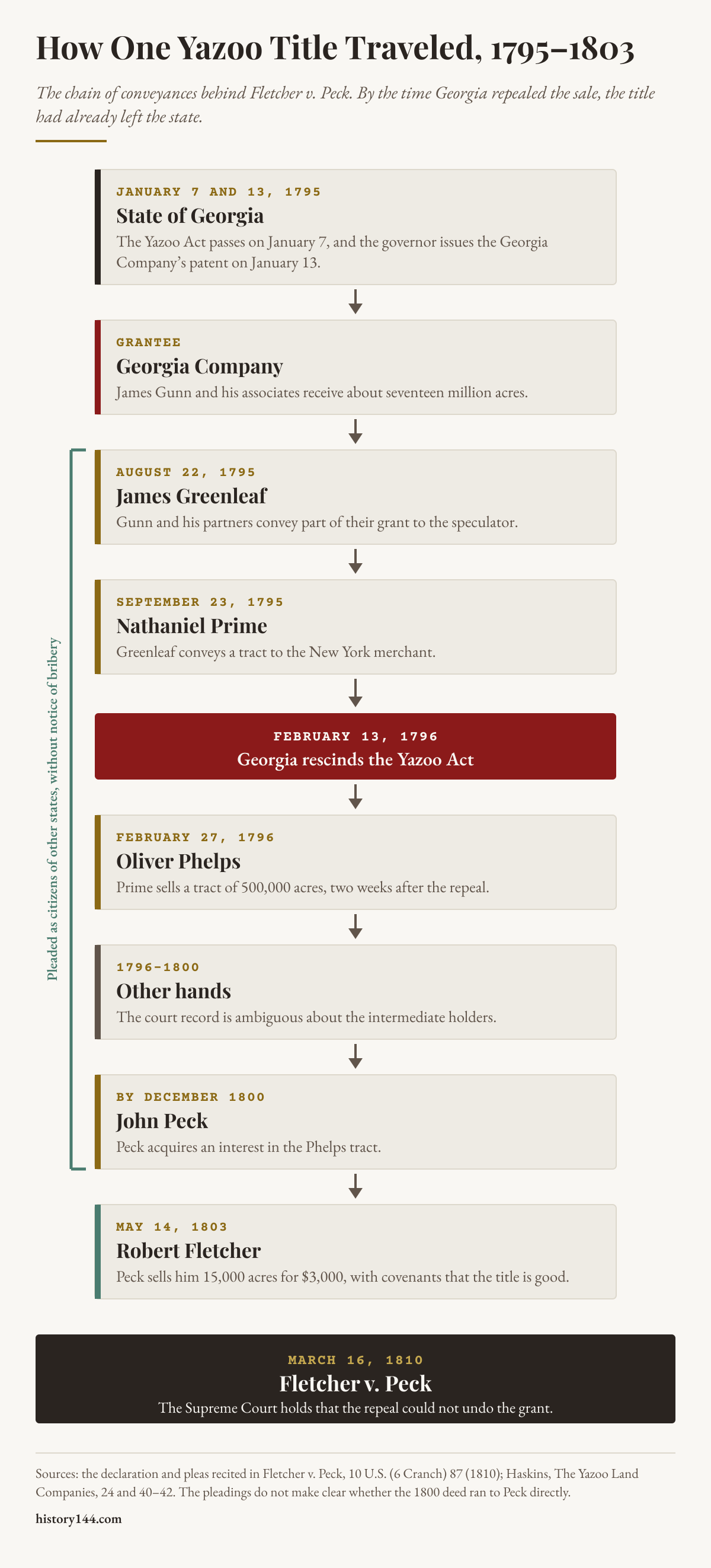
The course of a single title shows how quickly the land became a commodity detached from Georgia. Gunn and his partners conveyed part of their grant to the speculator James Greenleaf in August 1795. A five-hundred-thousand-acre tract then passed through the New York merchant Nathaniel Prime to Oliver Phelps in February 1796, two weeks after the rescission, and from Phelps through other hands to John Peck, who in May 1803 sold fifteen thousand acres to Robert Fletcher for three thousand dollars. In court Peck would plead that every holder after Gunn's company was a citizen of another state who had bought without notice of any bribery.[44]
The purchasers organized to defend their titles. In March 1796 Alexander Hamilton, retained by the New York merchant William Constable, gave a written opinion that "every grant" from a state was "virtually a contract," so that a revocation of Georgia's grant would violate the constitutional ban on state laws impairing the obligation of contracts.[45] Harper defended the sales in print, and Abraham Bishop attacked them in Georgia Speculation Unveiled, one of many pamphlets in a long controversy.[46]
The Federal Reckoning
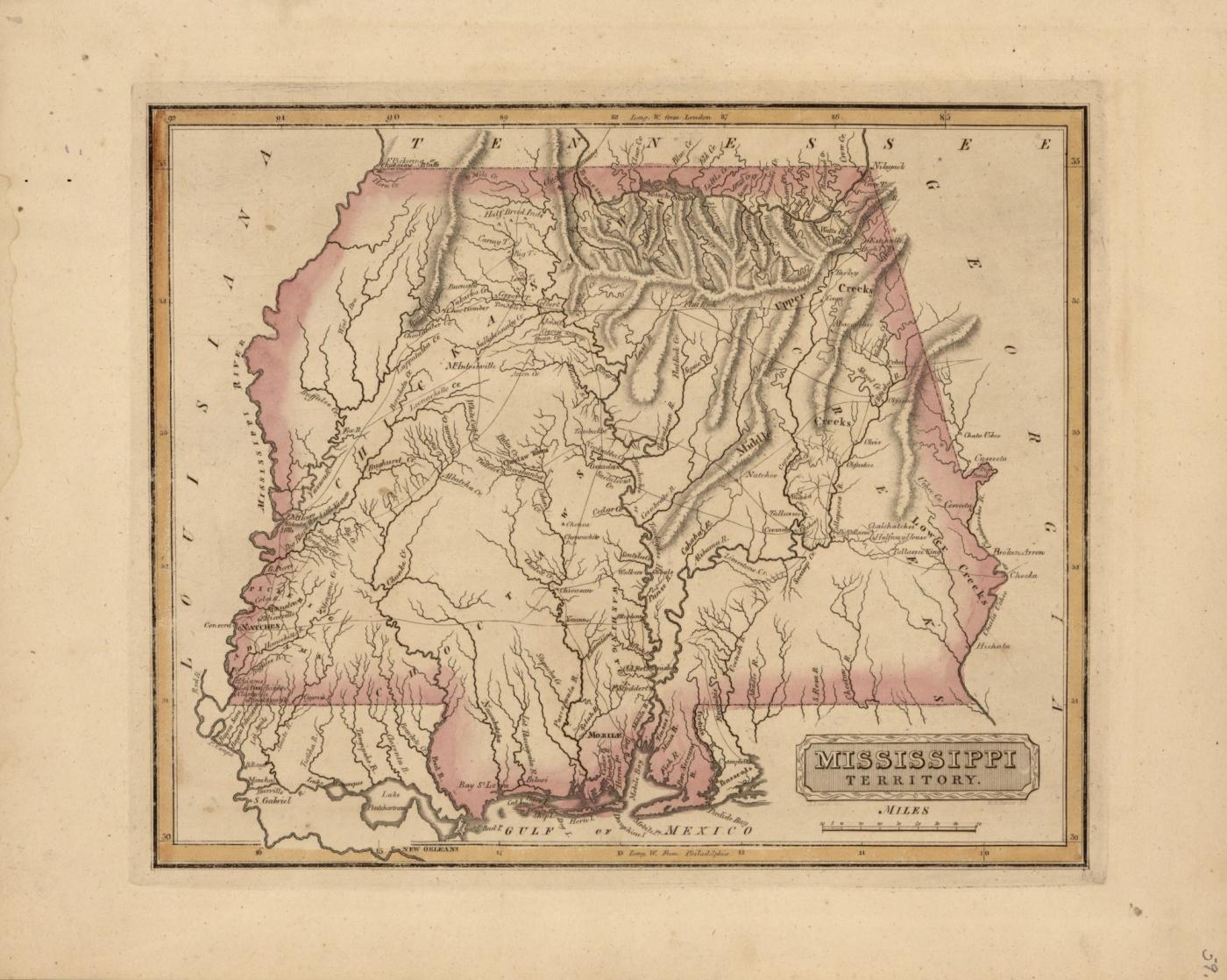
Attorney General Charles Lee delivered his report on Georgia's title to the Senate in April 1796.[47] The South Carolina company sued Georgia in the Supreme Court that year, but the Eleventh Amendment, declared in force in January 1798, ended suits against states by citizens of other states, and the case went no further.[48] In 1798 Congress organized the Mississippi Territory and authorized commissioners to settle the dispute with Georgia and receive a cession of its western claims. President John Adams named the federal commissioners.[49] A further law of 1800 directed the federal commissioners to look into the private claims to the territory south of Tennessee.[50]
Under Thomas Jefferson, who took office in 1801, the work passed to three members of his cabinet, Secretary of State Madison, Secretary of the Treasury Gallatin, and Attorney General Levi Lincoln.[51] Jackson, elected governor of Georgia in 1798, had returned to the United States Senate in 1801, where he would remain the strongest opponent of compromise.[52]
The Promise of 1802
On April 24, 1802, the federal commissioners and Georgia's representatives, Congressman John Milledge and Senators James Jackson and Abraham Baldwin, signed the Articles of Agreement and Cession, which the Georgia legislature ratified by an act approved on June 16. Georgia surrendered its claims west of the Chattahoochee in return for $1,250,000 and a pledge that the United States would, "at their own expence," extinguish the Indian title to lands within Georgia's remaining borders "as early as the same can be peaceably obtained on reasonable terms." Georgia agreed to let five million acres be held back to settle other claims.[53] In February 1803 the federal commissioners rejected the claims of the 1789 companies and judged that the titles of the 1795 purchasers could not be supported, but they concluded that the interests of the United States and the tranquillity of future settlers made a compromise expedient.[54]
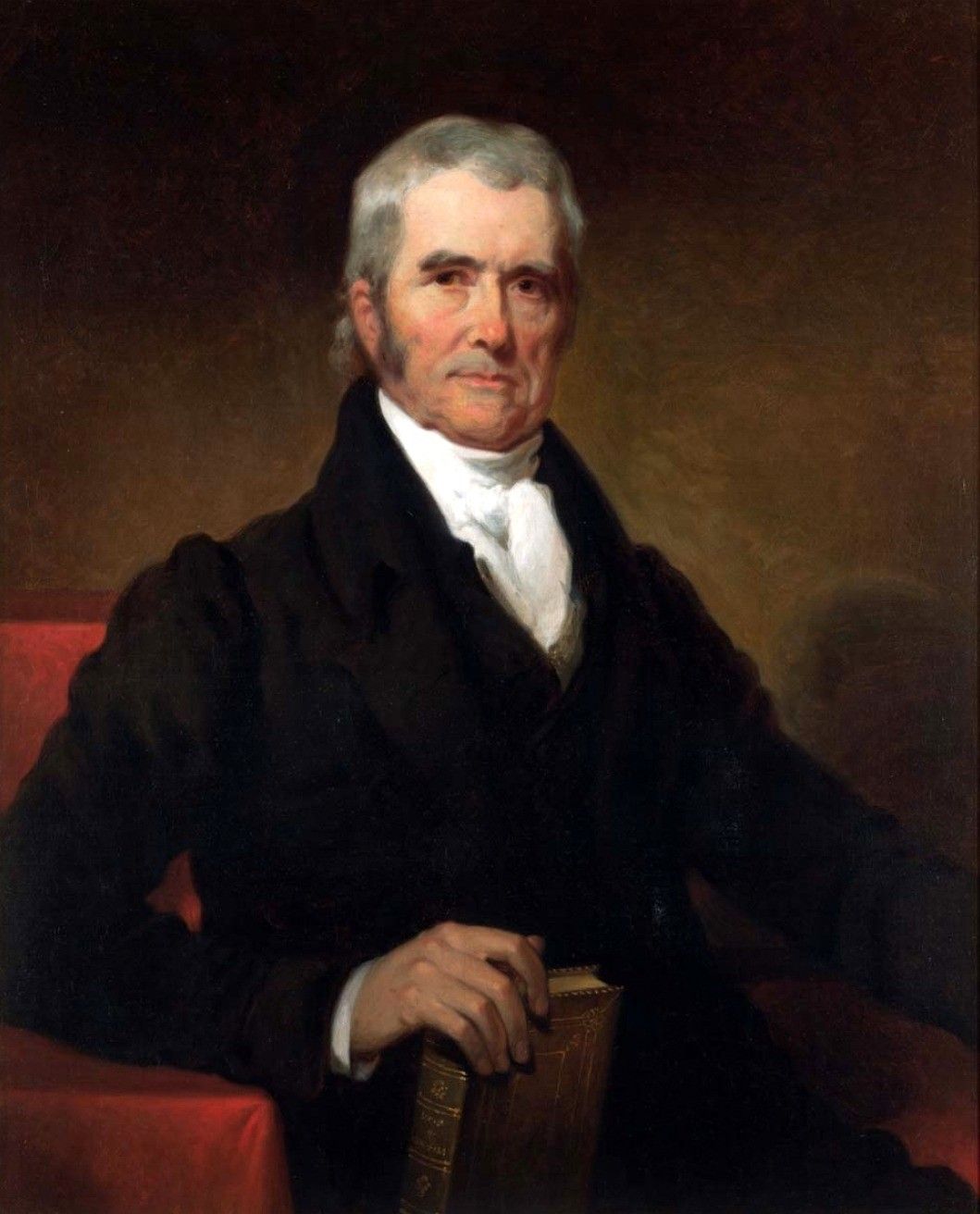
In January 1805 John Randolph of Roanoke told the House that the force behind the claims was "a monster generated by fraud, nursed in corruption, that in grim silence awaits its prey," and he named it "the spirit of Federalism."[55] The question finally reached the Supreme Court through Fletcher v. Peck, which had been arranged as a feigned issue. Justice William Johnson, in a separate opinion, remarked that it bore "strong evidence, upon the face of it, of being a mere feigned case." On March 16, 1810, Chief Justice John Marshall conceded that corruption in "the governments of our infant republics" was "most deeply to be deplored," but he held that a court hearing a suit between private parties could not declare a law void because of the impure motives of some of the legislators who passed it. A purchaser who had "paid his money for a title good at law" was innocent, "whatever may be the guilt of others." More fundamentally, Marshall treated the grant itself as a contract that "implies a contract not to reassert that right," and he concluded that Georgia was restrained, "either by general principles which are common to our free institutions, or by the particular provisions of the constitution of the United States," from revoking it. The Federal Judicial Center describes the decision as the first time the Supreme Court struck down a state statute.[56] In 1814 Congress appropriated five million dollars to settle the claims, and the Treasury eventually paid out $4,282,151.12, much of it to people who had bought the claims at a discount from the original investors.[57]
The Fire and the Paper
The burning at Louisville was meant to restore Georgia's honor, and in Georgia it largely did. Sparks remembered that opposition to the fraud became "the test of public confidence and social respect," and that even in his old age "to be known as the descendant of a Yazoo man is a badge of disgrace."[58] Yet the bonfire could destroy only paper. The deeds, the notes, and the expectations of thousands of buyers survived it, and by 1801 the question of what they were worth had passed out of Georgia's hands and into those of the federal government. The twelve years that began with a sale of western land at less than a penny an acre ended with Jefferson's cabinet negotiating for the whole of Georgia's western country. Haskins argued that the lawsuit the dispute eventually produced, Fletcher v. Peck, rather than the more famous Dartmouth College case, lay at the root of the later law of public contracts.[59] The men who lit the fire at Louisville had hoped to end the Yazoo affair. They had only moved it to a larger stage.
Places in this Story
The places this story moves through, in order — follow them on the interactive map →
- Louisville, Georgia February 15, 1796
Georgia’s new capital, where the act of 1795 was publicly burned before the statehouse two days after the Rescinding Act became law.
- Augusta, Georgia January 7, 1795
The legislature sitting here sold most of Georgia’s western territory to four companies for $500,000. Every member but one who voted for the sale held shares in the companies.
- New York City August 7, 1790
Henry Knox, Alexander McGillivray, and more than twenty Creek leaders signed the Treaty of New York, in which the United States guaranteed the Creeks their lands.
- Walnut Hills (Vicksburg), Mississippi 1790 to 1791
The South Carolina Yazoo Company planned a colony here near the mouth of the Yazoo. Its agent, James O’Fallon, intrigued with Spain, and his expedition collapsed after Washington’s proclamation of March 1791.
- Muscle Shoals, Alabama 1791
Zachariah Cox’s men built a blockhouse here for the Tennessee Company but withdrew when a party of Cherokees arrived.
- Boston, Massachusetts 1795 to 1796
The companies opened an office here, and New England buyers formed the New England Mississippi Land Company. Boston alone sank more than two million dollars into Yazoo lands.
- United States Capitol, Washington March 16, 1810
In Fletcher v. Peck, the Supreme Court held that Georgia could not revoke its Yazoo grants, the first time the Court struck down a state law.
Frequently Asked Questions
What was the Yazoo land fraud?
The Yazoo land fraud was the sale of most of what is now Alabama and Mississippi by the Georgia legislature to four land companies in January 1795, for $500,000, or about a cent and a half an acre. The sale was secured with bribes: with a single exception, every legislator who voted for it held shares in the companies. A new legislature repealed it in February 1796.
Who was involved in the Yazoo land fraud?
The Georgia Company was led by James Gunn, a United States senator from Georgia. Other investors included Congressmen Robert Goodloe Harper and Thomas P. Carnes, the federal judge Nathaniel Pendleton, and Justice James Wilson of the United States Supreme Court. Governor George Mathews signed the act, though historians have generally attributed his signature to weakness rather than corruption.
Why was it called the Yazoo land sale?
The lands took their name from the Yazoo River in what is now western Mississippi, where the first speculators planned to plant a colony at the Walnut Hills, the site of present-day Vicksburg. The name came to cover both Georgia’s first sale of western lands in 1789 and the far larger, corrupt sale of 1795.
Who was James Jackson?
James Jackson was a Revolutionary officer and Jeffersonian Republican who resigned his United States Senate seat in October 1795 to fight the Yazoo sale in the Georgia legislature. He chaired the committee that drafted the Rescinding Act of February 13, 1796, which declared the sale null and void. He later served as governor of Georgia and returned to the Senate in 1801.
Why was the Yazoo Act burned?
On February 15, 1796, two days after the Rescinding Act became law, Georgia’s officers publicly burned the 1795 act before the statehouse at Louisville, the new capital, to wipe out every trace of the sale. A tradition recorded only in later accounts holds that the flame was drawn from the sun through a burning glass, so that the act would be destroyed by “fire from heaven.”
What was Fletcher v. Peck?
Fletcher v. Peck was the 1810 Supreme Court case that grew out of the Yazoo sale. Chief Justice John Marshall held that Georgia’s land grant was a contract that the state could not revoke, even though the legislature had been bribed, because later buyers had purchased in good faith. It was the first time the Supreme Court struck down a state law.
How was the Yazoo land fraud settled?
In 1802 Georgia ceded its lands west of the Chattahoochee to the United States for $1,250,000 and a federal pledge to extinguish Indian title within the state, setting aside five million acres to settle claims. In 1814 Congress appropriated five million dollars to compensate the Yazoo claimants, and the Treasury eventually paid out $4,282,151.12.
Bibliography
Primary Sources
"An Act to Ratify and Confirm Certain Articles of Agreement and Cession." In Acts of the General Assembly of the State of Georgia, Passed at the Sessions of June and November, 1802. Louisville, GA: Ambrose Day, 1802. Digital Library of Georgia. https://dlg.usg.edu/record/dlg_zlgl_655511. Accessed November 1, 2026.
Brown v. Jackson, 20 U.S. (7 Wheat.) 218 (1822). Justia U.S. Supreme Court Center. https://supreme.justia.com/cases/federal/us/20/218/. Accessed November 2, 2026.
Fletcher v. Peck, 10 U.S. (6 Cranch) 87 (1810). United States Reports. GovInfo, U.S. Government Publishing Office. https://www.govinfo.gov/content/pkg/USREPORTS-10/pdf/USREPORTS-10-87.pdf. Accessed November 1, 2026.
Hamilton, Alexander. Alexander Hamilton to Oliver Wolcott Jr., [May–August 1796], with editorial notes. Founders Online, National Archives. https://founders.archives.gov/documents/Hamilton/01-20-02-0127. Accessed November 1, 2026.
Jackson, James. James Jackson to James Madison, November 17, 1795, with editorial notes. Founders Online, National Archives. https://founders.archives.gov/documents/Madison/01-16-02-0068. Accessed November 1, 2026.
Jackson, James. James Jackson to James Madison, May 15, 1801, with editorial notes. Founders Online, National Archives. https://founders.archives.gov/documents/Madison/02-01-02-0242. Accessed November 1, 2026.
Kappler, Charles J., ed. "Treaty with the Creeks, 1790." In Indian Affairs: Laws and Treaties. Vol. 2, Treaties. Washington, DC: Government Printing Office, 1904. Avalon Project, Lillian Goldman Law Library, Yale Law School. https://avalon.law.yale.edu/18th_century/cre1790.asp. Accessed November 1, 2026.
Pickering, Timothy. Timothy Pickering to Bartholomew Dandridge Jr., May 15, 1795, with editorial note quoting George Mathews to Timothy Pickering, April 16, 1795. Founders Online, National Archives. https://founders.archives.gov/documents/Washington/05-18-02-0105. Accessed November 1, 2026.
"Report of the Georgia Land Commissioners, 14 February 1803 (Abstract)." Founders Online, National Archives. https://founders.archives.gov/documents/Madison/02-04-02-0396. Accessed November 1, 2026.
Sparks, W. H. The Memories of Fifty Years. Philadelphia: Claxton, Remsen & Haffelfinger, 1870. Project Gutenberg. https://www.gutenberg.org/ebooks/15872. Accessed November 1, 2026.
Washington, George. Proclamation, March 19, 1791. Founders Online, National Archives. https://founders.archives.gov/documents/Washington/05-07-02-0343. Accessed November 1, 2026.
Washington, George. George Washington to the U.S. Senate and House of Representatives, February 17, 1795. Founders Online, National Archives. https://founders.archives.gov/documents/Washington/05-17-02-0361. Accessed November 1, 2026.
Secondary Sources
Federal Judicial Center. "Fletcher v. Peck." Cases That Shaped the Federal Courts. https://www.fjc.gov/history/cases/cases-that-shaped-the-federal-courts/fletcher-v-peck. Accessed November 2, 2026.
Haskins, Charles Homer. The Yazoo Land Companies. New York: Knickerbocker Press, 1891. Reprinted from Papers of the American Historical Association, October 1891. Google Books. https://books.google.com/books?id=D1AEAAAAMAAJ. Accessed November 1, 2026.
Lamplugh, George R. "Yazoo Land Fraud." New Georgia Encyclopedia. Georgia Humanities and University of Georgia Press. https://www.georgiaencyclopedia.org/articles/history-archaeology/yazoo-land-fraud/. Accessed November 1, 2026.
University of Georgia Libraries. "Yazoo Land Fraud Document, 1795." Collection description, ms 1457, Hargrett Rare Book and Manuscript Library. https://sclfind.libs.uga.edu/sclfind/view?docId=ead/ms1457.xml. Accessed November 1, 2026.
"Yazoo Act Burning." Caption to a 1908 illustration published by the American Book Company. New Georgia Encyclopedia. Georgia Humanities and University of Georgia Press. https://www.georgiaencyclopedia.org/file/11380. Accessed November 1, 2026.
Citations
- Charles Homer Haskins, The Yazoo Land Companies (New York: Knickerbocker Press, 1891), 27–28; "Yazoo Act Burning," New Georgia Encyclopedia. The encyclopedia entry is cited for the site of the burning at Louisville, not for the burning-glass tradition. ↑
- Haskins, Yazoo Land Companies, 30; "Report of the Georgia Land Commissioners, 14 February 1803 (Abstract)," Founders Online, National Archives. ↑
- James Jackson to James Madison, November 17, 1795, Founders Online, National Archives. ↑
- Henry Adams, History of the United States of America, vol. 1, quoted in Haskins, Yazoo Land Companies, 5. ↑
- Ibid., 6. ↑
- Treaty with the Creeks, August 7, 1790, preamble and arts. 2, 4, and 5, in Charles J. Kappler, ed., Indian Affairs: Laws and Treaties, vol. 2, Treaties (Washington, DC: Government Printing Office, 1904), Avalon Project. ↑
- Haskins, Yazoo Land Companies, 7 and 7n1. ↑
- Petition of the South Carolina Yazoo Company, November 20, 1789, quoted in Haskins, Yazoo Land Companies, 7. ↑
- Haskins, Yazoo Land Companies, 8, 18, 21–22. ↑
- Ibid., 8. The total price and the price per acre are calculated from Haskins's figures. ↑
- Ibid., 6, 8–9. ↑
- James Wilkinson to Esteban Miró, quoted in Haskins, Yazoo Land Companies, 9–10. On the evidence that Wilkinson was in Spanish pay, and the possibility that his pension began later, see Haskins, Yazoo Land Companies, 9 and 9n4. ↑
- James O'Fallon to Esteban Miró, May 24, 1790, quoted in Haskins, Yazoo Land Companies, 11; Haskins, Yazoo Land Companies, 11–13. ↑
- Haskins, Yazoo Land Companies, 13–14. ↑
- George Washington, Proclamation, March 19, 1791, Founders Online, National Archives. The proclamation itself refers to Washington's earlier proclamations of August 14 and 26, 1790; the editorial note identifies the joint opinion of Jefferson and Randolph of February 14, 1791, as its background. ↑
- Haskins, Yazoo Land Companies, 14–15, including the extract from John Halley's diary at 15n2. ↑
- Ibid., 21–22. ↑
- Ibid., 15–16. ↑
- Ibid., 20–21. Campbell's remarks are reported in Jefferson to Washington, April 24, 1791, as quoted by Haskins. ↑
- Haskins, Yazoo Land Companies, 22–23; Fletcher v. Peck, 10 U.S. (6 Cranch) 87 (1810), statement of the case, which places the 1795 session at Augusta. ↑
- Haskins, Yazoo Land Companies, 23–24. ↑
- Ibid., 24; Fletcher v. Peck, statement of the case. ↑
- Haskins, Yazoo Land Companies, 25. ↑
- Francis Watkins to Patrick Henry, March 7, 1795, quoted in Haskins, Yazoo Land Companies, 19–20 and 25, in the notes. ↑
- Haskins, Yazoo Land Companies, 26. Haskins based this finding on a comparison of the shareholder lists with the recorded votes, both printed in American State Papers: Public Lands, vol. 1. ↑
- Haskins, Yazoo Land Companies, 26. ↑
- George Washington to the U.S. Senate and House of Representatives, February 17, 1795, Founders Online, National Archives. ↑
- "Yazoo Land Fraud Document, 1795," ms 1457, Hargrett Rare Book and Manuscript Library, University of Georgia, collection description quoting the congressional resolution of March 3, 1795. ↑
- George Mathews to Timothy Pickering, April 16, 1795, quoted in the editorial note to Timothy Pickering to Bartholomew Dandridge Jr., May 15, 1795, Founders Online, National Archives. ↑
- Haskins, Yazoo Land Companies, 24n1. ↑
- Ibid., 26–27 and 27n1. ↑
- Ibid., 27 and 27n2; editorial notes to Jackson to Madison, November 17, 1795, which record his service with Madison in the House from 1789 to 1791 and the date of his resignation. ↑
- Editorial note to Jackson to Madison, November 17, 1795. ↑
- Jackson to Madison, November 17, 1795, and editorial note; Haskins, Yazoo Land Companies, 31n2. ↑
- Haskins, Yazoo Land Companies, 27. ↑
- George R. Lamplugh, "Yazoo Land Fraud," New Georgia Encyclopedia. ↑
- Rescinding Act of February 13, 1796, as recited in Fletcher v. Peck, statement of the case. ↑
- Haskins, Yazoo Land Companies, 27–28. ↑
- Ibid., 28. ↑
- W. H. Sparks, The Memories of Fifty Years (Philadelphia: Claxton, Remsen & Haffelfinger, 1870), chap. 3. ↑
- Ibid., preface and chap. 1. Sparks says he was born twenty days after Washington's death, which places his birth at the very beginning of 1800. ↑
- Haskins, Yazoo Land Companies, 28–29 and 29n1. ↑
- Ibid., 29–30; Brown v. Jackson, 20 U.S. (7 Wheat.) 218 (1822), statement of the case; "Report of the Georgia Land Commissioners." The quoted phrase comes from contemporary travelers' accounts cited by Haskins, chiefly those of the Duc de La Rochefoucauld-Liancourt and Timothy Dwight. ↑
- Fletcher v. Peck, statement of the case, including the defendant's second and third pleas. ↑
- Editorial note to Alexander Hamilton to Oliver Wolcott Jr., [May–August 1796], Founders Online, National Archives; Hamilton's opinion as quoted in Haskins, Yazoo Land Companies, 41n4. Hamilton's editors date the opinion March 25, 1796; Haskins gives the date as March 25, 1795, probably in error, since the opinion was prepared for Constable after the rescission. ↑
- Haskins, Yazoo Land Companies, 30n2; editorial note to Hamilton to Wolcott, [May–August 1796]. ↑
- Editorial note to Hamilton to Wolcott, [May–August 1796]. ↑
- Haskins, Yazoo Land Companies, 16. ↑
- Ibid., 31 and 31n6. ↑
- Ibid., 32. ↑
- Ibid., 31. ↑
- Editorial note to James Jackson to James Madison, May 15, 1801, Founders Online, National Archives; Haskins, Yazoo Land Companies, 38. ↑
- "An Act to Ratify and Confirm Certain Articles of Agreement and Cession," in Acts of the General Assembly of the State of Georgia, Passed at the Sessions of June and November, 1802 (Louisville, GA: Ambrose Day, 1802), Digital Library of Georgia; Haskins, Yazoo Land Companies, 31–32. Haskins calls Milledge "Governor," but he did not become governor until later in 1802; at the time of the agreement he was a member of Congress (editorial note to Jackson to Madison, November 17, 1795). ↑
- "Report of the Georgia Land Commissioners." ↑
- John Randolph, speech in the House of Representatives, January 1805, quoted in Haskins, Yazoo Land Companies, 36. ↑
- Haskins, Yazoo Land Companies, 41–42; Fletcher v. Peck, 10 U.S. (6 Cranch) 87, 130, 133, 139 (1810), and Johnson, J., separate opinion; Federal Judicial Center, "Fletcher v. Peck." ↑
- Haskins, Yazoo Land Companies, 44–45, citing American State Papers: Finance, vol. 3, 281. ↑
- Sparks, Memories of Fifty Years, chap. 3. ↑
- Haskins, Yazoo Land Companies, 42. ↑