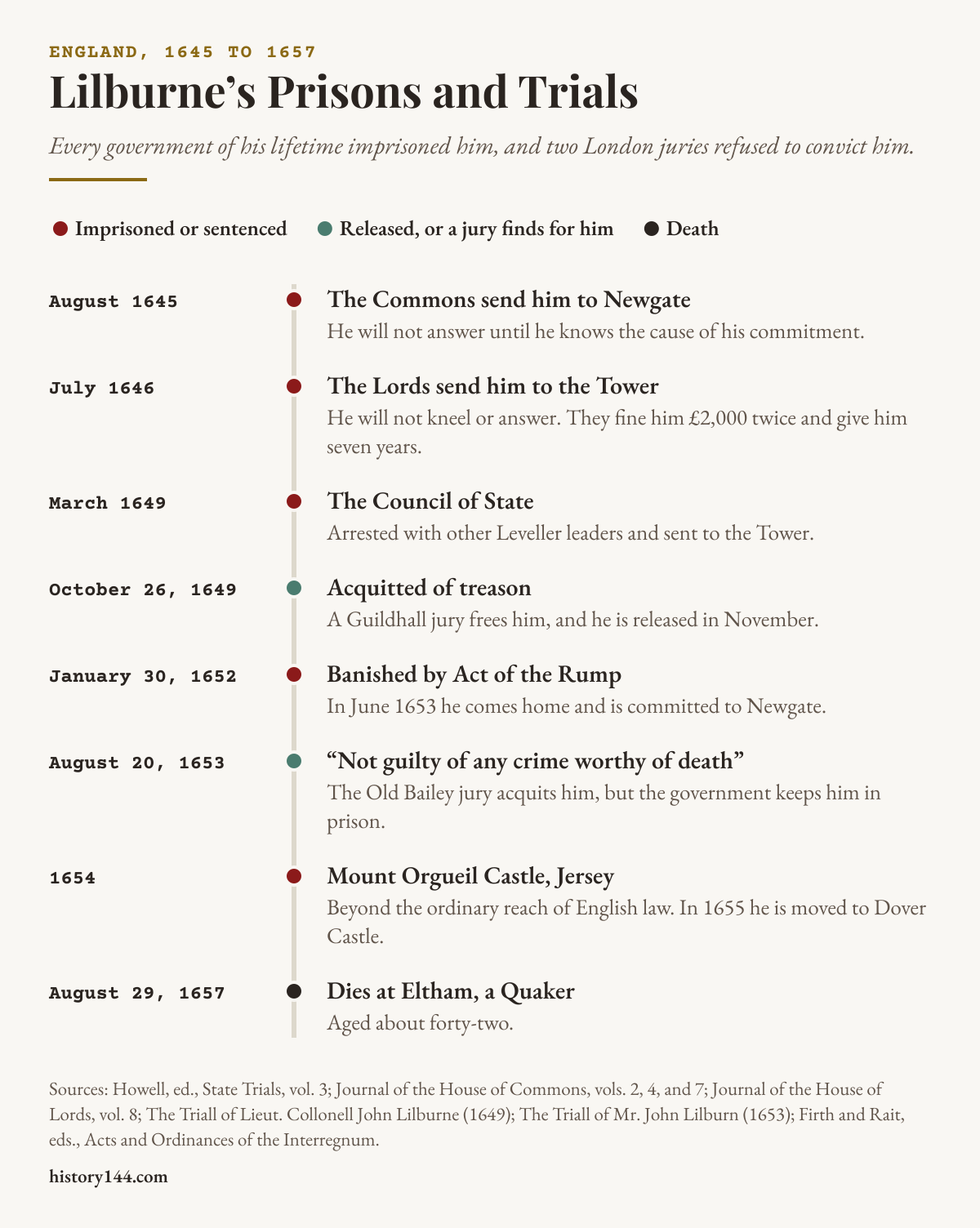
In August 1645 a committee of the House of Commons sent John Lilburne to Newgate for refusing to answer its questions. It was the same Long Parliament that had freed him from prison in 1640 and voted him reparation. He was a lieutenant colonel who had resigned his commission rather than take the Covenant, and his offense was words. He had accused the Speaker, William Lenthall, of corresponding with the king's party at Oxford, and a printed Letter to a Friend under his name attacked the House. Asked by the Committee of Examinations whether he had printed it, he would not answer "any Interrogatory" until he knew the cause of his commitment. The committee sent him to Newgate on August 9, and two days later the House approved what it had done.[1]
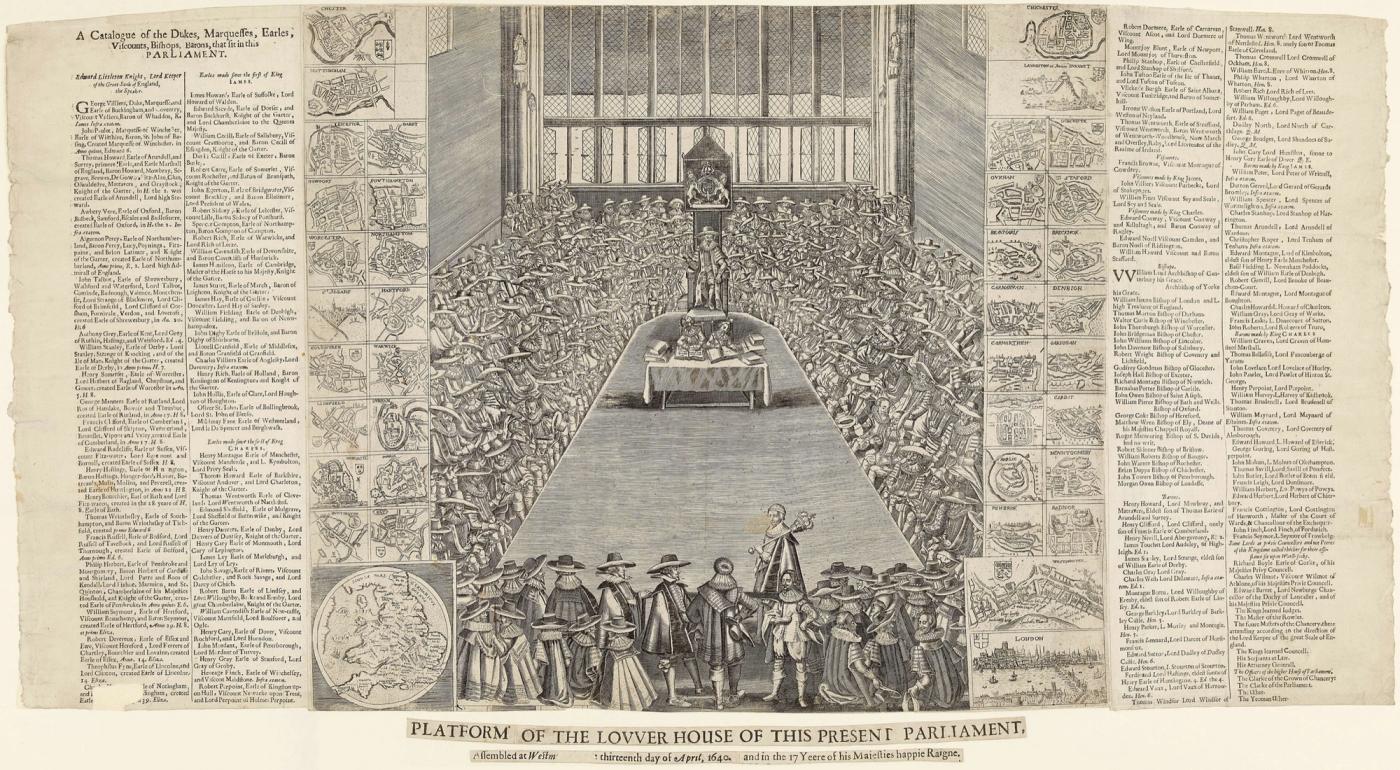
He answered in print, as he always would. From Newgate came a pamphlet, England's Birth-Right Justified, which argued that the law of England belonged to every freeborn Englishman and bound the Parliament as much as the king.[2] It is easy to assume that a Parliament which had fought a civil war against a king for imprisoning subjects on his own authority would never do the same. It did, and Lilburne said so in print. No charge was ever brought, and on October 14 he was let go.
Twelve years later, on August 29, 1657, he died at Eltham in Kent, aged about forty-two, a Quaker. In those years he was tried twice for his life and acquitted both times by London juries. He was banished by Act of Parliament, and he was imprisoned by every power that governed England in his lifetime, from Star Chamber and the king to the Lords, the Commons, the Council of State and the Lord Protector. This is the story of those twelve years, and of an argument about the rights of the subject that outlived the man, the Levellers, and the Commonwealth.
At the Cart's Tail
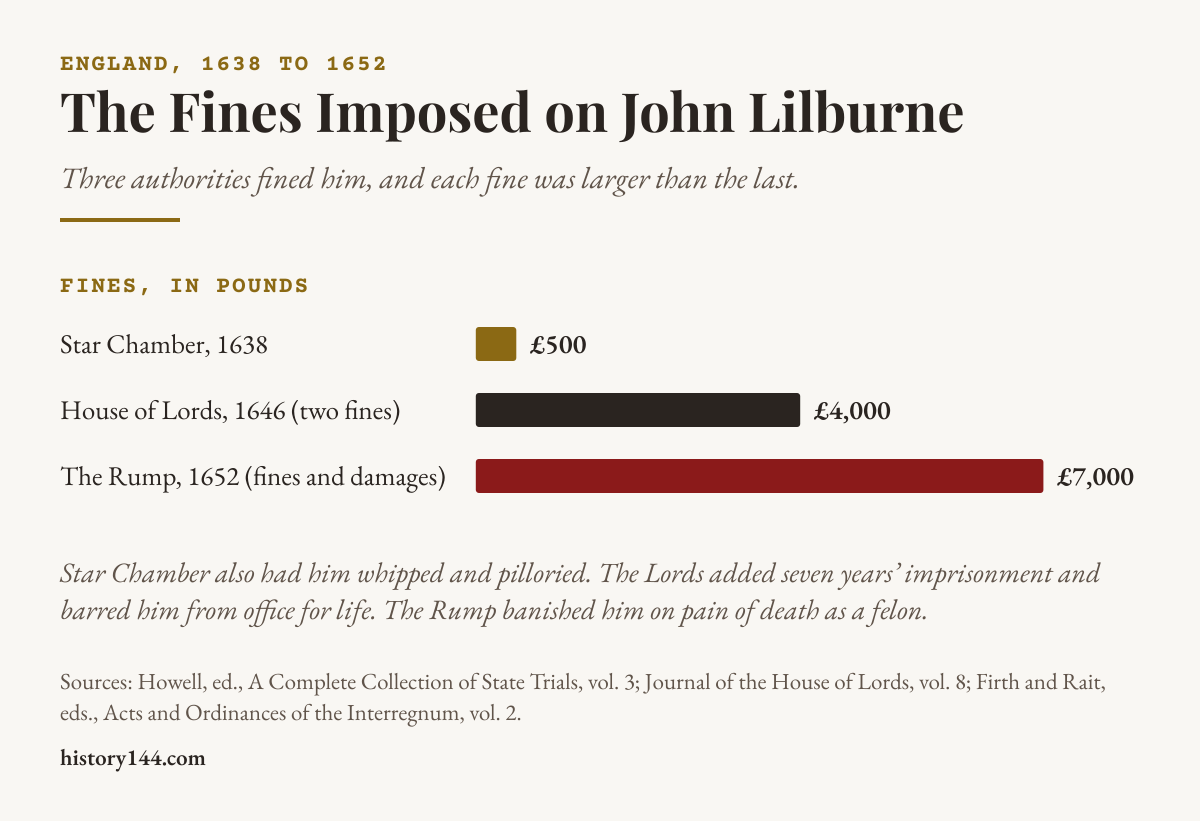
Lilburne's standing came from what had been done to him before the war. In 1638 he was brought before the Court of Star Chamber on a charge of printing and circulating unlicensed books. He refused to take the oath ex officio, which would have required him to answer on oath to questions not yet put. For that refusal the court fined him five hundred pounds, ordered him whipped at the cart's tail from the Fleet to Westminster, and set him in the pillory. He went on speaking from the pillory until he was gagged.[3]
The Long Parliament released him in November 1640, and on May 4, 1641 the Commons voted that the sentence had been illegal and against the liberty of the subject, and that he should have reparation.[4] That made him, at about twenty-six, a living argument. The prerogative courts had broken him, and Parliament had vindicated him. The experience also fixed in him a conviction that the forms of a trial are the substance of liberty, and that a man who can be made to accuse himself has no rights at all. He carried that conviction against every government he afterwards lived under.
England's Birth-Right
The 1645 pamphlet set out the case that the Levellers would spend the next five years refining. It argued that the fundamental laws of England are the birthright of every man born in it, that Parliament holds its power in trust from the people, and that a Parliament should be held every year. Statutes of Edward III, it said, had required as much. Monopolies, it said, robbed freeborn Englishmen of that birthright. One was the Stationers' Company's hold on printing, which it accused of suppressing "every thing which hath any true Declaration of the just Rights and Liberties of the free-borne people of this Nation."[5]
What made it dangerous was the audience. Lilburne wrote in plain English for apprentices, soldiers and small tradesmen, and his pamphlets passed from hand to hand in the shops and streets of London. In June 1646 the Lords summoned him over a pamphlet attacking the Earl of Manchester, and he refused to answer their questions on the ground that a commoner cannot be tried by peers. From the Newgate cell to which they committed him, he published The Free-Man's Freedom Vindicated. It argued from the creation that no man has by nature any authority over another, and that all magistracy is derived from the consent of those it governs.[6] Brought to their bar on July 11, he refused to kneel, and while his charge was read he stopped his ears with his fingers. The House passed two judgments on him that day. For his contempt it fined him two thousand pounds to the king and committed him to the Tower. On the charge itself it fined him a further two thousand pounds, sentenced him to seven years' imprisonment, and barred him from any office, civil or military, for life.[7]
A Name He Disliked
By 1647 Lilburne had allies, a program and a name he disliked. The name Leveller was fastened on them by their enemies and implied that they meant to level men's estates, which they repeatedly denied. What they did mean was a settlement of the kingdom on a written foundation. They wanted a Parliament elected by something much closer to manhood suffrage and sitting for fixed terms, with no king or Lords holding a negative voice, though the details changed from one proposal to the next. They wanted equality before the law, an end to conscription and tithes, and liberty of conscience placed beyond the reach of any Parliament.[8]
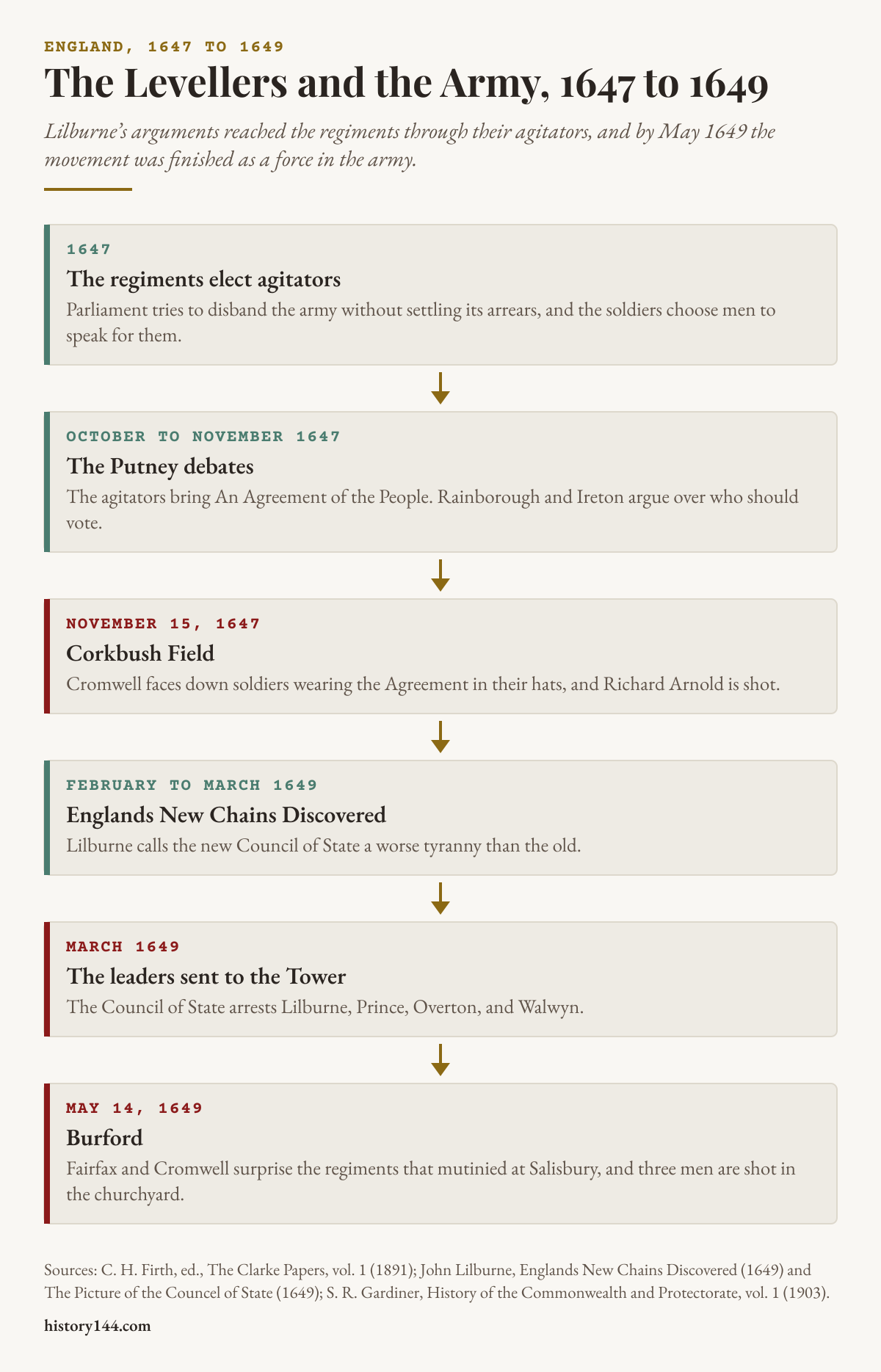
Their strength was in the army. Soldiers who had won the war and had not been paid read Lilburne's pamphlets in their regiments. When Parliament tried to disband the army in 1647 without settling its arrears, the regiments elected agents, called agitators, to speak for them. Edward Sexby, one of the agitators, and John Wildman, a young pamphleteer who wrote for them, carried Lilburne's arguments into the councils of the army while Lilburne himself sat in the Tower and wrote.[9]
The Poorest He
From October 28, 1647, the General Council of the Army met at Putney, first in the parish church. Into the second week of November the officers and the agitators argued about who should have a voice in choosing a government. The secretary William Clarke took it down in shorthand, and his notes are the nearest thing the seventeenth century produced to a transcript of men thinking aloud about democracy.[10]
The agitators brought with them a paper called An Agreement of the People, proposing to dissolve the Long Parliament, redistribute the seats by population, and place five things beyond the power of any Parliament, religion among them. Later versions of the Agreement changed that list. On October 29, when Henry Ireton asked whether the paper meant to give a vote to men who had none before, Colonel Thomas Rainborough answered him. "Really I thinke that the poorest hee that is in England hath a life to live as the greatest hee; and therfore truly, Sir, I thinke itt's cleare, that every man that is to live under a Governement ought first by his owne consent to putt himself under that Governement."[11]
Ireton answered that a franchise resting on birth rather than on a fixed interest in the kingdom must end in the abolition of property, since a majority without estates would vote to take estates away.[12] The argument was never resolved. Cromwell closed the debates, sent the agitators back to their regiments, and at a rendezvous at Corkbush Field on November 15 faced down the soldiers who came with the Agreement in their hats. Three of the mutineers were condemned, and one of them, Richard Arnold, chosen by lot, was shot in front of the regiment.[13]
New Chains
The Levellers had assumed that the enemy was the king and his party. The execution of Charles I in January 1649 removed the king and left them facing the thing they had actually feared, which was arbitrary power in whatever hands. In February 1649 Lilburne published Englands New Chains Discovered, and in March a second part. They argued that the new Council of State was a worse tyranny than the old because it wore the name of the people's own representatives. They also charged that the army officers had betrayed the Agreement and that the High Court of Justice was a court without law.[14]
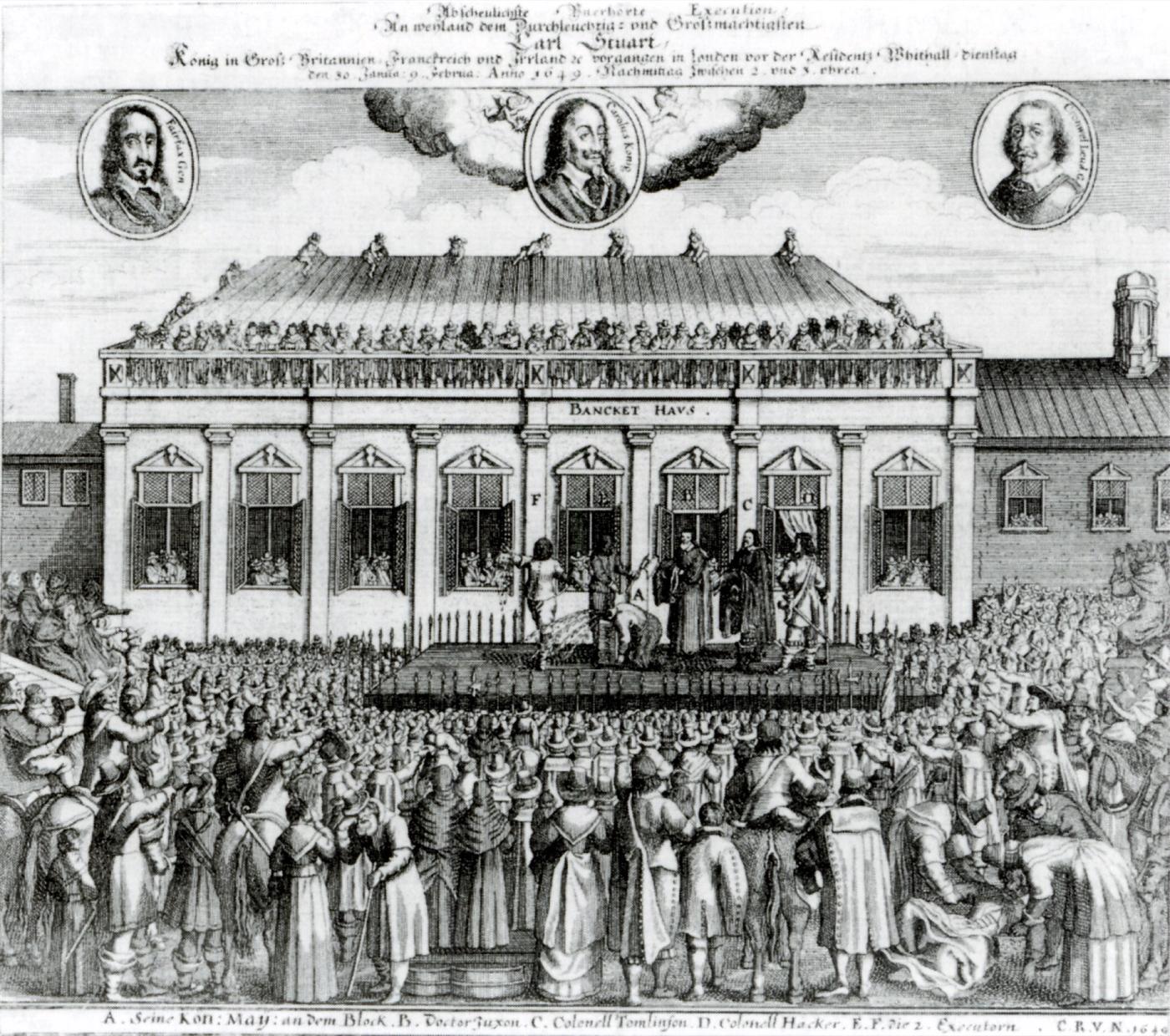
In March 1649 the Council of State had him arrested, with Thomas Prince, Richard Overton and William Walwyn, and sent to the Tower. Lilburne turned the examination into a pamphlet, The Picture of the Councel of State. In it he reported hearing Cromwell through the door, thumping the table as he spoke. "I tell you, sir, you have no other way to deal with these men but to break them, or they will break you."[15]
In May 1649 Scrope's regiment of horse, quartered around Salisbury in Wiltshire, refused to go to Ireland until the liberties of the country were secured, and troops of Ireton's regiment joined it. The mutineers marched north looking for other regiments to join them and crossed the Thames into Oxfordshire. Fairfax and Cromwell followed by forced marches and surprised them at Burford around midnight on May 14. The prisoners were locked in the church. A court-martial condemned four of them and pardoned one at the last moment. The other three, Cornet Thompson and Corporals Perkins and Church, were shot in the churchyard while the rest of the prisoners watched from the leads of the church roof.[16] As a force in the army, the Leveller movement ended in that churchyard.
Bonfires in the City
In October 1649 Lilburne was tried at the Guildhall for treason, on the ground that his pamphlets had incited mutiny and denied the authority of the government. He conducted his own defense for two days, demanded a copy of the indictment and counsel, and argued that the statute of treasons did not reach his words. Over the heads of the court he addressed himself to the jury, telling them that they were judges of law as well as of fact.[17]
The jury acquitted him on October 26. The crowd in the hall cheered so loudly, according to the printed account of the trial, that the noise went on for about half an hour, and that night there were bonfires in the city.[18] A medal was struck with his portrait on one side and the names of the jurymen on the other. On November 8 the Council of State ordered his release.
A defendant had told a London jury that it might judge the law, and the jury had acquitted him against the plain wishes of the bench. Four years later another London jury would do the same.
Judge in Its Own Cause
Lilburne could not stop. In 1651 he took up a quarrel over a colliery at Harraton in County Durham, which his uncle George Lilburne leased from a London leatherseller, Josiah Primate. The county sequestrators had seized it for the state, and Lilburne blamed Sir Arthur Haselrig, a member of the Council of State, for turning the decision against them. He helped Primate draw up a petition accusing Haselrig of oppression and tyranny, which was presented to Parliament on December 23. The Rump, with Haselrig sitting in it, acted as judge in its own cause. On January 15, 1652 it pronounced judgment on both men. Primate was fined as heavily as Lilburne. Lilburne was to pay three thousand pounds to the state, two thousand in damages to Haselrig, and five hundred apiece to four members of the committee for compounding, and he was banished for life. On January 30 an Act put the sentence into force, on pain of death as a felon if he returned to England, Scotland or Ireland.[19]
He went to the Low Countries, first to Amsterdam and then to Bruges, and stayed about sixteen months, writing. When Cromwell dissolved the Rump in April 1653, Lilburne concluded that the Act of a Parliament that no longer existed could not hold him, and came home on June 14. He was arrested the next day and committed to Newgate to be tried for his life under the Act.[20]
A Crime Worthy of Death
The second trial, at the Old Bailey in July and August 1653, was fought on the narrowest possible ground. The case turned on two questions. Was the man at the bar the man named in the Act, and was the Act itself law? He took every procedural objection he could, demanded the Act be read, and again addressed the jury directly.[21]
Outside, his supporters scattered appeals to the people, and on August 2 the young men and apprentices of London petitioned Parliament for him. On August 20 the jury found him not guilty of any crime worthy of death.[22] A contemporary newsletter put the spectators who cheered the verdict at three or four thousand, and the soldiers set to guard the court joined in, beating their drums and sounding their trumpets against their officers’ orders. When the Council of State questioned the jurymen, some said they were judges of law as well as of fact. The government did not let him go. It moved him first to the Tower, then in 1654 to Mount Orgueil Castle in Jersey, beyond the ordinary reach of English law and its writ of habeas corpus, and later, by the end of 1655, to Dover Castle.[23]
A Temporal Sword
In Jersey and at Dover something changed in him. Lilburne came into contact with Friends, and in letters from Dover Castle in December 1655 he described his convincement. On May 4, 1656 he signed a declaration that he believed he would "never hereafter be an user of a temporal sword more, nor a joyner with those that so do." He became a Quaker, and said so in print that month in a pamphlet addressed to his old readers.[24]
By 1657 he was out on parole from the deputy governor of Dover Castle, and Cromwell, when he heard of it, summoned him back. He died at Eltham on August 29, 1657, in a house he had rented so that his wife, who was expecting a child, could be near her friends. Two days later the mourners gathered at the Bull and Mouth near Aldersgate, which the Quakers used as their London meeting house. John Rushworth afterwards put them at four thousand, a figure there is no way to check. They fell out over a black hearse cloth that had been brought for the coffin. The Quakers refused it, holding that the less pomp attended the proceedings the more room there was for piety. When a man tried to cast a velvet pall over the coffin in the street, they would not have that either. They carried the bare coffin on their shoulders to Moorfields and buried him in the new churchyard adjoining Bedlam. Even his funeral ended in an argument about forms.[25]
By What Authority
Lilburne won nothing he set out to win. There was no Agreement of the People, no franchise by birthright, no settled law placing conscience beyond the reach of government. The Levellers were broken at Burford in 1649 and never reassembled. The Protectorate that ruled England when he died rested on the Humble Petition and Advice, a constitution written by a Parliament that had offered the Protector a crown.
What survived was narrower and harder. Three things came out of those twelve years and worked their way into English and later American practice. The first is the principle against compelled self-incrimination, which Lilburne asserted against Star Chamber in 1638, against the Commons in 1645 and against the Lords in 1646, and which his cases did much to make famous. The second is the jury as an independent check on the government's power to prosecute, shown in practice by the two London juries that refused to convict him when the state required it. The third is the habit, which he did as much as anyone to spread, of taking a constitutional question out of the courts and the Houses and putting it in print for ordinary people to read.
In August 1645 he had refused to answer the Commons until he knew the cause of his commitment. Twelve years later every government he had quarreled with had passed away or was about to, and the demand was still unmet. He had asked each of them, in substance, by what authority. It is the question Charles I put to the court that tried him, though Charles asked it as a king and Lilburne as a freeborn subject. None of those governments ever answered it to the satisfaction of the governed.
Places in this Story
The places this story moves through, in order — follow them on the interactive map →
- Newgate, London August 1645
The Commons committed Lilburne for refusing to answer about his charge against the Speaker.
- Westminster, London 1638
Star Chamber had him whipped at the cart's tail from the Fleet and set in the pillory.
- Tower of London, England July 1646
The Lords fined him two thousand pounds twice over, sentenced him to seven years, and sent him here after he refused to kneel at their bar.
- Putney, London October 1647
The agitators brought the Agreement of the People before the General Council of the Army.
- Corkbush Field, England November 15, 1647
Soldiers wearing the Agreement in their hats were faced down and Richard Arnold was shot.
- Burford, England May 14, 1649
Fairfax and Cromwell surprised the regiments that had mutinied at Salisbury and shot three men in the churchyard.
- Guildhall, London October 26, 1649
A London jury acquitted Lilburne of treason and the hall cheered for about half an hour.
- Old Bailey, London August 20, 1653
A second jury found him not guilty of any crime worthy of death under the Act of banishment.
- Eltham, London August 29, 1657
Lilburne died here on parole, a Quaker, in a house he had rented for his family.
Frequently Asked Questions
Who was John Lilburne?
He was a pamphleteer and former lieutenant colonel who argued that the fundamental laws of England are the birthright of every man born in it. Every government of his lifetime imprisoned him, including Star Chamber, the king, the Lords, the Commons, the Council of State and the Protector.
Why was Lilburne whipped in 1638?
Charged in Star Chamber with circulating unlicensed books, he refused the oath ex officio, which would have made him answer on oath to questions not yet put. For that contempt he was whipped at the cart's tail from the Fleet to Westminster and went on speaking from the pillory until he was gagged.
Who were the Levellers and what did they want?
Their enemies named them, implying they meant to level estates, which they denied. They wanted a Parliament elected on something near manhood suffrage and sitting for fixed terms, equality before the law, no conscription or tithes, and liberty of conscience placed beyond any Parliament's reach.
What was the Agreement of the People?
A written constitution the Levellers put before the General Council of the Army at Putney in 1647 and revised twice afterwards. It would have dissolved the Long Parliament, redistributed seats by population, and placed certain things beyond the power of any future Parliament.
What happened at Burford in 1649?
Regiments quartered around Salisbury in Wiltshire mutinied and marched north, and Fairfax and Cromwell surprised them at Burford in Oxfordshire around midnight on May 14. Three men were later shot in the churchyard while the other prisoners watched from the church roof.
Why do Lilburne's trials matter in English law?
He told the juries at the Guildhall in 1649 and the Old Bailey in 1653 that they judged the law as well as the facts, and both refused to convict him when the government required it. His cases also made famous the rule that no man need accuse himself.
How did Lilburne end his life?
He became a Quaker while imprisoned in Jersey and at Dover and said so in print in 1656. He died at Eltham in Kent on August 29, 1657, and the Quakers who carried him to his grave refused even a hearse cloth or a pall.
Bibliography
A Full Narrative of All the Proceedings betweene His Excellency the Lord Fairfax and the Mutineers. London, 1649. Google Books. https://books.google.com/books?id=1Cr7MgEACAAJ. Accessed November 9, 2026.
An Agreement of the People. London, 1647, 1648 and 1649.
Englands Birth-Right Justified Against all Arbitrary Usurpation, whether Regall or Parliamentary. London, 1645. Google Books. https://books.google.com/books?id=ECrtXwAACAAJ. Accessed November 9, 2026.
Englands New Chains Discovered. London, 1649. Google Books. https://books.google.com/books?id=heV_AQAACAAJ. Accessed November 9, 2026.
Firth, C. H., ed. The Clarke Papers: Selections from the Papers of William Clarke. Vol. 1. Camden Society. London, 1891. Internet Archive. https://archive.org/details/clarkepaperssel01firtgoog. Accessed November 9, 2026.
Firth, C. H., and R. S. Rait, eds. Acts and Ordinances of the Interregnum, 1642-1660. 3 vols. London: His Majesty's Stationery Office, 1911. British History Online. https://www.british-history.ac.uk/no-series/acts-ordinances-interregnum. Accessed November 9, 2026.
Gardiner, Samuel Rawson. History of the Commonwealth and Protectorate, 1649-1656. New ed. 4 vols. London: Longmans, Green, 1903.
The Free-Mans Freedome Vindicated. London, 1646. Google Books. https://books.google.com/books?id=0_huAQAACAAJ. Accessed November 9, 2026.
Gardiner, Samuel Rawson. History of the Great Civil War, 1642-1649. New ed. 4 vols. London: Longmans, Green, 1905. Internet Archive. https://archive.org/details/historyofgreatcigard_2. Accessed November 9, 2026.
Green, Mary Anne Everett, ed. Calendar of State Papers, Domestic Series, 1652-1653. London: Longman, 1878. Internet Archive. https://archive.org/details/abd6186.0005.001.umich.edu. Accessed November 9, 2026.
Green, Mary Anne Everett, ed. Calendar of State Papers, Domestic Series, 1653-1654. London: Longman, 1879. Internet Archive. https://archive.org/details/abd6186.0006.001.umich.edu. Accessed November 9, 2026.
Howell, T. B., ed. A Complete Collection of State Trials. Vol. 3. London, 1816.
Journal of the House of Commons. Vols. 2, 4 and 7. London, 1802. British History Online. https://www.british-history.ac.uk/commons-jrnl. Accessed November 9, 2026.
Journal of the House of Lords. Vol. 8. London, 1767-1830. British History Online. https://www.british-history.ac.uk/lords-jrnl. Accessed November 9, 2026.
Journal of the House of Lords. Vol. 9. London, 1767-1830. British History Online. https://www.british-history.ac.uk/lords-jrnl/vol9. Accessed November 9, 2026.
The Picture of the Councel of State. London, 1649. Google Books. https://books.google.com/books?id=OtVE0AEACAAJ. Accessed November 9, 2026.
The Resurrection of John Lilburne, Now a Prisoner in Dover-Castle. London: Giles Calvert, 1656. Google Books. https://books.google.com/books?id=vvCemAEACAAJ. Accessed November 9, 2026.
Rushworth, John. Historical Collections of Private Passages of State. Vol. 7. London, 1721. British History Online. https://www.british-history.ac.uk/rushworth-papers/vol7. Accessed November 9, 2026.
The Second Part of Englands New-Chaines Discovered. London, 1649. Google Books. https://books.google.com/books?id=8WgqMwEACAAJ. Accessed November 9, 2026.
The Triall, of Lieut. Collonell John Lilburne. London, 1649. Google Books. https://books.google.com/books?id=d_lAAQAAMAAJ. Accessed November 9, 2026.
The Triall of Mr. John Lilburn. London, 1653. Google Books. https://books.google.com/books?id=9Q7J0QEACAAJ. Accessed November 9, 2026.
Citations
- Journal of the House of Commons, vol. 4, under July and August 1645, for the proceedings against Lilburne, and 236-37, under August 11, 1645, where the Committee of Examinations reported that, asked whether he had printed "the Letter that goes abroad under his Name," he would not answer "any Interrogatory" until he knew the cause of his commitment, and the House approved his committal to Newgate. British History Online, https://www.british-history.ac.uk/commons-jrnl/vol4/pp236-237; and 306-308, under October 14, 1645, where the House resolved "That Lieutenant-Colonel Lilborne be forthwith discharged from his Imprisonment." ↑
- Englands Birth-Right Justified Against all Arbitrary Usurpation, whether Regall or Parliamentary (London, 1645), published anonymously and attributed to Lilburne. ↑
- The proceedings in Star Chamber against Lilburne, 1637 and 1638, printed in A Complete Collection of State Trials, ed. T. B. Howell, vol. 3 (London, 1816). ↑
- Journal of the House of Commons, vol. 2, under November 1640 for his release, and 133-34, under May 4, 1641, where the House resolved that the Star Chamber sentence "is illegal, and against the Liberty of the Subject" and that "Reparation ought to be given to Mr. Lilbourne, for his Imprisonment, Sufferings, and Losses." The vote named no sum, and he was never paid in full. British History Online, https://www.british-history.ac.uk/commons-jrnl/vol2/pp133-134. ↑
- Englands Birth-Right Justified (1645). ↑
- The Free-Mans Freedome Vindicated (London, 1646). ↑
- Journal of the House of Lords, vol. 8, under July 11, 1646, 432-33, where he refuses to kneel and stops his ears while his charge is read, and for the two judgments, the first fining him "Two Thousand Pounds to the King" for his contempt and the second fining him "to the King in Two Thousand Pounds," with the sentence of imprisonment "the Space of Seven Years," and his removal from Newgate to the Tower. British History Online, https://www.british-history.ac.uk/lords-jrnl/vol8/pp432-433. ↑
- The Leveller programme is set out in the successive versions of An Agreement of the People (1647, 1648 and 1649) and in the petitions to Parliament of 1647 and 1648; see also C. H. Firth's introduction to The Clarke Papers: Selections from the Papers of William Clarke, vol. 1, Camden Society (London, 1891). ↑
- The Clarke Papers, vol. 1, introduction and documents, for the election of agitators and for the parts of Sexby and Wildman; Firth notes that it was doubtless Lilburne who supplied Wildman with much of his information. ↑
- The Clarke Papers, vol. 1, for the debates of the General Council of the Army at Putney, October 28 to November 11, 1647. ↑
- Colonel Thomas Rainborough, October 29, 1647, in The Clarke Papers, 1:301. ↑
- Commissary General Henry Ireton, in reply, in The Clarke Papers, 1:301-15. ↑
- Sir Thomas Fairfax to the Earl of Manchester, Hertford, November 15, 1647, in Journal of the House of Lords, vol. 9, 527: of the mutineers, "Three whereof were presently tried and condemned to Death, and, by Lot, One of them was shot to Death in the Head of the Regiment," British History Online, https://www.british-history.ac.uk/lords-jrnl/vol9/pp526-528; John Rushworth, Historical Collections of Private Passages of State, vol. 7 (London, 1721), 875-76; Samuel Rawson Gardiner, History of the Great Civil War, 1642-1649, vol. 4 (London, 1905), 23, for the soldier's name, Richard Arnold. ↑
- Englands New Chains Discovered (London, February 1649) and The Second Part of Englands New-Chaines Discovered (London, March 1649). ↑
- The Picture of the Councel of State (London, 1649), Lilburne's own account of his examination, in which he reports overhearing Cromwell from the next room; the words are quoted in modern spelling from Gardiner, History of the Commonwealth and Protectorate, 1:35-36. ↑
- The suppression of the Burford mutiny, May 14, 1649, and the execution of Thompson, Perkins and Church, reported in the newsbooks of that week and in the army's own published account, A Full Narrative of All the Proceedings betweene His Excellency the Lord Fairfax and the Mutineers (London, 1649); see Samuel Rawson Gardiner, History of the Commonwealth and Protectorate, 1649-1656, vol. 1 (London, 1903), 48-54. Accounts differ on the day of the executions. Gardiner puts them on the morning after the surprise, May 15. The parish church's own account gives May 16, and many modern accounts give May 17. ↑
- The Triall, of Lieut. Collonell John Lilburne (London, 1649), the printed report of the proceedings at the Guildhall on October 24 to 26, 1649. ↑
- The Triall of Lieut. Collonell John Lilburne (1649), for the verdict and the shouting in the hall. ↑
- An Act for the execution of a judgement given in Parliament against Lieutenant Colonel John Lilburne, January 30, 1652, in C. H. Firth and R. S. Rait, eds., Acts and Ordinances of the Interregnum, 1642-1660, vol. 2 (London: His Majesty's Stationery Office, 1911); Journal of the House of Commons, 7:71-73, under January 15, 1652, for the judgment on both men, three thousand pounds to the Commonwealth, two thousand to Sir Arthur Hesilrige for his damages, and two thousand more to four commissioners for compounding at five hundred apiece, with Lilburne to depart the Commonwealth within thirty days and to be proceeded against as a felon if found in England, Scotland or Ireland afterwards; Samuel Rawson Gardiner, History of the Commonwealth and Protectorate, 1649-1656, vol. 2 (London, 1903), 80-81. ↑
- Calendar of State Papers, Domestic Series, 1652-1653, ed. Mary Anne Everett Green (London, 1878), 410, for the Council of State's order of June 14, 1653 to write to the Lord Mayor and Sheriffs that Lilburne "has returned into England, contrary to the Act of Parliament made concerning him," and 415, for its letter of June 16 that he had been apprehended and that "Council expects Lilburne should be committed to prison, in order to his trial at law"; Journal of the House of Commons, vol. 7, 284-85, under July 14, 1653, where his petition is read as that of "John Lilburne Esquire, now Prisoner in Newgate." ↑
- The Triall of Mr. John Lilburn (London, 1653), the printed report of the proceedings at the Old Bailey. ↑
- The Triall of Mr. John Lilburn (1653), for the verdict of August 20 that he was not guilty of any crime worthy of death; Gardiner, History of the Commonwealth and Protectorate, 2:297-300, for the petition of the young men and apprentices, the cheering, and the Council's examination of the jury. ↑
- Calendar of State Papers, Domestic Series, 1653-1654, ed. Mary Anne Everett Green (London, 1879), 105-7, for the order in Parliament of August 27, 1653 that the Council of State take some course "for the further securing" of Lilburne (Journal of the House of Commons, vol. 7, 309) and the Council's order the same day removing him from Newgate to the Tower; and the later orders of the Council of State for his removal to Mount Orgueil in Jersey and afterwards to Dover Castle. ↑
- The Resurrection of John Lilburne, Now a Prisoner in Dover-Castle (London: Giles Calvert, 1656), his own declaration of his convincement among Friends, with his letters dated "the fourth day of the tenth moneth, 1655" (December 4, 1655) and the declaration dated "the 4th of the 3d. month, 1655," a first day of the week, that is Sunday, May 4, 1656; Thomason's copy is marked "May 16." ↑
- Mercurius Politicus, no. 379 (August 27 to September 3, 1657), 1597-98, and The Publick Intelligencer, no. 98 (August 31 to September 7, 1657), 1874-75, for the gathering at the Bull and Mouth, the refusal of the hearse cloth and the burial in the new churchyard adjoining Bedlam. John Rushworth, Historical Collections, vol. 2 (London, 1721), 468, afterwards put the mourners at four thousand, a figure there is no way to check. For the parole, Cromwell's summons (The National Archives, SP 18/157A, fol. 129a) and the house at Eltham, see Ariel Hessayon, "The Resurrection of John Lilburne, Quaker," Goldsmiths Research Online, https://research.gold.ac.uk/id/eprint/25156. ↑